Business Law
Module – 4
Business Entities and Governance
Ref.
Munir Fuadi,2005, Pengantar Hukum Bisnis, PT. Citra Aditya Bakti, Bandung.
Burton, Simatupang Richard, 2007, Aspek Hukum Dalam Bisnis (Edisi Revisi), Jakarta: Rineka Cipta
K.Bertens, 2000, Pengantar Etika Bisnis, Kanisius, Yogyakarta.
Bambang B, Melia Famiola, 2007, Etika Bisnis dan Tanggung jawab sosial perusahaan di Indonesia, Rekayasa sains, Bandung.
Mariam Darus B,1994, Aneka Hukum Bisnis, Alumni Bandung.
Any relevant materials in conjunction with the cases and topics in discuss
I Nyoman Wisnu Wardhana
Yayasan Pendidikan Telkom
wisnuwin@yahoo.com
Business Entities and Governance
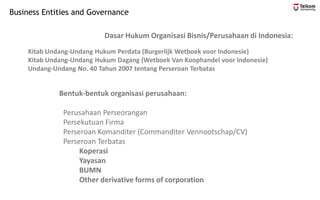
Dasar Hukum Organisasi Bisnis/Perusahaan di Indonesia:
Kitab Undang-Undang Hukum Perdata (Burgerlijk Wetboek voor Indonesie)
Kitab Undang-Undang Hukum Dagang (Wetboek Van Koophandel voor Indonesie)
Undang-Undang No. 40 Tahun 2007 tentang Perseroan Terbatas
Bentuk-bentuk organisasi perusahaan:
Perusahaan Perseorangan
Persekutuan Firma
Perseroan Komanditer (Commanditer Vennootschap/CV)
Perseroan Terbatas
Koperasi
Yayasan
BUMN
Other derivative forms of corporation
Business Entities and Governance
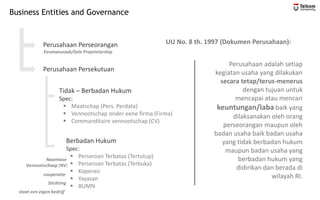
Perusahaan Perseorangan
Perusahaan Persekutuan
Berbadan Hukum
Spec:
â–Ş Perseroan Terbatas (Tertutup)
â–Ş Perseroan Terbatas (Terbuka)
â–Ş Koperasi
â–Ş Yayasan
â–Ş BUMN
Tidak – Berbadan Hukum
Spec:
â–Ş Maatschap (Pers. Perdata)
â–Ş Vennootschap onder eene firma (Firma)
â–Ş Commanditaire vennootschap (CV)
Perusahaan adalah setiap
kegiatan usaha yang dilakukan
secara tetap/terus-menerus
dengan tujuan untuk
mencapai atau mencari
keuntungan/laba baik yang
dilaksanakan oleh orang
perseorangan maupun oleh
badan usaha baik badan usaha
yang tidak berbadan hukum
maupun badan usaha yang
berbadan hukum yang
didirikan dan berada di
wilayah RI.
UU No. 8 th. 1997 (Dokumen Perusahaan):
Naamloze
Vennootschaap (NV)
cooperatie
Stichting
Eenmanszaak/Sole Proprietorship
staat een eigen bedrijf
Business Entities and Governance
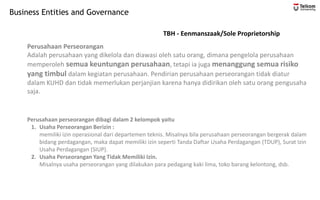
Perusahaan Perseorangan
Adalah perusahaan yang dikelola dan diawasi oleh satu orang, dimana pengelola perusahaan
memperoleh semua keuntungan perusahaan, tetapi ia juga menanggung semua risiko
yang timbul dalam kegiatan perusahaan. Pendirian perusahaan perseorangan tidak diatur
dalam KUHD dan tidak memerlukan perjanjian karena hanya didirikan oleh satu orang pengusaha
saja.
Perusahaan perseorangan dibagi dalam 2 kelompok yaitu
1. Usaha Perseorangan Berizin :
memiliki izin operasional dari departemen teknis. Misalnya bila perusahaan perseorangan bergerak dalam
bidang perdagangan, maka dapat memiliki izin seperti Tanda Daftar Usaha Perdagangan (TDUP), Surat Izin
Usaha Perdagangan (SIUP).
2. Usaha Perseorangan Yang Tidak Memiliki Izin.
Misalnya usaha perseorangan yang dilakukan para pedagang kaki lima, toko barang kelontong, dsb.
TBH - Eenmanszaak/Sole Proprietorship
Business Entities and Governance
TBH - Maatschap
Persekutuan Perdata
Adalah suatu persetujuan dimana dua orang/lebih mengikatkan diri untuk memasukkan sesuatu
kedalam persekutuan dengan tujuan untuk membagi keuntungan atau manfaat diperoleh
daripadanya. Dapat berupa: Barang, Uang, Tenaga, dan kerajinan
â–Ş Hubungan intern antara para sekutu bersifat kontraktual
â–Ş Hubungan Eksternnya (Hubungan antara seorang sekutu dengan pihak ketiga) hanya
mengikat sekutu yang mengikatkan diri tersebut, tetapi para sekutu lainnya dapat
terikat apabila:
âś“ Adanya pengukuhan terhadap peningkatan yang dilakukan kepada pihak ketiga
âś“ Adanya kesan pertanggung jawaban sekutu
âś“ Adanya kuasa
âś“ Adanya manfaat bagi persekutuan
Pertanggung jawaban tergantung kepada jumlahnya sekutu dengan dan bagian masing-masing sekutu dalam
modal persekutuan (pro Rata) seperti : Kerjasama Lawyer, Dokter, Architect, etc.
Gerant Statutaire (Perjanjian Persekutuan dalam tindakan pengutusan kepada pihak ketiga atas dasar akte
pendirian persekutuan, Gerant Mandataire merupakan pemberian kuasa dari persekutuan atas keperluan
persekutuan atau memberikan mandat.
Business Entities and Governance
TBH - Vennootschap onder eene firma
Firma
Adalah setiap persekutuan perdata yang menjalankan perusahaan dengan nama
bersama, jadi dapat dikatakan firma adalah persekutuan perdata khusus,
kekhususannya terletak pada:
â–Ş Menjalankan perusahaan dengan mana bersama
â–Ş Tanggung jawab sekutu secara pribadi untuk keseluruhan
â–Ş Menggunakan nama bersama
Firma bukan merupakan badan hukum, meskipun syarat materil sudah terpenuhi
antara lain:
âś“ Adanya harta kekayaan terbesar
âś“ Adanya kepentingan atau tujuan tertentu
âś“ Adanya Pengurus
Syarat formal sebagai badan hukum tidak terpenuhi, yaitu tidak adanya
pengesahan Menteri Kehakiman.
Business Entities and Governance
TBH - Commanditaire vennootschap
Persekutuan Komanditer
Adalah jenis persekutuan yang mirip dengan firma yang mempunyai dua jenis
sekutu yaitu sekutu komplementer dan komanditer. Merupakan persekutuan yang
didirikan oleh beberapa orang (sekutu) yang menyerahkan dan mempercayakan
uangnya untuk dipakai dalam persekutuan. Para anggota persekutuan menyerahkan
uangnya sebagai modal perseroan dengan jumlah yang tidak perlu sama sebagai
tanda keikutsertaan di dalam persekutuan.
â–Ş Sekutu komplementer (sekutu aktif/pengurus) yang dapat melakukan perbuatan
hukum atau mengadakan perikatan terhadap pihak ketiga.
â–Ş Sekutu komanditer (Sekutu yang memasukkan modalnya saja kedalam
persekutuan (sekutu pasif/dibelakang layar).
Berbeda dengan firma, maka sekutu komanditer hanya bertanggung
jawab sebesar modal yang masuk dalam perseroan.
Business Entities and Governance
BH - Naamloze Vennootschaap
Perseroan Terbatas
(Perseroan), adalah badan hukum yang merupakan persekutuan modal, didirikan berdasarkan
perjanjian, melakukan kegiatan usaha dengan modal dasar yang seluruhnya terbagi dalam saham
dan memenuhi persyaratan yang ditetapkan dalam undang-undang serta peraturan
pelaksanaannya.
Perseroan mempunyai organ yang terdiri dari:
Rapat Umum Pemegang Saham (RUPS)
adalah pemegang kekuasaan tertinggi dalam Perseroan dan memegang segala kewenangan yang tidak
diserahkan kepada direksi atau komisaris. RUPS terdiri dari RUPS tahunan yang diadakan paling lambat 6 bulan
setelah tahun buku dan RUPS lainnya yang dapat diadakan sewaktu-waktu berdasarkan kebutuhan.
Direksi
adalah organ Perseroan yang bertanggung jawab penuh atas pengurusan Perseroan untuk kepentingan dan
tujuan Perseroan serta mewakili Perseroan baik di dalam maupun di luar pengadilan sesuai dengan ketentuan
anggaran dasar.
Komisaris
adalah organ Perseroan yang bertugas melakukan pengawasan secara umum dan atau khusus serta
memberikan nasehat kepada direksi dalam menjalankan Perseroan
Business Entities and Governance
Pro(s) – Con(s)
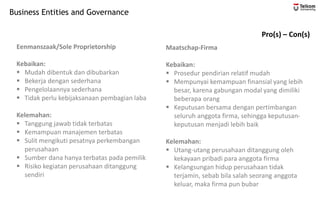
Eenmanszaak/Sole Proprietorship
Kebaikan:
â–Ş Mudah dibentuk dan dibubarkan
â–Ş Bekerja dengan sederhana
â–Ş Pengelolaannya sederhana
â–Ş Tidak perlu kebijaksanaan pembagian laba
Kelemahan:
â–Ş Tanggung jawab tidak terbatas
â–Ş Kemampuan manajemen terbatas
â–Ş Sulit mengikuti pesatnya perkembangan
perusahaan
â–Ş Sumber dana hanya terbatas pada pemilik
â–Ş Risiko kegiatan perusahaan ditanggung
sendiri
Maatschap-Firma
Kebaikan:
â–Ş Prosedur pendirian relatif mudah
â–Ş Mempunyai kemampuan finansial yang lebih
besar, karena gabungan modal yang dimiliki
beberapa orang
â–Ş Keputusan bersama dengan pertimbangan
seluruh anggota firma, sehingga keputusan-
keputusan menjadi lebih baik
Kelemahan:
â–Ş Utang-utang perusahaan ditanggung oleh
kekayaan pribadi para anggota firma
â–Ş Kelangsungan hidup perusahaan tidak
terjamin, sebab bila salah seorang anggota
keluar, maka firma pun bubar
Business Entities and Governance
Pro(s) – Con(s)
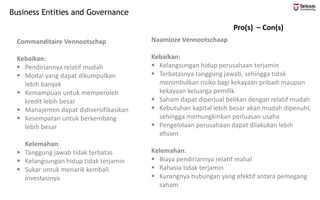
Commanditaire Vennootschap
Kebaikan:
â–Ş Pendiriannya relatif mudah
â–Ş Modal yang dapat dikumpulkan
lebih banyak
â–Ş Kemampuan untuk memperoleh
kredit lebih besar
â–Ş Manajemen dapat didiversifikasikan
â–Ş Kesempatan untuk berkembang
lebih besar
Kelemahan:
â–Ş Tanggung jawab tidak terbatas
â–Ş Kelangsungan hidup tidak terjamin
â–Ş Sukar untuk menarik kembali
investasinya
Naamloze Vennootschaap
Kebaikan:
â–Ş Kelangsungan hidup perusahaan terjamin
â–Ş Terbatasnya tanggung jawab, sehingga tidak
menimbulkan risiko bagi kekayaan pribadi maupun
kekayaan keluarga pemilik
â–Ş Saham dapat diperjual belikan dengan relatif mudah
â–Ş Kebutuhan kapital lebih besar akan mudah dipenuhi,
sehingga memungkinkan perluasan usaha
â–Ş Pengelolaan perusahaan dapat dilakukan lebih
efisien
Kelemahan:
â–Ş Biaya pendiriannya relatif mahal
â–Ş Rahasia tidak terjamin
â–Ş Kurangnya hubungan yang efektif antara pemegang
saham
Business Entities and Governance
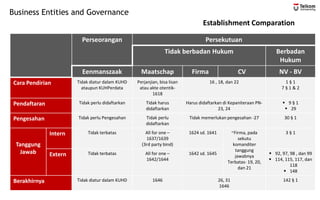
Perseorangan Persekutuan
Tidak berbadan Hukum Berbadan
Hukum
Eenmanszaak Maatschap Firma CV NV - BV
Cara Pendirian Tidak diatur dalam KUHD
ataupun KUHPerdata
Perjanjian, bisa lisan
atau akte otentik-
1618
16 , 18, dan 22 1 § 1
7 § 1 & 2
Pendaftaran Tidak perlu didaftarkan Tidak harus
didaftarkan
Harus didaftarkan di Kepaniteraan PN-
23, 24
▪ 9 § 1
â–Ş 29
Pengesahan Tidak perlu Pengesahan Tidak perlu
didaftarkan
Tidak memerlukan pengesahan -27 30 § 1
Tanggung
Jawab
Intern Tidak terbatas All for one –
1637/1639
(3rd party bind)
1624 sd. 1641 ~Firma, pada
sekutu
komanditer
tanggung
jawabnya
Terbatas- 19, 20,
dan 21
3 § 1
Extern Tidak terbatas All for one –
1642/1644
1642 sd. 1645 â–Ş 92, 97, 98 , dan 99
â–Ş 114, 115, 117, dan
118
â–Ş 148
Berakhirnya Tidak diatur dalam KUHD 1646 26, 31
1646
142 § 1
Establishment Comparation
Business Entities and Governance
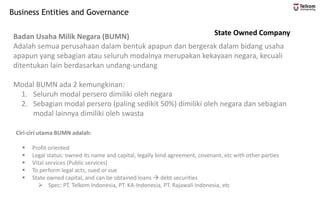
State Owned CompanyBadan Usaha Milik Negara (BUMN)
Adalah semua perusahaan dalam bentuk apapun dan bergerak dalam bidang usaha
apapun yang sebagian atau seluruh modalnya merupakan kekayaan negara, kecuali
ditentukan lain berdasarkan undang-undang
Modal BUMN ada 2 kemungkinan:
1. Seluruh modal persero dimiliki oleh negara
2. Sebagian modal persero (paling sedikit 50%) dimiliki oleh negara dan sebagian
modal lainnya dimiliki oleh swasta
Ciri-ciri utama BUMN adalah:
â–Ş Profit oriented
â–Ş Legal status: owned its name and capital, legally bind agreement, covenant, etc with other parties
â–Ş Vital services (Public services)
â–Ş To perform legal acts, sued or sue
▪ State owned capital, and can be obtained loans → debt securities
➢ Spec: PT. Telkom Indonesia, PT. KA-Indonesia, PT. Rajawali Indonesia, etc
Business Entities and Governance
Limited Liability Company- Classification
Perseroan Terbatas
Dapat diklasifikasikan ke dalam beberapa jenis yaitu:
1. Klasifikasi Perseroan Terbatas atas dasar diperjualbelikannya saham di Bursa Efek
â–Ş Perseroan Terbatas Tertutup
adalah PT yang saham-sahamnya tidak diperjual-belikan di Bursa Efek
â–Ş Perseroan Terbatas Terbuka
adalah PT yang sahamnya sudah diperjual-belikan di Bursa Efek dan perusahaan tersebut
merupakan perusahaan yang sudah go public.
2. Klasifikasi PT berdasarkan asal mula penanaman modal yaitu:
â–Ş PT. PMDN
â–Ş PT. PMA
â–Ş PT. Non PMA/PMDN
3. Klasifikasi PT berdasarkan ada tidaknya kelompok usaha yaitu:
â–Ş Holding Company:
â–Ş Full Holding Company
â–Ş Quasy Holding Company
â–Ş Non Holding Company
Business Entities and Governance
What is “business governance”?
Business governance concerns the actions and controls placed on those charged with managing a
business entity. Business governance is the subject of extensive legislation and research, particularly
as it pertains to the corporate entity form.
Corporate governance generally concerns the internal control of a corporation as influenced or
controlled by state and federal law, rules of ethics, and industry standards. It specifically focuses on
the actions of managers and directors and the observance of procedural safeguards of shareholder
rights.
Example: Issues in corporate governance include, voting rights, meeting requirements, approval of
corporate actions, record retentions, disclosure of information, and any other procedural
undertakings concerning the management of the corporation.
Business Entities and Governance
Who are the members of a corporation?
The corporation is made up of shareholders, directors, officers, and employees. Shareholders are the
owners of the corporation. Directors undertake the high-level management and decision-making for
the corporation. Officers (and their subordinate employees) run the daily operations of the
corporation. Each member of the corporation has specific rights and duties attached to her position.
These rights and duties can become confusing when a single individual holds more
than one position (such as shareholder, directors, and officer) of the corporation.
Note: Besides shareholders, directors, and officers, there are numerous other corporate
stakeholders (such as vendors, customers, other businesses, etc.) that are not members of the
corporation.
Business Entities and Governance
What is the distinction between a “private company” and “public company”?
A private company is a business whose ownership interest is not openly held or traded by the public
at large. Company ownership is not sold in the public market. As such, all ownership interests are
acquired via personal transactions with the company or other owners of the company.
A public company, on the other hand, is a business whose ownership is openly traded in the market.
Often, the ownership interest will be traded on a public “stock exchange”. If the shares are not listed
on an exchange, the shares are generally available for purchase through securities brokers in what is
known as “over-thecounter” transactions. Public companies are subject to far more extensive
regulation than private companies. This reality often leads public companies to repurchase
outstanding shares from the public market in a transaction known as “going private”.
Note: Most public companies are corporations. There are, however, limited instances where shares
of ownership in other types of entities are sold publicly. An example would be master limited
partnership interests.
Business Entities and Governance
What is the role and purpose of the corporation?
The concept of the corporation originated through governmental charter allowing individuals to
carry on business collectively. Basically, the charter gave the corporate entity form legal status that
was similar to personhood. The concept of the corporation as a legal person has expanded over time
to the point that corporations enjoy many of the same constitutional protections as US citizens. The
corporate entity also allows individuals to have a beneficial interest without being actively involved
in business operations.
That is, it allows for increased division and transfer of ownership interest in a business activity. It
allows for the utilization of outside capital from investors (rather than just debt or capital
contributions from founders) to grow business operations. The active trading of ownership in
corporate entities gave rise to the formation of US stock exchanges and the private equities market.
Business Entities and Governance
What is the “stakeholder theory” of corporate governance?
The stakeholder theory of corporate governance focuses on the effect of corporate activity on all
identifiable stakeholders of the corporation. This theory posits that corporate managers (officers and
directors) should take into consideration the interests of each stakeholder in its governance process.
This includes taking efforts to reduce or mitigate the conflicts between stakeholder interests. It looks
further than the traditional members of the corporation (officers, directors, and shareholders) and
also focuses on the interests of any third party that has some level of dependence upon the
corporation.
Stakeholders are generally divided into internal and external stakeholders.
• Internal Stakeholders - Are the corporate directors and employees, who are actually involved in
corporate governance process.
• External Stakeholders - May include creditors, auditors, customers, suppliers, government
agencies, and the community at large.
Business Entities and Governance
What is the “stakeholder theory” of corporate governance?
The stakeholder theory of corporate governance focuses on the effect of corporate activity on all
identifiable stakeholders of the corporation. This theory posits that corporate managers (officers and
directors) should take into consideration the interests of each stakeholder in its governance process.
This includes taking efforts to reduce or mitigate the conflicts between stakeholder interests. It looks
further than the traditional members of the corporation (officers, directors, and shareholders) and
also focuses on the interests of any third party that has some level of dependence upon the
corporation.
Stakeholders are generally divided into internal and external stakeholders.
• Internal Stakeholders - Are the corporate directors and employees, who are actually involved in
corporate governance process.
• External Stakeholders - May include creditors, auditors, customers, suppliers, government
agencies, and the community at large.
Business Entities and Governance
What is the role of “shareholders” of the corporation?
Shareholders are the owners of the corporation. They have ownership rights in the shares of
corporate stock. The role of the shareholder in the corporation is limited, however, as they have
neither the right nor the obligation to manage the dayto-day business of the enterprise. Shareholder
rights vary pursuant to the type of stock owned and the applicable state law. State law is heavily
influenced by authoritative sources, such as the Model Business Corporations Act (Model Act).
Below is an explanation of common rights afforded corporate shareholders under state law.
â–Ş Right to Information - Shareholders have the right to access and examine corporate records and information
concerning the governance and financial performance of the entity.
â–Ş Right to Vote - All corporations must have at least one class of stock representing an ownership interest in the
company. In most corporations, the basic ownership share is known as “common stock”. These shares entail
voting rights for the shareholder.
â–Ş Approval for Fundamental Changes in Corporation - Shareholders must approve any fundamental changes to
the corporation. Fundamental changes include: M&As (Corporate Actions, Sale of Assets, Dissolution, etc.)
â–Ş Meeting Rights - All state corporate statutes (as well as large public exchanges) require corporations to hold
annual shareholder meetings.
▪ Right to Dissent - In most states (and under the Model Act), corporate law allows for “dissenter rights”.
Dissenter rights are a special group of rights designed to provide protections to shareholders in corporations
that are not actively traded in the market.
Business Entities and Governance
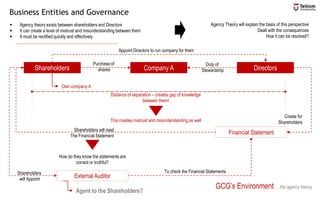
GCG’s Environment…..the agency theory
â–Ş Agency theory exists between shareholders and Directors
â–Ş It can create a level of mistrust and misunderstanding between them
â–Ş It must be rectified quickly and effectively
Agency Theory will explain the basis of this perspective
Dealt with the consequences
How it can be resolved?
Shareholders Company A Directors
Purchase of
shares
Duty of
Stewardship
Appoint Directors to run company for them
Distance of separation – creates gap of knowledge
between them!
This creates mistrust and misunderstanding as well
Own company A
Financial Statement
Create for
Shareholders
Shareholders will read
The Financial Statement
How do they know the statements are
correct or truthful?
External Auditor
Shareholders
will Appoint
To check the Financial Statements
Agent to the Shareholders?
Business Entities and Governance
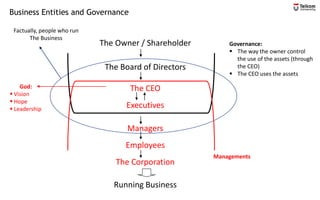
The Owner / Shareholder
The Corporation
The Board of Directors
The CEO
Executives
Managers
Employees
Running Business
Managements
Governance:
â–Ş The way the owner control
the use of the assets (through
the CEO)
â–Ş The CEO uses the assets
God:
â–Ş Vision
â–Ş Hope
â–Ş Leadership
Factually, people who run
The Business
Business Entities and Governance
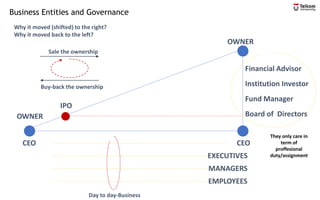
CEO CEO
OWNER
OWNER
Financial Advisor
Institution Investor
Fund Manager
Board of Directors
IPO
EXECUTIVES
MANAGERS
EMPLOYEES
Sale the ownership
Buy-back the ownership
They only care in
term of
proffesional
duty/assignment
Day to day-Business
Why it moved (shifted) to the right?
Why it moved back to the left?

Business law module 4

  • 1.
    Business Law Module –4 Business Entities and Governance Ref. Munir Fuadi,2005, Pengantar Hukum Bisnis, PT. Citra Aditya Bakti, Bandung. Burton, Simatupang Richard, 2007, Aspek Hukum Dalam Bisnis (Edisi Revisi), Jakarta: Rineka Cipta K.Bertens, 2000, Pengantar Etika Bisnis, Kanisius, Yogyakarta. Bambang B, Melia Famiola, 2007, Etika Bisnis dan Tanggung jawab sosial perusahaan di Indonesia, Rekayasa sains, Bandung. Mariam Darus B,1994, Aneka Hukum Bisnis, Alumni Bandung. Any relevant materials in conjunction with the cases and topics in discuss I Nyoman Wisnu Wardhana Yayasan Pendidikan Telkom wisnuwin@yahoo.com
  • 2.
    Business Entities andGovernance Dasar Hukum Organisasi Bisnis/Perusahaan di Indonesia: Kitab Undang-Undang Hukum Perdata (Burgerlijk Wetboek voor Indonesie) Kitab Undang-Undang Hukum Dagang (Wetboek Van Koophandel voor Indonesie) Undang-Undang No. 40 Tahun 2007 tentang Perseroan Terbatas Bentuk-bentuk organisasi perusahaan: Perusahaan Perseorangan Persekutuan Firma Perseroan Komanditer (Commanditer Vennootschap/CV) Perseroan Terbatas Koperasi Yayasan BUMN Other derivative forms of corporation
  • 3.
    Business Entities andGovernance Perusahaan Perseorangan Perusahaan Persekutuan Berbadan Hukum Spec: ▪ Perseroan Terbatas (Tertutup) ▪ Perseroan Terbatas (Terbuka) ▪ Koperasi ▪ Yayasan ▪ BUMN Tidak – Berbadan Hukum Spec: ▪ Maatschap (Pers. Perdata) ▪ Vennootschap onder eene firma (Firma) ▪ Commanditaire vennootschap (CV) Perusahaan adalah setiap kegiatan usaha yang dilakukan secara tetap/terus-menerus dengan tujuan untuk mencapai atau mencari keuntungan/laba baik yang dilaksanakan oleh orang perseorangan maupun oleh badan usaha baik badan usaha yang tidak berbadan hukum maupun badan usaha yang berbadan hukum yang didirikan dan berada di wilayah RI. UU No. 8 th. 1997 (Dokumen Perusahaan): Naamloze Vennootschaap (NV) cooperatie Stichting Eenmanszaak/Sole Proprietorship staat een eigen bedrijf
  • 4.
    Business Entities andGovernance Perusahaan Perseorangan Adalah perusahaan yang dikelola dan diawasi oleh satu orang, dimana pengelola perusahaan memperoleh semua keuntungan perusahaan, tetapi ia juga menanggung semua risiko yang timbul dalam kegiatan perusahaan. Pendirian perusahaan perseorangan tidak diatur dalam KUHD dan tidak memerlukan perjanjian karena hanya didirikan oleh satu orang pengusaha saja. Perusahaan perseorangan dibagi dalam 2 kelompok yaitu 1. Usaha Perseorangan Berizin : memiliki izin operasional dari departemen teknis. Misalnya bila perusahaan perseorangan bergerak dalam bidang perdagangan, maka dapat memiliki izin seperti Tanda Daftar Usaha Perdagangan (TDUP), Surat Izin Usaha Perdagangan (SIUP). 2. Usaha Perseorangan Yang Tidak Memiliki Izin. Misalnya usaha perseorangan yang dilakukan para pedagang kaki lima, toko barang kelontong, dsb. TBH - Eenmanszaak/Sole Proprietorship
  • 5.
    Business Entities andGovernance TBH - Maatschap Persekutuan Perdata Adalah suatu persetujuan dimana dua orang/lebih mengikatkan diri untuk memasukkan sesuatu kedalam persekutuan dengan tujuan untuk membagi keuntungan atau manfaat diperoleh daripadanya. Dapat berupa: Barang, Uang, Tenaga, dan kerajinan â–Ş Hubungan intern antara para sekutu bersifat kontraktual â–Ş Hubungan Eksternnya (Hubungan antara seorang sekutu dengan pihak ketiga) hanya mengikat sekutu yang mengikatkan diri tersebut, tetapi para sekutu lainnya dapat terikat apabila: âś“ Adanya pengukuhan terhadap peningkatan yang dilakukan kepada pihak ketiga âś“ Adanya kesan pertanggung jawaban sekutu âś“ Adanya kuasa âś“ Adanya manfaat bagi persekutuan Pertanggung jawaban tergantung kepada jumlahnya sekutu dengan dan bagian masing-masing sekutu dalam modal persekutuan (pro Rata) seperti : Kerjasama Lawyer, Dokter, Architect, etc. Gerant Statutaire (Perjanjian Persekutuan dalam tindakan pengutusan kepada pihak ketiga atas dasar akte pendirian persekutuan, Gerant Mandataire merupakan pemberian kuasa dari persekutuan atas keperluan persekutuan atau memberikan mandat.
  • 6.
    Business Entities andGovernance TBH - Vennootschap onder eene firma Firma Adalah setiap persekutuan perdata yang menjalankan perusahaan dengan nama bersama, jadi dapat dikatakan firma adalah persekutuan perdata khusus, kekhususannya terletak pada: â–Ş Menjalankan perusahaan dengan mana bersama â–Ş Tanggung jawab sekutu secara pribadi untuk keseluruhan â–Ş Menggunakan nama bersama Firma bukan merupakan badan hukum, meskipun syarat materil sudah terpenuhi antara lain: âś“ Adanya harta kekayaan terbesar âś“ Adanya kepentingan atau tujuan tertentu âś“ Adanya Pengurus Syarat formal sebagai badan hukum tidak terpenuhi, yaitu tidak adanya pengesahan Menteri Kehakiman.
  • 7.
    Business Entities andGovernance TBH - Commanditaire vennootschap Persekutuan Komanditer Adalah jenis persekutuan yang mirip dengan firma yang mempunyai dua jenis sekutu yaitu sekutu komplementer dan komanditer. Merupakan persekutuan yang didirikan oleh beberapa orang (sekutu) yang menyerahkan dan mempercayakan uangnya untuk dipakai dalam persekutuan. Para anggota persekutuan menyerahkan uangnya sebagai modal perseroan dengan jumlah yang tidak perlu sama sebagai tanda keikutsertaan di dalam persekutuan. â–Ş Sekutu komplementer (sekutu aktif/pengurus) yang dapat melakukan perbuatan hukum atau mengadakan perikatan terhadap pihak ketiga. â–Ş Sekutu komanditer (Sekutu yang memasukkan modalnya saja kedalam persekutuan (sekutu pasif/dibelakang layar). Berbeda dengan firma, maka sekutu komanditer hanya bertanggung jawab sebesar modal yang masuk dalam perseroan.
  • 8.
    Business Entities andGovernance BH - Naamloze Vennootschaap Perseroan Terbatas (Perseroan), adalah badan hukum yang merupakan persekutuan modal, didirikan berdasarkan perjanjian, melakukan kegiatan usaha dengan modal dasar yang seluruhnya terbagi dalam saham dan memenuhi persyaratan yang ditetapkan dalam undang-undang serta peraturan pelaksanaannya. Perseroan mempunyai organ yang terdiri dari: Rapat Umum Pemegang Saham (RUPS) adalah pemegang kekuasaan tertinggi dalam Perseroan dan memegang segala kewenangan yang tidak diserahkan kepada direksi atau komisaris. RUPS terdiri dari RUPS tahunan yang diadakan paling lambat 6 bulan setelah tahun buku dan RUPS lainnya yang dapat diadakan sewaktu-waktu berdasarkan kebutuhan. Direksi adalah organ Perseroan yang bertanggung jawab penuh atas pengurusan Perseroan untuk kepentingan dan tujuan Perseroan serta mewakili Perseroan baik di dalam maupun di luar pengadilan sesuai dengan ketentuan anggaran dasar. Komisaris adalah organ Perseroan yang bertugas melakukan pengawasan secara umum dan atau khusus serta memberikan nasehat kepada direksi dalam menjalankan Perseroan
  • 9.
    Business Entities andGovernance Pro(s) – Con(s) Eenmanszaak/Sole Proprietorship Kebaikan: ▪ Mudah dibentuk dan dibubarkan ▪ Bekerja dengan sederhana ▪ Pengelolaannya sederhana ▪ Tidak perlu kebijaksanaan pembagian laba Kelemahan: ▪ Tanggung jawab tidak terbatas ▪ Kemampuan manajemen terbatas ▪ Sulit mengikuti pesatnya perkembangan perusahaan ▪ Sumber dana hanya terbatas pada pemilik ▪ Risiko kegiatan perusahaan ditanggung sendiri Maatschap-Firma Kebaikan: ▪ Prosedur pendirian relatif mudah ▪ Mempunyai kemampuan finansial yang lebih besar, karena gabungan modal yang dimiliki beberapa orang ▪ Keputusan bersama dengan pertimbangan seluruh anggota firma, sehingga keputusan- keputusan menjadi lebih baik Kelemahan: ▪ Utang-utang perusahaan ditanggung oleh kekayaan pribadi para anggota firma ▪ Kelangsungan hidup perusahaan tidak terjamin, sebab bila salah seorang anggota keluar, maka firma pun bubar
  • 10.
    Business Entities andGovernance Pro(s) – Con(s) Commanditaire Vennootschap Kebaikan: ▪ Pendiriannya relatif mudah ▪ Modal yang dapat dikumpulkan lebih banyak ▪ Kemampuan untuk memperoleh kredit lebih besar ▪ Manajemen dapat didiversifikasikan ▪ Kesempatan untuk berkembang lebih besar Kelemahan: ▪ Tanggung jawab tidak terbatas ▪ Kelangsungan hidup tidak terjamin ▪ Sukar untuk menarik kembali investasinya Naamloze Vennootschaap Kebaikan: ▪ Kelangsungan hidup perusahaan terjamin ▪ Terbatasnya tanggung jawab, sehingga tidak menimbulkan risiko bagi kekayaan pribadi maupun kekayaan keluarga pemilik ▪ Saham dapat diperjual belikan dengan relatif mudah ▪ Kebutuhan kapital lebih besar akan mudah dipenuhi, sehingga memungkinkan perluasan usaha ▪ Pengelolaan perusahaan dapat dilakukan lebih efisien Kelemahan: ▪ Biaya pendiriannya relatif mahal ▪ Rahasia tidak terjamin ▪ Kurangnya hubungan yang efektif antara pemegang saham
  • 11.
    Business Entities andGovernance Perseorangan Persekutuan Tidak berbadan Hukum Berbadan Hukum Eenmanszaak Maatschap Firma CV NV - BV Cara Pendirian Tidak diatur dalam KUHD ataupun KUHPerdata Perjanjian, bisa lisan atau akte otentik- 1618 16 , 18, dan 22 1 § 1 7 § 1 & 2 Pendaftaran Tidak perlu didaftarkan Tidak harus didaftarkan Harus didaftarkan di Kepaniteraan PN- 23, 24 ▪ 9 § 1 ▪ 29 Pengesahan Tidak perlu Pengesahan Tidak perlu didaftarkan Tidak memerlukan pengesahan -27 30 § 1 Tanggung Jawab Intern Tidak terbatas All for one – 1637/1639 (3rd party bind) 1624 sd. 1641 ~Firma, pada sekutu komanditer tanggung jawabnya Terbatas- 19, 20, dan 21 3 § 1 Extern Tidak terbatas All for one – 1642/1644 1642 sd. 1645 ▪ 92, 97, 98 , dan 99 ▪ 114, 115, 117, dan 118 ▪ 148 Berakhirnya Tidak diatur dalam KUHD 1646 26, 31 1646 142 § 1 Establishment Comparation
  • 12.
    Business Entities andGovernance State Owned CompanyBadan Usaha Milik Negara (BUMN) Adalah semua perusahaan dalam bentuk apapun dan bergerak dalam bidang usaha apapun yang sebagian atau seluruh modalnya merupakan kekayaan negara, kecuali ditentukan lain berdasarkan undang-undang Modal BUMN ada 2 kemungkinan: 1. Seluruh modal persero dimiliki oleh negara 2. Sebagian modal persero (paling sedikit 50%) dimiliki oleh negara dan sebagian modal lainnya dimiliki oleh swasta Ciri-ciri utama BUMN adalah: ▪ Profit oriented ▪ Legal status: owned its name and capital, legally bind agreement, covenant, etc with other parties ▪ Vital services (Public services) ▪ To perform legal acts, sued or sue ▪ State owned capital, and can be obtained loans → debt securities ➢ Spec: PT. Telkom Indonesia, PT. KA-Indonesia, PT. Rajawali Indonesia, etc
  • 13.
    Business Entities andGovernance Limited Liability Company- Classification Perseroan Terbatas Dapat diklasifikasikan ke dalam beberapa jenis yaitu: 1. Klasifikasi Perseroan Terbatas atas dasar diperjualbelikannya saham di Bursa Efek â–Ş Perseroan Terbatas Tertutup adalah PT yang saham-sahamnya tidak diperjual-belikan di Bursa Efek â–Ş Perseroan Terbatas Terbuka adalah PT yang sahamnya sudah diperjual-belikan di Bursa Efek dan perusahaan tersebut merupakan perusahaan yang sudah go public. 2. Klasifikasi PT berdasarkan asal mula penanaman modal yaitu: â–Ş PT. PMDN â–Ş PT. PMA â–Ş PT. Non PMA/PMDN 3. Klasifikasi PT berdasarkan ada tidaknya kelompok usaha yaitu: â–Ş Holding Company: â–Ş Full Holding Company â–Ş Quasy Holding Company â–Ş Non Holding Company
  • 14.
    Business Entities andGovernance What is “business governance”? Business governance concerns the actions and controls placed on those charged with managing a business entity. Business governance is the subject of extensive legislation and research, particularly as it pertains to the corporate entity form. Corporate governance generally concerns the internal control of a corporation as influenced or controlled by state and federal law, rules of ethics, and industry standards. It specifically focuses on the actions of managers and directors and the observance of procedural safeguards of shareholder rights. Example: Issues in corporate governance include, voting rights, meeting requirements, approval of corporate actions, record retentions, disclosure of information, and any other procedural undertakings concerning the management of the corporation.
  • 15.
    Business Entities andGovernance Who are the members of a corporation? The corporation is made up of shareholders, directors, officers, and employees. Shareholders are the owners of the corporation. Directors undertake the high-level management and decision-making for the corporation. Officers (and their subordinate employees) run the daily operations of the corporation. Each member of the corporation has specific rights and duties attached to her position. These rights and duties can become confusing when a single individual holds more than one position (such as shareholder, directors, and officer) of the corporation. Note: Besides shareholders, directors, and officers, there are numerous other corporate stakeholders (such as vendors, customers, other businesses, etc.) that are not members of the corporation.
  • 16.
    Business Entities andGovernance What is the distinction between a “private company” and “public company”? A private company is a business whose ownership interest is not openly held or traded by the public at large. Company ownership is not sold in the public market. As such, all ownership interests are acquired via personal transactions with the company or other owners of the company. A public company, on the other hand, is a business whose ownership is openly traded in the market. Often, the ownership interest will be traded on a public “stock exchange”. If the shares are not listed on an exchange, the shares are generally available for purchase through securities brokers in what is known as “over-thecounter” transactions. Public companies are subject to far more extensive regulation than private companies. This reality often leads public companies to repurchase outstanding shares from the public market in a transaction known as “going private”. Note: Most public companies are corporations. There are, however, limited instances where shares of ownership in other types of entities are sold publicly. An example would be master limited partnership interests.
  • 17.
    Business Entities andGovernance What is the role and purpose of the corporation? The concept of the corporation originated through governmental charter allowing individuals to carry on business collectively. Basically, the charter gave the corporate entity form legal status that was similar to personhood. The concept of the corporation as a legal person has expanded over time to the point that corporations enjoy many of the same constitutional protections as US citizens. The corporate entity also allows individuals to have a beneficial interest without being actively involved in business operations. That is, it allows for increased division and transfer of ownership interest in a business activity. It allows for the utilization of outside capital from investors (rather than just debt or capital contributions from founders) to grow business operations. The active trading of ownership in corporate entities gave rise to the formation of US stock exchanges and the private equities market.
  • 18.
    Business Entities andGovernance What is the “stakeholder theory” of corporate governance? The stakeholder theory of corporate governance focuses on the effect of corporate activity on all identifiable stakeholders of the corporation. This theory posits that corporate managers (officers and directors) should take into consideration the interests of each stakeholder in its governance process. This includes taking efforts to reduce or mitigate the conflicts between stakeholder interests. It looks further than the traditional members of the corporation (officers, directors, and shareholders) and also focuses on the interests of any third party that has some level of dependence upon the corporation. Stakeholders are generally divided into internal and external stakeholders. • Internal Stakeholders - Are the corporate directors and employees, who are actually involved in corporate governance process. • External Stakeholders - May include creditors, auditors, customers, suppliers, government agencies, and the community at large.
  • 19.
    Business Entities andGovernance What is the “stakeholder theory” of corporate governance? The stakeholder theory of corporate governance focuses on the effect of corporate activity on all identifiable stakeholders of the corporation. This theory posits that corporate managers (officers and directors) should take into consideration the interests of each stakeholder in its governance process. This includes taking efforts to reduce or mitigate the conflicts between stakeholder interests. It looks further than the traditional members of the corporation (officers, directors, and shareholders) and also focuses on the interests of any third party that has some level of dependence upon the corporation. Stakeholders are generally divided into internal and external stakeholders. • Internal Stakeholders - Are the corporate directors and employees, who are actually involved in corporate governance process. • External Stakeholders - May include creditors, auditors, customers, suppliers, government agencies, and the community at large.
  • 20.
    Business Entities andGovernance What is the role of “shareholders” of the corporation? Shareholders are the owners of the corporation. They have ownership rights in the shares of corporate stock. The role of the shareholder in the corporation is limited, however, as they have neither the right nor the obligation to manage the dayto-day business of the enterprise. Shareholder rights vary pursuant to the type of stock owned and the applicable state law. State law is heavily influenced by authoritative sources, such as the Model Business Corporations Act (Model Act). Below is an explanation of common rights afforded corporate shareholders under state law. ▪ Right to Information - Shareholders have the right to access and examine corporate records and information concerning the governance and financial performance of the entity. ▪ Right to Vote - All corporations must have at least one class of stock representing an ownership interest in the company. In most corporations, the basic ownership share is known as “common stock”. These shares entail voting rights for the shareholder. ▪ Approval for Fundamental Changes in Corporation - Shareholders must approve any fundamental changes to the corporation. Fundamental changes include: M&As (Corporate Actions, Sale of Assets, Dissolution, etc.) ▪ Meeting Rights - All state corporate statutes (as well as large public exchanges) require corporations to hold annual shareholder meetings. ▪ Right to Dissent - In most states (and under the Model Act), corporate law allows for “dissenter rights”. Dissenter rights are a special group of rights designed to provide protections to shareholders in corporations that are not actively traded in the market.
  • 21.
    Business Entities andGovernance GCG’s Environment…..the agency theory ▪ Agency theory exists between shareholders and Directors ▪ It can create a level of mistrust and misunderstanding between them ▪ It must be rectified quickly and effectively Agency Theory will explain the basis of this perspective Dealt with the consequences How it can be resolved? Shareholders Company A Directors Purchase of shares Duty of Stewardship Appoint Directors to run company for them Distance of separation – creates gap of knowledge between them! This creates mistrust and misunderstanding as well Own company A Financial Statement Create for Shareholders Shareholders will read The Financial Statement How do they know the statements are correct or truthful? External Auditor Shareholders will Appoint To check the Financial Statements Agent to the Shareholders?
  • 22.
    Business Entities andGovernance The Owner / Shareholder The Corporation The Board of Directors The CEO Executives Managers Employees Running Business Managements Governance: â–Ş The way the owner control the use of the assets (through the CEO) â–Ş The CEO uses the assets God: â–Ş Vision â–Ş Hope â–Ş Leadership Factually, people who run The Business
  • 23.
    Business Entities andGovernance CEO CEO OWNER OWNER Financial Advisor Institution Investor Fund Manager Board of Directors IPO EXECUTIVES MANAGERS EMPLOYEES Sale the ownership Buy-back the ownership They only care in term of proffesional duty/assignment Day to day-Business Why it moved (shifted) to the right? Why it moved back to the left?