BUSINESS IN GLOBALIZATION by siddharthan
HISTORY The world's economic order through reduction of such barriers to international trade most closely associated with the term “ economic globalization ” integration of national economies into the international economy through trade,  foreign direct investment ,  capital flows ,  migration driven by a combination of economic, technological, sociocultural, political, and biological factors
DEFINITION United Nations  ESCWA  –”reduction and removal of barriers between national borders in order to facilitate the flow of goods, capital, services and labour”. Tom G. Palmer-"the diminution or elimination of state-enforced restrictions on exchanges across borders and the increasingly integrated and complex global system of production and exchange that has emerged as a result."
MEASUREMENT 3 main dimensions of globalization  ECONOMIC SOCIAL POLITICAL  SWISS THINK TANK RESEARCH- w orld's most globalized country-Austria, Sweden, the United Kingdom and the Netherlands. world's least globalized country-Haiti, Myanmar, the central african public and Burundi A.T. Kearney  and  Foreign Policy  Magazine - Singapore , Ireland, Switzerland, the Netherlands, Canada and Denmark -most globalized, while Indonesia,  India  and Iran are the least globalized among countries listed
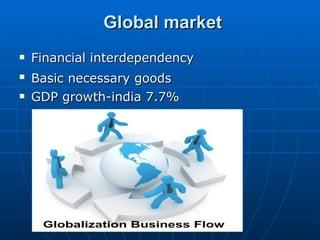
Global market Financial interdependency Basic necessary goods   GDP growth-india 7.7%
Globalization in India FDI reached 2% of GDP, compared with 0.1% in 1990 strengths in IT and other significant areas such as auto components, chemicals, apparels, pharmaceuticals, and jewellry large pool of skilled managerial and technical expertise FDI inflow for 2011-2013 has been reported as $24bn, expected $35 billion
EFFECTS INDUSTRIAL: International trade in manufactured goods has increased more than 100 times (from $95 billion to $12 trillion) since 1955. FINANCIAL By the early part of the 21st century, more than $1.5 trillion in national currencies traded daily to support the expanded levels of trade and investment  ECONOMIC workers compete in a global market. wages are less dependent on the success or failure of individual economies. This has had a major effect on wages and income distribution
 
Siddharthan

business globalization

  • 1.
  • 2.
    HISTORY The world'seconomic order through reduction of such barriers to international trade most closely associated with the term “ economic globalization ” integration of national economies into the international economy through trade, foreign direct investment , capital flows , migration driven by a combination of economic, technological, sociocultural, political, and biological factors
  • 3.
    DEFINITION United Nations ESCWA –”reduction and removal of barriers between national borders in order to facilitate the flow of goods, capital, services and labour”. Tom G. Palmer-"the diminution or elimination of state-enforced restrictions on exchanges across borders and the increasingly integrated and complex global system of production and exchange that has emerged as a result."
  • 4.
    MEASUREMENT 3 maindimensions of globalization ECONOMIC SOCIAL POLITICAL SWISS THINK TANK RESEARCH- w orld's most globalized country-Austria, Sweden, the United Kingdom and the Netherlands. world's least globalized country-Haiti, Myanmar, the central african public and Burundi A.T. Kearney and Foreign Policy Magazine - Singapore , Ireland, Switzerland, the Netherlands, Canada and Denmark -most globalized, while Indonesia, India and Iran are the least globalized among countries listed
  • 5.
    Global market Financialinterdependency Basic necessary goods GDP growth-india 7.7%
  • 6.
    Globalization in IndiaFDI reached 2% of GDP, compared with 0.1% in 1990 strengths in IT and other significant areas such as auto components, chemicals, apparels, pharmaceuticals, and jewellry large pool of skilled managerial and technical expertise FDI inflow for 2011-2013 has been reported as $24bn, expected $35 billion
  • 7.
    EFFECTS INDUSTRIAL: Internationaltrade in manufactured goods has increased more than 100 times (from $95 billion to $12 trillion) since 1955. FINANCIAL By the early part of the 21st century, more than $1.5 trillion in national currencies traded daily to support the expanded levels of trade and investment ECONOMIC workers compete in a global market. wages are less dependent on the success or failure of individual economies. This has had a major effect on wages and income distribution
  • 8.
  • 9.