Business Enterprise -AMC423
Reflective Report
Elizabeth Broughton
Tableof Contents
What is an entrepreneur?.........................................................................................................3
Key issues that face organisations in the UK in the current environment..............................3
The creative process we went through to create our business idea. ......................................3
Our business idea & the key areas of our business plan..........................................................5
A reflection on what I would do differently & why..................................................................6
References .................................................................................................................................7
Appendix....................................................................................................................................8
What is an entrepreneur?
An entrepreneur is: ‘Someone who exercises initiative by organizing a venture to take
benefit of an opportunity and, as the decision maker, decides what, how, and how much
of a good or service will be produced. An entrepreneur supplies risk capital as a risk
taker and monitors and controls the business activities. The entrepreneur is usually a
sole proprietor, a partner, or the one who owns the majority of shares in an
incorporated venture.’ (Business Dictionary, 2019) An Entrepreneur is usually a risk
taker, determined, passionate, confident, competitive, creative, flexible, a hard worker,
ambitious and professional. I would say I hold some of the traits of an entrepreneur but
others I lack. I think I am definitely competitive, hardworking, creative, determined and
ambitious. However, I wouldn’t say I was an initially confident or passionate person nor
am I a risk taker as I like to know the outcome of my actions. I am also not particularly
flexible or professional due to my lack of experience and my age.
Key issues that face organisations in the UK in the current
environment.
The current environment in the UK is particularly uncertain due to Brexit. With protestors
still requesting a second referendum whilst the government are continuously pushing back
the deadline and rejecting any offers the EU will agree on, UK businesses are increasingly
under the pressure of uncertain future economic and political conditions. There are also
other issues facing UK businesses such as the constant introduction of disruptive
technology, the digitisation and democratisation of technology and also keeping up with
new generations of talent. Therefore, businesses will need to become agile in order to
survive. ‘An Agile Organization is one that is quick in responding to changes in the
marketplace or environment’… ‘A highly agile organization reacts successfully to the
emergence of new competitors, rapid advancements in technology and sudden shifts in
overall market conditions. Agile enterprises thrive in non-hierarchical organizations without
a single point of control.’ (MBASkool, 2019). A business can become more agile by ensuring
the customer is the main focus, by functioning as a business around the customer they
become more agile as they will be able to act quickly when customer views/needs/wants
start to change. So, for example, due to indeterminate future political and economic
stability consumers generally are unsettled, as a business by keeping up with how
customers are viewing these changes they can make amendments accordingly to the
business, such as lowering prices as the pound falls in value. Businesses should also try to be
flexible, responsive and also develop so they can be quick decision makers. Employees are
also inevitably very important in an agile business, preparing employees for change is vital in
order to make fluid adjustments.
The creative process we went through to create our business idea.
The first thing we did was the ideation for our business idea. We started by creating
personas, we had a group discussion then began outlining two people by drawing and
adding notes. In our group we ended up with two people (a girl and a boy) that were
students, unsurprisingly, struggling with money and in a long-term relationship that were
currently finding it hard to keep their relationship going with so much work. From there we
used a method called brainwriting 6-3-5, where six people in a group write down three ideas
of business concepts in five minutes that could help these personas, we then passed them
round and as each of our sheets circulated we developed each other’s ideas further.
Eventually we came up with a few potential ideas such as an app that visualises different
hair styles on you so you can see what might suit you, a music/speaker alarm that doesn’t
stop going off until the light is turned on and an app that shows what jobs suit you
determined by your schedule and that are in the surrounding area. But, our final idea of an
app that creates date ideas based on a list of preferences you can fill in together as a couple,
is the one we eventually decided on. So, in the case of the personas we made they would
choose the options of cheap, close to home and only a couple of hours spent.
When it came to branding this idea we started off with a name, we looked into what our
business would be aiming to do and we thought our value proposition could be ‘relighting
the spark in relationships’ we then decided ‘Spark’ was an appropriate name that was short
and snappy and was easily connected with the business idea. We began creating a mood
bored using InVision (https://www.invisionapp.com/inside-design/boards-share-design-
inspiration-assets/) to start off the creative process. We used this to start creating a logo,
where we did some research and browsed some logo websites we were provided with and
came to the conclusion that a lightning bolt was rather fitting with our name, ‘Spark’. We
then looked into colour schemes using the Coolors website (https://coolors.co) and ended
up going for a blue to purple gradient. We chose this colour scheme in order to try to make
it accessible to both genders, as its quite bright and aesthetically pleasing and also as it
stands out as it is unique. Our logo and colour scheme are quite similar to that of Tinder in
the fact that we chose a white logo on a gradient background, we decided to do this
because we thought this aesthetic from a similar app but on a different market was
desirable. Also, after pitching our idea we got some feedback afterwards suggesting a
collaboration with Tinder could be an avenue to go down. For example, Tinder would get
people together and then we would, from preferences they had both separately chosen,
give them ideas for their first date. So, having similar branding could be beneficial in
connecting the apps.
Our team worked really well together, all of us had an input in making the app and coming
up with creative ideas. During the process we took the Belbin’s TeamRoles Test (Belbin,
2019) my results were that I am a Team Worker and a Completer Finisher, Team member A
is a Coordinator and a Team worker and Team member B is a Implementor and a Completer
Finisher. We therefore each bring different things to the table but can work together in
others areas. When it came to our business ideas, we would all come up with our own ideas
and share them but would also develop each other’s ideas. Upon creating our app and our
business plan I worked on the prototype, as I enjoyed the technicalities of it as well as the
creativity involved, with assistance from both team members whilst they worked on the
Business Model Canvas. We all had input in everything that was made, particularly when it
came to the pitch where we used google slides so we could all sit together and discuss and
amend each other’s work.
Our business idea & the key areas of our business plan.
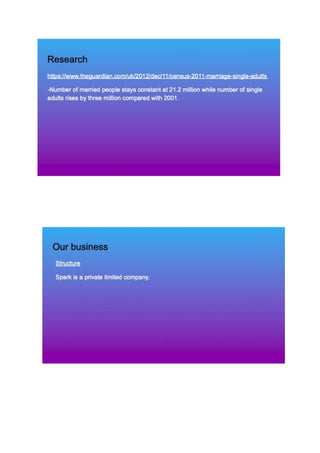
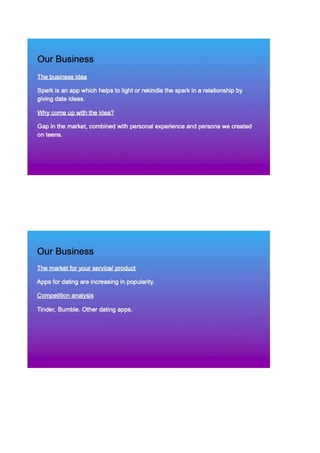
The business idea we eventually finished with is an activity planning/date app called Spark.
Compared to a dating app which finds you someone to date, our app sets up the date. We
aim to both light and rekindle the flame in relationships by giving date ideas based on
preferences that have been entered by both people in the relationship. The preferences we
give are (appendix 2): indoors or outdoors, how far you want to go, your price range,
whether you want a casual or formal setting, daytime or night time and how much time you
have to spend (e.g. a couple of hours compared to a weekend away). With these
preferences the app will then give the couple some options of date ideas based on the
information they uploaded as well as any promotions or offers we have. The app will
hopefully include a wide range of offers from restaurants, activity centres, hotels, bars and
getaways. We plan to do this by making deals with these businesses by offering them either
the promise of more customers, by paying them a small sum or by giving specific businesses
extra promotion on the app. Spark also includes: a page full of just our offers if couples are
just looking for a cheap date, as well as a ‘what’s new?’ tab so they can see recently
uploaded promotions, a random generator tab called ‘feeling wild’ if the couple have no
preferences, merchandise and finally a premium scheme under a ‘want more’ button. The
premium scheme offers our most exclusive deals as well as removal of ads and money off
merchandise. When it comes to merchandise, as a team and upon the suggestion of Chris,
we were thinking of running with the ‘relighting the spark’ idea and decided we could sell
items such as sex dice in order to spice up relationships that may need reigniting such as
older couples or those going through some turmoil.
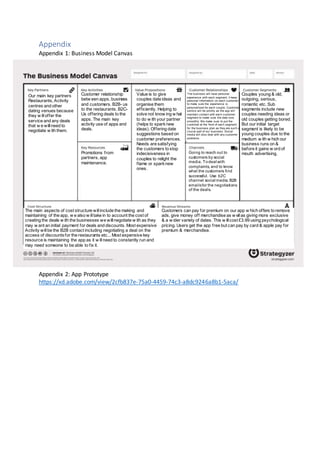
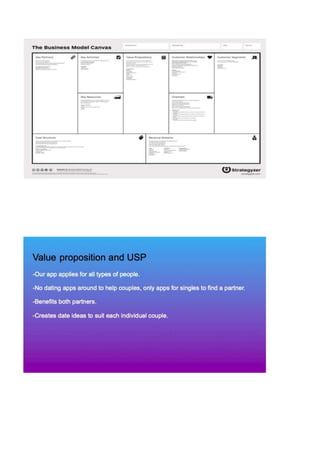
Our business model canvas (appendix 1) outlines our business plan in sections. Key Partners,
the first segment, for our business consists of restaurants, activity centres, hotels, salons,
bars, resorts and other date venues. We will need these as key partners as we will aim to
get deals and promotions from these businesses in order to send our customers their way.
Another set of key partners further on into the future of the business may be companies we
join with in order to sell merchandise, so, for example LoveHoney, Ann Summers, Victoria
Secret, Thorntons, Pandora etc. The next segment is Key Activities, as a business our key
activities are likely to be mainly ensuring the relationship between the customer and the
app is smooth, making sure the deals apply to the customer need and updating our offers
regularly for customers that use the app frequently. But also B2B (Business to Business)
where we’ll need to be negotiating deals with date spots in order to keep updating the app.
Next, Key Resources which are limited due to our business being an app however we will
need app maintenance as well as the offers from partners. The fourth segment is Cost
Structure, with our main focus being on the making and maintaining of the app followed by
the cost of negotiating deals with businesses. Negotiating may be costly as some businesses
may want an initial payment or a deposit to ensure they make a return on the agreement,
this B2B communication may be pricey, in order to get access for our customers to their
deals, as a start up as a return from the deal may not be certain. Maintaining the app will be
our most expensive key resource as consistency in the running of the app will be key to the
business surviving initially. The Value Proposition for the business is to give couples date
ideas and organise them efficiently, helping to solve not knowing what to do with your
partner. The app offers date suggestions based on the couples preferences, by satisfying the
customers it hopes to reduce indecisiveness and help couples relight the flame in their
relationship or even spark a new flame. Revenue Streams for Spark will start with customers
paying for premium which removes adverts, gives exclusive discounts on merchandise as
well as more exclusive & a wider variety of date offers. This will cost £3.99 using
psychological pricing, the app itself will be free but purchasing merchandise and premium
can be paid for using card, Apple pay and Paypal. Customer Relationships will be important
to the business as it keeps information on the customers. Customer service is going to be
vital to ensure the smooth running of the app. We have ensured the customer is at the front
of each segment of our business plan as the customer is so crucial to the business. We will
also use social media in order to deal with any customer complaints. The Channels we will
use will be social media to reach out to customers for any complaints as well as to find out
what customers are and are not enjoying. We will also use emails to contact other
businesses when negotiating deals. Finally, the customers segments we will target will be
couples young and old, sub segments will include new couples looking for first date ideas
and old couples getting bored. However, our likely initial target audience will be young
couples as the medium with which our business runs is currently used mainly by a younger
audience which also means we can use social media to promote the business, also relying
on word of mouth advertising.
A reflection on what I would do differently & why
After completing the process of developing a business plan and pitch from scratch, if I were
to do it again, I wouldn’t change the ideation process we went through as we quite quickly
came up with a lot of good ideas as a teamand worked productively to develop the idea
realistically, the whole group had an equal input in coming up with ideas. Therefore, I would
try to replicate this process next time. Once we had developed our idea, we moved onto
creating a prototype and a brand. I feel that this process may have taken slightly longer than
necessary as we all had a lot of creative ideas and we all helped, this meant making
decisions involved a lot more deliberation than if just one of us made design choices. The
extended length of time we spent on our prototype, because we struggled making decisions
but also because we were using a new software, meant that we had less time to focus on
the detail. When doing this again I would spend more time on the specifics such as the
business plan, I feel it may have been a bit rushed and there were some things we weren’t
entirely sure on. This could have been amended by doing more research or by setting
ourselves deadlines for things so that nothing was rushed. Finally, when it came to our
pitch, we received feedback afterwards on how we could improve our idea as well as our
pitch itself. As previously mentioned, one suggestion was a collaboration with Tinder, where
the dating app would recommend us in order for people who matched to make setting up a
date less awkward. Another suggestion was for our pitch, we were told that adding
screenshots of the app throughout our presentation or present it entirely at the beginning,
rather than showing it at the end, would make visualising the app easier as we spoke about
it making it easier to understand what we were discussing. Another suggestion was focusing
our advertising on social media where we originally were going to focus on word of mouth.
We developed this and came up with the idea of getting users of the app to post pictures of
them on their dates with a specific hashtag which could lead to them winning an exclusive
date or gift. This idea would promote the App but would also make It more interactive.
Overall, I think our business plan and pitch were actually rather successful, as a teamwe
worked together well to come up with an original, interesting and creative App idea. We
had very few issues throughout the process and came out with a good end result that we
were all proud of.
References
 Belbin, 2019, The Nine Belbin Team Roles, Available at:
https://www.belbin.com/about/belbin-team-roles/ (25th April 2019)
 Business Dictionary, 2019, Entrepreneur, Available at:
http://www.businessdictionary.com/definition/entrepreneur.html (8th April 2019)
 MBASkool, 2019, Agile Organization, Available at:
https://www.mbaskool.com/business-concepts/it-and-systems/6703-agile-
organization.html (9th April 2019)
Appendix
Appendix 1: Business Model Canvas
Appendix 2: App Prototype
https://xd.adobe.com/view/2cfb837e-75a0-4459-74c3-a8dc9246a8b1-5aca/
Our main key partners
Restaurants, Activity
centres and other
dating venues because
they w illoffer the
service and any deals
that w e willneed to
negotiate w ith them.
Promotions from
partners, app
maintenance.
Customer relationship
betw een apps, business
and customers. B2B- us
to the restaurants. B2C-
Us offering deals to the
apps. The main key
activity use of apps and
deals.
The main aspects of cost structure willinclude the making and
maintaining of the app, w e also w illtake in to account the cost of
creating the deals w ith the businesses we willnegotiate w ith as they
may w ant an initial payment for deals and discounts. Most expensive
Activity willbe the B2B contact including negotiating a deal on the
access of discountsfor the restaurants etc... Most expensive key
resource is maintaining the app as it w illneed to constantly run and
may need someone to be able to fix it.
Customers can pay for premium on our app w hich offers to remove
ads, give money off merchandise as w ellas giving more exclusive
& a w ider variety of dates. This w illcost £3.99 using psychological
pricing. Users get the app free but can pay by card & apple pay for
premium & merchandise.
Value is to give
couples date ideas and
organise them
efficiently. Helping to
solve not know ing w hat
to do w ith your partner
(helps to sparknew
ideas). Offering date
suggestions based on
customer preferences.
Needs are satisfying
the customers to stop
indecisiveness in
couples to relight the
flame or sparknew
ones.
The business will have personal
experience with each segment, it keep
personal information on each customer
to make sure the experience is
personalised for each couple. Customer
service will be priority as the app will
maintain contact with each customer
segment to make sure the date runs
smoothly. We make sure to put the
customer at the front of each segment
for the business plan as they are such a
crucial part of our business. Social
media will also deal with any customer
problems.
Couples young & old,
outgoing, serious,
romantic etc. Sub
segments include new
couples needing ideas or
old couples getting bored.
But our initial target
segment is likely to be
young couples due to the
medium w ith w hich our
business runs on &
before it gains w ord of
mouth advertising.Going to reach out to
customers by social
media. Todeal with
complaints, and to know
what the customers find
successful. Use b2C
channel social media. B2B
emailsfor the negotiations
of the deals.
Appendix 3: Presentation Slides
Business enterprise reflective report

Business enterprise reflective report

  • 1.
    Business Enterprise -AMC423 ReflectiveReport Elizabeth Broughton
  • 2.
    Tableof Contents What isan entrepreneur?.........................................................................................................3 Key issues that face organisations in the UK in the current environment..............................3 The creative process we went through to create our business idea. ......................................3 Our business idea & the key areas of our business plan..........................................................5 A reflection on what I would do differently & why..................................................................6 References .................................................................................................................................7 Appendix....................................................................................................................................8
  • 3.
    What is anentrepreneur? An entrepreneur is: ‘Someone who exercises initiative by organizing a venture to take benefit of an opportunity and, as the decision maker, decides what, how, and how much of a good or service will be produced. An entrepreneur supplies risk capital as a risk taker and monitors and controls the business activities. The entrepreneur is usually a sole proprietor, a partner, or the one who owns the majority of shares in an incorporated venture.’ (Business Dictionary, 2019) An Entrepreneur is usually a risk taker, determined, passionate, confident, competitive, creative, flexible, a hard worker, ambitious and professional. I would say I hold some of the traits of an entrepreneur but others I lack. I think I am definitely competitive, hardworking, creative, determined and ambitious. However, I wouldn’t say I was an initially confident or passionate person nor am I a risk taker as I like to know the outcome of my actions. I am also not particularly flexible or professional due to my lack of experience and my age. Key issues that face organisations in the UK in the current environment. The current environment in the UK is particularly uncertain due to Brexit. With protestors still requesting a second referendum whilst the government are continuously pushing back the deadline and rejecting any offers the EU will agree on, UK businesses are increasingly under the pressure of uncertain future economic and political conditions. There are also other issues facing UK businesses such as the constant introduction of disruptive technology, the digitisation and democratisation of technology and also keeping up with new generations of talent. Therefore, businesses will need to become agile in order to survive. ‘An Agile Organization is one that is quick in responding to changes in the marketplace or environment’… ‘A highly agile organization reacts successfully to the emergence of new competitors, rapid advancements in technology and sudden shifts in overall market conditions. Agile enterprises thrive in non-hierarchical organizations without a single point of control.’ (MBASkool, 2019). A business can become more agile by ensuring the customer is the main focus, by functioning as a business around the customer they become more agile as they will be able to act quickly when customer views/needs/wants start to change. So, for example, due to indeterminate future political and economic stability consumers generally are unsettled, as a business by keeping up with how customers are viewing these changes they can make amendments accordingly to the business, such as lowering prices as the pound falls in value. Businesses should also try to be flexible, responsive and also develop so they can be quick decision makers. Employees are also inevitably very important in an agile business, preparing employees for change is vital in order to make fluid adjustments. The creative process we went through to create our business idea. The first thing we did was the ideation for our business idea. We started by creating personas, we had a group discussion then began outlining two people by drawing and
  • 4.
    adding notes. Inour group we ended up with two people (a girl and a boy) that were students, unsurprisingly, struggling with money and in a long-term relationship that were currently finding it hard to keep their relationship going with so much work. From there we used a method called brainwriting 6-3-5, where six people in a group write down three ideas of business concepts in five minutes that could help these personas, we then passed them round and as each of our sheets circulated we developed each other’s ideas further. Eventually we came up with a few potential ideas such as an app that visualises different hair styles on you so you can see what might suit you, a music/speaker alarm that doesn’t stop going off until the light is turned on and an app that shows what jobs suit you determined by your schedule and that are in the surrounding area. But, our final idea of an app that creates date ideas based on a list of preferences you can fill in together as a couple, is the one we eventually decided on. So, in the case of the personas we made they would choose the options of cheap, close to home and only a couple of hours spent. When it came to branding this idea we started off with a name, we looked into what our business would be aiming to do and we thought our value proposition could be ‘relighting the spark in relationships’ we then decided ‘Spark’ was an appropriate name that was short and snappy and was easily connected with the business idea. We began creating a mood bored using InVision (https://www.invisionapp.com/inside-design/boards-share-design- inspiration-assets/) to start off the creative process. We used this to start creating a logo, where we did some research and browsed some logo websites we were provided with and came to the conclusion that a lightning bolt was rather fitting with our name, ‘Spark’. We then looked into colour schemes using the Coolors website (https://coolors.co) and ended up going for a blue to purple gradient. We chose this colour scheme in order to try to make it accessible to both genders, as its quite bright and aesthetically pleasing and also as it stands out as it is unique. Our logo and colour scheme are quite similar to that of Tinder in the fact that we chose a white logo on a gradient background, we decided to do this because we thought this aesthetic from a similar app but on a different market was desirable. Also, after pitching our idea we got some feedback afterwards suggesting a collaboration with Tinder could be an avenue to go down. For example, Tinder would get people together and then we would, from preferences they had both separately chosen, give them ideas for their first date. So, having similar branding could be beneficial in connecting the apps. Our team worked really well together, all of us had an input in making the app and coming up with creative ideas. During the process we took the Belbin’s TeamRoles Test (Belbin, 2019) my results were that I am a Team Worker and a Completer Finisher, Team member A is a Coordinator and a Team worker and Team member B is a Implementor and a Completer Finisher. We therefore each bring different things to the table but can work together in others areas. When it came to our business ideas, we would all come up with our own ideas and share them but would also develop each other’s ideas. Upon creating our app and our business plan I worked on the prototype, as I enjoyed the technicalities of it as well as the creativity involved, with assistance from both team members whilst they worked on the Business Model Canvas. We all had input in everything that was made, particularly when it came to the pitch where we used google slides so we could all sit together and discuss and amend each other’s work.
  • 5.
    Our business idea& the key areas of our business plan. The business idea we eventually finished with is an activity planning/date app called Spark. Compared to a dating app which finds you someone to date, our app sets up the date. We aim to both light and rekindle the flame in relationships by giving date ideas based on preferences that have been entered by both people in the relationship. The preferences we give are (appendix 2): indoors or outdoors, how far you want to go, your price range, whether you want a casual or formal setting, daytime or night time and how much time you have to spend (e.g. a couple of hours compared to a weekend away). With these preferences the app will then give the couple some options of date ideas based on the information they uploaded as well as any promotions or offers we have. The app will hopefully include a wide range of offers from restaurants, activity centres, hotels, bars and getaways. We plan to do this by making deals with these businesses by offering them either the promise of more customers, by paying them a small sum or by giving specific businesses extra promotion on the app. Spark also includes: a page full of just our offers if couples are just looking for a cheap date, as well as a ‘what’s new?’ tab so they can see recently uploaded promotions, a random generator tab called ‘feeling wild’ if the couple have no preferences, merchandise and finally a premium scheme under a ‘want more’ button. The premium scheme offers our most exclusive deals as well as removal of ads and money off merchandise. When it comes to merchandise, as a team and upon the suggestion of Chris, we were thinking of running with the ‘relighting the spark’ idea and decided we could sell items such as sex dice in order to spice up relationships that may need reigniting such as older couples or those going through some turmoil. Our business model canvas (appendix 1) outlines our business plan in sections. Key Partners, the first segment, for our business consists of restaurants, activity centres, hotels, salons, bars, resorts and other date venues. We will need these as key partners as we will aim to get deals and promotions from these businesses in order to send our customers their way. Another set of key partners further on into the future of the business may be companies we join with in order to sell merchandise, so, for example LoveHoney, Ann Summers, Victoria Secret, Thorntons, Pandora etc. The next segment is Key Activities, as a business our key activities are likely to be mainly ensuring the relationship between the customer and the app is smooth, making sure the deals apply to the customer need and updating our offers regularly for customers that use the app frequently. But also B2B (Business to Business) where we’ll need to be negotiating deals with date spots in order to keep updating the app. Next, Key Resources which are limited due to our business being an app however we will need app maintenance as well as the offers from partners. The fourth segment is Cost Structure, with our main focus being on the making and maintaining of the app followed by the cost of negotiating deals with businesses. Negotiating may be costly as some businesses may want an initial payment or a deposit to ensure they make a return on the agreement, this B2B communication may be pricey, in order to get access for our customers to their deals, as a start up as a return from the deal may not be certain. Maintaining the app will be our most expensive key resource as consistency in the running of the app will be key to the business surviving initially. The Value Proposition for the business is to give couples date ideas and organise them efficiently, helping to solve not knowing what to do with your partner. The app offers date suggestions based on the couples preferences, by satisfying the customers it hopes to reduce indecisiveness and help couples relight the flame in their relationship or even spark a new flame. Revenue Streams for Spark will start with customers paying for premium which removes adverts, gives exclusive discounts on merchandise as
  • 6.
    well as moreexclusive & a wider variety of date offers. This will cost £3.99 using psychological pricing, the app itself will be free but purchasing merchandise and premium can be paid for using card, Apple pay and Paypal. Customer Relationships will be important to the business as it keeps information on the customers. Customer service is going to be vital to ensure the smooth running of the app. We have ensured the customer is at the front of each segment of our business plan as the customer is so crucial to the business. We will also use social media in order to deal with any customer complaints. The Channels we will use will be social media to reach out to customers for any complaints as well as to find out what customers are and are not enjoying. We will also use emails to contact other businesses when negotiating deals. Finally, the customers segments we will target will be couples young and old, sub segments will include new couples looking for first date ideas and old couples getting bored. However, our likely initial target audience will be young couples as the medium with which our business runs is currently used mainly by a younger audience which also means we can use social media to promote the business, also relying on word of mouth advertising. A reflection on what I would do differently & why After completing the process of developing a business plan and pitch from scratch, if I were to do it again, I wouldn’t change the ideation process we went through as we quite quickly came up with a lot of good ideas as a teamand worked productively to develop the idea realistically, the whole group had an equal input in coming up with ideas. Therefore, I would try to replicate this process next time. Once we had developed our idea, we moved onto creating a prototype and a brand. I feel that this process may have taken slightly longer than necessary as we all had a lot of creative ideas and we all helped, this meant making decisions involved a lot more deliberation than if just one of us made design choices. The extended length of time we spent on our prototype, because we struggled making decisions but also because we were using a new software, meant that we had less time to focus on the detail. When doing this again I would spend more time on the specifics such as the business plan, I feel it may have been a bit rushed and there were some things we weren’t entirely sure on. This could have been amended by doing more research or by setting ourselves deadlines for things so that nothing was rushed. Finally, when it came to our pitch, we received feedback afterwards on how we could improve our idea as well as our pitch itself. As previously mentioned, one suggestion was a collaboration with Tinder, where the dating app would recommend us in order for people who matched to make setting up a date less awkward. Another suggestion was for our pitch, we were told that adding screenshots of the app throughout our presentation or present it entirely at the beginning, rather than showing it at the end, would make visualising the app easier as we spoke about it making it easier to understand what we were discussing. Another suggestion was focusing our advertising on social media where we originally were going to focus on word of mouth. We developed this and came up with the idea of getting users of the app to post pictures of them on their dates with a specific hashtag which could lead to them winning an exclusive date or gift. This idea would promote the App but would also make It more interactive. Overall, I think our business plan and pitch were actually rather successful, as a teamwe worked together well to come up with an original, interesting and creative App idea. We had very few issues throughout the process and came out with a good end result that we were all proud of.
  • 7.
    References  Belbin, 2019,The Nine Belbin Team Roles, Available at: https://www.belbin.com/about/belbin-team-roles/ (25th April 2019)  Business Dictionary, 2019, Entrepreneur, Available at: http://www.businessdictionary.com/definition/entrepreneur.html (8th April 2019)  MBASkool, 2019, Agile Organization, Available at: https://www.mbaskool.com/business-concepts/it-and-systems/6703-agile- organization.html (9th April 2019)
  • 8.
    Appendix Appendix 1: BusinessModel Canvas Appendix 2: App Prototype https://xd.adobe.com/view/2cfb837e-75a0-4459-74c3-a8dc9246a8b1-5aca/ Our main key partners Restaurants, Activity centres and other dating venues because they w illoffer the service and any deals that w e willneed to negotiate w ith them. Promotions from partners, app maintenance. Customer relationship betw een apps, business and customers. B2B- us to the restaurants. B2C- Us offering deals to the apps. The main key activity use of apps and deals. The main aspects of cost structure willinclude the making and maintaining of the app, w e also w illtake in to account the cost of creating the deals w ith the businesses we willnegotiate w ith as they may w ant an initial payment for deals and discounts. Most expensive Activity willbe the B2B contact including negotiating a deal on the access of discountsfor the restaurants etc... Most expensive key resource is maintaining the app as it w illneed to constantly run and may need someone to be able to fix it. Customers can pay for premium on our app w hich offers to remove ads, give money off merchandise as w ellas giving more exclusive & a w ider variety of dates. This w illcost £3.99 using psychological pricing. Users get the app free but can pay by card & apple pay for premium & merchandise. Value is to give couples date ideas and organise them efficiently. Helping to solve not know ing w hat to do w ith your partner (helps to sparknew ideas). Offering date suggestions based on customer preferences. Needs are satisfying the customers to stop indecisiveness in couples to relight the flame or sparknew ones. The business will have personal experience with each segment, it keep personal information on each customer to make sure the experience is personalised for each couple. Customer service will be priority as the app will maintain contact with each customer segment to make sure the date runs smoothly. We make sure to put the customer at the front of each segment for the business plan as they are such a crucial part of our business. Social media will also deal with any customer problems. Couples young & old, outgoing, serious, romantic etc. Sub segments include new couples needing ideas or old couples getting bored. But our initial target segment is likely to be young couples due to the medium w ith w hich our business runs on & before it gains w ord of mouth advertising.Going to reach out to customers by social media. Todeal with complaints, and to know what the customers find successful. Use b2C channel social media. B2B emailsfor the negotiations of the deals.
  • 9.