Business Economics (ECO 341)
Fall Semester, 2012
Khurrum S. Mughal
1
 Required Texts & Readings:
 Economics, 19th Edition by Paul A. Samuelson & William D.
Nordhaus
 Recommended Readings: Articles from
 Economics, 4th Edition by David H. Hyman
 Economist Weekly, Business Section.
Course Material
2
 Class Participation 5
 Quizzes 10
 Assignments 10
 Presentation 10
 Two Mid Term Examinations 25
 Final Exam 40
100
Grading Criteria
3
4
Economics
5
 Definition:
 How societies use scarce resources to produce valuable
goods and services and distribute them among different
individuals.
(Economics, 19th Edition by Paul A. Samuelson & William D. Nordhaus)
Economics
6
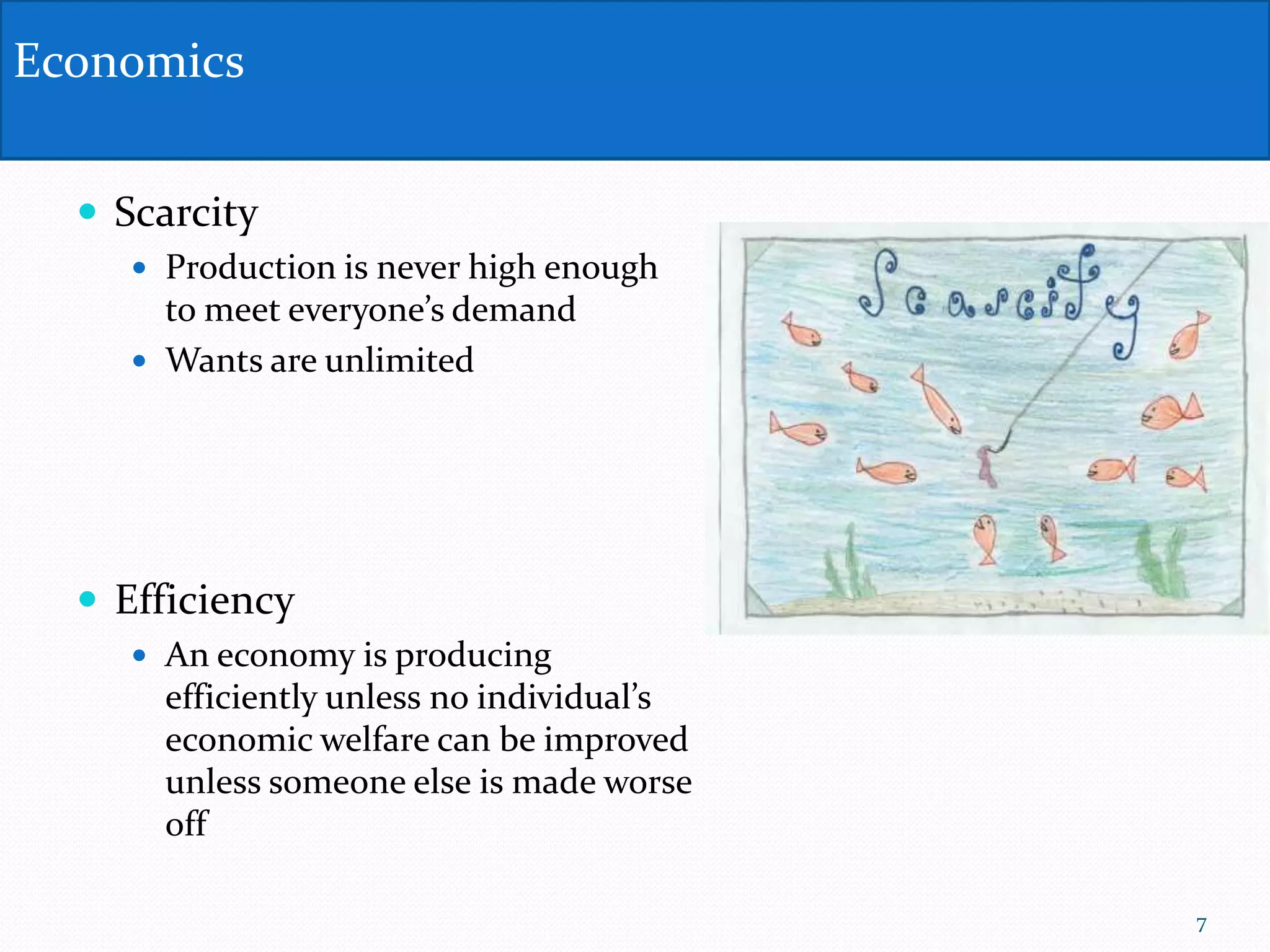
 Scarcity
 Production is never high enough
to meet everyone’s demand
 Wants are unlimited
 Efficiency
 An economy is producing
efficiently unless no individual’s
economic welfare can be improved
unless someone else is made worse
off
Economics
7
 Microeconomics
 Study of economics at smaller scale
 Adam Smith: Markets, Firms, & Households
 Wealth of Nations (1776): Determination of prices of land, labour, &
capital; and strength and weaknesses of market mechanism
 Macroeconomics
 Study of overall performance of the economy
 General Theory of Employment, Interest & Money, John M Keynes (1936)
 What causes business cycles, with alternating spells of high unemployment
and high inflation
 Fallacies Encountered in Economic Reasoning:
 The post hoc fallacy - causality
 Failure to hold other things constant
 The fallacy of composition
Basics of Economics
8
 Positive Economics
 Based on facts of an economy
 Normative Economics
 Involves ethical precepts and norms of fairness
Basics of Economics
9
 Types of Economies
 Market Economies: Individual and private firms make
the major decisions regarding production and
consumption (laissez-faire economy)
 Command Economies: Government makes all
important decisions about production and distribution
 Mixed Economies
Basics of Economics
10
 Limited Resources:
 Land
 Labour
 Energy
 Factories and tools
 Technical knowledge etc.
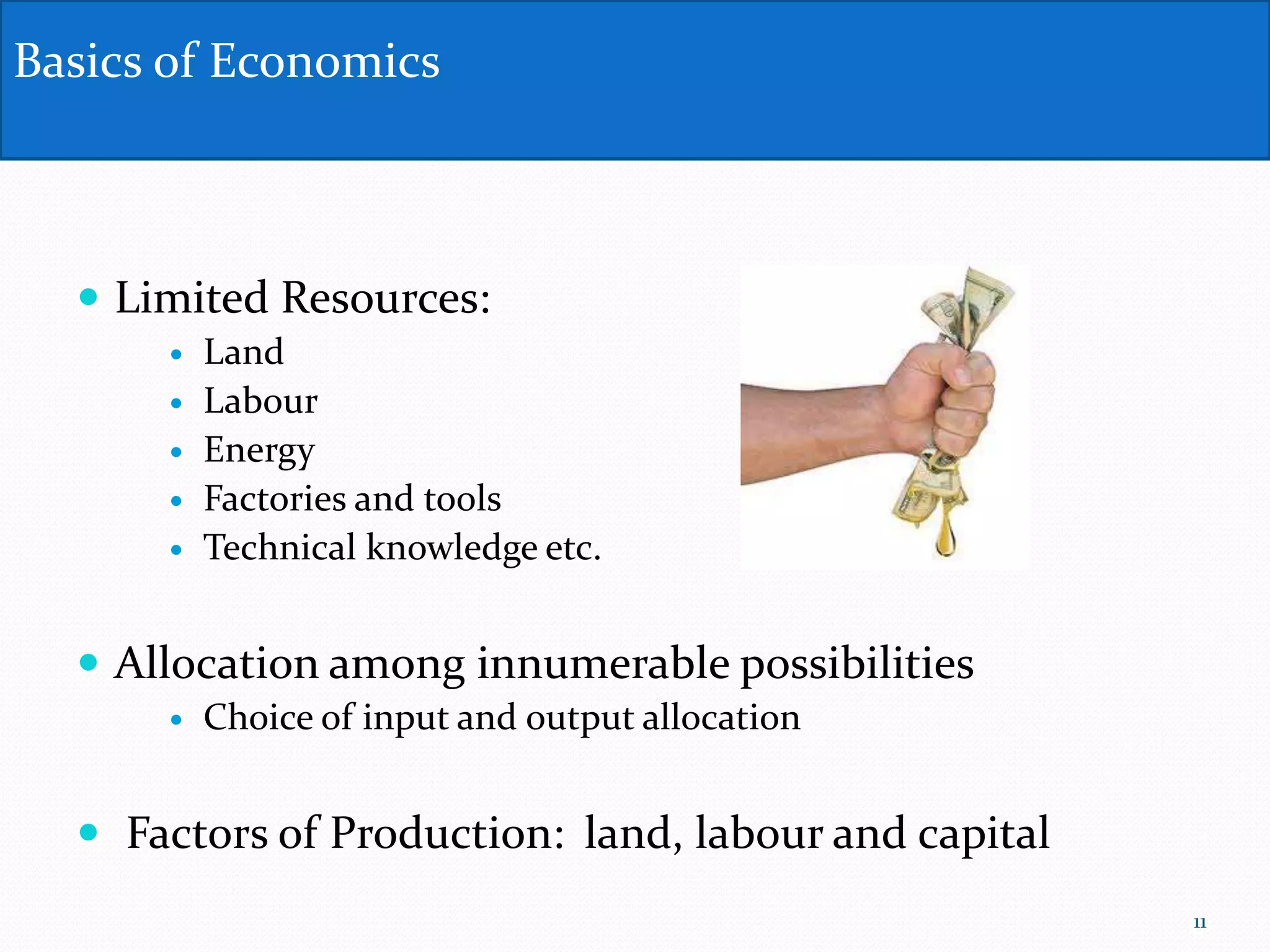
 Allocation among innumerable possibilities
 Choice of input and output allocation
 Factors of Production: land, labour and capital
Basics of Economics
11
Basics of Economics
12
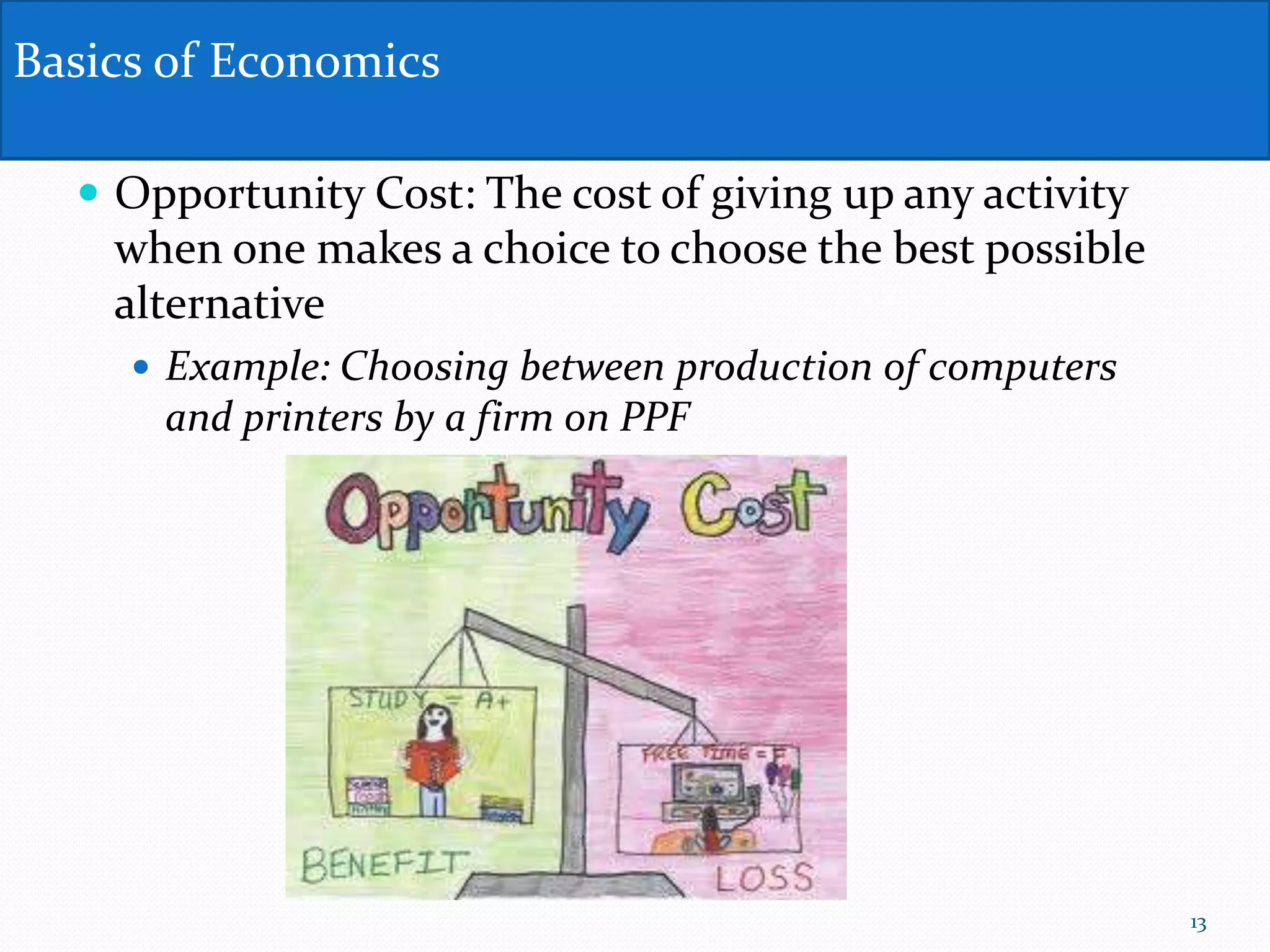
 Opportunity Cost: The cost of giving up any activity
when one makes a choice to choose the best possible
alternative
 Example: Choosing between production of computers
and printers by a firm on PPF
Basics of Economics
13
 Marginal Analysis: How much you get from using one
more unit
 Marginal Utility
 Marginal Product
 Marginal Revenue
 Marginal Cost
Basics of Economics
14
 Time Dimension:
 Short Run
 Operating period in which at least one factor of production is
in fixed supply
 Long Run
 Operating period in which all factors of production are in
variable supply
 Short Run Profits Vs Long Run Success of Business
Basics of Economics
15
 Limited Resources:
 Land
 Labour
 Energy
 Factories and tools
 Technical knowledge etc.
 Allocation among innumerable possibilities
 Choice of input and output allocation
 Factors of Production: land, labour and capital
Basics of Economics
16
 Inputs and Outputs
 The Production Possibility Frontier
 Application of PPFs
 Poor Vs High Income Nations
 Choice among Public and Private Goods
 Economic Growth
 Current Vs Future Consumption
 Unattainable Vs Inefficient Points on PPF
Society’s Technological Possibilities
17
Application of theory and tools of analysis of decision
science to examine how an organization can achieve its
aims and objectives most efficiently
Business Economics
18
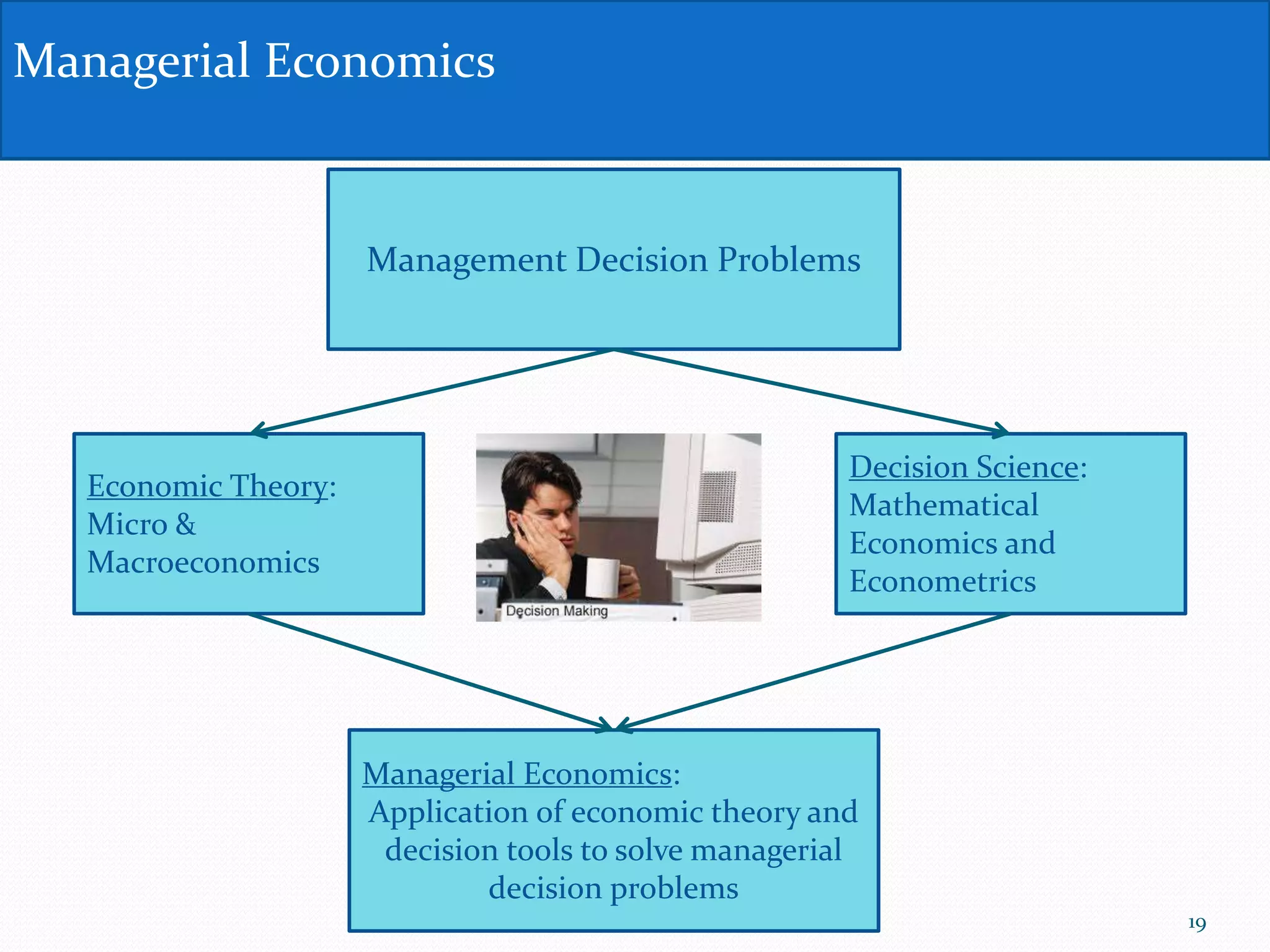
Managerial Economics
19
Management Decision Problems
Economic Theory:
Micro &
Macroeconomics
Managerial Economics:
Application of economic theory and
decision tools to solve managerial
decision problems
Decision Science:
Mathematical
Economics and
Econometrics
 Relationship to economic theory:
 Linked to individual firms investment decision,
production and preferences of consumers.
 Macroeconomic conditions in which a firm is
functioning.
 Economic theories aim to predict economic behaviour
 Theory of the firm is of utmost importance for
Managerial Economics
Relationship to Economic Theory
20
 Mathematical Economics is used to formalize the
economic models of economic theory in the form of an
equation
 Econometric tools are used to statistically analysis the
models using real world data
 The tools are used for forecasting as well.
 For Example: Demand of Education
Relationship to Decision Sciences
21
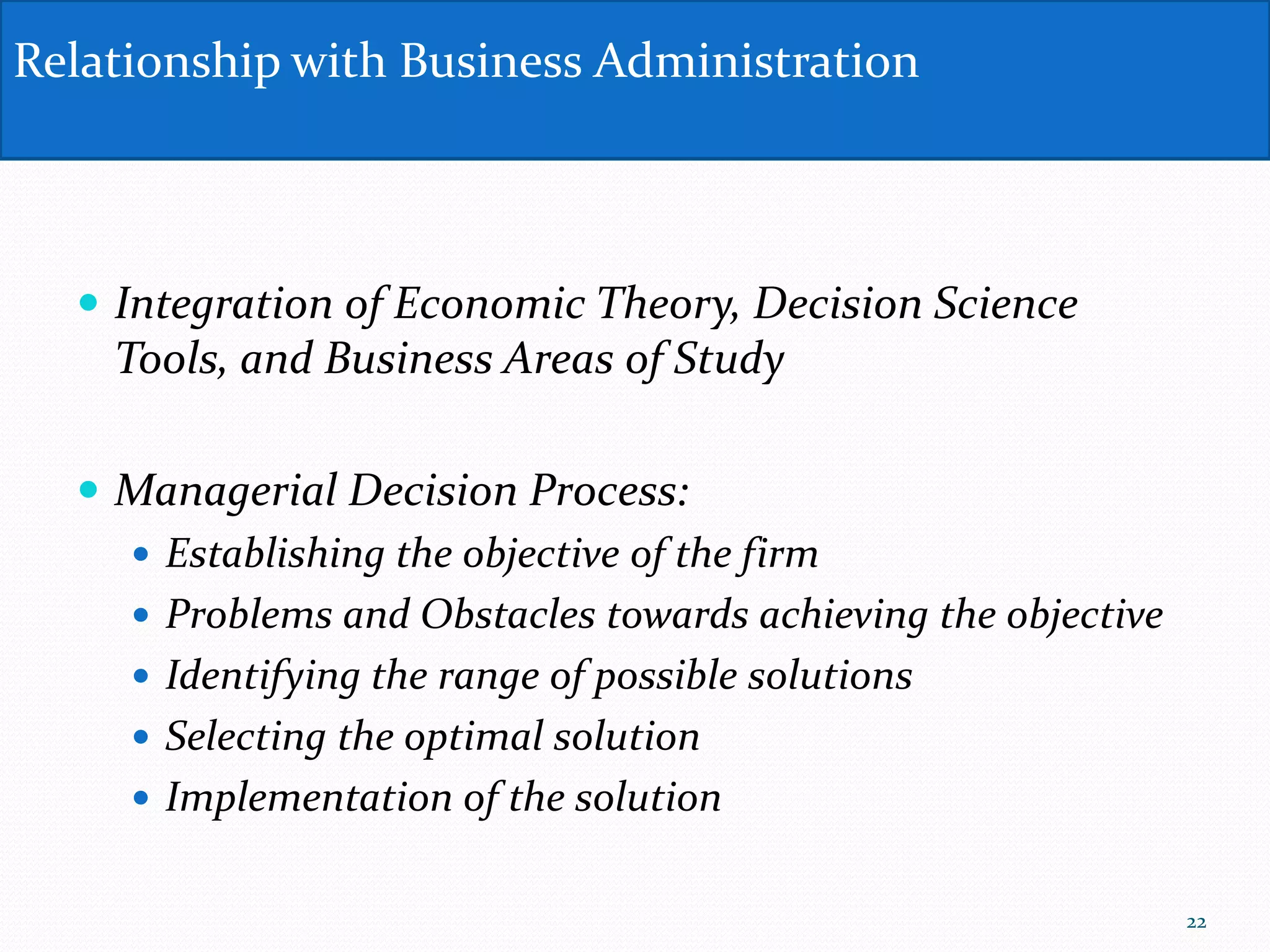
 Integration of Economic Theory, Decision Science
Tools, and Business Areas of Study
 Managerial Decision Process:
 Establishing the objective of the firm
 Problems and Obstacles towards achieving the objective
 Identifying the range of possible solutions
 Selecting the optimal solution
 Implementation of the solution
Relationship with Business Administration
22
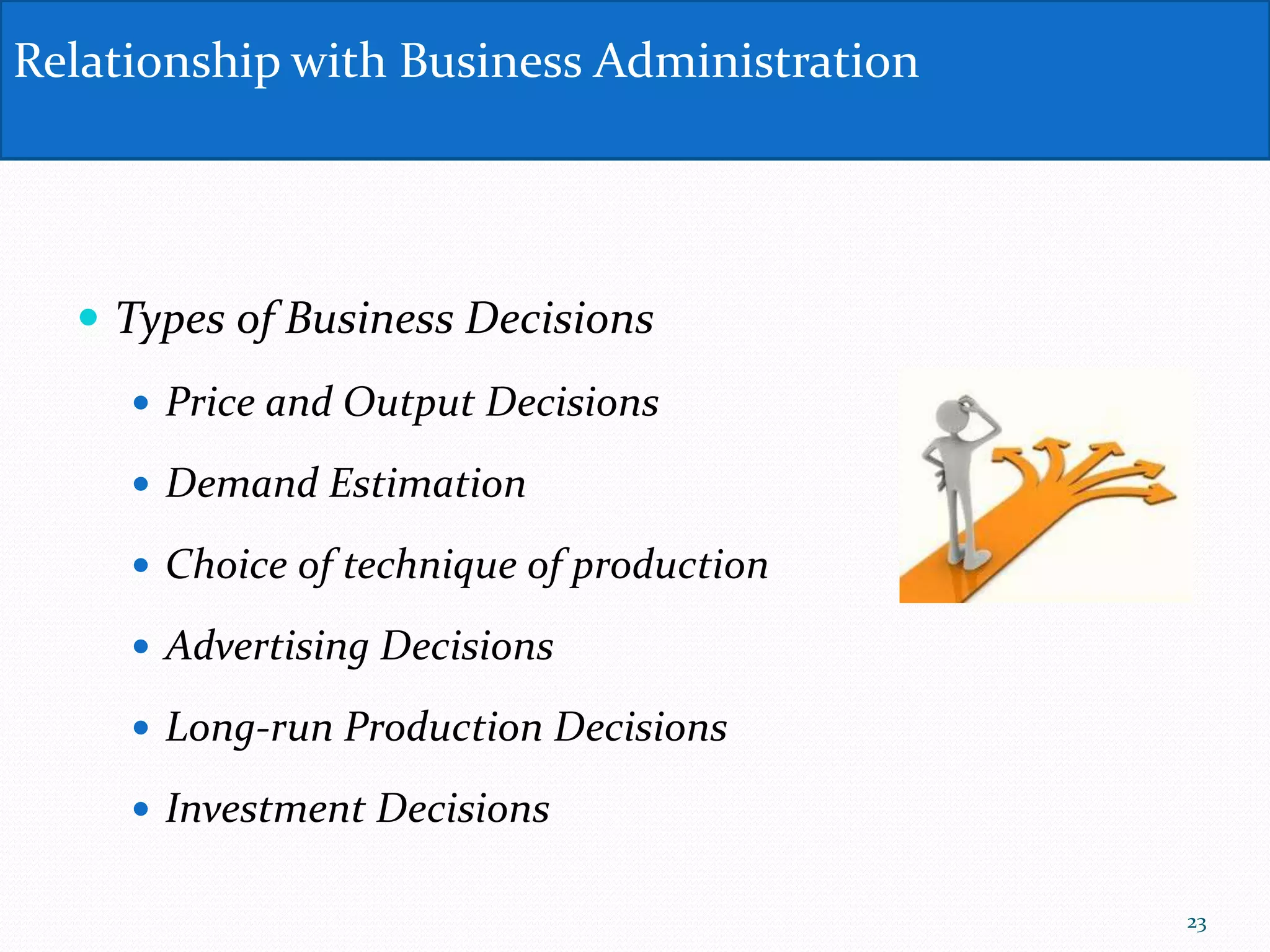
 Types of Business Decisions
 Price and Output Decisions
 Demand Estimation
 Choice of technique of production
 Advertising Decisions
 Long-run Production Decisions
 Investment Decisions
Relationship with Business Administration
23
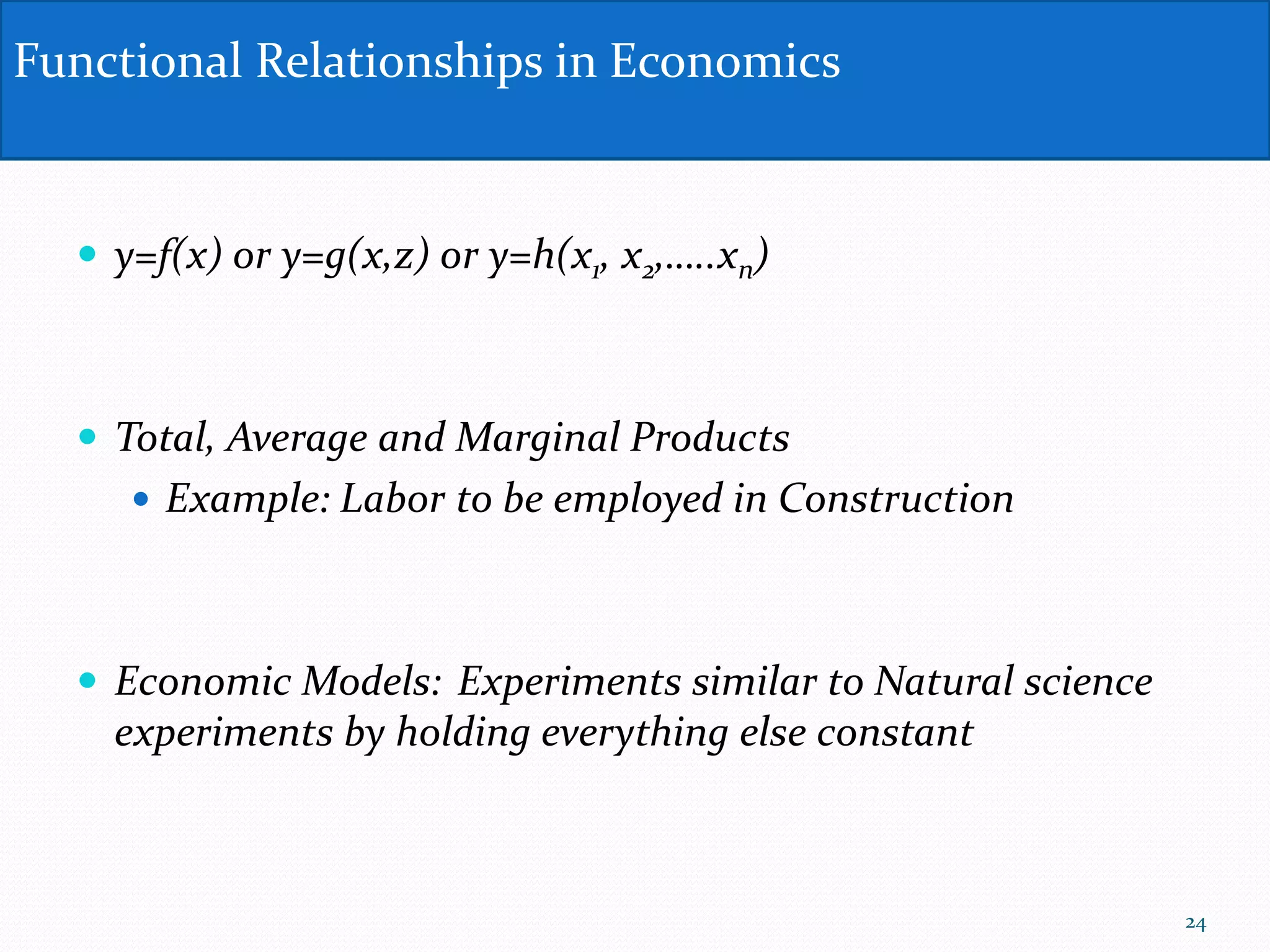
 y=f(x) or y=g(x,z) or y=h(x1, x2,…..xn)
 Total, Average and Marginal Products
 Example: Labor to be employed in Construction
 Economic Models: Experiments similar to Natural science
experiments by holding everything else constant
Functional Relationships in Economics
24
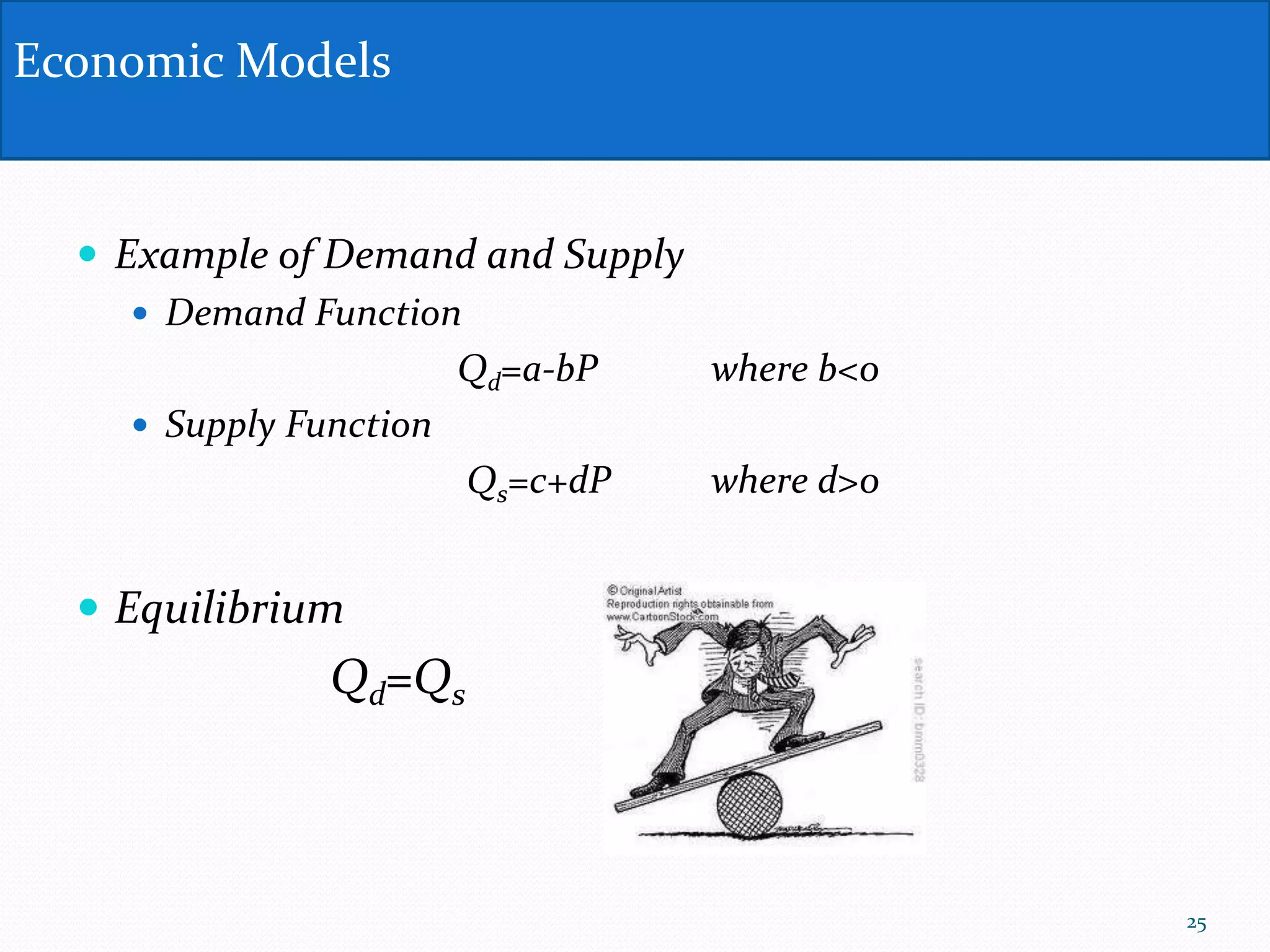
 Example of Demand and Supply
 Demand Function
Qd=a-bP where b<0
 Supply Function
Qs=c+dP where d>0
 Equilibrium
Qd=Qs
Economic Models
25

Business economics lecture_1

  • 1.
    Business Economics (ECO341) Fall Semester, 2012 Khurrum S. Mughal 1
  • 2.
     Required Texts& Readings:  Economics, 19th Edition by Paul A. Samuelson & William D. Nordhaus  Recommended Readings: Articles from  Economics, 4th Edition by David H. Hyman  Economist Weekly, Business Section. Course Material 2
  • 3.
     Class Participation5  Quizzes 10  Assignments 10  Presentation 10  Two Mid Term Examinations 25  Final Exam 40 100 Grading Criteria 3
  • 4.
  • 5.
  • 6.
     Definition:  Howsocieties use scarce resources to produce valuable goods and services and distribute them among different individuals. (Economics, 19th Edition by Paul A. Samuelson & William D. Nordhaus) Economics 6
  • 7.
     Scarcity  Productionis never high enough to meet everyone’s demand  Wants are unlimited  Efficiency  An economy is producing efficiently unless no individual’s economic welfare can be improved unless someone else is made worse off Economics 7
  • 8.
     Microeconomics  Studyof economics at smaller scale  Adam Smith: Markets, Firms, & Households  Wealth of Nations (1776): Determination of prices of land, labour, & capital; and strength and weaknesses of market mechanism  Macroeconomics  Study of overall performance of the economy  General Theory of Employment, Interest & Money, John M Keynes (1936)  What causes business cycles, with alternating spells of high unemployment and high inflation  Fallacies Encountered in Economic Reasoning:  The post hoc fallacy - causality  Failure to hold other things constant  The fallacy of composition Basics of Economics 8
  • 9.
     Positive Economics Based on facts of an economy  Normative Economics  Involves ethical precepts and norms of fairness Basics of Economics 9
  • 10.
     Types ofEconomies  Market Economies: Individual and private firms make the major decisions regarding production and consumption (laissez-faire economy)  Command Economies: Government makes all important decisions about production and distribution  Mixed Economies Basics of Economics 10
  • 11.
     Limited Resources: Land  Labour  Energy  Factories and tools  Technical knowledge etc.  Allocation among innumerable possibilities  Choice of input and output allocation  Factors of Production: land, labour and capital Basics of Economics 11
  • 12.
  • 13.
     Opportunity Cost:The cost of giving up any activity when one makes a choice to choose the best possible alternative  Example: Choosing between production of computers and printers by a firm on PPF Basics of Economics 13
  • 14.
     Marginal Analysis:How much you get from using one more unit  Marginal Utility  Marginal Product  Marginal Revenue  Marginal Cost Basics of Economics 14
  • 15.
     Time Dimension: Short Run  Operating period in which at least one factor of production is in fixed supply  Long Run  Operating period in which all factors of production are in variable supply  Short Run Profits Vs Long Run Success of Business Basics of Economics 15
  • 16.
     Limited Resources: Land  Labour  Energy  Factories and tools  Technical knowledge etc.  Allocation among innumerable possibilities  Choice of input and output allocation  Factors of Production: land, labour and capital Basics of Economics 16
  • 17.
     Inputs andOutputs  The Production Possibility Frontier  Application of PPFs  Poor Vs High Income Nations  Choice among Public and Private Goods  Economic Growth  Current Vs Future Consumption  Unattainable Vs Inefficient Points on PPF Society’s Technological Possibilities 17
  • 18.
    Application of theoryand tools of analysis of decision science to examine how an organization can achieve its aims and objectives most efficiently Business Economics 18
  • 19.
    Managerial Economics 19 Management DecisionProblems Economic Theory: Micro & Macroeconomics Managerial Economics: Application of economic theory and decision tools to solve managerial decision problems Decision Science: Mathematical Economics and Econometrics
  • 20.
     Relationship toeconomic theory:  Linked to individual firms investment decision, production and preferences of consumers.  Macroeconomic conditions in which a firm is functioning.  Economic theories aim to predict economic behaviour  Theory of the firm is of utmost importance for Managerial Economics Relationship to Economic Theory 20
  • 21.
     Mathematical Economicsis used to formalize the economic models of economic theory in the form of an equation  Econometric tools are used to statistically analysis the models using real world data  The tools are used for forecasting as well.  For Example: Demand of Education Relationship to Decision Sciences 21
  • 22.
     Integration ofEconomic Theory, Decision Science Tools, and Business Areas of Study  Managerial Decision Process:  Establishing the objective of the firm  Problems and Obstacles towards achieving the objective  Identifying the range of possible solutions  Selecting the optimal solution  Implementation of the solution Relationship with Business Administration 22
  • 23.
     Types ofBusiness Decisions  Price and Output Decisions  Demand Estimation  Choice of technique of production  Advertising Decisions  Long-run Production Decisions  Investment Decisions Relationship with Business Administration 23
  • 24.
     y=f(x) ory=g(x,z) or y=h(x1, x2,…..xn)  Total, Average and Marginal Products  Example: Labor to be employed in Construction  Economic Models: Experiments similar to Natural science experiments by holding everything else constant Functional Relationships in Economics 24
  • 25.
     Example ofDemand and Supply  Demand Function Qd=a-bP where b<0  Supply Function Qs=c+dP where d>0  Equilibrium Qd=Qs Economic Models 25