From Crisis To Opportunity
Business Continuity Management

Satya Yadav
Recon Business Advisory (P) Ltd
www.reconglobal.in
OBJECTIVE

To provide a basic appreciation on the importance of
Business Continuity Management.

To provide an overview on implementing BCM.
BUSINESS CONTINUITY MANAGEMENT
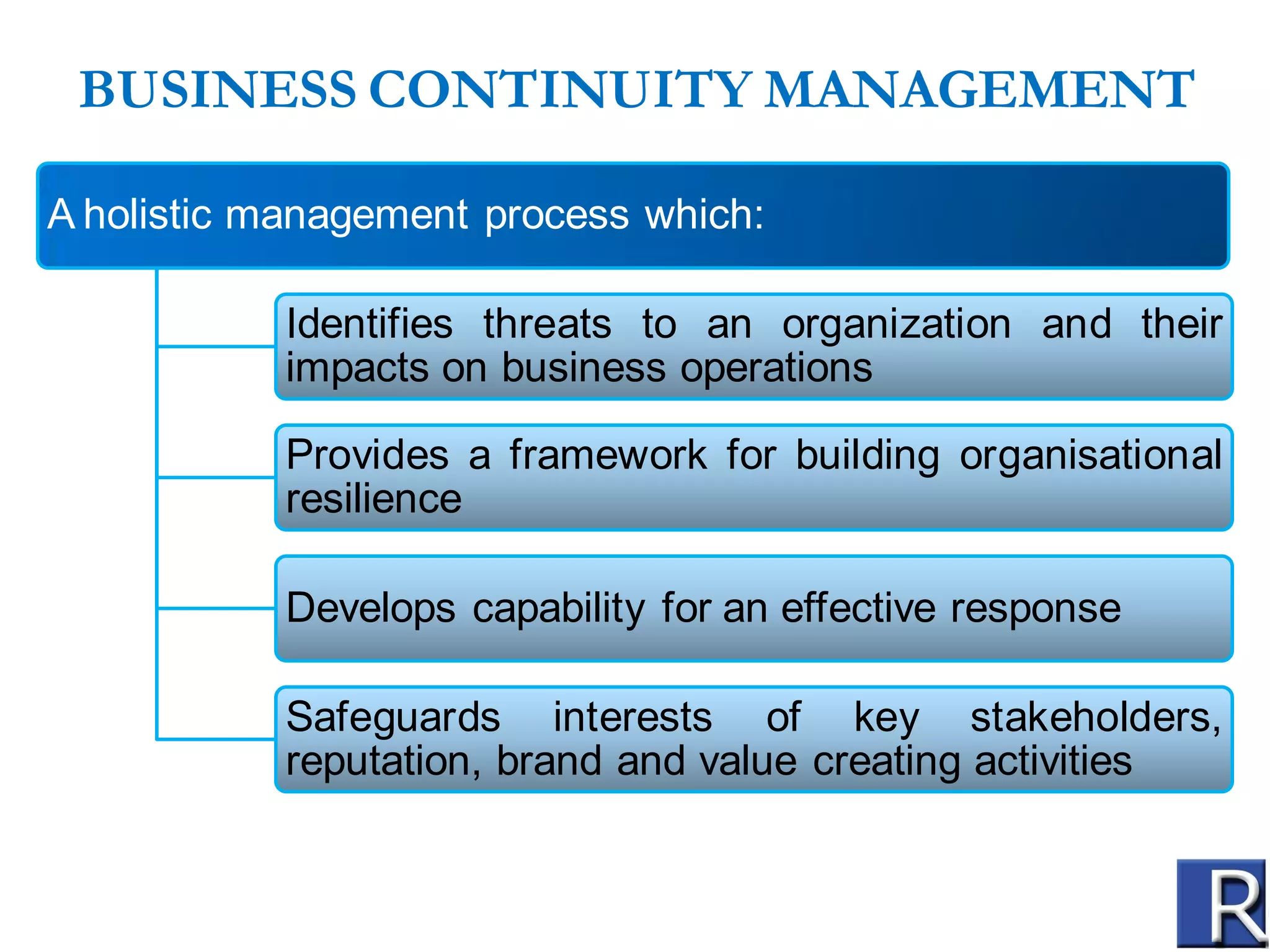
A holistic management process which:
Identifies threats to an organization and their
impacts on business operations
Provides a framework for building organisational
resilience
Develops capability for an effective response

Safeguards interests of key stakeholders,
reputation, brand and value creating activities
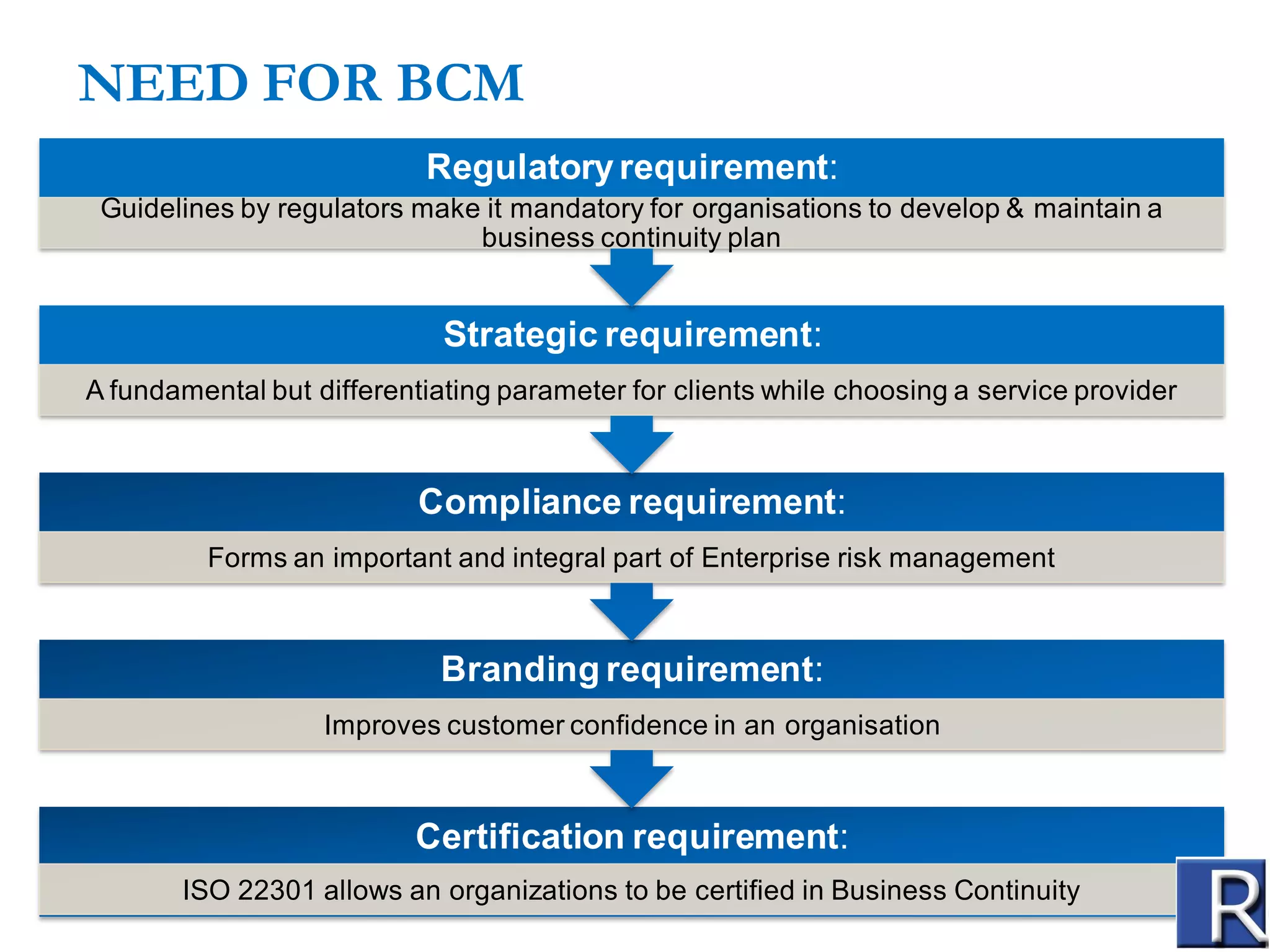
NEED FOR BCM
Regulatory requirement:
Guidelines by regulators make it mandatory for organisations to develop & maintain a
business continuity plan

Strategic requirement:
A fundamental but differentiating parameter for clients while choosing a service provider

Compliance requirement:
Forms an important and integral part of Enterprise risk management

Branding requirement:
Improves customer confidence in an organisation

Certification requirement:
ISO 22301 allows an organizations to be certified in Business Continuity
HISTORY OF BCM
Holistic
Contingency Plans

Organisation wide
Contingency Plans

IT or Technical
Contingency Plans

3

2

Alternative
Planning/Plan B

1

4

Business Continuity
Planning

Disaster recovery
Planning
Fallback Plans,
Contingency
Plans

Business Continuity
Management
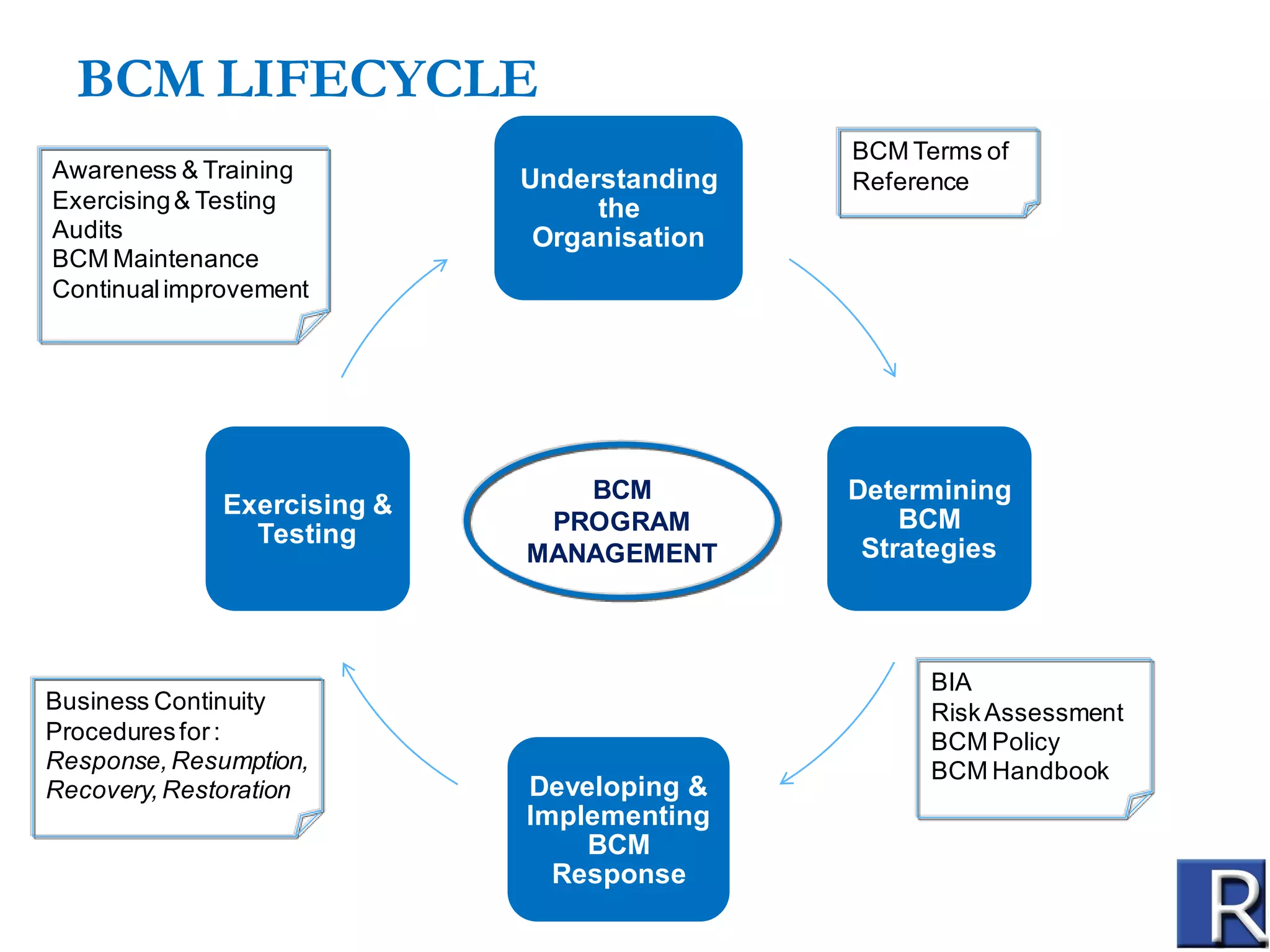
BCM LIFECYCLE
Awareness & Training
Exercising & Testing
Audits
BCM Maintenance
Continual improvement

Exercising &
Testing

Business Continuity
Procedures for :
Response, Resumption,
Recovery, Restoration

Understanding
the
Organisation

BCM
PROGRAM
MANAGEMENT

Developing &
Implementing
BCM
Response

BCM Terms of
Reference

Determining
BCM
Strategies

BIA
Risk Assessment
BCM Policy
BCM Handbook
PHASES OF BCMS
Monitor
&
Response

Recover
&
Resume

Rectify
&
Restore

Migrate
&
Normalize

PHASES

Prevention

Response

Recovery &
Resumption

Restoration

Normalisation

Emergency
Response,
Crisis
Management,
Public Relations

Business
Resumption
Plans, Disaster
Recovery Plan

Damage
Restoration,
Includes
installation &
commissioning

Migration, Restart
of all business
functions, Stand
Down

ACTIONS

Risk Management

Pre - Incident

Incident

Post - Incident
WHY WE NEED BCM STANDARDS?

Suppliers
Customer
Regulators

Your
Organisation

Business
Partners

Vendors

System Up Time (computing, data,networks, etc.)

Environment

Legal & Regulatory Duties

Infrastructure Dependence (power, voice, data,
logistics, food)
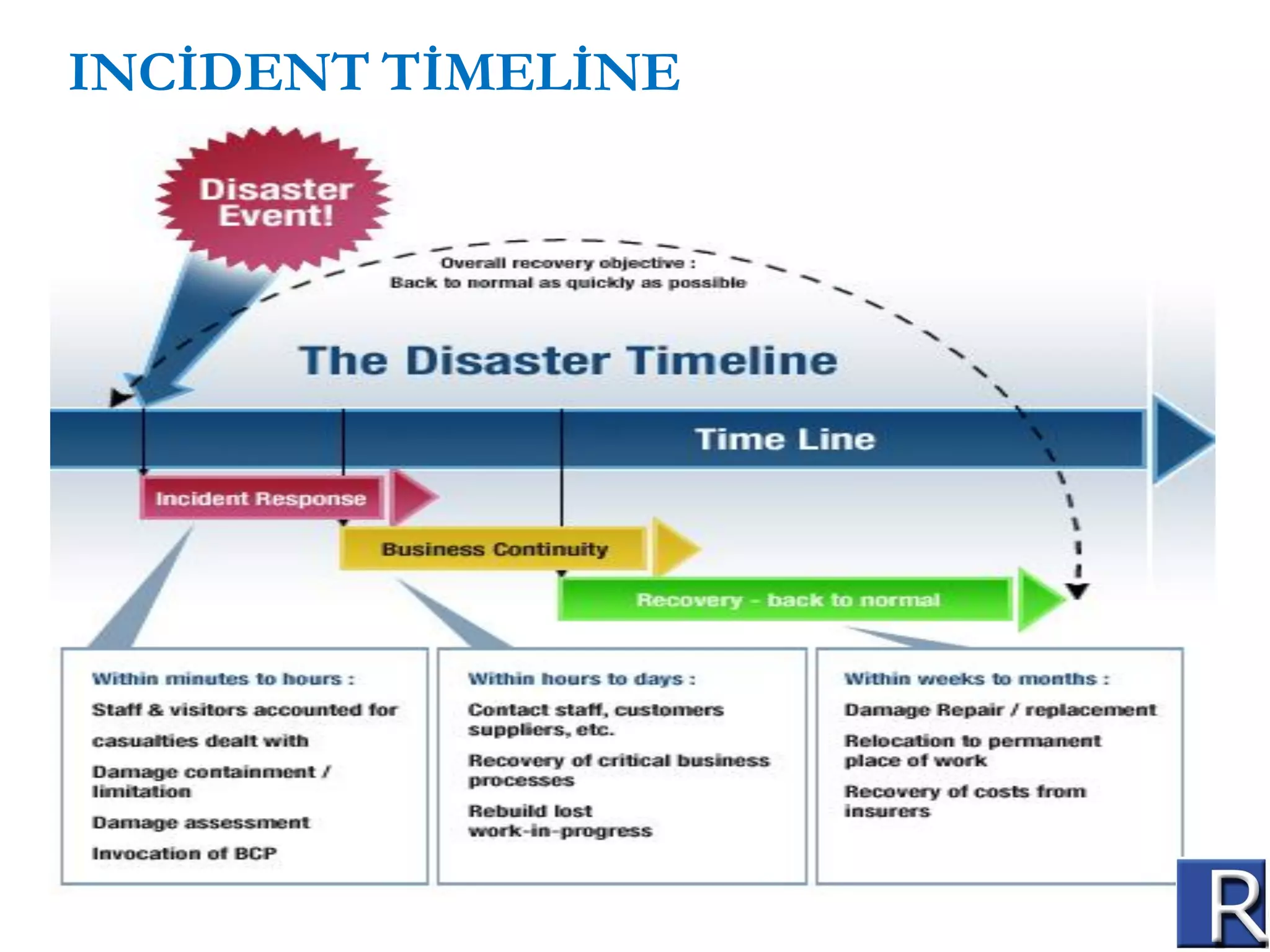
INCİDENT TİMELİNE
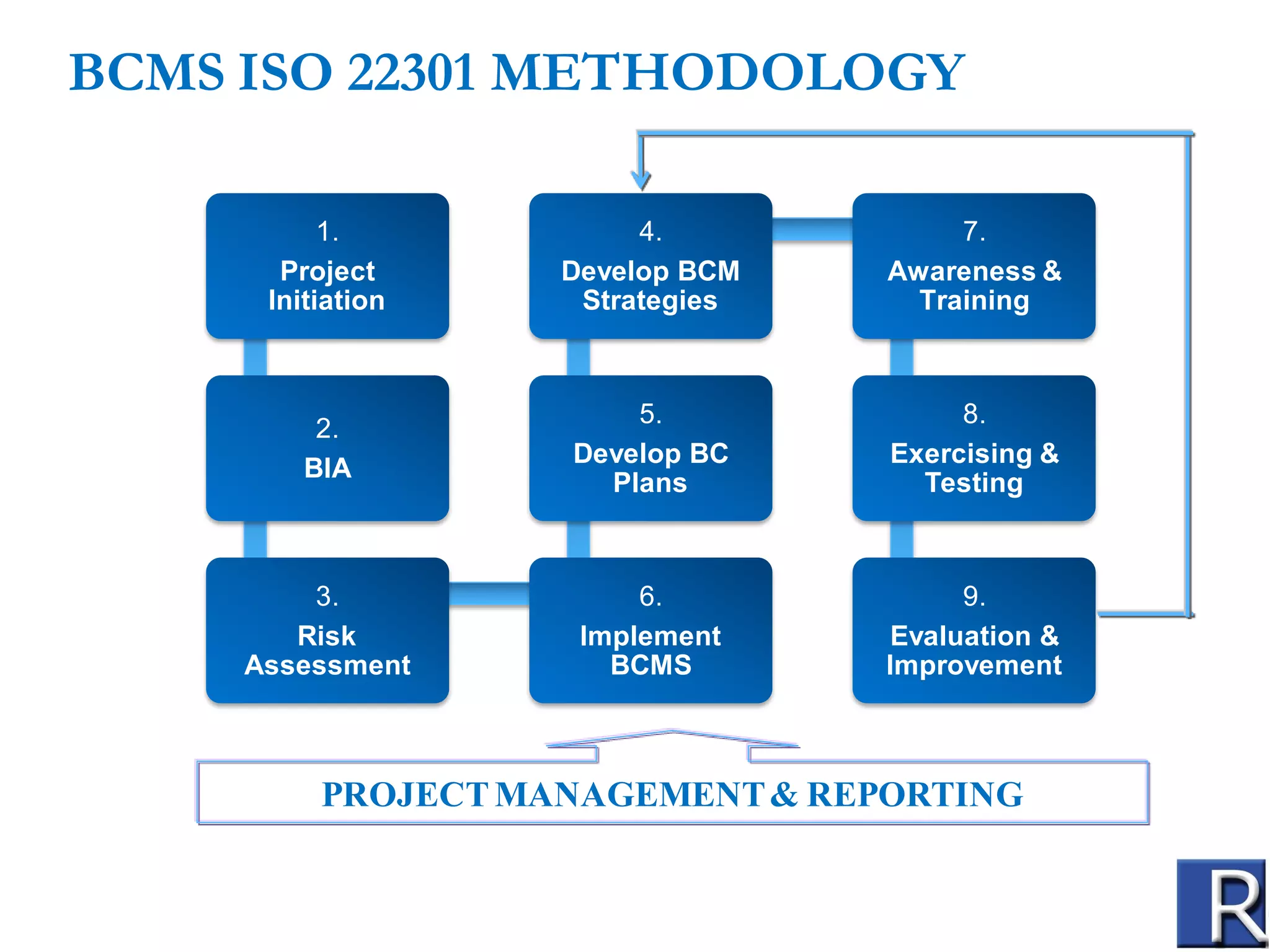
BCMS ISO 22301 METHODOLOGY
1.
Project
Initiation

4.
Develop BCM
Strategies

7.
Awareness &
Training

2.
BIA

5.
Develop BC
Plans

8.
Exercising &
Testing

3.
Risk
Assessment

6.
Implement
BCMS

9.
Evaluation &
Improvement

PROJECT MANAGEMENT & REPORTING
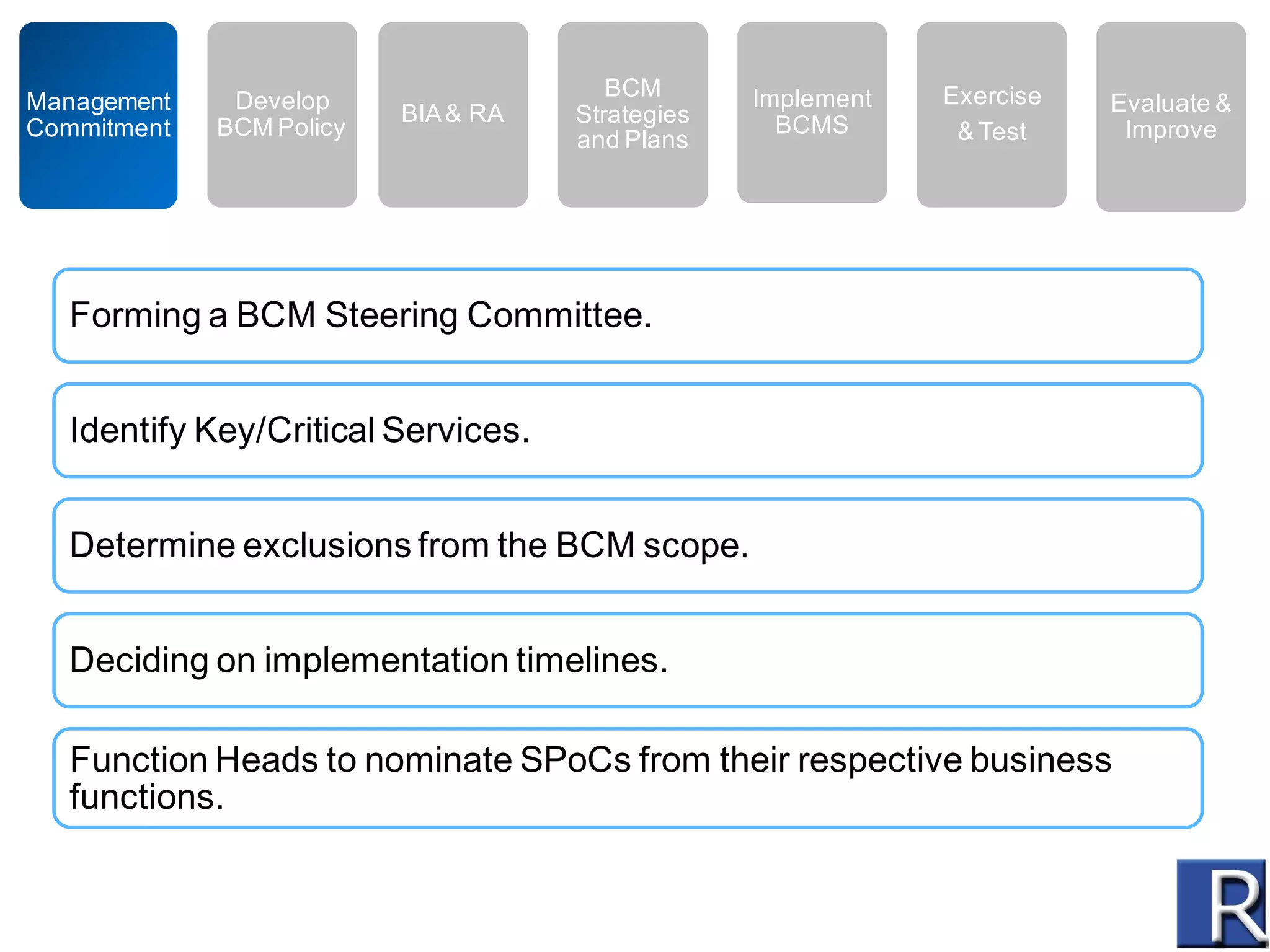
Management
Commitment

Develop
BCM Policy

BIA & RA

BCM
Strategies
and Plans

Implement
BCMS

Exercise
& Test

Evaluate &
Improve

Forming a BCM Steering Committee.
Identify Key/Critical Services.
Determine exclusions from the BCM scope.
Deciding on implementation timelines.
Function Heads to nominate SPoCs from their respective business
functions.
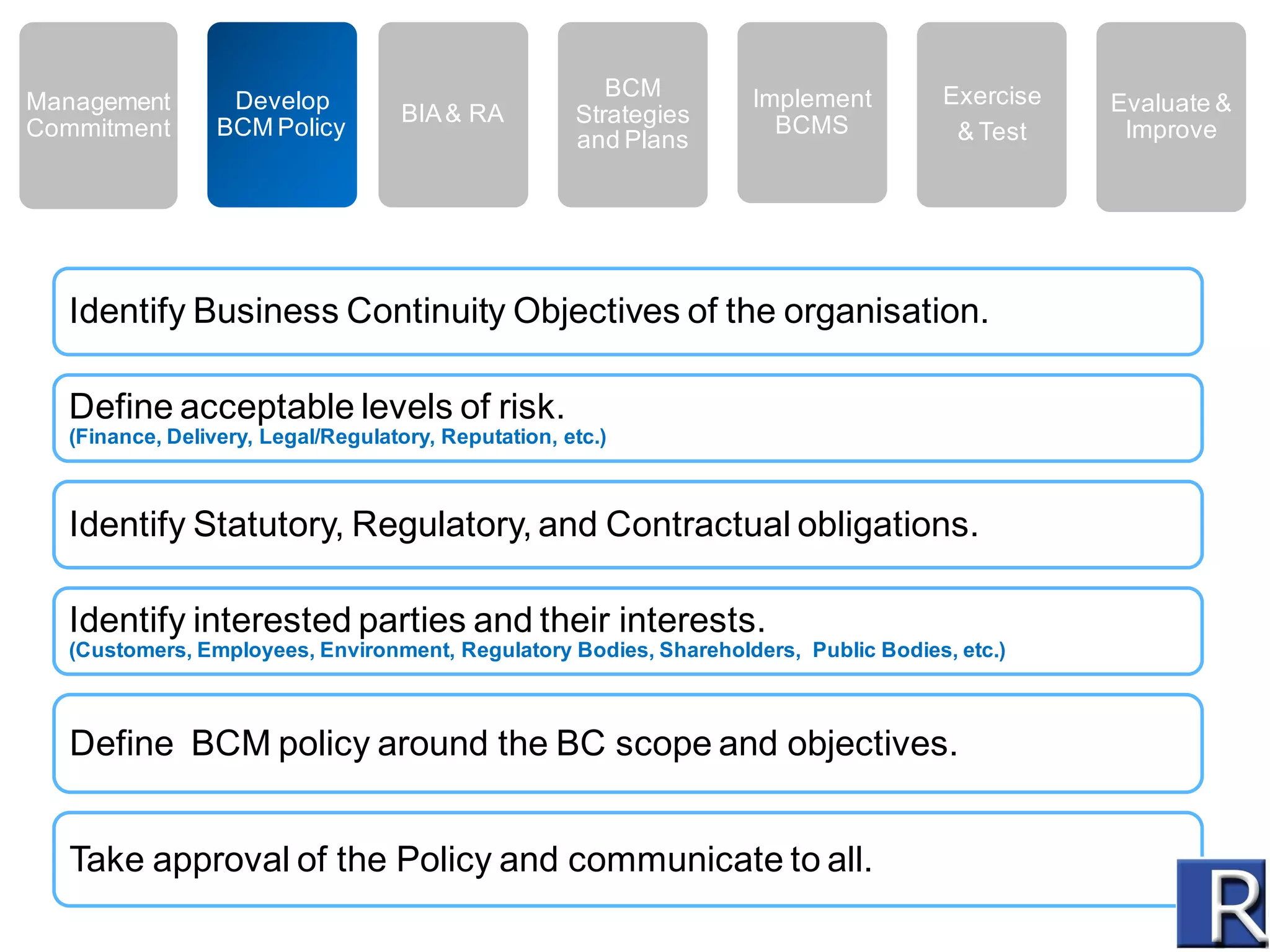
Management
Commitment

Develop
BCM Policy

BIA & RA

BCM
Strategies
and Plans

Implement
BCMS

Exercise
& Test

Identify Business Continuity Objectives of the organisation.
Define acceptable levels of risk.
(Finance, Delivery, Legal/Regulatory, Reputation, etc.)

Identify Statutory, Regulatory, and Contractual obligations.
Identify interested parties and their interests.
(Customers, Employees, Environment, Regulatory Bodies, Shareholders, Public Bodies, etc.)

Define BCM policy around the BC scope and objectives.
Take approval of the Policy and communicate to all.

Evaluate &
Improve
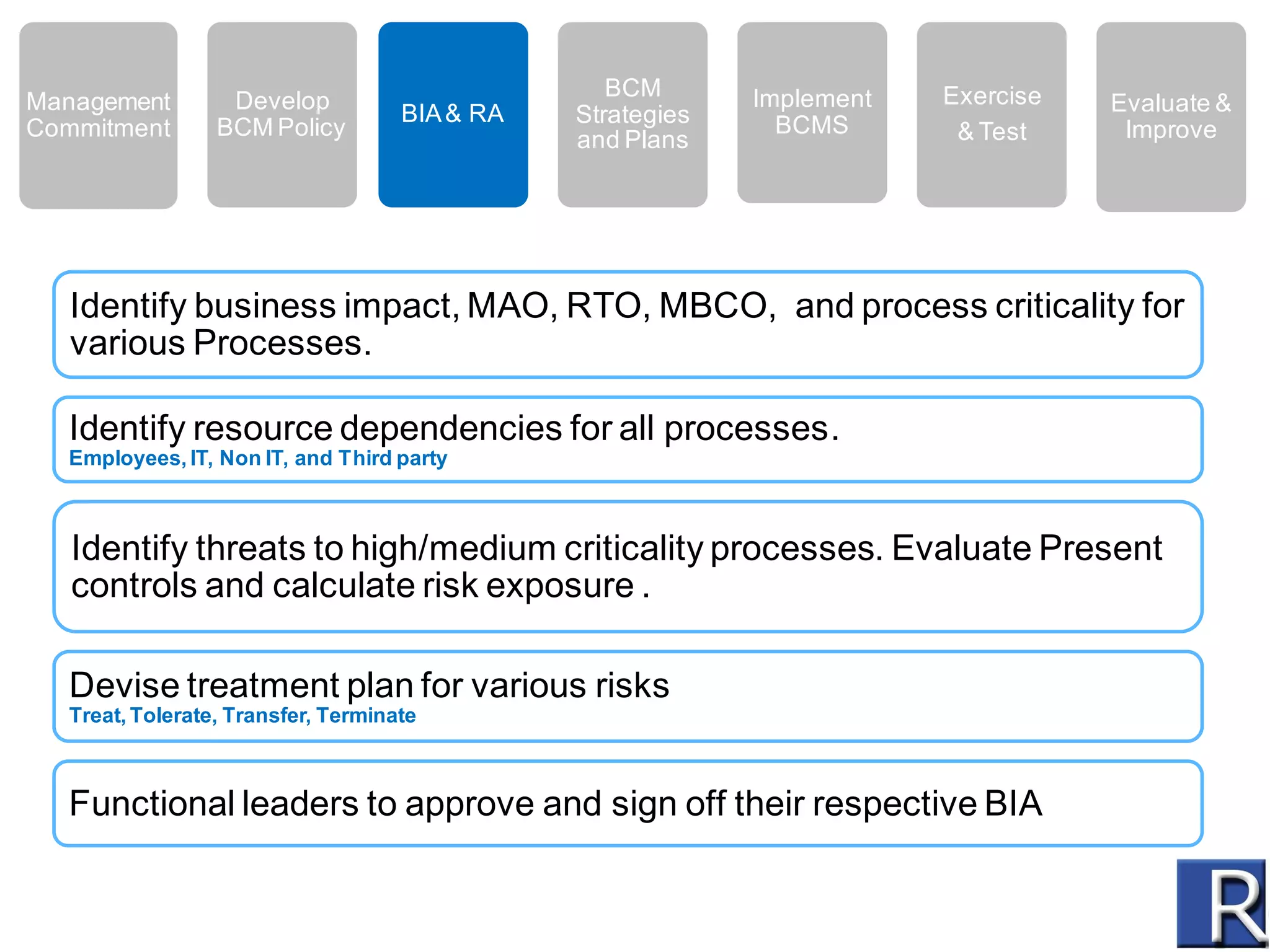
Management
Commitment

Develop
BCM Policy

BIA & RA

BCM
Strategies
and Plans

Implement
BCMS

Exercise
& Test

Evaluate &
Improve

Identify business impact, MAO, RTO, MBCO, and process criticality for
various Processes.
Identify resource dependencies for all processes.
Employees, IT, Non IT, and Third party

Identify threats to high/medium criticality processes. Evaluate Present
controls and calculate risk exposure .
Devise treatment plan for various risks
Treat, Tolerate, Transfer, Terminate

Functional leaders to approve and sign off their respective BIA
Management
Commitment

Develop
BCM Policy

BIA & RA

BCM
Strategies
and Plans

Implement
BCMS

Exercise
& Test

Determine number of processes with critical RTO
Determine the resource requirements for these Processes
Determine backup options for resuming these processes after an
incident
Cost Benefit Analysis and finalise continuity strategies
Devise BCM Plans
Incident Response, IT DR, Work-area recovery, BCP, Crisis Communication, etc.

Evaluate &
Improve
Management
Commitment

Develop
BCM Policy

BIA & RA

BCM
Strategies
and Plans

Implement
BCMS

Exercise
& Test

Evaluate &
Improve

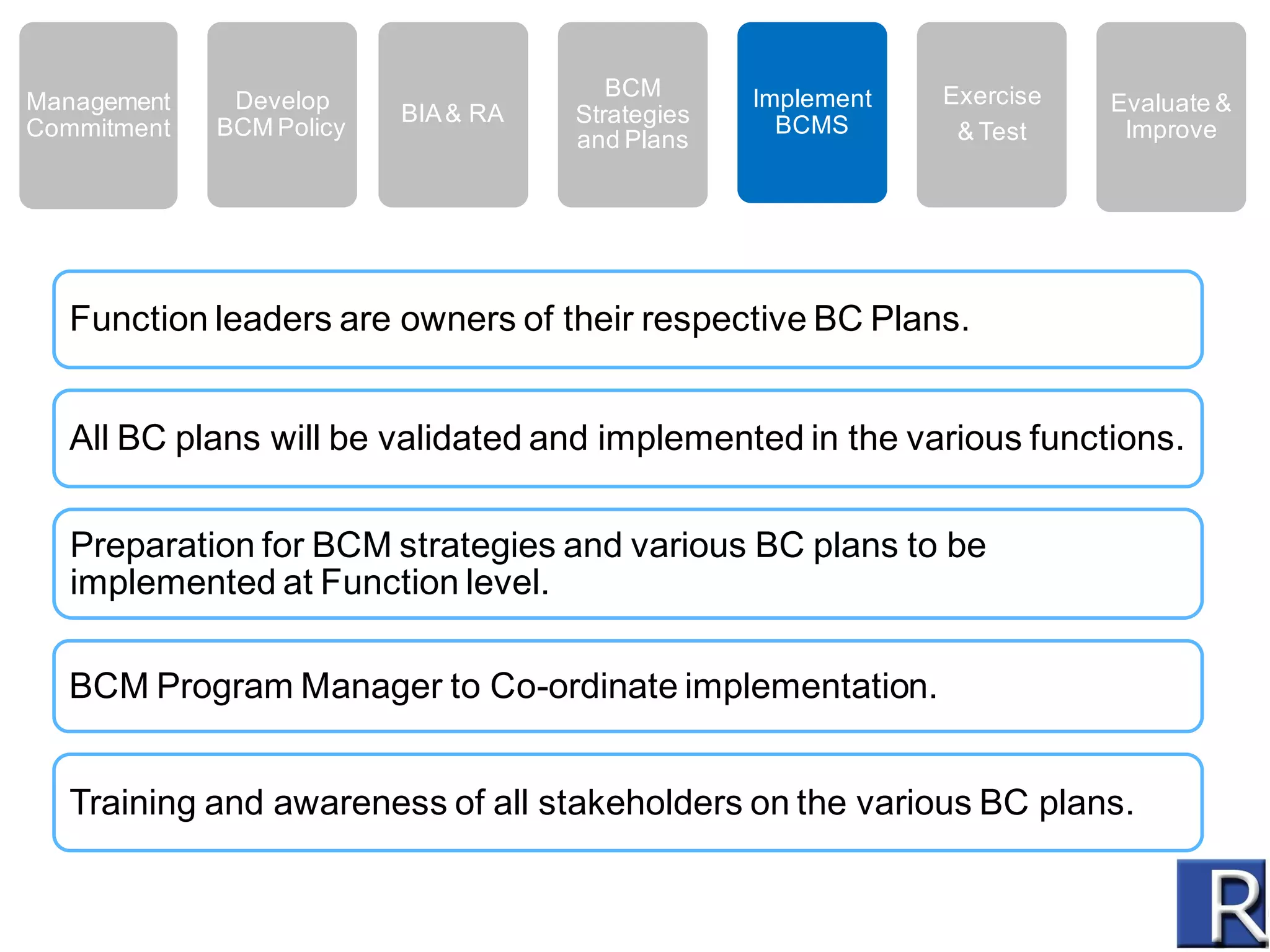
Function leaders are owners of their respective BC Plans.
All BC plans will be validated and implemented in the various functions.
Preparation for BCM strategies and various BC plans to be
implemented at Function level.
BCM Program Manager to Co-ordinate implementation.
Training and awareness of all stakeholders on the various BC plans.
Management
Commitment

Develop
BCM Policy

BIA & RA

BCM
Strategies
and Plans

Implement
BCMS

Exercise
& Test

Evaluate &
Improve

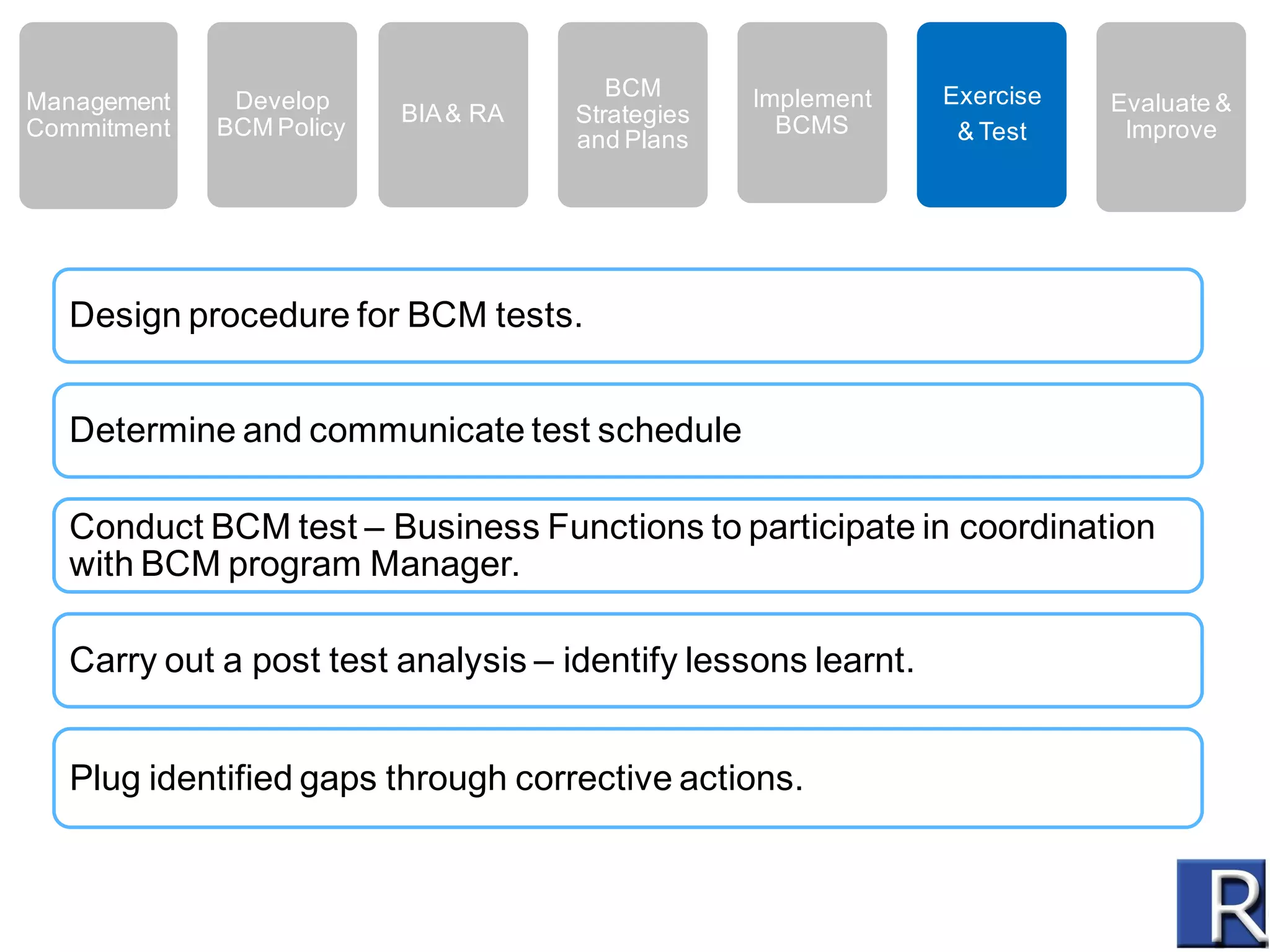
Design procedure for BCM tests.
Determine and communicate test schedule
Conduct BCM test – Business Functions to participate in coordination
with BCM program Manager.
Carry out a post test analysis – identify lessons learnt.
Plug identified gaps through corrective actions.
Management
Commitment

Develop
BCM Policy

BIA & RA

BCM
Strategies
and Plans

Implement
BCMS

Exercise
& Test

Evaluate &
Improve

Carry out Corrections/Corrective actions on the occurrence of any
incident/audits/tests, etc.

Function Heads to assign SPoCs to carry out corrective actions,
periodic review, and maintenance of BC Plans.
Need based or scheduled review of BC Policy, BCM objectives, BIA,
RA, BC plans, etc.
Incorporate changes after review, if required.
Continual improvement of BCMS – All business functions to proactively
participate.
TAKE AWAYS
BCM is a program and not a project.
The initial development of a BC Plan is a tedious and time consuming activity.
It needs to be given adequate attention to be successful (i.e. workable)
The responsibility and success of BCM rests on every business Function’s
shoulder.
All Functions have to earmark BCM SPoCs and spare them for BCM
participation for a minimum no. of man-hours each month.
All Head of Functions are owners of their Function’s Business Continuity.
There participation is absolutely necessary.
Top Management support and participation is absolutely necessary.
An annual budget should be allocated for the running & maintenance of the
BCM program
Recon Business Advisory
Recon is a premium business risk consultancy committed to the Growth, Security, and
Continuity objectives of its clients. Through the breadth of our service offerings and the depth
of our domain expertise we ensure that you enjoy the highest standards of service delivery on
time, every time. We are a passionate lot, enjoy what we do, and excited at opportunities to
delight our clients with our industry leading delivery.

Our Continuity Practice provides the following services:
1. Current state assessments of your organisation’s BCMS

2. Planning, Implementing, and Testing your BCMS

3. Preparing your organisation for ISO 22301 Certification

4. Training programs on – Business impact analysis, Risk Assessment, BCM, etc.
5. BCM Awareness Tools - Off the shelf / Custom designed Posters, Wallpapers,
Screensavers, Games, Audio/Video awareness tools, etc.
Plans Are Nothing,

Planning Is Everything!

Recon Business Advisory (P) Ltd
www.reconglobal.in | info@reconglobal.in
New Delhi - +91 813098 6963 | 011-6464 6963

Business continuity management www.reconglobal.in

  • 1.
    From Crisis ToOpportunity Business Continuity Management Satya Yadav Recon Business Advisory (P) Ltd www.reconglobal.in
  • 2.
    OBJECTIVE To provide abasic appreciation on the importance of Business Continuity Management. To provide an overview on implementing BCM.
  • 3.
    BUSINESS CONTINUITY MANAGEMENT Aholistic management process which: Identifies threats to an organization and their impacts on business operations Provides a framework for building organisational resilience Develops capability for an effective response Safeguards interests of key stakeholders, reputation, brand and value creating activities
  • 4.
    NEED FOR BCM Regulatoryrequirement: Guidelines by regulators make it mandatory for organisations to develop & maintain a business continuity plan Strategic requirement: A fundamental but differentiating parameter for clients while choosing a service provider Compliance requirement: Forms an important and integral part of Enterprise risk management Branding requirement: Improves customer confidence in an organisation Certification requirement: ISO 22301 allows an organizations to be certified in Business Continuity
  • 5.
    HISTORY OF BCM Holistic ContingencyPlans Organisation wide Contingency Plans IT or Technical Contingency Plans 3 2 Alternative Planning/Plan B 1 4 Business Continuity Planning Disaster recovery Planning Fallback Plans, Contingency Plans Business Continuity Management
  • 6.
    BCM LIFECYCLE Awareness &Training Exercising & Testing Audits BCM Maintenance Continual improvement Exercising & Testing Business Continuity Procedures for : Response, Resumption, Recovery, Restoration Understanding the Organisation BCM PROGRAM MANAGEMENT Developing & Implementing BCM Response BCM Terms of Reference Determining BCM Strategies BIA Risk Assessment BCM Policy BCM Handbook
  • 7.
    PHASES OF BCMS Monitor & Response Recover & Resume Rectify & Restore Migrate & Normalize PHASES Prevention Response Recovery& Resumption Restoration Normalisation Emergency Response, Crisis Management, Public Relations Business Resumption Plans, Disaster Recovery Plan Damage Restoration, Includes installation & commissioning Migration, Restart of all business functions, Stand Down ACTIONS Risk Management Pre - Incident Incident Post - Incident
  • 8.
    WHY WE NEEDBCM STANDARDS? Suppliers Customer Regulators Your Organisation Business Partners Vendors System Up Time (computing, data,networks, etc.) Environment Legal & Regulatory Duties Infrastructure Dependence (power, voice, data, logistics, food)
  • 9.
  • 10.
    BCMS ISO 22301METHODOLOGY 1. Project Initiation 4. Develop BCM Strategies 7. Awareness & Training 2. BIA 5. Develop BC Plans 8. Exercising & Testing 3. Risk Assessment 6. Implement BCMS 9. Evaluation & Improvement PROJECT MANAGEMENT & REPORTING
  • 11.
    Management Commitment Develop BCM Policy BIA &RA BCM Strategies and Plans Implement BCMS Exercise & Test Evaluate & Improve Forming a BCM Steering Committee. Identify Key/Critical Services. Determine exclusions from the BCM scope. Deciding on implementation timelines. Function Heads to nominate SPoCs from their respective business functions.
  • 12.
    Management Commitment Develop BCM Policy BIA &RA BCM Strategies and Plans Implement BCMS Exercise & Test Identify Business Continuity Objectives of the organisation. Define acceptable levels of risk. (Finance, Delivery, Legal/Regulatory, Reputation, etc.) Identify Statutory, Regulatory, and Contractual obligations. Identify interested parties and their interests. (Customers, Employees, Environment, Regulatory Bodies, Shareholders, Public Bodies, etc.) Define BCM policy around the BC scope and objectives. Take approval of the Policy and communicate to all. Evaluate & Improve
  • 13.
    Management Commitment Develop BCM Policy BIA &RA BCM Strategies and Plans Implement BCMS Exercise & Test Evaluate & Improve Identify business impact, MAO, RTO, MBCO, and process criticality for various Processes. Identify resource dependencies for all processes. Employees, IT, Non IT, and Third party Identify threats to high/medium criticality processes. Evaluate Present controls and calculate risk exposure . Devise treatment plan for various risks Treat, Tolerate, Transfer, Terminate Functional leaders to approve and sign off their respective BIA
  • 14.
    Management Commitment Develop BCM Policy BIA &RA BCM Strategies and Plans Implement BCMS Exercise & Test Determine number of processes with critical RTO Determine the resource requirements for these Processes Determine backup options for resuming these processes after an incident Cost Benefit Analysis and finalise continuity strategies Devise BCM Plans Incident Response, IT DR, Work-area recovery, BCP, Crisis Communication, etc. Evaluate & Improve
  • 15.
    Management Commitment Develop BCM Policy BIA &RA BCM Strategies and Plans Implement BCMS Exercise & Test Evaluate & Improve Function leaders are owners of their respective BC Plans. All BC plans will be validated and implemented in the various functions. Preparation for BCM strategies and various BC plans to be implemented at Function level. BCM Program Manager to Co-ordinate implementation. Training and awareness of all stakeholders on the various BC plans.
  • 16.
    Management Commitment Develop BCM Policy BIA &RA BCM Strategies and Plans Implement BCMS Exercise & Test Evaluate & Improve Design procedure for BCM tests. Determine and communicate test schedule Conduct BCM test – Business Functions to participate in coordination with BCM program Manager. Carry out a post test analysis – identify lessons learnt. Plug identified gaps through corrective actions.
  • 17.
    Management Commitment Develop BCM Policy BIA &RA BCM Strategies and Plans Implement BCMS Exercise & Test Evaluate & Improve Carry out Corrections/Corrective actions on the occurrence of any incident/audits/tests, etc. Function Heads to assign SPoCs to carry out corrective actions, periodic review, and maintenance of BC Plans. Need based or scheduled review of BC Policy, BCM objectives, BIA, RA, BC plans, etc. Incorporate changes after review, if required. Continual improvement of BCMS – All business functions to proactively participate.
  • 18.
    TAKE AWAYS BCM isa program and not a project. The initial development of a BC Plan is a tedious and time consuming activity. It needs to be given adequate attention to be successful (i.e. workable) The responsibility and success of BCM rests on every business Function’s shoulder. All Functions have to earmark BCM SPoCs and spare them for BCM participation for a minimum no. of man-hours each month. All Head of Functions are owners of their Function’s Business Continuity. There participation is absolutely necessary. Top Management support and participation is absolutely necessary. An annual budget should be allocated for the running & maintenance of the BCM program
  • 19.
    Recon Business Advisory Reconis a premium business risk consultancy committed to the Growth, Security, and Continuity objectives of its clients. Through the breadth of our service offerings and the depth of our domain expertise we ensure that you enjoy the highest standards of service delivery on time, every time. We are a passionate lot, enjoy what we do, and excited at opportunities to delight our clients with our industry leading delivery. Our Continuity Practice provides the following services: 1. Current state assessments of your organisation’s BCMS 2. Planning, Implementing, and Testing your BCMS 3. Preparing your organisation for ISO 22301 Certification 4. Training programs on – Business impact analysis, Risk Assessment, BCM, etc. 5. BCM Awareness Tools - Off the shelf / Custom designed Posters, Wallpapers, Screensavers, Games, Audio/Video awareness tools, etc.
  • 20.
    Plans Are Nothing, PlanningIs Everything! Recon Business Advisory (P) Ltd www.reconglobal.in | info@reconglobal.in New Delhi - +91 813098 6963 | 011-6464 6963