Milan Petrásek
31st January 2013
Overview
 What
 Why
 How
 Summary
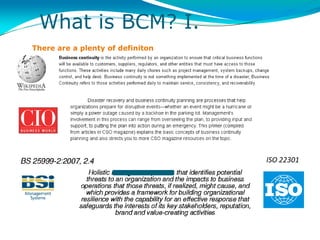
What is BCM? I.
There are a plenty of definiton


                                  ISO 22301
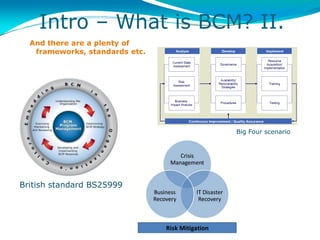
Intro – What is BCM? II.
  And there are a plenty of
   frameworks, standards etc.


                                Big Four scenario


British standard BS25999
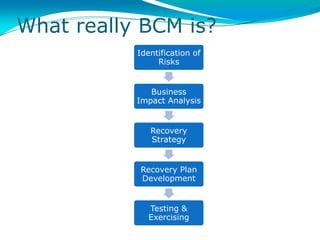
What really BCM is?
           Identification of
                Risks


              Business
           Impact Analysis


              Recovery
              Strategy


           Recovery Plan
           Development


              Testing &
              Exercising
Why? I.


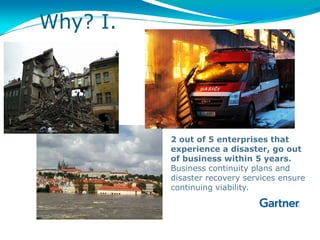
          2 out of 5 enterprises that
          experience a disaster, go out
          of business within 5 years.
          Business continuity plans and
          disaster recovery services ensure
          continuing viability.
Why? II.
 One of Top IT Priorities for 2010/2011 (by
  Forrester)
 Probability of crisis situations isn‘t zero.
   Crisis situations:
       „Accident-like“ – for example fire

       Natural disaster - floods, storm

       Failure of buildings technology - energy supply

       And many more


 In some businesses BCM is mandatory (Czech
 law – 240/2000 Sb – crisis management)
Why? III.
 To protect critical business processes from the
  effects of major failures or disaster
 To counteract interruptions to business
  activities
 Information is the key. And information still
  grow up …
 Without information and information
  technology, we won't be able to have good
  decisions
How
To survive a disaster you need:
 a plan to follow
 well trained people
 vital data
 a place to go
Summary
 BCM isn't primarily about ICT
 BCM needs support from top management (CEO,
 COO, Board)

 The most important part of BCM are
    Planning
    Training
    Testing


 Technology is only a tool.
Sources

  Wikipedia
http://en.wikipedia.org/wiki/Business_continuity
 Forrester Research – Survey 2010
http://www.forrester.com
 Gartner
http://www.gartner.com/id=340749
 CIO
http://www.cio.com/article/40287/Business_Continuity_and_Disaster_Recovery_Planning
   _Definition_and_Solutions
Questions


       Thank you

Business Continuity Management

  • 1.
  • 2.
  • 3.
    What is BCM?I. There are a plenty of definiton ISO 22301
  • 4.
    Intro – Whatis BCM? II. And there are a plenty of frameworks, standards etc. Big Four scenario British standard BS25999
  • 5.
    What really BCMis? Identification of Risks Business Impact Analysis Recovery Strategy Recovery Plan Development Testing & Exercising
  • 6.
    Why? I. 2 out of 5 enterprises that experience a disaster, go out of business within 5 years. Business continuity plans and disaster recovery services ensure continuing viability.
  • 7.
    Why? II.  Oneof Top IT Priorities for 2010/2011 (by Forrester)  Probability of crisis situations isn‘t zero.  Crisis situations:  „Accident-like“ – for example fire  Natural disaster - floods, storm  Failure of buildings technology - energy supply  And many more  In some businesses BCM is mandatory (Czech law – 240/2000 Sb – crisis management)
  • 8.
    Why? III.  Toprotect critical business processes from the effects of major failures or disaster  To counteract interruptions to business activities  Information is the key. And information still grow up …  Without information and information technology, we won't be able to have good decisions
  • 9.
    How To survive adisaster you need:  a plan to follow  well trained people  vital data  a place to go
  • 10.
    Summary  BCM isn'tprimarily about ICT  BCM needs support from top management (CEO, COO, Board)  The most important part of BCM are  Planning  Training  Testing  Technology is only a tool.
  • 11.
    Sources  Wikipedia http://en.wikipedia.org/wiki/Business_continuity Forrester Research – Survey 2010 http://www.forrester.com  Gartner http://www.gartner.com/id=340749  CIO http://www.cio.com/article/40287/Business_Continuity_and_Disaster_Recovery_Planning _Definition_and_Solutions
  • 12.
    Questions Thank you