Human resource Policies
 “ A policy is a man-made rule of pre-
determined courses of action that is
established to guide the performance of work
towards the organisation objectives.”
 “ Policies are statements of the organisation’s
over-all purposes and its objectives in the
various areas with which its operations are
concerned- personnel, finance, production,
marketing and so on.”
HR Policies are:
1)The keystone in the arch of management and
the life-blood for the successful functioning of
the personnel management for lasting
improvement in labour relations.
2)The statements of Intention indicating an
agreement to a general course of action and
purposes.
3)A positive declaration and a command to
an organisation translating the goals into
selected routes and dictating practices and
procedures.
Objectives of HR Policies:
1) Fulfillment of the organisational object.
2) Informing the employees about the policies.
3) Development of sincere sense of duty within the
enterprise.
4) Providing adequate and trained personnel at all levels.
5) Protection of the common interest of all parties.
6) Establishment of mutual confidence and avoidance of
misunderstanding.
7) Opportunity for growth who are willing to learn and
train.
8) Recognition of work and accomplishments by offering
rewards
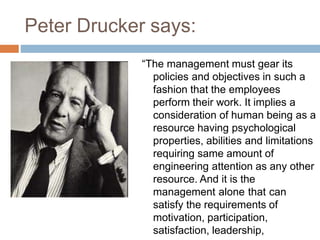
Peter Drucker says:
“The management must gear its
policies and objectives in such a
fashion that the employees
perform their work. It implies a
consideration of human being as a
resource having psychological
properties, abilities and limitations
requiring same amount of
engineering attention as any other
resource. And it is the
management alone that can
satisfy the requirements of
motivation, participation,
satisfaction, leadership,
Characteristics of sound HR
policies:
1) Definite, positive, clear and easily understood by
everyone.
2) It should be in writing in order to preserve loss.
3) Reasonably stable but not rigid i.e. periodically revised.
4) Balanced with the kind of reputation the enterprise
wants to build up.
5) Recognise the desire of workers.
6) In the best interest of all parties- employer, employee
and public community.
7) Based on careful analysis of all the available facts.
8) Must provide a two-way communication between
employer and employees.
Types of HR Policies:
There are two types of policies:
1) Functional policies- are grouped for
different categories of personnel. ex:
management dealing with personnel
planning, organising and controlling.
2) Centralised policies- are framed for
companies with several locations. They are
formulated at head office and apply
throughout the organisatio.n
Contd.
 Policies are further classified as:
1) Major policies- pertaining to the over-all
objectives, procedures and control which
affect an organisation as a whole. Ex:
product, financing, org. structure, plant
location etc.
2) Minor policies- cover relationships in a
segment of an organisation, with
considerable emphasis on details and
procedures. Such policies are the outgrowth
of major policies and preserve their unity of
purpose.
Forms of delivery of HR
policies:
1) Written standard practice, procedures issued to cover
company policies, with supplements to cover changes.
2) Booklets, bulletins, issued to new employees setting
forth rights, privileges and responsibilities.
3) Verbal instructions from immediate superiors.
4) Group meetings of new employees convened regularly.
5) Union contract
6) Company paper or house organ, giving details about
company policies.
7) Conference conducted as a part of executive training
programme.
Steps in HR Policy designing:
1) Initiating a policy.
2) Uncovering of facts by the personnel department.
3) Recommending a policy to the top management and eliciting
the views of all concerned.
4) Putting down a policy in writing.
5) Explaining and discussing the proposed policy with
members of the organisation.
6) Adopting and launching it.
7) Communicating it to employees at all levels.
8) Administering it.
9) Initiating follow-up action on it.
10) Evaluating it.
11) Reformulating the policy.
Tata steel’s Personnel Policy
The statement Objectives of the Tata Iron &
steel Co. Ltd. Gives a clear cut policy
towards its employees:
1) By a realistic and generous
understanding and acceptance of their
needs and rights.
2) By proving adequate wages, good
working conditions, job security, an
effective machinery for redressal of
grievances and suitable opportunities
of promotion.
3) By treating them as individuals, giving
them a sense of self-respect.
4) By creating a sense of belongingness
through human and purposeful
activities as an integral part of human
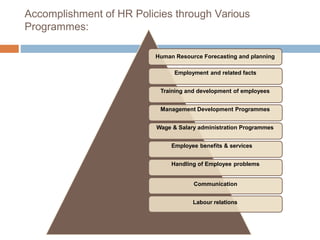
Accomplishment of HR Policies through Various
Programmes:
Human Resource Forecasting and planning
Employment and related facts
Training and development of employees
Management Development Programmes
Wage & Salary administration Programmes
Employee benefits & services
Handling of Employee problems
Communication
Labour relations
Human Resource Planning
Human Resource Planning – Meaning:
E.W. Vetter viewed human resource planning as “a process
by which an organisation should move from its current
manpower position to its desired manpower position.
Through planning, management strives to have the right
number and right kind of people at the right places at the
right time, doing things which result in both the organisation
and the individual receiving maximum long-run benefit.”
Human resource planning (HRP) is the first step in the
HRM process. HRP is the process by which an organization
ensures that it has the right number and kind of people, at
the right place, at the right time, capable of effectively and
efficiently completing those tasks that will help the
organization achieve its overall objectives.
HRP is also known by other names such as ‘Manpower
Planning’, ‘Employment Planning’, ‘Labour Planning’,
‘Personnel Planning’, etc. HRP is a sub-system in the total
organizational planning. In other words, HRP is derived
from the organizational planning just like production
planning, sales planning, material planning, etc.
HRP – Quantitative and Qualitative
Dimensions:
The rate of growth of human resources is determined by
two aspects quantitative and qualitative.
Variables Determining the Quantity of Human
Resources:
1. Population Policy: Some population policies operate by
influencing the factors responsible for growth such as
fertility, marriage and mortality. These are known as
population influencing policies. Another category of policies
known as responsive policies are implemented to adjust to
observed population trends with the help of programmes
like health, nutrition, education, housing, etc. The aim of
population policies is to achieve an optimum population for
enhancing the country’s development.
2. Population Structure: The structure or composition of the
population is determined by two factors, sex composition
and age composition.
(i) Sex Composition: Sex ratio is the ratio of males to
females in the population. It is the basic measure of the sex
composition of the population of any area. Higher the
number of females, higher will be the population growth
rate in future.
(ii) Age Composition: It is the distribution of population by
age groups. Age composition is the result of past trends in
fertility and mortality. The supply of labour depends on age
composition as economically active population falls in
range of 15-65 age groups.
3. Migration: Net migration is another factor which causes
changes in the population. Age and sex composition
determine the natural growth in population, but for
calculating the overall changes in population it is important
to consider net migration also.
Net migration = total immigrants – total emigrants
A positive net migration will lead to a rise in population
growth rate while negative net migration will reduce the
growth rate of population. Migration can be both inter-
regional and international.
4. Labour Force Participation: The population of any
country consists of workers and non-workers. The workers
are the people, usually in age group of 15-65, who
participate in economically productive activities by their
mental or physical presence.
These include:
i. Employers,
ii. Employees,
iii. Self-employed persons, and
iv. Those engaged in family enterprises without pay.
Qualitative Aspects of Human Resource Planning:
The quantitative dimensions help to ascertain human resources in
numbers while the productive power of human resources is assessed
by the qualitative dimensions. For example, there may be hundreds of
applicants for 20 vacancies, but out of these only a few may meet the
quality standards required for the job.
Factors which determine the quality of human resources are:
1. Education and Training: The quantity and quality of education and
training received by human resources impacts their knowledge and
skills. Education and training are important for the upliftment of both
individual and society. It can be of two types, formal and informal.
Formal education stresses the transfer of theoretical knowledge,
while informal education emphasizes on practical application of
knowledge.
2. Health and Nutrition: Health and nutrition along with
education are vital for Human Resource Development.
Health and nutrition impact the quality of life, productivity of
labour and the average life expectancy.
Health status is determined by: (i) Purchasing power of
people.
(ii) Public sanitation, climate and availability of medical
facilities.
(iii) People’s understanding and knowledge of health,
hygiene and nutrition.
3. Equality of Opportunity: Not all segments of people
comprising human resources get equal employment
opportunities. There is bound to be some discrimination.
The most common forms of discrimination are:
(i) Social discrimination – Discrimination on basis of gender,
religion or social standing.
(ii) Economic discrimination – Discrimination based on
financial positions or possession of wealth by the sections
of workforce.
(iii) Regional discrimination – These are in form of
discrimination between rural and urban population or
between people belonging to different regions/ states.

hrpolicies-170212040125.pptx

  • 1.
  • 2.
     “ Apolicy is a man-made rule of pre- determined courses of action that is established to guide the performance of work towards the organisation objectives.”  “ Policies are statements of the organisation’s over-all purposes and its objectives in the various areas with which its operations are concerned- personnel, finance, production, marketing and so on.”
  • 3.
    HR Policies are: 1)Thekeystone in the arch of management and the life-blood for the successful functioning of the personnel management for lasting improvement in labour relations. 2)The statements of Intention indicating an agreement to a general course of action and purposes. 3)A positive declaration and a command to an organisation translating the goals into selected routes and dictating practices and procedures.
  • 4.
    Objectives of HRPolicies: 1) Fulfillment of the organisational object. 2) Informing the employees about the policies. 3) Development of sincere sense of duty within the enterprise. 4) Providing adequate and trained personnel at all levels. 5) Protection of the common interest of all parties. 6) Establishment of mutual confidence and avoidance of misunderstanding. 7) Opportunity for growth who are willing to learn and train. 8) Recognition of work and accomplishments by offering rewards
  • 5.
    Peter Drucker says: “Themanagement must gear its policies and objectives in such a fashion that the employees perform their work. It implies a consideration of human being as a resource having psychological properties, abilities and limitations requiring same amount of engineering attention as any other resource. And it is the management alone that can satisfy the requirements of motivation, participation, satisfaction, leadership,
  • 6.
    Characteristics of soundHR policies: 1) Definite, positive, clear and easily understood by everyone. 2) It should be in writing in order to preserve loss. 3) Reasonably stable but not rigid i.e. periodically revised. 4) Balanced with the kind of reputation the enterprise wants to build up. 5) Recognise the desire of workers. 6) In the best interest of all parties- employer, employee and public community. 7) Based on careful analysis of all the available facts. 8) Must provide a two-way communication between employer and employees.
  • 7.
    Types of HRPolicies: There are two types of policies: 1) Functional policies- are grouped for different categories of personnel. ex: management dealing with personnel planning, organising and controlling. 2) Centralised policies- are framed for companies with several locations. They are formulated at head office and apply throughout the organisatio.n
  • 8.
    Contd.  Policies arefurther classified as: 1) Major policies- pertaining to the over-all objectives, procedures and control which affect an organisation as a whole. Ex: product, financing, org. structure, plant location etc. 2) Minor policies- cover relationships in a segment of an organisation, with considerable emphasis on details and procedures. Such policies are the outgrowth of major policies and preserve their unity of purpose.
  • 9.
    Forms of deliveryof HR policies: 1) Written standard practice, procedures issued to cover company policies, with supplements to cover changes. 2) Booklets, bulletins, issued to new employees setting forth rights, privileges and responsibilities. 3) Verbal instructions from immediate superiors. 4) Group meetings of new employees convened regularly. 5) Union contract 6) Company paper or house organ, giving details about company policies. 7) Conference conducted as a part of executive training programme.
  • 10.
    Steps in HRPolicy designing: 1) Initiating a policy. 2) Uncovering of facts by the personnel department. 3) Recommending a policy to the top management and eliciting the views of all concerned. 4) Putting down a policy in writing. 5) Explaining and discussing the proposed policy with members of the organisation. 6) Adopting and launching it. 7) Communicating it to employees at all levels. 8) Administering it. 9) Initiating follow-up action on it. 10) Evaluating it. 11) Reformulating the policy.
  • 11.
    Tata steel’s PersonnelPolicy The statement Objectives of the Tata Iron & steel Co. Ltd. Gives a clear cut policy towards its employees: 1) By a realistic and generous understanding and acceptance of their needs and rights. 2) By proving adequate wages, good working conditions, job security, an effective machinery for redressal of grievances and suitable opportunities of promotion. 3) By treating them as individuals, giving them a sense of self-respect. 4) By creating a sense of belongingness through human and purposeful activities as an integral part of human
  • 12.
    Accomplishment of HRPolicies through Various Programmes: Human Resource Forecasting and planning Employment and related facts Training and development of employees Management Development Programmes Wage & Salary administration Programmes Employee benefits & services Handling of Employee problems Communication Labour relations
  • 13.
    Human Resource Planning HumanResource Planning – Meaning: E.W. Vetter viewed human resource planning as “a process by which an organisation should move from its current manpower position to its desired manpower position. Through planning, management strives to have the right number and right kind of people at the right places at the right time, doing things which result in both the organisation and the individual receiving maximum long-run benefit.”
  • 14.
    Human resource planning(HRP) is the first step in the HRM process. HRP is the process by which an organization ensures that it has the right number and kind of people, at the right place, at the right time, capable of effectively and efficiently completing those tasks that will help the organization achieve its overall objectives. HRP is also known by other names such as ‘Manpower Planning’, ‘Employment Planning’, ‘Labour Planning’, ‘Personnel Planning’, etc. HRP is a sub-system in the total organizational planning. In other words, HRP is derived from the organizational planning just like production planning, sales planning, material planning, etc.
  • 15.
    HRP – Quantitativeand Qualitative Dimensions: The rate of growth of human resources is determined by two aspects quantitative and qualitative. Variables Determining the Quantity of Human Resources: 1. Population Policy: Some population policies operate by influencing the factors responsible for growth such as fertility, marriage and mortality. These are known as population influencing policies. Another category of policies known as responsive policies are implemented to adjust to observed population trends with the help of programmes like health, nutrition, education, housing, etc. The aim of population policies is to achieve an optimum population for enhancing the country’s development.
  • 16.
    2. Population Structure:The structure or composition of the population is determined by two factors, sex composition and age composition. (i) Sex Composition: Sex ratio is the ratio of males to females in the population. It is the basic measure of the sex composition of the population of any area. Higher the number of females, higher will be the population growth rate in future. (ii) Age Composition: It is the distribution of population by age groups. Age composition is the result of past trends in fertility and mortality. The supply of labour depends on age composition as economically active population falls in range of 15-65 age groups.
  • 17.
    3. Migration: Netmigration is another factor which causes changes in the population. Age and sex composition determine the natural growth in population, but for calculating the overall changes in population it is important to consider net migration also. Net migration = total immigrants – total emigrants A positive net migration will lead to a rise in population growth rate while negative net migration will reduce the growth rate of population. Migration can be both inter- regional and international.
  • 18.
    4. Labour ForceParticipation: The population of any country consists of workers and non-workers. The workers are the people, usually in age group of 15-65, who participate in economically productive activities by their mental or physical presence. These include: i. Employers, ii. Employees, iii. Self-employed persons, and iv. Those engaged in family enterprises without pay.
  • 19.
    Qualitative Aspects ofHuman Resource Planning: The quantitative dimensions help to ascertain human resources in numbers while the productive power of human resources is assessed by the qualitative dimensions. For example, there may be hundreds of applicants for 20 vacancies, but out of these only a few may meet the quality standards required for the job. Factors which determine the quality of human resources are: 1. Education and Training: The quantity and quality of education and training received by human resources impacts their knowledge and skills. Education and training are important for the upliftment of both individual and society. It can be of two types, formal and informal. Formal education stresses the transfer of theoretical knowledge, while informal education emphasizes on practical application of knowledge.
  • 20.
    2. Health andNutrition: Health and nutrition along with education are vital for Human Resource Development. Health and nutrition impact the quality of life, productivity of labour and the average life expectancy. Health status is determined by: (i) Purchasing power of people. (ii) Public sanitation, climate and availability of medical facilities. (iii) People’s understanding and knowledge of health, hygiene and nutrition.
  • 21.
    3. Equality ofOpportunity: Not all segments of people comprising human resources get equal employment opportunities. There is bound to be some discrimination. The most common forms of discrimination are: (i) Social discrimination – Discrimination on basis of gender, religion or social standing. (ii) Economic discrimination – Discrimination based on financial positions or possession of wealth by the sections of workforce. (iii) Regional discrimination – These are in form of discrimination between rural and urban population or between people belonging to different regions/ states.