Business Analysts can be Difficult PeopleDenver IIBA, September 21, 2010
Learning PointsThree things participants will take away from this session:Understand some common BA qualities that can make us “difficult”.Appreciate why certain qualities or behaviors might create negative reactions from others.Learn how to recognize difficult situations and explore some approaches to bring your best qualities forward.http://www.bridging-the-gap.com
About mewww.bridging-the-gap.comIndependent BA Consultant, Former BA ManagerBA Career Mentor Host of Bridging the Gap and author ofHow to Start a BA CareerThe Promotable Business AnalystIIBA VolunteerCareer Center Product ManagerPresent monthly on “BA Career” Call-In ShowVP Marketing, IIBA-Denver
Yes, we are good….We help our organizations deliver more successful projects.We help people solve their problems.We help people communicate who might otherwise misunderstand each other.http://www.bridging-the-gap.com
But….It’s not about How Good we AreIt’s about how we can make it betterhttp://www.bridging-the-gap.com
Just for this discussion…www.bridging-the-gap.comTry not to rest on “best practices” or other absolutes.No “I’d tell my boss and s/he’d fix it”.And…we are not here to complain about our stakeholders.
A word of caution / The fine print.www.bridging-the-gap.comThere will be situations when…you cannot or should not address a difficult situation.the best thing to do is escalate to your manager.None of what follows is “management advice”. We are focusing on basic difficult situations that happen because we are human.
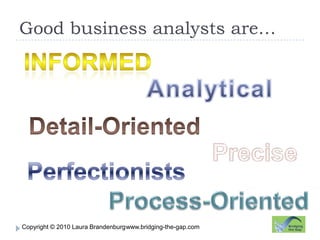
Good business analysts are…InformedAnalyticalDetail-OrientedPrecisePerfectionistsProcess-Orientedwww.bridging-the-gap.com
BrainstormWhat difficult situations do you want to talk about today?http://www.bridging-the-gap.com
Informed (A.K.A. “Know it all”)www.bridging-the-gap.comProblematic triggersWe hear “I’m sure you know this…” or “I’d tell you but…”You are talking more than anyone.Why this is a problemWe make mistaken assumptionsWe miss validation points and head down the wrong path
Informed – Solutions www.bridging-the-gap.comTake a stance of curiosity.Ask the question. Even if it hurts.“Check your ego at the door.” – Cecilie Hoffman“Just one more question…” -Columbo
Analyticalwww.bridging-the-gap.comProblematic triggersYou have more questions?!?Stuck in “analysis paralysis”.Stakeholders don’t have the answers.Why this is a problemCan stall forward progress.Frustrated stakeholders.
Analytical – Solutionswww.bridging-the-gap.comModel your requirements in iterations.Communicate about your plan.Ask “what could we do to learn?”When in doubt, take a step back and redefine the problem.
Precisewww.bridging-the-gap.comProblematic triggersWe tend to correct others: we hear what’s wrong instead of what’s right.Why this is a problemWe can be perceived as overly critical.Stakeholders can become defensive.
Precise – Solutions www.bridging-the-gap.comFocus on what’s right, then where the differences lie.Use questions to redefine understanding.Paraphrase to show understanding or disconnects.
Break Out! Practicing Precisionwww.bridging-the-gap.comClarify one these stakeholder statements using a yes-first approach:The system will support  about 20 users. (The requirement is exactly 15).Today we’re having that requirements sign-off meeting, right? (It’s an elicitation meeting.)Our search will look at all the keywords. (No common understanding of the term “keywords.”)
Detail-orientedProblematic triggersEye’s glaze overFrustration that we don’t get itBoredomWhy this is a problemWe are not getting their best input!http://www.bridging-the-gap.com
Detailed Oriented - Solutionswww.bridging-the-gap.comAcknowledge the challenge.Create context for the details to give them meaning.Experiment with different communication styles (pictures, models, text).Give positive feedback.Make time for fun or “mind breaks”
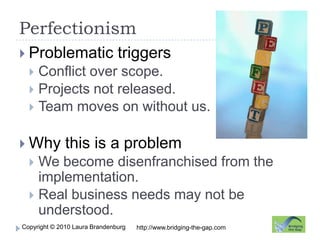
PerfectionismProblematic triggersConflict over scope.Projects not released.Team moves on without us.Why this is a problemWe become disenfranchised from the implementation.Real business needs may not be understood.http://www.bridging-the-gap.com
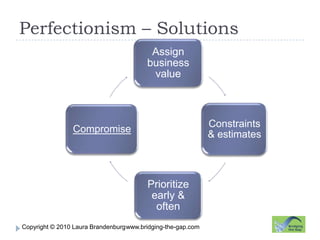
Perfectionism – Solutions www.bridging-the-gap.com
Process-orientedwww.bridging-the-gap.comProblematic triggersYou say “we just need to fill in this section”You do things because “that’s the process”Why this is a problemFollowing a process does not guarantee our best work.Our stakeholders care about results, not process.
Process-oriented – Solutions www.bridging-the-gap.comUnderstand the WHY and the goal behind every process.Lead your teams toward a goal, not through a process.Understand how your deliverables will be used.
Take a small step…www.bridging-the-gap.comWhat attribute makes you difficult?How is this impacting your work?What small change can you make tomorrow?
Resourceshttp://www.bridging-the-gap.comHow to Win Friends and Influence People,Dale CarnegieYES! AttitudeJeffrey GitomerRequirements by CollaborationEllen Gottesdiener
QuestionsLooking for more information? http://www.bridging-the-gap.com/free-resourceshttp://www.bridging-the-gap.com

Business Analysts can be Difficult People

  • 1.
    Business Analysts canbe Difficult PeopleDenver IIBA, September 21, 2010
  • 2.
    Learning PointsThree thingsparticipants will take away from this session:Understand some common BA qualities that can make us “difficult”.Appreciate why certain qualities or behaviors might create negative reactions from others.Learn how to recognize difficult situations and explore some approaches to bring your best qualities forward.http://www.bridging-the-gap.com
  • 3.
    About mewww.bridging-the-gap.comIndependent BAConsultant, Former BA ManagerBA Career Mentor Host of Bridging the Gap and author ofHow to Start a BA CareerThe Promotable Business AnalystIIBA VolunteerCareer Center Product ManagerPresent monthly on “BA Career” Call-In ShowVP Marketing, IIBA-Denver
  • 4.
    Yes, we aregood….We help our organizations deliver more successful projects.We help people solve their problems.We help people communicate who might otherwise misunderstand each other.http://www.bridging-the-gap.com
  • 5.
    But….It’s not aboutHow Good we AreIt’s about how we can make it betterhttp://www.bridging-the-gap.com
  • 6.
    Just for thisdiscussion…www.bridging-the-gap.comTry not to rest on “best practices” or other absolutes.No “I’d tell my boss and s/he’d fix it”.And…we are not here to complain about our stakeholders.
  • 7.
    A word ofcaution / The fine print.www.bridging-the-gap.comThere will be situations when…you cannot or should not address a difficult situation.the best thing to do is escalate to your manager.None of what follows is “management advice”. We are focusing on basic difficult situations that happen because we are human.
  • 8.
    Good business analystsare…InformedAnalyticalDetail-OrientedPrecisePerfectionistsProcess-Orientedwww.bridging-the-gap.com
  • 9.
    BrainstormWhat difficult situationsdo you want to talk about today?http://www.bridging-the-gap.com
  • 10.
    Informed (A.K.A. “Knowit all”)www.bridging-the-gap.comProblematic triggersWe hear “I’m sure you know this…” or “I’d tell you but…”You are talking more than anyone.Why this is a problemWe make mistaken assumptionsWe miss validation points and head down the wrong path
  • 11.
    Informed – Solutionswww.bridging-the-gap.comTake a stance of curiosity.Ask the question. Even if it hurts.“Check your ego at the door.” – Cecilie Hoffman“Just one more question…” -Columbo
  • 12.
    Analyticalwww.bridging-the-gap.comProblematic triggersYou havemore questions?!?Stuck in “analysis paralysis”.Stakeholders don’t have the answers.Why this is a problemCan stall forward progress.Frustrated stakeholders.
  • 13.
    Analytical – Solutionswww.bridging-the-gap.comModelyour requirements in iterations.Communicate about your plan.Ask “what could we do to learn?”When in doubt, take a step back and redefine the problem.
  • 14.
    Precisewww.bridging-the-gap.comProblematic triggersWe tendto correct others: we hear what’s wrong instead of what’s right.Why this is a problemWe can be perceived as overly critical.Stakeholders can become defensive.
  • 15.
    Precise – Solutionswww.bridging-the-gap.comFocus on what’s right, then where the differences lie.Use questions to redefine understanding.Paraphrase to show understanding or disconnects.
  • 16.
    Break Out! PracticingPrecisionwww.bridging-the-gap.comClarify one these stakeholder statements using a yes-first approach:The system will support about 20 users. (The requirement is exactly 15).Today we’re having that requirements sign-off meeting, right? (It’s an elicitation meeting.)Our search will look at all the keywords. (No common understanding of the term “keywords.”)
  • 17.
    Detail-orientedProblematic triggersEye’s glazeoverFrustration that we don’t get itBoredomWhy this is a problemWe are not getting their best input!http://www.bridging-the-gap.com
  • 18.
    Detailed Oriented -Solutionswww.bridging-the-gap.comAcknowledge the challenge.Create context for the details to give them meaning.Experiment with different communication styles (pictures, models, text).Give positive feedback.Make time for fun or “mind breaks”
  • 19.
    PerfectionismProblematic triggersConflict overscope.Projects not released.Team moves on without us.Why this is a problemWe become disenfranchised from the implementation.Real business needs may not be understood.http://www.bridging-the-gap.com
  • 20.
    Perfectionism – Solutionswww.bridging-the-gap.com
  • 21.
    Process-orientedwww.bridging-the-gap.comProblematic triggersYou say“we just need to fill in this section”You do things because “that’s the process”Why this is a problemFollowing a process does not guarantee our best work.Our stakeholders care about results, not process.
  • 22.
    Process-oriented – Solutionswww.bridging-the-gap.comUnderstand the WHY and the goal behind every process.Lead your teams toward a goal, not through a process.Understand how your deliverables will be used.
  • 23.
    Take a smallstep…www.bridging-the-gap.comWhat attribute makes you difficult?How is this impacting your work?What small change can you make tomorrow?
  • 24.
    Resourceshttp://www.bridging-the-gap.comHow to WinFriends and Influence People,Dale CarnegieYES! AttitudeJeffrey GitomerRequirements by CollaborationEllen Gottesdiener
  • 25.
    QuestionsLooking for moreinformation? http://www.bridging-the-gap.com/free-resourceshttp://www.bridging-the-gap.com

Editor's Notes

  • #3 Emphasize—we are here to talk about how we create difficult situations. If you just want to complain about your difficult stakeholders, you are in the wrong session!
  • #5 Emphasize here how great you are and how great our profession is. Talk about the value of a business analyst. I want you to know this now, because in 20 minutes or so you are going to feel rather beaten up.
  • #6 We are going to do our best in this session not to justify anything we do. We are not here to learn about how to sell our value as business analysts or learn how to help people see our value. We are here to improve our interactions with each individual we work with by seeing things from their point of view. We are here to improve difficult situations by changing OUR behavior.
  • #7 We are going to do our best in this session not to justify what we do. We are not here to learn about how to sell our value as business analysts or learn how to help people see our value. We are here to improve our interactions with each individual we work with by seeing things from their point of view. We are here to improve difficult situations by changing OUR behavior.
  • #9 Use this slide to tell a story about myself as a business analyst.Consider putting this slide into some sort of grouping or logical progression, showing how attributes build on one-another.We are all of these things, but they can also make us perceived as difficult.So let’s start at the top. As business analysts we find problems. Right? Or sometimes, we call these problems opportunities. It makes them seem more palatable. Then we typically go about becoming exceedingly informed about the problem. We might interview multiple people about their perspective. We might hold a focus group or a brainstorming session. We schedule lots of meetings to talk about the problem. The hopefully, we eventually find a solution to that problem and we go about our merry way, analyzing the problem, figuring out the solution. We do this at a very detailed level, leaving no stone unturned. We make sure everyone has the same understanding of our very precise definition of the solution. Our solutions are often perfect, conceptually, but they may be very difficult to implement. All this time, we might be following our organizations process for development software, filling in elaborate functional specification templates, holding copious document reviews, and dotting every I and crossing every T.
  • #10 Use flip chart to write up difficult situations from the group (at least 5, no more than 10).Indulge a bit of BA defensiveness in the discussion.Then focus on each of these situations from the other person’s perspective. Why might they have behaved the way they did.
  • #12 One of my mentees was sharing some of her prior work experiences with me. She said that she had been nicknamed Columbo
  • #13 Take a step back. Retrace your steps to figure out how you got into the mess you are in and see if there is a different way through the problem solution.Shifting context. Take a step to the side, approach the problem in a new way, remove a constraint and see what possibilities open up.Shifting context-more. Make sure there are no unvalidated assumptions in the statement of the problem.Modeling your requirements in iterations, starting with lower fidelity models, less granularity and then gradually diving deeper and into more detail. We know to do this, but often under time constraints or other pressures, we jump into a model that’s a bit too granular for our understanding. In attempting to work in thatThe “what could we learn” comment is really from Lean Software Development
  • #14 I’ve often started asking, “what can we do to learn” this shifts the thinking about the problem. Instead of everyone trying to come up with a solution right away, they are given license to think bigger about how we might research the solution. This is a great technique when you are working with other analytical people who want time to think and consider independently.
  • #15 We are often precise because we want to ensure a shared understanding…a very precise one! But if we correct people without care, we can damage their perception of us.
  • #18 I know. We just want them to “get it” but the reality is that we often come at a project with a level understanding that’s much deeper than our stakeholders. We come into the meeting having thought about the system for the last day or two. Our stakeholders are usually off doing many other things! Sometimes we need to explore different deliverables for differetn stakeholders to match their learning styles.
  • #19 Vendor data feed specifications review meeting – super-detailed review of each field we were passing over. This was not an exciting meeting. I acknowledged that upfront and let them know I was wary about it as well and was having trouble wrapping my head around it. Along the way we joked a bit about how boring it was. We allowed time for fun, and at the end I thanked them for sticking with me. Truth be told, it wasn’t fun for me either, but I saw my role as making it as fun as possible for them. As a result I got some great input.
  • #22 Processes develop over time and they are often developed to solve problems. But sometimes those problems solve themselves in new ways and we’re still following the old process. We need to know why we are being asked to do certain things and how the process is intended to serve the end result. Talking to the people who use your deliverables and understanding how they use them will give you a lot of insight into the value you are providing.