-James Embree
    An offer is something that one does or gives to
     or for someone else, commonly in exchange for
     something else, usually of equal value of the
     original offer.
    The three necessary elements of an offer
     include:
1.    Serious intent from the original offeror must
      be present.
2.    Terms of the offer must be serious and definite
      so they are usable both by the parties and by
      the courts.
3.    The offer must be communicated properly to
      the offeree.
   Acceptance takes place when the party being
    offered something decides in favor of the offer
    and will go through with their contractual
    obligations.
   The “mirror image rule” is the rule that
    enforces anyone who accepts an offer to go
    through with the exact contract they were
    getting into originally with no modifications.
    The five ways to terminate an offer include:
1.   Revocation
2.   Rejection of the original offer
3.   Lapse of time
4.   Condition unfulfilled
5.   Death of the offeror or offeree
   Genuine agreement is what’s basically created
    by all parties involved within a contract.
   Some mistakes are one-sided, which are known
    as unilateral. One example would be buying
    something that you then realize you actually
    own, which is a contract you cannot get out of.
    Another would be signing into a written legal
    or business contract then not wanting to go
    through with it, you are then legally obligated
    to do so.
   A bilateral mistake is a contractual mistake
    made by both parties. If you cannot pay for
    something you said you would and the clerk
    doesn’t have what he said he would, then that
    is a bilateral mistake. Another would be if you
    agreed to run track with someone and then you
    both break your left legs.
   Fraud involves intentionally deceiving another
    person or party within a contract for your own
    personal gain.
   If a mistake similar to a fraud is not a fraud and
    the accused actually made an honest mistake, it
    an innocent misrepresentation.
   Economic duress can also make a contract
    voidable. Economic duress is when the offeree
    was put in a place where giving into the
    contract was their only logical choice rather
    than legal. Wrongful or improper
    threat, reasonable alternative, threat inducing
    the making of a contract, and the other party
    causing original financial distress are the
    primary elements of economic duress.
   Duress of undue influence also makes a
    contract become voidable. Undue influence
    involves one party taking advantage of the
    other(s) while they’re in a position of power
    over them. Duress is generally cornering
    someone who is unwilling into a contract
    purposefully for your own personal gain.
   Capacity is what determines whether or not a
    contract is legally binding.
   People who are either minors, mentally
    impaired, or intoxicated are given certain rights
    that void them from a contract.
   Anyone under 18 or suffer from a certain
    mental illness is automatically able to void a
    contract.
   If someone is proven to have taken advantage
    of an intoxicated person, then that contract is
    also voidable. If the offeror of an intoxicated
    person is proven to be unaware of the other
    person’s intoxication however, it is not
    voidable.
   Consideration is what is of legal value within a
    contract. It can consist of anything from money
    to services or to abstinence from potential
    future actions.
   Benefits of contracts are what people have
    accepted to gain out of a contract.
   Detriments are what you have legally lost as a
    result to agreeing to the contract.
    Consideration leads to a lot of “contracts”
     being unenforceable. Here are a few examples
     of unenforceable contracts due to
     consideration:
1.    You lend someone your car and expect
      compensation despite the idea never being
      mentioned on either side.
2.    You sell someone a car for $50. Despite the
      offer being ridiculous, the other party
      accepted, and you cannot go back on it due to
      the consideration that you brought up.
3.) You buy a TV from a store. The seller realizes
    he made a mistake in the price about five
    minutes after you buy it. Since the purchase
    has gone through completely, the decision is
    final.
4.) You put $ .50 into a vending machine in which
    everything costs $1.00, and receive nothing in
    return. You did not meet the proper
    consideration, therefore there is no contract.
5.) You see a sign on a used car that states the
   price is $1,000. There is no contract due to
   consideration when the seller does not accept
   your offer $500.
   Some agreements are completely enforceable
    without consideration. A well-known example
    would be charity donations, and another
    would be simply giving money to someone for
    any reason without mentioning any contractual
    obligations.
   Legality is the general ideal that requires all law to
    be completely clear and nearly impossible to
    misinterpret in any way.
   Listed here are the six types of statutes (laws
    specifically passed by a governing body that has
    been created for stated proposes):
    1.) Civil statutes are laws that commonly result
    from civil suits in order to ban certain things from
    being taken to court again.
    2.) Criminal statutes are when certain actions are
    declared as a crime and are now illegal.
    3.) Usury statutes deal with loans and interest rates
    when dealing with contracts.
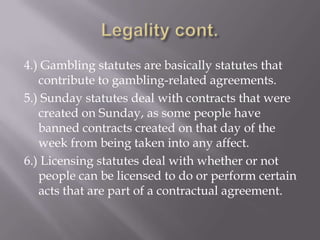
4.) Gambling statutes are basically statutes that
   contribute to gambling-related agreements.
5.) Sunday statutes deal with contracts that were
   created on Sunday, as some people have
   banned contracts created on that day of the
   week from being taken into any affect.
6.) Licensing statutes deal with whether or not
   people can be licensed to do or perform certain
   acts that are part of a contractual agreement.
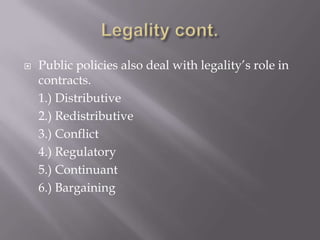
   Public policies also deal with legality’s role in
    contracts.
    1.) Distributive
    2.) Redistributive
    3.) Conflict
    4.) Regulatory
    5.) Continuant
    6.) Bargaining

3.02 project

  • 1.
  • 2.
     An offer is something that one does or gives to or for someone else, commonly in exchange for something else, usually of equal value of the original offer.  The three necessary elements of an offer include: 1. Serious intent from the original offeror must be present. 2. Terms of the offer must be serious and definite so they are usable both by the parties and by the courts. 3. The offer must be communicated properly to the offeree.
  • 3.
     Acceptance takes place when the party being offered something decides in favor of the offer and will go through with their contractual obligations.  The “mirror image rule” is the rule that enforces anyone who accepts an offer to go through with the exact contract they were getting into originally with no modifications.
  • 4.
     The five ways to terminate an offer include: 1. Revocation 2. Rejection of the original offer 3. Lapse of time 4. Condition unfulfilled 5. Death of the offeror or offeree
  • 5.
     Genuine agreement is what’s basically created by all parties involved within a contract.  Some mistakes are one-sided, which are known as unilateral. One example would be buying something that you then realize you actually own, which is a contract you cannot get out of. Another would be signing into a written legal or business contract then not wanting to go through with it, you are then legally obligated to do so.
  • 6.
     A bilateral mistake is a contractual mistake made by both parties. If you cannot pay for something you said you would and the clerk doesn’t have what he said he would, then that is a bilateral mistake. Another would be if you agreed to run track with someone and then you both break your left legs.  Fraud involves intentionally deceiving another person or party within a contract for your own personal gain.
  • 7.
     If a mistake similar to a fraud is not a fraud and the accused actually made an honest mistake, it an innocent misrepresentation.  Economic duress can also make a contract voidable. Economic duress is when the offeree was put in a place where giving into the contract was their only logical choice rather than legal. Wrongful or improper threat, reasonable alternative, threat inducing the making of a contract, and the other party causing original financial distress are the primary elements of economic duress.
  • 8.
     Duress of undue influence also makes a contract become voidable. Undue influence involves one party taking advantage of the other(s) while they’re in a position of power over them. Duress is generally cornering someone who is unwilling into a contract purposefully for your own personal gain.
  • 9.
     Capacity is what determines whether or not a contract is legally binding.  People who are either minors, mentally impaired, or intoxicated are given certain rights that void them from a contract.  Anyone under 18 or suffer from a certain mental illness is automatically able to void a contract.
  • 10.
     If someone is proven to have taken advantage of an intoxicated person, then that contract is also voidable. If the offeror of an intoxicated person is proven to be unaware of the other person’s intoxication however, it is not voidable.
  • 11.
     Consideration is what is of legal value within a contract. It can consist of anything from money to services or to abstinence from potential future actions.  Benefits of contracts are what people have accepted to gain out of a contract.  Detriments are what you have legally lost as a result to agreeing to the contract.
  • 12.
     Consideration leads to a lot of “contracts” being unenforceable. Here are a few examples of unenforceable contracts due to consideration: 1. You lend someone your car and expect compensation despite the idea never being mentioned on either side. 2. You sell someone a car for $50. Despite the offer being ridiculous, the other party accepted, and you cannot go back on it due to the consideration that you brought up.
  • 13.
    3.) You buya TV from a store. The seller realizes he made a mistake in the price about five minutes after you buy it. Since the purchase has gone through completely, the decision is final. 4.) You put $ .50 into a vending machine in which everything costs $1.00, and receive nothing in return. You did not meet the proper consideration, therefore there is no contract.
  • 14.
    5.) You seea sign on a used car that states the price is $1,000. There is no contract due to consideration when the seller does not accept your offer $500.
  • 15.
     Some agreements are completely enforceable without consideration. A well-known example would be charity donations, and another would be simply giving money to someone for any reason without mentioning any contractual obligations.
  • 16.
     Legality is the general ideal that requires all law to be completely clear and nearly impossible to misinterpret in any way.  Listed here are the six types of statutes (laws specifically passed by a governing body that has been created for stated proposes): 1.) Civil statutes are laws that commonly result from civil suits in order to ban certain things from being taken to court again. 2.) Criminal statutes are when certain actions are declared as a crime and are now illegal. 3.) Usury statutes deal with loans and interest rates when dealing with contracts.
  • 17.
    4.) Gambling statutesare basically statutes that contribute to gambling-related agreements. 5.) Sunday statutes deal with contracts that were created on Sunday, as some people have banned contracts created on that day of the week from being taken into any affect. 6.) Licensing statutes deal with whether or not people can be licensed to do or perform certain acts that are part of a contractual agreement.
  • 18.
     Public policies also deal with legality’s role in contracts. 1.) Distributive 2.) Redistributive 3.) Conflict 4.) Regulatory 5.) Continuant 6.) Bargaining