Introduction to Contracts
                  The Agreement: Offer
            The Agreement: Acceptance
                          Consideration
                      Reality of Consent


© 2010 The McGraw-Hill Companies, Inc. All rights reserved.
Capacity to Contract
                                Illegality
                                  Writing
                  Rights of Third Parties
             Performance and Remedies


© 2010 The McGraw-Hill Companies, Inc. All rights reserved.
Performance and
                                           Remedies
It is an immutable law in business that
words are words, explanations are
explanations, promises are promises –
but only performance is reality.

        Harold S. Geneen, CEO of ITT
        Managing (co-written with Alvin
        Moscow, 1984)


                         © 2010 The McGraw-Hill Companies, Inc. All rights reserved.
Learning Objectives
 Nature and types of conditions in
  contracts
 Performance of contracts
 Breach of contract
 Excuses for non-performance
 Remedies for breach of contract


18 - 4
Overview
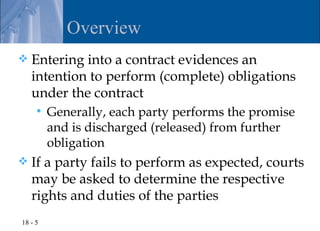
   Entering into a contract evidences an
    intention to perform (complete) obligations
    under the contract
        Generally, each party performs the promise
         and is discharged (released) from further
         obligation
   If a party fails to perform as expected, courts
    may be asked to determine the respective
    rights and duties of the parties
18 - 5
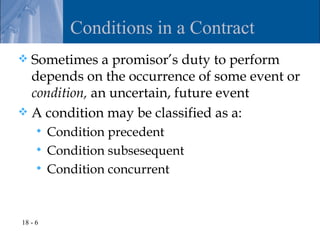
Conditions in a Contract
 Sometimes a promisor’s duty to perform
  depends on the occurrence of some event or
  condition, an uncertain, future event
 A condition may be classified as a:
      Condition precedent
      Condition subsesequent
      Condition concurrent


18 - 6
Condition Precedent
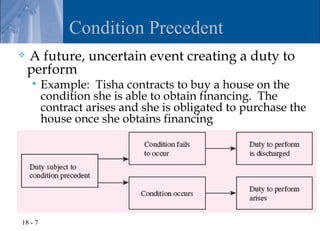
   A future, uncertain event creating a duty to
    perform
        Example: Tisha contracts to buy a house on the
         condition she is able to obtain financing. The
         contract arises and she is obligated to purchase the
         house once she obtains financing


18 - 7
Condition Concurrent
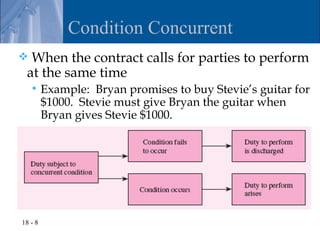
 When the contract calls for parties to perform
 at the same time
        Example: Bryan promises to buy Stevie’s guitar for
         $1000. Stevie must give Bryan the guitar when
         Bryan gives Stevie $1000.


18 - 8
Condition Subsequent
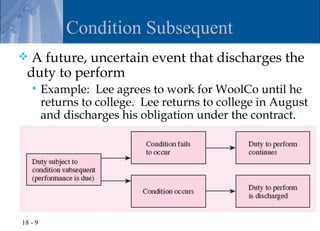
 A future, uncertain event that discharges the
 duty to perform
        Example: Lee agrees to work for WoolCo until he
         returns to college. Lee returns to college in August
         and discharges his obligation under the contract.


18 - 9
Excuse of Conditions
   Occurrence of a condition may be excused
     Estoppel: when a person whose duty is
      conditional leads other party to rely on his
      noninsistence on the condition
     Waiver: when a person whose duty is
      conditional voluntarily gives up his right
      to the occurrence of the condition


18 - 10
Excuse of Conditions
   Occurrence of condition excused
     When occurrence of condition
      was prevented or hindered by
      party benefiting from the
      condition
     When performance of the act
      that constitutes the condition
      becomes impossible

18 - 11
Harbor Park Market v. Gronda
   Facts:
         Grondas agreed to sell assets to Harbor Park
          Market (Harbor) expressly conditioned:
             “This Purchase Agreement is subject to review &
              approval of attorney Lynn Stedman…”
         Before Stedman approved Harbor contract,
          Gronda conditionally accepted another offer, also
          expressly conditioned on Stedman’s approval
         Stedman approved second contract and Harbor
          sued for specific performance, winning at trial

18 - 12
Harbor Park Market v. Gronda
   Issue and Reasoning:
         Issue on appeal is whether Grondas interfered
          with (and waived) the condition precedent by
          submitting to second contract to Stedman
         Contract language gave attorney complete
          discretion to approve or disapprove the
          agreement for whatever reason, and Grondas
          performed condition as required
         Reversed and remanded in favor of Grondas


18 - 13
Performance of Contracts
 To determine whether a promisor is
  discharged by performance, courts consider
  the standard of performance expected
 A strict performance standard requires full or
  perfect compliance with the contract terms
         Example: Buyer agrees to finalize a home purchase (close)
          by 5:00 pm on Nov. 21. If Buyer does not close by that
          time, the contract ends. Buyer is discharged from buying
          and Seller is discharged from turning over the house, but
          there may be legal remedies to Seller for Buyer’s breach

18 - 14
Performance of Contracts
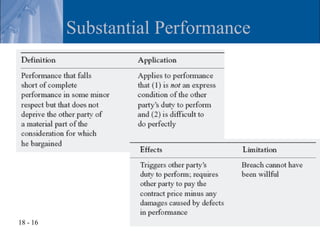
   A substantial performance standard is slightly
    lower standard applied to duties that are
    difficult to perform without some deviation
    from perfection in minor respects
         Example: Bob Builder built a home for Jason.
          Bob met the contract terms except he didn’t
          paint the baseboards the right shade of white.
          Bob is discharged and Jason has the duty to pay
          the contract price less any damages (repainting)
          resulting from the defects in performance
18 - 15
Substantial Performance


18 - 16
Breach of Contract
 Under the implied covenant of good faith and
  fair dealing, every contract includes an
  obligation to perform in good faith
 If a promisor fails to perform, breach occurs
 At minimum, breach of contract gives the
  non-breaching party the right to sue and
  recover for damages caused by the breach
 For a material (serious) breach, further legal
  remedies are available
18 - 17
Determining Materiality
    Standard for determining materiality is
     flexible, but generally based on the amount
     of the breach and timing for performance
         Example: if contract contains a “time is of the
          essence” provision, any delay by either party
          may constitute a material breach
         Example: if time for performance immaterial,
          promisee must accept late performance if
          within reasonable time after performance due,
          but may deduct costs of delay
18 - 18
Arnhold v. Ocean Atlantic Woodla
   Facts:
       Sellers agreed to sell farmland to developer Ocean
        Atlantic (Buyer), but delays and extensions ensued
       After more negotiation and litigation, Sellers and
        Buyer signed a settlement agreement containing a
        “time is of the essence” clause (basis of the lawsuit)
       Shortly before the closing date, Buyers again tried to
        extend the contract and Sellers refused, warning that
        “time is of the essence”
       Buyers assured Sellers they would close, but failed to
        do so; Sellers notifed Buyers of contract termination
18 - 19
Arnhold v. Ocean Atlantic
             Woodland Corp.
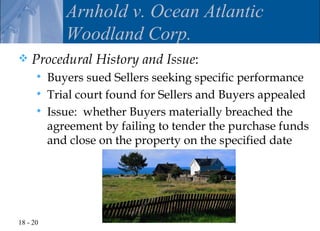
   Procedural History and Issue:
         Buyers sued Sellers seeking specific performance
         Trial court found for Sellers and Buyers appealed
         Issue: whether Buyers materially breached the
          agreement by failing to tender the purchase funds
          and close on the property on the specified date


18 - 20
Arnhold v. Ocean Atlantic
             Woodland Corp.
   Legal Reasoning and Holding:
         The materiality inquiry focuses on two
          interrelated issues: (1) the intent of the parties
          with respect to the disputed provision; and (2) the
          equitable factors and circumstances surrounding
          the breach of the provision
         Intent of the parties was clear – time was of the
          essence and timing was material


18 - 21
Arnhold v. Ocean Atlantic
             Woodland Corp.
   Legal Reasoning and Holding:
         In examining the totality of the circumstances, the
          facts do not support Buyer’s argument
            “Sellers displayed the patience of Job by
             waiting nearly 3 1⁄2 years”
         Buyer treated material deadlines as trivial, thus
          Buyer has lost any right to purchase Sellers’ land
         Affirmed in favor of Sellers


18 - 22
Anticipatory Breach
 When promisor indicates before time for
  performance that promisor is unwilling or
  unable to carry out the contract, anticipatory
  repudiation or anticipatory breach occurs
 Promisee has choices:
         Withhold his/her own performance and sue for
          damages for total breach of contract immediately
         Wait to sue until time for performance in case
          other party changes mind and decides to perform
         Waive his/her rights to performance
18 - 23
Excuses for Non-Performance
   Nonperformance of a duty generally is a breach
    of contract, but nonperformance may be excused
    in certain circumstances:
         Impossibility: “it cannot be done by anyone”
            See East Capitol View Community Development
             Corporation v. Robinson
         Impracticability: when unforeseen developments
          make performance highly impracticable,
          unreasonably expensive, or of little value to
          promisee (UCC 2–615)
18 - 24
Other Reasons for Discharge
 Discharge by mutual agreement
 Accord and satisfaction
         Accord is an agreement in which a promisee
          who has existing claim agrees with promisor
          that s/he will accept some performance
          different from that originally agreed on.
          When promisor performs the accord, that is
          called a satisfaction.
   Discharge by waiver of promisee
18 - 25
Other Reasons for Discharge
   Discharge by alteration
         One party alters and other does not consent
   Discharge by statute of limitations
       One party takes too long to bring lawsuit
       UCC 2–725: four-year statute of limitations
        for contracts involving the sale of goods
   Discharge by decree of bankruptcy


18 - 26
Remedies for Breach of Contract
    Legal remedies (money damages)
         Compensatory damages, nominal damages,
          liquidated (contractual) damages, and in
          certain circumstances, punitive damages
    Equitable remedies
         Specific performance or injunction
    Restitution


18 - 27
Test Your Knowledge
   True=A, False = B
       When a condition precedent occurs, the
        contract arises, creating duties to perform
       John agrees to work as Katy’s realtor until he
        sells her house. Katy closed on her house sale
        yesterday, so the contract has been
        discharged.
       The standard for materiality of a breach is
        when only 50% of a contract has been
        performed
18 - 28
Test Your Knowledge
   True=A, False = B
       Legal remedies for breach of contract include
        specific performance or injunction
       Nonperformance of a duty is always a breach
        of contract
       Performance that falls short of complete
        performance in some minor respect, but does
        not deprive the other party of a material part
        of the consideration for which s/he bargained
        is known as substantial performance.
18 - 29
Test Your Knowledge
   Multiple Choice
         Steve promised to work for his employer on
          Saturday morning. Steve didn’t show up for
          work on Saturday because he decided he
          didn’t need the overtime money. Steve:
           (a)   Is excused due to impracticality
           (b)   Breached his contract
           (c)   Breached the implied covenant of good faith
           (d)   Both B and C
           (e)   None of the above

18 - 30
Test Your Knowledge
   Multiple Choice
         Robert contracted to paint Stan’s house by the
          end of June, but realized after signing the
          contract that he had too many jobs to do and
          could not finish by the end of June. Robert
          called Stan and told him he could not fulfill
          the contract. Robert:
           (a)   Is excused due to impossibility
           (b)   Engaged in anticipatory breach
           (c)   Is excused because of condition precedent
           (d)   None of the above
18 - 31
Thought Questions
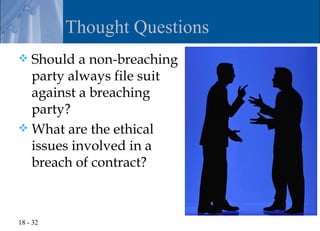
 Should a non-breaching
  party always file suit
  against a breaching
  party?
 What are the ethical
  issues involved in a
  breach of contract?


18 - 32

Chapter 18 – Performance and Remedies

  • 1.
    Introduction to Contracts The Agreement: Offer The Agreement: Acceptance Consideration Reality of Consent © 2010 The McGraw-Hill Companies, Inc. All rights reserved.
  • 2.
    Capacity to Contract Illegality Writing Rights of Third Parties Performance and Remedies © 2010 The McGraw-Hill Companies, Inc. All rights reserved.
  • 3.
    Performance and Remedies It is an immutable law in business that words are words, explanations are explanations, promises are promises – but only performance is reality. Harold S. Geneen, CEO of ITT Managing (co-written with Alvin Moscow, 1984) © 2010 The McGraw-Hill Companies, Inc. All rights reserved.
  • 4.
    Learning Objectives  Natureand types of conditions in contracts  Performance of contracts  Breach of contract  Excuses for non-performance  Remedies for breach of contract 18 - 4
  • 5.
    Overview  Entering into a contract evidences an intention to perform (complete) obligations under the contract  Generally, each party performs the promise and is discharged (released) from further obligation  If a party fails to perform as expected, courts may be asked to determine the respective rights and duties of the parties 18 - 5
  • 6.
    Conditions in aContract  Sometimes a promisor’s duty to perform depends on the occurrence of some event or condition, an uncertain, future event  A condition may be classified as a:  Condition precedent  Condition subsesequent  Condition concurrent 18 - 6
  • 7.
    Condition Precedent  A future, uncertain event creating a duty to perform  Example: Tisha contracts to buy a house on the condition she is able to obtain financing. The contract arises and she is obligated to purchase the house once she obtains financing 18 - 7
  • 8.
    Condition Concurrent  Whenthe contract calls for parties to perform at the same time  Example: Bryan promises to buy Stevie’s guitar for $1000. Stevie must give Bryan the guitar when Bryan gives Stevie $1000. 18 - 8
  • 9.
    Condition Subsequent  Afuture, uncertain event that discharges the duty to perform  Example: Lee agrees to work for WoolCo until he returns to college. Lee returns to college in August and discharges his obligation under the contract. 18 - 9
  • 10.
    Excuse of Conditions  Occurrence of a condition may be excused  Estoppel: when a person whose duty is conditional leads other party to rely on his noninsistence on the condition  Waiver: when a person whose duty is conditional voluntarily gives up his right to the occurrence of the condition 18 - 10
  • 11.
    Excuse of Conditions  Occurrence of condition excused  When occurrence of condition was prevented or hindered by party benefiting from the condition  When performance of the act that constitutes the condition becomes impossible 18 - 11
  • 12.
    Harbor Park Marketv. Gronda  Facts:  Grondas agreed to sell assets to Harbor Park Market (Harbor) expressly conditioned:  “This Purchase Agreement is subject to review & approval of attorney Lynn Stedman…”  Before Stedman approved Harbor contract, Gronda conditionally accepted another offer, also expressly conditioned on Stedman’s approval  Stedman approved second contract and Harbor sued for specific performance, winning at trial 18 - 12
  • 13.
    Harbor Park Marketv. Gronda  Issue and Reasoning:  Issue on appeal is whether Grondas interfered with (and waived) the condition precedent by submitting to second contract to Stedman  Contract language gave attorney complete discretion to approve or disapprove the agreement for whatever reason, and Grondas performed condition as required  Reversed and remanded in favor of Grondas 18 - 13
  • 14.
    Performance of Contracts To determine whether a promisor is discharged by performance, courts consider the standard of performance expected  A strict performance standard requires full or perfect compliance with the contract terms  Example: Buyer agrees to finalize a home purchase (close) by 5:00 pm on Nov. 21. If Buyer does not close by that time, the contract ends. Buyer is discharged from buying and Seller is discharged from turning over the house, but there may be legal remedies to Seller for Buyer’s breach 18 - 14
  • 15.
    Performance of Contracts  A substantial performance standard is slightly lower standard applied to duties that are difficult to perform without some deviation from perfection in minor respects  Example: Bob Builder built a home for Jason. Bob met the contract terms except he didn’t paint the baseboards the right shade of white. Bob is discharged and Jason has the duty to pay the contract price less any damages (repainting) resulting from the defects in performance 18 - 15
  • 16.
  • 17.
    Breach of Contract Under the implied covenant of good faith and fair dealing, every contract includes an obligation to perform in good faith  If a promisor fails to perform, breach occurs  At minimum, breach of contract gives the non-breaching party the right to sue and recover for damages caused by the breach  For a material (serious) breach, further legal remedies are available 18 - 17
  • 18.
    Determining Materiality  Standard for determining materiality is flexible, but generally based on the amount of the breach and timing for performance  Example: if contract contains a “time is of the essence” provision, any delay by either party may constitute a material breach  Example: if time for performance immaterial, promisee must accept late performance if within reasonable time after performance due, but may deduct costs of delay 18 - 18
  • 19.
    Arnhold v. OceanAtlantic Woodla  Facts:  Sellers agreed to sell farmland to developer Ocean Atlantic (Buyer), but delays and extensions ensued  After more negotiation and litigation, Sellers and Buyer signed a settlement agreement containing a “time is of the essence” clause (basis of the lawsuit)  Shortly before the closing date, Buyers again tried to extend the contract and Sellers refused, warning that “time is of the essence”  Buyers assured Sellers they would close, but failed to do so; Sellers notifed Buyers of contract termination 18 - 19
  • 20.
    Arnhold v. OceanAtlantic Woodland Corp.  Procedural History and Issue:  Buyers sued Sellers seeking specific performance  Trial court found for Sellers and Buyers appealed  Issue: whether Buyers materially breached the agreement by failing to tender the purchase funds and close on the property on the specified date 18 - 20
  • 21.
    Arnhold v. OceanAtlantic Woodland Corp.  Legal Reasoning and Holding:  The materiality inquiry focuses on two interrelated issues: (1) the intent of the parties with respect to the disputed provision; and (2) the equitable factors and circumstances surrounding the breach of the provision  Intent of the parties was clear – time was of the essence and timing was material 18 - 21
  • 22.
    Arnhold v. OceanAtlantic Woodland Corp.  Legal Reasoning and Holding:  In examining the totality of the circumstances, the facts do not support Buyer’s argument  “Sellers displayed the patience of Job by waiting nearly 3 1⁄2 years”  Buyer treated material deadlines as trivial, thus Buyer has lost any right to purchase Sellers’ land  Affirmed in favor of Sellers 18 - 22
  • 23.
    Anticipatory Breach  Whenpromisor indicates before time for performance that promisor is unwilling or unable to carry out the contract, anticipatory repudiation or anticipatory breach occurs  Promisee has choices:  Withhold his/her own performance and sue for damages for total breach of contract immediately  Wait to sue until time for performance in case other party changes mind and decides to perform  Waive his/her rights to performance 18 - 23
  • 24.
    Excuses for Non-Performance  Nonperformance of a duty generally is a breach of contract, but nonperformance may be excused in certain circumstances:  Impossibility: “it cannot be done by anyone”  See East Capitol View Community Development Corporation v. Robinson  Impracticability: when unforeseen developments make performance highly impracticable, unreasonably expensive, or of little value to promisee (UCC 2–615) 18 - 24
  • 25.
    Other Reasons forDischarge  Discharge by mutual agreement  Accord and satisfaction  Accord is an agreement in which a promisee who has existing claim agrees with promisor that s/he will accept some performance different from that originally agreed on. When promisor performs the accord, that is called a satisfaction.  Discharge by waiver of promisee 18 - 25
  • 26.
    Other Reasons forDischarge  Discharge by alteration  One party alters and other does not consent  Discharge by statute of limitations  One party takes too long to bring lawsuit  UCC 2–725: four-year statute of limitations for contracts involving the sale of goods  Discharge by decree of bankruptcy 18 - 26
  • 27.
    Remedies for Breachof Contract  Legal remedies (money damages)  Compensatory damages, nominal damages, liquidated (contractual) damages, and in certain circumstances, punitive damages  Equitable remedies  Specific performance or injunction  Restitution 18 - 27
  • 28.
    Test Your Knowledge  True=A, False = B  When a condition precedent occurs, the contract arises, creating duties to perform  John agrees to work as Katy’s realtor until he sells her house. Katy closed on her house sale yesterday, so the contract has been discharged.  The standard for materiality of a breach is when only 50% of a contract has been performed 18 - 28
  • 29.
    Test Your Knowledge  True=A, False = B  Legal remedies for breach of contract include specific performance or injunction  Nonperformance of a duty is always a breach of contract  Performance that falls short of complete performance in some minor respect, but does not deprive the other party of a material part of the consideration for which s/he bargained is known as substantial performance. 18 - 29
  • 30.
    Test Your Knowledge  Multiple Choice  Steve promised to work for his employer on Saturday morning. Steve didn’t show up for work on Saturday because he decided he didn’t need the overtime money. Steve: (a) Is excused due to impracticality (b) Breached his contract (c) Breached the implied covenant of good faith (d) Both B and C (e) None of the above 18 - 30
  • 31.
    Test Your Knowledge  Multiple Choice  Robert contracted to paint Stan’s house by the end of June, but realized after signing the contract that he had too many jobs to do and could not finish by the end of June. Robert called Stan and told him he could not fulfill the contract. Robert: (a) Is excused due to impossibility (b) Engaged in anticipatory breach (c) Is excused because of condition precedent (d) None of the above 18 - 31
  • 32.
    Thought Questions  Shoulda non-breaching party always file suit against a breaching party?  What are the ethical issues involved in a breach of contract? 18 - 32

Editor's Notes

  • #7 Compare a conditional duty to duties that are unconditional or absolute in which the duty to perform does not depend on the occurrence of any further event other than the passage of time A condition is an uncertain, future event that affects a party’s duty to perform
  • #8 If the condition does not occur, performance does not become due. If the condition does occur, the duty to perform arises. See Smith v. Carter & Burgess, Inc ., page 455 of the text, in which the contract language contained a condition precedent.
  • #9 When the contract calls for the parties to perform at the same time, each person’s performance is conditioned on the performance or tender of performance (offer of performance) by the other.
  • #10 When a duty is subject to a condition subsequent, the duty to perform arises but is discharged if the future, uncertain event occurs.
  • #13 “ Grondas” refers to William and Linda collectively. Opportunity to discuss how somebody might analyze the value of different offers and why attorney Stedman would have approved Carleton’s offer rather than Harbor’s Harbor offer was to purchase only liquor license and fixtures. Second offer by Carleton Enterprises, was to purchase the real property, along with the business, liquor license, and fixtures
  • #14 Trial court concluded that, by soliciting and submitting a competing purchase agreement to Stedman for review, the Grondas placed an obstacle in the way of Stedman’s approval of Harbor Park Market’s agreement and hindered the fulfillment of the condition precedent. It found in favor of Harbor Park Market and ordered the Grondas to perform the contract. The Grondas appealed. Appellate Court: “Where a party prevents the occurrence of a condition, the party, in effect, waives the performance of the condition….there was no limitation on what aspects of the agreement were subject to Stedman’s approval, …Since the parties failed to include an express limitation in the language of the condition precedent that restricted Stedman’s approval authority, we will not judicially impose one ourselves. …Hence, because the contract language giving the Grondas’ attorney complete discretion to approve or disapprove the agreement for whatever reason was clear and unambiguous, it has to be accepted and enforced as written…. The Grondas submitted the agreement to Stedman in a timely manner, and the agreement required them to do no more…Thus, it cannot be disputed that the Grondas did not fail to perform as required under the contract…. Reversed and remanded in favor of the Grondas.”
  • #15 The strict performance standard is also applied to contractual obligations that can be performed either exactly or to a high degree of perfection. Examples of this type of obligation include promises to pay money, deliver deeds, and, generally, promises to deliver goods.
  • #16 The most common example of this type of obligation is a promise to construct a building. Other examples include promises to construct roads, to cultivate crops, and to render some types of personal or professional services. When applied, the promisor substantially performed and is discharged, but the performance triggers the other party’s duty to pay the contract price less any damages resulting from the defects in performance
  • #20 Hyperlink is to the case opinion on the Justia website. New date scheduled for January 25, 2001. Throughout negotiations for settlement agreement, sellers insisted upon a rigid, absolute closing date. On January 18, Ocean Atlantic sent sellers a letter demanding that they move the closing to May 1 and pay an additional $680,000 in development fees. These fees had never been the subject of any prior negotiations nor were they embodied in any prior agreement between the parties. The sellers rejected Ocean Atlantic’s demand and warned that “if the closing does not occur in accordance with the terms of the settlement agreement, your clients will have no rights whatsoever to the property after January 25, 2001, as clearly spelled out in that same agreement.” Ocean Atlantic withdrew its proposals and assured sellers it would “fully participate in the scheduled closing [January 24], pursuant to the settlement agreement.” However, when the sellers arrived for the closing on the morning of January 24, they executed each and every document and were ready to close that day, but the closing failed to occur on the 24th (date selected by Ocean Atlantic) or January 25 (absolute, final drop-dead date) because Ocean Atlantic failed to tender the purchase price of $7.267 million for deposit into the sellers’ escrow account. Arnhold and Argoudelis’s attorneys notified Ocean Atlantic that the contract was terminated. After receiving this notice, Ocean Atlantic pleaded with Arnhold and Argoudelis to go forward with the sale, but they refused.
  • #21 Ocean Atlantic sued Arnhold and Argoudelis, seeking specific performance of the contract. Arnhold and Argoudelis asked the district court to rule that the contract was null and void. The district court decided in favor of Arnhold and Argoudelis, and Ocean Atlantic appealed.
  • #22 Court: “ Timely performance often is an absolute requirement even if the contract does not contain the talismanic phrase “time is of the essence”; it is well-settled that the intention of the parties as expressed by the agreement controls, and courts will give effect to this provision when no peculiar circumstances have intervened to prevent or excuse strict compliance….” “ When analyzing the materiality of a time-essence clause, the factfinder initially must ask whether performance by a particular date was truly of such significance that the contract would not have been made if the provision had not been included…. The factfinder must take into account the totality of the circumstances and focus on the inherent justice of the matter…..” “ 1. Step one: Intent of the parties… In the case before us, the district court considered the language of the settlement agreement, along with the substance of the parties’ negotiations and their course of performance. All three categories of evidence support a finding of materiality…. We are convinced that the settlement agreement reflects a compromise. The sellers agreed to … give Ocean Atlantic one last, final chance to comply with the language of the contract and purchase the farmland. In exchange, Ocean Atlantic agreed that absolutely no further delays would be tolerated. We agree that the clause was a material term of the contract….”
  • #23 Court: “ 2. Step two: Totality of the circumstances. b. The relevant factors i. Bargained-for objective …The sellers displayed the patience of Job by waiting nearly 3 1⁄2 years to accomplish the sale of farmland that was originally intended to be transferred within six months…. ii. Proportionality of prejudice…requires the factfinder to compare the relative burdens that each side would suffer if the contract were terminated…. Ocean Atlantic’s million-dollar loss was, admittedly, substantial. However…, the loss was not enough to warrant granting Ocean Atlantic’s motion for specific performance…. iii. Unreasonable, unfair advantage… Two important factors to consider at this juncture are: (1) whether the breaching party used reasonable efforts to perform its contractual obligations; and (2) whether the parties contemplated that the breaching party would forfeit its contractual rights if it committed the type of breach that is at issue. Neither of these factors favors Ocean Atlantic….” “ A reasonable factfinder concluded that Ocean Atlantic treated the material, bargained-for deadlines in this agreement as if they were trivial details that could be flouted with impunity. As a result, Ocean Atlantic has lost any and all rights to purchase the sellers’ farmland. Affirmed in favor of Arnhold and Argoudelis.”
  • #25 The three most common situations for impossibility involve illness or death of the promisor, supervening illegality, and destruction of the subject matter of the contract. Impracticability basically means the event was beyond the scope of the risks that the parties contemplated at the time of contracting. Case law and official comments to UCC section 2–615 indicate that neither increased cost nor collapse of a market for particular goods is sufficient to excuse nonperformance, because those are the types of business risks that every promisor assumes. However, drastic price increases or severe shortages of goods resulting from unforeseen circumstances such as wars and crop failures can give rise to impracticability.
  • #29 True. True. This is an example of a condition subsequent. False. The standard for the materiality of a breach is flexible, but generally based on the amount of the breach and timing for performance
  • #30 False. Legal remedies for breach of contract include compensatory damages, nominal damages, liquidated (contractual) damages, and in certain circumstances, punitive damages False. Nonperformance of a duty generally is a breach of contract, but there are valid reasons to excuse performance. True.
  • #31 The correct answer is (d).
  • #32 The correct answer is (b). Stan has choices: waive his right to performance under the contract and hire somebody else, w ithhold his/her own performance (payment) and sue Robert for damages for total breach of contract immediately, wait until the time for performance to file suit in case Robert changes his mind and decides to perform.
  • #33 Opportunity to discuss choices (negotiation and settlement, waiver, litigation) when faced with a breach of contract. Opportunity to discuss why a person might breach a contract and whether or not breaching a contract is “unethical.”