Note: please read all the instruction carefully before beginning
the assignment.
For this milestone, you will review Case Study One and
compose a short report, applying your legal knowledge and
understanding of the types of business organizations. Case
Study One focuses on the legal system, criminal law, and ethics.
For additional details, please refer to the Milestone One
Guidelines and Rubric document and the Milestone One
Template in the Assignment Guidelines and Rubrics section of
the course.
Note: the pages that you would need to read and understand in
order to be able to do this assignment is listed below on the
case study one
.
LEARNING OBJECTIVES
After reading this chapter, you will be able to answer the
following questions:
1
What is consideration?
2
What are the rules regarding consideration?
3
What is promissory estoppel, and when can it be used?
4
What is an illusory promise?
5
How are the UCC rules regarding consideration different from
the common law rules regarding consideration?
6
What is the difference between a liquidated debt and an
unliquidated debt?
7
What is an accord and satisfaction?
CASE OPENER
Upper Deck—Contract Liability or Gift?
In 1988 the Upper Deck Company was a company with an idea
for a better baseball card: one that had a hologram on it. By the
1990s the firm was a major corporation worth at least a quarter
of a billion dollars.
In 1988, however, its outlook hadn't been so bright. Upper
Deck lacked the funds for a $100,000 deposit it needed to buy
some special paper by August 1. Without that deposit its
contract with the Major League Baseball Players Association
would have been jeopardized.
Upper Deck's corporate attorney, Anthony Passante, Jr.,
loaned the company the money. That evening, the directors of
the company accepted the loan and, in gratitude, agreed to give
Passante 3 percent of the firm's stock. Passante never sought to
collect the stock, and later the company reneged on its promise.
Passante sued for breach of oral contract.
1
p. 343
1.
If you were on the jury, how would you decide the case? Was
the offer of 3 percent of the firm's stock legal consideration for
the loan? Or was it a mere gift?
2.
Does Upper Deck have a moral obligation to give Passante the
stock? If so, is this obligation legally enforceable?
The Wrap-Up at the end of the chapter will answer these
questions.
at is Consideration?
Consideration
The bargained-for exchange; what each party gets in exchange
for his or her promise under a contract.
is required in every contract. It is what a person will receive in
return for performing a contract obligation. Suppose Dan agrees
to purchase Marty's car for $1,000. Dan's payment of $1,000 is
the consideration Marty will receive for the car. Title to and
possession of the car are the consideration Dan will receive in
exchange. Consideration can be anything, as long as it is the
product of a bargained-for exchange. In a business context it is
often (but not always) money.
Exhibit 15-1
provides other examples of consideration.
Rules of Consideration
The key to understanding consideration is understanding the
rules that govern it and their exceptions. We explore them
below.
LACK OF CONSIDERATION
What are the rules regarding consideration?
A court will enforce one party's promise only if the other party
promised some consideration in exchange. For example, in a
bilateral contract (a promise for a promise), the consideration
for each promise is a return promise. Suppose Nicole promises
to pay Mike $2,000 tomorrow for his car. Mike promises to sell
Nicole his car tomorrow for $2,000. There is an oral contract
between them. Nicole's promise is her consideration to Mike.
Mike's promise is his consideration to Nicole. There has been a
mutual exchange of something of value.
An example of a bilateral contract, or a promise for a
promise, occurred when the U.S. government seized control of
insurance giant American International Group (AIG). The
government agreed to lend AIG up to $85 billion in exchange
for nearly 80 percent of AIG's stock. The consideration AIG
received was the promise of up to $85 billion in U.S.
government loans. The consideration the government received
was a promise of almost 80 percent of AIG's stock.
2
Exhibit 15-1
Examples of Consideration
p. 344
In a unilateral contract (a promise for an act), one party's
consideration is the promise and the other party's consideration
is the act. Suppose your professor made the following statement
in class: “If any student shows up at my house on Saturday and
does the gardening, I will pay that student $100.” You show up
and do the gardening. The professor's consideration to you is
the promise of the payment of $100 on completion of the
gardening, and your consideration to the professor is the act of
completing the gardening. Once again, there has been a mutual
exchange of something of value.
See
Exhibit 15-2
for an explanation of bilateral and unilateral contracts.
Legal Principle:
For a promise to be enforced by the courts, there must be
consideration.
One exception to the rule requiring consideration is
promissory estoppel
The legal enforcement of an otherwise unenforceable contract
due to a party’s detrimental reliance on the contract.
.
Promissory estoppel occurs when three conditions are met:
•
One party makes a promise knowing the other party will rely on
it.
•
The other party does rely on the promise.
•
The only way to avoid injustice is to enforce the promise.
What is promissory estoppel, and when can it be used?
How does promissory estoppel work? Suppose upon
graduation from college, Amanda receives a job offer across the
country. She gives up her apartment, cancels all her other job
interviews, and moves all her possessions. Upon arriving, she
rents a new apartment and shows up for work. Amanda is then
told there is no job! May she sue the employer? The answer in
most states is yes, under the theory of promissory estoppel.
Amanda may be able to recover her
reliance damages
(money she spent in “reliance” on the job offer). Promissory
estoppel is not awarded regularly, but in the right case it can
provide a remedy where no other remedy exists.
In a recent case, the Ninth Circuit Court of Appeals held that
Yahoo's promise to remove a nude photo from its Web site was
subject to a claim of promissory estoppel. In that case, the
plaintiff learned that her ex-boyfriend, pretending to be her, had
posted nude photos of her on Yahoo. He also included all her
contact information and an invitation for men to contact her for
sexual purposes.
3
The plaintiff contacted Yahoo (in accordance with its
established policies) and requested that the photo be removed.
Yahoo agreed but, despite repeated requests, did not remove the
photo for six months. The court held that Yahoo's promise to
depost the profile meant that Yahoo had a duty to the plaintiff.
As such, the plaintiff's claim of promissory estoppel could be
maintained. If the plaintiff is able to prove that she reasonably
relied on Yahoo's promise to her detriment, she may well
prevail on her claim.
Exhibit 15-2
Type of Consideration Based on Type of Contract
p. 345
CASE NUGGET
Promissory Estoppel
Double AA Builders, Ltd. v. Grand State Construction L.L.C.
114 P.3d 835 (Ariz. Ct. App. 2005)
In anticipation of submitting a bid for the construction of a
Home Depot Store in Mesa, Arizona, Double AA solicited bids
from subcontractors for various portions of the work. Grand
State faxed a written but unsigned bid to Double AA in the
amount of $115,000 for installation of the exterior insulation
finish system (EIFS) on the project. The proposal stated: “Our
price is good for 30 days.” Double AA relied on several
subcontractor bids, including Grand State's, in preparing its
overall price for the project.
On December 21, 2001, Home Depot advised Double AA it
was the successful bidder for the project. On January 11, 2002,
within the 30-day “price is good” period, Double AA sent a
subcontract for the EIFS work to Grand State to be signed and
returned. Grand State advised Double AA it would not sign the
subcontract or perform on the project. Double AA subsequently
entered into a subcontract with a replacement subcontractor to
install the EIFS at a cost of $131,449, which exceeded Grand
State's quoted price by $16,449. Double AA demanded that
Grand State pay the difference between its bid and Double AA's
ultimate cost to perform the same work. After Grand State
refused, Double AA filed suit based on promissory estoppel.
When a general contractor prepares an overall bid for a
competitively bid construction project, it receives bids and
quotes from subcontractors for portions of the work. The
general contractor uses the bids in preparing its overall price for
the project. A subcontractor's refusal to honor its bid can be
financially disastrous for the general contractor, because the
general contractor will typically be bound by the bid price it
submitted to the project owner.
Promissory estoppel may be used to require that the
subcontractor perform according to the terms of its bid to the
contractor if the contractor receives the contract award, because
the contractor has detrimentally relied on the subcontractor's
bid and must perform for a price based on that reliance. Double
AA prevailed. Nonperformance by the subcontractor resulted in
damages equal to the difference between what the contractor
had to pay and what it would have paid had the subcontractor
performed.
A second exception to the rule requiring consideration is a
contract under seal
. In the past, contracts were sealed with a piece of soft wax into
which an impression was made. Today, sealed contracts are
typically identified with the word
seal
or the letters
L.S.
(an abbreviation for
locus sigilli,
which means “the place for the seal”) at the end. Consumers
may also purchase contract forms with a preprinted seal. The
parties using them are presumed, without evidence to the
contrary, to be adopting the seal for the contract. States in the
U.S. no longer require that contracts be under seal. However, 10
states still allow a contract without consideration to be enforced
if it is under seal.
Legal Principle:
Promissory estoppel and contracts under seal are exceptions to
the common law rule requiring consideration.
In
Case 15-1
, the court must decide whether continued employment is
consideration for signing a noncompete agreement.
CASE
15-1
ANTHONY A. LABRIOLA v. POLLARD GROUP, INC.
SUPREME COURT OF WASHINGTON 100 P.3D 791 (SUP.
CT. WASH. 2004)
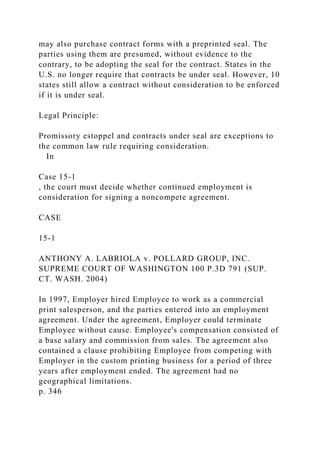
In 1997, Employer hired Employee to work as a commercial
print salesperson, and the parties entered into an employment
agreement. Under the agreement, Employer could terminate
Employee without cause. Employee's compensation consisted of
a base salary and commission from sales. The agreement also
contained a clause prohibiting Employee from competing with
Employer in the custom printing business for a period of three
years after employment ended. The agreement had no
geographical limitations.
p. 346
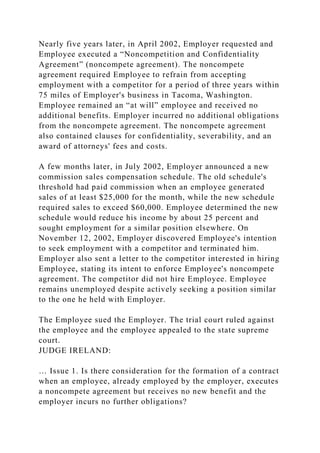
Nearly five years later, in April 2002, Employer requested and
Employee executed a “Noncompetition and Confidentiality
Agreement” (noncompete agreement). The noncompete
agreement required Employee to refrain from accepting
employment with a competitor for a period of three years within
75 miles of Employer's business in Tacoma, Washington.
Employee remained an “at will” employee and received no
additional benefits. Employer incurred no additional obligations
from the noncompete agreement. The noncompete agreement
also contained clauses for confidentiality, severability, and an
award of attorneys' fees and costs.
A few months later, in July 2002, Employer announced a new
commission sales compensation schedule. The old schedule's
threshold had paid commission when an employee generated
sales of at least $25,000 for the month, while the new schedule
required sales to exceed $60,000. Employee determined the new
schedule would reduce his income by about 25 percent and
sought employment for a similar position elsewhere. On
November 12, 2002, Employer discovered Employee's intention
to seek employment with a competitor and terminated him.
Employer also sent a letter to the competitor interested in hiring
Employee, stating its intent to enforce Employee's noncompete
agreement. The competitor did not hire Employee. Employee
remains unemployed despite actively seeking a position similar
to the one he held with Employer.
The Employee sued the Employer. The trial court ruled against
the employee and the employee appealed to the state supreme
court.
JUDGE IRELAND:
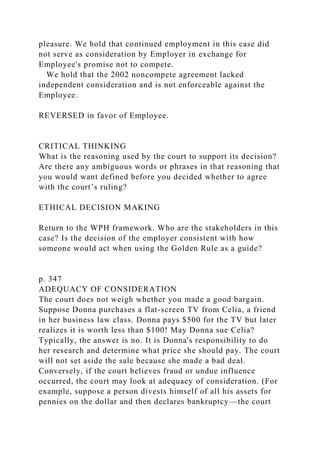
… Issue 1. Is there consideration for the formation of a contract
when an employee, already employed by the employer, executes
a noncompete agreement but receives no new benefit and the
employer incurs no further obligations?
Employee claims that the noncompete agreement fails for lack
of consideration; in other words, a contract was not formed.
Employer contends that the noncompete agreement is
enforceable because future and continued employment and/or
job training served as the Employer's consideration in exchange
for Employee's execution of the noncompete agreement…. The
general rule in Washington is that consideration exists if the
employee enters into a noncompete agreement when he or she is
first hired…. A noncompete agreement entered into after
employment will be enforced if it is supported by independent
consideration…. Independent, additional consideration is
required for the valid formation of a modification or subsequent
agreement. There is no consideration when “one party is to
perform some additional obligation while the other party is
simply to perform that which he promised in the original
contract.” [Citations omitted]. Independent consideration may
include increased wages, a promotion, a bonus, a fixed term of
employment, or perhaps access to protected information….
Independent consideration involves new promises or obligations
previously not required of the parties….
In the present case, Employer contends that continued
employment served as consideration for the 2002 noncompete
agreement … [but] Employee's noncompete agreement made no
promises as to future employment and wages. Further, during
deposition, Robin Pollard, Employer's president, conceded that
“no extra benefits or consideration or promises [were] made to
[Employee] if he signed the noncompete.”
Consideration is a bargained-for exchange of promises. A
comparison of the status of the employer before and after the
noncompete agreement confirms that the 2002 noncompete
agreement was entered into without consideration. Employer did
not incur additional duties or obligations from the noncompete
agreement. Prior to execution of the 2002 noncompete
agreement, Employee was an “at will” Employee. After
Employee executed the noncompete agreement, he still
remained an “at will” employee terminable at Employer's
pleasure. We hold that continued employment in this case did
not serve as consideration by Employer in exchange for
Employee's promise not to compete.
We hold that the 2002 noncompete agreement lacked
independent consideration and is not enforceable against the
Employee.
REVERSED in favor of Employee.
CRITICAL THINKING
What is the reasoning used by the court to support its decision?
Are there any ambiguous words or phrases in that reasoning that
you would want defined before you decided whether to agree
with the court’s ruling?
ETHICAL DECISION MAKING
Return to the WPH framework. Who are the stakeholders in this
case? Is the decision of the employer consistent with how
someone would act when using the Golden Rule as a guide?
p. 347
ADEQUACY OF CONSIDERATION
The court does not weigh whether you made a good bargain.
Suppose Donna purchases a flat-screen TV from Celia, a friend
in her business law class. Donna pays $500 for the TV but later
realizes it is worth less than $100! May Donna sue Celia?
Typically, the answer is no. It is Donna's responsibility to do
her research and determine what price she should pay. The court
will not set aside the sale because she made a bad deal.
Conversely, if the court believes fraud or undue influence
occurred, the court may look at adequacy of consideration. (For
example, suppose a person divests himself of all his assets for
pennies on the dollar and then declares bankruptcy—the court
would likely review the consideration paid to determine whether
there was fraud by the debtor against the creditors.)
Legal Principle:
The court seldom considers adequacy of consideration.
Is a promise to refrain from something you are legally entitled
to do appropriate consideration for a contract? See
Case 15-2
.
CASE
15-2
HAMER v. SIDWAY
COURT OF APPEALS OF NEW YORK 124 N.Y. 538 (1891)
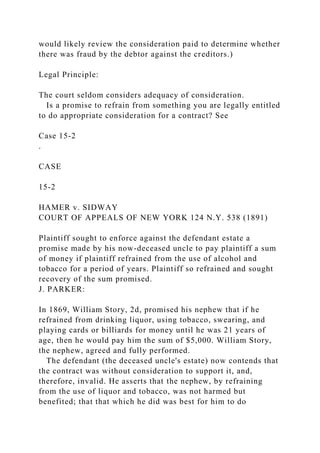
Plaintiff sought to enforce against the defendant estate a
promise made by his now-deceased uncle to pay plaintiff a sum
of money if plaintiff refrained from the use of alcohol and
tobacco for a period of years. Plaintiff so refrained and sought
recovery of the sum promised.
J. PARKER:
In 1869, William Story, 2d, promised his nephew that if he
refrained from drinking liquor, using tobacco, swearing, and
playing cards or billiards for money until he was 21 years of
age, then he would pay him the sum of $5,000. William Story,
the nephew, agreed and fully performed.
The defendant (the deceased uncle's estate) now contends that
the contract was without consideration to support it, and,
therefore, invalid. He asserts that the nephew, by refraining
from the use of liquor and tobacco, was not harmed but
benefited; that that which he did was best for him to do
independently of his uncle's promise, and insists that it follows
that unless the nephew was benefited, the contract was without
consideration. This contention, if well founded, would seem to
leave open for controversy in many cases whether that which
the promisee did or omitted to do was, in fact, of such benefit to
him as to leave no consideration to support the enforcement of
the promisor's agreement.
Such a rule could not be tolerated, and is without foundation
in the law. Consideration means not so much that one party is
profiting as that the other abandons some legal right in the
present or limits his legal freedom of action in the future. Now,
applying this rule to the facts before us, the promisee used
tobacco, occasionally drank liquor, and he had a legal right to
do so. He abandoned that right for a period of years based upon
the promise of his uncle that for such forbearance he would give
him $5,000. We need not speculate on the effort which may
have been required to give up the use of those stimulants. It is
sufficient that he restricted his lawful freedom of action within
certain prescribed limits upon the faith of his uncle's agreement.
Now, having fully performed the conditions imposed, it makes
no difference whether such performance was actually a benefit
to the promisor, and the court will not inquire into it. Even if it
were a proper subject of inquiry, we see nothing in this record
that would permit a determination that the uncle was not
benefited in a legal sense. It is deemed established for the
purposes of this appeal, that on January 31, 1875, defendant's
testator was indebted to William E. Story, 2d, in the sum of
$5,000. All concur.
The order reversing the trial court judgment in favor of plaintiff
is reversed on the grounds that plaintiff's promise to abandon
his legal right to use tobacco and alcohol was sufficient
consideration to enforce the contract.
CRITICAL THINKING
What difference would it have made in this case had the nephew
not had the legal right to drink or smoke? Why is this question
crucial to the decision?
ETHICAL DECISION MAKING
William Story, 2d, may well have thought that he should win
the case on moral grounds. He is applauding his nephew’s
behavior in recognition that the behavior the nephew stopped
was behavior that was harming his nephew. So, since his
nephew is now in better condition than he was before their
exchange of views, why does the court put itself in the position
of requiring William Story, 2d, to pay the $5,000?
p. 348
In
Case 15-3
, the court had to consider whether $1 plus “love and affection”
was adequate consideration for the transfer of property.
CASE
15-3
THELMA AGNES SMITH v. DAVID PHILLIP RILEY
COURT OF APPEALS OF TENNESSEE, EASTERN SECTION,
AT KNOXVILLE 2002 TENN. APP. LEXIS 65 (2002)
The plaintiff, Thelma Agnes Smith, lived with the defendant out
of wedlock for several years. When the relationship ended, she
sued the defendant, seeking to enforce two written agreements
with him regarding the sale and assignment of property to her.
The trial court enforced the agreements and divided the parties'
property. The defendant appealed, arguing the agreements
lacked consideration and were void as against public policy.
JUDGE CHARLES D. SUSANO:
…Thelma Agnes Smith and David Phillip Riley, both of whom
then resided in Florida, separated from their respective spouses
in 1997 and began a romantic relationship. In early 1998, the
two moved to Tennessee and began cohabitating…. Smith and
Riley opened a joint checking account in March, 1998. Over
time, Smith deposited into that account $9,500—the proceeds
from an insurance settlement and monies received when her
divorce later became final; she also deposited her monthly
social security check of $337 into the same account. Smith
continued to deposit her social security check in the joint
account until December, 1998, when she opened her own
checking account. Riley also contributed to the joint account.
He placed a settlement of $84,000 from the Veteran's
Administration into the account. In addition, he deposited his
monthly pension check of $ 2,036 into the same account….
On July 31, 1998, Riley entered into a lease with Jerry
Strickland and Wanda Strickland with respect to a residence
owned by them; the lease was accompanied by an option to
purchase. Almost four months later, on November 20, 1998,
Smith and Riley returned to their attorney's office, at which
time the attorney prepared a bill of sale and an assignment. In
the bill of sale, Riley transferred [to Smith] a one-half
undivided interest in seven items of personal property…. Riley
also assigned to Smith a one-half undivided interest in the lease
and option to purchase with the Stricklands, which interest
included a right of survivorship in the one-half interest retained
by Riley as well. The property Riley sold and assigned to Smith
in the two agreements was stated in each to be “for and in
consideration of the sum of One Dollar ($1.00) and other and
good and valuable consideration, the sufficiency of which is
hereby acknowledged….”
When Smith and Riley separated in April, 1999, Smith filed
suit against Riley in the trial court, seeking the dissolution of
their “domestic partnership.” Smith alleged that she and Riley
had been living together for several years without the benefit of
marriage and had acquired both real and personal property,
some of which Riley had assigned to her. As a result, she asked
the court to award her 50 percent of the “partnership” assets,
leaving the other 50 percent to Riley…. [The trial court ruled in
favor of Smith and Riley appealed.]
p. 349
Riley first argues that the trial court erred in finding that the
bill of sale and assignment are supported by valid consideration.
Specifically, Riley relies on Smith's statements at trial that she
considered their pending engagement and the funds she
deposited into their joint account to be consideration for their
agreements.
It is a well-settled principle of contract law that in order for a
contract to be binding, it must, among other things, be
supported by sufficient consideration. [Citations omitted.] In
expounding on the adequacy of consideration, the Tennessee
Supreme Court has stated that it is not necessary that the benefit
conferred or the detriment suffered by the promisee shall be
equal to the responsibility assumed. Any consideration, however
small, will support a promise. In the absence of fraud, the
courts will not undertake to regulate the amount of the
consideration. The parties are left to contract for themselves,
taking for granted that the consideration is one valuable in the
eyes of the law….
Quoting the United States Supreme Court, the Tennessee
Supreme Court went on to state that “[a] stipulation in
consideration of $1 is just as effectual and valuable a
consideration as a larger sum stipulated for or paid.” [Citations
omitted.] Indeed, the consideration of love and affection has
been deemed sufficient to support a conveyance….
Both the bill of sale and the assignment recite that they are
undertaken “for and in consideration of the sum of One Dollar
($1.00) and other and good and valuable consideration, the
sufficiency of which is hereby acknowledged….” Facially, the
documents are therefore supported by sufficient consideration,
as clearly recognized by the Supreme Court…. Moreover,
Smith's “society and consortium”—a concept comparable to the
love and affection … is further evidence of sufficient
consideration to support these conveyances.
Riley calls our attention to Smith's statement at trial that she
considered the funds she deposited into their joint account to be
consideration for the conveyances. If this were the only
consideration involved in this case, Riley's argument regarding
past consideration supporting a present transaction might have
some merit. However, the recitals of nominal consideration that
are present in both agreements, as well as the consideration of
Smith's love and affection, are adequate consideration and will
support the conveyances represented by the assignment and bill
of sale….
Judgment affirmed in favor of Plaintiff.
CRITICAL THINKING
What is the reasoning of the appellant in terms of why the
consideration was not adequate to cause the contracts to be
enforceable? What key rule of law did this reasoning overlook?
ETHICAL DECISION MAKING
What values are being advanced by the logic of the relevant rule
of law in this case? In other words, what values prevent the rule
of law from being that “consideration must be in an amount
similar in value to the item or services being transferred in
order for the contract to be enforceable”?
ILLUSORY PROMISE
What is an illusory promise? Suppose Shawn offers to sell
Molly his skis for $300. Molly responds, “I'll look at them in
the morning, and if I like them, I'll pay you.” At this point,
Molly has not committed to doing anything. The law considers
this an
illusory promise
A situation in which a party appears to commit to something but
really has not committed to anything. It is not a promise and
thus not consideration.
—it is not a promise at all.
What is an illusory promise?
Legal Principle:
An illusory promise is not consideration.
PAST CONSIDERATION
For a court to enforce a promise, both sides must offer
consideration. Imagine you graduate from college and get a
great job. After five years, your boss says to you, “Because you
have done such a great job the last five years, I am going to
give you 5 percent of the company stock.” Six months later, you
still have not received the stock. May you sue your boss to
enforce the promise? The answer is no. For a promise to be
enforceable, there must be bargaining and an exchange. Because
your work has already been performed, you have given nothing
in exchange, and the court will not enforce the promise. A
promise cannot be based on consideration provided before the
promise was made. You are at the mercy of your boss's
goodwill.
p. 350
COMPARING THE LAW OF OTHER COUNTRIES
Deeds in England
England has the same requirement for consideration as the
United States and even shares the exception of promissory
estoppel. However, England has an additional exception:
specialty contracts or deeds. In England, a
deed
creates a binding obligation between parties without
consideration when certain formalities are honored. These
formalities include a written document signed by the person
making it, a witness to the maker's signature, and delivery of
the document to the other party with a statement or an
accompanying act indicating the maker's intention to be bound
by the deed. Deeds are used in England to create enforceable
promises of gifts to charity. This exception to the requirement
for consideration also exists in Canadian law.
Legal Principle:
Past consideration is no consideration at all.
As you have probably guessed by now, there is an exception
to this rule. Under the Restatement (Second) of Contracts (a
persuasive, though not binding, authority), promises based on
past consideration may be enforceable “to the extent necessary
to avoid injustice.” In some cases, if past consideration was
given with expectation of future payment, the court may enforce
the promise.
PREEXISTING DUTY
There are two parts to the
preexisting duty
A promise to do something that one is already obligated to do.
It is not considered valid consideration.
rule.
Performance of a duty you are obligated to do under the law is
not good consideration.
Part of a police officer's sworn public duty is catching
suspected criminals. If someone offers a reward for the capture
of a suspect, the police officer may not collect it, as he or she
was already obligated to apprehend the suspect. Moreover,
performance of an existing contractual duty is not good
consideration.
Gene decides to have a pool built in his backyard. Under the
existing contract, the pool is to be completed by June 1, just in
time for summer. The pool contractor then explains that due to a
shortage of workers, the completion date cannot be met;
however, if Gene were to pay an extra $5,000, additional
workers could be hired and the pool completed on time. Gene
tells the contractor he will pay the $5,000. On June 1, the pool
is completed and the contractor asks for the additional payment.
Is Gene legally obligated to pay? The answer is no. The pool
contractor had a preexisting contractual duty to complete the
pool by June 1. Gene is under no obligation to pay the
additional money.
Legal Principle:
A promise to do something that you are already obligated to do
is not valid consideration.
Exceptions to the Preexisting Duty Rule.
There are exceptions to the preexisting duty rule: unforeseen
circumstances, additional work, and
UCC Article 2
(sale of goods).
If
unforeseen circumstances
cause a party to make a promise regarding an unfinished
project, that promise is valid consideration. Suppose the pool
contractor has been building pools in Gene's neighborhood for
the last 20 years and has never had any problem with rocks—
until now. While bulldozing the hole for the pool in Gene's
backyard, the pool contractor hits solid rock. It will cost an
additional $5,000 to clear the rock with jackhammers, possibly
even dynamite. The contractor says unless Gene agrees to pay
the additional money, he will not be able to finish the pool.
Gene agrees to pay. When the pool is completed, the contractor
asks for the additional $5,000. Will a court enforce Gene's
promise? The answer is yes. Even though the contractor is
completing only what he was obligated to do under the contract,
neither party knew of the solid rock. The contractor has given
additional consideration (removal of the rock) and Gene will be
held to his promise to pay the additional money.
pter Opener
p. 358
PART 2
Contracts
LEARNING OBJECTIVES
After reading this chapter, you will be able to answer the
following questions:
1
What is the legal effect of a lack of capacity on a person's
ability to enter into a contract?
2
Under what circumstances would a party have limited capacity
to enter into a contract?
3
What is the legal effect of entering into a contract for an illegal
purpose?
CASE OPENER
A Wasted Education
Ten months before he attained the age of majority, John
Adamowski paid for and received a course in elementary
aviation from Curtiss-Wright Flying Service. Five months later,
he purchased and received a limited commercial pilot's course
from the same company. Two months later, he entered into a
contract with Curtiss-Wright for an advanced course of
instruction to become a transport pilot, but he withdrew from
the course within a month and paid nothing.
Six months after reaching the age of majority, Adamowski
received a bill from Curtiss-Wright for the balance due on his
course. He visited Curtiss-Wright's attorney and denied liability
but said nothing about disaffirmance (exercising his legal right
to end the contract). He took no further action until a few days
shy of a year from the date on which he had attained the age of
majority. At that time, he filed suit against Curtiss-Wright,
seeking to disaffirm his contracts for the aviation courses and
recover the money he had paid for them on grounds that he had
entered into the contracts as a minor and thus had the right to
disaffirm them and receive his money back. Curtiss-Wright
argued that the courses were necessaries and, as such,
Adamowski was not entitled to disaffirm the contracts for them.
1
p. 359
1.
Were the contracts for necessaries and, as such, not subject to
being disaffirmed?
2.
Even if the plaintiff had the right to disaffirm the contracts, was
almost a year too long to wait to disaffirm them?
The Wrap-Up at the end of the chapter will answer these
questions.
Legality
p. 367
To be enforceable, contracts must have legal subject matter and
must be able to be performed legally. They cannot violate either
state or federal law. A contract overturned for illegal subject
matter or for being illegal to perform is generally declared void.
A contract need not be in violation of a statute to be illegal;
agreements against generally accepted public policy are also
illegal and unenforceable.
Contracts that are made for an illegal purpose or that cannot
be carried out by legal means are made void for two main
reasons: First, making them void clearly indicates that such
agreements are not socially acceptable, and, second, doing so
prevents the legal system's being used to promote agreements
that are harmful to society.
What is the legal effect of entering into a contract for an illegal
purpose?
CONTRACTS THAT VIOLATE STATE OR FEDERAL
STATUTES
There are any number of ways in which contracts can violate a
state or federal statute. Some of the more common ones are
discussed below and summarized in
Exhibit 16-4
.
Agreements to Commit a Crime or Tort.
Again, contracts cannot be for illegal purposes or require
illegal acts for performance. Any agreement to commit a crime
or tort is illegal and unenforceable. However, should a legal
contract be formed and its subject later become illegal under a
new statute, the contract is considered to be discharged by law.
Suppose Jim agrees to paint Hiroki's house and, in exchange,
Hiroki agrees to be a poker dealer at Jim's casino, starting in
two weeks. Before Hiroki can begin work, however, the state
amends its gaming statute, making all games of chance other
than slot machines illegal. Because it is now illegal for Jim's
casino to offer poker, it would be illegal for Hiroki to perform
the contract. Because a change in the law has made the subject
matter of the contract illegal, both parties are discharged from
their obligations under the contract.
Licensing Statutes.
All 50 states have statutes requiring that people in certain
professions obtain a license before practicing their craft. For
example, doctors of all varieties, plumbers, cosmetologists,
lawyers, electricians, teachers, and stockbrokers are all required
to obtain a license before practicing. While this list is far from
exhaustive, it demonstrates how widespread the licensing
requirement can be. For most of these licensed professions,
licenses are typically issued only after extensive schooling,
training, and/or demonstrating some degree of competence.
These requirements reflect the value society places on proper
performance of duties in the licensed professions.
Licensing statutes have three main purposes in addition to
indicating this value. The first is to give the government some
control over which people, and how many people, can perform
certain jobs. Second, by charging for licenses, the government
can obtain revenue.
Exhibit 16-4
Contracts That Violate State or Federal Statutes
Agreements to commit a crime or tort are illegal in all states.
Agreements made for the purpose of protecting the public's
health, safety, or welfare by a party unlicensed to do so are
typically illegal in all states.
Agreements regarding usurious loans may be illegal in some
states.
Agreements regarding gambling are illegal in most states.
Agreements that violate Sabbath or Sunday laws are illegal in
some states.
p. 368
The third purpose of licensing statutes, the protection of the
public's health, safety, and welfare, is related to the public
interest. By imposing legal standards on a profession, the
government can try to prevent harm to public health, safety, and
welfare due to substandard work. For instance, it is not in the
public's best interest to allow an unqualified person to perform
the delicate and complicated process of medical surgery. To
limit the number of people who might be harmed during
surgery, the government requires that prospective surgeons,
even after extensive schooling, obtain a license.
Given these different reasons for licensing various
professionals, different outcomes can result when someone
enters into an agreement with a person who is unlawfully
unlicensed, depending on the purpose of the licensing statute.
The state in which the unlicensed person is practicing is
relevant, because many licensing statutes occur at the state level
and thus vary from state to state. In some states the rule is “no
license, no contract.” These states will not enforce any
agreement with an unlawfully unlicensed professional.
However, in other states the courts typically consider the
purpose of licensing. If it is to provide government control over
the profession or generate revenue, most states allow
enforcement of the contract. Although the unlicensed
professional is acting in violation of the law and is usually
required to pay a fine for working without a license, there are
no grave reasons the contract should not be carried out.
If the licensing statute is intended to protect the public's
health, safety, and welfare, however, the agreement is typically
deemed illegal and unenforceable. For example, the public
would not be made safer if the government allowed unlicensed
people to perform surgery. Therefore, a person cannot enter into
a contract for professional service with an unlicensed
professional when the law requires a license out of intent to
protect the public.
Legal Principle:
If the licensing statute is intended simply to generate revenue,
then the contract of an unlicensed person is valid; if the purpose
of the licensing statute is to protect the public's health, safety,
and welfare, however, the agreement of an unlicensed person is
typically deemed illegal and unenforceable.
Usury.
Almost as widespread as licensing statutes, statutes
prohibiting usury are found on the books of nearly every state.
Usury
The lending of money at an exorbitant or unlawful rate of
interest.
occurs when a party gives a loan at an interest rate exceeding
the legal maximum. The legal maximum interest rate varies
from state to state, but it is easy to determine the rate of any
given state.
While usury statutes act as a ceiling on rates, there are a few
legal exceptions whereby loans may exceed the predetermined
maximum. To facilitate business transactions and keep the
economy healthy, for example, most states with usury statutes
allow corporations willing to pay more to lend and borrow at
rates exceeding the maximum. The rationale behind the
corporation exception is that if a business needs money to
expand and is willing to pay the higher interest rate, the
corporation should be afforded the opportunity to borrow. The
converse is that if a corporation is willing to borrow at a high
interest rate, parties should be allowed to lend at that rate for
corporations only. The intent is to facilitate business
transactions in order to keep the economy in a healthy state.
Many states also allow parties to make small loans at rates
above the maximum to parties that cannot obtain a needed loan
at the statutory maximum. The belief is that if people need
money and the statutory maximum is not inducing others to
lend, certain parties will make the necessary loans at a higher
rate as long as the loan is “small.” This exception allows cash
advance institutions to operate.
p. 369
If no exception allows a usurious loan, the legal outcome
varies by state. A few states declare all usurious loans void,
which means the lender is not entitled to recover either interest
or principal from the borrower. A larger number of states allow
lenders to recover the principal but no interest. States most
favorable toward lenders allow recovery of the principal as well
as interest up to, but not exceeding, the statutory maximum.
Gambling.
All states regulate gambling. As used in this chapter, the
term
gambling
Agreements in which parties pay consideration (money placed
during bets) for the chance, or opportunity, to obtain an amount
of money or property.
refers to agreements in which parties pay consideration (money
placed during bets) for the chance, or opportunity, to obtain an
amount of money or property. Industry officials, however,
prefer to use the term
gaming.
While gambling is illegal in most states, some allow casino
gambling, notably Nevada, New Jersey, and Louisiana. Some
allow certain other types of gambling, either intentionally or
through legal loopholes. For example, given California's
definition of gambling, betting on draw poker is legal. Some
states make other exceptions, such as for horse tracks, casinos
on Native American reservations, or state-run lotteries, which,
although most people do not consider them to be such, are a
form of gambling.
Sabbath Laws.
A large number of states still have
Sabbath, Sunday,
or
blue
laws on the books.
Sabbath Laws
A law that prohibits the performance of certain activities on
Sundays.
limit the types of business activities in which parties can legally
engage on Sundays. In Colonial times, these laws prohibited
store operations and all work on the “Lord's day” (Sunday).
Today these laws vary by state. Most prohibit the sale of all
alcohol, or specific types, either all day or at particular times on
Sundays. Some Sabbath laws also make it illegal to enter into
any contract on a Sunday. However, an executed, or fully
performed, contract created on a Sunday cannot be rescinded.
There are exceptions to Sabbath laws. Most states allow the
performance of charity work on Sundays. In addition, the laws
typically do not apply to contracts for obtaining “necessities,”
including prescription medication, food, and anything else
related to health or survival.
Regardless of how widespread Sabbath laws are, the vast
majority of states do not enforce some or all of their Sabbath
laws. In fact, some have been held to violate the First
Amendment. If they are on the books, however, they can be
applied, and some states do apply them. Prudent
businesspersons should always find out whether Sabbath laws
exist in their state and whether authorities enforce them.
AGREEMENTS IN CONTRADICTION TO PUBLIC POLICY
Some types of agreements are not illegal per se, as they are not
in violation of any statute or legal code, but are nevertheless
unenforceable because courts have deemed them to be against
public policy. Public policy involves both the government's
concern for its citizens and the beliefs people hold regarding the
proper subject of business transactions. The focus is what is “in
society's best interest.”
Contracts in Restraint of Trade.
It is a widely held belief in economics, and in U.S. culture in
general, that competition drives down prices, which is good for
consumers. Thus, agreements that restrain trade, called
anticompetitive agreements,
are viewed as being harmful to consumers and against public
policy. They also frequently violate antitrust laws. See
Chapter 47
for an in-depth discussion of antitrust law.
When courts determine a restraint on trade is reasonable,
however, and the restraint is part of a subordinate, or ancillary,
clause in the contract, the restraint is typically allowed. Such
restraints are known as
covenants not to compete
An agreement not to compete against a party for a set period of
time within a designated geographic area.
,
or
restrictive covenants.
There are two types.
p. 370
The first enforceable type of restrictive covenant is one made
in conjunction with the sale of an ongoing business. The public
policy argument in favor of supporting restrictions regarding
the sale of a business involves the fairness of the sale, as
illustrated by the following hypothetical: Suppose you purchase
a jewelry store from Ann, a well-respected member of the
community, whose business has been around for many years.
The people in the community know the store, and they trust Ann
to provide fair exchanges. As a well-informed businessperson,
you know about Ann's good reputation and it made the purchase
more appealing.
Now suppose a month later Ann opens another jewelry store a
block away. Ann's loyal customers are likely to go to her new
store because they still trust her. In the meantime, Ann's good
name is no longer associated with your store, and your business
suffers accordingly. You entered into the sales agreement
thinking you would benefit from Ann's good name, but in the
end you overpaid for a business that lacks that benefit, because
Ann took her name with her when she went into competition
with your store. In the interest of fairness, courts are willing to
impose restrictions preventing Ann, or others in her position,
from going into immediate competition with you, or others in
your position. Public policy requires fairness in business
transactions, which does not occur when people profit from the
sale of a business and then start a new business that destroys the
one they just sold.
Remember, if the covenant not to compete is an integral part
of the main agreement, not subordinate, the agreement is
typically considered unenforceable and void, because it goes
against public policy by creating unreasonable restraints on
trade. When the covenant is subordinate, however, the specific
noncompetition clause can be removed and the agreement can
go forward as planned. In
Case 16-2
, the court had to determine the reasonableness of a covenant
not to compete that was included in a separation agreement.
CASE
16-2
WILLIAM CAVANAUGH v. MARGARET McKENNA
SUPERIOR COURT OF MASSACHUSETTS, AT MIDDLESEX
22 Mass. L. Rep. 694; 2007 Mass. Super. LEXIS 298
Defendant entered into a separation agreement with the plaintiff
at the time of their divorce. The agreement provided in part that
defendant would not accept full-time employment or open her
own funeral business in Wilmington so long as the plaintiff
maintained his funeral business. The trial court found that
plaintiff had breached the agreement by competing with
defendant by working for, and later owning, Nichols Funeral
Home. On appeal, the defendant argued that the covenant not to
compete was unenforceable as a restraint of trade that violated
public policy.
JUSTICE SMITH:
A covenant to not compete must be reasonable in time and
scope, serve to protect a party's legitimate business interest, be
supported by consideration, and be consonant with the public
interest…. While most covenants not to compete arise either in
the context of an employment relationship or the sale of a
business, there are situations which do not “fit neatly into
existing standards for reviewing such covenants” which require
analogy.
Boulanger v. Dunkin' Donuts, Inc., …
(2004) (finding covenant in franchise agreement akin to that of
covenant in sale of business). With the sale of a business,
“courts look less critically at covenants not to compete because
they do not implicate an individual's right to employment to the
same degree as in the employment context.”
…
Courts will consider whether the parties were represented by
counsel in making the agreement and entered the agreement
without compulsion….
1
John P. Adamowski v. The Curtiss-Wright Flying Service, Inc.,
300 Mass. 281, 15 N.E.2d 467, 1938 Mass. LEXIS 942.
Note please read all the instruction carefully before beginning.docx

Note please read all the instruction carefully before beginning.docx

  • 1.
    Note: please readall the instruction carefully before beginning the assignment. For this milestone, you will review Case Study One and compose a short report, applying your legal knowledge and understanding of the types of business organizations. Case Study One focuses on the legal system, criminal law, and ethics. For additional details, please refer to the Milestone One Guidelines and Rubric document and the Milestone One Template in the Assignment Guidelines and Rubrics section of the course. Note: the pages that you would need to read and understand in order to be able to do this assignment is listed below on the case study one . LEARNING OBJECTIVES After reading this chapter, you will be able to answer the following questions: 1 What is consideration?
  • 2.
    2 What are therules regarding consideration? 3 What is promissory estoppel, and when can it be used? 4 What is an illusory promise? 5 How are the UCC rules regarding consideration different from the common law rules regarding consideration? 6 What is the difference between a liquidated debt and an unliquidated debt? 7 What is an accord and satisfaction? CASE OPENER Upper Deck—Contract Liability or Gift? In 1988 the Upper Deck Company was a company with an idea for a better baseball card: one that had a hologram on it. By the 1990s the firm was a major corporation worth at least a quarter of a billion dollars. In 1988, however, its outlook hadn't been so bright. Upper Deck lacked the funds for a $100,000 deposit it needed to buy some special paper by August 1. Without that deposit its
  • 3.
    contract with theMajor League Baseball Players Association would have been jeopardized. Upper Deck's corporate attorney, Anthony Passante, Jr., loaned the company the money. That evening, the directors of the company accepted the loan and, in gratitude, agreed to give Passante 3 percent of the firm's stock. Passante never sought to collect the stock, and later the company reneged on its promise. Passante sued for breach of oral contract. 1 p. 343 1. If you were on the jury, how would you decide the case? Was the offer of 3 percent of the firm's stock legal consideration for the loan? Or was it a mere gift? 2. Does Upper Deck have a moral obligation to give Passante the stock? If so, is this obligation legally enforceable? The Wrap-Up at the end of the chapter will answer these questions. at is Consideration? Consideration The bargained-for exchange; what each party gets in exchange for his or her promise under a contract. is required in every contract. It is what a person will receive in return for performing a contract obligation. Suppose Dan agrees to purchase Marty's car for $1,000. Dan's payment of $1,000 is the consideration Marty will receive for the car. Title to and possession of the car are the consideration Dan will receive in exchange. Consideration can be anything, as long as it is the product of a bargained-for exchange. In a business context it is often (but not always) money.
  • 4.
    Exhibit 15-1 provides otherexamples of consideration. Rules of Consideration The key to understanding consideration is understanding the rules that govern it and their exceptions. We explore them below. LACK OF CONSIDERATION What are the rules regarding consideration? A court will enforce one party's promise only if the other party promised some consideration in exchange. For example, in a bilateral contract (a promise for a promise), the consideration for each promise is a return promise. Suppose Nicole promises to pay Mike $2,000 tomorrow for his car. Mike promises to sell Nicole his car tomorrow for $2,000. There is an oral contract between them. Nicole's promise is her consideration to Mike. Mike's promise is his consideration to Nicole. There has been a mutual exchange of something of value. An example of a bilateral contract, or a promise for a promise, occurred when the U.S. government seized control of insurance giant American International Group (AIG). The government agreed to lend AIG up to $85 billion in exchange for nearly 80 percent of AIG's stock. The consideration AIG received was the promise of up to $85 billion in U.S. government loans. The consideration the government received was a promise of almost 80 percent of AIG's stock. 2 Exhibit 15-1 Examples of Consideration p. 344 In a unilateral contract (a promise for an act), one party's consideration is the promise and the other party's consideration is the act. Suppose your professor made the following statement
  • 5.
    in class: “Ifany student shows up at my house on Saturday and does the gardening, I will pay that student $100.” You show up and do the gardening. The professor's consideration to you is the promise of the payment of $100 on completion of the gardening, and your consideration to the professor is the act of completing the gardening. Once again, there has been a mutual exchange of something of value. See Exhibit 15-2 for an explanation of bilateral and unilateral contracts. Legal Principle: For a promise to be enforced by the courts, there must be consideration. One exception to the rule requiring consideration is promissory estoppel The legal enforcement of an otherwise unenforceable contract due to a party’s detrimental reliance on the contract. . Promissory estoppel occurs when three conditions are met: • One party makes a promise knowing the other party will rely on it. • The other party does rely on the promise. • The only way to avoid injustice is to enforce the promise.
  • 6.
    What is promissoryestoppel, and when can it be used? How does promissory estoppel work? Suppose upon graduation from college, Amanda receives a job offer across the country. She gives up her apartment, cancels all her other job interviews, and moves all her possessions. Upon arriving, she rents a new apartment and shows up for work. Amanda is then told there is no job! May she sue the employer? The answer in most states is yes, under the theory of promissory estoppel. Amanda may be able to recover her reliance damages (money she spent in “reliance” on the job offer). Promissory estoppel is not awarded regularly, but in the right case it can provide a remedy where no other remedy exists. In a recent case, the Ninth Circuit Court of Appeals held that Yahoo's promise to remove a nude photo from its Web site was subject to a claim of promissory estoppel. In that case, the plaintiff learned that her ex-boyfriend, pretending to be her, had posted nude photos of her on Yahoo. He also included all her contact information and an invitation for men to contact her for sexual purposes. 3 The plaintiff contacted Yahoo (in accordance with its established policies) and requested that the photo be removed. Yahoo agreed but, despite repeated requests, did not remove the photo for six months. The court held that Yahoo's promise to depost the profile meant that Yahoo had a duty to the plaintiff. As such, the plaintiff's claim of promissory estoppel could be maintained. If the plaintiff is able to prove that she reasonably relied on Yahoo's promise to her detriment, she may well prevail on her claim.
  • 7.
    Exhibit 15-2 Type ofConsideration Based on Type of Contract p. 345 CASE NUGGET Promissory Estoppel Double AA Builders, Ltd. v. Grand State Construction L.L.C. 114 P.3d 835 (Ariz. Ct. App. 2005) In anticipation of submitting a bid for the construction of a Home Depot Store in Mesa, Arizona, Double AA solicited bids from subcontractors for various portions of the work. Grand State faxed a written but unsigned bid to Double AA in the amount of $115,000 for installation of the exterior insulation finish system (EIFS) on the project. The proposal stated: “Our price is good for 30 days.” Double AA relied on several subcontractor bids, including Grand State's, in preparing its overall price for the project. On December 21, 2001, Home Depot advised Double AA it was the successful bidder for the project. On January 11, 2002, within the 30-day “price is good” period, Double AA sent a subcontract for the EIFS work to Grand State to be signed and returned. Grand State advised Double AA it would not sign the subcontract or perform on the project. Double AA subsequently entered into a subcontract with a replacement subcontractor to install the EIFS at a cost of $131,449, which exceeded Grand State's quoted price by $16,449. Double AA demanded that Grand State pay the difference between its bid and Double AA's ultimate cost to perform the same work. After Grand State refused, Double AA filed suit based on promissory estoppel. When a general contractor prepares an overall bid for a
  • 8.
    competitively bid constructionproject, it receives bids and quotes from subcontractors for portions of the work. The general contractor uses the bids in preparing its overall price for the project. A subcontractor's refusal to honor its bid can be financially disastrous for the general contractor, because the general contractor will typically be bound by the bid price it submitted to the project owner. Promissory estoppel may be used to require that the subcontractor perform according to the terms of its bid to the contractor if the contractor receives the contract award, because the contractor has detrimentally relied on the subcontractor's bid and must perform for a price based on that reliance. Double AA prevailed. Nonperformance by the subcontractor resulted in damages equal to the difference between what the contractor had to pay and what it would have paid had the subcontractor performed. A second exception to the rule requiring consideration is a contract under seal . In the past, contracts were sealed with a piece of soft wax into which an impression was made. Today, sealed contracts are typically identified with the word seal or the letters L.S. (an abbreviation for locus sigilli, which means “the place for the seal”) at the end. Consumers
  • 9.
    may also purchasecontract forms with a preprinted seal. The parties using them are presumed, without evidence to the contrary, to be adopting the seal for the contract. States in the U.S. no longer require that contracts be under seal. However, 10 states still allow a contract without consideration to be enforced if it is under seal. Legal Principle: Promissory estoppel and contracts under seal are exceptions to the common law rule requiring consideration. In Case 15-1 , the court must decide whether continued employment is consideration for signing a noncompete agreement. CASE 15-1 ANTHONY A. LABRIOLA v. POLLARD GROUP, INC. SUPREME COURT OF WASHINGTON 100 P.3D 791 (SUP. CT. WASH. 2004) In 1997, Employer hired Employee to work as a commercial print salesperson, and the parties entered into an employment agreement. Under the agreement, Employer could terminate Employee without cause. Employee's compensation consisted of a base salary and commission from sales. The agreement also contained a clause prohibiting Employee from competing with Employer in the custom printing business for a period of three years after employment ended. The agreement had no geographical limitations. p. 346
  • 10.
    Nearly five yearslater, in April 2002, Employer requested and Employee executed a “Noncompetition and Confidentiality Agreement” (noncompete agreement). The noncompete agreement required Employee to refrain from accepting employment with a competitor for a period of three years within 75 miles of Employer's business in Tacoma, Washington. Employee remained an “at will” employee and received no additional benefits. Employer incurred no additional obligations from the noncompete agreement. The noncompete agreement also contained clauses for confidentiality, severability, and an award of attorneys' fees and costs. A few months later, in July 2002, Employer announced a new commission sales compensation schedule. The old schedule's threshold had paid commission when an employee generated sales of at least $25,000 for the month, while the new schedule required sales to exceed $60,000. Employee determined the new schedule would reduce his income by about 25 percent and sought employment for a similar position elsewhere. On November 12, 2002, Employer discovered Employee's intention to seek employment with a competitor and terminated him. Employer also sent a letter to the competitor interested in hiring Employee, stating its intent to enforce Employee's noncompete agreement. The competitor did not hire Employee. Employee remains unemployed despite actively seeking a position similar to the one he held with Employer. The Employee sued the Employer. The trial court ruled against the employee and the employee appealed to the state supreme court. JUDGE IRELAND: … Issue 1. Is there consideration for the formation of a contract when an employee, already employed by the employer, executes a noncompete agreement but receives no new benefit and the employer incurs no further obligations?
  • 11.
    Employee claims thatthe noncompete agreement fails for lack of consideration; in other words, a contract was not formed. Employer contends that the noncompete agreement is enforceable because future and continued employment and/or job training served as the Employer's consideration in exchange for Employee's execution of the noncompete agreement…. The general rule in Washington is that consideration exists if the employee enters into a noncompete agreement when he or she is first hired…. A noncompete agreement entered into after employment will be enforced if it is supported by independent consideration…. Independent, additional consideration is required for the valid formation of a modification or subsequent agreement. There is no consideration when “one party is to perform some additional obligation while the other party is simply to perform that which he promised in the original contract.” [Citations omitted]. Independent consideration may include increased wages, a promotion, a bonus, a fixed term of employment, or perhaps access to protected information…. Independent consideration involves new promises or obligations previously not required of the parties…. In the present case, Employer contends that continued employment served as consideration for the 2002 noncompete agreement … [but] Employee's noncompete agreement made no promises as to future employment and wages. Further, during deposition, Robin Pollard, Employer's president, conceded that “no extra benefits or consideration or promises [were] made to [Employee] if he signed the noncompete.” Consideration is a bargained-for exchange of promises. A comparison of the status of the employer before and after the noncompete agreement confirms that the 2002 noncompete agreement was entered into without consideration. Employer did not incur additional duties or obligations from the noncompete agreement. Prior to execution of the 2002 noncompete agreement, Employee was an “at will” Employee. After Employee executed the noncompete agreement, he still remained an “at will” employee terminable at Employer's
  • 12.
    pleasure. We holdthat continued employment in this case did not serve as consideration by Employer in exchange for Employee's promise not to compete. We hold that the 2002 noncompete agreement lacked independent consideration and is not enforceable against the Employee. REVERSED in favor of Employee. CRITICAL THINKING What is the reasoning used by the court to support its decision? Are there any ambiguous words or phrases in that reasoning that you would want defined before you decided whether to agree with the court’s ruling? ETHICAL DECISION MAKING Return to the WPH framework. Who are the stakeholders in this case? Is the decision of the employer consistent with how someone would act when using the Golden Rule as a guide? p. 347 ADEQUACY OF CONSIDERATION The court does not weigh whether you made a good bargain. Suppose Donna purchases a flat-screen TV from Celia, a friend in her business law class. Donna pays $500 for the TV but later realizes it is worth less than $100! May Donna sue Celia? Typically, the answer is no. It is Donna's responsibility to do her research and determine what price she should pay. The court will not set aside the sale because she made a bad deal. Conversely, if the court believes fraud or undue influence occurred, the court may look at adequacy of consideration. (For example, suppose a person divests himself of all his assets for pennies on the dollar and then declares bankruptcy—the court
  • 13.
    would likely reviewthe consideration paid to determine whether there was fraud by the debtor against the creditors.) Legal Principle: The court seldom considers adequacy of consideration. Is a promise to refrain from something you are legally entitled to do appropriate consideration for a contract? See Case 15-2 . CASE 15-2 HAMER v. SIDWAY COURT OF APPEALS OF NEW YORK 124 N.Y. 538 (1891) Plaintiff sought to enforce against the defendant estate a promise made by his now-deceased uncle to pay plaintiff a sum of money if plaintiff refrained from the use of alcohol and tobacco for a period of years. Plaintiff so refrained and sought recovery of the sum promised. J. PARKER: In 1869, William Story, 2d, promised his nephew that if he refrained from drinking liquor, using tobacco, swearing, and playing cards or billiards for money until he was 21 years of age, then he would pay him the sum of $5,000. William Story, the nephew, agreed and fully performed. The defendant (the deceased uncle's estate) now contends that the contract was without consideration to support it, and, therefore, invalid. He asserts that the nephew, by refraining from the use of liquor and tobacco, was not harmed but benefited; that that which he did was best for him to do
  • 14.
    independently of hisuncle's promise, and insists that it follows that unless the nephew was benefited, the contract was without consideration. This contention, if well founded, would seem to leave open for controversy in many cases whether that which the promisee did or omitted to do was, in fact, of such benefit to him as to leave no consideration to support the enforcement of the promisor's agreement. Such a rule could not be tolerated, and is without foundation in the law. Consideration means not so much that one party is profiting as that the other abandons some legal right in the present or limits his legal freedom of action in the future. Now, applying this rule to the facts before us, the promisee used tobacco, occasionally drank liquor, and he had a legal right to do so. He abandoned that right for a period of years based upon the promise of his uncle that for such forbearance he would give him $5,000. We need not speculate on the effort which may have been required to give up the use of those stimulants. It is sufficient that he restricted his lawful freedom of action within certain prescribed limits upon the faith of his uncle's agreement. Now, having fully performed the conditions imposed, it makes no difference whether such performance was actually a benefit to the promisor, and the court will not inquire into it. Even if it were a proper subject of inquiry, we see nothing in this record that would permit a determination that the uncle was not benefited in a legal sense. It is deemed established for the purposes of this appeal, that on January 31, 1875, defendant's testator was indebted to William E. Story, 2d, in the sum of $5,000. All concur. The order reversing the trial court judgment in favor of plaintiff is reversed on the grounds that plaintiff's promise to abandon his legal right to use tobacco and alcohol was sufficient consideration to enforce the contract. CRITICAL THINKING
  • 15.
    What difference wouldit have made in this case had the nephew not had the legal right to drink or smoke? Why is this question crucial to the decision? ETHICAL DECISION MAKING William Story, 2d, may well have thought that he should win the case on moral grounds. He is applauding his nephew’s behavior in recognition that the behavior the nephew stopped was behavior that was harming his nephew. So, since his nephew is now in better condition than he was before their exchange of views, why does the court put itself in the position of requiring William Story, 2d, to pay the $5,000? p. 348 In Case 15-3 , the court had to consider whether $1 plus “love and affection” was adequate consideration for the transfer of property. CASE 15-3 THELMA AGNES SMITH v. DAVID PHILLIP RILEY COURT OF APPEALS OF TENNESSEE, EASTERN SECTION, AT KNOXVILLE 2002 TENN. APP. LEXIS 65 (2002) The plaintiff, Thelma Agnes Smith, lived with the defendant out of wedlock for several years. When the relationship ended, she sued the defendant, seeking to enforce two written agreements with him regarding the sale and assignment of property to her. The trial court enforced the agreements and divided the parties' property. The defendant appealed, arguing the agreements lacked consideration and were void as against public policy.
  • 16.
    JUDGE CHARLES D.SUSANO: …Thelma Agnes Smith and David Phillip Riley, both of whom then resided in Florida, separated from their respective spouses in 1997 and began a romantic relationship. In early 1998, the two moved to Tennessee and began cohabitating…. Smith and Riley opened a joint checking account in March, 1998. Over time, Smith deposited into that account $9,500—the proceeds from an insurance settlement and monies received when her divorce later became final; she also deposited her monthly social security check of $337 into the same account. Smith continued to deposit her social security check in the joint account until December, 1998, when she opened her own checking account. Riley also contributed to the joint account. He placed a settlement of $84,000 from the Veteran's Administration into the account. In addition, he deposited his monthly pension check of $ 2,036 into the same account…. On July 31, 1998, Riley entered into a lease with Jerry Strickland and Wanda Strickland with respect to a residence owned by them; the lease was accompanied by an option to purchase. Almost four months later, on November 20, 1998, Smith and Riley returned to their attorney's office, at which time the attorney prepared a bill of sale and an assignment. In the bill of sale, Riley transferred [to Smith] a one-half undivided interest in seven items of personal property…. Riley also assigned to Smith a one-half undivided interest in the lease and option to purchase with the Stricklands, which interest included a right of survivorship in the one-half interest retained by Riley as well. The property Riley sold and assigned to Smith in the two agreements was stated in each to be “for and in consideration of the sum of One Dollar ($1.00) and other and good and valuable consideration, the sufficiency of which is hereby acknowledged….” When Smith and Riley separated in April, 1999, Smith filed suit against Riley in the trial court, seeking the dissolution of their “domestic partnership.” Smith alleged that she and Riley
  • 17.
    had been livingtogether for several years without the benefit of marriage and had acquired both real and personal property, some of which Riley had assigned to her. As a result, she asked the court to award her 50 percent of the “partnership” assets, leaving the other 50 percent to Riley…. [The trial court ruled in favor of Smith and Riley appealed.] p. 349 Riley first argues that the trial court erred in finding that the bill of sale and assignment are supported by valid consideration. Specifically, Riley relies on Smith's statements at trial that she considered their pending engagement and the funds she deposited into their joint account to be consideration for their agreements. It is a well-settled principle of contract law that in order for a contract to be binding, it must, among other things, be supported by sufficient consideration. [Citations omitted.] In expounding on the adequacy of consideration, the Tennessee Supreme Court has stated that it is not necessary that the benefit conferred or the detriment suffered by the promisee shall be equal to the responsibility assumed. Any consideration, however small, will support a promise. In the absence of fraud, the courts will not undertake to regulate the amount of the consideration. The parties are left to contract for themselves, taking for granted that the consideration is one valuable in the eyes of the law…. Quoting the United States Supreme Court, the Tennessee Supreme Court went on to state that “[a] stipulation in consideration of $1 is just as effectual and valuable a consideration as a larger sum stipulated for or paid.” [Citations omitted.] Indeed, the consideration of love and affection has been deemed sufficient to support a conveyance…. Both the bill of sale and the assignment recite that they are undertaken “for and in consideration of the sum of One Dollar ($1.00) and other and good and valuable consideration, the sufficiency of which is hereby acknowledged….” Facially, the documents are therefore supported by sufficient consideration,
  • 18.
    as clearly recognizedby the Supreme Court…. Moreover, Smith's “society and consortium”—a concept comparable to the love and affection … is further evidence of sufficient consideration to support these conveyances. Riley calls our attention to Smith's statement at trial that she considered the funds she deposited into their joint account to be consideration for the conveyances. If this were the only consideration involved in this case, Riley's argument regarding past consideration supporting a present transaction might have some merit. However, the recitals of nominal consideration that are present in both agreements, as well as the consideration of Smith's love and affection, are adequate consideration and will support the conveyances represented by the assignment and bill of sale…. Judgment affirmed in favor of Plaintiff. CRITICAL THINKING What is the reasoning of the appellant in terms of why the consideration was not adequate to cause the contracts to be enforceable? What key rule of law did this reasoning overlook? ETHICAL DECISION MAKING What values are being advanced by the logic of the relevant rule of law in this case? In other words, what values prevent the rule of law from being that “consideration must be in an amount similar in value to the item or services being transferred in order for the contract to be enforceable”? ILLUSORY PROMISE What is an illusory promise? Suppose Shawn offers to sell Molly his skis for $300. Molly responds, “I'll look at them in the morning, and if I like them, I'll pay you.” At this point, Molly has not committed to doing anything. The law considers
  • 19.
    this an illusory promise Asituation in which a party appears to commit to something but really has not committed to anything. It is not a promise and thus not consideration. —it is not a promise at all. What is an illusory promise? Legal Principle: An illusory promise is not consideration. PAST CONSIDERATION For a court to enforce a promise, both sides must offer consideration. Imagine you graduate from college and get a great job. After five years, your boss says to you, “Because you have done such a great job the last five years, I am going to give you 5 percent of the company stock.” Six months later, you still have not received the stock. May you sue your boss to enforce the promise? The answer is no. For a promise to be enforceable, there must be bargaining and an exchange. Because your work has already been performed, you have given nothing in exchange, and the court will not enforce the promise. A promise cannot be based on consideration provided before the promise was made. You are at the mercy of your boss's goodwill. p. 350 COMPARING THE LAW OF OTHER COUNTRIES
  • 20.
    Deeds in England Englandhas the same requirement for consideration as the United States and even shares the exception of promissory estoppel. However, England has an additional exception: specialty contracts or deeds. In England, a deed creates a binding obligation between parties without consideration when certain formalities are honored. These formalities include a written document signed by the person making it, a witness to the maker's signature, and delivery of the document to the other party with a statement or an accompanying act indicating the maker's intention to be bound by the deed. Deeds are used in England to create enforceable promises of gifts to charity. This exception to the requirement for consideration also exists in Canadian law. Legal Principle: Past consideration is no consideration at all. As you have probably guessed by now, there is an exception to this rule. Under the Restatement (Second) of Contracts (a persuasive, though not binding, authority), promises based on past consideration may be enforceable “to the extent necessary to avoid injustice.” In some cases, if past consideration was given with expectation of future payment, the court may enforce the promise. PREEXISTING DUTY There are two parts to the preexisting duty A promise to do something that one is already obligated to do.
  • 21.
    It is notconsidered valid consideration. rule. Performance of a duty you are obligated to do under the law is not good consideration. Part of a police officer's sworn public duty is catching suspected criminals. If someone offers a reward for the capture of a suspect, the police officer may not collect it, as he or she was already obligated to apprehend the suspect. Moreover, performance of an existing contractual duty is not good consideration. Gene decides to have a pool built in his backyard. Under the existing contract, the pool is to be completed by June 1, just in time for summer. The pool contractor then explains that due to a shortage of workers, the completion date cannot be met; however, if Gene were to pay an extra $5,000, additional workers could be hired and the pool completed on time. Gene tells the contractor he will pay the $5,000. On June 1, the pool is completed and the contractor asks for the additional payment. Is Gene legally obligated to pay? The answer is no. The pool contractor had a preexisting contractual duty to complete the pool by June 1. Gene is under no obligation to pay the additional money. Legal Principle: A promise to do something that you are already obligated to do is not valid consideration. Exceptions to the Preexisting Duty Rule. There are exceptions to the preexisting duty rule: unforeseen circumstances, additional work, and
  • 22.
    UCC Article 2 (saleof goods). If unforeseen circumstances cause a party to make a promise regarding an unfinished project, that promise is valid consideration. Suppose the pool contractor has been building pools in Gene's neighborhood for the last 20 years and has never had any problem with rocks— until now. While bulldozing the hole for the pool in Gene's backyard, the pool contractor hits solid rock. It will cost an additional $5,000 to clear the rock with jackhammers, possibly even dynamite. The contractor says unless Gene agrees to pay the additional money, he will not be able to finish the pool. Gene agrees to pay. When the pool is completed, the contractor asks for the additional $5,000. Will a court enforce Gene's promise? The answer is yes. Even though the contractor is completing only what he was obligated to do under the contract, neither party knew of the solid rock. The contractor has given additional consideration (removal of the rock) and Gene will be held to his promise to pay the additional money. pter Opener p. 358 PART 2 Contracts LEARNING OBJECTIVES After reading this chapter, you will be able to answer the
  • 23.
    following questions: 1 What isthe legal effect of a lack of capacity on a person's ability to enter into a contract? 2 Under what circumstances would a party have limited capacity to enter into a contract? 3 What is the legal effect of entering into a contract for an illegal purpose? CASE OPENER A Wasted Education Ten months before he attained the age of majority, John Adamowski paid for and received a course in elementary aviation from Curtiss-Wright Flying Service. Five months later, he purchased and received a limited commercial pilot's course from the same company. Two months later, he entered into a contract with Curtiss-Wright for an advanced course of instruction to become a transport pilot, but he withdrew from the course within a month and paid nothing. Six months after reaching the age of majority, Adamowski received a bill from Curtiss-Wright for the balance due on his course. He visited Curtiss-Wright's attorney and denied liability but said nothing about disaffirmance (exercising his legal right to end the contract). He took no further action until a few days shy of a year from the date on which he had attained the age of majority. At that time, he filed suit against Curtiss-Wright, seeking to disaffirm his contracts for the aviation courses and
  • 24.
    recover the moneyhe had paid for them on grounds that he had entered into the contracts as a minor and thus had the right to disaffirm them and receive his money back. Curtiss-Wright argued that the courses were necessaries and, as such, Adamowski was not entitled to disaffirm the contracts for them. 1 p. 359 1. Were the contracts for necessaries and, as such, not subject to being disaffirmed? 2. Even if the plaintiff had the right to disaffirm the contracts, was almost a year too long to wait to disaffirm them? The Wrap-Up at the end of the chapter will answer these questions. Legality p. 367 To be enforceable, contracts must have legal subject matter and must be able to be performed legally. They cannot violate either state or federal law. A contract overturned for illegal subject matter or for being illegal to perform is generally declared void. A contract need not be in violation of a statute to be illegal; agreements against generally accepted public policy are also illegal and unenforceable. Contracts that are made for an illegal purpose or that cannot be carried out by legal means are made void for two main reasons: First, making them void clearly indicates that such agreements are not socially acceptable, and, second, doing so prevents the legal system's being used to promote agreements that are harmful to society. What is the legal effect of entering into a contract for an illegal purpose? CONTRACTS THAT VIOLATE STATE OR FEDERAL
  • 25.
    STATUTES There are anynumber of ways in which contracts can violate a state or federal statute. Some of the more common ones are discussed below and summarized in Exhibit 16-4 . Agreements to Commit a Crime or Tort. Again, contracts cannot be for illegal purposes or require illegal acts for performance. Any agreement to commit a crime or tort is illegal and unenforceable. However, should a legal contract be formed and its subject later become illegal under a new statute, the contract is considered to be discharged by law. Suppose Jim agrees to paint Hiroki's house and, in exchange, Hiroki agrees to be a poker dealer at Jim's casino, starting in two weeks. Before Hiroki can begin work, however, the state amends its gaming statute, making all games of chance other than slot machines illegal. Because it is now illegal for Jim's casino to offer poker, it would be illegal for Hiroki to perform the contract. Because a change in the law has made the subject matter of the contract illegal, both parties are discharged from their obligations under the contract. Licensing Statutes. All 50 states have statutes requiring that people in certain professions obtain a license before practicing their craft. For example, doctors of all varieties, plumbers, cosmetologists, lawyers, electricians, teachers, and stockbrokers are all required to obtain a license before practicing. While this list is far from exhaustive, it demonstrates how widespread the licensing requirement can be. For most of these licensed professions, licenses are typically issued only after extensive schooling, training, and/or demonstrating some degree of competence. These requirements reflect the value society places on proper performance of duties in the licensed professions. Licensing statutes have three main purposes in addition to indicating this value. The first is to give the government some
  • 26.
    control over whichpeople, and how many people, can perform certain jobs. Second, by charging for licenses, the government can obtain revenue. Exhibit 16-4 Contracts That Violate State or Federal Statutes Agreements to commit a crime or tort are illegal in all states. Agreements made for the purpose of protecting the public's health, safety, or welfare by a party unlicensed to do so are typically illegal in all states. Agreements regarding usurious loans may be illegal in some states. Agreements regarding gambling are illegal in most states. Agreements that violate Sabbath or Sunday laws are illegal in some states. p. 368 The third purpose of licensing statutes, the protection of the public's health, safety, and welfare, is related to the public interest. By imposing legal standards on a profession, the government can try to prevent harm to public health, safety, and welfare due to substandard work. For instance, it is not in the public's best interest to allow an unqualified person to perform the delicate and complicated process of medical surgery. To limit the number of people who might be harmed during surgery, the government requires that prospective surgeons, even after extensive schooling, obtain a license. Given these different reasons for licensing various professionals, different outcomes can result when someone enters into an agreement with a person who is unlawfully unlicensed, depending on the purpose of the licensing statute. The state in which the unlicensed person is practicing is relevant, because many licensing statutes occur at the state level and thus vary from state to state. In some states the rule is “no license, no contract.” These states will not enforce any
  • 27.
    agreement with anunlawfully unlicensed professional. However, in other states the courts typically consider the purpose of licensing. If it is to provide government control over the profession or generate revenue, most states allow enforcement of the contract. Although the unlicensed professional is acting in violation of the law and is usually required to pay a fine for working without a license, there are no grave reasons the contract should not be carried out. If the licensing statute is intended to protect the public's health, safety, and welfare, however, the agreement is typically deemed illegal and unenforceable. For example, the public would not be made safer if the government allowed unlicensed people to perform surgery. Therefore, a person cannot enter into a contract for professional service with an unlicensed professional when the law requires a license out of intent to protect the public. Legal Principle: If the licensing statute is intended simply to generate revenue, then the contract of an unlicensed person is valid; if the purpose of the licensing statute is to protect the public's health, safety, and welfare, however, the agreement of an unlicensed person is typically deemed illegal and unenforceable. Usury. Almost as widespread as licensing statutes, statutes prohibiting usury are found on the books of nearly every state. Usury The lending of money at an exorbitant or unlawful rate of interest. occurs when a party gives a loan at an interest rate exceeding the legal maximum. The legal maximum interest rate varies from state to state, but it is easy to determine the rate of any
  • 28.
    given state. While usurystatutes act as a ceiling on rates, there are a few legal exceptions whereby loans may exceed the predetermined maximum. To facilitate business transactions and keep the economy healthy, for example, most states with usury statutes allow corporations willing to pay more to lend and borrow at rates exceeding the maximum. The rationale behind the corporation exception is that if a business needs money to expand and is willing to pay the higher interest rate, the corporation should be afforded the opportunity to borrow. The converse is that if a corporation is willing to borrow at a high interest rate, parties should be allowed to lend at that rate for corporations only. The intent is to facilitate business transactions in order to keep the economy in a healthy state. Many states also allow parties to make small loans at rates above the maximum to parties that cannot obtain a needed loan at the statutory maximum. The belief is that if people need money and the statutory maximum is not inducing others to lend, certain parties will make the necessary loans at a higher rate as long as the loan is “small.” This exception allows cash advance institutions to operate. p. 369 If no exception allows a usurious loan, the legal outcome varies by state. A few states declare all usurious loans void, which means the lender is not entitled to recover either interest or principal from the borrower. A larger number of states allow lenders to recover the principal but no interest. States most favorable toward lenders allow recovery of the principal as well as interest up to, but not exceeding, the statutory maximum. Gambling. All states regulate gambling. As used in this chapter, the term gambling Agreements in which parties pay consideration (money placed during bets) for the chance, or opportunity, to obtain an amount
  • 29.
    of money orproperty. refers to agreements in which parties pay consideration (money placed during bets) for the chance, or opportunity, to obtain an amount of money or property. Industry officials, however, prefer to use the term gaming. While gambling is illegal in most states, some allow casino gambling, notably Nevada, New Jersey, and Louisiana. Some allow certain other types of gambling, either intentionally or through legal loopholes. For example, given California's definition of gambling, betting on draw poker is legal. Some states make other exceptions, such as for horse tracks, casinos on Native American reservations, or state-run lotteries, which, although most people do not consider them to be such, are a form of gambling. Sabbath Laws. A large number of states still have Sabbath, Sunday, or blue laws on the books. Sabbath Laws A law that prohibits the performance of certain activities on Sundays. limit the types of business activities in which parties can legally engage on Sundays. In Colonial times, these laws prohibited store operations and all work on the “Lord's day” (Sunday). Today these laws vary by state. Most prohibit the sale of all
  • 30.
    alcohol, or specifictypes, either all day or at particular times on Sundays. Some Sabbath laws also make it illegal to enter into any contract on a Sunday. However, an executed, or fully performed, contract created on a Sunday cannot be rescinded. There are exceptions to Sabbath laws. Most states allow the performance of charity work on Sundays. In addition, the laws typically do not apply to contracts for obtaining “necessities,” including prescription medication, food, and anything else related to health or survival. Regardless of how widespread Sabbath laws are, the vast majority of states do not enforce some or all of their Sabbath laws. In fact, some have been held to violate the First Amendment. If they are on the books, however, they can be applied, and some states do apply them. Prudent businesspersons should always find out whether Sabbath laws exist in their state and whether authorities enforce them. AGREEMENTS IN CONTRADICTION TO PUBLIC POLICY Some types of agreements are not illegal per se, as they are not in violation of any statute or legal code, but are nevertheless unenforceable because courts have deemed them to be against public policy. Public policy involves both the government's concern for its citizens and the beliefs people hold regarding the proper subject of business transactions. The focus is what is “in society's best interest.” Contracts in Restraint of Trade. It is a widely held belief in economics, and in U.S. culture in general, that competition drives down prices, which is good for consumers. Thus, agreements that restrain trade, called anticompetitive agreements, are viewed as being harmful to consumers and against public policy. They also frequently violate antitrust laws. See Chapter 47
  • 31.
    for an in-depthdiscussion of antitrust law. When courts determine a restraint on trade is reasonable, however, and the restraint is part of a subordinate, or ancillary, clause in the contract, the restraint is typically allowed. Such restraints are known as covenants not to compete An agreement not to compete against a party for a set period of time within a designated geographic area. , or restrictive covenants. There are two types. p. 370 The first enforceable type of restrictive covenant is one made in conjunction with the sale of an ongoing business. The public policy argument in favor of supporting restrictions regarding the sale of a business involves the fairness of the sale, as illustrated by the following hypothetical: Suppose you purchase a jewelry store from Ann, a well-respected member of the community, whose business has been around for many years. The people in the community know the store, and they trust Ann to provide fair exchanges. As a well-informed businessperson, you know about Ann's good reputation and it made the purchase more appealing. Now suppose a month later Ann opens another jewelry store a block away. Ann's loyal customers are likely to go to her new store because they still trust her. In the meantime, Ann's good name is no longer associated with your store, and your business suffers accordingly. You entered into the sales agreement thinking you would benefit from Ann's good name, but in the end you overpaid for a business that lacks that benefit, because Ann took her name with her when she went into competition
  • 32.
    with your store.In the interest of fairness, courts are willing to impose restrictions preventing Ann, or others in her position, from going into immediate competition with you, or others in your position. Public policy requires fairness in business transactions, which does not occur when people profit from the sale of a business and then start a new business that destroys the one they just sold. Remember, if the covenant not to compete is an integral part of the main agreement, not subordinate, the agreement is typically considered unenforceable and void, because it goes against public policy by creating unreasonable restraints on trade. When the covenant is subordinate, however, the specific noncompetition clause can be removed and the agreement can go forward as planned. In Case 16-2 , the court had to determine the reasonableness of a covenant not to compete that was included in a separation agreement. CASE 16-2 WILLIAM CAVANAUGH v. MARGARET McKENNA SUPERIOR COURT OF MASSACHUSETTS, AT MIDDLESEX 22 Mass. L. Rep. 694; 2007 Mass. Super. LEXIS 298 Defendant entered into a separation agreement with the plaintiff at the time of their divorce. The agreement provided in part that defendant would not accept full-time employment or open her own funeral business in Wilmington so long as the plaintiff maintained his funeral business. The trial court found that plaintiff had breached the agreement by competing with defendant by working for, and later owning, Nichols Funeral Home. On appeal, the defendant argued that the covenant not to compete was unenforceable as a restraint of trade that violated
  • 33.
    public policy. JUSTICE SMITH: Acovenant to not compete must be reasonable in time and scope, serve to protect a party's legitimate business interest, be supported by consideration, and be consonant with the public interest…. While most covenants not to compete arise either in the context of an employment relationship or the sale of a business, there are situations which do not “fit neatly into existing standards for reviewing such covenants” which require analogy. Boulanger v. Dunkin' Donuts, Inc., … (2004) (finding covenant in franchise agreement akin to that of covenant in sale of business). With the sale of a business, “courts look less critically at covenants not to compete because they do not implicate an individual's right to employment to the same degree as in the employment context.” … Courts will consider whether the parties were represented by counsel in making the agreement and entered the agreement without compulsion…. 1 John P. Adamowski v. The Curtiss-Wright Flying Service, Inc., 300 Mass. 281, 15 N.E.2d 467, 1938 Mass. LEXIS 942.