Introduction to Contracts
                  The Agreement: Offer
            The Agreement: Acceptance
                          Consideration
                      Reality of Consent


© 2010 The McGraw-Hill Companies, Inc. All rights reserved.
Capacity to Contract
                                Illegality
                                  Writing
                  Rights of Third Parties
             Performance and Remedies


© 2010 The McGraw-Hill Companies, Inc. All rights reserved.
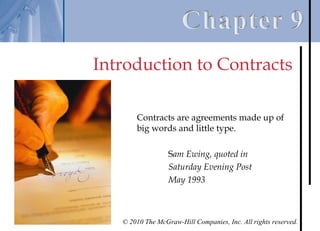
Introduction to Contracts

       Contracts are agreements made up of
       big words and little type.

                  Sam Ewing, quoted in
                  Saturday Evening Post
                  May 1993


   © 2010 The McGraw-Hill Companies, Inc. All rights reserved.
Learning Objectives
 Nature  of contracts
 Basic elements of a contract
 Basic contract types
 Non-contract obligations


9-4
Contracts
 Not every promise is legally enforceable
 But when a set of promises has the status of
  contract, a person injured by a breach of that
  contract is entitled to call on the government
  (courts) to force the breaching party to honor
  the contract
 Contract law is ancient law, but has evolved
  to reflect social change

9-5
Elements of a Contract
 (1) agreement (2) between competent parties
  (3) based on genuine assent of the parties
  that is (4) supported by consideration, (5)
  made for a lawful purpose, and (6) in the
  form required by law, if any
 See Figure 1, page 292


9-6
Lambert v. Barron
   Facts:
     Lambert and Barron had friendly as well as professional
      relationship
     Barron had financial troubles, so Lambert flew from
      New Orleans to Farmerville to meet with Barron
     Lambert claims that he and Barron orally contracted for
      Lambert to provide consulting services for one year at a
      monthly rate of $3100
     Barron paid one invoice, but refused to pay on a second,
      claiming that he had not agreed to such a price or term

9-7
Lambert v. Barron
   Procedural History and Issue:
         Lambert sued for breach of contract and lost
         Issue on appeal: was there a valid contract?
   Trial Court Ruling:
         Two competing views without evidence that
          contract was formed or that substantive business
          benefit was realized by Barron from his friend
         No contract formed, lower court ruling affirmed


9-8
Contract Concepts and Types
 Bilateral contracts: two parties make
  promises to one another
 Unilateral contracts: one party makes a
  promise
         Frequent buyer cards are offers for unilateral
          contracts; gaining points on the cards accept
          the offer and create a contract


9-9
Contract Concepts and Types
  Valid contract: binding and enforceable
   agreement
  Voidable contract: agreement otherwise
   binding, but due to circumstances
   surrounding execution or lack of capacity,
   may be rejected at option of one party
  Void contract: agreement without legal effect
   because prohibited by law

9 - 10
Contract Concepts and Types
  Express contract: agreement of parties
   manifested by words, written or oral
  Implied contract: agreement not shown by
   words, but by acts and conduct of parties
  Difference between express & implied
   contracts relates to manner of proving the
   existence of the contract, not the effect; one
   or the other arises

9 - 11
Sources of Governing Law
  Two bodies of law govern contracts:
     Article 2 of Uniform Commercial Code
     Common law of contracts
  Uniform Commercial Code (UCC) is
   statutory law in every state, but the
   common law of contracts is evolving
  UCC contains nine articles


9 - 12
UCC Article 2
        Article 2 expressly applies to contracts for the
         sale of goods [2–102] (numbers in brackets
         refer to specific Code sections)
          UCC [1–105]: goods are tangible, movable,
           personal property
          Does not apply to sale of services, intangible
           property (stocks, intellectual property), or
           real estate


9 - 13
The UCC and
                Hybrid Contracts
  Many contracts involve goods and services
  Test that courts most frequently apply to
   decide whether Article 2 applies is to ask
   which element – goods or services –
   predominates in the contract
            See Pass v. Shelby Aviation


9 - 14
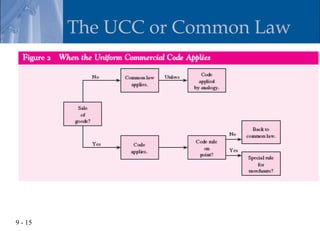
The UCC or Common Law


9 - 15
International Contract Law
        United Nations Convention on Contracts
         for the International Sale of Goods (CISG) is
         body of contract rules that harmonizes
         contract principles from many legal systems
            Seventy-one nations, including the United
             States and Canada, are parties to the CISG
                 See
                  UN Commission on International Trade Law
                  website

9 - 16
International Contract Law
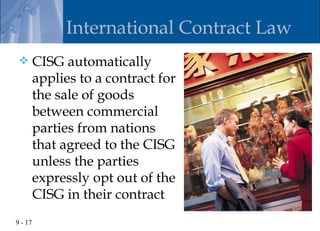
        CISG automatically
         applies to a contract for
         the sale of goods
         between commercial
         parties from nations
         that agreed to the CISG
         unless the parties
         expressly opt out of the
         CISG in their contract
9 - 17
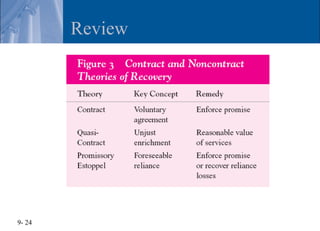
Non-Contract Obligations
        Sometimes the law enforces an obligation to
         pay for certain losses or benefits even in the
         absence of mutual agreement and exchange
         of value; the court then applies:
           Quasi-contract theory
           Promissory estoppel


9 - 18
Quasi-Contract Theory
    Quasi-contract is an obligation imposed by
     law to prevent unjust enrichment of one
     party in certain circumstances
            E.g., work performed by painter thinking work
             justified by contract & other party, who receives
             benefit of work, denies work was justified
            E.g., minor buys something but wrecks it,
             agreement is void by law, but the minor must
             pay the damages

9 - 19
Quasi-Contract Remedies


        Plaintiff recovers either the reasonable value
         of the benefit conferred on the defendant
         (reasonable price) or value of labor (quantum
         meruit)


9 - 20
Promissory Estoppel
    A court may apply doctrine of promissory
     estoppel when one party relies upon another
     party’s promise to his or her detriment
     (detrimental reliance), but there’s no contract
       Court will force promisor to fulfill
        promise or pay compensation
       Example: Holt v. Home Depot, U.S.A., Inc.


9 - 21
Holt v. Home Depot, U.S.A., Inc.
    Facts & Procedural History:
            Holt was a Home Depot manager for four years
            Home Depot assured employees that an open-
             door policy allowed complaints to management
             about supervisors without penalty
            Home Depot moved Holt and family to
             Connecticut, but soon after, Holt began to have
             difficulties with his immediate supervisor
            Holt told a senior manager about the problems
            Called Impact Line to begin formal complaint
            Six days later, Home Depot fired Holt

9 - 22
Holt v. Home Depot, U.S.A.,
                Inc.
    Procedural History:
            Holt sued claiming promissory estoppel
            Jury found for Holt, awarding $467,000 damages
    Appellate Decision and Ruling:
            Jury could reasonably find that Home Depot’s
             promise not to retaliate against employees was so
             clear and emphatic that Holt could reasonably
             believe it was inviolable; evidence indicated Holt
             terminated because of complaint about supervisor

9 - 23
Review


9- 24
Test Your Knowledge
    True=A, False = B
       Every promise is legally enforceable
       The main element of a contract is fairness
       In a bilateral contract, two parties make
        promises to one another
       The UCC is statutory law in every state
       The UCC applies to the sale of goods and
        services

9 - 25
Test Your Knowledge
    Multiple Choice
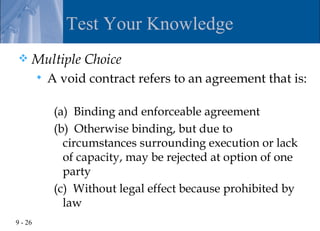
            A void contract refers to an agreement that is:

              (a) Binding and enforceable agreement
              (b) Otherwise binding, but due to
                circumstances surrounding execution or lack
                of capacity, may be rejected at option of one
                party
              (c) Without legal effect because prohibited by
                law
9 - 26
Test Your Knowledge
    Multiple Choice
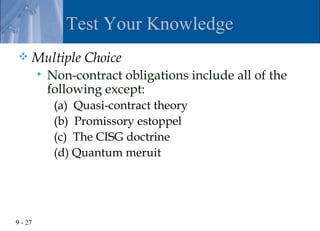
            Non-contract obligations include all of the
             following except:
              (a) Quasi-contract theory
              (b) Promissory estoppel
              (c) The CISG doctrine
              (d) Quantum meruit


9 - 27
Thought Question
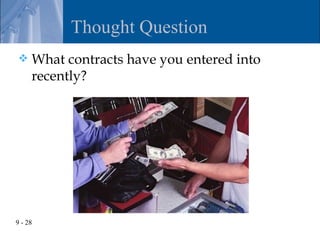
    What contracts have you entered into
     recently?


9 - 28

Chapter 9 – Introduction to Contracts

  • 1.
    Introduction to Contracts The Agreement: Offer The Agreement: Acceptance Consideration Reality of Consent © 2010 The McGraw-Hill Companies, Inc. All rights reserved.
  • 2.
    Capacity to Contract Illegality Writing Rights of Third Parties Performance and Remedies © 2010 The McGraw-Hill Companies, Inc. All rights reserved.
  • 3.
    Introduction to Contracts Contracts are agreements made up of big words and little type. Sam Ewing, quoted in Saturday Evening Post May 1993 © 2010 The McGraw-Hill Companies, Inc. All rights reserved.
  • 4.
    Learning Objectives  Nature of contracts  Basic elements of a contract  Basic contract types  Non-contract obligations 9-4
  • 5.
    Contracts  Not everypromise is legally enforceable  But when a set of promises has the status of contract, a person injured by a breach of that contract is entitled to call on the government (courts) to force the breaching party to honor the contract  Contract law is ancient law, but has evolved to reflect social change 9-5
  • 6.
    Elements of aContract  (1) agreement (2) between competent parties (3) based on genuine assent of the parties that is (4) supported by consideration, (5) made for a lawful purpose, and (6) in the form required by law, if any  See Figure 1, page 292 9-6
  • 7.
    Lambert v. Barron  Facts:  Lambert and Barron had friendly as well as professional relationship  Barron had financial troubles, so Lambert flew from New Orleans to Farmerville to meet with Barron  Lambert claims that he and Barron orally contracted for Lambert to provide consulting services for one year at a monthly rate of $3100  Barron paid one invoice, but refused to pay on a second, claiming that he had not agreed to such a price or term 9-7
  • 8.
    Lambert v. Barron  Procedural History and Issue:  Lambert sued for breach of contract and lost  Issue on appeal: was there a valid contract?  Trial Court Ruling:  Two competing views without evidence that contract was formed or that substantive business benefit was realized by Barron from his friend  No contract formed, lower court ruling affirmed 9-8
  • 9.
    Contract Concepts andTypes  Bilateral contracts: two parties make promises to one another  Unilateral contracts: one party makes a promise  Frequent buyer cards are offers for unilateral contracts; gaining points on the cards accept the offer and create a contract 9-9
  • 10.
    Contract Concepts andTypes  Valid contract: binding and enforceable agreement  Voidable contract: agreement otherwise binding, but due to circumstances surrounding execution or lack of capacity, may be rejected at option of one party  Void contract: agreement without legal effect because prohibited by law 9 - 10
  • 11.
    Contract Concepts andTypes  Express contract: agreement of parties manifested by words, written or oral  Implied contract: agreement not shown by words, but by acts and conduct of parties  Difference between express & implied contracts relates to manner of proving the existence of the contract, not the effect; one or the other arises 9 - 11
  • 12.
    Sources of GoverningLaw  Two bodies of law govern contracts:  Article 2 of Uniform Commercial Code  Common law of contracts  Uniform Commercial Code (UCC) is statutory law in every state, but the common law of contracts is evolving  UCC contains nine articles 9 - 12
  • 13.
    UCC Article 2  Article 2 expressly applies to contracts for the sale of goods [2–102] (numbers in brackets refer to specific Code sections)  UCC [1–105]: goods are tangible, movable, personal property  Does not apply to sale of services, intangible property (stocks, intellectual property), or real estate 9 - 13
  • 14.
    The UCC and Hybrid Contracts  Many contracts involve goods and services  Test that courts most frequently apply to decide whether Article 2 applies is to ask which element – goods or services – predominates in the contract  See Pass v. Shelby Aviation 9 - 14
  • 15.
    The UCC orCommon Law 9 - 15
  • 16.
    International Contract Law  United Nations Convention on Contracts for the International Sale of Goods (CISG) is body of contract rules that harmonizes contract principles from many legal systems  Seventy-one nations, including the United States and Canada, are parties to the CISG  See UN Commission on International Trade Law website 9 - 16
  • 17.
    International Contract Law  CISG automatically applies to a contract for the sale of goods between commercial parties from nations that agreed to the CISG unless the parties expressly opt out of the CISG in their contract 9 - 17
  • 18.
    Non-Contract Obligations  Sometimes the law enforces an obligation to pay for certain losses or benefits even in the absence of mutual agreement and exchange of value; the court then applies:  Quasi-contract theory  Promissory estoppel 9 - 18
  • 19.
    Quasi-Contract Theory  Quasi-contract is an obligation imposed by law to prevent unjust enrichment of one party in certain circumstances  E.g., work performed by painter thinking work justified by contract & other party, who receives benefit of work, denies work was justified  E.g., minor buys something but wrecks it, agreement is void by law, but the minor must pay the damages 9 - 19
  • 20.
    Quasi-Contract Remedies  Plaintiff recovers either the reasonable value of the benefit conferred on the defendant (reasonable price) or value of labor (quantum meruit) 9 - 20
  • 21.
    Promissory Estoppel  A court may apply doctrine of promissory estoppel when one party relies upon another party’s promise to his or her detriment (detrimental reliance), but there’s no contract  Court will force promisor to fulfill promise or pay compensation  Example: Holt v. Home Depot, U.S.A., Inc. 9 - 21
  • 22.
    Holt v. HomeDepot, U.S.A., Inc.  Facts & Procedural History:  Holt was a Home Depot manager for four years  Home Depot assured employees that an open- door policy allowed complaints to management about supervisors without penalty  Home Depot moved Holt and family to Connecticut, but soon after, Holt began to have difficulties with his immediate supervisor  Holt told a senior manager about the problems  Called Impact Line to begin formal complaint  Six days later, Home Depot fired Holt 9 - 22
  • 23.
    Holt v. HomeDepot, U.S.A., Inc.  Procedural History:  Holt sued claiming promissory estoppel  Jury found for Holt, awarding $467,000 damages  Appellate Decision and Ruling:  Jury could reasonably find that Home Depot’s promise not to retaliate against employees was so clear and emphatic that Holt could reasonably believe it was inviolable; evidence indicated Holt terminated because of complaint about supervisor 9 - 23
  • 24.
  • 25.
    Test Your Knowledge  True=A, False = B  Every promise is legally enforceable  The main element of a contract is fairness  In a bilateral contract, two parties make promises to one another  The UCC is statutory law in every state  The UCC applies to the sale of goods and services 9 - 25
  • 26.
    Test Your Knowledge  Multiple Choice  A void contract refers to an agreement that is: (a) Binding and enforceable agreement (b) Otherwise binding, but due to circumstances surrounding execution or lack of capacity, may be rejected at option of one party (c) Without legal effect because prohibited by law 9 - 26
  • 27.
    Test Your Knowledge  Multiple Choice  Non-contract obligations include all of the following except: (a) Quasi-contract theory (b) Promissory estoppel (c) The CISG doctrine (d) Quantum meruit 9 - 27
  • 28.
    Thought Question  What contracts have you entered into recently? 9 - 28

Editor's Notes

  • #8 Donald Lambert and Don Barron were friends and had a long-standing professional relationship based on their public service together on the Louisiana State Board of Licensed Contractors from the 1980s. In 1998, Barron’s business began experiencing financial strain. Barron and Lambert talked by phone during the summer of 1998 about Barron’s personal problems and financial difficulties, and Lambert was concerned about his friend’s depressed mental state. On November 11, 1998, Lambert flew from New Orleans to Farmerville to meet with Barron. Prior to Lambert’s flight, Barron’s employee had faxed and overnighted copies of various construction contracts and correspondence relating to Barron’s problematic construction projects for Lambert to review. Lambert contends that, while standing on the airport runway before he boarded the plane for his return trip home that day, he and Barron contracted for Lambert to provide consulting services for Barron. Lambert told Barron at that time that he customarily charged his clients $3,100 per month, and the minimum term for his services was one year. He also charged 10 percent of any amount recouped by his clients in settlement. In late 2000, Lambert billed Barron for a $34,100 balance owed on the alleged oral contract. Lambert’s letter dated October 30, 2000, requested payment and stated, “I have preformed (sic) my service for you and I must request that you pay me the balance due me of $34,100.” Two weeks later, Barron wrote Lambert a letter rejecting the claim. Lambert sued. The trial court dismissed Lambert’s suit, and Lambert appealed.
  • #9 Court: “This case involves the special setting of parties with a prior friendship and the aid and advice freely given between friends that existed before Lambert first broached the subject of a consulting contract…. From our review of the testimony of the two men, we also conclude that there was no clear agreement given by Barron…. Absent a direct oral or written acceptance by Barron, Lambert’s proof of the contract rests on his receipt of certain documentation of Barron’s troubled construction projects and invoices for consulting fees sent to Barron. The bulk of the documentation regarding Barron’s five construction projects was forwarded to Lambert days before the Farmerville meeting. Lambert’s review of the details of those construction contracts and Barron’s problems with the projects would have been performed in preparation for the Farmerville meeting without any contract binding his friend. More importantly, Barron provided Lambert that documentation without any indication that his friend’s review of the projects would require compensation…. From our review of this evidence, we find that the trial court could determine that no tacit acceptance of Lambert’s offer for services was made by Barron. Particularly lacking from the record is evidence of any substantive business benefit realized by Barron from his consultant friend. The trial court ultimately held that the parties’ relationship was that of a “friend helping a friend,” such that Lambert could not have reasonably believed that a contract had been formed.”
  • #13 Click to add notes
  • #14 Click to add notes
  • #15 Click to add notes
  • #16 Click to add notes
  • #17 Number of CISG parties as of 11-20-08. Hyperlink is to the CISG texts on the UN Commission on International Trade Law (UNCITRAL) website.
  • #18 Click to add notes
  • #19 Click to add notes
  • #23 Hyperlink is to the opinion (pdf format) on the court’s website.
  • #24 Click to add notes
  • #26 False. False. The elements include (1) agreement (offer and acceptance) (2) between competent parties (3) based on genuine assent of the parties that is (4) supported by consideration, (5) made for a lawful purpose, and (6) in the form required by law, if any . True. True. False. The UCC applies ONLY to the sale of goods.
  • #27 The correct answer is (c). (a) refers to a valid contract. (b) refers to a voidable contract.
  • #28 The correct answer is (c). The CISG is an international body of law regarding the sale of goods.
  • #29 Opportunity to discuss the contracting each person does almost every day.