z
presented by Larry J. McClatchey
2015 Great Lakes Region Credit Conference
November 18-19, 2015
z
What is a Preference?
Payment or transfer made during the
ninety days prior to bankruptcy
Debtor makes a payment or payments
to some creditors and not to others
90
z
Purpose of Preference Law?
Prevent “piecemeal” dismemberment of a debtor
To promote equal distribution among creditors
similarly situated
z
Who Can Avoid a
Preferential Transfer?
1
Bankruptcy trustee or
“debtor in possession”
2
Representative of Liquidating
Trust in chapter 11 case
z
Elements of a
Preference
Transfer of
property of
a debtor
To or for
benefit of
creditor
On account
of an
antecedent
debt
Made while
debtor was
insolvent
Within 90
days before
bankruptcy
Enables creditor
to receive more
than if transfer
had not been
made
Or 1 year to
an insider
z
Who Has Burden of
?
z
Plaintiff/trustee must prove each
element of preference
Burden of proof is on plaintiff
Defendant/creditor can establish
an “affirmative defense”
Creditor has burden of proof on
any affirmative defense
z
BASIC
1
Contemporaneous
exchange for new value
2 Enabling Loan
3 Floating Lien
4 Statutory Lien
z
Ordinary Course of
Business Defense
Encourages creditors to deal with companies on
“normal” credit terms
z
Payment in ordinary course
of business is payment:
of a debt incurred in the ordinary course of the business or
financial affairs of the debtor and the transferee
made in the ordinary course of business of the
debtor and the transferee
made according to ordinary business terms
z
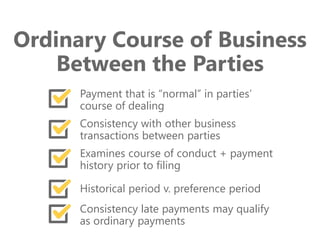
Ordinary Course of Business
Between the Parties
Payment that is “normal” in parties’
course of dealing
Consistency with other business
transactions between parties
Examines course of conduct + payment
history prior to filing
Historical period v. preference period
Consistency late payments may qualify
as ordinary payments
z
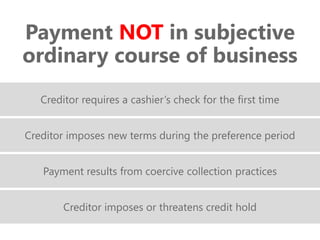
Payment NOT in subjective
ordinary course of business
Creditor requires a cashier’s check for the first time
Creditor imposes new terms during the preference period
Payment results from coercive collection practices
Creditor imposes or threatens credit hold
z
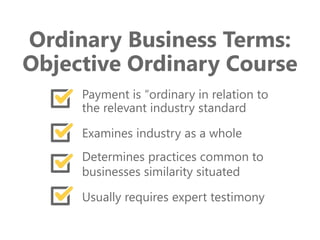
Ordinary Business Terms:
Objective Ordinary Course
Payment is “ordinary in relation to
the relevant industry standard
Examines industry as a whole
Determines practices common to
businesses similarity situated
Usually requires expert testimony
z
Subsequent new value or
subsequent advance
Transfer by creditor after payment received
Not secured by otherwise unavoidable security interest
On account of which new value debtor did not make
an otherwise unavoidable transfer to or benefit of creditor
New value determined as of petition date,
so post-petition payments not relevant
z
In re Globe Building
Materials, Inc.
Table sets forth dates of shipment by Seneca Petroleum and
dates of payment of invoices by debtor
Trustee sued to recover
Petition filed January 19; 90-day period started October 19
$356,823
z
z
Must new
value remain
unpaid?
Effect of
Court
Approved
Post-Petition
Payments?
Payments
Made by
Third Party
Under LC?
New Value Issues
in the Courts
z
Additional
Defenses to
Consider
z
Transfer <$600 in consumer cases <$600
Transfer <$5,000 in business cases<$5000
Improper to sue other than in defendant’s jurisdiction (venue)
Case filed too late (statute of limitations)
Transfer to “critical vendor” of as part of contract assumption
Transfer to holder of unperfected lien rights
z
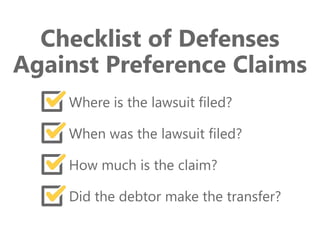
Checklist of Defenses
Against Preference Claims
Where is the lawsuit filed?
When was the lawsuit filed?
How much is the claim?
Did the debtor make the transfer?
z
Checklist of Defenses
Against Preference Claims
Do lien rights exist?
Debtor receive “20 day goods”?
Has debtor made “critical vendor” offer?
Executory supply agreement with debtor?
z
TIPS
Practical
z
Review your invoices
to compare to
industry standards
z
Stay consistent in
your collection
practices
z
If problem customer
files bankruptcy,
work up defenses
while fresh
z
Preserve all records
of collection
communications
z
Don’t ignore a
demand letter
z
TAKEAWAYS
z
OK to be aggressive
if consistent
1
z
Always, always take
payment offered
2
z
May not face future
avoidance or can
settle claim
3
z
Thank You!
Larry J. McClatchey, Director
Kegler Brown Hill + Ritter
lmcclatchey@keglerbrown.com
keglerbrown.com/mcclatchey
614-462-5463

Keeping the Gold: Successfully Resolving Preference Claims

  • 1.
    z presented by LarryJ. McClatchey 2015 Great Lakes Region Credit Conference November 18-19, 2015
  • 2.
    z What is aPreference? Payment or transfer made during the ninety days prior to bankruptcy Debtor makes a payment or payments to some creditors and not to others 90
  • 3.
    z Purpose of PreferenceLaw? Prevent “piecemeal” dismemberment of a debtor To promote equal distribution among creditors similarly situated
  • 4.
    z Who Can Avoida Preferential Transfer? 1 Bankruptcy trustee or “debtor in possession” 2 Representative of Liquidating Trust in chapter 11 case
  • 5.
    z Elements of a Preference Transferof property of a debtor To or for benefit of creditor On account of an antecedent debt Made while debtor was insolvent Within 90 days before bankruptcy Enables creditor to receive more than if transfer had not been made Or 1 year to an insider
  • 6.
  • 7.
    z Plaintiff/trustee must proveeach element of preference Burden of proof is on plaintiff Defendant/creditor can establish an “affirmative defense” Creditor has burden of proof on any affirmative defense
  • 8.
    z BASIC 1 Contemporaneous exchange for newvalue 2 Enabling Loan 3 Floating Lien 4 Statutory Lien
  • 9.
    z Ordinary Course of BusinessDefense Encourages creditors to deal with companies on “normal” credit terms
  • 10.
    z Payment in ordinarycourse of business is payment: of a debt incurred in the ordinary course of the business or financial affairs of the debtor and the transferee made in the ordinary course of business of the debtor and the transferee made according to ordinary business terms
  • 11.
    z Ordinary Course ofBusiness Between the Parties Payment that is “normal” in parties’ course of dealing Consistency with other business transactions between parties Examines course of conduct + payment history prior to filing Historical period v. preference period Consistency late payments may qualify as ordinary payments
  • 12.
    z Payment NOT insubjective ordinary course of business Creditor requires a cashier’s check for the first time Creditor imposes new terms during the preference period Payment results from coercive collection practices Creditor imposes or threatens credit hold
  • 13.
    z Ordinary Business Terms: ObjectiveOrdinary Course Payment is “ordinary in relation to the relevant industry standard Examines industry as a whole Determines practices common to businesses similarity situated Usually requires expert testimony
  • 14.
    z Subsequent new valueor subsequent advance Transfer by creditor after payment received Not secured by otherwise unavoidable security interest On account of which new value debtor did not make an otherwise unavoidable transfer to or benefit of creditor New value determined as of petition date, so post-petition payments not relevant
  • 15.
    z In re GlobeBuilding Materials, Inc. Table sets forth dates of shipment by Seneca Petroleum and dates of payment of invoices by debtor Trustee sued to recover Petition filed January 19; 90-day period started October 19 $356,823
  • 16.
  • 17.
    z Must new value remain unpaid? Effectof Court Approved Post-Petition Payments? Payments Made by Third Party Under LC? New Value Issues in the Courts
  • 18.
  • 19.
    z Transfer <$600 inconsumer cases <$600 Transfer <$5,000 in business cases<$5000 Improper to sue other than in defendant’s jurisdiction (venue) Case filed too late (statute of limitations) Transfer to “critical vendor” of as part of contract assumption Transfer to holder of unperfected lien rights
  • 20.
    z Checklist of Defenses AgainstPreference Claims Where is the lawsuit filed? When was the lawsuit filed? How much is the claim? Did the debtor make the transfer?
  • 21.
    z Checklist of Defenses AgainstPreference Claims Do lien rights exist? Debtor receive “20 day goods”? Has debtor made “critical vendor” offer? Executory supply agreement with debtor?
  • 22.
  • 23.
    z Review your invoices tocompare to industry standards
  • 24.
    z Stay consistent in yourcollection practices
  • 25.
    z If problem customer filesbankruptcy, work up defenses while fresh
  • 26.
    z Preserve all records ofcollection communications
  • 27.
  • 28.
  • 29.
    z OK to beaggressive if consistent 1
  • 30.
  • 31.
    z May not facefuture avoidance or can settle claim 3
  • 32.
    z Thank You! Larry J.McClatchey, Director Kegler Brown Hill + Ritter lmcclatchey@keglerbrown.com keglerbrown.com/mcclatchey 614-462-5463