Bursting Strength Analysis
Dr.R.Sunitha
Assistant Professor
Department of Textiles and Clothing
Introduction
• Tensile strength tests are generally used for woven fabrics where
there are definite warp and weft directions in which the strength can
be measured
• Bursting strength analysis is unidirectional
• It is done for the fabrics such as knitted materials, lace or non-
wovens do not have definite alignment of yarns/fibres and
multidirectional froce is required
• In the Bursting strength test the material is stressed in all directions
at the same time and is therefore more suitable for such materials.
There are fabrics which are simultaneously stressed in all directions
during service, such as parachute fabrics, filters, sacks and nets,
where it may be important to stress them in a realistic manner.
• A fabric is more likely to fail by bursting in service than it is to
break by a straight tensile fracture as this is the type of stress that is
present at the elbows and knees of clothing
Introduction Cont…
• In the Bursting strength test the material is stressed in
all directions at the same time and is therefore more
suitable for such materials. There are fabrics which
are simultaneously stressed in all directions during
service, such as parachute fabrics, filters, sacks and
nets, where it may be important to stress them in a
realistic manner
• A fabric is more likely to fail by bursting in service
than it is to break by a straight tensile fracture as this
is the type of stress that is present at the elbows and
knees of clothing, parachute, sacks and nets
What happens when fabric breaks in
bursting strength analysis?
• When a fabric fails during a bursting
strength test it means that it has the
lowest breaking extension
• This is because when the fabric is
stressed in all the directions it undergoes
the same extension so that the fabric
direction with the lowest extension
breaks first
Principle
The pressure in a liquid is exerted in
all directions and this phenomenon of
a liquid is used for testing bursting
strength in hydraulic bursting
strength tester
Hydraulic Bursting Tester
Sample Size
• The specimen for this test should be cut so that the
sample is ½ inch greater in diameter of the clamp ring
• Ten specimens are chosen
• The instrument used for testing bursting strength should
have a constant rate of speed and must be capable of
giving a uniform displacement of 6 ± 0.25 cubic inches
per minute
• The clamp ring should have an internal diameter of
1.20 inches
• For proper operation, the machine must be stopped at
the instant of rupture in order to avoid additional
application of pressure and load on the specimen
Working Procedure
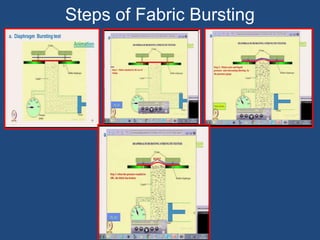
• The specimen – circular shape is clamped by a ring
over a thin flexible rubber diaphragm which itself is
clamped over a circular hole in the upper face of a
reservoir
• The liquid used may be water or glycerine
• The pressure in the liquid is increased, by values or
screw-driven position
• Due to increase in the pressure, the diaphragm
bulges, taking with it the specimen
• At some point the fabric bursts within 20-23
seconds, the pressure at that point is indicated by the
pressure gauge which is recorded
Working Procedure Cont…
• Since the rubber diaphragm requires a certain
pressure to stretch it, corrections are made by
doing a blank test
• In the test specimen, if cuts by chisel for ½
inch are made if a ¼ inch hole is punched and
then the same test is carried out, then it is
called as wounded bursting strength test
Types of Burst Test
ASTM D 3786 ASTM D 6797
It is Mullen Burst Test,
Fabric is clamped across
a 1.22 inch ring and
rubber diaphragm
underneath is inflated to
push against the fabric
until it bursts
It is Ball Burst Test,
Fabric is probed with a1-inch
ball-shaped end id pushed
through the fabric until it
bursts
Steps of Fabric Bursting
Reference
• https://textileapex.blogspot.com/2014/08/hydra
ulic-bursting-tester.html
• http://acadiantextiles.com/news/burst-strength/
• Apurba Das, Evaluation of Textile Materials
• Department of Textile Technology, Indian
Institute of Technology-Delhi.
Thank You

Bursting strength test

  • 1.
    Bursting Strength Analysis Dr.R.Sunitha AssistantProfessor Department of Textiles and Clothing
  • 2.
    Introduction • Tensile strengthtests are generally used for woven fabrics where there are definite warp and weft directions in which the strength can be measured • Bursting strength analysis is unidirectional • It is done for the fabrics such as knitted materials, lace or non- wovens do not have definite alignment of yarns/fibres and multidirectional froce is required • In the Bursting strength test the material is stressed in all directions at the same time and is therefore more suitable for such materials. There are fabrics which are simultaneously stressed in all directions during service, such as parachute fabrics, filters, sacks and nets, where it may be important to stress them in a realistic manner. • A fabric is more likely to fail by bursting in service than it is to break by a straight tensile fracture as this is the type of stress that is present at the elbows and knees of clothing
  • 3.
    Introduction Cont… • Inthe Bursting strength test the material is stressed in all directions at the same time and is therefore more suitable for such materials. There are fabrics which are simultaneously stressed in all directions during service, such as parachute fabrics, filters, sacks and nets, where it may be important to stress them in a realistic manner • A fabric is more likely to fail by bursting in service than it is to break by a straight tensile fracture as this is the type of stress that is present at the elbows and knees of clothing, parachute, sacks and nets
  • 4.
    What happens whenfabric breaks in bursting strength analysis? • When a fabric fails during a bursting strength test it means that it has the lowest breaking extension • This is because when the fabric is stressed in all the directions it undergoes the same extension so that the fabric direction with the lowest extension breaks first
  • 5.
    Principle The pressure ina liquid is exerted in all directions and this phenomenon of a liquid is used for testing bursting strength in hydraulic bursting strength tester
  • 6.
  • 7.
    Sample Size • Thespecimen for this test should be cut so that the sample is ½ inch greater in diameter of the clamp ring • Ten specimens are chosen • The instrument used for testing bursting strength should have a constant rate of speed and must be capable of giving a uniform displacement of 6 ± 0.25 cubic inches per minute • The clamp ring should have an internal diameter of 1.20 inches • For proper operation, the machine must be stopped at the instant of rupture in order to avoid additional application of pressure and load on the specimen
  • 8.
    Working Procedure • Thespecimen – circular shape is clamped by a ring over a thin flexible rubber diaphragm which itself is clamped over a circular hole in the upper face of a reservoir • The liquid used may be water or glycerine • The pressure in the liquid is increased, by values or screw-driven position • Due to increase in the pressure, the diaphragm bulges, taking with it the specimen • At some point the fabric bursts within 20-23 seconds, the pressure at that point is indicated by the pressure gauge which is recorded
  • 9.
    Working Procedure Cont… •Since the rubber diaphragm requires a certain pressure to stretch it, corrections are made by doing a blank test • In the test specimen, if cuts by chisel for ½ inch are made if a ¼ inch hole is punched and then the same test is carried out, then it is called as wounded bursting strength test
  • 10.
    Types of BurstTest ASTM D 3786 ASTM D 6797 It is Mullen Burst Test, Fabric is clamped across a 1.22 inch ring and rubber diaphragm underneath is inflated to push against the fabric until it bursts It is Ball Burst Test, Fabric is probed with a1-inch ball-shaped end id pushed through the fabric until it bursts
  • 11.
  • 12.
    Reference • https://textileapex.blogspot.com/2014/08/hydra ulic-bursting-tester.html • http://acadiantextiles.com/news/burst-strength/ •Apurba Das, Evaluation of Textile Materials • Department of Textile Technology, Indian Institute of Technology-Delhi.
  • 13.