




BURNS
Dr Vipin V Nair
1
OVERVIEW
• Part I
• Historical perspective
• Statistics
• Classification of Burns
• Pathophysiology
• Evaluation
2
 Part II
 Management
 Pre-hospital Care
 Resuscitation & Nutritional
support
 Burn wound care
 Complications
 Rehabilitation
Definition
Injuries that result from
direct contact or
exposure to any
physical,
thermal,
chemical,
electrical, or
radiation source
are termed as Burns.
3
HISTORICAL
PERSPECTIVE
4
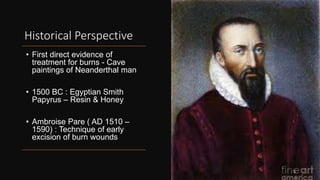
Historical Perspective
• First direct evidence of
treatment for burns - Cave
paintings of Neanderthal man
• 1500 BC : Egyptian Smith
Papyrus – Resin & Honey
• Ambroise Pare ( AD 1510 –
1590) : Technique of early
excision of burn wounds
5
Historical Perspective
• 1607 : GF Hildanus :
Pathophysiology of
Burns
• 1797 : Edward Kentish
: Chronic Burn scar 
Marjolin’s ulcer
6
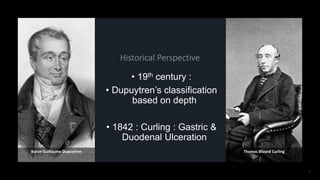
• 19th century :
• Dupuytren’s classification
based on depth
• 1842 : Curling : Gastric &
Duodenal Ulceration
Thomas Blizard Curling
Baron Guillaume Dupuytren
Historical Perspective
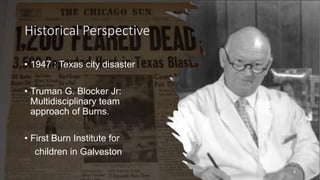
• 1947 : Texas city disaster
• Truman G. Blocker Jr:
Multidisciplinary team
approach of Burns.
• First Burn Institute for
children in Galveston
8
Historical Perspective
1951 : 45% TBSA Burns  49% mortality
Present : > 70 % TBSA  49 % mortality
Focus of advance : Improved survival  Rehabilitation of Burn
survivors
9
Problem
Statement :
India
70 lakh burn injury cases annually
Over 10,00,000 people are moderately or
severely burnt every year
1.4 lakh people die of burn every year.
Around 70% of all burn injuries occur in
most productive age group (15-35 years).
Around 4/5 are women & children.
As many as 80% of cases admitted are a
result of accidents at home (kitchen-
related incidents)
10
CLASSIFICATION
11
Classification
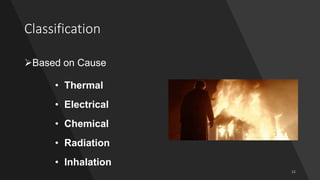
Based on Cause
• Thermal
• Electrical
• Chemical
• Radiation
• Inhalation
Thermal Injuries
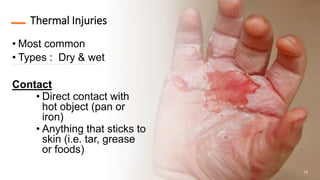
• Most common
• Types : Dry & wet
Contact
• Direct contact with
hot object (pan or
iron)
• Anything that sticks to
skin (i.e. tar, grease
or foods)
13
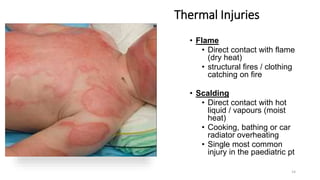
Thermal Injuries
• Flame
• Direct contact with flame
(dry heat)
• structural fires / clothing
catching on fire
• Scalding
• Direct contact with hot
liquid / vapours (moist
heat)
• Cooking, bathing or car
radiator overheating
• Single most common
injury in the paediatric pt
14
Electrical Burns
• Usually follows accidental
contact with exposed object
conducting electricity
• Electrically powered
devices
• Electrical wiring
• Power transmission lines
• Can also result from
Lightning
• Damage depends on intensity
of current
15
Electrical Burns
• Severity depends upon:
• What tissue current passes through (Low voltage/ High voltage)
• Width or extent of the current pathway
• AC or DC
• Duration of current contact
• Tissues with the lowest resistance eg. nerves, blood vessels &
muscles
• Heat generation during passage of the current injures the tissues
• Skin has a relatively high resistance, hence is mostly spared
16
Electrical Burns
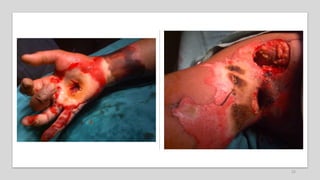
• Low-tension injuries(<1000 V)
• Low energy burns  Minimal
damage to subcutaneous
tissue
• Entry & Exit points – fingers
 small deep burns
• AC  Tetany within muscles,
cardiac arrest due to
interference with normal
cardiac pacing
17
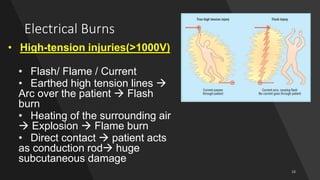
Electrical Burns
• High-tension injuries(>1000V)
• Flash/ Flame / Current
• Earthed high tension lines 
Arc over the patient  Flash
burn
• Heating of the surrounding air
 Explosion  Flame burn
• Direct contact  patient acts
as conduction rod huge
subcutaneous damage
Electrical Burns
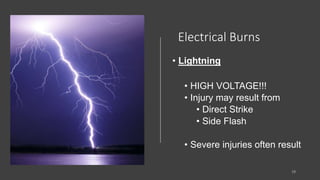
• Lightning
• HIGH VOLTAGE!!!
• Injury may result from
• Direct Strike
• Side Flash
• Severe injuries often result
Electrical Burns
• Manifestations:-
• External Burn
• Internal Burn
• Musculoskeletal injury
• Cardiovascular injury
• Respiratory injury
• Neurologic injury
• Rhabdomyolysis and
Renal injury
22
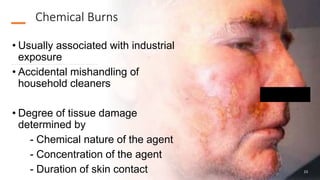
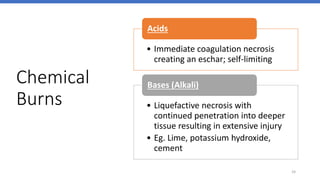
Chemical Burns
• Usually associated with industrial
exposure
• Accidental mishandling of
household cleaners
• Degree of tissue damage
determined by
- Chemical nature of the agent
- Concentration of the agent
- Duration of skin contact 23
Chemical
Burns
24
• Immediate coagulation necrosis
creating an eschar; self-limiting
Acids
• Liquefactive necrosis with
continued penetration into deeper
tissue resulting in extensive injury
• Eg. Lime, potassium hydroxide,
cement
Bases (Alkali)
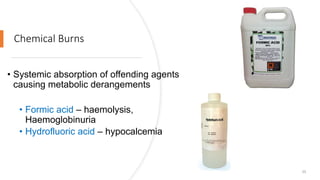
Chemical Burns
• Systemic absorption of offending agents
causing metabolic derangements
• Formic acid – haemolysis,
Haemoglobinuria
• Hydrofluoric acid – hypocalcemia
25
Radiation Exposure
• Waves or particles of energy that are emitted from radioactive
sources
• Alpha radiation
 Large, travel a short distance, minimal penetrating ability
 Can harm internal organs if inhaled, ingested or absorbed
• Beta radiation
 Small, more energy, more penetrating ability
 Usually enter through damaged skin, ingestion or inhalation
26
Radiation Exposure
• Gamma radiation & X-rays
 Most dangerous penetrating radiation
 May produce localized skin burns & extensive internal damage
27
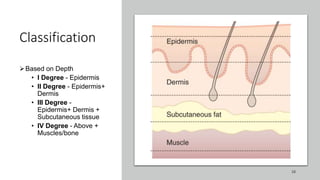
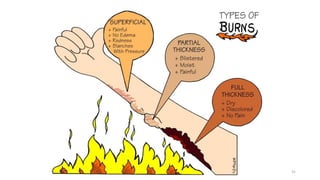
Classification
Based on Depth
• I Degree - Epidermis
• II Degree - Epidermis+
Dermis
• III Degree -
Epidermis+ Dermis +
Subcutaneous tissue
• IV Degree - Above +
Muscles/bone
28
29
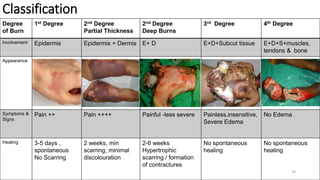
Classification
Degree
of Burn
1st Degree 2nd Degree
Partial Thickness
2nd Degree
Deep Burns
3rd Degree 4th Degree
Involvement Epidermis Epidermis + Dermis E+ D E+D+Subcut tissue E+D+S+muscles,
tendons & bone
Appearance
Symptoms &
Signs
Pain ++ Pain ++++ Painful -less severe Painless,insensitive,
Severe Edema
No Edema
Healing 3-5 days ,
spontaneous
No Scarring
2 weeks, min
scarring, minimal
discolouration
2-6 weeks
Hypertrophic
scarring / formation
of contractures
No spontaneous
healing
No spontaneous
healing
30
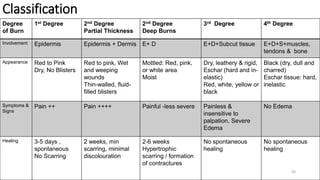
Classification
Degree
of Burn
1st Degree 2nd Degree
Partial Thickness
2nd Degree
Deep Burns
3rd Degree 4th Degree
Involvement Epidermis Epidermis + Dermis E+ D E+D+Subcut tissue E+D+S+muscles,
tendons & bone
Appearance Red to Pink
Dry, No Blisters
Red to pink, Wet
and weeping
wounds
Thin-walled, fluid-
filled blisters
Mottled: Red, pink,
or white area
Moist
Dry, leathery & rigid,
Eschar (hard and in-
elastic)
Red, white, yellow or
black
Black (dry, dull and
charred)
Eschar tissue: hard,
inelastic
Symptoms &
Signs
Pain ++ Pain ++++ Painful -less severe Painless &
insensitive to
palpation, Severe
Edema
No Edema
Healing 3-5 days ,
spontaneous
No Scarring
2 weeks, min
scarring, minimal
discolouration
2-6 weeks
Hypertrophic
scarring / formation
of contractures
No spontaneous
healing
No spontaneous
healing
31
PATHOPHYSIOLOGY
32
Pathophysiology
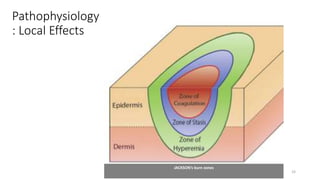
: Local Effects
33
JACKSON’s burn zones
Pathophysiology : Local Effects
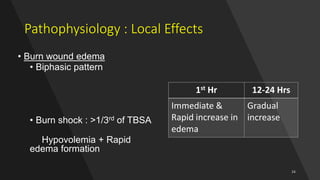
• Burn wound edema
• Biphasic pattern
• Burn shock : >1/3rd of TBSA
Hypovolemia + Rapid
edema formation
1st Hr 12-24 Hrs
Immediate &
Rapid increase in
edema
Gradual
increase
Pathophysiology : Local Effects
• Edema in non-burned tissue
•Loss of capillary endothelial integrity
•Reduced transmembrane potentials of skeletal
muscle at the site of injury as well as away
from the site of damage [-90mv -70 to -80mv]
•Increase in intracellular Na & water leading to
edema
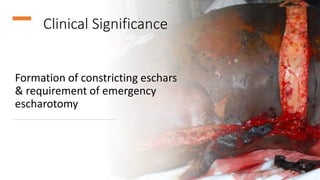
Clinical Significance
Formation of constricting eschars
& requirement of emergency
escharotomy
36
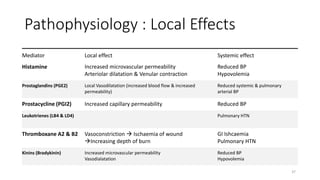
Pathophysiology : Local Effects
37
Mediator Local effect Systemic effect
Histamine Increased microvascular permeability
Arteriolar dilatation & Venular contraction
Reduced BP
Hypovolemia
Prostaglandins (PGE2) Local Vasodilatation (increased blood flow & increased
permeability)
Reduced systemic & pulmonary
arterial BP
Prostacycline (PGI2) Increased capillary permeability Reduced BP
Leukotrienes (LB4 & LD4) Pulmonary HTN
Thromboxane A2 & B2 Vasoconstriction  Ischaemia of wound
Increasing depth of burn
GI Ishcaemia
Pulmonary HTN
Kinins (Bradykinin) Increased microvascular permeability
Vasodialatation
Reduced BP
Hypovolemia
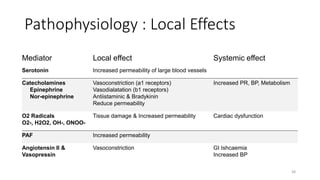
Pathophysiology : Local Effects
38
Mediator Local effect Systemic effect
Serotonin Increased permeability of large blood vessels
Catecholamines
Epinephrine
Nor-epinephrine
Vasoconstriction (a1 receptors)
Vasodialatation (b1 receptors)
Antiistaminic & Bradykinin
Reduce permeability
Increased PR, BP, Metabolism
O2 Radicals
O2-, H2O2, OH-, ONOO-
Tissue damage & Increased permeability Cardiac dysfunction
PAF Increased permeability
Angiotensin II &
Vasopressin
Vasoconstriction GI Ishcaemia
Increased BP
39
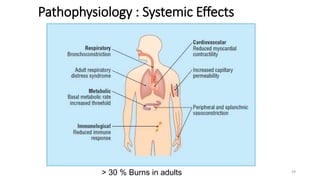
Pathophysiology : Systemic Effects
> 30 % Burns in adults
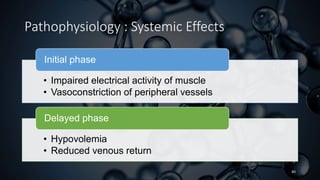
Pathophysiology : Systemic Effects
40
• Impaired electrical activity of muscle
• Vasoconstriction of peripheral vessels
Initial phase
• Hypovolemia
• Reduced venous return
Delayed phase
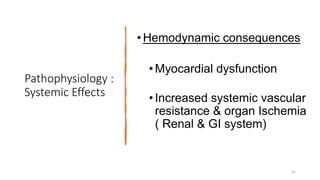
Pathophysiology :
Systemic Effects
•Hemodynamic consequences
•Myocardial dysfunction
•Increased systemic vascular
resistance & organ Ischemia
( Renal & GI system)
41
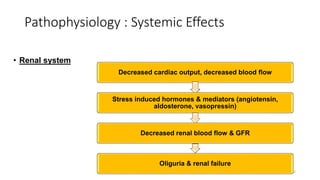
Pathophysiology : Systemic Effects
• Renal system
42
Decreased cardiac output, decreased blood flow
Stress induced hormones & mediators (angiotensin,
aldosterone, vasopressin)
Decreased renal blood flow & GFR
Oliguria & renal failure
Clinical Significance
•Importance of
Emergency &
Adequate
Resuscitation
43
Pathophysiology :
Systemic Effects
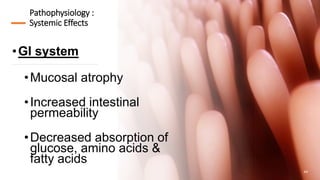
•GI system
•Mucosal atrophy
•Increased intestinal
permeability
•Decreased absorption of
glucose, amino acids &
fatty acids
44
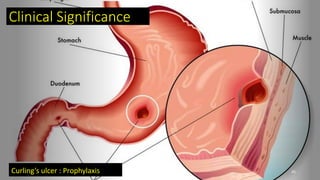
Clinical Significance
Curling’s ulcer : Prophylaxis 45
Pathophysiology :
Systemic Effects
• Immune system
• Global depression in immune function
• Diminished production of macrophages
• Increased neutrophil count
(dysfunctional) followed by decrease
after 48-72 hrs
• Impaired cytotoxic T cell activity
• Increase risk of infections
• Depressed Th function
46
Pathophysiology
: Systemic
Effects
• Hypermetabolic response
• Phase I [ebb]
• First 48 hrs
• Decrease in
• cardiac output
• urine output
• O2 consumption
• BMR
• Impaired glucose tolerance with
hyperglycemia
47
Pathophysiology :
Systemic Effects
• Hypermetabolic response
• Metabolic variables gradually
increase within first five days post
injury to reach a plateau
• Phase II [flow]
• Increase in metabolic rate
• Urine cortisol
• Serum catecholamines
• Basal energy expenditure
• Serum cytokines
• Hyperdynamic state – increase in
cardiac output
• Insulin resistance
• Persists for upto 3 years
48
Clinical
Significance
•Importance of Techniques
of early excision
•Nutritional support
49
Pathophysiology
: Systemic
Effects
• Inhalational Injury
• 80% of fire-related deaths due to
inhalation of toxic gases
• Synergestic effect of inhaled toxic
gases (CO + HCN)
• Agents:
• Carbon Monoxide
• Hydrogen Cyanide
• Hydrogen chloride (PVC)
• Nitrogen oxides
• Aldehydes & Acrolein (Wood &
Kerosene)
50
Pathophysiology : Systemic Effects
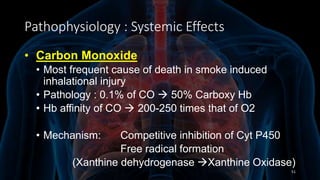
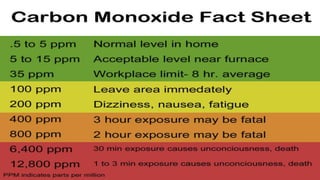
• Carbon Monoxide
• Most frequent cause of death in smoke induced
inhalational injury
• Pathology : 0.1% of CO  50% Carboxy Hb
• Hb affinity of CO  200-250 times that of O2
• Mechanism: Competitive inhibition of Cyt P450
Free radical formation
(Xanthine dehydrogenase Xanthine Oxidase)
51
52
Pathophysiology
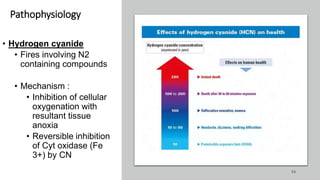
• Hydrogen cyanide
• Fires involving N2
containing compounds
• Mechanism :
• Inhibition of cellular
oxygenation with
resultant tissue
anoxia
• Reversible inhibition
of Cyt oxidase (Fe
3+) by CN
53
54
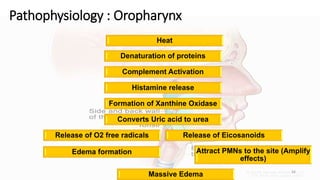
Pathophysiology : Oropharynx
Heat
Denaturation of proteins
Complement Activation
Histamine release
Formation of Xanthine Oxidase
Converts Uric acid to urea
Release of O2 free radicals
Edema formation
Release of Eicosanoids
Attract PMNs to the site (Amplify
effects)
Massive Edema
55
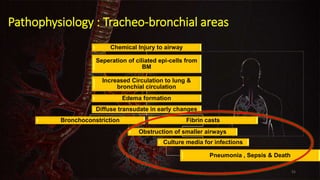
Pathophysiology : Tracheo-bronchial areas
Chemical Injury to airway
Seperation of ciliated epi-cells from
BM
Increased Circulation to lung &
bronchial circulation
Edema formation
Diffuse transudate in early changes
Bronchoconstriction Fibrin casts
Obstruction of smaller airways
Culture media for infections
Pneumonia , Sepsis & Death
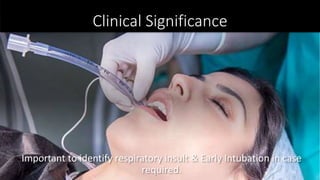
Clinical Significance
Important to identify respiratory insult & Early Intubation in case
required. 56
EVALUATION
57
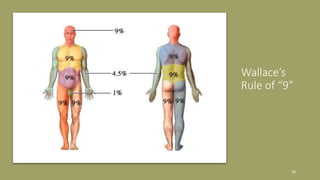
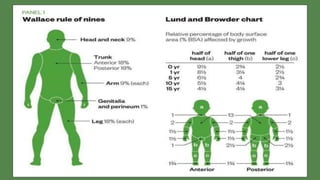
Wallace’s
Rule of “9”
58
59
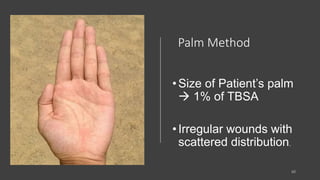
Palm Method
•Size of Patient’s palm
 1% of TBSA
•Irregular wounds with
scattered distribution.
MANAGEMENT OF BURNS
PHASES OF TPT
Phase 1: Treatment at the scene
and tpt to initial care facility
Phase 2: Assessment and stabilization
at initial care facility and tpt to burn
ICU.
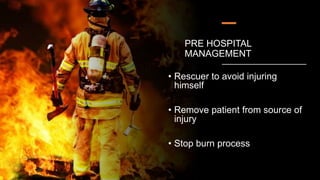
PRE HOSPITAL
MANAGEMENT
• Rescuer to avoid injuring
himself
• Remove patient from source of
injury
• Stop burn process
PRE HOSPITAL
MANAGEMENT
• Remove saturated clothing
• Brush skin if agent is powder
• Irrigation with copious amount water to
be started and continued in hospital
Chemical burns:
• Turn off the current
• Use non-conductor item to separate
from source
Electrical burns:
PRE HOSPITAL MANAGEMENT
PRIMARY ASSESSMENT
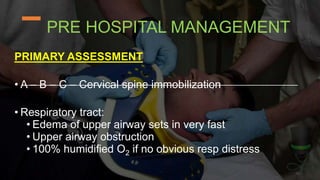
• A – B – C – Cervical spine immobilization
• Respiratory tract:
• Edema of upper airway sets in very fast
• Upper airway obstruction
• 100% humidified O2 if no obvious resp distress
PRE HOSPITAL MANAGEMENT
PRIMARY ASSESSMENT
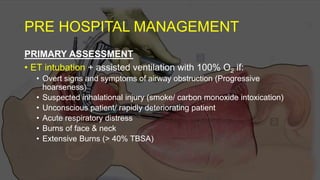
• ET intubation + assisted ventilation with 100% O2 if:
• Overt signs and symptoms of airway obstruction (Progressive
hoarseness)
• Suspected inhalational injury (smoke/ carbon monoxide intoxication)
• Unconscious patient/ rapidly deteriorating patient
• Acute respiratory distress
• Burns of face & neck
• Extensive Burns (> 40% TBSA)
PRE HOSPITAL MANAGEMENT
PRIMARY ASSESSMENT
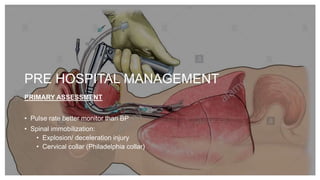
• Pulse rate better monitor than BP
• Spinal immobilization:
• Explosion/ deceleration injury
• Cervical collar (Philadelphia collar)
PRE HOSPITAL MANAGEMENT
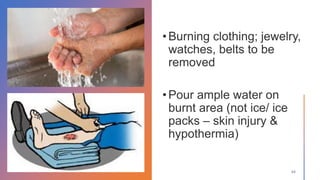
 Ice/ice cold water causes numbness, intense vasoconstriction,
hypothermia causing further damage.
 Do not break blisters.
 Do not apply lotions, powders, grease, ghee, gentian violet,
calamine lotion, toothpastes, butter and other sticky agents over the
burn wound.
 Prevent contamination: Wrap burn part in clean dry sheet /cloth.
 Assess for life threatening injuries.
NO I/M or S/C inj (Capillary leakage results
in unpredictable absorption)
I/V morphine to allay anxiety
Pain relief and reassurance
Withhold oral intake
PRE HOSPITAL
MANAGEMENT
Co-morbid conditions/ pre-
existing illness
Initiate rapid transfer to
hospital
Secure and protect the
airway
Cervical spine
immobilization; if necessary
PRE HOSPITAL MANAGEMENT
SECONDARY ASSESSMENT
Performed only if no immediate life-threatening injury/ hazard present
Thorough head to toe evaluation
Medical history, medication, allergies, mechanism of injury
Start IV line (not reqd in hospital <60 min away)
PRE HOSPITAL
MANAGEMENT
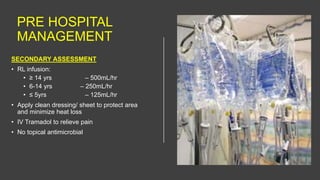
SECONDARY ASSESSMENT
• RL infusion:
• ≥ 14 yrs – 500mL/hr
• 6-14 yrs – 250mL/hr
• ≤ 5yrs – 125mL/hr
• Apply clean dressing/ sheet to protect area
and minimize heat loss
• IV Tramadol to relieve pain
• No topical antimicrobial
HOSPITAL
MANAGEMENT
INITIAL CARE
FACILITY
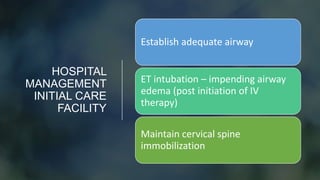
Establish adequate airway
ET intubation – impending airway
edema (post initiation of IV
therapy)
Maintain cervical spine
immobilization
INITIAL
CARE
FACILITY
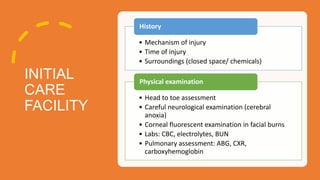
• Mechanism of injury
• Time of injury
• Surroundings (closed space/ chemicals)
History
• Head to toe assessment
• Careful neurological examination (cerebral
anoxia)
• Corneal fluorescent examination in facial burns
• Labs: CBC, electrolytes, BUN
• Pulmonary assessment: ABG, CXR,
carboxyhemoglobin
Physical examination
INITIAL CARE
FACILITY
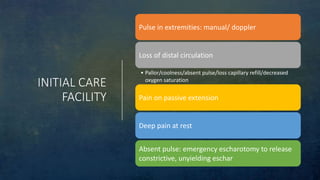
Pulse in extremities: manual/ doppler
Loss of distal circulation
• Pallor/coolness/absent pulse/loss capillary refill/decreased
oxygen saturation
Pain on passive extension
Deep pain at rest
Absent pulse: emergency escharotomy to release
constrictive, unyielding eschar
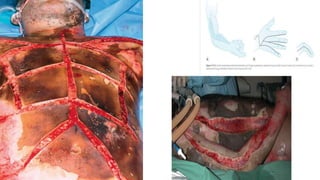
ESCHAROTOMY
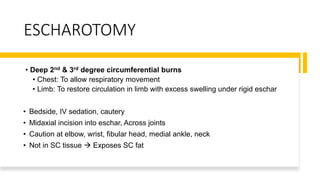
• Deep 2nd & 3rd degree circumferential burns
• Chest: To allow respiratory movement
• Limb: To restore circulation in limb with excess swelling under rigid eschar
• Bedside, IV sedation, cautery
• Midaxial incision into eschar, Across joints
• Caution at elbow, wrist, fibular head, medial ankle, neck
• Not in SC tissue  Exposes SC fat
ESCHAROTOMY
•Elevate limbs above level of heart
•Monitor pulses for 48 hrs
•Chemical escharotomy if pulses +nt but feeble.
•Useful in hand burns.
•Enzyme – collagenase
• Complications : bleeding, infection
• Antimicrobial prophylaxis must to prevent sepsis
INDICATIONS FOR
ADMISSION
• >15% burns in adults
• 10% burns in children
• Airway and inhalation injury.
• Significant burn involving face, hands, feet and
perineum.
• Extremes of age.
• Suspected non-accidental burns.
• Burns that require early surgery (deep partial
thickness / full thickness)
• Patients deficient of nursing care by attendants at
home
• Severe electric and acid burns that is likely to have
serious sequelae
• Resuscitation –ensure ABC
• Large gauge I.V catheter
Central line Insertion
• Foleys catheter and NG tube placement
• Quick assessment of extent
• Tetanus prophylaxis (the only IM administered inj)
• Weigh the patient
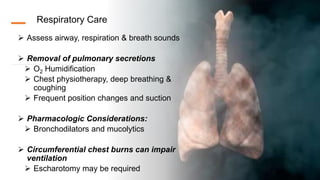
Respiratory Care
 Assess airway, respiration & breath sounds
 Removal of pulmonary secretions
 O2 Humidification
 Chest physiotherapy, deep breathing &
coughing
 Frequent position changes and suction
 Pharmacologic Considerations:
 Bronchodilators and mucolytics
 Circumferential chest burns can impair
ventilation
 Escharotomy may be required
Cardiovascular
Care
•Increase capillary permeability
• “Capillary Leakage Syndrome”
• Fluid shift  intravascular to
interstitial space  blistering
and massive edema
•Excessive insensible loss via burn
wound 3-5 lit/d !!
• Finally  hypovolemia 
untreated BURNS’ SHOCK
Severity of Burn Injuries
Treatment of burns as per severity of injury
• Severity is determined by:
• Depth of burns
• TBSA involved
• Site - face, hands, feet, face or perineum
• Age
• Associated injuries
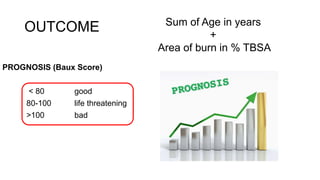
OUTCOME
PROGNOSIS (Baux Score)
< 80 good
80-100 life threatening
>100 bad
Sum of Age in years
+
Area of burn in % TBSA
Resuscitation
Phase
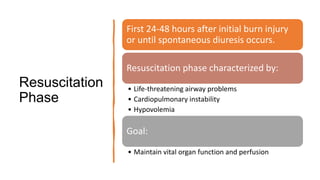
First 24-48 hours after initial burn injury
or until spontaneous diuresis occurs.
Resuscitation phase characterized by:
• Life-threatening airway problems
• Cardiopulmonary instability
• Hypovolemia
Goal:
• Maintain vital organ function and perfusion
PARENTERAL FLUIDS
Parkland Formula
Fluid of Choice
 Lactated Ringer’s (RL)
 NS can produce hyperchloremic acidosis
4 ml x % of burn x weight (Kg) in 24 hours
 First ½ of total volume given in the first 8 hours
 Remaining ½ of total volume given over following 16
hours
 NEXT 24 HRS
 Total volume ½ of first day
 Colloids ( 0.5 ml / kg / % )
 5 % glucose to make up the rest
Parkland Formula
 Maximum applicable TBSA –
50%
 Fully dilated capillaries
 Maximum capillary
permeability
 No further mounting of
inflammatory response
Adult Fluid
Resuscitation
Evan’s formula:
• Colloids : 1ml/kg/% burn
• Saline : 1ml/kg/% burn
• D5 : 2000ml
Requirement for first 24 hrs
• ½ of first 24 hrs
Requirement for second 24 hrs
Adult Fluid
Resuscitation
Brooke formula
• Requirement for first 24 hrs
• Colloids : 0.5ml / kg /% burn
• RL : 1.5ml / kg / %burn
• D5 : 2000ml in adults
Requirement for second 24 hrs
• ½ of first 24hrs
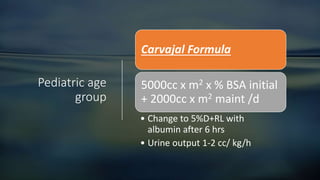
Pediatric age
group
Carvajal Formula
5000cc x m2 x % BSA initial
+ 2000cc x m2 maint /d
• Change to 5%D+RL with
albumin after 6 hrs
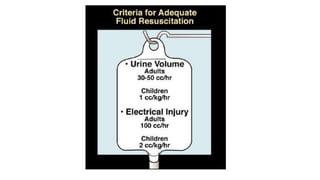
• Urine output 1-2 cc/ kg/h
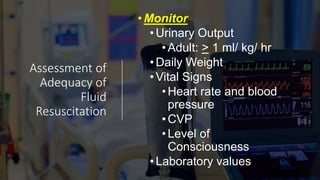
Assessment of
Adequacy of
Fluid
Resuscitation
•Monitor
• Urinary Output
•Adult: > 1 ml/ kg/ hr
• Daily Weight
• Vital Signs
•Heart rate and blood
pressure
•CVP
•Level of
Consciousness
• Laboratory values
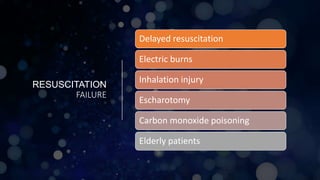
RESUSCITATION
FAILURE
Delayed resuscitation
Electric burns
Inhalation injury
Escharotomy
Carbon monoxide poisoning
Elderly patients
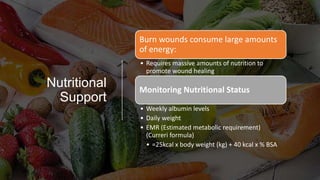
Nutritional
Support
Burn wounds consume large amounts
of energy:
• Requires massive amounts of nutrition to
promote wound healing
Monitoring Nutritional Status
• Weekly albumin levels
• Daily weight
• EMR (Estimated metabolic requirement)
(Curreri formula)
• =25kcal x body weight (kg) + 40 kcal x % BSA
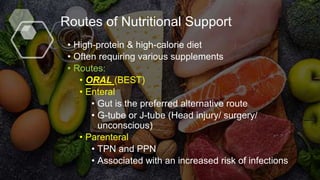
Routes of Nutritional Support
• High-protein & high-calorie diet
• Often requiring various supplements
• Routes:
• ORAL (BEST)
• Enteral
• Gut is the preferred alternative route
• G-tube or J-tube (Head injury/ surgery/
unconscious)
• Parenteral
• TPN and PPN
• Associated with an increased risk of infections
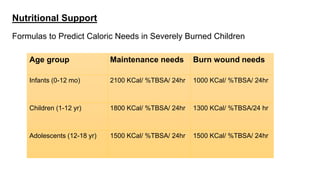
Nutritional Support
Formulas to Predict Caloric Needs in Severely Burned Children
Age group Maintenance needs Burn wound needs
Infants (0-12 mo) 2100 KCal/ %TBSA/ 24hr 1000 KCal/ %TBSA/ 24hr
Children (1-12 yr) 1800 KCal/ %TBSA/ 24hr 1300 KCal/ %TBSA/24 hr
Adolescents (12-18 yr) 1500 KCal/ %TBSA/ 24hr 1500 KCal/ %TBSA/ 24hr
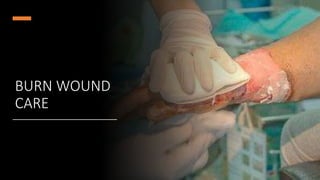
BURN WOUND
CARE
Burn Wounds
Risk for Infection
• Skin  first line of defense
• Necrotic tissue  bacterial growth
• Management
• Burn wounds are frequently
monitored for bacterial
colonization
• Wound swab cultures and
invasive biopsies
Role of burn wound cultures
• Early cultures positive/ high counts  early contamination of the burn wound
• Routine cultures  aid in empiric antimicrobial coverage if the patient subsequently
becomes ill
• Increasing colony counts  change topical antimicrobial agents.
• Colonization by virulent or resistant organisms  predictor of impending invasive burn
wound infection.
• Wound colony counts >106  high risk of infectious & graft failure.
Burn Wound
Care
Hydrotherapy
• Shower, bed baths or
clear water spray
• Maintain appropriate
water and room
temperature
• Limit duration to 20-30
minutes
• Don’t burst blisters,
aspirate them!!!
• Trim hair around wound;
except eyebrows
• Dry with towel; pat dry,
don’t rub!
• Clean unburned skin
and hair
Burn Wound
Care
Antimicrobial Agent
• Silvadene (silver sulfadiazine)
• Broad spectrum; the most
common agent used
• Painless & easy to use
• Doesn’t penetrate eschar
• Leaves black tattoos from
silver ion
• Sulfamylon (mafenide acetate)
• Penetrates eschar
• Painful for approximately 20
minutes after application
• Metabolic acidosis
Burn Wound Care
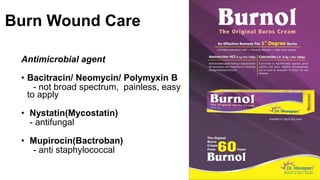
Antimicrobial agent
• Bacitracin/ Neomycin/ Polymyxin B
- not broad spectrum, painless, easy
to apply
• Nystatin(Mycostatin)
- antifungal
• Mupirocin(Bactroban)
- anti staphylococcal
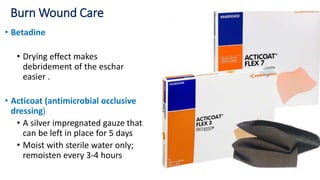
Burn Wound Care
• Betadine
• Drying effect makes
debridement of the eschar
easier .
• Acticoat (antimicrobial occlusive
dressing)
• A silver impregnated gauze that
can be left in place for 5 days
• Moist with sterile water only;
remoisten every 3-4 hours
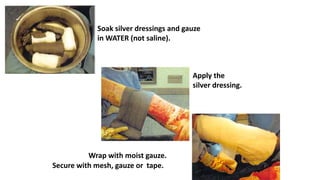
Soak silver dressings and gauze
in WATER (not saline).
Apply the
silver dressing.
Wrap with moist gauze.
Secure with mesh, gauze or tape.
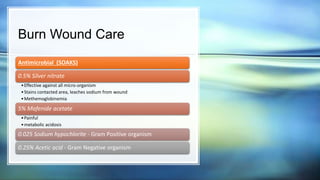
Burn Wound Care
Antimicrobial (SOAKS)
0.5% Silver nitrate
•Effective against all micro-organism
•Stains contacted area, leaches sodium from wound
•Methemoglobinemia
5% Mafenide acetate
•Painful
•metabolic acidosis
0.025 Sodium hypochlorite - Gram Positive organism
0.25% Acetic acid - Gram Negative organism
Closed Dressing
• Advantages
• Less wound
desiccation
• Decreased heat
loss
• Decreased cross
contamination
• Debriding effect
• More
comfortable
• Disadvantages
• Time consuming
• Expensive
• Increase
chances of
infection if not
changed
frequently
Burn Wound Care
Cover with a Sterile Dressing
• Most wounds covered with several layers of sterile gauze dressings.
• Special Considerations:
• Joint area lightly wrapped to allow mobility
• Facial wounds may be left open to air
• Circumferential burns: wrap distal to proximal
• All fingers and toes should be wrapped separately
• Splints over dressings
Burn
Wound
Care
Debridement of the wound
• May be completed at the bedside or as a
surgical procedure.
• Types of Debridement:
• Natural
• Body & bacterial enzymes dissolve
eschar; takes a long time
• Mechanical
• Sharp (scissors), Wet-to-Dry
Dressings or Enzymatic Agents
• Surgical
Why excise the burn?
Burn wound is a focus for sepsis
Burn stimulates inflammatory mediators
Deep burns cannot heal without grafts
Possible effect on future scar quality
111
 Non full-thickness burns may heal
spontaneously
 Superficial burns heal with acceptable
scars
 Excised burn wound must be closed
 Major burn surgery is hazardous
but
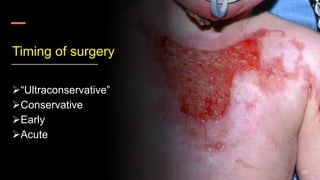
Timing of surgery
“Ultraconservative”
Conservative
Early
Acute
112
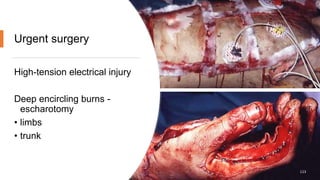
Urgent surgery
High-tension electrical injury
Deep encircling burns -
escharotomy
• limbs
• trunk
113
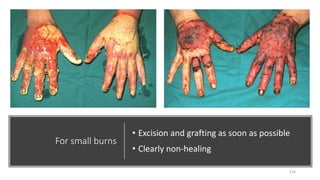
For small burns
• Excision and grafting as soon as possible
• Clearly non-healing
114
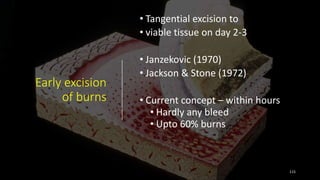
Early excision
of burns
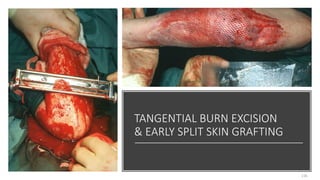
• Tangential excision to
• viable tissue on day 2-3
• Janzekovic (1970)
• Jackson & Stone (1972)
• Current concept – within hours
• Hardly any bleed
• Upto 60% burns
115
TANGENTIAL BURN EXCISION
& EARLY SPLIT SKIN GRAFTING
116
TANGENTIAL
BURN
EXCISION
& EARLY
SPLIT SKIN
GRAFTING
117
Early wound closure; shorter hospital stay
No increase in morbidity
Significant ↓ in mortality
Reduced bacterial colonization
Tissue preservation
Maintenance of function
Less scaring
Early burn surgery
Superior outcomes where suitably equipped
• Mortality
• Length of hospital stay
• Morbidity during acute burn
• Scar quality
118
Desirable
surgical
management
Excision of all non-shallow
burns as soon as practicable in
as few stages as possible
Closure of excised wounds with
autograft, allograft or artificial
material
Definitive wound closure
119
Surgical Management
Skin Grafting
• Closure of burn wound
• Spontaneous wound healing would take months for even a small full-
thickness burn
• Eschar is removed as soon as possible to prevent infection
• Wound needs to be covered to prevent infection, loss of heat, fluid
and electrolytes
• Therefore, skin grafting is done for most full-thickness burns.
• Can be permanent or temporary
Burn Wound Closure
Permanent Skin Grafts
• Two types:
• Autografts and Cultured Epithelial Autografts (CEA)
• Autograft
• Harvested from pt
• Non-antigenic
• Less expensive
• Decreased risk of infection
• Can utilize meshing to cover large area
• Disadvantage : lack of sites and painful
Burn Wound Closure
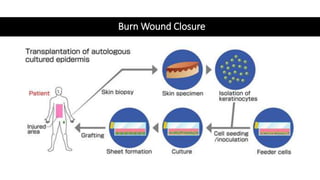
• Cultured Epithelial Autografts (CEA)
• A small piece of pt’s skin is harvested and grown in a culture medium (PDGF
impregnated)
• Takes 3 weeks to grow enough for the first graft
• Very fragile; immobile for 10 days post grafting
• Useful for limited donor sites
• Disadvantage : very expensive; poor long term cosmetic results and skin
remains fragile for years
Burn Wound Closure
Burn
Wound
Closure
Temporary Skin Grafts
• Why temporary ??
• Available donor sites are
used first, but in large
burns  not enough donor
sites.
• While waiting for donor site
to heal it can be reused as
a temporary covering.
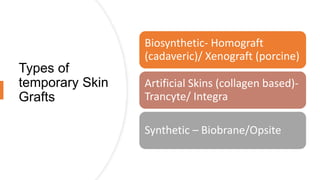
Types of
temporary Skin
Grafts
Biosynthetic- Homograft
(cadaveric)/ Xenograft (porcine)
Artificial Skins (collagen based)-
Trancyte/ Integra
Synthetic – Biobrane/Opsite
Burn
Wound
Closure
Biosynthetic Temporary Skin Grafts
• Homograft
• Allograft
• Live or cadaver human donors
• Fairly expensive/ all the function of
skin
• Best infection control of all biologic
coverings
• Disadvantage :
• Disease transmission (HBV & HIV)
• Antigenic: body rejects in 2 weeks
• Not always available
• Storage problems
Biosynthetic
Temporary
Skin Grafts
• Heterograft
• Xenograft
• Graft between 2 different species
• Porcine most common
• Fresh, frozen or freeze-dried
(longer shelf life)
• Amenable to meshing &
antimicrobial impregnation
• Antigenic: body rejects in 3-4
days
• Fairly inexpensive
• Disadvantage : Higher risk of
infection
Biosynthetic
Temporary
Skin Grafts
• Transcyte:
• A collagen based dressing impregnated
with newborn fibroblasts.
• Integra:
• A collagen based product that helps to
form a “neodermis”
• no anti-microbial property
Artificial Skins
• Any non-biologic dressing that will help
prevent fluid & heat loss
• Biobrane, Xeroform, OpSite or Beta
Glucan collagen matrix
Synthetic
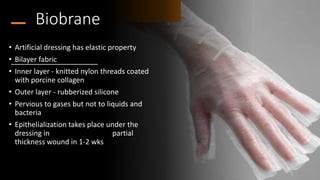
Biobrane
• Artificial dressing has elastic property
• Bilayer fabric
• Inner layer - knitted nylon threads coated
with porcine collagen
• Outer layer - rubberized silicone
• Pervious to gases but not to liquids and
bacteria
• Epithelialization takes place under the
dressing in partial
thickness wound in 1-2 wks
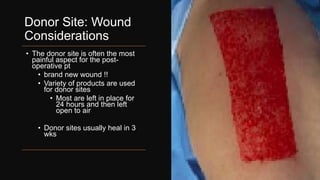
Donor Site: Wound
Considerations
• The donor site is often the most
painful aspect for the post-
operative pt
• brand new wound !!
• Variety of products are used
for donor sites
• Most are left in place for
24 hours and then left
open to air
• Donor sites usually heal in 3
wks
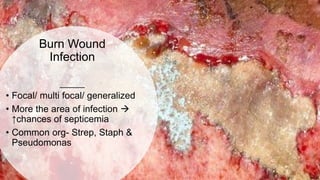
Burn Wound
Infection
• Focal/ multi focal/ generalized
• More the area of infection 
↑chances of septicemia
• Common org- Strep, Staph &
Pseudomonas
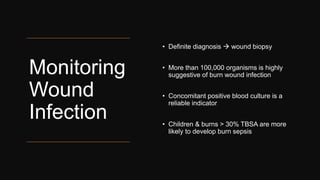
Monitoring
Wound
Infection
• Definite diagnosis  wound biopsy
• More than 100,000 organisms is highly
suggestive of burn wound infection
• Concomitant positive blood culture is a
reliable indicator
• Children & burns > 30% TBSA are more
likely to develop burn sepsis
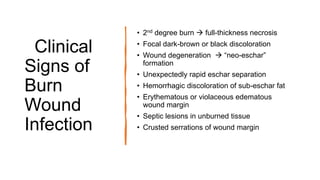
Clinical
Signs of
Burn
Wound
Infection
• 2nd degree burn  full-thickness necrosis
• Focal dark-brown or black discoloration
• Wound degeneration  “neo-eschar”
formation
• Unexpectedly rapid eschar separation
• Hemorrhagic discoloration of sub-eschar fat
• Erythematous or violaceous edematous
wound margin
• Septic lesions in unburned tissue
• Crusted serrations of wound margin
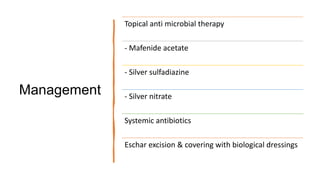
Management
Topical anti microbial therapy
- Mafenide acetate
- Silver sulfadiazine
- Silver nitrate
Systemic antibiotics
Eschar excision & covering with biological dressings
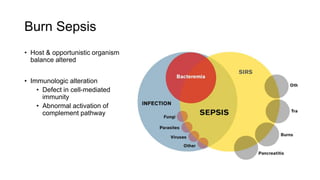
Burn Sepsis
• Host & opportunistic organism
balance altered
• Immunologic alteration
• Defect in cell-mediated
immunity
• Abnormal activation of
complement pathway
Burn Sepsis
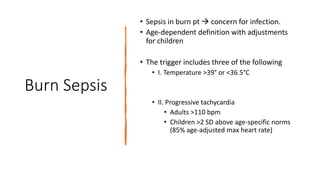
• Sepsis in burn pt  concern for infection.
• Age-dependent definition with adjustments
for children
• The trigger includes three of the following
• I. Temperature >39° or <36.5°C
• II. Progressive tachycardia
• Adults >110 bpm
• Children >2 SD above age-specific norms
(85% age-adjusted max heart rate)
Burn Sepsis
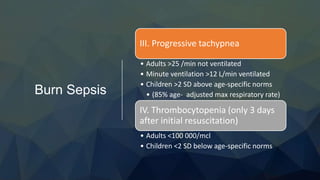
III. Progressive tachypnea
• Adults >25 /min not ventilated
• Minute ventilation >12 L/min ventilated
• Children >2 SD above age-specific norms
• (85% age- adjusted max respiratory rate)
IV. Thrombocytopenia (only 3 days
after initial resuscitation)
• Adults <100 000/mcl
• Children <2 SD below age-specific norms
Burn Sepsis
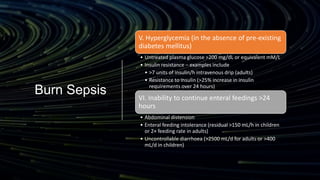
V. Hyperglycemia (in the absence of pre-existing
diabetes mellitus)
• Untreated plasma glucose >200 mg/dL or equivalent mM/L
• Insulin resistance – examples include
• >7 units of insulin/h intravenous drip (adults)
• Resistance to insulin (>25% increase in insulin
requirements over 24 hours)
VI. Inability to continue enteral feedings >24
hours
• Abdominal distension
• Enteral feeding intolerance (residual >150 mL/h in children
or 2× feeding rate in adults)
• Uncontrollable diarrhoea (>2500 mL/d for adults or >400
mL/d in children)
Burn
Sepsis
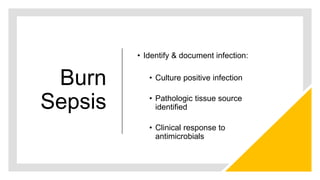
• Identify & document infection:
• Culture positive infection
• Pathologic tissue source
identified
• Clinical response to
antimicrobials
Clinical
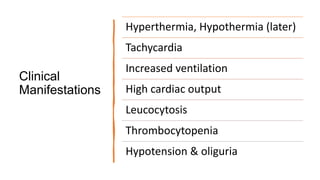
Manifestations
Hyperthermia, Hypothermia (later)
Tachycardia
Increased ventilation
High cardiac output
Leucocytosis
Thrombocytopenia
Hypotension & oliguria
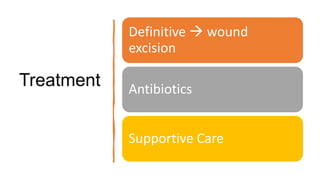
Treatment
Definitive  wound
excision
Antibiotics
Supportive Care
Rehabilitation
• Begins day one and may last several years
• Nursing care
• Meticulous asepsis continues to be important
• Major areas of focus:
• Support for adequate wound healing
• Prevention of hypertrophic scarring & contractures
• Psychosocial Support
• Patient and family
• Promotion of maximal functional independence
Hypertrophic Scar Formation
• Excessive scar formation, which rises above the skin
• Management: Pressure Garments
• Elasticized garments that are custom fitted
• Maintains constant pressure on the wound
• Result: smoother skin & minimized scar appearance
• Pt Considerations:
• Must be worn 2-3 hours a day
• Up to 1-2 years
• Jobst garments, foam sponge, foam tape, silicon gel sheet
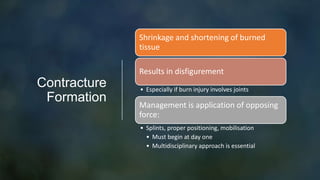
Contracture
Formation
Shrinkage and shortening of burned
tissue
Results in disfigurement
• Especially if burn injury involves joints
Management is application of opposing
force:
• Splints, proper positioning, mobilisation
• Must begin at day one
• Multidisciplinary approach is essential
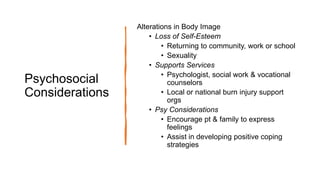
Psychosocial
Considerations
Alterations in Body Image
• Loss of Self-Esteem
• Returning to community, work or school
• Sexuality
• Supports Services
• Psychologist, social work & vocational
counselors
• Local or national burn injury support
orgs
• Psy Considerations
• Encourage pt & family to express
feelings
• Assist in developing positive coping
strategies
CONCLUSION
• Early, aggressive, controlled fluids
• Monitor urine output as a guide to resuscitation
• Prevent extension of injury
• Maintain high suspicion for inhalation injury & low thresh hold for
intubation
• Always rule out co-incident trauma
• Frequent reassessment of extremities
• Seek out & treat CO poisoning
• Liberal use of analgesia
• Prevent hypothermia
• Provide for increased metabolic demands
Take home message
- BURNS !!!
B Breathing
U Urinary output
R Rule of Nines & Resuscitation with fluid
N Nutrition
S Shock & Silversulfadiazine
THANK YOU
150

Burns

  • 1.
  • 2.
    OVERVIEW • Part I •Historical perspective • Statistics • Classification of Burns • Pathophysiology • Evaluation 2  Part II  Management  Pre-hospital Care  Resuscitation & Nutritional support  Burn wound care  Complications  Rehabilitation
  • 3.
    Definition Injuries that resultfrom direct contact or exposure to any physical, thermal, chemical, electrical, or radiation source are termed as Burns. 3
  • 4.
  • 5.
    Historical Perspective • Firstdirect evidence of treatment for burns - Cave paintings of Neanderthal man • 1500 BC : Egyptian Smith Papyrus – Resin & Honey • Ambroise Pare ( AD 1510 – 1590) : Technique of early excision of burn wounds 5
  • 6.
    Historical Perspective • 1607: GF Hildanus : Pathophysiology of Burns • 1797 : Edward Kentish : Chronic Burn scar  Marjolin’s ulcer 6
  • 7.
    • 19th century: • Dupuytren’s classification based on depth • 1842 : Curling : Gastric & Duodenal Ulceration Thomas Blizard Curling Baron Guillaume Dupuytren
  • 8.
    Historical Perspective • 1947: Texas city disaster • Truman G. Blocker Jr: Multidisciplinary team approach of Burns. • First Burn Institute for children in Galveston 8
  • 9.
    Historical Perspective 1951 :45% TBSA Burns  49% mortality Present : > 70 % TBSA  49 % mortality Focus of advance : Improved survival  Rehabilitation of Burn survivors 9
  • 10.
    Problem Statement : India 70 lakhburn injury cases annually Over 10,00,000 people are moderately or severely burnt every year 1.4 lakh people die of burn every year. Around 70% of all burn injuries occur in most productive age group (15-35 years). Around 4/5 are women & children. As many as 80% of cases admitted are a result of accidents at home (kitchen- related incidents) 10
  • 11.
  • 12.
    Classification Based on Cause •Thermal • Electrical • Chemical • Radiation • Inhalation
  • 13.
    Thermal Injuries • Mostcommon • Types : Dry & wet Contact • Direct contact with hot object (pan or iron) • Anything that sticks to skin (i.e. tar, grease or foods) 13
  • 14.
    Thermal Injuries • Flame •Direct contact with flame (dry heat) • structural fires / clothing catching on fire • Scalding • Direct contact with hot liquid / vapours (moist heat) • Cooking, bathing or car radiator overheating • Single most common injury in the paediatric pt 14
  • 15.
    Electrical Burns • Usuallyfollows accidental contact with exposed object conducting electricity • Electrically powered devices • Electrical wiring • Power transmission lines • Can also result from Lightning • Damage depends on intensity of current 15
  • 16.
    Electrical Burns • Severitydepends upon: • What tissue current passes through (Low voltage/ High voltage) • Width or extent of the current pathway • AC or DC • Duration of current contact • Tissues with the lowest resistance eg. nerves, blood vessels & muscles • Heat generation during passage of the current injures the tissues • Skin has a relatively high resistance, hence is mostly spared 16
  • 17.
    Electrical Burns • Low-tensioninjuries(<1000 V) • Low energy burns  Minimal damage to subcutaneous tissue • Entry & Exit points – fingers  small deep burns • AC  Tetany within muscles, cardiac arrest due to interference with normal cardiac pacing 17
  • 18.
    Electrical Burns • High-tensioninjuries(>1000V) • Flash/ Flame / Current • Earthed high tension lines  Arc over the patient  Flash burn • Heating of the surrounding air  Explosion  Flame burn • Direct contact  patient acts as conduction rod huge subcutaneous damage
  • 19.
    Electrical Burns • Lightning •HIGH VOLTAGE!!! • Injury may result from • Direct Strike • Side Flash • Severe injuries often result
  • 20.
    Electrical Burns • Manifestations:- •External Burn • Internal Burn • Musculoskeletal injury • Cardiovascular injury • Respiratory injury • Neurologic injury • Rhabdomyolysis and Renal injury
  • 21.
  • 22.
    Chemical Burns • Usuallyassociated with industrial exposure • Accidental mishandling of household cleaners • Degree of tissue damage determined by - Chemical nature of the agent - Concentration of the agent - Duration of skin contact 23
  • 23.
    Chemical Burns 24 • Immediate coagulationnecrosis creating an eschar; self-limiting Acids • Liquefactive necrosis with continued penetration into deeper tissue resulting in extensive injury • Eg. Lime, potassium hydroxide, cement Bases (Alkali)
  • 24.
    Chemical Burns • Systemicabsorption of offending agents causing metabolic derangements • Formic acid – haemolysis, Haemoglobinuria • Hydrofluoric acid – hypocalcemia 25
  • 25.
    Radiation Exposure • Wavesor particles of energy that are emitted from radioactive sources • Alpha radiation  Large, travel a short distance, minimal penetrating ability  Can harm internal organs if inhaled, ingested or absorbed • Beta radiation  Small, more energy, more penetrating ability  Usually enter through damaged skin, ingestion or inhalation 26
  • 26.
    Radiation Exposure • Gammaradiation & X-rays  Most dangerous penetrating radiation  May produce localized skin burns & extensive internal damage 27
  • 27.
    Classification Based on Depth •I Degree - Epidermis • II Degree - Epidermis+ Dermis • III Degree - Epidermis+ Dermis + Subcutaneous tissue • IV Degree - Above + Muscles/bone 28
  • 28.
    29 Classification Degree of Burn 1st Degree2nd Degree Partial Thickness 2nd Degree Deep Burns 3rd Degree 4th Degree Involvement Epidermis Epidermis + Dermis E+ D E+D+Subcut tissue E+D+S+muscles, tendons & bone Appearance Symptoms & Signs Pain ++ Pain ++++ Painful -less severe Painless,insensitive, Severe Edema No Edema Healing 3-5 days , spontaneous No Scarring 2 weeks, min scarring, minimal discolouration 2-6 weeks Hypertrophic scarring / formation of contractures No spontaneous healing No spontaneous healing
  • 29.
    30 Classification Degree of Burn 1st Degree2nd Degree Partial Thickness 2nd Degree Deep Burns 3rd Degree 4th Degree Involvement Epidermis Epidermis + Dermis E+ D E+D+Subcut tissue E+D+S+muscles, tendons & bone Appearance Red to Pink Dry, No Blisters Red to pink, Wet and weeping wounds Thin-walled, fluid- filled blisters Mottled: Red, pink, or white area Moist Dry, leathery & rigid, Eschar (hard and in- elastic) Red, white, yellow or black Black (dry, dull and charred) Eschar tissue: hard, inelastic Symptoms & Signs Pain ++ Pain ++++ Painful -less severe Painless & insensitive to palpation, Severe Edema No Edema Healing 3-5 days , spontaneous No Scarring 2 weeks, min scarring, minimal discolouration 2-6 weeks Hypertrophic scarring / formation of contractures No spontaneous healing No spontaneous healing
  • 30.
  • 31.
  • 32.
  • 33.
    Pathophysiology : LocalEffects • Burn wound edema • Biphasic pattern • Burn shock : >1/3rd of TBSA Hypovolemia + Rapid edema formation 1st Hr 12-24 Hrs Immediate & Rapid increase in edema Gradual increase
  • 34.
    Pathophysiology : LocalEffects • Edema in non-burned tissue •Loss of capillary endothelial integrity •Reduced transmembrane potentials of skeletal muscle at the site of injury as well as away from the site of damage [-90mv -70 to -80mv] •Increase in intracellular Na & water leading to edema
  • 35.
    Clinical Significance Formation ofconstricting eschars & requirement of emergency escharotomy 36
  • 36.
    Pathophysiology : LocalEffects 37 Mediator Local effect Systemic effect Histamine Increased microvascular permeability Arteriolar dilatation & Venular contraction Reduced BP Hypovolemia Prostaglandins (PGE2) Local Vasodilatation (increased blood flow & increased permeability) Reduced systemic & pulmonary arterial BP Prostacycline (PGI2) Increased capillary permeability Reduced BP Leukotrienes (LB4 & LD4) Pulmonary HTN Thromboxane A2 & B2 Vasoconstriction  Ischaemia of wound Increasing depth of burn GI Ishcaemia Pulmonary HTN Kinins (Bradykinin) Increased microvascular permeability Vasodialatation Reduced BP Hypovolemia
  • 37.
    Pathophysiology : LocalEffects 38 Mediator Local effect Systemic effect Serotonin Increased permeability of large blood vessels Catecholamines Epinephrine Nor-epinephrine Vasoconstriction (a1 receptors) Vasodialatation (b1 receptors) Antiistaminic & Bradykinin Reduce permeability Increased PR, BP, Metabolism O2 Radicals O2-, H2O2, OH-, ONOO- Tissue damage & Increased permeability Cardiac dysfunction PAF Increased permeability Angiotensin II & Vasopressin Vasoconstriction GI Ishcaemia Increased BP
  • 38.
    39 Pathophysiology : SystemicEffects > 30 % Burns in adults
  • 39.
    Pathophysiology : SystemicEffects 40 • Impaired electrical activity of muscle • Vasoconstriction of peripheral vessels Initial phase • Hypovolemia • Reduced venous return Delayed phase
  • 40.
    Pathophysiology : Systemic Effects •Hemodynamicconsequences •Myocardial dysfunction •Increased systemic vascular resistance & organ Ischemia ( Renal & GI system) 41
  • 41.
    Pathophysiology : SystemicEffects • Renal system 42 Decreased cardiac output, decreased blood flow Stress induced hormones & mediators (angiotensin, aldosterone, vasopressin) Decreased renal blood flow & GFR Oliguria & renal failure
  • 42.
  • 43.
    Pathophysiology : Systemic Effects •GIsystem •Mucosal atrophy •Increased intestinal permeability •Decreased absorption of glucose, amino acids & fatty acids 44
  • 44.
  • 45.
    Pathophysiology : Systemic Effects •Immune system • Global depression in immune function • Diminished production of macrophages • Increased neutrophil count (dysfunctional) followed by decrease after 48-72 hrs • Impaired cytotoxic T cell activity • Increase risk of infections • Depressed Th function 46
  • 46.
    Pathophysiology : Systemic Effects • Hypermetabolicresponse • Phase I [ebb] • First 48 hrs • Decrease in • cardiac output • urine output • O2 consumption • BMR • Impaired glucose tolerance with hyperglycemia 47
  • 47.
    Pathophysiology : Systemic Effects •Hypermetabolic response • Metabolic variables gradually increase within first five days post injury to reach a plateau • Phase II [flow] • Increase in metabolic rate • Urine cortisol • Serum catecholamines • Basal energy expenditure • Serum cytokines • Hyperdynamic state – increase in cardiac output • Insulin resistance • Persists for upto 3 years 48
  • 48.
    Clinical Significance •Importance of Techniques ofearly excision •Nutritional support 49
  • 49.
    Pathophysiology : Systemic Effects • InhalationalInjury • 80% of fire-related deaths due to inhalation of toxic gases • Synergestic effect of inhaled toxic gases (CO + HCN) • Agents: • Carbon Monoxide • Hydrogen Cyanide • Hydrogen chloride (PVC) • Nitrogen oxides • Aldehydes & Acrolein (Wood & Kerosene) 50
  • 50.
    Pathophysiology : SystemicEffects • Carbon Monoxide • Most frequent cause of death in smoke induced inhalational injury • Pathology : 0.1% of CO  50% Carboxy Hb • Hb affinity of CO  200-250 times that of O2 • Mechanism: Competitive inhibition of Cyt P450 Free radical formation (Xanthine dehydrogenase Xanthine Oxidase) 51
  • 51.
  • 52.
    Pathophysiology • Hydrogen cyanide •Fires involving N2 containing compounds • Mechanism : • Inhibition of cellular oxygenation with resultant tissue anoxia • Reversible inhibition of Cyt oxidase (Fe 3+) by CN 53
  • 53.
    54 Pathophysiology : Oropharynx Heat Denaturationof proteins Complement Activation Histamine release Formation of Xanthine Oxidase Converts Uric acid to urea Release of O2 free radicals Edema formation Release of Eicosanoids Attract PMNs to the site (Amplify effects) Massive Edema
  • 54.
    55 Pathophysiology : Tracheo-bronchialareas Chemical Injury to airway Seperation of ciliated epi-cells from BM Increased Circulation to lung & bronchial circulation Edema formation Diffuse transudate in early changes Bronchoconstriction Fibrin casts Obstruction of smaller airways Culture media for infections Pneumonia , Sepsis & Death
  • 55.
    Clinical Significance Important toidentify respiratory insult & Early Intubation in case required. 56
  • 56.
  • 57.
  • 58.
  • 59.
    Palm Method •Size ofPatient’s palm  1% of TBSA •Irregular wounds with scattered distribution.
  • 60.
  • 61.
    PHASES OF TPT Phase1: Treatment at the scene and tpt to initial care facility Phase 2: Assessment and stabilization at initial care facility and tpt to burn ICU.
  • 62.
    PRE HOSPITAL MANAGEMENT • Rescuerto avoid injuring himself • Remove patient from source of injury • Stop burn process
  • 64.
    PRE HOSPITAL MANAGEMENT • Removesaturated clothing • Brush skin if agent is powder • Irrigation with copious amount water to be started and continued in hospital Chemical burns: • Turn off the current • Use non-conductor item to separate from source Electrical burns:
  • 65.
    PRE HOSPITAL MANAGEMENT PRIMARYASSESSMENT • A – B – C – Cervical spine immobilization • Respiratory tract: • Edema of upper airway sets in very fast • Upper airway obstruction • 100% humidified O2 if no obvious resp distress
  • 66.
    PRE HOSPITAL MANAGEMENT PRIMARYASSESSMENT • ET intubation + assisted ventilation with 100% O2 if: • Overt signs and symptoms of airway obstruction (Progressive hoarseness) • Suspected inhalational injury (smoke/ carbon monoxide intoxication) • Unconscious patient/ rapidly deteriorating patient • Acute respiratory distress • Burns of face & neck • Extensive Burns (> 40% TBSA)
  • 67.
    PRE HOSPITAL MANAGEMENT PRIMARYASSESSMENT • Pulse rate better monitor than BP • Spinal immobilization: • Explosion/ deceleration injury • Cervical collar (Philadelphia collar)
  • 68.
    PRE HOSPITAL MANAGEMENT Ice/ice cold water causes numbness, intense vasoconstriction, hypothermia causing further damage.  Do not break blisters.  Do not apply lotions, powders, grease, ghee, gentian violet, calamine lotion, toothpastes, butter and other sticky agents over the burn wound.  Prevent contamination: Wrap burn part in clean dry sheet /cloth.  Assess for life threatening injuries.
  • 69.
    NO I/M orS/C inj (Capillary leakage results in unpredictable absorption) I/V morphine to allay anxiety Pain relief and reassurance Withhold oral intake
  • 70.
    PRE HOSPITAL MANAGEMENT Co-morbid conditions/pre- existing illness Initiate rapid transfer to hospital Secure and protect the airway Cervical spine immobilization; if necessary
  • 71.
    PRE HOSPITAL MANAGEMENT SECONDARYASSESSMENT Performed only if no immediate life-threatening injury/ hazard present Thorough head to toe evaluation Medical history, medication, allergies, mechanism of injury Start IV line (not reqd in hospital <60 min away)
  • 72.
    PRE HOSPITAL MANAGEMENT SECONDARY ASSESSMENT •RL infusion: • ≥ 14 yrs – 500mL/hr • 6-14 yrs – 250mL/hr • ≤ 5yrs – 125mL/hr • Apply clean dressing/ sheet to protect area and minimize heat loss • IV Tramadol to relieve pain • No topical antimicrobial
  • 73.
    HOSPITAL MANAGEMENT INITIAL CARE FACILITY Establish adequateairway ET intubation – impending airway edema (post initiation of IV therapy) Maintain cervical spine immobilization
  • 74.
    INITIAL CARE FACILITY • Mechanism ofinjury • Time of injury • Surroundings (closed space/ chemicals) History • Head to toe assessment • Careful neurological examination (cerebral anoxia) • Corneal fluorescent examination in facial burns • Labs: CBC, electrolytes, BUN • Pulmonary assessment: ABG, CXR, carboxyhemoglobin Physical examination
  • 75.
    INITIAL CARE FACILITY Pulse inextremities: manual/ doppler Loss of distal circulation • Pallor/coolness/absent pulse/loss capillary refill/decreased oxygen saturation Pain on passive extension Deep pain at rest Absent pulse: emergency escharotomy to release constrictive, unyielding eschar
  • 76.
    ESCHAROTOMY • Deep 2nd& 3rd degree circumferential burns • Chest: To allow respiratory movement • Limb: To restore circulation in limb with excess swelling under rigid eschar • Bedside, IV sedation, cautery • Midaxial incision into eschar, Across joints • Caution at elbow, wrist, fibular head, medial ankle, neck • Not in SC tissue  Exposes SC fat
  • 78.
    ESCHAROTOMY •Elevate limbs abovelevel of heart •Monitor pulses for 48 hrs •Chemical escharotomy if pulses +nt but feeble. •Useful in hand burns. •Enzyme – collagenase • Complications : bleeding, infection • Antimicrobial prophylaxis must to prevent sepsis
  • 79.
    INDICATIONS FOR ADMISSION • >15%burns in adults • 10% burns in children • Airway and inhalation injury. • Significant burn involving face, hands, feet and perineum. • Extremes of age. • Suspected non-accidental burns. • Burns that require early surgery (deep partial thickness / full thickness) • Patients deficient of nursing care by attendants at home • Severe electric and acid burns that is likely to have serious sequelae
  • 80.
    • Resuscitation –ensureABC • Large gauge I.V catheter Central line Insertion • Foleys catheter and NG tube placement • Quick assessment of extent • Tetanus prophylaxis (the only IM administered inj) • Weigh the patient
  • 81.
    Respiratory Care  Assessairway, respiration & breath sounds  Removal of pulmonary secretions  O2 Humidification  Chest physiotherapy, deep breathing & coughing  Frequent position changes and suction  Pharmacologic Considerations:  Bronchodilators and mucolytics  Circumferential chest burns can impair ventilation  Escharotomy may be required
  • 82.
    Cardiovascular Care •Increase capillary permeability •“Capillary Leakage Syndrome” • Fluid shift  intravascular to interstitial space  blistering and massive edema •Excessive insensible loss via burn wound 3-5 lit/d !! • Finally  hypovolemia  untreated BURNS’ SHOCK
  • 83.
    Severity of BurnInjuries Treatment of burns as per severity of injury • Severity is determined by: • Depth of burns • TBSA involved • Site - face, hands, feet, face or perineum • Age • Associated injuries
  • 84.
    OUTCOME PROGNOSIS (Baux Score) <80 good 80-100 life threatening >100 bad Sum of Age in years + Area of burn in % TBSA
  • 85.
    Resuscitation Phase First 24-48 hoursafter initial burn injury or until spontaneous diuresis occurs. Resuscitation phase characterized by: • Life-threatening airway problems • Cardiopulmonary instability • Hypovolemia Goal: • Maintain vital organ function and perfusion
  • 86.
  • 87.
    Parkland Formula Fluid ofChoice  Lactated Ringer’s (RL)  NS can produce hyperchloremic acidosis 4 ml x % of burn x weight (Kg) in 24 hours  First ½ of total volume given in the first 8 hours  Remaining ½ of total volume given over following 16 hours  NEXT 24 HRS  Total volume ½ of first day  Colloids ( 0.5 ml / kg / % )  5 % glucose to make up the rest
  • 88.
    Parkland Formula  Maximumapplicable TBSA – 50%  Fully dilated capillaries  Maximum capillary permeability  No further mounting of inflammatory response
  • 89.
    Adult Fluid Resuscitation Evan’s formula: •Colloids : 1ml/kg/% burn • Saline : 1ml/kg/% burn • D5 : 2000ml Requirement for first 24 hrs • ½ of first 24 hrs Requirement for second 24 hrs
  • 90.
    Adult Fluid Resuscitation Brooke formula •Requirement for first 24 hrs • Colloids : 0.5ml / kg /% burn • RL : 1.5ml / kg / %burn • D5 : 2000ml in adults Requirement for second 24 hrs • ½ of first 24hrs
  • 91.
    Pediatric age group Carvajal Formula 5000ccx m2 x % BSA initial + 2000cc x m2 maint /d • Change to 5%D+RL with albumin after 6 hrs • Urine output 1-2 cc/ kg/h
  • 93.
    Assessment of Adequacy of Fluid Resuscitation •Monitor •Urinary Output •Adult: > 1 ml/ kg/ hr • Daily Weight • Vital Signs •Heart rate and blood pressure •CVP •Level of Consciousness • Laboratory values
  • 94.
    RESUSCITATION FAILURE Delayed resuscitation Electric burns Inhalationinjury Escharotomy Carbon monoxide poisoning Elderly patients
  • 95.
    Nutritional Support Burn wounds consumelarge amounts of energy: • Requires massive amounts of nutrition to promote wound healing Monitoring Nutritional Status • Weekly albumin levels • Daily weight • EMR (Estimated metabolic requirement) (Curreri formula) • =25kcal x body weight (kg) + 40 kcal x % BSA
  • 96.
    Routes of NutritionalSupport • High-protein & high-calorie diet • Often requiring various supplements • Routes: • ORAL (BEST) • Enteral • Gut is the preferred alternative route • G-tube or J-tube (Head injury/ surgery/ unconscious) • Parenteral • TPN and PPN • Associated with an increased risk of infections
  • 97.
    Nutritional Support Formulas toPredict Caloric Needs in Severely Burned Children Age group Maintenance needs Burn wound needs Infants (0-12 mo) 2100 KCal/ %TBSA/ 24hr 1000 KCal/ %TBSA/ 24hr Children (1-12 yr) 1800 KCal/ %TBSA/ 24hr 1300 KCal/ %TBSA/24 hr Adolescents (12-18 yr) 1500 KCal/ %TBSA/ 24hr 1500 KCal/ %TBSA/ 24hr
  • 98.
  • 99.
    Burn Wounds Risk forInfection • Skin  first line of defense • Necrotic tissue  bacterial growth • Management • Burn wounds are frequently monitored for bacterial colonization • Wound swab cultures and invasive biopsies
  • 100.
    Role of burnwound cultures • Early cultures positive/ high counts  early contamination of the burn wound • Routine cultures  aid in empiric antimicrobial coverage if the patient subsequently becomes ill • Increasing colony counts  change topical antimicrobial agents. • Colonization by virulent or resistant organisms  predictor of impending invasive burn wound infection. • Wound colony counts >106  high risk of infectious & graft failure.
  • 101.
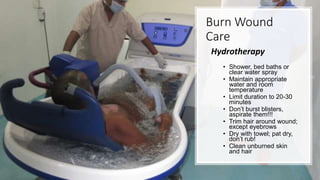
    Burn Wound Care Hydrotherapy • Shower,bed baths or clear water spray • Maintain appropriate water and room temperature • Limit duration to 20-30 minutes • Don’t burst blisters, aspirate them!!! • Trim hair around wound; except eyebrows • Dry with towel; pat dry, don’t rub! • Clean unburned skin and hair
  • 102.
    Burn Wound Care Antimicrobial Agent •Silvadene (silver sulfadiazine) • Broad spectrum; the most common agent used • Painless & easy to use • Doesn’t penetrate eschar • Leaves black tattoos from silver ion • Sulfamylon (mafenide acetate) • Penetrates eschar • Painful for approximately 20 minutes after application • Metabolic acidosis
  • 103.
    Burn Wound Care Antimicrobialagent • Bacitracin/ Neomycin/ Polymyxin B - not broad spectrum, painless, easy to apply • Nystatin(Mycostatin) - antifungal • Mupirocin(Bactroban) - anti staphylococcal
  • 104.
    Burn Wound Care •Betadine • Drying effect makes debridement of the eschar easier . • Acticoat (antimicrobial occlusive dressing) • A silver impregnated gauze that can be left in place for 5 days • Moist with sterile water only; remoisten every 3-4 hours
  • 105.
    Soak silver dressingsand gauze in WATER (not saline). Apply the silver dressing. Wrap with moist gauze. Secure with mesh, gauze or tape.
  • 106.
    Burn Wound Care Antimicrobial(SOAKS) 0.5% Silver nitrate •Effective against all micro-organism •Stains contacted area, leaches sodium from wound •Methemoglobinemia 5% Mafenide acetate •Painful •metabolic acidosis 0.025 Sodium hypochlorite - Gram Positive organism 0.25% Acetic acid - Gram Negative organism
  • 107.
    Closed Dressing • Advantages •Less wound desiccation • Decreased heat loss • Decreased cross contamination • Debriding effect • More comfortable • Disadvantages • Time consuming • Expensive • Increase chances of infection if not changed frequently
  • 108.
    Burn Wound Care Coverwith a Sterile Dressing • Most wounds covered with several layers of sterile gauze dressings. • Special Considerations: • Joint area lightly wrapped to allow mobility • Facial wounds may be left open to air • Circumferential burns: wrap distal to proximal • All fingers and toes should be wrapped separately • Splints over dressings
  • 109.
    Burn Wound Care Debridement of thewound • May be completed at the bedside or as a surgical procedure. • Types of Debridement: • Natural • Body & bacterial enzymes dissolve eschar; takes a long time • Mechanical • Sharp (scissors), Wet-to-Dry Dressings or Enzymatic Agents • Surgical
  • 110.
    Why excise theburn? Burn wound is a focus for sepsis Burn stimulates inflammatory mediators Deep burns cannot heal without grafts Possible effect on future scar quality 111  Non full-thickness burns may heal spontaneously  Superficial burns heal with acceptable scars  Excised burn wound must be closed  Major burn surgery is hazardous but
  • 111.
  • 112.
    Urgent surgery High-tension electricalinjury Deep encircling burns - escharotomy • limbs • trunk 113
  • 113.
    For small burns •Excision and grafting as soon as possible • Clearly non-healing 114
  • 114.
    Early excision of burns •Tangential excision to • viable tissue on day 2-3 • Janzekovic (1970) • Jackson & Stone (1972) • Current concept – within hours • Hardly any bleed • Upto 60% burns 115
  • 115.
    TANGENTIAL BURN EXCISION &EARLY SPLIT SKIN GRAFTING 116
  • 116.
    TANGENTIAL BURN EXCISION & EARLY SPLIT SKIN GRAFTING 117 Earlywound closure; shorter hospital stay No increase in morbidity Significant ↓ in mortality Reduced bacterial colonization Tissue preservation Maintenance of function Less scaring
  • 117.
    Early burn surgery Superioroutcomes where suitably equipped • Mortality • Length of hospital stay • Morbidity during acute burn • Scar quality 118
  • 118.
    Desirable surgical management Excision of allnon-shallow burns as soon as practicable in as few stages as possible Closure of excised wounds with autograft, allograft or artificial material Definitive wound closure 119
  • 119.
    Surgical Management Skin Grafting •Closure of burn wound • Spontaneous wound healing would take months for even a small full- thickness burn • Eschar is removed as soon as possible to prevent infection • Wound needs to be covered to prevent infection, loss of heat, fluid and electrolytes • Therefore, skin grafting is done for most full-thickness burns. • Can be permanent or temporary
  • 120.
    Burn Wound Closure PermanentSkin Grafts • Two types: • Autografts and Cultured Epithelial Autografts (CEA) • Autograft • Harvested from pt • Non-antigenic • Less expensive • Decreased risk of infection • Can utilize meshing to cover large area • Disadvantage : lack of sites and painful
  • 121.
    Burn Wound Closure •Cultured Epithelial Autografts (CEA) • A small piece of pt’s skin is harvested and grown in a culture medium (PDGF impregnated) • Takes 3 weeks to grow enough for the first graft • Very fragile; immobile for 10 days post grafting • Useful for limited donor sites • Disadvantage : very expensive; poor long term cosmetic results and skin remains fragile for years
  • 122.
  • 123.
    Burn Wound Closure Temporary Skin Grafts •Why temporary ?? • Available donor sites are used first, but in large burns  not enough donor sites. • While waiting for donor site to heal it can be reused as a temporary covering.
  • 124.
    Types of temporary Skin Grafts Biosynthetic-Homograft (cadaveric)/ Xenograft (porcine) Artificial Skins (collagen based)- Trancyte/ Integra Synthetic – Biobrane/Opsite
  • 125.
    Burn Wound Closure Biosynthetic Temporary SkinGrafts • Homograft • Allograft • Live or cadaver human donors • Fairly expensive/ all the function of skin • Best infection control of all biologic coverings • Disadvantage : • Disease transmission (HBV & HIV) • Antigenic: body rejects in 2 weeks • Not always available • Storage problems
  • 126.
    Biosynthetic Temporary Skin Grafts • Heterograft •Xenograft • Graft between 2 different species • Porcine most common • Fresh, frozen or freeze-dried (longer shelf life) • Amenable to meshing & antimicrobial impregnation • Antigenic: body rejects in 3-4 days • Fairly inexpensive • Disadvantage : Higher risk of infection
  • 127.
    Biosynthetic Temporary Skin Grafts • Transcyte: •A collagen based dressing impregnated with newborn fibroblasts. • Integra: • A collagen based product that helps to form a “neodermis” • no anti-microbial property Artificial Skins • Any non-biologic dressing that will help prevent fluid & heat loss • Biobrane, Xeroform, OpSite or Beta Glucan collagen matrix Synthetic
  • 128.
    Biobrane • Artificial dressinghas elastic property • Bilayer fabric • Inner layer - knitted nylon threads coated with porcine collagen • Outer layer - rubberized silicone • Pervious to gases but not to liquids and bacteria • Epithelialization takes place under the dressing in partial thickness wound in 1-2 wks
  • 129.
    Donor Site: Wound Considerations •The donor site is often the most painful aspect for the post- operative pt • brand new wound !! • Variety of products are used for donor sites • Most are left in place for 24 hours and then left open to air • Donor sites usually heal in 3 wks
  • 131.
    Burn Wound Infection • Focal/multi focal/ generalized • More the area of infection  ↑chances of septicemia • Common org- Strep, Staph & Pseudomonas
  • 132.
    Monitoring Wound Infection • Definite diagnosis wound biopsy • More than 100,000 organisms is highly suggestive of burn wound infection • Concomitant positive blood culture is a reliable indicator • Children & burns > 30% TBSA are more likely to develop burn sepsis
  • 133.
    Clinical Signs of Burn Wound Infection • 2nddegree burn  full-thickness necrosis • Focal dark-brown or black discoloration • Wound degeneration  “neo-eschar” formation • Unexpectedly rapid eschar separation • Hemorrhagic discoloration of sub-eschar fat • Erythematous or violaceous edematous wound margin • Septic lesions in unburned tissue • Crusted serrations of wound margin
  • 134.
    Management Topical anti microbialtherapy - Mafenide acetate - Silver sulfadiazine - Silver nitrate Systemic antibiotics Eschar excision & covering with biological dressings
  • 135.
    Burn Sepsis • Host& opportunistic organism balance altered • Immunologic alteration • Defect in cell-mediated immunity • Abnormal activation of complement pathway
  • 136.
    Burn Sepsis • Sepsisin burn pt  concern for infection. • Age-dependent definition with adjustments for children • The trigger includes three of the following • I. Temperature >39° or <36.5°C • II. Progressive tachycardia • Adults >110 bpm • Children >2 SD above age-specific norms (85% age-adjusted max heart rate)
  • 137.
    Burn Sepsis III. Progressivetachypnea • Adults >25 /min not ventilated • Minute ventilation >12 L/min ventilated • Children >2 SD above age-specific norms • (85% age- adjusted max respiratory rate) IV. Thrombocytopenia (only 3 days after initial resuscitation) • Adults <100 000/mcl • Children <2 SD below age-specific norms
  • 138.
    Burn Sepsis V. Hyperglycemia(in the absence of pre-existing diabetes mellitus) • Untreated plasma glucose >200 mg/dL or equivalent mM/L • Insulin resistance – examples include • >7 units of insulin/h intravenous drip (adults) • Resistance to insulin (>25% increase in insulin requirements over 24 hours) VI. Inability to continue enteral feedings >24 hours • Abdominal distension • Enteral feeding intolerance (residual >150 mL/h in children or 2× feeding rate in adults) • Uncontrollable diarrhoea (>2500 mL/d for adults or >400 mL/d in children)
  • 139.
    Burn Sepsis • Identify &document infection: • Culture positive infection • Pathologic tissue source identified • Clinical response to antimicrobials
  • 140.
    Clinical Manifestations Hyperthermia, Hypothermia (later) Tachycardia Increasedventilation High cardiac output Leucocytosis Thrombocytopenia Hypotension & oliguria
  • 141.
  • 143.
    Rehabilitation • Begins dayone and may last several years • Nursing care • Meticulous asepsis continues to be important • Major areas of focus: • Support for adequate wound healing • Prevention of hypertrophic scarring & contractures • Psychosocial Support • Patient and family • Promotion of maximal functional independence
  • 144.
    Hypertrophic Scar Formation •Excessive scar formation, which rises above the skin • Management: Pressure Garments • Elasticized garments that are custom fitted • Maintains constant pressure on the wound • Result: smoother skin & minimized scar appearance • Pt Considerations: • Must be worn 2-3 hours a day • Up to 1-2 years • Jobst garments, foam sponge, foam tape, silicon gel sheet
  • 145.
    Contracture Formation Shrinkage and shorteningof burned tissue Results in disfigurement • Especially if burn injury involves joints Management is application of opposing force: • Splints, proper positioning, mobilisation • Must begin at day one • Multidisciplinary approach is essential
  • 146.
    Psychosocial Considerations Alterations in BodyImage • Loss of Self-Esteem • Returning to community, work or school • Sexuality • Supports Services • Psychologist, social work & vocational counselors • Local or national burn injury support orgs • Psy Considerations • Encourage pt & family to express feelings • Assist in developing positive coping strategies
  • 147.
    CONCLUSION • Early, aggressive,controlled fluids • Monitor urine output as a guide to resuscitation • Prevent extension of injury • Maintain high suspicion for inhalation injury & low thresh hold for intubation • Always rule out co-incident trauma • Frequent reassessment of extremities • Seek out & treat CO poisoning • Liberal use of analgesia • Prevent hypothermia • Provide for increased metabolic demands
  • 148.
    Take home message -BURNS !!! B Breathing U Urinary output R Rule of Nines & Resuscitation with fluid N Nutrition S Shock & Silversulfadiazine
  • 149.