Burn InjuriesShamma Lootah
R3
27.11.2018
Burn Care
◂ Prevention
◂ First Aid
◂ Emergency care
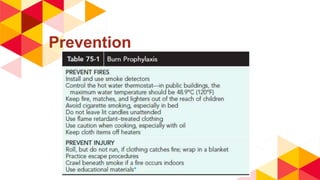
Prevention
Prevention
◂ Cooking is a major cause of fire…
so:
◂ Never leave it unattended
◂ If deep frying use equipment with a
thermostat
◂ Make sure all appliances are turned off
after use
Prevention
◂ Smoking:
◂ Never smoke in bed you could fall
asleep
◂ Use a proper ashtray
◂ Never empty the ashtray into the
rubbish bin before going to bed
Prevention
◂ Candles:
◂ Never leave them unattended
◂ Do not place them too close to curtains
◂ Ensure they are fully put before leaving
the house or going to bed
Prevention
◂ Electric:
◂ Do not overload sockets
◂ Avoid buying uncertified/cheap electric
goods
◂ Turn off appliances at night
◂ Call on electrician if fuses continually
trip or electric wires look damaged
Prevention
◂ Arson:
◂ You are four times more likely to die in
a fire if you do not have smoke alarm
that works
◂ Close doors at night to prevent smoke
traveling through your home.
First Aid Measures
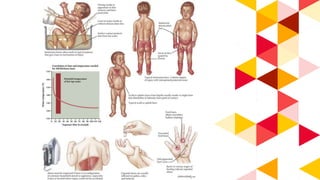
◂ Extinguish flames by rolling the child on the
ground; cover the child with a blanket, coat, or
carpet.
◂ After determining that the airway is patent,
remove smoldering clothing or clothing saturated
with hot liquid. Jewelry, particularly rings and
bracelets, should be removed or cut away to
prevent constriction and vascular compromise
during the edema phase in the 1st 24-72 hr after
burn injury.
First Aid Measures
◂ In cases of chemical injury, brush off any
remaining chemical, if powdered or solid;
then use copious irrigation or wash the
affected area with water. Call the local
poison control center for the neutralizing
agent to treat a chemical ingestion.
First Aid Measures
◂ Cover the burned area with clean, dry sheeting
and apply cold (not iced) wet compresses to
small injuries. Significant large-burn injury (>15%
of BSA) decreases body temperature control and
contraindicates the use of cold compresses.
◂ If the burn is caused by hot tar, use mineral oil to
remove the tar.
◂ Administer analgesic medications.
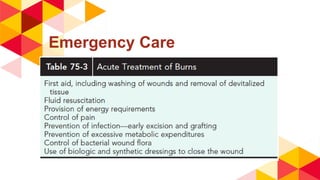
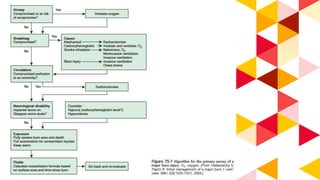
Emergency Care
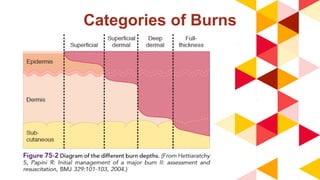
Categories of Burns
Categories of Burns
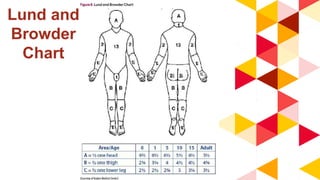
Lund and
Browder
Chart
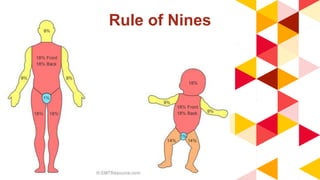
Rule of Nines
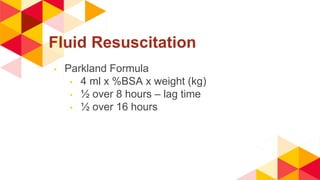
Fluid Resuscitation
◂ Parkland Formula
◂ 4 ml x %BSA x weight (kg)
◂ ½ over 8 hours – lag time
◂ ½ over 16 hours

Burn injuries

  • 1.
  • 5.
    Burn Care ◂ Prevention ◂First Aid ◂ Emergency care
  • 6.
  • 7.
    Prevention ◂ Cooking isa major cause of fire… so: ◂ Never leave it unattended ◂ If deep frying use equipment with a thermostat ◂ Make sure all appliances are turned off after use
  • 8.
    Prevention ◂ Smoking: ◂ Neversmoke in bed you could fall asleep ◂ Use a proper ashtray ◂ Never empty the ashtray into the rubbish bin before going to bed
  • 9.
    Prevention ◂ Candles: ◂ Neverleave them unattended ◂ Do not place them too close to curtains ◂ Ensure they are fully put before leaving the house or going to bed
  • 10.
    Prevention ◂ Electric: ◂ Donot overload sockets ◂ Avoid buying uncertified/cheap electric goods ◂ Turn off appliances at night ◂ Call on electrician if fuses continually trip or electric wires look damaged
  • 11.
    Prevention ◂ Arson: ◂ Youare four times more likely to die in a fire if you do not have smoke alarm that works ◂ Close doors at night to prevent smoke traveling through your home.
  • 12.
    First Aid Measures ◂Extinguish flames by rolling the child on the ground; cover the child with a blanket, coat, or carpet. ◂ After determining that the airway is patent, remove smoldering clothing or clothing saturated with hot liquid. Jewelry, particularly rings and bracelets, should be removed or cut away to prevent constriction and vascular compromise during the edema phase in the 1st 24-72 hr after burn injury.
  • 13.
    First Aid Measures ◂In cases of chemical injury, brush off any remaining chemical, if powdered or solid; then use copious irrigation or wash the affected area with water. Call the local poison control center for the neutralizing agent to treat a chemical ingestion.
  • 14.
    First Aid Measures ◂Cover the burned area with clean, dry sheeting and apply cold (not iced) wet compresses to small injuries. Significant large-burn injury (>15% of BSA) decreases body temperature control and contraindicates the use of cold compresses. ◂ If the burn is caused by hot tar, use mineral oil to remove the tar. ◂ Administer analgesic medications.
  • 15.
  • 17.
  • 18.
  • 19.
  • 20.
  • 21.
    Fluid Resuscitation ◂ ParklandFormula ◂ 4 ml x %BSA x weight (kg) ◂ ½ over 8 hours – lag time ◂ ½ over 16 hours

Editor's Notes

  • #7 The National Fire Protection Association (NFPA) recommends replacing smoke detector batteries annually and the smoke detector alarm every 10 yr (or earlier, if indicated on the device)
  • #15 https://www.stjohn.org.nz/First-Aid/First-Aid-Library/Burns/
  • #21 Parkland formula is an appropriate starting guideline for fluid resuscitation (4 mL lactated Ringer solution/kg/% BSA burned). Half of the fluid is given over the 1st 8 hr, calculated from the time of onset of injury; the remaining fluid is given at an even rate over the next 16 hr
  • #22 The first 8 hours are calculated from the time of injury, meaning if a patient presents 2 hours (lag time) after the injury the fluids will be given over 6 hours