Presented By
Yogesh Pal
M.Tech(VLSI)
172221013
 Introduction
 Objective
 Types of BISR Methods
 Proposed BISR Scheme
 Conclusion
 References
 Built-in Self-repair is used to test semiconductor
embedded memories.
 BISR scheme includes built-in self test(BIST) and
built-in redundancy analysis(BIRA), to test and
repair embedded memory.
 BISR scheme based on a self-test and repair
processor can perform multiple time memory
repair.
 The performance of BISR is evaluated with BIST
and BIRA.
 BIST Criteria:
Test-Time, Fault-Coverage and Area-
Overhead
 BISR Criteria:
Repair-Rate, Repair-Time and Area-
Overhead
 Main objective of BISR is reduce test-time and
repair time, high repair rate and low area-
overhead
 There are three methods for multiple memories are
I. Parallel test and Parallel Repair ( n BIST and n
BIRA)
II. Parallel test and Series Repair ( n BIST and 1
BIRA)
III. Series test and Series Repair ( 1 BIST and 1
BIRA)
 Memories are tested and classified as faulty
memory or fault-free memory by parallel test
procedure.
 Fault-free memory are excluded.
 Faulty memory are tested serially and repaired
according to the size of memories in descending
order.
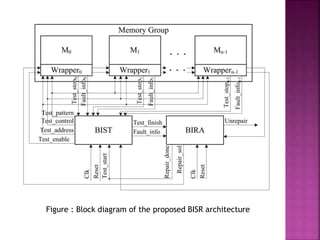
Figure : Block diagram of the proposed BISR architecture
Figure : Block diagram of the proposed BIST and wrapper modules
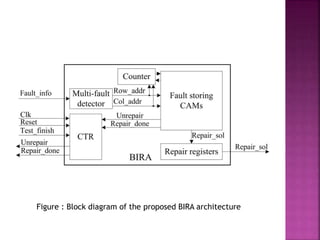
Figure : Block diagram of the proposed BIRA architecture
 All memories are concurrently tested by the small dedicated
BIST to figure out the faulty, the number of faults, and
irreparability.
 Only faulty memories are serially tested and repaired by the
global BIRA according to the sizes of memories in
descending order.
 The proposed BISR scheme finds the optimum point
between the test and repair time, and the area overhead by
maintaining the optimal repair rate.
 The verification procedure is simply conducted through the
parallel test.
 Therefore, the proposed BISR scheme is a solution that
trades off test and repair time, and area overhead to
accomplish an optimal repair rate for multiple embedded
memories in the SoC.
 Wooheon Kang, Changwook Lee, Hyunyul Lim, and Sungho Kang “Optimized
Built-in Self-Repair for multiple memories” IEEE TRANSACTIONS ON VERY
LARGE SCALE INTEGRATION (VLSI) SYSTEMS, VOL. 24, NO. 6, JUNE
2016
 C.-T. Huang, C.-F. Wu, J.-F. Li, and C.-W. Wu, “Built-in redundancy analysis for
memory yield improvement,” IEEE Trans. Rel., vol. 52, no. 4, pp. 386–399, Dec.
2003.
 C.-H. Su, R.-F. Huang, and C.-W. Wu, “A processor-based built-in self-repair
design for embedded memories,” in Proc. 12th Asian Test Symp., Nov. 2003, pp.
366–371.
 T.-W. Tseng, J.-F. Li, and C.-C. Hsu, “ReBISR: A reconfigurable built-in self-
repair scheme for random access memories in SOCs,” IEEE Trans. Very Large
Scale Integr. (VLSI) Syst., vol. 18, no. 6, pp. 921–932, Jun. 2010.
 C. H. Stapper, A. N. McLaren, and M. Dreckmann, “Yield model for productivity
optimization of VLSI memory chips with redundancy and partially good product,”
IBM J. Res. Develop., vol. 24, no. 3, pp. 398–409, May 1980.

Built in redundency analysis

  • 1.
  • 2.
     Introduction  Objective Types of BISR Methods  Proposed BISR Scheme  Conclusion  References
  • 3.
     Built-in Self-repairis used to test semiconductor embedded memories.  BISR scheme includes built-in self test(BIST) and built-in redundancy analysis(BIRA), to test and repair embedded memory.  BISR scheme based on a self-test and repair processor can perform multiple time memory repair.
  • 4.
     The performanceof BISR is evaluated with BIST and BIRA.  BIST Criteria: Test-Time, Fault-Coverage and Area- Overhead  BISR Criteria: Repair-Rate, Repair-Time and Area- Overhead  Main objective of BISR is reduce test-time and repair time, high repair rate and low area- overhead
  • 5.
     There arethree methods for multiple memories are I. Parallel test and Parallel Repair ( n BIST and n BIRA) II. Parallel test and Series Repair ( n BIST and 1 BIRA) III. Series test and Series Repair ( 1 BIST and 1 BIRA)
  • 6.
     Memories aretested and classified as faulty memory or fault-free memory by parallel test procedure.  Fault-free memory are excluded.  Faulty memory are tested serially and repaired according to the size of memories in descending order.
  • 7.
    Figure : Blockdiagram of the proposed BISR architecture
  • 8.
    Figure : Blockdiagram of the proposed BIST and wrapper modules
  • 9.
    Figure : Blockdiagram of the proposed BIRA architecture
  • 10.
     All memoriesare concurrently tested by the small dedicated BIST to figure out the faulty, the number of faults, and irreparability.  Only faulty memories are serially tested and repaired by the global BIRA according to the sizes of memories in descending order.  The proposed BISR scheme finds the optimum point between the test and repair time, and the area overhead by maintaining the optimal repair rate.  The verification procedure is simply conducted through the parallel test.  Therefore, the proposed BISR scheme is a solution that trades off test and repair time, and area overhead to accomplish an optimal repair rate for multiple embedded memories in the SoC.
  • 11.
     Wooheon Kang,Changwook Lee, Hyunyul Lim, and Sungho Kang “Optimized Built-in Self-Repair for multiple memories” IEEE TRANSACTIONS ON VERY LARGE SCALE INTEGRATION (VLSI) SYSTEMS, VOL. 24, NO. 6, JUNE 2016  C.-T. Huang, C.-F. Wu, J.-F. Li, and C.-W. Wu, “Built-in redundancy analysis for memory yield improvement,” IEEE Trans. Rel., vol. 52, no. 4, pp. 386–399, Dec. 2003.  C.-H. Su, R.-F. Huang, and C.-W. Wu, “A processor-based built-in self-repair design for embedded memories,” in Proc. 12th Asian Test Symp., Nov. 2003, pp. 366–371.  T.-W. Tseng, J.-F. Li, and C.-C. Hsu, “ReBISR: A reconfigurable built-in self- repair scheme for random access memories in SOCs,” IEEE Trans. Very Large Scale Integr. (VLSI) Syst., vol. 18, no. 6, pp. 921–932, Jun. 2010.  C. H. Stapper, A. N. McLaren, and M. Dreckmann, “Yield model for productivity optimization of VLSI memory chips with redundancy and partially good product,” IBM J. Res. Develop., vol. 24, no. 3, pp. 398–409, May 1980.