Developing Winning Attitudes
Developing a Winning Attitude  To be able to succeed in today’s competitive landscape, a “Winning Attitude” is the most important ingredient.
Developing a Winning Attitude  Through this training, you will learn how to develop and enjoy the “Winning Attitudes” necessary for customer service communication success.
Developing a Winning Attitude  The training comprises of 9 modules We will work through one module at a time (1 per week) Some follow-up work may be required by you between sessions
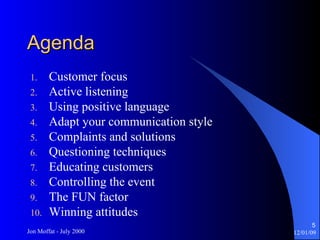
Agenda Customer focus Active listening Using positive language Adapt your communication style Complaints and solutions Questioning techniques Educating customers Controlling the event The FUN factor Winning attitudes
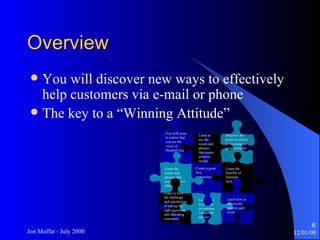
Overview  You will discover new ways to effectively help customers via e-mail or phone The key to a “Winning Attitude” Learn the benefits of listening techniques Learn how to provide exceptional customer service Learn how to effectively control each event Create a great first impression Learn the words and phrases that create positive effects Learn to love the challenge and satisfaction of asking the right questions and educating customers Learn to use the words and phrases that create positive results Discover the positive effects of focusing on your customer You will come to realise that you are the voice of DoubleClick
Module 1 Customer Focus
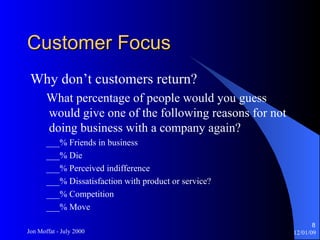
Customer Focus Why don’t customers return? What percentage of people would you guess would give one of the following reasons for not doing business with a company again? ___% Friends in business ___% Die ___% Perceived indifference ___% Dissatisfaction with product or service? ___% Competition ___% Move
Customer Focus FOCUS makes it easy… F O C U S
Customer Focus It’s the obvious that works… What three techniques would you use to develop trust? 1. 2. 3.
Customer Focus It’s the obvious that works… What three techniques would you use to develop an understanding the customers needs? 1. 2. 3.
Customer Focus It’s the obvious that works… What three techniques would you use to present a solution or solve the problem?  1. 2. 3.
Customer Focus It’s the obvious that works… What three techniques would you use to gain agreement or customer satisfaction? 1. 2. 3.
Customer Focus The four “S” of an effective opening… Smile Speak up Slow down Speak clearly
Customer Focus Tone says it all… Greeting Questioning Educating/presenting information Gaining agreement Responding to an aggressive person Good-bye
Customer Focus Use words that motivate… Help Results Easy Save money Safe Prove New Guarantee Discover Time saver Results
Customer Focus Use the persons name… Shows your listening Shows you appreciate them
Summary In this session you learned about the importance of “Customer Focus” You can now apply what was learned when in contact with clients
Module 2 Active Listening
Active Listening What are 10 reasons why listening will help you achieve results? 1. 2. 3. 4. 5. 6. 7. 8. 9. 10.
Active Listening Acknowledge the person To show you are listening and understand To develop a rapport and make the caller feel comfortable To clarify and correct information To help you concentrate
Active Listening Techniques for better listening…. Develop the ______ to be a good listener. Your ________ is the most important factor. Voice ____________ to the caller. Don’t __________. Make sure that the caller has fully expressed his/her thoughts so that you understand his/ her full meaning. If the caller interrupts you, what should you do?
Active Listening Techniques for better listening…. Fully________ and   _________. Listening is an active skill. Limit your talking. You have two ____ and one _____, use the accordingly! If you don’t understand something, ask for _______. Take ____. You are unobserved. Talking is sharing. Listening is ______.
Summary Listening is an active skill It helps us to understand the customers needs It can be applied easily and the benefits are that it helps you to control the call and solve the customers problem. Allowing the customer to be heard helps avoid a feeling of indifference!
Module 3 Using Positive Language
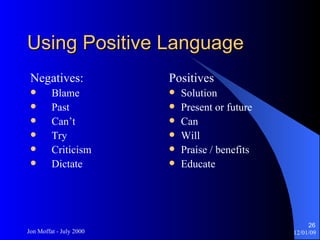
Using Positive Language Negatives: Blame Past Can’t Try Criticism Dictate Positives Solution Present or future Can Will Praise / benefits Educate
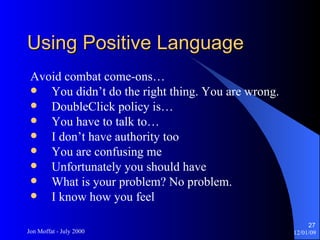
Using Positive Language Avoid combat come-ons… You didn’t do the right thing. You are wrong. DoubleClick policy is… You have to talk to… I don’t have authority too You are confusing me Unfortunately you should have What is your problem? No problem. I know how you feel
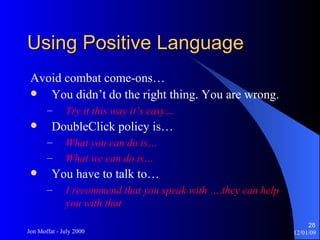
Using Positive Language Avoid combat come-ons… You didn’t do the right thing. You are wrong. Try it this way it’s easy… DoubleClick policy is… What you can do is… What we can do is… You have to talk to… I recommend that you speak with ….they can help you with that
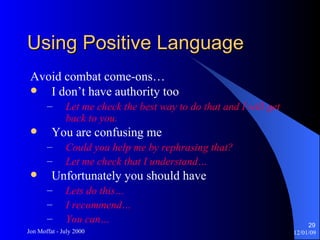
Using Positive Language Avoid combat come-ons… I don’t have authority too Let me check the best way to do that and I will get back to you. You are confusing me Could you help me by rephrasing that? Let me check that I understand… Unfortunately you should have Lets do this… I recommend…  You can…
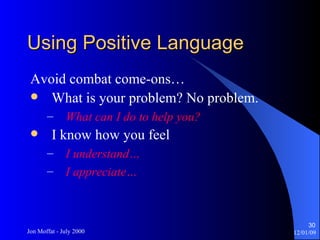
Using Positive Language Avoid combat come-ons… What is your problem? No problem. What can I do to help you? I know how you feel I understand… I appreciate…
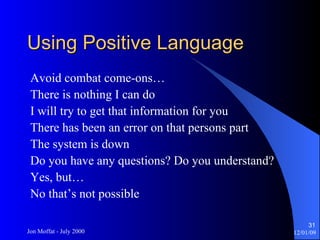
Using Positive Language Avoid combat come-ons… There is nothing I can do I will try to get that information for you There has been an error on that persons part The system is down Do you have any questions? Do you understand? Yes, but… No that’s not possible
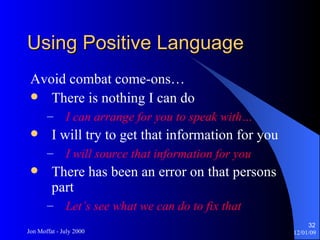
Using Positive Language Avoid combat come-ons… There is nothing I can do I can arrange for you to speak with… I will try to get that information for you I will source that information for you There has been an error on that persons part Let’s see what we can do to fix that
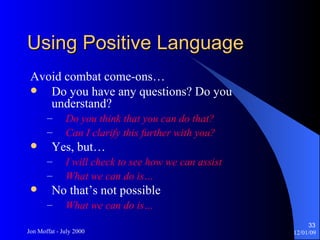
Using Positive Language Avoid combat come-ons… Do you have any questions? Do you understand? Do you think that you can do that? Can I clarify this further with you? Yes, but… I will check to see how we can assist What we can do is… No that’s not possible What we can do is…
Summary Listening is an active skill It helps us to understand the customers needs It can be applied easily and the benefits are that it helps you to control the call and solve the customers problem. Allowing the customer to be heard helps avoid a feeling of indifference!
Module 4 Adapting Your Communication Style
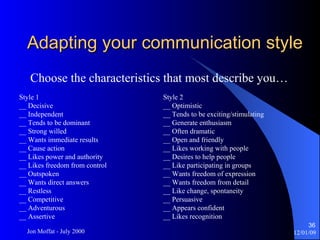
Adapting your communication style Choose the characteristics that most describe you… Style 1 __ Decisive __ Independent __ Tends to be dominant __ Strong willed __ Wants immediate results __ Cause action __ Likes power and authority __ Likes freedom from control __ Outspoken __ Wants direct answers __ Restless __ Competitive __ Adventurous __ Assertive Style 2 __ Optimistic __ Tends to be exciting/stimulating __ Generate enthusiasm __ Often dramatic __ Open and friendly __ Likes working with people __ Desires to help people __ Like participating in groups  __ Wants freedom of expression __ Wants freedom from detail __ Like change, spontaneity __ Persuasive __ Appears confident __ Likes recognition
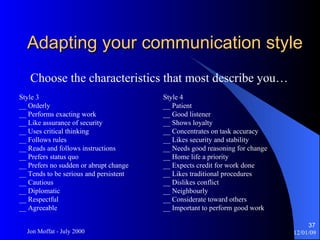
Adapting your communication style Choose the characteristics that most describe you… Style 3 __ Orderly __ Performs exacting work __ Like assurance of security __ Uses critical thinking __ Follows rules __ Reads and follows instructions __ Prefers status quo __ Prefers no sudden or abrupt change __ Tends to be serious and persistent __ Cautious __ Diplomatic __ Respectful __ Agreeable Style 4 __ Patient __ Good listener __ Shows loyalty __ Concentrates on task accuracy __ Likes security and stability __ Needs good reasoning for change __ Home life a priority __ Expects credit for work done __ Likes traditional procedures  __ Dislikes conflict __ Neighbourly __ Considerate toward others __ Important to perform good work
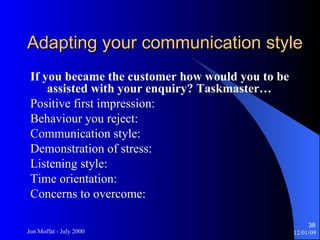
Adapting your communication style If you became the customer how would you to be assisted with your enquiry? Taskmaster… Positive first impression: Behaviour you reject: Communication style: Demonstration of stress: Listening style: Time orientation: Concerns to overcome:
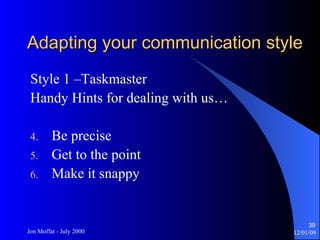
Adapting your communication style Style 1 –Taskmaster Handy Hints for dealing with us… Be precise Get to the point Make it snappy
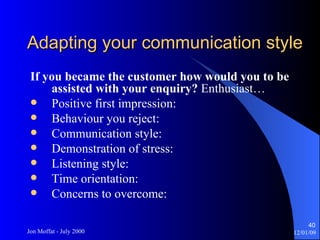
Adapting your communication style If you became the customer how would you to be assisted with your enquiry?  Enthusiast… Positive first impression: Behaviour you reject: Communication style: Demonstration of stress: Listening style: Time orientation: Concerns to overcome:
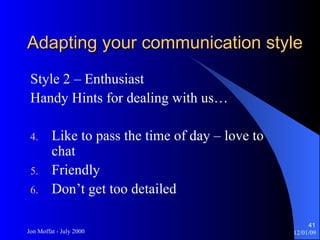
Adapting your communication style Style 2 – Enthusiast Handy Hints for dealing with us… Like to pass the time of day – love to chat Friendly Don’t get too detailed
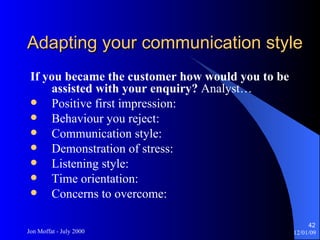
Adapting your communication style If you became the customer how would you to be assisted with your enquiry?  Analyst… Positive first impression: Behaviour you reject: Communication style: Demonstration of stress: Listening style: Time orientation: Concerns to overcome:
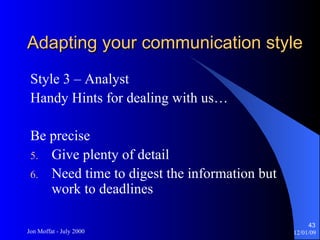
Adapting your communication style Style 3 – Analyst Handy Hints for dealing with us… Be precise Give plenty of detail Need time to digest the information but work to deadlines
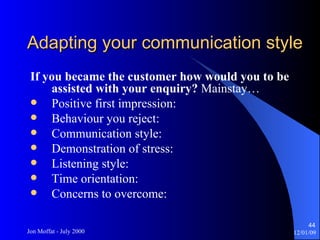
Adapting your communication style If you became the customer how would you to be assisted with your enquiry?  Mainstay… Positive first impression: Behaviour you reject: Communication style: Demonstration of stress: Listening style: Time orientation: Concerns to overcome:
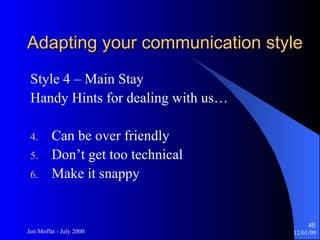
Adapting your communication style Style 4 – Main Stay Handy Hints for dealing with us… Can be over friendly Don’t get too technical Make it snappy
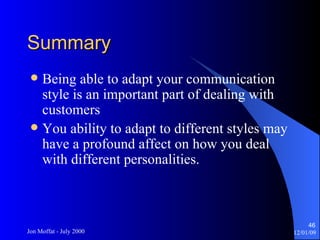
Summary Being able to adapt your communication style is an important part of dealing with customers You ability to adapt to different styles may have a profound affect on how you deal with different personalities.
Module 5 Complaints and Solutions
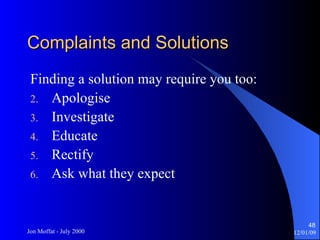
Complaints and Solutions Finding a solution may require you too: Apologise Investigate Educate Rectify Ask what they expect
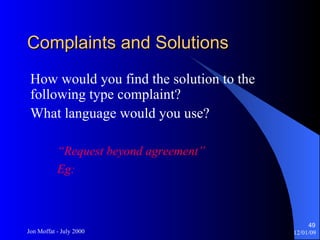
Complaints and Solutions How would you find the solution to the following type complaint? What language would you use? “ Request beyond agreement” Eg:
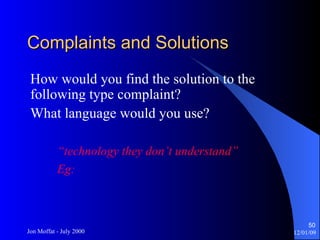
Complaints and Solutions How would you find the solution to the following type complaint? What language would you use? “ technology they don’t understand” Eg:
Complaints and Solutions How would you find the solution to the following type complaint? What language would you use? “ No body got back to me as promised” Eg:
Complaints and Solutions How would you find the solution to the following type complaint? What language would you use? “ The did not get the help or service they expected” Eg:
Complaints and Solutions Six steps of complaint management Listen carefully and give listening noises. “I see, I understand, etc” Acknowledge how they feel by showing the right amount of empathy. So not overdo the empathy thing…but do not ignore the emotion.
Complaints and Solutions Six steps of complaint management Let them know that you can help and clarify the situation Find a solution that rectifies the situation Do you investigate? Do you apologise again? Do you educate and correct misinformation? Do you ask what they expect?  Why? “How would you like this matter resolved?”
Complaints and Solutions Six steps of complaint management Repeat back to the customer what you will do and ask for agreement: “Does that clarify the situation? Does that meet your needs? Is that helpful to you?
Complaints and Solutions Six steps of complaint management. Thank the customer for the complaint. -  “Thank you for telling me about this so that we can rectify it for you.”
Summary
Module 6 Questioning Techniques
Questioning Techniques Types of questions Closed ended questions Often begin with have, has, are, did, would, could Used to direct and manage conversation Used to clarify or qualify Usually get a one word answer such as “yes” or “no”
Questioning Techniques Types of questions Open ended questions Often begin with who, what, when, why, how Used to encourage speaker to talk Used to gain information
Questioning Techniques Questions that will help ascertain the problem quickly? Open ended questions My ads are not serving My ads do not click through Reporting discrepancies
Summary
Module 7 Educating the Customer
Educating the agent Educate the customer in a concise manner. Explain the solution Explain where they can find out more information (support site) Offer training if necessary
Summary
Module 8 Controlling the Call/Event
Controlling the call Concentrate on the purpose of the call and focus on the needs of the customer. Let the agent know immediately what you are going to do for him/her. If you are loosing control of the call interject with the persons name and use a closed question to get the customer back on track and then direct the questions.
Controlling the call If you are loosing control of the call interject with the persons name and use a closed question to get the customer back on track and then direct the questions. Don’t voice encouragement to a customer that is rambling on.
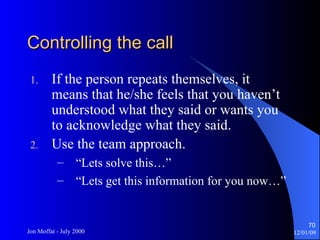
Controlling the call If the person repeats themselves, it means that he/she feels that you haven’t understood what they said or wants you to acknowledge what they said. Use the team approach. “Lets solve this…” “Lets get this information for you now…”
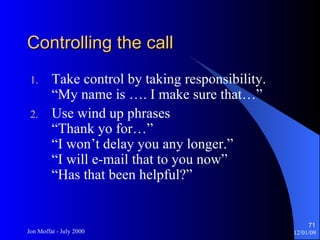
Controlling the call Take control by taking responsibility. “My name is …. I make sure that…” Use wind up phrases “Thank yo for…” “I won’t delay you any longer.” “I will e-mail that to you now” “Has that been helpful?”
Module 9 Developing a Winning Attitude
Developing a Winning Attitude  P - R - I - C - E -
Summary
Where to Get More Information Other training sessions List books, articles, electronic sources Consulting services, other sources

Developing Winning Attitiudes

  • 1.
  • 2.
    Developing a WinningAttitude To be able to succeed in today’s competitive landscape, a “Winning Attitude” is the most important ingredient.
  • 3.
    Developing a WinningAttitude Through this training, you will learn how to develop and enjoy the “Winning Attitudes” necessary for customer service communication success.
  • 4.
    Developing a WinningAttitude The training comprises of 9 modules We will work through one module at a time (1 per week) Some follow-up work may be required by you between sessions
  • 5.
    Agenda Customer focusActive listening Using positive language Adapt your communication style Complaints and solutions Questioning techniques Educating customers Controlling the event The FUN factor Winning attitudes
  • 6.
    Overview Youwill discover new ways to effectively help customers via e-mail or phone The key to a “Winning Attitude” Learn the benefits of listening techniques Learn how to provide exceptional customer service Learn how to effectively control each event Create a great first impression Learn the words and phrases that create positive effects Learn to love the challenge and satisfaction of asking the right questions and educating customers Learn to use the words and phrases that create positive results Discover the positive effects of focusing on your customer You will come to realise that you are the voice of DoubleClick
  • 7.
  • 8.
    Customer Focus Whydon’t customers return? What percentage of people would you guess would give one of the following reasons for not doing business with a company again? ___% Friends in business ___% Die ___% Perceived indifference ___% Dissatisfaction with product or service? ___% Competition ___% Move
  • 9.
    Customer Focus FOCUSmakes it easy… F O C U S
  • 10.
    Customer Focus It’sthe obvious that works… What three techniques would you use to develop trust? 1. 2. 3.
  • 11.
    Customer Focus It’sthe obvious that works… What three techniques would you use to develop an understanding the customers needs? 1. 2. 3.
  • 12.
    Customer Focus It’sthe obvious that works… What three techniques would you use to present a solution or solve the problem? 1. 2. 3.
  • 13.
    Customer Focus It’sthe obvious that works… What three techniques would you use to gain agreement or customer satisfaction? 1. 2. 3.
  • 14.
    Customer Focus Thefour “S” of an effective opening… Smile Speak up Slow down Speak clearly
  • 15.
    Customer Focus Tonesays it all… Greeting Questioning Educating/presenting information Gaining agreement Responding to an aggressive person Good-bye
  • 16.
    Customer Focus Usewords that motivate… Help Results Easy Save money Safe Prove New Guarantee Discover Time saver Results
  • 17.
    Customer Focus Usethe persons name… Shows your listening Shows you appreciate them
  • 18.
    Summary In thissession you learned about the importance of “Customer Focus” You can now apply what was learned when in contact with clients
  • 19.
    Module 2 ActiveListening
  • 20.
    Active Listening Whatare 10 reasons why listening will help you achieve results? 1. 2. 3. 4. 5. 6. 7. 8. 9. 10.
  • 21.
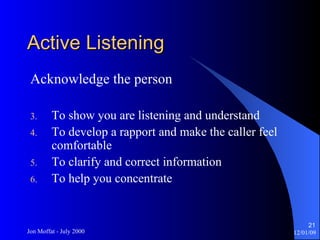
    Active Listening Acknowledgethe person To show you are listening and understand To develop a rapport and make the caller feel comfortable To clarify and correct information To help you concentrate
  • 22.
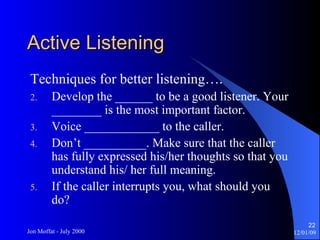
    Active Listening Techniquesfor better listening…. Develop the ______ to be a good listener. Your ________ is the most important factor. Voice ____________ to the caller. Don’t __________. Make sure that the caller has fully expressed his/her thoughts so that you understand his/ her full meaning. If the caller interrupts you, what should you do?
  • 23.
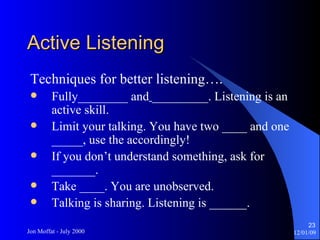
    Active Listening Techniquesfor better listening…. Fully________ and _________. Listening is an active skill. Limit your talking. You have two ____ and one _____, use the accordingly! If you don’t understand something, ask for _______. Take ____. You are unobserved. Talking is sharing. Listening is ______.
  • 24.
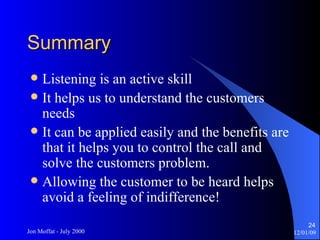
    Summary Listening isan active skill It helps us to understand the customers needs It can be applied easily and the benefits are that it helps you to control the call and solve the customers problem. Allowing the customer to be heard helps avoid a feeling of indifference!
  • 25.
    Module 3 UsingPositive Language
  • 26.
    Using Positive LanguageNegatives: Blame Past Can’t Try Criticism Dictate Positives Solution Present or future Can Will Praise / benefits Educate
  • 27.
    Using Positive LanguageAvoid combat come-ons… You didn’t do the right thing. You are wrong. DoubleClick policy is… You have to talk to… I don’t have authority too You are confusing me Unfortunately you should have What is your problem? No problem. I know how you feel
  • 28.
    Using Positive LanguageAvoid combat come-ons… You didn’t do the right thing. You are wrong. Try it this way it’s easy… DoubleClick policy is… What you can do is… What we can do is… You have to talk to… I recommend that you speak with ….they can help you with that
  • 29.
    Using Positive LanguageAvoid combat come-ons… I don’t have authority too Let me check the best way to do that and I will get back to you. You are confusing me Could you help me by rephrasing that? Let me check that I understand… Unfortunately you should have Lets do this… I recommend… You can…
  • 30.
    Using Positive LanguageAvoid combat come-ons… What is your problem? No problem. What can I do to help you? I know how you feel I understand… I appreciate…
  • 31.
    Using Positive LanguageAvoid combat come-ons… There is nothing I can do I will try to get that information for you There has been an error on that persons part The system is down Do you have any questions? Do you understand? Yes, but… No that’s not possible
  • 32.
    Using Positive LanguageAvoid combat come-ons… There is nothing I can do I can arrange for you to speak with… I will try to get that information for you I will source that information for you There has been an error on that persons part Let’s see what we can do to fix that
  • 33.
    Using Positive LanguageAvoid combat come-ons… Do you have any questions? Do you understand? Do you think that you can do that? Can I clarify this further with you? Yes, but… I will check to see how we can assist What we can do is… No that’s not possible What we can do is…
  • 34.
    Summary Listening isan active skill It helps us to understand the customers needs It can be applied easily and the benefits are that it helps you to control the call and solve the customers problem. Allowing the customer to be heard helps avoid a feeling of indifference!
  • 35.
    Module 4 AdaptingYour Communication Style
  • 36.
    Adapting your communicationstyle Choose the characteristics that most describe you… Style 1 __ Decisive __ Independent __ Tends to be dominant __ Strong willed __ Wants immediate results __ Cause action __ Likes power and authority __ Likes freedom from control __ Outspoken __ Wants direct answers __ Restless __ Competitive __ Adventurous __ Assertive Style 2 __ Optimistic __ Tends to be exciting/stimulating __ Generate enthusiasm __ Often dramatic __ Open and friendly __ Likes working with people __ Desires to help people __ Like participating in groups __ Wants freedom of expression __ Wants freedom from detail __ Like change, spontaneity __ Persuasive __ Appears confident __ Likes recognition
  • 37.
    Adapting your communicationstyle Choose the characteristics that most describe you… Style 3 __ Orderly __ Performs exacting work __ Like assurance of security __ Uses critical thinking __ Follows rules __ Reads and follows instructions __ Prefers status quo __ Prefers no sudden or abrupt change __ Tends to be serious and persistent __ Cautious __ Diplomatic __ Respectful __ Agreeable Style 4 __ Patient __ Good listener __ Shows loyalty __ Concentrates on task accuracy __ Likes security and stability __ Needs good reasoning for change __ Home life a priority __ Expects credit for work done __ Likes traditional procedures __ Dislikes conflict __ Neighbourly __ Considerate toward others __ Important to perform good work
  • 38.
    Adapting your communicationstyle If you became the customer how would you to be assisted with your enquiry? Taskmaster… Positive first impression: Behaviour you reject: Communication style: Demonstration of stress: Listening style: Time orientation: Concerns to overcome:
  • 39.
    Adapting your communicationstyle Style 1 –Taskmaster Handy Hints for dealing with us… Be precise Get to the point Make it snappy
  • 40.
    Adapting your communicationstyle If you became the customer how would you to be assisted with your enquiry? Enthusiast… Positive first impression: Behaviour you reject: Communication style: Demonstration of stress: Listening style: Time orientation: Concerns to overcome:
  • 41.
    Adapting your communicationstyle Style 2 – Enthusiast Handy Hints for dealing with us… Like to pass the time of day – love to chat Friendly Don’t get too detailed
  • 42.
    Adapting your communicationstyle If you became the customer how would you to be assisted with your enquiry? Analyst… Positive first impression: Behaviour you reject: Communication style: Demonstration of stress: Listening style: Time orientation: Concerns to overcome:
  • 43.
    Adapting your communicationstyle Style 3 – Analyst Handy Hints for dealing with us… Be precise Give plenty of detail Need time to digest the information but work to deadlines
  • 44.
    Adapting your communicationstyle If you became the customer how would you to be assisted with your enquiry? Mainstay… Positive first impression: Behaviour you reject: Communication style: Demonstration of stress: Listening style: Time orientation: Concerns to overcome:
  • 45.
    Adapting your communicationstyle Style 4 – Main Stay Handy Hints for dealing with us… Can be over friendly Don’t get too technical Make it snappy
  • 46.
    Summary Being ableto adapt your communication style is an important part of dealing with customers You ability to adapt to different styles may have a profound affect on how you deal with different personalities.
  • 47.
    Module 5 Complaintsand Solutions
  • 48.
    Complaints and SolutionsFinding a solution may require you too: Apologise Investigate Educate Rectify Ask what they expect
  • 49.
    Complaints and SolutionsHow would you find the solution to the following type complaint? What language would you use? “ Request beyond agreement” Eg:
  • 50.
    Complaints and SolutionsHow would you find the solution to the following type complaint? What language would you use? “ technology they don’t understand” Eg:
  • 51.
    Complaints and SolutionsHow would you find the solution to the following type complaint? What language would you use? “ No body got back to me as promised” Eg:
  • 52.
    Complaints and SolutionsHow would you find the solution to the following type complaint? What language would you use? “ The did not get the help or service they expected” Eg:
  • 53.
    Complaints and SolutionsSix steps of complaint management Listen carefully and give listening noises. “I see, I understand, etc” Acknowledge how they feel by showing the right amount of empathy. So not overdo the empathy thing…but do not ignore the emotion.
  • 54.
    Complaints and SolutionsSix steps of complaint management Let them know that you can help and clarify the situation Find a solution that rectifies the situation Do you investigate? Do you apologise again? Do you educate and correct misinformation? Do you ask what they expect? Why? “How would you like this matter resolved?”
  • 55.
    Complaints and SolutionsSix steps of complaint management Repeat back to the customer what you will do and ask for agreement: “Does that clarify the situation? Does that meet your needs? Is that helpful to you?
  • 56.
    Complaints and SolutionsSix steps of complaint management. Thank the customer for the complaint. - “Thank you for telling me about this so that we can rectify it for you.”
  • 57.
  • 58.
  • 59.
    Questioning Techniques Typesof questions Closed ended questions Often begin with have, has, are, did, would, could Used to direct and manage conversation Used to clarify or qualify Usually get a one word answer such as “yes” or “no”
  • 60.
    Questioning Techniques Typesof questions Open ended questions Often begin with who, what, when, why, how Used to encourage speaker to talk Used to gain information
  • 61.
    Questioning Techniques Questionsthat will help ascertain the problem quickly? Open ended questions My ads are not serving My ads do not click through Reporting discrepancies
  • 62.
    Questioning Techniques Questionsthat will help ascertain the problem quickly? Open ended questions My ads are not serving My ads do not click through Reporting discrepancies
  • 63.
  • 64.
    Module 7 Educatingthe Customer
  • 65.
    Educating the agentEducate the customer in a concise manner. Explain the solution Explain where they can find out more information (support site) Offer training if necessary
  • 66.
  • 67.
    Module 8 Controllingthe Call/Event
  • 68.
    Controlling the callConcentrate on the purpose of the call and focus on the needs of the customer. Let the agent know immediately what you are going to do for him/her. If you are loosing control of the call interject with the persons name and use a closed question to get the customer back on track and then direct the questions.
  • 69.
    Controlling the callIf you are loosing control of the call interject with the persons name and use a closed question to get the customer back on track and then direct the questions. Don’t voice encouragement to a customer that is rambling on.
  • 70.
    Controlling the callIf the person repeats themselves, it means that he/she feels that you haven’t understood what they said or wants you to acknowledge what they said. Use the team approach. “Lets solve this…” “Lets get this information for you now…”
  • 71.
    Controlling the callTake control by taking responsibility. “My name is …. I make sure that…” Use wind up phrases “Thank yo for…” “I won’t delay you any longer.” “I will e-mail that to you now” “Has that been helpful?”
  • 72.
    Module 9 Developinga Winning Attitude
  • 73.
    Developing a WinningAttitude P - R - I - C - E -
  • 74.
  • 75.
    Where to GetMore Information Other training sessions List books, articles, electronic sources Consulting services, other sources