

Communication
Speaking with Purpose
Why we are here…
Write down your answers to the following questions:
• What are the top 3 reasons you come to work each day?
• What motivates you to want to be in leadership?
• Write down the name of a co-worker you enjoy working with:
    – Describe them in 3 words
    – If you had to guess, how would you think they’d describe you?
• Write down the name of a co-worker present/past that you didn’t like
   working with:
    – How did they make you feel?
• Write down the name of the worst boss you ever had
    – Name 3 reasons they were bad bosses
Rank Yourself
• Exceptional : you can motivate, inspire and convince people to do just
  about anything you want them to by using superior listening and
  communicating skills. You jump off the bridge and they are coming with
  you.
• Exceeds: you know how to “business speak” and you can motivate people
  but you still struggle sometimes with speaking to authorative figures as
  articulatly as you’d want to.
• Meets: you are professional and people like you. You have average writing
  skills.
• Development Needed: you don’t always know what to say. You struggle
  with public speaking, motivating and/or language barriers
Communication Opportunities
1). Your boss keeps going directly to your employees and making deals
and/or changing policies without telling you

2). Your boss decides to fire a top performer of yours who transferred a
non-qualified call. You know that it was an innocent mistake and that the
CSR should not be let go

3). Your peer keeps disagreeing with everything you suggest in meetings.
They do this in front of employees, peers, clients and Sr. Leadership

4). Your employee rolls their eyes everytime you speak

5). You feel like you should have received credit for a suggestion that your
boss took and delivered as their own
Speaking with Purpose
Know Your Place, and their’s too
There is a difference between standing out as an ambitious go getter and
appearing cocky or insubordinate.

Know your roll. There is nothing more desirable than an rock star who doesn’t
know they are a rock star.

The most important part of knowing your place is knowing what you can and
can’t make blunt decisions on.
“You need to take this seriously. This can cost us millions”
• “If you don’t give me this raise, I’m going to walk and take people with
   me”
• “I’ll just tell the owner if you don’t do this”
First Impressions
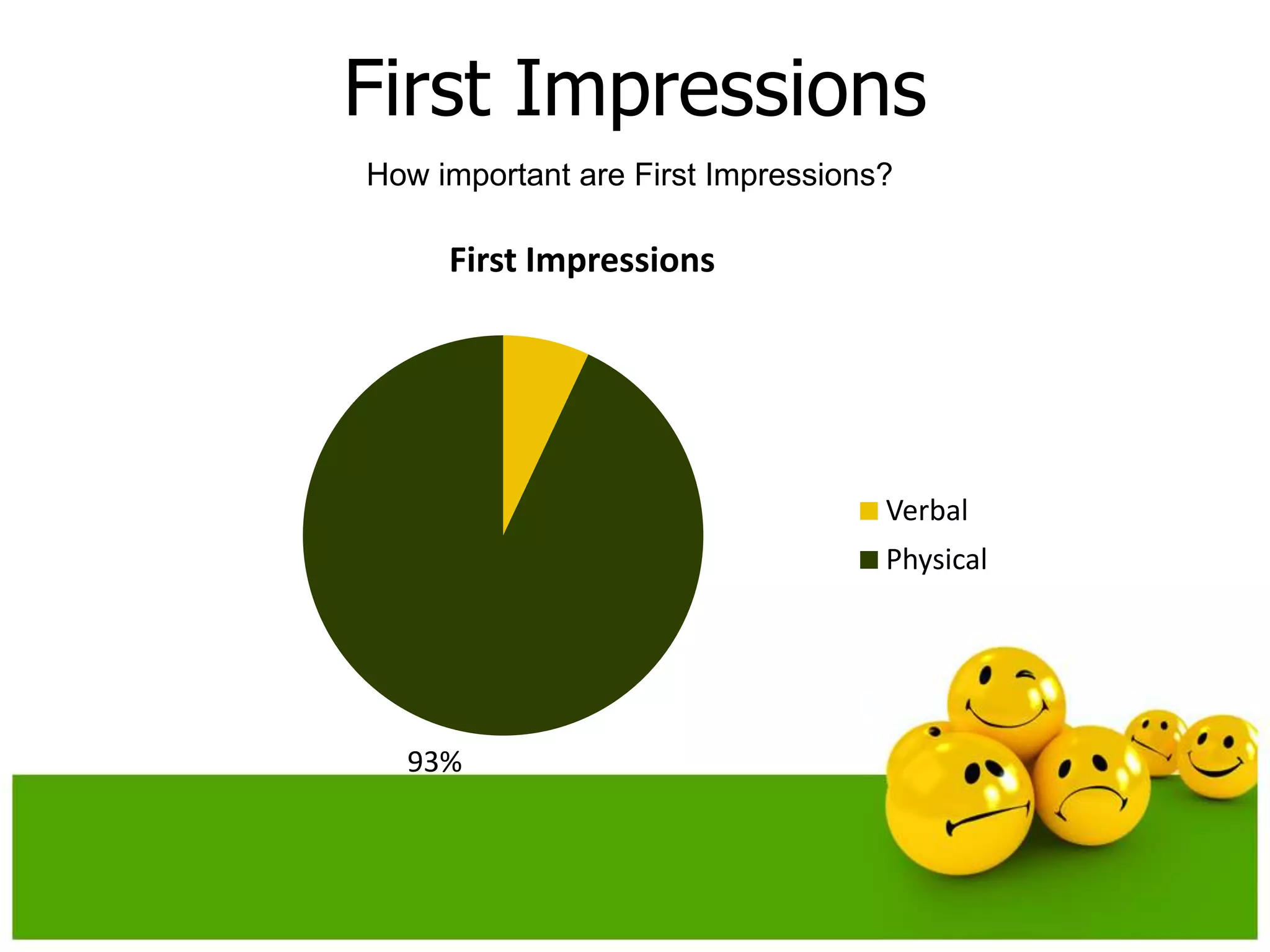
How important are First Impressions?

     First Impressions


                                   Verbal
                                   Physical


  93%
First Impressions
• Watch what you wear. First impressions are formed within 7 to 17
  seconds of meeting someone and 55% of a person’s opinion is driven by
  physical appearance. Dress conservatively when meeting for the first
  time, even if you’re in a “creative” office environment.
• Edit your body language. 93% of our judgment of others is based on non-
  verbal input. Watch your posture when standing and sitting. Use a firm
  hand shake. Maintain eye contact. Sitting too casually says you don’t care.
  Crossing your arms says you’re bored. Every so often, check how you’re
  positioned–and make necessary adjustments.rfumes, hair styles and shoes
  that call attention to themselves.
First Impressions
• Watch what you say. Words also make powerful first impressions–in
  fact, 7% of what we think of people is based on what they say. Before your
  first meeting, decide how you want to come across–
  confident, optimistic, innovative. Then list the words that convey these
  traits and keep them at the ready to use in conversation.
• Use the other person’s name. A study of personalized marketing showed
  that addressing prospects by name increased response 36%! Use the other
  person’s name as soon as you learn it and repeat it throughout
  the conversation. Afterwards, write them a note mentioning everyone you
  met by name. Getting people’s names right makes them want to connect
  with you.
First Impressions
• Use an appealing tone of voice. 38% of a person’s first impression is
  determined by your tone of voice. Getting the right tone of voice isn’t
  easy–you may want to be confident but not brash, enthusiastic but still
  relaxed, focused but not obsessed. Listen to yours and others’ tone of
  voice and practice speaking in a tone that reflects how you want to be
  regarded.
• Be on time. The way to never be late is to always plan on being 15 minutes
  early. You’ll need that 15 minutes if you get lost or stuck in traffic. And
  when you do get there early, you can use the extra time to collect your
  thoughts about what you’re going to do to make that lasting first
  impression.
• Bring printed materials. If it’s appropriate, have on hand printed copies of
  resumes, proposals, statistics, case studies and business cards.
First Impressions
• Put the focus on THEM. You’ll come off as self-centered if you talk too
  much about yourself. Before you meet, write down all the things you want
  to know about the other person–their goals, needs, where they’re at now.
  You don’t have to go deep the first meeting; just show interest in making a
  connection.
• Listen well. Time and again, studies show listening is one of the top skills
  needed for business success. On average, people only retain 50% of what
  they hear. Focus on doing better than that. Listening well makes it easy to
  keep the conversation going. Comment on what the other person says.
  Ask follow up questions.
First Impressions
•   Research them. Find out as much as you can about the person you want to
    impress before you meet them. If you can ask intelligent questions, it shows you
    have some understanding about their situation and makes a very positive first
    impression. Check out social media to find mutual interests or friends that will
    spark instant chemistry.
•   Watch the jokes. People’s response to humor varies, so skip anything
    controversial or sarcastic. Save the jokes for later when you know the person’s
    sensitivities.
•   Relax! Be at ease and be yourself. Let the other person know the real you, a
    person far more appealing than someone who’s stressed out trying to make a
    great first impression. Before your meeting, do something you like–listen to music,
    go to the gym. Give yourself a pep talk or call a friend for support. And if
    something trips you up in the meeting, don’t panic. Just pause, take a breath and
    continue. Never assume you’re blowing it–you really don’t know what the other
    person is thinking!
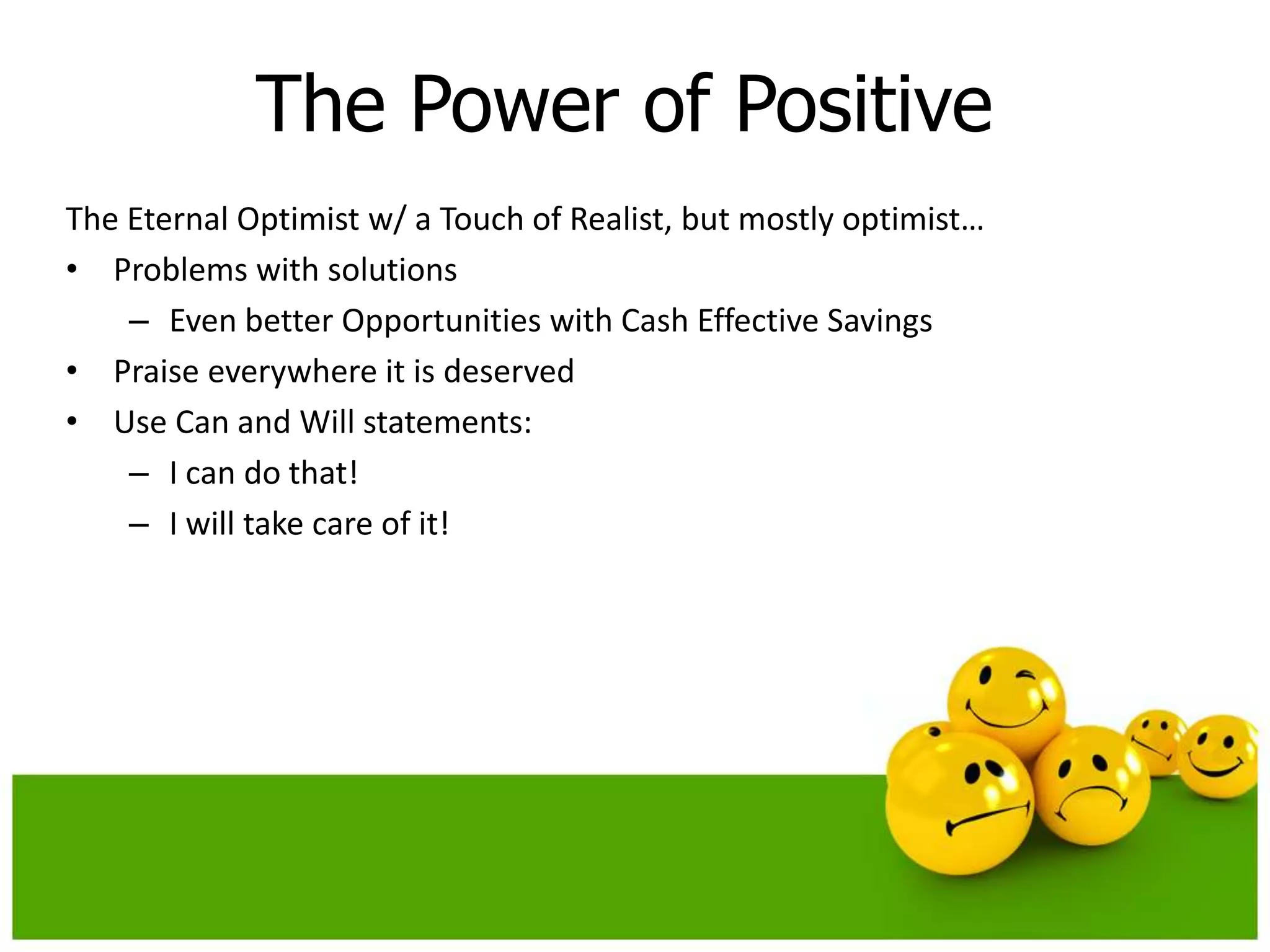
The Power of Positive
The Eternal Optimist w/ a Touch of Realist, but mostly optimist…
• Problems with solutions
    – Even better Opportunities with Cash Effective Savings
• Praise everywhere it is deserved
• Use Can and Will statements:
    – I can do that!
    – I will take care of it!
REALITY
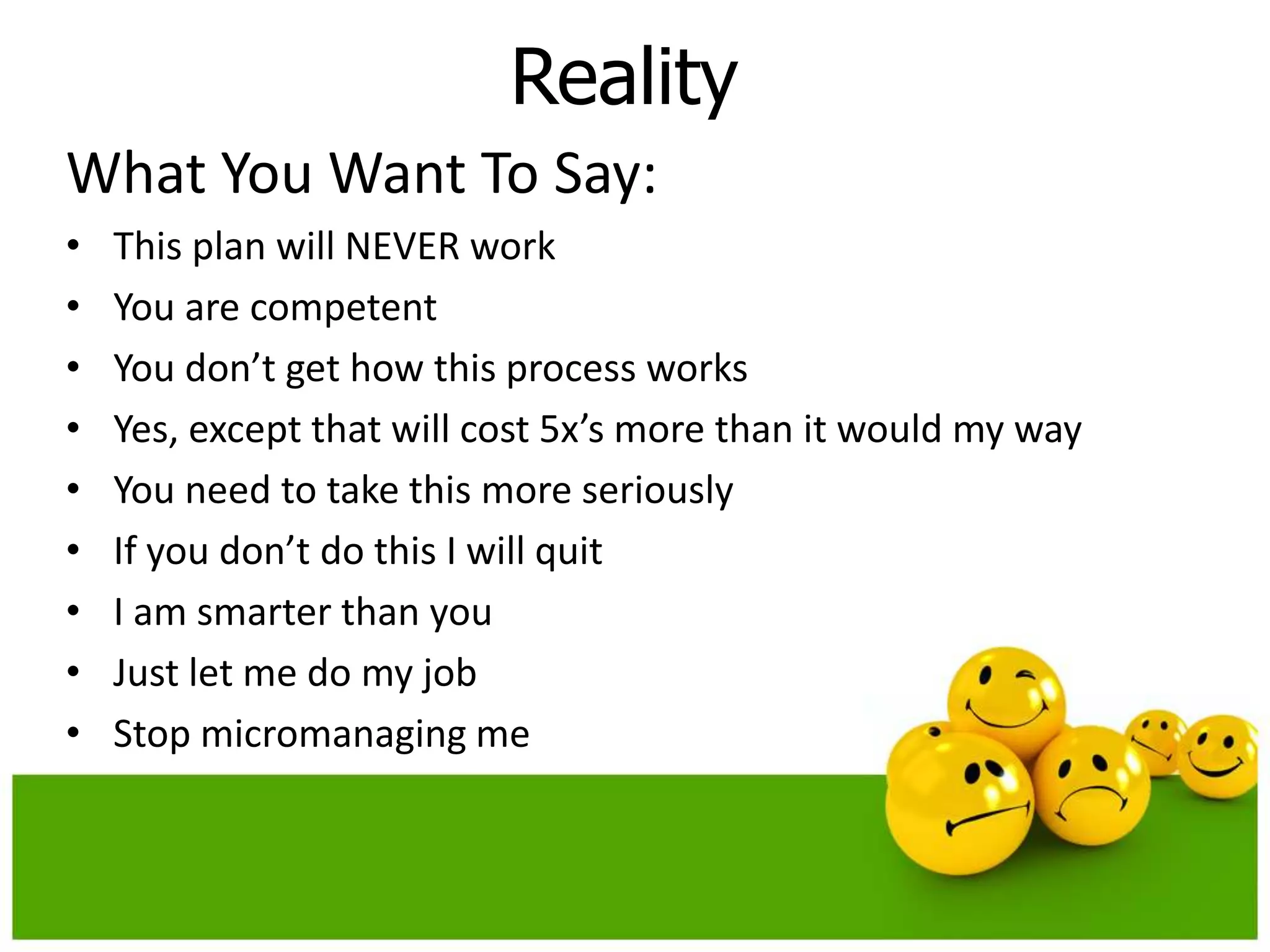
Reality
What You Want To Say:
•   This plan will NEVER work
•   You are competent
•   You don’t get how this process works
•   Yes, except that will cost 5x’s more than it would my way
•   You need to take this more seriously
•   If you don’t do this I will quit
•   I am smarter than you
•   Just let me do my job
•   Stop micromanaging me
How to Take Reality into Your
        Own Hands
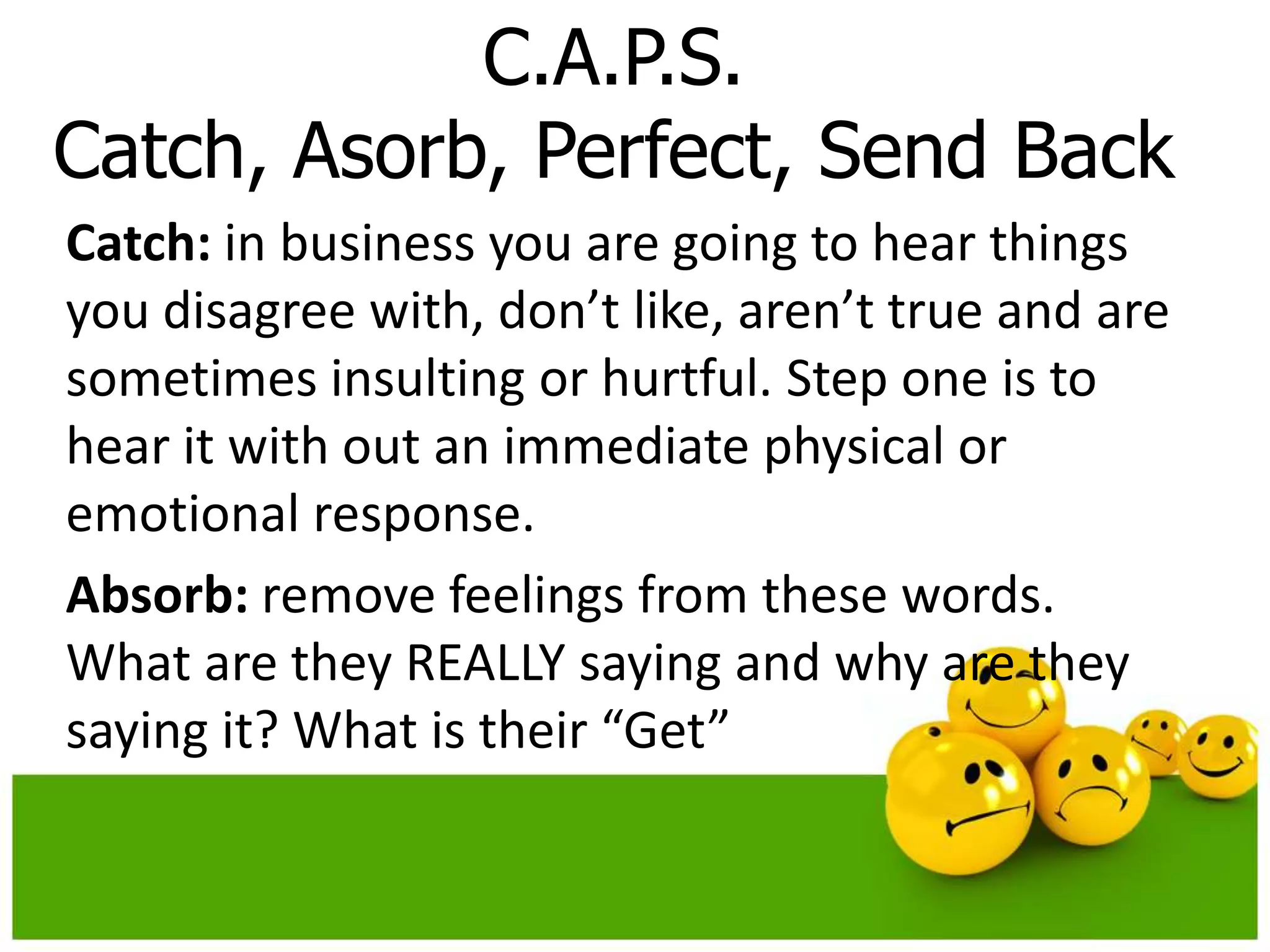
C.A.P.S.
Catch, Asorb, Perfect, Send Back
Catch: in business you are going to hear things
you disagree with, don’t like, aren’t true and are
sometimes insulting or hurtful. Step one is to
hear it with out an immediate physical or
emotional response.
Absorb: remove feelings from these words.
What are they REALLY saying and why are they
saying it? What is their “Get”
C.A.P.S.
Catch, Asorb, Perfect, Send Back
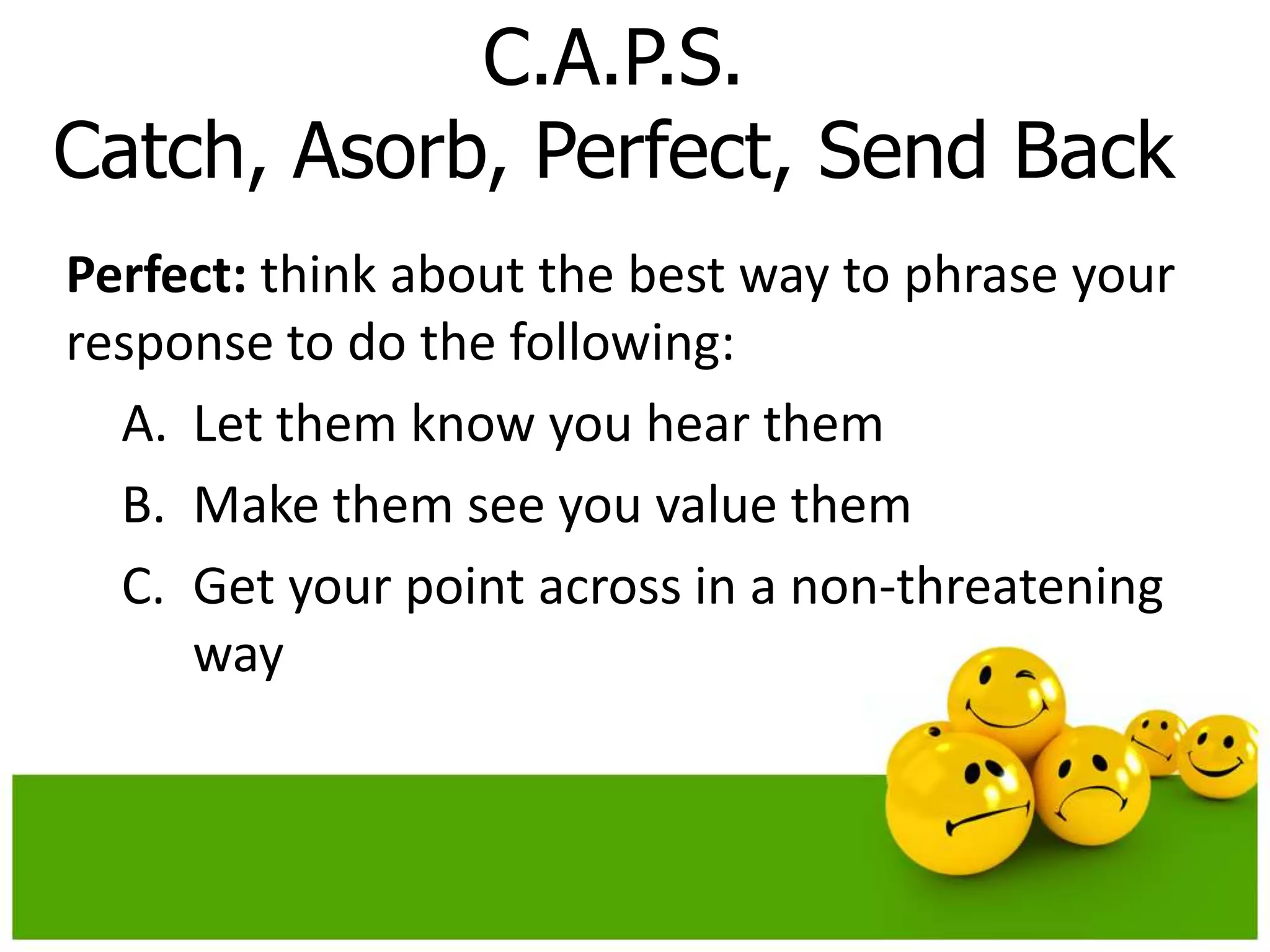
Perfect: think about the best way to phrase your
response to do the following:
  A. Let them know you hear them
  B. Make them see you value them
  C. Get your point across in a non-threatening
     way
C.A.P.S.
Catch, Asorb, Perfect, Send Back
Send Back: respond back with professionalism,
empathy, understanding and everything they
weren’t expecting.
Get Buy Ins
Sales 101, Get them to say yes!:
• I am sure we can both agree that….
• You had mentioned once that…
• You had a really good idea once about….
• Remember that really awesome _____ you did? This is kind of a play off of
  that
• You are such an ethical person and I love your vision for this project, do
  you think this falls inline with our company’s business direction?
Let’s See it Work

Reality: This plan will NEVER work
Catch: I see where you are coming from. Or “Got
it” or “Makes Sense” or “I hear you”
Absorb: Terrible plan but they put thought and
effort into it and want to fix a problem.
Perfect: My plan is way better. Let’s merge the
start of theirs with the better plan
Let’s See it Work

Send Back: I really like how you added the
customer retention factor to the program. I
think that mixed with a base increase and
recogntion plan would save the company a lot of
money. I would love to work with you on a
formal proposal.
Verbiage
Use this, not that:
• “clearly you don’t”
   – I can see how it might look like that. On the other hand I’m sure you
       can see how…
• “That is unacceptable”
   – I am sure we can both agree that this isn’t the most effective way to..
• “There is no way that will work”
   – I can see the benefits of that. The only question I have is how will that
       affect _____________?
• “I can’t do that”
   – I can do that. All I need is a little direction how to….
Reality
What You Want To Say:
•   You are incompetent
•   You don’t get how this process works
•   Yes, except that will cost 5x’s more than it would my way
•   You need to take this more seriously
•   If you don’t do this I will quit
•   I am smarter than you
•   Just let me do my job
•   Stop micromanaging me
•   I am right and you are wrong
Communication w/Direct Reports
•   Employees should feel like you are approachable and competent
•   Remember, your opinion and words are very important to employees
•   Be sensitive
•   Praise in Public, Punish in Private

Use CAPS here even more sensitively.
1. Sensitive Top Performer keeps wandering from their desk
2. Top performer is in 1st place but won’t stop playing online
3. Low performer is recruiting employees out
4. Average performer isn’t trying hard
5. Top Performer has an attendance issue
6. Low performer receives an autofail
Communication w/Peers
• Peers need to know that you are an advocate for them
• Building competence and leading or inspiring them is an added perk
• Remember peers won’t always be peers

Example:
• Peer isn’t holding their share of the daily reporting up that you need to do
   your job
• Peer is talking negatively about Sr. Management to you and their
   employees
• Peer is talking trying to find out from you how much you are paid
Communication w/Manager
Here’s the truth. You aren’t going to like it. But it’s the truth. Your boss is
never wrong. “WHAT?” NEVER?

Well, they are never wrong in their mind. Whose job is it to tell them they are
wrong?

YOURS!!!!

Use C.A.P.S. to phrase your ideas while validating theirs
Communication w/Sr. Management
• Sr. Level Managers have the least amount of emotional intelligence. They
  are busy and want quick and concise feedback.
• Let them catch you doing things right.
• Be positive, honest, humble and effective (CAPS)
• Be extra careful to speak with presence
• Think about making an impression
   – Mr. Smith, so great seeing you again. I just had a quick question, I see
       we are up 40% this month in productivity after the new product
       launch where do you see us in the next 90 days?
Written Communications
What are some challenges with written communications?

• You can’t tell people’s tone
• Different types of writing styles mean different THINGS TO DIFFERENT
  PEOPLE
• Reponse times vary “Why are they ignoring me?”

Because of this is it is extra important that you add additional positive
verbiage and that you NEVER angry send an email!!!
DON’T DO IT!
Items to avoid with communication:
1) Entitlement: I have been here longer than her… I deserved that award
2) Argumentative: know one should ever know you disagreed
3) Arrogance: I’m the only one here that can actually close a deal
4) Silence: I have nothing nice to say so I’m not saying anything at all
Motivate, Influence but don’t
             Manipulate
Remember there is a difference between rephrashing your words and
manipulating people.

Inspiring is searching for good in everything, recognizing it and redirecting to
a solution you believe is more effective.

Communication

  • 1.
  • 2.
    Why we arehere… Write down your answers to the following questions: • What are the top 3 reasons you come to work each day? • What motivates you to want to be in leadership? • Write down the name of a co-worker you enjoy working with: – Describe them in 3 words – If you had to guess, how would you think they’d describe you? • Write down the name of a co-worker present/past that you didn’t like working with: – How did they make you feel? • Write down the name of the worst boss you ever had – Name 3 reasons they were bad bosses
  • 3.
    Rank Yourself • Exceptional: you can motivate, inspire and convince people to do just about anything you want them to by using superior listening and communicating skills. You jump off the bridge and they are coming with you. • Exceeds: you know how to “business speak” and you can motivate people but you still struggle sometimes with speaking to authorative figures as articulatly as you’d want to. • Meets: you are professional and people like you. You have average writing skills. • Development Needed: you don’t always know what to say. You struggle with public speaking, motivating and/or language barriers
  • 4.
    Communication Opportunities 1). Yourboss keeps going directly to your employees and making deals and/or changing policies without telling you 2). Your boss decides to fire a top performer of yours who transferred a non-qualified call. You know that it was an innocent mistake and that the CSR should not be let go 3). Your peer keeps disagreeing with everything you suggest in meetings. They do this in front of employees, peers, clients and Sr. Leadership 4). Your employee rolls their eyes everytime you speak 5). You feel like you should have received credit for a suggestion that your boss took and delivered as their own
  • 5.
  • 6.
    Know Your Place,and their’s too There is a difference between standing out as an ambitious go getter and appearing cocky or insubordinate. Know your roll. There is nothing more desirable than an rock star who doesn’t know they are a rock star. The most important part of knowing your place is knowing what you can and can’t make blunt decisions on. “You need to take this seriously. This can cost us millions” • “If you don’t give me this raise, I’m going to walk and take people with me” • “I’ll just tell the owner if you don’t do this”
  • 7.
    First Impressions How importantare First Impressions? First Impressions Verbal Physical 93%
  • 8.
    First Impressions • Watchwhat you wear. First impressions are formed within 7 to 17 seconds of meeting someone and 55% of a person’s opinion is driven by physical appearance. Dress conservatively when meeting for the first time, even if you’re in a “creative” office environment. • Edit your body language. 93% of our judgment of others is based on non- verbal input. Watch your posture when standing and sitting. Use a firm hand shake. Maintain eye contact. Sitting too casually says you don’t care. Crossing your arms says you’re bored. Every so often, check how you’re positioned–and make necessary adjustments.rfumes, hair styles and shoes that call attention to themselves.
  • 9.
    First Impressions • Watchwhat you say. Words also make powerful first impressions–in fact, 7% of what we think of people is based on what they say. Before your first meeting, decide how you want to come across– confident, optimistic, innovative. Then list the words that convey these traits and keep them at the ready to use in conversation. • Use the other person’s name. A study of personalized marketing showed that addressing prospects by name increased response 36%! Use the other person’s name as soon as you learn it and repeat it throughout the conversation. Afterwards, write them a note mentioning everyone you met by name. Getting people’s names right makes them want to connect with you.
  • 10.
    First Impressions • Usean appealing tone of voice. 38% of a person’s first impression is determined by your tone of voice. Getting the right tone of voice isn’t easy–you may want to be confident but not brash, enthusiastic but still relaxed, focused but not obsessed. Listen to yours and others’ tone of voice and practice speaking in a tone that reflects how you want to be regarded. • Be on time. The way to never be late is to always plan on being 15 minutes early. You’ll need that 15 minutes if you get lost or stuck in traffic. And when you do get there early, you can use the extra time to collect your thoughts about what you’re going to do to make that lasting first impression. • Bring printed materials. If it’s appropriate, have on hand printed copies of resumes, proposals, statistics, case studies and business cards.
  • 11.
    First Impressions • Putthe focus on THEM. You’ll come off as self-centered if you talk too much about yourself. Before you meet, write down all the things you want to know about the other person–their goals, needs, where they’re at now. You don’t have to go deep the first meeting; just show interest in making a connection. • Listen well. Time and again, studies show listening is one of the top skills needed for business success. On average, people only retain 50% of what they hear. Focus on doing better than that. Listening well makes it easy to keep the conversation going. Comment on what the other person says. Ask follow up questions.
  • 12.
    First Impressions • Research them. Find out as much as you can about the person you want to impress before you meet them. If you can ask intelligent questions, it shows you have some understanding about their situation and makes a very positive first impression. Check out social media to find mutual interests or friends that will spark instant chemistry. • Watch the jokes. People’s response to humor varies, so skip anything controversial or sarcastic. Save the jokes for later when you know the person’s sensitivities. • Relax! Be at ease and be yourself. Let the other person know the real you, a person far more appealing than someone who’s stressed out trying to make a great first impression. Before your meeting, do something you like–listen to music, go to the gym. Give yourself a pep talk or call a friend for support. And if something trips you up in the meeting, don’t panic. Just pause, take a breath and continue. Never assume you’re blowing it–you really don’t know what the other person is thinking!
  • 13.
    The Power ofPositive The Eternal Optimist w/ a Touch of Realist, but mostly optimist… • Problems with solutions – Even better Opportunities with Cash Effective Savings • Praise everywhere it is deserved • Use Can and Will statements: – I can do that! – I will take care of it!
  • 14.
  • 15.
    Reality What You WantTo Say: • This plan will NEVER work • You are competent • You don’t get how this process works • Yes, except that will cost 5x’s more than it would my way • You need to take this more seriously • If you don’t do this I will quit • I am smarter than you • Just let me do my job • Stop micromanaging me
  • 16.
    How to TakeReality into Your Own Hands
  • 17.
    C.A.P.S. Catch, Asorb, Perfect,Send Back Catch: in business you are going to hear things you disagree with, don’t like, aren’t true and are sometimes insulting or hurtful. Step one is to hear it with out an immediate physical or emotional response. Absorb: remove feelings from these words. What are they REALLY saying and why are they saying it? What is their “Get”
  • 18.
    C.A.P.S. Catch, Asorb, Perfect,Send Back Perfect: think about the best way to phrase your response to do the following: A. Let them know you hear them B. Make them see you value them C. Get your point across in a non-threatening way
  • 19.
    C.A.P.S. Catch, Asorb, Perfect,Send Back Send Back: respond back with professionalism, empathy, understanding and everything they weren’t expecting.
  • 20.
    Get Buy Ins Sales101, Get them to say yes!: • I am sure we can both agree that…. • You had mentioned once that… • You had a really good idea once about…. • Remember that really awesome _____ you did? This is kind of a play off of that • You are such an ethical person and I love your vision for this project, do you think this falls inline with our company’s business direction?
  • 21.
    Let’s See itWork Reality: This plan will NEVER work Catch: I see where you are coming from. Or “Got it” or “Makes Sense” or “I hear you” Absorb: Terrible plan but they put thought and effort into it and want to fix a problem. Perfect: My plan is way better. Let’s merge the start of theirs with the better plan
  • 22.
    Let’s See itWork Send Back: I really like how you added the customer retention factor to the program. I think that mixed with a base increase and recogntion plan would save the company a lot of money. I would love to work with you on a formal proposal.
  • 23.
    Verbiage Use this, notthat: • “clearly you don’t” – I can see how it might look like that. On the other hand I’m sure you can see how… • “That is unacceptable” – I am sure we can both agree that this isn’t the most effective way to.. • “There is no way that will work” – I can see the benefits of that. The only question I have is how will that affect _____________? • “I can’t do that” – I can do that. All I need is a little direction how to….
  • 24.
    Reality What You WantTo Say: • You are incompetent • You don’t get how this process works • Yes, except that will cost 5x’s more than it would my way • You need to take this more seriously • If you don’t do this I will quit • I am smarter than you • Just let me do my job • Stop micromanaging me • I am right and you are wrong
  • 25.
    Communication w/Direct Reports • Employees should feel like you are approachable and competent • Remember, your opinion and words are very important to employees • Be sensitive • Praise in Public, Punish in Private Use CAPS here even more sensitively. 1. Sensitive Top Performer keeps wandering from their desk 2. Top performer is in 1st place but won’t stop playing online 3. Low performer is recruiting employees out 4. Average performer isn’t trying hard 5. Top Performer has an attendance issue 6. Low performer receives an autofail
  • 26.
    Communication w/Peers • Peersneed to know that you are an advocate for them • Building competence and leading or inspiring them is an added perk • Remember peers won’t always be peers Example: • Peer isn’t holding their share of the daily reporting up that you need to do your job • Peer is talking negatively about Sr. Management to you and their employees • Peer is talking trying to find out from you how much you are paid
  • 27.
    Communication w/Manager Here’s thetruth. You aren’t going to like it. But it’s the truth. Your boss is never wrong. “WHAT?” NEVER? Well, they are never wrong in their mind. Whose job is it to tell them they are wrong? YOURS!!!! Use C.A.P.S. to phrase your ideas while validating theirs
  • 28.
    Communication w/Sr. Management •Sr. Level Managers have the least amount of emotional intelligence. They are busy and want quick and concise feedback. • Let them catch you doing things right. • Be positive, honest, humble and effective (CAPS) • Be extra careful to speak with presence • Think about making an impression – Mr. Smith, so great seeing you again. I just had a quick question, I see we are up 40% this month in productivity after the new product launch where do you see us in the next 90 days?
  • 29.
    Written Communications What aresome challenges with written communications? • You can’t tell people’s tone • Different types of writing styles mean different THINGS TO DIFFERENT PEOPLE • Reponse times vary “Why are they ignoring me?” Because of this is it is extra important that you add additional positive verbiage and that you NEVER angry send an email!!!
  • 30.
    DON’T DO IT! Itemsto avoid with communication: 1) Entitlement: I have been here longer than her… I deserved that award 2) Argumentative: know one should ever know you disagreed 3) Arrogance: I’m the only one here that can actually close a deal 4) Silence: I have nothing nice to say so I’m not saying anything at all
  • 31.
    Motivate, Influence butdon’t Manipulate Remember there is a difference between rephrashing your words and manipulating people. Inspiring is searching for good in everything, recognizing it and redirecting to a solution you believe is more effective.