Building Trust Despite
Digital Personal Devices
Javier González - jgon@itu.dk
Philippe Bonnet - phbo@itu.dk
by
Javier González
OpenIT - 07.03.2014
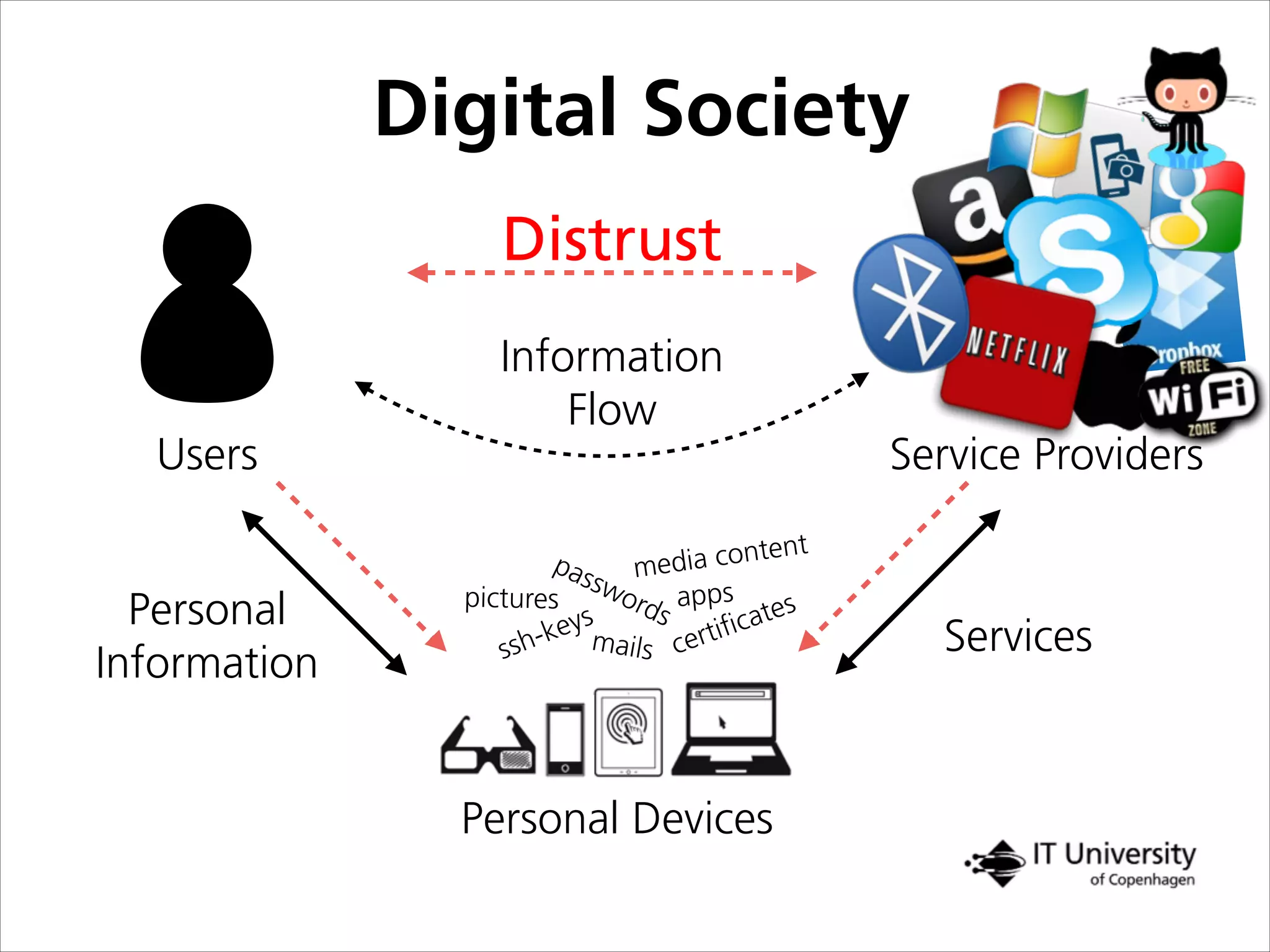
Users Service Providers
Personal Devices
Personal
Information
Services
!
Information
Flow
Distrust
Digital Society
mails
passwords
ssh-keys
media content
certificatespictures apps
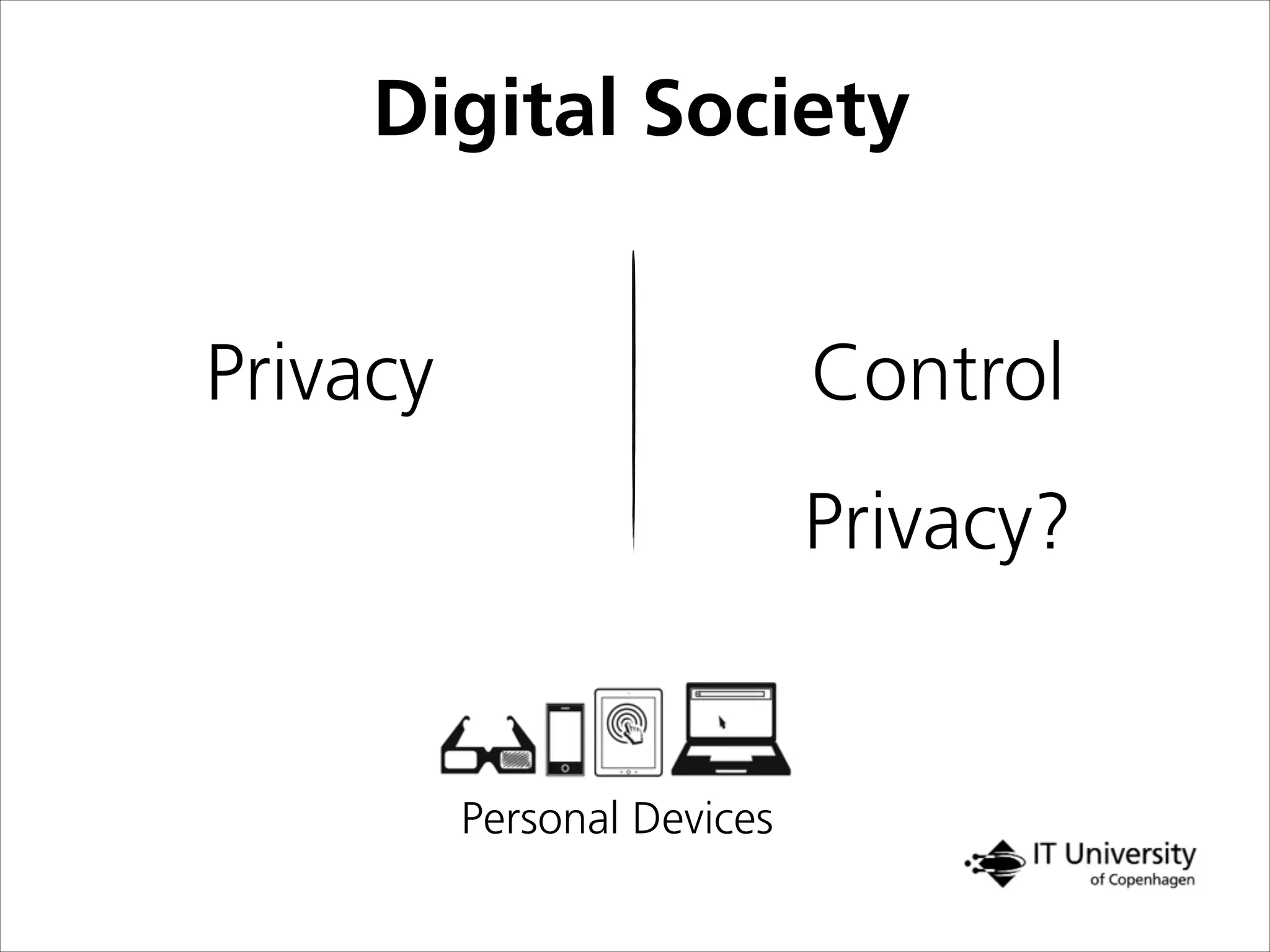
Digital Society
Privacy Control
Personal Devices
Privacy?
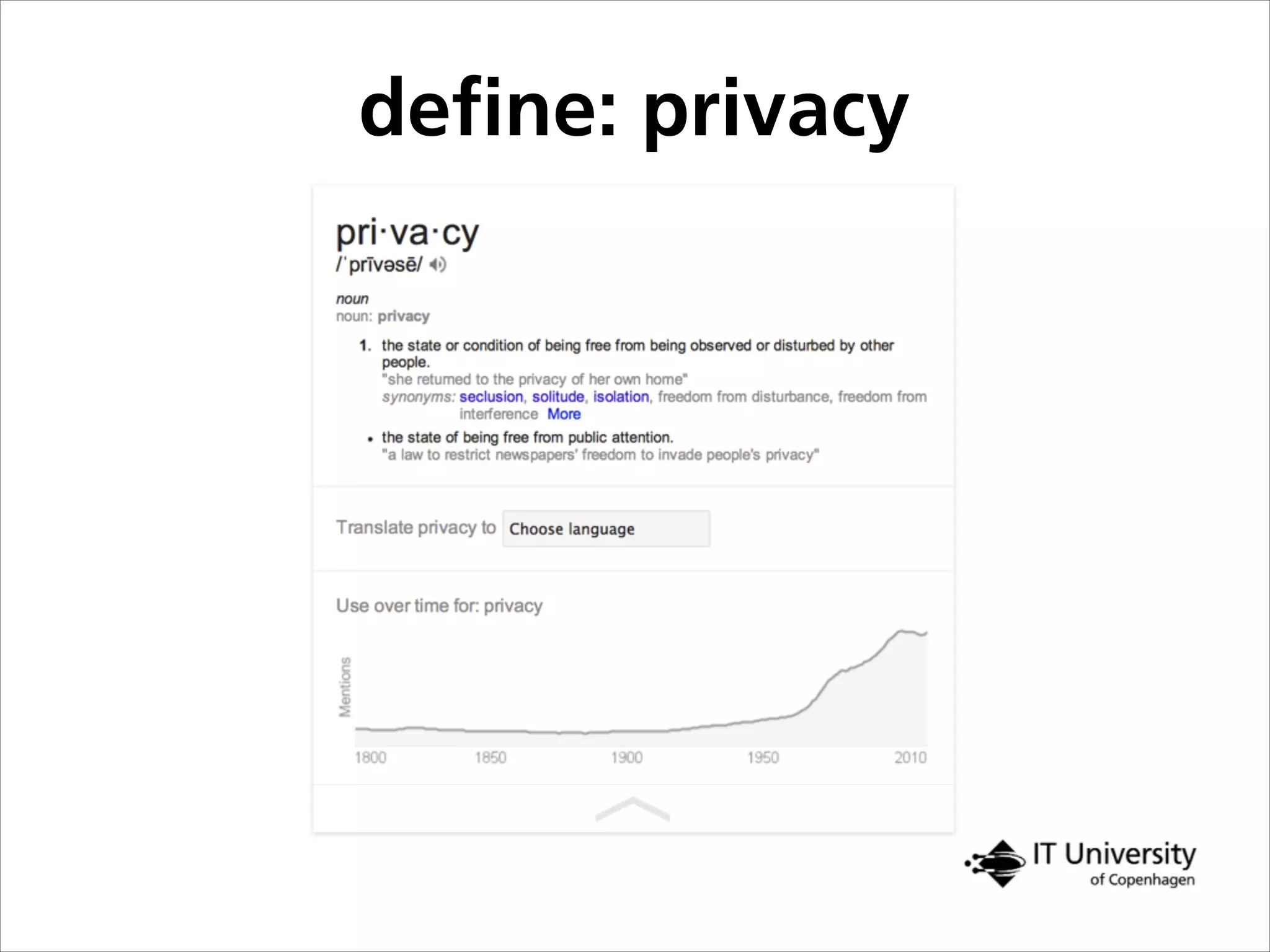
define: privacy
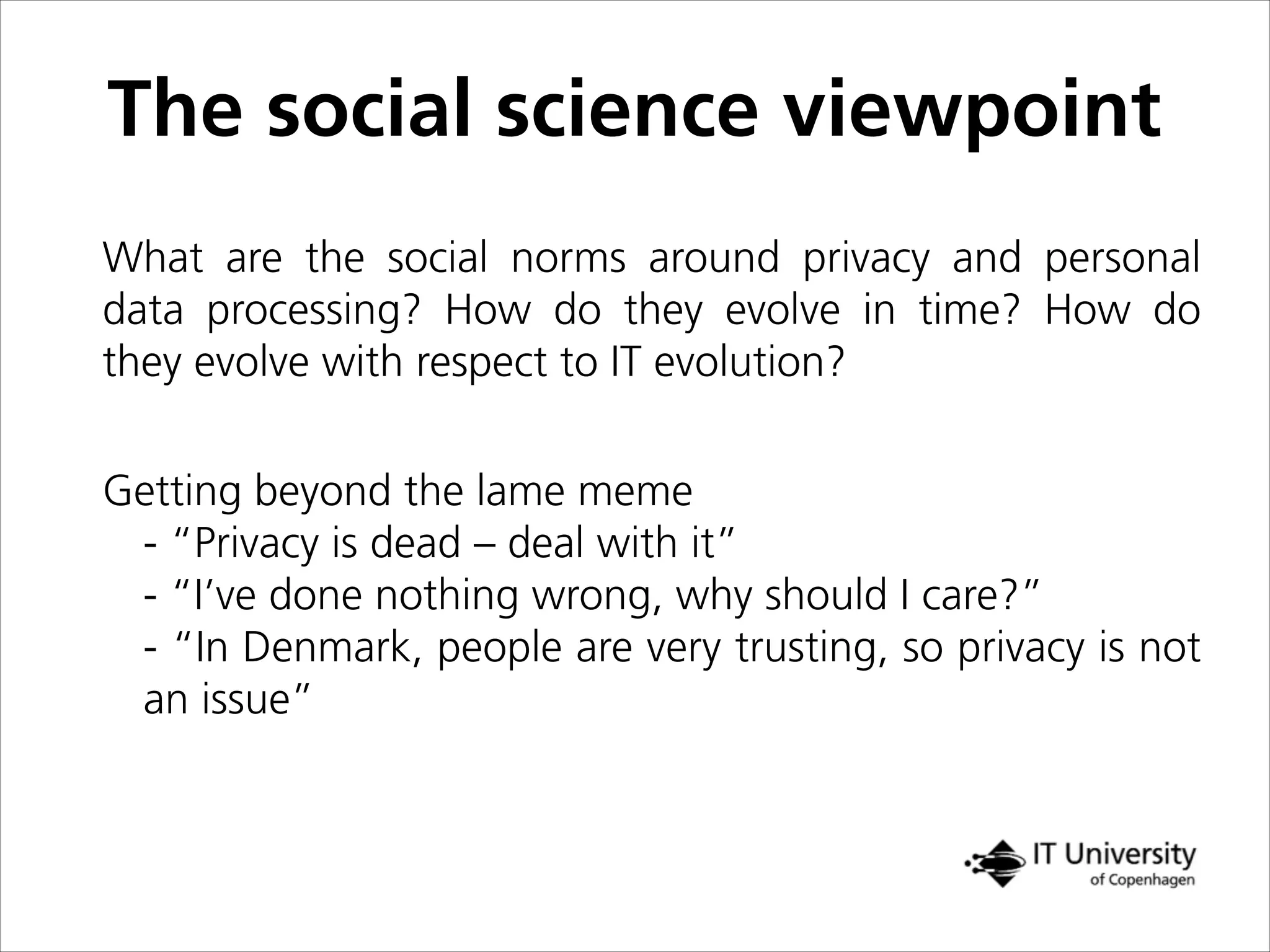
The social science viewpoint
What are the social norms around privacy and personal
data processing? How do they evolve in time? How do
they evolve with respect to IT evolution?
Getting beyond the lame meme
- “Privacy is dead – deal with it”
- “I’ve done nothing wrong, why should I care?”
- “In Denmark, people are very trusting, so privacy is not
an issue” !
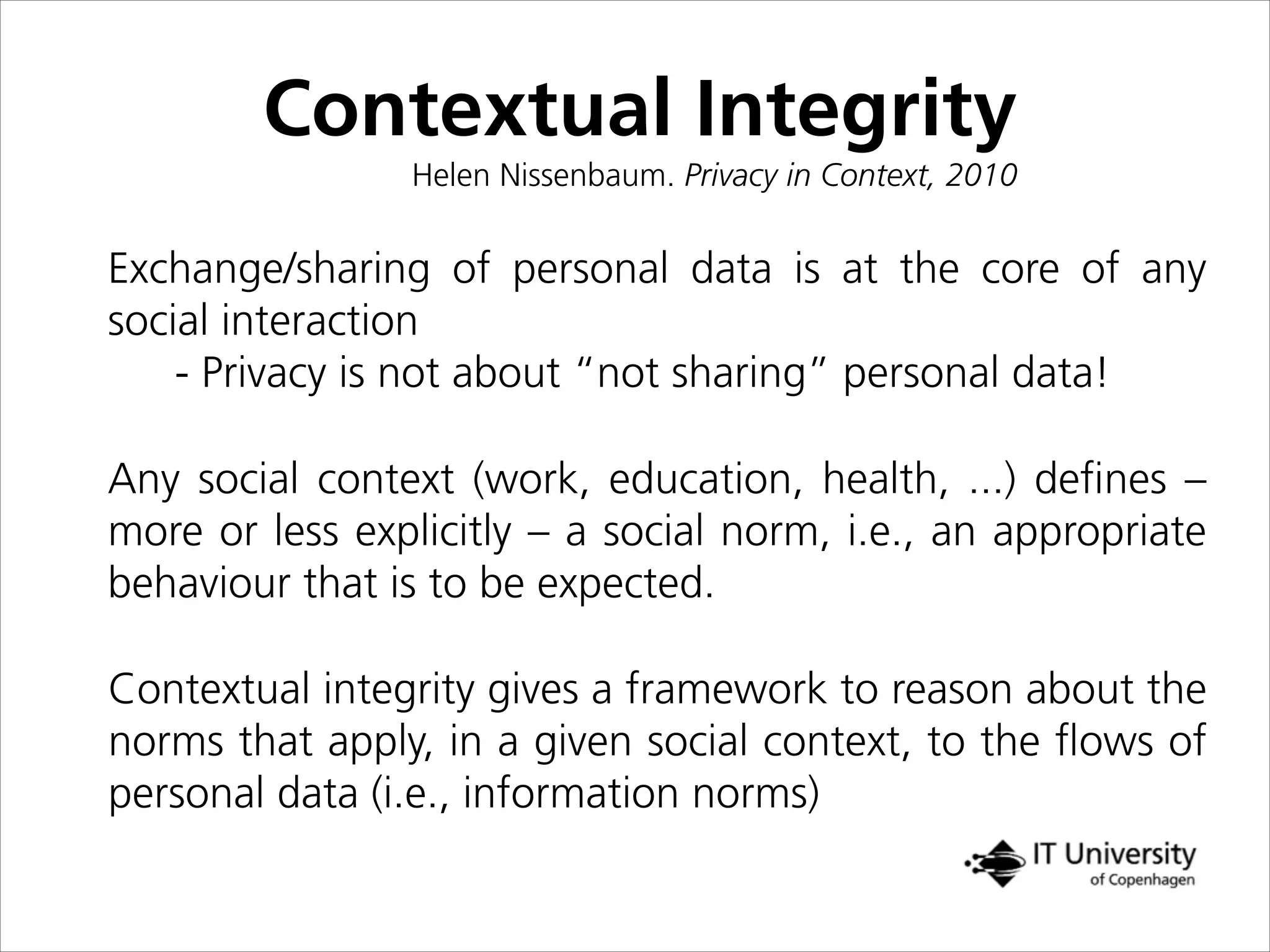
Contextual Integrity
Helen Nissenbaum. Privacy in Context, 2010
Exchange/sharing of personal data is at the core of any
social interaction
- Privacy is not about “not sharing” personal data!
Any social context (work, education, health, ...) defines –
more or less explicitly – a social norm, i.e., an appropriate
behaviour that is to be expected.
Contextual integrity gives a framework to reason about the
norms that apply, in a given social context, to the flows of
personal data (i.e., information norms)
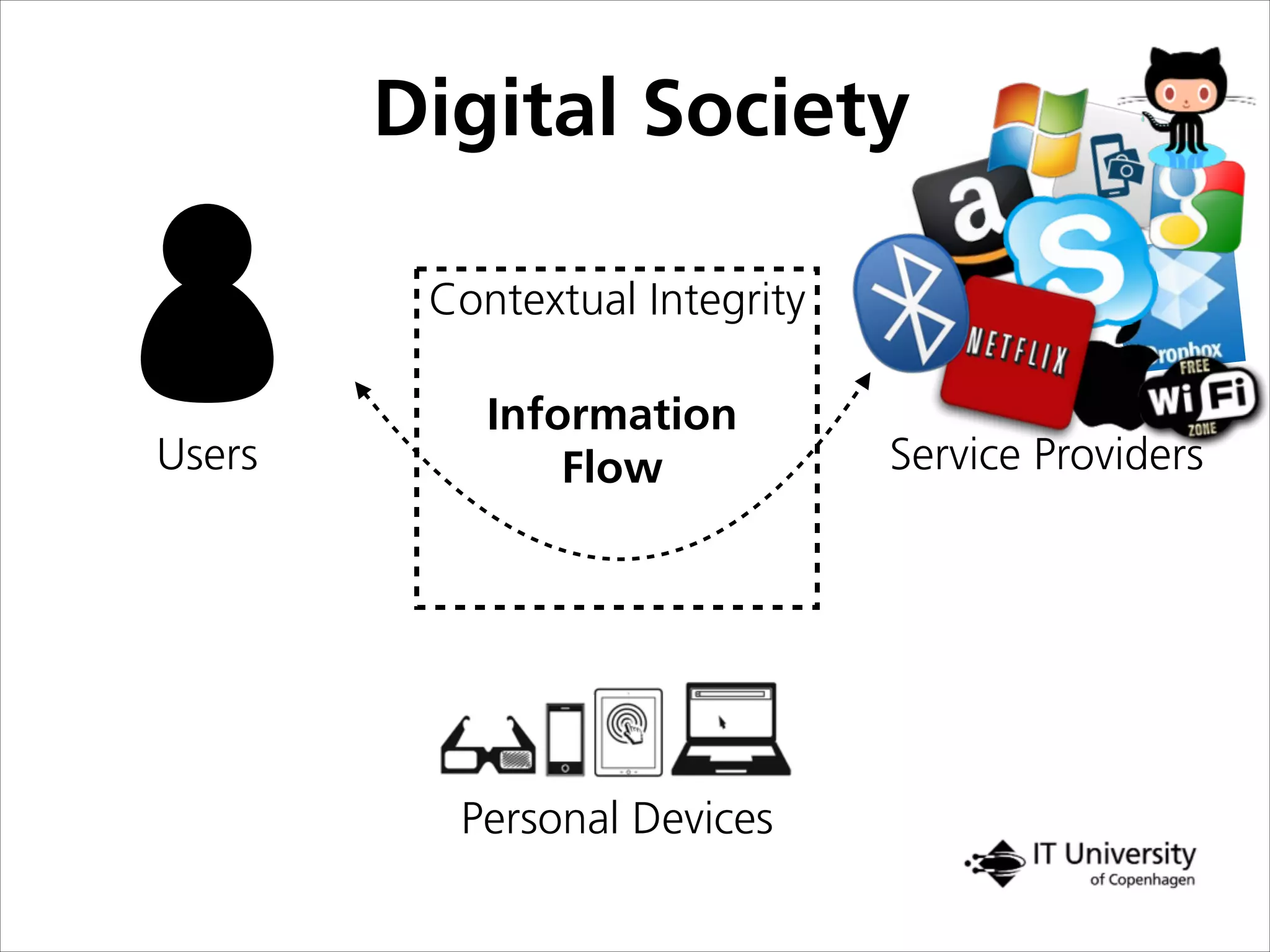
Users Service Providers
Personal Devices
Information
Flow
Digital Society
Contextual Integrity
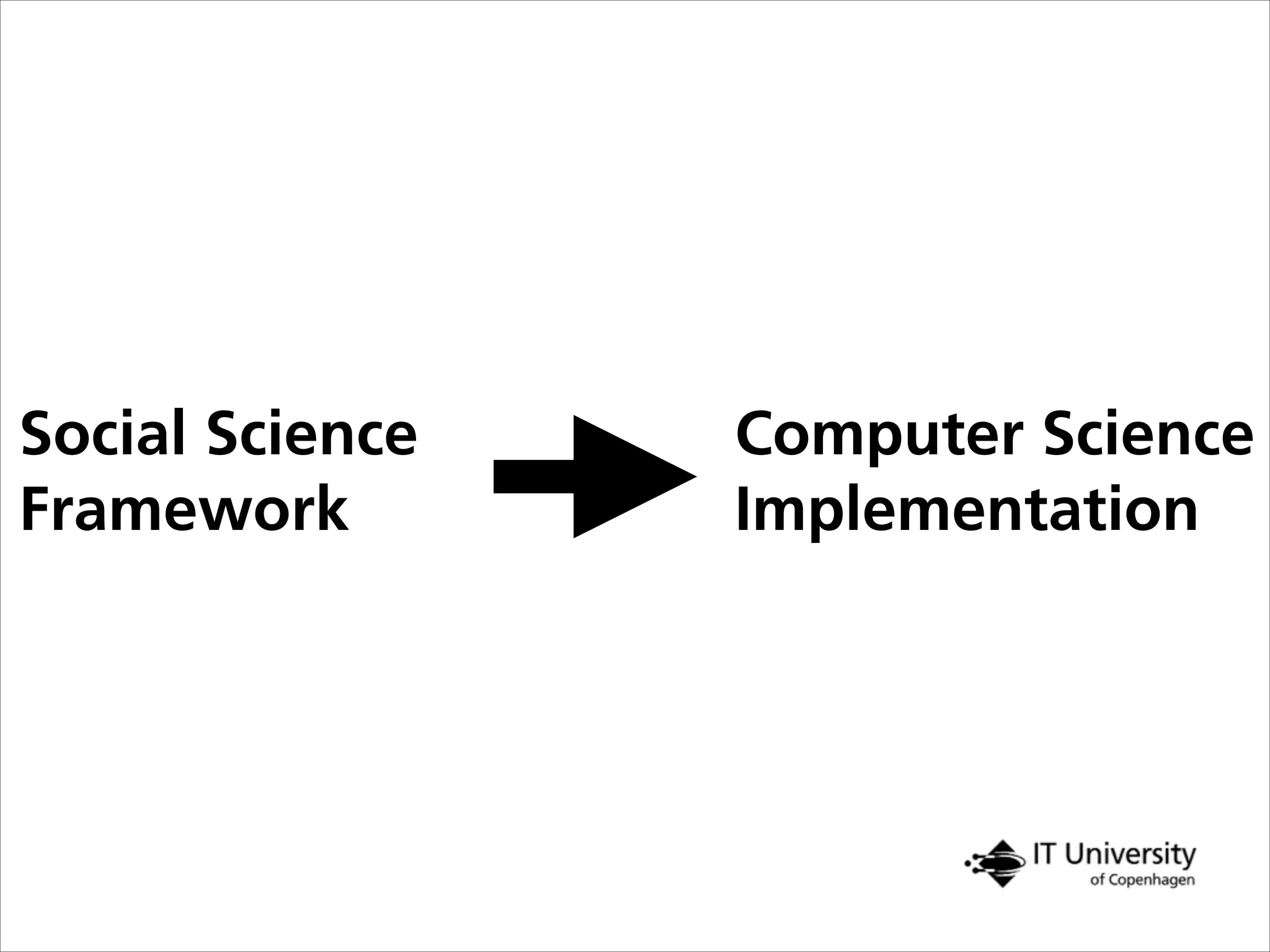
Social Science
Framework
Computer Science
Implementation
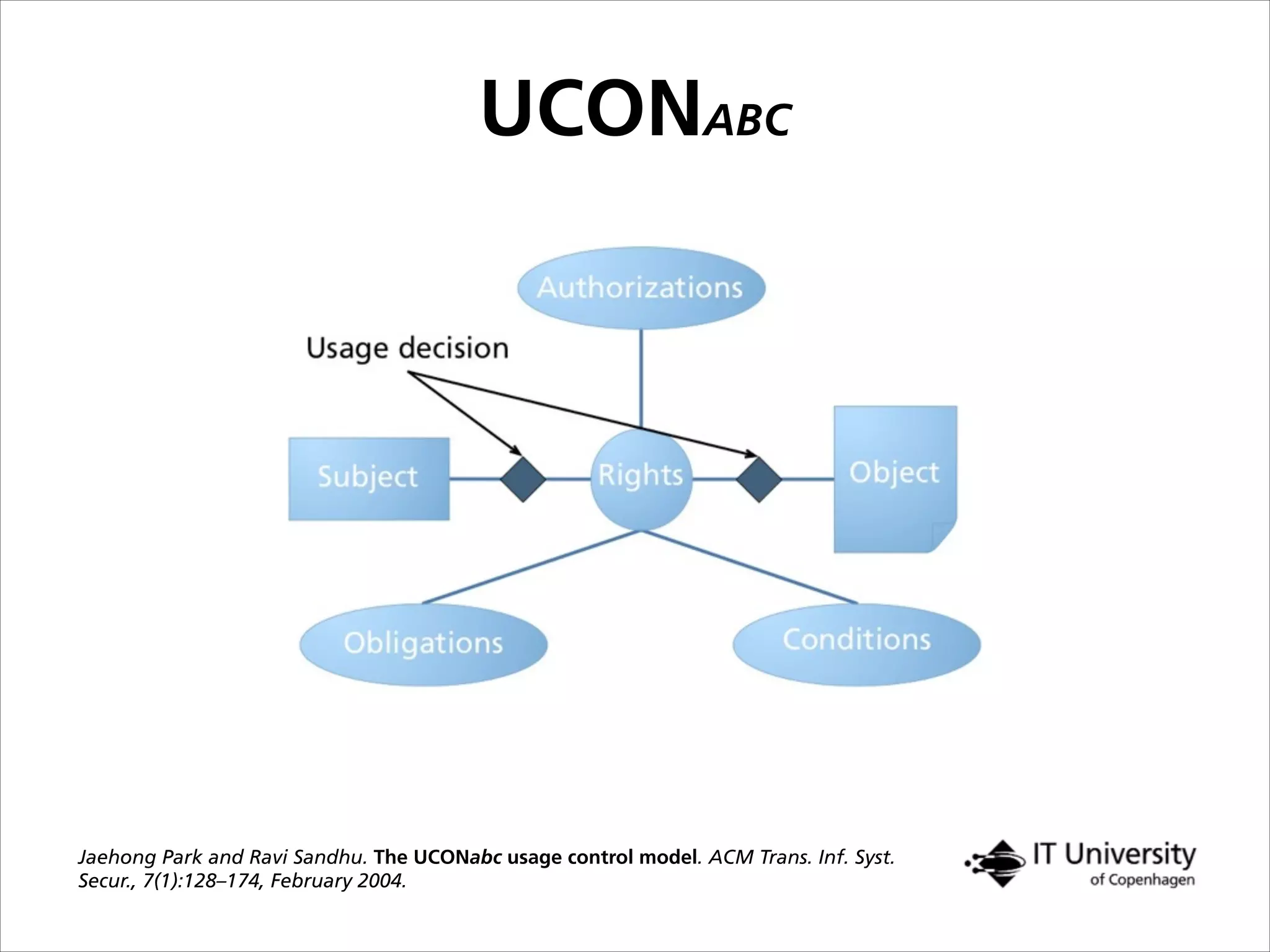
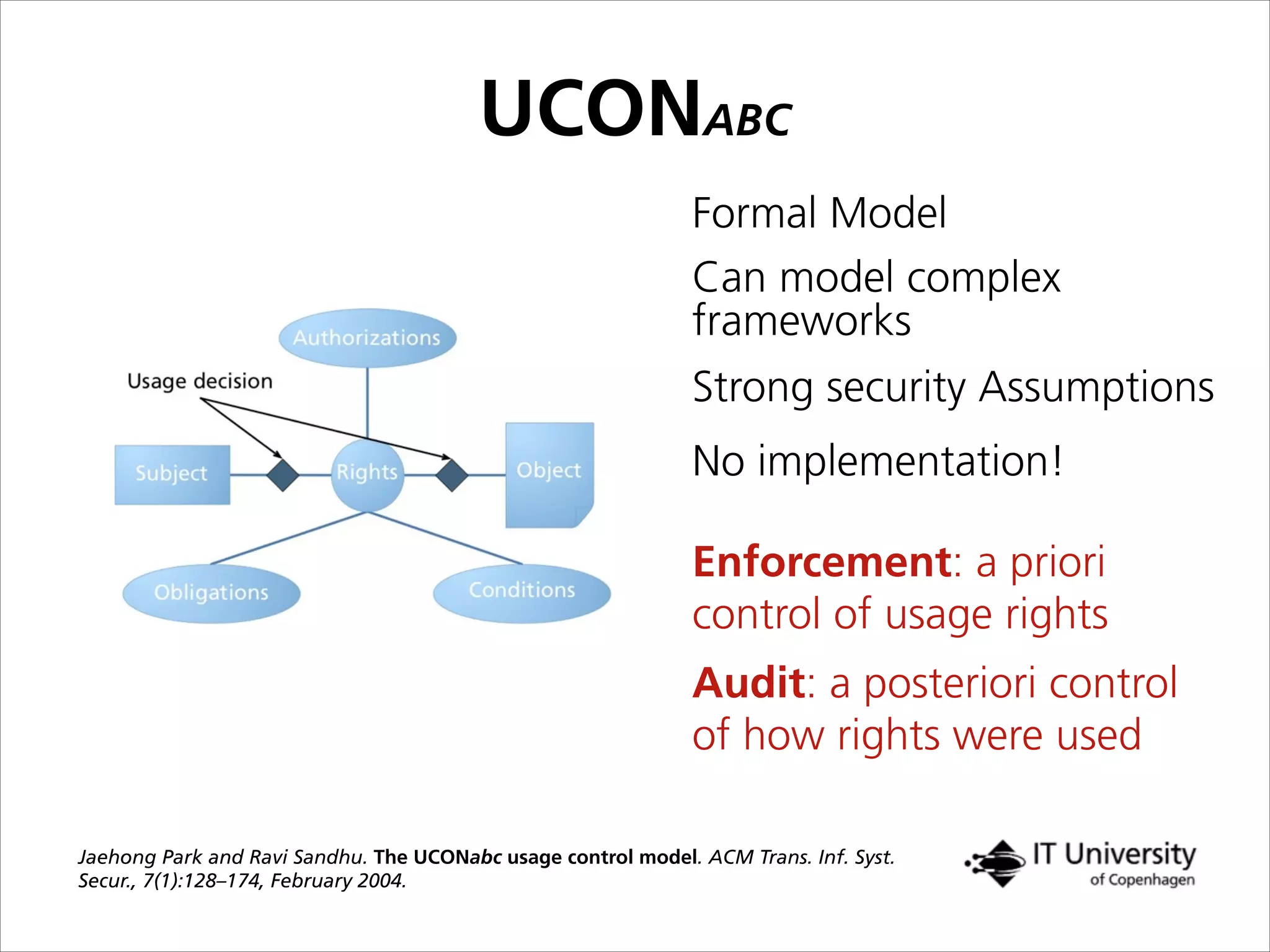
UCONABC
Jaehong Park and Ravi Sandhu. The UCONabc usage control model. ACM Trans. Inf. Syst.
Secur., 7(1):128–174, February 2004.
Audit: a posteriori control
of how rights were used
Enforcement: a priori
control of usage rights
Formal Model
Strong security Assumptions
No implementation!
Jaehong Park and Ravi Sandhu. The UCONabc usage control model. ACM Trans. Inf. Syst.
Secur., 7(1):128–174, February 2004.
Can model complex
frameworks
UCONABC
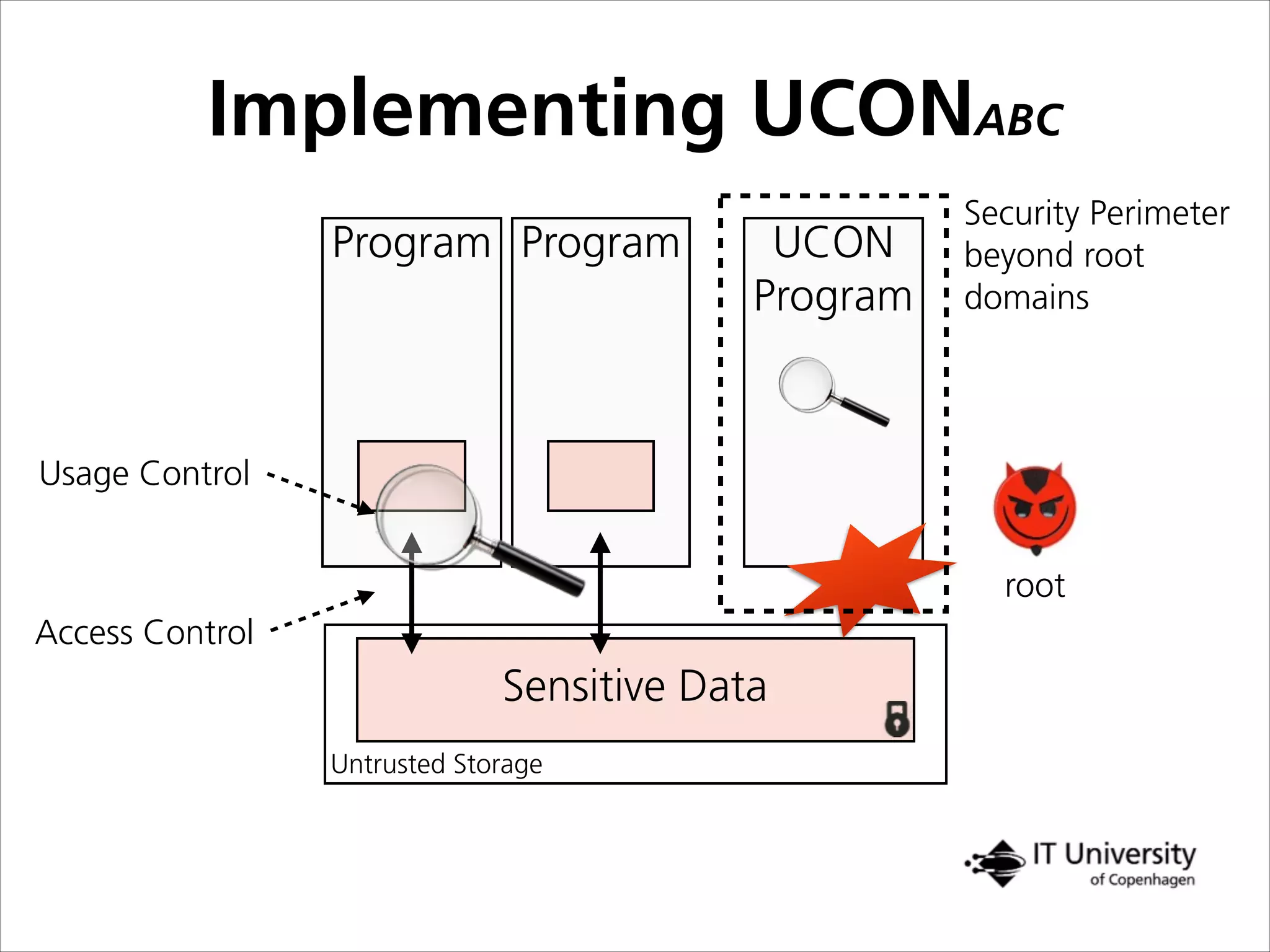
Implementing UCONABC
Sensitive Data
Untrusted Storage
Program Program
Usage Control
Access Control
UCON
Program
root
Security Perimeter
beyond root
domains
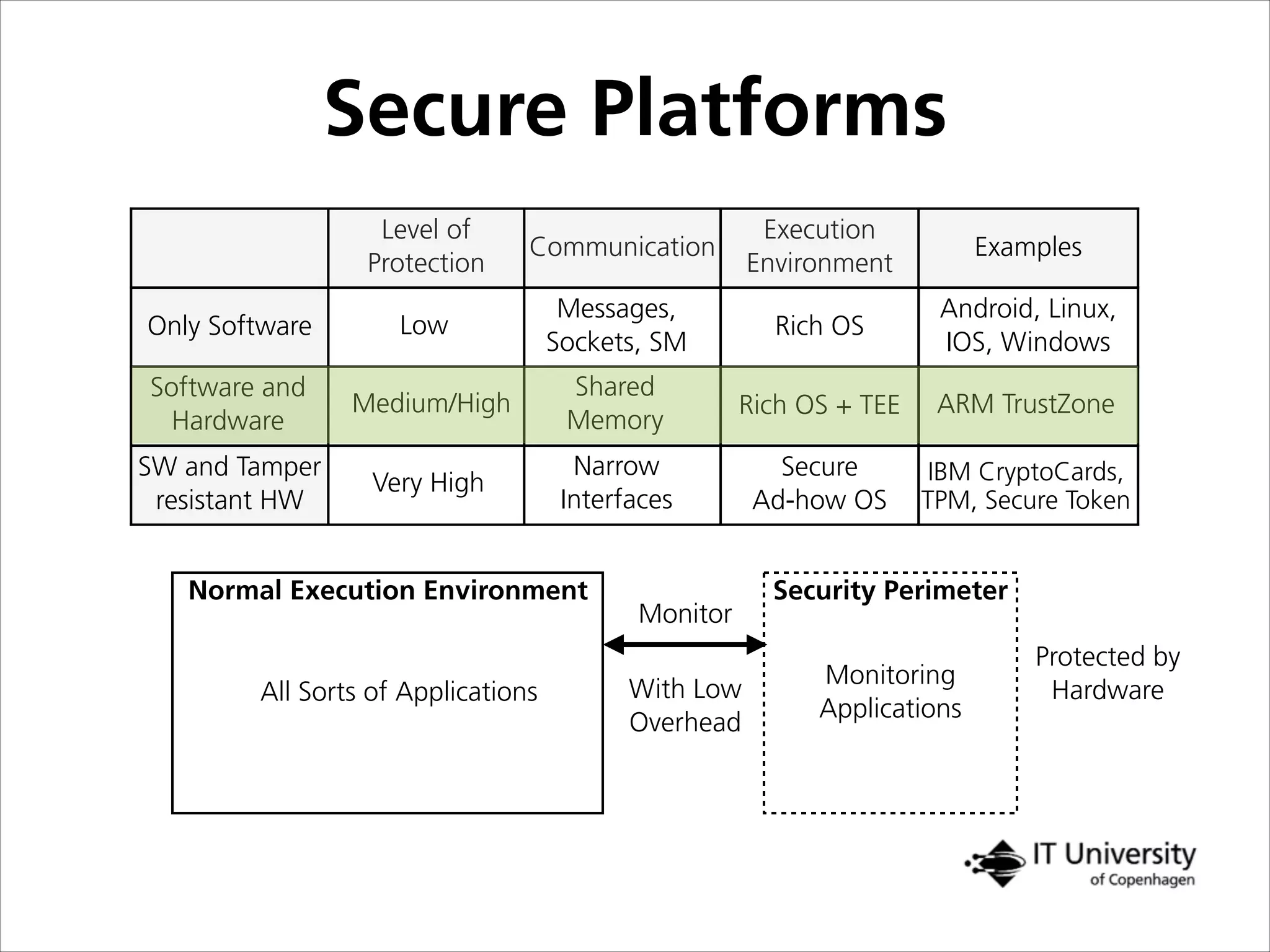
Requirements UCONABC
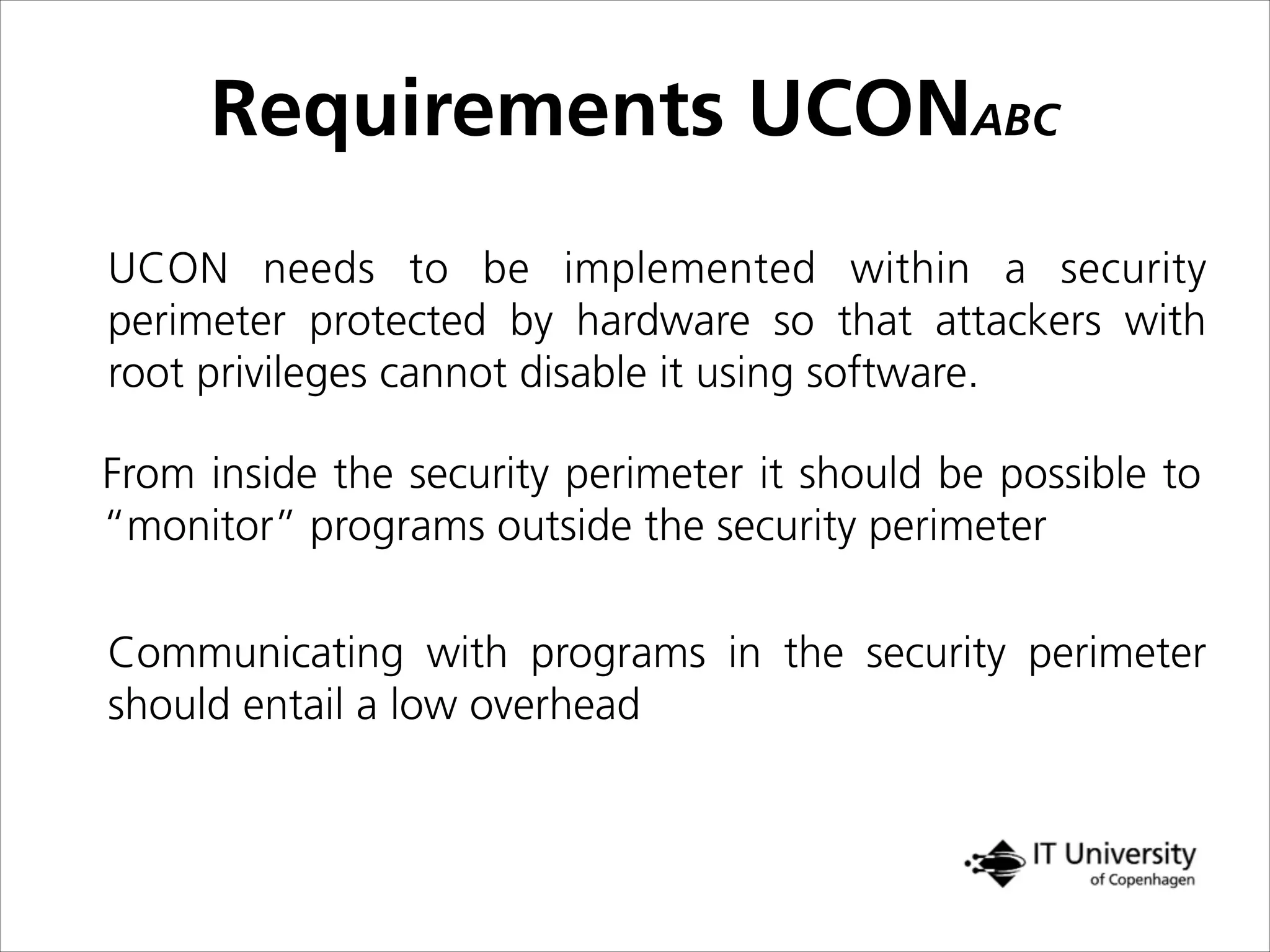
UCON needs to be implemented within a security
perimeter protected by hardware so that attackers with
root privileges cannot disable it using software.
From inside the security perimeter it should be possible to
“monitor” programs outside the security perimeter
Communicating with programs in the security perimeter
should entail a low overhead
Secure Platforms
Level of
Protection
Communication
Execution
Environment
Only Software Rich OS
Rich OS + TEE
SW and Tamper
resistant HW
Secure
Ad-how OS
Narrow
Interfaces
Very High
Low
Messages,
Sockets, SM
Software and
Hardware
Shared
Memory
Medium/High ARM TrustZone
Examples
Android, Linux,
IOS, Windows
IBM CryptoCards,
TPM, Secure Token
Normal Execution Environment Security Perimeter
Monitor
With Low
Overhead
Protected by
HardwareAll Sorts of Applications
Monitoring
Applications
ARM TrustZone
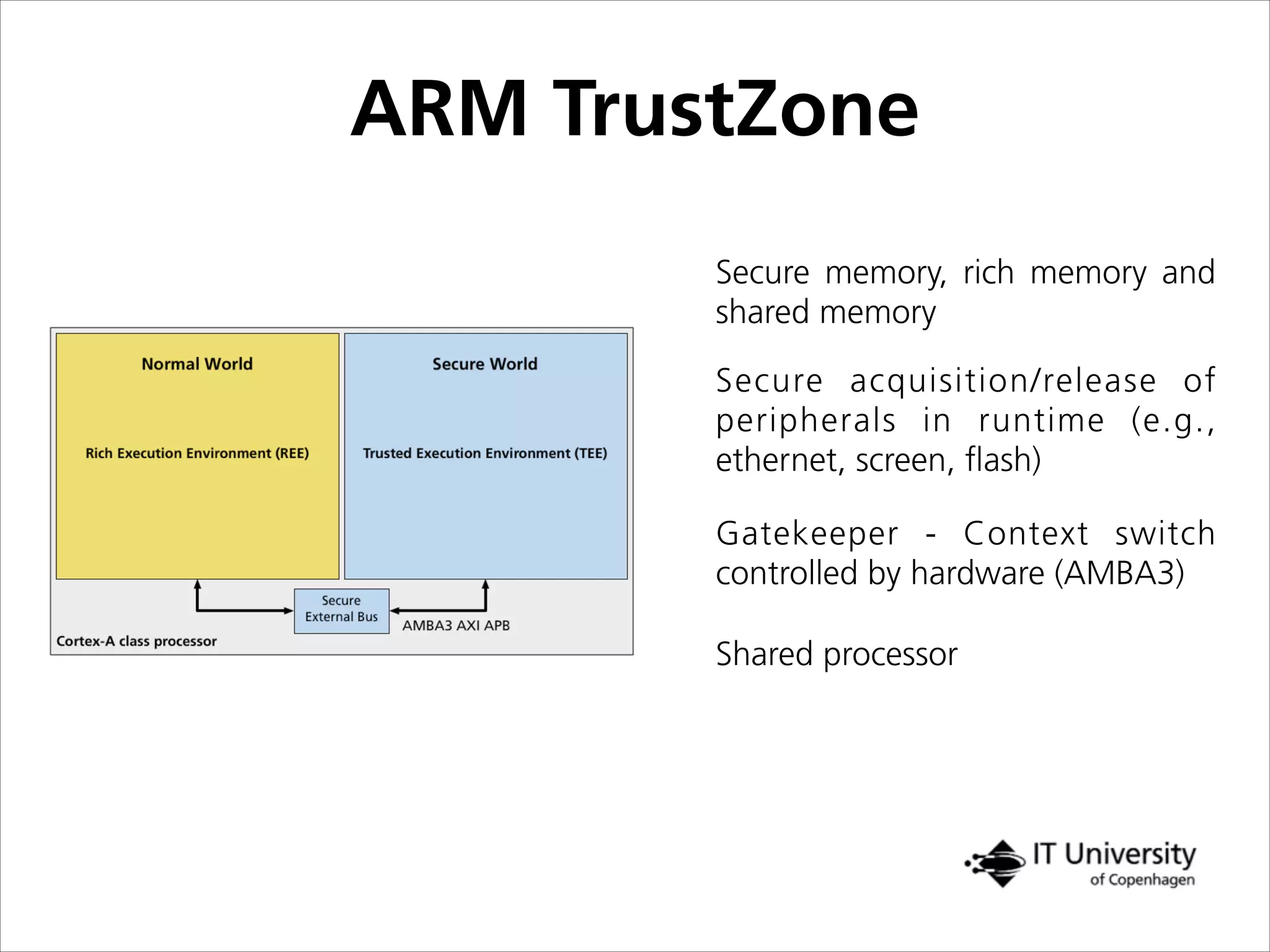
ARM TrustZone
Secure memory, rich memory and
shared memory
Secure acquisition/release of
peripherals in runtime (e.g.,
ethernet, screen, flash)
Gatekeeper - Context switch
controlled by hardware (AMBA3)
Shared processor
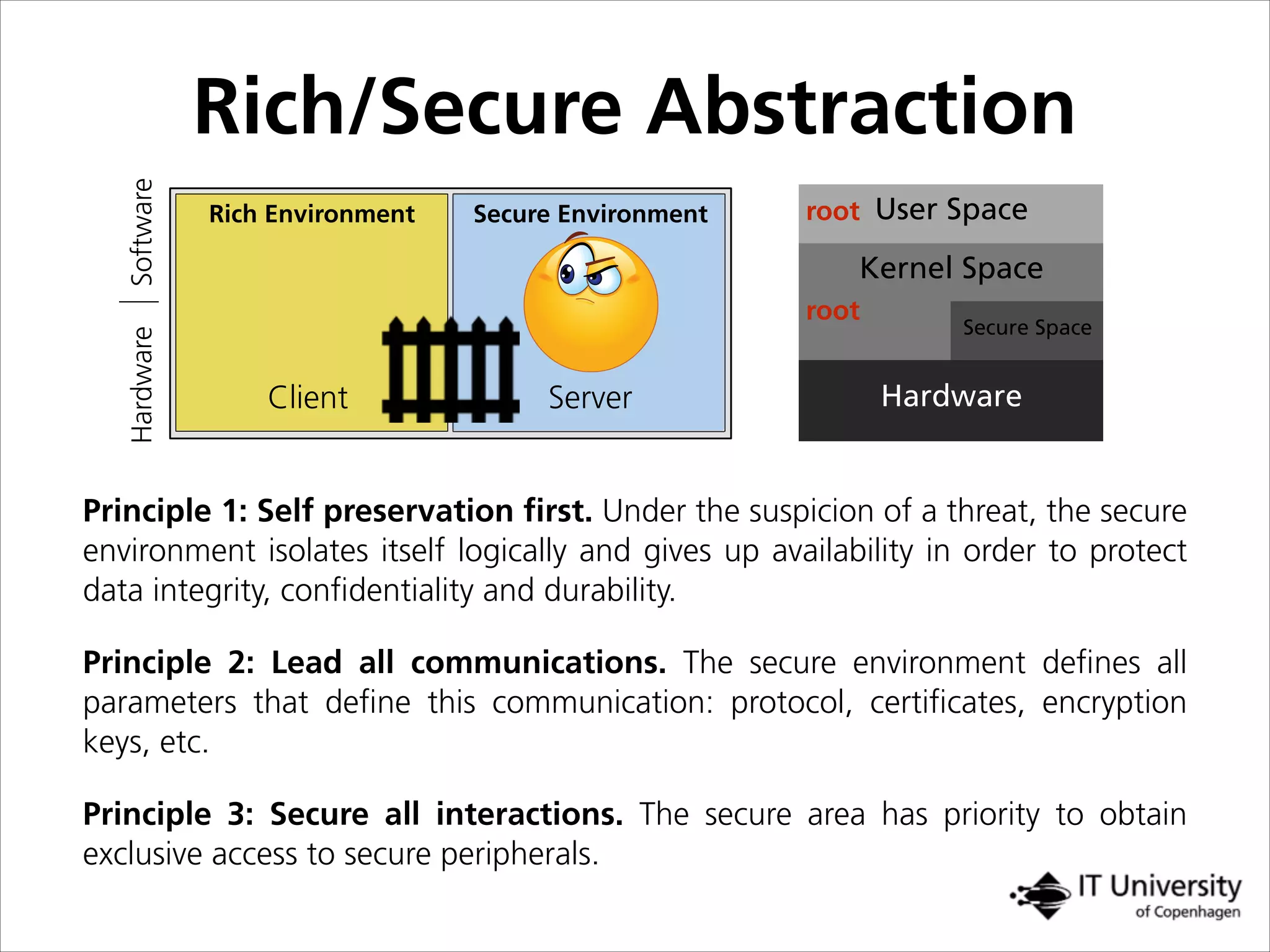
Rich/Secure Abstraction
Principle 1: Self preservation first. Under the suspicion of a threat, the secure
environment isolates itself logically and gives up availability in order to protect
data integrity, confidentiality and durability.
Rich Environment Secure Environment
Client Server
User Space
Kernel Space
Secure Space
Hardware
root
root
HardwareSoftware
Principle 2: Lead all communications. The secure environment defines all
parameters that define this communication: protocol, certificates, encryption
keys, etc.
Principle 3: Secure all interactions. The secure area has priority to obtain
exclusive access to secure peripherals.
Building Trust
Users have the certainty that their sensitive information will
not be misused by the software running in their devices.
Service providers have the certainty that the devices
interacting with their systems are not compromised
Both should have the freedom to choose who they trust,
and the technology should aid giving certainty, not
enforcing
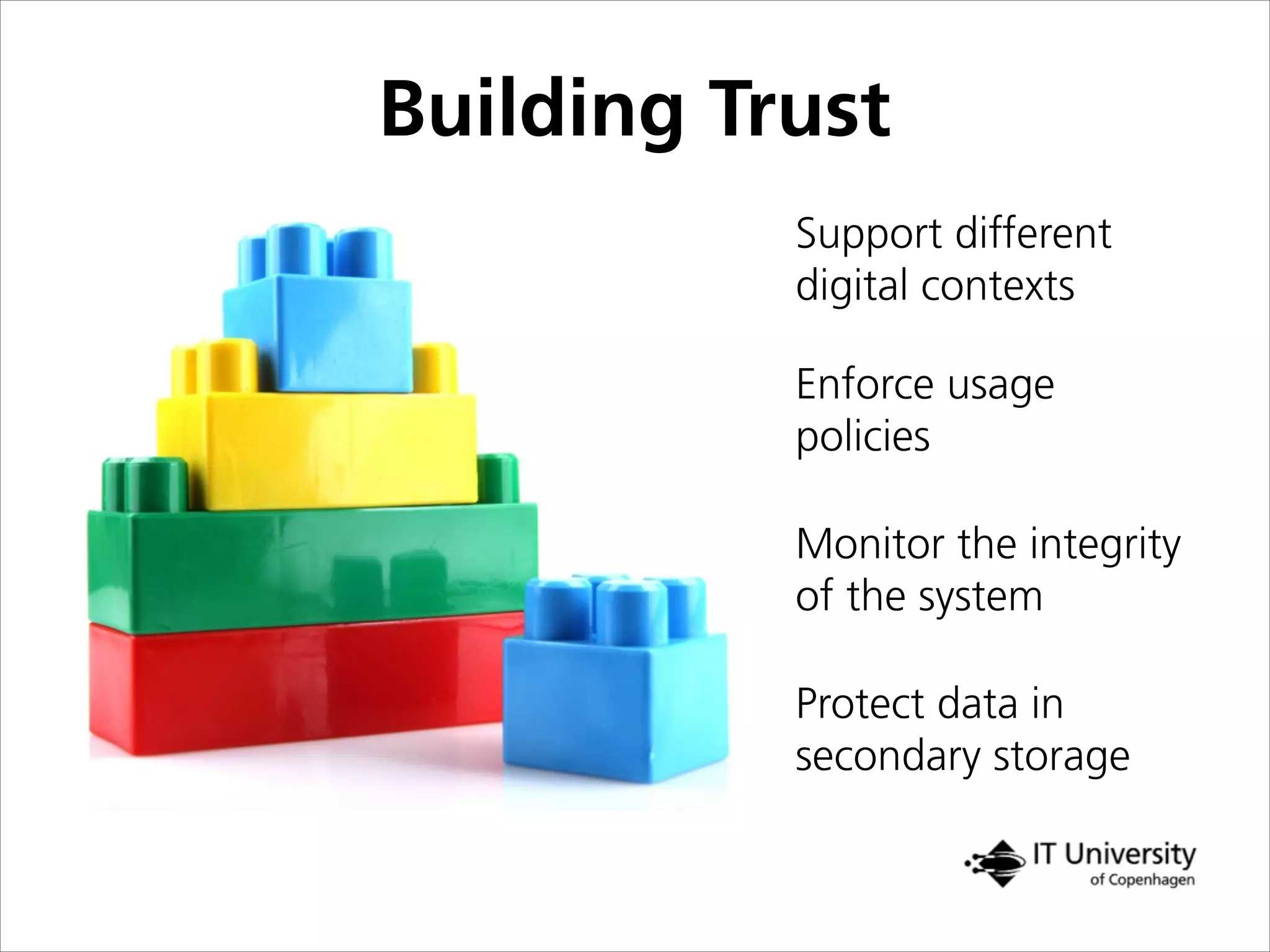
Building Trust
Protect data in
secondary storage
Monitor the integrity
of the system
Enforce usage
policies
Support different
digital contexts
Background Information
Trusted Storage Module (TSM)
A system providing trusted storage should guarantee data
confidentiality, integrity, availability, and durability
Today’s security policies rely on data encryption to support
confidentiality and integrity. However, if encryption keys
can be compromised or stolen on the client computer, then
there is not much protection left.
Approaches using tamper-resistant hardware: low
functionality, physical separated, and narrow interfaces
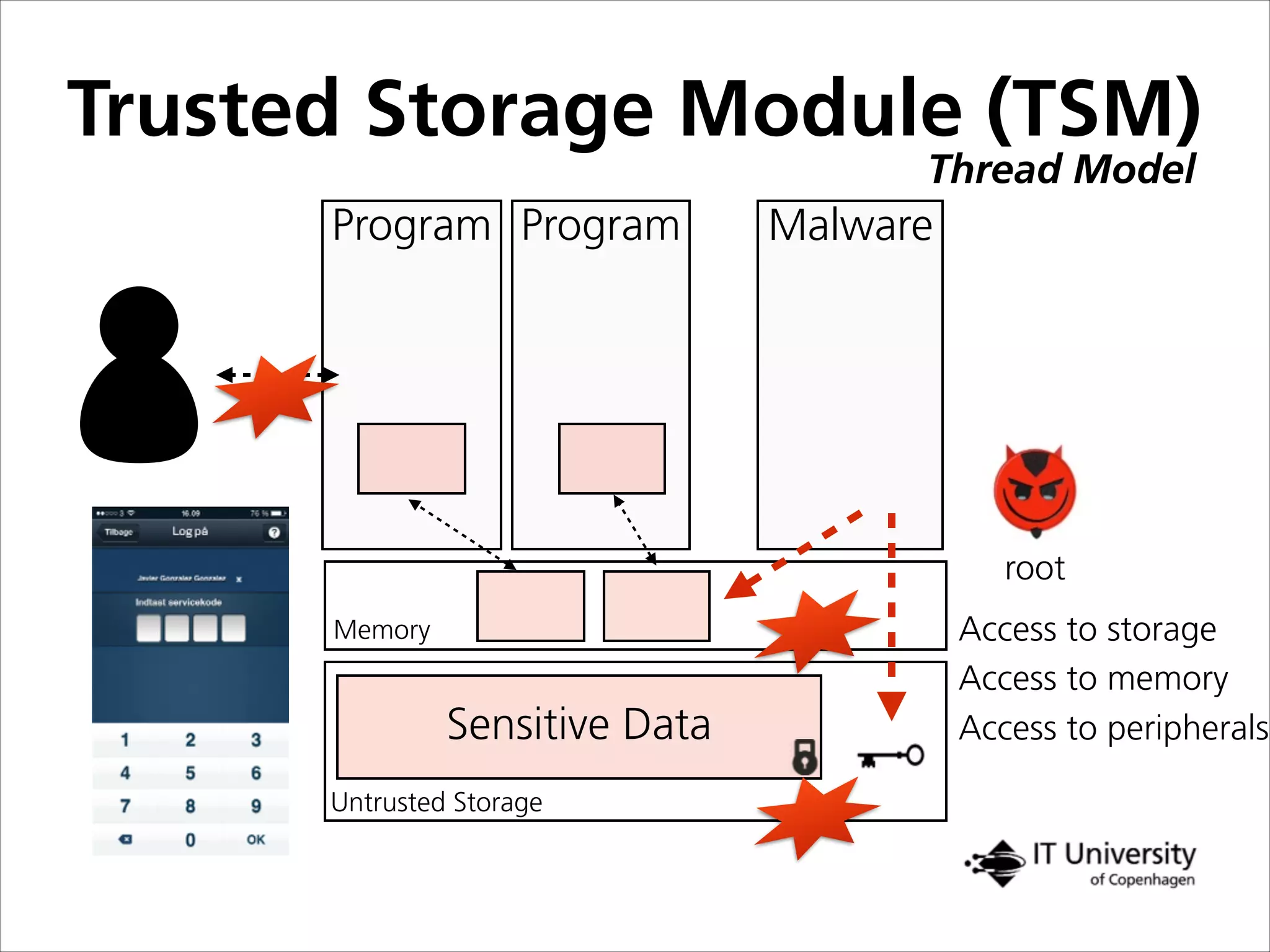
Thread Model
Trusted Storage Module (TSM)
Sensitive Data
Untrusted Storage
Program Program Malware
root
Memory Access to storage
Access to memory
Access to peripherals
Trusted Storage Module (TSM)
Architecture
Rich Environment Secure Environment
Data producer
App
Platform
Independent
Platform
Dependent
TSM CI
Secure
EnvironmentCI
TSM
Secure Module
Tamper
Resistant Unit
Crypto
Module
for [i..n]
Data Chunk
(i)
(ii)
Storage
(iii)(iv) Enc. DataEnc. Keys PDS
(v)
Enc. Data
Metadata
0
0.00375
0.00750
0.01125
0.01500
1KB 10KB 20KB 50KB 100KB
Time[s]
Store&Object&in&Rich& Store&Object&in&Secure&
Trusted Storage Module (TSM)
Overhead
Contributions
Trusted Storage Module (TSM)
Provide a mechanism for rich apps to store securely objects
containing sensitive information introducing low overhead
Provide a mechanism to enforce access control to the files
storing those objects, i.e., encryption, secure memory and
secure peripherals
Use untrusted storage as a cheap and “unlimited” source
of secondary storage
Antifragile Storage
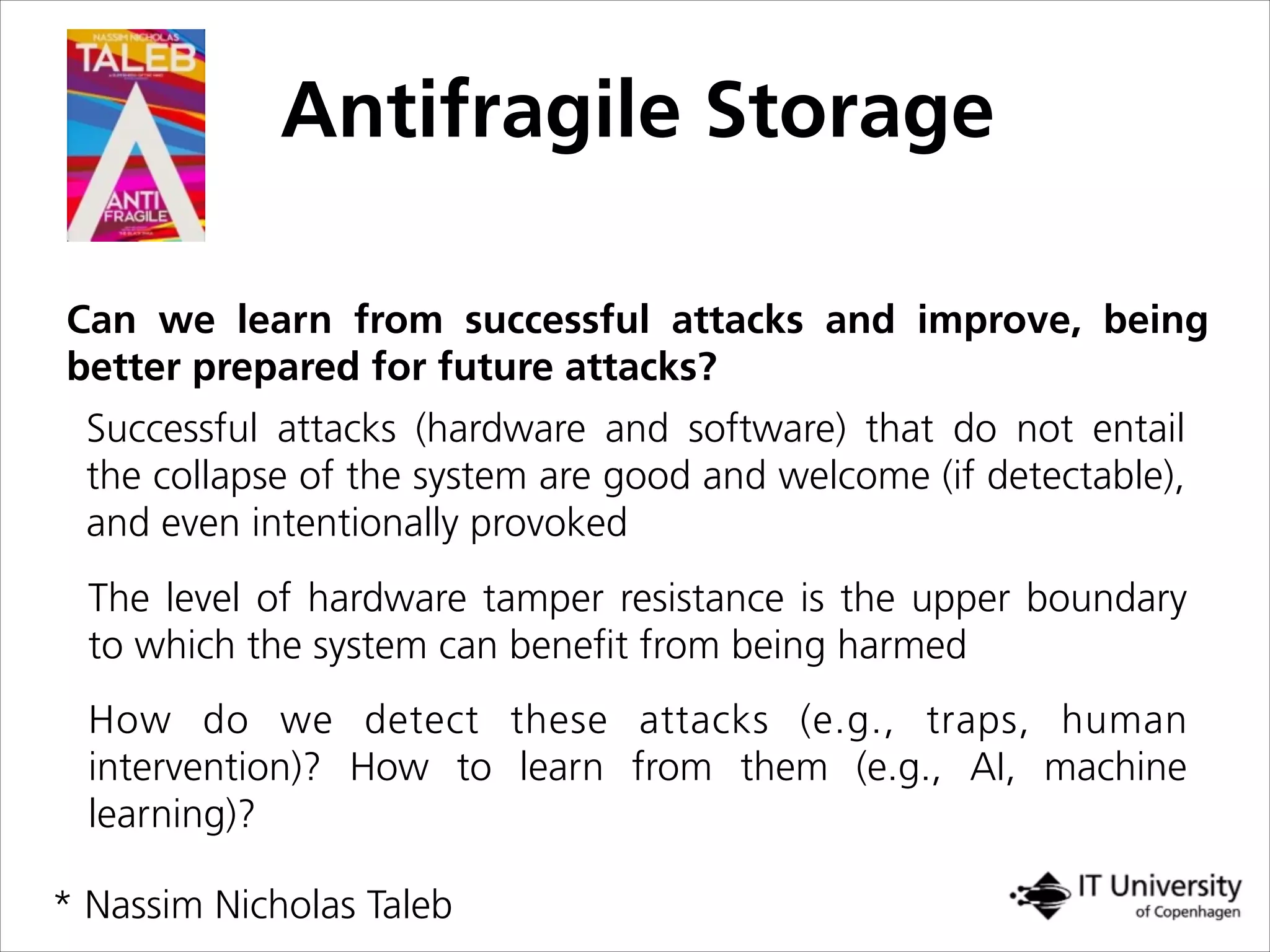
Can we learn from successful attacks and improve, being
better prepared for future attacks?
Successful attacks (hardware and software) that do not entail
the collapse of the system are good and welcome (if detectable),
and even intentionally provoked
The level of hardware tamper resistance is the upper boundary
to which the system can benefit from being harmed
How do we detect these attacks (e.g., traps, human
intervention)? How to learn from them (e.g., AI, machine
learning)?
* Nassim Nicholas Taleb
Trusted Integrity Module (TIM)
Background Information
Secondary storage is normally attacked. To survive a reboot
or hide from system administrators, attackers make
modifications to system files, line commands and system
libraries.
Running processed produce logs, which are accessible from
users space (applications), and therefore can be tampered
with.
Storage-based integrity checks need to build on top of
trusted storage (e.g., TSM)
Architecture
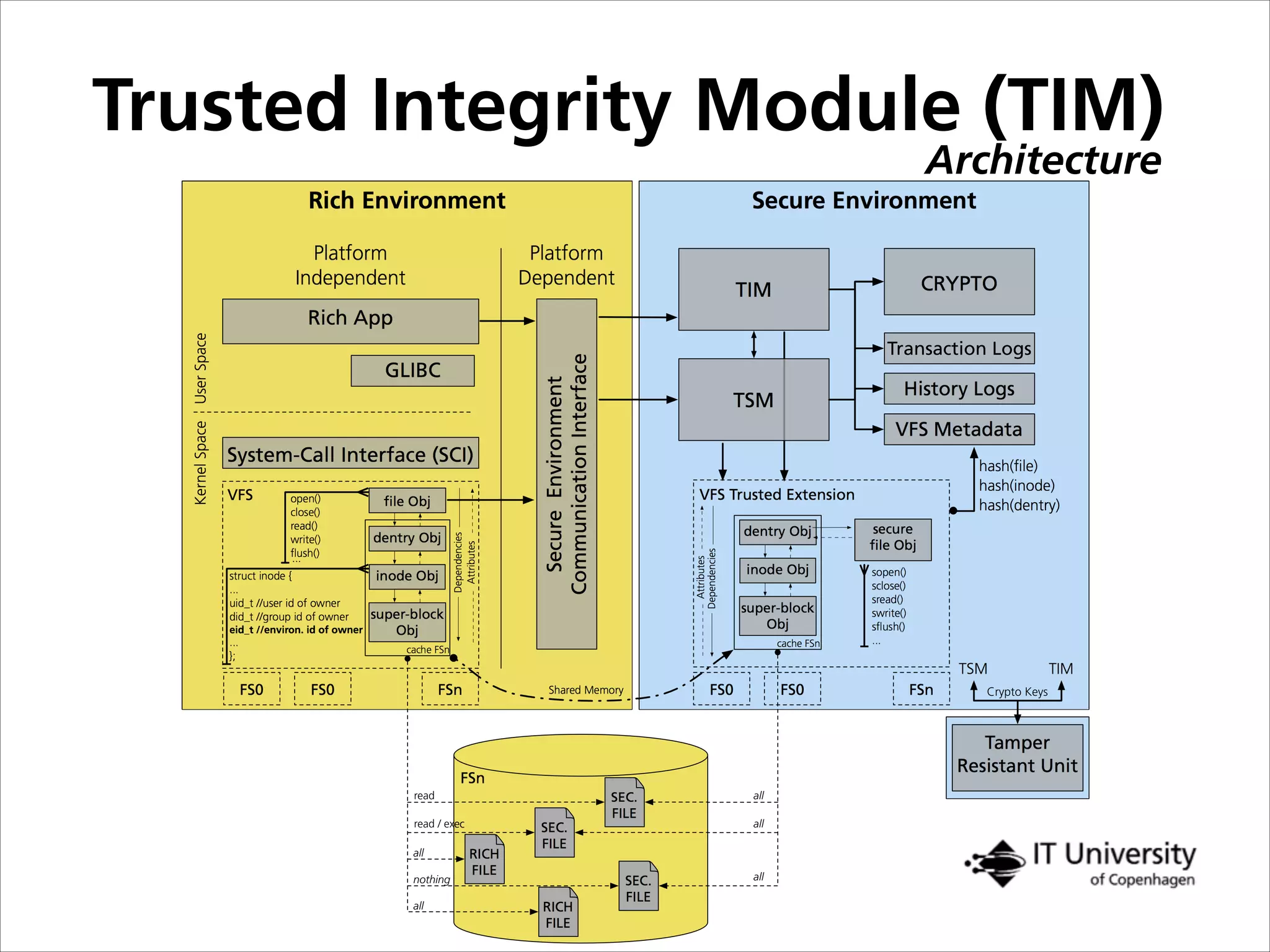
Trusted Integrity Module (TIM)
Rich App
GLIBC
System-Call Interface (SCI)
VFS file Obj
dentry Obj
inode Obj
super-block
Obj
Dependencies
Attributes
SecureEnvironment
CommunicationInterface
open()
close()
read()
write()
flush()
struct inode {
...
uid_t //user id of owner
did_t //group id of owner
eid_t //environ. id of owner
...
};
Platform
Independent
Platform
Dependent
UserSpaceKernelSpace Rich Environment Secure Environment
cache FSn
SEC.
FILE
SEC.
FILE
SEC.
FILE
VFS Trusted Extension
dentry Obj
inode Obj
super-block
Obj
cache FSn
Shared MemoryFS0 FS0 FSn
FSn
RICH
FILE
RICH
FILE
read / exec
all
all
read
nothing
all
all
all
VFS Metadata
TIM
...
CRYPTO
hash(file)
hash(inode)
hash(dentry)
TSM
Dependencies
Attributes
secure
file Obj
sopen()
sclose()
sread()
swrite()
sflush()
...
Tamper
Resistant Unit
TIMTSM
FS0 FS0 FSn
History Logs
Transaction Logs
Crypto Keys
Contribution
Trusted Integrity Module (TIM)
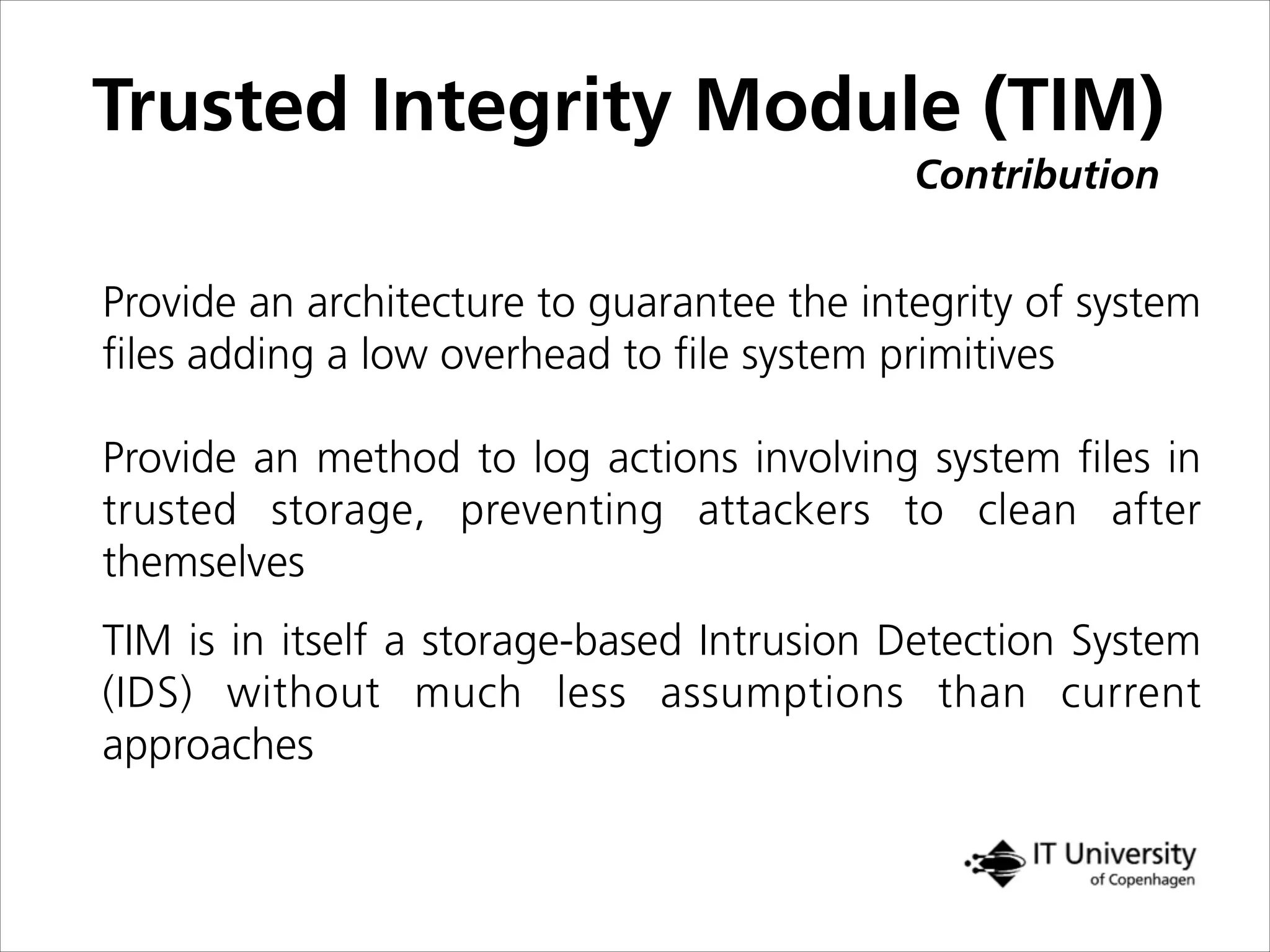
TIM is in itself a storage-based Intrusion Detection System
(IDS) without much less assumptions than current
approaches
Provide an architecture to guarantee the integrity of system
files adding a low overhead to file system primitives
Provide an method to log actions involving system files in
trusted storage, preventing attackers to clean after
themselves
Next Steps
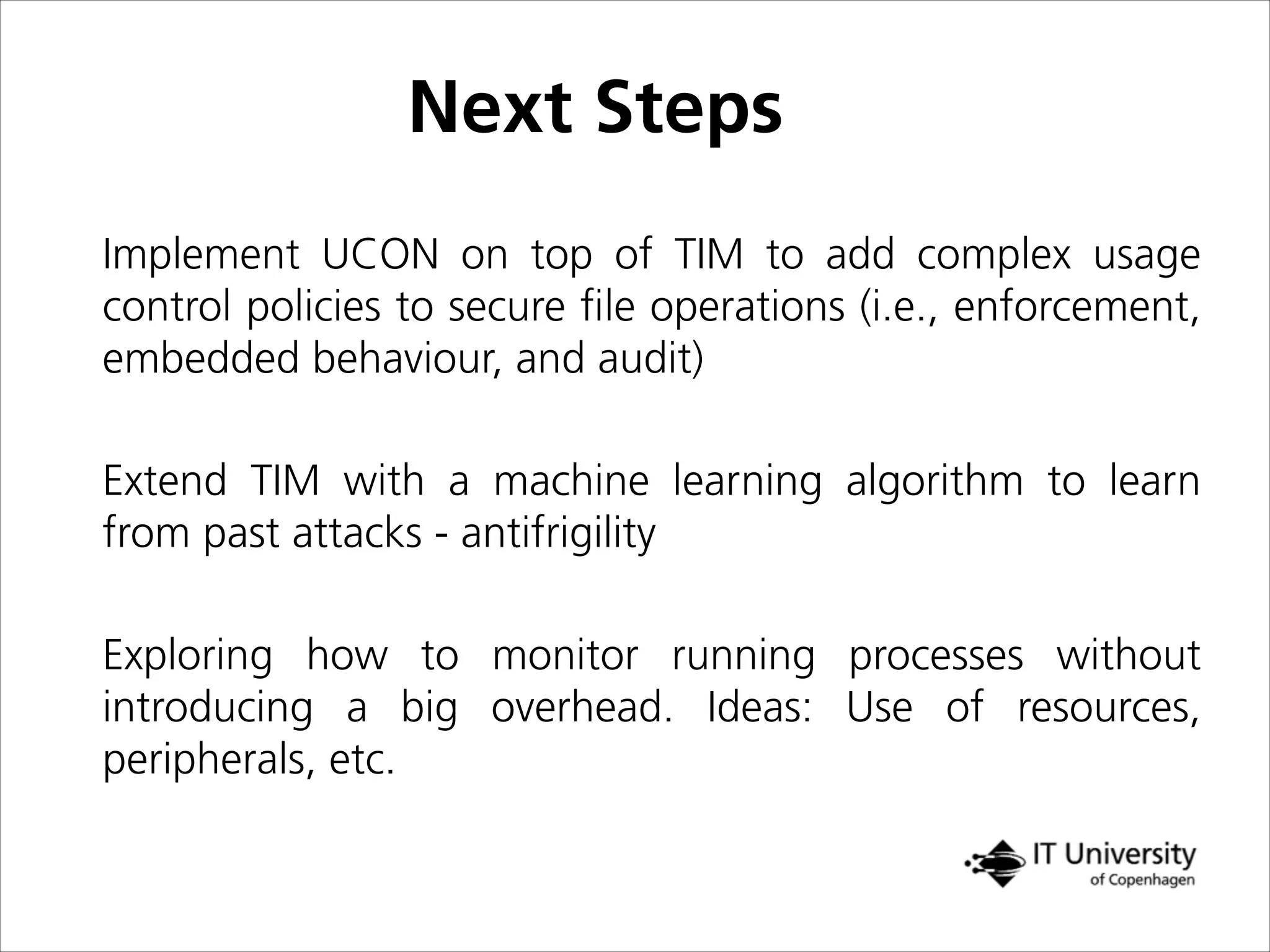
Implement UCON on top of TIM to add complex usage
control policies to secure file operations (i.e., enforcement,
embedded behaviour, and audit)
Extend TIM with a machine learning algorithm to learn
from past attacks - antifrigility
Exploring how to monitor running processes without
introducing a big overhead. Ideas: Use of resources,
peripherals, etc.
Example:
Supporting different
digital “social” contexts
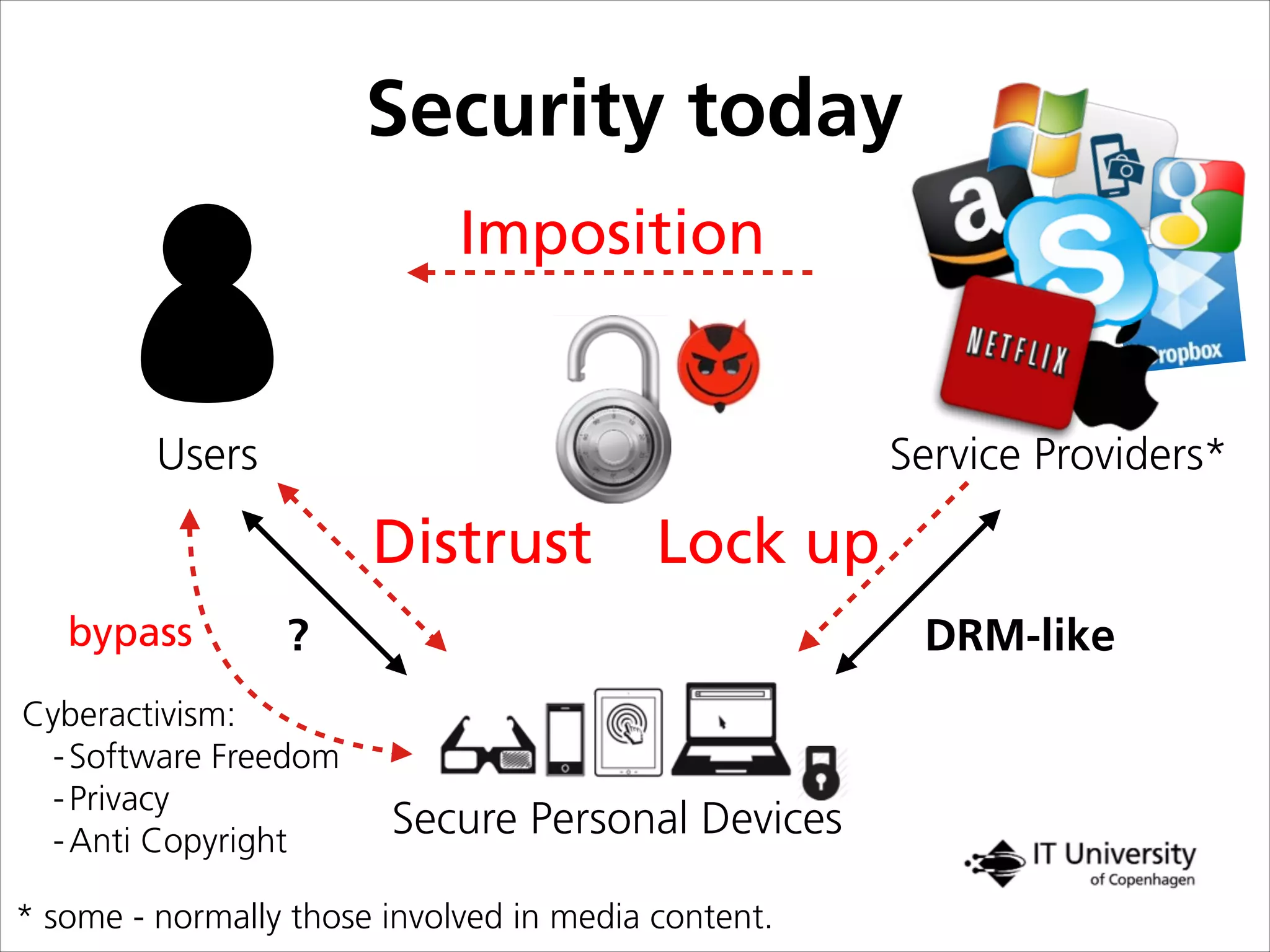
Security today
Users Service Providers
? DRM-like
Secure Personal Devices
Imposition
Lock upDistrust
Cyberactivism:
-Software Freedom
-Privacy
-Anti Copyright
!
* some - normally those involved in media content.
*
bypass
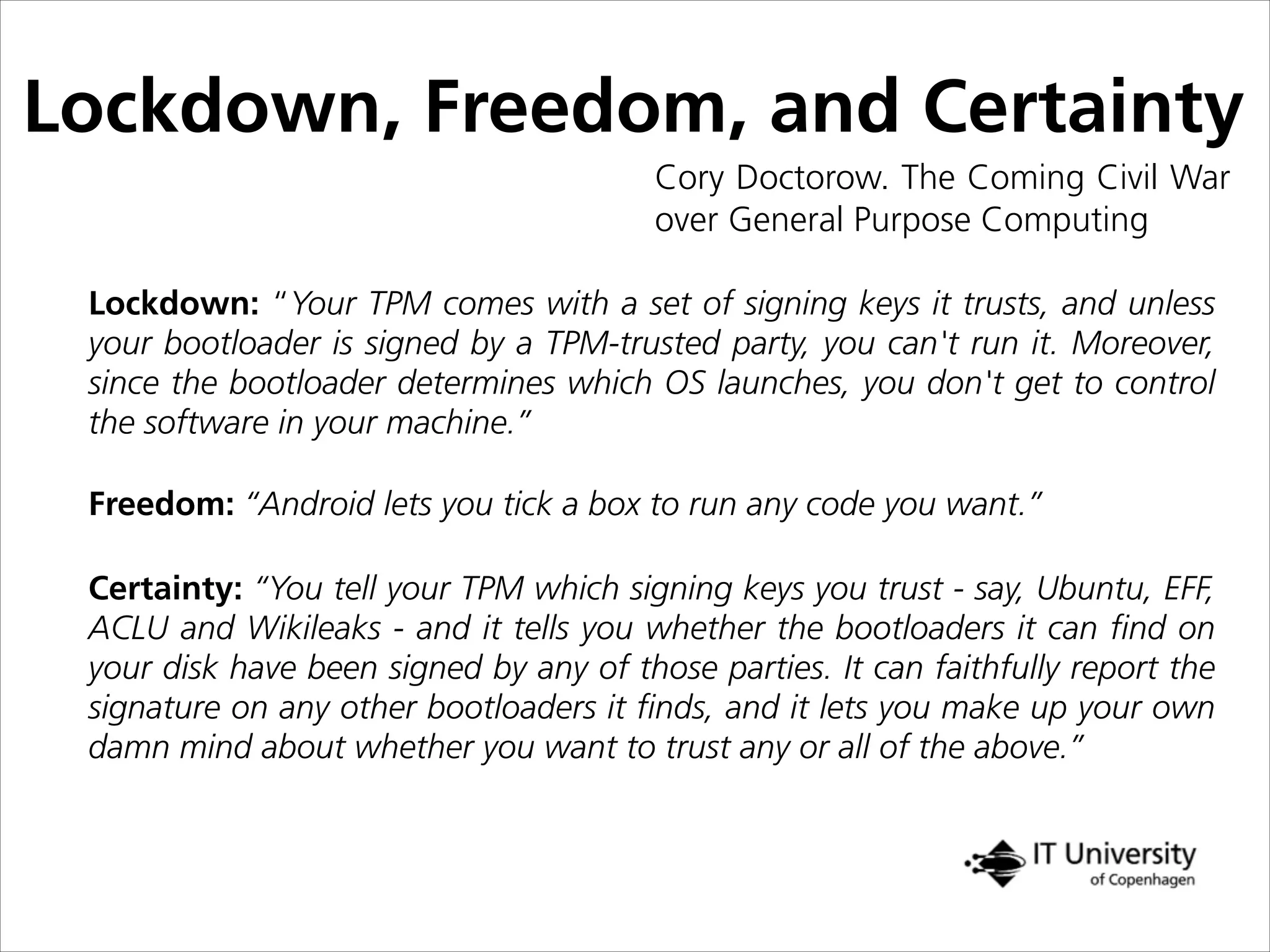
Lockdown, Freedom, and Certainty
Cory Doctorow. The Coming Civil War
over General Purpose Computing
Lockdown: “Your TPM comes with a set of signing keys it trusts, and unless
your bootloader is signed by a TPM-trusted party, you can't run it. Moreover,
since the bootloader determines which OS launches, you don't get to control
the software in your machine.”
Certainty: “You tell your TPM which signing keys you trust - say, Ubuntu, EFF,
ACLU and Wikileaks - and it tells you whether the bootloaders it can find on
your disk have been signed by any of those parties. It can faithfully report the
signature on any other bootloaders it finds, and it lets you make up your own
damn mind about whether you want to trust any or all of the above.”
Freedom: “Android lets you tick a box to run any code you want.”
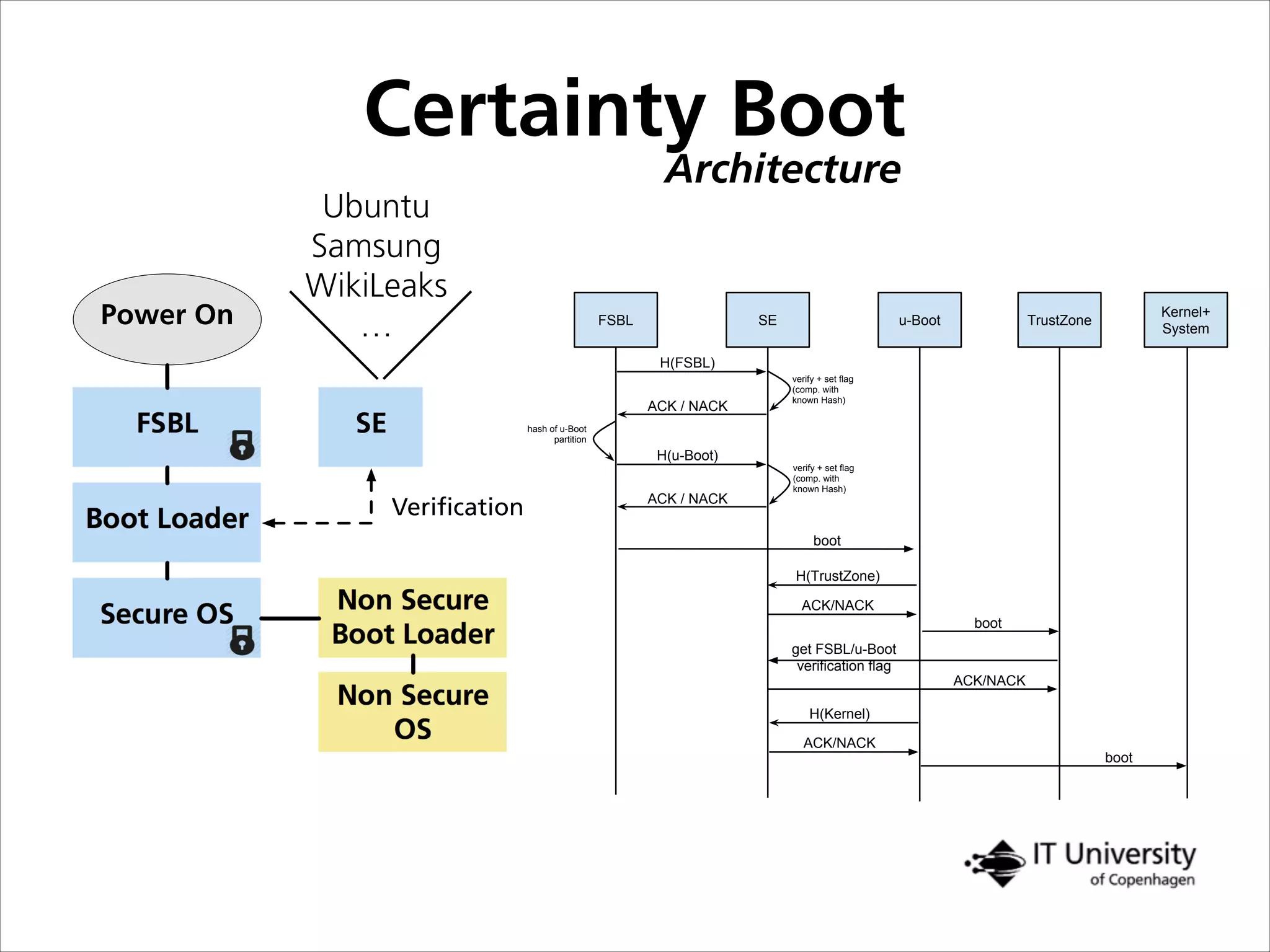
Certainty Boot
Power On
FSBL
Boot Loader
Secure OS Non Secure
Boot Loader
Non Secure
OS
SE
Verification
Ubuntu
Samsung
WikiLeaks
…
Architecture
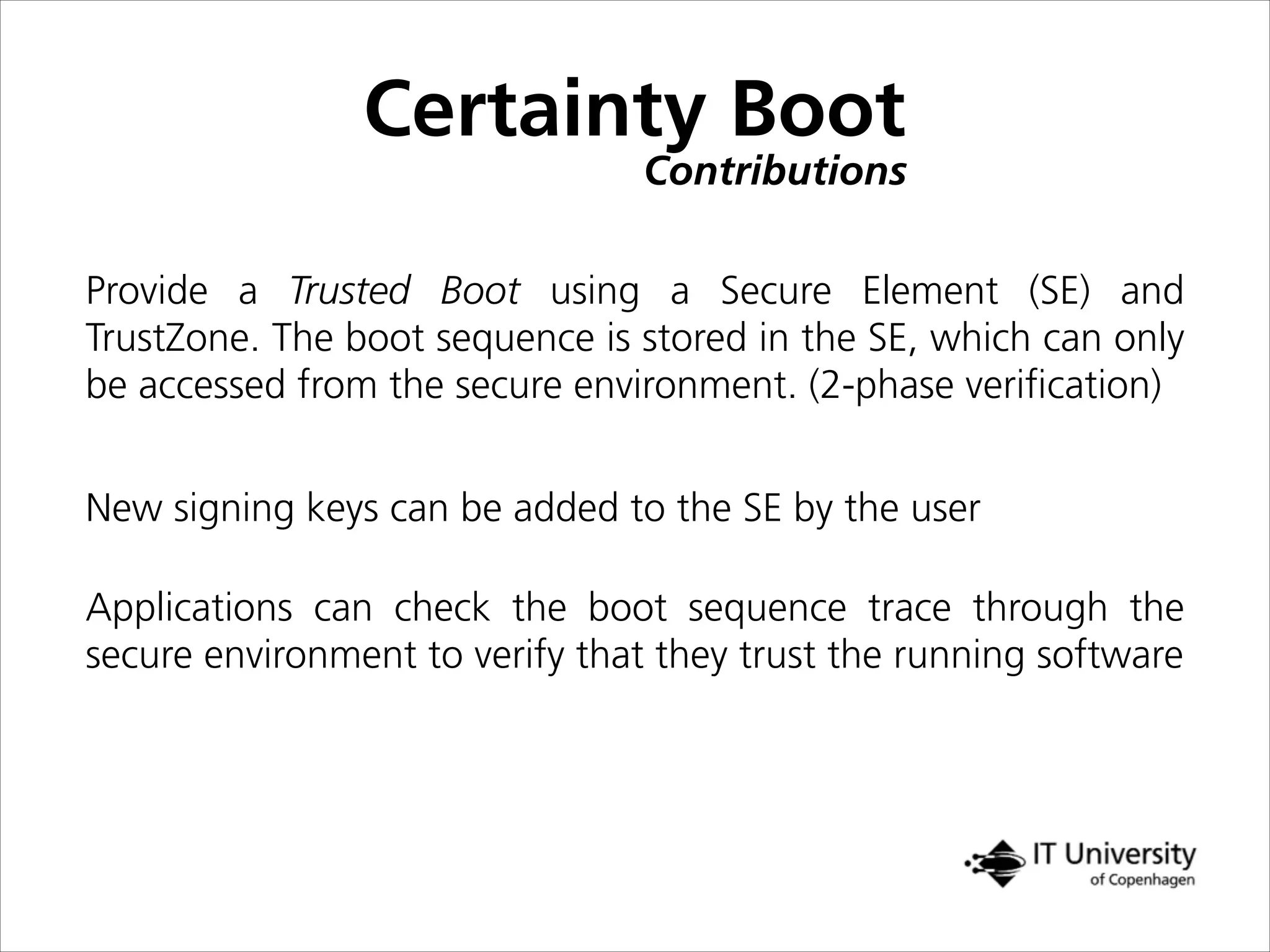
Certainty Boot
Contributions
New signing keys can be added to the SE by the user
Provide a Trusted Boot using a Secure Element (SE) and
TrustZone. The boot sequence is stored in the SE, which can only
be accessed from the secure environment. (2-phase verification)
Applications can check the boot sequence trace through the
secure environment to verify that they trust the running software
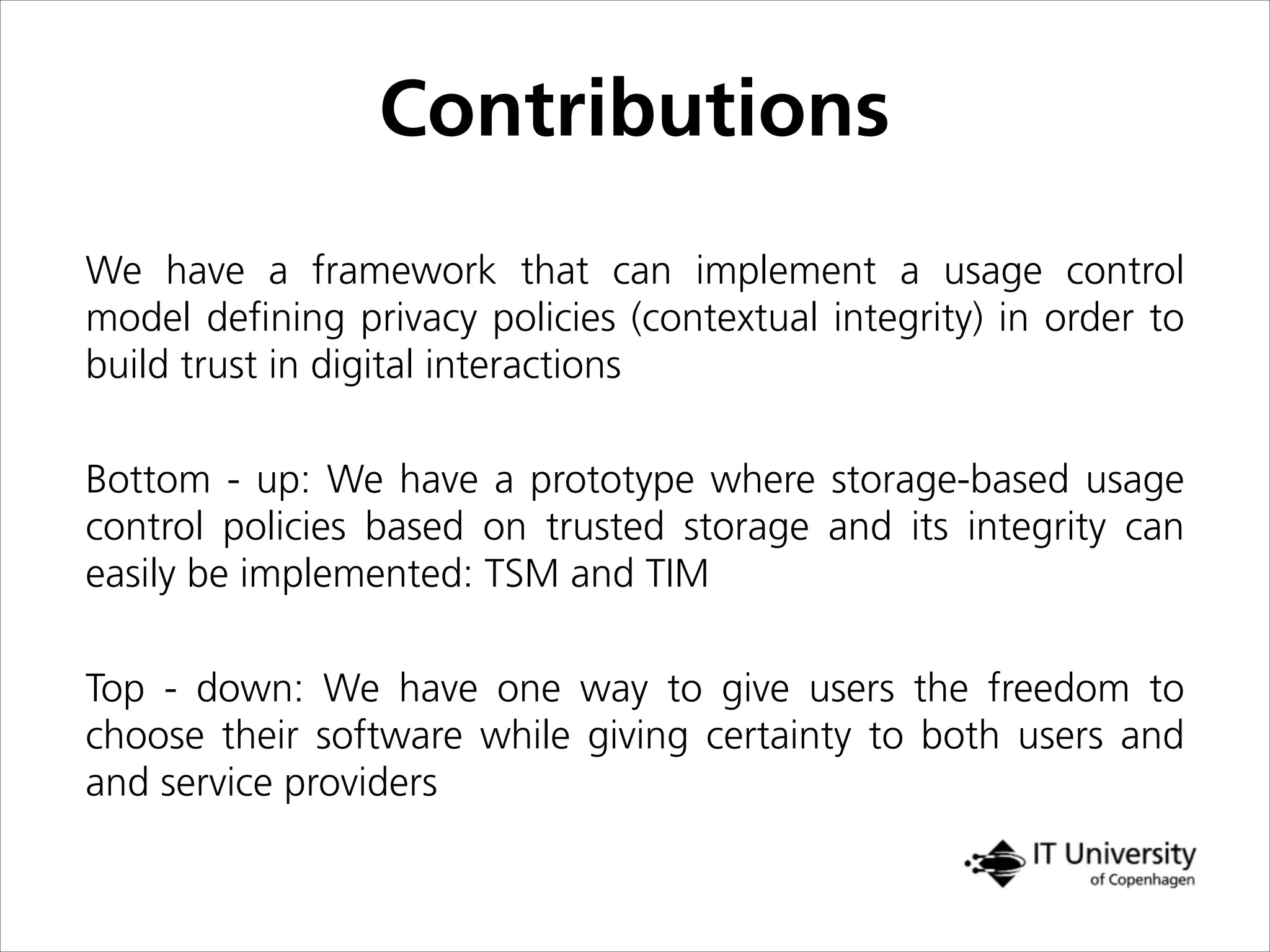
Contributions
We have a framework that can implement a usage control
model defining privacy policies (contextual integrity) in order to
build trust in digital interactions
Bottom - up: We have a prototype where storage-based usage
control policies based on trusted storage and its integrity can
easily be implemented: TSM and TIM
Top - down: We have one way to give users the freedom to
choose their software while giving certainty to both users and
and service providers
Building Trust Despite
Digital Personal Devices
Javier González - jgon@itu.dk
Philippe Bonnet - phbo@itu.dk
by
Javier González
OpenIT - 07.03.2014

Building Trust Despite Digital Personal Devices

  • 1.
    Building Trust Despite DigitalPersonal Devices Javier González - jgon@itu.dk Philippe Bonnet - phbo@itu.dk by Javier González OpenIT - 07.03.2014
  • 2.
    Users Service Providers PersonalDevices Personal Information Services ! Information Flow Distrust Digital Society mails passwords ssh-keys media content certificatespictures apps
  • 3.
  • 4.
  • 5.
    The social scienceviewpoint What are the social norms around privacy and personal data processing? How do they evolve in time? How do they evolve with respect to IT evolution? Getting beyond the lame meme - “Privacy is dead – deal with it” - “I’ve done nothing wrong, why should I care?” - “In Denmark, people are very trusting, so privacy is not an issue” !
  • 6.
    Contextual Integrity Helen Nissenbaum.Privacy in Context, 2010 Exchange/sharing of personal data is at the core of any social interaction - Privacy is not about “not sharing” personal data! Any social context (work, education, health, ...) defines – more or less explicitly – a social norm, i.e., an appropriate behaviour that is to be expected. Contextual integrity gives a framework to reason about the norms that apply, in a given social context, to the flows of personal data (i.e., information norms)
  • 7.
    Users Service Providers PersonalDevices Information Flow Digital Society Contextual Integrity
  • 8.
  • 9.
    UCONABC Jaehong Park andRavi Sandhu. The UCONabc usage control model. ACM Trans. Inf. Syst. Secur., 7(1):128–174, February 2004.
  • 10.
    Audit: a posterioricontrol of how rights were used Enforcement: a priori control of usage rights Formal Model Strong security Assumptions No implementation! Jaehong Park and Ravi Sandhu. The UCONabc usage control model. ACM Trans. Inf. Syst. Secur., 7(1):128–174, February 2004. Can model complex frameworks UCONABC
  • 11.
    Implementing UCONABC Sensitive Data UntrustedStorage Program Program Usage Control Access Control UCON Program root Security Perimeter beyond root domains
  • 12.
    Requirements UCONABC UCON needsto be implemented within a security perimeter protected by hardware so that attackers with root privileges cannot disable it using software. From inside the security perimeter it should be possible to “monitor” programs outside the security perimeter Communicating with programs in the security perimeter should entail a low overhead
  • 13.
    Secure Platforms Level of Protection Communication Execution Environment OnlySoftware Rich OS Rich OS + TEE SW and Tamper resistant HW Secure Ad-how OS Narrow Interfaces Very High Low Messages, Sockets, SM Software and Hardware Shared Memory Medium/High ARM TrustZone Examples Android, Linux, IOS, Windows IBM CryptoCards, TPM, Secure Token Normal Execution Environment Security Perimeter Monitor With Low Overhead Protected by HardwareAll Sorts of Applications Monitoring Applications
  • 14.
  • 15.
    ARM TrustZone Secure memory,rich memory and shared memory Secure acquisition/release of peripherals in runtime (e.g., ethernet, screen, flash) Gatekeeper - Context switch controlled by hardware (AMBA3) Shared processor
  • 16.
    Rich/Secure Abstraction Principle 1:Self preservation first. Under the suspicion of a threat, the secure environment isolates itself logically and gives up availability in order to protect data integrity, confidentiality and durability. Rich Environment Secure Environment Client Server User Space Kernel Space Secure Space Hardware root root HardwareSoftware Principle 2: Lead all communications. The secure environment defines all parameters that define this communication: protocol, certificates, encryption keys, etc. Principle 3: Secure all interactions. The secure area has priority to obtain exclusive access to secure peripherals.
  • 17.
    Building Trust Users havethe certainty that their sensitive information will not be misused by the software running in their devices. Service providers have the certainty that the devices interacting with their systems are not compromised Both should have the freedom to choose who they trust, and the technology should aid giving certainty, not enforcing
  • 18.
    Building Trust Protect datain secondary storage Monitor the integrity of the system Enforce usage policies Support different digital contexts
  • 19.
    Background Information Trusted StorageModule (TSM) A system providing trusted storage should guarantee data confidentiality, integrity, availability, and durability Today’s security policies rely on data encryption to support confidentiality and integrity. However, if encryption keys can be compromised or stolen on the client computer, then there is not much protection left. Approaches using tamper-resistant hardware: low functionality, physical separated, and narrow interfaces
  • 20.
    Thread Model Trusted StorageModule (TSM) Sensitive Data Untrusted Storage Program Program Malware root Memory Access to storage Access to memory Access to peripherals
  • 21.
    Trusted Storage Module(TSM) Architecture Rich Environment Secure Environment Data producer App Platform Independent Platform Dependent TSM CI Secure EnvironmentCI TSM Secure Module Tamper Resistant Unit Crypto Module for [i..n] Data Chunk (i) (ii) Storage (iii)(iv) Enc. DataEnc. Keys PDS (v) Enc. Data Metadata
  • 22.
    0 0.00375 0.00750 0.01125 0.01500 1KB 10KB 20KB50KB 100KB Time[s] Store&Object&in&Rich& Store&Object&in&Secure& Trusted Storage Module (TSM) Overhead
  • 23.
    Contributions Trusted Storage Module(TSM) Provide a mechanism for rich apps to store securely objects containing sensitive information introducing low overhead Provide a mechanism to enforce access control to the files storing those objects, i.e., encryption, secure memory and secure peripherals Use untrusted storage as a cheap and “unlimited” source of secondary storage
  • 24.
    Antifragile Storage Can welearn from successful attacks and improve, being better prepared for future attacks? Successful attacks (hardware and software) that do not entail the collapse of the system are good and welcome (if detectable), and even intentionally provoked The level of hardware tamper resistance is the upper boundary to which the system can benefit from being harmed How do we detect these attacks (e.g., traps, human intervention)? How to learn from them (e.g., AI, machine learning)? * Nassim Nicholas Taleb
  • 25.
    Trusted Integrity Module(TIM) Background Information Secondary storage is normally attacked. To survive a reboot or hide from system administrators, attackers make modifications to system files, line commands and system libraries. Running processed produce logs, which are accessible from users space (applications), and therefore can be tampered with. Storage-based integrity checks need to build on top of trusted storage (e.g., TSM)
  • 26.
    Architecture Trusted Integrity Module(TIM) Rich App GLIBC System-Call Interface (SCI) VFS file Obj dentry Obj inode Obj super-block Obj Dependencies Attributes SecureEnvironment CommunicationInterface open() close() read() write() flush() struct inode { ... uid_t //user id of owner did_t //group id of owner eid_t //environ. id of owner ... }; Platform Independent Platform Dependent UserSpaceKernelSpace Rich Environment Secure Environment cache FSn SEC. FILE SEC. FILE SEC. FILE VFS Trusted Extension dentry Obj inode Obj super-block Obj cache FSn Shared MemoryFS0 FS0 FSn FSn RICH FILE RICH FILE read / exec all all read nothing all all all VFS Metadata TIM ... CRYPTO hash(file) hash(inode) hash(dentry) TSM Dependencies Attributes secure file Obj sopen() sclose() sread() swrite() sflush() ... Tamper Resistant Unit TIMTSM FS0 FS0 FSn History Logs Transaction Logs Crypto Keys
  • 27.
    Contribution Trusted Integrity Module(TIM) TIM is in itself a storage-based Intrusion Detection System (IDS) without much less assumptions than current approaches Provide an architecture to guarantee the integrity of system files adding a low overhead to file system primitives Provide an method to log actions involving system files in trusted storage, preventing attackers to clean after themselves
  • 28.
    Next Steps Implement UCONon top of TIM to add complex usage control policies to secure file operations (i.e., enforcement, embedded behaviour, and audit) Extend TIM with a machine learning algorithm to learn from past attacks - antifrigility Exploring how to monitor running processes without introducing a big overhead. Ideas: Use of resources, peripherals, etc.
  • 29.
  • 30.
    Security today Users ServiceProviders ? DRM-like Secure Personal Devices Imposition Lock upDistrust Cyberactivism: -Software Freedom -Privacy -Anti Copyright ! * some - normally those involved in media content. * bypass
  • 31.
    Lockdown, Freedom, andCertainty Cory Doctorow. The Coming Civil War over General Purpose Computing Lockdown: “Your TPM comes with a set of signing keys it trusts, and unless your bootloader is signed by a TPM-trusted party, you can't run it. Moreover, since the bootloader determines which OS launches, you don't get to control the software in your machine.” Certainty: “You tell your TPM which signing keys you trust - say, Ubuntu, EFF, ACLU and Wikileaks - and it tells you whether the bootloaders it can find on your disk have been signed by any of those parties. It can faithfully report the signature on any other bootloaders it finds, and it lets you make up your own damn mind about whether you want to trust any or all of the above.” Freedom: “Android lets you tick a box to run any code you want.”
  • 32.
    Certainty Boot Power On FSBL BootLoader Secure OS Non Secure Boot Loader Non Secure OS SE Verification Ubuntu Samsung WikiLeaks … Architecture
  • 33.
    Certainty Boot Contributions New signingkeys can be added to the SE by the user Provide a Trusted Boot using a Secure Element (SE) and TrustZone. The boot sequence is stored in the SE, which can only be accessed from the secure environment. (2-phase verification) Applications can check the boot sequence trace through the secure environment to verify that they trust the running software
  • 34.
    Contributions We have aframework that can implement a usage control model defining privacy policies (contextual integrity) in order to build trust in digital interactions Bottom - up: We have a prototype where storage-based usage control policies based on trusted storage and its integrity can easily be implemented: TSM and TIM Top - down: We have one way to give users the freedom to choose their software while giving certainty to both users and and service providers
  • 35.
    Building Trust Despite DigitalPersonal Devices Javier González - jgon@itu.dk Philippe Bonnet - phbo@itu.dk by Javier González OpenIT - 07.03.2014