1
PRESENTATION ON PESHAWAR
PRESENTED BY
SOHAIL AHMAD
2
PESHAWAR: LOCATIONPESHAWAR: LOCATION
 Peshawar is the Capital of the North West Frontier
Province. Peshawar lies just west of the Bara
River, a tributary of the Kabul River, near the
Khyber Pass.
 Peshawar is bounded by Afghanistan to the west
and north, the territory of Jammu and Kashmir to
the northeast, Punjab province to the southeast,
and Balochistan province to the southwest.
3
 A major north-south road traverses the province,
and an east-west railway runs from the
Afghanistan border through Peshawar to Lahore in
Punjab province. A major airport is located in
Peshawar.
4
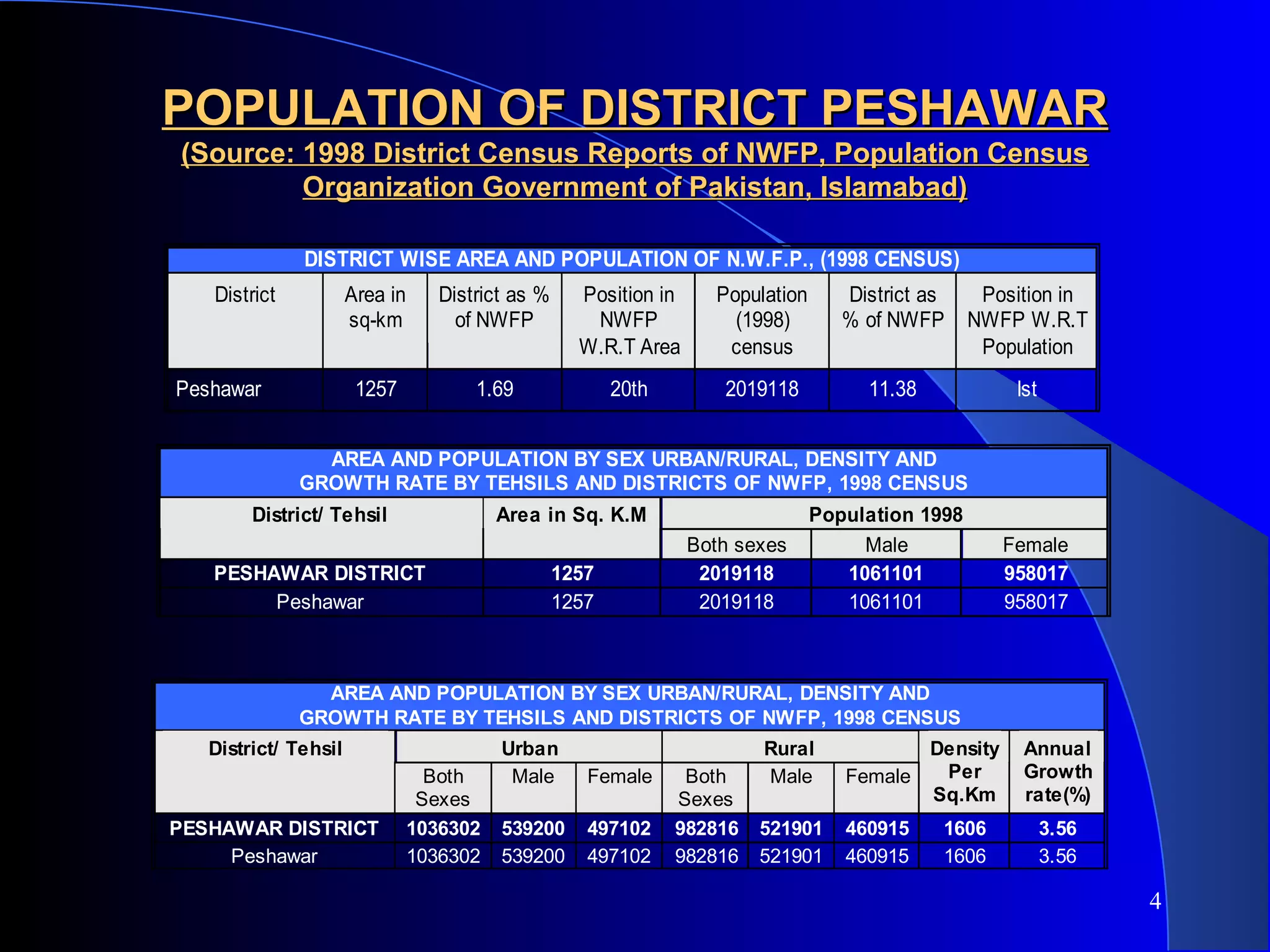
POPULATION OF DISTRICT PESHAWARPOPULATION OF DISTRICT PESHAWAR
(Source: 1998 District Census Reports of NWFP, Population Census(Source: 1998 District Census Reports of NWFP, Population Census
Organization Government of Pakistan, Islamabad)Organization Government of Pakistan, Islamabad)
DISTRICT WISE AREA AND POPULATION OF N.W.F.P., (1998 CENSUS)
District Area in
sq-km
District as %
of NWFP
Position in
NWFP
W.R.T Area
Population
(1998)
census
District as
% of NWFP
Position in
NWFP W.R.T
Population
Peshawar 1257 1.69 20th 2019118 11.38 Ist
AREA AND POPULATION BY SEX URBAN/RURAL, DENSITY AND
GROWTH RATE BY TEHSILS AND DISTRICTS OF NWFP, 1998 CENSUS
Population 1998District/ Tehsil Area in Sq. K.M
Both sexes Male Female
PESHAWAR DISTRICT 1257 2019118 1061101 958017
Peshawar 1257 2019118 1061101 958017
AREA AND POPULATION BY SEX URBAN/RURAL, DENSITY AND
GROWTH RATE BY TEHSILS AND DISTRICTS OF NWFP, 1998 CENSUS
Urban RuralDistrict/ Tehsil
Both
Sexes
Male Female Both
Sexes
Male Female
Density
Per
Sq.Km
Annual
Growth
rate(%)
PESHAWAR DISTRICT 1036302 539200 497102 982816 521901 460915 1606 3.56
Peshawar 1036302 539200 497102 982816 521901 460915 1606 3.56
5
PESHAWAR: HISTORYPESHAWAR: HISTORY
 The Shahji-ki Dheri mounds, situated to the east,
cover ruins of the largest Buddhist stupa in the
subcontinent (2nd century AD), which attest the
lengthy association of the town with Buddha and
the religion founded about him. Once the capital
of the ancient Buddhist kingdom of Gandhara, the
city was known variously as Parasawara and
Purusapura (town, or abode, of Purusa). Also
called Begram, the present name, Peshawar (pesh
awar, "frontier town"), is ascribed to Akbar, the
Mughal emperor of India (1556-1605).
6
 In ancient times, the state of Ghandhara occupied
the Vale of Peshawar and adjoining areas. This
kingdom was important because of its strategic
location at the eastern end of the Khyber Pass.
Gandhara was annexed by the Persian
Achaemenian Empire in the early 6th century BC
and remained a Persian satrapy until 327 BC. The
region then passed successively under Greek,
Indian, Indo-Bactrian, Sakan, Parthian, and
Kushan rule.
7
 Muslim rule was first brought to the region by the
Turks, whose ruler, Sebüktigin, gained control of
Peshawar in AD 988. His son, Mahmud of Ghazna,
invaded northern India several times between 1001
and 1027 and brought a large area of the present
province into the boundaries of his Ghaznavid
empire. Beginning in the late 12th century, the
region was held successively by the Ghurids, by
various Muslim Afghan dynasties, and then by the
Mughals. After the invasion of the Iranian ruler
Nadir Shah in 1738, the territory remained under a
loose form of Afghan Durrani rule. Beginning about
1818, invading Sikhs from the Punjab region of
India increasingly secured control of the frontier
territory until the coming of the British in 1849.
8
 The northwestern frontier areas were annexed to
India by the British after the Second Sikh War of
1849. The territories thenceforth formed a part of
the Punjab until the North-West Frontier Province
was created in 1901. After Pakistan attained
independence in 1947, the region continued to
exist as a separate Pakistani province. The
inhabitants of the tribal territories, the
westernmost area along the Afghanistan border,
are not subject to the Pakistani legal code,
however. During the 1980s the province was
inundated by Afghan refugees seeking asylum
from the Soviet occupation of their country.
9
PESHAWAR: CULTURAL HIGHLIGHTSPESHAWAR: CULTURAL HIGHLIGHTS
 The Inner City of Peshawar (historically a Walled
City) is quite lively.
 Traditionally hospitable and serves as a meeting
place for traders.
 Meeting point for various lingual groups from all
across the Province.
 Culture reflected in mannerisms and food
preferences.
10
PESHAWAR: ARCHITECTURALPESHAWAR: ARCHITECTURAL
HIGHLIGHTSHIGHLIGHTS
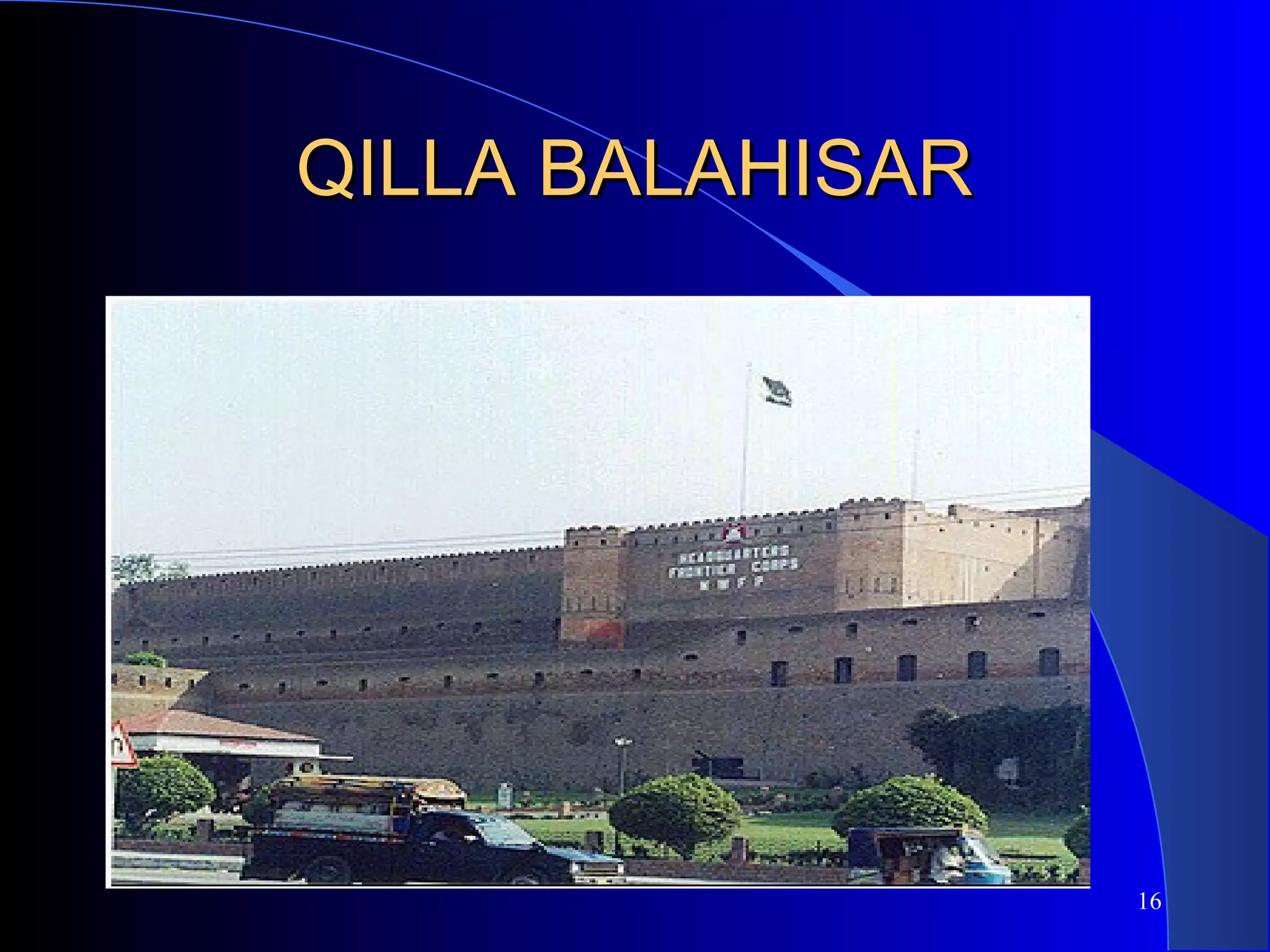
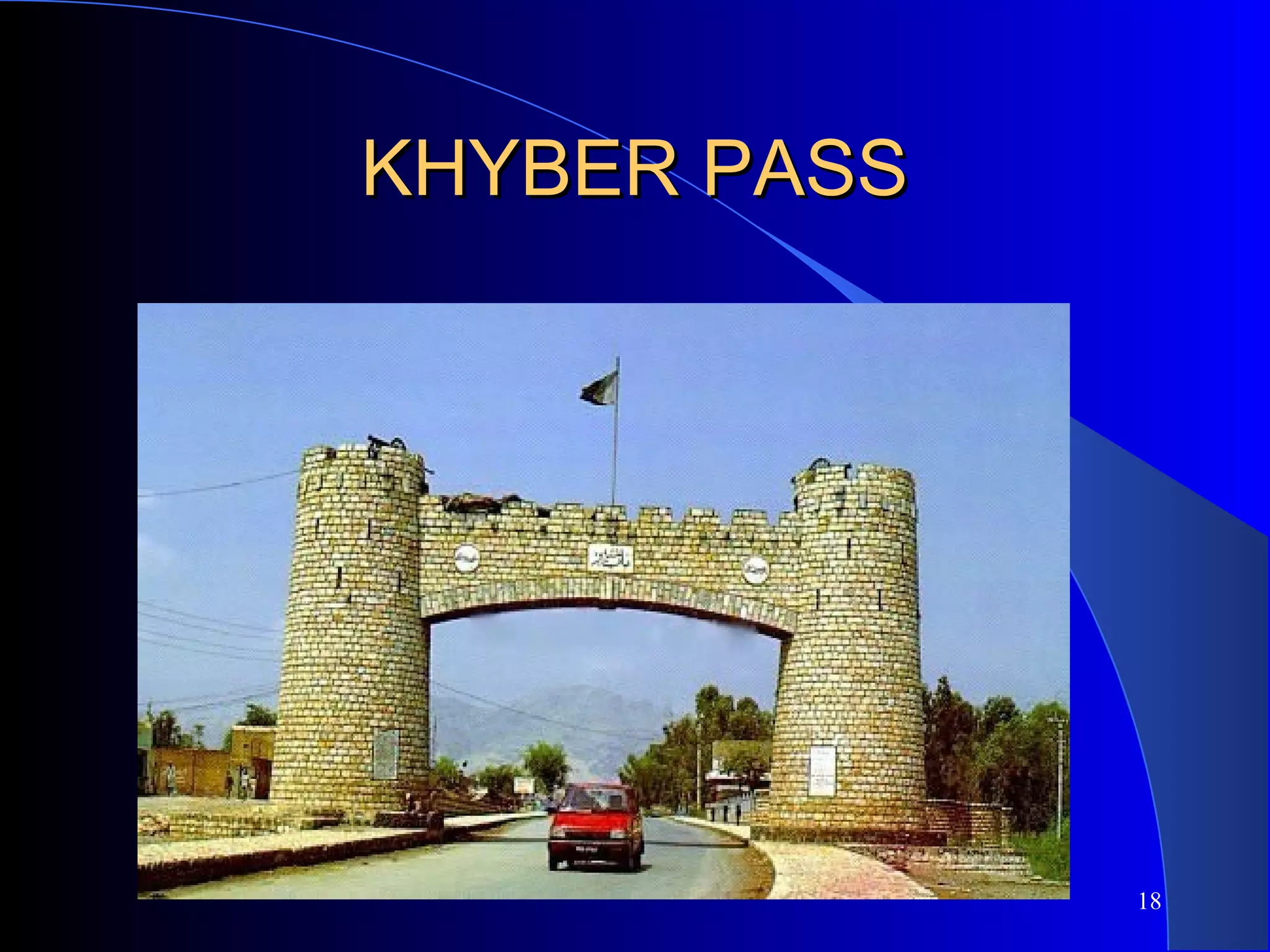
 Khyber Pass.
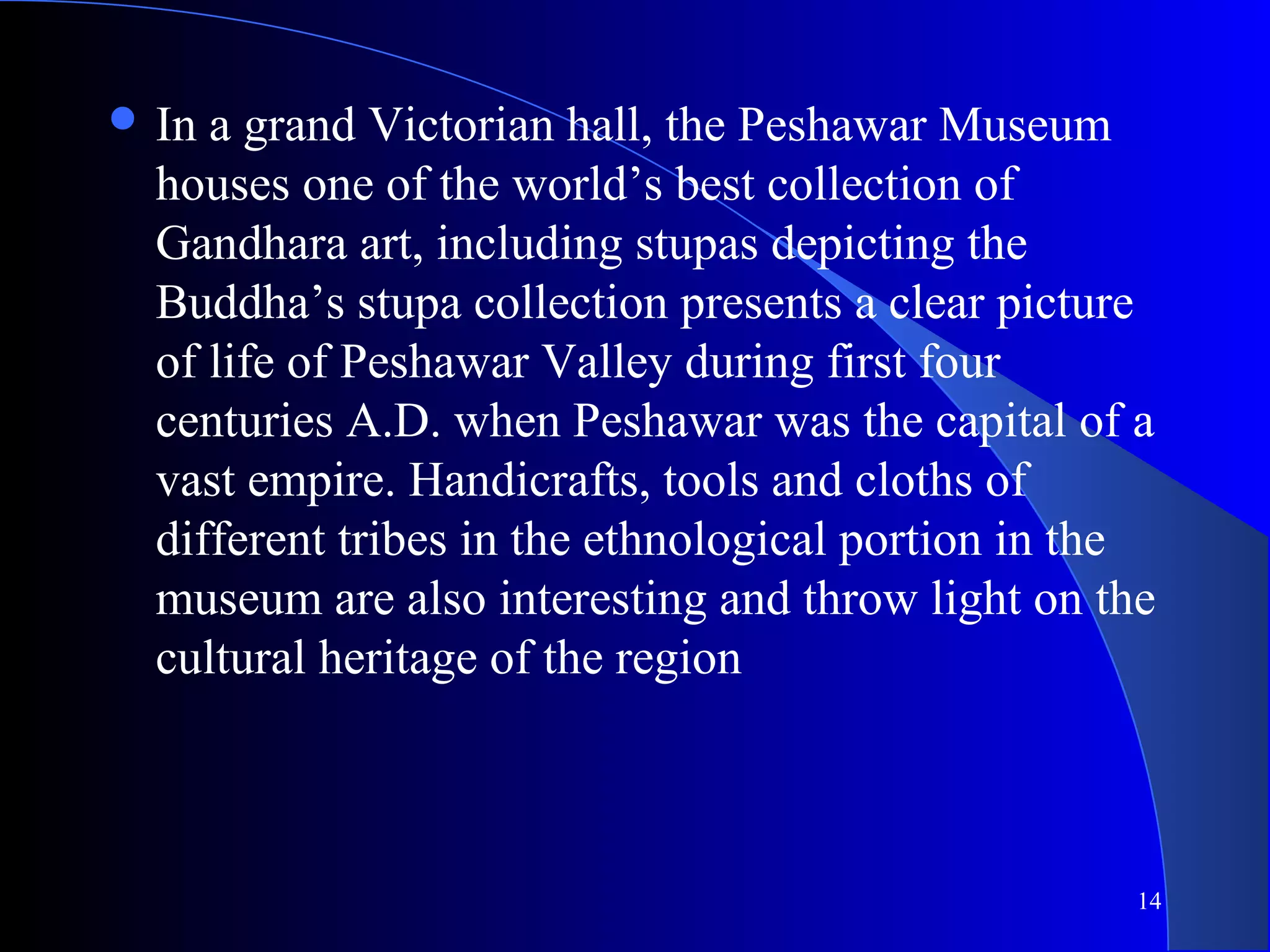
 Fort of Peshawar known as Bala-Hisar (the High
Fort).
 Zaheer-ud-Din Babur crossed the Khyber Pass in
the Sixteen Century on his way from Kabul, and
ordered to strengthen the Fort.
 Presently Bala-Hisar fort houses headquarters of a
prestigious Frontier Corps.
11
 The Mosque Mahabat Khan, Peshawar’s
outstanding architecture legacy, in Jeweller’s
Bazar was constructed by the Governor of
Peshawar Mahabat Khan Mirza Lerharsib, in 1630
during the era of the Mughal Emperor Shah Jehan.
The Mosque was desecrated and badly damaged
by the Sikhs in early nineteen century and later
when the fire broke out in 1898. The British
renovated it for the first time and brought back
some of its grandeur.
12
 Chowk Yadgar, is located in the amidst of wide
and sprawling convergence point of different
major roads and bazaars of the city.
Commemorative square was originally named in
the memory of British Colonel Hastings. In 1969,
the square was dedicated to the heroes of 1965
Indo-Pakistan war.
 Edward’s College was established in 1901 and
named in the memory of famous administrative Sir
Herbert Edward as missionary boarding school.
13
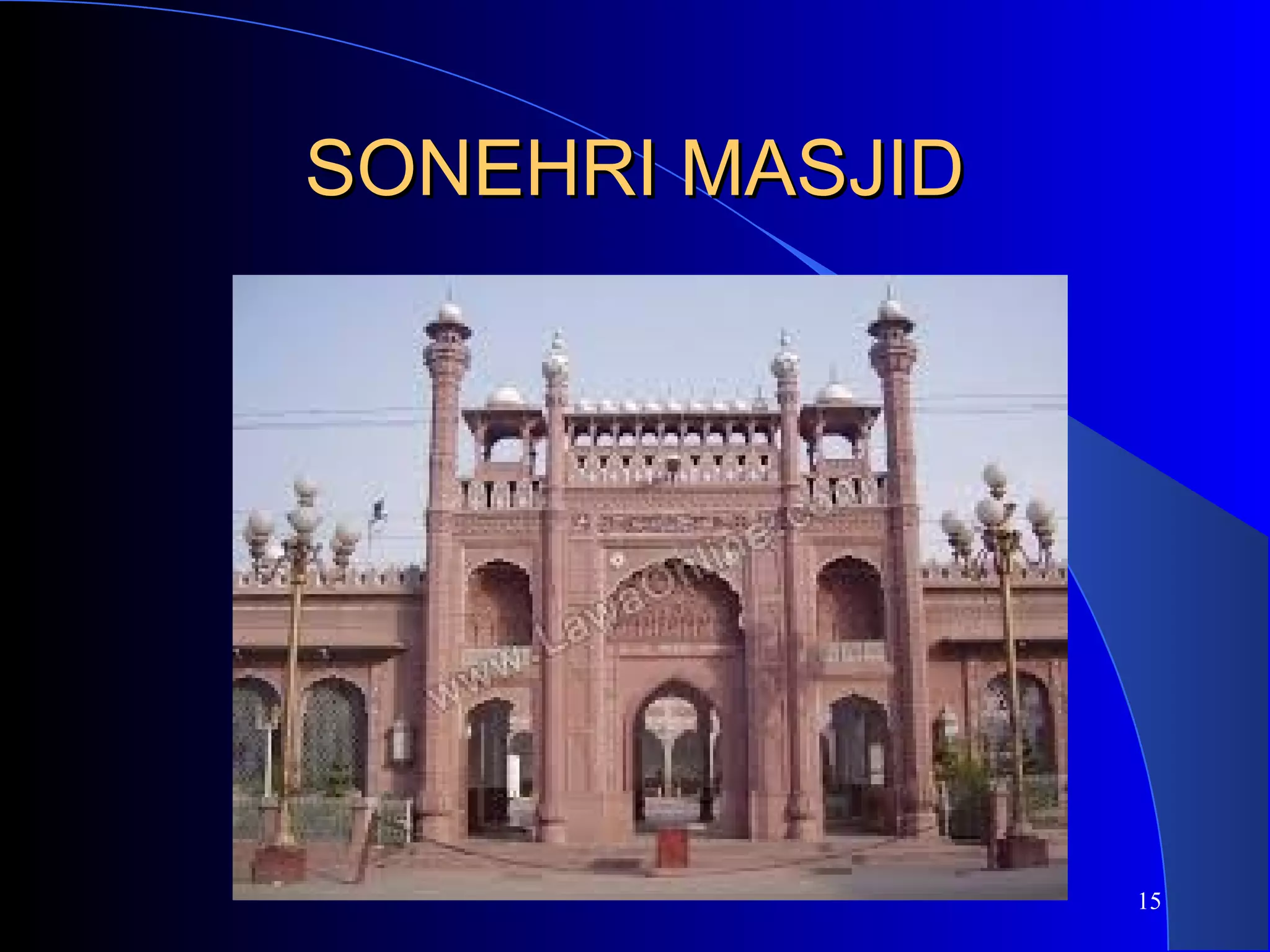
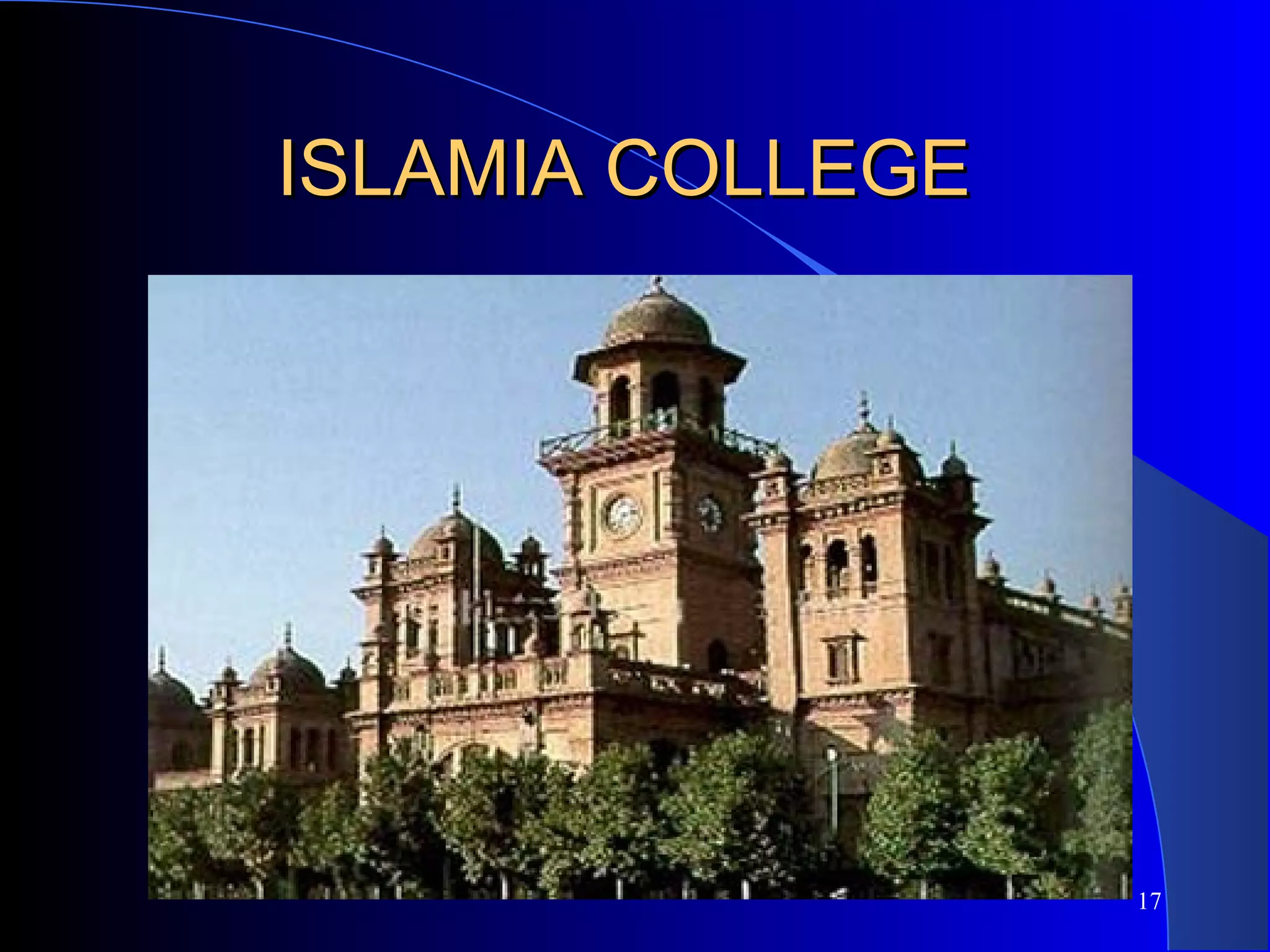
 The foundation of Islamia college was laid in
1911. The college has magnificent frontage facing
Jamrud Road with its domes, kiosks and pinnacles
rising above the green trees, which contrast
sharply with red brick ornate building. The
architectural taste is peculiarly of Mughal with a
touch of colonial style. Three domed mosque
adjacent to the college is also of artistic pleasure.
 Cosmopolitan character of Qissa Khawani Bazaar-
Piccadilly of Peshawar is lined with its traditional
kehwa khanas, Tikka, Chapli Kabab and dry fruit
shops along with modern show rooms of leather
ware and bright coloured garments
14
 In a grand Victorian hall, the Peshawar Museum
houses one of the world’s best collection of
Gandhara art, including stupas depicting the
Buddha’s stupa collection presents a clear picture
of life of Peshawar Valley during first four
centuries A.D. when Peshawar was the capital of a
vast empire. Handicrafts, tools and cloths of
different tribes in the ethnological portion in the
museum are also interesting and throw light on the
cultural heritage of the region
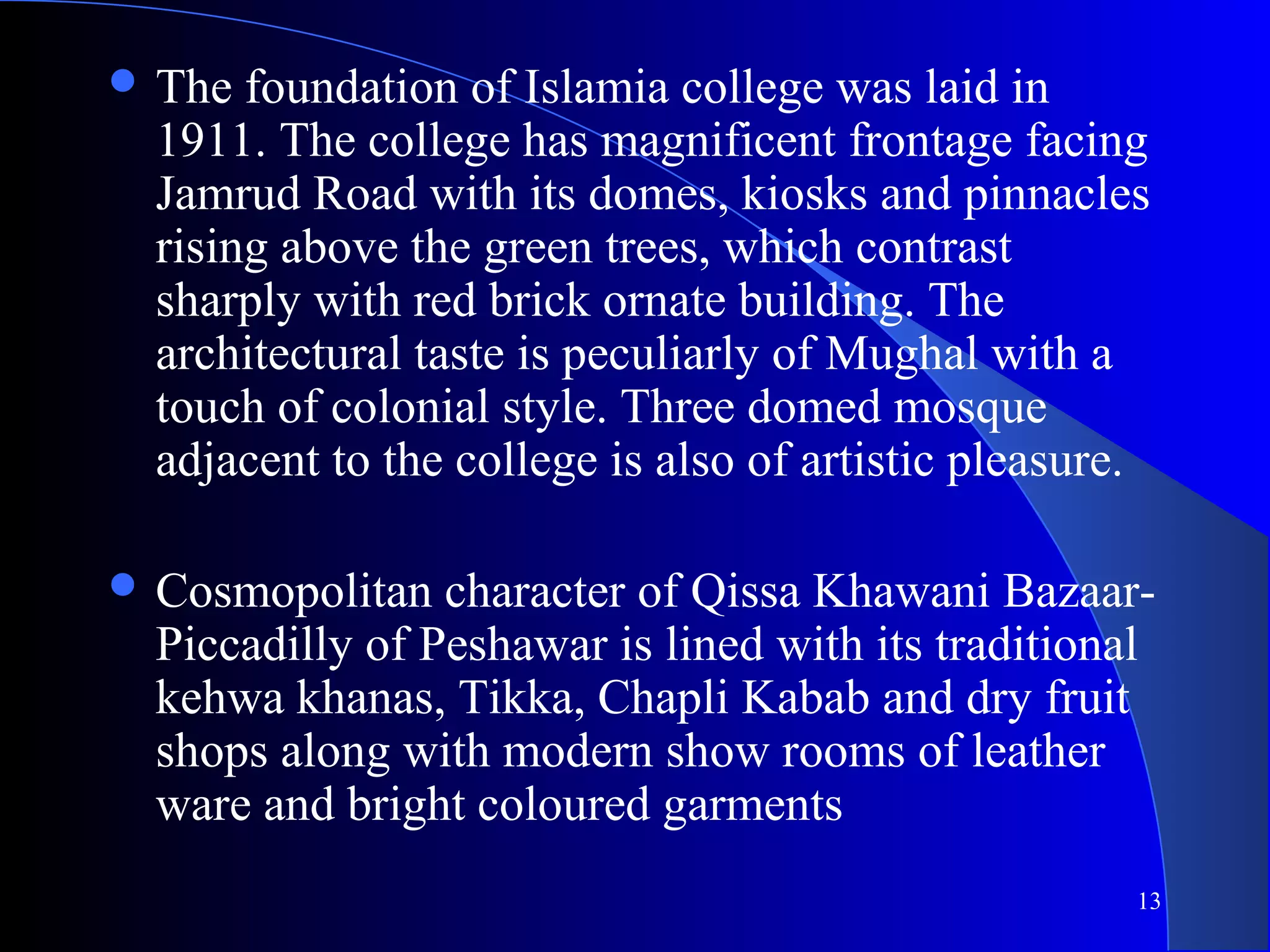
SONEHRI MASJIDSONEHRI MASJID
15
QILLA BALAHISARQILLA BALAHISAR
16
ISLAMIA COLLEGEISLAMIA COLLEGE
17
KHYBER PASSKHYBER PASS
18

Peshawar

  • 1.
  • 2.
    2 PESHAWAR: LOCATIONPESHAWAR: LOCATION Peshawar is the Capital of the North West Frontier Province. Peshawar lies just west of the Bara River, a tributary of the Kabul River, near the Khyber Pass.  Peshawar is bounded by Afghanistan to the west and north, the territory of Jammu and Kashmir to the northeast, Punjab province to the southeast, and Balochistan province to the southwest.
  • 3.
    3  A majornorth-south road traverses the province, and an east-west railway runs from the Afghanistan border through Peshawar to Lahore in Punjab province. A major airport is located in Peshawar.
  • 4.
    4 POPULATION OF DISTRICTPESHAWARPOPULATION OF DISTRICT PESHAWAR (Source: 1998 District Census Reports of NWFP, Population Census(Source: 1998 District Census Reports of NWFP, Population Census Organization Government of Pakistan, Islamabad)Organization Government of Pakistan, Islamabad) DISTRICT WISE AREA AND POPULATION OF N.W.F.P., (1998 CENSUS) District Area in sq-km District as % of NWFP Position in NWFP W.R.T Area Population (1998) census District as % of NWFP Position in NWFP W.R.T Population Peshawar 1257 1.69 20th 2019118 11.38 Ist AREA AND POPULATION BY SEX URBAN/RURAL, DENSITY AND GROWTH RATE BY TEHSILS AND DISTRICTS OF NWFP, 1998 CENSUS Population 1998District/ Tehsil Area in Sq. K.M Both sexes Male Female PESHAWAR DISTRICT 1257 2019118 1061101 958017 Peshawar 1257 2019118 1061101 958017 AREA AND POPULATION BY SEX URBAN/RURAL, DENSITY AND GROWTH RATE BY TEHSILS AND DISTRICTS OF NWFP, 1998 CENSUS Urban RuralDistrict/ Tehsil Both Sexes Male Female Both Sexes Male Female Density Per Sq.Km Annual Growth rate(%) PESHAWAR DISTRICT 1036302 539200 497102 982816 521901 460915 1606 3.56 Peshawar 1036302 539200 497102 982816 521901 460915 1606 3.56
  • 5.
    5 PESHAWAR: HISTORYPESHAWAR: HISTORY The Shahji-ki Dheri mounds, situated to the east, cover ruins of the largest Buddhist stupa in the subcontinent (2nd century AD), which attest the lengthy association of the town with Buddha and the religion founded about him. Once the capital of the ancient Buddhist kingdom of Gandhara, the city was known variously as Parasawara and Purusapura (town, or abode, of Purusa). Also called Begram, the present name, Peshawar (pesh awar, "frontier town"), is ascribed to Akbar, the Mughal emperor of India (1556-1605).
  • 6.
    6  In ancienttimes, the state of Ghandhara occupied the Vale of Peshawar and adjoining areas. This kingdom was important because of its strategic location at the eastern end of the Khyber Pass. Gandhara was annexed by the Persian Achaemenian Empire in the early 6th century BC and remained a Persian satrapy until 327 BC. The region then passed successively under Greek, Indian, Indo-Bactrian, Sakan, Parthian, and Kushan rule.
  • 7.
    7  Muslim rulewas first brought to the region by the Turks, whose ruler, Sebüktigin, gained control of Peshawar in AD 988. His son, Mahmud of Ghazna, invaded northern India several times between 1001 and 1027 and brought a large area of the present province into the boundaries of his Ghaznavid empire. Beginning in the late 12th century, the region was held successively by the Ghurids, by various Muslim Afghan dynasties, and then by the Mughals. After the invasion of the Iranian ruler Nadir Shah in 1738, the territory remained under a loose form of Afghan Durrani rule. Beginning about 1818, invading Sikhs from the Punjab region of India increasingly secured control of the frontier territory until the coming of the British in 1849.
  • 8.
    8  The northwesternfrontier areas were annexed to India by the British after the Second Sikh War of 1849. The territories thenceforth formed a part of the Punjab until the North-West Frontier Province was created in 1901. After Pakistan attained independence in 1947, the region continued to exist as a separate Pakistani province. The inhabitants of the tribal territories, the westernmost area along the Afghanistan border, are not subject to the Pakistani legal code, however. During the 1980s the province was inundated by Afghan refugees seeking asylum from the Soviet occupation of their country.
  • 9.
    9 PESHAWAR: CULTURAL HIGHLIGHTSPESHAWAR:CULTURAL HIGHLIGHTS  The Inner City of Peshawar (historically a Walled City) is quite lively.  Traditionally hospitable and serves as a meeting place for traders.  Meeting point for various lingual groups from all across the Province.  Culture reflected in mannerisms and food preferences.
  • 10.
    10 PESHAWAR: ARCHITECTURALPESHAWAR: ARCHITECTURAL HIGHLIGHTSHIGHLIGHTS Khyber Pass.  Fort of Peshawar known as Bala-Hisar (the High Fort).  Zaheer-ud-Din Babur crossed the Khyber Pass in the Sixteen Century on his way from Kabul, and ordered to strengthen the Fort.  Presently Bala-Hisar fort houses headquarters of a prestigious Frontier Corps.
  • 11.
    11  The MosqueMahabat Khan, Peshawar’s outstanding architecture legacy, in Jeweller’s Bazar was constructed by the Governor of Peshawar Mahabat Khan Mirza Lerharsib, in 1630 during the era of the Mughal Emperor Shah Jehan. The Mosque was desecrated and badly damaged by the Sikhs in early nineteen century and later when the fire broke out in 1898. The British renovated it for the first time and brought back some of its grandeur.
  • 12.
    12  Chowk Yadgar,is located in the amidst of wide and sprawling convergence point of different major roads and bazaars of the city. Commemorative square was originally named in the memory of British Colonel Hastings. In 1969, the square was dedicated to the heroes of 1965 Indo-Pakistan war.  Edward’s College was established in 1901 and named in the memory of famous administrative Sir Herbert Edward as missionary boarding school.
  • 13.
    13  The foundationof Islamia college was laid in 1911. The college has magnificent frontage facing Jamrud Road with its domes, kiosks and pinnacles rising above the green trees, which contrast sharply with red brick ornate building. The architectural taste is peculiarly of Mughal with a touch of colonial style. Three domed mosque adjacent to the college is also of artistic pleasure.  Cosmopolitan character of Qissa Khawani Bazaar- Piccadilly of Peshawar is lined with its traditional kehwa khanas, Tikka, Chapli Kabab and dry fruit shops along with modern show rooms of leather ware and bright coloured garments
  • 14.
    14  In agrand Victorian hall, the Peshawar Museum houses one of the world’s best collection of Gandhara art, including stupas depicting the Buddha’s stupa collection presents a clear picture of life of Peshawar Valley during first four centuries A.D. when Peshawar was the capital of a vast empire. Handicrafts, tools and cloths of different tribes in the ethnological portion in the museum are also interesting and throw light on the cultural heritage of the region
  • 15.
  • 16.
  • 17.
  • 18.