The Social Web:  Why The New Web Matters     Stowe Boyd
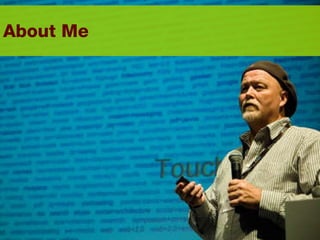
About Me
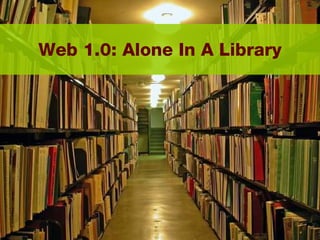
Web 1.0: Alone In A Library
Web 2.0: Global Village
The Edge Is What Matters,  And It’s All Edge Social Media
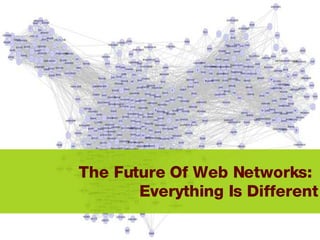
The Future Of Web Networks:  Everything Is Different
Four Deep Paradoxes
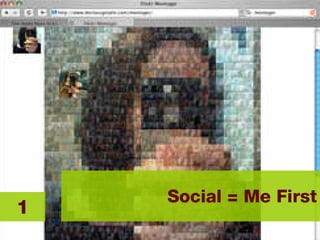
Social = Me First 1
The Web Is No Democracy,  But It’s Not A Hierarchy 2
It’s Shallow  At The Deep End Of The Pool 3
Time Is Relative,  Velocity Is Visceral:  The Web Of Flow 4
The Social Revolution:  Why Business Will Care
[ from  Edglings: A Well-Ordered Humanism and The Future Of Everything]  Decentralized, Enigmatic Centralized, Dogmatic Spirituality Restorative, Sustainable Exploitative, Unsustainable Environmental Participative Mainstream Media Glocalism Nationalism Political Scope Post-Nuclear (Tribal) Nuclear Family Networks Hierarchies Belonging Subjective, Partial Objective, Impartial Point of View Bottom Up, Egalitarian Top Down, Authoritarian Work and Politics Edglings Centroids
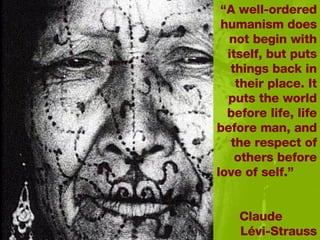
“ A well-ordered humanism does not begin with itself, but puts things back in their place. It puts the world before life, life before man, and the respect of others before love of self.”  Claude  L évi-Strauss
The Social Web:  Why The New Web Matters     Stowe Boyd credits https://stoweboyd.backpackit.com/pub/1477530

The Social Web: Why The New Web Matters

  • 1.
    The Social Web: Why The New Web Matters Stowe Boyd
  • 2.
  • 3.
    Web 1.0: AloneIn A Library
  • 4.
  • 5.
    The Edge IsWhat Matters, And It’s All Edge Social Media
  • 6.
    The Future OfWeb Networks: Everything Is Different
  • 7.
  • 8.
    Social = MeFirst 1
  • 9.
    The Web IsNo Democracy, But It’s Not A Hierarchy 2
  • 10.
    It’s Shallow At The Deep End Of The Pool 3
  • 11.
    Time Is Relative, Velocity Is Visceral: The Web Of Flow 4
  • 12.
    The Social Revolution: Why Business Will Care
  • 13.
    [ from Edglings: A Well-Ordered Humanism and The Future Of Everything] Decentralized, Enigmatic Centralized, Dogmatic Spirituality Restorative, Sustainable Exploitative, Unsustainable Environmental Participative Mainstream Media Glocalism Nationalism Political Scope Post-Nuclear (Tribal) Nuclear Family Networks Hierarchies Belonging Subjective, Partial Objective, Impartial Point of View Bottom Up, Egalitarian Top Down, Authoritarian Work and Politics Edglings Centroids
  • 14.
    “ A well-orderedhumanism does not begin with itself, but puts things back in their place. It puts the world before life, life before man, and the respect of others before love of self.” Claude L évi-Strauss
  • 15.
    The Social Web: Why The New Web Matters Stowe Boyd credits https://stoweboyd.backpackit.com/pub/1477530

Editor's Notes

  • #2 What is the web worth? How would you go about valuing it, if you had to? Is it worth all the tea in china? If Google wanted to buy the whole thing, what would it cost? Every blog post, spam comment, Wikipedia entry, and hyperlink: what would we charge if Martians arrived and wanted to buy it? The hardware involved is incalculable, and no reliable numbers exist. We can’t even begin to estimate how much we have spent on it. IDC calculated that 27 million servers had been deployed by the end of 2005, growing at an increasing rate of 3 or more million per year. Some have estimated that something on the order of 8 B USD was spent powering the servers alone, worldwide. This was about the same as we spend for powering televisions, globally, and growing much faster. On a crude level, we might compare it to television, which is telling. In the US, every hour that people spend online, is an hour not spent watching television. But this transcends an advertising-based valuation of clicks and eyeballs, because the web is not being created like television shows: it’s not being developed by hollywood. It is being built by us, for us. And it is being built without blueprints, without any centralized approval, without even any general agreement on what it is for. The big story of the web isn't the props - the servers, networks, ten trillion web sites, and all the information lying around in databases and in HTML - but what people are saying to each other and how we have been changed as a result. We are creating the Web to happen to ourselves.