Configuring Electronic Health Records
Building Order Sets
This material (Comp 11 Unit 4) was developed by Oregon Health & Science University, funded by the
Department of Health and Human Services, Office of the National Coordinator for Health Information
Technology under Award Number 90WT0001.
This work is licensed under the Creative Commons Attribution-NonCommercial-ShareAlike 4.0 International
License. To view a copy of this license, visit http://creativecommons.org/licenses/by-nc-sa/4.0/.
Definition
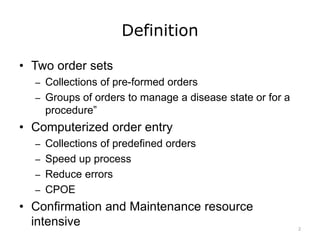
• Two order sets
– Collections of pre-formed orders
– Groups of orders to manage a disease state or for a
procedure”
• Computerized order entry
– Collections of predefined orders
– Speed up process
– Reduce errors
– CPOE
• Confirmation and Maintenance resource
intensive 2
Benefits
• Implements evidence based clinical
knowledge
• Reduces errors and improves quality of
care
• Reduces variability in health care
processes
• Improves efficiency
3
Costs
• Time consuming
• Requires expertise
• Must be maintained (reviewed to
incorporate most current research)
4
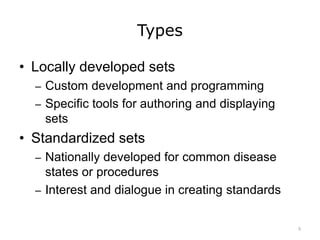
Types
• Locally developed sets
– Custom development and programming
– Specific tools for authoring and displaying
sets
• Standardized sets
– Nationally developed for common disease
states or procedures
– Interest and dialogue in creating standards
5
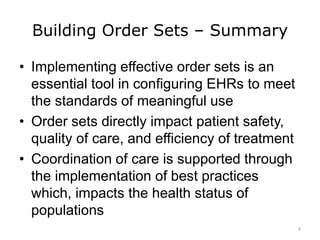
Building Order Sets – Summary
• Implementing effective order sets is an
essential tool in configuring EHRs to meet
the standards of meaningful use
• Order sets directly impact patient safety,
quality of care, and efficiency of treatment
• Coordination of care is supported through
the implementation of best practices
which, impacts the health status of
populations
6
Building Order Sets
References - 1
References
Amatayakul MK. Electronic health records: A practical guide for professionals and
organizations. 4th ed. Chicago IL: AHIMA; 2009.
Ash, Joan S., Stavri, P Zoë, Kuperman, Gilad J . The Practice of Informatics: Synthesis of
Research Paper: A Consensus Statement on Considerations for a Successful CPOE
Implementation . J Am Med Inform Assoc 2003;10:229-234 doi:10.1197/jamia.M1204
Bobb, Anne M., Payne, Thomas H., Gross, Peter A . Focus on Computerized Provider
Order Entry (CPOE): Viewpoint Paper: Viewpoint: Controversies Surrounding Use of
Order Sets for Clinical Decision Support in Computerized Provider Order Entry. J Am
Med Inform Assoc 2007;14:41-47 doi:10.1197/jamia.M2184.
Carter JH. Electronic health records: A guide for clinicians and administrators. 2nd ed.
Philadelphia: ACP Press; 2008.
Eichenwald Maki S, Petterson B. Using the electronic health record. Canada: Delmar
Cengage Learning; 2008.
Hebda T, Czar P. Handbook of informatics for nurses & healthcare professionals. 4th ed.
New Jersey: Pearson; 2009.
7
Building Order Sets
References - 2
References
Lehman HP, Abbot PA, Roderer NK, Rothschild A, Mandell SF, Ferrer JA, et al, editors.
Aspects of electronic health record systems. U.S.A: Springer; 2006.
McClay JC, Campbell JR, Parker C, Hrabak K, Tu SW, Abarbanel R./AMIA. Structuring
order sets for interoperable distribution [article on the internet]. C2006. Available
from: http://www.ncbi.nlm.nih.gov/pmc/articles/PMC1839584/.
Sheff R./ HCPro. Medical informatics: order sets are a medical staff leader’s best friend.
(July 22, 2009). Medical Staff Leader Insider. 30.
8
Configuring Electronic
Health Records
Building Order Sets
This material was developed by Oregon
Health & Science University, funded by the
Department of Health and Human Services,
Office of the National Coordinator for Health
Information Technology under Award
Number 90WT0001.
9

Building Order Sets

  • 1.
    Configuring Electronic HealthRecords Building Order Sets This material (Comp 11 Unit 4) was developed by Oregon Health & Science University, funded by the Department of Health and Human Services, Office of the National Coordinator for Health Information Technology under Award Number 90WT0001. This work is licensed under the Creative Commons Attribution-NonCommercial-ShareAlike 4.0 International License. To view a copy of this license, visit http://creativecommons.org/licenses/by-nc-sa/4.0/.
  • 2.
    Definition • Two ordersets – Collections of pre-formed orders – Groups of orders to manage a disease state or for a procedure” • Computerized order entry – Collections of predefined orders – Speed up process – Reduce errors – CPOE • Confirmation and Maintenance resource intensive 2
  • 3.
    Benefits • Implements evidencebased clinical knowledge • Reduces errors and improves quality of care • Reduces variability in health care processes • Improves efficiency 3
  • 4.
    Costs • Time consuming •Requires expertise • Must be maintained (reviewed to incorporate most current research) 4
  • 5.
    Types • Locally developedsets – Custom development and programming – Specific tools for authoring and displaying sets • Standardized sets – Nationally developed for common disease states or procedures – Interest and dialogue in creating standards 5
  • 6.
    Building Order Sets– Summary • Implementing effective order sets is an essential tool in configuring EHRs to meet the standards of meaningful use • Order sets directly impact patient safety, quality of care, and efficiency of treatment • Coordination of care is supported through the implementation of best practices which, impacts the health status of populations 6
  • 7.
    Building Order Sets References- 1 References Amatayakul MK. Electronic health records: A practical guide for professionals and organizations. 4th ed. Chicago IL: AHIMA; 2009. Ash, Joan S., Stavri, P Zoë, Kuperman, Gilad J . The Practice of Informatics: Synthesis of Research Paper: A Consensus Statement on Considerations for a Successful CPOE Implementation . J Am Med Inform Assoc 2003;10:229-234 doi:10.1197/jamia.M1204 Bobb, Anne M., Payne, Thomas H., Gross, Peter A . Focus on Computerized Provider Order Entry (CPOE): Viewpoint Paper: Viewpoint: Controversies Surrounding Use of Order Sets for Clinical Decision Support in Computerized Provider Order Entry. J Am Med Inform Assoc 2007;14:41-47 doi:10.1197/jamia.M2184. Carter JH. Electronic health records: A guide for clinicians and administrators. 2nd ed. Philadelphia: ACP Press; 2008. Eichenwald Maki S, Petterson B. Using the electronic health record. Canada: Delmar Cengage Learning; 2008. Hebda T, Czar P. Handbook of informatics for nurses & healthcare professionals. 4th ed. New Jersey: Pearson; 2009. 7
  • 8.
    Building Order Sets References- 2 References Lehman HP, Abbot PA, Roderer NK, Rothschild A, Mandell SF, Ferrer JA, et al, editors. Aspects of electronic health record systems. U.S.A: Springer; 2006. McClay JC, Campbell JR, Parker C, Hrabak K, Tu SW, Abarbanel R./AMIA. Structuring order sets for interoperable distribution [article on the internet]. C2006. Available from: http://www.ncbi.nlm.nih.gov/pmc/articles/PMC1839584/. Sheff R./ HCPro. Medical informatics: order sets are a medical staff leader’s best friend. (July 22, 2009). Medical Staff Leader Insider. 30. 8
  • 9.
    Configuring Electronic Health Records BuildingOrder Sets This material was developed by Oregon Health & Science University, funded by the Department of Health and Human Services, Office of the National Coordinator for Health Information Technology under Award Number 90WT0001. 9

Editor's Notes

  • #2 Welcome to Configuring Electronic Health Records: Building Order Sets. The component, Configuring Electronic Health Records, provides a practical experience with a laboratory component (utilizing the VistA for Education program) that will address approaches to assessing, selecting, and configuring Electronic Health Records (EHRs) to meet the specific needs of customers and end-users.
  • #3 This lecture examines the value of order sets and goes through lab exercises designed to instruct on how to build order sets within a typical EHR. Normally, the order sets would be created by clinicians with expertise in treatment plans. Clinical Application Coordinators would be able to take those plans and put them into specific order sets within the EHR system. Two definitions of order sets are "collections of pre-formed orders" and "groups of orders to manage a disease state or for a procedure". It is recognized that a major portion of patient care planning occurs during the process of writing orders. Computerized order entry can present collections of predefined orders to the clinician during the ordering process, thus speeding up the process while also reducing the opportunity for errors in creating the orders. These order sets are also useful for promoting standards of care and provide one element of structured clinical knowledge when using Computerized Provider Order Entry (CPOE) systems at the point of care. It is important to note that confirmation and maintenance of order sets is resource intensive; however, sharing order sets is a useful and desirable goal.
  • #4 There are several benefits of order sets. The use of order sets is familiar to most clinicians, and most health care organizations have pre-printed order sets in use. In fact, standardized order sets consisting of predefined collections of orders addressing particular patient treatment scenarios have been established for many common processes for medical, surgical, and procedural problems. In short, order sets are a tool to translate evidence-based clinical knowledge into actions at the point of care. Effective order sets support error reduction, quality improvement, and reduced health care process variability. Predefined care plans detailing the essential steps in the treatment of patients with well-defined clinical problems are designed to translate published guidelines into local workflow. From a practical perspective, using quick orders and order sets for frequently ordered items can significantly speed up the ordering process for clinicians. Several quick orders can be combined in an order set and order sets enable a group of quick orders to be executed in a sequence without having to select and create each order individually.
  • #5 There are significant time and expert resource costs associated with order sets. Although the incorporation of order sets into CPOE systems is a powerful tool to support implementation of standard care plans, reduce errors, and guide clinicians to utilize best practices in their care planning sessions, it is also time-consuming to create, manage, update, and distribute a large collection of predefined orders and order sets. In addition, this process requires clinical expertise and must incorporate the most current research to ensure best practices are in place.
  • #6 Authoring order sets is often a local process requiring custom development and programming that involves the time of a number of people with expert knowledge and skills. Typically, an EHR will provide specific tools for authoring and displaying order sets created for local use to ease the development burden and improve turn-around time. Health care organizations commonly have a number of standardized order sets implemented across the organization. However, the value of having nationally developed order sets for common disease states or procedures is also recognized. Currently, there is interest and dialogue around creating standard representations of order sets that in turn will support the maintenance, sharing and interoperation of pre-defined order sets amongst health care providers.
  • #7 This concludes Building Order Sets. In summary, it is clear that the implementation of effective order sets is an essential tool in configuring EHRs to meet the standards of meaningful use. Order sets directly impact patient safety, quality of care, and efficiency of treatment. Coordination of care is supported through the implementation of broadly recognized best practices which, in turn, will indirectly impact the health status of populations by providing the best treatments and reducing errors or oversights.
  • #8 References slide. No audio.
  • #9 References slide. No audio.
  • #10 No audio