Electronic Medical Records  and Handheld Computing  by Physician Assistants  in Clinical Practice An Applied Dissertation Submitted to the Fischler School of Education and Human Services in Partial Fulfillment of the Requirements for the  Degree of Doctor of Education Calvin R. Finley, Ed.D., PA-C Assistant Professor Physician Assistant Department College of Allied Health and Nursing Nova Southeastern University
Purpose of the Study This applied dissertation was designed to assess the use of personal digital assistants (PDAs) in association with electronic medical records (EMRs) by physician assistants (PAs) in clinical practice.  The use of PDAs is becoming commonplace in the day-to-day activities of many individuals, including health care providers. It is important to have an understanding of the dynamics involved in the diffusion of PDAs and EMRs into the day-to-day clinical practices of PAs and other health care providers.
Hypotheses It can be assumed that the combined use of PDAs and EMRs help PAs to better manage the care of their patients through increased and easier access to key patient information.  This improved access would benefit the PA, as well as the patient access to critical patient data helps to improve patient care and diagnosis saves time for the PA Resulting in  better informed clinical decisions  higher-quality care at lower costs for the patient  the medical facility
PAs who utilize a PDA in conjunction with an EMR application in their day-to-day clinical practice are most likely influenced by the practice setting the adoption of an EMR system by the facility in which they practice PAs who utilize a PDA in conjunction with an EMR application perceive a positive influence in the overall care provided to their patients
Purpose of the questionnaire  Determine how many PAs were using PDAs in their daily clinical practice How many were using PDAs in conjunction with EMRs What were the factors that influenced the adoption of the use of PDAs in conjunction with EMRs Of those PAs using a PDA in conjunction with EMRs, what was their perception of the way this diffusion of innovation changed their practice of medicine A questionnaire was mailed to the members of the 2002, 2003, and 2004 graduating classes of the PA program of Nova Southeastern University
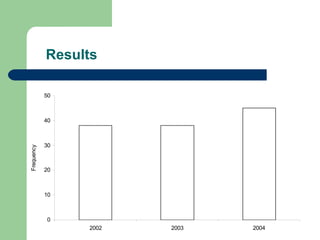
The questionnaires were mailed to a total of 229 graduates and responses were received from 122 (53%): 38 from the class of 2002 38 from the class of 2003 45 from the class of 2004 1 graduation year left blank
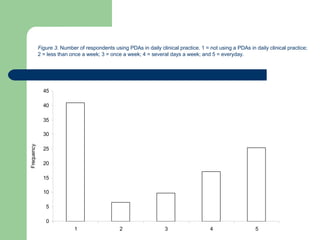
Of the respondents, there were 72 PDA users A total of 5 were using PDAs in conjunction with EMR systems This suggests that there remains a huge gap between early and late adopters of this innovation An analysis of the data indicates that further studies are needed to explore the barriers to the adoption of the use of PDAs in conjunction with EMRs
Background Past studies have shown that family practice residency programs are increasingly making use of handheld computers during residency training  (Criswell & Parchman, 2002) There is little evidence that PA programs are providing formal training in the use of PDAs Empirical evidence suggested that increasing numbers of PA students are utilizing PDAs during their training, especially during the clinical portion of their training (Helopoulos, 2003; McCabe & McGehee, 2004; Schaller, 2001)
Rogers (2003) related that scholars of diffusion have found that individuals gain awareness knowledge through behavior that must be initiated, adding that the need for an innovation must usually precede awareness knowledge of the innovation. The results of this study may lead to the development of guidelines that, when put into effect, would increase the effective use of PDAs in association with EMRs to meet the needs of clinicians and patients during the medical encounter.
If the research suggests that PDAs and EMRs are critical to providing greater efficiency and capabilities in the delivery of health care by PAs  then it may be beneficial to ensure that PAs are properly prepared during their training to incorporate this technology into their clinical practice.  If the trend towards the diffusion of technology into the delivery of health care continues it would be prudent to prepare PAs to be proficient in the use of handheld technology to meet the real-world standards of performance in the health care arena.
Literature Review Explore available data about use of PDAs by healthcare practitioners in association with EMRs Limited studies on use of PDAs in clinical setting Fewer studies on utilization of EMR systems Virtually no studies on use of PDAs in conjunction with EMR systems Evolution of technology in the form of EMR systems in healthcare How EMRs and handhelds can be combined to manage patient information and provide support for clinical decisions and outcomes
Breakdown of Lit Review Diffusion of Innovations [12] Health Professionals and PDAs [4] Health Professionals and EMRs [8] Handheld and EMRs [5]
Innovation   Diffusion Theories The familiarity of an innovation and its compatibility with the existing environment and behavior Is strongly linked to its diffusion The more an innovation can integrate and coexist with technologies and social patterns already in place The greater its prospects for adoption and diffusion
Summary of Literature Review Widespread acceptance of use of PDAs by healthcare providers Especially among residents and medical students Main uses of handhelds by clinicians Reviewing electronic medical databases Accessing online drug reference materials Inputting electronic medical information
Summary of Lit Review Adoption of EMRs is not as widespread Problems of non-interoperability High cost of implementation Main impetus behind incorporation of handhelds and EMRs into deliver of healthcare Federal government – under the direction of President George W. Bush
Summary of Lit Review Groundwork of this innovation diffusion Widespread adoption individually Use of the Internet Wireless technology Handheld technology
Instrument for Study Divided into two major components 1. Several sections of specific questions If respondents are using PDAs and how they are using PDAs [47] If respondents are using the PDA/EMR combination in their specific practice setting [28] Determine the driving forces for implementation of PDA/EMR combination [3]
Survey Instrument Additional demographic information [10] Draw inferences about likelihood of use of a PDA Male or female Younger or older Practice size
Survey Instrument 2. Perception of benefits of using a PDA in conjunction with EMR Four-point Likert scale “ strongly agree” to “strongly disagree” Provided information showing the effects that the use of PDA/EMR combination have on delivery of healthcare by PAs
Informal Review and Feedback Dr. Cheryl Hill, a professor in the Physical Therapy Department of the College of Allied Health and Nursing Dr. Patrick Hardigan, the director of the Health Professions Division’s Statistical Consulting Center  Mr. Chris Helopoulos, a physician assistant and operations director of Barry University PAs Program Expansion at St. Petersburg College  PA colleagues
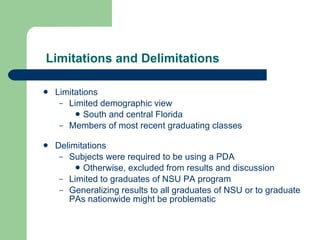
Limitations and Delimitations Limitations Limited demographic view South and central Florida Members of most recent graduating classes Delimitations Subjects were required to be using a PDA Otherwise, excluded from results and discussion Limited to graduates of NSU PA program Generalizing results to all graduates of NSU or to graduate PAs nationwide might be problematic
Results
 
Figure 3.  Number of respondents using PDAs in daily clinical practice. 1 = not using a PDAs in daily clinical practice; 2 = less than once a week; 3 = once a week; 4 = several days a week; and 5 = everyday.
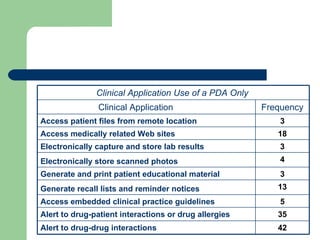
42 Alert to drug-drug interactions 35 Alert to drug-patient interactions or drug allergies 5 Access embedded clinical practice guidelines 13 Generate recall lists and reminder notices 3 Generate and print patient educational material 4 Electronically store scanned photos 3 Electronically capture and store lab results 18 Access medically related Web sites 3 Access patient files from remote location Frequency Clinical Application Clinical Application Use of a PDA Only
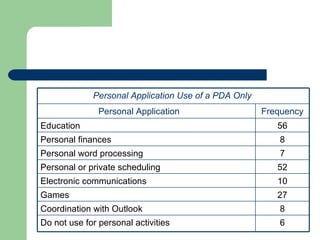
6 Do not use for personal activities 8 Coordination with Outlook 27 Games 10 Electronic communications 52 Personal or private scheduling 7 Personal word processing 8 Personal finances 56 Education Frequency Personal Application Personal Application Use of a PDA Only
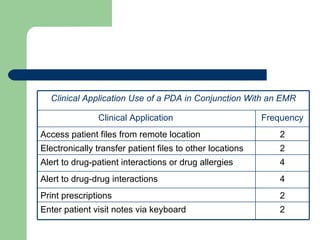
2 Enter patient visit notes via keyboard 2 Print prescriptions 4 Alert to drug-drug interactions 4 Alert to drug-patient interactions or drug allergies 2 Electronically transfer patient files to other locations 2 Access patient files from remote location Frequency Clinical Application Clinical Application Use of a PDA in Conjunction With an EMR
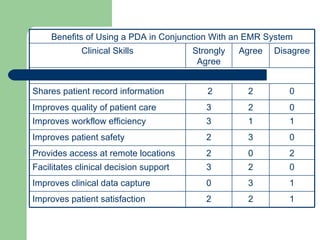
1 2 2 Improves patient satisfaction 1 3 0 Improves clinical data capture Facilitates clinical decision support Provides access at remote locations Improves patient safety Improves workflow efficiency Improves quality of patient care Shares patient record information Clinical Skills Benefits of Using a PDA in Conjunction With an EMR System 2 0 3 1 2 2 Agree 3 2 2 3 3 2 Strongly Agree 0 2 0 1 0 0 Disagree
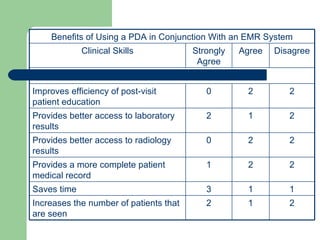
Increases the number of patients that are seen Saves time Provides a more complete patient medical record Provides better access to radiology results Provides better access to laboratory results Improves efficiency of post-visit patient education Clinical Skills Benefits of Using a PDA in Conjunction With an EMR System 1 1 2 2 1 2 Agree 2 3 1 0 2 0 Strongly Agree 2 1 2 2 2 2 Disagree
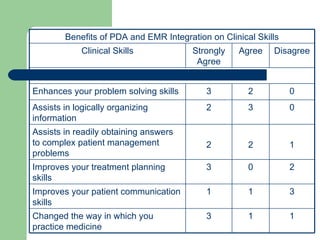
Changed the way in which you practice medicine Improves your patient communication skills Improves your treatment planning skills Assists in readily obtaining answers to complex patient management problems Assists in logically organizing information Enhances your problem solving skills Clinical Skills Benefits of PDA and EMR Integration on Clinical Skills 1 1 0 2 3 2 Agree 3 1 3 2 2 3 Strongly Agree 1 3 2 1 0 0 Disagree
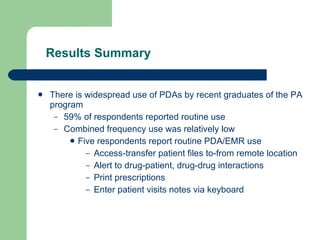
Results Summary There is widespread use of PDAs by recent graduates of the PA program 59% of respondents reported routine use Combined frequency use was relatively low Five respondents report routine PDA/EMR use Access-transfer patient files to-from remote location Alert to drug-patient, drug-drug interactions Print prescriptions Enter patient visits notes via keyboard
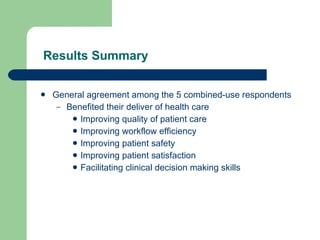
Results Summary General agreement among the 5 combined-use respondents Benefited their deliver of health care Improving quality of patient care Improving workflow efficiency Improving patient safety Improving patient satisfaction Facilitating clinical decision making skills
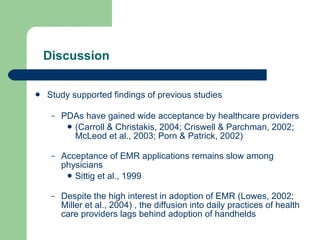
Discussion Study supported findings of previous studies PDAs have gained wide acceptance by healthcare providers (Carroll & Christakis, 2004; Criswell & Parchman, 2002; McLeod et al., 2003; Porn & Patrick, 2002)  Acceptance of EMR applications remains slow among physicians Sittig et al., 1999  Despite the high interest in adoption of EMR (Lowes, 2002; Miller et al., 2004) , the diffusion into daily practices of health care providers lags behind adoption of handhelds
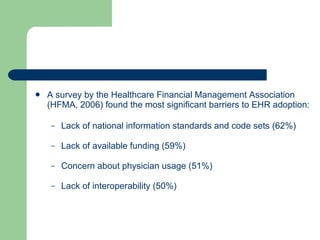
A survey by the Healthcare Financial Management Association (HFMA, 2006) found the most significant barriers to EHR adoption: Lack of national information standards and code sets (62%) Lack of available funding (59%) Concern about physician usage (51%) Lack of interoperability (50%)
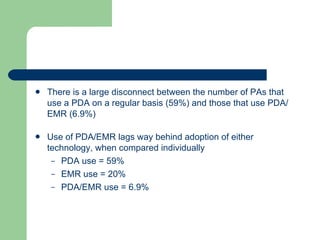
There is a large disconnect between the number of PAs that use a PDA on a regular basis (59%) and those that use PDA/EMR (6.9%) Use of PDA/EMR lags way behind adoption of either technology, when compared individually PDA use = 59% EMR use = 20% PDA/EMR use = 6.9%
The challenge is to decrease the gap between those who use the PDA alone and those who use the PDA/EMR combination Rao (2002) and Criswell and Parchman (2001) noted that medical residents-in-training were the agents of change for integrating PDAs into clinical practices This is a great opportunity for PAs to become the agents of change to incorporate the PDA/EMR concept into the medical settings in which they provide healthcare
Summary - Conclusion The use of PDAs by PAs and other health care providers is widespread The impetus to go digital with health care records is strong There is an urgency to adopt interoperable EHRs to reduce medical errors and cut health care costs through increased efficiency With the goal of improving medical care to patients
Many questions remain to be researched concerning the level of involvement of PAs in the diffusion of this technology partnership of PDAs and EMRs Future studies should survey a broader group of PAs across the nation to get a better idea of PDA/EMR use among PAs Investigate the role of the PA as change agent in the implementation of the use of PDA/EMR in the delivery of health care in the U.S.
HFMA, 2006 Universal implementation of EHRs will produce a profound societal return---improving care and reducing costs . . . Enhanced quality and patient safety through improved continuity of care and clinical decision making, reduced clerical and administrative costs, and more effective use of health services. (p. 13)
With a large percentage of PAs and other health care providers using PDAs and a greater emphasis on the implementation of EMRs by organizations that provide health care: The integration of PDAs and EMRs should be given a higher priority for the overall success of the diffusion of these innovations into the health care delivery system Future studies should concentrate on isolating the major factors that influence the adoption of PDA use in conjunction with EMRs, so that efforts to support the positive factors and remove barriers can be more focused Unless there is a concerted effort on a national level to negate the barriers to PDA/EMR integration, we may have to give a new meaning to the term “digital divide”

Electronic Medical Records

  • 1.
    Electronic Medical Records and Handheld Computing by Physician Assistants in Clinical Practice An Applied Dissertation Submitted to the Fischler School of Education and Human Services in Partial Fulfillment of the Requirements for the Degree of Doctor of Education Calvin R. Finley, Ed.D., PA-C Assistant Professor Physician Assistant Department College of Allied Health and Nursing Nova Southeastern University
  • 2.
    Purpose of theStudy This applied dissertation was designed to assess the use of personal digital assistants (PDAs) in association with electronic medical records (EMRs) by physician assistants (PAs) in clinical practice. The use of PDAs is becoming commonplace in the day-to-day activities of many individuals, including health care providers. It is important to have an understanding of the dynamics involved in the diffusion of PDAs and EMRs into the day-to-day clinical practices of PAs and other health care providers.
  • 3.
    Hypotheses It canbe assumed that the combined use of PDAs and EMRs help PAs to better manage the care of their patients through increased and easier access to key patient information. This improved access would benefit the PA, as well as the patient access to critical patient data helps to improve patient care and diagnosis saves time for the PA Resulting in better informed clinical decisions higher-quality care at lower costs for the patient the medical facility
  • 4.
    PAs who utilizea PDA in conjunction with an EMR application in their day-to-day clinical practice are most likely influenced by the practice setting the adoption of an EMR system by the facility in which they practice PAs who utilize a PDA in conjunction with an EMR application perceive a positive influence in the overall care provided to their patients
  • 5.
    Purpose of thequestionnaire Determine how many PAs were using PDAs in their daily clinical practice How many were using PDAs in conjunction with EMRs What were the factors that influenced the adoption of the use of PDAs in conjunction with EMRs Of those PAs using a PDA in conjunction with EMRs, what was their perception of the way this diffusion of innovation changed their practice of medicine A questionnaire was mailed to the members of the 2002, 2003, and 2004 graduating classes of the PA program of Nova Southeastern University
  • 6.
    The questionnaires weremailed to a total of 229 graduates and responses were received from 122 (53%): 38 from the class of 2002 38 from the class of 2003 45 from the class of 2004 1 graduation year left blank
  • 7.
    Of the respondents,there were 72 PDA users A total of 5 were using PDAs in conjunction with EMR systems This suggests that there remains a huge gap between early and late adopters of this innovation An analysis of the data indicates that further studies are needed to explore the barriers to the adoption of the use of PDAs in conjunction with EMRs
  • 8.
    Background Past studieshave shown that family practice residency programs are increasingly making use of handheld computers during residency training (Criswell & Parchman, 2002) There is little evidence that PA programs are providing formal training in the use of PDAs Empirical evidence suggested that increasing numbers of PA students are utilizing PDAs during their training, especially during the clinical portion of their training (Helopoulos, 2003; McCabe & McGehee, 2004; Schaller, 2001)
  • 9.
    Rogers (2003) relatedthat scholars of diffusion have found that individuals gain awareness knowledge through behavior that must be initiated, adding that the need for an innovation must usually precede awareness knowledge of the innovation. The results of this study may lead to the development of guidelines that, when put into effect, would increase the effective use of PDAs in association with EMRs to meet the needs of clinicians and patients during the medical encounter.
  • 10.
    If the researchsuggests that PDAs and EMRs are critical to providing greater efficiency and capabilities in the delivery of health care by PAs then it may be beneficial to ensure that PAs are properly prepared during their training to incorporate this technology into their clinical practice. If the trend towards the diffusion of technology into the delivery of health care continues it would be prudent to prepare PAs to be proficient in the use of handheld technology to meet the real-world standards of performance in the health care arena.
  • 11.
    Literature Review Exploreavailable data about use of PDAs by healthcare practitioners in association with EMRs Limited studies on use of PDAs in clinical setting Fewer studies on utilization of EMR systems Virtually no studies on use of PDAs in conjunction with EMR systems Evolution of technology in the form of EMR systems in healthcare How EMRs and handhelds can be combined to manage patient information and provide support for clinical decisions and outcomes
  • 12.
    Breakdown of LitReview Diffusion of Innovations [12] Health Professionals and PDAs [4] Health Professionals and EMRs [8] Handheld and EMRs [5]
  • 13.
    Innovation Diffusion Theories The familiarity of an innovation and its compatibility with the existing environment and behavior Is strongly linked to its diffusion The more an innovation can integrate and coexist with technologies and social patterns already in place The greater its prospects for adoption and diffusion
  • 14.
    Summary of LiteratureReview Widespread acceptance of use of PDAs by healthcare providers Especially among residents and medical students Main uses of handhelds by clinicians Reviewing electronic medical databases Accessing online drug reference materials Inputting electronic medical information
  • 15.
    Summary of LitReview Adoption of EMRs is not as widespread Problems of non-interoperability High cost of implementation Main impetus behind incorporation of handhelds and EMRs into deliver of healthcare Federal government – under the direction of President George W. Bush
  • 16.
    Summary of LitReview Groundwork of this innovation diffusion Widespread adoption individually Use of the Internet Wireless technology Handheld technology
  • 17.
    Instrument for StudyDivided into two major components 1. Several sections of specific questions If respondents are using PDAs and how they are using PDAs [47] If respondents are using the PDA/EMR combination in their specific practice setting [28] Determine the driving forces for implementation of PDA/EMR combination [3]
  • 18.
    Survey Instrument Additionaldemographic information [10] Draw inferences about likelihood of use of a PDA Male or female Younger or older Practice size
  • 19.
    Survey Instrument 2.Perception of benefits of using a PDA in conjunction with EMR Four-point Likert scale “ strongly agree” to “strongly disagree” Provided information showing the effects that the use of PDA/EMR combination have on delivery of healthcare by PAs
  • 20.
    Informal Review andFeedback Dr. Cheryl Hill, a professor in the Physical Therapy Department of the College of Allied Health and Nursing Dr. Patrick Hardigan, the director of the Health Professions Division’s Statistical Consulting Center Mr. Chris Helopoulos, a physician assistant and operations director of Barry University PAs Program Expansion at St. Petersburg College PA colleagues
  • 21.
    Limitations and DelimitationsLimitations Limited demographic view South and central Florida Members of most recent graduating classes Delimitations Subjects were required to be using a PDA Otherwise, excluded from results and discussion Limited to graduates of NSU PA program Generalizing results to all graduates of NSU or to graduate PAs nationwide might be problematic
  • 22.
  • 23.
  • 24.
    Figure 3. Number of respondents using PDAs in daily clinical practice. 1 = not using a PDAs in daily clinical practice; 2 = less than once a week; 3 = once a week; 4 = several days a week; and 5 = everyday.
  • 25.
    42 Alert todrug-drug interactions 35 Alert to drug-patient interactions or drug allergies 5 Access embedded clinical practice guidelines 13 Generate recall lists and reminder notices 3 Generate and print patient educational material 4 Electronically store scanned photos 3 Electronically capture and store lab results 18 Access medically related Web sites 3 Access patient files from remote location Frequency Clinical Application Clinical Application Use of a PDA Only
  • 26.
    6 Do notuse for personal activities 8 Coordination with Outlook 27 Games 10 Electronic communications 52 Personal or private scheduling 7 Personal word processing 8 Personal finances 56 Education Frequency Personal Application Personal Application Use of a PDA Only
  • 27.
    2 Enter patientvisit notes via keyboard 2 Print prescriptions 4 Alert to drug-drug interactions 4 Alert to drug-patient interactions or drug allergies 2 Electronically transfer patient files to other locations 2 Access patient files from remote location Frequency Clinical Application Clinical Application Use of a PDA in Conjunction With an EMR
  • 28.
    1 2 2Improves patient satisfaction 1 3 0 Improves clinical data capture Facilitates clinical decision support Provides access at remote locations Improves patient safety Improves workflow efficiency Improves quality of patient care Shares patient record information Clinical Skills Benefits of Using a PDA in Conjunction With an EMR System 2 0 3 1 2 2 Agree 3 2 2 3 3 2 Strongly Agree 0 2 0 1 0 0 Disagree
  • 29.
    Increases the numberof patients that are seen Saves time Provides a more complete patient medical record Provides better access to radiology results Provides better access to laboratory results Improves efficiency of post-visit patient education Clinical Skills Benefits of Using a PDA in Conjunction With an EMR System 1 1 2 2 1 2 Agree 2 3 1 0 2 0 Strongly Agree 2 1 2 2 2 2 Disagree
  • 30.
    Changed the wayin which you practice medicine Improves your patient communication skills Improves your treatment planning skills Assists in readily obtaining answers to complex patient management problems Assists in logically organizing information Enhances your problem solving skills Clinical Skills Benefits of PDA and EMR Integration on Clinical Skills 1 1 0 2 3 2 Agree 3 1 3 2 2 3 Strongly Agree 1 3 2 1 0 0 Disagree
  • 31.
    Results Summary Thereis widespread use of PDAs by recent graduates of the PA program 59% of respondents reported routine use Combined frequency use was relatively low Five respondents report routine PDA/EMR use Access-transfer patient files to-from remote location Alert to drug-patient, drug-drug interactions Print prescriptions Enter patient visits notes via keyboard
  • 32.
    Results Summary Generalagreement among the 5 combined-use respondents Benefited their deliver of health care Improving quality of patient care Improving workflow efficiency Improving patient safety Improving patient satisfaction Facilitating clinical decision making skills
  • 33.
    Discussion Study supportedfindings of previous studies PDAs have gained wide acceptance by healthcare providers (Carroll & Christakis, 2004; Criswell & Parchman, 2002; McLeod et al., 2003; Porn & Patrick, 2002) Acceptance of EMR applications remains slow among physicians Sittig et al., 1999 Despite the high interest in adoption of EMR (Lowes, 2002; Miller et al., 2004) , the diffusion into daily practices of health care providers lags behind adoption of handhelds
  • 34.
    A survey bythe Healthcare Financial Management Association (HFMA, 2006) found the most significant barriers to EHR adoption: Lack of national information standards and code sets (62%) Lack of available funding (59%) Concern about physician usage (51%) Lack of interoperability (50%)
  • 35.
    There is alarge disconnect between the number of PAs that use a PDA on a regular basis (59%) and those that use PDA/EMR (6.9%) Use of PDA/EMR lags way behind adoption of either technology, when compared individually PDA use = 59% EMR use = 20% PDA/EMR use = 6.9%
  • 36.
    The challenge isto decrease the gap between those who use the PDA alone and those who use the PDA/EMR combination Rao (2002) and Criswell and Parchman (2001) noted that medical residents-in-training were the agents of change for integrating PDAs into clinical practices This is a great opportunity for PAs to become the agents of change to incorporate the PDA/EMR concept into the medical settings in which they provide healthcare
  • 37.
    Summary - ConclusionThe use of PDAs by PAs and other health care providers is widespread The impetus to go digital with health care records is strong There is an urgency to adopt interoperable EHRs to reduce medical errors and cut health care costs through increased efficiency With the goal of improving medical care to patients
  • 38.
    Many questions remainto be researched concerning the level of involvement of PAs in the diffusion of this technology partnership of PDAs and EMRs Future studies should survey a broader group of PAs across the nation to get a better idea of PDA/EMR use among PAs Investigate the role of the PA as change agent in the implementation of the use of PDA/EMR in the delivery of health care in the U.S.
  • 39.
    HFMA, 2006 Universalimplementation of EHRs will produce a profound societal return---improving care and reducing costs . . . Enhanced quality and patient safety through improved continuity of care and clinical decision making, reduced clerical and administrative costs, and more effective use of health services. (p. 13)
  • 40.
    With a largepercentage of PAs and other health care providers using PDAs and a greater emphasis on the implementation of EMRs by organizations that provide health care: The integration of PDAs and EMRs should be given a higher priority for the overall success of the diffusion of these innovations into the health care delivery system Future studies should concentrate on isolating the major factors that influence the adoption of PDA use in conjunction with EMRs, so that efforts to support the positive factors and remove barriers can be more focused Unless there is a concerted effort on a national level to negate the barriers to PDA/EMR integration, we may have to give a new meaning to the term “digital divide”