Dr. James Malce Alo
 Primarily initiated for the purpose of 
friendship, socialization, companionship, or 
accomplishment of task. 
 Communication (may be superficial): usually 
focuses on sharing ideas, feelings, and 
experiences and meets the basic need for 
people to interact. 
 Advise if often given. 
 Roles may shift.
 Acceptable in nursing, but must be limited. 
 If relationship becomes more social than 
therapeutic, serious work that moves the 
client forward will not be done.
 Involves two people who are emotionally 
committed to each other. 
 Both parties are concerned about having 
their individual needs met and helping each 
other to meet needs as well. 
 May include sexual or emotional intimacy as 
well as sharing of mutual goals. 
 NO PLACE in the nurse-client interaction.
 Differs from the social or intimate 
relationship in many ways because it focuses 
on the needs, experiences, feelings, and 
ideas of the clients only. 
 Nurse and client agree about the areas to 
communicate to work on and evaluate the 
outcomes.
 Nurse uses communication skills, personal 
strengths, and understanding of human 
behavior to interact with the client. 
 Parameters are clear: the focus is the client’s 
needs, not the nurse’s. 
 The nurse must guard against allowing the 
therapeutic relationship to slip into a more 
social relationship and must constantly focus 
on the client’s needs, not on his or her own.
 The nurse who has self-confidence rooted in 
self-awareness is ready to establish 
appropriate therapeutic relationships with 
clients. 
 Awareness of his or her strengths at any 
particular moment is a good start.
 Trust builds when the client is confident in 
the nurse and when the nurse’s presence 
conveys integrity and reliability. 
 Trust develops when the client believes that 
the nurse will be consistent in his or her own 
words and actions and can be relied on to do 
what he or she says. 
 Congruence occurs when words and actions 
match.
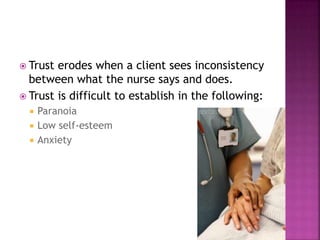
 Trust erodes when a client sees inconsistency 
between what the nurse says and does. 
 Trust is difficult to establish in the following: 
 Paranoia 
 Low self-esteem 
 Anxiety
 Caring 
Openness 
Objectivity 
Respect 
 Interest 
Understanding 
Consistency 
Treating the client 
as a human being 
 Suggesting without 
telling 
Approachability 
 Listening 
Keeping promises 
Honesty
 When the nurse is comfortable with himself 
or herself, aware of his or her strengths and 
limitations, and clearly focused, the client 
perceives a genuine person showing genuine 
interest. 
 The nurse should be open and honest and 
display congruent behavior.
 Sometimes, responding with truth and 
honesty alone does not provide the best 
professional response. 
 The nurse may choose to disclose to the 
client a personal experience related to the 
client’s current concerns. 
 Be selective about personal examples. 
 Maybe from the nurse’s past experience, not a 
current problem that is still being resolved, or a 
recent, still painful experience. 
 Day-to-day experiences, not value-laden.
 The ability to perceive the meanings and 
feelings of the client and to communicate 
that understanding to the client. 
 One of the essential skills a nurse must 
develop. 
 Both the client and the nurse give a “gift of 
self” when empathy occurs.
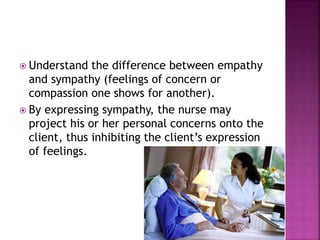
 Understand the difference between empathy 
and sympathy (feelings of concern or 
compassion one shows for another). 
 By expressing sympathy, the nurse may 
project his or her personal concerns onto the 
client, thus inhibiting the client’s expression 
of feelings.
 Avoiding judgments of the person, no matter 
what the behavior is. 
 E.g., The nurse does not become upset or 
respond negatively to a client’s outbursts, anger 
or acting out. 
 Does not mean acceptance of inappropriate 
behaviors but acceptance of the person as 
worthy.
 The nurse must set boundaries for behavior 
in the nurse-client relationship. 
 By being clear and firm without anger or 
judgment, the nurse allows the client to feel 
intact while still conveying that certain 
behavior is unacceptable.
 The nurse who appreciates the client as a 
unique worthwhile human being can respect 
the client regardless of his or her behavior, 
background or style. 
 Measures to convey respect and positive 
regard: 
 Calling client by name 
 Spending time with client 
 Listening and responding openly 
 Considering client’s ideas and preferences when 
planning care.
 The nurse relies on presence, or attending, 
which is using nonverbal and verbal 
communication techniques to make the 
client aware that he is receiving full 
attention. 
 Nonverbal techniques: leaning toward the 
client, eye contact, being relaxed, having 
the arms rested at the side, and interested 
but neutral attitude. 
 Verbally attending: nurse avoids value 
judgment about the client’s behavior.
 Begins when the nurse and client meet and 
ends when the client begins to identify 
problems to examine. 
 Activities: 
 Establish roles 
 Establish the purpose of the meeting and the 
parameters of the subsequent meeting 
 Identify client’s problems 
 Clarify expectations
 Before the meeting: 
 Read background materials available on the 
client 
 Become familiar with the medications the client 
is taking 
 Gather necessary paper work 
 Arrange for a quiet, private and comfortable 
setting 
 Self-assessment 
 Examine preconceptions about the client and 
ensure to put them aside and get to know the 
real person.
 The nurse begins to build trust with the 
client. 
 Share appropriate information about oneself: 
name, reason for being in the unit, and level 
of schooling 
 Listen closely to the client’s history, 
perceptions and misconceptions. 
 Be very empathetic and understanding. 
 It may take several sessions before a client 
trust the nurse.
 Nurse-client Contracts 
 Agree responsibilities in an informal or verbal 
contract 
 A formal or written contract may be appropriate 
at times. 
 State the following: 
 Time, place, and length of sessions 
 When session will terminate 
 Who will be involved in the treatment plan 
 Client responsibilities (arrive on time, end on time) 
 Nurse’s responsibilities (arrive on time, end on time, 
evaluate progress with client, document sessions)
 Confidentiality: 
 Respecting the client’s right to keep private 
information about his or her mental and physical care 
and related care. 
 Allowing only those dealing with client’s care to have 
access to the information that the client divulges. 
 Only under precisely defined conditions can third 
parties have access to this information. 
 Adult clients can decide which family members, if 
any, may be involved in treatment and may have 
access to clinical information. 
 The nurse must avoid any promises to keep secret.
 Tarasoff vs. University of California (1976): 
releases professionals from previleged 
communication with their clients should the 
client make a homicidal threat (duty to 
warn). 
 Document client problems with planned 
interventions. 
 The client needs to know the limits of 
confidentiality in the nurse-client 
interactions and how the nurse will use and 
share this information with professionals 
involved in the care.
 Self-disclosure: 
 Revealing personal information such as 
biographical information and personal ideas, 
thoughts, and feelings about oneself to others. 
 Some purposeful, well-planned, self-disclosure 
can improve rapport between the nurse and the 
client. 
 May be use to convey support, educate clients, 
and demonstrate that anxiety is normal and that 
many people deal with stress and problems in 
their lives.
 Self- disclosure may help the client feel more 
comfortable and more willing to share 
thoughts and feelings, or help the client gain 
insight into the situation. 
 Consider cultural factors. 
 Disclosing personal information to the 
patient can be harmful and inappropriate, so 
it must be planned and considered 
thoughtfully in advance. 
 Spontaneously self-disclosing personal 
information can have negative results.
 Two sub-phases: 
 Problem identification: client identifies the 
issues or concerns causing the problems. 
 Exploitation: the nurse guide the client to 
examine feelings and responses and to develop 
better coping skills and a more positive self-image. 
 Encourages behavior change and develops 
independence.
 The client must believe that the nurse will 
not turn away or be upset when the client 
reveals experiences, issues and behaviors, 
and problems. 
 The client will sometimes use outrageous 
stories or acting-out behaviors to test the 
nurse. 
 The nurse must remember that it is the 
client who examines and explores problem 
situations and relationships.
 Specific tasks: 
 Maintaining the relationship 
 Gathering the data 
 Exploring perceptions of reality 
 Developing positive coping mechanisms 
 Promoting a positive self-concept 
 Encourage verbalization of feelings 
 Facilitating behavior change 
 Working through resistance 
 Evaluating progress and redefining goals as 
appropriate 
 Providing opportunities for the client to practice new 
behaviors 
 Promoting independence
 Transference: the client unconsciously 
transfer to the nurse feelings he or she has 
for significant others. 
 Countertransference: the nurse responds to 
the client based on personal unconscious 
needs and conflicts. 
 SELF-AWARENESS is important so that the 
nurse can identify when transference and 
countertransference might occur.
 Final stage of the in the nurse-client 
relationship. 
 Begins when the problems are resolved, and 
it ends when the relationship is ended. 
 Nurse and client usually have feelings about 
ending the relationship. 
 Clients may feel the termination as an 
impending loss.
 Clients may avoid termination by acting 
angry or as if the problem is not resolved. 
 Acknowledge the client’s angry feelings and 
assure that this response is normal to ending 
a relationship. 
 If the client tries to reopen and discuss old 
resolved issues, the nurse must avoid feeling 
as if the sessions were unsuccessful; instead 
he or she should identify the client’s stalling 
maneuvers and refocus the client on newly 
learned behaviors and skills to handle the 
problem.
 It is appropriate to tell the client that the 
nurse enjoyed the time spent with the client 
and will remember him or her, but it is 
inappropriate for the nurse to agree to see 
the client outside the therapeutic 
relationship.
 Secrets; reluctance to talk to others about 
the work being done with the client. 
 Sudden increase in phone calls between the 
nurse and client calls outside the clinical 
hours. 
 Nurse making exceptions for client than 
normal.
 Inappropriate gift-giving between client and 
the nurse. 
 Loaning, trading, or selling goods or 
possessions. 
 Nurse disclosure of personal issues or 
information. 
 Inappropriate touching, comforting or 
physical contact. 
 Overdoing, overprotecting, or overidentifying 
with the client.
 Change in the nurse’s body language, dress 
or appearance (with no other satisfactory 
explanation). 
 Extended one-on-one sessions or home visits. 
 Spending off-duty time with the client. 
 Thinking about the client frequently when 
away from work. 
 Becoming defensive if another person 
questions the nurse’s care of the client. 
 Ignoring agency’s policies.
 Realize that all staff members, whether male 
or female, junior or senior, or from any 
discipline are at risk for over-involvement or 
loss of boundaries. 
 Assume that boundary violations will occur. 
Supervisors should recognize potential 
“problem” clients and regularly raise the 
issue of sexual feelings or boundary loss with 
staff members.
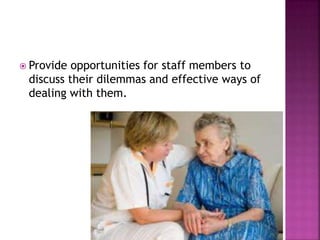
 Provide opportunities for staff members to 
discuss their dilemmas and effective ways of 
dealing with them.
 Privacy is desirable but not always possible in 
therapeutic communication. 
 Possible venues: 
 Interview/ conference room 
 End of the hall 
 Quiet corner of the day room or lobby 
 Evaluate whether interacting in the client’s 
room is therapeutic.
 Proxemics: study of distance zones between 
people during communication. 
 Intimate zone (0-18 inches between people): 
parents with children, people who mutually 
desire personal contact, or people whispering. 
Invasion is threatening and produces anxiety. 
 Personal zone (18-36 inches): family and friends 
who are talking. 
 Social zone (4-12 feet): communication in social, 
work, and business settings. 
 Public zone (12-25 feet): between speaker and 
an audience, small groups, and other informal 
functions.
 Consider the culture of the client. 
 Hispanic, Mediterranean, East Indian, Asian, and 
Middle Eastern: comfortable with less that 4-12 
feet distance. 
 When invading the personal zone, the nurse 
should ask permission. 
 Therapeutic communication interaction is 
most comfortable when the client and the 
nurse are 3-6 feet apart. 
 If client invades the nurse’s personal space, 
the nurse should set limits gradually.
 Five types: 
 Functional-professional: touch is used in examination 
or procedures. 
 Social-polite: touch is used in greeting, such as hand-shake 
and the “air kisses” some women use to greet 
acquaintances, or when a gentle hand guides 
someone for the correct direction. 
 Friendship-warmth: touch involves a hug in greeting, 
an arm thrown around the shoulder of a good friend, 
or the backslapping some men used to greet friends 
or relatives. 
 Love-intimacy: touch involves tight hugs and kisses 
between lovers and close relatives. 
 Sexual arousal: touch used by lovers.
 Touching a client can be comforting and 
supportive when it is welcomed and 
permitted. 
 Observe for cues that show whether touch is 
desired or indicated. 
 Although touch can be comforting and 
therapeutic, it is an invasion of intimate 
personal space. 
 When performing a procedure, prepare the client 
verbally before starting the procedure.
Active listening: refraining from other 
internal mental activities and 
concentrating exclusively on what the 
client says. 
Active observation: watching the 
speaker’s nonverbal actions as he or she 
communicates.
 Active listening and observation help the 
nurse to: 
 Recognize the issue that is most important to the 
client at this time. 
 Know what further questions to ask the client. 
 Use additional therapeutic communication 
techniques to guide the client to describe his or 
her perceptions fully. 
 Understanding the client’s perceptions of the 
issue instead of jumping to conclusions. 
 Interpret and respond to the message 
objectively.
Thank you! 
Dr. JMA

Building nurse client relationship.drjma

  • 1.
  • 3.
     Primarily initiatedfor the purpose of friendship, socialization, companionship, or accomplishment of task.  Communication (may be superficial): usually focuses on sharing ideas, feelings, and experiences and meets the basic need for people to interact.  Advise if often given.  Roles may shift.
  • 4.
     Acceptable innursing, but must be limited.  If relationship becomes more social than therapeutic, serious work that moves the client forward will not be done.
  • 5.
     Involves twopeople who are emotionally committed to each other.  Both parties are concerned about having their individual needs met and helping each other to meet needs as well.  May include sexual or emotional intimacy as well as sharing of mutual goals.  NO PLACE in the nurse-client interaction.
  • 6.
     Differs fromthe social or intimate relationship in many ways because it focuses on the needs, experiences, feelings, and ideas of the clients only.  Nurse and client agree about the areas to communicate to work on and evaluate the outcomes.
  • 7.
     Nurse usescommunication skills, personal strengths, and understanding of human behavior to interact with the client.  Parameters are clear: the focus is the client’s needs, not the nurse’s.  The nurse must guard against allowing the therapeutic relationship to slip into a more social relationship and must constantly focus on the client’s needs, not on his or her own.
  • 8.
     The nursewho has self-confidence rooted in self-awareness is ready to establish appropriate therapeutic relationships with clients.  Awareness of his or her strengths at any particular moment is a good start.
  • 10.
     Trust buildswhen the client is confident in the nurse and when the nurse’s presence conveys integrity and reliability.  Trust develops when the client believes that the nurse will be consistent in his or her own words and actions and can be relied on to do what he or she says.  Congruence occurs when words and actions match.
  • 11.
     Trust erodeswhen a client sees inconsistency between what the nurse says and does.  Trust is difficult to establish in the following:  Paranoia  Low self-esteem  Anxiety
  • 12.
     Caring Openness Objectivity Respect  Interest Understanding Consistency Treating the client as a human being  Suggesting without telling Approachability  Listening Keeping promises Honesty
  • 13.
     When thenurse is comfortable with himself or herself, aware of his or her strengths and limitations, and clearly focused, the client perceives a genuine person showing genuine interest.  The nurse should be open and honest and display congruent behavior.
  • 14.
     Sometimes, respondingwith truth and honesty alone does not provide the best professional response.  The nurse may choose to disclose to the client a personal experience related to the client’s current concerns.  Be selective about personal examples.  Maybe from the nurse’s past experience, not a current problem that is still being resolved, or a recent, still painful experience.  Day-to-day experiences, not value-laden.
  • 15.
     The abilityto perceive the meanings and feelings of the client and to communicate that understanding to the client.  One of the essential skills a nurse must develop.  Both the client and the nurse give a “gift of self” when empathy occurs.
  • 16.
     Understand thedifference between empathy and sympathy (feelings of concern or compassion one shows for another).  By expressing sympathy, the nurse may project his or her personal concerns onto the client, thus inhibiting the client’s expression of feelings.
  • 17.
     Avoiding judgmentsof the person, no matter what the behavior is.  E.g., The nurse does not become upset or respond negatively to a client’s outbursts, anger or acting out.  Does not mean acceptance of inappropriate behaviors but acceptance of the person as worthy.
  • 18.
     The nursemust set boundaries for behavior in the nurse-client relationship.  By being clear and firm without anger or judgment, the nurse allows the client to feel intact while still conveying that certain behavior is unacceptable.
  • 19.
     The nursewho appreciates the client as a unique worthwhile human being can respect the client regardless of his or her behavior, background or style.  Measures to convey respect and positive regard:  Calling client by name  Spending time with client  Listening and responding openly  Considering client’s ideas and preferences when planning care.
  • 20.
     The nurserelies on presence, or attending, which is using nonverbal and verbal communication techniques to make the client aware that he is receiving full attention.  Nonverbal techniques: leaning toward the client, eye contact, being relaxed, having the arms rested at the side, and interested but neutral attitude.  Verbally attending: nurse avoids value judgment about the client’s behavior.
  • 22.
     Begins whenthe nurse and client meet and ends when the client begins to identify problems to examine.  Activities:  Establish roles  Establish the purpose of the meeting and the parameters of the subsequent meeting  Identify client’s problems  Clarify expectations
  • 23.
     Before themeeting:  Read background materials available on the client  Become familiar with the medications the client is taking  Gather necessary paper work  Arrange for a quiet, private and comfortable setting  Self-assessment  Examine preconceptions about the client and ensure to put them aside and get to know the real person.
  • 24.
     The nursebegins to build trust with the client.  Share appropriate information about oneself: name, reason for being in the unit, and level of schooling  Listen closely to the client’s history, perceptions and misconceptions.  Be very empathetic and understanding.  It may take several sessions before a client trust the nurse.
  • 25.
     Nurse-client Contracts  Agree responsibilities in an informal or verbal contract  A formal or written contract may be appropriate at times.  State the following:  Time, place, and length of sessions  When session will terminate  Who will be involved in the treatment plan  Client responsibilities (arrive on time, end on time)  Nurse’s responsibilities (arrive on time, end on time, evaluate progress with client, document sessions)
  • 26.
     Confidentiality: Respecting the client’s right to keep private information about his or her mental and physical care and related care.  Allowing only those dealing with client’s care to have access to the information that the client divulges.  Only under precisely defined conditions can third parties have access to this information.  Adult clients can decide which family members, if any, may be involved in treatment and may have access to clinical information.  The nurse must avoid any promises to keep secret.
  • 27.
     Tarasoff vs.University of California (1976): releases professionals from previleged communication with their clients should the client make a homicidal threat (duty to warn).  Document client problems with planned interventions.  The client needs to know the limits of confidentiality in the nurse-client interactions and how the nurse will use and share this information with professionals involved in the care.
  • 28.
     Self-disclosure: Revealing personal information such as biographical information and personal ideas, thoughts, and feelings about oneself to others.  Some purposeful, well-planned, self-disclosure can improve rapport between the nurse and the client.  May be use to convey support, educate clients, and demonstrate that anxiety is normal and that many people deal with stress and problems in their lives.
  • 29.
     Self- disclosuremay help the client feel more comfortable and more willing to share thoughts and feelings, or help the client gain insight into the situation.  Consider cultural factors.  Disclosing personal information to the patient can be harmful and inappropriate, so it must be planned and considered thoughtfully in advance.  Spontaneously self-disclosing personal information can have negative results.
  • 30.
     Two sub-phases:  Problem identification: client identifies the issues or concerns causing the problems.  Exploitation: the nurse guide the client to examine feelings and responses and to develop better coping skills and a more positive self-image.  Encourages behavior change and develops independence.
  • 31.
     The clientmust believe that the nurse will not turn away or be upset when the client reveals experiences, issues and behaviors, and problems.  The client will sometimes use outrageous stories or acting-out behaviors to test the nurse.  The nurse must remember that it is the client who examines and explores problem situations and relationships.
  • 32.
     Specific tasks:  Maintaining the relationship  Gathering the data  Exploring perceptions of reality  Developing positive coping mechanisms  Promoting a positive self-concept  Encourage verbalization of feelings  Facilitating behavior change  Working through resistance  Evaluating progress and redefining goals as appropriate  Providing opportunities for the client to practice new behaviors  Promoting independence
  • 33.
     Transference: theclient unconsciously transfer to the nurse feelings he or she has for significant others.  Countertransference: the nurse responds to the client based on personal unconscious needs and conflicts.  SELF-AWARENESS is important so that the nurse can identify when transference and countertransference might occur.
  • 34.
     Final stageof the in the nurse-client relationship.  Begins when the problems are resolved, and it ends when the relationship is ended.  Nurse and client usually have feelings about ending the relationship.  Clients may feel the termination as an impending loss.
  • 35.
     Clients mayavoid termination by acting angry or as if the problem is not resolved.  Acknowledge the client’s angry feelings and assure that this response is normal to ending a relationship.  If the client tries to reopen and discuss old resolved issues, the nurse must avoid feeling as if the sessions were unsuccessful; instead he or she should identify the client’s stalling maneuvers and refocus the client on newly learned behaviors and skills to handle the problem.
  • 36.
     It isappropriate to tell the client that the nurse enjoyed the time spent with the client and will remember him or her, but it is inappropriate for the nurse to agree to see the client outside the therapeutic relationship.
  • 37.
     Secrets; reluctanceto talk to others about the work being done with the client.  Sudden increase in phone calls between the nurse and client calls outside the clinical hours.  Nurse making exceptions for client than normal.
  • 38.
     Inappropriate gift-givingbetween client and the nurse.  Loaning, trading, or selling goods or possessions.  Nurse disclosure of personal issues or information.  Inappropriate touching, comforting or physical contact.  Overdoing, overprotecting, or overidentifying with the client.
  • 39.
     Change inthe nurse’s body language, dress or appearance (with no other satisfactory explanation).  Extended one-on-one sessions or home visits.  Spending off-duty time with the client.  Thinking about the client frequently when away from work.  Becoming defensive if another person questions the nurse’s care of the client.  Ignoring agency’s policies.
  • 40.
     Realize thatall staff members, whether male or female, junior or senior, or from any discipline are at risk for over-involvement or loss of boundaries.  Assume that boundary violations will occur. Supervisors should recognize potential “problem” clients and regularly raise the issue of sexual feelings or boundary loss with staff members.
  • 41.
     Provide opportunitiesfor staff members to discuss their dilemmas and effective ways of dealing with them.
  • 42.
     Privacy isdesirable but not always possible in therapeutic communication.  Possible venues:  Interview/ conference room  End of the hall  Quiet corner of the day room or lobby  Evaluate whether interacting in the client’s room is therapeutic.
  • 43.
     Proxemics: studyof distance zones between people during communication.  Intimate zone (0-18 inches between people): parents with children, people who mutually desire personal contact, or people whispering. Invasion is threatening and produces anxiety.  Personal zone (18-36 inches): family and friends who are talking.  Social zone (4-12 feet): communication in social, work, and business settings.  Public zone (12-25 feet): between speaker and an audience, small groups, and other informal functions.
  • 44.
     Consider theculture of the client.  Hispanic, Mediterranean, East Indian, Asian, and Middle Eastern: comfortable with less that 4-12 feet distance.  When invading the personal zone, the nurse should ask permission.  Therapeutic communication interaction is most comfortable when the client and the nurse are 3-6 feet apart.  If client invades the nurse’s personal space, the nurse should set limits gradually.
  • 46.
     Five types:  Functional-professional: touch is used in examination or procedures.  Social-polite: touch is used in greeting, such as hand-shake and the “air kisses” some women use to greet acquaintances, or when a gentle hand guides someone for the correct direction.  Friendship-warmth: touch involves a hug in greeting, an arm thrown around the shoulder of a good friend, or the backslapping some men used to greet friends or relatives.  Love-intimacy: touch involves tight hugs and kisses between lovers and close relatives.  Sexual arousal: touch used by lovers.
  • 47.
     Touching aclient can be comforting and supportive when it is welcomed and permitted.  Observe for cues that show whether touch is desired or indicated.  Although touch can be comforting and therapeutic, it is an invasion of intimate personal space.  When performing a procedure, prepare the client verbally before starting the procedure.
  • 49.
    Active listening: refrainingfrom other internal mental activities and concentrating exclusively on what the client says. Active observation: watching the speaker’s nonverbal actions as he or she communicates.
  • 50.
     Active listeningand observation help the nurse to:  Recognize the issue that is most important to the client at this time.  Know what further questions to ask the client.  Use additional therapeutic communication techniques to guide the client to describe his or her perceptions fully.  Understanding the client’s perceptions of the issue instead of jumping to conclusions.  Interpret and respond to the message objectively.
  • 51.