Joe Caserta
President
September 30, 2016, Javits Center, New York City
Building new Data Ecosystem for
Customer Analytics
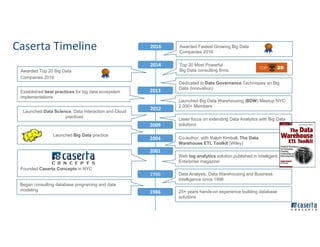
Caserta Timeline
Launched Big Data practice
Co-author, with Ralph Kimball, The Data
Warehouse ETL Toolkit (Wiley)
Data Analysis, Data Warehousing and Business
Intelligence since 1996
Began consulting database programing and data
modeling 25+ years hands-on experience building database
solutions
Founded Caserta Concepts in NYC
Web log analytics solution published in Intelligent
Enterprise magazine
Launched Data Science, Data Interaction and Cloud
practices
Laser focus on extending Data Analytics with Big Data
solutions
1986
2004
1996
2009
2001
2013
2012
2014
Dedicated to Data Governance Techniques on Big
Data (Innovation)
Awarded Top 20 Big Data
Companies 2016
Top 20 Most Powerful
Big Data consulting firms
Launched Big Data Warehousing (BDW) Meetup NYC:
2,000+ Members
2016 Awarded Fastest Growing Big Data
Companies 2016
Established best practices for big data ecosystem
implementations
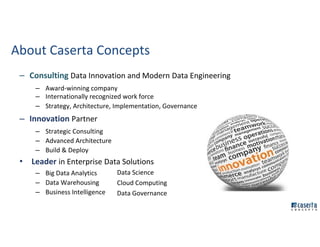
About Caserta Concepts
– Consulting Data Innovation and Modern Data Engineering
– Award-winning company
– Internationally recognized work force
– Strategy, Architecture, Implementation, Governance
– Innovation Partner
– Strategic Consulting
– Advanced Architecture
– Build & Deploy
• Leader in Enterprise Data Solutions
– Big Data Analytics
– Data Warehousing
– Business Intelligence
Data Science
Cloud Computing
Data Governance
Awards & Recognition
Top 10
Fastest Growing
Big Data Companies
2016
Our Partners
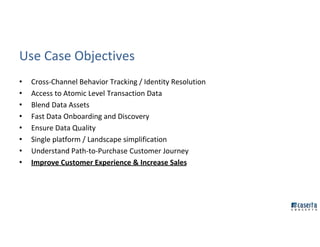
Use Case Objectives
• Cross-Channel Behavior Tracking / Identity Resolution
• Access to Atomic Level Transaction Data
• Blend Data Assets
• Fast Data Onboarding and Discovery
• Ensure Data Quality
• Single platform / Landscape simplification
• Understand Path-to-Purchase Customer Journey
• Improve Customer Experience & Increase Sales
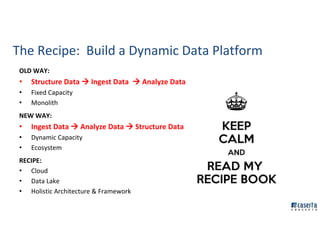
The Recipe: Build a Dynamic Data Platform
OLD WAY:
• Structure Data Ingest Data Analyze Data
• Fixed Capacity
• Monolith
NEW WAY:
• Ingest Data Analyze Data Structure Data
• Dynamic Capacity
• Ecosystem
RECIPE:
• Cloud
• Data Lake
• Holistic Architecture & Framework
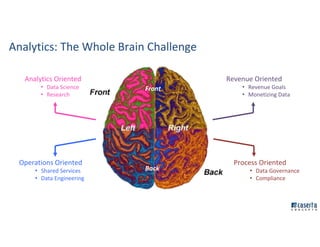
Analytics: The Whole Brain Challenge
Front
Back
Analytics Oriented
• Data Science
• Research
Process Oriented
• Data Governance
• Compliance
Operations Oriented
• Shared Services
• Data Engineering
Revenue Oriented
• Revenue Goals
• Monetizing Data
Chief Data Organization (Oversight)
Vertical Business Area
[Sales/Finance/Marketing/Operations/Customer Svc]
Product Owner
SCRUM Master
Development Team
Business Subject Matter Expertise
Data Librarian/Data Stewardship
Data Science/ Statistical Skills
Data Engineering / Architecture
Presentation/ BI Report Development Skills
Data Quality Assurance
DevOps
IT Organization
(Oversight)
Enterprise Data Architect
Solution Engineers
Data Integration Practice
User Experience Practice
QA Practice
Operations Practice
Advanced Analytics
Business Analysts
Data Analysts
Data Scientists
Statisticians
Data Engineers
Planning Organization
Project Managers
Data Organization
Data Gov Coordinator
Data Librarians
Data Stewards
It Takes a Village!
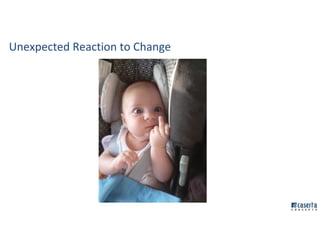
Unexpected Reaction to Change
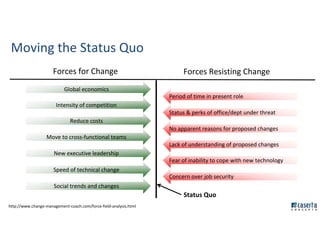
Global economics
Intensity of competition
Reduce costs
Move to cross-functional teams
New executive leadership
Speed of technical change
Social trends and changes
Period of time in present role
Status & perks of office/dept under threat
No apparent reasons for proposed changes
Lack of understanding of proposed changes
Fear of inability to cope with new technology
Concern over job security
Forces for Change Forces Resisting Change
Status Quo
Moving the Status Quo
http://www.change-management-coach.com/force-field-analysis.html
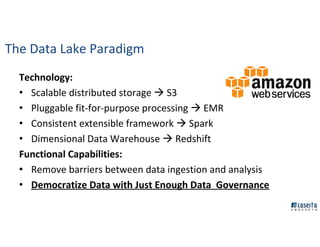
The Data Lake Paradigm
Technology:
• Scalable distributed storage S3
• Pluggable fit-for-purpose processing EMR
• Consistent extensible framework Spark
• Dimensional Data Warehouse Redshift
Functional Capabilities:
• Remove barriers between data ingestion and analysis
• Democratize Data with Just Enough Data Governance
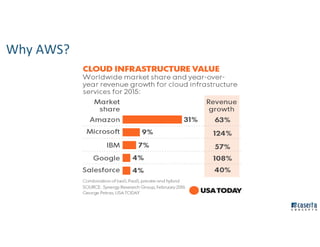
Why AWS?
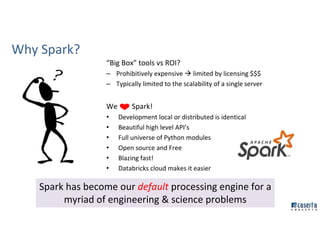
Why Spark?
“Big Box” tools vs ROI?
– Prohibitively expensive limited by licensing $$$
– Typically limited to the scalability of a single server
We Spark!
• Development local or distributed is identical
• Beautiful high level API’s
• Full universe of Python modules
• Open source and Free
• Blazing fast!
• Databricks cloud makes it easier
Spark has become our default processing engine for a
myriad of engineering & science problems
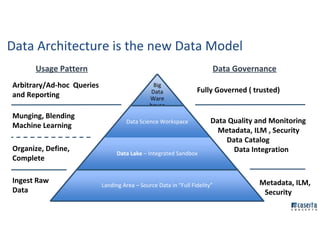
Ingest Raw
Data
Organize, Define,
Complete
Munging, Blending
Machine Learning
Data Quality and Monitoring
Metadata, ILM , Security
Data Catalog
Data Integration
Fully Governed ( trusted)
Arbitrary/Ad-hoc Queries
and Reporting
Big
Data
Ware
house
Data Science Workspace
Data Lake – Integrated Sandbox
Landing Area – Source Data in “Full Fidelity”
Usage Pattern Data Governance
Metadata, ILM,
Security
Data Architecture is the new Data Model
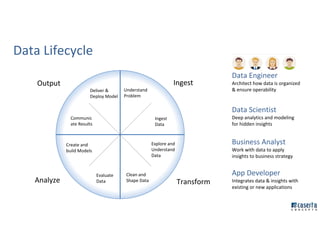
Data Lifecycle
Ingest
TransformAnalyze
Output
Understand
Problem
Ingest
Data
Explore and
Understand
Data
Clean and
Shape Data
Evaluate
Data
Create and
build Models
Communic
ate Results
Deliver &
Deploy Model
Data Engineer
Architect how data is organized
& ensure operability
Data Scientist
Deep analytics and modeling
for hidden insights
Business Analyst
Work with data to apply
insights to business strategy
App Developer
Integrates data & insights with
existing or new applications
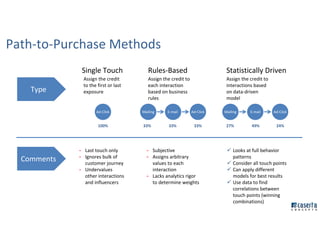
Type
Comments
Single Touch Rules-Based Statistically Driven
Assign the credit
to the first or last
exposure
Assign the credit to
each interaction
based on business
rules
Assign the credit to
interactions based
on data-driven
model
Ad-Click Mailing MailingE-mail E-mailAd-Click Ad-Click
100% 33% 33% 33% 27% 49% 24%
- Last touch only
- Ignores bulk of
customer journey
- Undervalues
other interactions
and influencers
- Subjective
- Assigns arbitrary
values to each
interaction
- Lacks analytics rigor
to determine weights
ü Looks at full behavior
patterns
ü Consider all touch points
ü Can apply different
models for best results
ü Use data to find
correlations between
touch points (winning
combinations)
Path-to-Purchase Methods
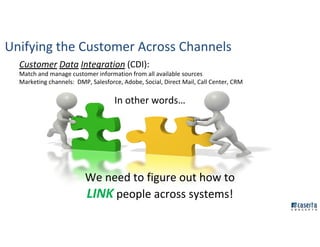
Unifying the Customer Across Channels
Customer Data Integration (CDI):
Match and manage customer information from all available sources
Marketing channels: DMP, Salesforce, Adobe, Social, Direct Mail, Call Center, CRM
In other words…
We need to figure out how to
LINK people across systems!
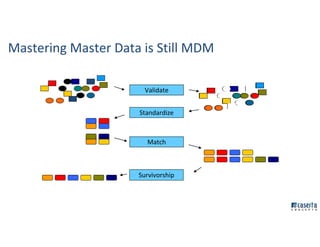
Mastering Master Data is Still MDM
Standardize
Match
Survivorship
Validate
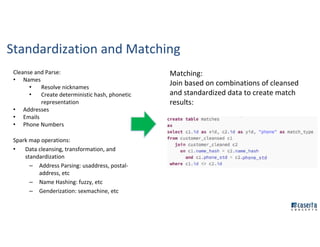
Standardization and Matching
Cleanse and Parse:
• Names
• Resolve nicknames
• Create deterministic hash, phonetic
representation
• Addresses
• Emails
• Phone Numbers
Matching:
Join based on combinations of cleansed
and standardized data to create match
results:
Spark map operations:
• Data cleansing, transformation, and
standardization
– Address Parsing: usaddress, postal-
address, etc
– Name Hashing: fuzzy, etc
– Genderization: sexmachine, etc
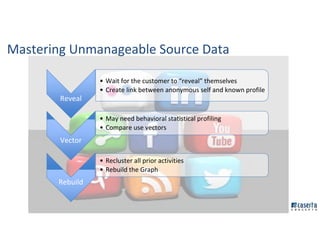
Mastering Unmanageable Source Data
Reveal
• Wait for the customer to “reveal” themselves
• Create link between anonymous self and known profile
Vector
• May need behavioral statistical profiling
• Compare use vectors
Rebuild
• Recluster all prior activities
• Rebuild the Graph
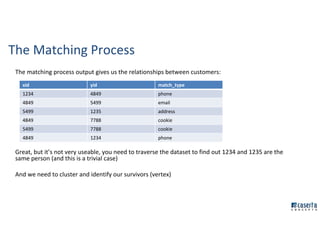
The Matching Process
The matching process output gives us the relationships between customers:
Great, but it’s not very useable, you need to traverse the dataset to find out 1234 and 1235 are the
same person (and this is a trivial case)
And we need to cluster and identify our survivors (vertex)
xid yid match_type
1234 4849 phone
4849 5499 email
5499 1235 address
4849 7788 cookie
5499 7788 cookie
4849 1234 phone
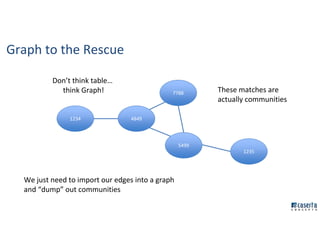
Graph to the Rescue
1234 4849
5499
7788
We just need to import our edges into a graph
and “dump” out communities
Don’t think table…
think Graph! These matches are
actually communities
1235
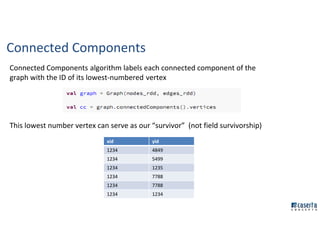
Connected Components algorithm labels each connected component of the
graph with the ID of its lowest-numbered vertex
This lowest number vertex can serve as our “survivor” (not field survivorship)
Connected Components
xid yid
1234 4849
1234 5499
1234 1235
1234 7788
1234 7788
1234 1234
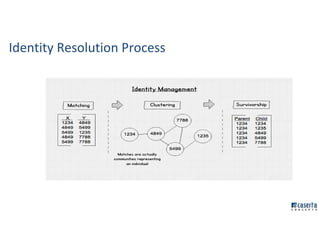
Identity Resolution Process
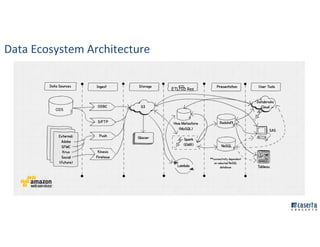
Data Ecosystem Architecture
ODS
ETL/ID Res
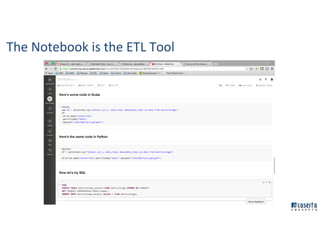
The Notebook is the ETL Tool
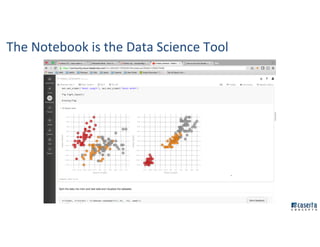
The Notebook is the Data Science Tool
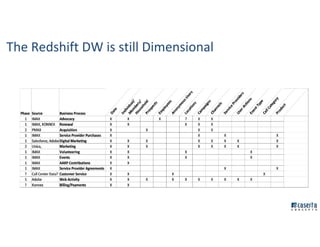
The Redshift DW is still Dimensional
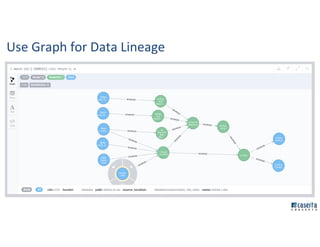
Use Graph for Data Lineage
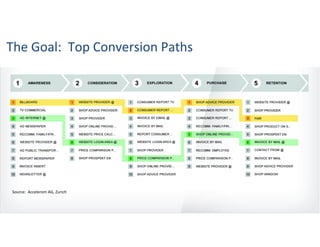
The Goal: Top Conversion Paths
Source: Accelerom AG, Zurich
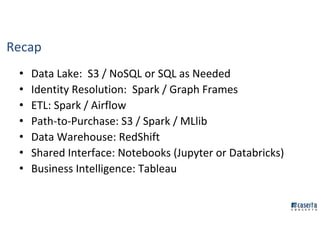
• Data Lake: S3 / NoSQL or SQL as Needed
• Identity Resolution: Spark / Graph Frames
• ETL: Spark / Airflow
• Path-to-Purchase: S3 / Spark / MLlib
• Data Warehouse: RedShift
• Shared Interface: Notebooks (Jupyter or Databricks)
• Business Intelligence: Tableau
Recap
Joe Caserta
President, Caserta Concepts
joe@casertaconcepts.com
@joe_Caserta
• Award-winning company
• Transformative Data Strategies
• Modern Data Engineering
• Advanced Architecture
• Innovation Partner
• Strategic Consulting
• Advanced Technical Design
• Build & Deploy Solutions
• BDW Meetup
• New York City
• 3,000+ members
• Knowledge sharing
Data is not important, it’s what you do with it that’s important!
Thank You

Building New Data Ecosystem for Customer Analytics, Strata + Hadoop World, 2016

  • 1.
    Joe Caserta President September 30,2016, Javits Center, New York City Building new Data Ecosystem for Customer Analytics
  • 2.
    Caserta Timeline Launched BigData practice Co-author, with Ralph Kimball, The Data Warehouse ETL Toolkit (Wiley) Data Analysis, Data Warehousing and Business Intelligence since 1996 Began consulting database programing and data modeling 25+ years hands-on experience building database solutions Founded Caserta Concepts in NYC Web log analytics solution published in Intelligent Enterprise magazine Launched Data Science, Data Interaction and Cloud practices Laser focus on extending Data Analytics with Big Data solutions 1986 2004 1996 2009 2001 2013 2012 2014 Dedicated to Data Governance Techniques on Big Data (Innovation) Awarded Top 20 Big Data Companies 2016 Top 20 Most Powerful Big Data consulting firms Launched Big Data Warehousing (BDW) Meetup NYC: 2,000+ Members 2016 Awarded Fastest Growing Big Data Companies 2016 Established best practices for big data ecosystem implementations
  • 3.
    About Caserta Concepts –Consulting Data Innovation and Modern Data Engineering – Award-winning company – Internationally recognized work force – Strategy, Architecture, Implementation, Governance – Innovation Partner – Strategic Consulting – Advanced Architecture – Build & Deploy • Leader in Enterprise Data Solutions – Big Data Analytics – Data Warehousing – Business Intelligence Data Science Cloud Computing Data Governance
  • 4.
    Awards & Recognition Top10 Fastest Growing Big Data Companies 2016
  • 5.
  • 6.
    Use Case Objectives •Cross-Channel Behavior Tracking / Identity Resolution • Access to Atomic Level Transaction Data • Blend Data Assets • Fast Data Onboarding and Discovery • Ensure Data Quality • Single platform / Landscape simplification • Understand Path-to-Purchase Customer Journey • Improve Customer Experience & Increase Sales
  • 7.
    The Recipe: Builda Dynamic Data Platform OLD WAY: • Structure Data Ingest Data Analyze Data • Fixed Capacity • Monolith NEW WAY: • Ingest Data Analyze Data Structure Data • Dynamic Capacity • Ecosystem RECIPE: • Cloud • Data Lake • Holistic Architecture & Framework
  • 8.
    Analytics: The WholeBrain Challenge Front Back Analytics Oriented • Data Science • Research Process Oriented • Data Governance • Compliance Operations Oriented • Shared Services • Data Engineering Revenue Oriented • Revenue Goals • Monetizing Data
  • 9.
    Chief Data Organization(Oversight) Vertical Business Area [Sales/Finance/Marketing/Operations/Customer Svc] Product Owner SCRUM Master Development Team Business Subject Matter Expertise Data Librarian/Data Stewardship Data Science/ Statistical Skills Data Engineering / Architecture Presentation/ BI Report Development Skills Data Quality Assurance DevOps IT Organization (Oversight) Enterprise Data Architect Solution Engineers Data Integration Practice User Experience Practice QA Practice Operations Practice Advanced Analytics Business Analysts Data Analysts Data Scientists Statisticians Data Engineers Planning Organization Project Managers Data Organization Data Gov Coordinator Data Librarians Data Stewards It Takes a Village!
  • 10.
  • 11.
    Global economics Intensity ofcompetition Reduce costs Move to cross-functional teams New executive leadership Speed of technical change Social trends and changes Period of time in present role Status & perks of office/dept under threat No apparent reasons for proposed changes Lack of understanding of proposed changes Fear of inability to cope with new technology Concern over job security Forces for Change Forces Resisting Change Status Quo Moving the Status Quo http://www.change-management-coach.com/force-field-analysis.html
  • 12.
    The Data LakeParadigm Technology: • Scalable distributed storage S3 • Pluggable fit-for-purpose processing EMR • Consistent extensible framework Spark • Dimensional Data Warehouse Redshift Functional Capabilities: • Remove barriers between data ingestion and analysis • Democratize Data with Just Enough Data Governance
  • 13.
  • 14.
    Why Spark? “Big Box”tools vs ROI? – Prohibitively expensive limited by licensing $$$ – Typically limited to the scalability of a single server We Spark! • Development local or distributed is identical • Beautiful high level API’s • Full universe of Python modules • Open source and Free • Blazing fast! • Databricks cloud makes it easier Spark has become our default processing engine for a myriad of engineering & science problems
  • 15.
    Ingest Raw Data Organize, Define, Complete Munging,Blending Machine Learning Data Quality and Monitoring Metadata, ILM , Security Data Catalog Data Integration Fully Governed ( trusted) Arbitrary/Ad-hoc Queries and Reporting Big Data Ware house Data Science Workspace Data Lake – Integrated Sandbox Landing Area – Source Data in “Full Fidelity” Usage Pattern Data Governance Metadata, ILM, Security Data Architecture is the new Data Model
  • 16.
    Data Lifecycle Ingest TransformAnalyze Output Understand Problem Ingest Data Explore and Understand Data Cleanand Shape Data Evaluate Data Create and build Models Communic ate Results Deliver & Deploy Model Data Engineer Architect how data is organized & ensure operability Data Scientist Deep analytics and modeling for hidden insights Business Analyst Work with data to apply insights to business strategy App Developer Integrates data & insights with existing or new applications
  • 17.
    Type Comments Single Touch Rules-BasedStatistically Driven Assign the credit to the first or last exposure Assign the credit to each interaction based on business rules Assign the credit to interactions based on data-driven model Ad-Click Mailing MailingE-mail E-mailAd-Click Ad-Click 100% 33% 33% 33% 27% 49% 24% - Last touch only - Ignores bulk of customer journey - Undervalues other interactions and influencers - Subjective - Assigns arbitrary values to each interaction - Lacks analytics rigor to determine weights ü Looks at full behavior patterns ü Consider all touch points ü Can apply different models for best results ü Use data to find correlations between touch points (winning combinations) Path-to-Purchase Methods
  • 18.
    Unifying the CustomerAcross Channels Customer Data Integration (CDI): Match and manage customer information from all available sources Marketing channels: DMP, Salesforce, Adobe, Social, Direct Mail, Call Center, CRM In other words… We need to figure out how to LINK people across systems!
  • 19.
    Mastering Master Datais Still MDM Standardize Match Survivorship Validate
  • 20.
    Standardization and Matching Cleanseand Parse: • Names • Resolve nicknames • Create deterministic hash, phonetic representation • Addresses • Emails • Phone Numbers Matching: Join based on combinations of cleansed and standardized data to create match results: Spark map operations: • Data cleansing, transformation, and standardization – Address Parsing: usaddress, postal- address, etc – Name Hashing: fuzzy, etc – Genderization: sexmachine, etc
  • 21.
    Mastering Unmanageable SourceData Reveal • Wait for the customer to “reveal” themselves • Create link between anonymous self and known profile Vector • May need behavioral statistical profiling • Compare use vectors Rebuild • Recluster all prior activities • Rebuild the Graph
  • 22.
    The Matching Process Thematching process output gives us the relationships between customers: Great, but it’s not very useable, you need to traverse the dataset to find out 1234 and 1235 are the same person (and this is a trivial case) And we need to cluster and identify our survivors (vertex) xid yid match_type 1234 4849 phone 4849 5499 email 5499 1235 address 4849 7788 cookie 5499 7788 cookie 4849 1234 phone
  • 23.
    Graph to theRescue 1234 4849 5499 7788 We just need to import our edges into a graph and “dump” out communities Don’t think table… think Graph! These matches are actually communities 1235
  • 24.
    Connected Components algorithmlabels each connected component of the graph with the ID of its lowest-numbered vertex This lowest number vertex can serve as our “survivor” (not field survivorship) Connected Components xid yid 1234 4849 1234 5499 1234 1235 1234 7788 1234 7788 1234 1234
  • 25.
  • 26.
  • 27.
    The Notebook isthe ETL Tool
  • 28.
    The Notebook isthe Data Science Tool
  • 29.
    The Redshift DWis still Dimensional
  • 30.
    Use Graph forData Lineage
  • 31.
    The Goal: TopConversion Paths Source: Accelerom AG, Zurich
  • 32.
    • Data Lake:S3 / NoSQL or SQL as Needed • Identity Resolution: Spark / Graph Frames • ETL: Spark / Airflow • Path-to-Purchase: S3 / Spark / MLlib • Data Warehouse: RedShift • Shared Interface: Notebooks (Jupyter or Databricks) • Business Intelligence: Tableau Recap
  • 33.
    Joe Caserta President, CasertaConcepts joe@casertaconcepts.com @joe_Caserta • Award-winning company • Transformative Data Strategies • Modern Data Engineering • Advanced Architecture • Innovation Partner • Strategic Consulting • Advanced Technical Design • Build & Deploy Solutions • BDW Meetup • New York City • 3,000+ members • Knowledge sharing Data is not important, it’s what you do with it that’s important! Thank You