Towards
  Neuro–Information Science


      Jacek Gwizdka & Michael Cole
          iSchool @ Rutgers University, NJ, USA


             jacek@neuroinfoscience.org
                      http://jsg.tel


                     June 5, 2012
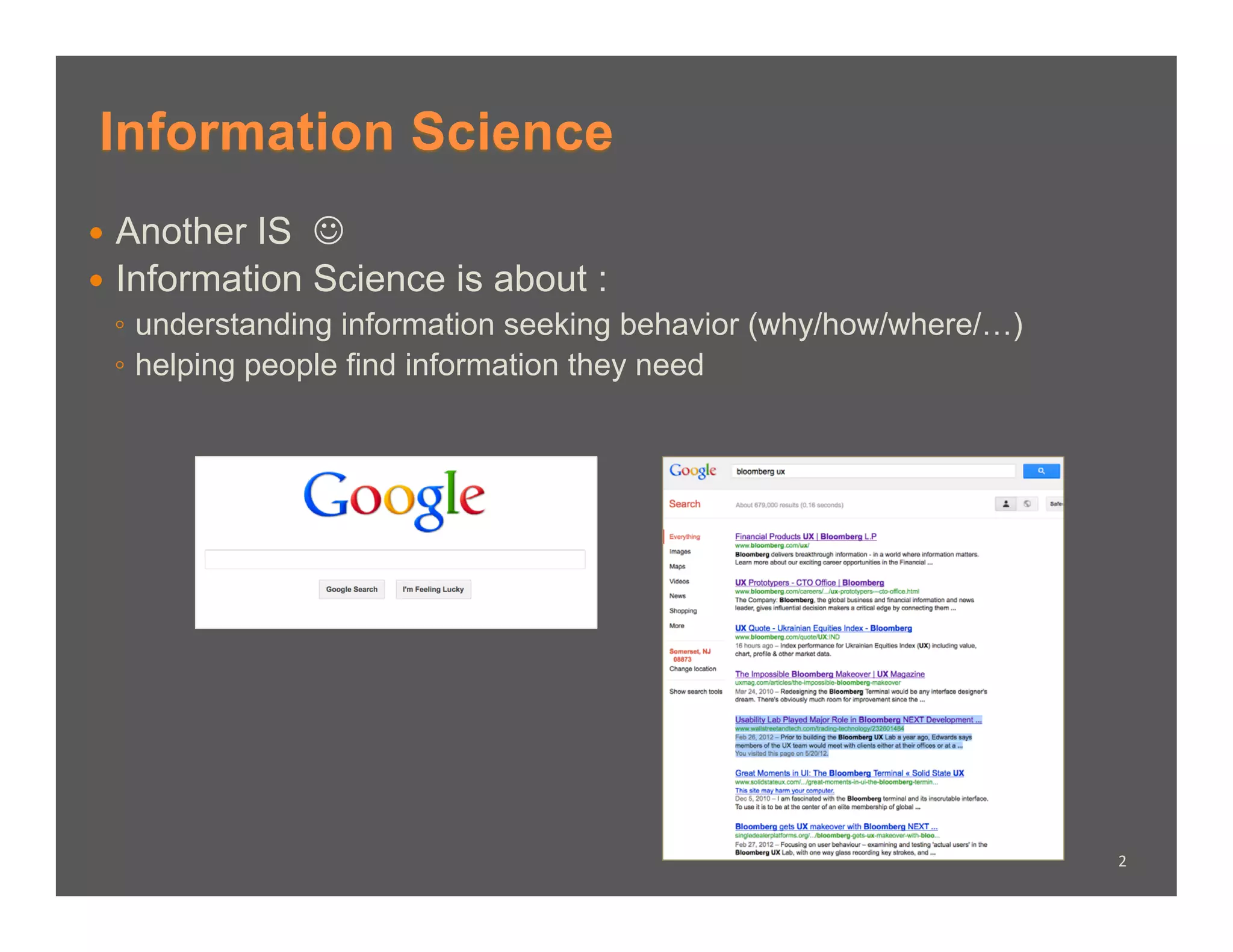
Information Science
  Another  IS 
  Information Science is about :
 ◦  understanding information seeking behavior (why/how/where/…)
 ◦  helping people find information they need


                                                                   2	
  
Information Systems vs. iScience
  A lot of common concerns and constructs:
   ◦  information is digital  accessed via information systems
   ◦  technology – task – individual
   ◦  IT usefulness, user interface design, usability …
   ◦  trust …
   ◦  decision making …
   ◦  affective and cognitive factors
   ◦  information search (e.g., stopping behavior) …


                                                                  3	
  
Information Systems vs. iScience
  Also new opportunities:
   ◦  neural-correlates of constructs specific to Information Science
   ◦  Information Relevance : most commonly refers to topical relevance
      or aboutness, that is: to what extent the content of a search result
      matches the topic of the query or a person’s information need (e.g.,
   Saracevic, 2007)
     relevance judgment  decision making
      information stopping


                                                                             4	
  
Opportunities for Neuroscience to Inform IS
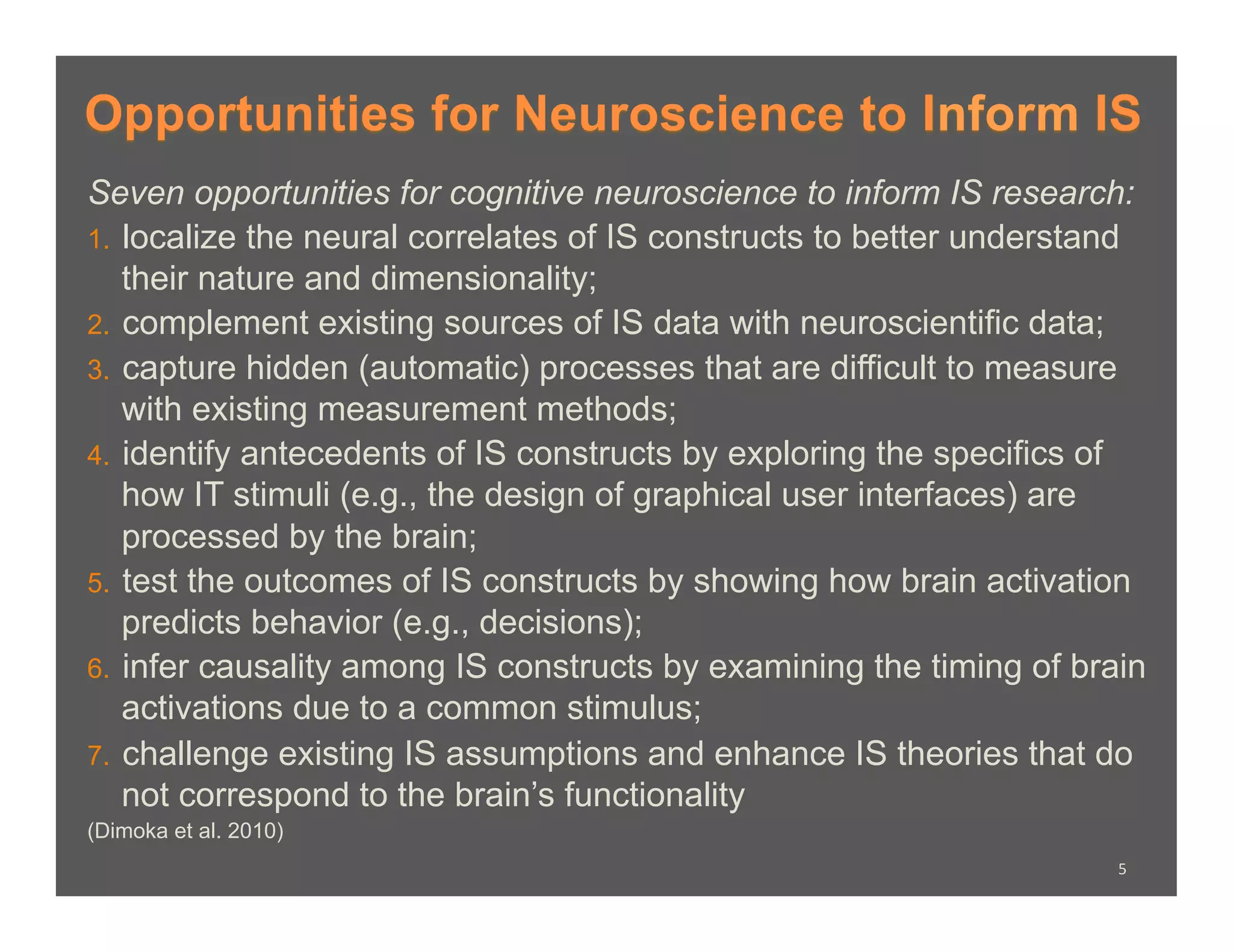
Seven opportunities for cognitive neuroscience to inform IS research:
1.  localize the neural correlates of IS constructs to better understand
    their nature and dimensionality;
2.  complement existing sources of IS data with neuroscientific data;
3.  capture hidden (automatic) processes that are difficult to measure
    with existing measurement methods;
4.  identify antecedents of IS constructs by exploring the specifics of
    how IT stimuli (e.g., the design of graphical user interfaces) are
    processed by the brain;
5.  test the outcomes of IS constructs by showing how brain activation
    predicts behavior (e.g., decisions);
6.  infer causality among IS constructs by examining the timing of brain
    activations due to a common stimulus;
7.  challenge existing IS assumptions and enhance IS theories that do
    not correspond to the brain’s functionality
(Dimoka et al. 2010)
                                                                      5	
  
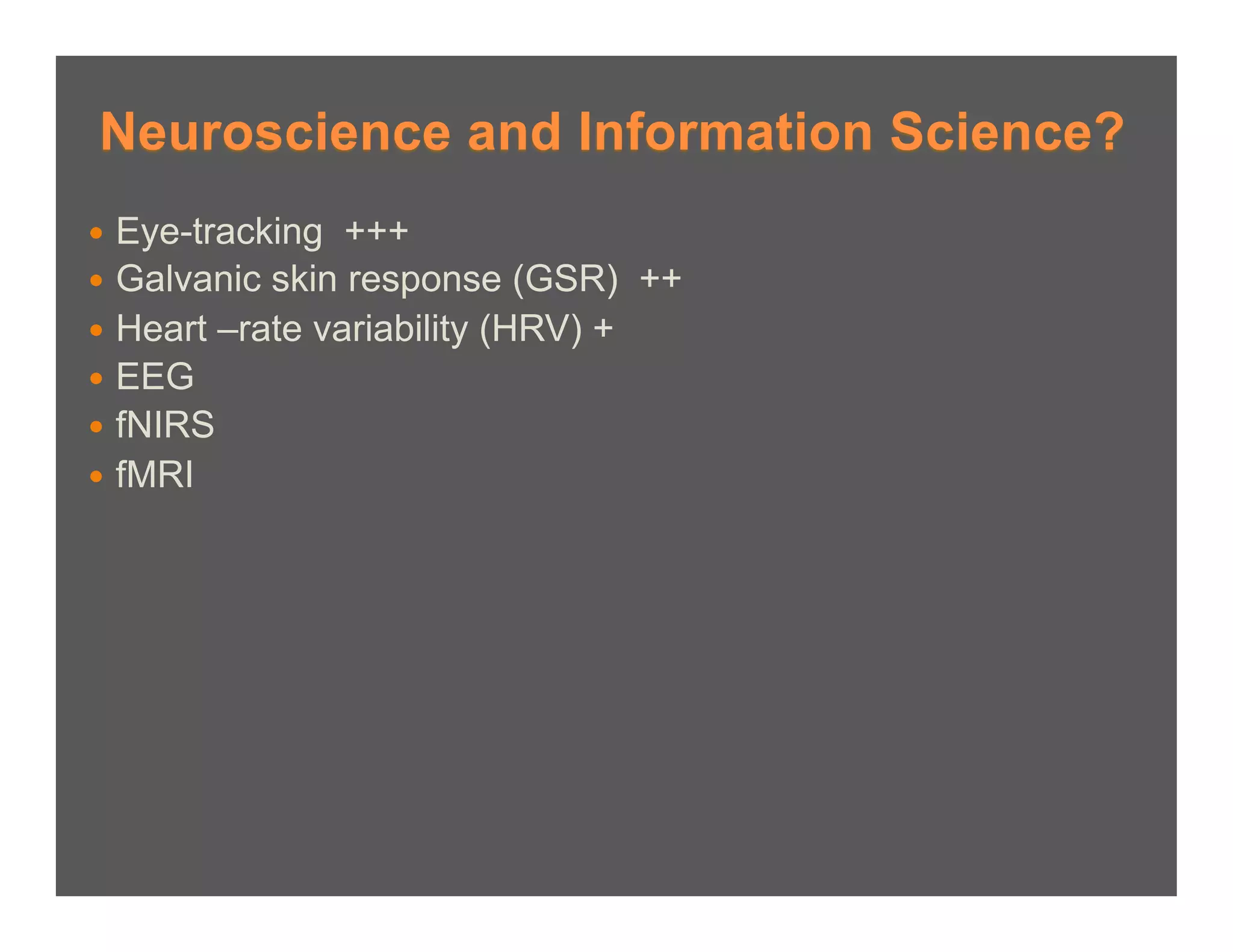
Neuroscience and Information Science?
  Eye-tracking  +++
  Galvanic skin response (GSR) ++
  Heart –rate variability (HRV) +
  EEG
  fNIRS
  fMRI
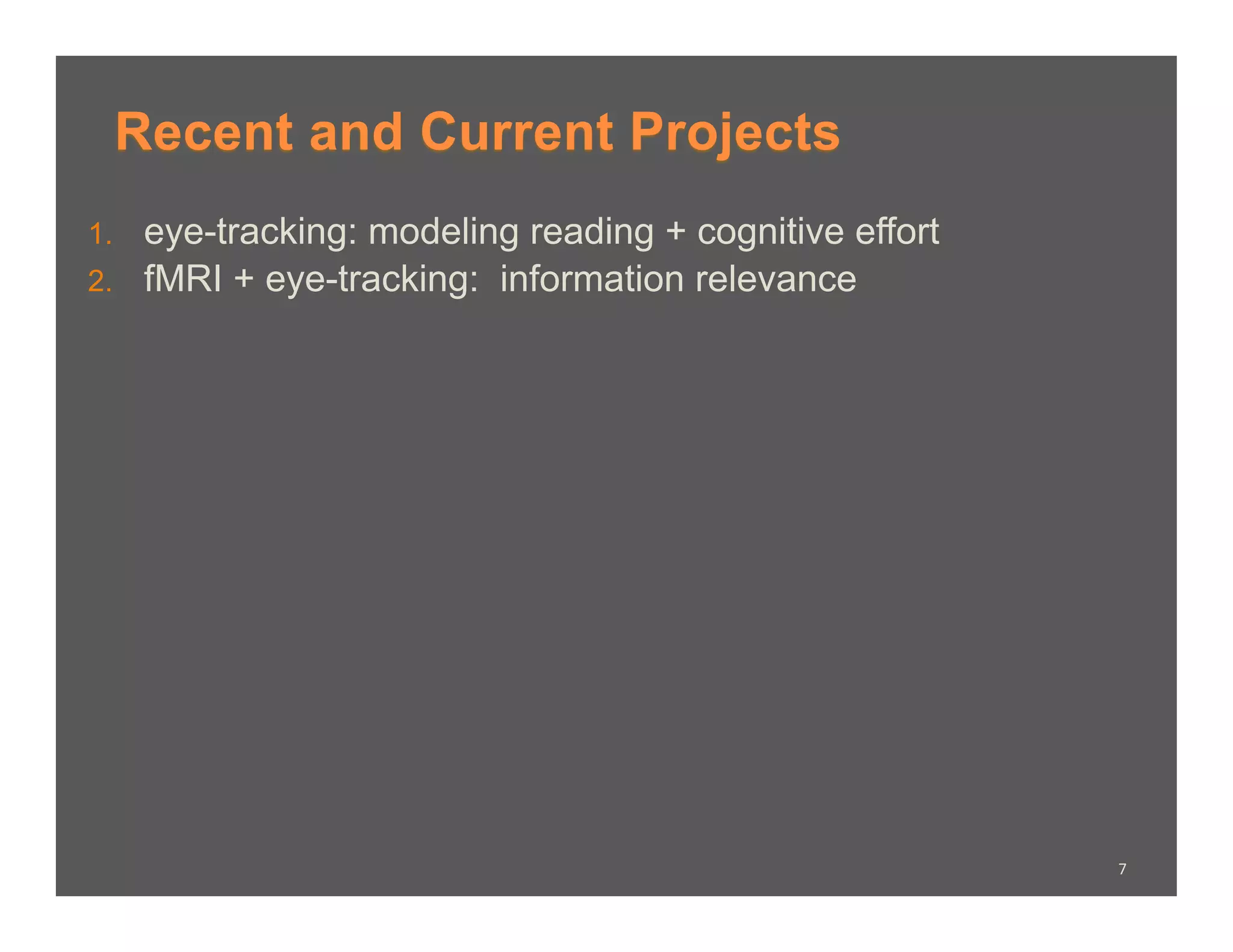
Recent and Current Projects
1.    eye-tracking: modeling reading + cognitive effort
2.    fMRI + eye-tracking: information relevance


                                                          7	
  
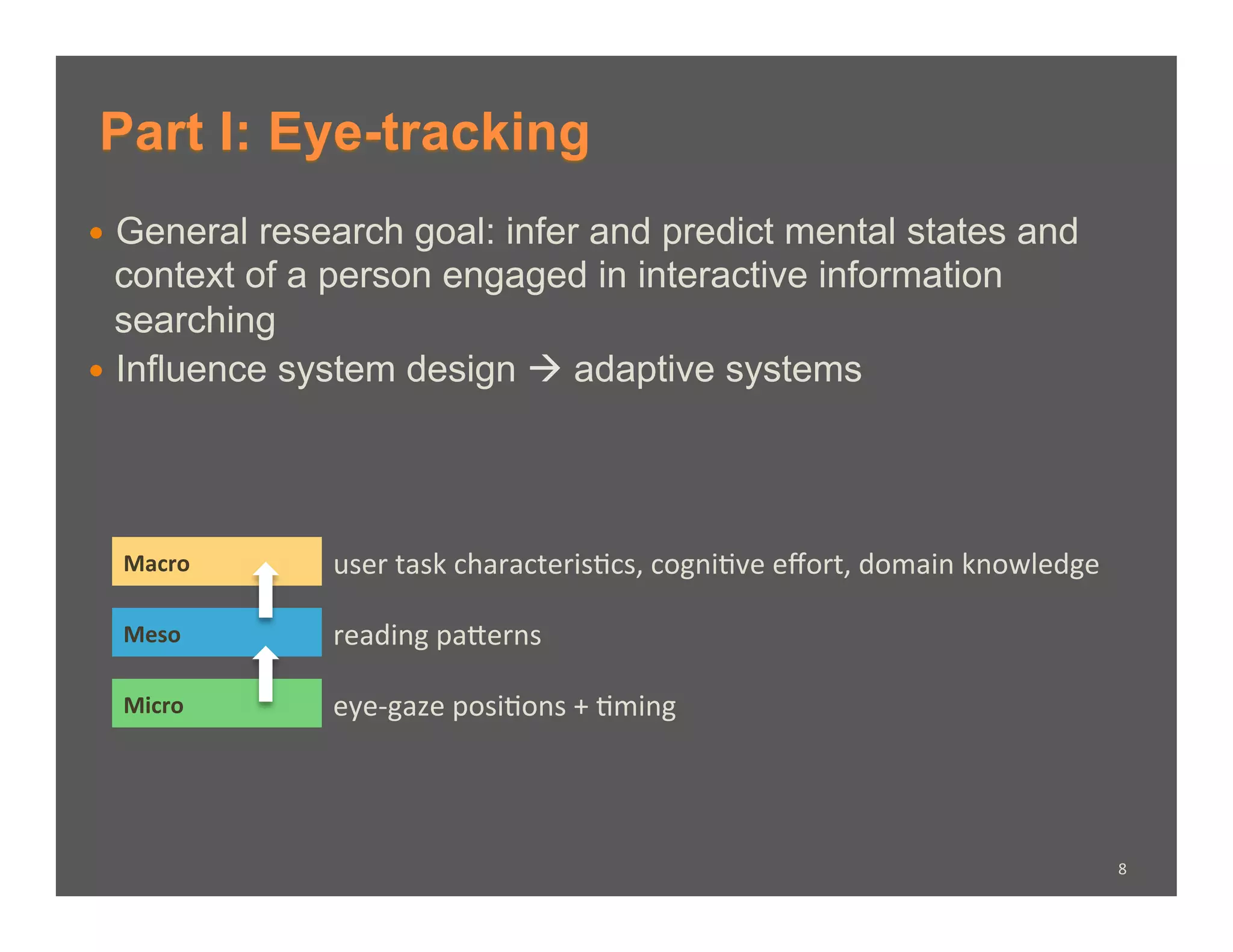
Part I: Eye-tracking
  General  research goal: infer and predict mental states and
   context of a person engaged in interactive information
   searching
  Influence system design  adaptive systems


  Macro	
      user	
  task	
  characteris�cs,	
  cogni�ve	
  effort,	
  domain	
  knowledge	
  

  Meso	
       reading	
  pa�erns	
  

  Micro	
      eye-­‐gaze	
  posi�ons	
  +	
  �ming	


                                                                                                  8	
  
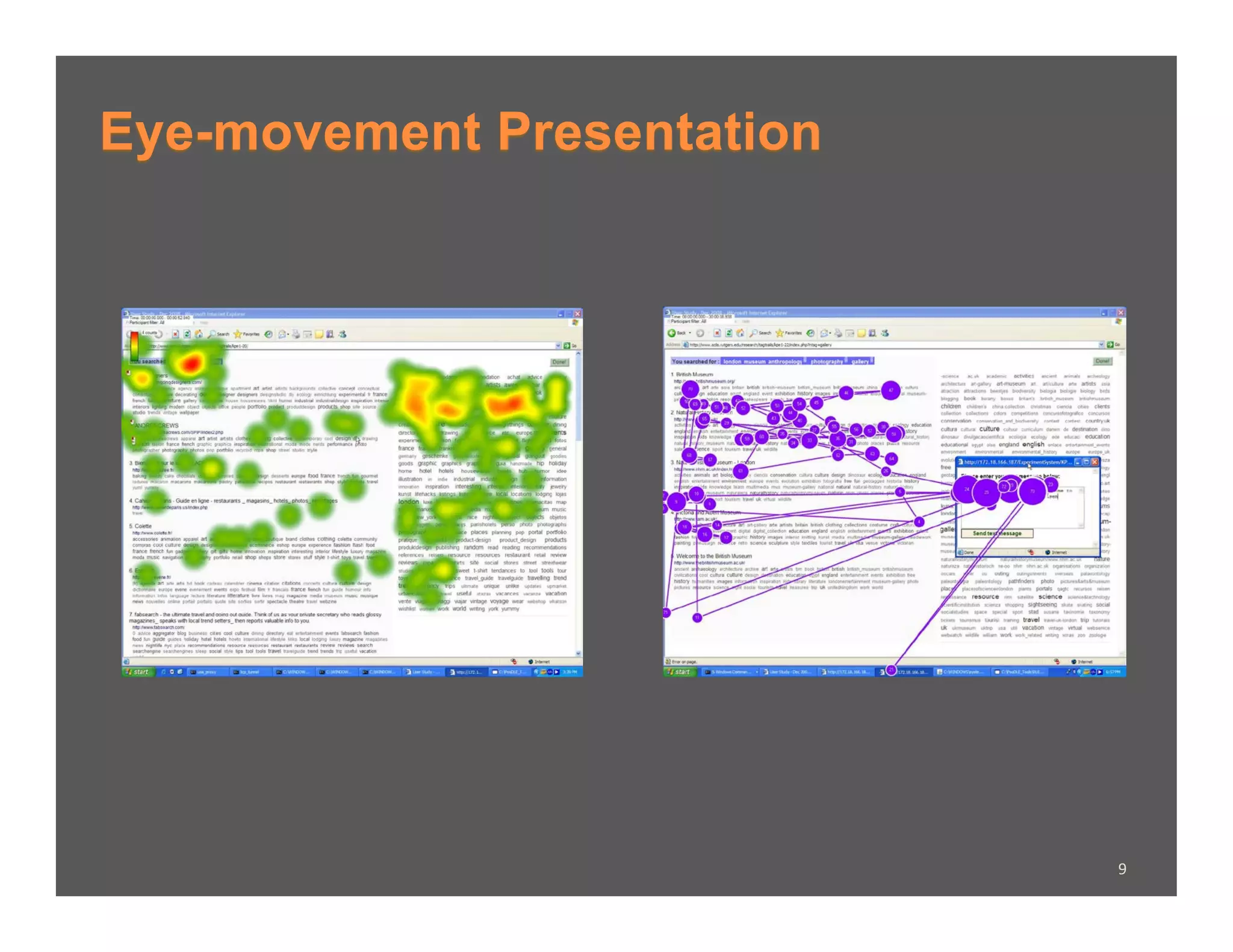
Eye-movement Presentation


                            9	
  
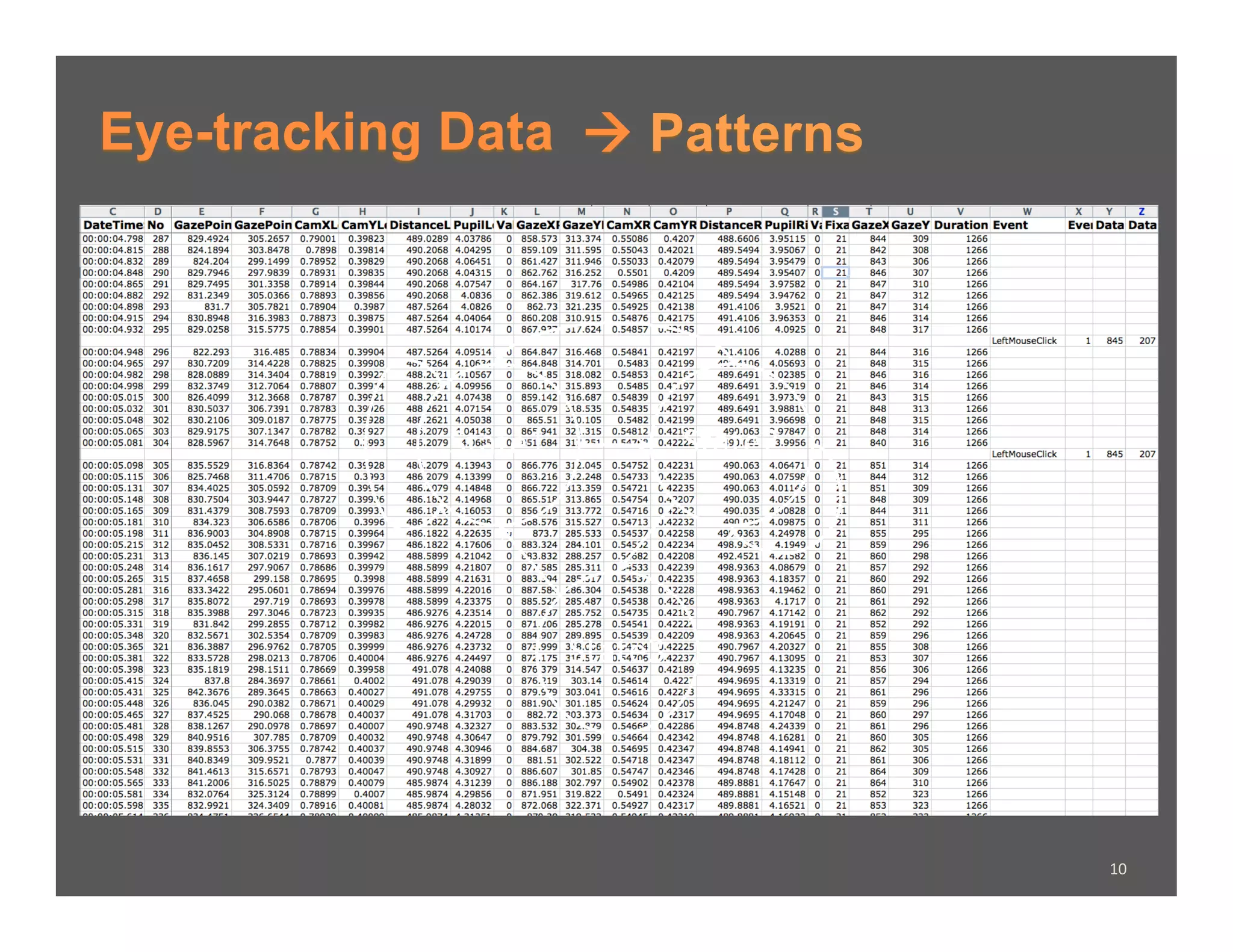
Eye-tracking Data à Patterns


             State1	
                  State2	


                          State3	


                                                    10	
  
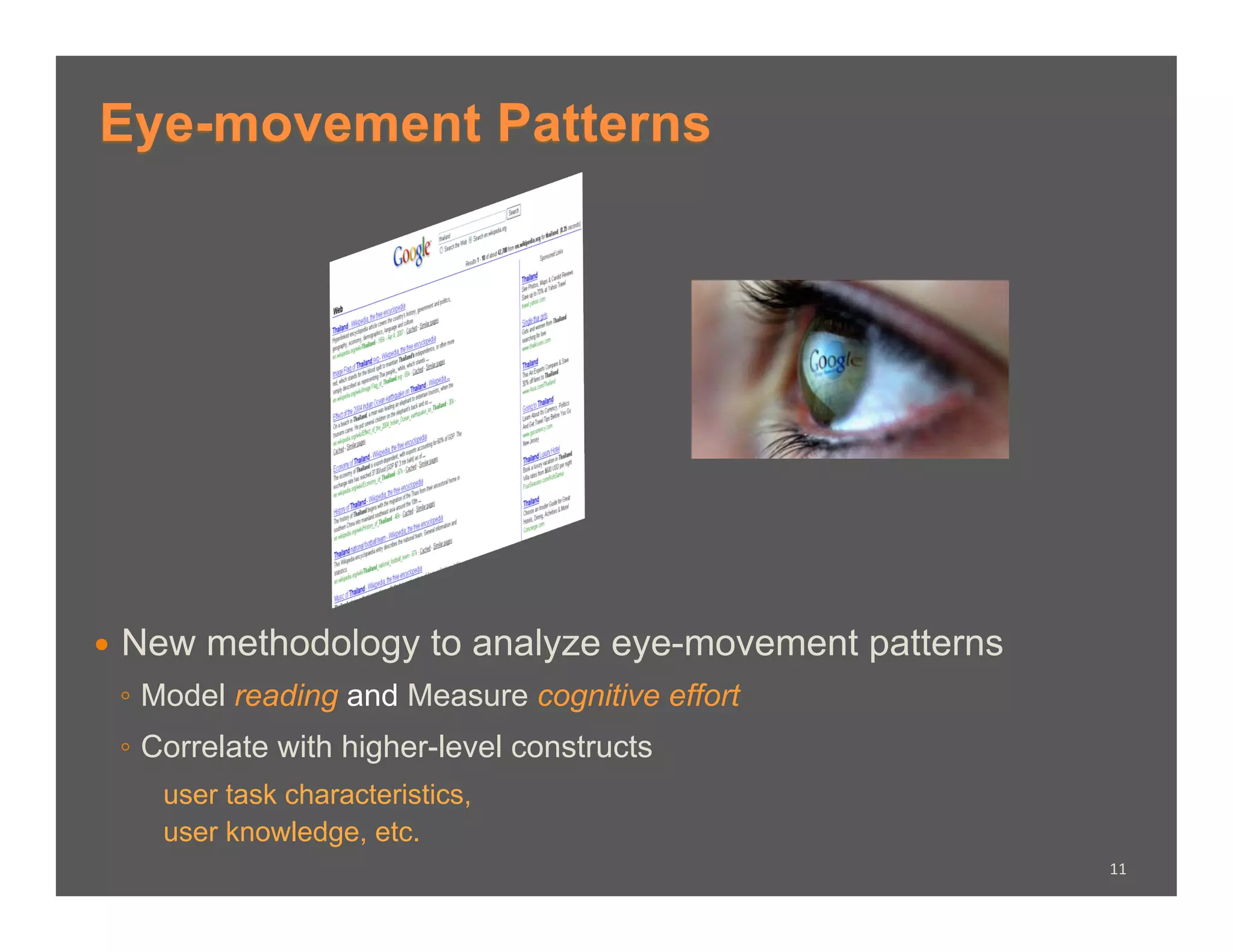
Eye-movement Patterns


  New   methodology to analyze eye-movement patterns
 ◦  Model reading and Measure cognitive effort
 ◦  Correlate with higher-level constructs
    user task characteristics,
    user knowledge, etc.
                                                        11	
  
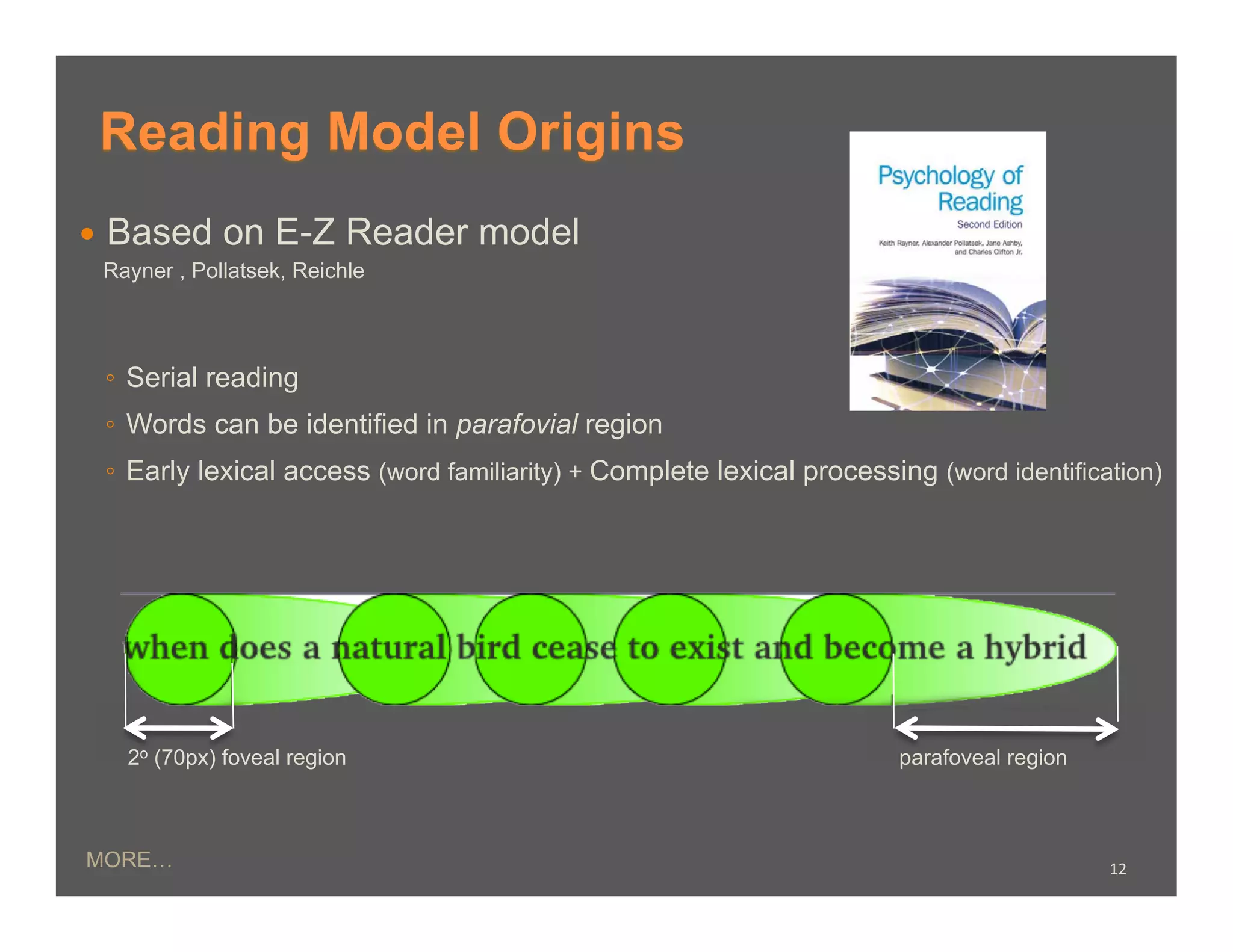
Reading Model Origins
  Based     on E-Z Reader model
 Rayner , Pollatsek, Reichle


 ◦  Serial reading
 ◦  Words can be identified in parafovial region
 ◦  Early lexical access (word familiarity) + Complete lexical processing (word identification)


   2o (70px) foveal region                                             parafoveal region


MORE…                                                                                      12	
  
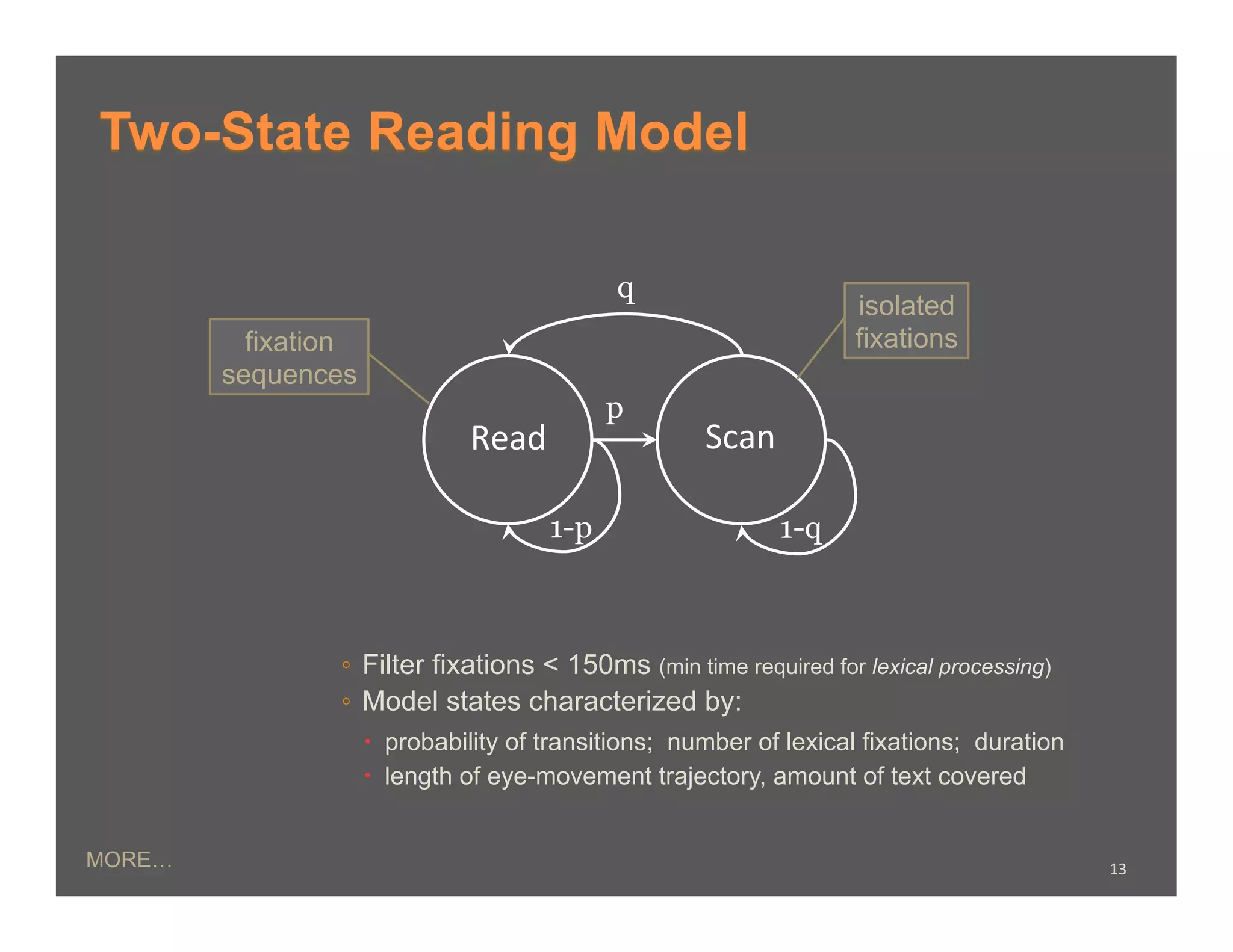
Two-State Reading Model

                                             q
                                                                    isolated
          fixation                                                  fixations
        sequences
                                             p
                               Read	
                 Scan	
  

                                       1-p                   1-q


                ◦  Filter fixations < 150ms (min time required for lexical processing)
                ◦  Model states characterized by:
                       probability of transitions; number of lexical fixations; duration
                       length of eye-movement trajectory, amount of text covered


MORE…                                                                                       13	
  
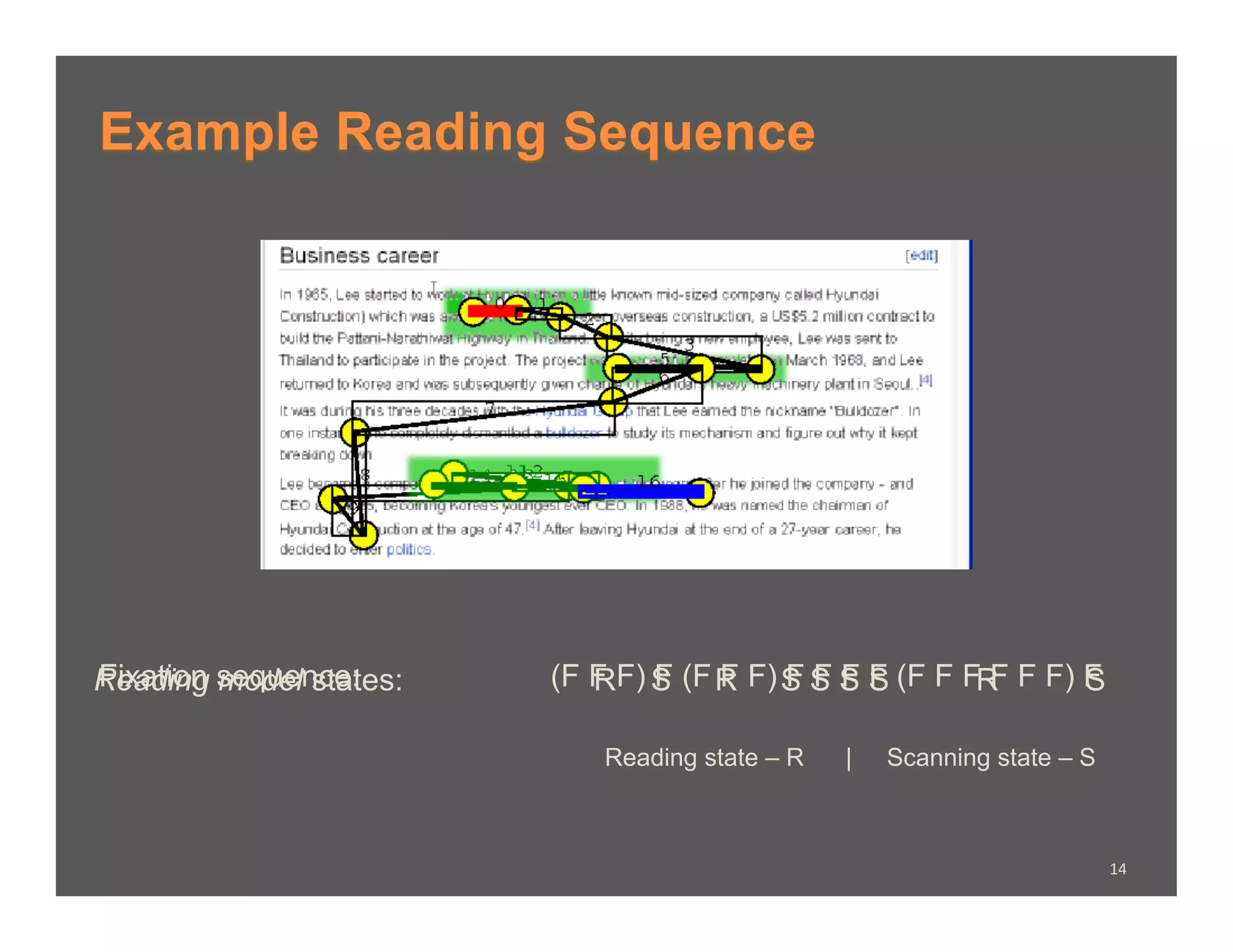
Example Reading Sequence


Reading sequence:
Fixation model states:   (F F F) S (F R F) S S S S (F F FR F F) F
                            R F       F    FFFF           F     S

                            Reading state – R   |   Scanning state – S


                                                                         14	
  
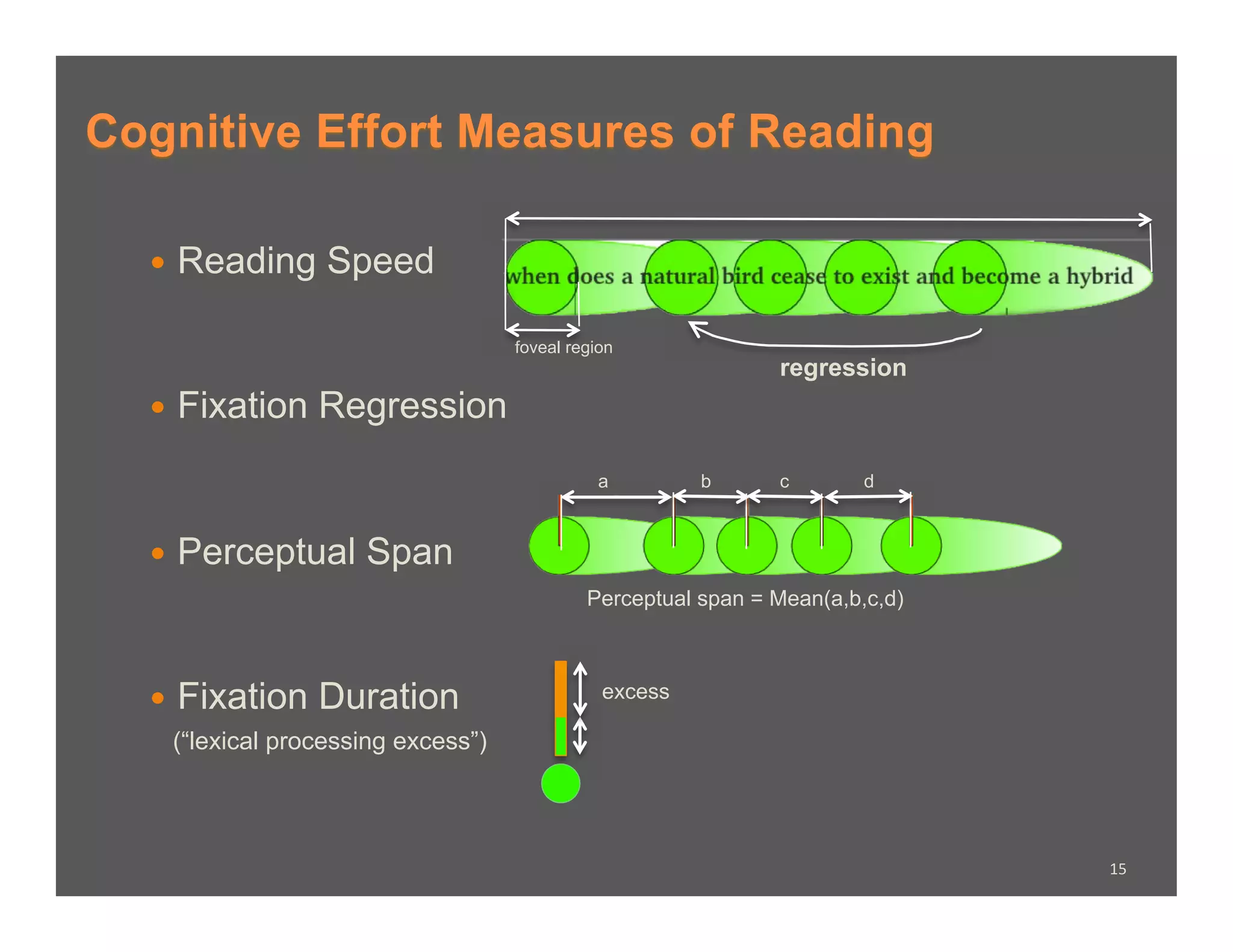
Cognitive Effort Measures of Reading

    Reading     Speed

                                   foveal region
                                                              regression
    Fixation   Regression
                                              a        b      c        d


    Perceptual     Span
                                            Perceptual span = Mean(a,b,c,d)


    Fixation   Duration                      excess

   (“lexical processing excess”)


                                                                              15	
  
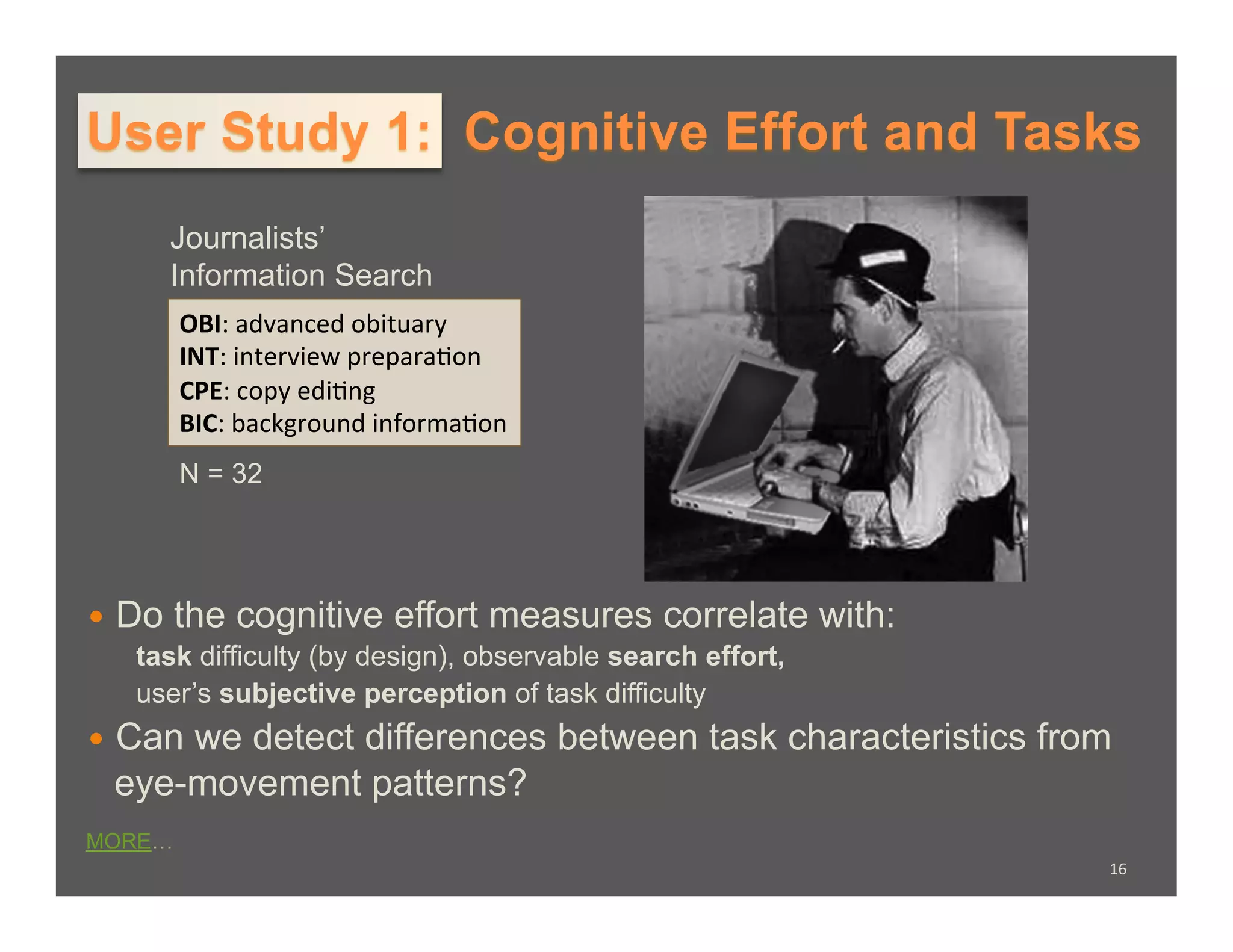
User Study 1: Cognitive Effort and Tasks
        Journalists’
        Information Search
        OBI:	
  advanced	
  obituary	
  
        INT:	
  interview	
  prepara�on	
  
        CPE:	
  copy	
  edi�ng	
  
        BIC:	
  background	
  informa�on	
  
        N = 32


  Do   the cognitive effort measures correlate with:
   task difficulty (by design), observable search effort,
   user’s subjective perception of task difficulty
  Can
     we detect differences between task characteristics from
 eye-movement patterns?
MORE…
                                                            16	
  
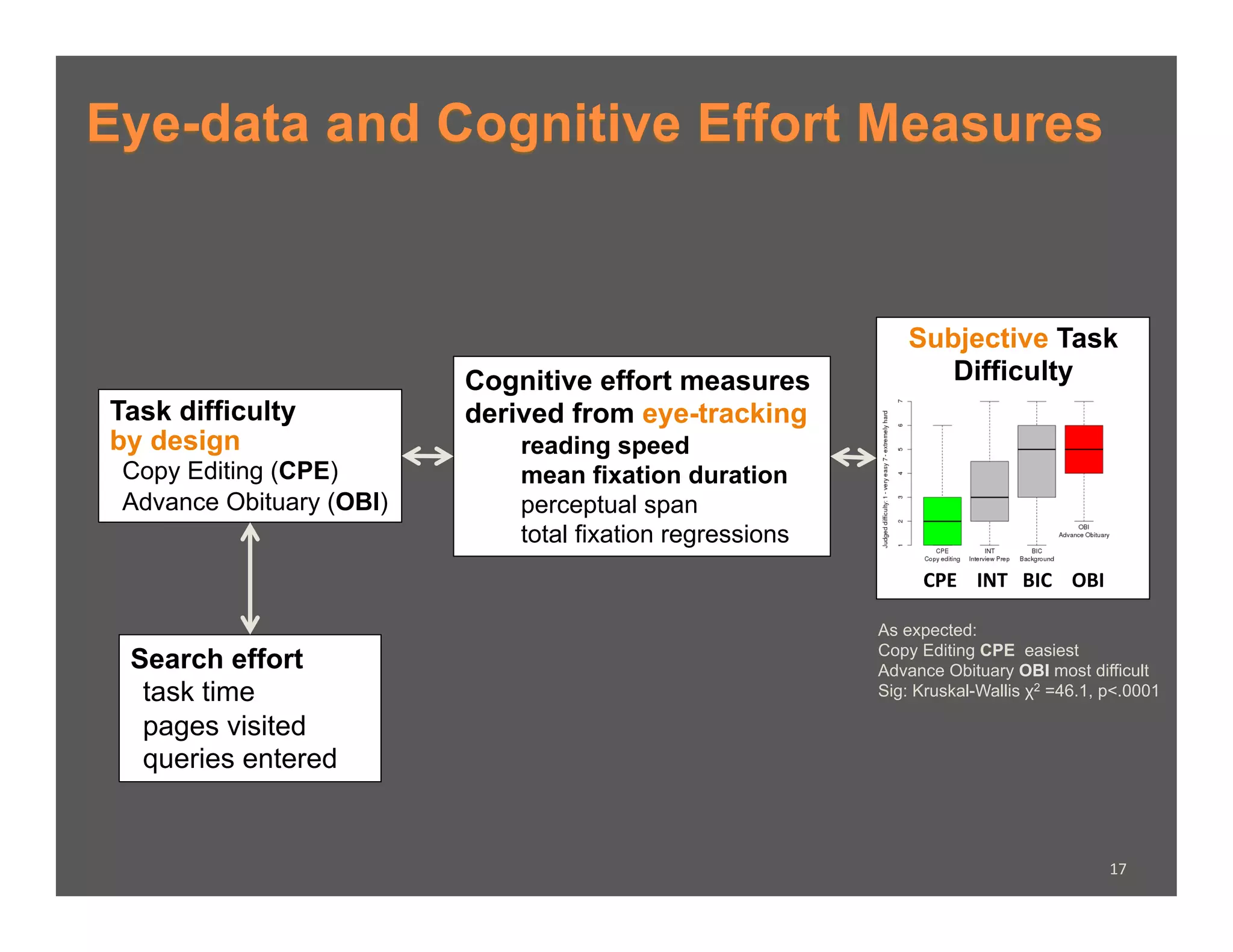
Eye-data and Cognitive Effort Measures


                                                              Subjective Task
                          Cognitive effort measures              Difficulty
Task difficulty           derived from eye-tracking
by design                     reading speed
 Copy Editing (CPE)           mean fixation duration
 Advance Obituary (OBI)       perceptual span
                              total fixation regressions
                                                                CPE	


  INT	
  	
  	
  BIC	


  OBI	
  

                                                           As expected:
                                                           Copy Editing CPE easiest
 Search effort                                             Advance Obituary OBI most difficult
  task time                                                Sig: Kruskal-Wallis χ2 =46.1, p<.0001

  pages visited
  queries entered


                                                                                                                               17	
  
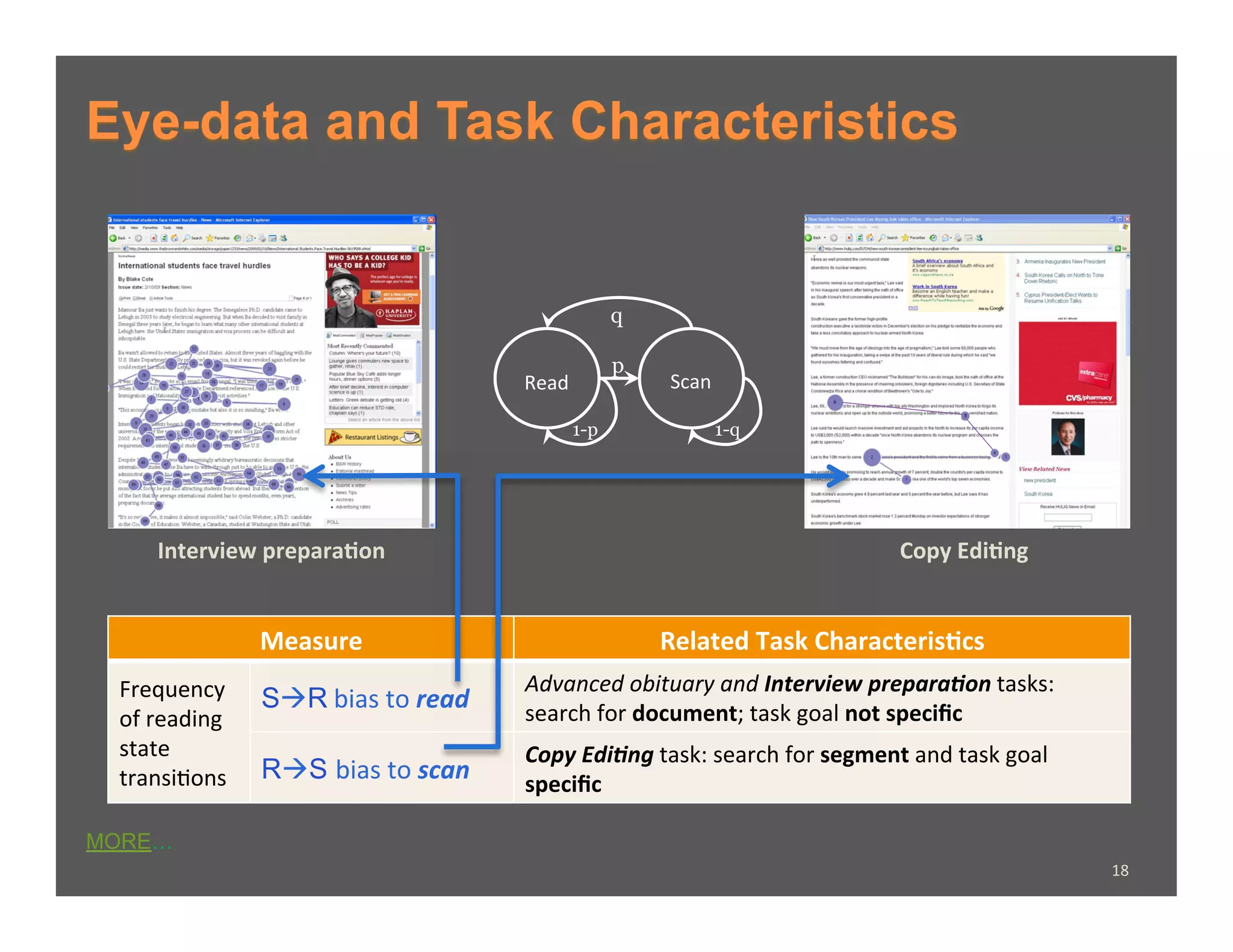
Eye-data and Task Characteristics


                                                               q

                                                               p
                                                  Read	
               Scan	
  

                                                         1-p                  1-q


      Interview	
  prepara�on                                                                            Copy	
  Edi�ng	


                     Measure	
                                       Related	
  Task	
  Characteris�cs	
  
 Frequency	
                                      Advanced	
  obituary	
  and	
  Interview	
  prepara�on	
  tasks:	
  	
  
                     SR bias	
  to	
  read	
     search	
  for	
  document;	
  task	
  goal	
  not	
  specific	
  
 of	
  reading	
  
 state	
                                          Copy	
  Edi�ng	
  task:	
  search	
  for	
  segment	
  and	
  task	
  goal	
  
 transi�ons	
        RS bias	
  to	
  scan	
     specific	
  

MORE…
                                                                                                                                   18	
  
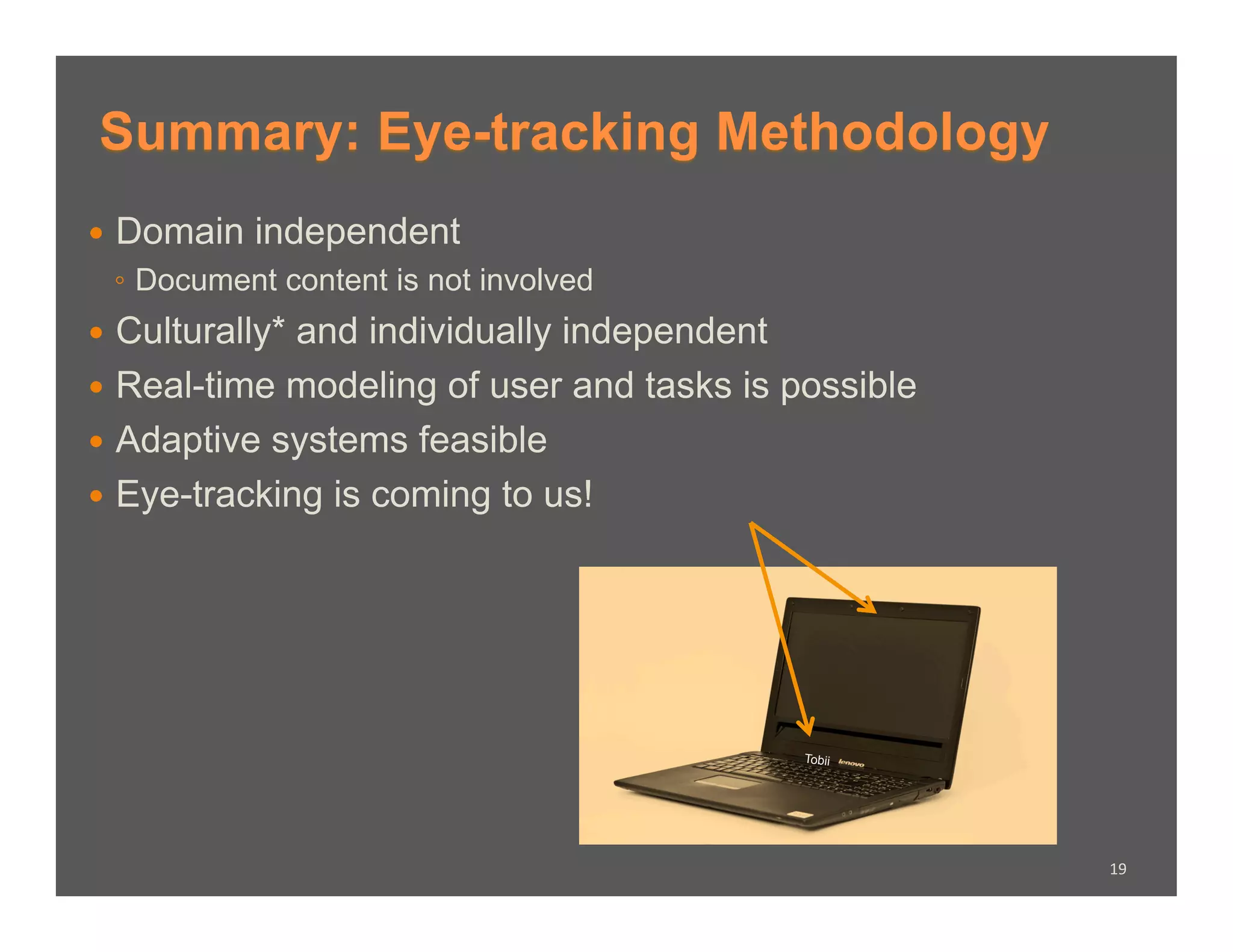
Summary: Eye-tracking Methodology
  Domain   independent
 ◦  Document content is not involved
  Culturally*and individually independent
  Real-time modeling of user and tasks is possible
  Adaptive systems feasible
  Eye-tracking is coming to us!


                                            Tobii


                                                      19	
  
Part II: Current fMRI+eye-tracking Study
  Information Relevance : refers to topical relevance
 or aboutness, that is: to what extent the content of a document
 (webpage) matches the topic of the query or a person’s
 information need (e.g., Saracevic, 2007)
 ◦  Relevance multi-dimensional: topical, meaningful, useful, trust, affective…
  Neuralcorrelates of topical relevance judgments
  Hypothesis
 ◦  Brain regions that are activated when relevant information is found are
    different from regions activated when no relevant info is found and when
    person does “low-level” visual word search (orthographic matching)
     but no hypothesis in a sense where the brain activity is located
  Exploratory    research

  (also:   a similar experiment with eye-tracking, EEG, GSR)
                                                                           20	
  
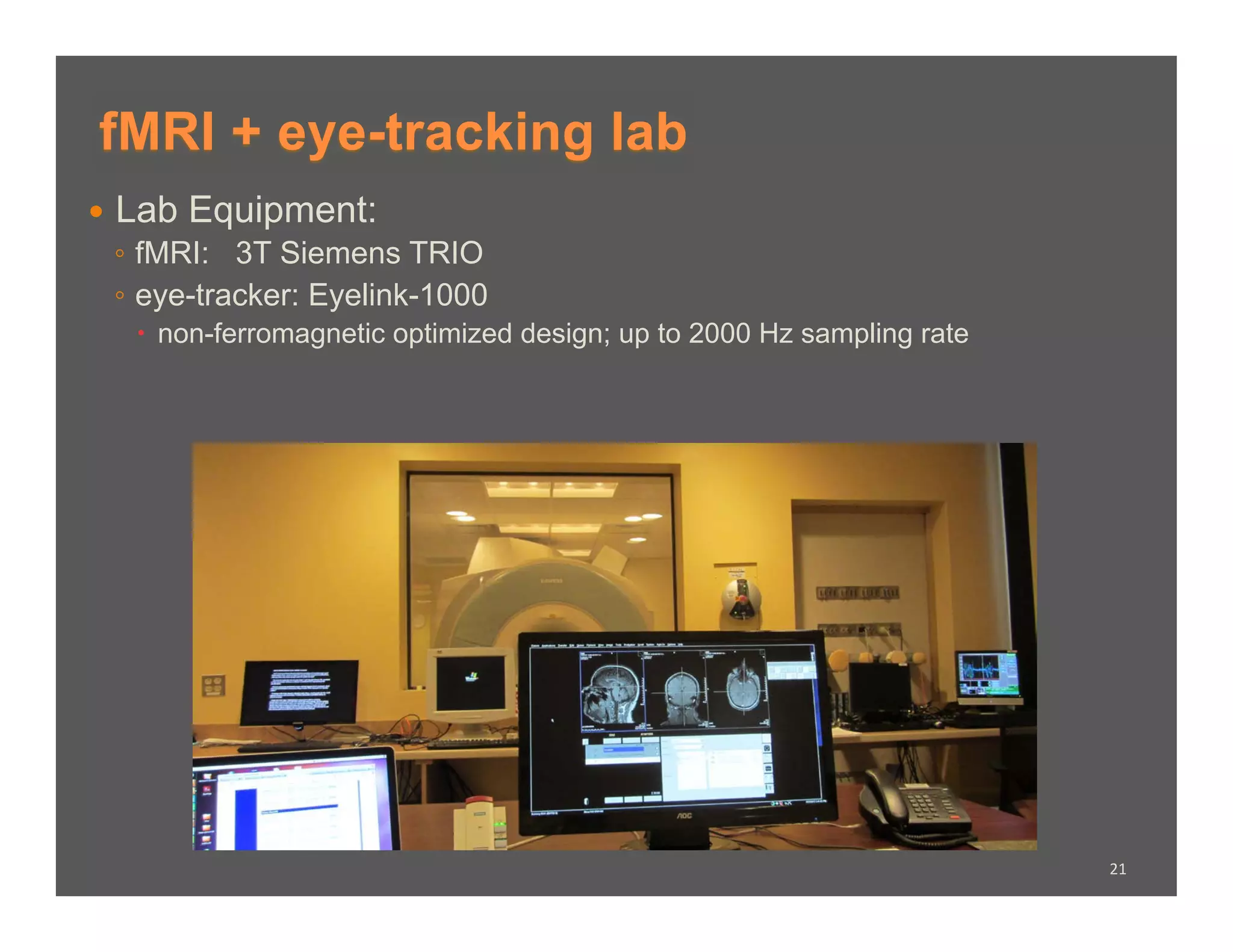
fMRI + eye-tracking lab
  Lab Equipment:
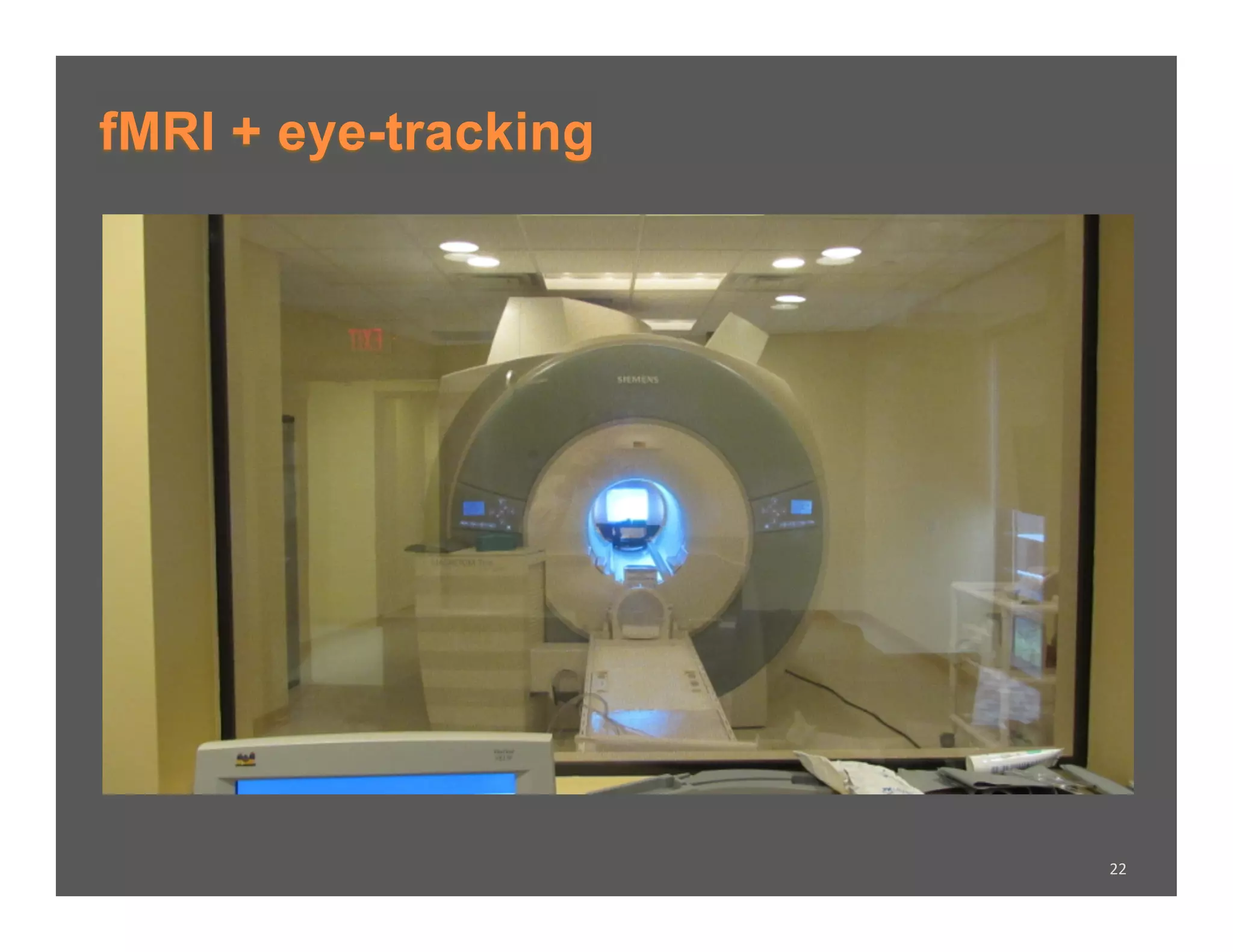
   ◦  fMRI: 3T Siemens TRIO
   ◦  eye-tracker: Eyelink-1000
     non-ferromagnetic optimized design; up to 2000 Hz sampling rate


                                                                        21	
  
fMRI + eye-tracking


                      22	
  
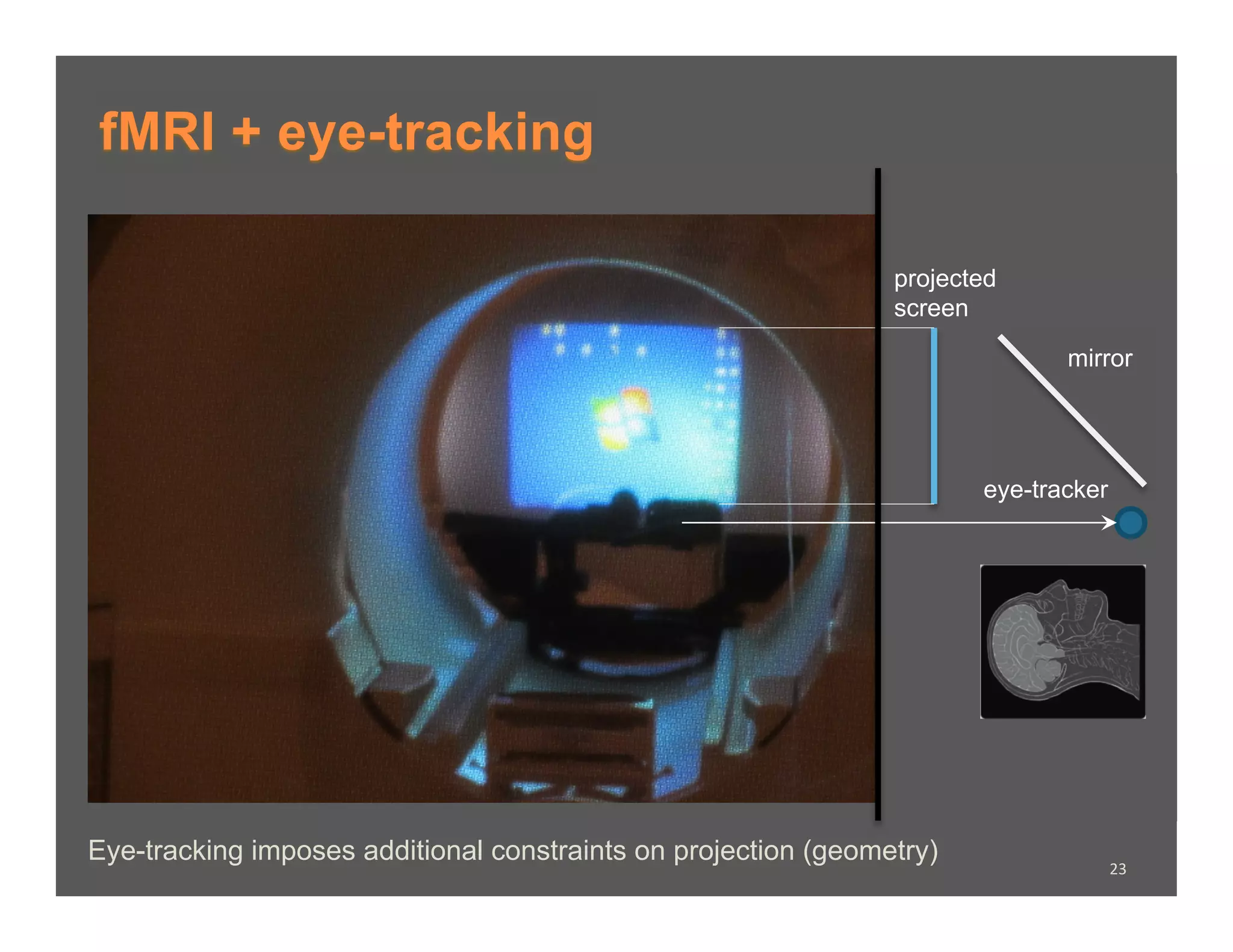
fMRI + eye-tracking

                                                                projected
                                                                screen

                                                                              mirror


                                                                       eye-tracker


Eye-tracking imposes additional constraints on projection (geometry)
                                                                                     23	
  
Current Experimental Design
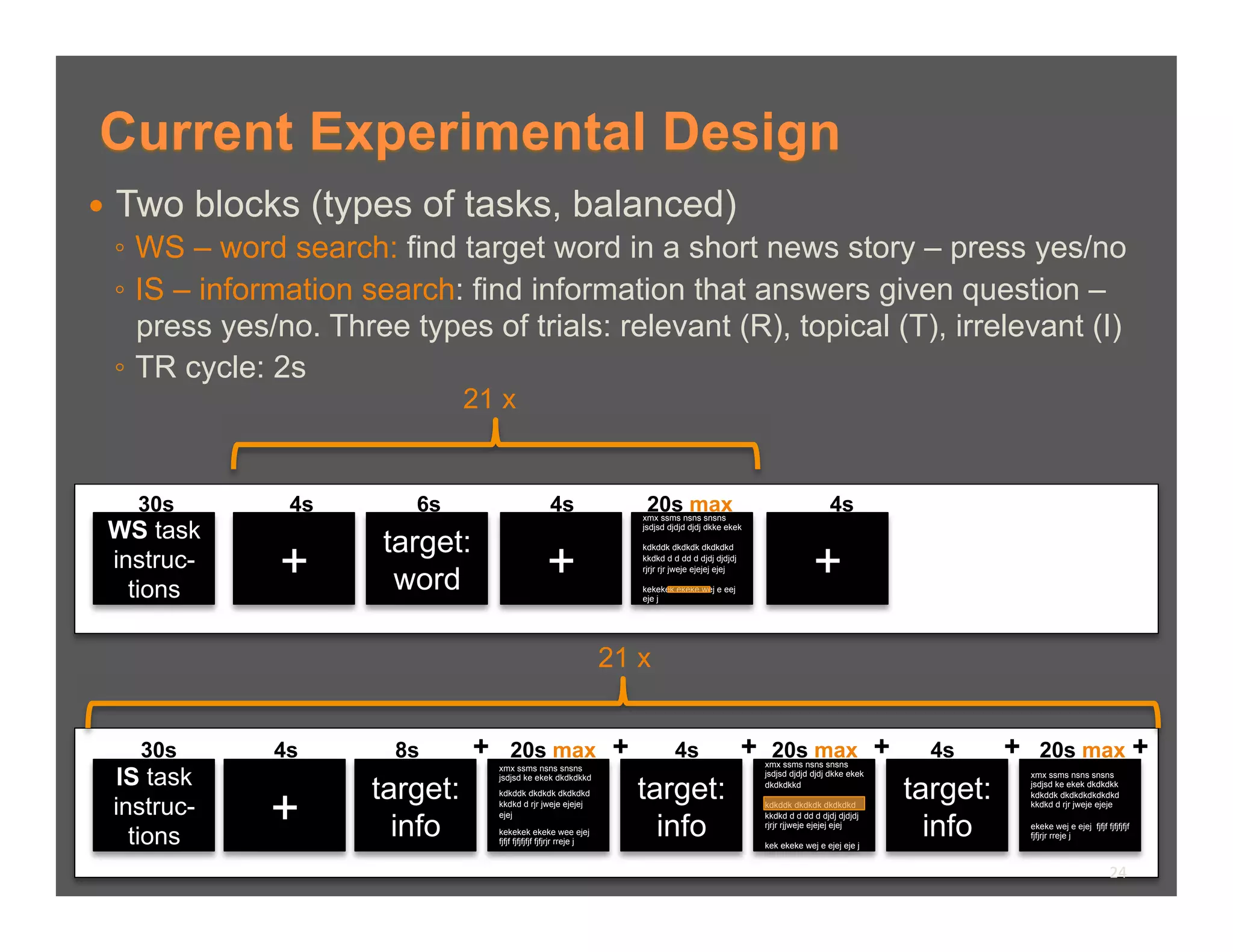
  Two blocks (types of tasks, balanced)
   ◦  WS – word search: find target word in a short news story – press yes/no
   ◦  IS – information search: find information that answers given question –
      press yes/no. Three types of trials: relevant (R), topical (T), irrelevant (I)
   ◦  TR cycle: 2s
                                21 x


    30s         4s        6s                          4s                     20s max
                                                                            xmx ssms nsns snsns
                                                                                                                               4s
 WS task
                       target:
                                                                            jsdjsd djdjd djdj dkke ekek


               +                                     +                                                                     +
                                                                            kdkddk dkdkdk dkdkdkd

 instruc-                                                                   kkdkd d d dd d djdj djdjdj


                        word
                                                                            rjrjr rjr jweje ejejej ejej

   tions                                                                    kekekek ekeke wej e eej
                                                                            eje j


                                                                       21 x


    30s        4s       8s       +      20s max                         +            4s                   +    20s max
                                                                                                              xmx ssms nsns snsns
                                                                                                                                            +     4s      +     20s max                          +
  IS task
                                     xmx ssms nsns snsns


                      target:                                               target:                                                             target:
                                     jsdjsd ke ekek dkdkdkkd                                                  jsdjsd djdjd djdj dkke ekek                     xmx ssms nsns snsns


              +
                                                                                                              dkdkdkkd                                        jsdjsd ke ekek dkdkdkk
                                     kdkddk dkdkdk dkdkdkd                                                                                                    kdkddk dkdkdkdkdkdkd
  instruc-                           kkdkd d rjr jweje ejejej                                                 kdkddk dkdkdk dkdkdkd                           kkdkd d rjr jweje ejeje


                        info                                                  info                                                                info
                                     ejej                                                                     kkdkd d d dd d djdj djdjdj

    tions
                                                                                                              rjrjr rjjweje ejejej ejej                       ekeke wej e ejej fjfjf fjfjfjfjf
                                     kekekek ekeke wee ejej                                                                                                   fjfjrjr rreje j
                                     fjfjf fjfjfjfjf fjfjrjr rreje j                                          kek ekeke wej e ejej eje j


                                                                                                                                                                                       24	
  
Planned Analysis
  Two blocks (types of tasks, balanced)
   ◦  WS – word search: find target word in a short news story
   ◦  IS – information search: find information that answers given question –
      Three types of trials: relevant (R), topical (T), irrelevant (I)


  The main contrasts     of interests are:
   ◦  IS-R - WS
   ◦  IS-R - IS-T
   ◦  IS-R - IS-I


                                                                           25	
  
A Very, Very Preliminary Analysis
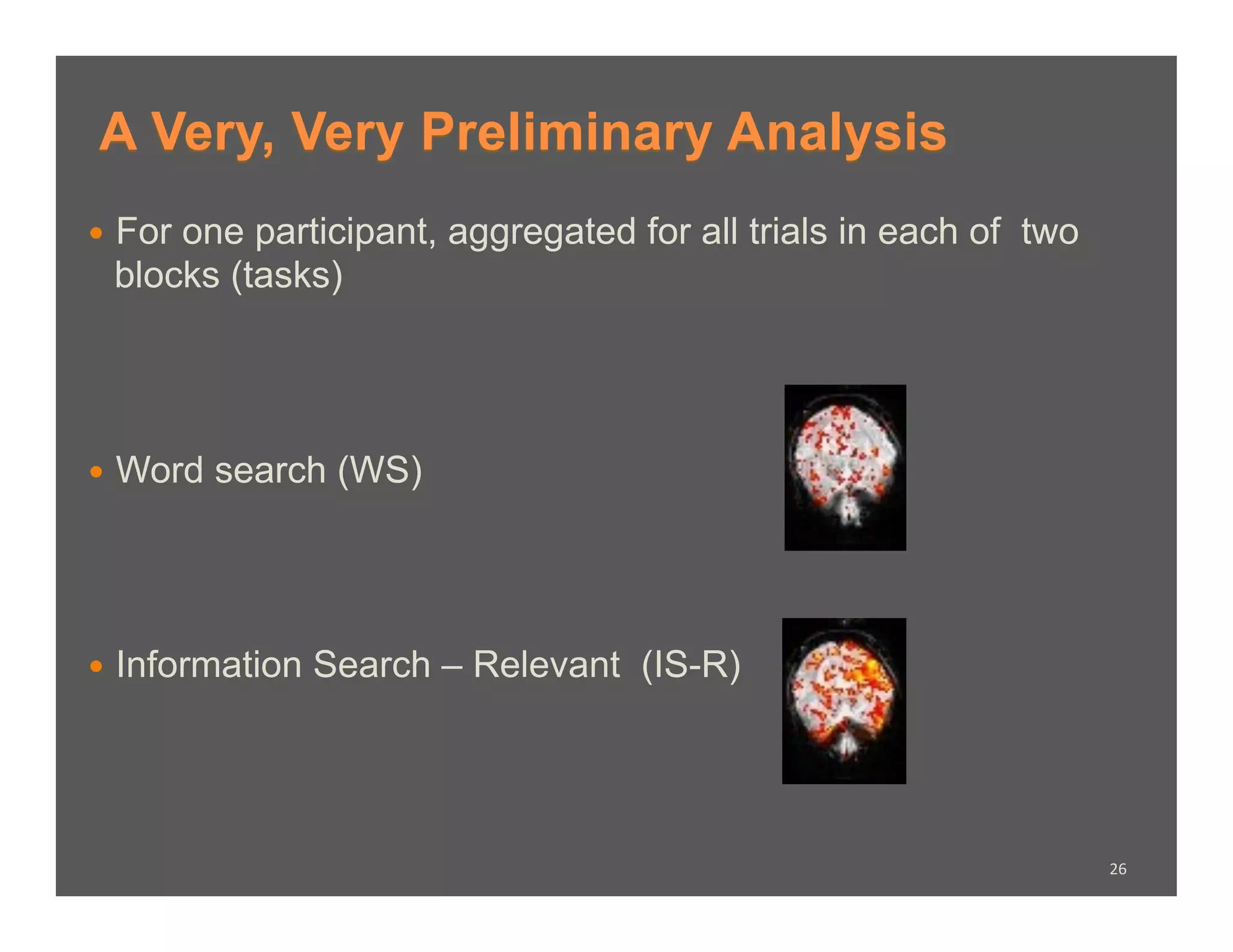
  For
     one participant, aggregated for all trials in each of two
 blocks (tasks)


  Word   search (WS)


  Information   Search – Relevant (IS-R)


                                                                 26	
  
Stay Tuned for Results…
Neuro – Information Science


Acknowledgements: Funding: Google, HP, IMLS (now funded by IMLS CAREER)
                  Collaborators: Drs. Nicholas Belkin, Art Chaovalitwongse (U Wash), Xiangmin Zhang,
                          Ralf Bierig (Post Doc); PhD students: Michael Cole (co-author), Chang Liu, Jingjing Liu, Irene Lopatovska
                          + many Master and undergraduate students …
                                                                                                                                   28	
  
Fragen?


More info & contact http://jsg.tel
                                     29	
  

Towards Neuro–Information Science

  • 1.
    Towards Neuro–InformationScience Jacek Gwizdka & Michael Cole iSchool @ Rutgers University, NJ, USA jacek@neuroinfoscience.org http://jsg.tel June 5, 2012
  • 2.
    Information Science   Another IS    Information Science is about : ◦  understanding information seeking behavior (why/how/where/…) ◦  helping people find information they need 2  
  • 3.
    Information Systems vs.iScience   A lot of common concerns and constructs: ◦  information is digital  accessed via information systems ◦  technology – task – individual ◦  IT usefulness, user interface design, usability … ◦  trust … ◦  decision making … ◦  affective and cognitive factors ◦  information search (e.g., stopping behavior) … 3  
  • 4.
    Information Systems vs.iScience   Also new opportunities: ◦  neural-correlates of constructs specific to Information Science ◦  Information Relevance : most commonly refers to topical relevance or aboutness, that is: to what extent the content of a search result matches the topic of the query or a person’s information need (e.g., Saracevic, 2007)   relevance judgment  decision making    information stopping 4  
  • 5.
    Opportunities for Neuroscienceto Inform IS Seven opportunities for cognitive neuroscience to inform IS research: 1.  localize the neural correlates of IS constructs to better understand their nature and dimensionality; 2.  complement existing sources of IS data with neuroscientific data; 3.  capture hidden (automatic) processes that are difficult to measure with existing measurement methods; 4.  identify antecedents of IS constructs by exploring the specifics of how IT stimuli (e.g., the design of graphical user interfaces) are processed by the brain; 5.  test the outcomes of IS constructs by showing how brain activation predicts behavior (e.g., decisions); 6.  infer causality among IS constructs by examining the timing of brain activations due to a common stimulus; 7.  challenge existing IS assumptions and enhance IS theories that do not correspond to the brain’s functionality (Dimoka et al. 2010) 5  
  • 6.
    Neuroscience and InformationScience?   Eye-tracking +++   Galvanic skin response (GSR) ++   Heart –rate variability (HRV) +   EEG   fNIRS   fMRI
  • 7.
    Recent and CurrentProjects 1.  eye-tracking: modeling reading + cognitive effort 2.  fMRI + eye-tracking: information relevance 7  
  • 8.
    Part I: Eye-tracking  General research goal: infer and predict mental states and context of a person engaged in interactive information searching   Influence system design  adaptive systems Macro   user  task  characteris�cs,  cogni�ve  effort,  domain  knowledge   Meso   reading  pa�erns   Micro   eye-­‐gaze  posi�ons  +  �ming   8  
  • 9.
  • 10.
    Eye-tracking Data àPatterns State1   State2   State3   10  
  • 11.
    Eye-movement Patterns   New methodology to analyze eye-movement patterns ◦  Model reading and Measure cognitive effort ◦  Correlate with higher-level constructs user task characteristics, user knowledge, etc. 11  
  • 12.
    Reading Model Origins  Based on E-Z Reader model Rayner , Pollatsek, Reichle ◦  Serial reading ◦  Words can be identified in parafovial region ◦  Early lexical access (word familiarity) + Complete lexical processing (word identification) 2o (70px) foveal region parafoveal region MORE… 12  
  • 13.
    Two-State Reading Model q isolated fixation fixations sequences p Read   Scan   1-p 1-q ◦  Filter fixations < 150ms (min time required for lexical processing) ◦  Model states characterized by:   probability of transitions; number of lexical fixations; duration   length of eye-movement trajectory, amount of text covered MORE… 13  
  • 14.
    Example Reading Sequence Readingsequence: Fixation model states: (F F F) S (F R F) S S S S (F F FR F F) F R F F FFFF F S Reading state – R | Scanning state – S 14  
  • 15.
    Cognitive Effort Measuresof Reading   Reading Speed foveal region regression   Fixation Regression a b c d   Perceptual Span Perceptual span = Mean(a,b,c,d)   Fixation Duration excess (“lexical processing excess”) 15  
  • 16.
    User Study 1:Cognitive Effort and Tasks Journalists’ Information Search OBI:  advanced  obituary   INT:  interview  prepara�on   CPE:  copy  edi�ng   BIC:  background  informa�on   N = 32   Do the cognitive effort measures correlate with: task difficulty (by design), observable search effort, user’s subjective perception of task difficulty   Can we detect differences between task characteristics from eye-movement patterns? MORE… 16  
  • 17.
    Eye-data and CognitiveEffort Measures Subjective Task Cognitive effort measures Difficulty Task difficulty derived from eye-tracking by design reading speed Copy Editing (CPE) mean fixation duration Advance Obituary (OBI) perceptual span total fixation regressions CPE        INT      BIC        OBI   As expected: Copy Editing CPE easiest Search effort Advance Obituary OBI most difficult task time Sig: Kruskal-Wallis χ2 =46.1, p<.0001 pages visited queries entered 17  
  • 18.
    Eye-data and TaskCharacteristics q p Read   Scan   1-p 1-q Interview  prepara�on Copy  Edi�ng   Measure   Related  Task  Characteris�cs   Frequency   Advanced  obituary  and  Interview  prepara�on  tasks:     SR bias  to  read   search  for  document;  task  goal  not  specific   of  reading   state   Copy  Edi�ng  task:  search  for  segment  and  task  goal   transi�ons   RS bias  to  scan   specific   MORE… 18  
  • 19.
    Summary: Eye-tracking Methodology  Domain independent ◦  Document content is not involved   Culturally*and individually independent   Real-time modeling of user and tasks is possible   Adaptive systems feasible   Eye-tracking is coming to us! Tobii 19  
  • 20.
    Part II: CurrentfMRI+eye-tracking Study   Information Relevance : refers to topical relevance or aboutness, that is: to what extent the content of a document (webpage) matches the topic of the query or a person’s information need (e.g., Saracevic, 2007) ◦  Relevance multi-dimensional: topical, meaningful, useful, trust, affective…   Neuralcorrelates of topical relevance judgments   Hypothesis ◦  Brain regions that are activated when relevant information is found are different from regions activated when no relevant info is found and when person does “low-level” visual word search (orthographic matching)   but no hypothesis in a sense where the brain activity is located   Exploratory research   (also: a similar experiment with eye-tracking, EEG, GSR) 20  
  • 21.
    fMRI + eye-trackinglab   Lab Equipment: ◦  fMRI: 3T Siemens TRIO ◦  eye-tracker: Eyelink-1000   non-ferromagnetic optimized design; up to 2000 Hz sampling rate 21  
  • 22.
  • 23.
    fMRI + eye-tracking projected screen mirror eye-tracker Eye-tracking imposes additional constraints on projection (geometry) 23  
  • 24.
    Current Experimental Design  Two blocks (types of tasks, balanced) ◦  WS – word search: find target word in a short news story – press yes/no ◦  IS – information search: find information that answers given question – press yes/no. Three types of trials: relevant (R), topical (T), irrelevant (I) ◦  TR cycle: 2s 21 x 30s 4s 6s 4s 20s max xmx ssms nsns snsns 4s WS task target: jsdjsd djdjd djdj dkke ekek + + + kdkddk dkdkdk dkdkdkd instruc- kkdkd d d dd d djdj djdjdj word rjrjr rjr jweje ejejej ejej tions kekekek ekeke wej e eej eje j 21 x 30s 4s 8s + 20s max + 4s + 20s max xmx ssms nsns snsns + 4s + 20s max + IS task xmx ssms nsns snsns target: target: target: jsdjsd ke ekek dkdkdkkd jsdjsd djdjd djdj dkke ekek xmx ssms nsns snsns + dkdkdkkd jsdjsd ke ekek dkdkdkk kdkddk dkdkdk dkdkdkd kdkddk dkdkdkdkdkdkd instruc- kkdkd d rjr jweje ejejej kdkddk dkdkdk dkdkdkd kkdkd d rjr jweje ejeje info info info ejej kkdkd d d dd d djdj djdjdj tions rjrjr rjjweje ejejej ejej ekeke wej e ejej fjfjf fjfjfjfjf kekekek ekeke wee ejej fjfjrjr rreje j fjfjf fjfjfjfjf fjfjrjr rreje j kek ekeke wej e ejej eje j 24  
  • 25.
    Planned Analysis   Twoblocks (types of tasks, balanced) ◦  WS – word search: find target word in a short news story ◦  IS – information search: find information that answers given question – Three types of trials: relevant (R), topical (T), irrelevant (I)   The main contrasts of interests are: ◦  IS-R - WS ◦  IS-R - IS-T ◦  IS-R - IS-I 25  
  • 26.
    A Very, VeryPreliminary Analysis   For one participant, aggregated for all trials in each of two blocks (tasks)   Word search (WS)   Information Search – Relevant (IS-R) 26  
  • 27.
    Stay Tuned forResults…
  • 28.
    Neuro – InformationScience Acknowledgements: Funding: Google, HP, IMLS (now funded by IMLS CAREER) Collaborators: Drs. Nicholas Belkin, Art Chaovalitwongse (U Wash), Xiangmin Zhang, Ralf Bierig (Post Doc); PhD students: Michael Cole (co-author), Chang Liu, Jingjing Liu, Irene Lopatovska + many Master and undergraduate students … 28  
  • 29.
    Fragen? More info &contact http://jsg.tel 29