MODEL BUILDING BYE-LAWS, 2015
Ministry of Urban Development
The relevance of Model Building Bye-Laws with respect to URDPFI and NBC
RELEVANCE OF BUILDING BYE-LAWS
2
Aspect Model Building Byelaws
Urban and Regional Plan Formulation
and Implementation (URDPFI)
Guidelines
National Building Code
Purpose
Building Permission and
regulating construction of
buildings.
Preparing Land Use the Master Plans The Code contains administrative
regulations, development control rules
and general building requirements.
Agency
and Use
Municipal Corporations and
Urban Development
Authorities.
State Town and Country Planning Depts,
and Urban Development Authorities.
All Private and Public building
construction agencies
Broad
areas/
Coverage
Building design as per Plan
Guidelines and additionally
looking into-
 Water supply,
 Sanitation,
 Fire safety
 Structural safety
 Air-conditioning
 Land use Classification,
 Zoning regulations/ Population density,
 Development promotion regulations,
 Growth directions and
 Future infrastructure needs.
 FAR/FSI
 Ground Coverage
 Set Backs
 Height
To ensure compliance in terms of
Development Control Regulations and
General Building requirements of
building
 Safety and Services.
 Fire & Life Safety
 Building Materials
 Structural Safety
 Construction Safety
 Building Services
 Landscaping
STRUCTURAL SAFETY – Post Bhuj Earthquake disaster, the MBBL-2004 advised
compliance with all IS Codes for Earthquake resistance of
buildings.
Achievement: 34/36 States/UT have incorporated norms
BARRIER FREE PUBLIC BUILDINGS – It was advised to make the provisions for
Public and Community buildings (excluding residential
buildings).
Achievement: 28/36 States/UT have incorporated norms
MANDATORY RAINWATER HARVESTING – It was advised to make provisions in all
new proposed buildings on plots more than 100 sq.m. including
storage or recharge.
Achievement: 30/36 States/UT have incorporated norms
MODEL BUILDING BYE-LAWS, 2004
 WASTE WATER RECYCLING SYSTEMS – It was advised to make provisions in
buildings having discharge volume of more than 10000 Lt.
 ROOFTOP SOLAR WATER HEATING SYSTEMS– It was advised to make
provisions in all Public and Community buildings including residential buildings
of plinth area more than 150sqm.
 FIRE SAFETY– It was advised to make provisions for all new Public buildings
as per NBC 2005 Norms.
Achievement: 36/36 States have incorporated Norms
MODEL BUILDING BYE-LAWS, 2004
Out of 36 states and UTs,
22 have undertaken
Comprehensive Revision
of their respective Building Bye-Laws
Since 2004
MODEL BUILDING BYE-LAWS, 2004
Raison d'être for revising the Bye-Laws are as under:
1. Growing Environmental concerns
2. Increased Safety and Security measures
3. Technological Developments
4. Components of Swachh Bharat Mission
5. Focus on Ease of Doing Business
Why Revise Model Building Bye-laws 2004
7
Stakeholder Consultation
on Draft MBBL 2015
8
The Draft Model Building Byelaws were circulated (Jan ‘15)
• Central Governments agencies/ Institutes:
 National Disaster Management Authority
 Bureau of Indian Standards
 National Building Construction Corporation
 National Remote Sensing Centre
 Delhi Development Authority
 National Capital Region Planning Board
 Indian Institute of Public Administration
 Municipal Corporation of Delhi (South)
 Housing and Urban Development Corporation
 Schools of Planning and Architecture
•State Government Departments
•Town and Country Planning Departments
•Selected Urban Development Authorities
•Selected Urban Local Bodies.
•Associations like CREDAI and NAREDCO
Safety and Security:
 Structural Safety – incorporating provisions of Disaster management as
per recommendations of Prof. Arya Committee Report
 BIS Codes for General, Cyclone, Earthquake and Landslide safety in
buildings
 Format for Structural Design Basis Report (SDBR) for various building
types
 Seismic strengthening/retrofitting of buildings
 Preventive measures against “Soft Storeys” in multistoreyed buildings
 Proof Checking of Structural Design for Buildings
Salient Features of MBBL (2015) -I
10
Barrier Free Environment
Building & Site for Differently abled, Elderly
and Children.
 Design provisions for Disabled People including
Non-Ambulant People (using small wheel chairs)
 Site development , Access Path / Walk Way ,
 Parking, Building requirements Stair, Lifts,
 Toilets, Designing for Children, Drinking Water,
 Refuge and signage
Salient Features of MBBL (2015) -II
Salient Features of MBBL (2015) -III
Environmental Concerns
 Green Buildings
 Rainwater Harvesting
 Solar Roof Top
 Waste water Reuse and Recycle
12
Adaption for Modern Construction Technology:
 Provisions for High-rise Building regulations
 Parking provisions (Podium and others).
 Peripheral Open Spaces including set-backs
 Disaster Management And Fire Safety
 Environment Protection and Preservation Plan
 Exclusions and exceptions and Structural Safety
 Definitions for High Rise, Plot Area, Means of access
 Building components, Building Services, Helipad
Salient Features of MBBL (2015) -IV
13
Technology Tools for Governance:
 Online submission of Building proposal, scrutiny and
approval systems.
 Adopt automated systems of plan scrutiny and generation
of reports
 Timely and integrated systems of intimation to applicant
of approval status
 Generation of Compliance report from drawings for
Completion certificate
Salient Features of MBBL (2015) -V
14
Following Swachh Bharat Mission:
Revised Norms for adequate toilet facilities for women.
• Revised provision of ratio of toilets for women based on higher work
participation
 Provisions of Public Conveniences in Public Buildings
Mandatory Provisions for Segregated toilet facilities for visitors in Public
Buildings
Salient Features of MBBL (2015) -VI
15
Ease of Doing Business:
Online Building plan approval process
 Integration of various clearances at Master Plan levels
Integrating “Single Window” process
Empowering Architects
Outsourcing non discretionary verification jobs
Citizen’s Charter
Salient Features of MBBL (2015) -VII
16
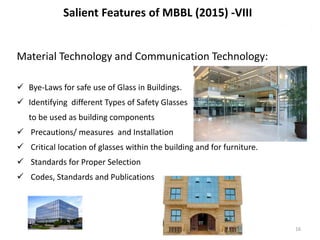
Material Technology and Communication Technology:
 Bye-Laws for safe use of Glass in Buildings.
 Identifying different Types of Safety Glasses
to be used as building components
 Precautions/ measures and Installation
 Critical location of glasses within the building and for furniture.
 Standards for Proper Selection
 Codes, Standards and Publications
Salient Features of MBBL (2015) -VIII
Chapter on Rain Water Harvesting
 Importance
 Indicative Provisions for Various types of Buildings
 Responsibility of ULBs for public spaces
 Enforcement and Monitoring
 Technological Options
Salient Features of MBBL (2015) -IX
18
Effects of Communication Technology:
 Draft Guidelines for mitigation of
Electro Magnetic Radiations in built spaces.
 Identifying different Types of Electro
Magnetic radiations and emitting
appliances/sources
 Effects of prolonged Exposure
 Guidelines for Buildings and Built Forms
 Indoor and Outdoor Appliances and
Equipment.
 Standards for Proper Placement
Salient Features of MBBL (2015) -X
19
LINKAGE TO AMRUT REFORMS
Likely to Be approved by the ministry
by August 2015
THANK YOU

Building laws

  • 1.
    MODEL BUILDING BYE-LAWS,2015 Ministry of Urban Development
  • 2.
    The relevance ofModel Building Bye-Laws with respect to URDPFI and NBC RELEVANCE OF BUILDING BYE-LAWS 2 Aspect Model Building Byelaws Urban and Regional Plan Formulation and Implementation (URDPFI) Guidelines National Building Code Purpose Building Permission and regulating construction of buildings. Preparing Land Use the Master Plans The Code contains administrative regulations, development control rules and general building requirements. Agency and Use Municipal Corporations and Urban Development Authorities. State Town and Country Planning Depts, and Urban Development Authorities. All Private and Public building construction agencies Broad areas/ Coverage Building design as per Plan Guidelines and additionally looking into-  Water supply,  Sanitation,  Fire safety  Structural safety  Air-conditioning  Land use Classification,  Zoning regulations/ Population density,  Development promotion regulations,  Growth directions and  Future infrastructure needs.  FAR/FSI  Ground Coverage  Set Backs  Height To ensure compliance in terms of Development Control Regulations and General Building requirements of building  Safety and Services.  Fire & Life Safety  Building Materials  Structural Safety  Construction Safety  Building Services  Landscaping
  • 3.
    STRUCTURAL SAFETY –Post Bhuj Earthquake disaster, the MBBL-2004 advised compliance with all IS Codes for Earthquake resistance of buildings. Achievement: 34/36 States/UT have incorporated norms BARRIER FREE PUBLIC BUILDINGS – It was advised to make the provisions for Public and Community buildings (excluding residential buildings). Achievement: 28/36 States/UT have incorporated norms MANDATORY RAINWATER HARVESTING – It was advised to make provisions in all new proposed buildings on plots more than 100 sq.m. including storage or recharge. Achievement: 30/36 States/UT have incorporated norms MODEL BUILDING BYE-LAWS, 2004
  • 4.
     WASTE WATERRECYCLING SYSTEMS – It was advised to make provisions in buildings having discharge volume of more than 10000 Lt.  ROOFTOP SOLAR WATER HEATING SYSTEMS– It was advised to make provisions in all Public and Community buildings including residential buildings of plinth area more than 150sqm.  FIRE SAFETY– It was advised to make provisions for all new Public buildings as per NBC 2005 Norms. Achievement: 36/36 States have incorporated Norms MODEL BUILDING BYE-LAWS, 2004
  • 5.
    Out of 36states and UTs, 22 have undertaken Comprehensive Revision of their respective Building Bye-Laws Since 2004 MODEL BUILDING BYE-LAWS, 2004
  • 6.
    Raison d'être forrevising the Bye-Laws are as under: 1. Growing Environmental concerns 2. Increased Safety and Security measures 3. Technological Developments 4. Components of Swachh Bharat Mission 5. Focus on Ease of Doing Business Why Revise Model Building Bye-laws 2004 7
  • 7.
    Stakeholder Consultation on DraftMBBL 2015 8 The Draft Model Building Byelaws were circulated (Jan ‘15) • Central Governments agencies/ Institutes:  National Disaster Management Authority  Bureau of Indian Standards  National Building Construction Corporation  National Remote Sensing Centre  Delhi Development Authority  National Capital Region Planning Board  Indian Institute of Public Administration  Municipal Corporation of Delhi (South)  Housing and Urban Development Corporation  Schools of Planning and Architecture •State Government Departments •Town and Country Planning Departments •Selected Urban Development Authorities •Selected Urban Local Bodies. •Associations like CREDAI and NAREDCO
  • 8.
    Safety and Security: Structural Safety – incorporating provisions of Disaster management as per recommendations of Prof. Arya Committee Report  BIS Codes for General, Cyclone, Earthquake and Landslide safety in buildings  Format for Structural Design Basis Report (SDBR) for various building types  Seismic strengthening/retrofitting of buildings  Preventive measures against “Soft Storeys” in multistoreyed buildings  Proof Checking of Structural Design for Buildings Salient Features of MBBL (2015) -I
  • 9.
    10 Barrier Free Environment Building& Site for Differently abled, Elderly and Children.  Design provisions for Disabled People including Non-Ambulant People (using small wheel chairs)  Site development , Access Path / Walk Way ,  Parking, Building requirements Stair, Lifts,  Toilets, Designing for Children, Drinking Water,  Refuge and signage Salient Features of MBBL (2015) -II
  • 10.
    Salient Features ofMBBL (2015) -III Environmental Concerns  Green Buildings  Rainwater Harvesting  Solar Roof Top  Waste water Reuse and Recycle
  • 11.
    12 Adaption for ModernConstruction Technology:  Provisions for High-rise Building regulations  Parking provisions (Podium and others).  Peripheral Open Spaces including set-backs  Disaster Management And Fire Safety  Environment Protection and Preservation Plan  Exclusions and exceptions and Structural Safety  Definitions for High Rise, Plot Area, Means of access  Building components, Building Services, Helipad Salient Features of MBBL (2015) -IV
  • 12.
    13 Technology Tools forGovernance:  Online submission of Building proposal, scrutiny and approval systems.  Adopt automated systems of plan scrutiny and generation of reports  Timely and integrated systems of intimation to applicant of approval status  Generation of Compliance report from drawings for Completion certificate Salient Features of MBBL (2015) -V
  • 13.
    14 Following Swachh BharatMission: Revised Norms for adequate toilet facilities for women. • Revised provision of ratio of toilets for women based on higher work participation  Provisions of Public Conveniences in Public Buildings Mandatory Provisions for Segregated toilet facilities for visitors in Public Buildings Salient Features of MBBL (2015) -VI
  • 14.
    15 Ease of DoingBusiness: Online Building plan approval process  Integration of various clearances at Master Plan levels Integrating “Single Window” process Empowering Architects Outsourcing non discretionary verification jobs Citizen’s Charter Salient Features of MBBL (2015) -VII
  • 15.
    16 Material Technology andCommunication Technology:  Bye-Laws for safe use of Glass in Buildings.  Identifying different Types of Safety Glasses to be used as building components  Precautions/ measures and Installation  Critical location of glasses within the building and for furniture.  Standards for Proper Selection  Codes, Standards and Publications Salient Features of MBBL (2015) -VIII
  • 16.
    Chapter on RainWater Harvesting  Importance  Indicative Provisions for Various types of Buildings  Responsibility of ULBs for public spaces  Enforcement and Monitoring  Technological Options Salient Features of MBBL (2015) -IX
  • 17.
    18 Effects of CommunicationTechnology:  Draft Guidelines for mitigation of Electro Magnetic Radiations in built spaces.  Identifying different Types of Electro Magnetic radiations and emitting appliances/sources  Effects of prolonged Exposure  Guidelines for Buildings and Built Forms  Indoor and Outdoor Appliances and Equipment.  Standards for Proper Placement Salient Features of MBBL (2015) -X
  • 18.
  • 19.
    Likely to Beapproved by the ministry by August 2015 THANK YOU