Building innovation
pipeline with service
design methods
Oleg Slyusarchuk & Uliana Bashchuk
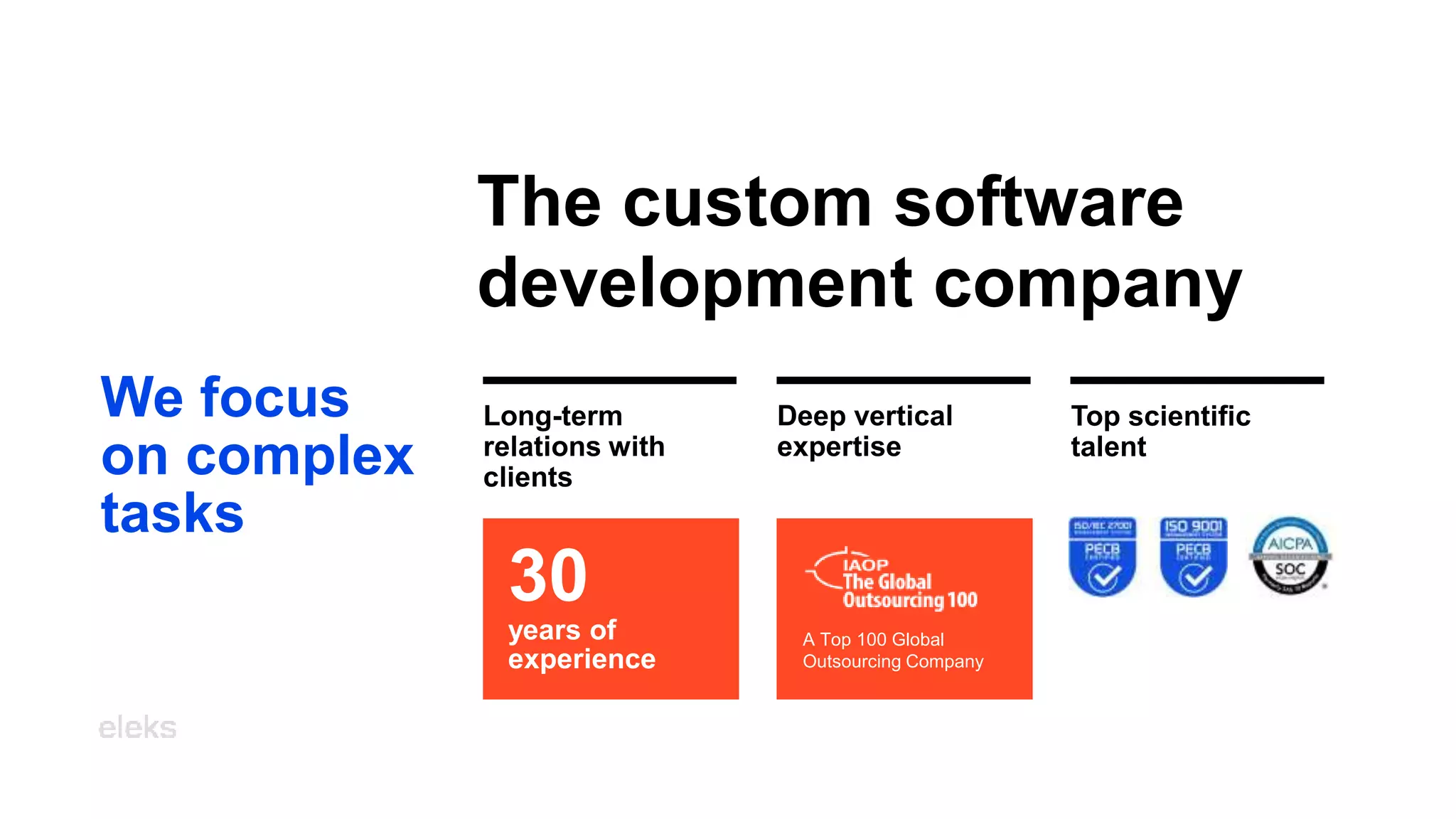
The custom software
development company
We focus
on complex
tasks
Long-term
relations with
clients
Deep vertical
expertise
Top scientific
talent
A Top 100 Global
Outsourcing Company
30
years of
experience
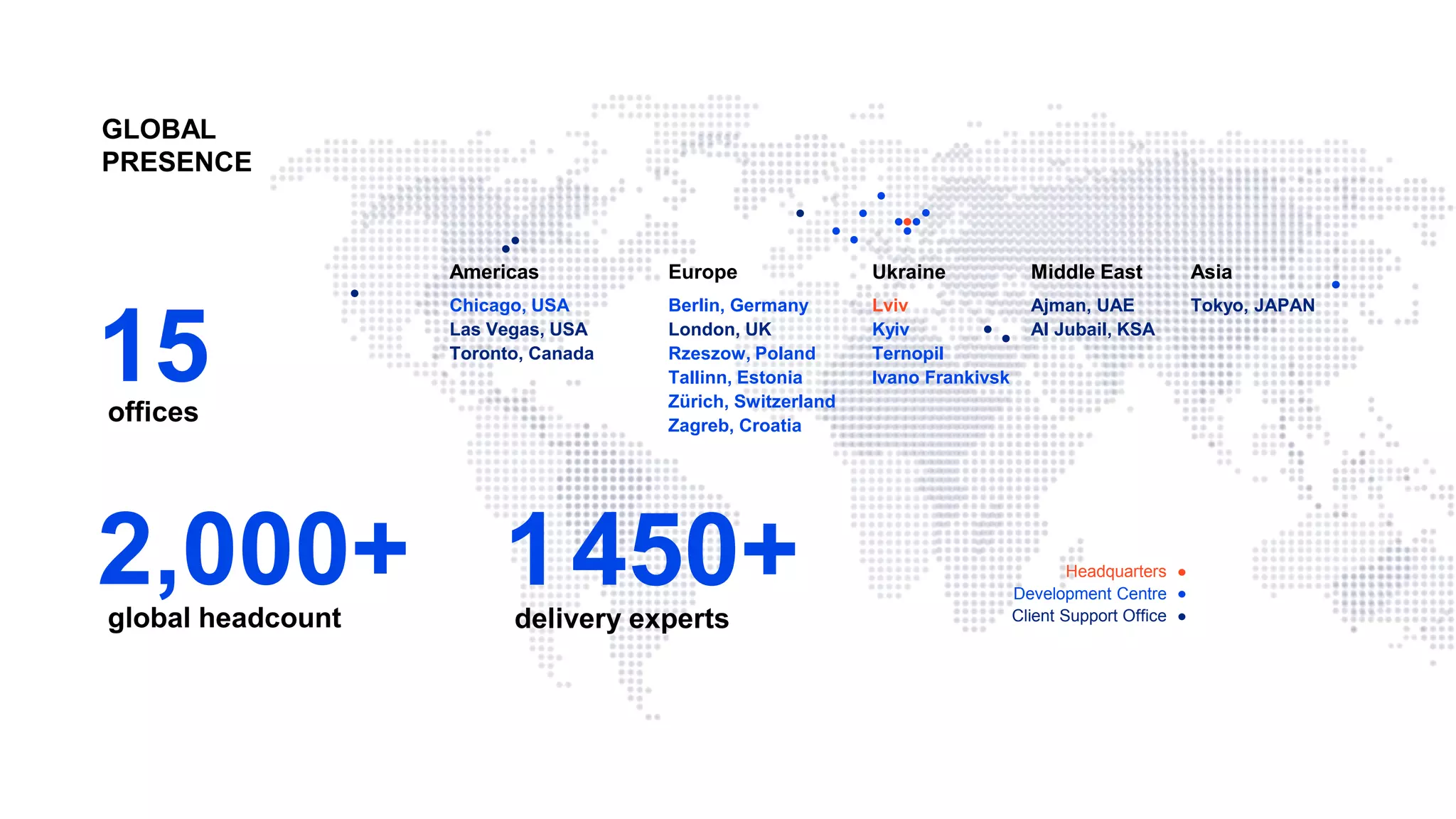
2,000+
global headcount
15
offices
1450+
delivery experts
Headquarters
Development Centre
Client Support Office
GLOBAL
PRESENCE
Ukraine
Lviv
Kyiv
Ternopil
Ivano Frankivsk
Americas
Chicago, USA
Las Vegas, USA
Toronto, Canada
Europe
Berlin, Germany
London, UK
Rzeszow, Poland
Tallinn, Estonia
Zürich, Switzerland
Zagreb, Croatia
Middle East
Ajman, UAE
Al Jubail, KSA
Asia
Tokyo, JAPAN
We are able to support all stages of product
development and bring products to market at
scale.
certified &
recognized
designers
USA, UK, Germany, Ukraine
Certified by industry
experts:
70+
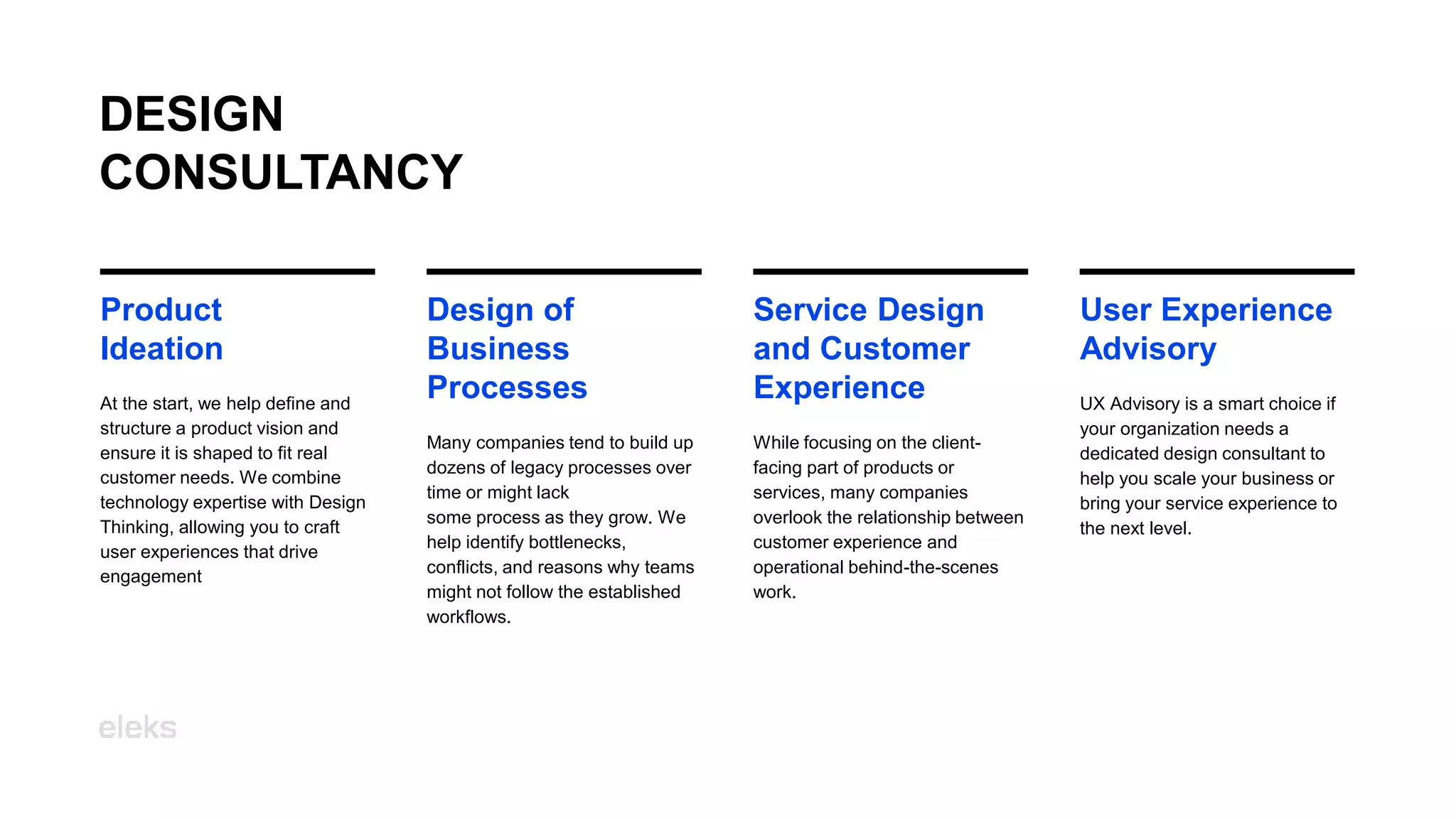
User Experience
Advisory
UX Advisory is a smart choice if
your organization needs a
dedicated design consultant to
help you scale your business or
bring your service experience to
the next level.
Design of
Business
Processes
Many companies tend to build up
dozens of legacy processes over
time or might lack
some process as they grow. We
help identify bottlenecks,
conflicts, and reasons why teams
might not follow the established
workflows.
Service Design
and Customer
Experience
While focusing on the client-
facing part of products or
services, many companies
overlook the relationship between
customer experience and
operational behind-the-scenes
work.
DESIGN
CONSULTANCY
Product
Ideation
At the start, we help define and
structure a product vision and
ensure it is shaped to fit real
customer needs. We combine
technology expertise with Design
Thinking, allowing you to craft
user experiences that drive
engagement
London Berlin
Birmingham
Amsterdam
Munich
Kyiv
Stockholm
Geneva
Istanbul
Amman
Dubai
Tokyo
San Francisco
Seattle
Kalispell
Minneapolis
Chicago
Philadelphia
Raleigh
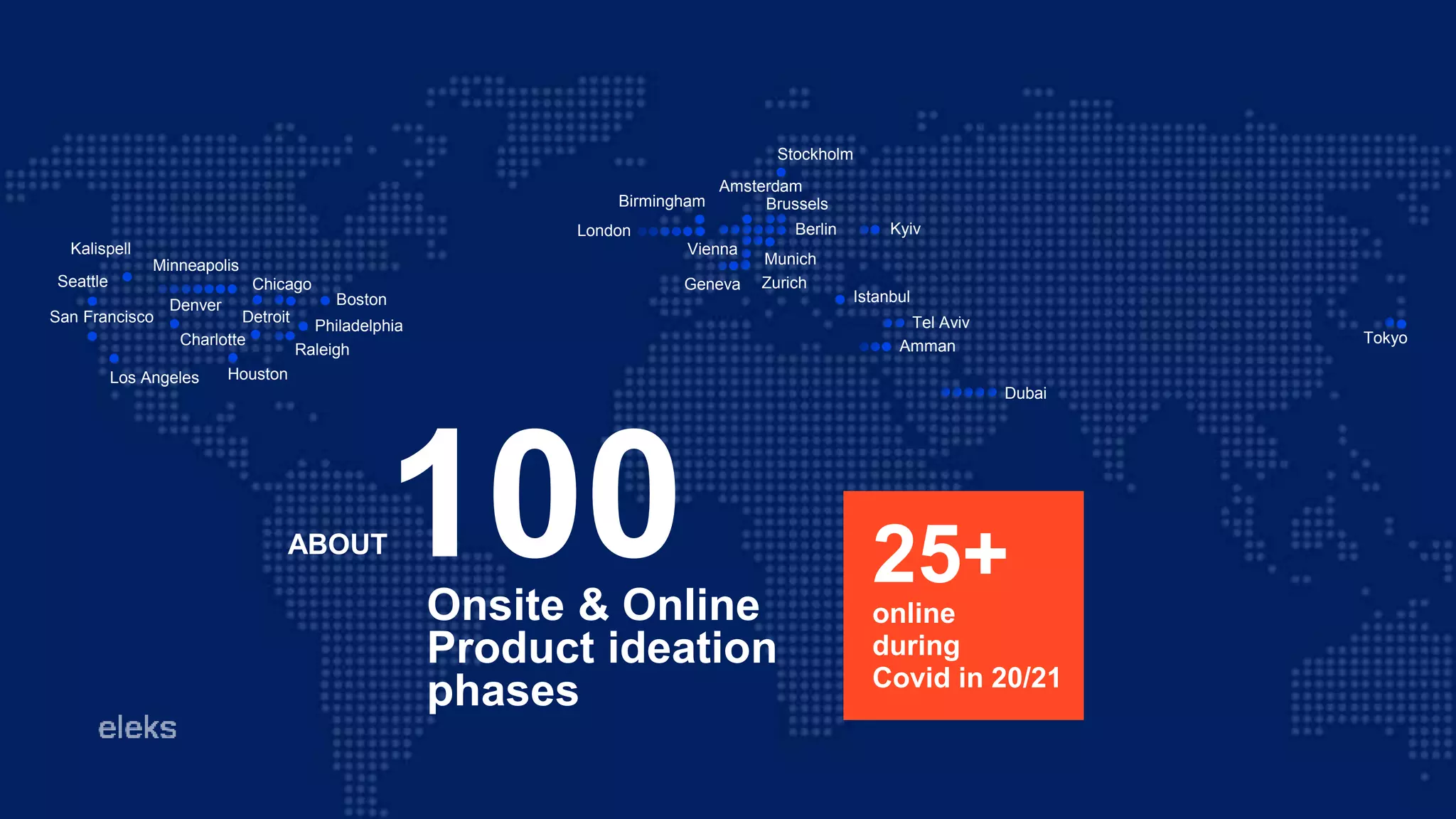
100
Onsite & Online
Product ideation
phases
Tel Aviv
Charlotte
Houston
Los Angeles
Boston
Denver
Detroit
Brussels
Vienna
Zurich
25+
online
during
Covid in 20/21
ABOUT
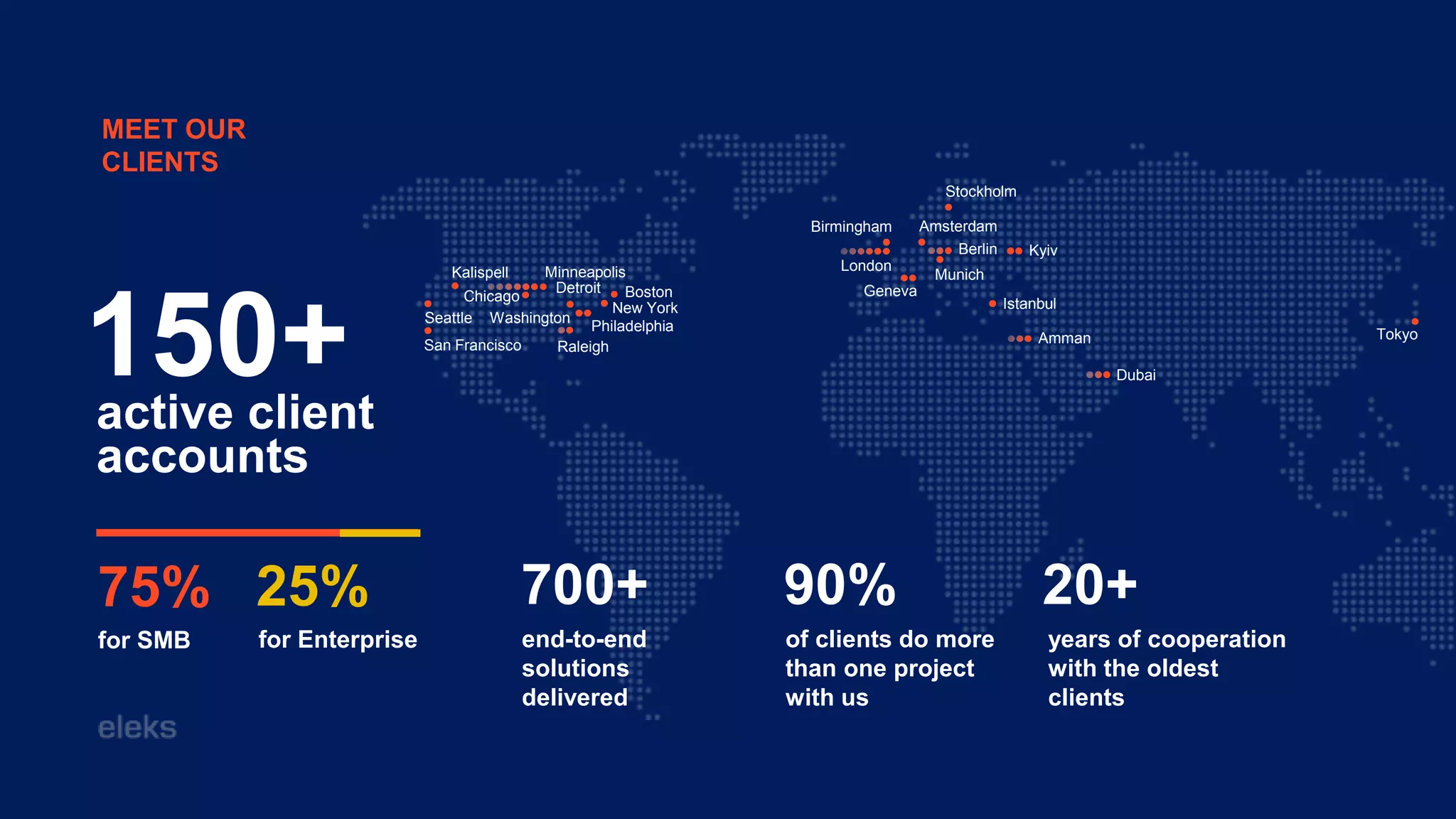
150+
active client
accounts
London
Berlin
Birmingham Amsterdam
Munich
Kyiv
Stockholm
Geneva
Istanbul
Amman
Dubai
Tokyo
San Francisco
Seattle
Kalispell Minneapolis
Detroit
Philadelphia
Raleigh
Washington
for SMB
75%
for Enterprise
25%
end-to-end
solutions
delivered
700+
of clients do more
than one project
with us
90%
years of cooperation
with the oldest
clients
20+
MEET OUR
CLIENTS
Chicago
New York
Boston
To design is to devise
courses of action
aimed at changing
existing situations into
preferred once.”
“
Herbert Simon
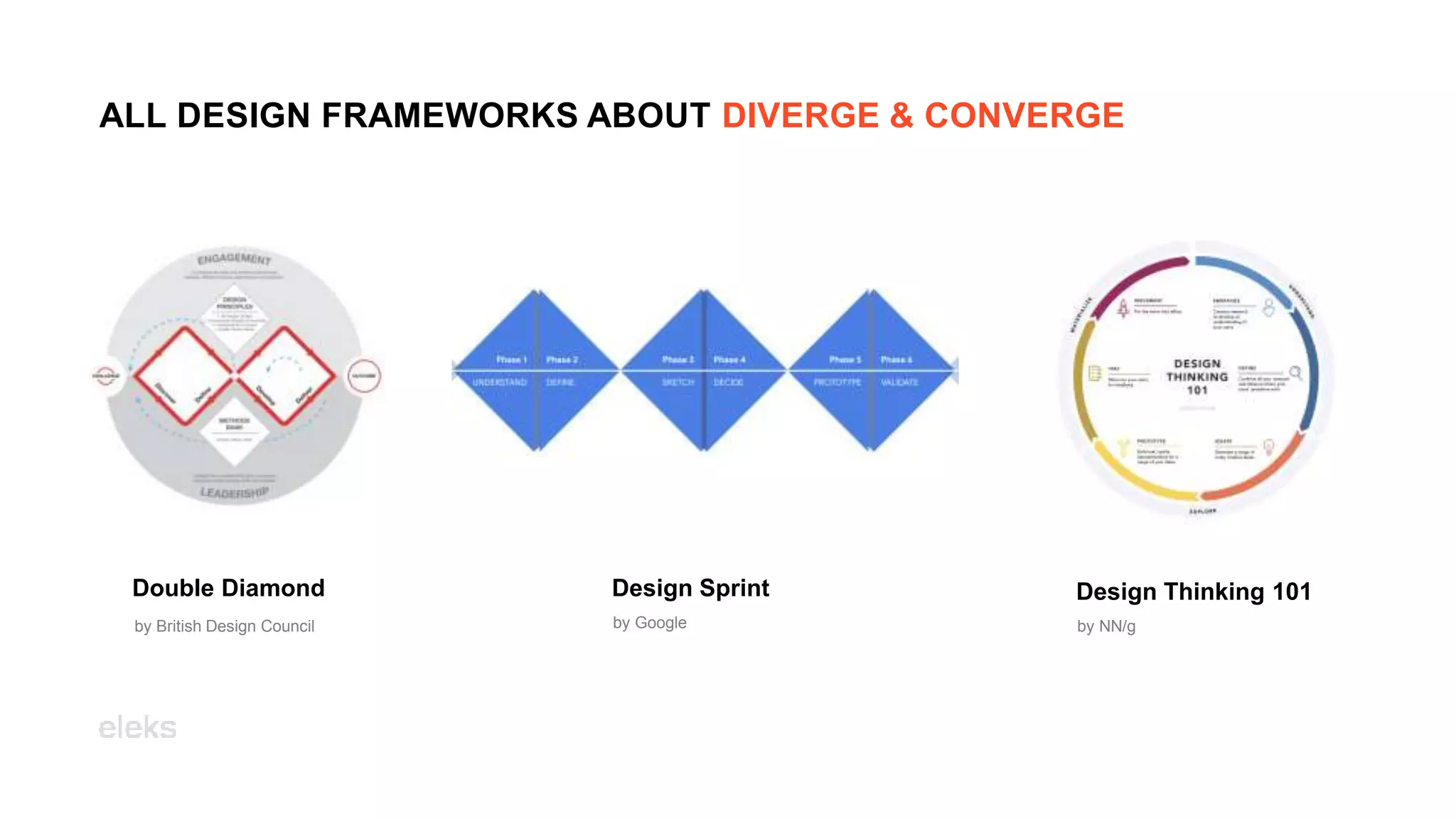
Double Diamond
by British Design Council
ALL DESIGN FRAMEWORKS ABOUT DIVERGE & CONVERGE
Design Sprint
by Google
Design Thinking 101
by NN/g
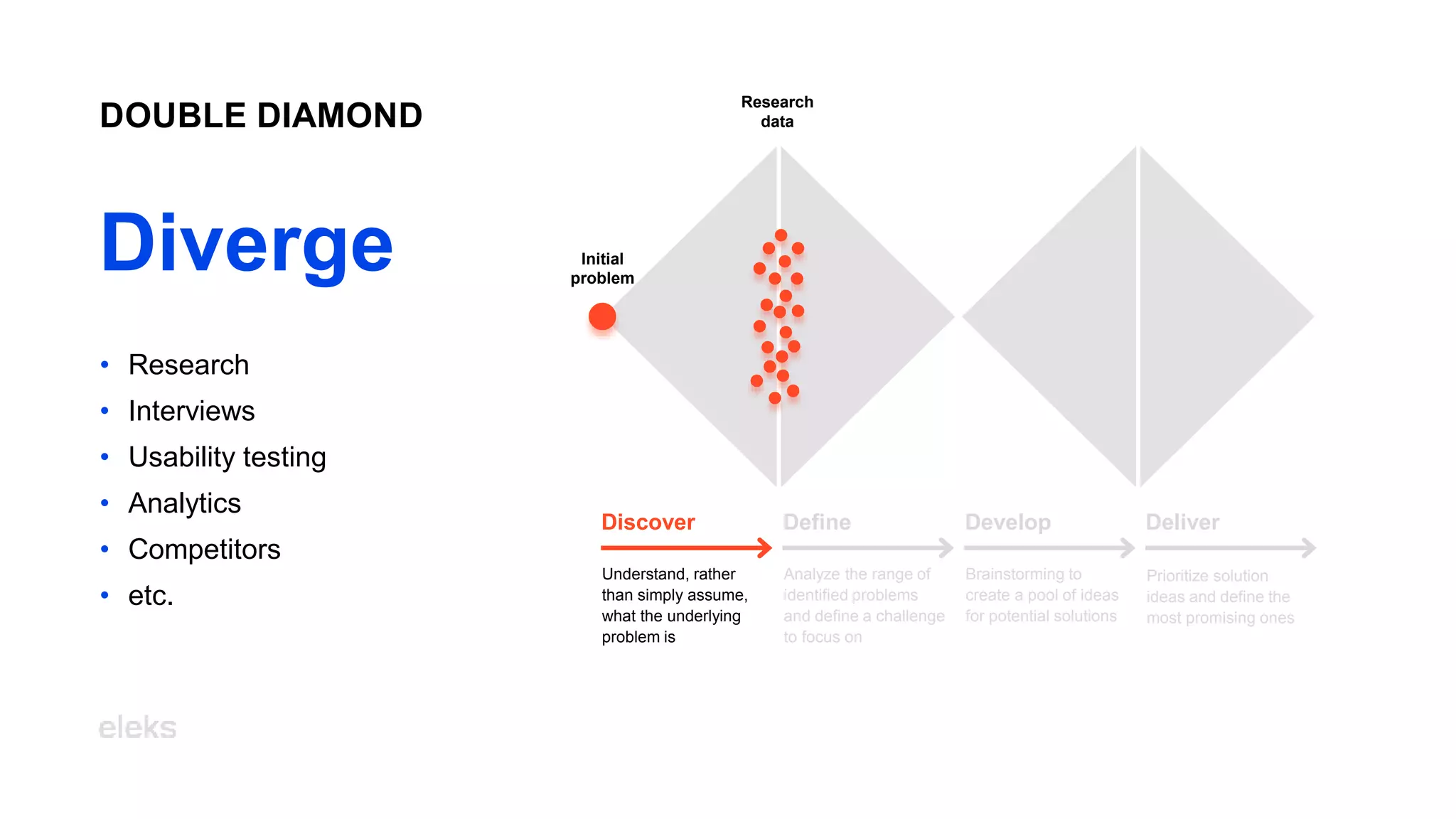
Initial
problem
Research
data
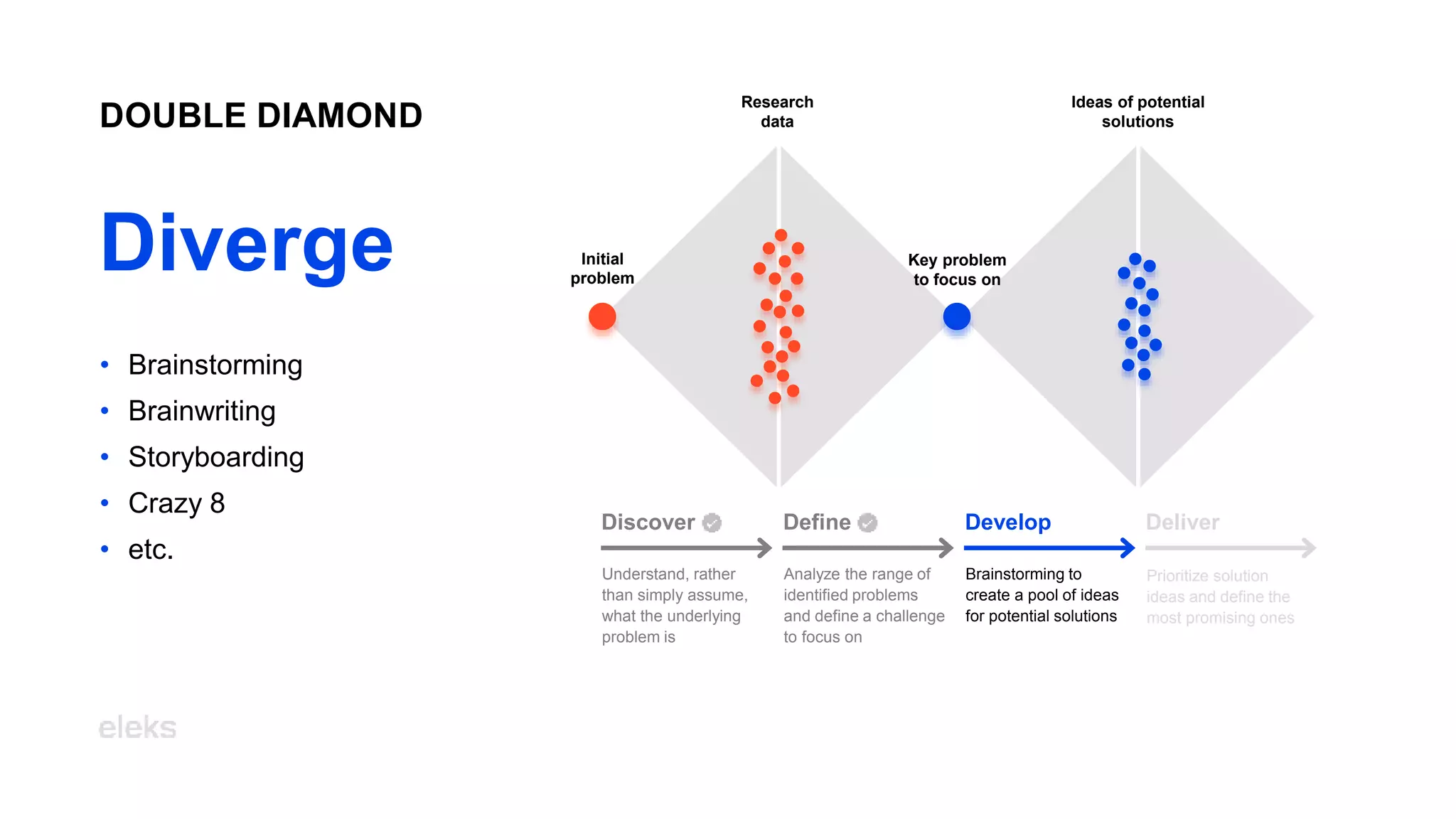
DOUBLE DIAMOND
Diverge
• Research
• Interviews
• Usability testing
• Analytics
• Competitors
• etc.
Develop
Define
Discover Deliver
Understand, rather
than simply assume,
what the underlying
problem is
Analyze the range of
identified problems
and define a challenge
to focus on
Brainstorming to
create a pool of ideas
for potential solutions
Prioritize solution
ideas and define the
most promising ones
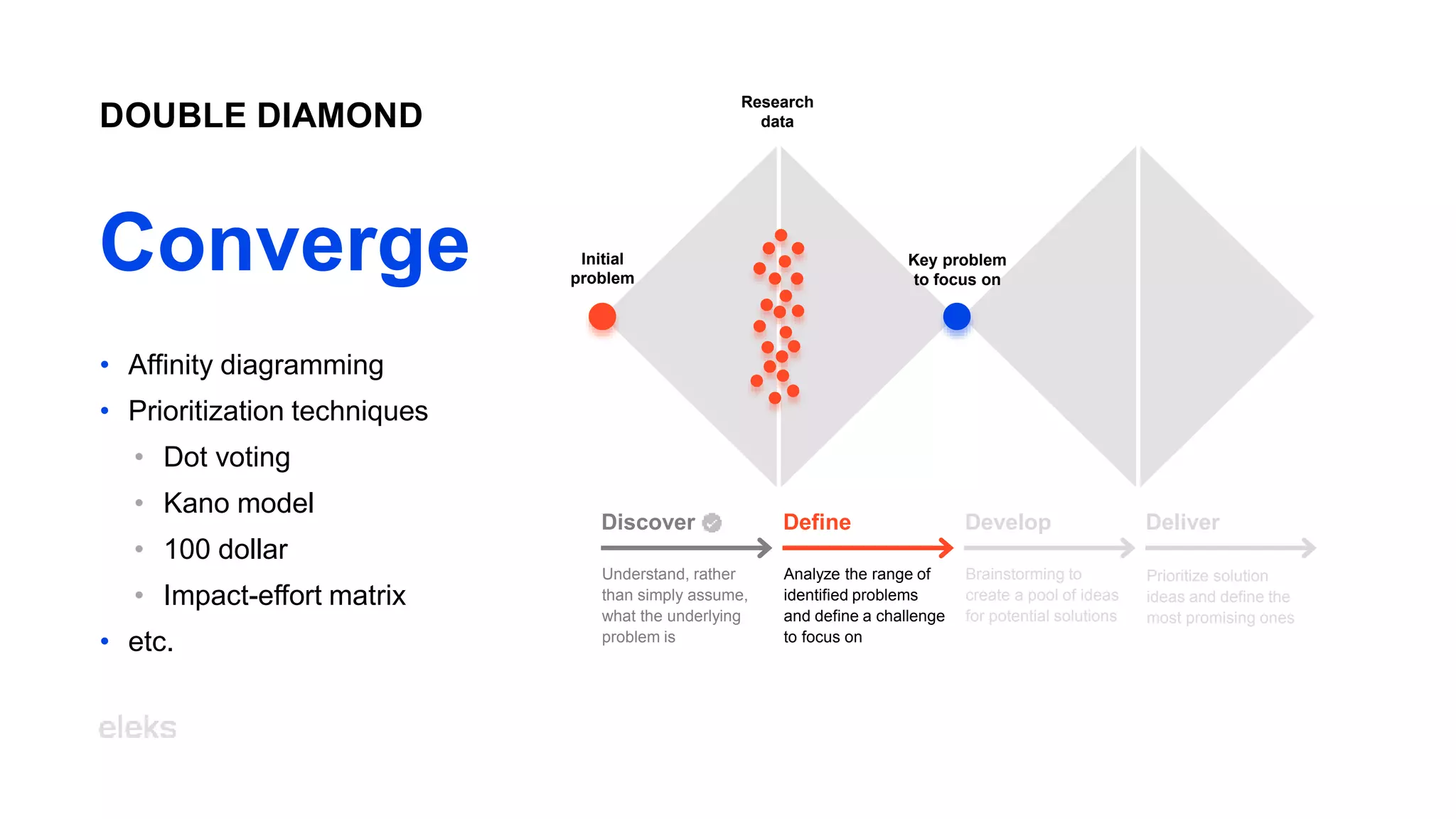
Initial
problem
Research
data
Key problem
to focus on
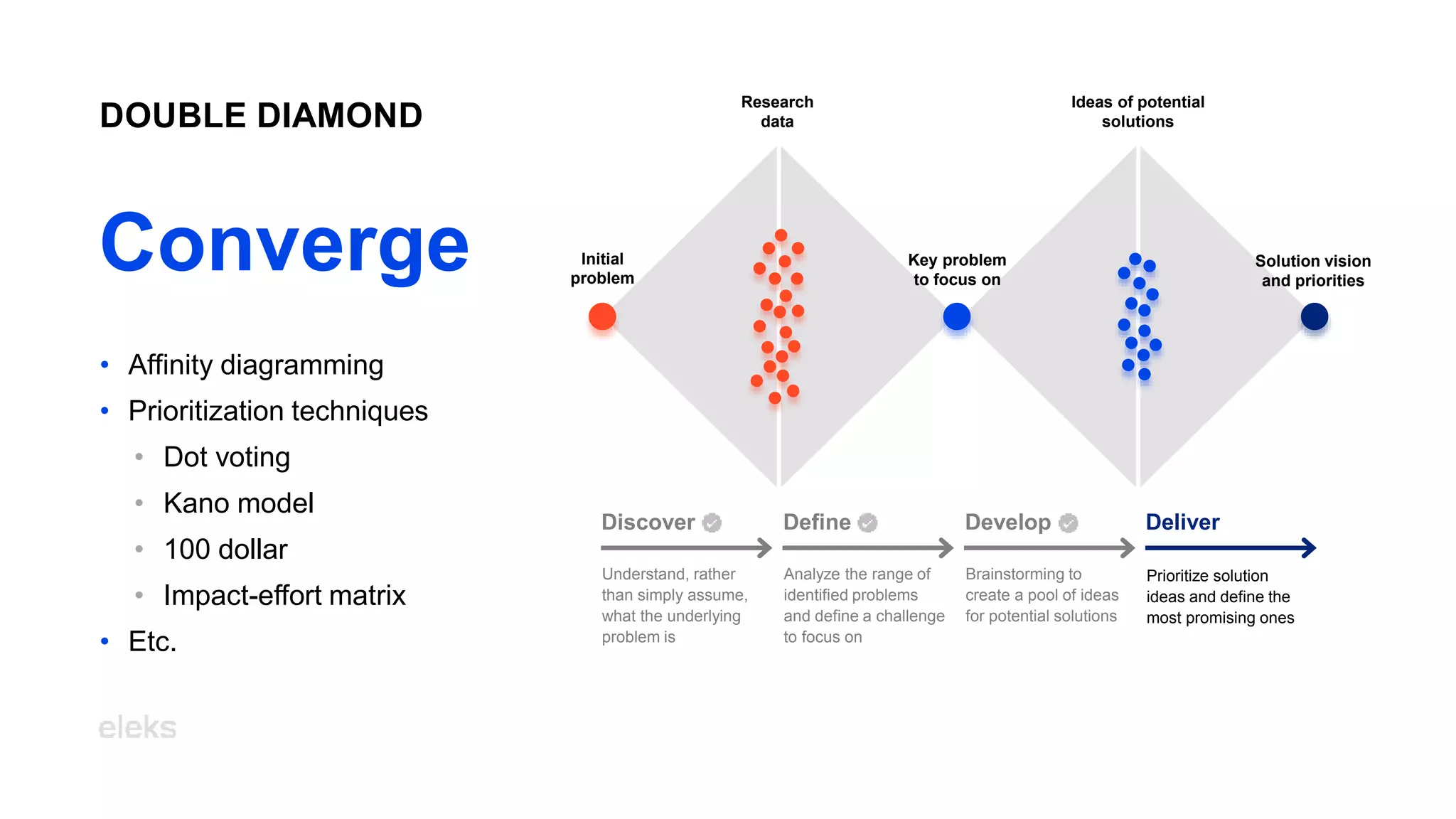
DOUBLE DIAMOND
Converge
Develop
Define
Discover Deliver
Understand, rather
than simply assume,
what the underlying
problem is
Analyze the range of
identified problems
and define a challenge
to focus on
Brainstorming to
create a pool of ideas
for potential solutions
Prioritize solution
ideas and define the
most promising ones
• Affinity diagramming
• Prioritization techniques
• Dot voting
• Kano model
• 100 dollar
• Impact-effort matrix
• etc.
Initial
problem
Research
data
Key problem
to focus on
Ideas of potential
solutions
DOUBLE DIAMOND
Diverge
Develop
Define
Discover Deliver
Understand, rather
than simply assume,
what the underlying
problem is
Analyze the range of
identified problems
and define a challenge
to focus on
Brainstorming to
create a pool of ideas
for potential solutions
Prioritize solution
ideas and define the
most promising ones
• Brainstorming
• Brainwriting
• Storyboarding
• Crazy 8
• etc.
Initial
problem
Research
data
Key problem
to focus on
Ideas of potential
solutions
Solution vision
and priorities
DOUBLE DIAMOND
Converge
Develop
Define
Discover Deliver
Understand, rather
than simply assume,
what the underlying
problem is
Analyze the range of
identified problems
and define a challenge
to focus on
Brainstorming to
create a pool of ideas
for potential solutions
Prioritize solution
ideas and define the
most promising ones
• Affinity diagramming
• Prioritization techniques
• Dot voting
• Kano model
• 100 dollar
• Impact-effort matrix
• Etc.
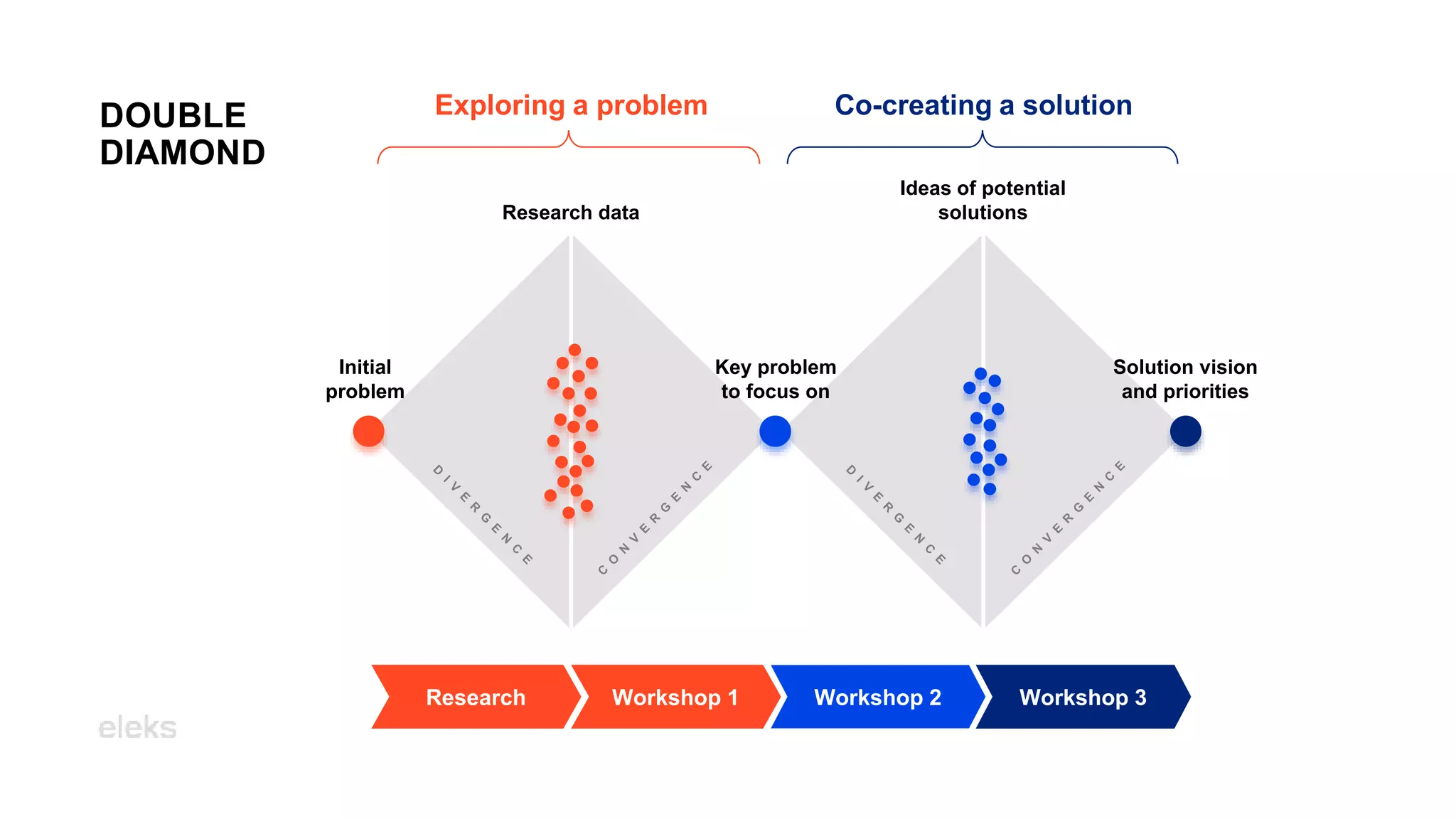
Workshop 1 Workshop 2 Workshop 3
Exploring a problem Co-creating a solution
Initial
problem
Research data
Key problem
to focus on
Ideas of potential
solutions
Solution vision
and priorities
DOUBLE
DIAMOND
Research
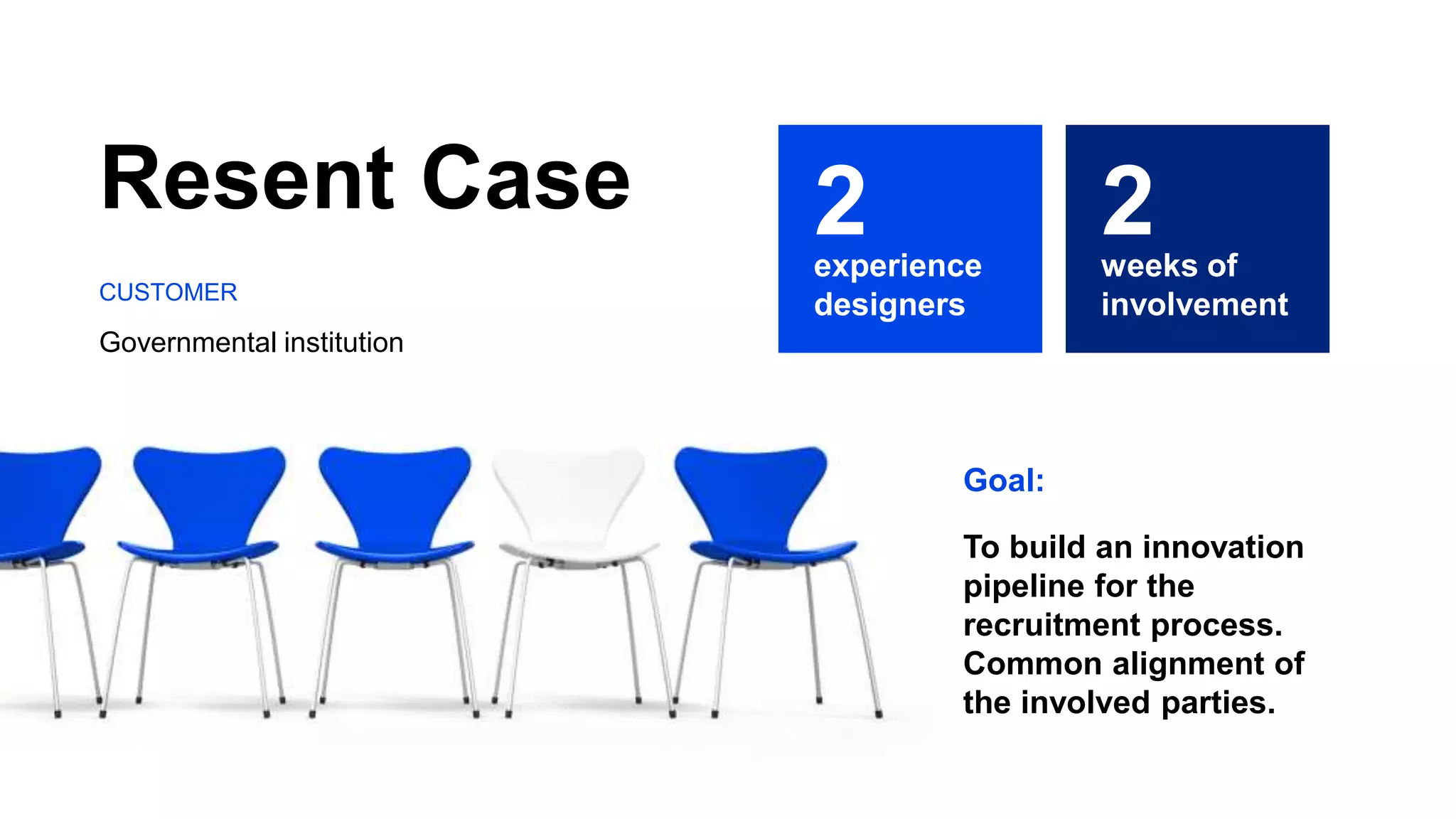
2
CUSTOMER
experience
designers
Governmental institution
To build an innovation
pipeline for the
recruitment process.
Common alignment of
the involved parties.
Goal:
Resent Case 2
weeks of
involvement
Results
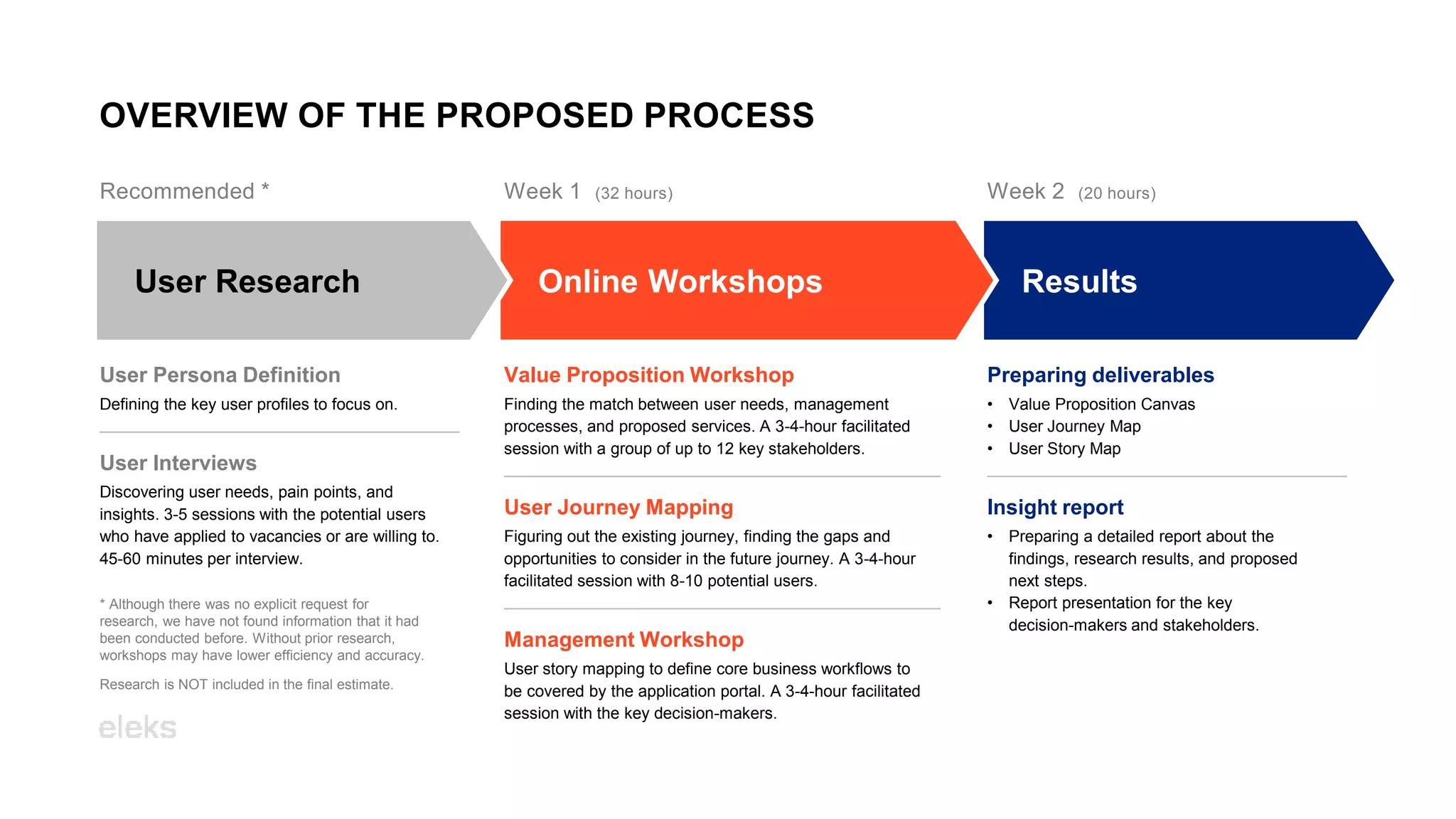
OVERVIEW OF THE PROPOSED PROCESS
User Persona Definition
Defining the key user profiles to focus on.
User Interviews
Discovering user needs, pain points, and
insights. 3-5 sessions with the potential users
who have applied to vacancies or are willing to.
45-60 minutes per interview.
Value Proposition Workshop
Finding the match between user needs, management
processes, and proposed services. A 3-4-hour facilitated
session with a group of up to 12 key stakeholders.
User Journey Mapping
Figuring out the existing journey, finding the gaps and
opportunities to consider in the future journey. A 3-4-hour
facilitated session with 8-10 potential users.
Management Workshop
User story mapping to define core business workflows to
be covered by the application portal. A 3-4-hour facilitated
session with the key decision-makers.
Preparing deliverables
• Value Proposition Canvas
• User Journey Map
• User Story Map
Insight report
• Preparing a detailed report about the
findings, research results, and proposed
next steps.
• Report presentation for the key
decision-makers and stakeholders.
* Although there was no explicit request for
research, we have not found information that it had
been conducted before. Without prior research,
workshops may have lower efficiency and accuracy.
Research is NOT included in the final estimate.
Online Workshops
User Research
Recommended * Week 1 (32 hours) Week 2 (20 hours)
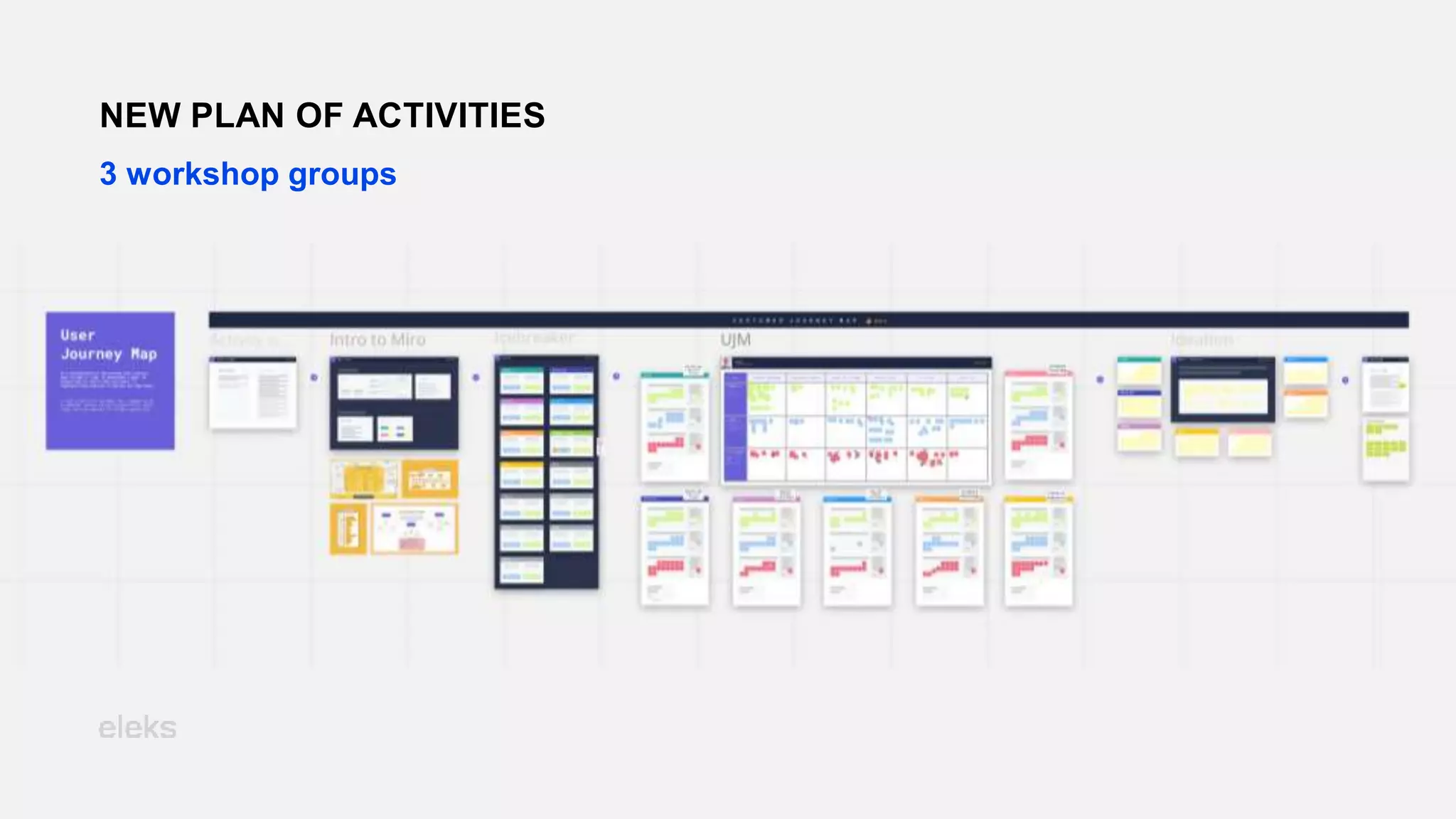
NEW PLAN OF ACTIVITIES
3 workshop groups
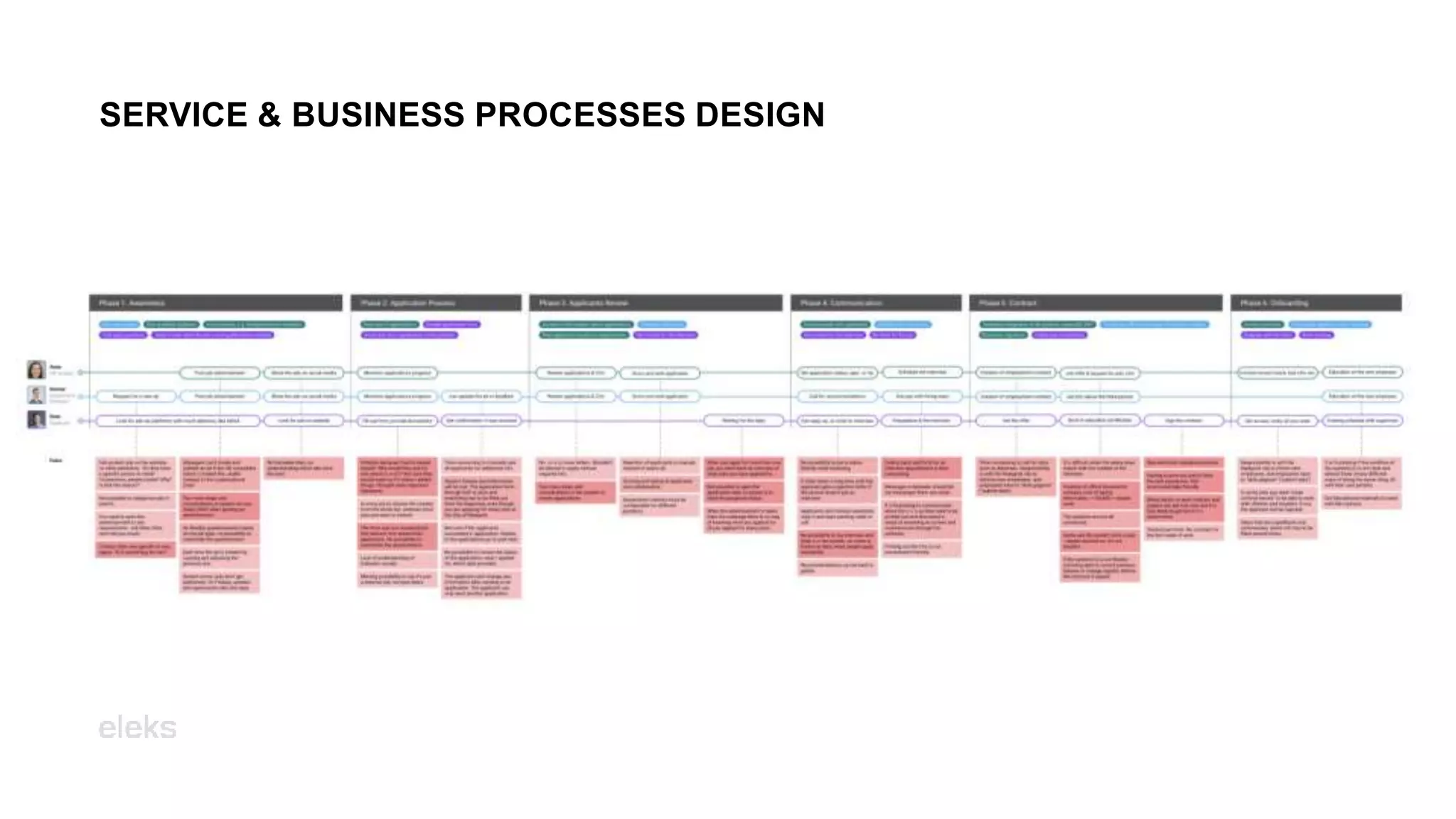
SERVICE & BUSINESS PROCESSES DESIGN
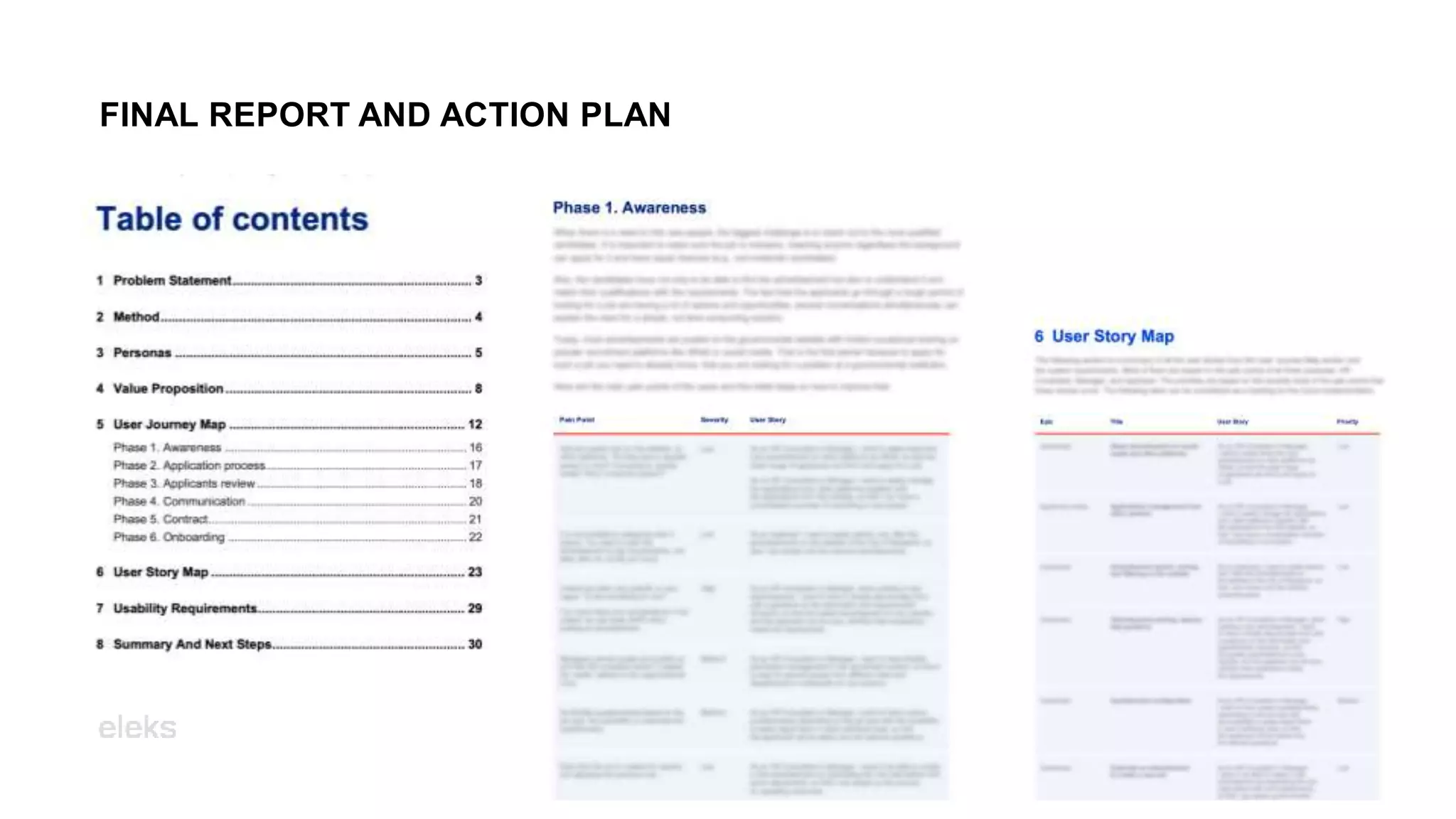
FINAL REPORT AND ACTION PLAN
BLUR
BLUR BLUR
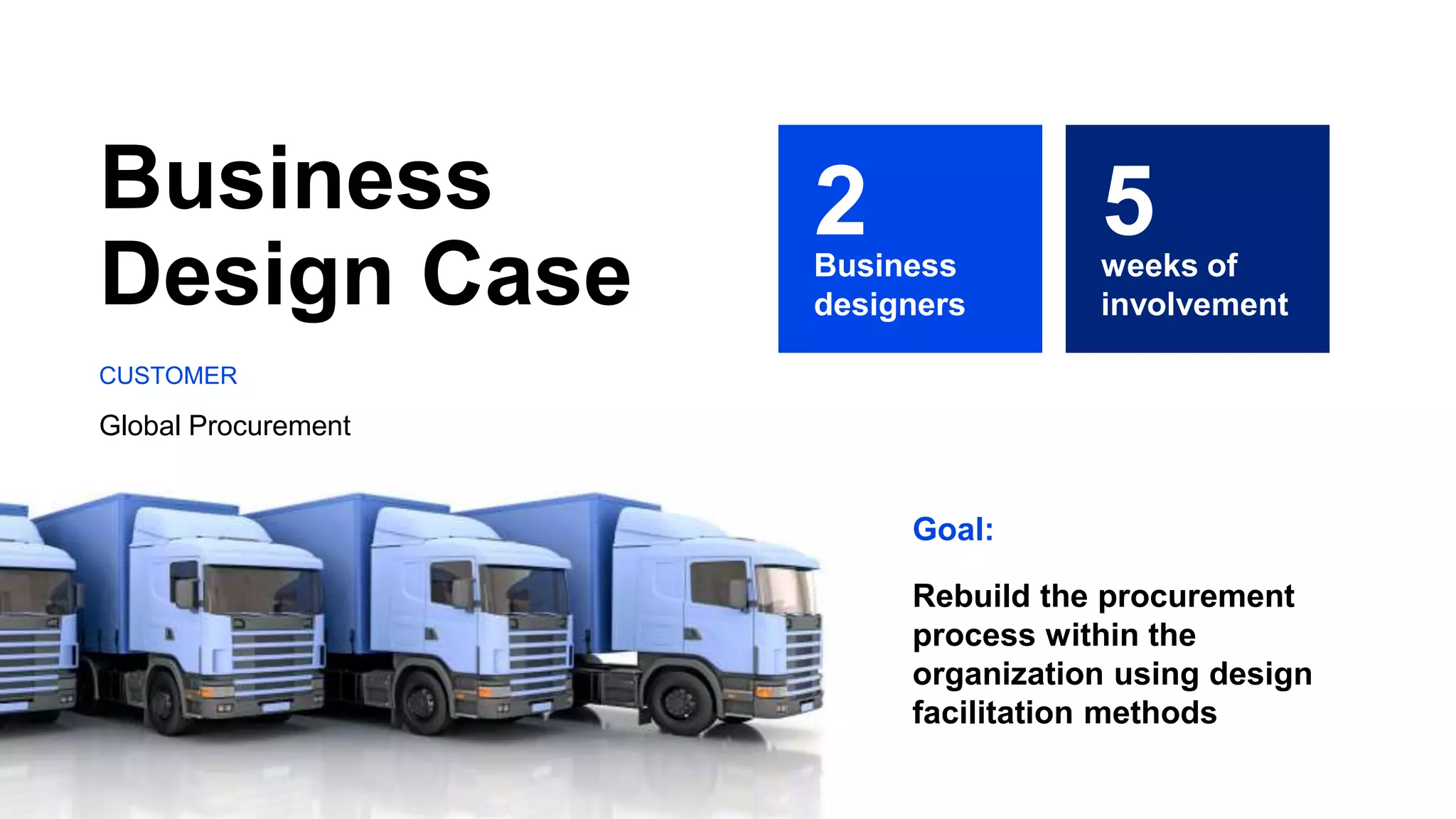
Business
Design Case
2
Business
designers
5
weeks of
involvement
CUSTOMER
Global Procurement
Rebuild the procurement
process within the
organization using design
facilitation methods
Goal:
Finalization
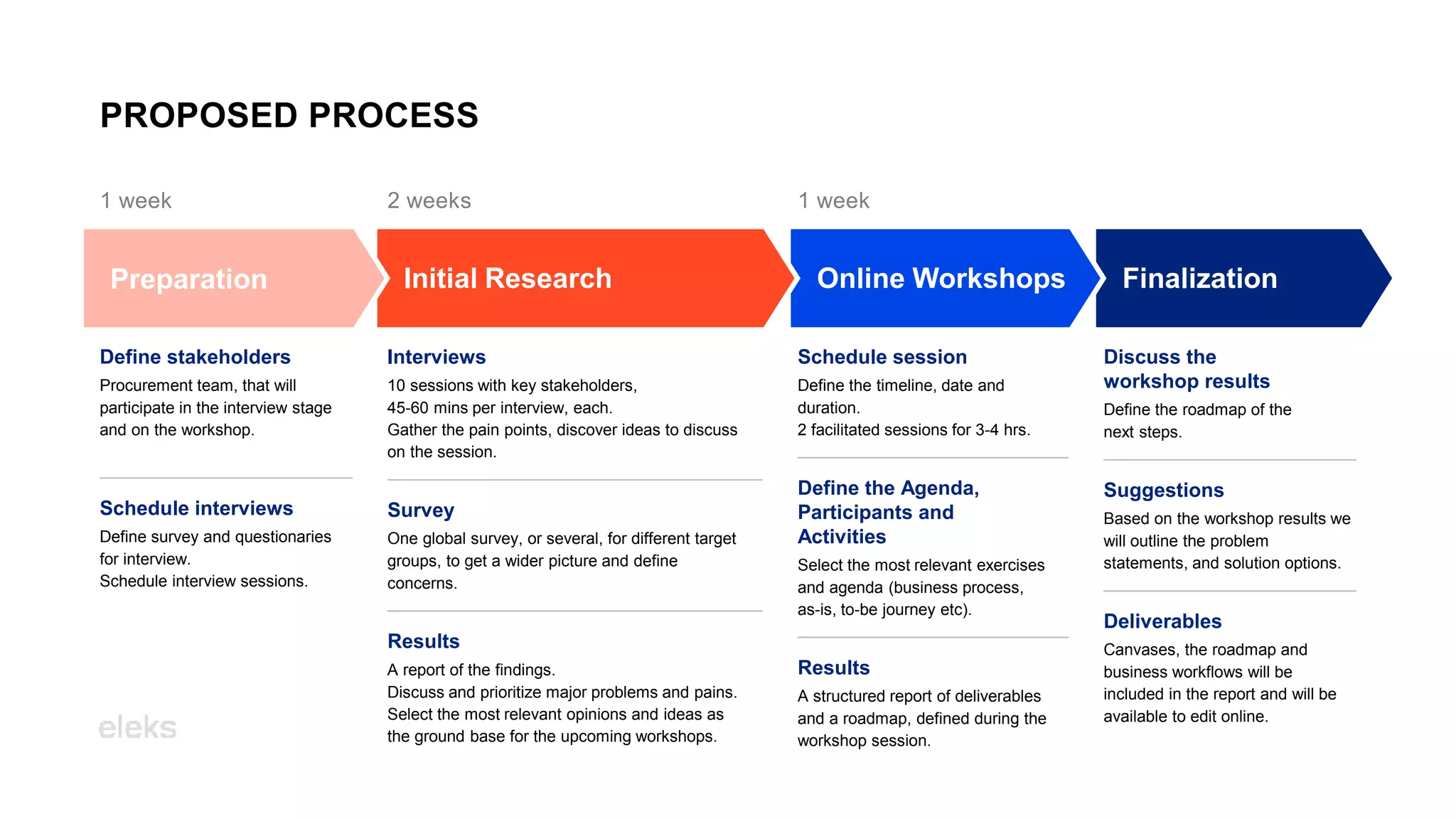
PROPOSED PROCESS
Define stakeholders
Procurement team, that will
participate in the interview stage
and on the workshop.
Schedule interviews
Define survey and questionaries
for interview.
Schedule interview sessions.
Interviews
10 sessions with key stakeholders,
45-60 mins per interview, each.
Gather the pain points, discover ideas to discuss
on the session.
Survey
One global survey, or several, for different target
groups, to get a wider picture and define
concerns.
Results
A report of the findings.
Discuss and prioritize major problems and pains.
Select the most relevant opinions and ideas as
the ground base for the upcoming workshops.
1 week 2 weeks
Schedule session
Define the timeline, date and
duration.
2 facilitated sessions for 3-4 hrs.
Define the Agenda,
Participants and
Activities
Select the most relevant exercises
and agenda (business process,
as-is, to-be journey etc).
Results
A structured report of deliverables
and a roadmap, defined during the
workshop session.
1 week
Discuss the
workshop results
Define the roadmap of the
next steps.
Suggestions
Based on the workshop results we
will outline the problem
statements, and solution options.
Deliverables
Canvases, the roadmap and
business workflows will be
included in the report and will be
available to edit online.
Online Workshops
Initial Research
Preparation
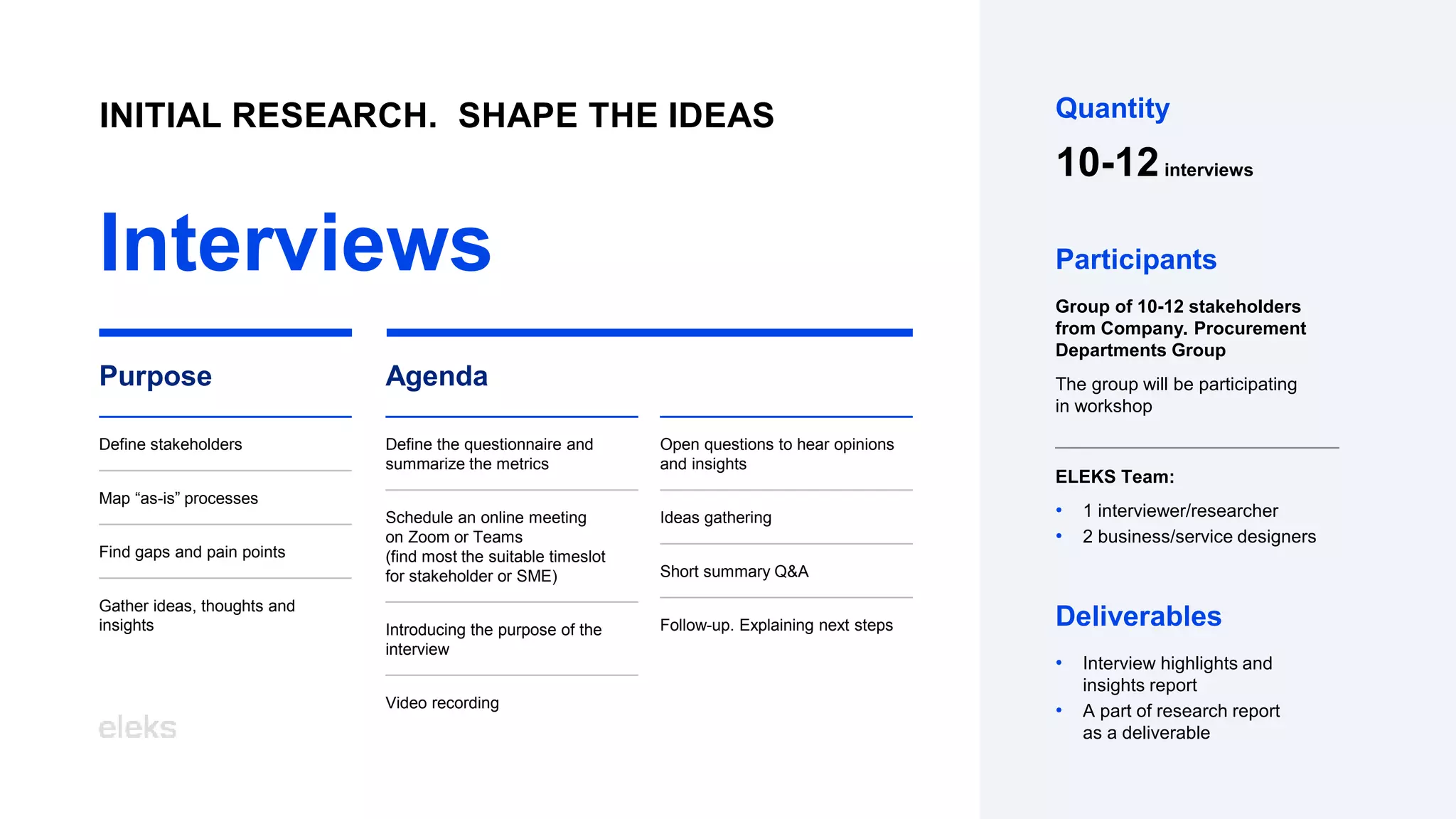
INITIAL RESEARCH. SHAPE THE IDEAS
Interviews
Purpose
Define stakeholders
Map “as-is” processes
Find gaps and pain points
Gather ideas, thoughts and
insights
Agenda
Define the questionnaire and
summarize the metrics
Schedule an online meeting
on Zoom or Teams
(find most the suitable timeslot
for stakeholder or SME)
Introducing the purpose of the
interview
Video recording
Open questions to hear opinions
and insights
Ideas gathering
Short summary Q&A
Follow-up. Explaining next steps
ELEKS Team:
• 1 interviewer/researcher
• 2 business/service designers
Group of 10-12 stakeholders
from Company. Procurement
Departments Group
The group will be participating
in workshop
Participants
Quantity
10-12interviews
• Interview highlights and
insights report
• A part of research report
as a deliverable
Deliverables
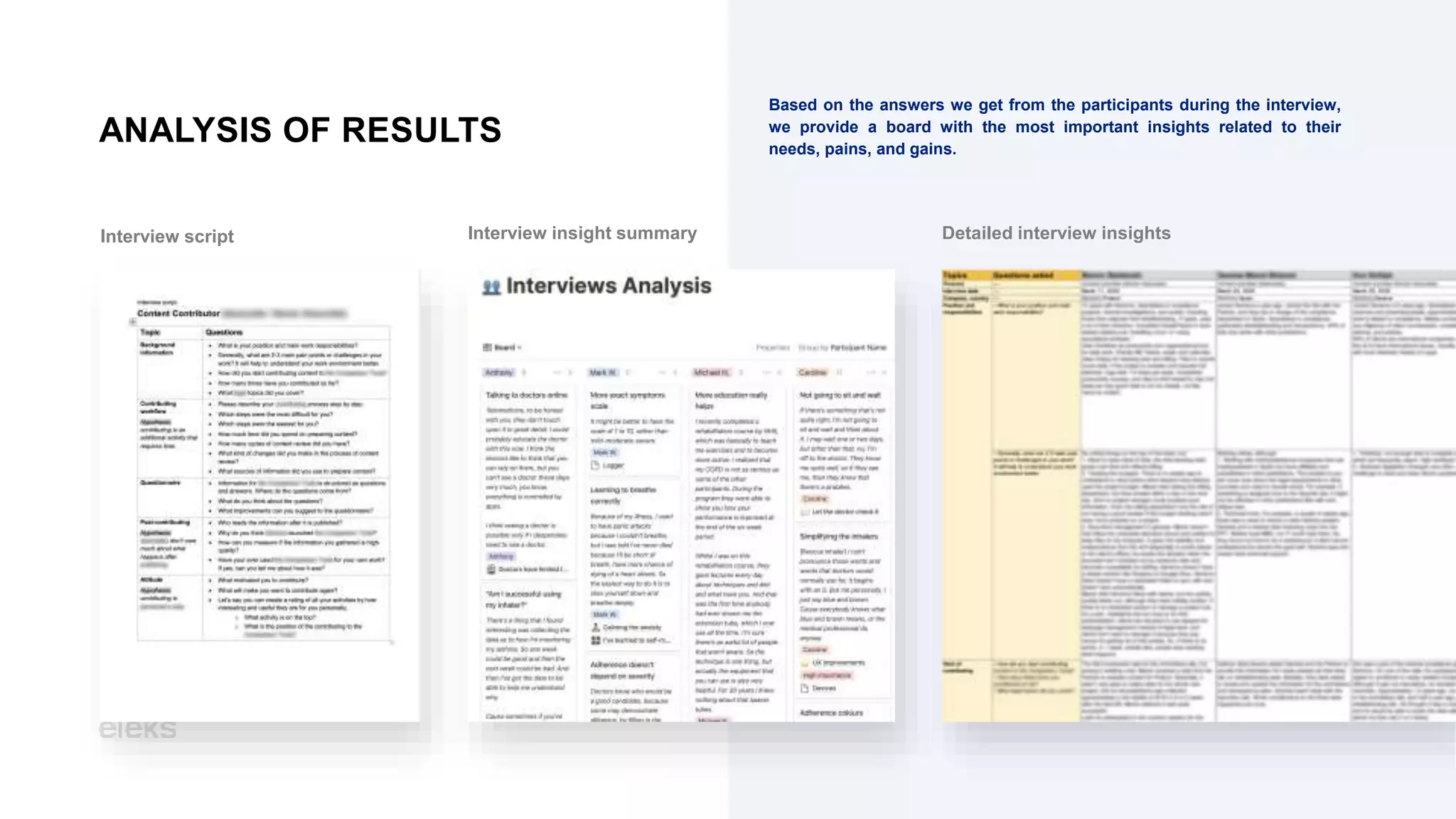
ANALYSIS OF RESULTS
Based on the answers we get from the participants during the interview,
we provide a board with the most important insights related to their
needs, pains, and gains.
Interview script Interview insight summary Detailed interview insights
INITIAL RESEARCH. SHAPE THE IDEAS
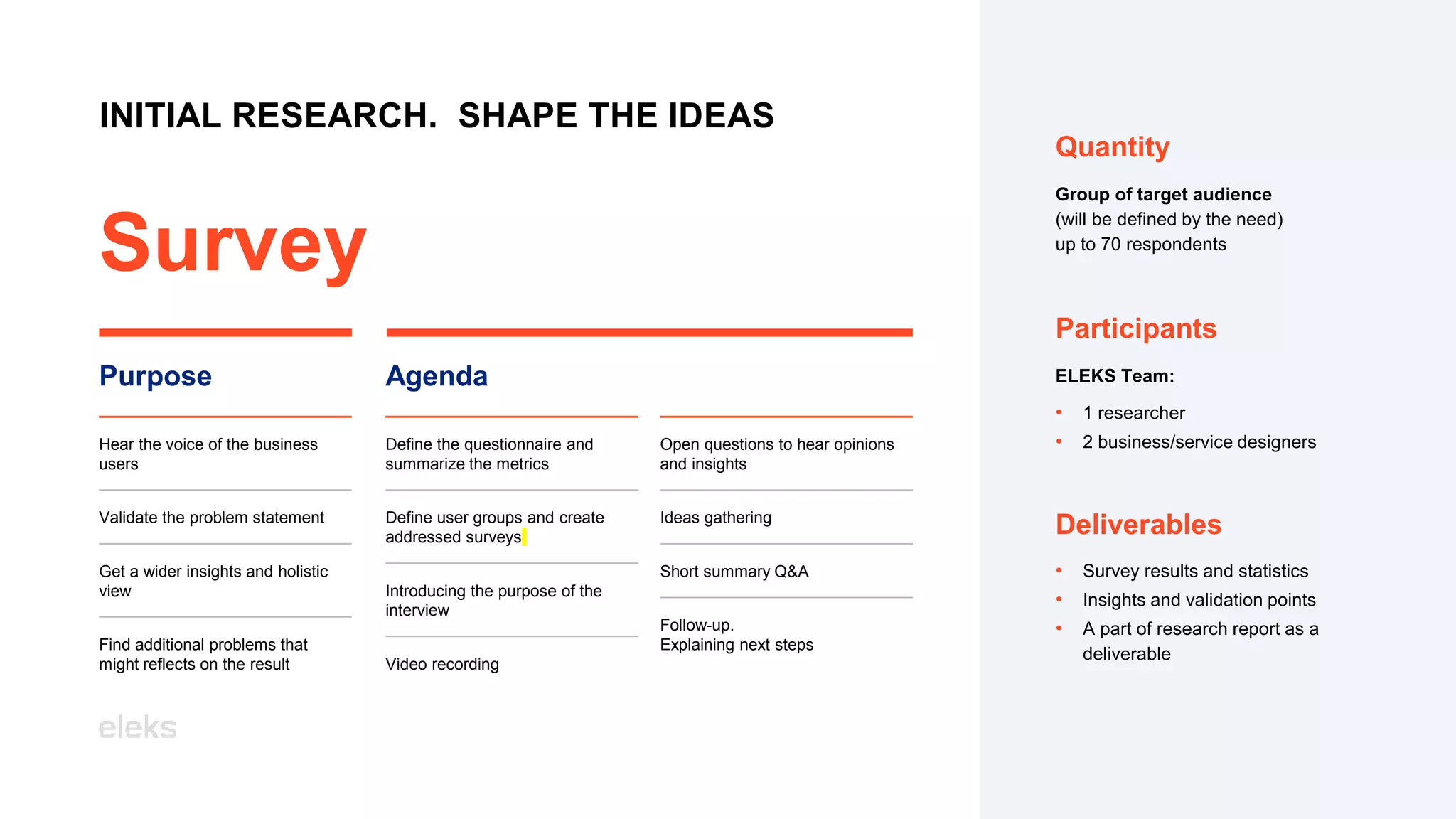
Survey
Purpose
Hear the voice of the business
users
Validate the problem statement
Get a wider insights and holistic
view
Find additional problems that
might reflects on the result
Agenda
Define the questionnaire and
summarize the metrics
Define user groups and create
addressed surveys
Introducing the purpose of the
interview
Video recording
Open questions to hear opinions
and insights
Ideas gathering
Short summary Q&A
Follow-up.
Explaining next steps
ELEKS Team:
• 1 researcher
• 2 business/service designers
Participants
Quantity
Group of target audience
(will be defined by the need)
up to 70 respondents
• Survey results and statistics
• Insights and validation points
• A part of research report as a
deliverable
Deliverables
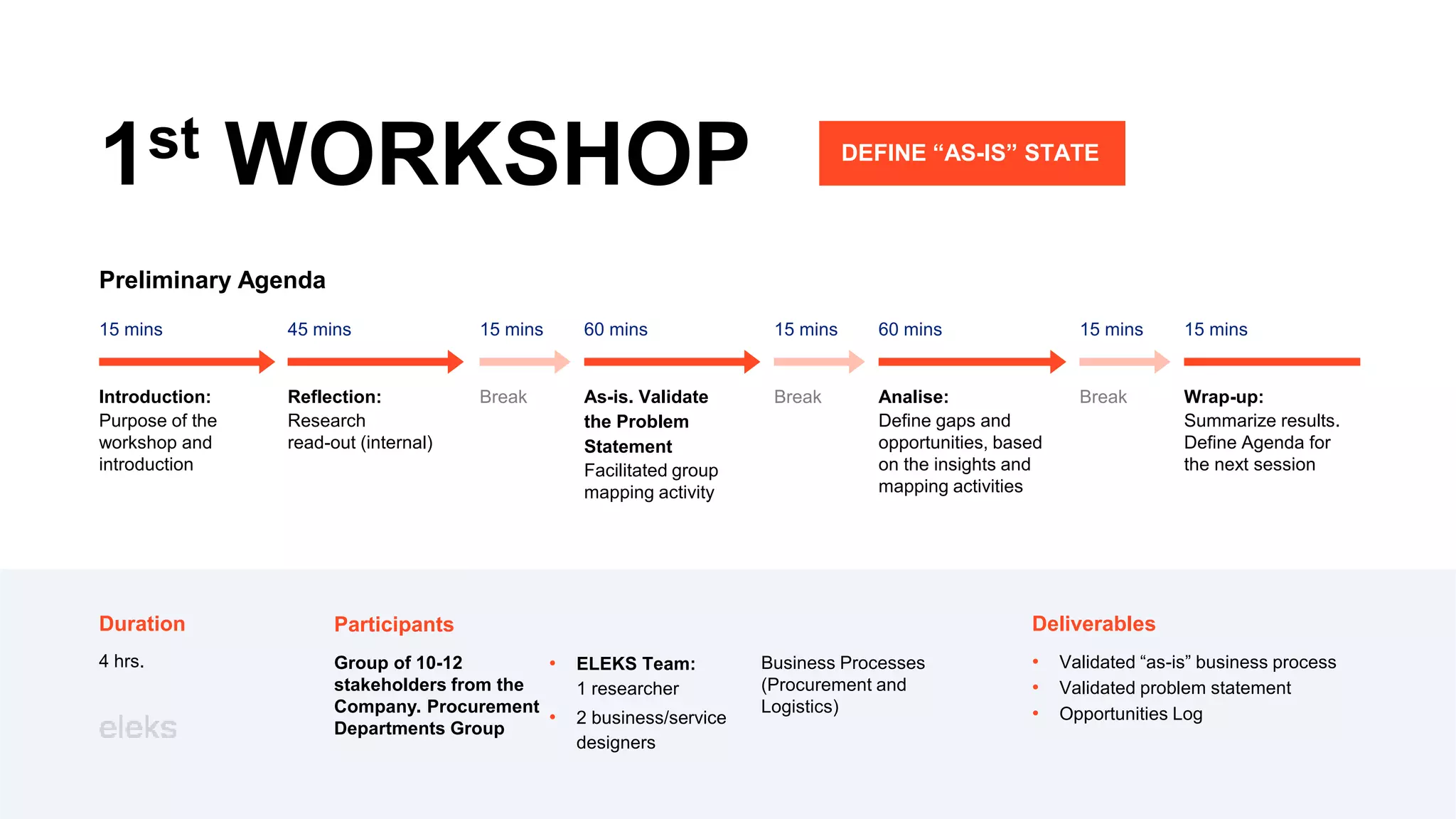
1st WORKSHOP
Preliminary Agenda
Analise:
Define gaps and
opportunities, based
on the insights and
mapping activities
60 mins
Introduction:
Purpose of the
workshop and
introduction
15 mins
Reflection:
Research
read-out (internal)
45 mins
Break
15 mins
As-is. Validate
the Problem
Statement
Facilitated group
mapping activity
60 mins
Break
15 mins
Break
15 mins
Wrap-up:
Summarize results.
Define Agenda for
the next session
15 mins
Group of 10-12
stakeholders from the
Company. Procurement
Departments Group
Participants
Duration
4 hrs. • Validated “as-is” business process
• Validated problem statement
• Opportunities Log
Deliverables
• ELEKS Team:
1 researcher
• 2 business/service
designers
Business Processes
(Procurement and
Logistics)
DEFINE “AS-IS” STATE
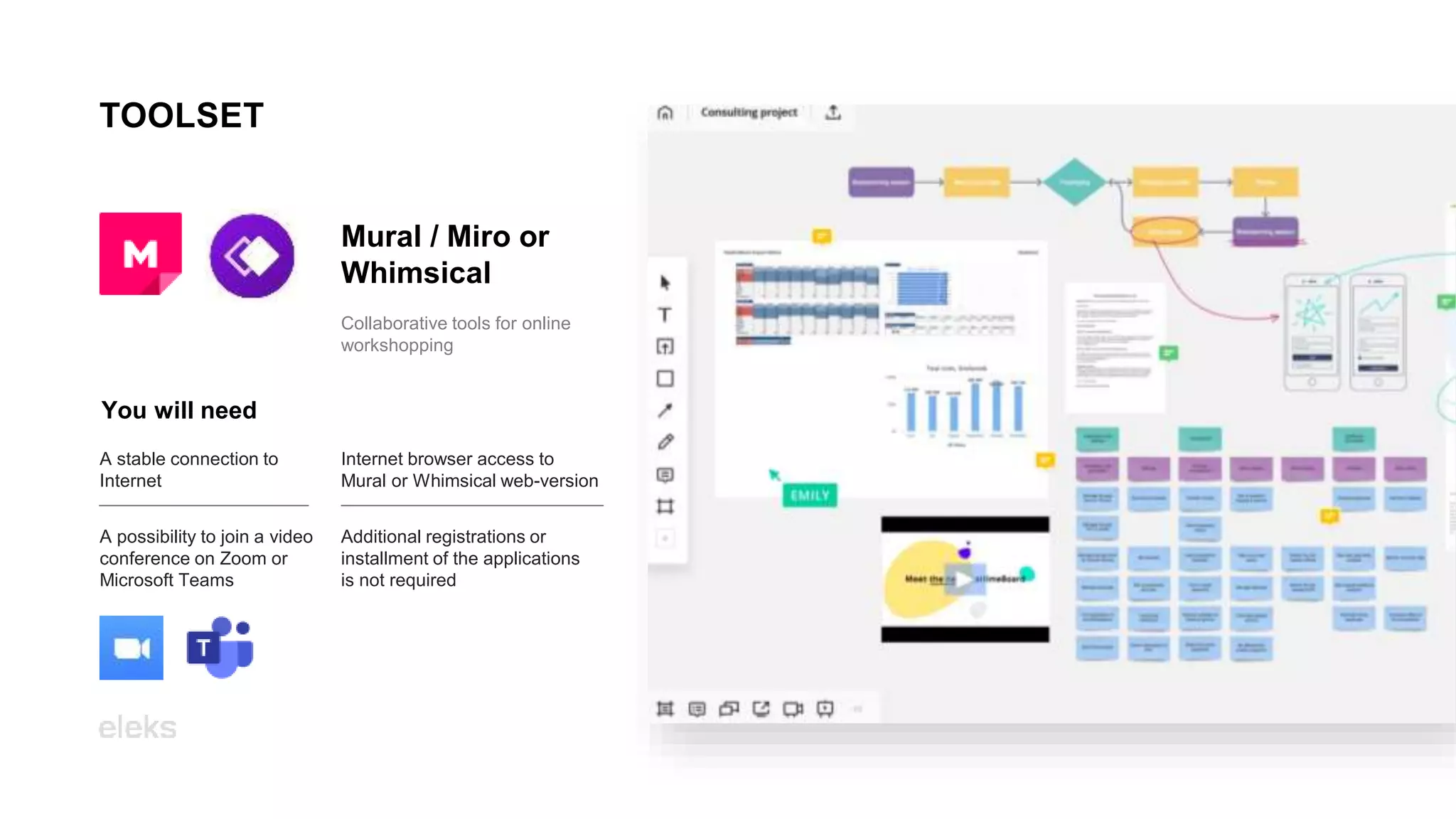
Mural / Miro or
Whimsical
Collaborative tools for online
workshopping
TOOLSET
A stable connection to
Internet
A possibility to join a video
conference on Zoom or
Microsoft Teams
Internet browser access to
Mural or Whimsical web-version
Additional registrations or
installment of the applications
is not required
You will need
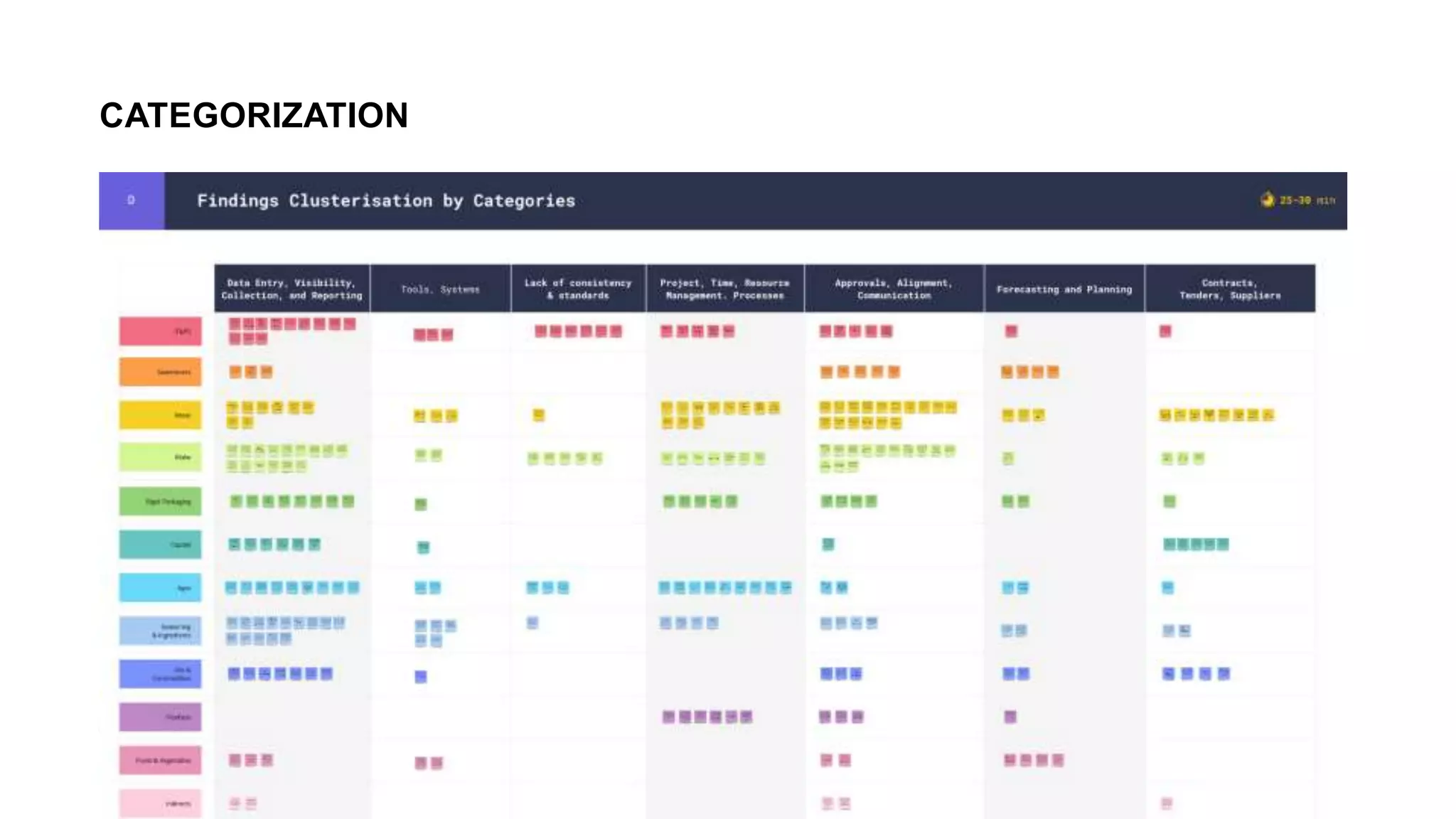
CATEGORIZATION
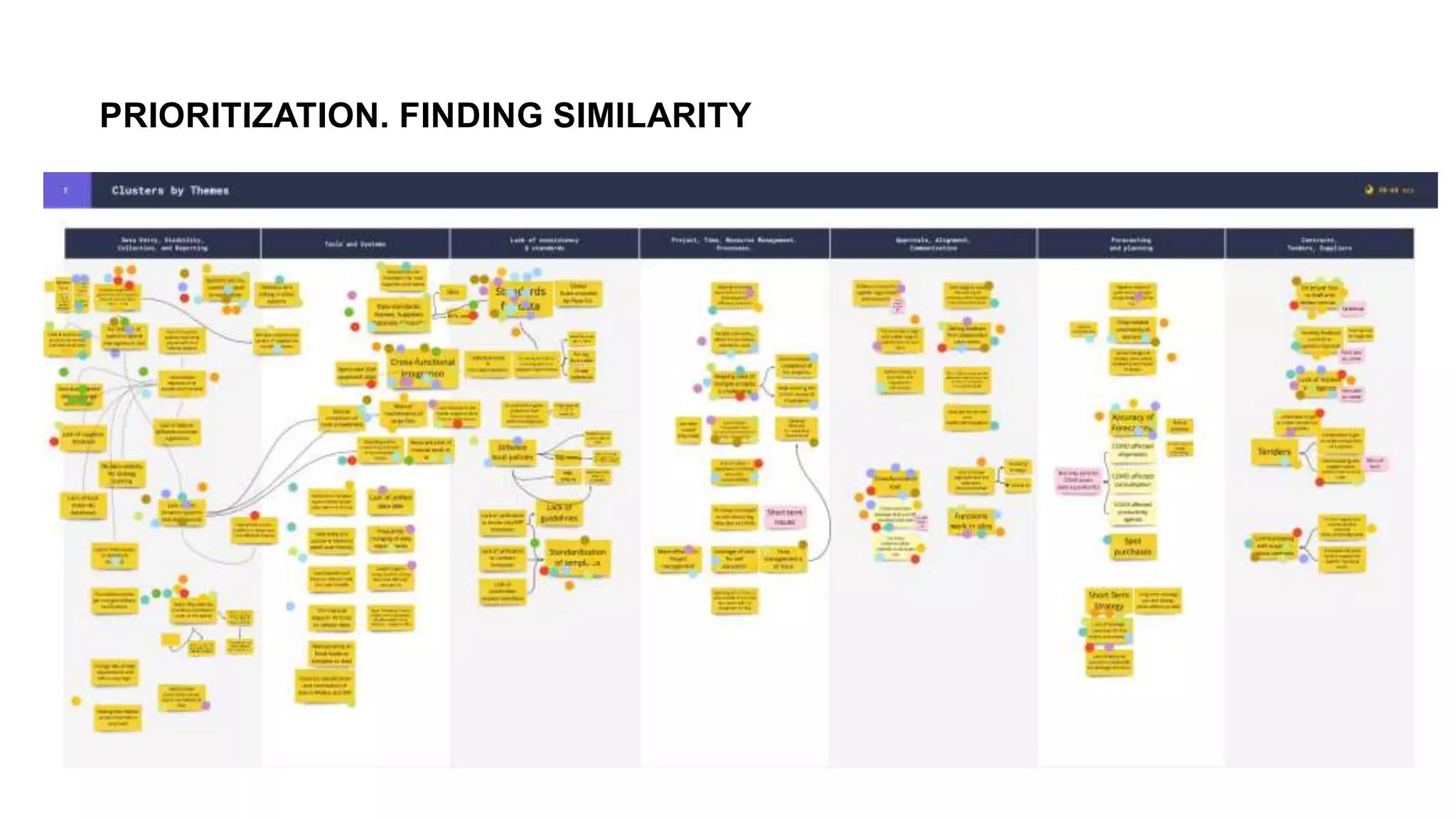
PRIORITIZATION. FINDING SIMILARITY
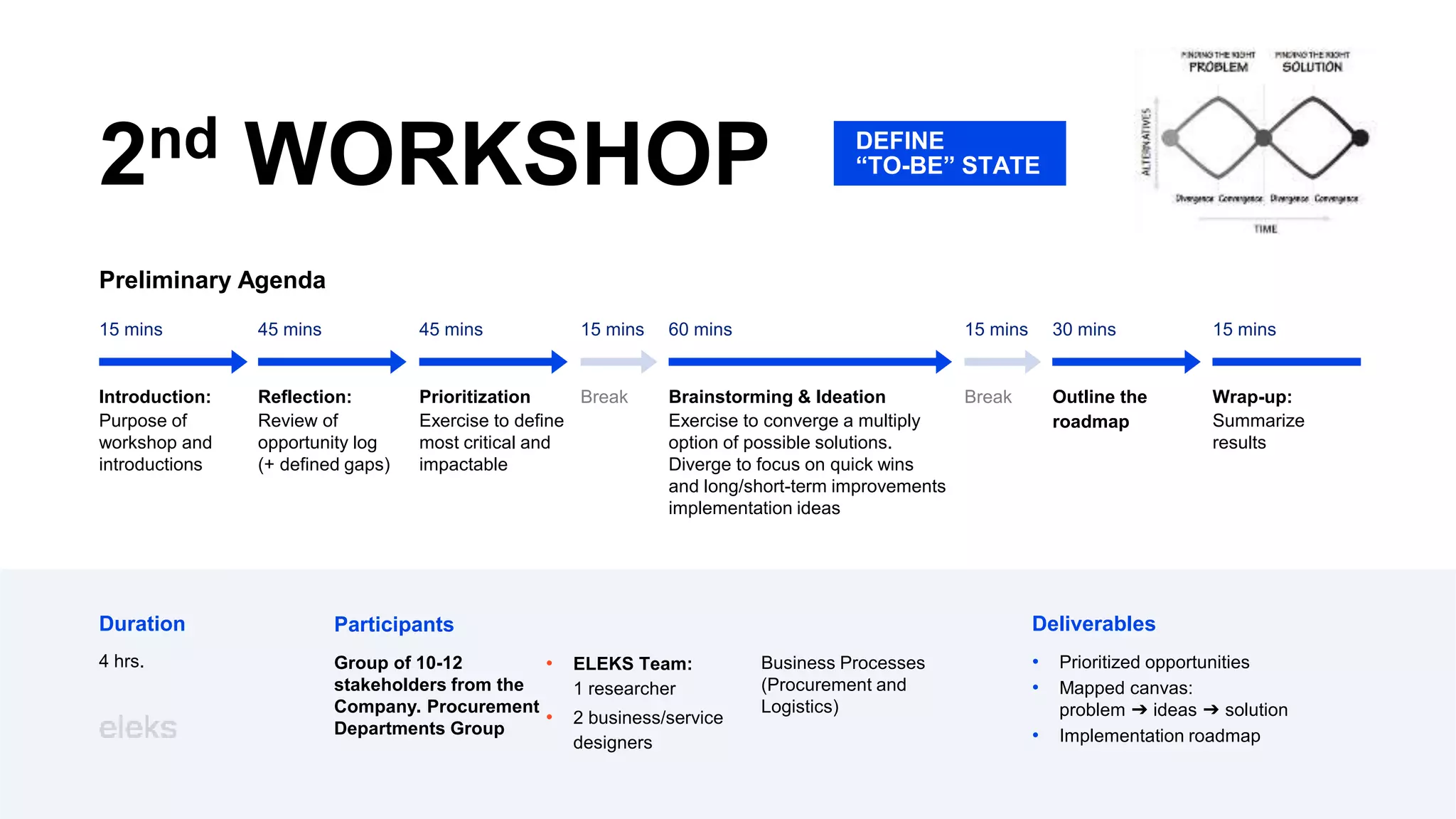
2nd WORKSHOP
Preliminary Agenda
Brainstorming & Ideation
Exercise to converge a multiply
option of possible solutions.
Diverge to focus on quick wins
and long/short-term improvements
implementation ideas
60 mins
Introduction:
Purpose of
workshop and
introductions
15 mins
Reflection:
Review of
opportunity log
(+ defined gaps)
45 mins
Break
15 mins
Break
15 mins
Outline the
roadmap
30 mins
Prioritization
Exercise to define
most critical and
impactable
45 mins
Wrap-up:
Summarize
results
15 mins
Group of 10-12
stakeholders from the
Company. Procurement
Departments Group
4 hrs. • Prioritized opportunities
• Mapped canvas:
problem ➔ ideas ➔ solution
• Implementation roadmap
• ELEKS Team:
1 researcher
• 2 business/service
designers
Business Processes
(Procurement and
Logistics)
DEFINE
“TO-BE” STATE
Participants
Duration Deliverables
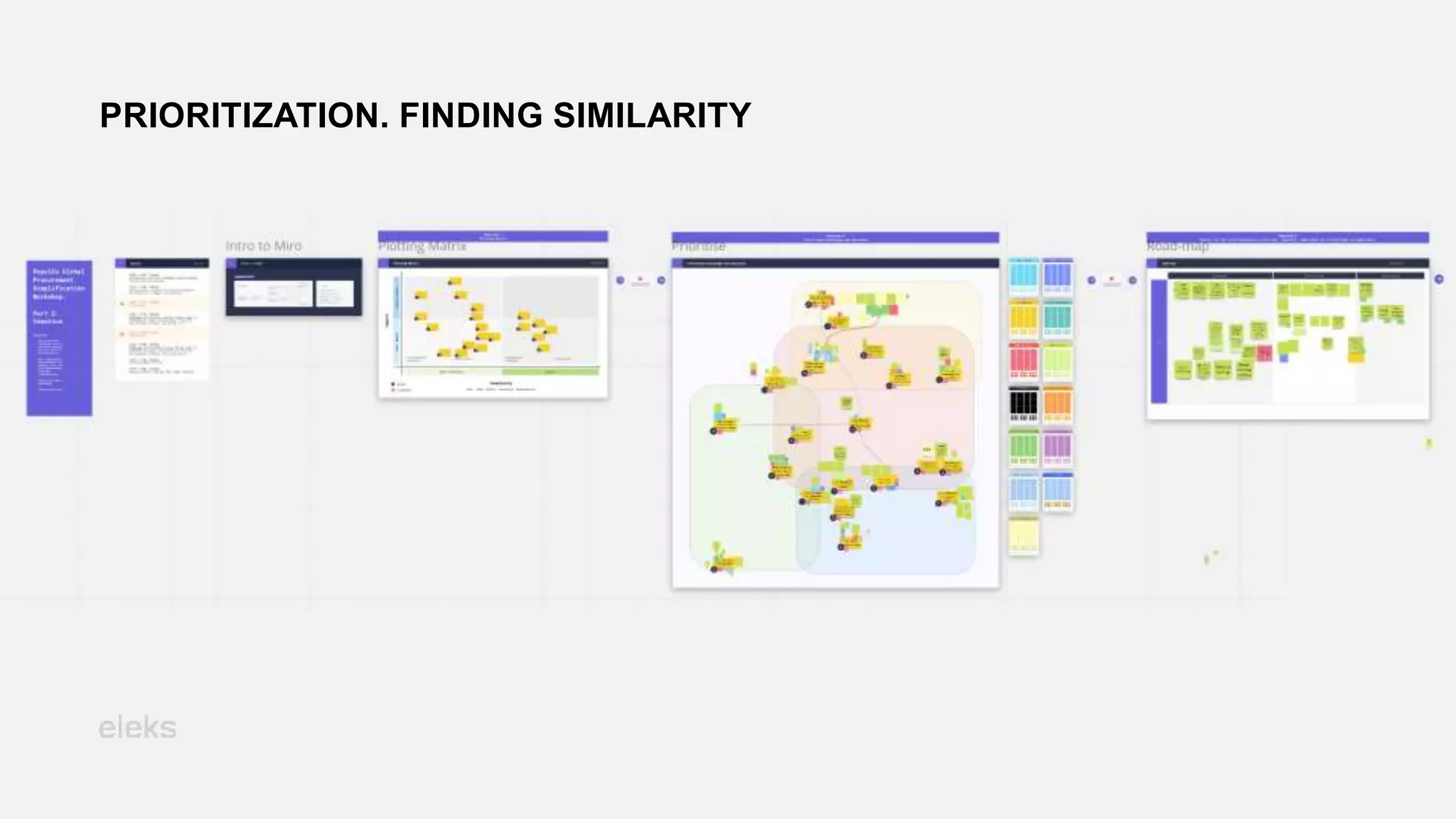
PRIORITIZATION. FINDING SIMILARITY
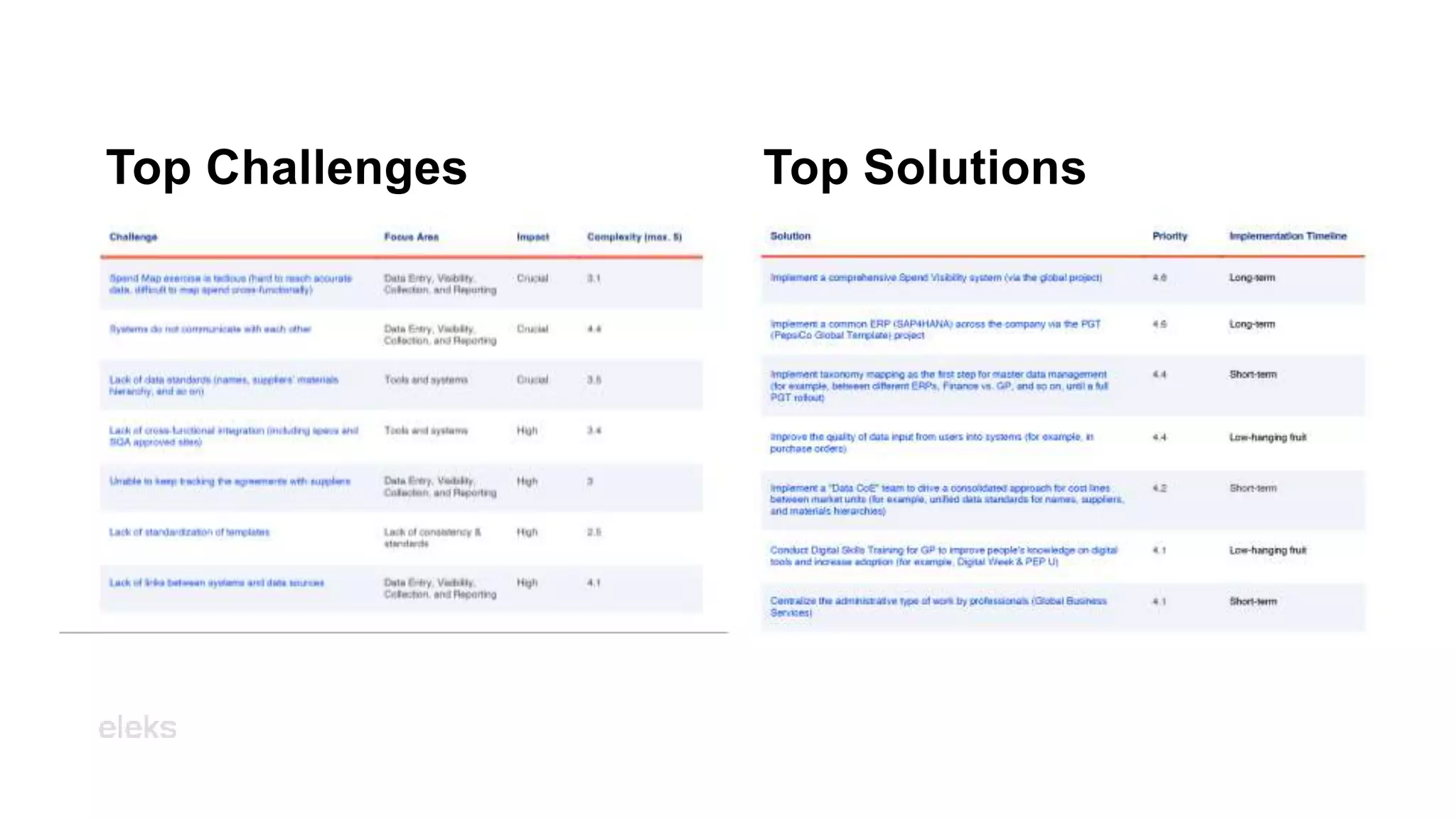
Top Challenges Top Solutions
Thank
you!
Oleg Slyusarchuk
/slyusarchuko
oleg.slyusarchuk@eleks.com
Uliana Bashchuk
/uliana-bashchuk
uliana.bashchuk@eleks.com

Building innovation pipeline with service design methods

  • 2.
    Building innovation pipeline withservice design methods Oleg Slyusarchuk & Uliana Bashchuk
  • 3.
    The custom software developmentcompany We focus on complex tasks Long-term relations with clients Deep vertical expertise Top scientific talent A Top 100 Global Outsourcing Company 30 years of experience
  • 4.
    2,000+ global headcount 15 offices 1450+ delivery experts Headquarters DevelopmentCentre Client Support Office GLOBAL PRESENCE Ukraine Lviv Kyiv Ternopil Ivano Frankivsk Americas Chicago, USA Las Vegas, USA Toronto, Canada Europe Berlin, Germany London, UK Rzeszow, Poland Tallinn, Estonia Zürich, Switzerland Zagreb, Croatia Middle East Ajman, UAE Al Jubail, KSA Asia Tokyo, JAPAN
  • 5.
    We are ableto support all stages of product development and bring products to market at scale. certified & recognized designers USA, UK, Germany, Ukraine Certified by industry experts: 70+
  • 6.
    User Experience Advisory UX Advisoryis a smart choice if your organization needs a dedicated design consultant to help you scale your business or bring your service experience to the next level. Design of Business Processes Many companies tend to build up dozens of legacy processes over time or might lack some process as they grow. We help identify bottlenecks, conflicts, and reasons why teams might not follow the established workflows. Service Design and Customer Experience While focusing on the client- facing part of products or services, many companies overlook the relationship between customer experience and operational behind-the-scenes work. DESIGN CONSULTANCY Product Ideation At the start, we help define and structure a product vision and ensure it is shaped to fit real customer needs. We combine technology expertise with Design Thinking, allowing you to craft user experiences that drive engagement
  • 7.
    London Berlin Birmingham Amsterdam Munich Kyiv Stockholm Geneva Istanbul Amman Dubai Tokyo San Francisco Seattle Kalispell Minneapolis Chicago Philadelphia Raleigh 100 Onsite& Online Product ideation phases Tel Aviv Charlotte Houston Los Angeles Boston Denver Detroit Brussels Vienna Zurich 25+ online during Covid in 20/21 ABOUT
  • 8.
    150+ active client accounts London Berlin Birmingham Amsterdam Munich Kyiv Stockholm Geneva Istanbul Amman Dubai Tokyo SanFrancisco Seattle Kalispell Minneapolis Detroit Philadelphia Raleigh Washington for SMB 75% for Enterprise 25% end-to-end solutions delivered 700+ of clients do more than one project with us 90% years of cooperation with the oldest clients 20+ MEET OUR CLIENTS Chicago New York Boston
  • 9.
    To design isto devise courses of action aimed at changing existing situations into preferred once.” “ Herbert Simon
  • 10.
    Double Diamond by BritishDesign Council ALL DESIGN FRAMEWORKS ABOUT DIVERGE & CONVERGE Design Sprint by Google Design Thinking 101 by NN/g
  • 11.
    Initial problem Research data DOUBLE DIAMOND Diverge • Research •Interviews • Usability testing • Analytics • Competitors • etc. Develop Define Discover Deliver Understand, rather than simply assume, what the underlying problem is Analyze the range of identified problems and define a challenge to focus on Brainstorming to create a pool of ideas for potential solutions Prioritize solution ideas and define the most promising ones
  • 12.
    Initial problem Research data Key problem to focuson DOUBLE DIAMOND Converge Develop Define Discover Deliver Understand, rather than simply assume, what the underlying problem is Analyze the range of identified problems and define a challenge to focus on Brainstorming to create a pool of ideas for potential solutions Prioritize solution ideas and define the most promising ones • Affinity diagramming • Prioritization techniques • Dot voting • Kano model • 100 dollar • Impact-effort matrix • etc.
  • 13.
    Initial problem Research data Key problem to focuson Ideas of potential solutions DOUBLE DIAMOND Diverge Develop Define Discover Deliver Understand, rather than simply assume, what the underlying problem is Analyze the range of identified problems and define a challenge to focus on Brainstorming to create a pool of ideas for potential solutions Prioritize solution ideas and define the most promising ones • Brainstorming • Brainwriting • Storyboarding • Crazy 8 • etc.
  • 14.
    Initial problem Research data Key problem to focuson Ideas of potential solutions Solution vision and priorities DOUBLE DIAMOND Converge Develop Define Discover Deliver Understand, rather than simply assume, what the underlying problem is Analyze the range of identified problems and define a challenge to focus on Brainstorming to create a pool of ideas for potential solutions Prioritize solution ideas and define the most promising ones • Affinity diagramming • Prioritization techniques • Dot voting • Kano model • 100 dollar • Impact-effort matrix • Etc.
  • 15.
    Workshop 1 Workshop2 Workshop 3 Exploring a problem Co-creating a solution Initial problem Research data Key problem to focus on Ideas of potential solutions Solution vision and priorities DOUBLE DIAMOND Research
  • 16.
    2 CUSTOMER experience designers Governmental institution To buildan innovation pipeline for the recruitment process. Common alignment of the involved parties. Goal: Resent Case 2 weeks of involvement
  • 17.
    Results OVERVIEW OF THEPROPOSED PROCESS User Persona Definition Defining the key user profiles to focus on. User Interviews Discovering user needs, pain points, and insights. 3-5 sessions with the potential users who have applied to vacancies or are willing to. 45-60 minutes per interview. Value Proposition Workshop Finding the match between user needs, management processes, and proposed services. A 3-4-hour facilitated session with a group of up to 12 key stakeholders. User Journey Mapping Figuring out the existing journey, finding the gaps and opportunities to consider in the future journey. A 3-4-hour facilitated session with 8-10 potential users. Management Workshop User story mapping to define core business workflows to be covered by the application portal. A 3-4-hour facilitated session with the key decision-makers. Preparing deliverables • Value Proposition Canvas • User Journey Map • User Story Map Insight report • Preparing a detailed report about the findings, research results, and proposed next steps. • Report presentation for the key decision-makers and stakeholders. * Although there was no explicit request for research, we have not found information that it had been conducted before. Without prior research, workshops may have lower efficiency and accuracy. Research is NOT included in the final estimate. Online Workshops User Research Recommended * Week 1 (32 hours) Week 2 (20 hours)
  • 18.
    NEW PLAN OFACTIVITIES 3 workshop groups
  • 19.
    SERVICE & BUSINESSPROCESSES DESIGN
  • 20.
    FINAL REPORT ANDACTION PLAN BLUR BLUR BLUR
  • 21.
    Business Design Case 2 Business designers 5 weeks of involvement CUSTOMER GlobalProcurement Rebuild the procurement process within the organization using design facilitation methods Goal:
  • 22.
    Finalization PROPOSED PROCESS Define stakeholders Procurementteam, that will participate in the interview stage and on the workshop. Schedule interviews Define survey and questionaries for interview. Schedule interview sessions. Interviews 10 sessions with key stakeholders, 45-60 mins per interview, each. Gather the pain points, discover ideas to discuss on the session. Survey One global survey, or several, for different target groups, to get a wider picture and define concerns. Results A report of the findings. Discuss and prioritize major problems and pains. Select the most relevant opinions and ideas as the ground base for the upcoming workshops. 1 week 2 weeks Schedule session Define the timeline, date and duration. 2 facilitated sessions for 3-4 hrs. Define the Agenda, Participants and Activities Select the most relevant exercises and agenda (business process, as-is, to-be journey etc). Results A structured report of deliverables and a roadmap, defined during the workshop session. 1 week Discuss the workshop results Define the roadmap of the next steps. Suggestions Based on the workshop results we will outline the problem statements, and solution options. Deliverables Canvases, the roadmap and business workflows will be included in the report and will be available to edit online. Online Workshops Initial Research Preparation
  • 23.
    INITIAL RESEARCH. SHAPETHE IDEAS Interviews Purpose Define stakeholders Map “as-is” processes Find gaps and pain points Gather ideas, thoughts and insights Agenda Define the questionnaire and summarize the metrics Schedule an online meeting on Zoom or Teams (find most the suitable timeslot for stakeholder or SME) Introducing the purpose of the interview Video recording Open questions to hear opinions and insights Ideas gathering Short summary Q&A Follow-up. Explaining next steps ELEKS Team: • 1 interviewer/researcher • 2 business/service designers Group of 10-12 stakeholders from Company. Procurement Departments Group The group will be participating in workshop Participants Quantity 10-12interviews • Interview highlights and insights report • A part of research report as a deliverable Deliverables
  • 24.
    ANALYSIS OF RESULTS Basedon the answers we get from the participants during the interview, we provide a board with the most important insights related to their needs, pains, and gains. Interview script Interview insight summary Detailed interview insights
  • 25.
    INITIAL RESEARCH. SHAPETHE IDEAS Survey Purpose Hear the voice of the business users Validate the problem statement Get a wider insights and holistic view Find additional problems that might reflects on the result Agenda Define the questionnaire and summarize the metrics Define user groups and create addressed surveys Introducing the purpose of the interview Video recording Open questions to hear opinions and insights Ideas gathering Short summary Q&A Follow-up. Explaining next steps ELEKS Team: • 1 researcher • 2 business/service designers Participants Quantity Group of target audience (will be defined by the need) up to 70 respondents • Survey results and statistics • Insights and validation points • A part of research report as a deliverable Deliverables
  • 27.
    1st WORKSHOP Preliminary Agenda Analise: Definegaps and opportunities, based on the insights and mapping activities 60 mins Introduction: Purpose of the workshop and introduction 15 mins Reflection: Research read-out (internal) 45 mins Break 15 mins As-is. Validate the Problem Statement Facilitated group mapping activity 60 mins Break 15 mins Break 15 mins Wrap-up: Summarize results. Define Agenda for the next session 15 mins Group of 10-12 stakeholders from the Company. Procurement Departments Group Participants Duration 4 hrs. • Validated “as-is” business process • Validated problem statement • Opportunities Log Deliverables • ELEKS Team: 1 researcher • 2 business/service designers Business Processes (Procurement and Logistics) DEFINE “AS-IS” STATE
  • 28.
    Mural / Miroor Whimsical Collaborative tools for online workshopping TOOLSET A stable connection to Internet A possibility to join a video conference on Zoom or Microsoft Teams Internet browser access to Mural or Whimsical web-version Additional registrations or installment of the applications is not required You will need
  • 29.
  • 30.
  • 31.
    2nd WORKSHOP Preliminary Agenda Brainstorming& Ideation Exercise to converge a multiply option of possible solutions. Diverge to focus on quick wins and long/short-term improvements implementation ideas 60 mins Introduction: Purpose of workshop and introductions 15 mins Reflection: Review of opportunity log (+ defined gaps) 45 mins Break 15 mins Break 15 mins Outline the roadmap 30 mins Prioritization Exercise to define most critical and impactable 45 mins Wrap-up: Summarize results 15 mins Group of 10-12 stakeholders from the Company. Procurement Departments Group 4 hrs. • Prioritized opportunities • Mapped canvas: problem ➔ ideas ➔ solution • Implementation roadmap • ELEKS Team: 1 researcher • 2 business/service designers Business Processes (Procurement and Logistics) DEFINE “TO-BE” STATE Participants Duration Deliverables
  • 32.
  • 34.
  • 36.

Editor's Notes

  • #3 Intro About us About Eleks Why this topic
  • #10 ..read the phrase I really like that definition of design, because it doesn’t eliminate design to only interface solutions or products. As long as there is a problem or area for improvement, you can apply design thinking to find a better solution. That solution might be a product, or a services, or business processes, or even your personal life. I mean literally, there are books on how to fix your personal life using design methodology. It is often the case, that you don’t really know what the problem is, or what else you can improve. We all know the stories, how the startups fail because they are trying to solve the problem, which doesn’t exist. So, for the start-ups at the idea stage it’s crucial to find out if the need is there, what is the product market fit, who are the competitors, etc. to propose their customer a new, better , innovative solution. For an existing product with real users we can turn to analytics, usability testing, user interviews, etc. again to find a problem we want to solve. If we take a service or a process, the only difference is that we are looking for the problem in a different place. Today want to show you how it can be done on the example of a recent project.
  • #11 If we take a look at the essence of the most popular design methodologies, you’ll notice the common leitmotif through all the design frameworks. All of them are built on diverge and converge alternation. Double diamond You start with a problem, or assumption about a problem Do research – diverge – to find out the reasons or adjust the problem statement Pick the one to solve – converge Ideate solutions – diverge And pick the most promising one – Converge Design Spring is basically the same but with additional round, where you prototype the solution to test it Collect feedback and adjust Design thinking 101 again same story, just put in a circle, to visualize that the process is iterative and you do it again and again. As a result, when you understand the ground rules und backbone of these frameworks, you are not so tithed up to methodologies, and can apply it to anything you want.
  • #12 Let’s take a quick overview of the steps. That’s double diamond. I won’t go in every detail. But just to visualize what I’m talking about. We start with a initial problem and at the discovery phase we try to understand it better. Or product, process, or idea can be on any maturity level. Depending on that, we choose a different set of activities. By conducting interviews, doing research, set-uping some AB tests (if it’s a running software), etc. we collect insights. Understand, rather than simply assume, what the underlying problem is Now we are at the diverge axis.
  • #13 Now, when we have the collected a lot of data, we try to make sense of it. That might be in form of a workshop, where we share and discuss the finding with the whole team, and with the common understanding and collaborative efforts we set the priorities. As a result, we have a key problem to focus on.
  • #14 Then again we move to diverging phase, where we look for possible solutions to our problem. Some will be obvious, but the idea is to remove the boundaries and think outside of the box. For that we have such exercises as brainstorming, brainwriting, crazy 8, etc.
  • #15 Then you pick the most promising one and try it. And with that the circle starts again: test, feedbacks, new related ideas, etc.
  • #16 As we see the the process consists of several blocs, and it is important to be creative, think out of the box to come up with a unique idea, but it’s also crutial to explore the problem itself, to dig dipper, to consider different layers of the process, different participants, different areas, that run simultaneously but influence the same end experience. That’s where we can learn from service design and it’s service blueprint, which brings to light all that layering.
  • #17 I will show you today an example of our recent case. Short term cooperation – 2 weeks – 2 designers Recruitment process for the governmental institution, a capital of one EU country. The recruitment process had been established a long time ago, with one of the SAP modules historically selected as the primary tool for the recruitment workflows. However, this SAP module wasn’t originally designed to cater to the nuances of work with job advertisements, vacancies, and interviews. That’s why it has multiple limitations and requires a lot of workarounds. It’s very time-consuming for the government employees and irritating for the applicants. Questions: how to get better? What to improve? Before requestion a new software, what are the requirement to this software? Are there any unrelated gabs in our process? How to make it better for everyone?
  • #18 That was the initial plan. Suggested interviews to collect the insights but were told that we have explicit survey results instead. So, we have the data to work with and can skip research. Then having the problem statement, we would go into ideation of possible solutions, and try to match user needs, management process and proposed services. Then with the help of user journey find the gaps and opportunities to consider in the future journey. That would be our diverge axis. The management workshop afterwards should have been the prioritization activity to converge our scope. As a result, we planned to deliver a report with the findings, to-do steps and requirements for the future recruitment process. And as it often happens it didn’t go as planned. On the kick-off meeting we find out, that the customer had already set up the workshops in the constellation, where we have 3 groups, that represent different roles, 1st with recruiters, then managers, then applicants. And we cannot change it. The quality of the survey data was not sufficient to work with, so we decided to improvise.
  • #19 Instead, we set up one board structure, that we reused for each user group. At the beginning we had a small warm up exercise to teach everyone to use the tool, to understand this workshop form of cooperation. Then we needed to collect the missing data from research. We asked to write down the tasks they have and placed it on a timeline, then highlighted the goals to achieve on each step. And finally, how did that make them feel on each thage of the process, what are the pain-points. With dot-voting we have prioritized the most important problems, and with the “how might we” exercise generated possible solutions. That cycle we did with each of the three groups. And at the and we had planty of data to work with.
  • #20 We have noticed the patterns and dependencies between the roles and their experiences. The whole process for everyone consists of the same phases, you see them in black on top. Each user groups das individual steps (outlined elements) and goals (color-coded on top). On the bottom you see the pain-points on each step, the color intensity relates to the priority. That accumulated view gives us the possibility to see the whole picture, understand dependencies and find more prisise problems or areas for improvement.
  • #21 The final report highlighted the problem statement, the methodology we used, simplified persona profiles and value proposition for them, the phases of our journey map (you see a screenshot in the middle) with short summary and a table of pain-points with severity level and related users story in form ”As a user… I want… so that…” Then the story map derived from user journey, where the phases where transformed to epics to group user stories, severity of the pain-point to priority of the story. Then a list of usability requirements, summary and the next steps. And now a give the word back to Oleg to show you another interesting case.