BUILDING CONSTRUCTION
HANDBOOK
The Building Construction Handbook is THE authoritative reference for all
construction students and professionals. Its detailed drawings clearly illustrate the
construction of building elements, and have been an invaluable guide for builders
since 1988. The principles and processes of construction are explained with the
concepts of design included where appropriate. Extensive coverage of building
construction practice, techniques, and regulations representing both traditional
procedures and modern developments are included to provide the most
comprehensive and easy to understand guide to building construction.
This new edition has been updated to reflect recent changes to the building
regulations, as well as new material on the latest technologies used in domestic
construction.
Building Construction Handbook is the essential, easy-to-use resource for
undergraduate and vocational students on a wide range of courses including
NVQ and BTEC National, through to Higher National Certificate and Diploma,
to Foundation and three-year Degree level. It is also a useful practical reference
for building designers, contractors and others engaged in the construction
industry.
Roger Greeno is a well-known author of construction texts. He has extensive
practical and consultancy experience in the industry, in addition to lecturing at
several colleges of further and higher education, and the University of
Portsmouth. He has also examined for City & Guilds, Edexcel, the Chartered
Institute of Building and the University of Reading.
Roy Chudley, formerly Senior Lecturer in Building Technology at the Guildford
College of Technology, U.K, is an established author of numerous respected
construction texts.
This page intentionally left blank
BUILDING
CONSTRUCTION
HANDBOOK
Tenth edition
Roy Chudley
and
Roger Greeno
First edition published 1998
by Butterworth-Heinemann
This edition published 2014
by Routledge
2 Park Square, Milton Park, Abingdon, Oxon, OX14 4RN
Simultaneously published in the USA and Canada
by Routledge
711 Third Avenue, New York, NY 10017
Routledge is an imprint of the Taylor & Francis Group, an informa business
© 2014 Roy Chudley and Roger Greeno
The right of Roy Chudley and Roger Greeno to be identified as author of this work has been
asserted by them in accordance with sections 77 and 78 of the Copyright, Designs and Patents
Act 1988.
All rights reserved. No part of this book may be reprinted or reproduced or utilised in any form
or by any electronic, mechanical, or other means, now known or hereafter invented, including
photocopying and recording, or in any information storage or retrieval system, without
permission in writing from the publishers.
Knowledge and best practice in this field are constantly changing. As new research and
experience broaden our understanding, changes in research methods, professional practices, or
medical treatment may become necessary.
Practitioners and researchers must always rely on their own experience and knowledge in
evaluating and using any information, methods, compounds, or experiments described herein. In
using such information or methods they should be mindful of their own safety and the safety of
others, including parties for whom they have a professional responsibility.
To the fullest extent of the law, neither the Publisher nor the authors, contributors or editors,
assume any liability for any injury and/or damage to persons or property as a matter of products
liability, negligence or otherwise, or form and use or operation of any methods, products,
instructions, or ideas contained in the material herein.
British Library Cataloguing in Publication Data
A catalogue record for this book is available from the British Library
Library of Congress Cataloging-in-Publication Data
A catalog record has been requested for this book
ISBN13: 978-0-415-83638-8 (pbk)
ISBN13: 978-1-315-78032 -0 (ebk)
Typeset in Chudley
by Taylor & Francis Books
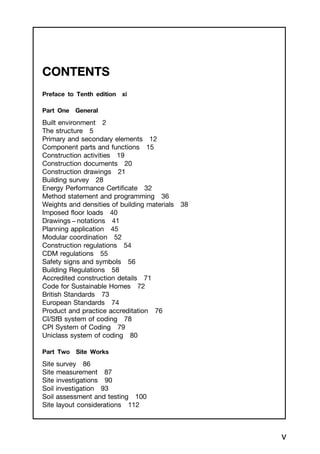
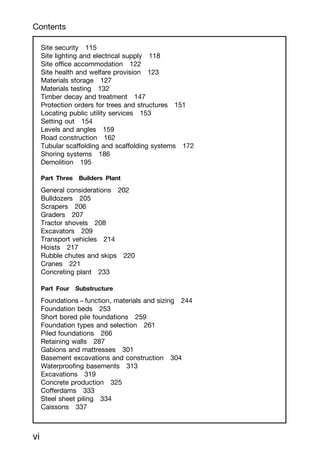
CONTENTS
Preface to Tenth edition xi
Part One General
Built environment 2
The structure 5
Primary and secondary elements 12
Component parts and functions 15
Construction activities 19
Construction documents 20
Construction drawings 21
Building survey 28
Energy Performance Certificate 32
Method statement and programming 36
Weights and densities of building materials 38
Imposed floor loads 40
Drawings -
-- notations 41
Planning application 45
Modular coordination 52
Construction regulations 54
CDM regulations 55
Safety signs and symbols 56
Building Regulations 58
Accredited construction details 71
Code for Sustainable Homes 72
British Standards 73
European Standards 74
Product and practice accreditation 76
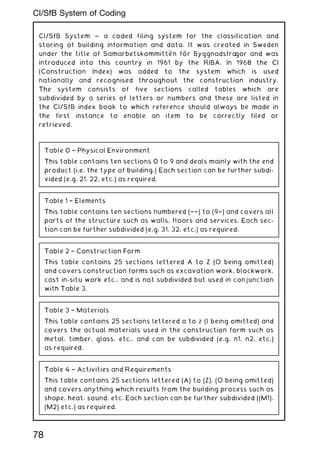
CI/SfB system of coding 78
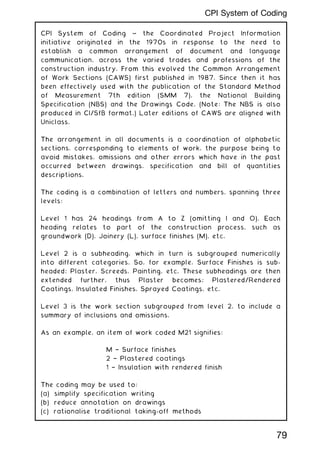
CPI System of Coding 79
Uniclass system of coding 80
Part Two Site Works
Site survey 86
Site measurement 87
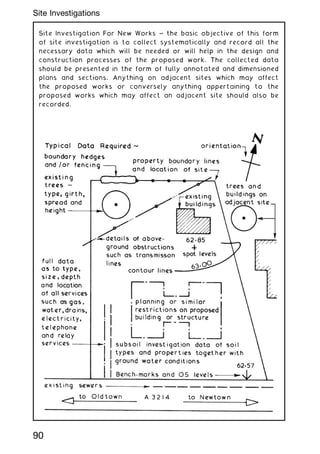
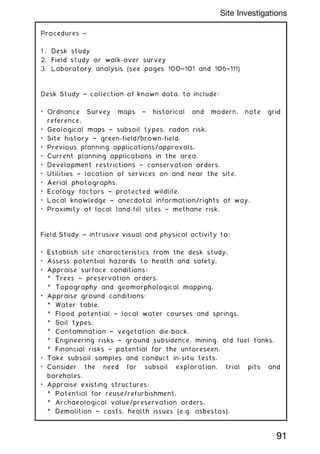
Site investigations 90
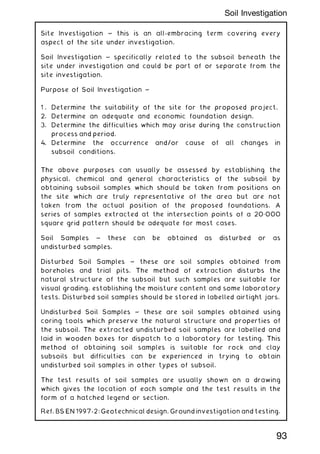
Soil investigation 93
Soil assessment and testing 100
Site layout considerations 112
v
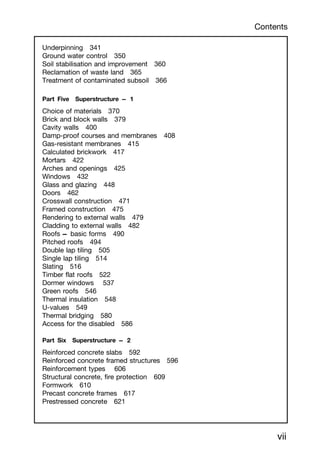
Site security 115
Site lighting and electrical supply 118
Site office accommodation 122
Site health and welfare provision 123
Materials storage 127
Materials testing 132
Timber decay and treatment 147
Protection orders for trees and structures 151
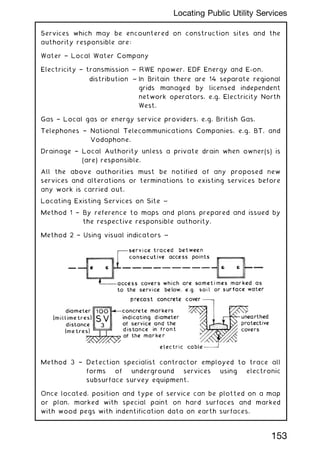
Locating public utility services 153
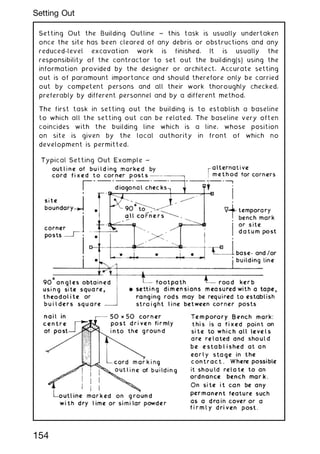
Setting out 154
Levels and angles 159
Road construction 162
Tubular scaffolding and scaffolding systems 172
Shoring systems 186
Demolition 195
Part Three Builders Plant
General considerations 202
Bulldozers 205
Scrapers 206
Graders 207
Tractor shovels 208
Excavators 209
Transport vehicles 214
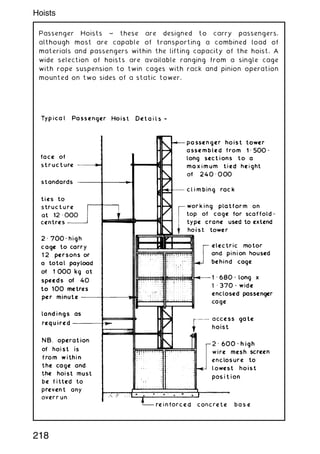
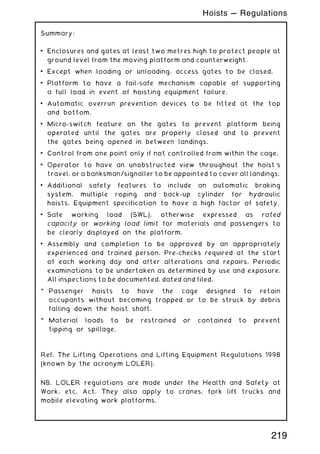
Hoists 217
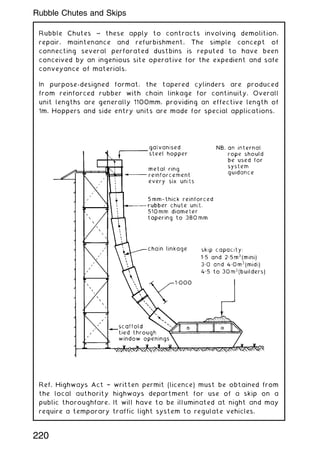
Rubble chutes and skips 220
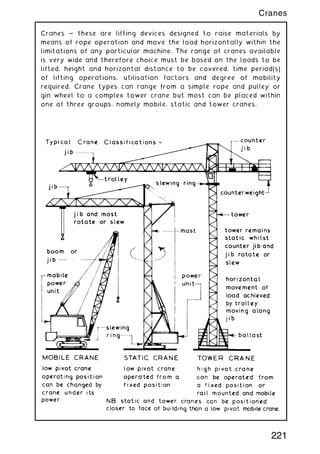
Cranes 221
Concreting plant 233
Part Four Substructure
Foundations -
-- function, materials and sizing 244
Foundation beds 253
Short bored pile foundations 259
Foundation types and selection 261
Piled foundations 266
Retaining walls 287
Gabions and mattresses 301
Basement excavations and construction 304
Waterproofing basements 313
Excavations 319
Concrete production 325
Cofferdams 333
Steel sheet piling 334
Caissons 337
Contents
vi
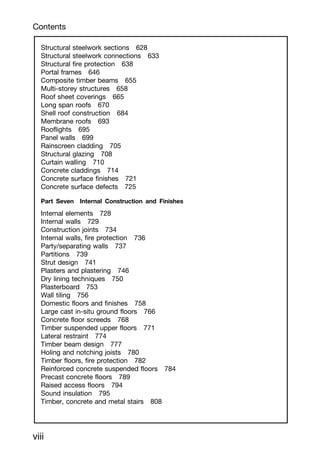
Underpinning 341
Ground water control 350
Soil stabilisation and improvement 360
Reclamation of waste land 365
Treatment of contaminated subsoil 366
Part Five Superstructure † 1
Choice of materials 370
Brick and block walls 379
Cavity walls 400
Damp-proof courses and membranes 408
Gas-resistant membranes 415
Calculated brickwork 417
Mortars 422
Arches and openings 425
Windows 432
Glass and glazing 448
Doors 462
Crosswall construction 471
Framed construction 475
Rendering to external walls 479
Cladding to external walls 482
Roofs † basic forms 490
Pitched roofs 494
Double lap tiling 505
Single lap tiling 514
Slating 516
Timber flat roofs 522
Dormer windows 537
Green roofs 546
Thermal insulation 548
U-values 549
Thermal bridging 580
Access for the disabled 586
Part Six Superstructure † 2
Reinforced concrete slabs 592
Reinforced concrete framed structures 596
Reinforcement types 606
Structural concrete, fire protection 609
Formwork 610
Precast concrete frames 617
Prestressed concrete 621
Contents
vii
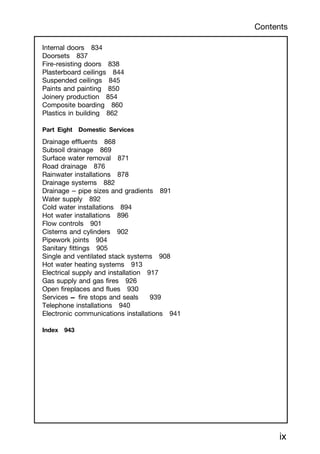
Structural steelwork sections 628
Structural steelwork connections 633
Structural fire protection 638
Portal frames 646
Composite timber beams 655
Multi-storey structures 658
Roof sheet coverings 665
Long span roofs 670
Shell roof construction 684
Membrane roofs 693
Rooflights 695
Panel walls 699
Rainscreen cladding 705
Structural glazing 708
Curtain walling 710
Concrete claddings 714
Concrete surface finishes 721
Concrete surface defects 725
Part Seven Internal Construction and Finishes
Internal elements 728
Internal walls 729
Construction joints 734
Internal walls, fire protection 736
Party/separating walls 737
Partitions 739
Strut design 741
Plasters and plastering 746
Dry lining techniques 750
Plasterboard 753
Wall tiling 756
Domestic floors and finishes 758
Large cast in-situ ground floors 766
Concrete floor screeds 768
Timber suspended upper floors 771
Lateral restraint 774
Timber beam design 777
Holing and notching joists 780
Timber floors, fire protection 782
Reinforced concrete suspended floors 784
Precast concrete floors 789
Raised access floors 794
Sound insulation 795
Timber, concrete and metal stairs 808
Contents
viii
Internal doors 834
Doorsets 837
Fire-resisting doors 838
Plasterboard ceilings 844
Suspended ceilings 845
Paints and painting 850
Joinery production 854
Composite boarding 860
Plastics in building 862
Part Eight Domestic Services
Drainage effluents 868
Subsoil drainage 869
Surface water removal 871
Road drainage 876
Rainwater installations 878
Drainage systems 882
Drainage -
-
- pipe sizes and gradients 891
Water supply 892
Cold water installations 894
Hot water installations 896
Flow controls 901
Cisterns and cylinders 902
Pipework joints 904
Sanitary fittings 905
Single and ventilated stack systems 908
Hot water heating systems 913
Electrical supply and installation 917
Gas supply and gas fires 926
Open fireplaces and flues 930
Services † fire stops and seals 939
Telephone installations 940
Electronic communications installations 941
Index 943
ix
Contents
This page intentionally left blank
PREFACE TO TENTH EDITION
The Building Construction Handbook originated in 1982 as a series of four
“check-books” written and illustrated by Roy Chudley. In 1988 these successful
study guides were consolidated into one volume under the present title. The
format of comprehensive illustrations and support text has been maintained as
revisions and updates are incorporated into new editions. This latest edition
contains a fresh assessment of the practices, procedures, guidance and legislation
appropriate to construction and maintenance of housing and other low-rise
buildings. It also includes applications to medium and larger scale structures
for commercial and industrial purposes.
Much of the work from earlier editions is retained as an important reference,
acknowledging that the industry end product generally has a long life span
representative of high capital investment. Product aftercare in the form of
maintenance, repair, renovation, refurbishment, extensions and alterations can
represent some 50% of the industry turnover, much more when bank lending is
limited for new development. For this purpose, many established and traditional
practices shown in earlier editions are retained. Existing practices also benchmark
development as a basis from which contemporary design and technology evolve.
This is in response to political, social and economic requirements through
legislative directives for environmental issues, energy regulation, fuel
conservation and the need for sustainability in construction.
The content of the book is extensive, although no textbook, not least this
one, could ever incorporate all practices experienced in an industry so diverse
as construction. The content is not exemplar and neither does it attempt to be
prescriptive. It is a perspective of construction principles including guidance to
processes and, where appropriate, associated design. Building is to some extent
determined by availability of materials and skilled operatives; therefore local,
regional and national factors will also be responsible for some variation.
Supplementary study material and detail can be obtained from professional
journals, legislative papers, manufacturers’ product literature, the many cross-
references in the text and attending exhibits and seminars. The most valuable
learning resource is observing and monitoring construction in progress.
RG 2014
xi
This page intentionally left blank
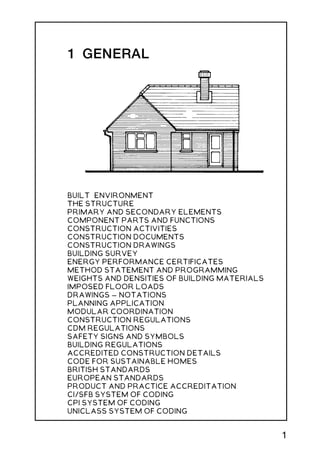
1 GENERAL
BUILT ENVIRONMENT
THE STRUCTURE
PRIMARY AND SECONDARY ELEMENTS
COMPONENT PARTS AND FUNCTIONS
CONSTRUCTION ACTIVITIES
CONSTRUCTION DOCUMENTS
CONSTRUCTION DRAWINGS
BUILDING SURVEY
ENERGY PERFORMANCE CERTIFICATES
METHOD STATEMENT AND PROGRAMMING
WEIGHTS AND DENSITIES OF BUILDING MATERIALS
IMPOSED FLOOR LOADS
DRAWINGS -
-
- NOTATIONS
PLANNING APPLICATION
MODULAR COORDINATION
CONSTRUCTION REGULATIONS
CDM REGULATIONS
SAFETY SIGNS AND SYMBOLS
BUILDING REGULATIONS
ACCREDITED CONSTRUCTION DETAILS
CODE FOR SUSTAINABLE HOMES
BRITISH STANDARDS
EUROPEAN STANDARDS
PRODUCT AND PRACTICE ACCREDITATION
CI/SFB SYSTEM OF CODING
CPI SYSTEM OF CODING
UNICLASS SYSTEM OF CODING
1
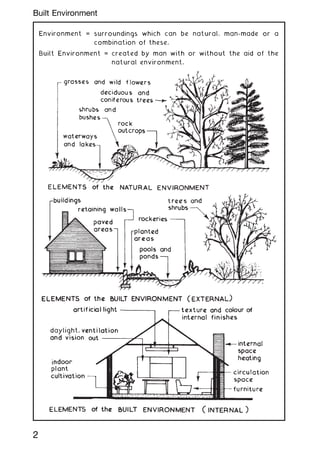
Environment = surroundings which can be natural, man-made or a
combination of these.
Built Environment = created by man with or without the aid of the
natural environment.
daylight,
daylight,
2
Built Environment
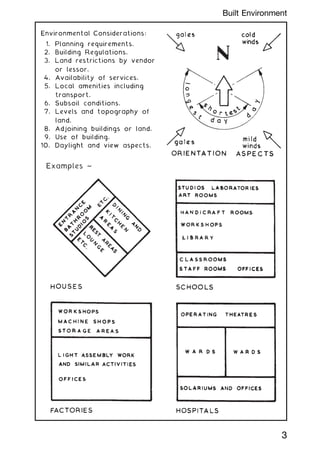
Environmental Considerations:
1. Planning requirements.
2. Building Regulations.
3. Land restrictions by vendor
or lessor.
4. Availability of services.
5. Local amenities including
transport.
6. Subsoil conditions.
7. Levels and topography of
land.
8. Adjoining buildings or land.
9. Use of building.
10. Daylight and view aspects.
Examples ~
3
Built Environment
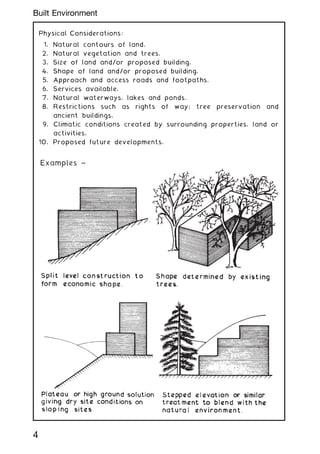
Physical Considerations:
1. Natural contours of land.
2. Natural vegetation and trees.
3. Size of land and/or proposed building.
4. Shape of land and/or proposed building.
5. Approach and access roads and footpaths.
6. Services available.
7. Natural waterways, lakes and ponds.
8. Restrictions such as rights of way; tree preservation and
ancient buildings.
9. Climatic conditions created by surrounding properties, land or
activities.
10. Proposed future developments.
Examples ~
4
Built Environment
5
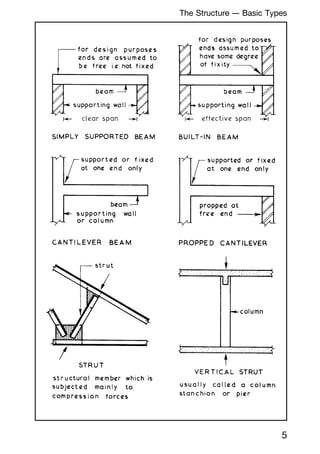
The Structure --- Basic Types
6
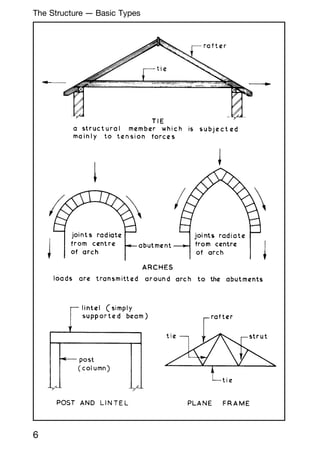
The Structure --- Basic Types
7
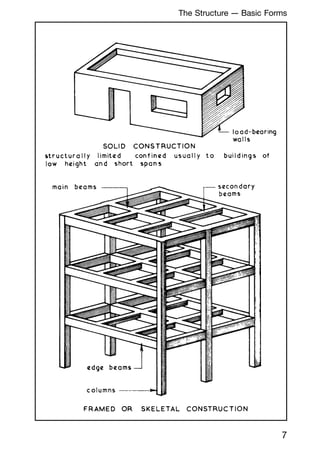
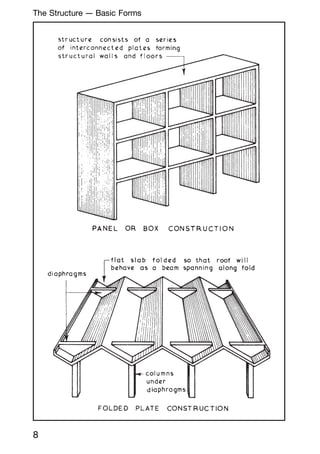
The Structure --- Basic Forms
8
The Structure --- Basic Forms
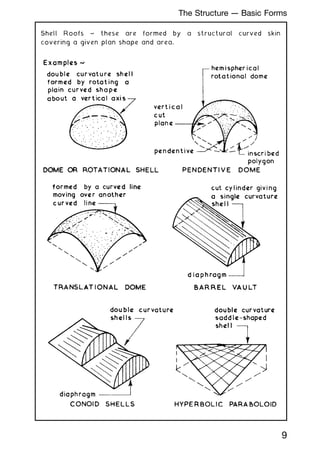
Shell Roofs ~ these are formed by a structural curved skin
covering a given plan shape and area.
9
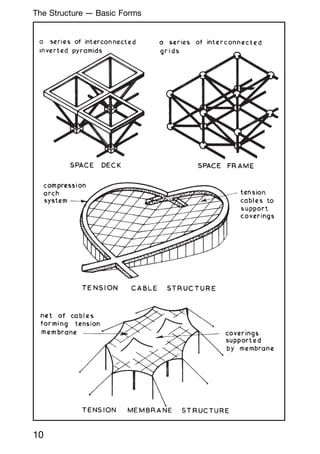
The Structure --- Basic Forms
10
The Structure --- Basic Forms
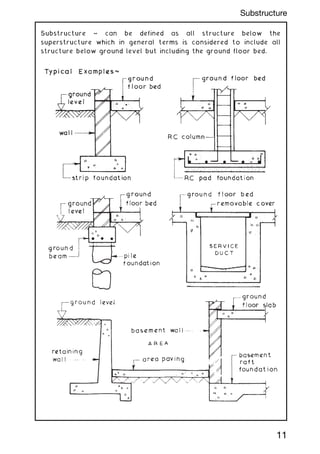
Substructure ~ can be defined as all structure below the
superstructure which in general terms is considered to include all
structure below ground level but including the ground floor bed.
11
Substructure
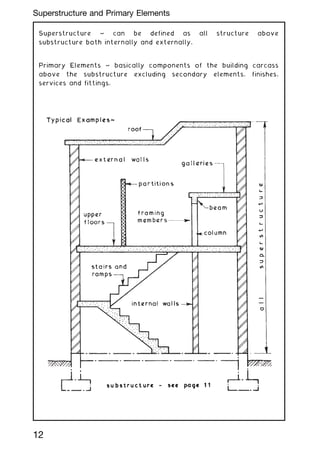
Superstructure ~ can be defined as all structure above
substructure both internally and externally.
Primary Elements ~ basically components of the building carcass
above the substructure excluding secondary elements, finishes,
services and fittings.
12
Superstructure and Primary Elements
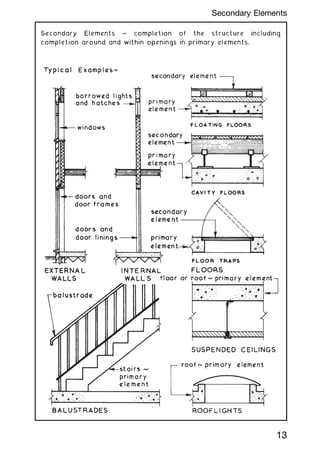
Secondary Elements ~ completion of the structure including
completion around and within openings in primary elements.
13
Secondary Elements
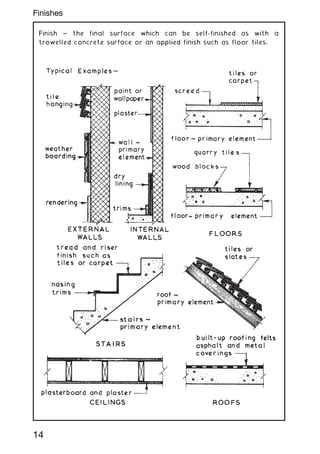
Finish ~ the final surface which can be self-finished as with a
trowelled concrete surface or an applied finish such as floor tiles.
14
Finishes
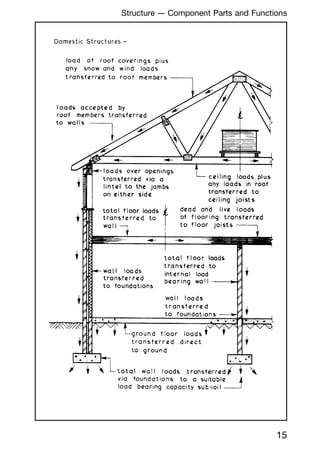
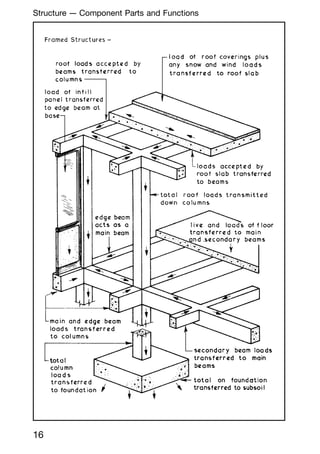
15
Structure --- Component Parts and Functions
16
Structure --- Component Parts and Functions
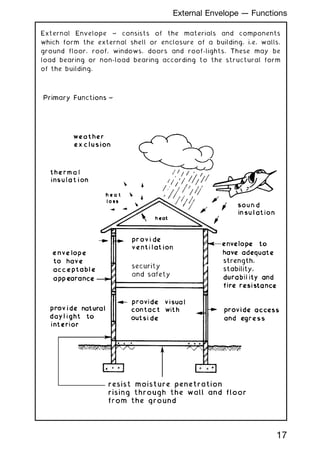
External Envelope ~ consists of the materials and components
which form the external shell or enclosure of a building, i.e. walls,
ground floor, roof, windows, doors and roof-lights. These may be
load bearing or non-load bearing according to the structural form
of the building.
17
External Envelope --- Functions
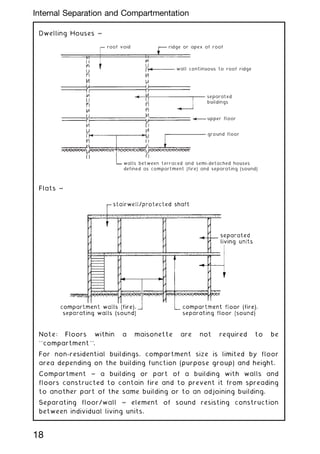
Dwelling Houses ~
Flats ~
Note: Floors within a maisonette are not required to be
``compartment''.
For non-residential buildings, compartment size is limited by floor
area depending on the building function (purpose group) and height.
Compartment ~ a building or part of a building with walls and
floors constructed to contain fire and to prevent it from spreading
to another part of the same building or to an adjoining building.
Separating floor/wall ~ element of sound resisting construction
between individual living units.
18
Internal Separation and Compartmentation
ridge or opex of roof
all continuous to roof ridge
eparated
buildings
upper floor
ground floor
terraced and semi-detached houses
defined as compartment (fire) and separating (sound)
upper floor
all continuous
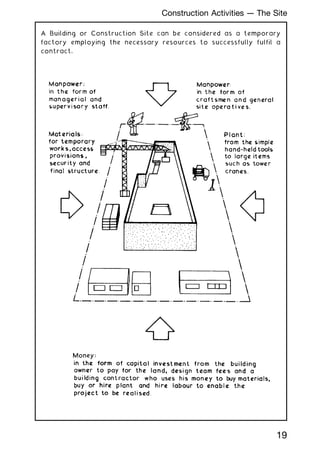
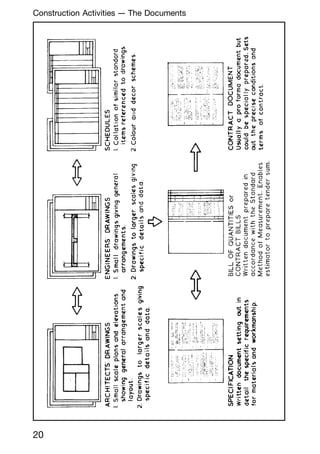
A Building or Construction Site can be considered as a temporary
factory employing the necessary resources to successfully fulfil a
contract.
19
Construction Activities --- The Site
20
Construction Activities --- The Documents
Location Drawings ~
Site Plans † used to locate site,
buildings, define site levels, indicate
services to buildings, identify parts of
site such as roads, footpaths and
boundaries and to give setting-out
dimensions for the site and buildings as
a whole. Suitable scale not less than
1 : 2500
Floor Plans † used to identify and set
out parts of the building such as rooms,
corridors, doors, windows, etc. Suitable
scale not less than 1 : 100
Elevations † used to show external
appearance of all faces and to identify
doors and windows. Suitable scale not
less than 1 : 100
Sections † used to provide vertical
views through the building to show
method of construction. Suitable scale
not less than 1 : 50
Component Drawings † used to identify
and supply data for components to be
supplied by a manufacturer or for
components not completely covered by
assembly drawings. Suitable scale range
1 : 100 to 1 : 1
Assembly Drawings † used to show how
items fit together or are assembled to
form elements. Suitable scale range
1 : 20 to 1 : 5
All drawings should be fully annotated,
fully dimensioned and cross-referenced.
Ref. BS EN ISO 7519: Technical drawings. Construction drawings.
General principles of presentation for general arrangement and
assembly drawings.
21
Drawings Used in the Construction Process
Sketch ~ this can be defined as a draft or rough outline of an idea;
it can be a means of depicting a three-dimensional form in a
two-dimensional guise. Sketches can be produced free-hand or using
rules and set squares to give basic guidelines.
All sketches should be clear, show all the necessary detail and
above all be in the correct proportions.
Sketches can be drawn by observing a solid object or they can be
produced from conventional orthographic views but in all cases can
usually be successfully drawn by starting with an outline `box'
format giving length, width and height proportions and then building
up the sketch within the outline box.
22
Drawings --- Sketches
23
Communicating Information --- Orthographic Projections
Isometric Projections ~ a pictorial projection of a solid object on a
plane surface drawn so that all vertical lines remain vertical and of
true scale length, all horizontal lines are drawn at an angle of 30
and are of true scale length; therefore scale measurements can be
taken on the vertical and 30 lines but cannot be taken on any
other inclined line.
A similar drawing can be produced using an angle of 45 for all
horizontal lines and is called an Axonometric Projection.
ISOMETRIC PROJECTION SHOWING SOUTH AND WEST ELEVATIONS
OF SMALL GARAGE AND WORKSHOP ILLUSTRATED ON PAGE 23
24
Communicating Information --- Isometric Projections
25
Communicating Information --- Perspective Projections
26
Communicating Information --- Floor Plans and Elevations
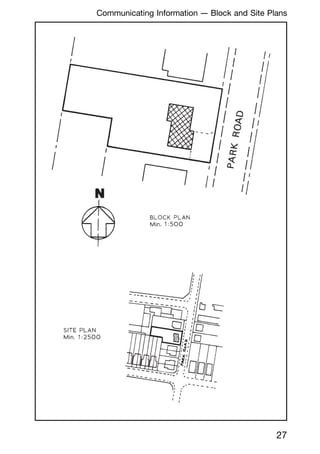
1:2500
1: 500
27
Communicating Information --- Block and Site Plans
Construction Defects † correct application of materials produced
to the recommendations of British, European and International
Standards authorities, in accordance with local building regulations,
bye-laws and the rules of building guarantee companies, i.e.
National House Building Council (NHBC) and MD Insurance Services,
should ensure a sound and functional structure. However, these
controls can be seriously undermined if the human factor of quality
workmanship is not fulfilled. The following guidance is designed to
promote quality controls:
BS 8000: Workmanship on building sites.
Building Regulations, Approved Document to support Regulation 7
† materials and workmanship.
No matter how good the materials, the workmanship and
supervision, the unforeseen may still affect a building. This may
materialise several years after construction. Some examples of
these latent defects include: woodworm emerging from untreated
timber, electrolytic decomposition of dissimilar metals inadvertently
in contact, and chemical decomposition of concrete. Generally, the
older a building the more opportunity there is for its components
and systems to have deteriorated and malfunctioned. Hence the
need for regular inspection and maintenance. The profession of
facilities management has evolved for this purpose and is
represented by the British Institute of Facilities Management (BIFM).
Property values, repairs and replacements are of sufficient
magnitude for potential purchasers to engage the professional
services of a building surveyor. Surveyors are usually members of
the Royal Institution of Chartered Surveyors (RICS). The extent of
survey can vary, depending on a client's requirements. This may be
no more than a market valuation to secure financial backing, to a
full structural survey incorporating specialist reports on electrical
installations, drains, heating systems, etc.
Further reading:
BRE Digest No. 268 † Common defects in low-rise traditional
housing. Available from Building Research Establishment Bookshop †
www.brebookshop.com.
28
Communicating Information --- Building Survey
Established Procedure † the interested purchaser engages a building
surveyor.
UK Government Requirements † the seller to provide an energy
performance certificate. This is a fuel use and efficiency appraisal
on a numerical scale. See pages 32 and 33.
Survey document preliminaries:
* Title and address of property
* Client's name, address and contacts
* Survey date and time
* Property status † freehold, leasehold or commonhold
* Occupancy † occupied or vacant. If vacant, source of keys
* Extent of survey, e.g. full structural + services reports
* Specialists in attendance, e.g. electrician, heating engineer, etc.
* Age of property (approx. if very dated or no records)
* Disposition of rooms, i.e. number of bedrooms, etc.
* Floor plans and elevations if available
* Elevation (flooding potential) and orientation (solar effect)
* Estate/garden area and disposition if appropriate
* Means of access † roads, pedestrian only, rights of way
Survey tools and equipment:
* Drawings + estate agent's particulars if available
* Notebook and pencil/pen
* Binoculars and a camera with flash facility
* Tape measure, spirit level and plumb line
* Other useful tools, to include small hammer, torch, screwdriver
and manhole lifting irons
* Moisture meter
* Ladders † eaves access and loft access
* Sealable bags for taking samples, e.g. wood rot, asbestos, etc.
29
Communicating Information --- Survey Preliminaries
Estate and garden:
* Location and establishment of boundaries
* Fences, gates and hedges † material, condition and suitability
* Trees † type and height, proximity to building
* Pathways and drives † material and condition
* Outbuildings † garages, sheds, greenhouses, barns, etc.
* Proximity of water courses
Roof:
* Tile type, treatment at ridge, hips, verge and valleys
* Age of covering, repairs, replacements, renewals, general
condition, defects and growths
* Eaves finish, type and condition
* Gutters † material, size, condition, evidence of leakage
* Rainwater downpipes as above
* Chimney † dpcs, flashings, flaunching, pointing, signs of
movement
* Flat roofs † materials, repairs, abutments, flashings and drainage
Walls:
* Materials † type of brick, rendering, cladding, etc., condition
and evidence of repairs
* Solid or cavity construction, if cavity extent of insulation and type
* Pointing of masonry, painting of rendering and cladding
* Air brick location, function and suitability
* Dpc, material and condition, position relative to ground level
* Windows and doors, material, signs of rot or damage, original
or replacement, frame seal
* Settlement † signs of cracking, distortion of window and door
frames † specialist report
Drainage:
A building surveyor may provide a general report on the condition of the
drainage and sanitation installation. However, a full test for leakage
and determination of self-cleansing and flow conditions to include fibre-
optic scope examination is undertaken as a specialist survey.
30
Communicating Information --- Survey Order (Exterior)
Roof space:
* Access to all parts, construction type † traditional or trussed
* Evidence of moisture due to condensation † ventilation at
eaves, ridge, etc.
* Evidence of water penetration † chimney flashings, abutments
and valleys
* Insulation † type and quantity
* Party wall in semi-detached and terraced dwellings † suitability
as fire barrier
* Plumbing † adequacy of storage cistern, insulation, overflow
function
Floors:
* Construction † timber, precast or cast in-situ concrete? Finish
condition?
* Timber ground floor † evidence of dampness, rot, woodworm,
ventilation, dpcs
* Timber upper floor stability, i.e. wall fixing, strutting, joist size,
woodworm, span and loading
Stairs:
* Type of construction and method of fixing † built in-situ or
preformed
* Soffit, re. fire protection (plasterboard?)
* Balustrading † suitability and stability
* Safety † adequate screening, balusters, handrail, pitch angle,
open tread, tread wear
Finishes:
* General décor, i.e. paint and wallpaper condition † damaged, faded
* Woodwork/joinery † condition, defects, damage, paintwork
* Plaster † ceiling (plasterboard or lath and plaster?) † condition
and stability
* Plaster † walls † render and plaster or plasterboard, damage
and quality of finish
* Staining † plumbing leaks (ceiling), moisture penetration (wall
openings), rising damp
* Fittings and ironmongery † adequacy and function, weather
exclusion and security
Supplementary enquiries should determine the extent of additional
building work, particularly since the planning threshold of 1948.
Check for planning approvals, permitted development and Building
Regulation approvals, exemptions and completion certificates.
Services † apart from a cursory inspection to ascertain location
and suitability of system controls, these areas are highly
specialised and should be surveyed by those appropriately qualified.
31
Communicating Information --- Survey Order (Interior)
Energy Performance Certificate (EPC) applications include:
• Construction of new buildings.
• Extensions to existing buildings.
• Alterations to existing buildings to provide an increase or a
reduction in the number of separate occupancies, e.g. a house
conversion into flats or vice versa.
• Refurbishment or modification to include provision or extension
of fixed energy consuming building services for hot water, heating,
air conditioning or mechanical ventilation (applies to buildings with
a floor area exceeding 1000 m2
but can also be required for
smaller buildings depending on specification of installation).
• Part of the marketing particulars when selling or letting a new
or existing property.
The above applications relate quite simply to buildings that are
roofed, have enclosing walls and use energy consuming appliances
to condition the internal space. Some building types are exempted
an EPC, these include the following:
• Buildings listed under the Planning (Listed Buildings and
Conservation Areas) Act.*
• Buildings within a conservation area as determined under
Section 69 of the Act.*
• Structures included in the monuments schedule under Section 1
of the Ancient Monuments and Archaeological Areas Act.*
• Churches and other buildings designated primarily for worship.
• Temporary buildings with less than two years' expected use.
• Industrial buildings, workshops and non-residential agricultural
buildings/barns with low demands on energy.
• Detached buildings other than dwellings with usable floor area
of less than 50 m2
.
* The objective is to preserve the character and appearance of
specific buildings that would otherwise be altered or spoilt by
applying contemporary energy efficiency requirements.
Ref. The Energy Performance of Buildings (Certificates and
Inspections) (England and Wales) Regulations.
32
Communicating Information -- Energy Performance Certificate
An Energy Performance Certificate (EPC) provides a rating for fuel
use efficiency in a building. This rating relates to the amount of
carbon dioxide (CO2) emitted by the energy producing appliances.
Asset rating ~ an estimate of the fuel energy required to meet the
needs of a building during normal occupancy. A performance rating
based on a building's age, location/exposure, size, glazing system,
materials, insulation, general condition, fuel use controls and fixed
appliance efficiency, e.g. boiler (SEDBUK rating see page 562).
Rating is alphabetical from A to G, A the highest grade for energy
efficiency with lowest impact on environmental damage in terms of
CO2 emissions. An EU-type energy rating label is part of the
certification documents. It is similar to the example shown on page
566 as applied to windows. The alphabetic rating relates directly
to SAP numerical ratings (see page 559) as follows:
EPC asset rating (SAP rating) ~
Operational rating ~ an alternative to asset rating, using the
numerical scale for energy consumed over a period of time. This
could be presented monthly or seasonally to indicate varying demands.
CO2 emission rate calculations for new-build and refurbishment work ~
Before work commences the local building control authority (LA) to
be provided with the following for approval:
Target CO2 emission rate by calculation (TER).
Dwelling CO2 emission rate by calculation and design (DER).
Building design specification relative to calculated CO2
emissions.
After (within five days of completion), LA to be provided with
certification confirming:
Target CO2 emissions.
Calculated CO2 emissions as constructed.
Confirmation that the building design specification is adhered to.
If not, details of variations to be provided.
Note: TER and DER energy performance requirements are expressed
in mass of CO2 in units of kg per m2
floor area per year. See also
pages 567 and 568.
A (92  100) B (81  91) C (69  80) D (55  68)
E (39  54) F (21  38) G (1  20)
33
Communicating Information --- EPC Rating
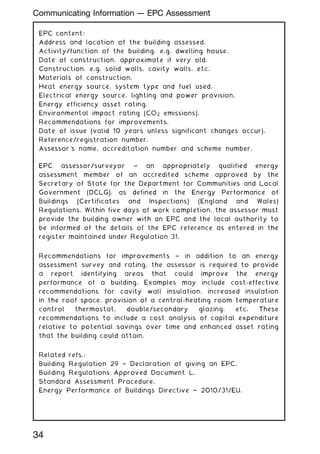
EPC content:
Address and location of the building assessed.
Activity/function of the building, e.g. dwelling house.
Date of construction, approximate if very old.
Construction, e.g. solid walls, cavity walls, etc.
Materials of construction.
Heat energy source, system type and fuel used.
Electrical energy source, lighting and power provision.
Energy efficiency asset rating.
Environmental impact rating (CO2 emissions).
Recommendations for improvements.
Date of issue (valid 10 years unless significant changes occur).
Reference/registration number.
Assessor's name, accreditation number and scheme number.
EPC assessor/surveyor ~ an appropriately qualified energy
assessment member of an accredited scheme approved by the
Secretary of State for the Department for Communities and Local
Government (DCLG), as defined in the Energy Performance of
Buildings (Certificates and Inspections) (England and Wales)
Regulations. Within five days of work completion, the assessor must
provide the building owner with an EPC and the local authority to
be informed of the details of the EPC reference as entered in the
register maintained under Regulation 31.
Recommendations for improvements ~ in addition to an energy
assessment survey and rating, the assessor is required to provide
a report identifying areas that could improve the energy
performance of a building. Examples may include cost-effective
recommendations for cavity wall insulation, increased insulation
in the roof space, provision of a central-heating room temperature
control thermostat, double/secondary glazing, etc. These
recommendations to include a cost analysis of capital expenditure
relative to potential savings over time and enhanced asset rating
that the building could attain.
Related refs.:
Building Regulation 29 † Declaration of giving an EPC.
Building Regulations Approved Document L.
Standard Assessment Procedure.
Energy Performance of Buildings Directive † 2010/31/EU.
34
Communicating Information --- EPC Assessment
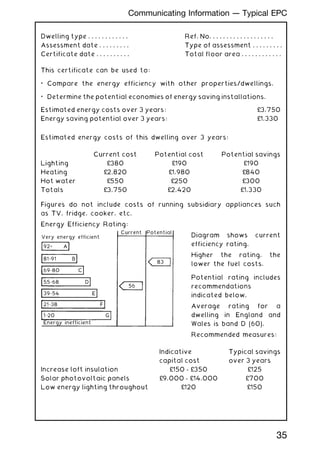
This certificate can be used to:
• Compare the energy efficiency with other properties/dwellings.
• Determine the potential economies of energy saving installations.
Estimated energy costs over 3 years: £3,750
Energy saving potential over 3 years: £1,330
Estimated energy costs of this dwelling over 3 years:
Current cost Potential cost Potential savings
Lighting £380 £190 £190
Heating £2,820 £1,980 £840
Hot water £550 £250 £300
Totals £3,750 £2,420 £1,330
Figures do not include costs of running subsidiary appliances such
as TV, fridge, cooker, etc.
Energy Efficiency Rating:
Diagram shows current
efficiency rating.
Higher the rating, the
lower the fuel costs.
Potential rating includes
recommendations
indicated below.
Average rating for a
dwelling in England and
Wales is band D (60).
Recommended measures:
Indicative
capital cost
Typical savings
over 3 years
Increase loft insulation £150 - £350 £125
Solar photovoltaic panels £9,000 - £14,000 £700
Low energy lighting throughout £120 £150
Dwelling type . . . . . . . . . . . . Ref. No. . . . . . . . . . . . . . . . . . .
Assessment date . . . . . . . . . Type of assessment . . . . . . . . .
Certificate date . . . . . . . . . . Total floor area . . . . . . . . . . . .
Current Potential
83
56
Very energy efficient
92+ A
81−91 B
69−80 C
55−68 D
39−54 E
21−38 F
1−20
Energy inefficient
G
35
Communicating Information --- Typical EPC
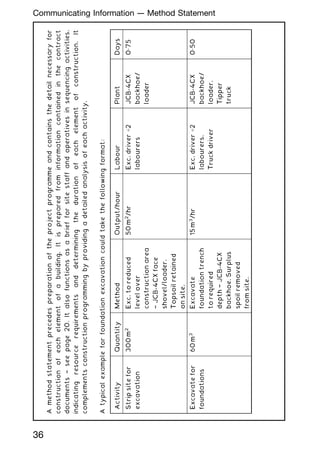
A
method
statement
precedes
preparation
of
the
project
programme
and
contains
the
detail
necessary
for
construction
of
each
element
of
a
building.
It
is
prepared
from
information
contained
in
the
contract
documents
†
see
page
20.
It
also
functions
as
a
brief
for
site
staff
and
operatives
in
sequencing
activities,
indicating
resource
requirements
and
determining
the
duration
of
each
element
of
construction.
It
complements
construction
programming
by
providing
a
detailed
analysis
of
each
activity.
A
typical
example
for
foundation
excavation
could
take
the
following
format:
Activity
Quantity
Method
Output/hour
Labour
Plant
Days
Strip
site
for
excavation
300
m
2
Exc.
to
reduced
level
over
construction
area
†
JCB-4CX
face
shovel/loader.
Topsoil
retained
on
site.
50
m
2
/hr
Exc.
driver
þ2
labourers
JCB-4CX
backhoe/
loader
0„75
Excavate
for
foundations
60
m
3
Excavate
foundation
trench
to
required
depth
†
JCB-4CX
backhoe.
Surplus
spoil
removed
from
site.
15
m
3
/hr
Exc.
driver
þ2
labourers.
Truck
driver
JCB-4CX
backhoe/
loader.
Tipper
truck
0„50
36
Communicating Information --- Method Statement
37
Communicating Information --- Bar Chart Programme
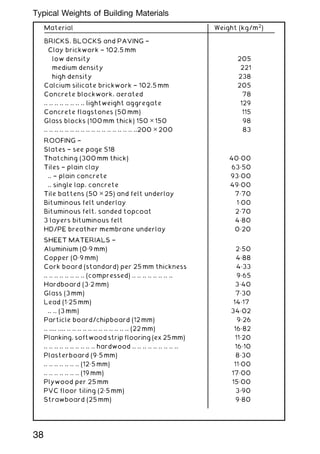
Material Weight (kg/m2
)
BRICKS, BLOCKS and PAVING †
Clay brickwork † 102.5 mm
low density 205
medium density 221
high density 238
Calcium silicate brickwork † 102.5 mm 205
Concrete blockwork, aerated 78
.. .. .. .. .. .. .. .. lightweight aggregate 129
Concrete flagstones (50 mm) 115
Glass blocks (100 mm thick) 150 ✕ 150 98
.. .. .. .. .. .. .. .. .. .. .. .. .. .. .. .. .. ..200 ✕ 200 83
ROOFING †
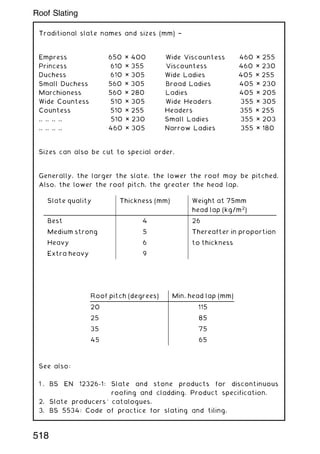
Slates † see page 518
Thatching (300 mm thick) 40„00
Tiles † plain clay 63„50
.. † plain concrete 93„00
.. single lap, concrete 49„00
Tile battens (50 ✕ 25) and felt underlay 7„70
Bituminous felt underlay 1„00
Bituminous felt, sanded topcoat 2„70
3 layers bituminous felt 4„80
HD/PE breather membrane underlay 0„20
SHEET MATERIALS †
Aluminium (0„9 mm) 2„50
Copper (0„9 mm) 4„88
Cork board (standard) per 25 mm thickness 4„33
.. .. .. .. .. .. .. .. (compressed) .. .. .. .. .. .. .. .. 9„65
Hardboard (3„2 mm) 3„40
Glass (3 mm) 7„30
Lead (1„25 mm) 14„17
.. .. (3 mm) 34„02
Particle board/chipboard (12 mm) 9„26
.. .... .... .. .. .. .. .. .. .. .. .. .. .. .. (22 mm) 16„82
Planking, softwood strip flooring (ex 25mm) 11„20
.. .. .. .. .. .. .. .. .. .. hardwood .. .. .. .. .. .. .. .. .. 16„10
Plasterboard (9„5 mm) 8„30
.. .. .. .. .. .. .. (12„5 mm) 11„00
.. .. .. .. .. .. .. (19 mm) 17„00
Plywood per 25 mm 15„00
PVC floor tiling (2„5 mm) 3„90
Strawboard (25 mm) 9„80
38
Typical Weights of Building Materials
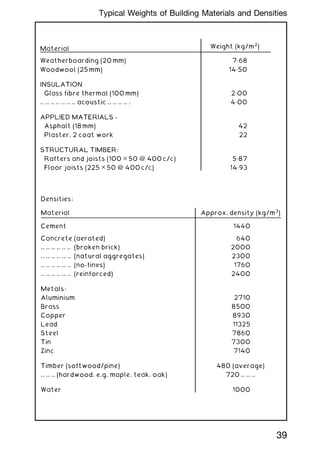
Densities:
Material Approx. density (kg/m3
)
Cement 1440
Concrete (aerated) 640
.. .. .. .. .. .. (broken brick) 2000
.. .. .. .. .. .. (natural aggregates) 2300
.. .. .. .. .. .. (no-fines) 1760
.. .. .. .. .. .. (reinforced) 2400
Metals:
Aluminium 2710
Brass 8500
Copper 8930
Lead 11325
Steel 7860
Tin 7300
Zinc 7140
Timber (softwood/pine) 480 (average)
.. .. .. (hardwood, e.g. maple, teak, oak) 720 .. .. ..
Water 1000
Material Weight (kg/m2
)
Weatherboarding (20 mm) 7„68
Woodwool (25 mm) 14„50
INSULATION
Glass fibre thermal (100 mm) 2„00
.. .. .. .. .. .. .. acoustic .. .. .. .. . 4„00
APPLIED MATERIALS -
Asphalt (18 mm) 42
Plaster, 2 coat work 22
STRUCTURAL TIMBER:
Rafters and joists (100 ✕ 50 @ 400 c/c) 5„87
Floor joists (225 ✕ 50 @ 400 c/c) 14„93
39
Typical Weights of Building Materials and Densities
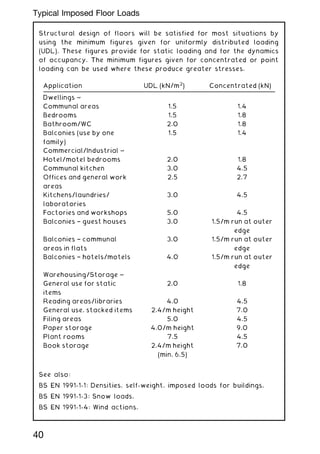
Structural design of floors will be satisfied for most situations by
using the minimum figures given for uniformly distributed loading
(UDL). These figures provide for static loading and for the dynamics
of occupancy. The minimum figures given for concentrated or point
loading can be used where these produce greater stresses.
See also:
BS EN 1991-1-1: Densities, self-weight, imposed loads for buildings.
BS EN 1991-1-3: Snow loads.
BS EN 1991-1-4: Wind actions.
Application UDL (kN/m2
) Concentrated (kN)
Dwellings ~
Communal areas 1.5 1.4
Bedrooms 1.5 1.8
Bathroom/WC 2.0 1.8
Balconies (use by one
family)
1.5 1.4
Commercial/Industrial ~
Hotel/motel bedrooms 2.0 1.8
Communal kitchen 3.0 4.5
Offices and general work
areas
2.5 2.7
Kitchens/laundries/
laboratories
3.0 4.5
Factories and workshops 5.0 4.5
Balconies † guest houses 3.0 1.5/m run at outer
edge
Balconies † communal
areas in flats
3.0 1.5/m run at outer
edge
Balconies † hotels/motels 4.0 1.5/m run at outer
edge
Warehousing/Storage ~
General use for static
items
2.0 1.8
Reading areas/libraries 4.0 4.5
General use, stacked items 2.4/m height 7.0
Filing areas 5.0 4.5
Paper storage 4.0/m height 9.0
Plant rooms 7.5 4.5
Book storage 2.4/m height
(min. 6.5)
7.0
40
Typical Imposed Floor Loads
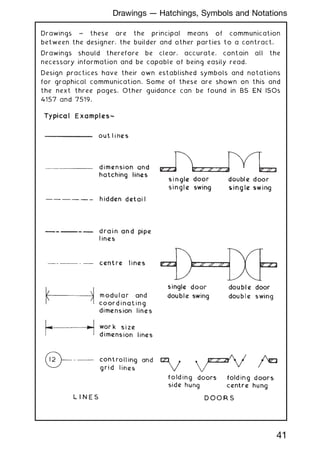
Drawings ~ these are the principal means of communication
between the designer, the builder and other parties to a contract.
Drawings should therefore be clear, accurate, contain all the
necessary information and be capable of being easily read.
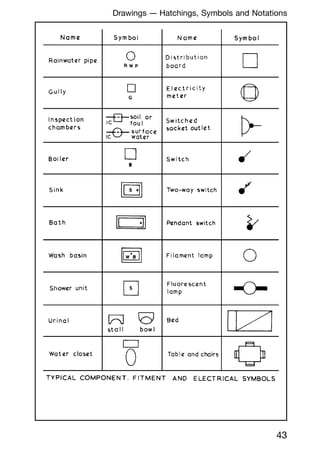
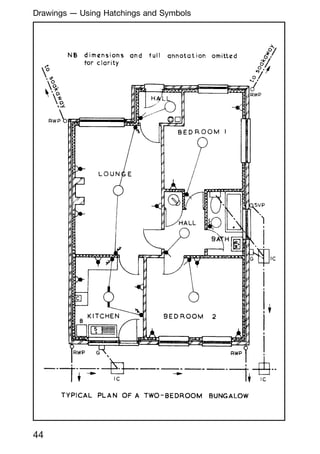
Design practices have their own established symbols and notations
for graphical communication. Some of these are shown on this and
the next three pages. Other guidance can be found in BS EN ISOs
4157 and 7519.
41
Drawings --- Hatchings, Symbols and Notations
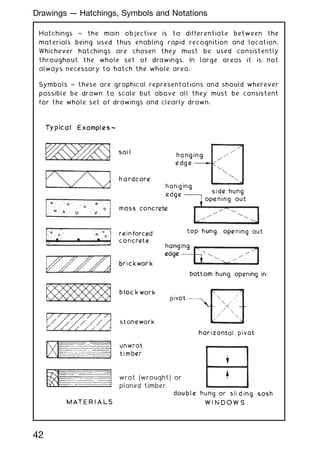
Hatchings ~ the main objective is to differentiate between the
materials being used thus enabling rapid recognition and location.
Whichever hatchings are chosen they must be used consistently
throughout the whole set of drawings. In large areas it is not
always necessary to hatch the whole area.
Symbols ~ these are graphical representations and should wherever
possible be drawn to scale but above all they must be consistent
for the whole set of drawings and clearly drawn.
wrot (wrought) or
planed timber
42
Drawings --- Hatchings, Symbols and Notations
43
Drawings --- Hatchings, Symbols and Notations
44
Drawings --- Using Hatchings and Symbols
Principal legislation ~
Town  Country Planning Act 1990 and Planning Act 2008 † Effect
control over volume of development, appearance and layout of buildings.
Public Health Acts 1936 to 1961 † Limit development with regard to
emission of noise, pollution and public nuisance.
Highways Act 1980 † Determines layout and construction of roads
and pavements.
Building Act 1984 † Effects the Building Regulations 2010, which
enforce minimum material and design standards.
Civic Amenities Act 1967 † Establishes conservation areas,
providing local authorities with greater control of development.
Town and Country Amenities Act 1974 † Local authorities
empowered to prevent demolition of buildings and tree felling.
Procedure ~
Outline Planning Application † This is necessary for permission to
develop a proposed site. The application should contain:
An application form describing the work.
A site plan showing adjacent roads and buildings (1 : 2500).
A block plan showing the plot, access and siting (1 : 500).
A certificate of land ownership.
Detail or Full Planning Application † This follows outline permission
and is also used for proposed alterations to existing buildings.
It should contain: details of the proposal, to include trees,
materials, drainage and any demolition.
Site and block plans (as above). A certificate of land ownership.
Building drawings showing elevations, sections, plans, material
specifications, access, landscaping, boundaries and relationship with
adjacent properties (1 : 100).
Permitted Developments † House extensions may be exempt from formal
application. Conditions vary depending on house position relative to its
plot and whether detached or attached. See next two pages.
Note: Most developments are subject to Building Regulation
approval. Some exemptions are shown on page 69.
Certificates of ownership † Article 7 of the Town  Country
Planning (General Development Procedure) Order 1995:
Cert. A † States the applicant is sole site freeholder (page 51).
Cert. B † States the applicant is part freeholder or prospective
purchaser and all owners of the site know of the application (page 51).
Cert. C † As Cert. B, but the applicant is only able to ascertain
some of the other landowners.
Cert. D † As Cert. B, but the applicant cannot ascertain any
owners of the site other than him/herself.
45
Planning Application
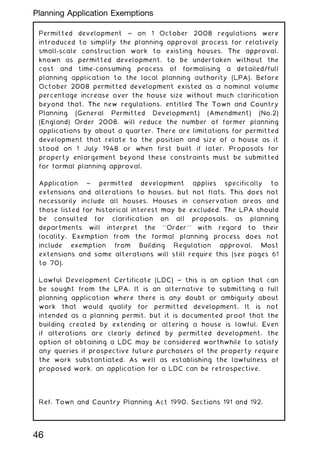
Permitted development ~ on 1 October 2008 regulations were
introduced to simplify the planning approval process for relatively
small-scale construction work to existing houses. The approval,
known as permitted development, to be undertaken without the
cost and time-consuming process of formalising a detailed/full
planning application to the local planning authority (LPA). Before
October 2008 permitted development existed as a nominal volume
percentage increase over the house size without much clarification
beyond that. The new regulations, entitled The Town and Country
Planning (General Permitted Development) (Amendment) (No.2)
(England) Order 2008, will reduce the number of former planning
applications by about a quarter. There are limitations for permitted
development that relate to the position and size of a house as it
stood on 1 July 1948 or when first built if later. Proposals for
property enlargement beyond these constraints must be submitted
for formal planning approval.
Application ~ permitted development applies specifically to
extensions and alterations to houses, but not flats. This does not
necessarily include all houses. Houses in conservation areas and
those listed for historical interest may be excluded. The LPA should
be consulted for clarification on all proposals, as planning
departments will interpret the ``Order'' with regard to their
locality. Exemption from the formal planning process does not
include exemption from Building Regulation approval. Most
extensions and some alterations will still require this (see pages 61
to 70).
Lawful Development Certificate (LDC) ~ this is an option that can
be sought from the LPA. It is an alternative to submitting a full
planning application where there is any doubt or ambiguity about
work that would qualify for permitted development. It is not
intended as a planning permit, but it is documented proof that the
building created by extending or altering a house is lawful. Even
if alterations are clearly defined by permitted development, the
option of obtaining a LDC may be considered worthwhile to satisfy
any queries if prospective future purchasers of the property require
the work substantiated. As well as establishing the lawfulness of
proposed work, an application for a LDC can be retrospective.
Ref. Town and Country Planning Act 1990, Sections 191 and 192.
46
Planning Application Exemptions
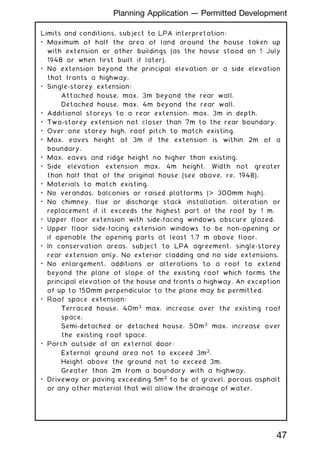
Limits and conditions, subject to LPA interpretation:
• Maximum of half the area of land around the house taken up
with extension or other buildings (as the house stood on 1 July
1948 or when first built if later).
• No extension beyond the principal elevation or a side elevation
that fronts a highway.
• Single-storey extension:
Attached house, max. 3m beyond the rear wall.
Detached house, max. 4m beyond the rear wall.
• Additional storeys to a rear extension, max. 3m in depth.
• Two-storey extension not closer than 7m to the rear boundary.
• Over one storey high, roof pitch to match existing.
• Max. eaves height of 3m if the extension is within 2m of a
boundary.
• Max. eaves and ridge height no higher than existing.
• Side elevation extension max. 4m height. Width not greater
than half that of the original house (see above, re. 1948).
• Materials to match existing.
• No verandas, balconies or raised platforms ( 300mm high).
• No chimney, flue or discharge stack installation, alteration or
replacement if it exceeds the highest part of the roof by 1 m.
• Upper floor extension with side-facing windows obscure glazed.
• Upper floor side-facing extension windows to be non-opening or
if openable the opening parts at least 1.7 m above floor.
• In conservation areas, subject to LPA agreement, single-storey
rear extension only. No exterior cladding and no side extensions.
• No enlargement, additions or alterations to a roof to extend
beyond the plane of slope of the existing roof which forms the
principal elevation of the house and fronts a highway. An exception
of up to 150mm perpendicular to the plane may be permitted.
• Roof space extension:
Terraced house, 40m3
max. increase over the existing roof
space.
Semi-detached or detached house, 50m3
max. increase over
the existing roof space.
• Porch outside of an external door:
External ground area not to exceed 3m2
.
Height above the ground not to exceed 3m.
Greater than 2m from a boundary with a highway.
• Driveway or paving exceeding 5m2
to be of gravel, porous asphalt
or any other material that will allow the drainage of water.
47
Planning Application --- Permitted Development
48
Planning Application --- Householder
49
Planning Application --- New Build (1)
Use this form to apply for Planning Permission for:-
Outline Permission
Full Permission
Approval of Reserved Matters
Renewal of Temporary Permission
Change of Use
I. NAME AND ADDRESS OF APPLICANT
Post Code
Day Tel. No. _ Fax No.
Email:
3. ADDRESS OR LOCATION OF LAND TO
WHICH APPLICATION RELATES
State Site Area Hectares
This must be shown edged in Red on the site plan
Please return:-
*6 copics of thc Form
*6 copies of the Plans
*a Certificate under
Article 7
*the correct fee
DATE RECEIVED
DATE VALID
2. NAME AND ADDRESS OF AGENT (If Used)
Post Code
Tel. No. Fax No.
Email:
4. OWNERSHIP
Please indicate applicants interest in the properly and
complete the appropriate Certificate under Article 7.
Freeholder
Leaseholder
Other
Purchaser
Any adjoining land owned or controlled and not part
of application must be edged Blue on the site plan
5. WHAT ARE YOt: APPLYING FOR? Please tick one box and then answer relevant questions.
Outline Planning Permission Which of the following are to be considered'
Siting Design Appearance Access Landscaping
Full Planning Permission/Change of Use
Approval of Reserved Matters following Outline Permission.
OjP No. Date No. of Condition this application refers to:
Continuance of Usc without complying with a condition of previous permission
PIP No. Date No. of Condition this application relates to:
Permission for Retention of works.
Date of usc of land or when buildings or works were constructed: Length of temporary permission:
Is the use temporary or permanent No. of previous temporary permission if applicable:
6. BRIEF DESCRIPTION OF PROPOSED DEVELOPME:,T
Please indicate the purpose for which the land or buildings arc to be used.
50
Planning Application --- New Build (2)
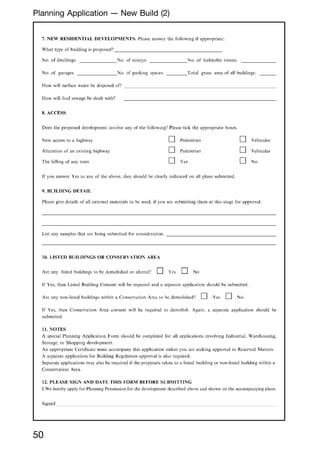
7. NEW RESIDENTIAL DEVELOPMENTS. Please answer the following if appropriate:
What type of building is proposed?
No. of dwellings: No. of storeys: No. of habitable rooms:
No. of garages: No. of parking spaces: Total grass area of all buildings:
How will surface water be disposed of!
How will foul sewage be dealt with?
8. ACCESS
Does the proposed development involve any of the following? Please tick the appropriate boxes.
New access to a highway Pedestrian Vehicular
Alteration of an existing highway Pedestrian Vehicular
The felling of any trees Yes No
If you answer Yes to any of the above. they should be clearly indicated on all plans submitted.
9. BULDI'IIG DETAIL
Please give details of all external materials to be used. if you arc submitting them at this stage for approval.
List any samples that arc being submitted for consideration.
10. LISTED BUILDINGS OR CONSERVATIOr-; AREA
Arc any listed buildings to be demolished or altered? es No
If Yes, then Listed Building Consent will be required and a separate application should be submitted.
Arc any non-listed buildings within a Conservation Area to be demolished? es No
If Yes, then Conservation Area consent will be required to demolish. Again, a separate application should be
submitted.
II. r-;OTES
A special Planning Application Form should be completed for all applications involving Industrial, Warehousing,
Storage, or Shopping development.
An appropriate Certificate must accompany this application unless you arc seeking approval to Reserved Matters.
A separate application for Building Regulation approval is also required.
Separate applications may also be required i[ the proposals relate to a listed building or non-listed building within a
Conservation Area.
12. PLEASE SIGN AND DATE THIS FORM BEFORE SUBMITTING
I/We hereby apply [or Planning Permission [or the development described above and shown on the accompanying plans.
Signed
TOWN AND COUNTRY PLANNING ACT
TOWN AND COUNTRY PLANNING (General Development Procedure) ORDER
Certificates under Article 7 of the Order
CERTIFICATE A For Freehold Owner (or his/her Agent)
I hereby certify that:-
1. No person other than the applicant was an owner of any part of the land to which the application relates at the
beginning of the period of 21 days before the date of the accompanying application.
2. *Either (i) None of the land to which the application relates constitutes or forms part of an agricultural holding:
*or (ii) *(I have) (the applicant has) given the requisite notice to every person other than *(myself) (himself)
(herself) who, 21 days before the date of the application, was a tenant of any agricultural holding any part of
which was comprised in the land to which the application relates, viz:-
Name and Address of Tenant.................................................
.................................................................................................
................................................................................................. Signed ........................ ........... Date..........................
Date of Service of Notice........................................................ *On Behalf of ....................................... ....................
CERTIFICATE B For Part Freehold Owner or Prospective Purchaser (or his/her Agent) able to ascertain
all the owners of the land
I hereby certify that:-
1. *(I have) (the applicant has) given the requisite notice to all persons other than (myself) (the applicant) who, 21
days before the date of the accompanying application were owners of any part of the land to which the
application relates, viz:-
Name and Address of Owner .................................................
.................................................................................................
................................................................................................. Date of Service of Notice ......... ................................
2. *Either (i) None of the land to which the application relates constitutes or forms part of an agricultural holding;
*or (ii) *(I have) (the applicant has) given the requisite notice to every person other than *(myself) (himself)
(herself) who, 21 days before the date of the application, was a tenant of any agricultural holding any part of
which was comprised in the land to which the application relates, viz:-
Name and Address of Tenant.................................................
.................................................................................................
................................................................................................. Signed ........................ .......... Date..........................
51
Planning Application --- Certificates
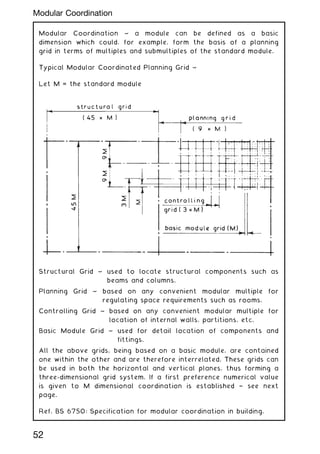
Modular Coordination ~ a module can be defined as a basic
dimension which could, for example, form the basis of a planning
grid in terms of multiples and submultiples of the standard module.
Typical Modular Coordinated Planning Grid ~
Let M = the standard module
Structural Grid ~ used to locate structural components such as
beams and columns.
Planning Grid ~ based on any convenient modular multiple for
regulating space requirements such as rooms.
Controlling Grid ~ based on any convenient modular multiple for
location of internal walls, partitions, etc.
Basic Module Grid ~ used for detail location of components and
fittings.
All the above grids, being based on a basic module, are contained
one within the other and are therefore interrelated. These grids can
be used in both the horizontal and vertical planes, thus forming a
three-dimensional grid system. If a first preference numerical value
is given to M dimensional coordination is established † see next
page.
Ref. BS 6750: Specification for modular coordination in building.
52
Modular Coordination
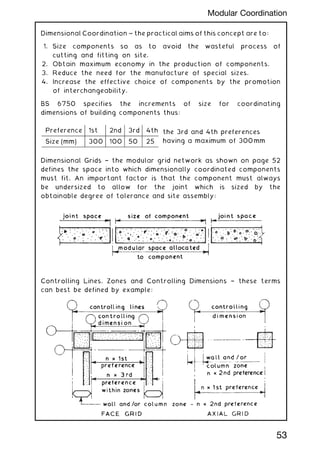
Dimensional Coordination ~ the practical aims of this concept are to:
1. Size components so as to avoid the wasteful process of
cutting and fitting on site.
2. Obtain maximum economy in the production of components.
3. Reduce the need for the manufacture of special sizes.
4. Increase the effective choice of components by the promotion
of interchangeability.
BS 6750 specifies the increments of size for coordinating
dimensions of building components thus:
the 3rd and 4th preferences
having a maximum of 300 mm
Dimensional Grids † the modular grid network as shown on page 52
defines the space into which dimensionally coordinated components
must fit. An important factor is that the component must always
be undersized to allow for the joint which is sized by the
obtainable degree of tolerance and site assembly:
Controlling Lines, Zones and Controlling Dimensions † these terms
can best be defined by example:
Preference 1st 2nd 3rd 4th
Size (mm) 300 100 50 25
53
Modular Coordination
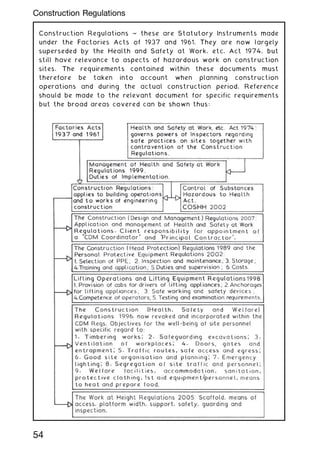
Construction Regulations ~ these are Statutory Instruments made
under the Factories Acts of 1937 and 1961. They are now largely
superseded by the Health and Safety at Work, etc. Act 1974, but
still have relevance to aspects of hazardous work on construction
sites. The requirements contained within these documents must
therefore be taken into account when planning construction
operations and during the actual construction period. Reference
should be made to the relevant document for specific requirements
but the broad areas covered can be shown thus:
54
Construction Regulations
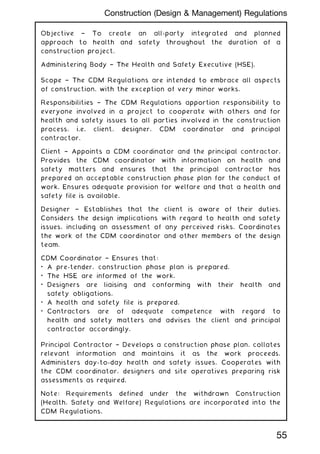
Objective † To create an all-party integrated and planned
approach to health and safety throughout the duration of a
construction project.
Administering Body † The Health and Safety Executive (HSE).
Scope † The CDM Regulations are intended to embrace all aspects
of construction, with the exception of very minor works.
Responsibilities † The CDM Regulations apportion responsibility to
everyone involved in a project to cooperate with others and for
health and safety issues to all parties involved in the construction
process, i.e. client, designer, CDM coordinator and principal
contractor.
Client † Appoints a CDM coordinator and the principal contractor.
Provides the CDM coordinator with information on health and
safety matters and ensures that the principal contractor has
prepared an acceptable construction phase plan for the conduct of
work. Ensures adequate provision for welfare and that a health and
safety file is available.
Designer † Establishes that the client is aware of their duties.
Considers the design implications with regard to health and safety
issues, including an assessment of any perceived risks. Coordinates
the work of the CDM coordinator and other members of the design
team.
CDM Coordinator † Ensures that:
• A pre-tender, construction phase plan is prepared.
• The HSE are informed of the work.
• Designers are liaising and conforming with their health and
safety obligations.
• A health and safety file is prepared.
• Contractors are of adequate competence with regard to
health and safety matters and advises the client and principal
contractor accordingly.
Principal Contractor † Develops a construction phase plan, collates
relevant information and maintains it as the work proceeds.
Administers day-to-day health and safety issues. Cooperates with
the CDM coordinator, designers and site operatives preparing risk
assessments as required.
Note: Requirements defined under the withdrawn Construction
(Health, Safety and Welfare) Regulations are incorporated into the
CDM Regulations.
55
Construction (Design  Management) Regulations
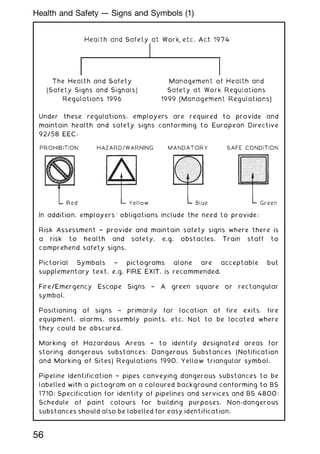
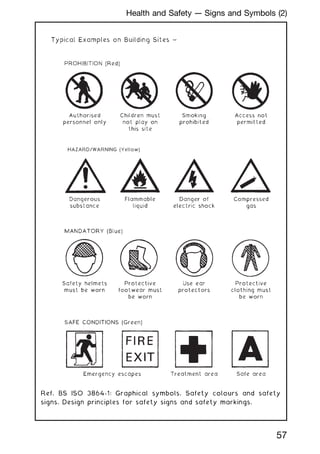
Under these regulations, employers are required to provide and
maintain health and safety signs conforming to European Directive
92/58 EEC:
HAZARD/WARNING
In addition, employers' obligations include the need to provide:
Risk Assessment † provide and maintain safety signs where there is
a risk to health and safety, e.g. obstacles. Train staff to
comprehend safety signs.
Pictorial Symbols † pictograms alone are acceptable but
supplementary text, e.g. FIRE EXIT, is recommended.
Fire/Emergency Escape Signs † A green square or rectangular
symbol.
Positioning of signs † primarily for location of fire exits, fire
equipment, alarms, assembly points, etc. Not to be located where
they could be obscured.
Marking of Hazardous Areas † to identify designated areas for
storing dangerous substances: Dangerous Substances (Notification
and Marking of Sites) Regulations 1990. Yellow triangular symbol.
Pipeline Identification † pipes conveying dangerous substances to be
labelled with a pictogram on a coloured background conforming to BS
1710: Specification for identity of pipelines and services and BS 4800:
Schedule of paint colours for building purposes. Non-dangerous
substances should also be labelled for easy identification.
56
Health and Safety --- Signs and Symbols (1)
HAZARD/WARNING (Yellow)
Ref. BS ISO 3864-1: Graphical symbols. Safety colours and safety
signs. Design principles for safety signs and safety markings.
57
Health and Safety --- Signs and Symbols (2)
Control over the way that buildings are constructed originated
from attempts to regulate development density in response to
demand for more living space as city populations increased.
Although there is little surviving documentation to support
effective building controls from the time, archived records of
London dating from the 12th century do provide some indication
that communal issues of convenience and privacy were monitored
by the city administration. These included provisions for sanitation,
dividing walls and control over encroachment.
Throughout the latter part of the Middle Ages (about 1200 to 1500),
regulation in London was haphazard and spontaneous, usually
effected on the basis of complaints about building nuisance, whereby
the city mayor and aldermen presided over a court hearing. The
outcome was determined on the complainant's evidence and expert
reports from appointed surveyors. An exception was an overall ban
on thatched roofs in London following a serious spread of fire in 1212.
Other densely populated cities established their own means for
controlling building work. Fire hazard was the principle criteria and
restrictions were applied to limit the ever rising timber framed
houses where storeys were built upon existing storeys and extensive
jetties of dubious construction overhung the streets below.
The bubonic plague (1665 to 1666) followed by the Great Fire of
London (1666) provided an unplanned opportunity to significantly
reconsider procedures for new building work. Redevelopment with
regard to better living standards and the health and safety of
building occupants resulted from the introduction of the London
Building Act in 1667. This Act enabled city surveyors to enforce
regulations which included:
• Non-combustible material for the main structure, i.e. brick or
stone.
• Wall thickness of a minimum specification.
• Limited storey height.
• No projections or jetties over the streets below.
• Minimum street widths to function as fire breaks.
London Building Acts of 1707, 1709, 1764 and 1772 widened control of
building development to suburban areas beyond the city boundary.
Further provisions prohibited the use of timber for application to
decorative cornices and established minimum heights for parapet walls.
58
Building Control --- History and Development (1)
London Building Act 1774 ~ known as the Black Act, consolidated
previous Building Acts as well as determining acceptable
construction methods for the whole of London's suburban areas. It
remained effective well into the 19th. century, until the introduction
of the Metropolitan Building Act of 1844. The main objective of the
1774 Act was to fire proof the exterior of buildings by prohibiting
superfluous use of timber ornamentation and other wooden
features. An exception was made for timber doors and window
frames. These were permitted if recessed at least 4'' (100mm)
behind the wall face. The London Building Acts were emulated
throughout other provincial towns and cities in the UK. This was
mainly in response to outbreaks of fire spreading between cheaply
constructed and uncontrolled, overdeveloped timber housing.
Metropolitan Building Act 1844 ~ this extended the area around
London covered by building controls. It empowered the appointment
of district surveyors to visit building sites and inspect work in
progress.
Public Health Act 1848 ~ created municipal Boards of Health
through local authorities in England and Wales. Mandatory
provisions included minumum standards for structural stability,
sanitation, light and ventilation and for the prevention of dampness
in buildings.
Local Government Act 1858 ~ extended the powers of local
authorities to supervise and control building construction through
bye-laws. The national government published guidelines known as
the Form of Bye-laws which were adopted by most local
authorities. These permitted LAs to demand deposit of plans and
specifications for new building work and substantial alterations to
existing buildings.
Public Health Act 1875 ~ consolidated existing building control
legislation for England and Wales. Ireland and Scotland passed
similar legislation in 1878 and 1897 respectively. The most notable
provision was a requirement for installation of damp proof courses
in walls.
Thereafter, LAs administered their own interpretation of building
control through their bye-laws. This presented problems, as
standards varied throughout the UK. It was not until the mid-20th
century that some form of unification was introduced.
59
Building Control --- History and Development (2)
Public Health Act 1936 ~ this covered all buildings intended for
human occupation and was primarily concerned with provisions for
drainage and sanitation. Empowered LAs with responsibility for
adoption and maintenance of public sewers and drains. Introduced
new guidelines in the form of model bye-laws which LAs could
enforce.
Model Bye-laws 1952 ~ produced as a means for unifying the
standards of building throughout England and Wales. One model for
all areas was designed to avoid urban and rural variations in
performance standards. Introduced deemed to satisfy provisions
with reference to established quality benchmarks such as British
Standards.
Building (Scotland) Act 1959 ~ enabled Scotland to adopt national
building standards which formed the first Building Regulations in the
UK. These came into force in 1964.
Public Health Act 1961 ~ statutory unification of building standards
that became the forerunner to the first Building Regulations.
Proposed replacement of local bye-laws with nationally acceptable
regulations. Central government responsibility for establishing
minimum building standards administered through the LAs of
England and Wales.
Building Regulations 1966 on ~ the first unified regulations made as
a statutory instrument. Excluded inner London, Scotland and
Ireland. In 1972 amendments and updates were issued as a second
edition. In the same year the Building Regulations (Northern Ireland)
Order was established as the first regulations for that region.
These were modeled closely on the second edition for England and
Wales. In 1976, further amendments were consolidated into the third
edition, which incorporated Approved Documents as deemed to
satisfy practice guidelines that could be used to satisfy the
regulations.
Building Act 1984 ~ consolidated various other building legislation
and redefined the Building Regulations. From 1985 the regulations
were based on performance and presented in a simpler format.
Previous editions were considered too prescriptive, confusing and
inflexible. That year the Building (Inner London) Regulations
incorporated most of the 1985 regulations for England and Wales
with some limited exceptions. Bye-laws made under the previous
London Acts no longer applied. In 2012 Wales determined its own
building regulations.
60
Building Control --- History and Development (3)
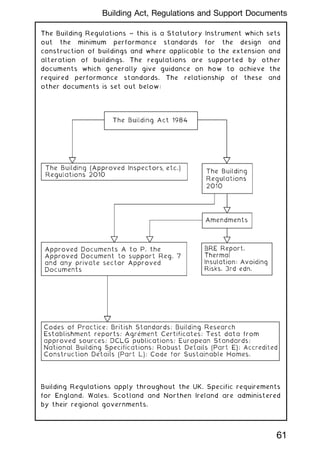
The Building Regulations ~ this is a Statutory Instrument which sets
out the minimum performance standards for the design and
construction of buildings and where applicable to the extension and
alteration of buildings. The regulations are supported by other
documents which generally give guidance on how to achieve the
required performance standards. The relationship of these and
other documents is set out below:
Building Regulations apply throughout the UK. Specific requirements
for England, Wales, Scotland and Northen Ireland are administered
by their regional governments.
61
Building Act, Regulations and Support Documents
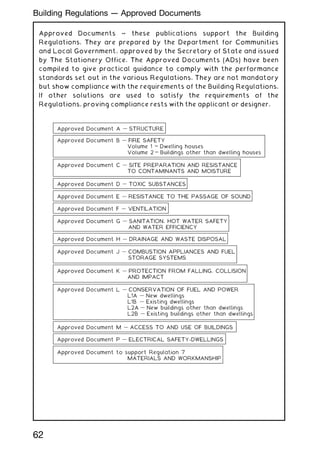
Approved Documents ~ these publications support the Building
Regulations. They are prepared by the Department for Communities
and Local Government, approved by the Secretary of State and issued
by The Stationery Office. The Approved Documents (ADs) have been
compiled to give practical guidance to comply with the performance
standards set out in the various Regulations. They are not mandatory
but show compliance with the requirements of the Building Regulations.
If other solutions are used to satisfy the requirements of the
Regulations, proving compliance rests with the applicant or designer. ĆĆ
Approved Document B — FIRE SAFETY
Volume 1 – Dwelling houses
Volume 2 – Buildings other than dwelling houses
Approved Document A — STRUCTURE
Approved Document C — SITE PREPARATION AND RESISTANCE
TO CONTAMINANTS AND MOISTURE
Approved Document D — TOXIC SUBSTANCES
Approved Document E — RESISTANCE TO THE PASSAGE OF SOUND
Approved Document F — VENTILATION
Approved Document G — SANITATION, HOT WATER SAFETY
AND WATER EFFICIENCY
Approved Document H — DRAINAGE AND WASTE DISPOSAL
Approved Document J — COMBUSTION APPLIANCES AND FUEL
STORAGE SYSTEMS
Approved Document K — PROTECTION FROM FALLING, COLLISION
AND IMPACT
Approved Document L — CONSERVATION OF FUEL AND POWER
L1A — New dwellings
L1B — Existing dwellings
L2A — New buildings other than dwellings
L2B — Existing buildings other than dwellings
Approved Document M — ACCESS TO AND USE OF BUILDINGS
Approved Document P — ELECTRICAL SAFETY-DWELLINGS
Approved Document to support Regulation 7
MATERIALS AND WORKMANSHIP
62
Building Regulations --- Approved Documents
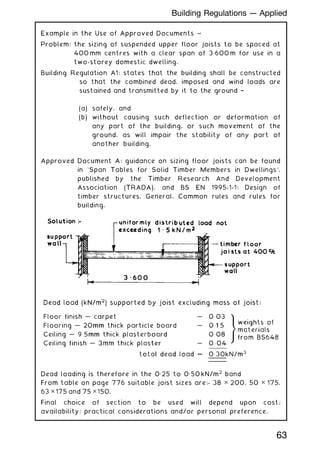
Example in the Use of Approved Documents ~
Problem: the sizing of suspended upper floor joists to be spaced at
400 mm centres with a clear span of 3„600 m for use in a
two-storey domestic dwelling.
Building Regulation A1: states that the building shall be constructed
so that the combined dead, imposed and wind loads are
sustained and transmitted by it to the ground †
(a) safely, and
(b) without causing such deflection or deformation of
any part of the building, or such movement of the
ground, as will impair the stability of any part of
another building.
Approved Document A: guidance on sizing floor joists can be found
in `Span Tables for Solid Timber Members in Dwellings',
published by the Timber Research And Development
Association (TRADA), and BS EN 1995-1-1: Design of
timber structures. General. Common rules and rules for
building.
Dead loading is therefore in the 0„25 to 0„50 kN/m2
band
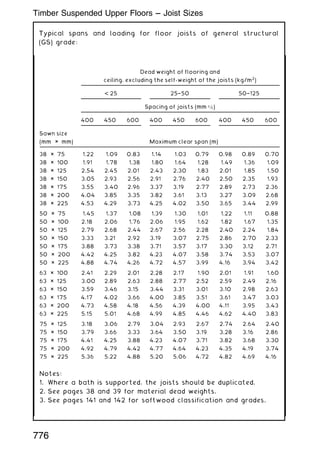
From table on page 776 suitable joist sizes are:- 38 ✕ 200, 50 ✕ 175,
63 ✕ 175 and 75 ✕ 150.
Final choice of section to be used will depend upon cost;
availability; practical considerations and/or personal preference.
63
Building Regulations --- Applied
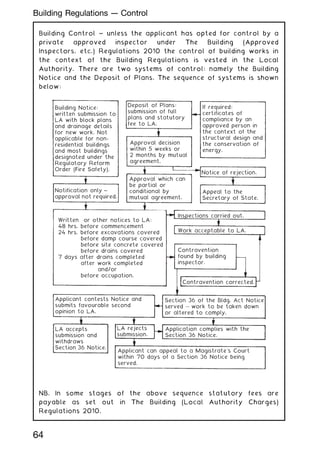
Building Control ~ unless the applicant has opted for control by a
private approved inspector under The Building (Approved
Inspectors, etc.) Regulations 2010 the control of building works in
the context of the Building Regulations is vested in the Local
Authority. There are two systems of control: namely the Building
Notice and the Deposit of Plans. The sequence of systems is shown
below:
Building Notice:
written submission to
LA with block plans
and drainage details
for new work. Not
applicable for non-
residential buildings
and most buildings
designated under the
Regulatory Reform
Order (Fire Safety).
Deposit of Plans:
submission of full
plans and statutory
fee to LA.
If required:
certificates of
compliance by an
approved person in
the context of the
structural design and
the conservation of
energy.
Approval decision
within 5 weeks or
2 months by mutual
agreement.
Notice of rejection.
Appeal to the
Secretary of State.
Inspections carried out.
Work acceptable to LA.
Contravention
found by building
inspector.
Contravention corrected.
Section 36 of the Bldg. Act Notice
served — work to be taken down
or altered to comply.
Application complies with the
Section 36 Notice.
Applicant can appeal to a Magistrate's Court
within 70 days of a Section 36 Notice being
served.
LA rejects
submission.
Approval which can
be partial or
conditional by
mutual agreement.
Notification only –
approval not required.
Written or other notices to LA:
48 hrs. before commencement
24 hrs. before excavations covered
before damp course covered
before site concrete covered
before drains covered
7 days after drains completed
after work completed
and/or
before occupation.
Applicant contests Notice and
submits favourable second
opinion to LA.
LA accepts
submission and
withdraws
Section 36 Notice.
NB. In some stages of the above sequence statutory fees are
payable as set out in The Building (Local Authority Charges)
Regulations 2010.
64
Building Regulations --- Control
Building Regulations Approval ~ required if ``Building Work'' as
defined in Regulation 3 of the Building Regulations is proposed. This
includes:
• Construction or extension of a building.
• Alterations to an existing building that would bring into effect
any of the complying regulations.
• Installing replacement windows where the installer is not known
to the local Building Control Authority as being a `competent'
registered installer, e.g. FENSA (FEN
FENestration S
Self-A
Assessment)
scheme.
• Alteration or installation of building services and fittings that
bring into effect any of the complying regulations.
• Installation of cavity wall insulation.
• Underpinning of a building's foundations.
• Change of purpose or use of a building.
`Competent' persons are appropriately qualified and experienced to the
satisfaction of a relevant scheme organiser. For example, Capita
Group's `Gas Safe Register' of engineers for gas installation and
maintenance services. They can `self-certify' that their work complies
with Building Regulations, thereby removing the need for further
inspection (see next page).
Local Authority Building Control ~ the established procedure as set
out diagrammatically on the preceding page with an application
form of the type shown on page 70 and accompanying documents
as indicated on page 68.
Private Sector Building Control ~ an alternative, where suitably
qualified and experienced inspectors approved by the Local
Authority undertake the application approval and site inspections.
An `Initial Notice' from the client and their appointed inspector is
lodged with the Local Authority.
Whichever building control procedure is adopted, the methodology
is the same, i.e. Deposit of Plans or Building Notice (see page 68).
Refs.: The Building (Approved Inspectors, etc.) Regulations.
The Association of Consultant Approved Inspectors.
65
Building Regulations --- Approval
Benchmark Checklist ~ an initiative that places responsibilities on
manufacturers and installers to provide equipment of an
appropriate standard for the situation. Further requirements are
that it is installed, commissioned and serviced to the
manufacturer's requirements in accordance with the relevant
Building Regulations.
Some Examples of Building Regulations Notification Work
Acceptable by Registered Competent Persons ~ air pressure
testing, cavity wall insulation, electrical and gas installation, micro-
generation installation, renewable technologies and replacement
windows.
Local authority
building control
Notification/application
given to LABC who will
appoint a government
registered approved
and qualified inspector
Install, test and
commission work to
equipment manufacturer's
instructions
Approved inspector to
check installation and
endorse the Benchmark
LABC register details
and issue certificate
of compliance
Regulatory body to
register details, issue
certificate of compliance
and inform LABC
Notify regulatory
body to issue
Building Regulations
Certification
Complete
Install, test and
commission work
to equipment
manufacturer's
instructions
Competent persons
self certification
Building
Regulations
compliance
Checklist
Benchmark
Checklist
66
Building Regulations --- Installer Notification
Local Authority Building Control ~ as described in the previous two
pages. A public service administered by borough and unitary
councils through their building control departments.
Approved Inspectors ~ a private sector building control alternative
as outlined on the preceding page. Approved inspectors may be
suitably qualified individuals or corporate bodies employing suitably
qualified people, e.g. National House Building Council (NHBC Ltd)
and MD Insurance Services Ltd.
Borough councils can contract out the building control process to
approved inspectors. Validation and site examinations follow the
established format shown on page 64, with approved inspectors
substituting for LA.
Both NHBC and MD Insurance publish their own construction rules and
standards that supplement the Building Regulations. These form the
basis for their own independent quality control procedures whereby
their Inspectors will undertake stage and periodic examinations of
work in progress to ensure that these standards are adhered to. The
objective is to provide new home buyers with a quality assured
product warranted against structural defects (10†15 years), provided
the house builder has satisfied certain standards for registration.
Therefore, the buyer should be provided with a completion certificate
indicating Building Regulations approval and a warranty against
defects.
Robust Details ~ Building Regulations A.D. E † Resistance to the
passage of sound; requires that the separating walls, floors and stairs
in new dwellings are sufficiently resistant to airborne and impact
sound transmission. Sound measurement tests defined in the
associated BSs specified in the Approved Document must be
undertaken by an approved inspector/building control official before
completion.
An alternative or a means for exemption of pre-completion testing is
for the builder to notify the building inspector that sound insulation
construction details are registered and specified to those approved by
Robust Details Ltd. This is a not-for-profit company established by the
house building industry to produce guidance manuals containing details
of acceptable sound resistant construction practice.
67
Building Regulations --- Compliance
Deposit of Plans or Full Plans Application ~
• Application form describing the proposed work.
• Location plan, scale not less than 1 : 2500.
• Block plan, scale not less than 1 : 1250 showing north point,
lines of drains (existing and proposed) and size and species of
trees within 30 m.
• Plans, sections and elevations, scale not less than 1 : 50 (1 : 100
may be acceptable for elevations).
• Materials specification.
• Structural calculations where appropriate, e.g. load-bearing
beams.
• Fee depending on a valuation of work.
The appointed inspector examines the application and, subject to any
necessary amendments, an approval is issued. This procedure ensures
that work on site is conducted in accordance with the approved plans.
Also, where the work is being financed by a loan, the lender will often
insist the work is only to a Full Plans approval.
Building Notice ~
• A simplified application form.
• Block plan as described above.
• Construction details, materials specification and structural
calculations if considered necessary by the inspector.
• Fee depending on a valuation of work.
This procedure is only really appropriate for minor work, for
example, extensions to existing small buildings such as houses.
Building control/inspection occurs as each element of the work
proceeds. Any Building Regulation contravention will have to be
removed or altered to attain an acceptable standard.
Regularisation ~
• Application form.
• Structural calculations if relevant.
• A proportionally higher fee.
Applies to unauthorised work undertaken since November 1985. In effect
a retrospective application that will involve a detailed inspection of the
work. Rectification may be necessary before approval is granted.
68
Building Regulations --- Validation
69
Building Regulations Exemptions
70
Building Regulations --- Full Plans
Purpose ~ to provide a checklist that assists designers and builders
to attain performance standards that will satisfy the energy
efficiency requirements of Part L to the Building Regulations.
Also, to provide a measure against which the building control
inspectorate can ensure conformity.
Documentation ~ a UK Department for Communities and Local
Government (DCLG) publication. This contains a series of construction
details that are applied to five different building techniques.
The fully detailed illustrations are for relatively light construction
appropriate to dwellings. The details and supplementary support
notes concentrate on continuity of thermal insulation with a regard
for thermal (cold) bridging and on quality of construction to maintain
airtightness.
Publication sections and details ~
Section 1: Introduction relating mainly to continuity of insulation
and airtightness.
Section 2: Detailed drawings and checklists for constructing the
external envelope.
The five types of construction are:
• Externally insulated masonry solid walls.
• Part and fully filled cavity insulated masonry walls.
• Internally insulated masonry walls.
• Timber framed walls.
• Lightweight steel framed walls.
Note: All five construction practice details include the critical areas
of junctions and interfaces between wall and roof, ground and
intermediate floors. Treatment at door and window openings is also
included with specific applications where appropriate.
Refs.:
The Building Regulations 2010 and associated Approved Document L:
Conservation of Fuel and Power.
Accredited Construction Details, Communities and Local Government
publications.
71
Accredited Construction Details
Published ~ 2006 by the Department for Communities and Local
Government (DCLG) in response to the damaging effects of climate
change. The code promotes awareness and need for new energy
conservation initiatives in the design of new dwellings.
Objective ~ to significantly reduce the 27% of UK CO2 emissions that
are produced by 25 million homes. This is to be a gradual process, with
the target of reducing CO2 and other greenhouse gas emissions from all
UK sources by 80% by 2050 relative to 1990 levels. Interim objectives
are 28% by 2017, 34% by 2022 and 50% by 2027.
Sustainability ~ measured in terms of a quality standard designed
to provide new homes with a factor of environmental performance.
This measure is applied primarily to categories of thermal energy, use
of water, material resources, surface water run-off and management
of waste.
Measurement ~ a `green' star rating that indicates environmental
performance ranging from one to six stars. Shown below is the star
rating criteria applied specifically to use of thermal energy. A home
with a six star rating is also regarded as a Zero Carbon Home.
Proposed Progression ~
Zero Carbon Home ~ zero net emissions of CO2 from all energy use
in the home. This incorporates insulation of the building fabric,
heating equipment, hot water systems, cooling, washing appliances,
lighting and other electrical/electronic facilities. Net zero emissions
can be measured by comparing the carbon emissions produced in
consuming on- or off-site fossil fuel energy use in the home, with
the amount of on-site renewable energy produced. Means for
producing low or zero carbon energy include micro combined heat
and power units, photovoltaic (solar) panels, wind generators and
ground energy heat pumps (see Building Services Handbook).
Percentage Improvement
compared with A.D. L 2006
Year Code level
star rating
10 † 1
18 † 2
25 2010 3
44 2013 4
100 2016 5 and 6
72
Code for Sustainable Homes
British Standards ~ these are publications issued by the British
Standards Institution which give recommended minimum standards for
materials, components, design and construction practices. These
recommendations are not legally enforceable but some of the Building
Regulations refer directly to specific British Standards and accept them
as deemed to satisfy provisions. All materials and components
complying with a particular British Standard are marked with the British
Standards kitemark thus: together with the appropriate BS number.
This symbol assures the user that the product so marked has been
produced and tested in accordance with the recommendations set
out in that specific standard. Full details of BS products and
services can be obtained from Customer Services, BSI, 389
Chiswick High Road, London W4 4AL. Standards applicable to
building may be purchased individually or in modules for General
Construction, Materials, Health and Safety, Project and Design,
Interior and Utility and Eurocodes. British Standards are constantly
under review and are amended, revised and rewritten as necessary;
therefore a check should always be made to ensure that any
standard being used is the current issue. There are over 1500
British Standards which are directly related to the construction
industry and these are prepared in five formats:
1. British Standards † these give recommendations for the
minimum standard of quality and testing for materials and
components. Each standard number is prefixed BS.
2. Codes of Practice † these give recommendations for good
practice relative to design, manufacture, construction,
installation and maintenance with the main objectives of
safety, quality, economy and fitness for the intended purpose.
Each code of practice number is prefixed CP or BS.
3. Draft for Development † these are issued instead of a British
Standard or Code of Practice when there is insufficient data
or information to make firm or positive recommendations.
Each draft number is prefixed DD. Sometimes given a BS
number and suffixed DC, i.e. Draft for public Comment.
4. Published Document † these are publications which cannot be
placed into any one of the above categories. Each published
document is numbered and prefixed PD.
5. Publicly Available Specification - client sponsored standards
produced to BSI guidelines. Reviewed after two years to
determine whether they should become established as a BS.
Prefixed PAS.
73
British Standards
European Standards † since joining the European Union (EU), trade
and tariff barriers have been lifted. This has opened up the market
for manufacturers of construction-related products, from all EU
and European Economic Area (EEA) member states. Before 2004,
the EU was composed of 15 countries: Austria, Belgium, Denmark,
Finland, France, Germany, Greece, Ireland, Italy, Luxemburg,
Netherlands, Portugal, Spain, Sweden and the United Kingdom. It
now includes Bulgaria, Cyprus, the Czech Republic, Estonia,
Hungary, Latvia, Lithuania, Malta, Poland, Romania, Slovakia,
Slovenia, Iceland, Liechtenstein and Norway. Nevertheless, the wider
market is not so easily satisfied, as regional variations exist. This
can create difficulties where product dimensions and performance
standards differ. For example, thermal insulation standards for
masonry walls in Mediterranean regions need not be the same as
those in the UK. Also, preferred dimensions differ across Europe in
items such as bricks, timber, tiles and pipes.
European Standards are prepared under the auspices of Comité
Européen de Normalisation (CEN), of which the BSI is a
member. European Standards that the BSI have not recognised or
adopted are prefixed EN. These are EuroNorms and will need
revision for national acceptance.
For the time being, British Standards will continue and, where
similarity with other countries' standards and ENs can be identified,
they will run side by side until harmonisation is complete and
approved by CEN.
e.g. BS EN 295 complements the previous national standard:
BS 65 † Vitrefied clay pipes . . . for drains and sewers.
European Pre-standards are similar to BS Drafts for Development.
These are known as ENVs.
Some products which satisfy the European requirements for safety,
durability and energy efficiency carry the CE mark. This is not to
be assumed as a mark of performance and is not intended to show
equivalence to the BS kitemark. However, the BSI is recognised as a
Notified Body by the EU and as such is authorised to provide
testing and certification in support of the CE mark.
International Standards † these are prepared by the International
Organisation for Standardisation and are prefixed ISO. Many are
compatible with, complement and have superseded BSs, e.g. ISO 9001
Quality Management Systems and BS 5750: Quality Systems.
74
European Standards
For manufacturers' products to be compatible and uniformly
acceptable in the European market, there exists a process for
harmonising technical specifications. These specifications are known as
harmonised European product standards (hENs), produced and
administered by the Comité Européen de Normalisation (CEN). European
Technical Approvals (ETAs) are also acceptable where issued by the
European Organisation for Technical Approvals (EOTA).
CPR harmonises the following compliance requirements:
• Energy economy and heat retention.
• Hygiene, health and environment.
• Mechanical resistance and stability.
• Protection aganist noise.
• Safety and accessibility in use.
• Safety in case of fire.
• Sustainable use of natural resources.
Member states of the European Economic Area (EEA) are legally
required to ensure their construction products satisfy the above
basic criteria.
UK attestation accredited bodies include: BBA, BRE and BSI.
CE mark † a marking or labelling for conforming products. A
`passport' permitting a product to be legally marketed in any EEA.
It is not a quality mark, e.g. BS kitemark, but where appropriate
this may appear with the CE marking.
CE marking † reproduced with kind permission of Rockwool Ltd.
75
Construction Products Regulation (CPR)
Specific Product Test Results
Certificate of Conformity
CAVITY WALL BATT
Y~or CE Marl: Affixed
Product Test
Test Results
Test
Product Standard Conformity
Conformity
Conformity
Conformity
Conformity
Marl:
BSI
Number
Number
Number
NumberNumber
Building Research Establishment ~ The BRE was founded as a UK
Government agency in 1921. It was known initially as the Building
Research Department and thereafter until the early 1970s as the
Building Research Station.
In addition to UK Government funding, some financial support is
now provided by the European Union. Additional funding is derived
from a variety of sources, including commercial services for private
industry and from publications. The latter includes the BRE's well-
known regular issue of research information products, i.e. Digests,
Information Papers, Good Building Guides and Good Repair Guides.
UK Government support is principally through the Department for
Business Enterprise and Regulatory Reform (BERR) and the
Department for Communities and Local Government (DCLG). The DCLG
works with the BRE in formulating specific aspects of the Approved
Documents to the Building Regulations. Commissioned research is
funded by the BRE Trust.
The BRE incorporates and works with other specialised research
and material testing organisations, e.g. see LPCB, below. It is
accredited under the United Kingdom Accreditation Service (UKAS)
as a testing laboratory authorised to issue approvals and
certifications such as CE product marking (see pages 75 and 76).
Certification of products, materials and applications is effected
through BRE Certification Ltd.
Loss Prevention Certification Board (LPCB) ~ The origins of this
organisation date back to the latter part of the 19th century, when
it was established by a group of building insurers as the Fire
Offices' Committee (FOC).
Through a subdivision known as the Loss Prevention Council
(LPC), the FOC produced a number of technical papers and
specifications relating to standards of building construction and fire
control installations. These became the industry standards that
were, and continue to be, frequently used by building insurers as
supplementary to local bye-laws and latterly the Building
Regulation Approved Documents.
In the late 1980s the LPC was renamed the LPCB as a result of
reorganisation within the insurance profession. At this time the
former LPC guidance documents became established in the current
format of Loss Prevention Standards.
In 2000 the LCPB became part of the BRE and now publishes its
Standards under BRE Certification Ltd.
76
Product and Practice Accreditation (1)
British Board of Agrément (BBA) ~ an approvals authority
established in 1966, known then as the Agrément Board. It was
based on the French Government's system of product approval. In
1982 it was renamed. Accredited by UKAS and a UK representative
in EOTA.
The BBA's UK premises are at the BRE in Garston, near Watford, a
convenient location for access to the BRE's research and testing
facilities. It is an independent organisation with the purpose of
impartially assessing materials, systems, practices, new market
products and existing products being used in a new or innovative
way. The objective is to evaluate these where an existing British
Standard, Eurostandard or similar quality benchmark does not
exist. Agrément certification is a quality assurance standard for
products and innovations not covered by a CE mark and/or a BS
kitemark. Once established, an agrément certificate may be used to
attain CE marking or for development into a new BS.
Agrément certificates are only issued after rigorous testing and
critical analysis criteria are satisfied, relative to intended
application and fitness for purpose. Where new materials, products,
components, installation processes and installations are proposed,
an agrément certificate may be regarded as sufficiently
authoritative for proof of Building Regulations compliance.
The Construction Industry Research and Information Association
(CIRIA) ~ established in 1960 as the Civil Engineering Research
Council (CERC) with the objective of financing research with money
raised from industry. In 1967 it was renamed, thereafter as a non-
profit making company owned by other companies, universities,
government departments and various other public sector
organisations. All subscriptions and fee income is invested into
seminars, training and research.
Main areas of activity:
• Research † industry wide covering construction and the
environment.
• Publications † a catalogue of over 600 titles.
• Training † short courses, seminars and conferences.
• Networks † support processes at training events, seminars and
workshops.
• Information services † newsletters, bulletins and a biannual
magazine.
77
Product and Practice Accreditation (2)
CI/SfB System ~ a coded filing system for the classification and
storing of building information and data. It was created in Sweden
under the title of Samarbetskommitte
..
n fo
..
r Byggnadsfra
¦ gor and was
introduced into this country in 1961 by the RIBA. In 1968 the CI
(Construction Index) was added to the system which is used
nationally and recognised throughout the construction industry.
The system consists of five sections called tables which are
subdivided by a series of letters or numbers and these are listed in
the CI/SfB index book to which reference should always be made in
the first instance to enable an item to be correctly filed or
retrieved.
Table 0 † Physical Environment
This table contains ten sections 0 to 9 and deals mainly with the end
product (i.e. the type of building.) Each section can be further subdi-
vided (e.g. 21, 22, etc.) as required.
Table 1 † Elements
This table contains ten sections numbered (††) to (9†) and covers all
parts of the structure such as walls, floors and services. Each sec-
tion can be further subdivided (e.g. 31, 32, etc.) as required.
Table 2 † Construction Form
This table contains 25 sections lettered A to Z (O being omitted)
and covers construction forms such as excavation work, blockwork,
cast in-situ work etc., and is not subdivided but used in conjunction
with Table 3.
Table 3 † Materials
This table contains 25 sections lettered a to z (l being omitted) and
covers the actual materials used in the construction form such as
metal, timber, glass, etc., and can be subdivided (e.g. n1, n2, etc.)
as required.
Table 4 † Activities and Requirements
This table contains 25 sections lettered (A) to (Z), (O being omitted)
and covers anything which results from the building process such as
shape, heat, sound, etc. Each section can be further subdivided ((M1),
(M2) etc.) as required.
78
CI/SfB System of Coding
CPI System of Coding ~ the Coordinated Project Information
initiative originated in the 1970s in response to the need to
establish a common arrangement of document and language
communication, across the varied trades and professions of the
construction industry. From this evolved the Common Arrangement
of Work Sections (CAWS) first published in 1987. Since then it has
been effectively used with the publication of the Standard Method
of Measurement 7th edition (SMM 7), the National Building
Specification (NBS) and the Drawings Code. (Note: The NBS is also
produced in CI/SfB format.) Later editions of CAWS are aligned with
Uniclass.
The arrangement in all documents is a coordination of alphabetic
sections, corresponding to elements of work, the purpose being to
avoid mistakes, omissions and other errors which have in the past
occurred between drawings, specification and bill of quantities
descriptions.
The coding is a combination of letters and numbers, spanning three
levels:
Level 1 has 24 headings from A to Z (omitting I and O). Each
heading relates to part of the construction process, such as
groundwork (D), Joinery (L), surface finishes (M), etc.
Level 2 is a subheading, which in turn is subgrouped numerically
into different categories. So, for example, Surface Finishes is sub-
headed; Plaster, Screeds, Painting, etc. These subheadings are then
extended further, thus Plaster becomes; Plastered/Rendered
Coatings, Insulated Finishes, Sprayed Coatings, etc.
Level 3 is the work section subgrouped from level 2, to include a
summary of inclusions and omissions.
As an example, an item of work coded M21 signifies:
M † Surface finishes
2 † Plastered coatings
1 † Insulation with rendered finish
The coding may be used to:
(a) simplify specification writing
(b) reduce annotation on drawings
(c) rationalise traditional taking-off methods
79
CPI System of Coding
Uniclass ~ the Unified Classification for the Construction Industry
was created in the 1990s by the Construction Project Information
Committee (CPIC) [see below] and first published by the RIBA in
1997.
Purpose ~ to organise product literature and project information
into a structured library format. It incorporates the Common
Arrangement of Work Sections (CAWS) and the Electronic Product
Information Cooperation (EPIC) system of structuring product
literature and information.
Composition ~ comprises 15 tables (coded A to Q, I and O omitted),
each table an independent classification of specific information that
can be used solely or in combination with other table references
where subject matter is complex or diverse.
EPIC ~ an established European coding system for technical
product literature and information. Widely used across continental
Europe but less so in the UK. Favoured by some product
manufacturers in their presentation of data to architects and
engineers.
Product literature label showing CI/SfB, Uniclass and EPIC notation ~
CPIC members ~
Construction Confederation (CC).
Royal Institute of British Architects (RIBA).
Chartered Institute of Architectural Technologists (CIAT).
Chartered Institution of Building Services Engineers (CIBSE).
Royal Institution of Chartered Surveyors (RICS).
Institution of Civil Engineers (ICE).
(47)
CI/SfB
Uniclass
L5214
Ne5
EPIC
E312
80
Uniclass System of Coding
BIM ~ terminology specific to the construction industry as a
summary description for collating, organising and managing
technical information and project data.
Development and Background ~ information modelling is not new in
concept. The practice of creating and maintaining libraries of
readily accessible, searchable and transferable building information
has produced several orderly and systematic arrangements. Not
least the established coding systems outlined on the preceding
three pages; namely, CI/SfB, CPI (incorporating CAWS, NBS and
SMM7) and Uniclass. As independent systems these have their
limitations. Certain parts are becoming oversubscribed as new
technologies and processes evolve. The CI/SfB alpha-numeric mix of
letters, numbers and brackets is not entirely compatible with digital
formatting. Used in combination, there is cross correlation and
common identification of some coded classifications, but there
remains an element of variation and disparity. Unification of data
formatting and presentation is an objective that BIM seeks to
address to simplify information transfer between projects and more
widely across the industry.
Structured data can be presented within three categories:
• Building Information Modelling ~ as outlined above, a business
information process providing access for all involved with a
construction project from client through design, assembly and
after care.
• Building Information Model ~ digital representation of the
business process that provides structured data management to
include schedules and reports in spreadsheet format for the
various stages of a project's development.
• Building Information Management ~ the organisation and
administrative strategy for control of a project using data
from the building information model. A communication process
that applies from initial concept and inception of a building,
throughout the construction process and with regard to the
long term maintenance and intended life span of a completed
asset.
81
Building Information Modelling (BIM)
Project information and data classification systems:
BPIC
BPIC ~ Building Project Information Committee, formed in 1987.
Produced the Common Arrangement of Work Sections (CAWS) as a
simplified specification and referencing system. Renamed CPIC,
Construction Project Information Committee in the mid 90s. In 1997
introduced Uniclass as a structured product literature and
information classification.
BS ISO 12006-2
BS ISO 12006-2: (Building construction. Organisation of information
about construction works. Framework for classification of
information) ~ guidance on information exchange, data organisation
and classification systems.
CAWS
CAWS ~ a letter and number (alpha-numeric) coded notation of
work sections, groups and sub-groups produced primarily to
coordinate entries in specifications and bills of quantities.
Compatible with SMM7, NBS and NES. See page 79.
CI/SfB
CI/SfB ~ introduced to the UK in 1961 with revisions in 1968 and
1976. The forerunner to subsequent indexing systems, it has gained
wide acceptance across the construction industry. Now functions
mainly as library referencing of product literature. Its bracketed
combinations of letters and numbers limit its application to digital
technology. See page 78.
COBie
COBie ~ Construction Operations Building information exchange. A
shared data standard management system applied to the intended
life span of a building. It provides a spreadsheet source of data
based on reports and models relating to existing completed
projects. From this data storage facility, structured information
can be transferred and used for planning and managing subsequent
similar building types.
EPIC
EPIC ~ Electronic Product Information Cooperation. Popular across
continental Europe as a coding system for manufacturers' product
literature. Used by some UK architectural and engineering practices
as a basis for data presentation. See page 80.
continued . . . . .
82
Building Information Modelling Processes --- 1
NBS
NBS ~ National Building Specification, the UK national standard
specification for building work. Part of RIBA Enterprises Ltd. NBS
also have other information resource products including the
Construction Information Service (CIS) produced jointly with IHS,
Information Handling Services.
NBS Create
NBS Create ~ a data standard for documenting and sharing
structured information based on existing work schedules and
manufacturers' product details. Links NBS to building information
modelling.
NBS National BIM Library
NBS National BIM Library ~ an information resource covering all
aspects of the building fabric and elements of construction. The
content of the library is based on ``. . . . . proprietory and pre-
configured generic objects . . . . .''.
NES
NES ~ National Engineering Specification for building services
projects. Standard, concise specifications endorsed by CIBSE,
Chartered Institution of Building Services Engineers and BSRIA,
Building Services Research and Information Association.
RIBA Plan of Work
RIBA Plan of Work ~ established in 1964 by the Royal Institute of
British Architects as a methodical procedure for the design team to
apply to building projects. Its `work stages' and `key tasks' have
become universally accepted by the other building professions as a
planning model, as guidance for progressing projects and for
processing contract procurement. Subsequent revisions, notably in
1998, 2007 and 2011 have retained its relevance.
SMM
SMM ~ Standard Method of Measurement, originated in 1922 with
several revisions since then. It is used mainly by quantity surveyors
as a model for producing bills of quantities for builders' estimators
to price when tendering for work. The SMM's rules for
measurement are used throughout the world. In current format it is
written to comply with CPI guidance (see page 79). Maintained by
the RICS, Royal Institution of Chartered Surveyors.
Uniclass
Uniclass ~ first produced in 1997 and subsequently revised, provides
a tabulated system of classifications that represent project
information and product literature. Incorporates CAWS and EPIC.
See page 80.
83
Building Information Modelling Processes --- 2
84
Notes
This page intentionally left blank
2 SITE WORKS
PROPOSED FIVE-STOREY BLOCK PROPOSED GARAGES
PAVED
AREA
PAVED AREA
EXISTING TREES
ROADWAY
ROADWAY
N
SITE MEASUREMENT
SITE INVESTIGATIONS
SOIL INVESTIGATION
SOIL ASSESSMENT AND TESTING
SITE LAYOUT CONSIDERATIONS
SITE SECURITY
SITE LIGHTING AND ELECTRICAL SUPPLY
SITE OFFICE ACCOMMODATION
SITE HEALTH AND WELFARE PROVISION
MATERIALS STORAGE
MATERIALS TESTING
TIMBER DECAY AND TREATMENT
PROTECTION ORDERS FOR TREES AND SHRUBS
LOCATING PUBLIC UTILITY SERVICES
SETTING OUT
LEVELS AND ANGLES
ROAD CONSTRUCTION
TUBULAR SCAFFOLDING AND SCAFFOLDING SYSTEMS
SHORING SYSTEMS
DEMOLITION
85
Site Analysis † prior to purchasing a building site it is essential to
conduct a thorough survey to ascertain whether the site
characteristics suit the development concept. The following
guidance forms a basic checklist:
* Refer to Ordnance Survey maps to determine adjacent features,
location, roads, facilities, footpaths and rights of way.
* Conduct a measurement survey to establish site dimensions and
levels.
* Observe surface characteristics, i.e. trees, steep slopes, existing
buildings, rock outcrops, wells.
* Inquire of local authority whether preservation orders affect
the site and if it forms part of a conservation area.
* Investigate subsoil. Use trial holes and borings to determine
soil quality and water table level.
* Consider flood potential, possibilities for drainage of water
table, capping of springs, filling of ponds, diversion of streams
and rivers.
* Consult local utilities providers for underground and overhead
services, proximity to site and whether they cross the site.
* Note suspicious factors such as filled ground, cracks in the
ground, subsidence due to mining and any cracks in existing
buildings.
* Regard neighbourhood scale and character of buildings with
respect to proposed new development.
* Decide on best location for building (if space permits) with
regard to `cut and fill', land slope, exposure to sun and
prevailing conditions, practical use and access.
See also desk and field studies on page 91.
86
Site Survey
Irregular plan surface areas ~ these are typical of many building
sites, with odd-shaped boundaries and directional changes.
Methods for measurement ~ modern instruments and computational
techniques, including photogrammetry, can provide accurate
calculation of site areas. Traverse data coordinates from
theodolite readings can also be used. Fieldwork measurements and
simple calculations are an adequate and economic means for
obtaining reasonable area estimates for most modest size sites.
These can be undertaken from scaled maps or preferably from a
scaled drawing of the area following a measured survey.
Estimates based on scaled site drawings ~
• Gridded tracing paper superimposed over the plotted area and
the number of squares counted.
square grid
tracing paper
overlay
plot of
site area
site boundary
number of
whole squares
counted
proportions of
squares occupied,
estimated and
summated
E.g. If each square scaled is 10 m ✕ 10 m (100 m2
), the approximate
site area is:
8 full squares at 100 m2
= 800 m2
3.5 squares made up of proportional squares = 350m2
Total area is approximately 800 m2
+ 350 m2
= 1150 m2
• Give and take for irregular boundaries.
overmeasured (give) ignored (take)
superimposed
straight line
to eastablish
mean boundary
modified area bounded by straight
lines for dividing into squares,
rectangles and triangles for simple
calculation and summation
87
Site Measurement
Thomas Simpson (1710†1761) ~ a British mathematician who derived
interpolation and numerical methods of integration for calculation
of areas under curves.
Simpson's rule ~
A = w [(h1 + h7) + 4(h2 + h4 + h6) + 2(h3 + h5)] ÷ 3
Where: A = estimate of site area (m2
)
w = width or equal distances between ordinates (m)
h = height or length of parallel ordinates (m)
Note: requires an odd number of ordinates and an even number of
areas.
E.g.
parallel
ordinates
site boundary
h7
h6
h5
h4
h3
h2
w w w w w w
h1
If, h1 = 40 m, h2 = 36 m, h3 = 34 m, h4 = 34 m, h5 = 38 m, h6 = 36 m,
and h7 = 20 m. w = 12 m.
A = 12 [(40 + 20) + 4(36 + 36 + 36) + 2(34 + 38)] ÷ 3
A = 12 [60 + 432 + 144] ÷ 3
A = 12 ✕ 636 ÷ 3
A = 2544 m2
Note: An area 100 m ✕ 100 m (10,000 m2
) = 1 hectare (1 ha).
In the above calculation, 2544 m2
= 0.2544 ha.
In imperial measurement there are approximately 2.5 (2.471) acres
to 1 ha. Therefore 0.2544 ha = 0.6286 acres.
88
Site Measurement --- Simpson's Rule
Method ~ a little less accurate than Simpson's rule as it does not
assume a curved boundary, but it is adequate in most situations for
providing a reasonable estimate of site area. As with Simpson's
rule, the site plan area is divided into several parallel strips of
equal width (w).
E.g.
parallel
ordinates
site boundary
trapezoid
G
F
E
D
C
B
A
h7
h6
h5
h4
h3
h2
w w w w w w
h1
H J K L M N P
Area of trapezoid ABHJ = [(h1 + h2) ÷ 2] ✕ w
Area of trapezoid BCJK = [(h2 + h3) ÷ 2] ✕ w
and so on until:
Area of trapezoid FGNP = [(h6 + h7) ÷ 2] ✕ w
Therefore the total plot area (A) will be the sum of the trapezoids
expressed as:
A = w {[(h1 + h7) ÷ 2] + h2 + h3 + h4 + h5 + h6}
E.g. Using the site dimensions from the previous page:
A = 12 {[(40 + 20) ÷ 2] + 36 + 34 + 36 + 38 + 36}
A = 12 {30 + 36 + 34 + 36 + 38 + 36}
A = 12 ✕ 210
A = 2520 m2
A fair comparison with the same area calculation of 2544 m2
using
Simpson's rule on the previous page. Greater accuracy can be
achieved by reducing the ordinate widths (w).
89
Site Measurement --- Trapezoidal Rule
Site Investigation For New Works ~ the basic objective of this form
of site investigation is to collect systematically and record all the
necessary data which will be needed or will help in the design and
construction processes of the proposed work. The collected data
should be presented in the form of fully annotated and dimensioned
plans and sections. Anything on adjacent sites which may affect
the proposed works or conversely anything appertaining to the
proposed works which may affect an adjacent site should also be
recorded.
90
Site Investigations
Procedures ~
1 . Desk study
2. Field study or walk-over survey
3. Laboratory analysis (see pages 100†101 and 106†111)
Desk Study ~ collection of known data, to include:
• Ordnance Survey maps † historical and modern, note grid
reference.
• Geological maps † subsoil types, radon risk.
• Site history † green-field/brown-field.
• Previous planning applications/approvals.
• Current planning applications in the area.
• Development restrictions † conservation orders.
• Utilities † location of services on and near the site.
• Aerial photographs.
• Ecology factors † protected wildlife.
• Local knowledge † anecdotal information/rights of way.
• Proximity of local land-fill sites † methane risk.
Field Study ~ intrusive visual and physical activity to:
• Establish site characteristics from the desk study.
• Assess potential hazards to health and safety.
• Appraise surface conditions:
* Trees † preservation orders.
* Topography and geomorphological mapping.
• Appraise ground conditions:
* Water table.
* Flood potential † local water courses and springs.
* Soil types.
* Contamination † vegetation die-back.
* Engineering risks † ground subsidence, mining, old fuel tanks.
* Financial risks † potential for the unforeseen.
• Take subsoil samples and conduct in-situ tests.
• Consider the need for subsoil exploration, trial pits and
boreholes.
• Appraise existing structures:
* Potential for reuse/refurbishment.
* Archaeological value/preservation orders.
* Demolition † costs, health issues (e.g. asbestos).
91
Site Investigations
Purpose ~ primarily to obtain subsoil samples for identification,
classification and ascertaining the subsoil's characteristics and
properties. Trial pits and augered holes may also be used to
establish the presence of any geological faults and the upper or
lower limits of the water table.
General use ~
dry ground which requires
little or no temporary
support to sides of
excavation.
Subsidiary use~
to expose and/or locate
underground services.
Advantages ~
subsoil can be visually examined
in-situ † both disturbed and
undisturbed samples can be
obtained.
General use ~
dry ground but liner tubes
could be used if required to
extract subsoil samples at
a depth beyond the economic
limit of trial holes.
Advantages ~
generally a cheaper and
simpler method of obtaining
subsoil samples than the
trial pit method.
Trial pits and holes should be sited so that the subsoil samples will
be representative but not interfering with works.
92
Trial Pits and Hand Auger Holes
Site Investigation ~ this is an all-embracing term covering every
aspect of the site under investigation.
Soil Investigation ~ specifically related to the subsoil beneath the
site under investigation and could be part of or separate from the
site investigation.
Purpose of Soil Investigation ~
1 . Determine the suitability of the site for the proposed project.
2. Determine an adequate and economic foundation design.
3. Determine the difficulties which may arise during the construction
process and period.
4. Determine the occurrence and/or cause of all changes in
subsoil conditions.
The above purposes can usually be assessed by establishing the
physical, chemical and general characteristics of the subsoil by
obtaining subsoil samples which should be taken from positions on
the site which are truly representative of the area but are not
taken from the actual position of the proposed foundations. A
series of samples extracted at the intersection points of a 20„000
square grid pattern should be adequate for most cases.
Soil Samples ~ these can be obtained as disturbed or as
undisturbed samples.
Disturbed Soil Samples ~ these are soil samples obtained from
boreholes and trial pits. The method of extraction disturbs the
natural structure of the subsoil but such samples are suitable for
visual grading, establishing the moisture content and some laboratory
tests. Disturbed soil samples should be stored in labelled airtight jars.
Undisturbed Soil Samples ~ these are soil samples obtained using
coring tools which preserve the natural structure and properties of
the subsoil. The extracted undisturbed soil samples are labelled and
laid in wooden boxes for dispatch to a laboratory for testing. This
method of obtaining soil samples is suitable for rock and clay
subsoils but difficulties can be experienced in trying to obtain
undisturbed soil samples in other types of subsoil.
The test results of soil samples are usually shown on a drawing
which gives the location of each sample and the test results in the
form of a hatched legend or section.
Ref. BS EN 1997-2: Geotechnical design. Ground investigation and testing.
93
Soil Investigation
Depth of Soil Investigation ~ before determining the actual method
of obtaining the required subsoil samples the depth to which the
soil investigation should be carried out must be established. This is
usually based on the following factors:
1 . Proposed foundation type.
2. Pressure bulb of proposed foundation.
3. Relationship of proposed foundation to other foundations.
Pressure bulbs of less than 20% of original loading at foundation
level can be ignored † this applies to all foundation types.
NB. For further examples see next page.
94
Soil Investigation
95
Soil Investigation
Soil Investigation Methods ~ method chosen will depend on several
factors:
1 . Size of contract.
2. Type of proposed foundation.
3. Type of sample required.
4. Types of subsoils which may be encountered.
As a general guide the most suitable methods in terms of
investigation depth are:
1 . Foundations up to 3„000 deep † trial pits.
2. Foundations up to 30„000 deep † borings.
3. Foundations over 30„000 deep † deep borings and in-situ
examinations from tunnels and/or deep pits.
96
Soil Investigation
Boring Methods to Obtain Disturbed Soil Samples:
1 . Hand or Mechanical Auger † suitable for depths up to 3„000
using a 150 or 200 mm diameter flight auger.
2. Mechanical Auger † suitable for depths over 3„000 using a
flight or Cheshire auger † a liner or casing is required for
most granular soils and may be required for other types of
subsoil.
3. Sampling Shells † suitable for shallow to medium depth
borings in all subsoils except rock.
97
Soil Investigation
Wash Boring ~ this is a method of removing loosened soil from a
borehole using a strong jet of water or bentonite which is a
controlled mixture of fullers earth and water. The jetting tube is
worked up and down inside the borehole, the jetting liquid
disintegrates the subsoil which is carried in suspension up the
annular space to a settling tank. The settled subsoil particles can
be dried for testing and classification. This method has the
advantage of producing subsoil samples which have not been
disturbed by the impact of sampling shells; however, it is not
suitable for large gravel subsoils or subsoils which contain boulders.
Mud-rotary Drilling ~ this is a method which can be used for rock
investigations where bentonite is pumped in a continuous flow down
hollow drilling rods to a rotating bit. The cutting bit is kept in
contact with the bore face and the debris is carried up the annular
space by the circulating fluid. Core samples can be obtained using
coring tools.
Core Drilling ~ water or compressed air is jetted down the
borehole through a hollow tube and returns via the annular space.
Coring tools extract continuous cores of rock samples which are
sent in wooden boxes for laboratory testing.
98
Soil Investigation
Borehole Data ~ the information obtained from trial pits or boreholes
can be recorded on a pro forma sheet or on a drawing showing the
position and data from each trial pit or borehole thus:
Boreholes can be taken on a 15„000 to 20„000 grid covering the
whole site or in isolated positions relevant to the proposed
foundation(s).
As a general guide the cost of site and soil investigations should
not exceed 1% of estimated project costs.
99
Borehole Data
Soil Assessment ~ prior to designing the foundations for a building
or structure the properties of the subsoil(s) must be assessed.
These processes can also be carried out to confirm the suitability
of the proposed foundations. Soil assessment can include
classification, grading, tests to establish shear strength and
consolidation. The full range of methods for testing soils is given in
BS 1377: Methods of test for soils for civil engineering purposes.
Classification ~ soils may be classified in many ways such as
geological origin, physical properties, chemical composition and
particle size. It has been found that the particle size and physical
properties of a soil are closely linked and are therefore of
particular importance and interest to a designer.
Particle Size Distribution ~ this is the percentages of the various
particle sizes present in a soil sample as determined by sieving
or sedimentation. BS 1377 divides particle sizes into groups as
follows:
Gravel particles † over 2 mm
Sand particles † between 2 mm and 0„06 mm
Silt particles † between 0„06 mm and 0„002 mm
Clay particles † less than 0„002 mm
The sand and silt classifications can be further divided thus:
The results of a sieve analysis can be plotted as a grading curve thus:
CLAY SILT SAND GRAVEL
fine medium coarse fine medium coarse
0„002 0„006 0„02 0„06 0„2 0„6 2  2
100
Soil Assessment and Testing
Triangular Chart ~ this provides a general classification of soils
composed predominantly from clay, sand and silt. Each side of the
triangle represents a percentage of material component. Following
laboratory analysis, a sample's properties can be graphically
plotted on the chart and classed accordingly.
E.g. Sand † 70%, Clay † 10% and Silt † 20% = Sandy Loam.
Note:
Silt is very fine particles of sand, easily suspended in water.
Loam is very fine particles of clay, easily dissolved in water.
101
Soil Assessment and Testing
Plate Loading Test ~ otherwise known as the plate bearing test. By
comparison with the more scientific testing procedures described on
the next few pages, this test is rudimentary in simplicity. However,
it is a cost effective application as a preliminary means for
assessing the bearing capacity of unknown soil conditions.
Procedure ~ a trial hole is excavated to the anticipated depth of
foundation bearing. Within the excavation is placed a steel test
plate of proportionally smaller area than the finished foundation.
This plate is then loaded with a proportionally smaller loading than
the building load and settlement monitored to establish a building
load/soil settlement relationship.
Traditionally, heavy weights of steel billets, concrete blocks,
bricks or sandbags were mounted over the test plate gradually
increasing the load as the relative settlement was recorded. This
somewhat precarious material intensive procedure is superseded by
using a hydraulic jack between test plate and a kentledge forming
a platform for dense objects such as concrete blocks as shown
below.
concrete block
kentledge
concrete
block
penetration of steel plate
measuring gauge
hydraulic jack
steel spreader
joist
scaffold boards
steel joists
timber
spreader
hydraulic pump and
pressure gauge
Typical test results shown on the next page.
102
Soil Assessment and Testing
Plate Loading Test Results ~
Load in kN/m2
(1 tonne force equates to 9.81 kN)
10
20
30
40
50
60
70
Settlement
in
mm
Test duration in days
100 300 500 700 900 1100
Typical
representation
of settlement
relative to
load over time
Load increased
100 kN/m2
at
12 hour
intervals
Max. design
load ⬎ ultimate
load ⫼3
1 2 3 4 5
Limitations ~ although useful for determining subsoil properties at
shallow depths, this test is limited to a relatively small area of
test plate. As shown on pages 94 and 95, the extent of pressure
bulb under the test load will be less than the pressure bulb beneath
the actual foundation. Therefore this test does not account for the
underlying soil conditions beyond the pressure bulb sphere of the
test plate.
Plate Loading Test Numerical Example ~
A steel column pad foundation with anticipated design dimensions of one
square metre supporting a load of 30 tonnes. Using a proportionally
reduced test plate of 25% foundation area (500 mm ✕ 500 mm) this will
be required to carry 30 ÷ 4 tonnes, i.e. 7.5 tonnes. The usual safety
margin with these tests is a factor of 3, therefore 7.5 tonnes ✕ 3 will be
22.5 tonnes or 225 kN ultimate loading to be applied.
103
Soil Assessment and Testing
Site Soil Tests ~ these tests are designed to evaluate the density
or shear strength of soils and are very valuable since they do not
disturb the soil under test. Three such tests are the standard
penetration test, the vane test and the unconfined compression
test, all of which are fully described in BS 1377; Methods of test
for soils for civil engineering purposes.
Standard Penetration Test ~ this test measures the resistance of a
soil to the penetration of a split spoon or split barrel sampler driven into
the bottom of a borehole. The sampler is driven into the soil to a depth
of 150mm by a falling standard weight of 65kg falling through a distance
of 760 mm. The sampler is then driven into the soil a further 300 mm and
the number of blows counted up to a maximum of 50 blows. This test
establishes the relative density of the soil.
TYPICAL RESULTS
Non-cohesive soils:
Cohesive soils:
The results of this test in terms of
number of blows and amounts of
penetration will need expert
interpretation.
No. of Blows Relative Density
0 to 4 very loose
4 to 10 loose
10 to 30 medium
30 to 50 dense
50+ very dense
No. of Blows Relative Density
0 to 2 very soft
2 to 4 soft
4 to 8 medium
8 to 15 stiff
15 to 30 very stiff
30+ hard
104
Soil Assessment and Testing
Vane Test ~ this test measures the shear strength of soft cohesive
soils. The steel vane is pushed into
the soft clay soil and rotated by
hand at a constant rate. The amount
of torque necessary for rotation is
measured and the soil shear strength
calculated as shown below.
This test can be carried out within a
lined borehole where the vane is
pushed into the soil below the base
of the borehole for a distance equal
to three times the vane diameter
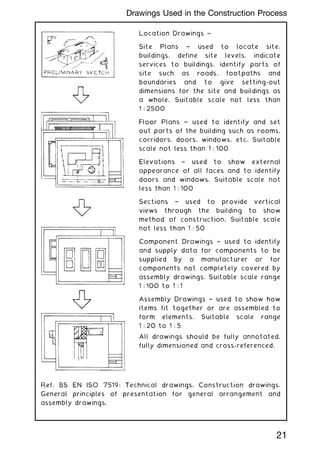
before rotation commences. Alter-
natively the vane can be driven or
jacked to the required depth, the
vane being protected within a special
protection shoe. The vane is then
driven or jacked a further 500 mm
before rotation commences.
Calculation of Shear Strength †
Formula: S =
M
K
where S = shear value in kN/m2
M = torque required to shear soil
K = constant for vane
= 3„66 D3
✕ 10†6
D = vane diameter
105
Soil Assessment and Testing
Unconfined Compression Test ~ this test can be used to establish
the shear strength of a non-fissured cohesive soil sample using
portable apparatus either on site or in a laboratory. The 75 mm
long ✕ 38 mm diameter soil sample is placed in the apparatus and
loaded in compression until failure occurs by shearing or lateral
bulging. For accurate reading of the trace on the recording chart a
transparent viewfoil is placed over the trace on the chart.
Typical Results ~ showing compression strengths of clays:
Very soft clay † less than 25 kN/m2
Soft clay † 25 to 50 kN/m2
Medium clay † 50 to 100 kN/m2
Stiff clay † 100 to 200 kN/m2
Very stiff clay † 200 to 400 kN/m2
Hard clay † more than 400 kN/m2
NB. The shear strength of clay soils is only half of the compression
strength values given above.
106
Soil Assessment and Testing
Laboratory Testing ~ tests for identifying and classifying soils with
regard to moisture content, liquid limit, plastic limit, particle size
distribution and bulk density are given in BS 1377.
Bulk Density ~ this is the mass per unit volume which includes mass
of air or water in the voids and is essential information required for
the design of retaining structures where the weight of the retained
earth is an important factor.
Shear Strength ~ this soil property can be used to establish its
bearing capacity and also the pressure being exerted on the
supports in an excavation. The most popular method to establish
the shear strength of cohesive soils is the Triaxial Compression
Test. In principle this test consists of subjecting a cylindrical
sample of undisturbed soil (75 mm long ✕ 38 mm diameter) to a
lateral hydraulic pressure in addition to a vertical load. Three tests
are carried out on three samples (all cut from the same large
sample), each being subjected to a higher hydraulic pressure before
axial loading is applied. The results are plotted in the form of
Mohr's circles.
107
Soil Assessment and Testing
Shear Strength ~ this can be defined as the resistance offered by a
soil to the sliding of one particle over another. A simple method of
establishing this property is the Shear Box Test in which the
apparatus consists of two bottomless boxes which are filled with
the soil sample to be tested. A horizontal shearing force (S) is
applied against a vertical load (W), causing the soil sample to shear
along a line between the two boxes.
Consolidation of Soil ~ this property is very important in
calculating the movement of a soil under a foundation. The
laboratory testing apparatus is called an Oedometer.
108
Soil Assessment and Testing
Shrinkable Soils ~ soils subject to volume changes due to variation
in moisture content. Pages 245 to 248 show the causes and effects
of soil swelling and shrinkage.
Shrinkable Soil Classification ~
•  35% fine particles.
• Plasticity index (PI) ‡ 10%.
Fine Particles ~ minute portions of clay (loam) or silt having a
nominal diameter of  60 m (0.06mm).
Plasticity Index (PI) ~ a numerical measure of the potential for a
soil to change in volume. Can be determined by the Atterberg*
limits test on fine particles  425 m (0.425mm). Particles greater
than this are removed by sieving.
PI = Liquid limit (LL) -
- Plastic limit ðPLÞ
plastic
limit (PL)
non-plastic plastic viscous fluid
plasticity
index (PI)
percentage water content
Note: See next page for PL and LL
liquid
limit (LL)
Soils with a high PI tend to be mainly composed of clay, those with
a low PI, of silt.
Plasticity index (PI) Characteristic plastic quality
0 None
1 † 5 Slight
5 † 10 Low
10 † 20 Medium
20 † 40 High
 40 Very high
*Albert Atterberg (1846 † 1916) Swedish chemist.
109
Soil Assessment and Testing
Modified Plasticity Index (MPI) ~ a variation of the plasticity index
as shown by formula:
MPI = PI  % of soil particles  425  m … 100
MPI (%) Soil volume change potential
‡ 40 High
20 † 40 Medium
10 † 20 Low
Atterberg Limits Test ~ (liquid limit and plastic limit) for fine
grained soil. As shown on the previous page, determines the state
of a soil in terms of non-plastic, plastic and viscous fluid.
Plastic Limit ~ a simple test established by hand rolling a sample of
soil on a flat non-porous surface. Soil is defined as plastic when the
sample retains its shape down to a very small diameter. The plastic
limit occurs when the slender thread of soil breaks apart at a
diameter of about 3mm. Considered non-plastic if the thread of soil
cannot be rolled down to 3mm at any moisture content. A measure
of the relatively low water content at which a soil changes from a
plastic state to a solid state.
Liquid Limit ~ water or moisture content when a soil sample
changes from plastic to liquid behavioural characteristics. Can also
be regarded as the relatively high water content at which soil
changes from a liquid to a plastic state.
Atterberg's Original Test Procedure ~ pat of clay soil placed in a
porcelain bowl and a groove cut through the middle of the sample.
By hand striking the bowl several times the relative characteristics
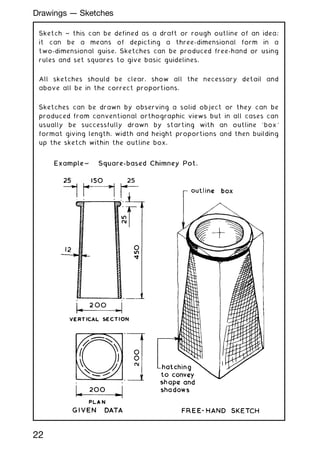
of different clay soils could be measured by the number of blows
required to close the groove. This arbitrary test process was later
standardised following experimental research attributed to Arthur
Casagrande. His procedure quantified and defined results for liquid
limit, as outlined on the next page.
110
Soil Assessment and Testing
Casagrande's Modified Test ~ a refinement of Atterberg's test
using a metal bowl of about 100 mm diameter known as a
Casagrande* cup. Into this the soil sample is placed and a 13 mm
standard groove cut through the middle. By rotating a cam, the
cup drops 10 mm onto a rubber base. Liquid limit is determined by
measuring the moisture content (MC) of samples when the groove
closes at 25 drops of the cup.
MC =
Mass of moist sample † Mass of dried sample
Mass of dried sample
✕
100
1
Eg. A soil sample of wet mass 200 grams having an oven dried
mass of 168 grams.
MC =
200 † 168
168
✕
100
1
= 19%
Casagrande Cup Test Apparatus ~
metal bowl or
Casagrande cup
scroll cam
handle
10 mm
13 mm groove
cohesive
soil sample
rubber base
*Arthur Casagrande (1902 † 1981) Australian born American geo-
physicist. Also associated with development of the oedometer,
shear box and triaxial shear compression tests.
111
Soil Assessment and Testing
General Considerations ~ before any specific considerations and
decisions can be made regarding site layout a general appreciation
should be obtained by conducting a thorough site investigation at
the pre-tender stage and examining in detail the drawings,
specification and Bill of Quantities to formulate proposals of how
the contract will be carried out if the tender is successful. This will
involve a preliminary assessment of plant, materials and manpower
requirements plotted against the proposed time scale in the form
of a bar chart (see page 37).
Access Considerations ~ this must be considered for both on- and
off-site access. Routes to and from the site must be checked as
to the suitability for transporting all the requirements for the
proposed works. Access on site for deliveries and general
circulation must also be carefully considered.
112
Site Layout Considerations
Storage Considerations ~ amount and types of material to be
stored. Security and weather protection requirements. Allocation of
adequate areas for storing materials and allocating adequate
working space around storage areas. Siting of storage areas to
reduce double handling to a minimum without impeding the general
site circulation and/or works in progress.
Accommodation Considerations ~ number and type of site staff
anticipated. Calculate size and select units of accommodation and
check to ensure compliance with the minimum welfare requirements
of the Construction (Design and Management) Regulations. Select
siting for offices to give easy and quick access for visitors but at
the same time giving a reasonable view of the site. Select siting for
mess room and toilets to reduce walking time to a minimum without
impeding the general site circulation and/or works in progress.
Temporary Services Considerations ~ what, when and where are
they required? Possibility of having permanent services installed at
an early stage and making temporary connections for site use
during the construction period. Coordination with the various
service undertakings is essential.
Plant Considerations ~ what plant, when and where is it required?
Static or mobile plant? If static select the most appropriate
position and provide any necessary hardstanding. If mobile check
on circulation routes for optimum efficiency and suitability. Provision
of space and hardstanding for on-site plant maintenance if
required.
Fencing and Hoarding Considerations ~ what is mandatory and what
is desirable? Local vandalism record, type or types of fence and/or
hoarding required, possibility of using fencing which is part of the
contract by erecting this at an early stage in the contract.
Safety and Health Considerations ~ check to ensure that outcome
of the above considerations comply with the minimum requirements
set out in the various Construction Regulations and in the Health
and Safety at Work, etc. Act 1974.
NB. For a typical site layout example see next page.
113
Site Layout Considerations
114
Site Layout Considerations
Site Security ~ the primary objectives of site security are:
1 . Security against theft.
2. Security from vandals.
3. Protection from innocent trespassers.
The need for and type of security required will vary from site to
site according to the neighbourhood, local vandalism record and
the value of goods stored on site. Perimeter fencing, internal site
protection and night security may all be necessary.
115
Site Security
Hoardings ~ under the Highways Act 1980 a close-boarded fence
hoarding must be erected prior to the commencement of building
operations if such operations are adjacent to a public footpath or
highway. The hoarding needs to be adequately constructed to
provide protection for the public, resist impact damage, resist
anticipated wind pressures and adequately lit at night. Before a
hoarding can be erected a licence or permit must be obtained from
the local authority who will usually require 10 to 20 days' notice.
The licence will set out the minimum local authority requirements
for hoardings and define the time limit period of the licence.
116
Hoardings
117
Hoardings
Site Lighting ~ this can be used effectively to enable work to continue
during periods of inadequate daylight. It can also be used as a deterrent
to would-be trespassers. Site lighting can be employed externally to
illuminate the storage and circulation areas and internally for general
movement and for specific work tasks. The types of lamp available
range from simple tungsten filament lamps to tungsten halogen and
discharge lamps. The arrangement of site lighting can be static where
the lamps are fixed to support poles or mounted on items of fixed plant
such as scaffolding and tower cranes. Alternatively the lamps can be
sited locally where the work is in progress by being mounted on
a movable support or handheld with a trailing lead. Whenever the
position of site lighting is such that it can be manhandled it should be run
on a reduced voltage of 110 V single phase as opposed to the mains
voltage of 230 V.
To plan an adequate system of site lighting the types of activity
must be defined and given an illumination target value which is
quoted in lux (lx). Recommended minimum target values for building
activities are:
Such target values do not take into account deterioration, dirt or
abnormal conditions; therefore it is usual to plan for at least twice
the recommended target values. Generally the manufacturers will
provide guidance as to the best arrangement to use in any
particular situation but lamp requirements can be calculated thus:
Total lumens
required
=
area to be illluminated (m
2
) ✕ t arg et value (lx)
utilisation factor 0„23 [dispersive lights 0„27]
After choosing lamp type to be used:
Number of
lamps required
=
total lumens required
lumen output of chosen lamp
118
Site Lighting
Typical Site Lighting Arrangement:
Typical minimum heights for dispersive lamps:
Fluorescent 40 to 125 W † 2„500 m; Tungsten filament 300 W † 3„000 m.
119
Site Lighting
Walkway and Local Lighting ~ to illuminate the general circulation
routes bulkhead and/or festoon lighting could be used either on a
standard mains voltage of 230 V or on a reduced voltage of 110 V.
For local lighting at the place of work hand lamps with trailing
leads or lamp fittings on stands can be used and positioned to give
the maximum amount of illumination without unacceptable shadow
cast.
120
Site Lighting
Electrical Supply to Building Sites ~ a supply of electricity is usually
required at an early stage in the contract to provide light and power to
the units of accommodation. As the work progresses power could also
be required for site lighting, handheld power tools and large items of
plant. The supply of electricity to a building site is the subject of a
contract between the contractor and the local area electricity
company who will want to know the date when supply is required; site
address together with a block plan of the site; final load demand of
proposed building and an estimate of the maximum load demand in
kilowatts for the construction period. The latter can be estimated by
allowing 10 W/m2
of the total floor area of the proposed building plus an
allowance for high load equipment such as cranes. The installation
should be undertaken by a competent electrical contractor to ensure
that it complies with all the statutory rules and regulations for the
supply of electricity to building sites.
The units must be strong, durable and resistant to rain penetration
with adequate weather seals to all access panels and doors. All
plug and socket outlets should be colour coded: 400 V † red; 230 V
† blue; 110 V † yellow.
121
Electrical Supply to Building Sites
Office Accommodation ~ the arrangements for office
accommodation to be provided on site is a matter of choice for
each individual contractor. Generally, separate offices would be
provided for site agent, clerk of works, administrative staff, site
surveyors and sales staff.
The minimum requirements of such accommodation are governed by
the Offices, Shops and Railway Premises Act 1963 unless they are:
1 . Mobile units in use for not more then six months.
2. Fixed units in use for not more than six weeks.
3. Any type of unit in use for not more than 21 man hours per
week.
4. Office for exclusive use of self-employed person.
5. Office used by family-only staff.
Sizing Example ~
Office for site agent and assistant plus an allowance for three
visitors.
Assume an internal average height of 2„400.
Allow 3„7 m2
minimum per person and 11„5 m3
minimum per person.
Minimum area = 5 ✕ 3„7 = 18„5 m2
Minimum volume = 5 ✕ 11„5 = 57„5 m3
Assume office width of 3„000 then minimum length required is
=
57„5
3 ✕ 2„4
=
57„5
7„2
= 7„986 say 8„000
Area check 3 ✕ 8 = 24 m2
which is  18„5 m2
∴ satisfactory
Typical Example ~
Portable cabin with four
adjustable steel legs with
attachments for stacking.
Panelling of galvanised steel
sheet and rigid insulation core.
Plasterboard inner lining to walls
and ceiling. Pyro-shield windows
with steel shutters and a high
security steel door.
Ref. Fire prevention on construction sites † the joint code of
practice on protection from fire of construction sites and buildings
undergoing renovation. Published by Construction Industry
Publications and The Fire Protection Association.
122
Site Office Accommodation
Applicable where the work is notifiable to the HSE, i.e. work extends
to more than 30 days or it involves more than 500 person days.
First aid:
• box readily accessible and distinctly marked.
• contents sufficient for the number of persons on site.
• person appointed with responsibility for first aid facilities and
calls to emergency ambulance service (not necessarily a qualified
first aider).
• information displayed confirming name of appointed person.
• person trained (first aider) in first aid at work holding an HSE
recognised FAW qualification or an emergency first aid at work
EFAW qualification.
Sanitary facilities ~
• toilets, separate male and female if possible.
• lockable doors.
Minimum where men and women are employed:
Minimum where only men are employed:
Portable toilets for use where there is no plumbing and drainage,
at least one per seven persons, emptied at least once a week.
No. of site personnel Minimum requirements
 5 One appointed person preferably trained in
first aid
5 † 50 One trained in EFAW or FAW depending on
assessment of possible injuries
 50 One trained in FAW for every 50 persons or
part thereof
No. of persons on site No. of WCs No. of washbasins
 5 1 1
6 † 25 2 2
Thereafter an additional WC and basin for every 25 persons.
No. of men on site No. of WCs No. of urinals
1 † 15 1 1
16 † 30 2 1
31 † 45 2 2
46 † 60 3 2
61 † 75 3 3
76 † 90 4 3
91 † 100 4 4
123
Site Health and Welfare Provision (1)
Washing facilities:
• next to toilets and changing areas.
• hot and cold water or mixed warm water.
• soap, towels or hot air dryer.
• adequate ventilation and lighting.
• washbasins large enough to wash face, hands and forearms.
• showers for particularly dirty work.
Drinking water:
• wholesome supply direct from the mains.
• bottled water acceptable if mains supply unavailable.
• cups or other drinking vessels at outlets or a drinking fountain.
Accommodation for rest, shelter, changing and eating:
• separate provisions if men and women are on site.
• located close to washing facilities.
• heated place for shelter from inclement weather.
• space for changing with security for personal clothing, etc.
• lockers and/or place to hang clothes.
• place for wet clothing to be dried.
• rest facilities with tables and raised-back chairs.
• ventilation and lighting.
• means for heating water and warming food unless a separate
provision is made for providing meals.
Note: All facilities to be cleaned regularly and serviced with soap,
paper, towels, etc.
Refs.: Health and Safety at Work, etc. Act 1974.
Construction (Design and Management) Regulations 2007
[incorporating the Construction (Health, Safety and Welfare)
Regulations of 1996].
Health and Safety (First Aid) Regulations 1981.
Workplace (Health, Safety and Welfare) Regulations 1992.
Management of Health and Safety at Work Regulations 1999.
See also requirements and responsibilities for personal protective
equipment and clothing summarised on the next page.
124
Site Health and Welfare Provision (2)
Definition ~ `all equipment (including clothing affording protection
against the weather) which is intended to be worn or held by a
person at work which protects them against one or more risks
to their health and safety.' Personal Protective Equipment
Regulations.
Provision ~ by an employer at no cost to employees. Self-employed
to provide their own, unless in an employer†employee relationship.
Types of PPE generally required ~
Face and eyes:
• disposable face masks.
• respirators/breathing apparatus (special training required).
• air-fed helmets (special training required).
• safety glasses, similar to ordinary glasses, may have side
shields.
• shield, one-piece moulded lens worn over other glasses.
• goggles, flexible plastic frame with elastic headband.
• face guard, shield or visor to fully enclose the eyes from dust,
etc.
Hearing:
• earmuffs † helmet mounted available.
• earplugs and ear inserts (canal caps).
Legs and feet:
• safety boots/shoes, steel toe cap and slip-resistant sole.
• Wellington boots, steel toe cap and studded soles available.
• anti-static electricity insulated footwear.
• knee pads, gaiters, leggings and spats.
Body:
• high visibility waistcoats.
• overalls, coveralls and boiler suits.
• aprons, chain mail or leather.
• life jackets.
• safety harnesses.
• insulated and waterproof clothing.
Hands:
• gloves, waterproof and/or insulating.
• gauntlets.
• armlets and wristcuffs.
Risk assessment ~
Hazard † any situation that has the potential to harm.
Risk † possibility of damage, injury or loss caused by a hazard.
Responsibility † all persons in and associated with the work place.
125
Personal Protective Equipment (PPE)
Site Storage ~ materials stored on site prior to being used or fixed
may require protection for security reasons or against the adverse
effects which can be caused by exposure to the elements.
Small and Valuable Items ~ these should be kept in a secure and
lockable store. Similar items should be stored together in a rack or
bin system and only issued against an authorised requisition.
Large or Bulk Storage Items ~ for security protection these items
can be stored within a lockable fenced compound. The form of
fencing chosen may give visual security by being of an open nature
but these are generally easier to climb than the close-boarded type
of fence which lacks the visual security property.
Typical Storage Compound Fencing ~
Close-boarded fences can be constructed on the same methods
used for hoardings † see pages 116  117.
Alternative Fence Types ~ woven wire fence, strained wire fence,
cleft chestnut pale fence, wooden palisade fence, wooden post and
rail fence and metal fences † see BS 1722: Fences, for details.
126
Site Storage
Storage of Materials ~ this can be defined as the provision of
adequate space, protection and control for building materials and
components held on site during the construction process. The
actual requirements for specific items should be familiar to students
who have completed studies in construction technology at an
introductory level but the need for storage and control of
materials held on site can be analysed further:
1 . Physical Properties † size, shape, weight and mode of delivery
will assist in determining the safe handling and stacking
method(s) to be employed on site, which in turn will enable
handling and storage costs to be estimated.
2. Organisation † this is the planning process of ensuring that
all the materials required are delivered to site at the correct
time, in sufficient quantity, of the right quality, the means of
unloading is available and that adequate space for storage or
stacking has been allocated.
3. Protection † building materials and components can be
classified as durable or non-durable; the latter will usually
require some form of weather protection to prevent
deterioration whilst in store.
4. Security † many building materials have a high resale and/or
usage value to persons other than those for whom they were
ordered and unless site security is adequate material losses
can become unacceptable.
5. Costs † to achieve an economic balance of how much
expenditure can be allocated to site storage facilities the
following should be taken into account:
• storage areas, fencing, racks, bins, etc.
• protection requirements.
• handling, transporting and stacking requirements.
• salaries and wages of staff involved in storage of materials
and components.
• heating and/or lighting if required.
• allowance for losses due to wastage, deterioration,
vandalism and theft.
• facilities to be provided for subcontractors.
6. Control † checking quality and quantity of materials at
delivery and during storage period, recording delivery and
issue of materials and monitoring stock holdings.
127
Materials Storage
Site Storage Space ~ the location and size(s) of space to be
allocated for any particular material should be planned by
calculating the area(s) required and by taking into account all the
relevant factors before selecting the most appropriate position on
site in terms of handling, storage and convenience. Failure to carry
out this simple planning exercise can result in chaos on site or
having on site more materials than there is storage space available.
Calculation of Storage Space Requirements ~ each site will present
its own problems since a certain amount of site space must be
allocated to the units of accommodation, car parking, circulation
and working areas, therefore the amount of space available for
materials storage may be limited. The size of the materials or
component being ordered must be known together with the
proposed method of storage and this may vary between different
sites of similar building activities. There are therefore no standard
solutions for allocating site storage space and each site must be
considered separately to suit its own requirements.
Typical Examples ~
Bricks † quantity = 15,200 to be delivered in strapped packs of 380
bricks per pack each being 1100 mm wide ✕ 670 mm long ✕ 850 mm
high. Unloading and stacking to be by forklift truck to form two rows
two packs high.
Area required:- number of packs per row =
15,200
380 ✕ 2
= 20
length of row = 10 ✕ 670 = 6„700
width of row = 2 ✕ 1100 = 2„200
allowance for forklift approach in front of stack = 5„000 ∴ minimum
brick storage area = 6„700 long ✕ 7„200 wide
Timber † to be stored in open-sided top covered racks constructed
of standard scaffold tubes. Maximum length of timber ordered =
5„600. Allow for rack to accept at least 4 No. 300 mm-wide
timbers placed side by side then minimum width required = 4 ✕ 300
= 1„200
Minimum plan area for timber storage rack = 5„600 ✕ 1„200
Allow for end loading of rack equal to length of rack
∴ minimum timber storage area = 11„200 long ✕ 1„200 wide
Height of rack to be not more than 3 ✕ width = 3„600
Areas for other materials stored on site can be calculated using
the basic principles contained in the examples above.
128
Materials Storage
Site Allocation for Materials Storage ~ the area and type of
storage required can be determined as shown on pages 126 to 128,
but the allocation of an actual position on site will depend on:
1 . Space available after areas for units of accommodation have
been allocated.
2. Access facilities on site for delivery, vehicles.
3. Relationship of storage area(s) to activity area(s) † the
distance between them needs to be kept as short as possible
to reduce transportation needs in terms of time and costs to
the minimum. Alternatively storage areas and work areas need
to be sited within the reach of any static transport plant
such as a tower crane.
4. Security † needs to be considered in the context of site
operations, vandalism and theft.
5. Stockholding policy † too little storage could result in delays
awaiting materials to be delivered, too much storage can be
expensive in terms of weather and security protection
requirements apart from the capital used to purchase the
materials stored on site.
NB. temporary site services omitted for clarity.
129
Materials Storage
Bricks ~ may be supplied loose or strapped in unit loads and stored
on timber pallets
130
Materials Storage
Drainage Pipes ~ supplied loose or strapped together on timber
pallets
Gullies, etc. should be stored upside down and supported to remain
level
Cement, Sand and Aggregates ~ for supply and storage details see
pages 326 and 332.
131
Materials Storage
Site Tests ~ the majority of materials and components arriving on
site will conform to the minimum recommendations of the
appropriate British Standard and therefore the only tests which
need to be applied are those of checking quantity received against
amount stated on the delivery note, ensuring quality is as ordered
and a visual inspection to reject damaged or broken goods. The
latter should be recorded on the delivery note and entered in the
site records. Certain site tests can however be carried out on some
materials to establish specific data such as the moisture content of
timber which can be read direct from a moisture meter. Other
simple site tests are given in the various British Standards to
ascertain compliance with the recommendations, such as tests for
dimensional tolerances and changes given in BS EN 771-1 and BS EN
772-16 which cover random sampling of clay bricks of up to 10
units. An alternative site test can be carried out by measuring a
sample of 24 bricks taken at random from a delivered load thus:
Refs.: BS EN 772-16: Methods of test for masonry units.
BS EN 771-1: Specification for masonry units.
132
Materials Testing
Site Test ~ apart from the test outlined on page 132 site tests on
materials which are to be combined to form another material such
as concrete can also be tested to establish certain properties
which if not known could affect the consistency and/or quality of
the final material.
Typical Example ~ Testing Sand for Bulking
This data is required when batching concrete by volume † test
made at commencement of mixing and if change in weather
Therefore volume of sand should be increased by 21% over that
quoted in the specification.
NB. a given weight of saturated sand will occupy the same space as
when dry but more space when damp.
133
Materials Testing
Silt Test for Sand ~ the object of this test is to ascertain the
cleanliness of sand by establishing the percentage of silt present in
a natural sand since too much silt will weaken the concrete
Obtaining Samples for Laboratory Testing ~ these tests may be
required for checking aggregate grading by means of a sieve test,
checking quality or checking for organic impurities, but whatever
the reason the sample must be truly representative of the whole:
134
Materials Testing
The quality of site mixed concrete should be monitored, especially
to ensure uniformity of mix components and consistency of
batches. When constituents are known to be constant by design,
the water/cement ratio of consecutive batches can be compared by
using a slump test. Water for hydration is about one quarter of the
cement weight, but if a w/c ratio of 0.25 were used the mix would
be too stiff and unworkable. Therefore, a w/c ratio of 0.5 is more
usual; the additional water providing a lubricant for the aggregates
and cement. Increasing the w/c ratio above 0.5 will make the
concrete easier to work, but it will be detrimental to the final
compressive strength (see page 329) unless other measures are
incorporated to counter this, e.g. steel or fabric reinforcement.
Slump Test Equipment ~ shown below, an open ended frustum of a
cone, tamping rod and a rule. Dimensions in mm.
metal plate
lifting
handle
slumped
concrete
sample
measured
slump
600 long
x 16 diameter
tamping rod
inverted slump
cone
tamping rod
rule
steel
slump
cone
100
foot rests
200
300
Procedure ~ the cone is one-quarter filled with concrete and
tamped 25 times. Further filling and tamping is repeated three more
times until the cone is full and the sample levelled off. The cone is
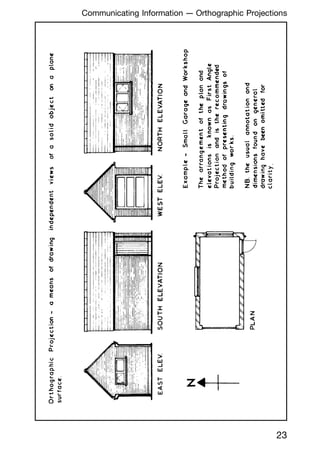
removed and the concrete slump measured. The measurement
should be consistent for all samples of concrete being used in the
same situation.
Typical Slump Specification ~ generally between 50 and 100 mm
depending on application. See page 331 for slump consistency
classes applicable to standard prescribed site batched concrete
mixes.
Ref. BS EN 12350-2: Testing fresh concrete. Slump test.
135
Materials Testing
Procedure for Testing Batched Concrete from Source ~
• Wet concrete samples extracted from the mixer batch are placed
into machine faced steel casting moulds in 50mm layers.
• Each layer compacted at least 35 times (150mm cube) or 25
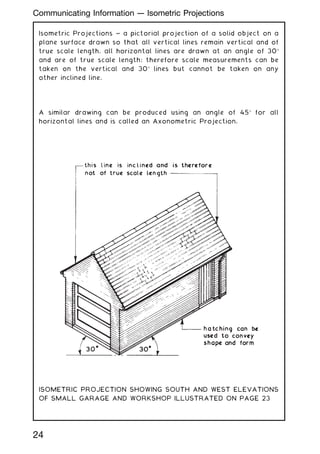
times (100mm cube) with a tamping bar.
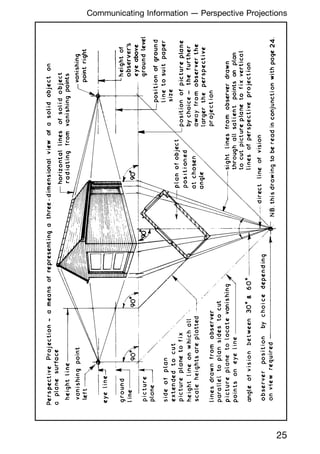
• Alternatively, each layer may be consolidated by external
vibration from an electric or pneumatic hammer.
• Surplus concrete trowelled off and samples marked with time,
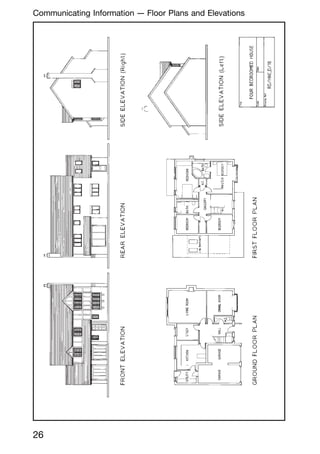
date and job reference.
• Samples left for 24 hours – 30 minutes and covered with a damp cloth.
• After 24 hours, samples removed from moulds and submersed in
water at 20C – 2C.
• At 7 days, hydraulic compression test applied to sample cubes
to determine stress failure strength.
• If strength specification not achieved, other samples from the
same batch tested at 28 days.
• If 28 day samples fail compressive strength requirement, core samples
may be taken from placed concrete for further laboratory analysis.
Equipment ~
hydraulic pressure
applied to the sides
of sample as cast
25 x 25mm square end
tamping bar
pressure
gauge
test
cube
sample
before
test
sample
after stress
failure
smooth
plane
steel
plates
380
mm
concrete sample with
trowelled surface
and identification
150 x 150 x 150mm standard
steel test cube mould thinly
coated inside with oil, if
aggregate ⱹ 20mm a 100mm
cube mould may be used
28 day characteristic crushing strength categories below which not
more than 5% of test results are permitted to fail, are: 7.5, 10, 15,
20, 25, 30 and 35 N/mm2
. 40, 45 and 50 N/mm2
are also specified,
mainly for prestressed reinforced concrete.
Ref. BS EN 12390-1: Testing hardened concrete. Shape, dimensions
and other requirements for specimens and moulds.
136
Materials Testing
Non-destructive testing of concrete. Also known as in-place or
in-situ tests.
Changes over time and in different exposures can be monitored.
References: BS 6089: Assessment of in-situ compressive strength in
structures and precast concrete components.
BS 1881: Testing concrete.
BS EN 13791: Assessment of in-situ compressive strength
in structures and precast concrete components.
Provides information on: strength in-situ, voids, flaws, cracks and
deterioration.
Rebound hammer test † attributed to Ernst Schmidt after he
devised the impact hammer in 1948. It works on the principle of an
elastic mass rebounding off a hard surface. Varying surface
densities will affect impact and propagation of stress waves. These
can be recorded on a numerical scale known as rebound numbers. It
has limited application to smooth surfaces of concrete only. False
results may occur where there are local variations in the concrete,
such as a large piece of aggregate immediately below the impact
surface. Rebound numbers can be graphically plotted to correspond
with compressive strength.
Ref. BS EN 12504-2: Testing concrete in structures. Non-destructive
testing. Determination of rebound number.
137
Materials Testing --- Concrete
Penetration or Windsor probe test ~ there are various
interpretations of this test. It is a measure of the penetration of a
steel alloy rod, fired by a predetermined amount of energy into
concrete. In principle, the depth of penetration is inversely
proportional to the concrete compressive strength. Several
recordings are necessary to obtain a fair assessment and some can
be discarded particularly where the probe cannot penetrate some
dense aggregates. The advantage over the rebound hammer is
provision of test results at a greater depth (up to 50 mm).
Pull-out test ~ this is not entirely non-destructive as there will be
some surface damage, albeit easily repaired. A number of circular
bars of steel with enlarged ends are cast into the concrete as work
proceeds. This requires careful planning and location of bars with
corresponding voids provided in the formwork. At the appropriate
time, the bar and a piece of concrete are pulled out by tension
jack. Although the concrete fails in tension and shear, the pull-out
force can be correlated to the compressive strength of the
concrete.
Ref. BS 1881†207: Testing concrete. Recommendations for the
assessment of concrete strength by near-to-surface tests.
138
Materials Testing --- Concrete
Vibration test ~ a number of electronic tests have been devised,
which include measurement of ultrasonic pulse velocity through
concrete. This applies the principle of recording a pulse at
predetermined frequencies over a given distance. The apparatus
includes transducers in contact with the concrete, pulse generator,
amplifier, and time measurement to digital display circuit. For
converting the data to concrete compressive strength, see BS EN
12504-4: Testing concrete. Determination of ultrasonic pulse
velocity.
A variation, using resonant frequency, measures vibrations
produced at one end of a concrete sample against a receiver or
pick up at the other. The driving unit or exciter is activated by a
variable frequency oscillator to generate vibrations varying in
resonance, depending on the concrete quality. The calculation of
compressive strength by conversion of amplified vibration data is
by formulae found in BS 1881-209: Testing concrete.
Recommendations for the measurement of dynamic modulus of
elasticity.
Other relevant standards:
BS 1881-122: Testing concrete. Method for determination of water
absorption.
BS 1881-124: Testing concrete. Methods for analysis of hardened
concrete.
BS EN 12390-7: Testing hardened concrete. Density of hardened
concrete.
139
Materials Testing --- Concrete
The quality of softwood timber for structural use depends very much
on the environment in which it is grown and the species selected. Timber
can be visually strength graded, but this is unlikely to occur at the
construction site except for a general examination for obvious
handling defects and damage during transit. Site inspection will be to
determine that the grading authority
's markings on the timber comply
with that specified for the application.
Format of strength grade markings on softwood timber for
structural uses ~
accredited certification
authority (see below)*
accredited certification
authority (see below)*
grader or company
licence number
grader or company
licence number
European
whitewood/
redwood
British spruce
grade † general structural
(SS = special structural)
kiln dried
British Standard
quality reference
*Accredited certification authorities include
BM TRADA Certification Ltd. and Certification And Timber Grading Ltd.
alternative
condition indicator
BS strength
class
KD
Refs.: BS 4978: Visual strength grading of softwood. Specification.
BS EN 14081: Timber structures. Strength graded structural
timber with rectangular cross section (four parts).
140
Materials Testing --- Softwood Timber
Grading ~ either visually or by computerised machine. Individual
rectangular timber sections are assessed against permissible defect
limitations and grade marked accordingly.
UK grading standard ~ BS 4978.
European grading standard ~ BS EN 14081 (four parts).
The two principal grades apart from rejects are GS (general structural)
and SS (special structural) preceded with an M if graded by machine.
Additional specification is to BS EN 338: Structural timber.
Strength classes. This standard provides softwood strength
classifications from C14 to C40 as well as a separate classification
of hardwoods.
A guide to softwood grades with strength classes for timber from
the UK, Europe and North America ~
Source/species Strength class (BS EN 338)
C14 C16 C18 C22 C24 C27 C30
UK:
British pine GS SS
British spruce GS SS
Douglas fir GS SS
Larch GS SS
Ireland:
Sitka and Norway
spruce
GS SS
Europe:
Redwood or white-
wood
GS SS
USA:
Western whitewood GS SS
Southern pine GS SS
USA/Canada:
Spruce/pine/fir or
hemlock
GS SS
Douglas fir and larch GS SS
Canada:
Western red cedar GS SS
Sitka spruce GS SS
141
Materials Testing --- Softwood Timber Classification
BS
EN
338
strength
class
Bending
parallel
to
grain
(N/mm
2
)
Tension
parallel
to
grain
(N/mm
2
)
Compres-
sion
parallel
to
grain
(N/mm
2
)
Compres-
sion
per-
pendicular
to
grain
(N/mm
2
)
Shear
parallel
to
grain
(N/mm
2
)
Modulus
of
elasticity
Charac-
teristic
density
(kg/m
3
)
Average
density
(kg/m
3
)
Mean
(N/mm
2
)
Minimum
(N/mm
2
)
C14
4.1
2.5
5.2
2.1
0.60
6800
4600
290
350
C16
5.3
3.2
6.8
2.2
0.67
8800
5800
310
370
C18
5.8
3.5
7.1
2.2
0.67
9100
6000
320
380
C22
6.8
4.1
7.5
2.3
0.71
9700
6500
340
410
C24
7.5
4.5
7.9
2.4
0.71
10800
7200
350
420
TR26
10.0
6.0
8.2
2.5
1.10
11000
7400
370
450
C27
10.0
6.0
8.2
2.5
1.10
12300
8200
370
450
C30
11.0
6.6
8.6
2.7
1.20
12300
8200
380
460
C35
12.0
7.2
8.7
2.9
1.30
13400
9000
400
480
C40
13.0
7.8
8.7
3.0
1.40
14500
10000
420
500
Notes:
1.
Strength
class
TR26
is
specifically
for
the
manufacture
of
trussed
rafters.
2.
Characteristic
density
values
are
given
specifically
for
the
design
of
joints.
Average
density
is
appropriate
for
calculation
of
dead
load.
3.
For
a
worked
example
of
a
softwood
timber
joist/beam
design
using
data
for
strength
classification
C24
(e.g.
SS
graded
European
redwood)
see
pages
777
and
778.
BS
EN
338:
Structural
softwood
classifications
and
typical
strength
properties
~
142
Materials Testing --- Softwood Timber Properties
Visual strength grading ~ `process by which a piece of timber can
be sorted, by means of visual inspection, into a grade to which
characteristic values of strength, stiffness and density may be
allocated.' Definition from BS EN 14081-1.
Characteristics:
Knots ~ branch growth from or through the main section of timber
weakening the overall structural strength. Measured by comparing
the sum of the projected cross sectional knot area with the cross-
sectional area of the piece of timber. This is known as the knot
area ratio (KAR). Knots close to the edge of section have greater
structural significance; therefore this area is represented as a
margin condition at the top and bottom quarter of a section. A
margin condition exists when more than half the top or bottom
quarter of a section is occupied by knots.
MKAR = Margin knot area ratio.
TKAR = Total knot area ratio.
T
W
knots projected
Projected knots
relative to
sectional area
of timber
w
4
w
4
margin areas
each x T
w
4
w
2
143
Materials Testing --- Softwood Timber Grading (1)
Fissures and resin pockets ~ defects in growth. Fissures, also known
as shakes, are usually caused by separation of annual growth rings.
Fissures and resin pockets must be limited in structural timber as
they reduce resistance to shear and bending parallel to the grain.
A + B = fissure
size
C = fissure
size
width
and face
thickness and edge
length
of
fissure
pith
Slope of grain ~ an irregularity in growth or where the log is not
cut parallel to the grain. If excessive this will produce a weakness
in shear. Measurement is by scoring a line along the grain of the
timber surface and comparing this with the parallel sides of the
section.
grain reasonably parallel
X
1
slope of grain = 1 in X
Insect damage ~ no active allowed. Woodworm holes acceptable if
only nominal. Wood wasp holes not permitted.
Sapstain ~ acceptable.
144
Materials Testing --- Softwood Timber Grading (2)
Wane or waney edge ~ occurs on timber cut close to the outer
surface of the log producing incomplete corners. Measurement is
parallel to the edge or face of section and it is expressed as a
fraction of the surface dimension.
Growth rate ~ measurement is applied to the annual growth ring
separation averaged over a line 75mm long. If pith is present the
line should commence 25mm beyond and if 75mm is impractical to
achieve, the longest possible line is taken.
pith
A
D
B
C
25 mm
75mm
A D B
C
if pith is absent measure 75mm
through centre of the end of timber
wane is
expressed
as: A+B
C
D = 2C
3
minimum
Distortion ~ measurement over the length and width of section to
determine the amount of bow, spring and twist.
2m
2m
Bow
Spring
Twist
2m
145
Materials Testing --- Softwood Timber Grading (3)
Characteristics and tolerances of GS and SS graded timber ~
Criteria GS SS
KAR: MKAR1/2 MKAR1/2
No margin
condition
TKAR1/2 TKAR1/3
Or:
KAR: MKAR  1/2 MKAR  1/2
Margin
condition
TKAR1/3 TKAR1/5
Fissures and
resin pockets:
Defects1 /2 timber thick-
ness
Defects1 /2 timber
thickness
Not through
thickness
 1.5 m or 1/2 timber
length take lesser
 1.0 m or 1/4 timber
length take lesser
Through
thickness
 1.0 m or 1/4 timber
length take lesser
 0.5 m or 1/4 timber
length take lesser
If at ends fissure length
maximum 2 ✕ timber width
If at ends fissure
length  width of tim-
ber section
Slope of grain: Maximum 1 in 6 Maximum 1 in 10
Wane: Maximum 1/3 of the full
edge and face of the sec-
tion † length not limited
Resin pockets:
Not through
thickness
Unlimited if shorter than width of section otherwise
as for fissures
Through
thickness
Unlimited if shorter than
1/2 width of section other-
wise as for fissures
Growth rate
of annual
rings:
Average width or
growth  10mm
Average width or
growth  6mm
Distortion:
†bow  20 mm over 2m  10 mm over 2m
†spring  12 mm over 2m  8 mm over 2m
†twist  2 mm per 25mm  1 mm per 25mm
width over 2m width over 2m
146
Materials Testing --- Softwood Timber Grading (4)
Structural softwood cross-sectional size has established
terminology such as sawn, basic and unwrought as produced by
conversion of the log into commercial dimensions, e.g. 100 ✕ 50 mm
and 225 ✕ 75 mm (400
✕ 200
and 900
✕ 300
respectively, as the nearest
imperial sizes).
Timber is converted in imperial and metric sizes depending on its
source in the world. Thereafter, standardisation can be undertaken
by machine planing the surfaces to produce uniformly compatible
and practically convenient dimensions, i.e. 225 mm is not the same
as 900
. Planed timber has been variously described as nominal,
regularised and wrought, e.g. 100 ✕ 50 mm sawn becomes 97 ✕
47 mm when planed and is otherwise known as ex. 100 ✕ 50 mm,
where ex means out of.
Guidance in BS EN 336 requires the sizes of timber from a supplier
to be redefined as `Target Sizes' within the following tolerances:
T1 ~ Thickness and width100 mm, †1 to + 3 mm.
Thickness and width  100 mm, †2 to + 4 mm.
T2 ~ Thickness and width100 mm, †1 to + 1 mm.
Thickness and width  100 mm, †1.5 to + 1.5 mm.
T1 applies to sawn timber, e.g. 100 ✕ 75 mm.
T2 applies to planed timber, e.g. 97 ✕ 72 mm.
Further example ~ a section of timber required to be 195 mm planed
✕ 50 mm sawn is specified as: 195 (T2) ✕ 50 (T1).
Target sizes for sawn softwood (T1) ~
50, 63, 75, 100, 125, 150, 175, 200, 225, 250 and 300 mm.
Target sizes for planed/machined softwood (T2) ~
47, 60, 72, 97, 120, 145, 170, 195, 220, 245 and 295 mm.
Ref. BS EN 336: Structural timber. Sizes, permitted deviations.
147
Timber Sizes and Surface Finishes
Conversion ~ after timber is sawn into commercially useable
sections, it is seasoned (oven dried) to a moisture content of
between 10% and 15% depending on species.
Moisture content =
Masswhenwet -
- Masswhendried
Masswhendried  100%
Protection ~ the moisture content of seasoned timber is much less
than timber in its natural state, therefore timber will readily
absorb water if it is unprotected.
The effects of water absorption may be:
• Deformities and distortion (see page 145).
• Rot and decay (see pages 149 and 150).
• Swelling and shrinkage.
Swelling and shrinkage will be most noticeable after fixing, unless
the seasoned moisture content is maintained by correct storage at
the suppliers, on site and by adequate protection in use.
Movement ~ shrinkage occurs as wood dries below its fibre saturation
point. It will also expand if water is allowed to penetrate the open fibres.
Volume change is not the same or even proportionally the same, as
potential for movement varies directionally:
• Longitudinally † minimal, i.e. 0.1% to 0.3%.
• Transversely/radially † 2% to 6%.
• Tangentially † 5% to 10%.
tangential movement
e.g. 8% in 25mm = 2mm transverse
or radial
movement
e.g. 4% in
200 mm = 8mm
movement longitudinally
is relatively small,
e.g. 0.1% in 2 m = 2mm
148
Timber --- Moisture Movement
Damp conditions can be the source of many different types of
wood-decaying fungi. The principal agencies of decay are:
* Dry rot (Serpula lacrymans or merulius lacrymans), and
* Wet rot (Coniophora cerabella)
Dry rot † this is the most difficult to control as its root system
can penetrate damp and porous plaster, brickwork and concrete. It
can also remain dormant until damp conditions encourage its
growth, even though the original source of dampness is removed.
Appearance † white fungal threads which attract dampness from
the air or adjacent materials. The threads develop strands bearing
spores or seeds which drift with air movements to settle and
germinate on timber having a moisture content exceeding about
25%. Fruiting bodies of a grey or red flat profile may also identify
dry rot.
Typical surface appearance of dry rot †
Wet rot † this is limited in its development and must have moisture
continually present, e.g. a permanently leaking pipe or a faulty dpc.
Growth pattern is similar to dry rot, but spores will not germinate
in dry timber.
Appearance † fungal threads of black or dark-brown colour.
Fruiting bodies may be olive-green or dark brown and these are
often the first sign of decay.
Typical surface appearance of wet rot †
149
Timber Rot --- Types
Causes:
* Defective construction, e.g. broken roof tiles; no damp-proof
course.
* Installation of wet timber during construction, e.g. framing
sealed behind plasterboard linings; wet joists under floor
decking.
* Lack of ventilation, e.g. blocked air-bricks to suspended timber
ground floor; condensation in unventilated roof spaces.
* Defective water services, e.g. undetected leaks on internal
pipework; blocked or broken rainwater pipes and guttering.
General treatment:
* Remove source of dampness.
* Allow affected area to dry.
* Remove and burn all affected timber and sound timber within
500 mm of fungal attack.
* Remove contaminated plaster and rake out adjacent mortar
joints to masonry.
Note: This is normally sufficient treatment where wet rot is
identified. However, where dry rot is apparent the following
additional treatment is necessary:
* Sterilise surface of concrete and masonry.
Heat with a blow torch until the surface is too hot to touch.
Apply a proprietary fungicide† generously to warm surface.
Irrigate badly affected masonry and floors, i.e. provide 12 mm
diameter boreholes at about 500 mm spacing and flood or
pressure inject with fungicide.
† 20:1 dilution of water and sodium pentachlorophenate, sodium
orthophenylphate or mercuric chloride. Product manufacturers'
safety in handling and use measures must be observed when
applying these chemicals.
Replacement work should ensure that new timbers are pressure
impregnated with a preservative. Cement and sand mixes for
rendering, plastering and screeds should contain a zinc oxychloride
fungicide.
Further reading †
BRE: Timber pack (ref. AP 265) † various Digests, Information
Papers, Good Repair Guides and Good Building Guides.
In-situ timber treatment using timber preservatives † HSE Books.
Ref. Bldg. Regs. Approved Document C, Site preparation and
resistance to contaminants and moisture.
150
Timber Rot --- Causes, Treatment and Preservation
Trees are part of our national heritage and are also the source of
timber. To maintain this source a control over tree felling has been
established under the Forestry Act which places the control
responsibility on the Forestry Commission. Local planning authorities
also have powers under the Town and Country Planning Act and the
Town and Country Amenities Act to protect trees by making tree
preservation orders. A TPO may be applied if the LPA consider that it
is ``expedient in the interests of amenity to make provision for the
preservation of trees or woodlands in their area'' (Section 198[1] of
the Town and Country Planning Act). Before cutting down, uprooting,
severing roots, topping off, lopping, damaging or destroying a tree, a
formal application must be submitted to the LPA for consent.
Contravention of such an order can lead to a substantial fine and a
compulsion to replace any protected tree which has been removed
or destroyed. Trees on building sites which are covered by a tree
preservation order should be protected by a suitable fence.
Definition and interpretation of what constitutes a tree (e.g. trunk
diameter, overall height, etc.) will vary and may be considered
subjective. Therefore, appeals will be considered. If upheld, an
agreement for replacement trees is usual, in at least the same
quantity of the same species within the proposed development site.
Trees, shrubs, bushes and tree roots which are to be removed from
site can usually be grubbed out using handheld tools such as saws,
picks and spades. Where whole trees are to be removed for
relocation special labour and equipment is required to ensure that
the roots, root earth ball and bark are not damaged.
Ref. BS 5837: Trees in relation to design, demolition and
construction, Recommendations.
151
Protection Orders for Trees
Buildings of special historic or architectural interest are protected
by provisions in the Planning (Listed Buildings and Conservation
Areas) Act. English Heritage, funded by the Department for Culture,
Media and Sport and from donations and commercial activities, is
responsible for safeguarding and protecting the character of
buildings that could otherwise be lost through demolition or
unsympathetic alterations, extensions, modifications, refurbishment
or inadequate maintenance.
Buildings considered to be a national asset and worthy of
preservation are listed. Statutory listing applies to about half-a-
million buildings. This status places responsibility on their owners to
keep them in good order. These buildings are legally protected,
therefore proposals for development on the site that they occupy
as well as proposals for both internal and external alterations are
subject to a listed building consent being obtained from the local
planning authority.
Examples of the type of work may include the following:
• Extensions and any demolition.
• Removal of internal walls and floors.
• Changes to room layout.
• Window and door replacement.
• Painting of unpainted surfaces.
• Exposed plumbing and electrical installations.
• Alterations to internal features, e.g. doors, panelling, fireplaces.
• Changes to existing materials/colour specifications.
• Removal of finishes to expose brickwork and structural timber.
The LPA should be consulted about all proposed work. It is a
fineable offence to alter the character of listed buildings without
the necessary consent and an order can be imposed on the building
owner to rectify matters at their expense.
Categories of listing ~
Grade I: Buildings of exceptional interest.
Grade II*: Particularly important buildings of more than special
interest.
Grade II: Buildings of special interest, warranting preservation;
90% of listed buildings are in this category.
The grading applies in England and Wales. Similar provisions exist
for Northern Ireland and Scotland.
See also the Royal Commission on Historical Monuments.
152
Protection Orders for Structures
Services which may be encountered on construction sites and the
authority responsible are:
Water † Local Water Company
Electricity † transmission ~ RWE npower, EDF Energy and E-on.
distribution ~ In Britain there are 14 separate regional
grids managed by licensed independent
network operators, e.g. Electricity North
West.
Gas † Local gas or energy service providers, e.g. British Gas.
Telephones † National Telecommunications Companies, e.g. BT, and
Vodaphone.
Drainage † Local Authority unless a private drain when owner(s) is
(are) responsible.
All the above authorities must be notified of any proposed new
services and alterations or terminations to existing services before
any work is carried out.
Locating Existing Services on Site ~
Method 1 † By reference to maps and plans prepared and issued by
the respective responsible authority.
Method 2 † Using visual indicators ~
Method 3 † Detection specialist contractor employed to trace all
forms of underground services using electronic
subsurface survey equipment.
Once located, position and type of service can be plotted on a map
or plan, marked with special paint on hard surfaces and marked
with wood pegs with indentification data on earth surfaces.
153
Locating Public Utility Services
Setting Out the Building Outline ~ this task is usually undertaken
once the site has been cleared of any debris or obstructions and any
reduced-level excavation work is finished. It is usually the
responsibility of the contractor to set out the building(s) using the
information provided by the designer or architect. Accurate setting
out is of paramount importance and should therefore only be carried
out by competent persons and all their work thoroughly checked,
preferably by different personnel and by a different method.
The first task in setting out the building is to establish a baseline
to which all the setting out can be related. The baseline very often
coincides with the building line which is a line, whose position
on site is given by the local authority in front of which no
development is permitted.
154
Setting Out
Setting Out Trenches ~ the objective of this task is twofold. First,
it must establish the excavation size, shape and direction; and
second, it must establish the width and position of the walls. The
outline of building will have been set out and using this outline
profile boards can be set up to control the position, width and
possibly the depth of the proposed trenches. Profile boards should
be set up at least 2„000 clear of trench positions so that they do
not obstruct the excavation work. The level of the profile
crossboard should be related to the site datum and fixed at a
convenient height above ground level if a traveller is to be used to
control the depth of the trench. Alternatively the trench depth can
be controlled using a level and staff related to site datum. The
trench width can be marked on the profile with either nails or saw
cuts and with a painted band if required for identification.
NB. Corners of walls transferred from intersecting cord lines to
mortar spots on concrete foundations using a spirit level.
155
Setting Out
Setting Out a Framed Building ~ framed buildings are usually
related to a grid, the intersections of the grid lines being the
centre point of an isolated or pad foundation. The grid is usually
set out from a baseline which does not always form part of the
grid. Setting out dimensions for locating the grid can either be
given on a drawing or they will have to be accurately scaled off a
general layout plan. The grid is established using a theodolite and
marking the grid line intersections with stout pegs. Once the grid
has been set out offset pegs or profiles can be fixed clear of any
subsequent excavation work. Control of excavation depth can be
by means of a traveller sighted between sight rails or by level and
staff related to site datum.
156
Setting Out
Setting Out Reduced Level Excavations ~ the overall outline of the
reduced level area can be set out using a theodolite, ranging rods,
tape and pegs working from a baseline. To control the depth of
excavation, sight rails are set up at a convenient height and at
positions which will enable a traveller to be used.
157
Setting Out
Datum ~ altitude zero taken at mean sea level. This varies between
different countries, but for UK purposes it was established at
Newlyn in Cornwall from tide data recorded between May 1915 and
April 1921. Relative levels defined by bench marks are located
throughout the country. The most common are identified as
carved arrows cut into walls of permanent structures. Reference
to Ordnance Survey maps of an area will indicate bench
mark positions and their height above sea level, hence the name
Ordnance Datum (OD).
Wall inset
altitude relative to mean sea
level at Newlyn, Cornwall
masonry
wall toe of staff
Section
Section
Plan
Elevation
Horizontally set bolt
staff brass insert
ground surface
cast concrete
plinth
500
300
400
300
Taking site levels ~ the nearest OD bench mark may be impractical
to access. The alternative is to establish a datum or temporary
bench mark (TBM) from a fixture such as a manhole cover.
Otherwise, a fixed position for a TBM could be a robust post set in
concrete or a cast concrete plinth set in the ground to one side of
ongoing work.
158
Setting Out --- Datum
Instruments consist of a level (tilting or automatic) and a staff. A
tilting level is basically a telescope mounted on a tripod for stability.
Correcting screws establish accuracy in the horizontal plane by air
bubble in a vial and focus is by adjustable lens. Cross hairs of
horizontal and vertical lines indicate image sharpness on an extending
staff of 3, 4 or 5 m length. Staff graduations are in 10 mm intervals on
an ``E'' pattern as shown on the next page. Estimates are taken to the
nearest millimetre. An automatic level is much simpler to use,
eliminating the need for manual adjustment. It is approximately
levelled by centre bulb bubble. A compensator within the telescope
effects fine adjustment.
Taking levels ~ an Ordnance Datum bench mark or a temporary
bench mark is located. The levelling instrument and tripod are
positioned on firm ground and sighted to the bench mark. Further
staff height readings are taken at established positions around the
site or at measured intervals corresponding to a grid pattern at
convenient intervals, typically 10m. Each intersection of the grid
lines represents a staff position, otherwise known as a station.
Levels taken from the staff readings (4 No. from the grid corners)
are computed with the plan area calculations (100m2
for a 10m
grid). From this the volume of site excavation or cut and fill
required to level the site can be calculated.
159
Setting Out --- Levelling
160
Setting Out --- Application
Theodolite † a tripod mounted instrument designed to measure
angles in the horizontal or vertical plane.
The theodolite in principle
Measurement † a telescope provides for focal location between
instrument and subject. Position of the scope is defined by an index of
angles. The scale and presentation of angles varies from traditional
micrometer readings to computer-compatible crystal displays. Angles
are measured in degrees, minutes and seconds, e.g. 165 530
3000
.
Direct reading micrometer scale
Application † at least two sightings are taken and the readings
averaged. After the first sighting, the horizontal plate is rotated
through 180 and the scope is also rotated 180 through the
vertical to return the instrument to its original alignment for the
second reading. This process will move the vertical circle from right
face to left face, or vice versa. It is important to note the readings
against the facing † see below.
161
Setting Out --- Angles
Road Construction ~ within the context of building operations
roadworks usually consist of the construction of small estate
roads, access roads and driveways together with temporary roads
laid to define site circulation routes and/or provide a suitable
surface for plant movements. The construction of roads can be
considered under three headings:
1 . Setting out (this and next two pages).
2. Earthworks (see page 165).
3. Paving Construction (see pages 165†167).
Setting Out Roads ~ this activity is usually carried out after the
topsoil has been removed using the dimensions given on the layout
drawing(s). The layout could include straight lengths junctions,
hammer heads, turning bays and intersecting curves.
Straight Road Lengths † these are usually set out from centre
lines which have been established by traditional means
162
Road Construction (1)
Lane Width ~ established by assessment of the amount of traffic
flow and speed restriction. For convenience of road users, the
minimum width can be based on a vehicle width not exceeding
2.500 m plus an allowance for clearance of at least 0.500 m
between vehicles. This will provide an overall dimension of 5.500 m
for two-way traffic. One-way traffic will require a lane width of at
least 3.000 m.
Road Junctions ~ drivers of vehicles approaching a junction from
any direction should have a clear view of other road users.
Unobstructed visibility is required within vertical sight lines,
triangular on plan. These provide a distance and area within which
other vehicles and pedestrians can be seen at specific heights
above the carriageway. No street furniture, trees or other
obstructions are permitted within these zones, as indicated in the
diagram below and on the next page.
Vertical Sight Lines ~ vertical in height and horizontal or near
horizontal for driver and pedestrian visibility. These clear sight lines
are established between a driver's eye height of between 1.050 m
and 2.000 m to allow for varying vehicle heights, to an
object height of between 0.600 m and 2.000 m over the horizontal
plane.
eye-height sight lines
0.600
1.050
2.000
object height 0.6 to 2.0m for
drivers' and for pedestrians' clear view
163
Road Construction (2)
Horizontal Sight Lines ~ these should be provided and maintained
thereafter with a clear view, to prevent the possibility of danger
from vehicle drivers having obstructed outlook when approaching
junctions. The recommended dimensions vary relative to the
category of road classification and the speed restriction.
5.500m
footpath preferably
outside sight line
sight line or visibility splay
6.750m
local distributor or major road
B B
A
minor
road
or
access
Guidance for dimensions A and B ~
Type of road Min. dimension A (m)
Access to a single dwelling or a small
development of about half-a-dozen units 2.0
Minor road junctions within developed areas 2.4
Minor road junctions at local distributor roads 4.5
Busy minor road junctions, access roads, district
or local distributor roads and other major
junctions 9.0
Speed restriction mph (kph) Min. major road dimension B (m)
20 (32) 45
30 (48) 90
40 (64) 120
50 (80) 160
60 (90) 215
70 (112) 295
Refs.: Planning Policy Guidance (PPG) 13, DCLG.
Manual for Streets, DfT and DCLG. Manual for Streets 2, The
Chartered Institution of Highways and Transport.
164
Road Construction (3)
Earthworks ~ this will involve the removal of topsoil together with
any vegetation, scraping and grading the required area down to
formation level plus the formation of any cuttings or embankments.
Suitable plant for these operations would be tractor shovels fitted
with a 4 in 1 bucket (page 208): graders (page 207) and bulldozers
(page 205). The soil immediately below the formation level is called
the subgrade whose strength will generally decrease as its moisture
content rises; therefore if it is to be left exposed for any length of
time protection may be required. Subgrade protection may take the
form of a covering of medium-gauge plastic sheeting with generous
overlaps. To preserve the strength and durability of the subgrade
it may be necessary to install cut off subsoil drains alongside the
proposed road (see Road Drainage on page 876).
Paving Construction ~ once the subgrade has been prepared and
any drainage or other buried services installed the construction of
the paving can be undertaken. Paved surfaces can be either flexible
or rigid in format. Flexible or bound surfaces are formed of
materials applied in layers directly over the subgrade whereas rigid
pavings consist of a concrete slab resting on a granular base (see
pages 166 and 167).
165
Road Construction (4)
Rigid Pavings ~ these consist of a reinforced or unreinforced in-situ
concrete slab laid over a base course of crushed stone or similar
material which has been blinded to receive a polythene sheet slip
membrane. The primary objective of this membrane is to prevent
grout loss from the in-situ slab.
166
Road Construction (5)
Joints in Rigid Pavings ~ longitudinal and transverse joints are
required in rigid pavings to:
1 . Limit size of slab.
2. Limit stresses due to subgrade restraint.
3. Provide for expansion and contraction movements.
The main joints used are classified as expansion, contraction or
longitudinal, the latter being the same in detail as the contraction
joint differing only in direction. The spacing of road joints is
determined by:
1 . Slab thickness.
2. Whether slab is reinforced or unreinforced.
3. Anticipated traffic load and flow rate.
4. Temperature at which concrete is laid.
167
Road Construction (6)
168
Roads --- Footpaths
169
Roads --- Kerbs, Pavings and Edgings
Concrete paving flags † BS dimensions:
Note: All dimensions in millimetres.
Tactile flags † manufactured with a blistered (shown) or ribbed
surface. Used in walkways to provide warning of hazards or to
enable recognition of locations for people whose visibility is
impaired. See also Department of Transport Disability Circular DU
1/86[1], for uses and applications.
Ref. BS EN 1339: Concrete paving flags. Requirements and test
methods.
Type Size (nominal) Size (work) Thickness (T)
A † plain 600 ✕ 450 598 ✕ 448 50 or 63
B † plain 600 ✕ 600 598 ✕ 598 50 or 63
C † plain 600 ✕ 750 598 ✕ 748 50 or 63
D † plain 600 ✕ 900 598 ✕ 898 50 or 63
E † plain 450 ✕ 450 448✕ 448 50 or 70
TA/E † tactile 450 ✕ 450 448✕ 448 50 or 70
TA/F † tactile 400 ✕ 400 398 ✕ 398 50 or 65
TA/G † tactile 300 ✕ 300 298 ✕ 298 50 or 60
170
Roads --- Kerbs, Pavings and Edgings
Landscaping ~ in the context of building works this would involve
reinstatement of the site as a preparation to the landscaping in
the form of lawns, paths, pavings, flower and shrub beds and tree
planting. The actual planning, lawn laying and planting activities
are normally undertaken by a landscape subcontractor. The main
contractor's work would involve clearing away all waste and
unwanted materials, breaking up and levelling surface areas,
removing all unwanted vegetation, preparing the subsoil for and
spreading topsoil to a depth of at least 150mm.
Services ~ the actual position and laying of services is the
responsibility of the various service boards and undertakings. The
best method is to use the common trench approach; avoid as far
as practicable laying services under the highway.
171
Roads --- Kerbs, Pavings and Edgings
Scaffolds ~ temporary platforms to provide a safe working place
at a convenient height. Usually required when the working height is
1„500 or more above ground level.
Component Parts of a Tubular Scaffold ~
standard
all tubes to
comply with BS EN 39
or BS 1139-1.2
transom or
putlog
ledger
ledger
double coupler
putlog coupler
standard
ledger
base plate with
locating spigot
plan size 150 ×
150
transverse horizontal
member called a
transom fixed to ledgers
HORIZONTAL COMPONENTS
VERTICAL COMPONENT SLOPING COMPONENTS
all bracing fixed with swivel couplers
cross-
brace
timber sole plate
under base plates
on soft or uneven
ground
transverse horizontal
member called a
putlog — fixed to
ledger with a putlog coupler
longitudinal horizontal
member called a
ledger — fixed to
standards with double
couplers
blade end standard
transom or
putlog
vertical member
usually called a
standard spaced
at 1.800 to
2.400 centres
depending on
load to be carried
transoms or
putlogs
facade
brace
Refs.: BS EN 39: Loose steel tubes for tube and coupler scaffolds.
BS 1139-1.2: Metal scaffolding. Tubes. Specification for
aluminium tube.
BS EN 12811-1: Temporary equipment. Scaffolds. Performance
requirements and general design.
Work at Height Regulations.
Occupational Health and Safety Act. Scaffold regulations.
172
Tubular Scaffolding
Putlog Scaffolds ~ these are scaffolds which have an outer row of
standards joined together by ledgers which in turn support the
transverse putlogs which are built into the bed joints or perpends
as the work proceeds; they are therefore only suitable for new
work in bricks or blocks.
173
Tubular Scaffolding
Independent Scaffolds ~ these are scaffolds which have two rows of
standards, each row joined together with ledgers which in turn
support the transverse transoms. The scaffold is erected clear of
the existing or proposed building but is tied to the building or
structure at suitable intervals † see page 176.
174
Tubular Scaffolding
Working Platforms ~ these are close-boarded or plated level surfaces
at a height at which work is being carried out and they must provide a
safe working place of sufficient strength to support the imposed loads
of operatives and/or materials. All working platforms above ground
level must be fitted with a toe board and a guard rail.
175
Tubular Scaffolding
Tying-in ~ all putlog and independent scaffolds should be tied
securely to the building or structure at alternate lift heights
vertically and at not more than 6„000 centres horizontally.
Putlogs should not be classified as ties.
Suitable tying-in methods include connecting to tubes fitted
between sides of window openings or to internal tubes fitted across
window openings; the former method should not be used for more
than 50% of the total number of ties. If there is an insufficient
number of window openings for the required number of ties external
rakers should be used.
176
Tubular Scaffolding
Mobile Scaffolds ~ otherwise known as mobile tower scaffolds. They can
be assembled from preformed framing components or from standard
scaffold tube and fittings. Used mainly for property maintenance. Must
not be moved whilst occupied by persons or equipment.
177
Tubular Scaffolding
Some basic fittings ~
Reveal pin
Base plate
scaffold tube
scaffold tube
over circular
spigot welded to
150mm square
plate
circular nut with
podger recess
face plate
Wrapover putlog coupler Split joint pin
bolt
swing-over
bolt
swing-over bolt
Putlog end
putlog tube
blade
scaffold tube
split sections
tube clamp
Swivel coupler Double coupler
swivel joint
swing-over
bolt
scaffold
tube
scaffold tube
tube clamp
tube clamp
swing-over bolt
swing-over bolt
178
Tubular Scaffolding
Patent Scaffolding ~ these are systems based on an independent
scaffold format in which the members are connected together using
an integral locking device instead of conventional clips and
couplers used with traditional tubular scaffolding. They have
the advantages of being easy to assemble and take down using
semi-skilled labour and should automatically comply with the
requirements set out in the Work at Height Regulations 2005.
Generally cross bracing is not required with these systems but
façade bracing can be fitted if necessary. Although simple in
concept patent systems of scaffolding can lack the flexibility of
traditional tubular scaffolds in complex layout situations.
179
Patent Scaffolding
Scaffolding Systems ~ these are temporary stagings to provide safe
access to and egress from a working platform. The traditional putlog and
independent scaffolds have been covered on pages 172 to 176 inclusive.
The minimum design, safety, inspection and performance requirements
applicable to traditional scaffolds apply equally to special scaffolds.
Special scaffolds are designed to fulfil a specific function or to
provide access to areas where it is not possible and/or economic
to use traditional formats. They can be constructed from standard
tubes or patent systems; the latter complying with most regulation
requirements are easy and quick to assemble but lack the complete
flexibility of the traditional tubular scaffolds.
Birdcage Scaffolds ~ these are a form of independent scaffold
normally used for internal work in large buildings such as public
halls and churches to provide access to ceilings and soffits for light
maintenance work like painting and cleaning. They consist of
parallel rows of standards connected by leaders in both directions,
the whole arrangement being firmly braced in all directions. The
whole birdcage scaffold assembly is designed to support a single
working platform which should be double planked or underlined with
polythene or similar sheeting as a means of restricting the amount
of dust reaching the floor level.
Slung Scaffolds ~ these are a form of scaffold which is suspended
from the main structure by means of wire ropes or steel chains and
is not provided with a means of being raised or lowered. Each
working platform of a slung scaffold consists of a supporting
framework of ledgers and transoms which should not create a plan
size in excess of 2„500 ✕ 2„500 and be held in position by not less
than six evenly spaced wire ropes or steel chains securely anchored
at both ends. The working platform should be double planked or
underlined with polythene or similar sheeting to restrict the amount
of dust reaching the floor level. Slung scaffolds are an alternative
to birdcage scaffolds and although more difficult to erect have the
advantage of leaving a clear space beneath the working platform
which makes them suitable for cinemas, theatres and high-ceilinged
banking halls.
180
Scaffolding Systems
Suspended Scaffolds ~ these consist of a working platform in the
form of a cradle which is suspended from cantilever beams or
outriggers from the roof of a tall building to give access to the
façade for carrying out light maintenance work and cleaning
activities. The cradles can have manual or power control and be in
single units or grouped together to form a continuous working
platform. If grouped together they are connected to one another
at their abutment ends with hinges to form a gap of not more than
25 mm wide. Many high-rise buildings have a permanent cradle
system installed at roof level and this is recommended for all
buildings over 30„000 high.
181
Scaffolding Systems
Cantilever Scaffolds ~ these are a form of independent tied
scaffold erected on cantilever beams and used where it is
impracticable, undesirable or uneconomic to use a traditional
scaffold raised from ground level. The assembly of a cantilever
scaffold requires special skills and should therefore always be
carried out by trained and experienced personnel.
182
Scaffolding Systems
Truss-out Scaffold ~ this is a form of independent tied scaffold
used where it is impracticable, undesirable or uneconomic to build a
scaffold from ground level. The supporting scaffold structure is
known as the truss-out. The assembly of this form of scaffold
requires special skills and should therefore be carried out by
trained and experienced personnel.
183
Scaffolding Systems
Gantries ~ these are elevated platforms used when the building
being maintained or under construction is adjacent to a public
footpath. A gantry over a footpath can be used for storage of
materials, housing units of accommodation and supporting an
independent scaffold. Local authority permission will be required
before a gantry can be erected and they have the power to set
out the conditions regarding minimum sizes to be used for public
walkways and lighting requirements. It may also be necessary to
comply with police restrictions regarding the loading and unloading
of vehicles at the gantry position. A gantry can be constructed of
any suitable structural material and may need to be structurally
designed to meet all the necessary safety requirements.
184
Scaffolding Systems
Principle Considerations ~
• Structural stability and integrity.
• Safety of personnel using a scaffold and for those in the vicinity.
Relevant Factors ~
• Simple configurations of putlog and independent scaffold, otherwise
known as basic systems (see National Access and Scaffolding
Confederation [NASC] technical guidance) do not require specific design
calculations. Structural calculations are to be prepared by an
appropriately qualified person for other applications.
• Assembly, alterations and dismantling to be undertaken in
accordance with NASC technical guidance or system scaffolding
manufacturer's instructions.
• Scaffold erectors to be competence qualified, e.g. having
attended a Construction Industry Scaffolders Registration
Scheme (CISRS) course and be in possession of a scaffolder's
card. Trainees to be supervised by a competent qualified
person, e.g. foreman scaffolder.
• Non-basic scaffolds should have a sequence and methodology for
assembly and dismantling, plus further guidance for any anticipated
alterations included with the design information. Any unforeseen
alterations should receive specific design consideration.
• On completion, the scaffold supplier should provide a `handover
certificate' endorsed with references to design drawings and
calculations. Any limitations of use, with particular mention of
platform safe working loads, to be documented.
• Completed scaffolds to be inspected by a competent person, i.e.
suitably qualified by experience and training. The latter assessed
by the CISRS or by certificated attendance on a system scaffold
manufacturer's course. This does not apply to basic systems
mentioned in the first bullet point. These can be approved by a
person of sufficient site experience such as a site manager.
• Inspection reports to be undertaken daily before work
commences, after adverse weather and when alterations,
modifications or additions are made. Any defects noted and
corrective action taken.
• Incomplete scaffolds should be suitably signed for non-access.
Physical barriers to be in place during assembly and dismantling.
• Inspection records to be documented and filed. These to include
location and description of the scaffold, time and date of
inspection, result of inspection and any actions taken. The
report to be authorised by signature and endorsed with the
inspector's job title.
185
Scaffolding Systems --- Safety Checklist
Shoring ~ this is a form of temporary support which can be given
to existing buildings with the primary function of providing the
necessary precautions to avoid damage to any person or property
from collapse of the supported structure.
Shoring Systems ~ there are three basic systems of shoring which
can be used separately or in combination with one another to
provide the support(s), namely:
1 . Dead Shoring † used primarily to carry vertical loadings.
2. Raking Shoring † used to support a combination of vertical and
horizontal loadings.
3. Flying Shoring † an alternative to raking shoring to give a clear
working space at ground level.
186
Shoring
Dead Shores ~ these shores should be placed at approximately
2„000 c/c and positioned under the piers between the windows,
any windows in the vicinity of the shores being strutted to prevent
distortion of the openings. A survey should be carried out to
establish the location of any underground services so that they
can be protected as necessary. The sizes shown in the detail below
are typical; actual sizes should be obtained from tables or
calculated from first principles. Any suitable structural material
such as steel can be substituted for the timber members shown.
187
Shoring
Raking Shoring ~ these are placed at 3„000 to 4„500 c/c and can
be of single, double, triple or multiple raker format. Suitable
materials are timber, structural steel and framed tubular
scaffolding.
188
Shoring
Flying
Shores
~
these
are
placed
at
3.000
to
4.500
c/c
and
can
be
of
a
single
or
double
format.
They
are
designed,
detailed
and
constructed
to
the
same
basic
principles
as
that
shown
for
raking
shores
on
page
188.
Unsymmetrical
arrangements
are
possible
providing
the
basic
principles
for
flying
shores
are
applied
†
see
page
191.
189
Shoring
190
Shoring
Unsymmetrical Flying Shores ~ arrangements of flying shores for
unsymmetrical situations can be devised if the basic principles for
symmetrical shores is applied (see page 189). In some cases the
arrangement will consist of a combination of both raking and flying
shore principles.
191
Shoring
Temporary Support Determination ~ the basic sizing of most
temporary supports follows the principles of elementary structural
design. Readers with this basic knowledge should be able to
calculate such support members which are required, particularly
those used in the context of the maintenance and adaptation of
buildings such as a dead shoring system.
192
Determination of Temporary Support Members
Design calculations reference previous page.
Timber strength class C22, See page 142 for data.
BM =
WL
4
=
39300  3000
4
= 29475000 Nmm
MR = stress  section modulus = fZ = f
bd2
6
assume b = 300 mm and f = 6.8 N/mm2
then 29475000 =
6: 8 ✕ 300 ✕ d2
6
d =
ffiffiffiffiffiffiffiffiffiffiffiffiffiffiffiffiffiffiffiffiffiffiffiffiffiffiffiffiffiffiffiffiffiffiffiffiffiffiffiffiffiffiffiffiffiffiffiffiffi
29475000 ✕ 6
6: 8 ✕ 300
s
= 294 mm
use 300 ✕ 300 timber section or 2 No. 150 ✕ 300 sections bolted
together with timber connectors.
Props to Needle Design:
area =
load
stress
=
19650
7:5
= 2620 mm̂2
 minimum timber size =
ffiffiffiffiffiffiffiffiffiffiffiffiffiffiffiffiffiffi
2620
q
= 52 ✕ 52 mm
check slenderness ratio:
slenderness ratio =
effective length
breadth
=
4500
52
= 86„5
the 52 ✕ 52 mm section is impractically small with a very high
slenderness ratio, therefore a more stable section of say 300 ✕
225 mm would be selected giving a slenderness ratio of 4500/
225 = 20 (stability check, next page)
Check crushing at point of loading on needle:
wall loading on needle = 3930 kg = 39300 N = 39„3 kN
area of contact = width of wall ✕ width of needle
= 215 ✕ 300 = 64500 mm2
safe compressive stress perpendicular to grain = 2„3 N/mm2
∴ safe load =
64500 ✕ 2„3
1000
= 148„3 kN which is  39„3 kN
193
Determination of Temporary Support Members
Stability check using the example from previous page ~
Timber of strength classification C22 (see page 142):
Modulus of elasticity, 6500 N/mm2
minimum.
Grade stress in compression parallel to the grain, 7.5 N/mm2
.
Grade stress ratio = 6500 ÷ 7.5 = 867
The grade stress and slenderness ratios are used to provide a
modification factor for the compression parallel to the grain. The
following table shows some of these factors:
By interpolation, a grade stress of 867 and a slenderness ratio of
20 indicates that 7.5 N/mm2
is multiplied by 0.57.
Applied stress should be 7.5 ✕ 0.57 = 4.275 N/mm2
.
Applied stress = axial load ÷ prop section area
= 19650 N ÷ (300 ✕ 225 mm) = 0.291 N/mm2
0.291 N/mm2
is well within the allowable stress of 4.275 N/mm2
,
therefore 300 ✕ 225 mm props are satisfactory.
Ref. BS EN 1995-1-1: Design of timber structures. General. Common
rules and rules for buildings.
Effective length/breadth of section (slenderness ratio)
3 6 12 18 24 30 36 42 48
Grade
stress
ratio
400 0.95 0.90 0.74 0.51 0.34 0.23 0.17 0.11 0.10
600 0.95 0.90 0.77 0.58 0.41 0.29 0.21 0.16 0.13
800 0.95 0.90 0.78 0.63 0.48 0.36 0.26 0.21 0.16
1000 0.95 0.90 0.79 0.66 0.52 0.41 0.30 0.24 0.19
1200 0.95 0.90 0.80 0.68 0.56 0.44 0.34 0.27 0.22
1400 0.95 0.90 0.80 0.69 0.58 0.47 0.37 0.30 0.24
1600 0.95 0.90 0.81 0.70 0.60 0.49 0.40 0.32 0.27
1800 0.95 0.90 0.81 0.71 0.61 0.51 0.42 0.34 0.29
2000 0.95 0.90 0.81 0.71 0.62 0.52 0.44 0.36 0.31
194
Design of Temporary Vertical Supports and Struts
Town and Country Planning Act ~ demolition is generally not regarded
as development, but planning permission will be required if the site is to
have a change of use. Attitudes to demolition can vary between local
planning authorities and consultation should be sought.
Planning (Listed Buildings and Conservation Areas) Act ~ listed
buildings and those in conservation areas will require local
authority approval for any alterations. Consent for change may be
limited to partial demolition, particularly where it is necessary to
preserve a building frontage for historic reasons. See the
arrangements for temporary shoring on the preceding pages.
Building Act ~ intention to demolish a building requires six weeks'
written notice of intent. The next page shows the typical outline of
a standard form for submission to the building control department
of the local authority, along with location plans. Notice must also
be given to utilities providers and adjoining/adjacent building
owners, particularly where party walls are involved. Small buildings
of volumes less than 50 m3
are generally exempt. Within six weeks
of the notice being submitted, the local authority will specify their
requirements for shoring, protection of adjacent buildings, debris
disposal and general safety requirements under the HSE.
Public Health Act ~ the local authority can issue a demolition
enforcement order to a building owner, where a building is
considered to be insecure, a danger to the general public and
detrimental to amenities.
Highways Act ~ concerns the protection of the general public using
a thoroughfare in or near to an area affected by demolition work.
The building owner and demolition contractor are required to
ensure that debris and other materials are not deposited in the
street unless in a suitable receptacle (skip) and the local authority
highways department and police are in agreement with its location.
Temporary road-works require protective fencing and site hoardings
must be robust and secure. All supplementary provisions such as
hoardings and skips may also require adequate illumination.
Provision must be made for immediate removal of poisonous and
hazardous waste.
195
Demolition -- Relevant Acts
196
Demolition -- Notice
Demolition ~ skilled and potentially dangerous work that should
only be undertaken by experienced contractors.
Types of demolition ~ partial or complete removal. Partial is less
dynamic than complete removal, requiring temporary support to
the remaining structure. This may involve window strutting, floor
props and shoring. The execution of work is likely to be limited to
manual handling with minimal use of powered equipment.
Preliminaries ~ a detailed survey should include:
• an assessment of condition of the structure and the impact of
removing parts on the remainder.
• the effect demolition will have on adjacent properties.
• photographic records, particularly of any noticeable defects on
adjacent buildings.
• neighbourhood impact, i.e. disruption, disturbance, protection.
• the need for hoardings, see pages 113 to 117.
• potential for salvaging/recycling/reuse of materials.
• extent of basements and tunnels.
• services † need to terminate and protect for future
reconnections.
• means for selective removal of hazardous materials.
Insurance ~ general builders are unlikely to find demolition cover in
their standard policies. All risks indemnity should be considered to
cover claims from site personnel and others accessing the site.
Additional third party cover will be required for claims for loss or
damage to other property, occupied areas, business, utilities,
private and public roads.
Salvage ~ salvaged materials and components can be valuable:
bricks, tiles, slates, steel sections and timber are all marketable.
Architectural features such as fireplaces and stairs will command a
good price. Reclamation costs will be balanced against the financial
gain.
Asbestos ~ this banned material has been used in a variety of
applications including pipe insulation, fire protection, sheet
claddings, linings and roofing. Samples should be taken for
laboratory analysis and if necessary, specialist contractors
engaged to remove material before demolition commences.
197
Demolition
Generally ~ the reverse order of construction to gradually reduce
the height. Where space is not confined, overturning or explosives
may be considered.
Piecemeal ~ use of handheld equipment such as pneumatic breakers,
oxy-acetylene cutters, picks and hammers. Care should be taken
when salvaging materials and other reusable components. Chutes
should be used to direct debris to a suitable place of collection
(see page 220).
Pusher Arm ~ usually attached to a long reach articulated boom
fitted to a tracked chassis. Hydraulic movement is controlled from
a robust cab structure mounted above the tracks.
Wrecking Ball ~ largely confined to history, as even with safety
features such as anti-spin devices, limited control over a heavy
weight swinging and slewing from a crane jib will be considered
unsafe in many situations.
Impact Hammer ~ otherwise known as a `pecker'. Basically a large
chisel operated by pneumatic power and fitted to the end of an
articulated boom on a tracked chassis.
Nibbler ~ a hydraulically operated grip fitted as above that can be
rotated to break brittle materials such as concrete.
Overturning ~ steel wire ropes of at least 38 mm diameter
attached at high level and to an anchored winch or heavy vehicle.
May be considered where controlled collapse is encouraged by
initial removal of key elements of structure, typical of steel framed
buildings. Alternative methods should be given preference.
Explosives ~ demolition is specialised work and the use of
explosives in demolition is a further specialised practice limited to
very few licensed operators. Charges are set to fire in a sequence
that weakens the building to a controlled internal collapse.
Some additional references ~
BS 6187: Code of practice for full and partial demolition.
The Construction (Design and Management) Regulations.
The Management of Health and Safety at Work Regulations.
198
Demolition -- Methods
Concept ~ to reduce waste by designing for deconstruction.
Linear (wasteful, non-sustainable) process ~
Production and
component
manufacture
Material
resource
extraction
Disposal/landfill
of residual
material
Building assembly
and occupancy
over design life
Decommission
and
demolition
Limited
under
EU Landfill
Directive
(Defra)
Closed-loop (near zero waste, sustainable) process ~
Production and
component
manufacture
Reusable examples may include:
• Recycled concrete aggregate (RCA) and broken
masonry for hardcore, backfill, landscaping, etc.
• Recovered: structural timber joists and joinery.
architectural components/features.
slates and tiles.
structural steel standard sections.
Material
resource
extraction
Building assembly
and occupancy
over design life
Reconditioning and
recycling of
components
Decommissioning and
deconstruction
of components
199
Sustainable Demolition
200
Notes
This page intentionally left blank
3 BUILDERS PLANT
GENERAL CONSIDERATIONS
BULLDOZERS
SCRAPERS
GRADERS
TRACTOR SHOVELS
EXCAVATORS
TRANSPORT VEHICLES
HOISTS
RUBBLE CHUTES AND SKIPS
CRANES
CONCRETING PLANT
201
General Considerations ~ items of builders plant ranging from small
handheld power tools to larger pieces of plant such as mechanical
excavators and tower cranes can be considered for use for one or
more of the following reasons:
1 . Increased production.
2. Reduction in overall construction costs.
3. Carry out activities which cannot be carried out by the
traditional manual methods in the context of economics.
4. Eliminate heavy manual work, thus reducing fatigue and as a
consequence increasing productivity.
5. Replacing labour where there is a shortage of personnel with
the necessary skills.
6. Maintain the high standards required, particularly in the
context of structural engineering works.
Economic Considerations ~ the introduction of plant does not
always result in economic savings since extra temporary site works
such as road-works, hardstandings, foundations and anchorages
may have to be provided at a cost which is in excess of the
savings made by using the plant. The site layout and circulation
may have to be planned around plant positions and movements
rather than around personnel and material movements and
accommodation. To be economic plant must be fully utilised and
not left standing idle, since plant, whether hired or owned, will
have to be paid for even if it is non-productive. Full utilisation of
plant is usually considered to be in the region of 85% of on-site
time, thus making an allowance for routine, daily and planned
maintenance which needs to be carried out to avoid as far as
practicable plant breakdowns which could disrupt the construction
programme. Many pieces of plant work in conjunction with other
items of plant such as excavators and their attendant haulage
vehicles; therefore a correct balance of such plant items must be
obtained to achieve an economic result.
Maintenance Considerations ~ on large contracts where a number
of plant items are to be used it may be advantageous to employ a
skilled mechanic to be on site to carry out all the necessary daily,
preventive and planned maintenance tasks together with any
running repairs which could be carried out on site.
202
Builders Plant
Plant Costing ~ with the exception of small pieces of plant, which
are usually purchased, items of plant can be bought or hired or
where there are a number of similar items a combination of buying
and hiring could be considered. The choice will be governed by
economic factors and the possibility of using the plant on future
sites, thus enabling the costs to be apportioned over several
contracts.
Advantages of Hiring Plant:
1 . Plant can be hired for short periods.
2. Repairs and replacements are usually the responsibility of the
hire company.
3. Plant is returned to the hire company after use, thus
relieving the building contractor of the problem of disposal or
finding more work for the plant to justify its purchase or
retention.
4. Plant can be hired with the operator, fuel and oil included in
the hire rate.
Advantages of Buying Plant:
1 . Plant availability is totally within the control of the
contractor.
2. Hourly cost of plant is generally less than hired plant.
3. Owner has choice of costing method used.
203
Builders Plant
Output and Cycle Times ~ all items of plant have optimum output
and cycle times which can be used as a basis for estimating
anticipated productivity taking into account the task involved,
task efficiency of the machine, operator's efficiency and in the
case of excavators the type of soil. Data for the factors to
be taken into consideration can be obtained from timed
observations, feedback information or published tables contained in
manufacturer's literature or reliable textbooks.
Typical Example ~
Backacter with 1 m3
capacity bucket engaged in normal trench
excavation in a clayey soil and discharging directly into an
attendant haulage vehicle.
An allowance should be made for the bulking or swell of the solid
material due to the introduction of air or voids during the
excavation process
 Net output allowing for a 30% swell = 36 † (36 x 0„3)
= say 25m3
per hr.
If the Bill of Quantities gives a total net excavation of 950 m3
time required =
950
25
= 38 hours
or assuming an 8-hour day-
--1/2 hour maintenance time in
days =
38
7„5
= say 5 days
Haulage vehicles required = 1 +
round trip time of vehicle
loading time of vehicle
If round trip time = 30 min. and loading time = 10 min.
number of haulage vehicles required = 1 +
30
10
= 4
This gives a vehicle waiting overlap ensuring excavator is fully
utilised which is economically desirable.
Optimum output = 60 bucket loads per hour
Task efficiency factor = 0„8 (from tables)
Operator efficiency factor = 75% (typical figure)
 Anticipated output = 60 x 0„8 x 0„75
= 36 bucket loads per hour
= 36 x 1 = 36 m3
per hour
204
Builders Plant
Bulldozers ~ these machines consist of a track or wheel mounted
power unit with a mould blade at the front which is controlled by
hydraulic rams. Many bulldozers have the capacity to adjust the
mould blade to form an angledozer and the capacity to tilt the
mould blade about a central swivel point. Some bulldozers can also
be fitted with rear attachments such as rollers and scarifiers.
The main functions of a bulldozer are:
1 . Shallow excavations up to 300 m deep either on level ground
or sidehill cutting.
2. Clearance of shrubs and small trees.
3. Clearance of trees by using raised mould blade as a pusher
arm.
4. Acting as a towing tractor.
5. Acting as a pusher to scraper machines (see next page).
NB. Bulldozers push earth in front of the mould blade with some
side spillage whereas angledozers push and cast the spoil to one
side of the mould blade.
NB. Protective cab/roll bar to be fitted before use.
205
Bulldozers
Scrapers ~ these machines consist of a scraper bowl which is
lowered to cut and collect soil where site stripping and levelling
operations are required involving large volume of earth. When the
scraper bowl is full the apron at the cutting edge is closed to
retain the earth and the bowl is raised for travelling to the
disposal area. On arrival the bowl is lowered, the apron opened
and the spoil pushed out by the tailgate as the machine moves
forward. Scrapers are available in three basic formats:
1 . Towed Scrapers † these consist of a four-wheeled scraper bowl
which is towed behind a power unit such as a crawler tractor.
They tend to be slower than other forms of scraper but are
useful for small capacities with haul distances up to 30000.
2. Two axle Scrapers † these have a two-wheeled scraper bowl
with an attached two-wheeled power unit. They are very
manoeuvrable with a low rolling resistance and very good
traction.
3. Three axle Scrapers † these consist of a two-wheeled scraper
bowl which may have a rear engine to assist the four-
wheeled traction engine which makes up the complement.
Generally these machines have a greater capacity potential
than their counterparts, are easier to control and have a
faster cycle time.
To obtain maximum efficiency scrapers should operate downhill if
possible, have smooth haul roads, hard surfaces broken up before
scraping and be assisted over the last few metres by a pushing
vehicle such as a bulldozer.
NB. Protective cab/roll bar to be fitted before use.
206
Scrapers
Graders ~ these machines are similar in concept to bulldozers in
that they have a long, slender, adjustable mould blade, which is
usually slung under the centre of the machine. A grader's main
function is to finish or grade the upper surface of a large area
usually as a follow up operation to scraping or bulldozing. They
can produce a fine and accurate finish but do not have the power
of a bulldozer; therefore they are not suitable for over-site
excavation work. The mould blade can be adjusted in both the
horizontal and vertical planes through an angle of 300 the latter
enabling it to be used for grading sloping banks.
Two basic formats of grader are available:
1 . Four Wheeled † all wheels are driven and steered which gives
the machine the ability to offset and crab along its direction
of travel.
2. Six Wheeled † this machine has four wheels in tandem drive
at the rear and two front-tilting idler wheels, giving it the
ability to counteract side thrust.
207
Graders
Tractor Shovels ~ these machines are sometimes called loaders or
loader shovels and their primary function is to scoop up loose
materials in the front-mounted bucket, elevate the bucket and
manoeuvre into a position to deposit the loose material into an
attendant transport vehicle. Tractor shovels are driven towards
the pile of loose material with the bucket lowered; the speed and
power of the machine will enable the bucket to be filled. Both
tracked and wheeled versions are available, the tracked format
being more suitable for wet and uneven ground conditions than the
wheeled tractor shovel which has greater speed and manoeuvring
capabilities. To increase their versatility tractor shovels can be
fitted with a four-in-one bucket, enabling them to carry out
bulldozing, excavating, clam lifting and loading activities.
208
Tractor Shovels
Excavating Machines ~ these are one of the major items of
builders plant and are used primarily to excavate and load most
types of soil. Excavating machines come in a wide variety of
designs and sizes but all of them can be placed within one of three
categories:
1. Universal Excavators † this category covers most forms of
excavators all of which have a common factor: the power
unit. The universal power unit is a tracked based machine
with a slewing capacity of 360 and by altering the boom
arrangement and bucket type different excavating functions
can be obtained. These machines are selected for high output
requirements and are rope controlled.
2. Purpose Designed Excavators † these are machines which
have been designed specifically to carry out one mode of
excavation and they usually have smaller bucket capacities
than universal excavators; they are hydraulically controlled
with a shorter cycle time.
3. Multi-purpose Excavators † these machines can perform
several excavating functions having both front and rear
attachments. They are designed to carry out small excavation
operations of low output quickly and efficiently. Multi-purpose
excavators can be obtained with a wheeled or tracked base
and are ideally suited for a small building firm with low
excavation plant utilisation requirements.
Skimmers ~ these excavators are rigged using a universal power
unit for surface stripping and shallow excavation work up to
300 mm deep where a high degree of accuracy is required. They
usually require attendant haulage vehicles to remove the spoil and
need to be transported between sites on a low-loader. Because of
their limitations and the alternative machines available they are
seldom used today.
209
Excavators
Face Shovels ~ the primary function of this piece of plant is to
excavate above its own track or wheel level. They are available as
a universal power unit-based machine or as a hydraulic purpose-
designed unit. These machines can usually excavate any type of
soil except rock which needs to be loosened, usually by blasting,
prior to excavation. Face shovels generally require attendant
haulage vehicles for the removal of spoil and a low-loader
transport lorry for travel between sites. Most of these machines
have a limited capacity of between 300 and 400 mm for
excavation below their own track or wheel level.
210
Excavators
Backacters ~ these machines are suitable for trench, foundation
and basement excavations and are available as a universal power
unit-based machine or as a purpose-designed hydraulic unit. They
can be used with or without attendant haulage vehicles since the
spoil can be placed alongside the excavation for use in backfilling.
These machines will require a low-loader transport vehicle for
travel between sites. Backacters used in trenching operations with
a bucket width equal to the trench width can be very accurate
with a high output rating.
211
Excavators
Draglines ~ these machines are based on the universal power unit
with basic crane rigging to which is attached a drag bucket. The
machine is primarily designed for bulk excavation in loose soils up
to 3„000 below its own track level by swinging the bucket out to
the excavation position and hauling or dragging it back towards
the power unit. Dragline machines can also be fitted with a grab or
clamshell bucket for excavating in very loose soils.
212
Excavators
Multi-purpose Excavators ~ these machines are usually based on
the agricultural tractor with two- or four-wheel drive and are
intended mainly for use in conjunction with small excavation works
such as those encountered by the small to medium sized building
contractor. Most multi-purpose excavators are fitted with a
loading/excavating front bucket and a rear backacter bucket both
being hydraulically controlled. When in operation using the
backacter bucket the machine is raised off its axles by rear-
mounted hydraulic outriggers or jacks and in some models by
placing the front bucket on the ground. Most machines can be
fitted with a variety of bucket widths and various attachments
such as bulldozer blades, scarifiers, grab buckets and post hole
auger borers.
213
Excavators
Transport Vehicles ~ these can be defined as vehicles whose
primary function is to convey passengers and/or materials between
and around building sites. The types available range from the
conventional saloon car to the large low-loader lorries designed to
transport other items of builders plant between construction sites
and the plant yard or depot.
Vans † these transport vehicles range from the small two-person
plus a limited amount of materials to the large vans with purpose-
designed bodies such as those built to carry large sheets of glass.
Most small vans are usually fitted with a petrol engine and are
based on the manufacturer's standard car range whereas the
larger vans are purpose designed with either petrol or diesel
engines. These basic designs can usually be supplied with an
uncovered tipping or non-tipping container mounted behind the
passenger cab for use as a `pick-up' truck.
Passenger Vehicles † these can range from a simple framed cabin
which can be placed in the container of a small lorry or `pick-up'
truck to a conventional bus or coach. Vans can also be designed
to carry a limited number of seated passengers by having fixed or
removable seating together with windows fitted in the van sides,
thus giving the vehicle a dual function. The number of passengers
carried can be limited so that the driver does not have to hold a
PSV (public service vehicle) licence.
Lorries † these are sometimes referred to as haul vehicles and are
available as road- or site-only vehicles. Road haulage vehicles have
to comply with all the requirements of the Road Traffic Acts which
among other requirements limit size and axle loads. The off-
highway or site-only lorries are not so restricted and can be
designed to carry two to three times the axle load allowed on the
public highway. Site-only lorries are usually specially designed to
traverse and withstand the rough terrain encountered on many
construction sites. Lorries are available as non-tipping, tipping and
special-purpose carriers such as those with removable skips and
those equipped with self-loading and unloading devices. Lorries
specifically designed for the transportation of large items of plant
are called low-loaders and are usually fitted with integral or
removable ramps to facilitate loading and some have a winching
system to haul the plant onto the carrier platform.
214
Transport Vehicles
Dumpers ~ these are used for the horizontal transportation of
materials on and off construction sites generally by means of an
integral tipping skip. Highway dumpers are of a similar but larger
design and can be used to carry materials such as excavated spoil
along the roads. A wide range of dumpers are available of various
carrying capacities and options for gravity or hydraulic discharge
control with front tipping, side tipping or elevated tipping facilities.
Special format dumpers fitted with flat platforms, rigs to carry
materials skips and rigs for concrete skips for crane hoisting are
also obtainable. These machines are designed to traverse rough
terrain but they are not designed to carry passengers, and this
misuse is the cause of many accidents involving dumpers.
215
Transport Vehicles
Fork Lift Trucks ~ these are used for the horizontal and limited
vertical transportation of materials positioned on pallets or
banded together such as brick packs. They are generally suitable
for construction sites where the building height does not exceed
three storeys. Although designed to negotiate rough terrain site
fork lift trucks have a higher productivity on firm and level soils.
Three basic fork lift truck formats are available, namely straight
mast, overhead and telescopic boom with various height, reach and
lifting capacities. Scaffolds onto which the load(s) are to be placed
should be strengthened locally or a specially constructed loading
tower could be built as an attachment to or as an integral part of
the main scaffold.
216
Transport Vehicles
Hoists ~ these are designed for the vertical transportation of
materials, passengers, or materials and passengers (see page 218).
Materials hoists are designed for one specific use (i.e. the vertical
transportation of materials) and under no circumstances should
they be used to transport passengers. Most material hoists are of
a mobile format which can be dismantled, folded onto the chassis
and moved to another position or site under their own power or
towed by a haulage vehicle. When in use material hoists need to be
stabilised and/or tied to the structure and enclosed with a
protective screen.
217
Hoists
Passenger Hoists ~ these are designed to carry passengers,
although most are capable of transporting a combined load of
materials and passengers within the lifting capacity of the hoist. A
wide selection of hoists are available ranging from a single cage
with rope suspension to twin cages with rack and pinion operation
mounted on two sides of a static tower.
218
Hoists
Summary:
• Enclosures and gates at least two metres high to protect people at
ground level from the moving platform and counterweight.
• Except when loading or unloading, access gates to be closed.
• Platform to have a fail-safe mechanism capable of supporting
a full load in event of hoisting equipment failure.
• Automatic overrun prevention devices to be fitted at the top
and bottom.
• Micro-switch feature on the gates to prevent platform being
operated until the gates are properly closed and to prevent
the gates being opened in between landings.
• Control from one point only if not controlled from within the cage.
• Operator to have an unobstructed view throughout the hoist's
travel, or a banksman/signaller to be appointed to cover all landings.
• Additional safety features to include an automatic braking
system, multiple roping and back-up cylinder for hydraulic
hoists. Equipment specification to have a high factor of safety.
• Safe working load (SWL), otherwise expressed as rated
capacity or working load limit for materials and passengers to
be clearly displayed on the platform.
• Assembly and completion to be approved by an appropriately
experienced and trained person. Pre-checks required at the start
of each working day and after alterations and repairs. Periodic
examinations to be undertaken as determined by use and exposure.
All inspections to be documented, dated and filed.
* Passenger hoists to have the cage designed to retain
occupants without becoming trapped or to be struck by debris
falling down the hoist shaft.
* Material loads to be restrained or contained to prevent
tipping or spillage.
Ref. The Lifting Operations and Lifting Equipment Regulations 1998
(known by the acronym LOLER).
NB. LOLER regulations are made under the Health and Safety at
Work, etc. Act. They also apply to cranes, fork lift trucks and
mobile elevating work platforms.
219
Hoists --- Regulations
Rubble Chutes ~ these apply to contracts involving demolition,
repair, maintenance and refurbishment. The simple concept of
connecting several perforated dustbins is reputed to have been
conceived by an ingenious site operative for the expedient and safe
conveyance of materials.
In purpose-designed format, the tapered cylinders are produced
from reinforced rubber with chain linkage for continuity. Overall
unit lengths are generally 1100mm, providing an effective length of
1m. Hoppers and side entry units are made for special applications.
Ref. Highways Act † written permit (licence) must be obtained from
the local authority highways department for use of a skip on a
public thoroughfare. It will have to be illuminated at night and may
require a temporary traffic light system to regulate vehicles.
220
Rubble Chutes and Skips
Cranes ~ these are lifting devices designed to raise materials by
means of rope operation and move the load horizontally within the
limitations of any particular machine. The range of cranes available
is very wide and therefore choice must be based on the loads to be
lifted, height and horizontal distance to be covered, time period(s)
of lifting operations, utilisation factors and degree of mobility
required. Crane types can range from a simple rope and pulley or
gin wheel to a complex tower crane but most can be placed within
one of three groups, namely mobile, static and tower cranes.
221
Cranes
Self Propelled Cranes ~ these are mobile cranes mounted on a
wheeled chassis and have only one operator position from which
the crane is controlled and the vehicle driven. The road speed
of this type of crane is generally low, usually not exceeding 30km p.h.
A variety of self propelled crane formats are available ranging
from short height lifting strut booms of fixed length to
variable length lattice booms with a fly jib attachment.
222
Cranes
Lorry Mounted Cranes ~ these mobile cranes consist of a lattice
or telescopic boom mounted on a specially adapted truck or lorry.
They have two operating positions: the lorry being driven from a
conventional front cab and the crane being controlled from a
different location. The lifting capacity of these cranes can be
increased by using outrigger stabilising jacks and the approach
distance to the face of the building decreased by using a fly jib.
Lorry mounted telescopic cranes require a firm surface from which
to operate and because of their short site preparation time they
are ideally suited for short hire periods.
223
Cranes
Lorry Mounted Lattice Jib Cranes ~ these cranes follow the same
basic principles as the lorry mounted telescopic cranes but they
have a lattice boom and are designed as heavy duty cranes with
lifting capacities in excess of 100 tonnes. These cranes will require
a firm, level surface from which to operate and can have a folding
or sectional jib which will require the crane to be rigged on site
before use.
224
Cranes
Track Mounted Cranes ~ these machines can be a universal power
unit rigged as a crane (see page 210) or a purpose-designed track
mounted crane with or without a fly jib attachment. The latter
type are usually more powerful with lifting capacities of up to 45
tonnes. Track mounted cranes can travel and carry out lifting
operations on most sites without the need for special road and
hardstand provisions but they have to be rigged on arrival after
being transported to site on a low-loader lorry.
225
Cranes
Gantry Cranes ~ these are sometimes called portal cranes and
consist basically of two `A' frames joined together with a cross-
member on which transverses the lifting appliance. In small gantry
cranes (up to 10 tonnes lifting capacity) the `A' frames are usually
wheel mounted and manually propelled whereas in the large gantry
cranes (up to 100 tonnes lifting capacity) the `A' frames are
mounted on powered bogies running on rail tracks with the
driving cab and lifting gear mounted on the cross-beam or gantry.
Small gantry cranes are used primarily for loading and
unloading activities in stock yards whereas the medium and large
gantry cranes are used to straddle the work area such as in
power station construction or in repetitive low- to medium-rise
developments. All gantry cranes have the advantage of three-
direction movement:
1 . Transverse by moving along the cross-beam.
2. Vertical by raising and lowering the hoist block.
3. Horizontal by forward and reverse movements of the whole
gantry crane.
226
Cranes
Mast Cranes ~ these are similar in appearance to the familiar
tower cranes but they have one major difference in that the mast
or tower is mounted on the slewing ring and thus rotates, whereas
a tower crane has the slewing ring at the top of the tower and
therefore only the jib portion rotates. Mast cranes are often
mobile, self-erecting, of relatively low lifting capacity and are
usually fitted with a luffing jib. A wide variety of models are
available and have the advantage over most mobile low pivot
cranes of a closer approach to the face of the building.
227
Cranes
Tower Cranes ~ most tower cranes have to be assembled and
erected on site prior to use and can be equipped with a horizontal
or luffing jib. The wide range of models available often makes it
difficult to choose a crane suitable for any particular site but most
tower cranes can be classified into one of four basic groups thus:
1. Self-supporting Static Tower Cranes † high lifting capacity
with the mast or tower fixed to a foundation base † they
are suitable for confined and open sites (see page 229).
2. Supported Static Tower Cranes † similar in concept to self-
supporting cranes and are used where high lifts are required,
the mast or tower being tied at suitable intervals to the
structure to give extra stability (see page 230).
3. Travelling Tower Cranes † these are tower cranes mounted
on power bogies running on a wide gauge railway track to
give greater site coverage † only slight gradients can be
accommodated, therefore a reasonably level site or specially
constructed railway support trestle is required (see page 231).
4. Climbing Cranes † these are used in conjunction with tall buildings
and structures. The climbing mast or tower is housed within the
structure and raised as the height of the structure is increased.
Upon completion the crane is dismantled into small sections and
lowered down the face of the building (see page 232).
All tower cranes should be left in an `out of service' condition
when unattended and in high wind conditions, the latter varying
with different models but generally wind speeds in excess of 60 km
p.h. would require the crane to be placed in an out of service
condition thus:
228
Cranes
229
Cranes
230
Cranes
231
Cranes
232
Cranes
Concreting ~ this site activity consists of four basic procedures:
1 . Material Supply and Storage † this is the receiving on site of
the basic materials namely cement, fine aggregate and coarse
aggregate and storing them under satisfactory conditions (see
Concrete Production † Materials on pages 325 and 326).
2. Mixing † carried out in small batches this requires only simple
handheld tools whereas when demand for increased output is
required mixers or ready mixed supplies could be used (see
Concrete Production on pages 327 to 332 and Concreting
Plant on pages 234 to 239).
3. Transporting † this can range from a simple bucket to barrows
and dumpers for small amounts. For larger loads, especially those
required at high level, crane skips could be used:
For the transportation of large volumes of concrete over a
limited distance concrete pumps could be used (see page 237).
4. Placing Concrete † this activity involves placing the wet
concrete in the excavation, formwork or mould; working the
concrete between and around any reinforcement; vibrating and/
or tamping and curing (see Concreting Plant on page 238 and
Formwork on page 600).
Further refs. BS 8000-2.1 and 2.2: Workmanship on building sites.
Codes of practice for concrete work. Also, BS EN 1992-1-1 and -2:
Design of concrete structures.
233
Concreting Plant
Concrete Mixers ~ apart from the very large output mixers most
concrete mixers in general use have a rotating drum designed to
produce a concrete without segregation of the mix.
Concreting Plant ~ the selection of concreting plant can be
considered under three activity headings:
1. Mixing. 2. Transporting. 3. Placing.
Choice of Mixer ~ the factors to be taken into consideration when
selecting the type of concrete mixer required are:
1 . Maximum output required (m3
/hour).
2. Total output required (m3
).
3. Type or method of transporting the mixed concrete.
4. Discharge height of mixer (compatibility with transporting
method).
Concrete mixer types are generally related to their designed
output performance, therefore when the answer to the question
`How much concrete can be placed in a given time period?' or
alternatively `What mixing and placing methods are to be employed
to mix and place a certain amount of concrete in a given time
period?' has been found the actual mixer can be selected. Generally
a batch mixing time of 5 minutes per cycle or 12 batches per hour
can be assumed as a reasonable basis for assessing mixer output.
Small Batch Mixers ~ these mixers have outputs of up to 200
litres per batch with wheelbarrow transportation an hourly placing
rate of 2 to 3 m3
can be achieved. Most small batch mixers are of
the tilting drum type. Generally these mixers are hand loaded which
makes the quality control of successive mixes difficult to regulate.
234
Concreting Plant
Medium Batch Mixers ~ outputs of these mixers range from 200 to
750 litres and can be obtained at the lower end of the range as a
tilting drum mixer or over the complete range as a non-tilting drum
mixer with either reversing drum or chute discharge. The latter
usually has a lower discharge height. These mixers usually have
integral weight batching loading hoppers, scraper shovels and
water tanks, thus giving better quality control than the small
batch mixers. Generally they are unsuitable for wheelbarrow
transportation because of their high output.
235
Concreting Plant
Transporting Concrete ~ the usual means of transporting mixed
concrete produced in a small capacity mixer is by wheelbarrow.
The run between the mixing and placing positions should be kept to
a minimum and as smooth as possible by using planks or similar
materials to prevent segregation of the mix within the
wheelbarrow.
Dumpers ~ these can be used for transporting mixed concrete from
mixers up to 600 litre capacity when fitted with an integral skip
and for lower capacities when designed to take a crane skip.
Ready Mixed Concrete Trucks ~ these are used to transport mixed
concrete from a mixing plant or depot to the site. Usual capacity
range of ready mixed concrete trucks is 4 to 6 m3
. Discharge can
be direct into placing position via a chute or into some form of
site transport such as a dumper, crane skip or concrete pump.
236
Concreting Plant
Concrete Pumps ~ these are used to transport large volumes of
concrete in a short time period (up to 100 m3
per hour) in both the
vertical and horizontal directions from the pump position to the
point of placing. Concrete pumps can be trailer or lorry mounted
and are usually of a twin cylinder hydraulically driven format with
a small bore pipeline (100 mm diameter) with pumping ranges of up
to 85„000 vertically and 200„000 horizontally depending on the
pump model and the combination of vertical and horizontal
distances. It generally requires about 45 minutes to set up a
concrete pump on site including coating the bore of the pipeline
with a cement grout prior to pumping the special concrete mix.
The pump is supplied with pumpable concrete by means of a
constant flow of ready mixed concrete lorries throughout the
pumping period after which the pipeline is cleared and cleaned.
Usually a concrete pump and its operator(s) are hired for the
period required.
237
Concreting Plant
Placing Concrete ~ this activity is usually carried out by hand with
the objectives of filling the mould, formwork or excavated area to
the correct depth, working the concrete around any inserts or
reinforcement and finally compacting the concrete to the required
consolidation. The compaction of concrete can be carried out using
simple tamping rods or boards, or alternatively it can be carried
out with the aid of plant such as vibrators.
Poker Vibrators ~ these consist of a hollow steel tube casing
containing a rotating impeller which generates vibrations as its
head comes into contact with the casing †
Poker vibrators should be inserted vertically and allowed to
penetrate 75mm into any previously vibrated concrete.
Clamp or Tamping Board Vibrators ~ clamp vibrators are powered
either by compressed air or electricity whereas tamping board
vibrators are usually petrol driven †
238
Concreting Plant
Power Float † a hand-operated electric motor or petrol engine,
surmounted over a mechanical surface skimmer. Machines are
provided with an interchangeable revolving disc and a set of
blades. These are used in combination to produce a smooth, dense
and level surface finish to in-situ concrete beds.
The advantages offset against the cost of plant hire are:
* Eliminates the time and materials needed to apply a finishing
screed.
* A quicker process and less labour-intensive than hand
trowelling.
Application † after transverse tamping, the concrete is left to
partially set for a few hours. Amount of setting time will depend
on a number of variables, including air temperature and humidity,
mix specification and machine weight. As a rough guide, walking on
the concrete will leave indentations of about 3†4 mm. A surfacing
disc is used initially to remove high tamping lines, before two
passes with blades to finish and polish the surface.
239
Concreting Plant
Definition ~ curing of concrete can be explained as a series of
chemical reactions that occur between cement in a concrete mix
and the water, a process known as hydration. For concrete to
achieve its correct design strength, hydration must be carefully
controlled. In effect, it is the process of initial setting of concrete
into a solid mass and subsequent hardening.
Adhesion ~ cement combining with water forms an adhesive paste.
It sets slowly, gaining strength and hardening over time. In a
thoroughly mixed batch of concrete the paste functions as a glue,
adhering to the aggregates and binding them into a solid mass.
Hydration continues indefinitely as the concrete gets harder. The
critical period is within the first few hours as the concrete changes
state from a liquid to a solid. Under controlled curing conditions
concrete attains design strength after about 28 days.
Temperature ~ the hydration of cement generates a rise in
temperature, possibly up to 20ƒ C, therefore it is very important
to regulate the cement content (see w/c ratio on page 329). Too
much cement will cause excessive thermal expansion followed by
contraction on cooling and setting, introducing potential for
thermal stress cracking. The ideal ambient temperature during
concreting is between 10ƒ C and 24ƒ C. This should be maintained
throughout curing.
Water Retention ~ initial setting time is the most crucial for
concrete to gain its design strength, therefore water must be
retained and prevented from evaporating. Conversely, the addition
of water from exposure to rain during the initial setting must also
be prevented. Once set (24 hours after pouring) surface water can
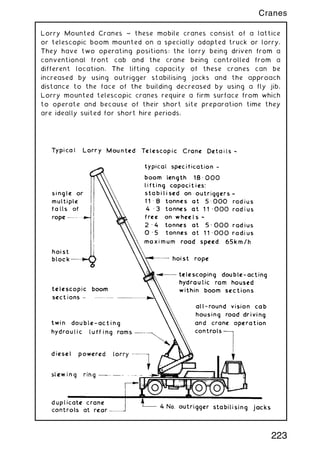
be a useful means of hydration control. Ideally, fresh concrete
should be kept moist for at least 7 days when using OPC,
otherwise shrinkage will induce tensile stresses manifesting in
surface cracks. With other cements such as the rapid setting and
hardening types, the manufacturer should be consulted to establish
optimum curing time.
Curing Methods ~ the longer the time during which fresh concrete
is kept moist, the more efficient will be the hardening process.
Concrete should be protected from exposure to sunshine and high
air temperatures in summer, drying winds, potentially freezing low
air temperatures in winter and low relative humidy.
Concrete --- Curing (1)
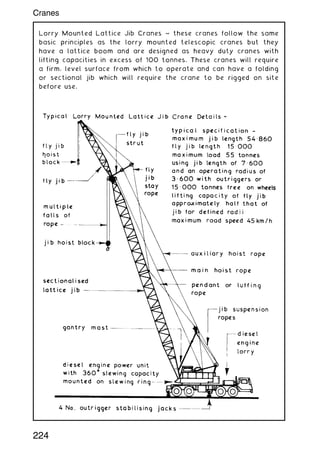
240
Setting ~ concrete will normally set within the working day. This
can vary somewhat with air temperatures as indicated below.
Approximate initial
setting time for
OPC concrete
Time
in
hours
20
†20 †10 0 10
Temperature ƒC
20 24 30 40
18
16
14
12
Optimum
concrete
production
10
8
6
4
2
0
Methods for Retaining Water Content in Set Concrete ~
• Sealing by leaving the formwork/shuttering in place.
• Covering with an impervious membrane, e.g. plastic sheeting.
• Spraying with water.
• Spraying with a purpose made curing agent. A solvent based
acrylic resin will also function as a surface sealant
(polyurethane acrylic).
• Ponding by covering the concrete with a layer of water
creating a temporary reservoir.
• For winter use, an insulating cover or blanket possibly with an
electric element to prevent water content freezing.
• Steaming † appropriate in factory controlled situations. A sealed
compartment contains circulation of a vapour of warm moist air.
Note: Period of curing should be as long as is practicable,
maintained above 5ƒC for a minimum of 7 days. Demand for
progress may limit these ideal measures hence the availability of
mix additives and special cements with rapid setting and hardening
properties. These should only be used with strict application of the
manufacturer's instructions and/or to the structural engineer's
specification.
Concrete --- Curing (2)
241
Notes
242
This page intentionally left blank
4 SUBSTRUCTURE
FOUNDATIONS † FUNCTION, MATERIALS AND SIZING
FOUNDATION BEDS
SHORT BORED PILE FOUNDATIONS
FOUNDATION TYPES AND SELECTION
PILED FOUNDATIONS
RETAINING WALLS
GABIONS AND MATTRESSES
BASEMENT CONSTRUCTION
WATERPROOFING BASEMENTS
EXCAVATIONS
CONCRETE PRODUCTION
COFFERDAMS
STEEL SHEET PILING
CAISSONS
UNDERPINNING
GROUND WATER CONTROL
SOIL STABILISATION AND IMPROVEMENT
RECLAMATION OF WASTE LAND
TREATMENT OF CONTAMINATED SUBSOIL
243
Foundations ~ the function of any foundation is to safely sustain
and transmit to the ground on which it rests the combined dead,
imposed and wind loads in such a manner as not to cause any
settlement or other movement which would impair the stability or
cause damage to any part of the building.
Subsoil beneath foundation is compressed and reacts by exerting
an upward pressure to resist foundation loading. If foundation load
exceeds maximum passive pressure of ground (i.e. bearing capacity)
a downward movement of the foundation could occur. Remedy is
to increase plan size of foundation to reduce the load per unit
area or alternatively reduce the loadings being carried by the
foundations.
244
Foundations --- Functions
Subsoil Movements ~ these are due primarily to changes in volume
when the subsoil becomes wet or dry and occurs near the upper
surface of the soil. Compact granular soils such as gravel suffer very
little movement whereas cohesive soils such as clay do suffer volume
changes near the upper surface. Similar volume changes can occur
due to water held in the subsoil freezing and expanding † this is called
Frost Heave.
245
Foundations --- Subsoil Movements
Trees ~ damage to foundations. Substructural damage to buildings
can occur with direct physical contact by tree roots. More
common is the indirect effect of moisture shrinkage or heave,
particularly apparent in clay subsoils.
Shrinkage is most evident in long periods of dry weather,
compounded by moisture abstraction from vegetation. Notably
broad-leaved trees such as oak, elm and poplar in addition to
the thirsty willow species. Heave is the opposite. It occurs
during wet weather and is compounded by previous removal of
moisture-dependent trees that would otherwise effect some
drainage and balance to subsoil conditions.
246
Foundations --- Subsoil Movements
Trees ~ effect on foundations. Trees up to 30 m distance may have
an effect on foundations, therefore reference to local authority
building control policy should be undertaken before specifying
construction techniques.
Traditional strip foundations are practically unsuited, but at
excavation depths up to 2„5 or 3„0m, deep strip or trench fill
(preferably reinforced) may be appropriate. Short bored pile
foundations are likely to be more economical and particularly
suited to depths exceeding 3„0m.
For guidance only, the illustration and table provide an indication
of foundation depths in shrinkable subsoils.
247
Foundations --- Subsoil Movements
Trees ~ preservation orders (see page 151) may be waived by the
local planning authority. Permission for tree felling is by formal
application and will be considered if the proposed development is in
the economic and business interests of the community. However,
tree removal is only likely to be acceptable if there is an
agreement for replacement stock being provided elsewhere on the
site.
In these circumstances there is potential for ground heave within
the `footprint' of felled trees. To resist this movement, foundations
must incorporate an absorbing layer or compressible filler with
ground floor suspended above the soil.
248
Foundations --- Subsoil Movements
Cracking in Walls ~ cracks are caused by applied forces which
exceed those that the building can withstand. Most cracking is
superficial, occurring as materials dry out and subsequently shrink
to reveal minor surface fractures of  2 mm. These insignificant
cracks can be made good with proprietary fillers.
Severe cracking in walls may result from foundation failure, due to
inadequate design or physical damage. Further problems could include:
A survey should be undertaken to determine:
1 . The cause of cracking, i.e.
* Loads applied externally (tree roots, subsoil movement).
* Climate/temperature changes (thermal movement).
* Moisture content change (faulty dpc, building leakage).
* Vibration (adjacent work, traffic).
* Changes in physical composition (salt or ice formation).
* Chemical change (corrosion, sulphate attack).
* Biological change (timber decay).
2. The effect on a building's performance (structural and
environmental).
3. The nature of movement † completed, ongoing or intermittent
(seasonal).
Observations over a period of several months, preferably over a
full year, will determine whether the cracking is new or established
and whether it is progressing.
Simple method for monitoring cracks †
pencil lines
drawn level
Pencil lines
Tell-tales
Gauge
crack in wall
glass strip
original position
of pencil line
later location
of pencil line
epoxy
resin
dabs
nails positioned
each side of crack
micrometer or
vernier gauge
crack
glass sheared to
show crack progression
Further reading † BRE Digest 251: Assessment of damage in low rise
buildings.
* Structural instability
* Air infiltration
* Sound insulation reduction
* Rain penetration
* Heat loss
* Visual depreciation
249
Foundations --- Defect Observation
Foundation Materials ~ from page 244 one of the functions of a
foundation can be seen to be the ability to spread its load evenly
over the ground on which it rests. It must of course be constructed
of a durable material of adequate strength. Experience has shown
that the most suitable material is concrete.
Concrete is a mixture of cement + aggregates + water in controlled
proportions.
250
Foundations --- Materials
251
Foundation Types
252
Foundation Types
Bed ~ a concrete slab resting on and supported by the subsoil,
usually forming the ground floor surface. Beds (sometimes called
over-site concrete) are usually cast on a layer of hardcore which is
used to make up the reduced level excavation and thus raise the
level of the concrete bed to a position above ground level.
253
Foundation Beds
Basic Sizing ~ the size of a foundation is basically dependent on
two factors:
1 . Load being transmitted, max 70kN/m (dwellings up to three storeys).
2. Bearing capacity of subsoil under proposed foundation.
For guidance on bearing capacities for different types of subsoil
see BS EN 1997-1: Geotechnical design. General rules and BS 8103-1:
Structural design of low rise buildings. Also, directly from soil
investigation results.
254
Foundations --- Basic Sizing
Max. total load on
load-bearing wall (kN/m)
20 30 40 50 60 70
Ground type
Ground
condition
Field
test
Minimum width (mm)
Rock Not inferior
to sandstone,
limestone or
firm chalk
Requires a
mechanical
device to
excavate.
At least equal to
the width of the wall
Gravel Medium
density
Pick required
to excavate.
Sand Compact 50 mm square
peg hard to
drive beyond
150 mm.
250 300 400 500 600 650
Clay
Sandy clay
Stiff
Stiff
Requires pick
or mechanical
device to aid
removal. Can
be indented
slightly with
thumb.
250 300 400 500 600 650
Clay
Sandy clay
Firm
Firm
Can be moulded
under
substantial
pressure by
fingers.
300 350 450 600 750 850
Sand
Silty sand
Clayey sand
Loose
Loose
Loose
Can be
excavated by
spade. 50 mm
square peg
easily driven.
400 600
Silt Soft
450 650
Clay Soft
Sandy clay Soft
Silty clay Soft
Silt Very soft
Clay Very soft
Sandy clay Very soft
Silty clay Very soft
Adapted from Table 10 in the Bldg. Regs., A.D: A † Structure.
Conventional strip
foundations unsuitable
for a total load
exceeding 30 kN/m
Finger pushed
in up to 10 mm.
Easily moulded
with fingers.
Finger easily
pushed in up
to 25 mm. Wet
sample exudes
between fingers
when squeezed.
Conventional strip inappropriate.
Steel-reinforced wide strip, deep
strip or piled foundation selected
subject to specialist advice
255
Guide to Strip Foundation Width
Typical Procedure (for guidance only) †
5.0 m
5.0 m
1.0 m
2.5 m
2.5 m
2.9 m
2.9 m
30°
30°
1 m wide
strip
foundation
0.15 m x 0.5 m (assumed)
Note: For roof pitch 30, snow load = 0„75 kN/m2
Dead + imposed load is 26„56 kN + 7„80 kN = 34„36 kN
Given that the subsoil has a safe bearing capacity of 75 kN/m2
,
W = load ÷ bearing capacity = 34„36 ÷ 75 = 0„458 m or 458 mm
Therefore a foundation width of 500 mm is adequate.
Note: This example assumes the site is sheltered. If it is necessary
to make allowance for wind loading, reference should be made to
BS EN 1991-1-4: Wind actions.
Dead load per m run (see pages 38 and 39)
Substructure brickwork, 1 m ✕ 1 m ✕ 476 kg/m2
= 476 kg
.. .. .. .. cavity conc. (50 mm), 1 m ✕ 1 m ✕ 2300 kg/m3
= 115 kg
Foundation concrete, 0„15 m ✕ 1 m ✕ 0„5 m ✕
2300 kg/m3
= 173 kg
Superstructure brickwork, 5 m ✕ 1 m ✕ 221 kg/m2
= 1105 kg
.. .. .. .. .. blockwork  ins., 5 m ✕ 1 m ✕ 79 kg/m2
= 395 kg
.. .. .. .. .. 2 coat plasterwork, 5 m ✕ 1 m ✕ 22 kg/m2
= 110 kg
Floor joists/boards/plstrbrd., 2„5 m ✕ 1 m ✕ 42„75 kg/m2
= 107 kg
Ceiling joists/plstrbrd/ins., 2„5 m ✕ 1 m ✕ 19„87 kg/m2
= 50 kg
Rafters, battens  felt, 2„9 m ✕ 1 m ✕ 12„10 kg/m2
= 35 kg
Single lap tiling, 2„9 m ✕ 1 m ✕ 49 kg/m2
= 142 kg
2708 kg
Note: kg ✕ 9„81 = Newtons
Therefore: 2708 kg ✕ 9„81 = 26565 N or 26„56 kN
Imposed load per m run (see BS EN 1991-1-1: Densities, self-weight,
imposed loads for buildings) †
Floor, 2„5 m ✕ 1 m ✕ 1„5 kN/m2
= 3„75 kN
Roof, 2„9 m ✕ 1 m ✕ 1„5 kN/m2
(snow) = 4„05 kN
7„80 kN
256
Foundations --- Calculated Sizing
Stepped Foundations ~ these are usually considered in the context
of strip foundations and are used mainly on sloping sites to reduce
the amount of excavation and materials required to produce an
adequate foundation.
257
Stepped Foundations
Concrete Foundations ~ concrete is a material which is strong in
compression but weak in tension. If its tensile strength is exceeded
cracks will occur, resulting in a weak and unsuitable foundation.
One method of providing tensile resistance is to include in the
concrete foundation bars of steel as a form of reinforcement to
resist all the tensile forces induced into the foundation. Steel is a
material which is readily available and has high tensile strength.
258
Simple RC Foundations
Short Bored Piles ~ these are a form of foundation which are
suitable for domestic loadings and clay subsoils where ground
movements can occur below the 1„000 depth associated with
traditional strip and trench fill foundations. They can be used
where trees are planted close to a new building since the trees
may eventually cause damaging ground movements due to
extracting water from the subsoil and root growth. Conversely
where trees have been removed this may lead to ground swelling.
Typical Details ~
40 mm thick sand
or lean concrete
blinding
damp-proof course
damp-proof membrane
mass
concrete
ground
floor
compacted hardcore
reinforced concrete ground
beam cast in trench over
short bored pile heads —
size of beam and
reinforcement to design or
from tables
250 to 300 mm diameter
according to design
bored and cast in-situ piles of mass
concrete maximum spacing to design
Piles formed by lorry or tractor
mounted auger capable of
drilling 80 piles per day
ground level
cavity filling
external wall
cavity insulation
50 mm rigid insulation
floor screed
depth of pile governed by level
of suitable bearing capacity
ground and/or stability of clay
subsoil — economic maximum
depth 4.500
Typical spacing of piles
1.800 to 2.500
Typical loading
40 to 125 kN per pile
259
Short Bored Pile Foundations
Simple Raft Foundations ~ these can be used for lightly loaded
buildings on poor soils or where the top 450 to 600 mm of soil is
overlaying a poor-quality substrata.
Typical Details ~
cavity insulation
external wall
floor screed
rigid insulation
damp-proof membrane
damp-proof course
damp-proof cavity
tray min. 150 mm
step
75 mm-thick rolled
sand or similar
blinding
edge thickening to 150 mm
min. thick RC raft
300
225
450 225
weep holes at 900 c/c
REINFORCED CONCRETE RAFT WITH EDGE THICKENING
REINFORCED CONCRETE RAFT WITH EDGE BEAM
floor screed
rigid insulation
cavity insulation
cavity tray
ground
level
external
wall
dpc
damp-proof membrane
steel fabric reinforcement
150 mm min.-thick RC raft
forming ground floor slab
225
300 min.
750
minimum
mass
concrete
edge beam
225
compacted hardcore with
upper surface blinded with
50 mm coarse sand
260
Simple RC Raft Foundations
Foundation Design Principles ~ the main objectives of foundation
design are to ensure that the structural loads are transmitted to
the subsoil(s) safely, economically and without any unacceptable
movement during the construction period and throughout the
anticipated life of the building or structure.
Basic Design Procedure ~ this can be considered as a series of
steps or stages:
1. Assessment of site conditions in the context of the site and
soil investigation report.
2. Calculation of anticipated structural loading(s).
3. Choosing the foundation type taking into consideration:
• Soil conditions;
• Type of structure;
• Structural loading(s);
• Economic factors;
• Time factors relative to the proposed contract period;
• Construction problems.
4. Sizing the chosen foundation in the context of loading(s),
ground bearing capacity and any likely future movements of
the building or structure.
Foundation Types ~ apart from simple domestic foundations most
foundation types are constructed in reinforced concrete and may
be considered as being shallow or deep. Most shallow types of
foundation are constructed within 2„000 of the ground level but in
some circumstances it may be necessary to take the whole or part
of the foundations down to a depth of 2„000 to 5„000 as in the
case of a deep basement where the structural elements of the
basement are to carry the superstructure loads. Generally
foundations which need to be taken below 5„000 deep are cheaper
when designed and constructed as piled foundations and such
foundations are classified as deep foundations. (For piled
foundation details see pages 266 to 286.)
Foundations are usually classified by their type such as strips,
pads, rafts and piles. It is also possible to combine foundation
types such as strip foundations connected by beams to and
working in conjunction with pad foundations.
261
Foundation Types and Selection
Strip Foundations ~ these are suitable for most subsoils and light
structural loadings such as those encountered in low to medium rise
domestic dwellings where mass concrete can be used. Reinforced
concrete is usually required for all other situations.
262
Foundation Types and Selection
Pad Foundations ~ suitable for most subsoils except loose sands,
loose gravels and filled areas. Pad foundations are usually
constructed of reinforced concrete and where possible are square
in plan.
263
Foundation Types and Selection
Raft Foundations ~ these are used to spread the load of the
superstructure over a large base to reduce the load per unit area
being imposed on the ground and this is particularly useful where
low bearing capacity soils are encountered and where individual
column loads are heavy.
264
Foundation Types and Selection
Cantilever Foundations ~ these can be used where it is necessary
to avoid imposing any pressure on an adjacent foundation or
underground service.
265
Foundation Types and Selection
Piled Foundations ~ these can be defined as a series of columns
constructed or inserted into the ground to transmit the load(s) of
a structure to a lower level of subsoil. Piled foundations can be
used when suitable foundation conditions are not present at or
near ground level making the use of deep traditional foundations
uneconomic. The lack of suitable foundation conditions may be
caused by:
1. Natural low bearing capacity of subsoil.
2. High water table † giving rise to high permanent dewatering
costs.
3. Presence of layers of highly compressible subsoils such as peat
and recently placed filling materials which have not sufficiently
consolidated.
4. Subsoils which may be subject to moisture movement or
plastic failure.
Classification of Piles ~ piles may be classified by their basic design
function or by their method of construction:
266
Piled Foundations
Replacement Piles ~ these are often called bored piles since the
removal of the spoil to form the hole for the pile is always carried
out by a boring technique. They are used primarily in cohesive
subsoils for the formation of friction piles and when forming pile
foundations close to existing buildings where the allowable amount
of noise and/or vibration is limited.
267
Piled Foundations
Percussion Bored Piles
268
Piled Foundations
Flush Bored Piles
269
Piled Foundations
Small Diameter Rotary Bored Piles
270
Piled Foundations
Large Diameter Rotary Bored Piles
271
Piled Foundations
Continuous Flight Auger Bored Piles
Typical Details ~
kelly bar pulleys suspension arm
Completed pile
shaft as shown
on page 270
hydraulic ram
tracked
power
unit
stabiliser
mobile kelly
bar drive
kelly bar
drive guide
flight auger
auger guide
collar
Standard pile diameters are 300, 450 and 600 mm. Depth of
borehole to about 15 m.
272
Piled Foundations
Grout Injection Piling ~
A variation of continuous flight auger bored piling that uses an
open ended hollow core to the flight. After boring to the required
depth, high slump concrete is pumped through the hollow stem as
the auger is retracted. Spoil is displaced at the surface and
removed manually. In most applications there is no need to line the
boreholes, as the subsoil has little time to be disturbed. A
preformed reinforcement cage is pushed into the wet concrete.
hollow core
within flight auger
displaced
spoil
concrete
high slump
concrete pumped
into core as
flight auger
is raised
reinforcement
pushed into
wet concrete to
a predetermined
depth
borehole
unlined
unless
subsoil
quality
justifies it
Stages ~
1. Hole bored to established
depth.
2. Concrete replaces auger
as it is removed.
3. Reinforcement cage
placed into wet concrete.
1 2 3
273
Piled Foundations
Displacement Piles ~ these are often called driven piles since they
are usually driven into the ground, displacing the earth around the
pile shaft. These piles can be either preformed or partially
preformed if they are not cast in-situ and are available in a wide
variety of types and materials. The pile or forming tube is driven
into the required position to a predetermined depth or to the
required `set' which is a measure of the subsoil's resistance to the
penetration of the pile and hence its bearing capacity by noting
the amount of penetration obtained by a fixed number of hammer
blows.
274
Piled Foundations
Timber Piles ~ these are usually square sawn and can be used for
small contracts on sites with shallow alluvial deposits overlaying a
suitable bearing strata (e.g. river banks and estuaries). Timber piles
are percussion driven.
275
Piled Foundations
Preformed Concrete Piles ~ variety of types available which are
generally used on medium to large contracts of not less than
one hundred piles where soft soil deposits overlie a firmer strata.
These piles are percussion driven using a drop or single-acting
hammer.
276
Piled Foundations
Preformed Concrete Piles † jointing with a peripheral steel splicing
collar as shown on the preceding page is adequate for most
concentrically or directly loaded situations. Where very long piles
are to be used and/or high stresses due to compression, tension
and bending from the superstructure or the ground conditions are
anticipated, the four or eight lock pile joint [AARSLEFF PILING]
may be considered.
hardwood or dense plastic
driving plate removed
steel dowel with
void for pin
treated steel
shutter and pile
lock bonded to
pile reinforcement
*upper section as lower section but
inverted and dowels located over holes
lower preformed
concrete pile
section*
high tensile
steel locking pin
Pile dimensions (mm) Possible no. of locks per joint
250 ✕ 250, 300 ✕ 300,
350 ✕ 350 and 400 ✕ 400
4
350 ✕ 350, 400 ✕ 400
and 450 ✕ 450
8
277
Piled Foundations
Steel Box and `H' Sections ~ standard steel sheet pile sections can
be used to form box section piles whereas the `H' section piles are
cut from standard rolled sections. These piles are percussion driven
and are used mainly in connection with marine structures.
Steel Screw Piles ~ rotary driven and used for dock and jetty
works where support at shallow depths in soft silts and sands is
required.
278
Piled Foundations
Steel Tube Piles ~ used on small to medium-size contracts for
marine structures and foundations in soft subsoils over a suitable
bearing strata. Tube piles are usually bottom driven with an
internal drop hammer. The loading can be carried by the tube alone
but it is usual to fill the tube with mass concrete to form a
composite pile. Reinforcement, except for pile cap bonding bars, is
not normally required.
279
Piled Foundations
Partially Preformed Piles ~ these are composite piles of precast
concrete and in-situ concrete or steel and in-situ concrete (see
page 279). These percussion-driven piles are used on medium to
large contracts where bored piles would not be suitable owing to
running water or very loose soils.
280
Piled Foundations
Driven In-situ Piles ~ used on medium to large contracts as an
alternative to preformed piles particularly where final length of
pile is a variable to be determined on site.
281
Piled Foundations
Cast In-situ Piles ~ an alternative to the driven in-situ piles (see
page 281)
282
Piled Foundations
Piling Hammers ~ these are designed to deliver an impact blow to
the top of the pile to be driven. The hammer weight and drop
height is chosen to suit the pile type and nature of subsoil(s)
through which it will be driven. The head of the pile being driven is
protected against damage with a steel helmet which is padded with
a sand bed or similar material and is cushioned with a plastic or
hardwood block called a dolly.
Drop Hammers ~ these are
blocks of iron with a rear
lug(s) which locate in the
piling rig guides or leaders
and have a top eye for
attachment of the winch
rope. The number of blows
which can be delivered with
a free fall of 1„200 to 1„500
ranges from 10 to 20 per
minute. The weight of the
hammer should be not less
than 50% of the concrete
or steel pile weight and 1 to
1„5 times the weight of a
timber pile.
Single Acting Hammers ~
these consist of a heavy
falling cylinder raised by
steam or compressed air
sliding up and down a fixed
piston. Guide lugs or rollers
are located in the piling
frame leaders to maintain
the hammer position
relative to the pile head.
The number of blows
delivered ranges from 36 to
75 per minute with a total
hammer weight range of 2
to 15 tonnes.
283
Piled Foundations
Double Acting Hammers ~ these
consist of a cast iron cylinder
which remains stationary on the
pile head whilst a ram powered
by steam or compressed air for
both up and down strokes
delivers a series of rapid blows
which tends to keep the pile on
the move during driving. The
blow delivered is a smaller force
than that from a drop or single
acting hammer. The number of
blows delivered ranges from 95
to 300 per minute with a total
hammer weight range of 0„7 to
6„5 tonnes. Diesel powered
double acting hammers are also
available.
Diesel Hammers ~ these are self-
contained hammers which are
located in the leaders of a piling
rig and rest on the head of the
pile. The driving action is started
by raising the ram within the
cylinder which activates the
injection of a measured amount
of fuel. The free-falling ram
compresses the fuel above the
anvil causing the fuel to explode
and expand resulting in a
downward force on the anvil and
upward force which raises the
ram to recommence the cycle
which is repeated until the fuel is
cut off. The number of blows
delivered ranges from 40 to 60
per minute with a total hammer
weight range of 1„0 to 4„5
tonnes.
284
Piled Foundations
Vibrating Hammer ~ used with preformed displacement piles driven
into clay, sand or gravel subsoils.
Application ~ unit suspended by cable from a crane, positioned and
secured to the top of the pile. Steel pipe, H section and sheet pile
profiles are most suited to this procedure.
Function ~ two electric motors are used to propel eccentric rotors
in opposing directions. The vibrations generated combine with the
weight of the unit to transmit through the pile. This breaks down
the subsoils resistance to shear and enables the pile to penetrate.
Resistance can be reduced by water jetting at the toe of the pile.
central
frame
drive
motor
eccentric weight
sheet steel pile
suspension cable
from crane
suspension block
with vibration
absorbing springs
drive
chain
motor
mounted
side frame
driven head
and pile clamp
Advantages ~ relatively silent in operation, a considerable benefit
in built-up areas. Use of electricity is non-polluting in the immediate
site area. No impact, therefore pile cap is unlikely to be damaged.
Disadvantage ~ electricity is not always available during
preliminary ground works.
285
Piled Foundations
Pile Caps ~ piles can be used singly to support the load but often
it is more economical to use piles in groups or clusters linked
together with a reinforced concrete cap. The pile caps can also be
linked together with reinforced concrete ground beams.
The usual minimum spacing for piles is:
1 . Friction Piles † 1„100 or not less than 3 ✕ pile diameter,
whichever is the greater.
2. Bearing Piles † 750 mm or not less than 2 ✕ pile diameter,
whichever is the greater.
Pile Testing ~ it is advisable to test load at least one pile per
scheme. The test pile should be overloaded by at least 50% of its
working load and this load should be held for 24 hours. The test
pile should not form part of the actual foundations. Suitable
testing methods are:
1 . Jacking against kentledge placed over test pile.
2. Jacking against a beam fixed to anchor piles driven in on two
sides of the test pile.
286
Piled Foundations
Retaining Walls ~ the major function of any retaining wall is to act
as an earth-retaining structure for the whole or part of its height
on one face, the other being exposed to the elements. Most small
height retaining walls are built entirely of brickwork or a
combination of brick facing and blockwork or mass concrete
backing. To reduce hydrostatic pressure on the wall from ground
water an adequate drainage system in the form of weep holes
should be used. Alternatively subsoil drainage behind the wall could
be employed.
287
Retaining Walls up to 1 m High (1)
Small Height Retaining Walls ~ retaining walls must be stable and
the usual rule of thumb for small height brick retaining walls is for
the height to lie between two and four times the wall thickness.
Stability can be checked by applying the middle third rule †
288
Retaining Walls up to 1 m High (2)
Retaining Walls up to 6„000 high ~ these can be classified as
medium height retaining walls and have the primary function of
retaining soils at an angle in excess of the soil's natural angle of
repose. Walls within this height range are designed to provide the
necessary resistance by either their own mass or by the principles
of leverage.
Design ~ the actual design calculations are usually carried out by
a structural engineer who endeavours to ensure that:
1 . Overturning of the wall does not occur.
2. Forward sliding of the wall does not occur.
3. Materials used are suitable and not overstressed.
4. The subsoil is not overloaded.
5. In clay subsoils slip circle failure does not occur.
The factors which the designer will have to take into account:
1 . Nature and characteristics of the subsoil(s).
2. Height of water table † the presence of water can create
hydrostatic pressure on the rear face of the wall, it can also
affect the bearing capacity of the subsoil together with its
shear strength, reduce the frictional resistance between the
underside of the foundation and the subsoil and reduce the
passive pressure in front of the toe of the wall.
3. Type of wall.
4. Material(s) to be used in the construction of the wall.
289
Medium Height Retaining Walls
Earth Pressures ~ these can take one of two forms, namely:
1 . Active Earth Pressures † these are those pressures which
tend to move the wall at all times and consist of the wedge
of earth retained plus any hydrostatic pressure. The latter
can be reduced by including a subsoil drainage system behind
and/or through the wall.
2. Passive Earth Pressures ~ these are a reaction of an equal
and opposite force to any imposed pressure thus giving
stability by resisting movement.
290
Medium Height Retaining Walls
Mass Retaining Walls ~ these walls rely mainly on their own mass
to overcome the tendency to slide forward. Mass retaining walls
are not generally considered to be economic over a height of 1„800
when constructed of brick or concrete and 1„000 high in the case
of natural stonework. Any mass retaining wall can be faced with
another material but generally any applied facing will not increase
the strength of the wall and is therefore only used for aesthetic
reasons.
291
Medium Height Retaining Walls
292
Medium Height Retaining Walls
Cantilever Retaining Walls ~ these are constructed of reinforced
concrete with an economic height range of 1„200 to 6„000. They
work on the principles of leverage where the stem is designed as a
cantilever fixed at the base and base is designed as a cantilever
fixed at the stem. Several formats are possible and in most cases
a beam is placed below the base to increase the total passive
resistance to sliding. Facing materials can be used in a similar
manner to that shown on page 292.
293
Medium Height Retaining Walls
Formwork ~ concrete retaining walls can be cast in one of three
ways † full height; climbing (page 295) or against earth face (page
296).
Full Height Casting ~ this can be carried out if the wall is to be
cast as a free-standing wall and allowed to cure and gain strength
before the earth to be retained is backfilled behind the wall.
Considerations are the height of the wall, anticipated pressure of
wet concrete, any strutting requirements and the availability of
suitable materials to fabricate the formwork. As with all types
of formwork a traditional timber format or a patent system using
steel forms could be used.
294
Medium Height Retaining Walls
Climbing Formwork or Lift Casting ~ this method can be employed
on long walls, high walls or where the amount of concrete which
can be placed in a shift is limited.
295
Medium Height Retaining Walls
Casting Against Earth Face ~ this method can be an adaptation of
the full height or climbing formwork systems. The latter uses a
steel wire loop tie fixing to provide the support for the second and
subsequent lifts.
296
Medium Height Retaining Walls
Masonry units † these are an option where it is impractical or
cost-ineffective to use temporary formwork to in-situ concrete.
Exposed brick or blockwork may also be a preferred finish. In
addition to being a structural component, masonry units provide
permanent formwork to reinforced concrete poured into the voids
created by:
* Quetta bonded standard brick units, OR
* Stretcher bonded standard hollow dense concrete blocks.
vertical reinforcement bars
void filled with steel reinforced concrete
from foundation
concrete filling in voids
Elevation,
as Flemish
bond
Elevation
steel bar
reinforcement
Plan
Plan
250 mm
327 mm
1 B or
1
2
Reinforced quetta
bonded brickwork
Reinforced hollow
concrete blocks
Standard hollow
concrete block
to BS 6073-2
Purpose-
-made hollow block
for use with additional
horizontal reinforcement
440 mm
60-250 mm
215 mm
297
Retaining Walls --- Reinforced Masonry
Construction † a reinforced concrete base is cast with projecting
steel bars accurately located for vertical continuity. The wall may
be built solid, e.g. Quetta bond, with voids left around the bars for
subsequent grouting. Alternatively, the wall may be of wide cavity
construction, where the exposed reinforcement is wrapped in
`denso' grease tape for protection against corrosion. Steel bars are
threaded at the top to take a tensioning nut over a bearing plate.
Typical post-tensioned
masonry retaining wall
precast concrete padstone
nut and bearing plate
upper ground level
granular backfill
ground water drain
post-tensioning bar reinforcement
in concrete foundation
masonry cavity wall
grease tape corrosion
protection to steel
bars if void left open
lower ground
level
post-tensioning
nuts on threaded
steel
threaded
socket
couplers
masonry wall
bearing plate
reinforcement
grouted into
voids in
perforated
bricks
curtailed bars
base retention
plate
interim nuts and
bearing plate
continuity
reinforcement
from base
Staged post-tensioning to high masonry retaining walls
Refs. BS EN 1996-1-1: Design of masonry structures. General rules
for reinforced and unreinforced masonry structures.
PD 6697: Recommendations to BS EN 1996-1-1.
298
Post-tensioned Retaining Wall
Crib Retaining Walls † a system of precast concrete or treated
timber components comprising headers and stretchers which
interlock to form a three-dimensional framework. During assembly
the framework is filled with graded stone to create sufficient mass
to withstand ground pressures.
batter
1:4 timber
1:6– 8 concrete
headers
stretchers
with joints
staggered
concrete
foundation
with surface
of incline
finished rough
NB. height limited to 10 m with timber.
upper ground
graded granular fill
within cribs and up
to 1 m behind wall
subsoil drain
lower ground
stretcher 100 ×50 mm
up to 2.2 m long
header 100 × 50 mm,
0.6–1.4 m long
spaced at 550 mm
stretcher
1.2 or 1.5 m
Timber preserved with
copper/chrome/arsenic
Reinforced concrete, sulphate
resisting 50 N/mm
2
header
header 300 ×125 mm,
0.65, 1.2 or 1.6 m long
header
stretcher
stretcher
Principle †
Components †
299
Retaining Walls --- Cribs
Soil Nailing ~ a cost effective geotechnic process used for
retaining large soil slopes, notably highway and railway
embankments.
Function ~ after excavating and removing the natural slope
support, the remaining wedge of exposed unstable soil is pinned or
nailed back with tendons into stable soil behind the potential slip
plane.
Types of Soil Nails or Tendons:
• Solid deformed steel rods up to 50 mm in diameter, located in
boreholes up to 100 mm in diameter. Cement grout is
pressurised into the void around the rods.
• Hollow steel, typically 100 mm diameter tubes with an
expendable auger attached. Cement grout is injected into the
tube during boring to be ejected through purpose-made holes
in the auger.
• Solid glass reinforced plastic (GRP) with resin grouts.
Embankment Treatment ~ the exposed surface is faced with a
plastic coated wire mesh to fit over the ends of the tendons. A
steel head plate is fitted over and centrally bolted to each
projecting tendon, followed by spray concreting to the whole face.
Typical Application ~
soil nails at 10ƒ incline, 1.5 to 2.5 m
spacing and at up to 20 m depth
unstable soil
plant-
-mounted drilling rig
natural support
angle of soil
70ƒ cut
potential slip
plane
tendon
300
Soil Nailing
Gabion ~ a type of retaining wall produced from individual
rectangular boxes made from panels of wire mesh, divided
internally and filled with stones. These units are stacked and
overlapped (like stretcher bonded masonry) and applied in several
layers or courses to retained earth situations. Typical sizes, 1„0m
long x 0„5m wide x 0„5m high, up to 4„0m long x 1„0m wide x 1„0m
high.
Mattress ~ unit fabrication is similar to a gabion but of less
thickness, smaller mesh and stone size to provide some flexibility
and shaping potential. Application is at a much lower incline.
Generally used next to waterways for protection against land
erosion where tidal movement and/or water level differentials
could scour embankments. Typical sizes, 3„0m long x 2„0m wide x
0„15m thick, up to 6„0m long x 2„0m wide x 0„3m thick.
Gabion wall
foundation to
suit situation
horizontally laid staggered units
dry jointed and angled to suit
height and type of retained soil
units laid across
the slope with
joints staggered
sloped and
protected
embankment
Mattress wall
natural drainage
through stone
filling water at
variable levels
length
Woven mesh box
selvedge wire plastic coated hexagon mesh fabric
loose stone
filling
height or
thickness
width
301
Gabions and Mattresses
Design of Retaining Walls ~ this should allow for the effect of
hydrostatics or water pressure behind the wall and the pressure
created by the retained earth (see page 290). Calculations are
based on a 1 m unit length of wall, from which it is possible to
ascertain:
302
Retaining Walls---Design Calculations
A graphical design solution, to determine the earth thrust (P)
behind a retaining wall. Data from previous page:
h = 3„300 m
 = 30
w = 1500 kg/m3
Wall height is drawn to scale and plane of repose plotted. The
wedge section is obtained by drawing the plane of rupture through
an angle bisecting the plane of repose and vertical back of the
wall. Dimension `y' can be scaled or calculated:
Tangent x =
y
3„3
x = 30
; and tan 30
= 0„5774
therefore, y = 3„3 ✕ 0„5774 = 1„905 m
Area of wedge section =
3„3
2
× 1„905 m = 3„143 m2
Volume of wedge per metre run of wall = 3„143 x 1 = 3„143 m3
Weight .. .. .. .. .. .. .. .. .. .. .. .. .. .. .. .. .. .. .. = 3„143 ✕ 1500 = 4715 kg
Vector line A † B is drawn to a scale through centre of gravity of
wedge section, line of thrust and plane of rupture to represent
4715 kg.
Vector line B † C is drawn at the angle of earth friction (usually
same as angle of repose, i.e. 30 in this case), to the normal to the
plane of rupture until it meets the horizontal line C † A.
Triangle ABC represents the triangle of forces for the wedge
section of earth, so C † A can be scaled at 2723 kg to represent
(P), the earth thrust behind the retaining wall.
303
Retaining Walls --- Coulomb’s Wedge Theory
Open Excavations ~ one of the main problems which can be
encountered with basement excavations is the need to provide
temporary support or timbering to the sides of the excavation.
This can be intrusive when the actual construction of the basement
floor and walls is being carried out. One method is to use battered
excavation sides cut back to a safe angle of repose thus
eliminating the need for temporary support works to the sides of
the excavation.
In economic terms the costs of plant and manpower to cover the
extra excavation, backfilling and consolidating must be offset by
the savings made by omitting the temporary support works to the
sides of the excavation. The main disadvantage of this method is
the large amount of free site space required.
304
Basement Excavations
Perimeter Trench Excavations ~ in this method a trench wide
enough for the basement walls to be constructed is excavated and
supported with timbering as required. It may be necessary for
runners or steel sheet piling to be driven ahead of the excavation
work. This method can be used where weak subsoils are
encountered so that the basement walls act as permanent
timbering whilst the mound or dumpling is excavated and the base
slab cast. Perimeter trench excavations can also be employed in
firm subsoils when the mechanical plant required for excavating the
dumpling is not available at the right time.
305
Basement Excavations
Complete Excavation ~ this method can be used in firm subsoils
where the centre of the proposed basement can be excavated first
to enable the basement slab to be cast thus giving protection to
the subsoil at formation level. The sides of excavation to the
perimeter of the basement can be supported from the formation
level using raking struts or by using raking struts pitched from the
edge of the basement slab.
306
Basement Excavations
Excavating Plant ~ the choice of actual pieces of plant to be used
in any construction activity is a complex matter taking into
account many factors. Specific details of various types of
excavators are given on pages 209 to 213. At this stage it is only
necessary to consider basic types for particular operations. In the
context of basement excavation two forms of excavator could be
considered.
307
Basement Excavations
Basement Construction ~ in the general context of buildings a
basement can be defined as a storey which is below the ground
storey and is therefore constructed below ground level. Most
basements can be classified into one of three groups:
308
Basement Construction
Deep Basement Construction ~ basements can be constructed
within a cofferdam or other temporary supported excavation (see
Basement Excavations on pages 304 to 306) up to the point when
these methods become uneconomic, unacceptable or both due to
the amount of necessary temporary support work. Deep basements
can be constructed by installing diaphragm walls within a trench
and providing permanent support with ground anchors or by using
the permanent lateral support given by the internal floor during
the excavation period (see next page). Temporary lateral support
during the excavation period can be provided by lattice beams
spanning between the diaphragm walls (see next page).
NB. vertical ground anchors installed through the lowest floor can
be used to overcome any tendency to flotation during the
construction period.
309
Basement Construction
310
Basement Construction
Top Down Construction with Superstructure ~ an extension of the
principles outlined on the previous page where basement floors are
constructed as excavation proceeds. Applied to construction of
tall buildings, particularly in congested areas where existing
buildings are in close proximity. Suited to deep basements where
construction above ground can be conducted simultaneously with
construction below ground, thereby optimising progress. Also
suitable for underground car parks and railway stations.
Sequence Guidance (illustrated next page) ~
• Ground water controls/dewatering installed and activated
(subject to sub-surface composition and water table height).
• Cast in-situ concrete diaphragm perimeter walls installed,
possibly using contiguous or secant piling methods.
• Holes bored for piled foundations.
• Steel reinforcement cage positioned in boreholes.
• Load-bearing plunge columns (standard steel UC sections)
lowered inside reinforcement cage.
• Boreholes concreted to ground level.
• In-situ reinforced concrete slab cast at ground level with
shuttering to create suitable size opening(s) for excavation
plant access. This and subsequent sub-floors act as lateral
bracing to perimeter walls.
• Superstructure commences.
• Subsoil extracted through slab opening. Possible use of crane and
bucket or long arm excavator. After initial soil removal, small
backacters may be able to operate below ground floor slab.
• First basement formation level established and in-situ concrete floor
slab cast with suitable size opening to access the next level down.
• Excavation procedure repeated to formation level of second
basement floor and slab cast with access void if further sub-
floors required.
• Continue until design depth and number of sub-floors is reached.
• Basement construction completed with waterproofing (tanking) and
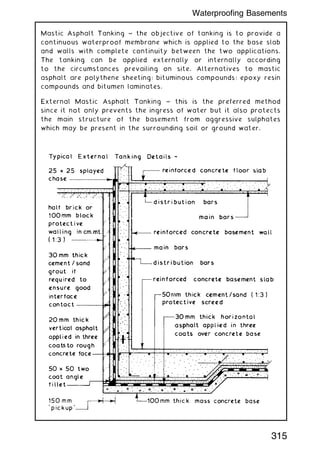
finishes.
• Continue with superstructural construction.
311
Basement Construction
Top Down Construction Principles Illustrated ~
Diaphragm walls and plunge column piled foundation
diaphragm wall of
reinforced concrete
contiguous or
secant piling
around periphery
standard steel
column with steel
plate attachment
in-situ concrete
bored pile foundation
UC section
steel
reinforced
cage
Reinforced ground floor slab cast with access for excavation and
commencement of superstructure
cast in-situ
reinforced concrete slab
void in slab
for access
UC secured
to top of
plunge column
ground level
continuity steel
reinforcement
subsoil excavated
down to first
basement floor
formation level
Sub-floors concreted whilst superstructure proceeds
diaphragm
wall
access for excavation and
concreting, through floor void
and between cast in-situ piles ground floor slab
first basement
floor completed
second/lowest
basement floor
completed
interior bored pile
foundations
UC
312
Basement Construction
Waterproofing Basements ~ basements can be waterproofed by one
of three basic methods, namely:
1 . Use of dense monolithic concrete walls and floor.
2. Tanking techniques (see pages 315 and 316).
3. Drained cavity system (see page 317).
Dense Monolithic Concrete † the main objective is to form a watertight
basement using dense high quality reinforced or prestressed concrete by
a combination of good materials, good workmanship, attention to
design detail and on-site construction methods. If strict control of all
aspects is employed a sound, watertight structure can be produced but
it should be noted that such structures are not always water
vapourproof. If the latter is desirable some waterproof coating, lining or
tanking should be used. The watertightness of dense concrete mixes
depends primarily upon two factors:
1 . Water/cement ratio.
2. Degree of compaction.
The hydration of cement during the hardening process produces heat;
therefore to prevent early stage cracking the temperature changes
within the hardening concrete should be kept to a minimum. The greater
the cement content the more is the evolution of heat; therefore the mix
should contain no more cement than is necessary to fulfil design
requirements. Concrete with a free water/cement ratio of 0.5 is
watertight and although the permeability is three times more at a ratio
of 0.6 it is for practical purposes still watertight but above this ratio
the concrete becomes progressively less watertight. For lower water/
cement ratios the workability of the mix would have to be increased,
usually by adding more cement, to enable the concrete to be fully
compacted.
Admixtures † if the ingredients of good design, materials and
workmanship are present watertight concrete can be produced
without the use of admixtures. If admixtures are used they should
be carefully chosen and used to obtain a specific objective:
1 . Water-reducing admixtures † used to improve workability.
2. Retarding admixtures † slow down rate of hardening.
3. Accelerating admixtures † increase rate of hardening † useful for
low temperatures † calcium chloride not suitable for reinforced
concrete.
4. Water-repelling admixtures † effective only with low water
head, will not improve poor-quality or porous mixes.
5. Air-entraining admixtures † increase workability † lower water
content.
313
Waterproofing Basements
Joints ~ in general these are formed in basement constructions to
provide for movement accommodation (expansion joints) or to
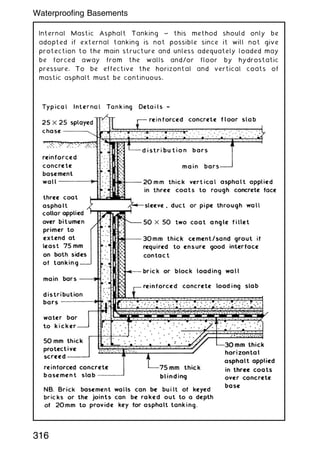
create a convenient stopping point in the construction process
(construction joints). Joints are lines of weakness which will leak
unless carefully designed and constructed; therefore they should be
simple in concept and easy to construct.
Basement slabs ~ these are usually designed to span in two
directions and as a consequence have relatively heavy top and
bottom reinforcement. To enable them to fulfil their basic
functions they usually have a depth in excess of 250mm. The
joints, preferably of the construction type, should be kept to a
minimum and if waterbars are specified they must be placed to
ensure that complete compaction of the concrete is achieved.
314
Waterproofing Basements
Mastic Asphalt Tanking ~ the objective of tanking is to provide a
continuous waterproof membrane which is applied to the base slab
and walls with complete continuity between the two applications.
The tanking can be applied externally or internally according
to the circumstances prevailing on site. Alternatives to mastic
asphalt are polythene sheeting: bituminous compounds: epoxy resin
compounds and bitumen laminates.
External Mastic Asphalt Tanking ~ this is the preferred method
since it not only prevents the ingress of water but it also protects
the main structure of the basement from aggressive sulphates
which may be present in the surrounding soil or ground water.
315
Waterproofing Basements
Internal Mastic Asphalt Tanking ~ this method should only be
adopted if external tanking is not possible since it will not give
protection to the main structure and unless adequately loaded may
be forced away from the walls and/or floor by hydrostatic
pressure. To be effective the horizontal and vertical coats of
mastic asphalt must be continuous.
316
Waterproofing Basements
Drained Cavity System ~ this method of waterproofing basements
can be used for both new and refurbishment work. The basic
concept is very simple in that it accepts that a small amount of
water seepage is possible through a monolithic concrete wall and
the best method of dealing with such moisture is to collect it and
drain it away. This is achieved by building an inner non-load-bearing
wall to form a cavity which is joined to a floor composed of
special triangular tiles laid to falls which enables the moisture to
drain away to a sump from which it is either discharged direct or
pumped into the surface water drainage system. The inner wall
should be relatively vapour tight or alternatively the cavity should
be ventilated.
317
Waterproofing Basements
Basements benefit considerably from the insulating properties of
the surrounding soil. However, that alone is insufficient to satisfy
the typical requirements for wall and floor U-values of 0„35 and
0„25 W/m2
K, respectively.
Refurbishment of existing basements may include insulation within
dry lined walls and under-the-floor screed or particle board
overlay. This should incorporate an integral vapour control layer
to minimise risk of condensation.
External insulation of closed cell rigid polystyrene slabs is
generally applied to new construction. These slabs combine low
thermal conductivity with low water absorption and high
compressive strength. The external face of insulation is grooved to
encourage moisture run-off. It is also filter faced to prevent
clogging of the grooves. Backfill is granular.
Tables and calculation methods to determine heat energy transfer
for basements are provided in BS EN ISO 13370: Thermal
performance of buildings. Heat transfer via the ground. Calculation
methods.
318
Insulation of Basements
Excavation ~ to hollow out † in building terms to remove earth to
form a cavity in the ground.
NB. Water in Excavations † this should be removed since it can:
1 . Undermine sides of excavation.
2. Make it impossible to adequately compact bottom of excavation
to receive foundations.
3. Cause puddling which can reduce the bearing capacity of the
subsoil.
319
Excavations
Trench Excavations ~ narrow excavations primarily for strip
foundations and buried services † excavation can be carried out by
hand or machine.
320
Excavations
Excavations up to 2.5 m deep --- Processes
321
All subsoils have different abilities in remaining stable during
excavation works. Most will assume a natural angle of repose or
rest unless given temporary support. The presence of ground
water apart from creating difficult working conditions can have an
adverse effect on the subsoil's natural angle of repose.
Time factors such as period during which excavation will remain
open and the time of year when work is carried out.
The need for an assessment of risk with regard to the support of
excavations and protection of people within is a legal
responsibility under the Health and Safety at Work, etc. Act and
the Construction (Design and Management) Regulations.
322
Excavations up to 2.5m deep --- Temporary Support
Temporary Support ~ in the context of excavations this is called
timbering irrespective of the actual materials used. If the sides of
the excavation are completely covered with timbering it is known
as close timbering whereas any form of partial covering is called
open timbering.
An adequate supply of timber or other suitable material must be
available and used to prevent danger to any person employed in
an excavation from a fall or dislodgement of materials forming the
sides of an excavation.
A suitable barrier or fence must be provided to the sides of all
excavations or alternatively they must be securely covered.
Materials must not be placed near to the edge of any excavation,
nor must plant be placed or moved near to any excavation so that
persons employed in the excavation are endangered.
323
Excavations up to 2.5m deep --- Temporary Support
Poling Board ~ a form of temporary support which is placed in
position against the sides of excavation after the excavation work
has been carried out. Poling boards are placed at centres
according to the stability of the subsoils encountered.
Runner ~ a form of temporary support which is driven into position
ahead of the excavation work either to the full depth or by a
drive-and-dig technique where the depth of the runner is always
lower than that of the excavation.
Trench Sheeting ~ form of runner made from sheet steel with a
trough profile † can be obtained with a lapped joint or an
interlocking joint.
Water ~ if present or enters an excavation, a pit or sump should
be excavated below the formation level to act as a collection
point from which the water can be pumped away.
324
Excavations up to 2.5m deep --- Temporary Support
shape, surface texture and grading (distribution
of particle sizes) are factors which influence
the workability and strength of a concrete
mix. Fine aggregates are generally regarded as
those materials which pass through a
those materials which pass through a 4 mm sieve
mm sieve
whereas coarse aggregates are retained on a
4 mm sieve. Dense aggregates have a density of
mm sieve. Dense aggregates have a density of
more than 120
more than 1200 kg/m3
for coarse aggregates and
more than 125
more than 1250 kg/m3
for fine aggregates. These
are detailed in BS EN 12620: Aggregates for
concrete. Lightweight aggregates include clinker;
foamed or expanded blastfurance slag and exfoliated
and expanded materials such as vermiculite, perlite,
clay and sintered pulverised
clay and sintered pulverised fuel ash to BS EN 13055-1.
fuel ash to BS EN 13055-1.
Aggregates ~
Aggregates ~
coarse
aggregate
aggregate
4mm sieve
fine
fine
aggregate
aggregate
325
Concrete Production --- Materials
Cement ~ whichever type of cement is being used it must be
properly stored on site to keep it in good condition. The cement
must be kept dry since contact with any moisture whether direct
or airborne could cause it to set. A rotational use system should
be introduced to ensure that the first batch of cement delivered is
the first to be used.
326
Concrete Production --- Site Storage of Materials
Concrete Batching ~ a batch is one mixing of concrete and can be
carried out by measuring the quantities of materials required by
volume or weight. The main aim of both methods is to ensure that
all consecutive batches are of the same standard and quality.
Volume Batching ~ concrete mixes are often quoted by ratio such
as 1:2:4 (cement : fine aggregate or sand : coarse aggregate).
Cement weighing 50 kg has a volume of 0„033 m3
; therefore for the
above mix 2 ✕ 0„033 (0„066 m3
) of sand and 4 ✕ 0„033 (0„132 m3
)
of coarse aggregate is required. To ensure accurate amounts of
materials are used for each batch a gauge box should be employed,
its size being based on convenient handling. Ideally a batch of
concrete should be equated to using 50 kg of cement per batch.
Assuming a gauge box 300 mm deep and 300 mm wide with a
volume of half the required sand the gauge box size would be †
volume = length ✕ width ✕ depth = length ✕ 300 ✕ 300.
length =
volume
width × depth
=
0„033
0„3 × 0„3
= 0„366 m
For the above given mix fill gauge box once with cement, twice
with sand and four times with coarse aggregate.
An allowance must be made for the bulking of damp sand which
can be as much as 331
/3 %. General rule of thumb unless using dry
sand: allow for 25% bulking.
Materials should be well mixed dry before adding water.
327
Concrete Production --- Volume Batching
Weight or Weigh Batching ~ this is a more accurate method of
measuring materials for concrete than volume batching since it
reduces considerably the risk of variation between different
batches. The weight of sand is affected very little by its dampness
which in turn leads to greater accuracy in proportioning materials.
When loading a weighing hopper the materials should be loaded in a
specific order:
1 . Coarse aggregates † tend to push other materials out and
leave the hopper clean.
2. Cement † this is sandwiched between the other materials
since some of the fine cement particles could be blown away
if cement is put in last.
3. Sand or fine aggregates † put in last to stabilise the fine
lightweight particles of cement powder.
Typical Densities ~ cement † 1440 kg/m3
sand † 1600 kg/m3
coarse
aggregate † 1440 kg/m3
Water/Cement Ratio ~ water in concrete has two functions:
1 . Starts the chemical reaction which causes the mixture to set
into a solid mass.
2. Gives the mix workability so that it can be placed, tamped or
vibrated into the required position.
Very little water is required to set concrete (approximately 0„2 w/c
ratio) and the surplus evaporates leaving minute voids; therefore
the more water added to the mix to increase its workability the
weaker is the resultant concrete. Generally w/c ratios of 0„4 to 0„5
are adequate for most purposes. See next page.
328
Concrete Production --- Weight (Weigh) Batching
Free Water ~ water on the surface of aggregates where stored in
stock piles plus water added during the mixing process. Does not
include any water that is absorbed by the aggregate.
Free Water/Cement Ratio ~ a high w/c ratio increases the
workability of concrete. This may be convenient for placing but it
should be controlled in order to regulate the final concrete
strength.
10
0.4 0.5 0.6 0.7
Free w/c ratio using ordinary Portland cement
Concrete
strength
at
28
days
(N/mm
2
)
0.8 0.9 1.0
15
20
25
30
35
40
45
50
Note: The w/c ratio is found by dividing the weight of water in a
batch by the weight of cement. E.g. If a batch contains 50 kg of
water and 100 kg of cement, the w/c ratio is 0.5.
329
Concrete Production --- Water/Cement Ratio
Concrete ~ a composite with many variables, represented by
numerous gradings which indicate components, quality and
manufacturing control.
Grade mixes: C7.5, C10, C15, C20, C25, C30, C35, C40, C45, C50,
C55 and C60; F3, F4 and F5; IT2, IT2.5, and IT3.
C = Characteristic compressive
F = Flexural
IT = Indirect tensile
NB. If the grade is followed by a `P', e.g. C30P, this indicates a
prescribed mix (see below).
Grades C7.5 and C10 † Unreinforced plain concrete.
Grades C15 and C20 † Plain concrete or if reinforced containing
lightweight aggregate.
Grades C25 † Reinforced concrete containing dense
aggregate.
Grades C30 and C35 † Post-tensioned reinforced concrete.
Grades C40 to C60 † Pre-tensioned reinforced concrete.
Categories of mix:
1 . Prescribed Mix † components are predetermined (to a recipe)
to ensure strength requirements. Variations exist to allow the
purchaser to specify particular aggregates, admixtures and
colours. All grades permitted.
2. Standard Prescribed Mix † applicable to minor works such as
house construction, particularly where weight or volume batching
is used for small quantities. See next page for standard (ST)
mixes with C30 strength class concrete.
3. Designed Mix † concrete is specified to an expected
performance. Criteria can include characteristic strength,
durability and workability, to which a concrete manufacturer will
design and supply an appropriate mix. All grades permitted.
4. Designated Mix † selected for specific applications. General
(GEN) graded 0†4, 7„5†25 N/mm2
for foundations, floors and
external works. Foundations (FND) graded 2, 3, 4A and 4B,
35N/mm2
mainly for sulphate resisting foundations.
Paving (PAV) graded 1 or 2, 35 or 45 N/mm2
for roads and drives.
Reinforced (RC) graded 30, 35, 40, 45 and 50 N/mm2
mainly for
pre-stressing.
See also BS EN 206-1: Concrete. Specification, performance,
production and conformity, and BS's 8500-1 and -2: Concrete.
)
strengths at 28 days (N/mm2
)
330
Concrete Production --- Specification
Standard prescribed mixes for site batching are graded for
concrete with a characteristic compressive strength of 30 N/mm2
at 28 days. Compressive strength is achieved by laboratory testing
sample cubes as detailed on page 136.
Weight Batched Proportions ~
Standard
prescribed
mix
Consistence
class
(slump)
Cement
bag
(kg)
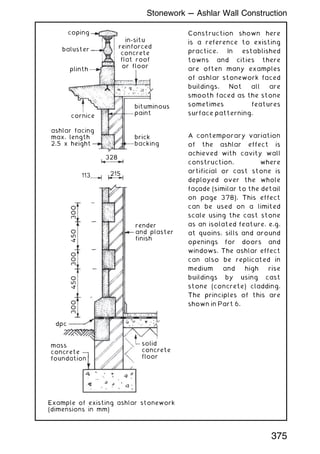
Fine
agg.
(kg)
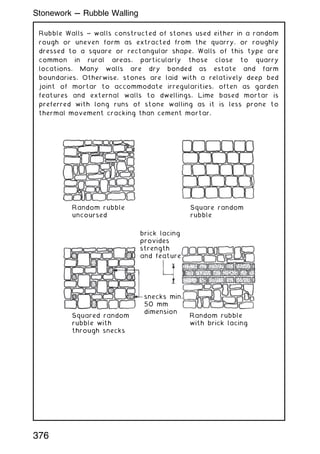
Coarse
agg. (kg)
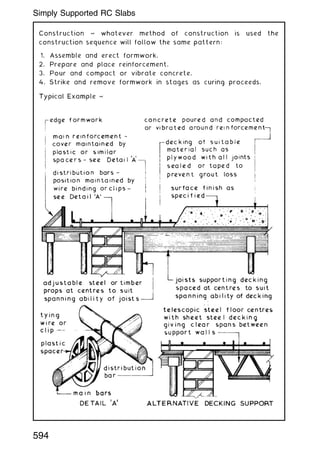
max. 20 mm
Mix
ratio
ST1 S1 25 84 126 1:3.35:5.02
ST2 S2 25 72 107 1:2.87:4.28
ST2 S3 25 65 97 1:2.58:3.88
ST2 S4 25 68 83 1:2.72:3.30
ST3 S2 25 63 95 1:2.52:3.80
ST4 S2 25 56 83 1:2.23:3.33
ST5 S2 25 48 72 1:1.92:2.88
Volume Batched Proportions~
Standard
prescribed
mix
Consistency
class
(slump)
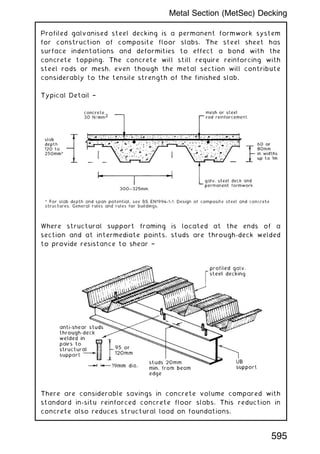
Cement
bag
(kg)
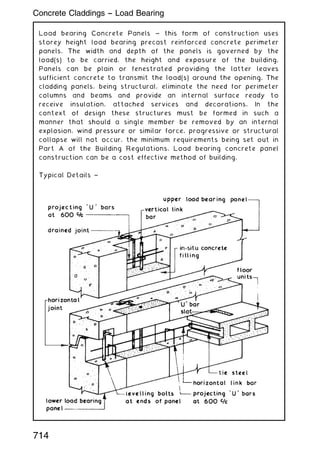
Fine
agg.
(litres)
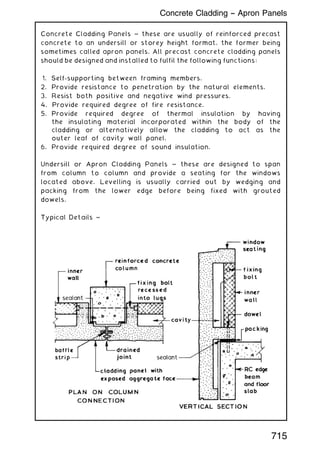
Coarse
agg.
(litres)
ST1 S1 25 60 85
ST2 S2 25 50 75
ST2 S3 25 45 70
ST2 S4 25 50 60
ST3 S2 25 45 65
Consistency Class ~ this refers to the amount of water in the mix,
affecting workability and final strength. See page 135.
Consistency class Slump (mm)
S1 10 - 40
S2 50 - 90
S3 100 - 150
S4 160 † 210
331
Concrete Production --- Site Mixed Specification
Concrete Supply ~ this is usually geared to the demand or the rate
at which the mixed concrete can be placed. Fresh concrete should
always be used or placed within 30 minutes of mixing to prevent
any undue drying out. Under no circumstances should more water
be added after the initial mixing.
Ref. BS EN 206-1: Concrete. Specification, performance, production
and conformity.
332
Concrete Production --- Supply
Cofferdams ~ these are temporary enclosures installed in soil or
water to prevent the ingress of soil and/or water into the
working area with the cofferdam. They are usually constructed
from interlocking steel sheet piles which are suitably braced or
tied back with ground anchors. Alternatively a cofferdam can be
installed using any structural material which will fulfil the required
function.
333
Cofferdams
Steel Sheet Piling ~ apart from cofferdam work, steel sheeting can
be used in excavations and to form permanent retaining walls.
Three common formats of steel sheet piles with interlocking joints
are available with a range of section sizes and strengths up to a
maximum length of 30 m.
Installing Steel Sheet Piles ~ to ensure that the sheet piles are
pitched and installed vertically a driving trestle or guide frame is
used. These are usually purpose built to accommodate a panel of
10 to 12 pairs of piles. The piles are lifted into position by a crane
and driven by means of a percussion piling hammer or alternatively
they can be pushed into the ground by hydraulic rams acting
against the weight of the power pack which is positioned over the
heads of the pitched piles.
Note: Rot-proof PVC sheet piling is also available.
334
Cofferdams --- Steel Sheet Piling
Alternative guide rail support system to that shown on the
preceding page. This uses standard steel sections with components
bolted together for simple assembly and dismantling. Tack welding
is an option instead of bolting, with welds removed by angle
grinder for dismantling on completion of pile driving.
Steel trench sheeting is available in various profiles, including the
following ~
UC guide rail/waling
(same other side)
intermediate steel sheet piles
suspended and lowered by
crane into adjacent interlocking
joint, then driven/vibrated
into the ground
channel cross head
RSJ or channel brace
(same other side)
channels
two steel sheet piles located
in ground approximately 15 m
apart, with bracing framework
of steel channels and joists
1.5 m
to 2.0m
D
D
T
B
T
B
B = 330mm, D = 35mm, T = 3.5mm
B = 400mm, D = 50mm, T = 6.0mm
335
Steel Sheet Piling --- Installation
Applications ~
• Cofferdams
• Ground water control/diversion
• Barrier for ground water treatment systems
• Retaining walls
• Containment walls
• Flood protection
• Coastal protection, bulkheads and sea walls
• Tunnelling, cut and cover
• River weir walls
• Slope stabilisation
• Baffle walls
Compound Profiles ~
outer profile can function
as permanent formwork
with voids concreted in-situ
Larssen Box
Note: Tack welding is jointing adjacent pieces of
steel discontinuously.
Frodingham Plated Box
frodingham sheet pile
tack
weld
tack
welds
standard steel section
e.g. UB (see page 629)
tack welds steel plate
void
Ref. BS EN 12063: Execution of special geotechnical work. Sheet
pile walls.
336
Steel Sheet Piling
Caissons ~ these are box-like structures which are similar in
concept to cofferdams but they usually form an integral part of
the finished structure. They can be economically constructed and
installed in water or soil where the depth exceeds 18„000. There
are four basic types of caisson, namely:
1 . Box Caissons
2. Open Caissons
3. Monolithic Caissons
4. Pneumatic Caissons † used in water † see next page.
9

=

;
usually of precast concrete and used in
water being towed or floated into
position and sunk † land caissons are of
the open type and constructed in-situ.
337
Caissons
Pneumatic Caissons ~ these are sometimes called compressed air
caissons and are similar in concept to open caissons. They can be
used in difficult subsoil conditions below water level and have a
pressurised lower working chamber to provide a safe, dry working
area. Pneumatic caissons can be made of concrete whereby they
sink under their own weight or they can be constructed from steel
with hollow walls which can be filled with water to act as ballast.
These caissons are usually designed to form part of the finished
structure.
338
Caissons
Culvert ~ construction for subways and underground passageways.
Often used below elevated roads and railways as access for
pedestrians, animals (badger crossings), sewers, tidal outfalls and
as voids for the general location of pipes and cables.
Types ~ box, conduit or pipe, manufactured from reinforced
concrete for placing in large excavations before backfilling; a
technique known as cut and cover. Excavations may require
temporary support from sheet steel piling. Ground dewatering may
also be necessary.
Precast concrete sections in standard lengths of 1.000, 1.500 or
2.000 m and up to 4.000 m width or diameter
backfill
reinforced
concrete base
kicker and
water bar
lifting loops attached to
crown reinforcement
precast
concrete
crown
sealed
construction
joint
in-situ
concrete
base
formwork
sealed joint
or water
bar
In-situ concrete
Precast concrete
crown on in-situ
concrete base
line of excavation
embankment
temporary props
or formwork
support
lifting loops
precast concrete box
precast
concrete
pipe/conduit
225 mm
granular
bed
0.500 to
2.500 m
precast or in-situ
concrete cover slab
reinforced
concrete wall
339
Culverts --- Principles and Types
Principles of Procedure ~ after excavating to the appropriate
depth, the base is levelled (slightly inclined for drainage) and
finished with well compacted selected stone granules. Granular
material is used to consolidate the soil and to ease movement of
the precast concrete sections as they are pulled into place. After
crane lowering several sections into approximate locations, the
first is positioned, levelled and restrained for attachment of anchor
tension units. The remaining sections are pulled into place as
shown below. Spigot and socket joints are sealed with a synthetic
rubber gasket or mastic sealant. Thereafter, further sections are
added, similarly positioned and jointed. Subsequently, the complete
installation is backfilled for ground reinstatement.
Assembly of precast concrete sections
bolted down
tensioner
recesses cut
at joint positions
threads for handling loops and
for securing tensioner and anchor
joint surfaces primed
spigot
synthetic rubber sealing
ring or mastic sealant
in spigot recess
socket
75 mm
5 to 10 mm
precast
concrete
section
A
chain
tensioned
bolted down
anchor
first section
restrained
gl
Joint detail at A
tensioner
handle
340
Culverts --- Application and installation
Underpinning ~ the main objective of most underpinning work is to
transfer the load carried by a foundation from its existing bearing
level to a new level at a lower depth. Underpinning techniques can
also be used to replace an existing weak foundation. An
underpinning operation may be necessary for one or more of the
following reasons:
1. Uneven Settlement † this could be caused by uneven loading
of the building, unequal resistance of the soil action of tree
roots or cohesive soil settlement.
2. Increase in Loading † this could be due to the addition of an
extra storey or an increase in imposed loadings such as that
which may occur with a change of use.
3. Lowering of Adjacent Ground † usually required when
constructing a basement adjacent to existing foundations.
General Precautions ~ before any form of underpinning work is
commenced the following precautions should be taken:
1. Notify adjoining owners of proposed works giving full details
and temporary shoring or tying.
2. Carry out a detailed survey of the site, the building to be
underpinned and of any other adjoining or adjacent building
or structures. A careful record of any defects found should
be made and where possible agreed with the adjoining
owner(s) before being lodged in a safe place.
3. Indicators or `tell-tales' should be fixed over existing cracks
so that any subsequent movements can be noted and
monitored.
4. If settlement is the reason for the underpinning works a
thorough investigation should be carried out to establish the
cause and any necessary remedial work put in hand before
any underpinning works are started.
5. Before any underpinning work is started the loads on the
building to be underpinned should be reduced as much as
possible by removing the imposed loads from the floors and
installing any props and/or shoring which is required.
6. Any services which are in the vicinity of the proposed
underpinning works should be identified, traced, carefully
exposed, supported and protected as necessary.
341
Underpinning
Underpinning to Walls ~ to prevent fracture, damage or settlement
of the wall(s) being underpinned the work should always be carried
out in short lengths called legs or bays. The length of these bays
will depend upon the following factors:
1. Total length of wall to be underpinned.
2. Wall loading.
3. General state of repair and stability of wall and foundation
to be underpinned.
4. Nature of subsoil beneath existing foundation.
5. Estimated spanning ability of existing foundation.
Generally suitable bay lengths are:
1„000 to 1„500 for mass concrete strip foundations supporting
walls of traditional construction.
1„500 to 3„000 for reinforced concrete strip foundations
supporting walls of moderate loading.
In all cases the total sum of the unsupported lengths of wall
should not exceed 25% of the total wall length.
The sequence of bays should be arranged so that working in
adjoining bays is avoided until one leg of underpinning has been
completed, pinned and cured sufficiently to support the wall above.
342
Underpinning
343
Underpinning
Jack Pile Underpinning ~ this method can be used when the depth
of a suitable bearing capacity subsoil is too deep to make
traditional underpinning uneconomic. Jack pile underpinning is quiet,
vibration free and flexible since the pile depth can be adjusted to
suit subsoil conditions encountered. The existing foundations must
be in a good condition since they will have to span over the heads
of the pile caps which are cast onto the jack pile heads after the
hydraulic jacks have been removed.
344
Underpinning
Needle and Pile Underpinning ~ this method of underpinning can be
used where the condition of the existing foundation is unsuitable
for traditional or jack pile underpinning techniques. The brickwork
above the existing foundation must be in a sound condition since
this method relies on the `arching effect' of the brick bonding to
transmit the wall loads onto the needles and ultimately to the
piles. The piles used with this method are usually small diameter
bored piles † see page 268.
345
Underpinning
`Pynford' Stool Method of Underpinning ~ this method can be used
where the existing foundations are in a poor condition and it
enables the wall to be underpinned in a continuous run without the
need for needles or shoring. The reinforced concrete beam formed
by this method may well be adequate to spread the load of the
existing wall or it may be used in conjunction with other forms of
underpinning such as traditional and jack pile.
346
Underpinning
Root Pile or Angle Piling ~ this is a much simpler alternative to
traditional underpinning techniques, applying modern concrete
drilling equipment to achieve cost benefits through time saving. The
process is also considerably less disruptive, as large volumes of
excavation are avoided. Where sound bearing strata can be located
within a few metres of the surface, wall stability is achieved
through lined reinforced concrete piles installed in pairs, at
opposing angles. The existing floor, wall and foundation are pre-
drilled with air-flushed percussion auger, giving access for a steel
lining to be driven through the low grade/clay subsoil until it
impacts with firm strata. The lining is cut to terminate at the
underside of the foundation and the void steel reinforced prior to
concreting.
In many situations it is impractical to apply angle piling to both
sides of a wall. Subject to subsoil conditions being adequate, it
may be acceptable to apply remedial treatment from one side only.
The piles will need to be relatively close spaced.
347
Underpinning
Underpinning Columns ~ columns can be underpinned in the some
manner as walls using traditional or jack pile methods after the
columns have been relieved of their loadings. The beam loads can
usually be transferred from the columns by means of dead shores
and the actual load of the column can be transferred by means of
a pair of beams acting against a collar attached to the base of
the column shaft.
348
Underpinning
Classification of Water ~ water can be classified by its relative
position to or within the ground thus †
Problems of Water in the Subsoil:
1 . A high water table could cause flooding during wet periods.
2. Subsoil water can cause problems during excavation works by
its natural tendency to flow into the voids created by the
excavation activities.
3. It can cause an unacceptable humidity level around finished
buildings and structures.
Control of Ground Water ~ this can take one of two forms which
are usually referred to as temporary and permanent exclusion †
349
Dewater Principles
Permanent Exclusion ~ this can be defined as the insertion of an
impermeable barrier to stop the flow of water within the ground.
Temporary Exclusion ~ this can be defined as the lowering of the
water table and within the economic depth range of 1„500 can be
achieved by subsoil drainage methods; for deeper treatment a
pump or pumps are usually involved.
Simple Sump Pumping ~ suitable for trench work and/or where
small volumes of water are involved.
350
Ground Water Control --- Temporary Exclusion
Jetted Sumps ~ this method achieves the same objectives as the
simple sump methods of dewatering (previous page) but it will
prevent the soil movement associated with this and other open
sump methods. A borehole is formed in the subsoil by jetting a
metal tube into the ground by means of pressurised water, to a
depth within the maximum suction lift of the extract pump. The
metal tube is withdrawn to leave a void for placing a disposable
wellpoint and plastic suction pipe. The area surrounding the pipe is
filled with coarse sand to function as a filtering media.
351
Ground Water Control --- Temporary Exclusion
Wellpoint Systems ~ method of lowering the water table to a
position below the formation level to give a dry working area. The
basic principle is to jet into the subsoil a series of wellpoints which
are connected to a common header pipe which is connected to a
vacuum pump. Wellpoint systems are suitable for most subsoils and
can encircle an excavation or be laid progressively alongside as in
the case of a trench excavation. If the proposed formation level is
below the suction lift capacity of the pump a multi-stage system
can be employed † see next page.
352
Ground Water Control --- Temporary Exclusion
353
Ground Water Control --- Temporary Exclusion
Thin Grouted Membranes ~ these are permanent curtain or cut-off
non-structural walls or barriers inserted in the ground to enclose
the proposed excavation area. They are suitable for silts and
sands and can be installed rapidly but they must be adequately
supported by earth on both sides. The only limitation is the depth
to which the formers can be driven and extracted.
354
Ground Water Control --- Permanent Exclusion
Contiguous or Secant Piling ~ this forms a permanent structural
wall of interlocking bored piles. Alternate piles are bored and cast
by traditional methods and before the concrete has fully hardened
the interlocking piles are bored using a toothed flight auger. This
system is suitable for most types of subsoil and has the main
advantages of being economical on small and confined sites;
capable of being formed close to existing foundations and can be
installed with the minimum of vibration and noise. Ensuring a
complete interlock of all piles over the entire length may be
difficult to achieve in practice; therefore the exposed face of the
piles is usually covered with a mesh or similar fabric and face with
rendering or sprayed concrete. Alternatively a reinforced concrete
wall could be cast in front of the contiguous piling. This method of
ground water control is suitable for structures such as basements,
road underpasses and underground car parks.
355
Ground Water Control --- Permanent Exclusion
Diaphragm Walls ~ these are structural concrete walls which can
be cast in-situ (usually by the bentonite slurry method) or
constructed using precast concrete components (see next page).
They are suitable for most subsoils and their installation generates
only a small amount of vibration and noise, making them suitable
for works close to existing buildings. The high cost of these walls
makes them uneconomic unless they can be incorporated into the
finished structure. Diaphragm walls are suitable for basements,
underground car parks and similar structures.
356
Ground Water Control --- Permanent Exclusion
Precast Concrete Diaphragm Walls ~ these walls have the some
applications as their in-situ counterparts and have the advantages
of factory-produced components but lack the design flexibility of
cast in-situ walls. The panel or post and panel units are installed in
a trench filled with a special mixture of bentonite and cement with
a retarder to control the setting time. This mixture ensures that
the joints between the wall components are effectively sealed. To
provide stability the panels or posts are tied to the retained earth
with ground anchors.
357
Ground Water Control --- Permanent Exclusion
Grouting Methods ~ these techniques are used to form a curtain or
cut off wall in high permeability soils where pumping methods could
be uneconomic. The curtain walls formed by grouting methods are
non-structural; therefore adequate earth support will be required
and in some cases this will be a distance of at least 4„000 from
the face of the proposed excavation. Grout mixtures are injected
into the soil by pumping the grout at high pressure through special
injection pipes inserted in the ground. The pattern and spacing of
the injection pipes will depend on the grout type and soil
conditions.
Grout Types ~
1 . Cement Grouts † mixture of neat cement and water cement
sand up to 1 : 4 or PFA (pulverised fuel ash) cement to a 1 : 1
ratio. Suitable for coarse-grained soils and fissured and
jointed rock strata.
2. Chemical Grouts † one shot (premixed) or two shot (first
chemical is injected followed immediately by second chemical
resulting in an immediate reaction) methods can be employed
to form a permanent gel in the soil to reduce its permeability
and at the same time increase the soil's strength. Suitable
for medium to coarse sands and gravels.
3. Resin Grouts † these are similar in application to chemical
grouts but have a low viscosity and can therefore penetrate
into silty fine sands.
358
Ground Water Control --- Permanent Exclusion
Ground Freezing Techniques ~ this method is suitable for all types
of saturated soils and rock and for soils with a moisture content in
excess of 8% of the voids. The basic principle is to insert into the
ground a series of freezing tubes to form an ice wall thus creating
an impermeable barrier. The treatment takes time to develop and
the initial costs are high; therefore it is only suitable for large
contracts of reasonable duration. The freezing tubes can be
installed vertically for conventional excavations and horizontally
for tunnelling works. The usual circulating brines employed are
magnesium chloride and calcium chloride with a temperature of 15
to 25C which would take 10 to 17 days to form an ice wall 1„000
thick. Liquid nitrogen could be used as the freezing medium to
reduce the initial freezing period if the extra cost can be justified.
359
Ground Water Control --- Medium Term Exclusion
Soil Investigation ~ before a decision is made as to the type of
foundation which should be used on any particular site a soil
investigation should be carried out to establish existing ground
conditions and soil properties. The methods which can be employed
together with other sources of information such as local
knowledge, ordnance survey and geological maps, mining records
and aerial photography should be familiar to students at this level.
If such an investigation reveals a naturally poor subsoil or
extensive filling the designer has several options:
1. Not to Build † unless a new and suitable site can be found
building is only possible if the poor ground is localised and
the proposed foundations can be designed around these areas
with the remainder of the structure bridging over these
positions.
2. Remove and Replace † the poor ground can be excavated,
removed and replaced by compacted fills. Using this method
there is a risk of differential settlement and generally for
depths over 4„000 it is uneconomic.
3. Surcharging † this involves preloading the poor ground with a
surcharge of aggregate or similar material to speed up
settlement and thereby improve the soil's bearing capacity.
Generally this method is uneconomic due to the time delay
before actual building operations can commence which can
vary from a few weeks to two or more years.
4. Vibration † this is a method of strengthening ground by
vibrating a granular soil into compacted stone columns either
by using the natural coarse granular soil or by replacement †
see pages 361 and 362.
5. Dynamic Compaction † this is a method of soil improvement
which consists of dropping a heavy weight through a
considerable vertical distance to compact the soil and thus
improve its bearing capacity and is especially suitable for
granular soils † see page 363.
6. Jet Grouting † this method of consolidating ground can be
used in all types of subsoil and consists of lowering a monitor
probe into a 150 mm diameter prebored guide hole. The probe
has two jets the upper of which blasts water, concentrated by
compressed air to force any loose material up the guide to
ground level. The lower jet fills the void with a cement slurry
which sets into a solid mass † see page 364.
360
Soil Stabilisation and Improvement
Ground Vibration ~ the objective of this method is to strengthen
the existing soil by rearranging and compacting coarse granular
particles to form stone columns with the ground. This is carried
out by means of a large poker vibrator which has an effective
compacting radius of 1„500 to 2„700. On large sites the vibrator is
inserted on a regular triangulated grid pattern with centres
ranging from 1„500 to 3„000. In coarse-grained soils extra coarse
aggregate is tipped into the insertion positions to make up levels
as required whereas in clay and other fine particle soils the
vibrator is surged up and down enabling the water jetting action
to remove the surrounding soft material thus forming a borehole
which is backfilled with a coarse granular material compacted
in-situ by the vibrator. The backfill material is usually of 20 to
70 mm size of uniform grading within the chosen range. Ground
vibration is not a piling system but a means of strengthening
ground to increase the bearing capacity within a range of 200 to
500 kN/m2
.
361
Soil Stabilisation and Improvement
Sand Compaction † applied to non-cohesive subsoils where the
granular particles are rearranged into a denser condition by poker
vibration.
The crane-suspended vibrating poker is water-jetted into the
ground using a combination of self-weight and water displacement
of the finer soil particles to penetrate the ground. Under this
pressure, the soil granules compact to increase in density as the
poker descends. At the appropriate depth, which may be determined
by building load calculations or the practical limit of plant
(generally 30 m max.), jetting ceases and fine aggregates or sand
are infilled around the poker. The poker is then gradually
withdrawn compacting the granular fill in the process. Compaction
continues until sand fill reaches ground level. Spacing of
compaction boreholes is relatively close to ensure continuity and
an integral ground condition.
362
Soil Stabilisation and Improvement
Dynamic Compaction ~ this method of ground improvement
consists of dropping a heavy weight from a considerable height and
is particularly effective in granular soils. Where water is present in
the subsoil, trenches should be excavated to allow the water to
escape and not collect in the craters formed by the dropped
weight. The drop pattern, size of weight and height of drop are
selected to suit each individual site but generally three or four drops
are made in each position forming a crater up to 2„500 deep and
5„000 in diameter. Vibration through the subsoil can be a problem
with dynamic compaction operations; therefore the proximity and
condition of nearby buildings must be considered together with the
depth position and condition of existing services on site.
363
Soil Stabilisation and Improvement
Jet Grouting ~ this is a means of consolidating ground by lowering
a monitor probe into preformed boreholes. The probe is rotated
and the sides of the borehole are subjected to a jet of pressurised
water and air from a single outlet which enlarges and compacts
the borehole sides. At the same time a cement grout is being
introduced under pressure to fill the void being created. The water
used by the probe and any combined earth is forced up to the
surface in the form of a sludge. If the monitor probe is not rotated
grouted panels can be formed. The spacing, depth and layout of
the boreholes is subject to specialist design.
364
Soil Stabilisation and Improvement
Green-field † land not previously built upon. Usually part of the
`green†belt' surrounding urban areas, designated inappropriate
for development in order to preserve the countryside. Limited
development for agricultural purposes only may be permitted on
`green-belt' land.
Brown-field † derelict land formerly a developed site and usually
associated with previous construction of industrial buildings. The
UK government has an objective to build 60% of new homes on
these sites.
Site Survey † land previously used for industrial bulidings could be
contaminated with hazardous waste or pollutants. Therefore it is
essential that a geo†technical survey is undertaken to determine
whether contaminants are in the soil and ground water. Of
particular concern are: acids, salts, heavy metals, cyanides and
coal tars, in addition to organic materials which decompose to
form the highly explosive gas methane. Analysis of the soil will
determine a `trigger threshold value', above which it will be
declared sensitive to the end user. For example, a domestic garden
or children's play area will have a low value relative to land
designated for a commercial car park.
Site Preparation † when building on sites previously infilled with
uncontaminated material, a reinforced raft-type foundation may be
adequate for light structures. Larger buildings will justify soil
consolidation and compaction processes to improve the bearing
capacity. Remedial measures for subsoils containing chemicals or
other contaminants are varied.
Legislation † the Environment Protection Act of 1990 attempted
to enforce responsibility on local authorities to compile a register
of all potentially contaminated land. This proved unrealistic and
too costly due to inherent complexities. Since then, requirements
under the Environment Act 1995, the Pollution Prevention and
Control Act 1999, the PPC Regulations 2000 and the subsequent
DCLG Planning Policy Statement (PPS 23, 2004): Planning and
Pollution Control (Annex 2: Development on land affected by
contamination) have made this more of a planning issue. It has
become the responsibility of developers to conduct site
investigations and to present details of proposed remedial
measures as part of their planning application.
365
Reclamation of Waste Land
The traditional low-technology method for dealing with
contaminated sites has been to excavate the soil and remove it to
places licensed for depositing. However, with the increase in
building work on brown-field sites, suitable dumps are becoming
scarce. Added to this is the reluctance of ground operators to
handle large volumes of this type of waste. Also, where
excavations exceed depths of about 5m, it becomes less practical
and too expensive. Alternative physical, biological or chemical
methods of soil treatment may be considered.
Encapsulation † in-situ enclosure of the contaminated soil. A
perimeter trench is taken down to rock or other sound strata and
filled with an impervious agent such as bentonite clay. An
impermeable horizontal capping is also required to link with the
trenches. A high-specification barrier is necessary where liquid or
gas contaminants are present as these can migrate quite easily. A
system of monitoring soil condition is essential as the barrier may
decay in time. Suitable for all types of contaminant.
Soil washing † involves extraction of the soil, sifting to remove
large objects and placing it in a scrubbing unit resembling a huge
concrete mixer. Within this unit water and detergents are added for
a basic wash process, before pressure spraying to dissolve
pollutants and to separate clay from silt. Eliminates fuels, metals
and chemicals.
Vapour extraction † used to remove fuels or industrial solvents
and other organic deposits. At variable depths, small diameter
boreholes are located at frequent intervals. Attached to these are
vacuum pipes to draw air through the contaminated soil. The
contaminants are collected at a vapour treatment processing
plant on the surface, treated and evaporated into the atmosphere.
This is a slow process and it may take several months to cleanse a
site.
Electrolysis † use of low voltage d.c. in the presence of metals.
Electricity flows between an anode and cathode, where metal ions
in water accumulate in a sump before pumping to the surface for
treatment.
366
Physical Treatment of Contaminated Subsoil
BIOLOGICAL
Phytoremediation † the removal of contaminants by plants which
will absorb harmful chemicals from the ground. The plants are
subsequently harvested and destroyed. A variant uses fungal
degradation of the contaminants.
Bioremediation † stimulating the growth of naturally occurring
microbes. Microbes consume petrochemicals and oils, converting
them to water and carbon dioxide. Conditions must be right, i.e. a
temperature of at least 10C with an adequate supply of nutrients
and oxygen. Untreated soil can be excavated and placed over
perforated piping, through which air is pumped to enhance the
process prior to the soil being replaced.
CHEMICAL
Oxidation † subsoil boreholes are used for the pumped distribution
of liquid hydrogen peroxide or potassium permanganate. Chemicals
and fuel deposits convert to water and carbon dioxide.
Solvent extraction † the subsoil is excavated and mixed with a
solvent to break down oils, grease and chemicals that do not
dissolve in water.
THERMAL
Thermal treatment (off site) † an incineration process involving the
use of a large heating container/oven. Soil is excavated, dried and
crushed prior to heating to 2500C, where harmful chemicals are
removed by evaporation or fusion.
Thermal treatment (in-situ) † steam, hot water or hot air is
pressure-injected through the soil. Variations include electric
currents and radio waves to heat water in the ground to become
steam. Evaporates chemicals.
Ref. Building Regulations, Approved Document, C1: Site preparation
and resistance to contaminants. Section 1: Clearance or treatment
of unsuitable material. Section 2: Resistance to contaminants.
367
Biological, Chemical and Thermal Treatment of Contaminated Subsoil
368
Notes
This page intentionally left blank
5 SUPERSTRUCTURE † 1
CHOICE OF MATERIALS
BRICK AND BLOCK WALLS
CAVITY WALLS
DAMP-PROOF COURSES AND MEMBRANES
GAS-RESISTANT MEMBRANES
CALCULATED BRICKWORK MORTARS
ARCHES AND OPENINGS
WINDOWS, GLASS AND GLAZING
DOMESTIC AND INDUSTRIAL DOORS
CROSSWALL CONSTRUCTION
FRAMED CONSTRUCTION
RENDERING AND CLADDING EXTERNAL WALLS
TIMBER PITCHED AND FLAT ROOFS
GREEN ROOFS
THERMAL INSULATION
U-VALUE CALCULATION
THERMAL BRIDGING
ACCESS FOR THE DISABLED
369
STAGE 1
Consideration to be given to the following:
1 . Building type and usage.
2. Building owner's requirements and preferences.
3. Local planning restrictions.
4. Legal restrictions and requirements.
5. Site restrictions.
6. Capital resources.
7. Future policy in terms of maintenance and adaptation.
370
External Envelope --- Choice of Materials
Formation ~ millions of years ago planet earth originated as a ball
of hot gases. Millions of years later the gases began to cool,
solidify and liquefy to form large areas of land and seas. Today, a
molten mass remains at the core, some 200 km below the surface,
occasionally materialising in volcanic eruptions. The effect of
cooling also created an atmospheric condition about the earth. As
the gases solidified they formed into deposits of stone, varying in
composition depending on their relative levels below the earth's
crust and rate of cooling. Many of these stone deposits are
materially suitable for building work and can be categorised under
the following geological classifications:
• Igneous 2560 † 3200 kg/m3
• Sedimentary 1950 † 2750 ..
• Metamorphic 2630 † 3040 ..
Igneous ~ originated from volcanic activity, formed by the
crystallisation of molten rock. Can be sub-divided into:
Plutonic † solidified very slowly, deep into the lower part of the
earth's surface, e.g. granite.
Hypabyssal † solidified less slowly, near to the earth's upper
surface, e.g. porphyry.
Volcanic † solidified rapidly at the earth's outer surface, e.g.
pumice.
Sedimentary ~ composed of particles of older rocks broken down
by erosion due to the receding water levels that at one time
covered much of the earth's surface. Fierce winds and ice also had
a disintegrating effect on exposed stone deposits. Sedimentary
deposits tend to lie in roughly horizontal stratified formations.
These are sometimes loose as in sand and shingle, otherwise may
be consolidated by superimposed loads with particles cemented
together by minerals carried in water. In this dense form, sandstone
and limestone can be shaped as building blocks. Chalk and shale are
other examples.
Metamorphic ~ originally igneous or sedimentary, but changed
structurally by geological processes involving heat, pressure and
chemical reaction due to the presence of fluids. Examples include
marble a form of metamorphic limestone, and slate a metamorphic
clay.
371
Stonework --- Types of Stone
Sources ~ stones of various types occur worldwide. Some are
mined, but most are reasonably accessible from surface workings
at quarries. Removal is by blasting and then wedge cutting into
slabs, blocks and thin sections of workable sizes. Thereafter it is
sawn and split into commercial sizes, dressed and/or polished for
final purpose. The UK and Ireland have many sources of stone to
include the following:
Type Location Colour
Granite Cornwall Light grey
Highlands and Western Isles Bright grey to black
Leicestershire Various, light to dark
Westmorland, Cumbria Reddish brown
Down, Ireland Greenish grey
Limestone Portland, Dorset White to light brown
Bath, West Country White to cream
Lincolnshire Cream to buff
Wiltshire Light brown
Somerset Yellowish grey
Kent Blue grey
Leicestershire Cream to yellow
Nottinghamshire Yellowish brown
Oxfordshire Buff
Sandstone Yorkshire Grey and light brown
Forest of Dean, Gloucs. Grey/blue, grey/pink
Gloucestershire Dull blue
Glamorganshire Dull blue
Derbyshire Buff and light grey
Sussex Buff, brown specs
Marble Dorset Green/blue or grey
Derbyshire Light grey
Argyllshire Pale green/white
Galway, Ireland Green
Stonework is often a preferred alternative to brickwork,
particularly where local planning requirements stipulate that
vernacular characteristics are maintained.
372
Stonework --- Location
Naturally Quarried Stones ~ these vary marginally in appearance,
even when extracted in the same location from one quarry.
Texture and slight colour variation adds to the character and
visual attractiveness, along with the presence of veins, crystals,
fossils and other visible features that manifest with wear and
exposure.
Artificial Stones ~ otherwise known as reconstituted,
reconstructed or cast stone. These are factory manufactured by
casting natural stone aggregates of 15 mm maximum size with
white or coloured cement into moulds of a specific dimensions. The
usual ratio is 3 to 4 parts of aggregate to 1 part cement. These
defect free blocks produced under quality controlled conditions are
an economical substitute for natural stone. Block sizes can vary to
suit specific applications, but colour and texture are uniform. A
variation is a 20 to 25 mm facing of natural stone aggregate, fine
sand aggregate and cement (possibly colour pigmented) set over a
base of wet concrete.
Further working of cast stone can produce a high quality surface
finish to very accurate overall dimensions. In this precise form,
blocks can be used as an artificial type of ashlar facing over
brickwork or standard blockwork backgrounds, (see below for a
definition of ashlar and next page for a summary of ashlar
walling).
The long term weathering qualities of cast stone differ from that
of natural stone. Natural stone weathers slowly with a gradual
and fairly consistent colour change. Artificial stone has the
characteristics of concrete. With time it may crack, become dull
and attract dirt staining at joints, corners and projecting features
such as copings and sills.
Ashlar ~ hewn and dressed stone facing block.
Ashlaring ~ stonework comprising blocks of stone finely squared
and dressed to a precise finish and dimensions, laid to courses of
not less than 300 mm in height.
Refs.: BS 1217: Cast stone. Specification.
BS EN 771-5: Specification for masonry units. Manufactured
stone masonry units.
373
Stonework --- Artificial Stone
Ashlaring ~ as defined on the preceding page, a wall facing of high
quality stone laid with very thin joints. It is a classic façade
treatment to many existing prestigious buildings, but now rarely
used due to the cost of manufacturing the stone to fine
tolerances and the time consuming craftsmanship required for
construction. Examples are included here not just for historical
reference; many buildings constructed with ashlar walling are the
subject of ongoing refurbishment, conversion, modification,
adaptation and repair. Limestone is popular for ashlar, produced
in thicknesses between 100 and 300 mm and bedded in a mortar
known as mason's putty. The traditional mix for this mortar
comprises stone dust, lime putty and portland cement in the ratio
of 7:5:2.
unit thickness, 100 to 300 mm
60
10
10
20
Channelled Vee and
channel
Vee
50
40
mason's putty
thin bed joint
Examples of joint profiles to ashlar walling units (dimensions in mm)
374
Stonework --- Ashlar Walling
Construction shown here
is a reference to existing
practice. In established
towns and cities there
are often many examples
of ashlar stonework faced
buildings. Not all are
smooth faced as the stone
sometimes features
surface patterning.
A contemporary variation
of the ashlar effect is
achieved with cavity wall
construction, where
artificial or cast stone is
deployed over the whole
façade (similar to the detail
on page 378). This effect
can be used on a limited
scale using the cast stone
as an isolated feature, e.g.
at quoins, sills and around
openings for doors and
windows. The ashlar effect
can also be replicated in
medium and high rise
buildings by using cast
stone (concrete) cladding.
The principles of this are
shown in Part 6.
coping
baluster
plinth
cornice
ashlar facing
max. length
2.5 x height
bituminous
paint
brick
backing
328
215
113
300
render
and plaster
finish
450
300
450
300
dpc
mass
concrete
foundation
solid
concrete
floor
Example of existing ashlar stonework
(dimensions in mm)
in-situ
reinforced
concrete
flat roof
or floor
375
Stonework --- Ashlar Wall Construction
Rubble Walls ~ walls constructed of stones used either in a random
rough or uneven form as extracted from the quarry, or roughly
dressed to a square or rectangular shape. Walls of this type are
common in rural areas, particularly those close to quarry
locations. Many walls are dry bonded as estate and farm
boundaries. Otherwise, stones are laid with a relatively deep bed
joint of mortar to accommodate irregularities, often as garden
features and external walls to dwellings. Lime based mortar is
preferred with long runs of stone walling as it is less prone to
thermal movement cracking than cement mortar.
Random rubble
uncoursed
Square random
rubble
Squared random
rubble with
through snecks
Random rubble
with brick lacing
brick lacing
provides
strength
and feature
snecks min.
50 mm
dimension
376
Stonework --- Rubble Walling
Common Treatment at Dressed Stone Arch Openings ~ examples
show rubble walling to the left and ashlar to the right.
coursed random
rubble wall
centre-line of
semi-circular arch
ashlar wall
coursed random
rubble wall ashlar wall
keystone
extrados
curved voussoirs
intrados
quoin stones
keystone
stepped
voussoirs
crossetted
voussoirs
intrados
quoin stones
377
Stonework --- Feature Arches
In many areas where locally quarried stone is the established
building material, traditions are maintained and specified as part of
planning compliance requirements. Dressed stone is an example of
an established external feature and can be used as an alternative
to brickwork as the outer leaf of cavity walls. Stone widths of 150
to 225 mm are usual, although as little as 100 mm is possible with
mechanically cut and finished stone. However, this type of precise
finishing produces an effect resembling ashlar rather than rubble. A
lightweight concrete block inner leaf provides lateral support and
stability with wall ties positioned at the maximum spacings shown
on page 400.
150 mm
lightweight
concrete block
inner leaf
50 mm min.
cavity insulated
as required
wall ties spaced
as shown on
page 400
dpc min. 150 mm
above ground
cavity filled
with concrete
at least 225 mm
below dpc
mass concrete
strip foundation
300 mm
random rubble
outer leaf
Note: Solid walls of stone need to be at least 300 mm wide to
ensure stability; in excess of 400 mm (depending on quality) to
resist penetration of rainfall.
378
Stonework --- Cavity Wall
Shaping and Moulding ~ bricks were originally made by hand
kneading clay into an open wooden box. The box dimensions
typically 250 mm × 125 mm × 75 mm (10'' × 5'' × 3'') with a
protrusion in the bottom if a frog or indent was required as a
mortar key. Oversized dimensions allowed for shrinkage.
Drying and Burning ~ after surplus clay was struck off, the green brick
was turned out of the mould and stacked with others in a drying shed
for 3 to 6 weeks. The bricks were then burnt in open clamps. This
involved stacking in open flue formations to a height of 3 to 4 metres
with layers of fine coal laid between the bricks. Fine particles of coal
could also be mixed with the clay during the moulding process. On
setting the clamp, fires were placed and ignited leaving the bricks to
burn for several days. Bricks were produced in this way by the
Romans and more so during the Middle Ages. There is evidence that
the Babylonians used this procedure over 6000 years ago.
Hardwood hand mould or
frame for standard size
clay bricks
Outline examples of
moulds for hand made
purpose made specials
Double cant
250mm
frame
inserts
75 mm
125mm
Birdsmouth
Single angle Dog-leg
Notes:
• Clamp burning is still used by some of the smaller brick
companies, but most producers now use controlled kiln burning
as described on the next page.
• Bricks made with fine coal deposits have characteristic purple/
blue markings. They have become known as stocks.
• Small batch orders for purpose made bricks as shown on page
396, are still made by hand in specially shaped moulds.
379
Clay Brick Manufacture --- History
Machine Manufacture ~ during the industrial revolution (mid 18th. to
19th. centuries) greater demand for bricks led to brick production
on an industrial scale. Machinery was introduced to mass produce
pressed bricks in moulds and for wire cutting extruded clay. Both
techniques are the basis of production today. Wire cutting to size is
used where clay is mechanically forced through a brick sized
opening. Circular bars in the central area of the opening leave two
or three perforations to provide for a mortar key when laid.
Kiln Drying and Firing ~ in 1858 the German, Friedrich Hoffmann
devised the circular or oval kiln system containing several
chambers. The chambers have loading doors, fire holes and flues
connecting to a common chimney. Each chamber represents a
different stage of drying, pre-heating, firing* (1100 0
C) and cooling,
all of which are undertaken on a large scale without
transportation. A later development is the straight tunnel kiln with
a central firing zone. With this, bricks stacked on trolleys run on a
narrow railway line through slowly increasing and decreasing heat
zones. Both types of kiln are used today, although the tunnel is
generally preferred as this is easier to control.
Hoffmann kiln
in principle
Tunnel kiln
in principle
cooling
unloading direction
of fire
oval or
circular
outline
on plan
loading
central
flue
firing
drying
bricks on trolleys move slowly
rail
track
drying and
pre-heating
central
firing zone
cooling
zone
pre-heating
* Fired using natural gas, fuel oil or solid fuel.
380
Clay Brick Manufacture --- Development
History ~ originated during the 19th. century as a form of cast
artificial stone. Caustic lime and sand were mixed with water into a
workable consistency and left until the lime was completely
hydrated. It was then pressed into moulds for steam curing and
initial hardening. After dry stacking for several weeks the bricks
matured to a usable strength.
Development ~ by the end of the 19th. century, processing was
considerably improved. Steam at 200C was pressurised in an
autoclave (a sealed vessel used to create a chemical reaction
between the lime and sand under high pressure; approximately 15 bar or
1.5 MN/m2
). The reaction formed hydrosilicates (hydrated calcium
silicates) resulting in an extremely durable and strong building brick.
This principle is the basis for calcium silicate brick production today.
Typical Composition ~ Silica (sand) 84%
Lime (quicklime or hydrated lime) 7%
Alumina and oxide of lime 2%
Water, manganese and alkalis 7%
Properties ~ Similar production costs to clay brick manufacture
High crushing strength (see below)
Dimensionally accurate, ie. edges straight, even and
without defects, warping or twisting
Uniformity of dull white colour and of texture
(perceived as uninteresting by some)
Variations ~ Flint-lime, produced by adding powdered flint
Colouring agents; options for buffs, blues, mauves, etc.
Typical Brick Compressive Strength Comparisons ~
Hand made clay † 6 to 14 MN/m2
Machine made clay † 15 to 20 MN/m2
Stock (clay) † 10 to 20 MN/m2
Engineering brick (clay) † 50 to 70 MN/m2
Sand-lime † 20 to 50 MN/m2
(see BS EN 771-2)
Environmental Impact ~ due to less energy fuel use in production and
without generating the air pollutants that occur with clay brick
manufacture, considered to have a relative low environmental impact.
381
Calcium Silicate (Sand-Lime) Brick Manufacture
Bricks ~ these are walling units within a length of 337„5 mm, a width
of 225 mm and a height of 112„5 mm. The usual size of bricks in
common use is length 215 mm, width 102„5 mm and height 65 mm and
like blocks they must be laid in a definite pattern or bond if they
are to form a structural wall. Bricks are usually made from clay
(BS EN 771-1) or from sand and lime (BS EN 771-2) and are available
in a wide variety of strengths, types, textures, colours and special
shaped bricks to BS 4729.
382
Solid Brick Walls
Typical Details ~
Bonding ~ an arrangement of bricks in a wall, column or pier laid
to a set pattern to maintain an adequate lap.
Purposes of Brick Bonding:
1 . Obtain maximum strength whilst distributing the loads to be
carried throughout the wall, column or pier.
2. Ensure lateral stability and resistance to side thrusts.
3. Create an acceptable appearance.
Simple Bonding Rules:
1 . Bond is set out along length of wall working from each end
to ensure that no vertical joints are above one another in
consecutive courses.
2. Walls which are not in exact bond length can be set out thus †
3. Transverse or cross joints
continue unbroken across the
width of wall unless stopped
by a face stretcher.
383
Brick Bonding --- Principles
English Bond ~ formed by laying alternate courses of stretchers
and headers it is one of the strongest bonds but it will require
more facing bricks than other bonds (89 facing bricks per m2
).
Typical Example ~
384
Brick Bonding --- English Bond
Flemish Bond ~ formed by laying headers and stretchers alternately
in each course. Not as strong as English bond but is considered to
be aesthetically superior and uses less facing bricks (79 facing
bricks per m2
).
Typical Example ~
385
Brick Bonding --- Flemish Bond
386
Brick Bonding --- Special Bonds
A variation of
stretcher bond with
less symmetry of
load distribution.
RAKING STRETCHER BOND
Each brick overlaps
the brick below by a
quarter.
Similar to English
cross bond using
bricks of colour or
texture variation to
create a pattern.
DUTCH BOND
Three quarter bricks
are used at ends
instead of queen
closers.
Two stretcher faces
to one header each
course. Headers
stagger and may be
picked out in colour
or texture differing
to the stretchers.
MONK BOND
Many variations of
monk bond exist.
Similar to Flemish
bond. Two headers
replace a stretcher
every seventh course.
Coloured or textured
bricks pick out
diamond shapes.
FLEMISH CROSS BOND
387
Brick Bonding --- Further Special Bonds
Stack Bonding † the quickest, easiest and most economical bond to
lay, as there is no need to cut bricks or to provide special sizes.
Visually the wall appears unbonded as continuity of vertical joints
is structurally unsound, unless wire bed-joint reinforcement is
placed in every horizontal course, or alternate courses where
loading is moderate. In cavity walls, wall ties should be closer than
normal at 600 mm max. spacing horizontally and 225 mm max.
spacing vertically and staggered.
Application † this distinctive uniform pattern is popular as non-
structural infill panelling to framed buildings and for non-load
bearing exposed brickwork partitions.
388
Brick Bonding --- Stack Bond
Attached Piers ~ the main function of an attached pier is to give
lateral support to the wall of which it forms part from the base to
the top of the wall. It also has the subsidiary function of dividing a
wall into distinct lengths whereby each length can be considered as
a wall. Generally walls must be tied at end to an attached pier,
buttressing or return wall.
Typical Examples ~
Requirements for the external wall of a small single storey non-
residential building or annex exceeding 2.5 m in length or height and
of floor area not exceeding 36 m2
:
• Minimum thickness, 90 mm, i.e. 102.5 mm brick or 100 mm block.
• Built solid of bonded brick or block masonry and bedded in
cement mortar.
• Surface mass of masonry, minimum 130 kg/m2
where floor area
exceeds 10 m2
.
• No lateral loading permitted excepting wind loads.
• Maximum length or width not greater than 9 m.
• Maximum height as shown on page 391.
• Lateral restraint provided by direct bearing of roof and as
shown on page 543.
• Maximum of two major openings in one wall of the building.
Height maximum 2.1 m, width maximum 5 m (if two openings,
total width maximum 5 m).
• Other small openings permitted, as shown on next page.
• Bonded or connected to piers of minimum size 390 5 190 mm at
maximum 3 m centres for the full wall height as shown above.
Pier connections are with pairs of wall ties of 20 5 3 mm flat
stainless steel type at 300 mm vertical spacing.
389
Brick Bonding --- Attached Piers
Attached piers as applied to half brick (90mm min.) thick walls ~
• Major openings A and B are permitted in one wall only.
Aggregate width is 5m maximum. Height not greater than 2.1 m.
No other openings within 2m.
• Other walls not containing a major opening can have smaller
openings of maximum aggregate area 2.4 m2
.
• Maximum of only one opening between piers.
• Distance from external corner of a wall to an opening at
least 390mm unless the corner contains a pier.
• The minimum pier dimension of 390 5 190 mm can be varied to
327 5 215 mm to suit brick sizes.
390
Attached Piers
Construction of half brick and 100 mm thick solid concrete block
walls (90 mm min.) with attached piers, has height limitations to
maintain stability. The height of these buildings will vary depending
on the roof profile; it should not exceed the lesser value in the
following examples ~
NB. All dimensions are maximum.
Height is measured from top of foundation to top of wall except
where shown at an intermediate position. Where the underside of
the floor slab provides an effective lateral restraint, measurements
may be taken from here.
391
Small Non-residential Buildings or Annexes
Movement ~ caused by building settlement, moisture absorption
and drying out and thermal expansion and contraction.
Effects ~ provided the mortar is weaker than the bricks, the
effects of movement within normal expectations will be
accommodated without unsightly cracking and damage. See page
423 for guidance on mortar composition and strengths.
Limitations ~ moisture and thermal movement is reversible up to a
limit. Clay brick walls can move about 1 mm in every 1 m of wall, so
for a visually and practically acceptable movement joint width of
12 mm, the spacing should not exceed 12 m. For calcium silicate
(sand-lime) bricks the maximum spacing is 9 m as they have greater
movement characteristics.
Applications ~
Plan Views
See page 734 for lightweight concrete block walls.
12m max.
uninterrupted
straight wall
long length
12 mm vertical
movement joint
movement
movement joint allows
long length to slide
long length
short return
short
return
bonded returns
and corners
6 m max.
wall tie
x x
Typical vertical
joint in a masonary
cavity wall
X = 225 mm max.
exposed brick leaf
joint filled with silicone sealant
or compressible material and
sealant pointing
Note: Joint at A in blockwork at 6 m max. spcing may be staggered, i.e. not directly
opposite joint in brickwork to promote integrity and to reduce differential movement.
12 mm vertical joint
6m
max.
392
Brickwork --- Movement Control
The appearance of a building can be significantly influenced by the
mortar finishing treatment to masonry. Finishing may be achieved
by jointing or pointing.
Jointing † the finish applied to mortar joints as the work proceeds.
Pointing † the process of removing semi-set mortar to a depth of
about 20mm and replacing it with fresh mortar. Pointing may
contain a colouring pigment to further enhance the masonry.
Finish Profiles, Typical Examples Shown Pointed ~
Examples of pointing to masonry
NB. Recessed and overhung finishes should not be used in exposed
situations, as rainwater can be detained. This could encourage
damage by frost action and growth of lichens.
393
Brickwork --- Jointing and Pointing
Brickwork should be reasonably uniform in colour, texture and
finish. The natural composition of clay source material is variable,
even where closely extracted. Combined with kiln baking to about
11000
C, no two bricks will be identical in dimensions and shape.
Therefore, some allowance for characteristic irregularities of
individual units is acceptable, see page 132. When assessing
acceptable thickness and tolerance of brickwork joints, overall
areas are considered and not the joints between individual units.
Note: Sand lime (calcium silicate) bricks are an exception. These are
produced to relatively precise dimensional tolerances with a
uniformity of colour and texture, see page 381.
Bed Joints, Deviation From the Horizontal ~
12 mm maximum deviation bed joint
reference
line
walls over 5 m long
deviation reduced on a
pro-rata basis for walls
less than 5 m
Bed Joints, Thickness ~
8 successive
joints*
individual bed joint
max. 5 mm variation
from the average*
perpends should not
deviate significantly
from the vertical
394
Brickwork --- Jointing Tolerances
Specials † these are required for feature work and application to
various bonds, as shown on the preceding pages. Bonding is not
solely for aesthetic enhancement. In many applications, e.g. English
bonded manhole walls, the disposition of bricks is to maximise wall
strength and integrity. In a masonry wall the amount of overlap
should not be less than one quarter of a brick length. Specials may
be machine or hand cut from standard bricks, or they may be
purchased as purpose-made. These purpose-made bricks are
relatively expensive as they are individually manufactured in
hardwood moulds.
Ref. BS 4729: Clay and calcium silicate bricks of special shapes and
sizes. Recommendations.
395
Special Bricks
Brickwork can be repetitive and monotonous, but with a little
imagination and skilled application it can be a highly decorative art
form. Artistic potential is made possible by the variety of naturally
occurring brick colours, textures and finishes, the latter often
applied as a sanding to soft clay prior to baking. Furthermore, the
range of pointing techniques, mortar colourings, brick shapes and
profiles can combine to create countless possibilities for
architectural expression.
Bricks are manufactured from baked clay, autoclaved sand/lime or
concrete. Clay is ideally suited to hand making special shapes in
hardwood moulds. Some popular formats are shown below, but
there is no limit to creative possibilities.
396
Purpose-made Special Bricks
Plinths † used as a projecting feature to enhance external wall
appearance at its base. The exposed projection determines that
only frost-proof quality bricks are suitable and that recessed or
raked-out joints which could retain water must be avoided.
Typical External Wall Base †
Corbel † a projecting
feature at higher levels of
a building. This may be
created by using plinth
bricks laid upside-down
with header and stretcher
formats maintaining bond.
For structural integrity,
the amount of projection
(P) must not exceed one-
third of the overall wall
thickness (T). Some other
types of corbel are shown
on the next page.
397
Special Bricks --- Plinths
Corbel † a type
of inverted plinth,
generally located at
the higher levels of a
building to create a
feature. A typical
example is quarter
bonded headers as a
detail below window
openings.
Dentil Coursing † a variation on continuous corbelling where
alternative headers project. This is sometimes referred to as table
corbelling.
Dog Toothing † a variation on a dentil course created by setting
the feature bricks at 45.
NB. Cavity insulated as required.
398
Special Bricks --- Corbels, Dentils and Dog Toothing
Blocks ~ these are walling units exceeding in length, width or height
the dimensions specified for bricks in BS EN 772-16. Precast concrete
blocks should comply with the recommendations set out in BS 6073-2
and BS EN 771-3. Blocks suitable for external solid walls are
classified as load bearing and are required to have a minimum declared
compressive strength of not less than 2.9 N/mm2
.
Typical Details ~
*See pages 401 to 403.
Refs.: BS 6073-2: Precast concrete masonry units.
BS EN 772-16: Methods of test for masonry units.
BS EN 771-3: Specification for (concrete) masonry units.
399
Solid Block Walls
Cavity Walls ~ these consist of an outer brick or block leaf or skin
separated from an inner brick or block leaf or skin by an air space
called a cavity. These walls have better thermal insulation and
weather-resistance properties than a comparable solid brick or
block wall and therefore are in general use for the enclosing walls
of domestic buildings. The two leaves of a cavity wall are tied
together with wall ties located at 2.5/m2
, or at equivalent
spacings shown below and as given in Section 2C of Approved
Document A † Building Regulations.
With butterfly-type ties the width of the cavity should be between
50 and 75 mm. Where vertical twist-type ties are used the cavity
width can be between 75 and 300 mm. Cavities are not normally
ventilated and are closed by roof insulation at eaves level.
* Stainless steel or non-ferrous ties are now preferred.
400
Cavity Walls
Minimum requirements ~
Thickness of each leaf, 90 mm.
Width of cavity, 50 mm.
Wall ties at 2.5/m2
(see previous page).
Compressive strength of bricks, 6 N/mm2
up to two storeys.*
Compressive strength of blocks, 2.9 N/mm2
up to two storeys.*
* For work between the foundation and the surface a 6 N/mm2
minimum brick strength is normally specified or 2.9 N/mm2
minimum concrete block strength (see next page for variations).
Combined thickness of each leaf + 10 mm whether used as an
external wall, a separating wall or a compartment wall, should be
not less than 1/16 of the storey height** which contains the wall.
** Generally measured between the undersides of lateral supports, e.g.
undersides of floor or ceiling joists, or from the underside of upper
floor joists to half-way up a laterally restrained gable wall. See
Approved Document A, Section 2C for variations and next page.
Wall dimensions for minimum combined leaf thicknesses of 90 mm +
90 mm + 10 mm (190 mm min. actual thickness) ~
Wall dimensions for minimum combined leaf thickness of 280 mm +
10 mm (290 mm actual thickness), e.g. 190 mm + 100 mm for one storey
height and a minimum 180 mm combined leaf thickness + 10 mm (i.e.
90 mm + 100 mm) for the remainder of its height ~
Wall dimensions for minimum combined leaf thickness of 280 mm +
10 mm (290 mm actual thickness) for two-storey height and a
minimum 180 mm combined leaf thickness + 10 mm (190 mm actual
thickness) for the remainder of its height ~
Wall length is measured from centre to centre of restraints by
buttress walls, piers or chimneys.
For other wall applications, see the reference to calculated
brickwork on page 419.
Height Length
3.5 m max. 12.0 m max.
3.5 m † 9.0 m 9.0 m max.
Height Length
3.5 † 9.0 m 9.0 † 12.0 m
9.0 m † 12.0 m 9.0 m max.
Height Length
9.0 m † 12.0 m 9.0 m † 12.0 m
401
Cavity Walls
Single storey Two storeys
timber roof
construction
A A
A A
A A
H
A A
H
H
upper level
of floor
upper level
of floor 140 mm min.
concrete block
or 215 mm
brick if  1 m
A if ⱹ 1 m
B if  1 m
Three storeys
timber roof
construction
A
B
A
H
A
B
A
H
C
C B
B
B
B
H
upper level
of floor
140 mm min.
concrete block
or 215 mm brick
Key for H 
†
2.7 m (N/mm2
min. compressive strength) ~
Note 1: If H  2.7 m, A should be at least 7.3 N/mm2
for concrete
blocks and 9 N/mm2
for brickwork, or as indicated in the diagrams
(take greater value).
Note 2: The above applies to standard format bricks of 215 mm ×
102.5 mm × 65 mm with  25% formed voids (20% for bricks with
frogs). For bricks with voids  25% (max. 55%) see Table 6 in
Approved Document A, Section 2C.
Conc.blocks Bricks
A 2.9 6.0
B 7.3 9.0
C 7.3 18.0
402
Cavity Walls
*Min. compressive strength depends on building height and loading.
See Building Regulations A.D. A: Section 2C (Diagram 9) and
extracts shown on the previous page.
cavity leaves to be not
less than 90 mm thick
(see page 401)
cavity to extend at least
225 mm below the lowest dpc
outer leaf of selected
facing bricks
dpc
ground level
TRADITIONAL CONSTRUCTION
bricks and blocks
below ground level
to be of suitable
quality*
mass concrete
strip foundation
(1 : 3 : 6) 15 N/mm2
cavity filling of weak
concrete to prevent
leaves of wall from moving
towards each other as a
result of earth pressures
well-
-compacted hardcore
mass concrete
ground floor slab
damp-proof
membrane
50 mm min. rigid insulation
floor screed
150
min.
brick outer leaf and
block inner leaf
dpc
150
min.
ground
level
ALTERNATIVE CONSTRUCTION
225 or 300 mm wide
blocks of 150 or
225 mm thickness
laid flat
mass concrete
strip foundation
(1 : 3 : 6) 15 N/mm
2
blocks below
ground level
to be of a
suitable quality*
ground floor
construction
as above
damp-proof
membrane
insulated cavity to be unbridged
except by wall ties, unless a
suitable dpc is used to prevent
the passage of moisture to the
inner leaf
403
Cavity Walls
Parapet ~ a low wall projecting above the level of a roof, bridge
or balcony forming a guard or barrier at the edge. Parapets are
exposed to the elements, justifying careful design and construction
for durability.
Typical Details ~
Ref. BS EN 771-1: Specification for (clay) masonry units.
*`severe' exposure specification in the absence of a protective
coping.
404
Parapet Walls
Historically, finned or buttressed walls have been used to provide
lateral support to tall, single storey masonry structures such as
churches and cathedrals. Modern applications are similar in
principle and include theatres, gymnasiums, warehouses, etc. Where
space permits, they are an economic alternative to masonry
cladding of steel or reinforced concrete framed buildings. The fin or
pier is preferably brick bonded to the main wall. It may also be
connected with horizontally bedded wall ties, sufficient to resist
vertical shear stresses between fin and wall.
Structurally, the fins are deep piers which reinforce solid or cavity
masonry walls. For design purposes the wall may be considered as
a series of `T' sections composed of a flange and a pier. If the wall
is of cavity construction, the inner leaf is not considered for
bending moment calculations, although it does provide stiffening to
the outer leaf or flange.
405
Masonry Fin Walls
Masonry diaphragm walls are an alternative means of constructing
tall, single storey buildings such as warehouses, sports centres,
churches, assembly halls, etc. They can also be used as retaining
and boundary walls with planting potential within the voids. These
voids may also be steel reinforced and concrete filled to resist the
lateral stresses in high retaining walls.
A diaphragm wall is effectively a cavity wall where the two leaves
of masonry are bonded together with cross ribs and not wall ties.
It is stronger than a conventionally tied cavity wall and for
structural purposes may be considered as a series of bonded `I'
sections or box sections. The voids may be useful for housing
services, but any access holes in the construction must not disturb
the integrity of the wall. The voids may also be filled with
insulation to reduce heat energy losses from the building, and to
prevent air circulatory heat losses within the voids. Where thermal
insulation standards apply, this type of wall will have limitations
as the cross ribs will provide a route for cold bridging. U-values
will increase by about 10% compared with conventional cavity wall
construction of the same materials.
Ref. BS EN 1996: Design of masonry structures.
PD 6697: Recommendations for the design of masonry structures.
406
Masonry Diaphragm Walls
Individual masonry units may not be uniform in dimensions and
shape. This characteristic is particularly applicable to natural
stone masonry and to kiln manufactured clay bricks. Dimensional
variations and other irregularities must be accommodated within an
area of walling. The following is acceptable:
Vertical Alignment and Straightness ~
reference
line
8mm max. per
storey height up
to 5m*
8mm max. deviation
any 2.5m
wall height
storey
height
*Walls  5m height, max. 12mm out of plumb. Limited to 8mm/storey
height. E.g. typical storey height of 2.5m = 3.2mm/m.
reference
line
string line
established from
battens and deviation
adjusted accordingly
Horizontal Alignment ~
8mm max. deviation
up to 5m
Plan view
reference
line
407
Masonry Walls --Tolerances
Function † the primary function of any damp-proof course (dpc) or
damp-proof membrane (dpm) is to provide an impermeable barrier
to the passage of moisture. The three basic ways in which damp-
proof courses are used is to:
1 . Resist moisture penetration from below (rising damp).
2. Resist moisture penetration from above.
3. Resist moisture penetration from horizontal entry.
Typical Examples ~
external
wall
passage
of moisture dpm lapped
with dpc
weep
holes at
900 c/c
ground
floor
dpc's
cavity
insulation
galvanised
steel lintel
with
insulated
fill and
a polyester
coating
as integral
dpc
lintel
extends
150 mm min.
as end
bearing
rain
PENETRATION FROM BELOW
(Ground Floor/External Wall)
PENETRATION FROM ABOVE
(Window/Door Head)
150
min.
internal reveal
(see also page 414)
vertical dpc
traditional
uninsulated
cavity
HORIZONTAL ENTRY (Window/Door Jamb)
cavity closer/dpc
external wall mastic
seal
rain
rain
See also: BSs 743, 6398, 6515, 8102 and 8215.
408
Damp-proof Courses and Membranes
Building Regulations, Approved Document C2, Section 5:
A wall may be built with a `damp-proof course of bituminous material,
polyethylene, engineering bricks or slates in cement mortar, or any
other material that will prevent the passage of moisture.'
Material Remarks
Lead BS EN 12588 Code 4 (1„8mm) May corrode in the
presence of mortar.
Both surfaces to be
coated with bituminous
paint. Workable for
application to cavity
trays, etc.
Copper BS EN 1172 0„25 mm Can cause staining to
adjacent masonry.
Resistant to corrosion.
Bitumen BS 6398
in various
bases:
Hessian 3„8 kg/m2
Fibre 3„3 .. ..
Hessian or fibre may
decay with age, but this
will not affect efficiency.
Tearable if not
protected. Lead bases
are suited where there
may be a high degree of
movement in the wall.
Asbestos is now prohibited.
Asbestos 3„8 .. ..
Hessian  lead 4„4 .. ..
Fibre  lead 4„4 .. ..
LDPE BS 6515 0„46 mm
(polyethylene)
No deterioration likely,
but may be difficult to
bond, hence the profiled
surface finish. Not
suited under light loads.
Bitumen polymer
and pitch polymer 1„10 mm
Absorbs movement well.
Joints and angles
made with product
manufacturer's adhesive
tape.
Polypropylene BS 5139
1.5 to 2.0 mm
Preformed dpc for cavity
trays, cloaks, direction
changes and over lintels.
NB. All the above dpcs to be lapped at least 100mm at joints and
adhesive sealed. Dpcs should be continuous with any dpm in the floor.
409
Materials for Damp-proof Courses (1)
Refs.:
BS 743: Specification for materials for damp-proof courses.
BS 8102: Code of practice for protection of structures against
water from the ground.
BS 8215: Code of practice for design and installation of damp-proof
courses in masonry construction.
BRE Digest 380: Damp-proof courses.
Note: It was not until the Public Health Act of 1875, that it
became mandatory to install damp-proof courses in new buildings.
Structures constructed before that time, and those since, which
have suffered dpc failure due to deterioration or incorrect
installation, will require remedial treatment. This could involve
cutting out the mortar bed-joint two brick courses above ground
level in stages of about 1m in length. A new dpc can then be
inserted with mortar packing, before proceeding to the next length.
No two adjacent sections should be worked consecutively. This
process is very time consuming and may lead to some structural
settlement. Therefore, the measures explained on the following two
pages are usually preferred.
Material Remarks
Mastic
asphalt BS 6925 12 kg/m2
Does not deteriorate.
Requires surface treatment
with sand or scoring to
effect a mortar key.
Engineering BS EN 771-1 4„5%
bricks BS EN 772-7 absorption
Min. two courses laid
breaking joint in cement
mortar 1:3. No deteriora-
tion, but may not blend
with adjacent facings.
Slate BS EN 12326-1 4 mm Min. two courses laid as
above. Will not
deteriorate, but brittle so
may fracture if building
settles.
410
Materials for Damp-proof Courses (2)
Materials † Silicone solutions in organic solvent.
Aluminium stearate solutions.
Water-soluble silicone formulations (siliconates).
Methods † High pressure injection (0„70†0„90 MPa) solvent based.
Low pressure injection (0„15†0„30 MPa) water based.
Gravity feed, water based.
Insertion/injection, mortar based.
Pressure injection † 12mm diameter holes are bored to about two-
thirds the depth of masonry, at approximately 150mm horizontal
intervals at the appropriate depth above ground (normally two to
three brick courses). These holes can incline slightly downwards.
With high (low) pressure injection, walls in excess of 120mm
(460 mm) thickness should be drilled from both sides. The chemical
solution is injected by pressure pump until it exudes from the
masonry. Cavity walls are treated as each leaf being a solid wall.
Gravity feed † 25mm diameter holes are bored as above. Dilute
chemical is transfused from containers which feed tubes inserted in
the holes. This process can take from a few hours to several days
to effect. An alternative application is insertion of frozen pellets
placed in the boreholes. On melting, the solution disperses into the
masonry to be replaced with further pellets until the wall is
saturated.
411
Chemical Damp-proof Courses for Remedial Work (1)
Injection mortars † 19 mm diameter holes are bored from both sides
of a wall, at the appropriate level and no more than 230 mm apart
horizontally, to a depth equating to three-fifths of the wall
thickness. They should be inclined downwards at an angle of 20 to
30. The drill holes are flushed out with water, before injecting
mortar from the base of the hole and outwards. This can be
undertaken with a hand operated caulking gun. Special cement
mortars contain styrene butadiene resin (SDR) or epoxy resin and
must be mixed in accordance with the manufacturer's guidance.
Notes relating to all applications of chemical dpcs:
* Before commencing work, old plasterwork and rendered
undercoats are removed to expose the masonry. This should
be to a height of at least 300 mm above the last detectable
(moisture meter reading) signs of rising dampness (1 metre
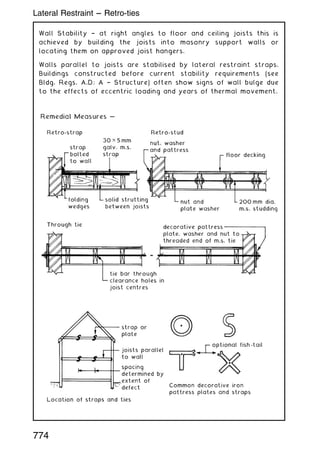
min.).
* If the wall is only accessible from one side and both sides
need treatment, a second deeper series of holes may be bored
from one side, to penetrate the inaccessible side.
* On completion of work, all boreholes are made good with
cement mortar. Where dilute chemicals are used for the dpc,
the mortar is rammed the full length of the hole with a piece
of timber dowelling.
* The chemicals are effective by bonding to, and lining the
masonry pores by curing and solvent evaporation.
* The process is intended to provide an acceptable measure of
control over rising dampness. A limited amount of water
vapour may still rise, but this should be dispersed by
evaporation in a heated building.
Refs.:
BS 6576: Code of practice for diagnosis of rising damp in walls of
buildings and installation of chemical damp-proof courses.
BRE Digest 245: Rising damp in walls: diagnosis and treatment.
BRE Digest 380: Damp-proof courses.
BRE Good Repair Guide 6: Treating rising damp in houses.
412
Chemical Damp-proof Courses for Remedial Work (2)
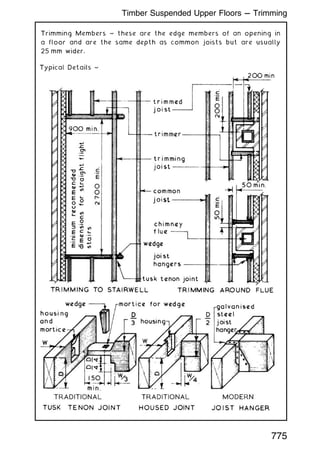
In addition to damp-proof courses failing due to deterioration or
damage, they may be bridged as a result of:
* Faults occurring during construction.
* Work undertaken after construction, with
disregard for the damp-proof course.
Typical Examples ~
413
Bridging of Damp-proof Courses
Thermal insulation regulations may require insulating dpcs to
prevent cold bridging around window and door openings in cavity
wall construction (see pages 580 and 581). By locating a vertical
dpc with a bonded insulant at the cavity closure, the dpc prevents
penetration of dampness from the outside, and the insulation
retains the structural temperature of the internal reveal. This will
reduce heat losses by maintaining the temperature above dewpoint,
preventing condensation, wall staining and mould growth.
Application ~
Refs.: Building Regulations, Approved Document L: Conservation of
fuel and power.
BRE Report † Thermal Insulation: avoiding risks (3rd. ed.).
Building Regulations, Approved Document B3 (Vol. 1), Section 6:
Concealed spaces (cavities).
414
Insulating Damp-proof Course
Penetrating Gases ~ Methane and Radon
Methane † methane is produced by deposited organic material
decaying in the ground. It often occurs with carbon dioxide and
traces of other gases to form a cocktail known as landfill gas. It
has become an acute problem in recent years, as planning
restrictions on `green-field' sites have forced development of
derelict and reclaimed `brown-field' land.
The gas would normally escape into the atmosphere, but under a
building it pressurises until percolating through cracks, cavities and
junctions with services. Being odourless, it is not easily detected
until contacting a naked flame, then the result is devastating!
Radon ~ a naturally occurring colour/odourless gas produced by
radioactive decay of radium. It originates in uranium deposits
of granite subsoils as far apart as the south-west and north of
England and the Grampian region of Scotland. Concentrations of
radon are considerably increased if the building is constructed
of granite masonry. The combination of radon gas and the tiny
radioactive particles known as radon daughters are inhaled. In
some people with several years' exposure, research indicates a high
correlation with cancer related illness and death.
Protection of buildings and the occupants from subterranean gases
can be achieved by passive or active measures incorporated within
the structure:
1 . Passive protection consists of a complete airtight seal
integrated within the ground floor and walls. A standard
LDPE damp-proof membrane of 03mm thickness should be
adequate if carefully sealed at joints, but thicknesses of up
to 1 mm are preferred, combined with foil and/or wire
reinforcement.
2. Active protection requires installation of a permanently
running extract fan connected to a gas sump below the
ground floor. It is an integral part of the building services
system and will incur operating and maintenance costs
throughout the building's life.
NB. See next page for construction details.
415
Gas-resistant Membranes
cavity wall
insulated as required
stepped cavity
tray/dpc
weep hole
air brick
dpc
sealed joint
screed
insulation
LDPE
membrane
min. 1200
gauge (0.3 mm)
PASSIVE
Suspended concrete floor
precast
reinforced
concrete
floor
min.
150mm
LDPE
membrane
finished
slab level
reinforced
concrete slab
Solid floor
(2 possibilities)
damp- and gas-
proof membrane
vent outlet
above eaves
vent riser
if trench
paved over
granular
trench
subfloor
vent pipe
min. 200 mm
granular layer
EPS profiled matting
heights … 80, 100, 150
 200 mm
reinforced concrete slab ACTIVE
LDPE membrane paving slab
perforated bricks
granular fill
void
110 mm
uPVC
extract
duct
fan
sump centrally
located
416
Gas-resistant Construction
Calculated Brickwork ~ for small and residential buildings up to three
storeys high the sizing of load bearing brick walls can be taken from
data given in Section 2C of Approved Document A. The alternative
methods for these and other load bearing brick walls are given in:
BS EN 1996: Design of masonry structures.
BS 8103-2: Structural design of low rise buildings. Code of practice
for masonry walls for housing.
The main factors governing the load bearing capacity of brick
walls and columns are:
1 . Thickness of Wall.
2. Strength of bricks used.
3. Type of mortar used.
4. Slenderness ratio of wall or column.
5. Eccentricity of applied load.
Thickness of Wall ~ this must always be sufficient throughout its
entire body to carry the design loads and induced stresses. Other
design requirements such as thermal and sound insulation
properties must also be taken into account when determining the
actual wall thickness to be used.
Effective Thickness ~ this is the assumed thickness of the wall or
column used for the purpose of calculating its slenderness ratio †
see page 419.
Typical Examples ~
417
Principles of Calculated Brickwork
Strength of Bricks ~ due to the wide variation of the raw
materials and methods of manufacture bricks can vary greatly in
their compressive strength. The compressive strength of a
particular type of brick or batch of bricks is taken as the
arithmetic mean of a sample of ten bricks tested in accordance
with the appropriate British Standard. A typical range for clay
bricks would be from 20 to 170 MN/m2
the majority of which would
be in the 20 to 90 MN/m2
band. Calcium silicate bricks have a
compressive strength between 20 and 50 MN/m2
.
Strength of Mortars ~ mortars consist of an aggregate (sand) and
a binder which is usually cement; cement plus additives to improve
workability; or cement and lime. The factors controlling the
strength of any particular mix are the ratio of binder to aggregate
plus the water:cement ratio. The strength of any particular mix
can be ascertained by taking the arithmetic mean of a series of
test cubes or prisms † see page 423.
Wall Design Strength ~ the basic stress of any brickwork depends
on the crushing strength of the bricks and the type of mortar used
to form the wall unit. This relationship can be plotted on a graph
as shown below:
418
Principles of Calculated Brickwork --- Strength
Slenderness Ratio ~ this is the relationship of the effective height
to the effective thickness thus:
Slenderness ratio ¼
effective height
effective thickness
¼
h
t
j
 27
Effective Height ~ this is the dimension taken to calculate the
slenderness ratio as opposed to the actual height.
Typical Examples † actual height = H effective height = h
Effective Thickness ~ this is the dimension taken to calculate the
slenderness ratio as opposed to the actual thickness.
Typical Examples † actual thickness = T effective thickness = t
Stress Reduction ~ the permissible stress for a wall is based on
the basic stress multiplied by a reduction factor related to the
slenderness factor and the eccentricity of the load:
419
Principles of Calculated Brickwork --- Slenderness Ratio
Piers, Effective Thickness ~
Effective Thickness = tK
Effective Thickness = 0.66 (t1 þ t2K) or t1 or t2K (take greater)
Key : t ¼ actual wall thickness
t1 ¼ actual thickness of cavity leaf without attached pier
t2 ¼ actual thickness of leaf with attached pier
tp ¼ pier thickness
K ¼ stiffening coefficient
Sp ¼ pier spacing
Wp ¼ pier width
Stiffening Coefficient K ~
Linear interpolation may be applied
Sp ÷ Wp ¼ 2150 ÷ 215 ¼ 10
tp ÷ t ¼ 328 ÷ 215 ¼ 1:523
By interpolation, K = 1.104
Effective thickness, tK = 215 x 1.104 = 237.4 mm
t
Sp
Wp
Solid wall
tp
t2
t1
Sp
Wp
tp
Cavity wall
Sp ÷ Wp tp ÷ t ¼ 1 2 3
 6 K ¼ 1:0 1.4 2.0
10 1.0 1.2 1.4
 20 1.0 1.0 1.0
215mm
215mm 328mm
2150mm
E.g.
420
Principles of Calculated Brickwork --- Piers
Piers and Columns, Effective Height Calculations ~
E.g. A one-and-a-half brick column of 4.000m effective height/
length. See page 645 for factors affecting the effective length of a
column.
It is usual to incorporate a factor of safety into these
calculations. Using a figure of 2, the brickwork safe bearing
strength will be:
4 N=mm2
÷ 2 ¼ 2 N=mm2
Permissible load will be:
2 N=mm2
× 107; 584 ¼ 215; 168 Newtons
Newtons ÷ gravity ð9:81 m=s2
Þ ¼ kilograms
215; 168 ÷ 9:81 ¼ 21; 933kg ð22 tonnes approx:Þ
Note: This example is a very simple application that has assumed
that there is no axial loading with bending or eccentric forces such
as lateral loading from the structure or from wind loading. It also
has a low slenderness ratio (effective height/length to least lateral
dimension), i.e. 4000 mm ÷ 328 mm = 12.2. See pages 602 and 603
for the effect of buckling factors where greater slenderness ratios
apply.
t t
tp
b
tp
tp  1.5t design as a column
effective thickness = tp or b
depending on direction of bending
tp ≤ 1.5t design
as a pier
effective height/length
= 4.000m
(see page 645)
one-and-a-half brick column
4 N/mm2
brickwork compressive
strength (see page 418)
plan area
328x328mm = 107,584mm2
421
Principles of Calculated Brickwork --- Columns
Lime ~ traditional mortars are a combination of lime, sand and
water. These mixes are very workable and have sufficient flexibility
to accommodate a limited amount of wall movement due to
settlement, expansion and contraction. The long term durability of
lime mortars is poor as they can break down in the presence of
atmospheric contaminants and surface growths. Nevertheless, lime is
frequently specified as a supplementary binder with cement, to
increase mix workability and to reduce the possibility of joint
shrinkage and cracking, a characteristic of stronger cement mortars.
Cement ~ the history of cement-type mortar products is extensive.
Examples dating back to the Mesopotamians and the Egyptians are
not unusual; one of the earliest examples from over 10,000 years
ago has been found in Galilee, Israel. Modern mortars are made with
Portland cement, the name attributed to a bricklayer named Joseph
Aspdin. In 1824 he patented his improved hydraulic lime product as
Portland cement, as it resembled Portland stone in appearance. It was
not until the 1920s that Portland cement, as we now know it, was
first produced commercially by mixing a slurry of clay (silica, alumina
and iron-oxides) with limestone (calcium carbonate). The mix is burnt
in a furnace (calcinated) and the resulting clinker crushed and bagged.
Mortar ~ mixes for masonry should have the following properties:
* Adequate strength
* Workability
* Water retention during laying
* Plasticity during application
* Adhesion or bond
* Durability
* Good appearance ~ texture and colour
Modern mortars are a combination of cement, lime and sand plus
water. Liquid plasticisers exist as a substitute for lime, to improve
workability and to provide some resistance to frost when used
during winter.
Masonry cement ~ these proprietary cements generally contain
about 75% Portland cement and about 25% of fine limestone filler
with an air entraining plasticiser. Allowance must be made when
specifying the mortar constituents to allow for the reduced cement
content. These cements are not suitable for concrete.
Refs.: BS 6463-101, 102 and 103: Quicklime, hydrated lime and
natural calcium carbonate.
BS EN 197-1: Cement. Composition, specifications and
conformity criteria for common cements.
422
Mortars for Brickwork and Blockwork (1)
Ready mixed mortar ~ this is delivered dry for storage in purpose-
made silos with integral mixers as an alternative to site blending
and mixing. This ensures:
* Guaranteed factory quality controlled product
* Convenience
* Mix consistency between batches
* Convenient facility for satisfying variable demand
* Limited wastage
* Optimum use of site space
Mortar and cement strength ~ see also page 418. Test samples are
made in prisms of 40 × 40 mm cross section, 160mm long. At
28 days samples are broken in half to test for flexural strength.
The broken pieces are subject to a compression test across the
40 mm width. An approximate comparison between mortar strength
(MN/m2
or N/mm2
), mortar designations (i to v) and proportional
mix ratios is shown in the classification table below. Included is
guidance on application.
Proportional mixing of mortar constituents by volume is otherwise
known as a prescribed mix or simply a recipe.
Mortar classification ~
Relevant standards;
BS EN 1996: Design of masonry structures.
BS EN 196: Methods of testing cement.
BS EN 998-2: Specification for mortar for masonry. Masonry
mortar.
PD 6678: Guide to the specification of masonry mortar.
BS EN 1015: Methods of test for mortar for masonry.
Traditional BS EN 998-2 Proportions by volume
designation Strength cement/lime/sand cement/sand Application
i 12 1:0.25:3 1:3 Exposed external
ii 6 1:0.5:4†4.5 1:3†4 General external
iii 4 1:1:5†6 1:5†6 Sheltered internal
iv 2 1:2:8†9 1:7†8 General internal
v † 1:3:10†12 1:9†10 Internal, grouting
423
Mortars for Brickwork and Blockwork (2)
Supports Over Openings ~ the primary function of any support
over an opening is to carry the loads above the opening and
transmit them safely to the abutments, jambs or piers on both
sides. A support over an opening is usually required since the
opening infilling such as a door or window frame will not have
sufficient strength to carry the load through its own members.
424
Supports Over Openings
Arch Construction ~ by the arrangement of the bricks or stones in
an arch over an opening it will be self-supporting once the jointing
material has set and gained adequate strength. The arch must
therefore be constructed over a temporary support until the arch
becomes self-supporting. The traditional method is to use a framed
timber support called a centre. Permanent arch centres are also
available for small spans and simple formats.
425
Arches
The profile of an arch does not lend itself to simple positioning of
a damp-proof course. At best, it can be located horizontally at
upper extrados level. This leaves the depth of the arch and
masonry below the dpc vulnerable to dampness. Proprietary
galvanised or stainless steel cavity trays resolve this problem by
providing:
* Continuity of dpc around the extrados.
* Arch support/centring during construction.
* Arch and wall support after construction.
Standard profiles are made to the traditional outlines shown on
the previous two pages, in spans up to 2 m. Other options may
also be available from some manufacturers. Irregular shapes and
spans can be made to order.
Note: Arches in semicircular, segmental or parabolic form up to 2 m
span can be proportioned empirically. For integrity of structure it
is important to ensure sufficient provision of masonry over and
around any arch.
426
Arch Cavity Tray
The example in steel shown on the preceding page combines
structural support with a damp-proof course, without the need for
temporary support from a centre. Where traditional centring is
retained, a lightweight preformed polypropylene cavity tray/dpc
can be used. These factory-made plastic trays are produced in
various thicknesses of 1.5 to 3 mm relative to spans up to about
2 m. Arch centres are made to match the tray profile and with care
can be reused several times.
An alternative material is code 4 lead sheet.* Lead is an adaptable
material but relatively heavy. Therefore, its suitability is limited to
small spans particularly with non-standard profiles.
*BS EN 12588: Lead and lead alloys. Rolled lead sheet for building
purposes. Lead sheet is coded numerically from 3 to 8 (1.25 to
3.50 mm † see page 531), which closely relates to the traditional
specification in lbs./sq. ft.
Ref. BS EN 1996: Design of masonry structures.
427
Alternative Arch Cavity Tray
Openings ~ these consist of a head, jambs and sill. Different
methods can be used in their formation, all with the primary
objective of adequate support around the void. Details relate to
older/existing construction and where thermal insulation is not
critical. Application limited † see pages 580 and 581.
Typical Head Details ~
Ref. BS EN 845-2: Specification for ancillary components for
masonry. Lintels.
428
Opening Details --- Heads
Jambs ~ these may be bonded as in solid walls or unbonded as in
cavity walls. The latter must have some means of preventing the
ingress of moisture from the outer leaf to the inner leaf and hence
the interior of the building. Details as preceding page.
Application limited † see pages 580 and 581.
Typical Jamb Details ~
*Ref. BS 1245: Pedestrian doorsets and door frames made from
sheet steel. Sepcification.
429
Opening Details --- Jambs
Sills ~ the primary function of any sill is to collect the rainwater
which has run down the face of the window or door and shed it
clear of the wall below.
Timber Sill 1, Cast Stone Subsill and Slate Sill have limited
applications † see pages 580 and 581.
Typical Sill details ~
Ref. BS 5642-1: Sills and copings. Specification for window sills of
precast concrete, cast stone, clayware, slate and natural stone.
430
Opening Details --- Sills
Traditional Construction †
checked rebates or recesses
in masonry solid walls were
often provided at openings
to accommodate door and
window frames. This detail
was used as a means to
complement frame retention
and prevent weather
intrusion.
Exposure Zones † checked reveal treatment is now required mainly
where wind-driven rain will have most impact. This is primarily in
the south-west and west coast areas of the British Isles, plus some
isolated inland parts that will be identified by their respective local
authorities.
Typical Checked Opening Details †
Ref. Building Regulations, Approved Document C. Section 5: Walls.
Driving rain exposure zones 3 and 4.
431
Opening Details --- Checked Head, Jamb and Sill
A window must be aesthetically acceptable in the context of
building design and the surrounding environment.
Windows should be selected or designed to resist wind loadings, be
easy to clean and provide for safety and security. They should be
sited to provide visual contact with the outside.
Habitable upper floor rooms should have a window for emergency
escape. Min. opening area, 0.330m2
. Min. height and width, 0.450m.
Max height of opening, 1.100m above floor.
432
Windows --- Performance Requirements
433
Windows --- Conventional Types
434
Timber Casement Windows
The standard range of casement windows used in the UK was derived from
the English Joinery Manufacturer's Association (EJMA) designs of some
50 years ago. These became adopted in BS 644: Timber windows and
doorsets. Fully finished factory assembled windows of various types.
Specification. A modified type is shown on the preceding page.
Contemporary building standards require higher levels of performance
in terms of thermal and sound insulation (Bldg. Regs. Pt. L and E),
air permeability, watertightness and wind resistance (BS ENs 1026,
1027 and 12211, respectively). This has been achieved by adapting
Scandinavian designs with double and triple glazing to attain U-
values as low as 1„2 W/m2
K and a sound reduction of 50 dB.
Further refs.:
BS 6375 series: Performance of windows and doors.
BS 6375-1: Classification for weather tightness.
BS 6375-2: Classification for operation and strength characteristics.
PAS 24: Enhanced security performance requirements for doorsets
and windows in the UK
435
High Performance Timber Casement Windows
A
vent
light
B
B
60 x 70
head with
trickle vent
20 rebate
57 x 63
sash frame
57 x 63
sash frame
57 x 63
sash frame
glazing
bead
factory sealed
double glazing
setting strip
133 x 70
sill
57 x 70
jamb
57 x 63
sash frame
57 x 89
sash frame
HORIZONTAL SECTION B-B VERTICAL SECTION A-A
weather
strip
A
side
hung
sash
plastic or
synthetic rubber
weather strip
70 x 70
transom
Details show EJMA (see previous page) standardised designs for
casements with double glazed factory produced hermetically sealed
units. In the early 1960s EJMA evolved into the British
Woodworking Manufacturers Association (BWMA) and subsequently
the British Woodworking Federation (bWf). Although dated, the
principles of these designs remain current.
436
Timber Standard Double Glazed Casement Windows
Metal Windows ~ these can be obtained in steel (BS 6510) or in
aluminium alloy (BS 4873). Steel windows are cheaper in initial cost
than aluminium alloy but have higher maintenance costs over their
anticipated life, both can be obtained fitted into timber subframes.
Generally they give a larger glass area for any given opening size
than similar timber windows but they can give rise to condensation
on the metal components. Page 454 shows an example of an
energy efficient improvement.
top hung ventlight
1500
1500
head
70 x 44 timber
subframe head
121 x 70 timber
subframe sill
25 x 33
o/a metal
sash framing
25 x 33
o/a metal
framing
side hung
casement
sash
fixed
sub-light
70 x 57
transom
glass
putty
BS 6510
metal
windows
mastic
seal
top
hung
vent.
4mm glass
factory
glazed
fixed
light
aluminium alloy
framing in mill,
anodised or
acrylic finishes
projecting
or flush
sills
available
TYPICAL VERTICAL SECTIONS
STEEL FRAME SECTIONS
TYPICAL ELEVATION
fixed
light
Refs.:
BS 4873: Aluminium alloy windows and doorsets. Specification.
BS 6510: Steel-framed windows and glazed doors. Specification.
437
Metal Casement Windows
Timber Windows ~ wide range of ironmongery available which can
be factory fitted or supplied and fixed on site.
Metal Windows ~ ironmongery usually supplied with and factory
fitted to the windows.
438
Casement Windows --- Ironmongery
Sliding Sash Windows ~ these are an alternative format to the
conventional side hung casement windows and can be constructed
as a vertical or double hung sash window or as a horizontal sliding
window in timber, metal, plastic or in any combination of these
materials. The performance and design functions of providing
daylight, ventilation, vision out, etc. are the same as those given
for traditional windows in Windows † Performance Requirements on
page 432.
439
Sliding Sash Windows --- Vertical Weight Balanced
plywood parting slip
suspended from pulley
head
92 X 21 head
outside lining
pulley wheel
parting slip
sash cord
92 X 21
outside lining
horn
SILL
upper sash
counter weight
plywood backing
21 x 8 parting bead
135 x 60 flush sill
33 x 19 draught stop
57 x 41 bottom rail
48 x 41 sash frame
49 x 32 splayed and
rebated meeting rails
19 x 14 staff bead
sash cord
21mm pulley stile
48 x 41 sash frame
21 x 8 parting bead
21mm pulley head
19 x 14 staff bead
angle glue block
70 x 14 head inside lining
70 x 14 jamb inside lining
INTERMEDIATE
HEAD
440
Sliding Sash Windows --- Weight Balanced Details
Double Hung Sash Windows ~ these vertical sliding sash windows
come in two formats when constructed in timber. The weight
balanced format is shown on the preceding two pages. The
alternative spring balanced type is illustrated below and overleaf.
Various formats for sliding windows are specified in BS 644: Timber
windows and doorsets.
441
Sliding Sash Windows --- Vertical Spring Balanced
NB. The spring balance can be housed within the stile. Stile
thickness will need to be at least 60 mm to accommodate the
grooved recess.
HEAD
48 x 21 head
outer lining
40 mm projecting horn
dowelled mortice and tenon joint
114 x 33 head
19 x 14 bead
21 x 8 parting bead
48 x 41 upper sash
frame
114 x 33 stile
spring counter-balance
19 x 14 bead
49 x 38 splayed and
rebated meeting rails
33 x 19 draught
stop
top fixing
tube housing
coil spring
nylon bush
twisted rod
base fixing
SPIRAL
BALANCE
21 x 8 parting bead
INTERMEDIATE
SILL
48 x 21 outer
lining
48 x 41 lower
sash frame
135 x 60 flush sill 57 x 41 bottom rail
442
Sliding Sash Windows --- Spring Balanced Details
Horizontally Sliding Sash Windows ~ these are an alternative
format to the vertically sliding or double hung sash windows shown
on pages 439 to 442 and can be constructed in timber, metal,
plastic or combinations of these materials with single or double
glazing. A wide range of arrangements are available with two or
more sliding sashes which can have a ventlight incorporated into
the outer sliding sash.
Typical Horizontally Sliding Sash Window Details ~
timber subframe
window
frame bedded
in sealant
nylon slipper
shoes and
polypropylene
pile seals
head of
timber
subframe
anodised
aluminium
framing
integral
pull
handle
inner
sash
bushed
nylon
rollers
sill of
timber
subframe
inner sash
outer sash
outer sash
ELEVATION
factory-glazed anodised aluminium
horizontal sliding sash
integral pull handle
window frame sealant
bedded
inner sliding sash
weather-sealed meeting stiles
outer sliding sash
timber subframe
VERTICAL SECTION
weather seal
HORIZONTAL SECTION
443
Sliding Sash Windows --- Horizontal
Pivot Windows ~ like other windows these are available in timber,
metal, plastic or in combinations of these materials.
They can be constructed with centre jamb pivots enabling the sash
to pivot or rotate in the horizontal plane or alternatively the
pivots can be fixed in the head and sill of the frame so that the
sash rotates in the vertical plane.
444
Pivot Windows
Bay Windows ~ these can be defined as any window with sidelights
which projects in front of the external wall and is supported by a
sill height wall. Bay windows not supported by a sill height wall are
called oriel windows. They can be of any window type, constructed
from any of the usual window materials and are available in three
plan formats, namely square, splay and circular or segmental.
Timber corner posts can be boxed, solid or jointed, the latter being
the common method.
445
Bay Windows
Schedules
~
the
main
function
of
a
schedule
is
to
collect
together
all
the
necessary
information
for
a
particular
group
of
components
such
as
windows,
doors
and
drainage
inspection
chambers.
There
is
no
standard
format
for
schedules
but
they
should
be
easy
to
read,
accurate
and
contain
all
the
necessary
information
for
their
purpose.
Schedules
are
usually
presented
in
a
tabulated
format
which
can
be
related
to
and
read
in
conjunction
with
the
working
drawings.
446
Window Schedules
Window manufacturers identify their products with a notation
that combines figures with numbers. The objective is to
simplify catalogue entries, specification clauses and schedules.
For example:
head
1350
1770
fixed light
sill
ventlight
left-hand casement
as viewed from front
right-hand casement
as viewed from front
Ref. 313 CVC
Notation will vary to some extent between the different joinery
producers. The example of 313 CVC translates to:
3 = width divided into three units.
13 = first two dimensions of standard height, i.e. 1350mm.
C = casement.
V = ventlight.
Other common notations include:
N = narrow light.
P = plain (picture type window, i.e. no transom or mullion).
T = through transom.
S = sub-light, fixed.
VS = ventlight and sub-light.
F = fixed light.
B = bottom casement opening inwards.
RH/LH = right or lefthand as viewed from the outside.
447
Window Notation
Glass ~ this material is produced by fusing together soda, lime and
silica with other minor ingredients such as magnesia and alumina.
A number of glass types are available for domestic work and these
include:
Clear Float ~ used where clear, undistorted vision is required.
Available thicknesses range from 3mm to 25mm.
Clear Sheet ~ suitable for all clear glass areas but because the
two faces of the glass are never perfectly flat or parallel some
distortion of vision usually occurs. This type of glass is gradually
being superseded by the clear float glass. Available thicknesses
range from 3 mm to 6 mm.
Translucent Glass ~ these are patterned glasses, most having one
patterned surface and one relatively flat surface. The amount of
obscurity and diffusion obtained depends on the type and nature of
pattern. Available thicknesses range from 4mm to 6mm for
patterned glasses and from 5 mm to 10 mm for rough cast glasses.
Wired Glass ~ obtainable as a clear polished wired glass or as a
rough cast wired glass with a nominal thickness of 7mm. Generally
used where a degree of fire resistance is required. Georgian wired
glass has a 12mm square mesh whereas the hexagonally wired glass
has a 20mm mesh.
Choice of Glass ~ the main factors to be considered are:
1. Resistance to wind loadings. 2. Clear vision required.
3. Privacy. 4. Security. 5. Fire resistance. 6. Aesthetics.
Glazing Terminology ~
448
Glass and Glazing
Glazing ~ the act of fixing glass into a frame or surround. In
domestic work this is usually achieved by locating the glass in a
rebate and securing it with putty or beading and should be carried
out in accordance with the recommendations contained in the BS
6262 series: Glazing for buildings.
Timber Surrounds ~ linseed oil putty is the traditional material for
sealing and retaining glass in wooden frames. It is a composite of
crushed chalk and linseed oil (whiting). Rebate to be clean, dry and
primed before glazing is carried out. Putty should be protected
with paint within two weeks of application.
Metal Surrounds ~ metal casement putty if metal surround is to be
painted † if surround is not to be painted a non-setting compound
should be used.
449
Glass and Glazing
Double Glazing ~ as its name implies this is where two layers of
glass are used instead of the traditional single layer. Double
glazing can be used to reduce the rate of heat loss through
windows and glazed doors or it can be employed to reduce the
sound transmission through windows. In the context of thermal
insulation this is achieved by having a small air or argon gas-filled
space within the range of 6 to 20 mm between the two layers of
glass. The sealed double glazing unit will also prevent internal
misting by condensation. If metal frames are used these should
have a thermal break incorporated into their design. All opening
sashes in a double glazing system should be fitted with adequate
weather seals to reduce the rate of heat loss through the opening
clearance gap.
In the context of sound insulation three factors affect the
performance of double glazing. First, good installation to ensure
airtightness, second, the weight of glass used and third, the size of
air space between the layers of glass. The heavier the glass used
the better the sound insulation and the air space needs to be
within the range of 50 to 300 mm. Absorbent lining to the reveals
within the air space will also improve the sound insulation
properties of the system.
450
Double Glazing
Secondary glazing of existing windows is an acceptable method for
reducing heat energy losses at wall openings. Providing the existing
windows are in a good state of repair, this is a cost-effective,
simple method for upgrading windows to current energy efficiency
standards. In addition to avoiding the disruption of removing
existing windows, further advantages of secondary glazing include
retention of the original window features, reduction in sound
transmission and elimination of draughts. Applications are
manufactured for all types of window, with sliding or hinged
variations. The following details are typical of horizontal sliding
sashes †
451
Secondary Glazing (1)
Double hung weight balanced vertical sliding timber sash windows ~
a feature of many listed buildings, particularly those representing
our architectural heritage. Preservation of original design is
important and must be maintained, but there should also be a
regard for current standards of insulation. Replacement with
modern double glazed frames and casements is out of character
and in many situations may be prohibited under the Planning
(Listed Buildings and Conservation Areas) Act.
Application ~ secondary glazing fitted internally will not impact
visually on the external elevation. If required it can be reversed, i.e.
it can be removed with minimal inconvenience. Accessibility to the
original window remains unimpeded. The illustration shows the
simplicity of application to the window type detailed on page 439.
Some minor changes may be necessary to replace the staff bead
with a larger section to accommodate the casement frame and to
modify the inner lining accordingly. External traditional appearance
is preserved with the benefit of improved sound and thermal
insulation, better security and elimination of draughts.
Modified traditional sliding sash window ~
parting bead
lower sash
extruded aluminium
side hung hinged
casement and frame
staff bead and inner
lining modified if required
to receive casement frame
sash weight
parting slip
452
Secondary Glazing (2)
Low emissivity or `Low E' glass is specially manufactured with a
surface coating to significantly improve its thermal performance.
The surface coating has a dual function:
1 . Allows solar short wave light radiation to penetrate a building.
2. Reflects long wave heat radiation losses back into a building.
Manufacturing processes:
1 . Pyrolitic hard coat, applied on-line as the glass is made.
Emissivity range, 0.15†0.20, e.g. Pilkington `K'.
2. A sputtered soft coat applied after glass manufacture.
Emissivity range, 0.05†0.10, e.g. Pilkington `Kappafloat' and
`Suncool High Performance'.
Note: In relative terms, uncoated glass has a normal emissivity of about 0.90.
Indicative U-values for multi-glazed windows of 4 mm glass with a 16mm void width:
Glazing type uPVC or wood frame metal frame
Double, air filled 2.7 3.3
Double, argon filled 2.6 3.2
Double, air filled Low E (0.20) 2.1 2.6
Double, argon filled Low E (0.20) 2.0 2.5
Double, air filled Low E (0.05) 2.0 2.3
Double, argon filled Low E (0.05) 1.7 2.1
Triple, air filled 2.0 2.5
Triple, argon filled 1.9 2.4
Triple, air filled Low E (0.20) 1.6 2.0
Triple, argon filled Low E (0.20) 1.5 1.9
Triple, air filled Low E (0.05) 1.4 1.8
Triple, argon filled Low E (0.05) 1.3 1.7
Notes:
1. A larger void and thicker glass will reduce the U-value, and vice versa.
2. Data for metal frames assumes a thermal break of 4 mm (see next page).
3. Hollow metal framing units can be filled with a closed cell insulant foam to con-
siderably reduce U-values.
453
Low Emissivity Glass
Extruded aluminium profiled sections are designed and
manufactured to create lightweight hollow window (and door)
framing members.
Finish † untreated aluminium is prone to surface oxidisation. This
can be controlled by paint application, but most manufacturers
provide a variable colour range of polyester coatings finished in
gloss, satin or matt.
Thermal insulation † poor insulation and high conductivity are
characteristics of solid profile metal windows. This is much less
apparent with hollow profile outer members, as they can be
considerably enhanced by a thermal infilling of closed cell foam.
Condensation † a high strength two-part polyurethane resin
thermal break between internal and external profiles inhibits cold
bridging. This reduces the opportunity for condensation to form on
the surface. The indicative U-values given on the preceding page
are based on a thermal break of 4mm. If this is increased to 16mm,
the values can be reduced by up to 0.2 W/m2
K.
Hollow Core Aluminium Profiled Window Section
454
Aluminium Hollow Profile Casement Windows
Inert gas fills ~ argon or krypton. Argon is generally used as it is
the least expensive and more readily available. Where krypton is
used, the air gap need only be half that with argon to achieve a
similar effect. Both gases have a higher insulating value than air
due to their greater density.
Densities (kg/m3
):
Air = 1.20
Argon = 1.66
Krypton = 3.49
Argon and krypton also have a lower thermal conductivity than air.
Spacers ~ generally hollow aluminium with a desiccant or drying
agent fill. The filling absorbs the initial moisture present in
between the glass layers. Non-metallic spacers are preferred as
aluminium is an effective heat conductor.
Approximate solar gains with ordinary float glass ~
Single glazing
88% 78% 70%
Double glazing Triple glazing
`Low E' invisible coatings reduce the solar gain by up to one-third.
Depending on the glass quality and cleanliness, about 10 to 15% of
visible light reduction applies for each pane of glass.
455
Multiple Glazing
Typical application ~
* Hollow profiles manufactured with a closed cell insulant foam/expanded polystyrene core.
vertical
section
synthetic rubber
sealing strip
' L' shaped glazing
bead/clip and seal/gasket
glazed units of 3 mm
glass and 12 mm gap
or 4 mm glass and
16 mm gap
air, argon or krypton
filled gaps
casement frame*
window board,
material optional
synthetic rubber seal/gasket
middle and inner pane 'E' coated
33 or 44 mm overall depth
synthetic rubber compression seal
standard head
and jamb profile*
hollow profile 'plastic'
sections*, typically uPVC or
glass fibres with polyester
resin bonding
sill
Further considerations:
* U-value potential, less than 1.0 W/m2
K.
* `Low E' invisible metallic layer on one pane of double glazing gives a
similar insulating value to standard triple glazing (see page 453).
* Performance enhanced with blinds between wide gap panes.
* High quality ironmongery required due to weight of glazed frames.
* Improved sound insulation, particularly with heavier than air gap fill.
456
Triple Glazing
There are many manufacturers of triple glazed units, each with
their own design profile. Some feature a wide gap between two of
the glass panes to incorporate Venetian blinds. This type of
curtaining is used to control solar radiation and heat gain. Glass
specification and thickness may also vary depending on thermal
and sound insulation requirements. Blinds can be actuated
automatically in response to pre-set thermostatic control or over-
ridden manually.
Typical Profile ~
hermetically
sealed
inner double
glazed panes
outer pane
Venetian blind
between outer
and middle pane
hollow profile
aluminium
glazing frame
EPDM composite
weather and air
tightness seal
polyester powder
coated or colour
anodised aluminium
profile
closed-cell
insulant
glazing
bead
Potential for Sound Insulation Effectiveness ~
Glazing system Max. sound reduction (dB)
Single glazed opening sash 20
Single glazed fixed light with weather strips 25
Double glazed, hermetically sealed with weather strips 35
Triple glazed, hermetically sealed, weather strips and blinds 45
Note: These units are considerably heavier than other window
types, therefore they will need care in handling during site
transportation. The manufacturer's purpose made jamb fixings
should be used.
457
Triple Glazing with Solar Blinds
In these critical locations, glazing must satisfy one of the
following:
1 . Breakage to leave only a small opening with small detachable
particles without sharp edges.
2. Disintegrating glass must leave only small detached pieces.
3. Inherent robustness, e.g. polycarbonate composition. Annealed
glass acceptable but with the following limitations:
4. Panes in small areas, 250mm wide and 0.5 m2
area. e.g.
leaded lights (4 mm annealed glass) and Georgian pattern
(6 mm annealed glass).
5. Protective screening as shown with lower bar of screen 75 mm
above finished floor level.
Ref. Building Regulations, A.D. K4: Protection against impact with glazing.
Thickness of Max. glazed area
annealed glass (mm) Height (m) Width (m)
8 1„100 1„100
10 2„250 2„250
12 3„000 4„500
15 no limit
458
Glazing --- Location
Manifestation or Marking of Glass ~ another aspect of the critical
location concept which frequently occurs with contemporary
glazed features in a building. Commercial premises such as open
plan offices, shops and showrooms often incorporate large walled
areas of uninterrupted glass to promote visual depth, whilst
dividing space or forming part of the exterior envelope. To prevent
collision, glazed doors and walls must have prominent framing or
intermediate transoms and mullions. An alternative is to position
obvious markings at two levels, as shown below. Glass doors could
have large pull/push handles and/or IN and OUT signs in bold
lettering. Other areas may be adorned with company logos, stripes,
geometric shapes, etc.
glazed doors without
frame or with narrow frames
prominent
lettering
large
push/pull
plates or
handles
ffl
1600
max.
1400
min.
1000
max.
850
min.
fixed
pane
logos or
patterned
marking
min. 150mm
high within
dimensions
shown
Critical Locations ~ The Building Regulations, Approved Document
† K, determines positions where potential personal impact and
injury with glazed doors and windows are most critical. In these
situations the glazing specification must incorporate a degree of
safety such that any breakage would be relatively harmless.
Additional measures in British Standard 6206 complement the
Building Regulations and provide test requirements and
specifications for impact performance for different classes of
glazing material. See also BS 6262.
Refs.: Building Regulations, A.D. K5.2: Manifestation of glazing.
BS 6206: Specification for impact performance requirements for
flat safety glass and safety plastics for use in buildings.
BS 6262 series: Glazing for buildings. Codes of practice.
459
Glazing --- Manifestation
Glass blocks have been used for some time as internal feature
partitioning. They now include a variety of applications in external
walls, where they combine the benefits of a walling unit with a
natural source of light. They have also been used in paving to
allow natural light penetration into basements.
Fire resistance, BS 476-22 - one hour integrity (load bearing capacity and fire
containment).
Maximum panel size is 9m2
. Maximum panel dimension is 3 m.
Laying † glass blocks can be bonded like conventional brickwork,
but for aesthetic reasons are usually laid with continuous vertical
and horizontal joints.
Jointing † blocks are bedded in mortar with reinforcement from
two nine-gauge galvanised steel wires in horizontal joints. Every
third course for 150 mm units, every second course for 200 mm
units and every course for 300 mm units. First and last course to
be reinforced.
Ref.: BS 476-22: Fire tests on building materials and structures.
Methods for determination of the fire resistance of non-load-
bearing elements of construction.
460
Glass Block Walling (1)
Mortar † dryer than for bricklaying as the blocks are non-
absorbent. The general specification will include: White Portland
Cement (BS EN 197-1), High Calcium Lime (BS EN 459-1) and Sand.
The sand should be white quartzite or silica type. Fine silver sand is
acceptable. An integral waterproofing agent should also be
provided. Recommended mix ratios † 1 part cement: 0.5 part lime:
4 parts sand.
Ref. BS EN 1051-1: Glass in building. Glass blocks and glass pavers.
Definitions and description.
461
Glass Block Walling (2)
Doors ~ can be classed as external or internal. External doors are
usually thicker and more robust in design than internal doors since
they have more functions to fulfil.
462
Doors --- Performance Requirements
External Doors ~ these are available in a wide variety of types
and styles in timber, aluminium alloy or steel. The majority of
external doors are however made from timber, the metal doors
being mainly confined to fully glazed doors such as `patio doors'.
463
Door Types
464
Door Types
Door Frames ~ these are available for all standard external doors
and can be obtained with a fixed solid or glazed panel above a
door height transom. Door frames are available for doors opening
inwards or outwards. Most door frames are made to the
recommendations set out in BS 4787: Internal and external wood
doorsets, door leaves and frames. Specification for dimensional
requirements.
465
External Door Frames
Door Ironmongery ~ available in a wide variety of materials, styles
and finishers but will consist of essentially the same components:
Hinges or Butts † these are used to fix the door to its frame or
lining and to enable it to pivot about its hanging edge.
Locks, Latches and Bolts ~ the means of keeping the door in its
closed position and providing the required degree of security. The
handles and cover plates used in conjunction with locks and
latches are collectively called door furniture.
Letter Plates † fitted in external doors to enable letters, etc. to
be deposited through the door.
Other items include Finger and Kicking Plates which are used to
protect the door fabric where there is high usage,
Draught Excluders to seal the clearance gap around the edges of
the door and Security Chains to enable the door to be partially
opened and thus retain some security.
466
Door Ironmongery
Industrial Doors ~ these doors are usually classified by their
method of operation and construction. There is a very wide range
of doors available and the choice should be based on the following
considerations:
1 . Movement † vertical or horizontal.
2. Size of opening.
3. Position and purpose of door(s).
4. Frequency of opening and closing door(s).
5. Manual or mechanical operation.
6. Thermal and/or sound insulation requirements.
7. Fire resistance requirements.
467
Industrial Doors
Straight Sliding Doors ~ these doors are easy to operate,
economic to maintain and present no problems for the inclusion of
a wicket gate. They do however take up wall space to enable the
leaves to be parked in the open position. The floor guide channel
associated with top hung doors can become blocked with dirt,
causing a malfunction of the sliding movement, whereas the rollers
in bottom track doors can seize up unless regularly lubricated and
kept clean. Straight sliding doors are available with either manual
or mechanical operation.
468
Industrial Doors
Sliding/Folding Doors ~ these doors are an alternative format to
the straight sliding door types and have the same advantages and
disadvantages except that the parking space required for the
opened door is less than that for straight sliding doors. Sliding/
folding are usually manually operated and can be arranged in
groups of two to eight leaves.
Typical Example ~
469
Industrial Doors
Shutters ~ horizontal folding shutters are similar in operation to
sliding/folding doors but are composed of smaller leaves and
present the same problems. Roller shutters however do not occupy
any wall space but usually have to be fully opened for access.
They can be manually operated by means of a pole when the
shutters are self-coiling, operated by means of an endless chain
winding gear or mechanically raised and lowered by an electric
motor but in all cases they are slow to open and close. Vision
panels cannot be incorporated into the roller shutter but it is
possible to include a small wicket gate or door in the design.
470
Industrial Doors
Crosswall Construction ~ this is a form of construction where load
bearing walls are placed at right angles to the lateral axis of the
building, the front and rear walls being essentially non-load bearing
cladding. Crosswall construction is suitable for buildings of up to
five storeys high where the floors are similar and where internal
separating or party walls are required such as in blocks of flats or
maisonettes. The intermediate floors span longitudinally between
the crosswalls providing the necessary lateral restraint and if both
walls and floors are of cast in-situ reinforced concrete the series
of `boxes' so formed is sometimes called box frame construction.
Great care must be taken in both design and construction to
ensure that the junctions between the non-load bearing claddings
and the crosswalls are weather tight. If a pitched roof is to be
employed with the ridge parallel to the lateral axis an edge beam
will be required to provide a seating for the trussed or common
rafters and to transmit the roof loads to the crosswalls.
471
Crosswall Construction
Advantages of Crosswall Construction:
1 . Load bearing and non-load bearing components can be
standardised and in same cases prefabricated giving faster
construction times.
2. Fenestration between crosswalls unrestricted structurally.
3. Crosswalls although load bearing need not be weather
resistant as is the case with external walls.
Disadvantages of Crosswall Construction:
1 . Limitations of possible plans.
2. Need for adequate lateral ties between crosswalls.
3. Need to weather adequately projecting crosswalls.
Floors:
An in-situ solid reinforced concrete floor will provide the greatest
rigidity, all other forms must be adequately tied to walls.
472
Crosswall Construction
System ~ comprises quality controlled factory produced
components of plain reinforced concrete walls and prestressed
concrete hollow or solid core plank floors.
Site Assembly ~ components are crane lifted and stacked manually
with the floor panel edges bearing on surrounding walls. Temporary
support will be necessary until the units are `stitched' together
with horizontal and vertical steel reinforcing ties located through
reinforcement loops projecting from adjacent panels. In-situ
concrete completes the structural connection to provide full
transfer of all forces and loads through the joint. Precast
concrete stair flights and landings are located and connected to
support panels by steel angle bracketing and in-situ concrete
joints.
Typical `stitched' joint between precast concrete crosswall
components ~
PLAN VIEW
RC crosswall
vertical reinforcement
tie and in-situ
concrete in void
joint seal RC external
wall
cavity
insulated
as required
external
masonry
cladding
movement joint
(12 m max. spacing)
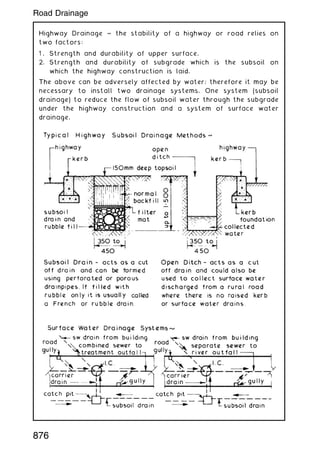
purpose-made
wall tie in
dovetail recess
panel reinforcement
looped at ends
473
Crosswall Construction -- Precast Concrete
Concept ~ a cost-effective simple and fast site assembly system
using load-bearing partitions and external walls to transfer
vertical loads from floor panels. The floor provides lateral
stability by diaphragm action between the walls.
Application ~ precast reinforced concrete crosswall construction
systems may be used to construct multi-storey buildings,
particularly where the diaphragm floor load distribution is
transferred to lift or stair well cores. Typical applications include
schools, hotels, hostels, apartment blocks and hospitals. External
appearance can be enhanced by a variety of cladding possibilities,
including the traditional look of face brickwork secured to the
structure by in-built ties. Internal finishing may be with paint or
plaster, but it is usually dry lined with plasterboard.
Location of `stitched' in-situ reinforced concrete ties ~
floor panels
and walls
stacked
and 'stitched'
precast reinforced
concrete external wall
precast reinforced
concrete crosswall
precast, prestressed
first floor panel
precast reinforced
concrete crosswall
precast, prestressed
upper floor panel
Fire resistance and sound insulation are achieved by density and
quality of concrete. The thermal mass of concrete can be enhanced
by applying insulation in between the external precast panel and
the masonry or other cladding.
474
Crosswall Construction -- Precast Concrete
Framing ~ an industry-based prefabricated house manufacturing
process permitting rapid site construction, with considerably fewer
site operatives than traditional construction. This technique has a
long history of conventional practice in Scandinavia and North
America, but has only gained credibility in the UK since the 1960s.
Factory-made panels are based on a stud framework of timber,
normally ex. 100 × 50 mm, an outer sheathing of plywood, particle-
board or similar sheet material, insulation between the framing
members and an internal lining of plasterboard. An outer cladding
of brickwork weatherproofs the building and provides a traditional
appearance.
Assembly techniques are derived from two systems:
1 . Balloon frame
2. Platform frame
A balloon frame consists of two-storey height panels with an
intermediate floor suspended from the framework. In the UK, the
platform frame is preferred with intermediate floor support directly
on the lower panel. It is also easier to transport, easier to handle
on site and has fewer shrinkage and movement problems.
475
Timber Frame Construction
Notes:
1 . Cavity barriers prevent fire spread.
The principal locations are between
elements and compartments of
construction (see B. Regs. A.D. B3).
2. Thermal bridging through solid
framing may be reduced by using rigid
EPS insulation and lighter `I' section
members of plywood or oriented
strand board (OSB).
476
Timber Frame Construction
Framing ~ comprising inner leaf wall panels of standard cold-
formed galvanised steel channel sections as structural support,
with a lined inner face of vapour check layer under plasterboard.
These panels can be site assembled, but it is more realistic to
order them factory made. Panels are usually produced in 600 mm
wide modules and bolted together on site. Roof trusses are made
up from steel channel or sigma sections. See page 628 for
examples of standard steel sections and BS EN 10162: Cold rolled
steel sections.
Standard channel and panel.
Background/history ~ the concept of steel framing for house
construction evolved in the early 1920s, but development of the
lightweight concrete `breeze' block soon took preference. Due to a
shortage of traditional building materials, a resurgence of interest
occurred again during the early post-war building boom of the late
1940s. Thereafter, steel became relatively costly and
uncompetitive as a viable alternative to concrete block or timber
frame construction techniques. Since the 1990s more efficient
factory production processes, use of semi-skilled site labour and
availability of economic cold-formed sections have revived an
interest in this alternative means of house construction.
477
Steel Frame Construction (1)
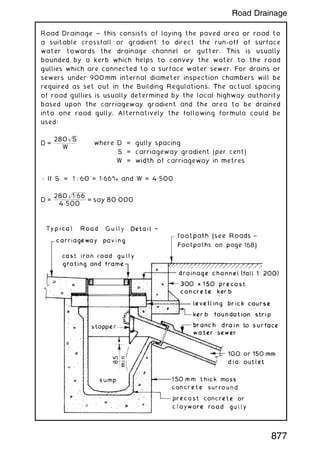
Typical Details ~
Eaves
insulated cavity closer
barrier (see Building
Regs. A. D.: B3,
Section 6 [Vol. 1]
and 9 [Vol. 2]) and
plywood bracket
bolted channel
section truss
storey height
modular frame
brickwork
outer leaf
channel section
floor joists
ground
floor
slab
channel section
truss members
header binder or wall
plate
stud framing
fire-retardant insulation
breather membrane
wall tie
50mm
cavity
insulation between studding
and into cavity
Intermediate floor Ground floor
plaster-
board
plywood
deck
dpc
channel
section
floor
joists
insulated cavity
barrier/fire stop if
a compartment floor
concrete slab
or beam and
block floor
dpm
insulation
screed
anchor
bolt
12.5 mm vapour check
plasterboard screwed
to stud framework
Advantages:
• Factory made, therefore produced to quality controlled
standards and tolerances.
• Relatively simple to assemble on site † bolted connections in
preformed holes.
• Dimensionally stable, consistent composition, insignificant
movement.
• Unaffected by moisture, therefore will not rot.
• Does not burn.
• Inedible by insects.
• Roof spans potentially long relative to weight.
Disadvantages:
• Possibility of corrosion if galvanised protective layer is
damaged.
• Deforms at high temperature, therefore unpredictable in fire.
• Electricity conductor † must be earthed.
478
Steel Frame Construction (2)
Render ~ a mix of binder (cement) and fine aggregate (sand) with
the addition of water and lime or a plasticiser to make the mix
workable. Applied to walls as a decorative and/or waterproofing
treatment.
Mix ratios ~ for general use, mix ratios are between 1:0.5:4†4.5
and 1 : 1 : 5†6 of cement, lime and sand. Equivalent using masonry
cement and sand is 1:2.5†3.5 and 1:4†5. Unless a fine finish is
required, coarse textured sharp sand is preferred for stability.
Background ~
Masonry † brick and block-work joints raked out 12 to 15 mm to
provide a key for the first bonding coat. Metal mesh can be nailed
to the surface as supplementary support and reinforcing.
Wood or similar sheeting † metal lathing, wire mesh or expanded
metal of galvanised (zinc coated) or stainless steel secured every
300 mm. A purpose-made lathing is produced for timber-framed
walls.
Concrete † and other smooth, dense surfaces can be hacked to
provide a key or spatter-dashed. Spatter-dash is a strong mix of
cement and sand (1:2) mixed into a slurry, trowelled roughly or
thrown on to leave an irregular surface as a key to subsequent
applications.
Three coat application to a masonry background
brickwork mortar
joints raked out
galvanised wire mesh
stapled every 300mm
finish
6†8mm
undercoat 8†10mm
bonding coat 10†12mm
surface scratched
479
Rendering to External Walls --- Mix and Background
Number of coats (layers) and composition ~ in sheltered locations,
one 10 mm layer is adequate for regular backgrounds. Elsewhere,
two or possibly three separate applications are required to
adequately weatherproof the wall and to prevent the brick or
block-work joints from `grinning' through. Render mixes should
become slightly weaker towards the outer layer to allow for
greater flexure at the surface, i.e. less opportunity for movement
and shrinkage cracking.
Finishes ~ smooth, textured, rough-cast and pebble-dashed.
Smooth † fine sand and cement finished with a steel trowel (6 to
8 mm).
Textured † final layer finished with a coarse brush, toothed implement
or a fabric roller (10 to 12 mm with 3 mm surface treated).
Rough-cast † irregular finish resulting from throwing the final coat
onto the wall (6 to 10 mm).
Pebble or dry dash † small stones thrown onto a strong mortar
finishing coat (10 to 12 mm).
Render application to a timber framed background
timber framing
plywood sheathing
timber batten
breather membrane
rendered finish
in two coats min.
st/st wire reinforced lath
or expanded metal over breather
paper nailed to battens
Ref. BS EN 13914 † 1: Design, preparation and application of external
rendering and internal plastering. External rendering.
480
Rendering to External Walls --- Layers and Finishes
Traditional renders ~ a site-mixed sand base with a cement and/or
lime binder combined with water to produce a workable mix. Mostly
used to cover poor quality or inexpensive backgrounds, producing
a reasonably waterproof outer surface for decorative treatment.
Can also be a design choice.
Polymer modified renders ~ delivered to site in factory-premixed 20
or 25kg bags for the addition of water prior to application.
Recipes vary, but in principle manufacturers combine polymeric
additives with the base materials of sand and cement. These may
include latexes or emulsions, water soluble polymer powders and
resins. Polyvinyl acetate (PVA) is the synthetic adhesive generally
used. PVA is more commonly known as a wood glue, but in modified
renders it functions as an emulsion in water to partially replace
cement. Some products also include anti-crack fibres as a
reinforcement.
Background ~ existing or newly constructed substrate of render,
masonry, concrete, timber or insulation slab (see page 576). Must
be sound, reasonably level, free of friable material, algae, litchens
and any other surface growths. A fungicidal wash and stabilising
solution/primer can be applied to control surface suction.
Application ~ two-coat work for irregular surfaces and
refurbishment, 8†10mm base coat reinforced with galvanised or
stainless steel mesh secured to the wall. Woven glass-fibre mesh
can also be used, generally embedded in the base coat over
existing cracks or damaged areas.
Finish ~ 6†8mm over scratched base coat. Surface treatments as
described for traditional renders.
Properties ~
Enhanced weatherproofing.
Vapour permeable.
Good resistance to impact.
Inherent adhesion.
Consistent mix produced in quality controlled factory
conditions.
Suitable for a variety of backgrounds.
481
Rendering to External Walls --- Polymer Renders
Claddings to External Walls ~ external walls of block or timber
frame construction can be clad with tiles, timber boards or plastic
board sections. The tiles used are plain roofing tiles with either a
straight or patterned bottom edge. They are applied to the
vertical surface in the same manner as tiles laid on a sloping
surface (see pages 504 and 507) except that the gauge can be
wider and each tile is twice nailed. External and internal angles can
be formed using special tiles or they can be mitred. Timber boards
such as matchboarding and shiplap can be fixed vertically to
horizontal battens or horizontally to vertical battens. Plastic
moulded board claddings can be applied in a similar manner. The
battens to which the claddings are fixed should be treated with a
preservative against fungi and beetle attack and should be fixed
with corrosion resistant nails.
482
Cladding to External Walls
Shrinkage ~ timber is subject to natural movement (page 148). With
slender cladding sections allowance must be made to accommodate
this by drying to an appropriate moisture content before fixing,
otherwise gaps will open between adjacent boards.
Fixing ~ round head galvanised or stainless steel nails will avoid
corrosion and metal staining. Lost head nails should be avoided as
these can pull through. Annular ring shank nails provide extra grip.
Pneumatic gun fixing to be applied with care to ensure no surface
damage from impact. Nail length to penetrate the support battens
by at least 22 mm. Two and a half times board thickness is usually
specified. Dense timbers such as Siberian larch, Douglas fir and
hardwoods should be pre-drilled 2 mm over nail diameter. Double
nailing may be required in very exposed situations.
Various Timber Cladding Profiles ~
weather
boarded
cladding
vertical
batten
breather
membrane
nail
nail
galvanised or
st/st nail 10mm
overlap
30mm
overlap
Sawn
feather-edge
Planed, rebated
and chamfered
Planed and
rebated shiplap
10mm
overlap
Ref. BS 1186-3: Timber for and workmanship in joinery. Specification
for wood trim and its fixing.
483
Timber Cladding
External corner tiles are made to order as special fittings to
standard plain tiles. In effect they are tile and a halfs turned
through 90 (other angles can be made) and handed left or right,
fixed alternately to suit the overlapping pattern.
special one-piece
external corner tile 38 × 25 battens
vertical external
90°
° corner tile
80
165
265
plain tiles
An alternative is to accurately mitre cut the meeting sides of tiles.
This requires pairs of tile and a halfs in alternate courses to
maintain the bond. Lead soakers (1.75 mm) of at least
225 × 200 mm are applied to every course to weather the mitred
cut edges. The top of each soaker is turned over the tiles and the
bottom finished flush or slightly above the lower edge of tiles.
1.75mm lead soaker 25mm return
100
200
mitre cut plain tiles
and tile and a halfs
plain tile
484
Tile Cladding -- External Corners
Internal corners are treated similarly to external corners by using
special tiles of approximately tile and a half overall dimensions,
turned through 90 (or other specified angle) in the opposing
direction to external specials. These tiles are left and right handed
and fixed alternately to vertical courses to maintain the
overlapping bond.
165
80
vertical internal
90°
° corner tile
265
38 × 25 batten
plain tile
Internal angles can also be formed with mitre cut tiles, with tile and a
half tiles in alternate courses. Lead soakers (1.75 mm) of 175 × 175 mm
minimum dimensions are placed under each pair of corner tiles to
weather the cut edges. As with external soakers, the lead is discretely
hidden by accurate mitre cutting and shaping of tiles.
1.75mm lead soakers under
every course of corner tiles
100
25
150
38 × 25 batten
plain tile
mitre cut plain tiles
and tile and a halfs
485
Tile Cladding -- Internal Corners
Some standard patterned bottom edge tiles ~
165mm 165mm
265mm
265mm
D
Arrowhead
Arrowhead
Club
approx. D/4
Bullnose,
beavertail or spade
Bullnose and
arrowhead
Bullnose and
scalloped
Club and
scalloped
Scalloped
or fishtail
Club Bullnose Scalloped
NB. May also be used as a roof-tiling feature, generally in two to
three courses at 1.5 to 2.0 m intervals to relieve plain tiling.
486
Decorative Tile Cladding to External Walls
Ordinary splay cutting to roof verge ~
Tile and a half tiles at the
end of each course, cut to
the undercloak course of
roof tiling. A second nail
hole can be drilled at the
head of each cut tile for
secure fixing to the parallel
batten.
Winchester cutting to roof verge ~
More attractive than
ordinary splay cutting.
Two cut tiles are
required at the end of
each course, varying in
size depending on the
roof pitch. Tile and half
tiles should be used for
these to avoid narrow
cuts.
A variation that also
has two cut tiles at the
end of each course, has
the square (90) edge of
the first course of tiles
next to the roof tiling
undercloak course.
38 × 25mm battens
batten parallel
to roof pitch
undercourse
of eaves tiles
tilting fillet
plain
tiling
tile and half
cut to verge
plain tile
undercloak
38 × 25mm
battens at
115mm gauge
parallel batten
plain tile
undercloak course
tile and half tiles
cut to suit
identical shape
cut tile and half
tiles verge course
90°
°
plain tiling
parallel
batten
tile battens
90°
cut tile and half tiles
tiles cut to identical
dimensions and nailed
to parallel batten
487
Cut Tile Cladding
Appearance and concept ~ a type of fake brickwork made up of
clay tiles side and head lapped over each other to create the
impression of brickwork, but without the expense. Joints/pointing
can be in lime mortar or left dry.
History ~ originated during the eighteenth century, when they were
used quite frequently on timber framed buildings notably in Kent
and Sussex. Possibly this was to update and improve deteriorated
weatherboarding or to avoid the brick tax of 1784. This tax was
repealed in 1835.
Application ~ restoration to mathematically tiled older structures
and as a lightweight cladding to modern timber-framed
construction where the appearance of a brickwork façade is
required.
Application shown in a Flemish bond ~
488
Mathematical Tile Cladding
Brick slips ~ thin bricks resembling tiles of 15 to 20mm thickness
with face dimensions the same as standard bricks (see page 395)
and a finish or texture to match. Other terminology includes brick
tiles, brick cladding units, slip bricks and briquettes.
Application ~ used to maintain continuity of appearance where
brickwork infill panels are supported by a reinforced concrete
frame, as shown on page 699. Originally slips were cut from whole
bricks, a time consuming and wasteful process no longer necessary,
as most brick manufacturers make slips to complement their stock
items. Other uses are as a cost effective dressing to inexpensive or
repaired backgrounds and for use where it is too difficult to build
with standard bricks.
Support system ~ profiled galvanised or stainless steel mesh
secured with screws and nylon discs 300mm horizontally and
150mm vertically apart into a sound background. Slips are stuck to
the mesh with a structural adhesive of epoxy mortar, a two-part
mix of resin and hardener combined with a sand filler.
Note: Extruded polystyrene closed cell foam insulating panel 25 to
50mm in thickness, adhesive secured to the background.
15 to 20mm
65mm
102.5mm
Pistol brick slip
(corners and reveals)
Standard brick slip
215mm
screw and plug fixing with
45mm diameter nylon disc
brick slip
10mm gap for mortar pointing
adhesive
profiled metal mesh
insulation (see Note)
background/sub-layer
489
Brick Slip Cladding
490
Roofs --- Performance Requirements
Roofs ~ these can be classified as either:
Flat † pitch from 0 to 10
Pitched † pitch over 10
It is worth noting that for design purposes roof pitches over 70
are classified as walls.
Roofs can be designed in many different forms and in combinations
of these forms, some of which would not be suitable and/or
economic for domestic properties.
491
Basic Roof Forms
492
Basic Roof Forms
493
Basic Roof Forms
Pitched Roofs ~ the primary functions of any domestic roof are to:
1 . Provide an adequate barrier to the penetration of the
elements.
2. Maintain the internal environment by providing an adequate
resistance to heat loss.
A roof is in a very exposed situation and must therefore be
designed and constructed in such a manner as to:
1 . Safely resist all imposed loadings such as snow and wind.
2. Be capable of accommodating thermal and moisture
movements.
3. Be durable so as to give a satisfactory performance and
reduce maintenance to a minimum.
494
Timber Pitched Roofs up to 7.5 m Span
hip rafter
hip
rafter
ridge board
ridge
board
valley
rafter
valley
rafter
main
rafter
purlin
purlin
jack or
cripple
rafter
hipped end
ridge board
Purlins ~ guide to minimum size (mm) relative to span and spacing:
Span (m) Spacing (m)
1.75 2.25 2.75
2.0 125 × 75 150 × 75 150 × 100
2.5 150 × 75 175 × 75 175 × 100
3.0 175 × 100 200 × 100 200 × 125
3.5 225 × 100 225 × 100 225 × 125
4.0 225 × 125 250 × 125 250 × 125
495
Timber Pitched Roofs up to 7.5 m Span -- Plan
496
Timber Pitched Roofs up to 7.5 m Span -- Types
497
Timber Pitched Roofs up to 7.5 m Span -- Types
Roof
Trusses
~
these
are
triangulated
plane
roof
frames
designed
to
give
clear
spans
between
the
external
supporting
walls.
They
are
usually
prefabricated
or
partially
prefabricated
off
site
and
are
fixed
at
1„800
centres
to
support
purlins
which
accept
loads
from
the
infill
rafters.
See
`Note'
previous
page.
498
Timber Pitched Roofs up to 7.5 m Span -- Types
Trussed
Rafters
~
these
are
triangulated
plane
roof
frames
designed
to
give
clear
spans
between
the
external
supporting
walls.
They
are
delivered
to
site
as
a
prefabricated
component
where
they
are
fixed
to
the
wall
plates
at
600
mm
centres.
Trussed
rafters
do
not
require
any
ridge
boards
or
purlins
since
they
receive
their
lateral
stability
by
using
larger
tiling
battens
(50
×
25
mm)
than
those
used
on
traditional
roofs.
See
`Note'
on
page
497.
Longitudinal
ties
(75
×
38)
fixed
over
ceiling
ties
and
under
internal
ties
near
to
roof
apex
and
rafter
diagonal
bracing
(75
×
38)
fixed
under
rafters
at
gable
ends
from
eaves
to
apex
may
be
required
to
provide
stability
bracing
†
actual
requirements
specified
by
manufacturer.
Lateral
restraint
to
gable
walls
at
top
and
bottom
chord
levels
in
the
form
of
mild
steel
straps
at
2„000
maximum
centres
over
2
No.
trussed
rafters
may
also
be
required.
499
Timber Pitched Roofs up to 7.5 m Span -- Types
More
economical
for
larger
spans
than
with
double
rafters
and
ordinary
purlins.
Used
where
the
size
of
purlins
would
be
uneconomically
large
and/or
an
excessive
number
of
struts,
ties
and
hangers
would
be
required
Top
and
bottom
flanges/chords
are
typically
100
×
100
mm
or
100
×
75
mm
and
struts
100
×
75
mm
125
×
50
rafter
225
×
32
ridge
board
lattice
frame
or
other
composite
beam
(see
page
655)
Elevation
on
A
wall
plate
or
padstone
internal
load
bearing
wall
125
×
50
ceiling
joist
wall
plate
external
wall
space
within
the
roof
void
maximised
trussed
purlin
The
lattice
frame
can
be
faced
with
plasterboard
or
with
plywood
for
additional
strength.
500
Trussed Purlin Roof
Gambrel roofs are double pitched with a break in the roof slope.
The pitch angle above the break is less than 45 relative to the
horizontal, whilst the pitch angle below the break is greater.
Generally, these angles are 30 and 60.
Gambrels are useful in providing more attic headroom and
frequently incorporate dormers and rooflights. They have a variety
of constructional forms.
Intermediate support can be provided in various ways as shown
above. To create headroom for accommodation in what would
otherwise be attic space, a double head plate and partition studding
is usual. The collar beam and rafters can conveniently locate on
the head plates or prefabricated trusses can span between
partitions.
501
Gambrel or Mansard Roof
Valley construction and associated pitched roofing is used:
• to visually enhance an otherwise plain roof structure.
• where the roof plan turns through an angle (usually 90) to
follow the building layout or a later extension.
• at the intersection of main and projecting roofs above a bay
window or a dormer window.
Construction may be by forming a framework of cut rafters
trimmed to valley rafters as shown in the roof plan on page 495.
Alternatively, and as favoured with building extensions, by locating
a valley or lay board over the main rafters to provide a fixing for
each of the jack rafters.
valley or
lay board
jack rafter
common or
main rafters
wall plate
ceiling
joist
ridge
board
502
Valley Construction
Sprockets may be provided at the eaves to reduce the slope of a
pitched roof. Sprockets are generally most suitable for use on
wide, steeply pitched roofs to:
• enhance the roof profile by creating a feature.
• to slow down the velocity of rainwater running off the roof
and prevent it from overshooting the gutter.
Where the rafters overhang the external wall, taper cut timber
sprockets can be attached to the top of the rafters. Alternatively,
the ends of rafters can be birds mouthed onto the wall plate and
short lengths of timber the same size as the rafters secured to the
rafter feet. In reducing the pitch angle, albeit for only a short
distance, it should not be less than the minimum angle
recommended for specific roof coverings.
Types of sprocketed eaves
rafter
rafter
ceiling joist
ceiling joist
rafter end
birds mouthed
onto wall plate
wall plate
sprocket to
top of rafter
sprocket to
side of
rafter
503
Sprocket Roof
Roof Underlays ~ sometimes called sarking or roofing felt provides
the barrier to the entry of snow, wind and rain blown between the
tiles or slates. It also prevents the entry of water from capillary
action.
Suitable Materials ~
Bitumen fibre-based felts † supplied in rolls 1 m wide and up to 25 m
long. Traditionally used in house construction with a cold
ventilated roof.
Breather or vapour permeable underlay † typically produced from
HDPE fibre or extruded polypropylene fibre, bonded by heat and
pressure. Materials permeable to water vapour are preferred as
these do not need to be perforated to ventilate the roof space.
Also, subject to manufacturer's guidelines, traditional eaves
ventilation may not be necessary. Underlay of this type should be
installed taut across the rafters with counter battens support to
the tile battens. Where counter battens are not used, underlay
should sag slightly between rafters to allow rain penetration to
flow under tile battens.
Underlays are fixed initially with galvanised clout nails or st/st staples but
are finally secured with the tiling or slating batten fixings
tile batten
rain blown
under tiles
deflected
to gutter
rafter
100mm min. head
and side laps to
be adhesive or
tape sealed
vapour permeable
underlay
counter batten
tiling
504
Roof Underlays
Double Lap Tiles ~ these are the traditional tile covering for pitched
roofs and are available made from clay and concrete and are usually
called plain tiles. Plain tiles have a slight camber in their length to ensure
that the tail of the tile will bed and not ride on the tile below. There are
always at least two layers of tiles covering any part of the roof. Each
tile has at least two nibs on the underside of its head so that it can be
hung on support battens nailed over the rafters. Two nail holes provide
the means of fixing the tile to the batten; in practice only every fourth
course of tiles is nailed unless the roof exposure is high. Double lap tiles
are laid to a bond so that the edge joints between the tiles are in the
centre of the tiles immediately below and above the course under
consideration.
Minimum pitch 35 machine-made, 45 hand-made.
For other types, shapes and sections see BS EN 1304: Clay roofing
tiles and fittings. Product definitions and specifications.
505
Double Lap Plain Tiles
Hand-made from extracted clay substrata. Sources of suitable clay
in the UK are the brick making areas of Kent, Sussex and
Leicestershire.
Tiles are shaped in a timber frame or clamp before being kiln fired
at about 1000C. Early examples of these tiles have been
attributed to the Romans, but after they left the UK manufacture
all but ceased until about the twelfth century. Historically and
today, tile dimensions vary quite significantly, especially those
from different regions and makers. In 1477 a Royal Charter
attempted to standardise tiles to 101
2
00
× 61
2
00
× 1
2
00
thick
(265 × 165 × 12 mm) and this remains as the BS dimensions shown on
the previous page. However, peg tile makers were set in their ways
and retained their established local dimensions. This means that
replacements have to be specifically produced to match existing
tiles.
Peg tile showing
general range of
dimensions
square or
round hole
12 mm
tapered oak
peg located
behind batten
cam
ber
ca
m
ber
150
to
160
m
m
225
to
255
m
m
Typical regional sizes ~
Sussex 91
2
00
× 6 1
4
00
(240 × 160 mm)
Kent 1000
× 600
(255 × 150 mm)
Leicestershire 1100
× 700
(280 × 180 mm)
506
Double Lap Peg Tiles
Typical details (cold roof) ~
timber
battens
underlay
rafters
ceiling joists
insulation between
and over joists
vapour-check
plasterboard
ceiling (see Note 1)
50mm deep
wall plate
external wall with
insulated cavity
cavity insulation
EAVES DETAIL
10mm wide
continuous
ventilation
gap
fascia
soffit
board
gutter
eaves tile
margin = gauge
ventilation
spacer
plain tiles nailed
to battens every
4th course
=
tile length — lap
2
= 100mm
=
265 — 65
2
Note 1: Through ventilation is necessary to prevent condensation
from occurring in the roof space. A vapour check can also help
limit the amount of moisture entering the roof void.
Note 2: 50 × 25 where rafter spacing is 600mm.
507
Double Lap Tiling
Note 1: If a cavity closer is also required to function as a cavity
barrier to prevent fire spread, it should provide at least 30
minutes' fire resistance (B. Reg. A.D. B3 Section 6 [Vol. 1] and 9
[Vol. 2]).
Note 2: A breather membrane is an alternative to conventional
bituminous felt as an under-tiling layer. It has the benefit of
restricting liquid water penetration whilst allowing water vapour
transfer from within the roof space. This permits air circulation
without perforating the under-tiling layer.
508
Eaves and Ridge --- Alternative Treatment
Typical detail (warm roof) ~
Where a roof space is used for habitable space, insulation must be
provided within the roof slope. Insulation above the rafters (as
shown) creates a `warm roof', eliminating the need for continuous
ventilation. Insulation placed between the rafters creates a `cold
roof', where a continuous 50mm ventilation void above the
insulation will assist in the control of condensation (see next
page).
Suitable rigid insulants include; low density polyisocyanurate (PIR)
foam, reinforced with long strand glass fibres, both faces bonded
to aluminium foil with joints aluminium foil taped on the upper
surface; high density mineral wool slabs over rafters with less
dense mineral wool between rafters.
An alternative location for the breather membrane is under the
counter battens. This is often preferred as the insulation board will
provide uniform support for the underlay. Otherwise, extra
insulation could be provided between the counter battens, retaining
sufficient space for the underlay to sag between rafter positions
to permit any rainwater penetration to drain to eaves.
509
Pitched Roof -- Insulation Above Rafters
Insulation in between rafters is an alternative to placing it above
(see page 570). The following details show two possibilities, where
if required supplementary insulation can be secured to the
underside of rafters.
Vapour control layer ~ condensation occurs where warm moist air
contacts a cold layer. This could be in the roof space above
inhabited rooms, where permeable insulation will not prevent
movement of moisture in air and vapour from condensing on the
underside of traditional tile underlay (sarking felt) and bituminous
felt flat roof coverings. Venting of the roof space (see pages
540 to 541) will control condensation.
Alternatively it can be controlled with a well sealed vapour
control layer (for instance, foil [metallised polyester] backed
plasterboard) incorporated in the ceiling lining and used with a
vapour permeable (breather membrane) underlay to the tiling.
Joints and openings in the vcl ceiling (e.g. cable or pipe
penetrations) should be sealed, but if this is impractical ventilation
should be provided to the underside of the tile underlay.
510
Pitched Roof --- Insulation Between Rafters
SIPs are prefabricated `sandwich' panels that can be used as an
alternative to traditional rafters or trusses for roof construction.
They can also be used for structural wall panels. Surface layers of
plywood or OSB are separated by a core of insulation. The outer
face can be provided with counter battens for securing tile
battens.
Properties ~
High strength to weight ratio.
Good thermal insulation.
Continuity of insulation, no cold bridges.
Good sound insulation.
Fire-retardant core with improved resistance to fire by lining the
inner face with plasterboard.
Dimensionally coordinated.
Factory cut to specification, including mitres and angles for ridge,
valleys, hips, etc.
Rapid and simple site assembly.
Panel size ~ typically 1.2m wide in lengths up to 8.0m.
Typical thermal insulation values ~
Key: EPS † Expanded polystyrene. PIR † Polyisocyanurate, rigid foam.
PUR † Rigid polyurethane. OSB † Oriented strand board.
EPS, PIR or PUR foam insulating
core adhesive bonded to facings
airtight side
abutments
30x30mm tiling counter batten
45 x 18mm
structural ribs
12-18mm OSB top and bottom face panels
1200mm
PART PERSPECTIVE
CROSS-
SECTION
Depth/thickness, exc. battens (mm) U-value (W/m2
K)
100 0.35
150 0.25
200 0.20
250 0.15
511
Pitched Roof --- Structural Insulated Panels (SIPs)
512
Double Lap Tiling
513
Double Lap Tiling
Single Lap Tiling ~ so called because the single lap of one tile over
another provides the weather tightness as opposed to the two
layers of tiles used in double lap tiling. Most of the single lap tiles
produced in clay and concrete have a tongue and groove joint
along their side edges and in some patterns on all four edges which
forms a series of interlocking joints and therefore these tiles are
called single lap interlocking tiles. Generally there will be an
overall reduction in the weight of the roof covering when
compared with double lap tiling but the batten size is larger than
that used for plain tiles and as a minimum every tile in alternate
courses should be twice nailed, although a good specification will
require every tile to be twice nailed. The gauge or batten spacing
for single lap tiling is found by subtracting the end lap from the
length of the tile.
Single Lap Tiling
514
lap
margin
underside of deep profiles
filled with filler piece or
bedded in cm.mt. on eaves
course of plain tiles
margin = gauge
= tile length — lap
fascia
ventilation
gap
soffit
board
cavity insulation
external wall with thermal
blockwork inner leaf
100 × 50 wall plate
vapour check
plasterboard
(see Note 1, p. 507)
insulation
ceiling joists
ventilation spacer
rafters
EAVES DETAIL
Hips † can be finished with a half round tile as a capping as shown
for double lap tiling on page 512.
Valleys † these can be finished by using special valley trough tiles
or with a lead lined gutter † see manufacturer's data.
515
Single Lap Tiling
Slates ~ slate is a natural dense material which can be split into thin
sheets and cut to form a small unit covering suitable for pitched
roofs in excess of 25 pitch. Slates are graded according to thickness
and texture, the thinnest being known as `Bests'. These are of 4 mm
nominal thickness. Slates are laid to the same double lap principles
as plain tiles. Ridges and hips are normally covered with half round
or angular tiles whereas valley junctions are usually of mitred slates
over soakers. Unlike plain tiles every course is fixed to the battens
by head or centre nailing, the latter being used on long slates and on
pitches below 35 to overcome the problem of vibration caused by
the wind which can break head nailed long slates.
Typical Details ~
516
Roof Slating
The UK has been supplied with its own slate resources from
quarries in Wales, Cornwall and Westermorland. Imported slate is
also available from Spain, Argentina and parts of the Far East.
e.g. Countess slate, 510 × 255 mm laid to a 30 pitch with 75 mm
head lap.
Batten gauge = (slate length † lap) ÷ 2
= (510 † 75) ÷ 2 = 218 mm.
Holing gauge = batten gauge + head lap + 8 to 15 mm,
= 218 + 75 + (8 to 15 mm) = 301 to 308 mm.
Side lap = 255 ÷ 2 = 127 mm.
Margin = batten gauge of 218 mm.
Eaves course length = head lap + margin = 293 mm.
517
Roof Slating
Traditional slate names and sizes (mm) †
Empress 650 × 400 Wide Viscountess 460 × 255
Princess 610 × 355 Viscountess 460 × 230
Duchess 610 × 305 Wide Ladies 405 × 255
Small Duchess 560 × 305 Broad Ladies 405 × 230
Marchioness 560 × 280 Ladies 405 × 205
Wide Countess 510 × 305 Wide Headers 355 × 305
Countess 510 × 255 Headers 355 × 255
.. .. .. .. 510 × 230 Small Ladies 355 × 203
.. .. .. .. 460 × 305 Narrow Ladies 355 × 180
Sizes can also be cut to special order.
Generally, the larger the slate, the lower the roof may be pitched.
Also, the lower the roof pitch, the greater the head lap.
See also:
1 . BS EN 12326-1: Slate and stone products for discontinuous
roofing and cladding. Product specification.
2. Slate producers' catalogues.
3. BS 5534: Code of practice for slating and tiling.
Slate quality Thickness (mm) Weight at 75mm
head lap (kg/m2
)
Best 4 26
Medium strong 5 Thereafter in proportion
Heavy 6 to thickness
Extra heavy 9
Roof pitch (degrees) Min. head lap (mm)
20 115
25 85
35 75
45 65
518
Roof Slating
Roof hip examples †
519
Roof Slating --- Applications
Roof valley examples †
NB. In swept valleys, cut and tapered slates are interleaved with
1.25 mm lead soakers.
520
Roof Slating --- Applications
Materials † water reed (Norfolk reed), wheat straw (Spring or
Winter), Winter being the most suitable. Wheat for thatch is often
known as wheat reed, long straw or Devon reed. Other thatches
include rye and oat straws, and sedge. Sedge is harvested every
fourth year to provide long growth, making it most suitable as a
ridging material.
There are various patterns and styles of thatching, relating to the
skill of the thatcher and local traditions.
Typical details †
The material composition of thatch with its natural voids and
surface irregularities provides excellent insulation when dry and
compact. However, when worn with possible accumulation of moss
and rainwater, the U-value is less reliable. Thatch is also very
vulnerable to fire. Therefore, in addition to imposing a premium,
insurers may require application of a surface fire retardant and a
fire insulant underlay.
521
Roof Thatching
Flat Roofs ~ these roofs are very seldom flat with a pitch of 0
but are considered to be flat if the pitch does not exceed 10. The
actual pitch chosen can be governed by the roof covering selected
and/or by the required rate of rainwater discharge off the roof. As
a general rule the minimum pitch for smooth surfaces such as
asphalt should be 1 : 80 or 0†430
and for sheet coverings with laps
1 : 60 or 0†570
.
Methods of Obtaining Falls ~
Wherever possible joists should span the shortest distance of the
roof plan.
522
Timber Flat Roofs up to 4m Span
Timber Roof Joists ~ the spacing and sizes of joists is related to
the loadings and span, actual dimensions for domestic loadings can
be taken direct from recommendations in Approved Document A or
they can be calculated as shown for timber beam designs. Strutting
between joists should be used if the span exceeds 2„400 to restrict
joist movements and twisting.
Typical Eaves Details ~
Ref. BS EN 13707: Flexible sheets for waterproofing. Reinforced
bitumen sheets for roof waterproofing. Definitions and characteristics.
523
Timber Flat Roofs (1)
Ref. BS 8217: Reinforced bitumen membranes for roofing. Code of
practice.
524
Timber Flat Roofs (2)
Further details ~
Note: Insulation type and thickness varies with application and
situation.
stone
chippings
3-layer built-up
roofing felt
decking
firring
joist
insulation quilt
between joists
plasterboard
vcl
fascia
eaves
ventilation
stepped
dpc
cavity
tray
1.75mm
lead apron
cement particle board
cavity seal
insulating
roof board
WARM
DECK
vcl
joist angle fillet
inverted insulating
roof board
ceramic paving or
pebbles/stone chippings
INVERTED
WARM
DECK
waterproof membrane
COLD
DECK
525
Timber Flat Roofs (3)
Typical spans and loading for flat roof joists of general structural
(GS) grade ~
Notes:
1 . See pages 38 and 39 for material dead weights.
2. See pages 141 and 142 for softwood classification and grades.
Dead weight of decking and
ceiling, excluding the self-weight of the joists (kg/m2
)
 50 50†75 75†100
Spacing of joists (mm c/c)
Sawn size 400 450 600 400 450 600 400 450 600
(mm x mm) Maximum clear span (m)
38 x 125 1.80 1.79 1.74 1.74 1.71 1.65 1.68 1.65 1.57
38 x 150 2.35 2.33 2.27 2.27 2.25 2.18 2.21 2.18 2.09
38 x 175 2.88 2.85 2.77 2.77 2.74 2.64 2.68 2.64 2.53
38 x 200 3.47 3.43 3.29 3.33 3.28 3.16 3.21 3.16 3.02
38 x 225 4.08 4.03 3.71 3.90 3.84 3.56 3.75 3.66 3.43
50 x 125 2.06 2.05 2.00 2.00 1.98 1.93 1.95 1.93 1.86
50 x 150 2.68 2.65 2.59 2.59 2.58 2.47 2.51 2.47 2.38
50 x 175 3.27 3.25 3.14 3.14 3.10 2.99 3.04 2.99 2.86
50 x 200 3.93 3.86 3.61 3.76 3.70 3.47 3.62 3.56 3.35
50 x 225 4.60 4.47 4.07 4.38 4.30 3.91 4.21 4.13 3.78
63 x 100 1.67 1.66 1.63 1.63 1.61 1.57 1.59 1.93 1.86
63 x 125 2.31 2.29 2.24 2.24 2.21 2.15 2.17 2.15 2.07
63 x 150 2.98 2.95 2.87 2.87 2.84 2.74 2.78 2.74 2.63
63 x 175 3.62 3.59 3.41 3.48 3.43 3.28 3.36 3.30 3.16
63 x 200 4.34 4.29 3.90 4.15 4.08 3.75 3.99 3.92 3.62
63 x 225 5.00 4.82 4.39 4.82 4.64 4.22 4.62 4.48 4.08
75 x 125 2.50 2.48 2.42 2.42 2.40 2.32 2.35 2.32 2.24
75 x 150 3.23 3.19 3.11 3.11 3.07 2.96 3.00 2.96 2.84
75 x 175 3.91 3.87 3.61 3.75 3.69 3.47 3.61 3.55 3.35
75 x 200 4.66 4.53 4.13 4.45 4.36 3.97 4.28 4.20 3.84
75 x 225 5.28 5.09 4.65 5.09 4.90 4.47 4.92 4.74 4.32
526
Timber Flat Roofs --- Joist Sizes
Timber Boards ~ traditional decking, rarely used now as
manufactured composite boards are less expensive in materal cost
and installation time. Softwood boards should be at least 19mm
finished thickness on joists spaced at up to 450mm centres.
Tongued and grooved boards are preferred to plain edge boards as
butt jointed plain edge boards may tend to warp and deform.
Boards should be tightly clamped, securely nailed with nail heads
punched below the surface. Countersunk screw fixings are an
alternative.
Plywood ~ exterior grade boarding often specified as WBP (water
boiled proof), a reference to the bonding quality of the adhesive
securing the ply veneers. Fixed on all four edges, requiring noggins/
struts between the joists. BS EN 636.
Particle Boards ~ general term for a variety of board materials
derived from wood shavings and parings. Fixed with nails or screws
as appropriate, as indicated for plywood.
Wood chipboard † Susceptible to movement and possibly decay if
exposed to dampness. Therefore should be specified as moisture
resistant to BS EN 312 types C3, C4 or C5. Usually identified by a
dull green colour. Available pre-felted, i.e. with a factory-applied
bituminous felt layer.
Oriented strand board (OSB) † a favoured alternative to
chipboard as it is more stable in moist conditions. BS EN 300
types 3 and 4.
Cement bonded particle board † another alternative that has a
high density and greater moisture resistance than other particle
boards. BS EN 634†2.
Woodwool Slabs ~ composed of wood fibre shreds bonded together
with cement. Produced in a variety of thicknesses, but for roof
decking the minimum thickness is 50mm to satisfy strength
requirements when accessed. Widths of 600mm are produced in
lengths up to 4m. BS EN 13168.
Further information on composite board materials is on pages 860
and 861.
527
Timber Flat Roofs --- Structural Deck Materials
Conservation of Energy ~ this can be achieved in two ways:
1 . Cold Deck † insulation is placed on the ceiling lining, between
joists. See pages 523 and 525 for details. A metallised
polyester lined plasterboard ceiling functions as a vapour
control layer, with a minimum 50 mm air circulation space
between insulation and decking. The air space corresponds
with eaves vents and both provisions will prevent moisture
buildup, condensation and possible decay of timber.
2. (a) Warm Deck † rigid* insulation is placed below the
waterproof covering and above the roof decking. The insulation
must be sufficient to maintain the vapour control layer and roof
members at a temperature above dewpoint, as this type of roof
does not require ventilation.
(b) Inverted Warm Deck † rigid* insulation is positioned above the
waterproof covering. The insulation must be unaffected by
water and capable of receiving a stone dressing or ceramic
pavings.
* Resin bonded mineral fibre roof boards, expanded polystyrene or
polyurethane slabs.
Typical Warm Deck Details ~
528
Timber Flat Roofs --- Thermal Insulation
Material ~ bitumen is found naturally in ground deposits on its own
or as a component of asphalt. It is also produced during distillation
of crude oil.
Composition ~ originally based on rag fibres as reinforcement to
hot bitumen impregnated during manufacture. Modern bituminous
felts have a matrix of glass fibre or polyester matting as
reinforcement to a stabilising bitumen coating on both sides. These
materials provide an effective binding and have superseded rags as
a more robust base. The upper surface is lightly coated with sand
or fine mineral granules to prevent the sheet from sticking to itself
when rolled. Standard dimensions are rolls of 1m width in lengths of
8 to 10 m. Thickness varies depending on specification, but is
usually about 3 to 4 mm. During manufacture some polymer
modification is included with the bitumen. This is to reduce rigidity,
making the material more flexible, workable and durable. Additives
can be elastomers of atactic-polypropylene (APP) or styrene-
butadiene-styrene (SBS).
Application ~ multi-layers, usually three, preferably in material
specified to BS EN 13707 and laid to the recommendations of BS
8217. The first layer is laid at right angles to the fall commencing
at the eaves. If the decking is timber, plywood or a wood
composite, the first layer can be secured with large flat head nails,
subsequent layers bonded together with hot molten bitumen. Side
laps are at least 50 mm with 75 mm minimum laps at upper and
lower ends. A variation known as torch-on is for use with specially
made sheet. This is heated to the underside to produce a wave of
molten bitumen as the sheet is unrolled. Timber product decking is
not suitable for torch-on applications due to the fire risk, unless
the surface is pre-felted and taped.
Finish ~ limestone, light-coloured shingle or granite chippings of 10
to 12 mm are suitable as weatherproofing, protection from solar
radiation and resistance to fire. These are bonded to the surface
with a cold or hot molten bitumen solution.
529
Timber Flat Roof Coverings --- Bituminous Felt
Composition ~ a natural fine-grained material from sedimentary
deposits in parts of Derbyshire, Leicestershire and Shropshire.
A variation mined mainly in France known as rock asphalt is
extracted from bitumen impregnated sandstone and limestone. The
base material is often modified to create a composite material.
Additives include limestone to improve stability and oil to reduce
hardness and brittleness. Synthetic or natural fibres can be added
for reinforcement. For transportation and storage, asphalt is cast
into blocks. On site the blocks are heated in a cauldron to about
200
C. Molten asphalt is transferred by bucket and spread
manually with a wooden trowel.
Application ~ this consists of two layers of mastic asphalt laid
breaking joints and built up to a minimum thickness of 20 mm and
should be laid to the recommendations of BS 8218. The mastic
asphalt is laid over an isolating membrane of black sheathing felt
which should be laid loose with 50 mm minimum overlaps.
Typical Details ~
Ref. BS 8218: Code of practice for mastic asphalt roofing.
530
Timber Flat Roof Coverings --- Mastic Asphalt
Milled Lead Sheet ~ produced from refined lead to an initial
thickness of about 125 mm. Thereafter it is rolled and cut to
12.000 m lengths, 2.400 m wide into the following thicknesses and
categories:
Other dimensions ~ cut widths between 75 mm and 600 mm in coils.
Density ~ approximately 11,325 kg/m3
.
Application (colour marking) ~
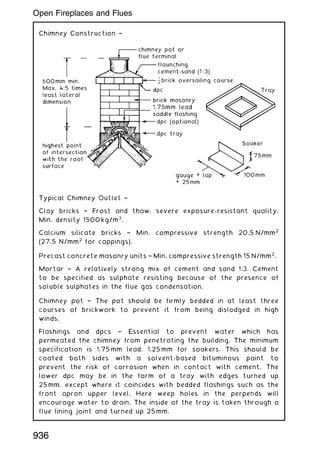
Green and yellow † soakers.
Blue, red and black † flat roof covering in small, medium and large
areas respectively (see table on page 534).
White and orange † lead lining to walls as protection from X-rays
or for sound insulation, but can be used for relatively large areas
of roof covering.
BS 1178* BS EN 12588/standard Weight (kg/m2
) Colour
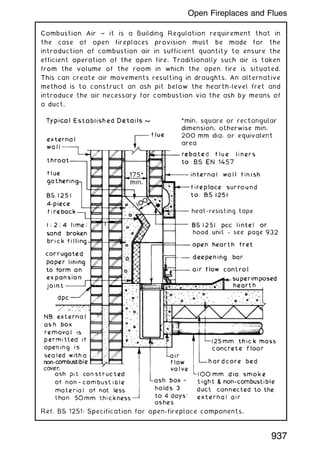
Code No. milled thickness (mm) BS EN/milled marking
3 1.25/1.32 14.17/14.97 Green
- 1.50/1.59 17.00/18.03 Yellow
4 1.75/1.80 19.84/20.41 Blue
5 2.00/2.24 22.67/25.40 Red
6 2.50/2.65 28.34/30.05 Black
7 3.00/3.15 34.02/35.72 White
8 3.50/3.55 39.69/40.26 Orange
*BS 1178: Specification for milled sheet lead and strip for building
purposes. This BS has been superseded by BS EN 12588: Lead
and lead alloys. Rolled lead sheet for building purposes. The former
BS codes are replaced with lead sheet thicknesses between 1.25 and
3.50 millimetres. They are included here, as these codes remain
common industry reference. Codes originated before metrication
as the approximate weight of lead sheet in pounds per square foot
(lb/ft2
), e.g. 3 lb/ft2
became Code 3.
531
Timber Flat Roof Coverings -- Lead Sheet Specification
Thermal Movement ~ the coefficient of linear expansion for lead is
0.0000297 (2.97 × 10† 6
) for every degree Kelvin.
E.g. If the exposure temperature range throughout a year is from
† 10C to 35C (45 K), then a 2.000 m length of sheet lead could
increase by: 0.0000297 × 45 × 2 = 0.00267 m, or 2.67 mm.
Over time this movement will cause fatigue stress, manifesting in
cracking. To prevent fracture, a smooth surface underlay should be
used and the areas of lead sheet limited with provision of joints
designed to accommodate movement.
Underlay ~ placed over plywood or similar smooth surface decking,
or over rigid insulation boards. Bitumen impregnated felt or
waterproof building paper have been the established underlay, but
for new work a non-woven, needle punched polyester textile is now
generally preferred.
Fixings ~ clips, screws and nails of copper, brass or stainless steel.
Jointing ~ for small areas such as door canopies and dormers
where there is little opportunity for thermal movement, a simply
formed welt can be used if the depth of rainwater is unlikely to
exceed the welt depth.
25mm
copper clips at 500mm
spacing, nailed to decking
and folded within welt
Welted joint
underlay
decking
Jointing to absorb movement:
• Wood cored rolls in the direction of the roof slope (see next
page).
• Drips at right angles to and across the roof slope (see next
page).
532
Timber Flat Roof Coverings -- Lead Sheet
2mm lead sheet 50mm high
wood cored
roll, 25mm
wide at base
25mm rebate
for lead nailed
every 100mm
anti-capillary groove
smooth surface decking
or decking plus underlay
overcloak
40mm splashlap
undercloak nailed
every 150mm to top
of roll
Typical provision of wood cored rolls
and drips † detail at junction
40mm splashlap
drip 55mm min.
45
Lead is a soft and malleable material. A skilled craftsman
(traditionally a plumber) can manipulate lead sheet with hand tools
originally made from dense timber such as boxwood, but now
produced from high-density polythene. This practice is known as
`bossing' the lead to the profiles shown. Alternatively, the lead
sheet can be cut and welded to shape.
Selection of lead working tools ~
Mallet
Dresser
Bossing stick
Setting-in stick
Bending stick
Chase wedge
533
Timber Flat Roof Coverings -- Lead Sheet Details
Spacing of wood cored rolls and drips varies with the thickness
specification of lead sheet. The following is a guide ~
Typical flat roof plan (page 491)
100mm min.
abutment upstand
to wall with
apron flashing
wood cored
roll
see previous
page
drip
verge
fascia downstand
into gutter
B
A
BS EN 12588
thickness (mm)
Maximum distance
between drips (mm) [A]
Maximum distance
between rolls (mm) [B]
1.25 and 1.50 Use for soakers only
1.75 1500 500
2.00 2000 600
2.50 2250 675
3.00 2500 675
3.50 3000 750
534
Timber Flat Roof Coverings -- Lead Sheet Application
Single Ply Membranes ~ durable, resilient, flexible and lightweight
sheet materials composed mainly of synthetic polymers. Some are
reinforced with glass fibres depending on application and coverage
area. A backing of glass fibre or polyester matting is often
provided as a bonding interface.
Thickness ~ generally between 1 and 2 mm.
Fixing ~ product manufacturer's recommended adhesive applied to
the sub-surface. Purpose made mechanical fixing devices are an
alternative in situations that may be exposed to wind lift.
Materials ~ Polyvinyl chloride (PVC).
Thermoplastics: Thermoplastic polyolefin (TPO).
Chlorinated polyethylene (CPE).
Ethylene interpolymer (EIP).
Copolymer alloy (CPA).
Acrylonitrile butadiene polymer (NBP).
Other Considerations ~
• PVC membranes can be solvent adhesive bonded at overlaps
or hot air welded.
• Thermoplastics are hot air welded at seams and overlaps
(homogenous jointing at about 400 to 5000
C).
• Ethylene propylene diene monomer (EPDM) is a thermoset
synthetic rubber that can only be adhesive sealed. Application
of heat would physically break it down.
Typical Detail ~
single ply membrane
adhesive
rigid batt
insulation
vapour control
layer
boarded decking
Note: `Warm deck' shown. `Cold deck' construction details on pages
523 and 525.
535
Timber Flat Roofs -- Single Ply Membranes
Application
Side lap
Eaves
Abutment
metal trim
and fixing
over edge
fillet
PVC single
ply membrane
adhesive
rigid batt insulation
vapour control layer
decking
lead apron and dpc in wall
plastic or aluminium alloy fixing strip
40mm min. heat welds
as above
End lap
150mm
40mm min. polyfused
heat weld
heat
weld
cover
strip
heat
weld
100mm
hand held low voltage
electric element welder
(see note below) pressure applied
by hand roller
PVC single ply
membrane
Notes:
• Hand held welder and roller used mainly for small detail areas.
Automatic (manually directed) welder/roller more effective for
continuous seaming.
• See Note re. warm and cold deck construction on preceding
page.
536
Timber Flat Roofs -- Single Ply Membrane Details
A dormer is the framework for a vertical window constructed from the
roof slope. It may be used as a feature, but is more likely as an
economical and practical means for accessing light and ventilation to
an attic room. Dormers are normally external with the option of a flat
or pitched roof. Frame construction is typical of the following
illustrations, with connections made by traditional housed and tenoned
joints or simpler galvanised steel brackets and hangers.
537
Dormer Windows
roof
slope
pitched options
gable or hip end
eaves
alternative ceiling joist/tie
ridge board
trimmed common
rafters
alternative head
trimmer position
ceiling joists
head trimmer
trimming rafter
internal studding
between trimming
rafters and floor joists
corner post
floor joists
sill trimmer
cheek
posts
corner
post
head beam
plywood
boarded
gable
barge
board
Section through gable ended external dormer
ceiling joist
rafters
Internal Partial External
Dormer Window Types
538
A graceful interruption to the routine of a pitched roof, derived
from thatched roofs where the thatch is swept over window
openings. Other suitable coverings are timber shingles, plain tiles
and small slates.
Main roof pitch 
†
50. Eyebrow pitch 
†
35.
Transition curve should be smooth with span to height ratio  8 : 1.
Less is possible, but may prove impractical and disproportionate.
Possible profile ~
transition curve
window
wall plate
or double
rafter
support
normal
to curve
30°
60°
A†B is a line through the centre of the window opening.
A†D radius is positioned to clear the window head.
C†D radius is established near window base in continuity to A†D.
A purpose-made gluelam beam can be used to create the transition
curve, effectively extending the wall plate to receive the eyebrow
rafters. The curved beam for an intermediate eyebrow may be
supported on joist hangers to double trimming rafters each side.
539
Eyebrow Dormer Window
Air carries water vapour, the amount increasing proportionally
with the air temperature. As the water vapour increases so does
the pressure and this causes the vapour to migrate from warmer
to cooler parts of a building. As the air temperature reduces, so
does its ability to hold water and this manifests as condensation
on cold surfaces. Insulation between living areas and roof spaces
increases the temperature differential and potential for
condensation in the roof void.
Condensation can be prevented by either of the following:
* Providing a vapour control layer on the warm side of any
insulation.
* Removing the damp air by ventilating the colder area.
The most convenient form of vapour layer is vapour check
plasterboard which has a moisture resistant lining bonded to the
back of the board. A typical patented product is a foil or
metallised polyester backed plasterboard in 9„5 and 12„5 mm
standard thicknesses. This is most suitable where there are rooms
in roofs and for cold deck flat roofs. Ventilation is appropriate to
larger roof spaces.
540
Ventilation of Roof Spaces (1)
Roof Ventilation † provision of eaves ventilation alone should
allow adequate air circulation in most situations. However, in some
climatic conditions and where the air movement is not directly at
right angles to the building, moist air can be trapped in the roof
apex. Therefore, supplementary ridge ventilation is recommended.
NB. Ventilation dimensions shown relate to a continuous strip
(or equivalent) of at least the given gap.
541
Ventilation of Roof Spaces (2)
Refs.: Building Regulations, Approved Document C † Site
preparation and resistance to contaminants and moisture.
Section 6 † Roofs.
BS 5250: Code of practice for control of condensation in
buildings.
BRE report † Thermal Insulation: avoiding risks (3rd. edn).
542
Ventilation of Roof Spaces (3)
Lateral Restraint † stability of gable walls and construction at
the eaves, plus integrity of the roof structure during excessive
wind forces, requires complementary restraint and continuity
through 30 × 5 mm cross-sectional area galvanised steel straps.
Exceptions may occur if the roof:
1. exceeds 15 pitch, and
2. is tiled or slated, and
3. has the type of construction known locally to resist gusts,
and
4. has ceiling joists and rafters bearing onto support walls at
not more than 12 m centres.
Application ~
543
Timber Pitched Roofs
Preservation ~ ref. Building Regulations: Materials and
Workmanship. Approved Document to support Regulation 7.
Woodworm infestation of untreated structural timbers is common.
However, the smaller woodborers such as the abundant Furniture
beetle are controllable. It is the threat of considerable damage
potential from the House Longhorn beetle that has forced many
local authorities in Surrey and the fringe areas of adjacent
counties to seek timber preservation listing in the Building
Regulations (see Table 1 in the above reference). Prior to the
introduction of pretreated timber (c. 1960s), the House Longhorn
beetle was once prolific in housing in the south of England,
establishing a reputation for destroying structural roof timbers,
particularly in the Camberley area.
House Longhorn beetle data:
Latin name † Hylotrupes bajulus
Life cycle † Mature beetle lays up to 200 eggs on rough surface
of untreated timber.
After two to three weeks, larvae emerge and bore
into wood, preferring sapwood to denser growth
areas. Up to 10 years in the damaging larval stage. In
three weeks, larvae change to chrysalides to emerge
as mature beetles in summer to reproduce.
Timber appearance † powdery deposits (frass) on the surface and
the obvious mature beetle flight holes.
Beetle appearance †
Other woodborers:
Furniture beetle † dark brown, 6†8 mm long, lays 20†50 eggs on
soft or hardwoods. Boreholes only 1†2 mm diameter.
Lyctus powder post beetle † reddish brown, 10†15 mm long, lays
70†200 eggs on sapwood of new hardwood. Boreholes only 1†2 mm
in diameter.
Death-watch beetle † dark brown, sometimes speckled in lighter
shades. Lays 40†80 eggs on hardwood. Known for preferring the
oak timbers used in old churches and similar buildings.
Boreholes about 3 mm diameter.
544
Timber Roofs --- Preservation
Preservation ~ treatment of timber to prevent damage from House
Longhorn beetle.
In the areas specified (see previous page), all softwood used in roof
structures including ceiling joists and any other softwood fixings
should be treated with insecticide prior to installation. Specific
chemicals and processes have not been listed in the Building
Regulations since the 1976 issue. Timber treatment then was either:
• Vacuum/pressure impregnation with a blend of copper,
chromium and arsenic (CCA), known commercially as `tanalising'.
• Diffusion with sodium borate (boron salts).
• Steeping (min. 10 mins.) in organic solvent wood preservative.
• Steeping or soaking in tar oil (creosote). This has limitations
due to staining of adjacent surfaces.
The current edition of Approved Document A (Structure) to the
Building Regulations refers to guidance on preservative treatments
in the British Wood Preserving and Damp-Proofing Association's
Manual. Other guidance is provided in:
BS 5707: Specification for preparation for wood preservatives in
organic solvents.
BS 8417: Preservation of wood. Code of practice.
BS EN 117: Wood preservatives.
Insect treatment adds about 10% to the cost of timber and also
enhances its resistance to moisture. Other parts of the structure
(e.g. floors and partitions) are less exposed to woodworm damage
as they are enclosed. Also, there is a suggestion that if these
areas received treated timber, the toxic fumes could be harmful to
the health of building occupants. Current requirements for through
ventilation in roofs have the added benefit of discouraging wood
boring insects, as they prefer draught-free damp areas.
Note: EU directive CEN/TC 38 prohibits the use of CCA
preservative for domestic applications and in places where the
public may be in contact with it.
545
Timber Roofs --- Preservation
Green roof ~ green with reference to the general appearance of
plant growths and for being environmentally acceptable. Part of
the measures for constructing sustainable and ecologically friendly
buildings.
Categories:
• Extensive ~ a relatively shallow soil base (typically 50 mm) and
lightweight construction. Maximum roof pitch is 40 and slopes
greater than 20 will require a system of baffles to prevent the soil
moving. Plant life is limited by the shallow soil base to grasses,
mosses, herbs and sedum (succulents, generally with fleshy leaves
producing pink or white flowers).
• Intensive ~ otherwise known as a roof garden. This category
has a deeper soil base (typically 400 mm) that will provide for
landscaping features, small ponds, occasional shrubs and small
trees. A substantial building structure is required for support
and it is only feasible to use a flat roof.
Advantages:
• Absorbs and controls water run-off.
• Integral thermal insulation.
• Integral sound insulation.
• Absorbs air pollutants, dust and CO2.
• Passive heat storage potential.
Disadvantages:
• Weight.
• Maintenance.
Construction ~ the following buildup will be necessary to fulfil the
objectives and to create stability:
• Vapour control layer above the roof structure.
• Rigid slab insulation.
• Root resilient waterproof under-layer.
• Drainage layer.
• Filter.
• Growing medium (soil).
• Vegetation (grass, etc.)
NB. Examples of both extensive and intensive green roof
construction are shown on the next page.
546
Green Roofs
Typical extensive roof buildup ~
grass/sedum
soil
filter layer or fleece
drainage layer*
waterproof membrane
insulation
vapour control layer
reinforced concrete
roof structure
* typically, expanded polystyrene with slots
147 kg/m2
saturated weight x 9.81 = 1442 N/m2
or 1.44 kN/m2
Typical intensive roof buildup ~
filter layer or fleece
drainage layer
water retention fleece
over waterproof membrane
insulation
vapour control layer
reinforced concrete
roof structure
Depth to vcl, approximately 560 mm at about 750 kg/m2
saturated weight. 750 kg/m2
× 9.81 = 7358 N/m2
or 7.36 kN/m2
.
plants, shrubs
and grasses
soil substrate
up to 450 mm
Component Weight (kg/m2
) Thickness (mm)
vcl 3 3
insulation 3 50
membrane 5 5
drainage layer 3 50
filter 3 3
soil 90 50
turf 40 20
------------- ---------
147 kg/m2
181 mm
547
Green Roofs -- Types
Thermal insulation of external elements of construction is
measured in terms of thermal transmittance rate, otherwise known
as the U-value. It is the amount of heat energy in watts
transmitted through one square metre of construction for every
one degree Kelvin between external and internal air temperature,
i.e. W/m2
K.
U-values are unlikely to be entirely accurate, due to:
* the varying effects of solar radiation, atmospheric dampness
and prevailing winds.
* inconsistencies in construction, even with the best of
supervision.
* `bridging' where different structural components meet, e.g.
dense mortar in lightweight blockwork.
Nevertheless, calculation of the U-value for a particular element of
construction will provide guidance as to whether the structure is
thermally acceptable. The Building Regulations, Approved
Document L, Conservation of fuel and power, determines
acceptable energy efficiency standards for modern buildings, with
the objective of limiting the emission of carbon dioxide and other
burnt gases into the atmosphere.
The U-value is calculated by taking the reciprocal of the summed
thermal resistances (R) of the component parts of an element of
construction:
U ¼
1
 R
¼ W=m
2
K
R is expressed in m2
K/W. The higher the value, the better a
component's insulation. Conversely, the lower the value of U, the
better the insulative properties of the structure.
Building Regulations, Approved Document references:
L1A, Work in new dwellings.
L1B, Work in existing dwellings.
L2A, Work in new buildings other than dwellings.
L2B, Work in existing buildings other than dwellings.
548
Thermal Insulation, U-Value Calculations (1)
Thermal resistances (R) are a combination of the different
structural, surface and air space components which make up an
element of construction. Typically:
U =
1
Rso + R1 + R2 + Ra + R3 + R4 etc . . . + Rsi(m2
K=W)
Where: Rso = Outside or external surface resistance.
R1, R2, etc. = Thermal resistance of structural components.
Ra = Air space resistance, e.g. wall cavity.
Rsi = Internal surface resistance.
The thermal resistance of a structural component (R1, R2, etc.) is
calculated by dividing its thickness (L) by its thermal conductivity
(), i.e.
R(m2
K=W) =
L(m)
 (W=mK)
E.g. 1. A 102 mm brick with a conductivity of 0„84 W/mK has a
thermal resistance (R) of: 0„102 ÷ 0„84 = 0„121 m2
K/W.
E.g. 2.
NB. the effect of mortar joints in the brickwork can be ignored, as
both components have similar density and insulative properties.
U =
1
Rso + R1 + R2 + Rsi
R1 = 0„215 ÷ 0„84 = 0„256
R2 = 0„013 ÷ 0„50 = 0„026
U =
1
0:055 + 0:256 + 0:026 + 0:123
= 2:17W=m
2
K
549
Thermal Insulation, U-Value Calculations (2)
Typical values in: m2
K/W
Internal surface resistances (Rsi):
Walls † 0 123
Floors or ceilings for upward heat flow † 0 104
Floors or ceilings for downward heat flow † 0 148
Roofs (flat or pitched) † 0 104
External surface resistances (Rso):
Sheltered † town buildings to 3 storeys.
Normal † town buildings 4 to 8 storeys and most suburban
premises.
Severe †  9 storeys in towns.
 5 storeys elsewhere and any buildings on exposed
coasts and hills.
Air space resistances (Ra):
Pitched or flat roof space † 0„180
Behind vertical tile hanging † 0„120
Cavity wall void † 0„180
Between high and low emissivity surfaces † 0„300
Unventilated/sealed † 0„180
Emissivity relates to the heat transfer across and from surfaces by
radiant heat emission and absorption effects. The amount will
depend on the surface texture, the quantity and temperature of air
movement across it, the surface position or orientation and the
temperature of adjacent bodies or materials. High surface
emissivity is appropriate for most building materials. An example of
low emissivity would be bright aluminium foil on one or both sides
of an air space.
Surface Exposure
Sheltered Normal Severe
Wall † high emissivity 0„080 0„055 0„030
Wall † low emissivity 0„1 1 0 0„070 0„030
Roof † high emissivity 0„070 0„045 0„020
Roof † low emissivity 0„090 0„050 0„020
Floor † high emissivity 0„070 0„040 0„020
550
Thermal Insulation, Surface and Air Space Resistances
Typical values †
Material Density
(kg/m3
)
Conductivity ()
(W/mK)
WALLS:
Boarding (hardwood) 700 0„1 8
.. .. .. (softwood) 500 0„1 3
Brick outer leaf 1 700 0„84
.. .. inner leaf 1 700 0„62
Calcium silicate board 875 0„1 7
Ceramic tiles 2300 1 „30
Concrete 2400 1 „93
.. .. .. .. .. 2200 1 „59
.. .. .. .. .. 2000 1 „33
.. .. .. .. .. 1 800 1 „1 3
.. .. .. .. .. (lightweight) 1 200 0„38
.. .. .. .. .. (reinforced) 2400 2„50
Concrete block (lightweight) 600 0„1 8
.. .. .. .. .. .. .. (mediumweight) 1 400 0„53
Cement mortar (protected) 1 750 0„88
.. .. .. .. .. .. .. (exposed) 1 750 0„94
Fibreboard 350 0„08
Gypsum plaster (dense) 1 300 0„57
Gypsum plaster (lightweight) 600 0„1 6
Plasterboard 950 0„1 6
Tile hanging 1 900 0„84
Rendering 1 300 0„57
Sandstone 2600 2„30
Wall ties (st/st) 7900 1 7„00
ROOFS:
Aerated concrete slab 500 0„1 6
Asphalt 1 900 0„60
Bituminous felt in 3 layers 1 700 0„50
Sarking felt 1 700 0„50
Stone chippings 1 800 0„96
Tiles (clay) 2000 1 „00
.. .. (concrete) 21 00 1 „50
Wood wool slab 500 0„10
551
Thermal Insulation, Density and Thermal Conductivity (1)
Notes:
1 . For purposes of calculating U-values, the effect of mortar in
external brickwork is usually ignored as the density and
thermal properties of bricks and mortar are similar.
2. Where butterfly wall ties are used at normal spacing in an
insulated cavity 
†
75 mm, no adjustment is required to
calculations. If vertical twist ties are used in insulated
cavities 75 mm, 0020 W/m2
K should be added to the
U-value.
3. Thermal conductivity () is a measure of the rate that heat is
conducted through a material under specific conditions (W/mK).
Typical values †
Material Density
(kg/m3
)
Conductivity ()
(W/mK)
FLOORS:
Cast concrete 2000 1 „33
Hardwood block/strip 700 0„1 8
Plywood/particle board 650 0„1 4
Screed 1 200 0„41
Softwood board 500 0„1 3
Steel tray 7800 50„00
INSULATION:
Expanded polystyrene board 20 0„035
Mineral wool batt/slab 25 0„038
Mineral wool quilt 1 2 0„042
Phenolic foam board 30 0„025
Polyurethane board 30 0„025
Urea formaldehyde foam 1 0 0„040
GROUND:
Clay/silt 1 250 1 „50
Sand/gravel 1 500 2„00
Homogeneous rock 3000 3„50
552
Thermal Insulation, Density and Thermal Conductivity (2)
* Tables and charts † Insulation manufacturers' design guides
and technical papers (walls, roofs and ground floors).
* Calculation using the Proportional Area Method (walls and roofs).
* Calculation using the Combined Method † BS EN ISO 6946
(walls and roofs).
* Calculation using BS EN ISO 13370 (ground floors and basements).
Tables and charts † these apply where specific U-values are
required and standard forms of construction are adopted. The
values contain appropriate allowances for variable heat transfer
due to different components in the construction, e.g. twisted
pattern wall ties and non-uniformity of insulation with the
interruption by ceiling joists. The example below shows the
tabulated data for a solid ground floor with embedded insulation
of  = 0.03 W/mK:
Typical table for floor insulation:
90 mm of insulation required.
Refs.: BS EN ISO 6946: Building components and building elements.
Thermal resistance and thermal transmittance. Calculation
method.
BS EN ISO 13370: Thermal performance of buildings. Heat
transfer via the ground. Calculation methods.
P/A 0„020 0„025 0„030* 0„035 0„040 0„045 W/mK
1 „0 6 1 76 9 1 1 07 1 22 1 37 mm ins.
0„9* 60 75 90 1 05 1 20 1 35 .. ..
0„8 58 73 88 1 02 1 1 7 1 32 .. ..
0„7 57 7 1 85 99 1 1 3 1 28 .. ..
0„6 54 68 82 95 1 09 1 22 .. ..
0„5 5 1 64 77 90 1 03 1 1 5 .. ..
553
Thermal Insulation, Methods for Determining U-Values
Various applications to different ground floor situations are
considered in BS EN ISO 13370. The following is an example of a
solid concrete slab in direct contact with the ground. The data
used is from the previous page.
Floor section
Perimeter = 18 m (exposed)
Floor area = 20 m2
 for 90 mm insulation = 0.03 W/mK
Characteristic floor dimension = B1
B1
= Floor area ÷ (1/2 exp. perimeter)
B1
= 20 ÷ 9 = 2.222 m
Formula to calculate total equivalent floor thickness for
uninsulated and insulated all over floor:
dt = w +  (Rsi + Rf + Rso)
where: dt = total equivalent floor thickness (m)
w = wall thickness (m)
 = thermal conductivity of soil (W/mK) [see page 552]
Rsi = internal surface resistance (m2
K/W) [see page 550]
Rf = insulation resistance (0.09 ÷ 0.03 = 3 m2
K/W)
Rso = external surface resistance (m2
K/W) [see page 550]
Uninsulated: dt = 0.3 + 1.5 (0.148 + 0 + 0.04) = 0.582m
Insulated: dt = 0.3 + 1.5 (0.148 +3+0.04) = 5.082m
Formulae to calculate U-values ~
Uninsulated or poorly insulated floor, dt  B1
:
U = (2) ÷ [(p B1
) + dt] × ln [(p B1
÷ dt) + 1]
Well insulated floor, dt 
†
B1
:
U =  ÷ [(0.457 × B1
) + dt]
where: U = thermal transmittance coefficient (W/m2
/K)
 = thermal conductivity of soil (W/mK)
B1
= characteristic floor dimension (m)
dt = total equivalent floor thickness (m)
ln = natural logarithm
Uninsulated floor ~
U = (2 × 1.5) ÷ [(3.142 × 2.222) + 0.582] × ln [(3.142 × 2.222) ÷ 0.582 + 1]
U = 0.397 × ln 12.996 = 1.02 W/m2
K
Insulated floor ~
U = 1.5 ÷ [(0.457 × 2.222) +5.082] = 1.5 ÷ 6.097 = 0.246 W/m2
K
NB. Compares with the tabulated figure of 0.250 W/m2
K on the
previous page.
554
Thermal Insulation, Calculating U-Values (1)
A standard block with mortar is 450 × 225 mm = 101250 mm2
A standard block format of 440 × 215 mm = 94600 mm2
The area of mortar per block = 6650 mm2
Proportional area of mortar =
6650
101250
×
100
1
= 6„57%(0:066)
Therefore the proportional area of blocks = 93„43%(0„934)
Thermal resistances (R):
Outer leaf + insulation (unbridged) Inner leaf (unbridged)
Rso = 0„055 blocks = 0„555
brickwork = 0„122 plaster = 0„081
insulation = 2.631 Rsi = 0.123
2„808 0„759
× 100% = 2„808 × 93„43% = 0„709
Inner leaf (bridged)
mortar = 0„114
plaster = 0„081
Rsi = 0.123
= 0„318
× 6„57% = 0„021
U =
1
R
=
1
2„808 + 0„709 + 0:021
= 0„283W=m
2
K
555
Thermal Insulation, Calculating U-Values (2)
Combined Method (Wall)
This method considers the upper and lower thermal resistance (R)
limits of an element of structure. The average of these is
reciprocated to provide the U-value.
Formula for upper and lower resistances =
1
(Fx÷ Rx)
Where: Fx = Fractional area of a section
Rx = Total thermal resistance of a section
Using the wall example from the previous page:
Upper limit of resistance (R) through section containing blocks †
(Rso, 0„055) + (brkwk, 0„122) + (ins, 2„631) + (blocks, 0„555) + (plstr,
0„081) + (Rsi, 0„123) = 3„567 m2
K/W
Fractional area of section (F) = 93„43% or 0„934
Upper limit of resistance (R) through section containing mortar †
(Rso 0„055) + (brkwk, 0„122) + (ins, 2„631) + (mortar, 0„114) + (plstr,
0„081) + (Rsi, 0„123) = 3„126 m2
K/W
Fractional area of section (F) = 6„57% or 0„066
The upper limit of resistance =
1
 (0„943 ÷ 3„567) + (0„066 ÷ 3„126)
= 3„533m2
K=W
Lower limit of resistance (R) is obtained by summating the
resistance of all the layers †
(Rso, 0„055) + (brkwk, 0„122) + (ins, 2„631) + (bridged layer,
1 ÷ [0„934 ÷ 0„555] + [0„066 ÷ 0„114] = 0„442) + (plstr, 0„081) +
(Rsi, 0„123) = 3„454 m2
K/W
Total resistance (R) of wall is the average of upper and lower
limits = (3„533 + 3„454) ÷ 2 = 3„493 m2
K/W
U-value =
1
R
=
1
3„493
= 0„286 W=m
2
K
NB. Both proportional area and combined method calculations
require an addition of 0„020 W/m2
K to the calculated U-value. This
is for vertical twist type wall ties in the wide cavity. See page
400 and note 2 on page 552.
556
Thermal Insulation, Calculating U-Values (3)
Notes:
1 . The air space in the loft area is divided between pitched and ceiling
components, i.e. Ra = 0180  2 = 0090 m2
K/W.
2. The U-value is calculated perpendicular to the insulation, therefore the
pitched component resistance is adjusted by multiplying by the cosine of
the pitch angle, i.e. 0819.
3. Proportional area of bridging parts (rafters and joists) is 50  400 =
0125 or 125%.
4. With an air space resistance value (R1) of 0120 m2
K/W between tiles and
felt, the resistance of the tiling may be ignored.
Thermal resistance (R) of the pitched component:
Raftered part Non-raftered part
Rso = 0„045 Rso = 0„045
R1 = 0„120 R1 = 0„120
R2 = 0„004 R2 = 0„004
R3 = 0„714 Ra = 0.090
Ra = 0.090 0„259 × 87„5%
0„973 × 12„5% = 0„122 = 0„227
Total resistance of pitched components =
(0„122 + 0„227) × 0„819 = 0„286 m2
K/W
Thermal resistance (R) of the ceiling component:
Joisted part Fully insulated part
Rsi = 0„104 Rsi = 0„104
R6 = 0„081 R6 = 0„081
R5 = 0„714 R4 = 5„000 (200 mm)
R4 = 2„500 (100 mm) Ra = 0.090
Ra = 0.090 5„275 × 87„5%
3„489 × 12„5% = 0„436 = 4„615
Total resistance of ceiling components = 0„436 + 4„615
= 5„051 m2
K/W.
U =
1
R
=
1
0:286 + 5:051
= 0:187 W=m
2
K
557
Thermal Insulation, Calculating U-Values (4)
Area weighted application ~ an allowance for a variation occurring
in the construction of an external element.
E.g. Taking the roof U-value calculation shown on the previous
page and including an uninsulated plywood loft hatch within the
ceiling. The loft hatch occupies 10% of the overall ceiling area.
Ceiling/loft hatch section
Resistance (R) of hatch material = 0.025 m ÷ 0.140 W/mK
= 0.178 m2
K/W
Resistance of hatch = Rsi + R + Ra
= 0.104 + 0.178 + 0.090
= 0.372 m2
K/W
Proportional area resistance of hatch = 0.372 x 10% = 0.037 m2
K/W
Resistance of ceiling = 5.051 m2
K/W (see previous page)
Proportional area resistance of ceiling = 5.051 x 90% = 4.546 m2
K/W
Resistance of pitched component = 0.286 m2
K/W (see previous page)
U =
1
0:286 + 0:037 + 4:546
=
1
4:869
= 0:205 W=m
2
K
An area weighted higher U-value than the 0.187 W/m2
K calculated
on the previous page for a fully insulated ceiling.
NB. Proprietary loft hatches are manufactured to incorporate a
substantial layer of insulating material.
ceiling joist
25 mm (0.025 m) plywood loft
hatch door uninsulated,
thermal conductivity
(λ) of 0.140 W/mK
Rsi = 0.104
Ra = 0.180 2
= 0.090
558
Thermal Insulation, Calculating U-Values (5)
Standard Assessment Procedure ~ the Approved Document to Part
L of the Building Regulations emphasises the importance of
quantifying the energy costs of running homes. For this purpose it
uses the Government's Standard Assessment Procedure (SAP). SAP
has a numerical scale of 1 to 100, although it can exceed 100 if a
dwelling is a net energy exporter. It takes into account the
effectiveness of a building's fabric relative to insulation and
standard of construction. It also appraises the energy efficiency of
fuel consuming installations such as ventilation, hot water, heating
and lighting. Incidentals like solar gain also feature in the
calculations.
As part of the Building Regulations approval procedure, energy
rating (SAP) calculations are submitted to the local building
control authority. SAP ratings are also required to provide
prospective home purchasers or tenants with an indication of the
expected fuel costs for hot water and heating. This information is
documented and included with the property conveyance. The SAP
calculation involves combining data from tables, work sheets and
formulae. Guidance is found in Approved Document L, or by
application of certified SAP computer software programs.
SAP rating average for all homes is about 50. A modernised 1930s
house is about 70, that built to 1995 energy standards about 80
and a 2002 house about 90. Current quality construction
standards should rate dwellings close to 100.
Ref. Standard Assessment Procedure for Energy Rating of
Dwellings. The Stationery Office.
Air Permeability ~ airtightness in the construction of dwellings is
an important quality control objective. Compliance is achieved by
attention to detail at construction interfaces, e.g. by silicone
sealing built-in joists to blockwork inner leafs and door and window
frames to masonry surrounds; draft proofing sashes, doors and loft
hatches. Guidance for compliance is provided in Limiting thermal
bridging and air leakage: Robust construction details for dwellings
and similar buildings, published by The Stationery Office. Dwellings
failing to comply with these measures are penalised in SAP
calculations. Alternatively, a certificate must be obtained to show
pre-completion testing satisfying air permeability of less than
10 m3
/h per m2
envelope area at 50 Pascals (Pa or N/m2
) pressure.
559
Thermal Insulation Energy Efficiency of New Dwellings
Dwellings in England and Wales ~ the worst acceptable, or the
limiting heat energy loss through the enclosing fabric as an area
weighted average U-value:
Area weighted average U-value ~ for an element of construction this
depends on the individual U-values of the components and the area
they occupy within that element. Some examples with higher thermal
transmittance than the adjacent construction to include the part of
an external wall containing a meter cupboard and the part of a roof
structure containing a loft hatch and/or a rooflight. Also, a window
or door U-value is measured with the combined performance of the
principal unit and its frame.
Objective U-values ~
Notwithstanding the limiting thermal transmittance values stated
above, an objective target for U-values could be better than:
Element of
construction
Area weighted average
U-value (W/m2
K)
External wall 0.18
Roof 0.13
Floor 0.13
Party wall 0.00
Windows, roof windows, glazed rooflights and
glazed doors 1.40 (adjusted for slope)*
Doors opaque 1.00
Doors semi-glazed 1.20
NB. Air permeability objective not greater than 5 m3
/hour per m2
at 50 Pa.
* See next page.
Element of
construction
Area weighted average
U-value (W/m2
K)
External wall 0.30
Roof 0.20
Floor 0.25
Party wall 0.20
Windows, roof windows, glazed
rooflights and pedestrian doors 2.00 (adjusted for slope)*
Note: Air permeability through the external envelope, not to exceed 10 m3
/hour
per m2
at 50 Pascals (Pa) pressure.
560
Thermal Insulation, Elements of Construction (1)
Typical party wall U-values:
U-values for windows and rooflights ~ these are shown for the unit
mounted in a vertical position. Where a window is inclined to the
vertical, U-values should be modified relative to the angle of
installation. The following table is a guide:
E.g. A triple glazed rooflight with an area weighted average
U-value of 1.50 W/m2
K in a 45
pitched roof.
Revised U-value = 1.50 + 0.20 = 1.70 W/m2
K.
Total window area and other measures for glazing provision and
energy rating are considered on the next page.
References and further reading:
BRE Digest 443: Conventions for U-value calculations.
Building Regulations, Approved Documents:
L1A: Conservation of fuel and power in new dwellings.
L1B: Conservation of fuel and power in existing dwellings.
Domestic Building Services Compliance Guide † NBS for DCLG.
Construction type U-value (W/m2
K)
Solid 0.00
Cavity, unfilled without edge sealing 0.50
Cavity, unfilled with edge sealing 0.20
Cavity, filled with edge sealing 0.00
Inclination to U-value (W/m2
K) increase
the horizontal Double glazed Triple glazed
 20
0.50 0.30
20
† 40
0.40 0.20
40
† 60
0.30 0.20
60
† 70
0.20 0.10
70
0.00 0.00
561
Thermal Insulation, Elements of Construction (2)
Windows, doors, rooflights and roof windows:
• New dwellings ~ a maximum area is not critical to Approved
Document guidance to Building Regulation compliance, except
that openable parts should not exceed one quarter of the total
floor area. The contribution that window and door openings make
to the overall energy efficiency of a dwelling, with particular
regard to their U-values is included in SAP calculations. A
measure of compliance can be achieved using the BFRC window
energy rating and efficiency design guide shown on page 566.
• Existing dwellings ~ extensions and alterations. Approved
Document guidance to Building Regulation compliance includes
a reasonable provision to limit the total area to the
equivalent of 25% of an extension floor area. The BFRC
window energy rating of new installations is at least band C,
i.e. higher than minus 20 (see page 566) or a U-value of not
greater than 1.6 W/m2
K (area weighted combining glazing and
frame). Doors to have an area weighted U-value of not
greater than 1.8 W/m2
K.
Ref. BFRC ~ British Fenestration Registration Council.
Energy source:
A gas or oil fired central heating boiler with a SEDBUK
efficiency rating of 90% (band rating A) is standard installation
for new dwellings. There are transitional and exceptional
circumstances that may permit lower band rated boilers. Where
this occurs, the construction of the building envelope should
compensate with very low U-values. An energy recovery system
or an alternative/renewable energy system may also be
considered as a trade-off. Acceptable standards for solid fuel
boilers are provided to HETAS certification (see page 565).
SEDBUK band ratings ~ these are defined in the UK Government's
publication, Standard Assessment Procedure for Energy Rating of
Dwellings (SAP)
Note: SEDBUK band A =  90% efficiency
.. B = 86†90% ..
.. C = 82†86% ..
.. D = 78†82% ..
.. E = 74†82% ..
.. F = 70†74% ..
.. G = 70% ..
Ref. SEDBUK ~ Seasonal Efficiency of a Domestic Boiler in the UK.
562
Thermal Insulation, Elements of Construction (3)
New-build dwellings, limiting or worst acceptable and (objective
target) heat energy loss values ~
Extensions or alterations to existing dwellings, reasonable/
acceptable heat energy loss objectives ~
NB. Figures indicate the thermal transmittance coefficient through
the fabric of construction. Otherwise known as the U-value,
expressed in units of watts per square metre for every one
degree Kelvin temperature difference (W/m2
K).
unheated loft space
0.20 (0.13)
0.20 (0.13)
0.20 (0.13)
0.30 (0.18)
0.30 (0.18)
unheated space
(resistance values can
apply depending on size
of space and exposed areas,
see SAP section 3)
* A WER (page 566)
above −30 may be an
acceptable alternative
subject to other SAP
objectives being satisfied
** See page 560
Door 2.00 (1.40)**
2.00 (1.40)*
2.00 (1.40) adjusted for
slope*
0.25 (0.13)
0.25 (0.13)
unheated loft space
1.60 adjusted for slope,
or WER above −20
1.60 or WER above −20
Door 1.80
0.22
unheated space
(as above)
0.28
0.28
0.18
0.18
0.16
0.22
563
Thermal Insulation --- U-Values
There are many situations in the enclosing envelope of a building
where the U-value of the principal construction is interrupted by
necessary change. In these instances, U-values are averaged over
the material components. Some examples include meter cupboard/
cavity wall (illustrated), door/door frame, loft hatch/ceiling and
rooflight/roof structure.
Formula ~
Area weighted average =
ðU1 × A1Þ + ðU2 × A2Þ þ ðU3 × A3Þ, etc.
A1 + A2 + A3, etc.
E.g. A 12.00m2
cavity wall containing gas and electricity meter
cupboards, each 0.410m wide x 0.610m high. Thermal transmittance
factors 0.25 W/m2
K and 0.45 W/m2
K respectively.
Meter cupboard area = 0.41 m x 0.61 m x 2 = 0.50m2
Effective wall area = 12.00 m2
less 0.50 m2
= 11.50m2
Area weighted U-value ~
ð0:25 × 11:50Þ + ð0:45 × 0:50Þ
11:50 + 0:50
=
2:875 + 0:225
12:00
¼ 0:258 W=m2
K
NB. See also page 558.
U1 = 0.25 W/m2K
U2 = 0.45 W/m2K
effective wall
area A1 = 11.50 m2
meter cupboard
area 0.25 m2
2 Nƒ. (gas
and electricity)
A2 = 0.50m2
Thermal Insulation --- Area Weighted Average
564
Further quality procedures (structure):
• Provision of insulation to be continuous. Gaps are
unacceptable and if allowed to occur will invalidate the
insulation value by thermal bridging.
• Junctions at elements of construction (wall/floor, wall/roof) to
receive particular attention with regard to continuity of
insulation.
• Openings in walls for windows and doors to be adequately
treated with insulating cavity closers.
Further quality procedures (energy consumption):
• Hot water and heating systems to be fully commissioned on
completion and controls set with regard for comfort, health
and economical use of fuel.
• As part of the commissioning process for new wet heating
system installations, they should be filled and drained (flushed
out) and on refilling, the water should be blended with an anti-
corrosion additive diluted to the manufacturer's instructions.
This additive also functions as a pump lubricant, an anti-freeze
and protection against scaling.
• A certificate confirming heating system commissioning and
water treatment should be provided for the new installation
user. This document to be accompanied by component
manufacturer's operating and maintenance instructions.
Note: Commissioning of heating installations and the issue of
certificates is by a qualified `competent person' as recognised
by the appropriate body: CAPITA GROUP, OFTEC or HETAS.
CAPITA GROUP ~ `Gas Safe Register' of installers (has
replaced CORGI).
OFTEC ~ Oil Firing Technical Association for the Petroleum
Industry.
HETAS ~ Solid Fuel Heating Equipment Testing and Approval
Scheme.
Further quality procedures (existing dwellings) ~
Where an existing dwelling is subject to alterations/extensions and
improvements such as refurbishment, it is expected that reasonable
provision be made to enhance the thermal properties of the
external envelope of the existing structure.
Thermal Insulation --- Other Considerations
565
European Window Energy Rating Scheme (EWERS) ~ an alternative
to U-values for measuring the thermal efficiency of windows.
U-values form part of the assessment, in addition to factors for
solar heat gain and air leakage. In the UK, testing and labelling of
window manufacturers' products is promoted by the British
Fenestration Rating Council (BFRC). The scheme uses a computer
to simulate energy movement over a year through a standard
window of 1.480 × 1.230 m containing a central mullion and opening
sash to one side.
Data is expressed on a scale from A†G in units of kWh/m2
/year.
A  zero
B †10 to 0
C †20 to †10
D †30 to †20
E †50 to †30
F †70 to †50
G  †70
By formula, rating = (218.6 ×
g value) † 68.5 (U-value × L-value)
where: g value = factor measuring
effectiveness of solar heat block
expressed between 0 and 1. For
comparison:
0.48 (no curtains)
0.43 (curtains open)
0.17 (curtains closed)
U-value = weighted average
transmittance coefficient
L-value = air leakage factor
From the label shown opposite:
Rating = (218„6 × 0„5)
† 68„5 (1„8 + 0„10)
= 109„3 † 130„15
= †20„85 i.e. †21
Typical format of a window
energy rating label ~
ABC Joinery Ltd.
Window ref. XYZ 123
Thermal Insulation, Window Energy Rating
566
Carbon Index ~ the Standard Assessment Procedure (SAP) for
energy rating dwellings includes a facility to calculate annual
emission of carbon dioxide (CO2). This is measured in kilogrammes
and can be related to floor area using the following established
calculation method for determining a carbon factor (CF) and
carbon index (CI):
CF = CO2 ÷ (total floor area + 45)
CI = 17.7 † (9 log. CF) Note: log. = logarithm to the base 10.
E.g. A dwelling of floor area 125 m2
with CO2 emissions of 2000 kg/yr.
CF = 2000 ÷ (125 + 45) = 11.76
CI = 17.7 † (9 log. 11.76) = 8.06
The carbon index ranges from zero to 10. Objective values for new
dwellings should be at least 9.
DER and TER ~ A.D. L refers to the Dwelling Carbon Emissions
Rate (DER) as another means for assessing carbon discharge. The
DER is compared by calculation to a Target Carbon Emissions
Rate (TER) based on data for type of lighting, floor area, building
shape and fuel category. The DER is derived by appraising the
potential CO2 emission relative to the consumption of fuel in hot
water, heating, lighting, cooling (if fitted), fans and pumps.
DER  TER ðunits of kg/m
2
floor area/yearÞ
Note: DER applies to dwellings. A similar Building Carbon Emissions
Rate (BER) is used to assess CO2 emissions for other building
types.
TFEE ~ Target Fabric Energy Efficiency is a supplementary
performance standard, introduced to A.D. L from 2014 for new
buildings. The objective of TFEE is to reduce carbon emissions by
6% for dwellings and 9% for non-domestic buildings compared with
2010 requirements. Calculations incorporate factors for U-values,
thermal bridging, air permeability, thermal mass, lighting and solar
gains. FEE is measured in CO2 emissions of kWh/m2
/yr.
Fuel type CO2 (kg per kWh) conversion factor
Gas 0.206
Electricity 0.527
Fuel oil 0.215
Thermal Insulation -- Carbon Emissions
567
• Basis for improvement ~ total annual CO2 emissions from
building are around 150 million tonnes (MtC).
• CO2 represents about 85% of all greenhouse gases produced
by burning fossil fuels (methane 6%, nitrous oxide 5%,
industrial trace gases the remainder).
• 25 million homes produce about 15% (74 MtC) of carbon
emissions, representing a significant target for improvement
(non-domestic buildings about 17%, 79 MtC).
• The table below shows the main sources of CO2 emissions in MtC.
Source 1990 1995 2000 2005 2010 2012*
Residential/domestic 79 81 87 84 87 74
Business/non-domestic 113 107 107 97 79 79
Energy supply 241 210 203 216 195 192
Transport 120 120 125 129 119 116
Other 39 36 31 27 18 18
Total 592 554 553 553 498 479
Note: CO2 emissions have declined significantly by about 19% since
1990, corresponding to about 3% less consumption of fuel energy.
These figures are affected by higher energy efficiency of new buildings,
climate/temperature change, improved efficiency of power generation
and lower usage of carbon intensive coal. Allowing for these variables,
in real terms there has been about a 6% reduction in energy use.
* Provisional figures.
Ref. DECC National statistics.
The energy efficiency of new homes is about 70% higher than
those built in 1990. However, many older homes have been
improved to include some of the following provisions:
Application Potential reduction,
CO2 per annum (kg)
Loft insulation 1000
Double glazing 700
Draft proofing (doors, windows, floors) 300
Wall cavity insulation 750
Condensing boiler 875
Insulated hot water storage cylinder 160
Energy saving light bulb 45 (each)
Thermal Insulation, UK Carbon Emissions Data
568
Thermal Insulation ~ this is required within the roof of all dwellings
in the UK. It is necessary to create a comfortable internal
environment, to reduce the risk of condensation and to economise
in fuel consumption costs.
To satisfy these objectives, insulation may be placed between and
over the ceiling joists as shown below to produce a cold roof void.
Alternatively, the insulation can be located above the rafters as
shown on page 509. Insulation above the rafters creates a warm
roof void and space within the roof structure that may be useful
for habitable accommodation.
Thermal Insulation, Dwelling Roof Space
569
Application of Insulation with Typical U-values ~
Cold roof
Note: 200, 250 and 300 mm over joist insulation in two layers.
Warm roof
NB. Underlay insulation in between and fully filling the rafter depth.
Overlay insulation board under counter battens secured to the top
of rafters with helical skewers.
mineral wool
insulation
over joists
mineral wool insulation
between joists
soffit vent
ventilated loft space
undertiling felt
Insulation (mm)
between/over
joists
U-value
W/m2
K
100 80 0.22
100 100 0.20
100 150 0.16
100 200 0.13
100 250 0.11
100 300 0.10
tile underlay breather membrane
counter battens heli-fixed
through insulation to rafters
high-density
mineral wool
overlay board
12.5mm plasterboard with
vcl backing
mineral wool underlay batts
fully filling rafter depth
Insulation (mm)
underlay/overlay
U-value
W/m2
K
100 50 0.25
100 80 0.21
100 100 0.19
150 50 0.20
150 80 0.17
100 100 0.16
Thermal Insulation --- Pitched Roofs
570
Various Applications with Typical Thermal Transmittance Values ~
Timber
Concrete
Troughed or profiled steel decking
NB. Insulation of mineral wool roofing board, with a thermal
conductivity () of 0.038 W/mK.
waterproof covering insulation board
vcl over
decking
joist
12.5mm plasterboard
Insulation
thickness (mm)
U-value
W/m2
K
130 0.25
165 0.22
190 0.18
220 0.16
270 0.13
waterproof covering insulation board
vcl
purlin
unsupported span (S), min. thickness insulation s/3
⬍
Insulation
thickness (mm)
U-value
W/m2
K
130 0.25
165 0.22
190 0.18
220 0.16
270 0.13
waterproof covering insulation board
vcl over 50mm
screed
150mm dense
concrete
12.5mm plasterboard on battens
Insulation
thickness (mm)
U-value
W/m2
K
145 0.25
165 0.22
210 0.18
230 0.16
280 0.13
Thermal Insulation --- Flat Roofs (Warm)
571
Thermal Insulation to Walls ~ the minimum performance standards
for exposed walls set out in Approved Document L to meet the
requirements of Part L of the Building Regulations can be achieved
in several ways (see pages 560 and 563). The usual methods
require careful specification, detail and construction of the wall
fabric, insulating material(s) and/or applied finishes.
Typical examples of existing construction that would require
upgrading to satisfy contemporary UK standards ~
Thermal Insulation -- External Walls
572
Typical examples of contemporary construction practice that
achieve a thermal transmittance or U-value below 0„30 W/m2
K ~
120 mm mineral
wool cavity batts 100 mm lightweight
concrete block inner
leaf
13 mm lightweight
plaster
102.5 mm external
brick outer leaf
75 mm mineral
wool cavity batts
lightweight concrete
blocks, density
460 kg/m3
9.5 mm plasterboard
on dabs
T
102.5 mm external
brick outer leaf
50 mm wide cavity
40 mm mineral wool
cavity batts
mineral wool batts
T
VCL and 12.5 mm
plasterboard
breather membrane
and sheathing
board
102.5 mm external
brick outer leaf
TIMBER FRAME PART CAVITY FILL, T = 100 mm U = 0.26 W/m2K
T = 120 mm U = 0.24 W/m2K
T = 140 mm U = 0.21 W/m2K
FULL FILL CAVITY WALL, Block density 750 kg/m3 U = 0.25 W/m2K
Block density 600 kg/m3 U = 0.24 W/m2K
Block density 475 kg/m3 U = 0.23 W/m2K
FULL FILL CAVITY WALL,
T = 150 mm U = 0.26 W/m2K
T = 200 mm U = 0.24 W/m2K
T = 125 mm U = 0.28 W/m2K
NB. Mineral wool insulating batts have a typical thermal
conductivity () value of 0„038 W/mK.
Thermal Insulation -- External Walls
573
Improvements to various forms of existing construction with
typical thermal transmittance U-values (W/m2
K) ~
Masonry with external insulation
Masonry with internal insulation
Insulation thickness and U-values as shown for external insulation.
NB. Expanded polystyrene board (EPS) is an alternative insulation
material that will provide similar insulation values.
215mm brick wall
13mm render and plaster
reinforcement mesh and 10mm render
mineral fibre slab insulation
mechanically and adhesive fixed
Insulation U-value
0mm 2.17
80 .. 0.36
100 .. 0.30
120 .. 0.26
150 .. 0.21
215mm concrete block
plastered internally
OUTSIDE
reinforcement mesh and 10mm render
mineral fibre slab insulation
mechanically and adhesive fixed
Insulation U-values
Med.
dens
blk.
 ¼ 0:5
Ltwt.
dens
blk.
 ¼ 0:2
80mm 0.36 0.29
100 .. 0.30 0.25
120 .. 0.26 0.22
150 .. 0.21 0.19
mineral fibre slab insulation
mechanically fixed and secured
with adhesive to existing
plastered wall, or supported
between treated timber
battens secured to the wall
brick or concrete
block wall
12.5mm vapour control lined
plasterboard
optional external surface
treatment will increase
resistance to heat loss
Thermal Insulation --- External Solid Walls (Improvements)
574
Cavity filling may be by:
• injected urea-formaldehyde (UF) foam, or
• blown in granulated fibres of mineral wool or perlite.
UF foam ~ a resin and a hardener mixed in solution. Placement into
the wall cavity is from the ground upward, by compressed air
injection through 12mm holes. After placement the foam hardens.
An alternative material is an adhesive polyurethane (PUR) foam.
This has an added benefit of bonding the two leaves of masonry, a
remedial treatment where wall ties have corroded.
Granulated materials ~ a dry system, pressure injected from
ground level upward through 20mm holes.
Typical thermal transmittance U-values (W/m2
K) ~
Refs.: BS 5617: Specification for urea-formaldehyde foam systems
suitable for thermal insulation of cavity walls with masonry or
concrete inner and outer leaves.
BS 5618: Code of practice for thermal insulation of cavity walls
(with masonry or concrete inner and outer leaves) by filling with
urea-formaldehyde foam systems.
Approved Document D † Toxic substances, D1: Cavity insulation.
half-brick outer leaf
cavity fill blown through
outer leaf from handheld
flexible tube 13mm render
and plaster
100mm concrete block
foam or granular fill
holes spaced at 1.0 to 1.5m
Cavity (mm) Med. dens. block  ¼ 0:5 Ltwt. dens. block  ¼ 0:2
50 0.54 0.47
75 0.40 0.36
100 0.32 0.29
125 0.27 0.25
Thermal Insulation --- External Cavity Walls (Improvements -- 1)
575
Surface treatment may be:
• External if space and access permits, or
• Internal with some loss of room volume, and possibly
disturbance to existing surface attachments, e.g. shelves,
radiators, electrical sockets and light fittings.
External
Internal
Notes:
1. A modified alternative to conventional cement and sand render
with a polymer, silicone or acrylic additive. Vapour permeable
with good weatherproofing qualities.
2. Vapour control layer is an impervious lining of polythene or
metal foil placed to the warm side of insulation. Prevents warm
moisture from the interior of a house condensing on the cold
parts of construction.
mineral fibre slab insulation
6mm thin coat
polymer render (see Note 1)
half brick and 100mm concrete block wall with
50mm cavity, rendered and plastered internally
Typical U-values
Ins.
(mm)
Med.
dens.
blk.
 ¼ 0:5
Low
dens.
blk.
 ¼ 0:3
50 0.51 0.48
75 0.38 0.36
100 0.30 0.29
half brick and 100mm concrete
block wall with 50mm cavity,
rendered and plastered internally
thermal wallboard or mineral
fibre slab insulation with vapour
control lined plasterboard, fixed
to existing wall with multi-purpose
adhesive dabs (see Note 2)
Typical U-values
Ins.
(mm)
Med.
dens.
blk.
 ¼ 0:5
Low
dens.
blk.
 ¼ 0:3
50 0.44 0.42
75 0.34 0.33
100 0.28 0.27
Thermal Insulation --- External Cavity Walls (Improvements -- 2)
576
RSC ~ rainscreen cladding to existing solid masonry walls.
Upgrading existing structures by overcladding has the following
benefits:
* Enhanced appearance.
* Protection to the substructural wall.
* Weather exclusion.
* Improved thermal insulation.
* Improved sound insulation.
* No loss or disruption to habitable internal space.
Solid masonry one brick walls typical of many pre-1950s houses
have a U-value of about 2.20 W/m2
K (see page 549). Surface
insulation and overcladding can considerably reduce this figure to
less than 0.50 W/m2
K
rigid batt insulation*
aluminium alloy framing
215 mm brick
solid wall
215 mm
brick wall
air space
Isometric
screw
fixing and
bracket
cladding
insulation
retainer
Vertical section
*Typically expanded polystyrene (EPS), polyurethane (PUR) or
glass/mineral wool.
rainscreen
cladding panel
self drill/tap screw fixing
breather membrane
insulation*
air space or
ventilation void
Additional details are shown on pages 705 to 707.
Thermal Insulation --- Solid Wall Improvements (RSC)
577
RSC ~ rainscreen cladding to existing and new build cavity walls.
The benefits for solid walls listed on the preceding page apply
equally to existing and new cavity wall construction.
Cavity masonry walls for housing have varied materially over a
period exceeding 100 years. Some comprise a brick outer and inner
leaf, others brick outer leaf and concrete block inner leaf. The
composition of concrete blocks has varied considerably over time.
Aggregates have included breeze, pumice and wood shavings to
name just a few examples. Most brick and block cavity walls have
a U-value of around 1.50 W/m2
K. Overcladding and insulation can
reduce this figure to less than 0.4 W/m2
K.
rigid batt insulation*
aluminium alloy framing
brick and block cavity
wall air space
air
space
rsc
Vertical
Section
insulation*
screw
fixing and
bracket
Isometric
insulation
retainer
cavity may
be insulated
rainscreen
cladding panel
self drill/tap screw fixing
breather membrane
See page 552 for insulation types and comparable conductivity
values.
*See previous page
Thermal Insulation --- Cavity Wall Improvements (RSC)
578
The U-value (W/m2
K) varies with floor shape and size. This is
represented as the ratio of perimeter (P) to area (A). Page 553
has a worked example using insulation manufacturers' data for the
P/A ratio.
Ground-bearing concrete
Suspended beam and block
Note: Figures apply to mineral wool insulation board,  = 0.038 W/mK.
Closed cell extruded polystyrene can also be used,  = 0.029 W/mK.
Suspended timber
screed over concrete slab
insulation board
over dpm
P/A
ratio
Typical insulation
thickness (mm)
1.0 140 150 180
0.8 140 140 180
0.6 120 140 180
0.4 120 140 150
0.2 75 90 120
U 0.25 0.22 0.20
insulation board
500 gauge
polythene vcl
screed
P/A
ratio
Typical insulation
thickness (mm)
1.0 105 140 175
0.8 100 135 170
0.6 90 130 160
0.4 75 110 130
0.2 30 60 80
U 0.25 0.20 0.18
chipboard or softwood
timber floorboards
mineral wool quilt with
support from nylon netting
P/A
ratio
Typical insulation
thickness (mm)
1.0 110 145 175
0.8 105 140 165
0.6 100 130 155
0.4 90 120 145
0.2 60 95 125
U 0.25 0.20 0.18
Thermal Insulation --- Ground Floors
579
Thermal or Cold Bridging ~ this is heat loss and possible
condensation, occurring mainly around window and door openings
and at the junction between ground floor and wall. Other
opportunities for thermal bridging occur where uniform
construction is interrupted by unspecified components, e.g.
occasional use of bricks and/or tile slips to make good gaps in
thermal block inner leaf construction.
NB. This practice was quite common, but is no longer acceptable
by current legislative standards in the UK.
Prime areas for concern ~
*Cavity should extend down at least 225mm below the level of the
lowest dpc (A.D. C: Section 5).
GROUND FLOOR AND WALL
dpc
cavity insulation incomplete,
possibly caused by mortar
droppings building up and bridging
the lower part of the cavity*
hollow steel
lintel
and
incomplete
cavity
insulation
heat loss
through
uninsulated wall
incomplete
cavity
insulation
WINDOW/DOOR HEAD
WINDOW/DOOR JAMB
WINDOW SILL
Thermal Bridging
580
As shown on the preceding page, continuity of insulated
construction in the external envelope is necessary to prevent
thermal bridging. Nevertheless, some discontinuity is unavoidable
where the pattern of construction has to change. For example,
windows and doors have significantly higher U-values than
elsewhere. Heat loss and condensation risk in these situations is
regulated by limiting areas, effectively providing a trade-off
against very low U-values elsewhere.
The following details should be observed around openings and at
ground floor ~
dpc
insulation batts
installed at least
150mm below top
of floor
insulation
GROUND FLOOR AND WALL
proprietary cavity
closer and
insulated dpc (page 414)
Thermal Bridging
581
The possibility of a thermal or cold bridge occurring in a specific location can
be appraised by calculation. Alternatively, the calculations can be used to
determine how much insulation will be required to prevent a cold bridge. The
composite lintel of concrete and steel shown below will serve as an example ~
Wall components, less insulation (steel in lintel is insignificant):
Resistances of above components:
Resistances of surfaces:
To achieve a U-value of say 0„27 W/m2
K,
total resistance required = 1 ÷ 0„27 = 3„703m2
K/W
The insulation in the cavity at the lintel position is required to have a
resistance of 3„703 † 0„613 = 3„09 m2
K/W
Using a urethane insulation with a thermal conductivity () of 0„025 W/mK,
0„025 × 3„09 = 0„077 m or 77 mm minimum thickness.
If the cavity closer has the same thermal conductivity, then:
Summary of resistance = 0„613 † 0„180 (Ra) = 0„433 m2
K/W
Total resistance required = 3„703m2
K/W, therefore the cavity closer is required
to have a resistance of: 3„703 † 0„433 = 3„270 m2
K/W
Min. cavity closer width = 0„025 W/mK × 3„270 m2
K/W = 0„082 m or 82 mm.
In practice, the cavity width and the lintel insulation would exceed
82 mm.
NB. data for resistances and  values taken from pages 550 to 552.
102.5 mm brickwork outer leaf,  = 0.84 W/mK
100 mm dense concrete lintel,  = 1.93 ..
13 mm lightweight plaster,  = 0.16 ..
Brickwork, 0.1025 ÷ 0.84 = 0.122 m2
K/W
Concrete lintel, 0.100 ÷ 1.93 = 0.052 ..
Lightweight plaster, 0.013 ÷ 0.16 = 0.081 ..
Internal (Rsi) = 0.123 ..
Cavity (Ra) = 0.180 ..
External (Rso) = 0.055 ..
Summary of resistances = 0„613 ..
Thermal Bridging
582
Air Infiltration ~ heating costs will increase if cold air is allowed to
penetrate peripheral gaps and breaks in the continuity of
construction. Furthermore, heat energy will escape through
structural breaks and the following are prime situations for
treatment:
1 . Loft hatch
2. Services penetrating the structure
3. Opening components in windows, doors and rooflights
4. Gaps between dry lining and masonry walls
NB. See page 431 for threshold detail.
Thermal Insulation --- Draught Proofing
583
With new buildings and those subject to alterations, the objective
is to optimise the use of fuel and power to minimise emission of
carbon dioxide and other burnt fuel gases into the atmosphere.
This applies principally to the installation of hot water, heating,
lighting, ventilation and air conditioning systems.
Guidance to satisfy the Building Regulations is provided in
Approved Document L2, but this is not prescriptive. It sets out a
series of objectives relating to achievement of a satisfactory
carbon emission standard. Other technical references and
approvals are cross referenced in the Approved Document and
these provide a significant degree of design flexibility in achieving
its objectives.
Energy efficiency assessment in terms of limiting CO2 emissions for
a proposed building is determined by applying a series of
procedures modelled on the specification of a building the same
size and shape as the proposal. The performance standards are
given in the 2013 National Calculation Methodology (NCM)
modelling guide published by the DCLG. The proposed or actual
building must be seen to have the same as or less carbon emissions
by calculation. Improvements can be achieved in many ways,
including the following:
 Limit the area or number of rooflights, windows and other
openings.
 Improve the U-values of the external envelope. The limiting or
worst acceptable are shown on the following page.
 Improve the building airtightness from the poorest acceptable
air permeability of 10 m3
per hour per m2
of external envelope
at 50 Pa.
 Improve the heating system efficiency by installing thermostatic,
zone and optimum time controls. Fully insulate pipes, ducting,
storage vessels and other energy consuming plant.
 Use high efficacy lighting fittings, automated controls and low
voltage equipment.
 Apply heat recovery systems to ventilation and air
conditioning systems.
 Install a building energy management system to monitor and
regulate heating and air conditioning plant.
 Limit overheating with solar controls and purpose-made glazing.
 Provide continuity of insulation about the external envelope.
 Establish a commissioning and plant maintenance procedure, with
a log book to record all repairs, replacements and inspections.
Further guidance: Non-domestic Building Services Compliance Guide.
A DCLG (Dept. for Communities and Local Government) publication.
Thermal Insulation, Buildings Other Than Dwellings (1)
584
Buildings other than dwellings (England and Wales), worst acceptable
or limiting heat energy loss through the enclosing fabric ~
Notes:
• For display windows and for building types that may be
exempted, see Section 3 in A.D. L2A.
• U-values for inclined windows modified as shown on page 561.
• The worst acceptable thermal transmittance values allow for
some design flexibility by permitting a trade-off against other
fuel-saving features such as energy recovery systems.
• The U-value standard is set with regard to minimising the risk
of condensation.
• Elements of construction will normally be expected to provide
much better insulation than the limiting U-values. Objective or
target design values could be better than:
External wall 0.23 W/m2
K
Roof 0.15 ..
Floor 0.20 ..
Windows, etc. 1.50 ..
Building airtightness 
†
5m3
per hour per m2
at 50 Pa pressure.
Continuity of insulation ~ conformity can be shown in the form of a
report produced for the local authority building control department
by an accredited surveyor. The report can contain confirmation of:
* an approved design specification and construction practice to
an acceptable standard, or
* a thermographic survey showing continuity of insulation over
the external envelope. This is essential where it is impractical
to fully inspect the work in progress.
Airtightness ~ tested by using portable fans of a capacity to suit
the building volume. Smoke capsules in conjunction with fan
pressurisation provide a visual indication of air leakage paths.
Element of construction
Area weighted average
U-value (W/m2
K)
External wall 0.35
Roof 0.25
Floor 0.25
Windows, pedestrian doors, rooflights,
roof windows and curtain walling 2.20
High use entrances and roof vents 3.50
Large vehicle access doors 1.50
Thermal Insulation, Buildings Other Than Dwellings (2)
585
Main features of Approved Document (A.D.) M: Access to and use
of buildings, and other associated guidance:
* Site entrance or car parking space to building entrance to be
firm and level. Building approach width 900 mm min. A gentle
slope is acceptable with a gradient up to 1 in 20 and up to 1
in 40 in cross-falls. A slightly steeper ramped access or easy
steps should satisfy A.D. Sections 614 and 615, and 616 and
617 respectively.
* An accessible threshold for wheelchairs is required at the
principal entrance † see illustration.
* Entrance door † minimum clear opening width of 775 mm.
* Corridors, passageways and internal doors of adequate width
for wheelchair circulation. Minimum 750 mm † see also table 4
in A.D. Section 7.
* Stair minimum clear width of 900 mm, with provision of
handrails both sides. Other requirements as A.D. K for private
stairs.
* Accessible light switches, power, telephone and aerial sockets
between 450 and 1200 mm above floor level.
* WC provision in the entrance storey or first habitable storey.
Door to open outward. Clear wheelchair space of at least
750 mm in front of WC and a preferred dimension of 500 mm
either side of the WC as measured from its centre.
* Special provisions are required for passenger lifts and stairs in
blocks of flats, to enable disabled people to access other
storeys. See A.D. Section 9 for details.
Refs.: Accessible thresholds in new housing † Guidance for house
builders and designers. The Stationery Office.
BS 8300: Design of buildings and their approaches to meet
the needs of disabled people. Code of practice.
Access for the Disabled --- Dwellings
586
Objective ~ car parking should be provided for visitors, customers
and employees requiring access to a building. The main entrance to
a building and any other entrances used by employees should be
reasonably accessible on foot or by wheelchair from any of the
allocated car parking spaces. Parking for the disabled should be
prioritised, specifically designated and given larger bay areas to
allow people with restricted mobility to access their vehicles
unimpeded.
Provisions for designated parking spaces:
• Location to be clearly signed at the car park entrance.
• Specific bays to be clearly identified.
• Surfaces to be firm, durable and slip resistant on level ground
with no undulations greater than 5 mm.
• No further distance than 50 m from the main entrance to a
building.
• Bay width to be sufficient to allow car doors to fully open
for wheelchair space and passenger transfer.
• Dropped kerb access of at least 1.20 m width for wheelchair
access.
• Parking ticket machines to be in close proximity, with controls
between 0.75 m and 1.20 m above the adjacent ground.
Designated parking bays ~
standard
single bay
adjacent bays with
shared access space
dropped kerb
1.200 m min.
or flush edge
defined access space between designated parking
2.400 1.200 2.400 2.400
4.800
1.400
1.200
1.200
Access for the Disabled --- Parking
587
Main features:
* Site entrance, or car parking space to building entrance to be
firm and level, i.e. maximum gradient 1 in 20 with a minimum
car access zone of 1200 mm. Ramped and easy stepped
approaches are also acceptable.
* Access to include tactile warnings, i.e. profiled (blistered or
ribbed) pavings over a width of at least 1200 mm, for the
benefit of people with impaired vision. Dropped kerbs are
required to ease wheelchair use.
* Special provision for handrails is necessary for those who may
have difficulty in negotiating changes in level.
* Guarding and warning to be provided where projections or
obstructions occur, e.g. tactile paving could be used around
window opening areas.
* Sufficient space for wheelchair manoeuvrability in entrances.
Minimum entrance width
of 800 mm. Unob-
structed space of at
least 300 mm to the
leading (opening) edge
of door. Glazed panel
in the door to provide
visibility from 500 to
1500 mm above floor
level. Entrance lobby
space should be suffic-
ient for a wheelchair
user to clear one door
before opening another.
* Width of door opening measured as the effective clear
dimension at right angles to the wall containing a door, to
include the door frame/lining and stop and any other
projection.
continued. . . . . .
Access for the Disabled --- Buildings Other Than Dwellings
588
* Main access and internal fire doors that self-close should have
a maximum operating force of 20 Newtons at the leading
edge. If this is not possible, a power operated door opening
and closing system is required.
* Corridors and passageways, minimum unobstructed width
1200 mm. Internal lobbies as described on the previous page
for external lobbies.
* Lift dimensions and capacities to suit the building size. Ref. BS
EN 81 series: Safety rules for the construction and installation
of lifts. Alternative vertical access may be by wheelchair
stairlift, see BS EN 81-40 (special lifts and lifting platforms)
and BS 6440: Powered vertical lifting platforms having non-
enclosed or partially enclosed liftways intended for use by
persons with impaired mobility.
* Stair minimum width 1200 mm, with step nosings brightly
distinguished. Rise maximum 12 risers external, 16 risers internal
between landings. Landings to have 1200 mm of clear space
from any door swings. Step rise, maximum 170 mm and uniform
throughout. Step going, minimum 250 mm (internal), 280 mm
(external) and uniform throughout. No open risers. Handrail to
each side of the stair.
* Number and location of WCs to reflect ease of access for
wheelchair users. In no case should a wheelchair user have to
travel more than one storey. Provision may be `unisex' which
is generally more suitable, or `integral' with specific sex
conveniences. Particular provision is outlined in Section 5 of
the Approved Document.
* Section 4 of the Approved Document should be consulted for
special provisions in restaurants, bars and hotel bedrooms, and
for special provisions for spectator seating in theatres, stadia
and conference facilities.
Refs.: Building Regulations, Approved Document M: Access to and
use of buildings.
Disability Discrimination Act.
BS 9999: Code of practice for fire safety in the design,
management and use of buildings.
BS 8300: Design of buildings and their approaches to meet
the needs of disabled people. Code of practice.
Access for the Disabled --- Buildings Other Than Dwellings (Cont.)
589
Notes
590
This page intentionally left blank
6 SUPERSTRUCTURE † 2
REINFORCED CONCRETE SLABS
REINFORCED CONCRETE FRAMED STRUCTURES
STRUCTURAL CONCRETE, FIRE PROTECTION
FORMWORK
PRECAST CONCRETE FRAMES
PRESTRESSED CONCRETE
STRUCTURAL STEELWORK ASSEMBLY
STRUCTURAL STEELWORK CONNECTIONS
STRUCTURAL FIRE PROTECTION
PORTAL FRAMES
COMPOSITE TIMBER BEAMS
ROOF SHEET COVERINGS
LONG SPAN ROOFS
SHELL ROOF CONSTRUCTION
MEMBRANE ROOFS
ROOFLIGHTS
PANEL WALLS, RAINSCREEN CLADDING AND CURTAIN
WALLING
CONCRETE CLADDINGS
CONCRETE SURFACE FINISHES AND DEFECTS
591
Simply Supported Slabs ~ these are slabs which rest on a bearing
and for design purposes are not considered to be fixed to the
support and are therefore, in theory, free to lift. In practice
however they are restrained from unacceptable lifting by their own
self-weight plus any loadings.
Concrete Slabs ~ concrete is a material which is strong in
compression and weak in tension, and if the member is overloaded
its tensile resistance may be exceeded leading to structural failure.
592
Simply Supported RC Slabs
Reinforcement ~ generally in the form of steel bars which are used
to provide the tensile strength which plain concrete lacks. The
number, diameter, spacing, shape and type of bars to be used have
to be designed; a basic guide is shown on pages 597 and 598.
Reinforcement is placed as near to the outside as practicable, with
sufficient cover of concrete over the reinforcement to protect the
steel bars from corrosion and to provide a degree of fire
resistance. Slabs which are square in plan are considered to
be spanning in two directions and therefore main reinforcing bars are
used both ways, whereas slabs which are rectangular in plan
are considered to span across the shortest distance and main bars are
used in this direction only with smaller diameter distribution bars placed
at right angles forming a mat or grid.
593
Simply Supported RC Slabs
Construction ~ whatever method of construction is used the
construction sequence will follow the same pattern:
1. Assemble and erect formwork.
2. Prepare and place reinforcement.
3. Pour and compact or vibrate concrete.
4. Strike and remove formwork in stages as curing proceeds.
594
Simply Supported RC Slabs
Profiled galvanised steel decking is a permanent formwork system
for construction of composite floor slabs. The steel sheet has
surface indentations and deformities to effect a bond with the
concrete topping. The concrete will still require reinforcing with
steel rods or mesh, even though the metal section will contribute
considerably to the tensile strength of the finished slab.
Typical Detail †
Where structural support framing is located at the ends of a
section and at intermediate points, studs are through-deck welded
to provide resistance to shear †
There are considerable savings in concrete volume compared with
standard in-situ reinforced concrete floor slabs. This reduction in
concrete also reduces structural load on foundations.
595
Metal Section (MetSec) Decking
Beams ~ these are horizontal load bearing members which are
classified as either main beams which transmit floor and secondary
beam loads to the columns or secondary beams which transmit
floor loads to the main beams.
Concrete being a material which has little tensile strength needs to
be reinforced to resist the induced tensile stresses which can be in
the form of ordinary tension or diagonal tension (shear). The
calculation of the area, diameter, type, position and number of
reinforcing bars required is one of the functions of a structural
engineer.
596
In-situ RC Framed Structures -- Beams
Mild Steel Reinforcement † located in areas where tension occurs
in a beam or slab. Concrete specification is normally 25 or 30 N/mm2
in
this situation.
NB. Distribution or cross bars function as lateral reinforcement and
supplement the unit
's strength in tensile areas. They also provide
resistance to cracking in the concrete as the unit contracts during
setting and drying.
Pitch of main bars 
…
3 × effective depth.
Pitch of distribution bars 
…
5 × effective depth.
597
Simple Reinforced Concrete Beam and Slab Design (1)
Guidance † simply supported slabs are capable of the following
loading relative to their thickness:
NB. As a rule of thumb, it is easy to remember that for general use
(as above), thickness of slab equates to 1/24 span.
* Imposed loading varies with application from 1„5 kN/m2
(153 kg/m2
)
for domestic buildings, to over 10 kN/m2
(1020 kg/m2
) for heavy
industrial storage areas. 500 kg/m2
is typical for office filing and
storage space. See BS EN 1991-1-1: Actions on structures. General
actions. Densities, self-weight, imposed loads for buildings.
For larger spans † thickness can be increased proportionally to the
span, e.g. 6 m span will require a 250 mm thickness.
For greater loading † slab thickness is increased proportionally to
the square root of the load, e.g. for a total load of 1500 kg/m2
over a 3m span:
ffiffiffiffiffiffiffiffiffiffiffiffiffiffiffiffiffiffi
1500
800
r
× 125 = 171„2 i:e: 175 mm
Continuous beams and slabs have several supports, therefore they
are stronger than simple beams and slabs. The spans given in the
above table may be increased by 20% for interior spans and 10%
for end spans.
Deflection limit on reinforced concrete beams and slabs is 1/250 span.
Ref.:
BS EN 1992-1-1: Design of concrete structures. General rules and
rules for buildings.
NB. See pages 642 and 643 for deflection formulae.
Thickness
(mm)
Self-
weight
(kg/m2
)
Imposed
load*
(kg/m2
)
Total load
(kg/m2
) (kN/m2
)
Span
(m)
100 240 500 740 7„26 2„4
125 300 500 800 7„85 3„0
150 360 500 860 8„44 3„6
598
Simple Reinforced Concrete Beam and Slab Design (2)
Bond Between Concrete and Steel † permissible stress for the bond
between concrete and steel can be taken as one-tenth of the
compressive concrete stress, plus 0„175 N/mm2 *
. Given the stresses in
concrete and steel, it is possible to calculate sufficient grip length.
E.g. concrete working stress of 5 N/mm2
steel working stress of 125 N/mm2
sectional area of reinf. bar = 3„142 r2
or 0„7854 d2
tensile strength of bar = 125 × 0„7854 d2
circumference of bar = 3„142 d
area of bar in contact = 3„142 × d ×L
Key: r = radius of steel bar
d = diameter of steel bar
L = Length of bar in contact
* Conc. bond stress = (0„10 × 5 N/mm2
) + 0„175 = 0„675 N/mm2
Total bond stress = 3„142 d × L × 0„675 N/mm2
Thus, developing the tensile strength of the bar:
125 × 0.7854 d2
= 3„142 d × L × 0„675
98„175 d = 2„120 L
L = 46 d
As a guide to good practice, a margin of 14 d should be added to L.
Therefore the bar bond or grip length in this example is equivalent
to 60 times the bar diameter.
599
Grip Length of Reinforcement
Columns ~ these are the vertical load bearing members of the
structural frame which transmits the beam loads down to the
foundations. They are usually constructed in storey heights and
therefore the reinforcement must be lapped to provide structural
continuity.
600
In-situ RC Framed Structures -- Columns
With the exception of where bars are spliced ~
BEAMS
The distance between any two parallel bars in the horizontal
should be not less than the greater of:
* 25mm
* the bar diameter where they are equal
* the diameter of the larger bar if they are unequal
* 6mm greater than the largest size of aggregate in the concrete
The distance between successive layers of bars should be not less
than the greater of:
* 15mm (25mm if bars  25mm dia.)
* the maximum aggregate size
An exception is where the bars transverse each other, e.g. mesh
reinforcement.
COLUMNS
Established design guides allow for reinforcement of between 0„8%
and 8% of column gross cross sectional area. A lesser figure of
0„6% may be acceptable. A relatively high percentage of steel may
save on concrete volume, but consideration must be given to the
practicalities of placing and compacting wet concrete. If the design
justifies a large proportion of steel, it may be preferable to
consider using a concrete clad rolled steel I section.
Transverse reinforcement ~ otherwise known as binders or links.
These have the purpose of retaining the main longitudinal
reinforcement during construction and restraining each reinforcing
bar against buckling. Diameter, take the greater of:
* 6mm
* 0„25 × main longitudinal reinforcement
Spacing or pitch, not more than the lesser of:
* least lateral column dimension
* 12 × diameter of smallest longitudinal reinforcement
* 300mm
Helical binding ~ normally, spacing or pitch as above, unless the
binding has the additional function of restraining the concrete core
from lateral expansion, thereby increasing its load carrying
potential. This increased load must be allowed for with a pitch:
* not greater than 75mm
* not greater than 0.166 × core diameter of the column
* not less than 25mm
* not less than 3 × diameter of the binding steel
NB. Core diameter is measured across the area of concrete
enclosed within the centre line of the binding.
601
Spacing of Reinforcement Bars
Typical RC Column Details ~
Steel Reinforced Concrete † a modular ratio represents the
amount of load that a square unit of steel can safely transmit
relative to that of concrete. A figure of 18 is normal, with some
variation depending on materials specification and quality.
Area of concrete = 88,743 mm2
Equivalent area of steel = 18 × 1257 mm2
= 22626 mm2
Equivalent combined area of concrete and steel:
88743
+22626
1 1 1 369mm2
Using concrete with a safe or working stress of 5 N/mm2
, derived
from a factor of safety of 5, i.e.
Factory of safety =
Ultimate stress
Working stress
=
25 N=mm
2
5 N=mm
2
= 5 N=mm
2
5 N/mm2
× 111369 mm2
= 556845 Newtons
kg × 9„81 (gravity) = Newtons
Therefore:
556845
9„81
= 56763kg or 56„76 tonnes permissible load
NB. This is the safe load calculation for a reinforced concrete column
where the load is axial and bending is minimal or non-existent, due to
a very low slenderness ratio (effective length to least lateral
dimension). In reality this is unusual and the next example shows how
factors for buckling can be incorporated into the calculation.
602
Simple Reinforced Concrete Column Design (1)
Buckling or Bending Effect † the previous example assumed total
rigidity and made no allowance for column length and attachments
such as floor beams.
The working stress unit for concrete may be taken as 0.8 times
the maximum working stress of concrete where the effective length
of column (see page 645) is less than 15 times its least lateral
dimension. Where this exceeds 15, a further factor for buckling can
be obtained from the following:
Using the example from the previous page, with a column effective
length of 9 metres and a modular ratio of 18:
Effective length ÷ Least lateral dimension = 9000 ÷ 300 = 30
From above table the buckling factor = 0„5
Concrete working stress = 5 N/mm2
Equivalent combined area of concrete and steel = 111369mm2
Therefore: 5 × 0„8 × 0„5 × 111369 = 222738 Newtons
222738
9:81
= 22705kg or 22„7 tonnes permissible load
Effective length ÷ Least lateral dimension Buckling factor
15 1„0
18 0„9
21 0„8
24 0„7
27 0„6
30 0„5
33 0„4
36 0„3
39 0„2
42 0„1
45 0
603
Simple Reinforced Concrete Column Design (2)
Bar Coding ~ a convenient method for specifying and coordinating
the prefabrication of steel reinforcement in the assembly area. It is
also useful on site, for checking deliveries and locating materials
relative to project requirements. BS EN ISO 3766 provides
guidance for a simplified coding system, such that bars can be
manufactured and labelled without ambiguity for easy recognition
and application on site.
A typical example is the beam shown on page 596, where the lower
longitudinal reinforcement (mk„1) could be coded:
2T20-1-200B or, *
1 2TO
= 20-200-B-21
2 = number of bars
T = deformed high yield steel (460 N/mm2
, 8†40 mm dia.)
20 or, O
= 20 = diameter of bar (mm)
1 or *
1 = bar mark or ref. no.
200 = spacing (mm)
B = located in bottom of member
21 = shape code
Other common notation:
R = plain round mild steel (250 N/mm2
, 8†16 mm dia.)
S = stainless steel
W = wire reinforcement (4†12 mm dia.)
T (at the end) = located in top of member
abr = alternate bars reversed (useful for offsets)
Thus, bar mk.2 = 2R10-2-200T or, *
2 RO
= 10-200-T-00
and mk.3 = 10R8-3-270 or, *
3 10RO
= 8-270-54
All but the most obscure reinforcement shapes are illustrated in
the British Standard. For the beam referred to on page 596, the
standard listing is:
Ref. BS EN ISO 3766: Construction drawings. Simplified
representation of concrete reinforcement.
604
Identification of Concrete Reinforcement
Bar Schedule ~ this can be derived from the coding explained on
the previous page. Assuming 10 No. beams are required:-
Bar coding ~
NB. 9 is used for special or non-standard shapes.
1st character 2nd character
0 No bends 0 Straight bars
1 1 bend 1 90 bends, standard radius, all bends towards same
direction
2 2 bends 2 90 bends, non-standard radius, all bends towards same
direction
3 3 bends 3 180 bends, non-standard radius, all bends towards same
direction
4 4 bends 4 90 bends, standard radius, not all bends towards same
direction
5 5 bends 5 Bends 90, standard radius, all bends towards same
direction
6 Arcs of circles 6 Bends 90, standard radius, not all bends towards same
direction
7 Complete helices 7 Arcs or helices
605
Identification of Concrete Reinforcement
Material ~ Mild steel or high yield steel. Both contain about 99%
iron, the remaining constituents are manganese, carbon, sulphur
and phosphorus. The proportion of carbon determines the quality
and grade of steel; mild steel has 0„25% carbon, high yield steel
0„40%. High yield steel may also be produced by cold working or
deforming mild steel until it is strain hardened. Mild steel has the
letter R preceding the bar diameter in mm, e.g. R20, and high yield
steel the letter T or Y.
Standard bar diameters ~ 6, 8, 10, 12, 16, 20, 25, 32 and 40 mm.
Grade notation:
• Mild steel † grade 250 or 250 N/mm2
characteristic tensile
strength (0„25% carbon, 0„06% sulphur and 0„06% phosphorus).
• High yield steel † grade 460/425 (0„40% carbon, 0„05% sulphur
and 0„05% phosphorus).
460 N/mm2
characteristic tensile strength: 6, 8, 10, 12 and 16 mm
diameter.
425 N/mm2
characteristic tensile strength: 20, 25, 32 and 40 mm
diameter.
Ref. BS 4449: Steel for the reinforcement of concrete, weldable
reinforcing steel. Bar, coil and decoiled product. Specification.
606
Types of Reinforcement --- Steel Bars
Steel reinforcement mesh or fabric is produced in four different
formats for different applications:
Standard sheet size ~ 4„8 m long × 2„4 m wide.
Standard roll size ~ 48 and 72 m long × 2„4 m wide.
Specification ~ format letter plus a reference number. This number
equates to the cross sectional area in mm2
of the main bars per
metre width of mesh.
E.g. B385 is rectangular mesh with 7 mm dia. main bars, i.e. 10 bars
of 7 mm dia. @ 100 mm spacing = 385 mm2
.
Refs.: BS 4483: Steel fabric for the reinforcement of concrete.
Specification.
BS 4482: Steel wire for the reinforcement of concrete
products. Specification.
Format Type Typical application
A Square mesh Floor slabs
B Rectangular mesh Floor slabs
C Long mesh Roads and pavements
D Wrapping mesh Binding wire with concrete fire
protection to structural steelwork
607
Types of Reinforcement --- Steel Mesh
Cover to reinforcement in columns, beams, foundations, etc. is
required for the following reasons:
• To protect the steel against corrosion.
• To provide sufficient bond or adhesion between steel and concrete.
• To ensure sufficient protection of the steel in a fire (see Note).
If the cover is insufficient, concrete will spall away from the steel.
Minimum cover ~ never less than the maximum size of aggregate in the
concrete, or the largest reinforcement bar size (take greater value).
Guidance on minimum cover for particular locations ~
Below ground:
• Foundations,retainingwalls,basements,etc.,40 mm,binders25 mm.
• Marine structures, 65 mm, binders 50 mm.
• Uneven earth and fill 75 mm, blinding 40 mm.
Above ground:
• Ends of reinforcing bars, not less than 25 mm nor less than 2 × bar
diameter.
• Column longitudinal reinforcement 40 mm, binders 20 mm.
• Columns 190 mm min. dimension with bars 12 mm dia., 25 mm.
• Beams 25 mm, binders 20 mm.
• Slabs 20 mm (15 mm where max. aggregate size is 15 mm).
Note: Minimum cover for corrosion protection and bond may not
be sufficient for fire protection and severe exposure situations.
For details of fire protection see Refs.:
Building Regulations, Approved Document B: Fire safety.
BS EN 1992-1-1: Design of concrete structures. General rules and
rules for buildings.
BS EN 1992-1-2: Design of concrete structures. General rules.
Structural fire design.
For general applications, including exposure situations, see next page.
608
Concrete Cover to Reinforcing Steel
Typical examples using dense concrete of calcareous aggregates
(excluding limestone) or siliceous aggregates, e.g. flints, quartzites
and granites ~
Column fully exposed ~
35 mm min. concrete cover to reinforcement
300 mm min. each face, 120 minutes' fire resistance
450 mm min. each face, 240 minutes' fire resistance
Column, maximum 50% exposed ~
200 mm min., 120 minutes' fire resistance, 25 mm cover
350 mm min., 240 minutes' fire resistance, 35 mm cover
concrete cover to reinforcement
240-
-minute fire resistant
compartment wall
Column, one face only exposed ~
160 mm min., 120 minutes'
fire resistance
240 mm min., 240 minutes'
fire resistance
25 mm min. cover
240-
-minute fire resistant compartment wall
Beam and floor slab ~
125 mm min. thickness reinforced
concrete compartment floor,
120 minutes' fire resistance, 35 mm cover
cover
150 mm min., 120 minutes' fire resistance, 50 mm cover
240 mm min., 240 minutes' fire resistance, 70 mm cover
609
Reinforced Concrete -- Fire Protection
Formwork ~ concrete when first mixed is a fluid and therefore to
form any concrete member the wet concrete must be placed in a
suitable mould to retain its shape, size and position as it sets. It is
possible with some forms of concrete foundations to use the sides
of the excavation as the mould but in most cases when casting
concrete members a mould will have to be constructed on site.
These moulds are usually called formwork. It is important to
appreciate that the actual formwork is the reverse shape of the
concrete member which is to be cast.
Falsework ~ the temporary structure which supports the formwork.
Principles ~
610
Basic Formwork --- Details
611
Basic Formwork --- Details
Beam Formwork ~ this is basically a three-sided box supported and
propped in the correct position and to the desired level. The beam
formwork sides have to retain the wet concrete in the required
shape and be able to withstand the initial hydrostatic pressure of
the wet concrete whereas the formwork soffit apart from retaining
the concrete has to support the initial load of the wet concrete
and finally the set concrete until it has gained sufficient strength
to be self-supporting. It is essential that all joints in the formwork
are constructed to prevent the escape of grout which could result
in honeycombing and/or feather edging in the cast beam. The
removal time for the formwork will vary with air temperature,
humidity and consequent curing rate.
Typical Formwork Striking Times ~
Beam Sides † 9 to 12 hours
Beam Soffits † 8 to 14 days (props left under)
Beam Props † 15 to 21 days
)
Using OPC air temp
7 to 16C
612
Formwork --- Beams
Column Formwork ~ this consists of a vertical mould of the desired
shape and size which has to retain the wet concrete and resist the
initial hydrostatic pressure caused by the wet concrete. To keep
the thickness of the formwork material to a minimum horizontal
clamps or yokes are used at equal centres for batch filling and at
varying centres for complete filling in one pour. The head of the
column formwork can be used to support the incoming beam
formwork which gives good top lateral restraint but results in
complex formwork. Alternatively the column can be cast to the
underside of the beams and at a later stage a collar of formwork
can be clamped around the cast column to complete casting and
support the incoming beam formwork. Column forms are located at
the bottom around a 75 to 100 mm high concrete plinth or kicker
which has the dual function of location and preventing grout loss
from the bottom of the column formwork.
613
Formwork --- Columns
Column Yokes ~ these are obtainable as a metal yoke or clamp or
they can be purpose made from timber.
Typical Examples ~
614
Formwork --- Column Clamps and Yokes
Wall Forms ~ conventionally made up of plywood sheeting that
may be steel, plastic or wood faced for specific concrete finishes.
Stability is provided by vertical studs and horizontal walings
retained in place by adjustable props. Base location is by a kicker
of 50 of 75mm height of width to suit the wall thickness. Spacing
of wall forms is shown on the next page.
Refs.: BS 6100-9: Building and civil engineering. Vocabulary. Work
with concrete and plaster.
BS 8000-2.2: Workmanship on building sites. Code of practice
for concrete work. Sitework with in-situ and precast
concrete.
BRE Report 495: Concrete frame buildings, modular formwork.
*See next page and page 294.
615
Formwork --- Walls
Formwork sides to concrete walls of modest height and load can
be positioned with long bolts or threaded dowel bars inserted
through the walings on opposing sides. To keep the wall forms
apart, tube spacers are placed over the bolts between the forms.
For greater load applications, variations include purpose-made high
tensile steel bolts or dowels. These too are sleeved with plastic
tubes and have removable spacer cones inside the forms. Surface
voids from the spacers can be made good with strong mortar.
Some examples are shown below with the alternative coil tie
system. Further applications are shown on pages 294 to 296.
spacer
tube
strut
plate washer,
nut and bolt
or threaded
steel dowel
two tie rods welded
to coils (left in place)
tube and cone
spacers
15 or 20mm
standard diameter
high tensile steel
deformed screw
threaded bar
kicker,
50 to 75mm
high x
wall width
wing nut
waling plate washer
bolt threaded
to match coils
washer
plastic cone
waling
wall form
Bolt
Coil tie
Tie bolt
616
Formwork --- Wall Form Spacing
Precast Concrete Frames ~ these frames are suitable for single
storey and low rise applications, the former usually in the form of
portal frames which are normally studied separately. Precast
concrete frames provide the skeleton for the building and can be
clad externally and finished internally by all the traditional methods.
The frames are usually produced as part of a manufacturer's standard
range of designs and are therefore seldom purpose made due mainly to
the high cost of the moulds.
Advantages:
1. Frames are produced under factory-controlled conditions
resulting in a uniform product of both quality and accuracy.
2. Repetitive casting lowers the cost of individual members.
3. Off-site production releases site space for other activities.
4. Frames can be assembled in cold weather and generally by
semi-skilled labour.
Disadvantages:
1. Although a wide choice of frames is available from various
manufacturers these systems lack the design flexibility of cast
in-situ purpose-made frames.
2. Site planning can be limited by manufacturer's delivery and
unloading programmes and requirements.
3. Lifting plant of a type and size not normally required by
traditional construction methods may be needed.
617
Precast Concrete Frames
Foundation Connections ~ the preferred method of connection is to
set the column into a pocket cast into a reinforced concrete pad
foundation and is suitable for light to medium loadings. Where
heavy column loadings are encountered it may be necessary to use
a steel base plate secured to the reinforced concrete pad
foundation with holding down bolts.
618
Precast Concrete Frames
Column to Column Connection ~ precast columns are usually cast
in one length and can be up to four storeys in height. They are
either reinforced with bar reinforcement or they are prestressed
according to the loading conditions. If column to column are
required they are usually made at floor levels above the beam to
column connections and can range from a simple dowel connection
to a complex connection involving in-situ concrete.
619
Precast Concrete Frames
Beam to Column Connections ~ as with the column to column
connections (see previous page) the main objective is to provide
structural continuity at the junction. This is usually achieved by
one of two basic methods:
1. Projecting bearing haunches cast onto the columns with a
projecting dowel or stud bolt to provide both location and
fixing.
2. Steel to steel fixings which are usually in the form of a corbel or
bracket projecting from the column providing a bolted
connection to a steel plate cast into the end of the beam.
620
Precast Concrete Frames
Principles ~ the well known properties of concrete are that it has
high compressive strength and low tensile strength. The basic
concept of reinforced concrete is to include a designed amount of
steel bars in a predetermined pattern to give the concrete a
reasonable amount of tensile strength. In prestressed concrete a
precompression is induced into the member to make full use of its
own inherent compressive strength when loaded. The design aim is
to achieve a balance of tensile and compressive forces so that the
end result is a concrete member which is resisting only stresses
which are compressive. In practice a small amount of tension may
be present but providing this does not exceed the tensile strength
of the concrete being used tensile failure will not occur.
621
Prestressed Concrete
Materials ~ concrete will shrink whilst curing and it can also suffer
sectional losses due to creep when subjected to pressure. The
amount of shrinkage and creep likely to occur can be controlled by
designing the strength and workability of the concrete, high
strength and low workability giving the greatest reduction in both
shrinkage and creep. Mild steel will suffer from relaxation losses
which is where the stresses in steel under load decrease to a
minimum value after a period of time and this can be overcome by
increasing the initial stress in the steel. If mild steel is used for
prestressing the summation of shrinkage, creep and relaxation
losses will cancel out any induced compression, therefore special
alloy steels must be used to form tendons for prestressed work.
Tendons † these can be of small diameter wires (2 to 7 mm) in a
plain round, crimped or indented format; these wires may be
individual or grouped to form cables. Another form of tendon is
strand which consists of a straight core wire around which
is helically wound further wires to give formats such as 7 wire
(6 over 1) and 19 wire (9 over 9 over 1) and like wire tendons strand
can be used individually or in groups to form cables. The two main
advantages of strand are:
1. A large prestressing force can be provided over a restricted
area.
2. Strand can be supplied in long flexible lengths capable of
being stored on drums, thus saving site storage and site
fabrication space.
622
Prestressed Concrete
Pre-tensioning ~ this method is used mainly in the factory
production of precast concrete components such as lintels, floor
units and small beams. Many of these units are formed by the long
line method where precision steel moulds up to 120„000 long are
used with spacer or dividing plates to form the various lengths
required. In pre-tensioning the wires are stressed within the mould
before the concrete is placed around them. Steam curing is often
used to accelerate this process to achieve a 24-hour characteristic
strength of 28 N/mm2
with a typical 28-day cube strength of
40 N/mm2
. Stressing of the wires is carried out by using hydraulic
jacks operating from one or both ends of the mould to achieve an
initial 10% overstress to counteract expected looses. After curing
the wires are released or cut and the bond between the stressed
wires and the concrete prevents the tendons from regaining their
original length, thus maintaining the precompression or prestress.
At the extreme ends of the members the bond between the
stressed wires and concrete is not fully developed due to low
frictional resistance. This results in a small contraction and
swelling at the ends of the wire forming in effect a cone shape
anchorage. The distance over which this contraction occurs is
called the transfer length and is equal to 80 to 120 times the wire
diameter. To achieve a greater total surface contact area it is
common practice to use a larger number of small diameter wires
rather than a smaller number of large diameter wires giving the
same total cross sectional area.
623
Prestressed Concrete
Post-tensioning ~ this method is usually employed where stressing
is to be carried out on site after casting an in-situ component or
where a series of precast concrete units are to be joined together
to form the required member. It can also be used where curved
tendons are to be used to overcome negative bending moments. In
post-tensioning the concrete is cast around ducts or sheathing in
which the tendons are to be housed. Stressing is carried out after
the concrete has cured by means of hydraulic jacks operating from
one or both ends of the member. The anchorages (see next page)
which form part of the complete component prevent the stressed
tendon from regaining its original length, thus maintaining the
precompression or prestress. After stressing the annular space in
the tendon ducts should be filled with grout to prevent corrosion
of the tendons due to any entrapped moisture and to assist in
stress distribution. Due to the high local stresses at the anchorage
positions it is usual for a reinforcing spiral to be included in the
design.
624
Prestressed Concrete
Typical Post-tensioning Arrangement ~
Anchorages ~ the formats for anchorages used in conjunction with
post-tensioned prestressed concrete works depends mainly on
whether the tendons are to be stressed individually or as a group,
but most systems use a form of split cone wedges or jaws acting
against a form of bearing or pressure plate.
625
Prestressed Concrete
Comparison with Reinforced Concrete ~ when comparing
prestressed concrete with conventional reinforced concrete the
main advantages and disadvantages can be enumerated but in the
final analysis each structure and/or component must be decided on
its own merit.
Main advantages:
1. Makes full use of the inherent compressive strength of
concrete.
2. Makes full use of the special alloy steels used to form the
prestressing tendons.
3. Eliminates tension cracks, thus reducing the risk of corrosion
of steel components.
4. Reduces shear stresses.
5. For any given span and loading condition a component with a
smaller cross section can be used, thus giving a reduction in
weight.
6. Individual precast concrete units can be joined together to
form a composite member.
Main Disadvantages:
1. High degree of control over materials, design and quality of
workmanship is required.
2. Special alloy steels are dearer than most traditional steels
used in reinforced concrete.
3. Extra cost of special equipment required to carry out the
prestressing activities.
4. Cost of extra safety requirements needed whilst stressing
tendons.
As a general comparison between the two structural options under
consideration it is usually found that:
1. Up to 6„000 span traditional reinforced concrete is the most
economic method.
2. Spans between 6„000 and 9„000 the two cost options are
comparable.
3. Over 9„000 span prestressed concrete is more economical
than reinforced concrete.
It should be noted that generally columns and walls do not need
prestressing but in tall columns and high retaining walls where the
bending stresses are high, prestressing techniques can sometimes be
economically applied.
626
Prestressed Concrete
Ground Anchors ~ these are a particular application of post-
tensioning prestressing techniques and can be used to form ground
tie backs to cofferdams, retaining walls and basement walls. They
can also be used as vertical tie downs to basement and similar
slabs to prevent flotation during and after construction. Ground
anchors can be of a solid bar format (rock anchors) or of a wire or
cable format for granular and cohesive soils. A lined or unlined
borehole must be drilled into the soil to the design depth and at
the required angle to house the ground anchor. In clay soils the
borehole needs to be underreamed over the anchorage length to
provide adequate bond. The tail end of the anchor is pressure
grouted to form a bond with the surrounding soil, the remaining
length being unbonded so that it can be stressed and anchored at
head, thus inducing the prestress. The void around the unbonded or
elastic length is gravity grouted after completion of the stressing
operation.
627
Prestressed Concrete
Cold rolled steel sections are a lightweight alternative to the
relatively heavy, hot rolled steel sections that have been
traditionally used in sub-framing situations, e.g. purlins, joists and
sheeting rails. Cold rolled sections are generally only a few
millimetres in wall thickness, saving on material and handling costs
and building dead load. They are also produced in a wide variety of
section profiles, some of which are shown below.
Dimensions vary considerably and many non-standard profiles are
made for particular situations. A range of standard sections are
produced to:
BS EN 10162: Cold rolled steel sections. Technical delivery
conditions. Dimensional and cross sectional tolerances.
628
Structural Steelwork --- Standard Cold Rolled Sections
Structural Steelwork ~ standard section references:
BS 4-1: Structural steel sections. Specification for hot rolled sections.
BS EN 10056: Specification for structural steel equal and unequal
angles.
BS EN 10210: Hot finished structural hollow sections of non-alloy
and fine grain steels.
Typical Standard Steelwork Sections ~
NB. Sizes given are serial or nominal, for actual sizes see relevant BS.
width
constant
dim.
for
each
serial
size
constant
dimension
for
each
serial
size
width
web web
92ƒ 52′
or 90ƒ 90ƒ
root radius root radius
flange
flange
127 x 76 x 13 kg/m to
914 x 419 x 388 kg/m
UNIVERSAL COLUMNS
depth
depth
width
width breadth
web web
95ƒ 95ƒ
root
radius
JOISTS CHANNELS HOLLOW SECTIONS
root
radius
flange
flange
toe
radius
toe radius
depth
depth
depth
wall
90ƒ 90ƒ
root
radius
EQUAL ANGLES UNEQUAL ANGLES HOLLOW SECTIONS
root
radius
A B
A
A
flange flange
toe
radius
toe
radius
diameter
wall
UNIVERSAL BEAMS
152 x 152 x 23 kg/m to
356 x 406 x 634 kg/m
25 x 25 x 1.2 kg/m to
200 x 200 x 71.1 kg/m
40 x 25 x 1.91 kg/m to
200 x 150 x 47.1 kg/m
21.3 dia. x 1.43 kg/m to
508 dia. x 194 kg/m
76 x 76 x 13 kg/m to
254 x 203 x 82 kg/m
100 x 50 x 10 kg/m to
430 x 100 x 64 kg/m
50 x 30 x 2.89 kg/m to
500 x 300 x 191 kg/m
629
Structural Steelwork --- Standard Hot Rolled Sections
Compound Sections † these are produced by welding together
standard sections. Various profiles are possible, which can be
designed specifically for extreme situations such as very high loads
and long spans, where standard sections alone would be
insufficient. Some popular combinations of standard sections
include:
630
Structural Steelwork --- Compound Sections
Open Web Beams † these are particularly suited to long spans with
light to moderate loading. The relative increase in depth will help
resist deflection and voids in the web will reduce structural dead
load.
Perforated Beam † a standard beam section with circular voids cut
about the neutral axis.
Castellated Beam † a standard beam section web is profile cut into
two by oxy-acetylene torch. The projections on each section are
welded together to create a new beam 50% deeper than the
original.
Litzka Beam † a standard beam cut as the castellated beam, but
with overall depth increased further by using spacer plates welded
to the projections. Minimal increase in weight.
NB. Voids at the end of open web beams should be filled with a
welded steel plate, as this is the area of maximum shear stress in a
beam.
631
Structural Steelwork --- Open Web Beams
Lattices † these are an alternative type of open web beam, using
standard steel sections to fabricate high depth to weight ratio
units capable of spans up to about 15m. The range of possible
components is extensive and some examples are shown below:
NB. Span potential for lattice beams is approximately 24 × D.
632
Structural Steelwork --- Lattice Beams
Structural Steelwork Connections ~ these are either workshop or
site connections according to where the fabrication takes place.
Most site connections are bolted whereas workshop connections
are very often carried out by welding. The design of structural
steelwork members and their connections is the province of the
structural engineer who selects the type and number of bolts or
the size and length of weld to be used according to the connection
strength to be achieved.
Typical Connection Examples ~
3mm wide
expansion
gap
universal
beams
universal
beam
erection
cleat
erection cleat
ground level
web cleats if
required
site fillet
welds
seating
cleats
top cleats
site
connection
site connection
site connections
workshop
connections
workshop connection
SIMPLE CONNECTION
SEMI-RIGID CONNECTION
universal
column
universal beam
workshop fillet weld
workshop fillet welds
holding down bolts grouted
after final levelling
steel levelling wedges or shims
steel base plate bolted and
grouted to RC foundation
removable bolt box of foamed
plastic, plywood, PVC tube, etc.
100 x 100 plate washers
COLUMN TO FOUNDATION CONNECTION
RIGID CONNECTION
150mm thick
minimum
concrete
encasing
universal column
universal
column
633
Structural Steelwork --- Connections
NB. All holes for bolted connections must be made from
backmarking the outer surface of the section(s) involved. For
actual positions see structural steelwork manuals.
634
Structural Steelwork --- Connections
Types ~
Slab or bloom base.
Gusset base.
Steel grillage (see page 263).
The type selected will depend on the load carried by the column
and the distribution area of the base plate. The cross sectional
area of a UC concentrates the load into a relatively small part of
the base plate. Therefore to resist bending and shear, the base
must be designed to resist the column loads and transfer them
onto the pad foundation below.
SLAB or BLOOM BASE
universal column
bolt hole
fillet weld
relatively thick
steel base plate
SLAB BASE WITH ANGLE CLEATS
UC
bolt hole
angle cleat welded to UC and
base plate
GUSSET BASE
UC
angle cleat
angle cleats to both
sides of UC
gusset
BOLT BOX
EPS moulding
to be removed
before placing
concrete
chipboard or plywood
template with holes spaced to
match base plate
large steel
plate washer
bolt thread,
nut and rough
washer
Bolt Box ~ a template used to accurately locate column holding
down bolts into wet concrete. EPS or plastic tubes provide space
around the bolts when the concrete has set. The bolts can then be
moved slightly to aid alignment with the column base.
635
Structural Steelwork --- Column Base Connections
Welding is used to prefabricate the sub-assembly of steel frame
components in the workshop, prior to delivery to site where the
convenience of bolted joints will be preferred.
Oxygen and acetylene (oxy-acetylene) gas welding equipment may
be used to fuse together light steel sections, but otherwise it is
limited to cutting profiles of the type shown on page 631. The
electric arc process is preferred as it is more effective and
efficient. This technique applies an expendable steel electrode to
fuse parts together by high amperage current. The current
potential and electrode size can be easily changed to suit the
thickness of metal.
Overlapping of sections permits the convenience of fillet welds, but
if the overlap is obstructive or continuity and direct transfer of
loads is necessary, a butt weld will be specified. To ensure
adequate weld penetration with a butt weld, the edges of the
parent metal should be ground to produce an edge chamfer. For
very large sections, both sides of the material should be chamfered
to allow for double welds.
BUTT WELD
single V weld
chamfered edge throat thickness T
T
penetration
parent metal
NB. For greater thicknesses of parent metal, both sides are chamfered in
preparation for a double weld.
FILLET WELD
end fillet
side fillet parent metal throat thickness, 0.7 x
L
L
penetration
Ref. BS EN 1011-1 and 2: Welding. Recommendations for welding of
metallic materials.
636
Structural Steelwork --- Welded Connections
Bolts are the preferred method for site assembly of framed building
components, although rivets have been popular in the past and will
be found when working on existing buildings. Cold driven and `pop'
rivets may be used for factory assembly of light steel frames such
as stud walling, but the traditional process of hot riveting
structural steel both in the workshop and on site has largely been
superseded for safety reasons and the convenience of other
practices.
Types of Bolt:
1. Black Bolts ~ the least expensive and least precise type of
bolt, produced by forging with only the bolt and nut threads
machined. Clearance between the bolt shank and bolt hole is
about 2 mm, a tolerance that provides for ease of assembly.
However, this imprecision limits the application of these bolts
to direct bearing of components onto support brackets or
seating cleats.
2. Bright Bolts ~ also known as turned and fitted bolts. These
are machined under the bolt head and along the shank to
produce a close fit of 0„5 mm hole clearance. They are
specified where accuracy is paramount.
3. High Strength Friction Grip Bolts ~ also known as torque
bolts as they are tightened to a predetermined shank tension
by a torque-controlled wrench. This procedure produces a
clamping force that transfers the connection by friction
between components and not by shear or bearing on the
bolts. These bolts are manufactured from high-yield steel. The
number of bolts used to make a connection is less than
otherwise required.
Refs.:
BS 4190: ISO metric black hexagon bolts, screws and nuts.
Specification.
BS 3692: ISO metric precision hexagon bolts, screws and nuts.
Specification.
BS 4395 (2 parts): Specification for high strength friction grip bolts
and associated nuts and washers for structural engineering.
BS EN 14399 (9 parts): High strength structural bolting assemblies
for preloading.
637
Structural Steelwork -- Bolted Connections
Fire Resistance of Structural Steelwork ~ although steel is a non-
combustible material with negligible surface spread of flame
properties it does not behave very well under fire conditions.
During the initial stages of a fire the steel will actually gain in
strength but this reduces to normal at a steel temperature range
of 250 to 400C and continues to decrease until the steel
temperature reaches 550C when it has lost most of its strength.
Since the temperature rise during a fire is rapid, most structural
steelwork will need protection to give it a specific degree of fire
resistance in terms of time. Part B of the Building Regulations sets
out the minimum requirements related to building usage and size,
BRE Report 128 `Guidelines for the construction of fire resisting
structural elements' gives acceptable methods.
Typical Examples for 120 minutes' Fire Resistance ~
25 mm minimum cover
of concrete over steel
1.6 mm wire binding
at 100 mm pitch
steel column
with section
factor 90…140
25 mm firecheck plasterboard
15 mm firecheck
plasterboard
25
min.
steel column
with section
factor 90…140
non-load bearing
concrete not
leaner than a
1:2:4 mix with
natural aggregates
2.3 mm wire
binding at
150 mm pitch
SOLID PROTECTION
SOLID PROTECTION
compartment floor slab
steel beam with section
factor 90…140
non-load-bearing concrete
not leaner than a 1: 2: 4
mix with natural aggs.
metal
lathing
20 mm thick perlite-
gypsum plaster
2.3 mm
wire binding
at 150 mm
pitch
minimum cover of concrete
over steel 25 mm
HOLLOW PROTECTION
HOLLOW PROTECTION
NB. For section factor calculations see next page.
638
Structural Steelwork -
-- Fire Protection
Section Factors † these are criteria found in tabulated fire
protection data such as the Loss Prevention Certification Board's
Standards. These factors can be used to establish the minimum
thickness or cover of protective material for structural sections.
This interpretation is usually preferred by buildings insurance
companies, as it often provides a standard in excess of the Building
Regulations. Section factors are categorised: 90, 90†140 and
 140. They can be calculated by the following formula:
Section Factor = Hp/A (m1
)
Hp = Perimeter of section exposed to fire (m)
A = Cross sectional area of steel (m2
) [see BS 4-1 or Structural
Steel Tables]
Examples:
Hp = (2 × 124„3) + (2 × 306„6) + 2(124„3 † 8) = 1„0944 m
A = 53„2 cm2
or 0„00532 m2
Section Factor, Hp/A = 1„0944/0„00532 = 205
As beam above, but three sides only exposed
fire protection
UB
compartment concrete
floor, f.r. = 120 minutes
Hp = 124„3 + (2 × 306„6) + 2(124„3 † 8) = 0„9701 m
A = 53„2 cm2
or 0„00532 m2
Section Factor, Hp/A = 0„9701/0„00532 = 182
639
Structural Steelwork -
-- Fire Protection
Refs.: BS 4-1: Structural steel sections. Specification for hot rolled
sections.
BS EN 1993-1: Design of steel structures.
Simple beam design (Bending)
Formula:
Z =
M
f
where: Z = section or elastic modulus (BS 4-1)
M = moment of resistance  or = max. bending moment
f = fibre stress of the material (normally 165 N/mm2
for
rolled steel sections)
In simple situations the bending moment can be calculated:
From structural design tables, e.g. BS 4-1, a Universal Beam
305 × 127 × 48 kg/m with section modulus (Z) of 612„4 cm3
about
the x-x axis, can be seen to satisfy the calculated 606 cm3
.
NB. Total load in kN can be established by summating the weight
of materials † see pages 38 to 39: The total weight of materials
multiplied by gravity; i.e. kg × 9„81 = Newtons.
This must be added to any imposed loading:
People and furniture = 1„5 kN/m2
Snow on roofs  30 pitch = 1„5 kN/m2
Snow on roofs  30 pitch = 0„75 kN/m2
640
Structural Steelwork --- Beam Design (1)
Simple beam design (shear)
From the previous example, the section profile is:
Maximum shear force normally occurs at the support points, i.e.
near the end of the beam. Calculation is made of the average
stress value on the web sectional area.
Using the example of 200 kN load distributed over the beam, the
maximum shear force at each end support will be 100 kN.
Therefore, the average shear stress =
shear force
web sectional area
=
100 × 103
2762„56
= 36„20 N=mm
2
Grade S275 steel has an allowable shear stress in the web of
110 N/mm2
. Therefore the example section of serial size: 305 mm ×
127 mm × 48 kg/m with only 36„20 N/mm2
calculated average shear
stress is more than capable of resisting the applied forces.
Grade S275 steel has a characteristic yield stress of 275 N/mm2
in
sections up to 40 mm thickness. This grade is adequate for most
applications, but the more expensive grade S355 steel is available
for higher stress situations.
Ref. BS EN 10025: Hot rolled products of structural steels.
641
Structural Steelwork --- Beam Design (2)
Simple beam design (deflection)
The deflection due to loading, other than the weight of the
structure, should not exceed 1/360 of the span.
The formula to determine the extent of deflection varies,
depending on:
(a) Point loading
(b) Uniformly distributed loading
where: W = load in kN
L = span in cm
E = Young's modulus of elasticity (typically 21,000 kN/cm2
for steel)
I = 2nd moment of area about the x-x axis (see BS 4-1)
Using the example of 200 kN uniformly distributed over a 4 m span:
Deflection =
5WL
3
384EI
=
5 × 200 × 43
× 1003
384 × 21000 × 9504
= 0„835cm
Permissible deflection is 1/360 of 4 m = 11„1 mm or 1„11 cm.
Therefore actual deflection of 8„35 mm or 0„835 cm is acceptable.
Ref. BS EN 1993-1: Design of steel structures.
642
Structural Steelwork --- Beam Design (3)
Summary of Properties Applicable to Loaded Beams ~
Beam
type
Load
type
Maximum
shear
Maximum
BM
Maximum
deflection
Arrangement
over span L
Simply
supported
Central
point
load W
W
-
-
-
-
2
WL
-
-
-
-
-
-
-
-
4
WL3
-
-
-
-
-
-
-
-
-
-
-
-
48EI
W
Simply
supported
UDL
W
W
-
-
-
-
2
WL
-
-
-
-
-
-
-
-
8
5WL3
-
-
-
-
-
-
-
-
-
-
-
-
-
-
384EI
W
Ends
fixed
Central
point
load W
W
-
-
-
-
2
WL
-
-
-
-
-
-
-
-
8
†WL
-
-
-
-
-
-
-
-
8
*
•
WL3
-
-
-
-
-
-
-
-
-
-
-
-
192EI
W
Ends
fixed
UDL
W
W
-
-
-
-
2
†WL
-
-
-
-
-
-
-
-
12
WL
-
-
-
-
-
-
-
-
24
*
* At supports • At mid-span
•
WL3
-
-
-
-
-
-
-
-
-
-
-
-
-
-
384EI
W
Cantilever
Point
load W
at end
W †WL
WL3
-
-
-
-
-
-
-
-
-
-
3EI
W
Cantilever
UDL
W
W
†WL
-
-
-
-
-
-
-
-
2
WL3
-
-
-
-
-
-
-
-
-
-
8EI
W
Note: Where a beam of constant properties, i.e. size, section
modulus and 2nd
. moment of area is used with the same type of end
support to carry the same load:
• the bending moment will increase linearly with span, e.g. a
doubling of the span doubles the bending moment.
• the deflection will increase by the span (L) cubed, e.g. doubling
the span increases the deflection by eight times (2)3
.
643
Structural Steelwork --- Beam Design (4)
Simple column design
Steel columns or stanchions have a tendency to buckle or bend
under extreme loading. This can be attributed to:
(a) length
(b) cross sectional area
(c) method of end fixing, and
(d) the shape of section.
(b) and (d) are incorporated into a geometric property of section,
known as the radius of gyration (r). It can be calculated:
r ¼
ffiffiffiffiffiffi
I
A
s
where: I = 2nd moment of area
A = cross-sectional area
Note: r, I and A are all listed in steel design tables, e.g. BS 4-1.
The length of a column will affect its slenderness ratio and
potential to buckle. This length is calculated as an effective length
relative to the method of fixing each end. Examples of position and
direction fixing are shown on the next page, e.g. A Universal
Column 203 mm × 203 mm × 46 kg/m, 10 m long, position and
direction fixed both ends. Determine the maximum axial loading.
Effective length (l) = 0.7 × 10 m = 7 m
(r) from BS 4-1 = 51„1 mm
Slenderness ratio =
l
r
=
7 × 10³
51:1
= 137
From structural steel design tables the maximum allowable stress
for grade S275 steel with slenderness ratio of 137 is 48 N/mm2
Cross sectional area of stanchion (UC) = 5880 mm2
(BS 4-1)
The total axial load =
48 × 5880
103
= 283 kN (approx. 28 tonnes)
644
Structural Steelwork --- Column Design
The tendency for a column to buckle depends on its slenderness as
determined by the ratio of its effective length to the radius of
gyration about the weaker axis.
Effective lengths of columns and struts in compression ~
L l = 0.7L
Position and direction fixed is location at specific points by
beams or other means of retention. Position fixed only means
hinged or pinned.
Position and
direction fixed
both ends
Position and
direction fixed
at one end,
direction only
fixed at the
other end
Position
and
direction fixed
one end only
Position fixed
both ends,
direction fixed
at one end
Position
fixed
both ends
l = 0.85L l =L
l = 1.5L
l = 2L
The effective lengths shown apply to the simplest of structures,
for example, single storey buildings. Where variations occur such as
cross braced support to columns, corrective factors should be
applied to the effective length calculations. Guidance is available in
BS EN 1993-1: Design of steel structures.
End conditions Effective length relative
to actual length
Restrained both ends in position and
direction
0.70
Restrained both ends in position with one
end in direction
0.85
Restrained both ends in position but
not in direction
1.00
Restrained one end in position and
direction. The other end restrained
in direction only
1.50
Restrained one end in position and
direction. The other end unrestrained
2.00
645
Structural Steelwork -- Effective Column Length
Portal Frames ~ these can be defined as two-dimensional rigid
frames which have the basic characteristic of a rigid joint between
the column and the beam. The main objective of this form of design
is to reduce the bending moment in the beam thus allowing the
frame to act as one structural unit. The transfer of stresses from
the beam to the column can result in a rotational movement at
the foundation which can be overcome by the introduction of a pin
or hinge joint. The pin or hinge will allow free rotation to take
place at the point of fixity whilst transmitting both load and shear
from one member to another. In practice a true `pivot' is not
always required but there must be enough movement to ensure
that the rigidity at the point of connection is low enough to
overcome the tendency of rotational movement.
646
Portal Frames
647
Portal Frames
648
Portal Frames
649
Portal Frames -- Steel
Plywood Faced Lattice ~ framework of planed standard softwood
sections with a plywood facing to both sides. A lightweight
structure with high span to weight ratio. Spans to about 9m are
possible with modest size timber members, providing economical
construction for halls, community centres, etc. Based on the
principle of a box beam comprising flanges or chords to resist
bending, web stiffeners to control buckling and plywood facing to
resist shear and bending as well as enhancing appearance.
plywood facing to both sides
of softwood lattice beam
solid block apex butt jointed
and bolted
typically 20°
stud
6 to 12mm plywood facing
stud/bracing/stiffener
planed sw chord
knee
up
to
6m
depending
on
roof
pitch
and
span
knee bracing
support leg/column
stud
plywood face
steel fixing shoe
bolted to foundation
300 to 750mm depending on position
in tapered frame and design span
leg or beam section
reinforced concrete pad
650
Portal Frames --- Timber
Laminated Timber ~ sometimes called `Gluelam' and is the process
of building up beams, ribs, arches, portal frames and other
structural units by gluing together layers of timber boards so that
the direction of the grain of each board runs parallel with the
longitudinal axis of the member being fabricated.
Laminates ~ these are the layers of board and may be jointed in
width and length.
Joints ~
Width † joints in consecutive layers should lap twice the board
thickness or one-quarter of its width whichever is the greater.
Length † scarf and finger joints can be used. Scarf joints should
have a minimum slope of 1 in 12 but this can be steeper (say 1 in 6)
in the compression edge of a beam:
Moisture Content ~ timber should have a moisture content equal
to that which the member will reach in service and this is known as
its equilibrium moisture content; for most buildings this will be
between 11 and 15%. Generally at the time of gluing timber should
not exceed 15 – 3% in moisture content.
651
Laminated Timber
Vertical Laminations ~ not
often used for structural
laminated timber members
and is unsatisfactory
for curved members.
Horizontal Laminations ~ most popular method for all types of
laminated timber members. The stress diagrams below show that
laminates near the upper edge are subject to a compressive stress
whilst those near the lower edge to a tensile stress and those near
the neutral axis are subject to shear stress.
Flat sawn timber shrinks twice as much as quarter sawn timber;
therefore flat and quarter sawn timbers should not be mixed in the
same member since the different shrinkage rates will cause
unacceptable stresses to occur on the glue lines.
Planing ~ before gluing, laminates should be planed so that the
depth of the planer cutter marks are not greater than 0„025mm.
652
Laminated Timber
Gluing ~ this should be carried out within 48 hours of the planing
operation to reduce the risk of the planed surfaces becoming
contaminated or case hardened (for suitable adhesives see next
page). Just before gluing up the laminates they should be checked
for `cupping'. The amount of cupping allowed depends upon the
thickness and width of the laminates and has a range of 0„75 mm
to 1„5 mm.
Laminate Thickness ~ no laminate should be more than 50 mm thick
since seasoning up to this thickness can be carried out
economically and there is less chance of any individual laminate
having excessive cross-grain strength.
Straight Members † laminate thickness is determined by the depth
of the member, there must be enough layers to allow the end
joints (i.e. scarf or finger joints † see page 651) to be properly
staggered.
Curved Members † laminate thickness is determined by the radius
to which the laminate is to be bent and the species together with
the quality of the timber being used. Generally the maximum
laminate thickness should be 1/150 of the sharpest curve radius
although with some softwoods 1/100 may be used.
653
Laminated Timber
Adhesives ~ although timber laminates are carefully machined, the
minimum of cupping permitted and efficient cramping methods
employed mean it is not always possible to obtain really tight
joints between the laminates. One of the important properties of
the adhesive is therefore that it should be gap filling. The maximum
permissible gap is 1.25 mm.
There are four adhesives suitable for laminated timber work which
have the necessary gap filling property and they are:
1. Casein † the protein in milk, extracted by coagulation and
precipitation. It is a cold setting adhesive in the form of a
powder which is mixed with water, it has a tendency to stain
timber and is only suitable for members used in dry conditions
of service.
2. Urea Formaldehyde † this is a cold setting resin glue
formulated to MR/GF (moisture resistant/gap filling). Although
moisture resistant it is not suitable for prolonged exposure in
wet conditions and there is a tendency for the glue to lose its
strength in temperatures above 40C such as when exposed to
direct sunlight. The use of this adhesive is usually confined to
members used in dry, unexposed conditions of service. This
adhesive will set under temperatures down to 10C.
3. Resorcinol Formaldehyde † this is a cold setting glue
formulated to WBP/GF (weather and boilproof/gap filling). It is
suitable for members used in external situations but is
relatively expensive. This adhesive will set under temperatures
down to 15C and does not lose its strength at high
temperatures.
4. Phenol Formaldehyde † this is a similar glue to resorcinol
formaldehyde but is a warm setting adhesive requiring a
temperature of above 86C in order to set. Phenol/resorcinol
formaldehyde is an alternative, having similar properties to
but less expensive than resorcinol formaldehyde. PRF needs a
setting temperature of at least 23C.
Preservative Treatment † this can be employed if required,
provided that the pressure impregnated preservative used is
selected with regard to the adhesive being employed. See also
page 545.
Ref. BS EN 301: Adhesives, phenolic and aminoplastic, for load-
bearing timber structures. Classification and performance
requirements.
654
Laminated Timber
Composite Beams ~ stock sizes of structural softwood have
sectional limitations of about 225 mm and corresponding span
potential in the region of 6 m. At this distance, even modest
loadings could interpose with the maximum recommended deflection
of 0„003 × span.
Fabricated softwood box, lattice and plywood beams are an
economic consideration for medium spans. They are produced with
adequate depth to resist deflection and with sufficient strength for
spans into double figures. The high strength to weight ratio and
simple construction provides advantages in many situations
otherwise associated with steel or reinforced concrete, e.g. frames,
trusses, beams and purlins in gymnasia, workshops, garages,
churches, shops, etc. They are also appropriate as purlins in loft
conversion.
655
Composite Timber Beams
PSB ~ otherwise known as a parallam beam. Fabricated from long
strands of softwood timber bonded with a phenol-formaldehyde
adhesive along the length of the beam to produce a structural
section of greater strength than natural timber of equivalent section.
Used for beams, lintels, structural framing and trimmer sections around
floor openings in spans up to 20 m. Can also be used vertically as
columns.
Standard sizes ~ range from 200 × 45 mm up to 406 × 178 mm.
longitudinal strands
of softwood timber
adhesive coated
and bonded under
heat and pressure
Standard lengths 12, 15 and 18m
Typical grade stresses [N/mm2
] (compare with sw timber, page 142) ~
Variation ~ for spans in excess of 20 m or for high loads, a flitch
beam as shown on the previous page can be made by bolting a
steel plate (typically 10 or 12 mm) between two PSBs.
Ref. BBA Agr 
ement Certificate No. 92/2813.
Bending parallel to grain 16.8
Tension parallel to grain 14.8
Compression parallel to grain 15.1
Compression perpendicular to grain 3.6
Shear parallel to grain 2.2
Modulus of elasticity (mean) 12750
Average density 740 kg/m3
656
Parallel Strand Beam (PSB)
Composite Joist ~ a type of lattice frame, constructed from a pair
of parallel and opposing stress graded softwood timber flanges,
separated and jointed with a web of V-shaped galvanised steel
plate connectors. Manufacture is off site in a factory quality-
controlled situation. Here, joists can be made in standard or
specific lengths to order. Depending on loading, spans to about 8 m
are possible at joist spacing up to 600 mm.
Advantages over solid timber joists:
Large span to depth ratio.
High strength to weight ratio.
Alternative applications, including roof members, purlins, etc.
Generous space for services without holing or notching.
Minimal movement and shrinkage.
Wide flanges provide large bearing area for decking and ceiling
board.
657
Steel Web Lattice Joist
Otherwise known as tall, high rise or multi-storey buildings.
Designed as an economic necessity where urban spread is prevented
due to planning development constraints, e.g. green belt
restrictions and as a response to high density living requirements in
towns and cities. Tall buildings are also constructed to present an
image of corporate status.
Building Types ~ residential apartments, hotels and office blocks.
Material Considerations ~ until the late 19th century when steel
became commercially available, buildings of several storeys were
constructed of brick masonry. By modern standards for height,
with the exception of a modest rise to about four or five storeys,
load-bearing masonry is uneconomic due to the necessary width of
the lower walls to carry the superstructural loads. Therefore,
framed structures of steel reinforced concrete or steel hot rolled
sections are used, whereby the wall is infilling only, being relieved
of any load bearing function except that of its own weight. The
choice between reinforced concrete or steel for the framing is an
economic decision dependent on the availability and cost of
materials and appropriately qualified and experienced work force.
Design Constraints ~ the relationship between the superstructure,
its foundations and the bearing capacity of the subsoil is the most
important consideration. In particular, loading from vertical or
gravitational forces in addition to exposure to horizontal or
lateral wind forces and possibly ground movement from
earthquakes.
Other Significant Design Factors ~
• Internal movement/circulation of occupants. Up to 20% of the
floor area may be required to provide for vertical access in
the form of stairs, lifts and escalators.
• Up to 15% of the volume of a building may be required to
accommodate the services, i.e. plumbing, sanitation, drainage,
ventilation, air conditioning, electrical cabling, etc. This is
usually contained within suspended ceilings and raised floors.
• Occupancy type, building function and purpose will influence
internal layout and structural floor load.
• External accessibility, often constrained in city and town centres.
Movement must be factored in as this will affect the construction
programme and subsequent efficient function of a building.
658
Structures for Height
Traditional Rigid Frame ~ the structure is designed with rigidly
connected welded and bolted joints between columns and beams.
These joints sustain bending and provide resistance to lateral/
horizontal forces. Columns are positioned quite closely and internal
columns may impose to some extent on the design of the interior
layout.
lateral
wind
forces
frame
composed
of columns
and
connecting
beams
beams
and
floors
columns
columns
subject
to bending
Core Structures ~ these are designed with a rigid structural core
extending the full height of the building. The core is located
centrally and the void within it is used to contain lifts and stairs.
Lateral wind forces are transferred from the external wall cladding
through the floor structure and into the core.
cladding to top
floors omitted
for clarity
rigid structural core
housing lifts, stairs
and other services
659
Structures for Height -- Systems (1)
Hull or Tube Core ~ a variation of the central core structure shown on
the preceding page, whereby the perimeter wall and its structural
bracing contain all the floor area. The outer framing, bracing and
cladding is known as the hull and it functions structurally with the
internal core through the intermediary floors. The result is a rigid form
of construction with a design potential for very tall buildings.
rigid structural
core housing
lifts, stairs etc.
alternative
braced
rigid
framing
Shear Wall ~ lateral loading
is resisted by rigid reinforced
concrete external and
internal walls. Floors act as
diaphragms that transmit
the lateral wind loads from
façade cladding to shear
walls. Long rectangular plan
shaped buildings are suited
to this design.
cladding to
top floors
omitted
for clarity
rigid end shear wall
rigid internal shear wall
Diagonal Braced ~ a steel
variation of the concrete
shear wall. Structural walls
are substituted with steel
bracing which is in effect a
series of vertical steel trusses.
Columns are designed solely
as compression members.
bracing
columns
660
Structures for Height -- Systems (2)
Suspended, Propped and Cantilevered ~ variations on a design
theme that reduce the ground space occupied by the structural
components. This facilitates unimpeded and sheltered pedestrian
and vehicular access.
Suspended ~ uses a central services structural core to resist
lateral forces and to transmit vertical loads to the foundations.
Floors are supported on beams secured to peripheral columns that
hang from a roof level truss.
cross beams or
trusses in both
directions
beams and floors
span between
columns and core
Section
internal
core
hanger or
suspended
column
Propped ~ a first floor
cantilevered reinforced
concrete slab or a steel
structure that forms a base
for peripheral columns. These
columns carry the floor
beams and structural floor
slabs.
beams and
floors span
between
columns
and core
cantilever
slab or
platform
as base
or seating
for columns
external
propped
column
internal
core
Cantilevered ~ each floor
slab is cantilevered from a
structural inner core.
Peripheral columns are not
required and external
cladding can be light weight
infill panelling. The infilling
must have sufficient structural
resistance to lateral wind
loads.
internal
core
columns
not
required
beams and
floors
cantilever
from core
non-load
bearing
cladding or
infill panels
661
Structures for Height -- Systems (3)
Push-up ~ a steel frame construction method where the roof
structure is assembled on the ground, then elevated by hydraulic
jacking one floor at a time until the design height is achieved. At
each floor lift, temporary supports are inserted whilst the space in
between receives columns securely bolted to the preformed floor
structure. The main advantage is a considerable reduction in the
amount of heavy lifting plant and equipment needed by comparison
with other construction methods. Also, with a roof covering
applied, work at ground and upper floor levels can continue in all
but extreme weather conditions.
Roof construction
at ground level
Construction method ~
Ground floor
constructed
Procedure
repeated
floors
completed
ground
floor
first
floor
hydraulic
jacks located
strategically
First floor
constructed
Roof structure
elevated above
ground floor
and temporarily
supported
Roof structure
elevated and
temporarily supported
662
Structures for Height -- Systems (4)
Steel Roof Trusses ~ these are triangulated plane frames which
carry purlins to which the roof coverings can be fixed. Steel is
stronger than timber and will not spread fire over its surface and
for these reasons it is often preferred to timber for medium and
long span roofs. The rafters are restrained from spreading by being
connected securely at their feet by a tie member. Struts and ties
are provided within the basic triangle to give adequate bracing.
Angle sections are usually employed for steel truss members since
they are economic and accept both tensile and compressive
stresses. The members of a steel roof truss are connected
together with bolts or by welding to shaped plates called gussets.
Steel trusses are usually placed at 3„000 to 4„500 centres which
gives an economic purlin size.
663
Steel Roof Trusses up to 12 m Span
664
Steel Roof Trusses up to 12 m Span
Sheet Coverings ~ the basic functions of sheet coverings used in
conjunction with steel roof trusses are to:
1. Provide resistance to penetration by the elements.
2. Provide restraint to wind and snow loads.
3. Provide a degree of thermal insulation of not less than that
set out in Part L of the Building Regulations.
4. Provide resistance to surface spread of flame as set out in
Part B of the Building Regulations.
5. Provide any natural daylight required through the roof in
accordance with the maximum permitted areas set out in Part
L of the Building Regulations.
6. Be of low self-weight to give overall design economy.
7. Be durable to keep maintenance needs to a minimum.
Suitable Materials ~
Hot-dip galvanised corrugated steel sheets † BS 3083.
Aluminium profiled sheets † BS 4868.
Asbestos-free profiled sheets † various manufacturers whose
products are usually based on a mixture of Portland cement,
mineral fibres and density modifiers † BS EN 494.
665
Roof Sheet Coverings
666
Roof Sheet Coverings
667
Roof Sheet Coverings
Double Skin, Energy Roof Systems ~ apply to industrial and
commercial use buildings. In addition to new projects constructed
to current thermal insulation standards, these systems can be
specified to upgrade existing sheet profiled roofs with
superimposed supplementary insulation and protective decking.
Thermal performance with resin bonded mineral wool fibre of up to
250 mm overall depth may provide U-values as low as 0„13 W/m2
K.
Typical Details ~
668
Roof Sheet Coverings
Further typical details using profiled galvanised steel or aluminium,
colour coated if required ~
RIDGE
cranked one-piece profiled ridge
zed purlin
ridge lining
outer profiled sheeting
VALLEY GUTTER
compressible profiled filler
mineral fibre
quilt insulation
thermal break
`plastic' spacer
inner lining and gutter support
gutter lining
EAVES GUTTER
radiused eaves
piece
galvanised steel or
aluminium flashing
zed purlin
zed rail
inner profiled sheeting, overlaps butyl or silicone
sealed to provide vapour control layer … optional
polythene vcl and breather membrane as shown
on previous page
insulated trough gutter
669
Roof Sheet Coverings
Long Span Roofs ~ these can be defined as those exceeding 12„000
in span. They can be fabricated in steel, aluminium alloy, timber,
reinforced concrete and prestressed concrete. Long span roofs can
be used for buildings such as factories, and large public halls and
gymnasiums which require a large floor area free of roof support
columns. The primary roof functions of providing weather
protection, thermal insulation, sound insulation and restricting
spread of fire over the roof surface are common to all roof types
but these roofs may also have to provide strength sufficient to
carry services lifting equipment and provide for natural daylight to
the interior by means of rooflights.
670
Long Span Roofs
Pitched Trusses ~ these can be constructed with a symmetrical
outline (as shown on pages 663 and 664) or with an asymmetrical
outline (Northlight † see detail below). They are usually made from
standard steel sections with shop welded or bolted connections.
Alternatively they can be fabricated using timber members joined
together with bolts and timber connectors or formed as a precast
concrete portal frame.
671
Long Span Roofs
Monitor
Roofs
~
these
are
basically
a
flat
roof
with
raised
glazed
portions
called
monitors
which
forms
a
roof
having
a
uniform
distribution
of
daylight
with
no
solar
glare
problems
irrespective
of
orientation
and
a
roof
with
easy
access
for
maintenance.
These
roofs
can
be
constructed
with
light
long
span
girders
supporting
the
monitor
frames,
cranked
welded
beams
following
the
profile
of
the
roof
or
they
can
be
of
a
precast
concrete
portal
frame
format.
672
Long Span Roofs
Flat
Top
Girders
~
attributed
to
Thomas
Pratt
an
American
engineer
who
with
his
father
Caleb,
patented
their
original
truss
design
in
1844.
Suitable
for
roof
spans
up
to
about
45
m.
Effectively
low
pitched
lattice
beams
used
to
carry
purlins
which
support
the
roof
coverings.
One
of
the
main
advantages
of
this
form
of
roof
is
the
reduction
in
roof
volume.
The
usual
materials
employed
in
the
fabrication
of
flat
top
girders
are
timber
and
steel.
673
Long Span Roofs
Vierendeel
Girder
~
developed
during
the
1890s
by
Belgian
civil
engineer,
Arthur
Vierendeel
(1852-1940).
A
type
of
rigid
jointed
structural
frame
without
diagonal
members.
Traditionally
made
up
from
steel
plates,
whilst
contemporary
versions
use
standard
steel
profiles
such
as
square
sections
welded
at
abutments.
The
large
rectangular
openings
can
feature
glazing;
an
appropriate
infilling
for
long
span
elevated
footways.
Typical
Vierendeel
Girder
of
Traditional
Steel
Plate
Manufacture
~
top
chord
bottom
chord
10†20
mm
steel
plates
Section
A†A
Alternative
using
standard
box
profiles
height
variable
up
to
complete
storeys
vertical
members
effectively
floor
to
floor
columns
support
column
very
large
span
potential
floor
height
trussed
girder
unobstructed
space
A
A
Unlike
pin-jointed
trusses
with
diagonal
members,
structural
integrity
relies
on
fixed
or
rigid
joints
to
accommodate
shear
forces.
674
Long Span Roofs
Bowstring Truss ~ a type of lattice truss formed with a curved
upper edge. Bows and strings may be formed in pairs of laminated
timber sections that are separated by solid web timber sections of
struts and ties.
Spacing ~ 4.000 to 6.000 m apart depending on sizes of timber
sections used and span.
Purlins ~ to coincide with web section meeting points and at about
1.000 m interim intervals.
Decking ~ sheet material suitably weathered or profiled metal
sheeting. Thermally insulated relative to application.
Top bow radius ~ generally taken as between three-quarters of the
span and the whole span.
Application ~ manufacturing assembly areas, factories, aircraft
hangers, exhibition centres, sports arenas and other situations
requiring a very large open span with featured timbers. Standard
steel sections may also be used in this profile where appearance is
less important, e.g. railway termini.
Variation ~ the Belfast truss that pre-dates the standard
bowstring shown. It has much smaller interlaced struts and ties and
is therefore more complicated in terms of assembly and for
calculation of stress distribution. See next page.
web sections
span
(in excess of 50m possible)
bow in pairs of laminated sections
depth, generally
0.125 to 0.167 span
string in
laminated timber
pairs often
cambered
10mm in
every 2.4m
675
Long Span Roofs
Belfast Truss ~ established as one of the earliest forms of
bowstring truss for achieving an efficient and economical roof
construction over large spans. It was first used in the latter part
of the 19th century and early part of the 20th century for
industrial and agricultural buildings in response to the need for
space uninterrupted by walls and columns within production,
assembly and storage areas. A contribution to the name was a
truss design devised by Messrs D. Anderson and Son, Ltd of
Belfast, for supporting their patent roofing felt.
lattice location alternative
45°
A = purlins at about
1.000m spacing
centre
line
radius
(see
calculation)
spans up to
about 30.000m
A
A
span
8
span
2
Centre line radius = [(0.5 × span)2
+ (rise)2
] ÷ (2 × rise)
E.g. A 16 m span with a rise of 0.125 × span.
Therefore, rise of truss = 0.125 × 16 = 2 m.
Centre line radius = [(0.5 × 16)2
+ (2)2
]÷(2 × 2)
= 68÷4 = 17 m.
676
Long Span Roofs
Bowed Lattice Truss Details ~
Bowstring ~
steel or softwood fish plate (x2)
laminated bow (x2)
bracket or block
strut
bows
ties
steel heel
plate
bolt and split
ring connection
laminated
tie (x2)
centre tie
packing
between bows
Belfast ~
purlin
bows (2)
strings (2)
plywood gusset
packing
steel
angle
lattice bracing
sheet
decking
Typical softwood timber dimensions ~
Span (m) 6 12 18 24
Bow × 2 (mm) 38 × 20 63 × 25 75 × 32 75 × 50
String × 2 (mm) 125 × 20 200 × 25 250 × 32 300 × 50
Lattices (mm) 75 × 20 75 × 25 100 × 25 125 × 25
677
Long Span Roofs
Connections ~ nails, screws and bolts have their limitations when
used to join structural timber members. The low efficiency of joints
made with a rigid bar such as a bolt is caused by the usual low
shear strength of timber parallel to the grain and the non-uniform
distribution of bearing stress along the shank of the bolt †
Timber Connectors ~ these are designed to overcome the problems
of structural timber connections outlined above by increasing the
effective bearing area of the bolts.
Toothed Plate Connector † provides an
efficient joint without special tools or
equipment † suitable for all connections
especially small sections † bolt holes
are drilled 2 mm larger than the bolt
diameter, the timbers forming the
joint being held together whilst being
drilled.
Split Ring Connector † very efficient
and develops a high joint strength †
suitable for all connections † split
ring connectors are inserted into a
precut groove formed with a special
tool making the connector
independent from the bolt.
Shear Plate Connector † counterpart
of a split ring connector † housed
flush into timber † used for
temporary joints.
678
Long Span Roofs
Space Deck ~ a roofing system based on a combination of
repetitive inverted pyramidal units to give large clear spans of up
to 22m for single span designs and up to 33m for two-way spans.
Each unit consists of a square frame of steel angles connected
with steel tubular bracing to a cast steel apex boss. The
connecting boss has four threaded holes to receive horizontal high
tensile steel tie bars. Threads are left and right handed at
opposing ends of the tie bar to match corresponding threads in the
boss. As the bar is rotated both ends tighten into a boss. Tie bars
can be varied in length to alter the spacing of apex boss
connectors. This will induce tension in the upper frame forming a
camber for surface water drainage.
Assembly ~ usually transported to site as individual units for
assembly into beams and complete space deck at ground level
before crane hoisting into position onto the perimeter supports. A
lightweight insulated structural roof deck system is appropriate in
combination with rooflights mounted directly onto individual units
if required.
Standard Unit Dimensions ~
1.2 m × 1.2 m on plan with depths of 750 mm or 1.2 m.
1.5 m × 1.5 m on plan with depths of 1.2 m or 1.5 m.
1200 mm square
750
or
1200
mm
4 tubular
diagonals
welded to
tray and
boss
high
tensile
steel
tie bar
apex boss
STANDARD UNIT DECK ASSEMBLY
apex boss
diagonal
bracing
tie bars with
opposing
threads
steel angles
forming tray
inverted pyramidal
units bolted together
679
Long Span Roofs -- Space Grid Structures
Space Deck Frame Support ~ can be on columns or a peripheral
ring beam through purpose made bearing joints. These joints
should be designed with adequate strength to resist and transmit
vertical and horizontal loads that combine compressive and tensile
forces.
Edge Treatment and Finishes ~ various possibilities; these include
vertical fascias, mansard and cantilever.
Space Deck Edge Fixings and Finishes ~
fascia
column head bracket
support column
support column
extra tie bar
tray angles
fixing plate
base plate
support
angles
diagonal
brace
and tie
support
angle
diagonal
gusset
plate
gusset plate
column
cap
column
cap
UC UC
FLAT FASCIA FINISH MANSARD FINISH
COLUMN HEAD BRACKET EDGE BRACKET
extra tie
bar
diagonal
forming
mansard
profile
channel
edge
beam
fascia
tray
standard
unit
standard
unit
680
Long Span Roofs -- Space Grid Structures
Space Frame ~ a concept based on a three-dimensional framework
of structural members pinned at their ends, i.e. four joints or nodes
that combine to produce a simple tetrahedron. As a roofing system
it uses a series of connectors to join chords and bracing members.
Single or double layer grids are possible, the former usually
employed for assembling small domes or curved roofs. Space
frames are similar in concept to space decks but they have greater
flexibility in design and layout possibilities. Steel or aluminium alloy
tubes have been the favoured material for space frames. Fibre
reinforced composites are also viable.
bracing
connector,
joint or
node
Origins ~ initially attributed to Alexander Bell (1847†1922), perhaps
better known as the inventor of the telephone. During the early
1900s he experimented with octahedral and tetrahedral space truss
structures. It was much later before the potential for space grid
structures was recognised and produced commercially. One of the
earliest being the German MERO system developed by Max
Mengeringhausen (1903-1988) in the 1940s. Its name was devised
from an abreviation of MEngeringhausen ROhrbauweise. In the
1960s and 1970s space frame technology moved into a new
generation of super-systems capable of very long spans often
exceeding 50 m. It is from the basis of the technological principles
established during this era that contemporary applications are now
designed.
681
Long Span Roofs -- Space Grid Structures
Examples of Space Frames ~
Development ~ during the 1960s and 1970s investment in public and
private company research led to numerous systems of long span space
frames being developed and introduced on a commercial scale. One of
the better known is the `Nodus' system created by British Steel
Corporation (later Corus, now TATA). This concept formed the basis
for later improvements and many contemporary systems use the
principles of nodal jointing compatible with standard manufactured
tubular metal sections. See next page for details.
Notes:
• All factory fabrication, leaving simple assembly processes for site.
• Node steel castings in two parts with machined grooves and drilled
holes. Machined steel teeth connector welded to chord ends.
682
Long Span Roofs -- Space Grid Structures
Space Frame Concept Based on the `Nodus' System of Jointing ~
edge
chord
top
chord
60mm tubular
top chord
standard
joint
column adaptor
standard column
support
bottom chords
column
adaptor
60 mm tubular
bottom chord
standard
joint
standard
joint
48 mm tubular
bracing
48 mm
tubular
bracing
standard column
support
grid depth to
span ratio 1:20
for edge support
and 1:15 for
corner support
standard joint
bolted to
column adaptor
standard joint
bolted to column
adaptor
central high strength
friction grip bolt
top casting with 45ƒ lugs
gasket clamped
between castings
connector welded
to chord
hexagonal bolt
head recess
chord
chord chords
brace
clevis pin
braces
split pin
washer
lower
casting
lugs
nut
forked
connector
chord
top and bottom castings chord sealing gasket
chord
brace
brace
forked connector
welded to brace
forked connector
welded to brace
683
Long Span Roofs -- Space Grid Structures
Shell Roofs ~ these can be defined as a structural curved skin
covering a given plan shape and area where the forces in the shell
or membrane are compressive and in the restraining edge beams
are tensile. The usual materials employed in shell roof construction
are in-situ reinforced concrete and timber. Concrete shell roofs are
constructed over formwork which in itself is very often a shell roof
making this format expensive, since the principle of use and reuse
of formwork cannot normally be applied. The main factors of shell
roofs are:
1. The entire roof is primarily a structural element.
2. Basic strength of any particular shell is inherent in its
geometrical shape and form.
3. Comparatively less material is required for shell roofs than
for other forms of roof construction.
Domes ~ these are double curvature shells which can be
rotationally formed by any curved geometrical plane figure rotating
about a central vertical axis. Translation domes are formed by a
curved line moving over another curved line whereas pendentive
domes are formed by inscribing within the base circle a regular
polygon and vertical planes through the true hemispherical dome.
684
Shell Roof Construction
Barrel Vaults ~ these are single curvature shells which are
essentially a cut cylinder which must be restrained at both ends to
overcome the tendency to flatten. A barrel vault acts as a beam
whose span is equal to the length of the roof. Long span barrel
vaults are those whose span is longer than its width or chord
length and conversely short barrel vaults are those whose span is
shorter than its width or chord length. In every long span barrel
vault thermal expansion joints will be required at 30„000 centres
which will create a series of abutting barrel vault roofs weather
sealed together (see next page).
Typical Single Barrel Vault Principles~
685
Shell Roof Construction
NB. Ribs not connected to support columns will set up extra
stresses within the shell roof; therefore extra reinforcement will be
required at the stiffening rib or beam positions.
686
Shell Roof Construction
Other Forms of Barrel Vault ~ by cutting intersecting and placing
at different levels the basic barrel vault roof can be formed into a
groin or northlight barrel vault roof:
Conoids ~ these are double curvative shell roofs which can be
considered as an alternative to barrel vaults. Spans up to 12„000
with chord lengths up to 24„000 are possible. Typical chord to
span ratio 2:1.
687
Shell Roof Construction
Hyperbolic Paraboloids ~ the true hyperbolic paraboloid shell roof
shape is generated by moving a vertical parabola (the generator)
over another vertical parabola (the directrix) set at right angles
to the moving parabola. This forms a saddle shape where
horizontal sections taken through the roof are hyperbolic in
format and vertical sections are parabolic. The resultant shape is
not very suitable for roofing purposes; therefore only part of the
saddle shape is used and this is formed by joining the centre points
thus:
To obtain a more practical shape than the true saddle a straight
line limited hyperbolic paraboloid is used. This is formed by raising
or lowering one or more corners of a square forming a warped
parallelogram thus:
NB. For further examples see next page.
688
Shell Roof Construction
Typical Straight Line Limited Hyperbolic Paraboloid Formats ~
689
Shell Roof Construction
Concrete Hyperbolic Paraboloid Shell Roofs ~ these can be
constructed in reinforced concrete (characteristic strength 25 or
30 N/mm2
) with a minimum shell thickness of 50 mm with diagonal
spans up to 35„000. These shells are cast over a timber form in
the shape of the required hyperbolic paraboloid format. In practice
therefore two roofs are constructed and it is one of the reasons
for the popularity of timber versions of this form of shell roof.
Timber Hyperbolic Paraboloid Shell Roofs ~ these are usually
constructed using laminated edge beams and layers of t  g
boarding to form the shell membrane. For roofs with a plan size of
up to 6„000 × 6„000 only two layers of boards are required and
these are laid parallel to the diagonals with both layers running in
opposite directions. Roofs with a plan size of over 6„000 × 6„000
require three layers of board as shown below. The weather
protective cover can be of any suitable flexible material such as
built-up roofing felt, copper and lead. During construction the
relatively lightweight roof is tied down to a framework of
scaffolding until the anchorages and wall infilling have been
completed. This is to overcome any negative and positive wind
pressures due to the open sides.
Typical Details ~
690
Shell Roof Construction
691
Shell Roof Construction
A form of stressed skin reinforced concrete construction also
known as folded plate construction. The concept is to profile a
flat slab into folds so that the structure behaves as a series of
beams spanning parallel with the profile.
Optimum depth to span ratio is between 1:10 to 1:15, or a depth to
width of not less than 1:10, whichever is greater.
Roof format ~ pitched, monitor or multi-fold.
Pitched multi-fold
depth
Monitor
edge
beam
downstand
diaphragm beam
span
width
Several slabs of narrow thickness are usually preferred to a few
wider slabs as this reduces the material dead loading. Numerous
design variations are possible particularly where counter-folds are
introduced and the geometry developed to include bowed or arched
spans extending to the ground.
Typical main reinforcement Counter-folded slab
692
Folded Slab Roof Construction
Membrane Structure Principles ~ a form of tensioned cable
structural support system with a covering of stretched fabric. In
principle and origin, this compares to a tent with poles as
compression members secured to the ground. The fabric membrane
is attached to peripheral stressing cables suspended in a catenary
between vertical support members.
Form ~ there are limitless three-dimensional possibilities. The
following geometric shapes provide a basis for imagination and
elegance in design:
• Hyperbolic paraboloid (Hypar)
• Barrel vault
• Conical or double conical
Hyperbolic paraboloid Barrel vault Conical
Double conical~
anchor cable
centre support
corner support
ground anchor
fabric support
cables
stressed
fabric
693
Membrane Roof Structures
Simple support structure as viewed from the underside ~
vertical compression member
stressed fabric
reinforced gussets
peripheral support or ties
tensioned fabric
support cables
tensioned horizontal
cables secured
centrally to a
vertical support
plate
Fabric ~ has the advantages of requiring minimal support,
opportunity for architectural expression in colour and geometry
and a translucent quality that provides an outside feel inside,
whilst combining shaded cover from the sun and shelter from rain.
Applications are generally attachments as a feature to entrances
and function areas in prominent buildings, notably sports venues,
airports and convention centres.
Materials ~ historically, animal hides were the first materials used
for tensile fabric structures, but more recently woven fibres of
hemp, flax or other natural yarns have evolved as canvas.
Contemporary synthetic materials have a plastic coating on a
fibrous base. These include polyvinyl chloride (PVC) on polyester
fibres, silicone on glass fibres and polytetrafluorethylene (PTFE) on
glass fibres. Design life is difficult to estimate, as it will depend
very much on type of exposure. Previous use of these materials
would indicate that at least 20 years is anticipated, with an excess
of 30 years being likely. Jointing can be by fusion welding of
plastics, bonding with silicone adhesives and stitching with glass
threads.
694
Membrane Roof Structures
Rooflights ~ the useful penetration of daylight through the
windows in external walls of buildings is from 6„000 to 9„000
depending on the height and size of the window. In buildings with
spans over 18„000 side wall daylighting needs to be supplemented
by artificial lighting or in the case of top floors or single-storey
buildings by rooflights. The total maximum area of wall window
openings and rooflights for the various purpose groups is set out
in the Building Regulations with allowances for increased areas if
double or triple glazing is used. In pitched roofs such as northlight
and monitor roofs the rooflights are usually in the form of patent
glazing (see Long Span Roofs on pages 671 and 672). In flat roof
construction natural daylighting can be provided by one or more
of the following methods:
1. Lantern lights † see page 697.
2. Lens lights † see page 697.
3. Dome, pyramid and similar rooflights † see page 698.
Patent Glazing ~ these are systems of steel or aluminium alloy
glazing bars which span the distance to be glazed whilst giving
continuous edge support to the glass. They can be used in the roof
forms noted above as well as in pitched roofs with profiled
coverings where the patent glazing bars are fixed above and below
the profiled sheets † see next page.
695
Rooflights
696
Rooflights
Lantern Lights ~ these are a form of rooflight used in conjuction
with flat roofs. They consist of glazed vertical sides and fully
glazed pitched roof which is usually hipped at both ends. Part of
the glazed upstand sides is usually formed as an opening light or
alternatively glazed with louvres to provide a degree of
controllable ventilation. They can be constructed of timber, metal
or a combination of these two materials. Lantern lights in the
context of new buildings have been generally superseded by the
various forms of dome light (see next page).
Lens Lights ~ these are small square or round blocks of
translucent toughened glass especially designed for casting into
concrete and are suitable for use in flat roofs and curved roofs
such as barrel vaults. They can also be incorporated into precast
concrete frames for inclusion in a cast in-situ roof.
697
Rooflights
Dome, Pyramid and Similar Rooflights ~ these are used in
conjuction with flat roofs and may be framed or unframed. The
glazing can be of glass or plastics such as polycarbonate, acrylic,
PVC and glass fibre reinforced polyester resin (grp). The whole
component is fixed to a kerb and may have a raising piece
containing hit and miss ventilators, louvres or flaps for
controllable ventilation purposes.
Typical Details ~
698
Rooflights
Non-load-bearing Brick Panel Walls ~ these are used in conjunction
with framed structures as an infill between the beams and columns.
They are constructed in the same manner as ordinary brick walls
with the openings being formed by traditional methods.
Basic requirements:
1. To be adequately supported by and tied to the structural
frame.
2. Have sufficient strength to support own self-weight plus any
attached finishes and imposed loads such as wind pressures.
3. Provide the necessary resistance to penetration by the
natural elements.
4. Provide the required degree of thermal insulation, sound
insulation and fire resistance.
5. Have sufficient durability to reduce maintenance costs to a
minimum.
6. Provide for movements due to moisture and thermal expansion of
the panel and for contraction of the frame.
dpc
brick panel walls
brick slips
stainless steel
strap supports
sealant
pointing
floor slab
edge beam
compressible
filler to inner
skin and behind
sealant pointing
dpc
dovetail slots
and anchors
at 600c/c
sealant
pointing
stainless
steel plate
699
Non-load-bearing Brick Panel Walls
reinforced concrete
column
Note: Standard cavity
wall insulated as
required
reinforced concrete
perimeter beam
dovetail channel
support rail
set in concrete
6mm steel angle
bracket, min.
penetration into
brickwork
galvanised steel
fish-tail tie
sliding brick anchor ~
(ties fit loosely over
guide)
brickwork
movement joint
2
3
Application † multi-storey buildings, where a traditional brick
façade is required.
Brickwork movement † to allow for climatic changes and
differential movement between the cladding and main structure, a
`soft' joint (cellular polyethylene, cellular polyurethane, expanded
rubber or sponge rubber with polysulphide or silicon pointing)
should be located below the support angle. Vertical movement
joints may also be required at a maximum of 12 m spacing.
Lateral restraint † provided by normal wall ties between inner and
outer leaf of masonry, plus sliding brick anchors below the support
angle.
700
Brickwork Cladding Support System
Infill Panel Walls ~ these can be used between the framing members
of a building to provide the cladding and division between the
internal and external environments and are distinct from claddings
and facing:
Functional Requirements ~ all forms of infill panel should be
designed and constructed to fulfil the following functional
requirements:
1. Self-supporting between structural framing members.
2. Provide resistance to the penetration of the elements.
3. Provide resistance to positive and negative wind pressures.
4. Give the required degree of thermal insulation.
5. Give the required degree of sound insulation.
6. Give the required degree of fire resistance.
7. Have sufficient openings to provide the required amount of
natural ventilation.
8. Have sufficient glazed area to fulfil the natural daylight and
vision out requirements.
9. Be economical in the context of construction and
maintenance.
10. Provide for any differential movements between panel and
structural frame.
701
Infill Panel Walls
Brick Infill Panels ~ these can be constructed in a solid or cavity
format, the latter usually having an inner skin of blockwork to
increase the thermal insulation properties of the panel. All the
fundamental construction processes and detail of solid and cavity
walls (bonding, lintels over openings, wall ties, damp-proof courses,
etc.) apply equally to infill panel walls. The infill panel walls can be
tied to the columns by means of wall ties cast into the columns at
300 mm centres or located in cast-in dovetail anchor slots. The
head of every infill panel should have a compressible joint to allow
for any differential movements between the frame and panel.
Typical Details
702
Infill Panel Walls
Lightweight Infill Panels ~ these can be constructed from a wide
variety or combination of materials such as timber, metals and
plastics into which single or double glazing can be fitted. If solid
panels are to be used below a transom they are usually of a
composite or sandwich construction to provide the required sound
insulation, thermal insulation and fire resistance properties.
703
Infill Panel Walls
Lightweight Infill Panels ~ these can be fixed between the
structural horizontal and vertical members of the frame or fixed to
the face of either the columns or beams to give a grid, horizontal
or vertical emphasis to the façade thus:
704
Infill Panel Walls
Rainscreen Cladding ~ a surface finish produced by overcladding
the external walls of new construction, or as a decorative façade
and insulation enhancement to the external walls of existing
construction. This concept provides an inexpensive loose-fit
weather resistant layer. It is simple to replace to suit changes in
occupancy, corporate image, client tastes, new material
innovations and design changes in the appearance of buildings.
Sustainability objectives are satisfied by re-use and refurbishment
instead of demolition and rebuilding. Existing buildings can be
seamlessly extended with uniformity of finish.
profiled sheet metal
sill capping
insulation, e.g. resin bonded
rock fibre batts
air flow
cavity
fire barrier
perforations in
intumescent
coated pressed
steel
decorative weather resistant
cladding secured to wall
anti-bird mesh
reinforced
concrete
beam
concrete
block
in fill
wall
structural
floor
Principle Features ~
* Weather-proof outer layer includes plastic laminates, fibre-cement,
ceramics, aluminium, enamelled steel and various stone effects.
* Decorative finish.
* Support frame attached to structural wall.
* Ventilated and drained cavity behind cladding.
* Facility for sound and thermal insulation.
* Loose-fit simple and economic for ease of replacement.
705
Rainscreen Cladding
Standard sawn treated softwood sections of 38 mm minimum
dimension.
50mm x 50mm
vertical battens
at 400mm to
600mm spacing
10mm to 15mm
RSC overcladding
synthetic
rubber weathering
50mm screw
fixing with plastic
cap and washer
breather
membrane
50mm x 50mm
RSC
breather
membrane
synthetic rubber
weathering
Note: Timber support battens to be pre-treated with waterproof
preservative.
3mm space over
synthetic rubber weathering
3mm
max.
100mm x 50mm
support wall
synthetic rubber seal
50mm
25mm
6mm
max.
ventilated
void
infill or structural
support wall
vapour permeable
breather membrane
Plan
sections
Plan
sections
at
corners
Vertical section
706
RSC -- Timber Support Frame
Aluminium alloy standard profile sections with extendable support
brackets.
profiled T or L
carrier rail
rigid insulation batt
load bearing
or infill wall
Vertical
section
RSC panel secured
with brackets bolted
to wall at 400mm
to 600mm spacing
aluminium
weathering
ventilation void
self drill/tap screw EPDM* seal RSC
insulation
wall bracket
* Ethylene
Propylene
Diene
Monomer
synthetic
rubber
vapour permeable
membrane
insulation retainer
3mm gap over L profile
aluminium alloy L profile
secured to cladding
Plan sections
Plan sections
at corners
bolted fixing
Note: RSC materials should satisfy tests for fire propagation and
surface spread of flame, ref. BS 476-6 and 7 respectively.
707
RSC -- Metal Support Frame
Glazed façades have been associated with hi-tech architecture since
the 1970s. The increasing use of this type of cladding is largely due
to developments in toughened glass and improved qualities of
elastomeric silicone sealants. The properties of the latter must
incorporate a resilience to varying atmospheric conditions as well
as the facility to absorb structural movement without loss of
adhesion.
Systems † two edge and
four edge.
The two edge system relies
on conventional glazing
beads/fixings to the head
and sill parts of a frame,
with sides silicone bonded to
mullions and styles.
The four edge system relies
entirely on structural
adhesion, using silicone
bonding between glazing
and support frame † see
details.
Structural glazing, as shown
on this and the next page, is
in principle a type of curtain
walling. Due to its unique
appearance it is usual to
consider full glazing of the
building façade as a
separate design and
construction concept.
BS EN 13830: Curtain
walling. Product standard;
defines curtain walling as
an external vertical building
enclosure produced by
elements mainly of metal,
timber or plastic. Glass
as a primary material is
excluded.
Note: Sides of frame as head.
708
Structural Sealant Glazed Cladding
Structural glazing is otherwise known as frameless glazing. It is a
system of toughened glass cladding without the visual impact of
surface fixings and supporting components. Unlike curtain walling,
the self-weight of the glass and wind loads are carried by the glass
itself and transferred to a subsidiary lightweight support structure
behind the glazing.
Assembly Principles ~
709
Structural Glazing
Curtain Walling ~ this is a form of lightweight non-load bearing external
cladding which forms a complete envelope or sheath around the
structural frame. In low rise structures the curtain wall framing could
be of timber or patent glazing but in the usual high rise context, box or
solid members of steel or aluminium alloy are normally employed.
Basic Requirements for Curtain Walls:
1. Provide the necessary resistance to penetration by the
elements.
2. Have sufficient strength to carry own self-weight and provide
resistance to both positive and negative wind pressures.
3. Provide required degree of fire resistance † glazed areas are
classified in the Building Regulations as unprotected areas;
therefore any required fire resistance must be obtained from
the infill or undersill panels and any backing wall or beam.
4. Be easy to assemble, fix and maintain.
5. Provide the required degree of sound and thermal insulation.
6. Provide for thermal and structural movements.
head member
roof slab
transoms as required
double glazing
window board
upstand edge beam
floor slab
upstand edge beam
floor slab
load of curtain walling
transferred to floor slab
or edge beam by means
of fixing bracket
one or two storey
spanning mullions
transom
infill panel
column
transom
infill or undersill panels
composed of a combination
of materials fulfilling the
fire resistance, sound and
thermal insulation and
aesthetic requirements
710
Curtain Walling
711
Curtain Walling
Fixing Curtain Walling to the Structure ~ in curtain walling systems
it is the main vertical component or mullion which carries the loads
and transfers them to the structural frame at every or alternate
floor levels depending on the spanning ability of the mullion. At
each fixing point the load must be transferred and an allowance
made for thermal expansion and differential movement between the
structural frame and curtain walling. The usual method employed is
slotted bolt fixings.
712
Curtain Walling
Re-cladding existing framed buildings has become an economical
alternative to complete demolition and rebuilding. This may be
justified when a building has a change of use or it is in need of an
image upgrade. Current energy conservation measures can also be
achieved by the redressing of older buildings.
Typical section through an existing structural floor slab with a
replacement system attached ~
713
Curtain Wall --- Over-cladding in Glass
Load bearing Concrete Panels ~ this form of construction uses
storey height load bearing precast reinforced concrete perimeter
panels. The width and depth of the panels is governed by the
load(s) to be carried, the height and exposure of the building.
Panels can be plain or fenestrated providing the latter leaves
sufficient concrete to transmit the load(s) around the opening. The
cladding panels, being structural, eliminate the need for perimeter
columns and beams and provide an internal surface ready to
receive insulation, attached services and decorations. In the
context of design these structures must be formed in such a
manner that should a single member be removed by an internal
explosion, wind pressure or similar force, progressive or structural
collapse will not occur, the minimum requirements being set out in
Part A of the Building Regulations. Load bearing concrete panel
construction can be a cost effective method of building.
Typical Details ~
714
Concrete Claddings -- Load Bearing
Concrete Cladding Panels ~ these are usually of reinforced precast
concrete to an undersill or storey height format, the former being
sometimes called apron panels. All precast concrete cladding panels
should be designed and installed to fulfil the following functions:
1. Self-supporting between framing members.
2. Provide resistance to penetration by the natural elements.
3. Resist both positive and negative wind pressures.
4. Provide required degree of fire resistance.
5. Provide required degree of thermal insulation by having
the insulating material incorporated within the body of the
cladding or alternatively allow the cladding to act as the
outer leaf of cavity wall panel.
6. Provide required degree of sound insulation.
Undersill or Apron Cladding Panels ~ these are designed to span
from column to column and provide a seating for the windows
located above. Levelling is usually carried out by wedging and
packing from the lower edge before being fixed with grouted
dowels.
Typical Details ~
715
Concrete Cladding -- Apron Panels
Storey Height Cladding Panels ~ these are designed to span
vertically from beam to beam and can be fenestrated if required.
Levelling is usually carried out by wedging and packing from floor
level before being fixed by bolts or grouted dowels.
Typical Details ~
716
Concrete Cladding -- Storey Height
Single Stage ~ the application of a compressible filling material
and a weatherproofing sealant between adjacent cladding panels.
This may be adequate for relatively small areas and where
exposure to thermal or structural movement is limited. Elsewhere,
in order to accommodate extremes of thermal movement between
exposed claddings, the use of only a sealant and filler would
require an over-frequency of joints or over-wide joints that could
slump or fracture.
Two Stage ~ otherwise known as open drained joints. The
preferred choice as there is a greater facility to absorb movement.
Drained joints to cladding panels comprise a sealant to the inside
or back of the joint and a baffle to the front, both separated by
an air seal.
Comparison of single- and two-stage jointing principles ~
SINGLE
STAGE
TWO
STAGE
Plan views
open joint
metal or
plastic
baffle strip
air seal
sealant
sealant
bond breaker
tape
backup
compressible
filling material
optional plastic
or metal cover
strip
Typical coefficients of linear thermal expansion (106
m/mK) ~
Dense concrete aggregate 14, lightweight concrete aggregate 10.
Ref. BS 6093: Design of joints and jointing in building construction.
717
Concrete Cladding -- Joints
baffle
Typical weathering detail ~
vertical dpc
sealant
stepped flashing
Where the horizontal lapped joint between upper and lower
cladding panels coincides with the vertical open drained joint, a
stepped apron flashing is required to weather the intersection.
Lead is the natural choice for this, but reinforced synthetic rubber
or reinforced plastic sheet may be preferred to avoid possible lead
oxide staining over the panel surface.
Baffle material is traditionally of non-ferrous metal such as
copper, but like lead this can cause staining to the surface.
Neoprene, butyl rubber or PVC are alternatives.
718
Concrete Claddings -- Drained Joint Intersection
Gasket ~ an alternative to using mastic or sealant to close the
gap between two cladding panels. They are used specifically where
movements or joint widths are greater than could be
accommodated by sealants. For this purpose a gasket is defined in
BS 6093 as `flexible, generally elastic, preformed material that
constitutes a seal when compressed'.
Location and Fit ~ as shown on the next page, a recess is provided in
at least one of the two adjacent claddings. To be effective contact
surfaces must be clean and free of imperfections for a gasket to
exert pressure on adjacent surfaces and to maintain this during all
conditions of exposure. To achieve this, greater dimensional accuracy
in manufacture and assembly of components is necessary relative to
other sealing systems.
Profile ~ solid or hollow extrusions in a variety of shapes.
Generally non-structural but vulcanised polychloroprene rubber can
be used if a structural specification is required.
Materials (non-structural) ~ synthetic rubber including neoprene,
silicone, ethylene propylene diene monomer (EPDM) and thermo-
plastic rubber (TPR). These materials are very durable with
excellent resistance to compression, heat, water, ultra-violet light,
ozone, ageing, abrasion and chemical cleaning agents such as
formaldehyde. They also have exceptional elastic memory, i.e. will
resume original shape after stressing. Polyvinyl chloride (PVC) and
similar plastics can also be used but they will need protection from
the effects of direct sunlight.
Refs.:
BS 4255-1: Rubber used in preformed gaskets for weather exclusion
from buildings. Specification for non-cellular gaskets.
BS 6093: Design of joints and jointing in building construction.
Guide.
719
Concrete Cladding -- Gasket Joints
Non-structural gasket types (shown plan view) ~
HOLLOW/TUBULAR (cast into concrete during manufacture)
SOLID DOUBLE SPLAY (fitted on site during assembly)
pcc cladding panels
recess in pcc panel External face
SOLID CRUCIFORM shoulder to tapered recess
drainage zone
vertical recess
Gaskets have other applications to construction. See Double
Glazing, Triple Glazing and Curtain Walling.
720
Concrete Claddings -- Gasket Joint Types
Concrete Surface Finishes ~ it is not easy to produce a concrete
surface with a smooth finish of uniform colour direct from
the mould or formwork since the colour of the concrete can be
affected by the cement and fine aggregate used. The concrete
surface texture can be affected by the aggregate grading, cement
content, water content, degree of compaction, pin holes caused by
entrapped air and rough patches caused by adhesion to parts of
the formworks. Complete control over the above mentioned causes
is difficult under ideal factory conditions and almost impossible
under normal site conditions. The use of textured and applied
finishes has therefore the primary function of improving the
appearance of the concrete surface and in some cases it will help
to restrict the amount of water which reaches a vertical joint.
Casting ~ concrete components can usually be cast in-situ or
precast in moulds. Obtaining a surface finish to concrete cast in-
situ is usually carried out against a vertical face, whereas precast
concrete components can be cast horizontally and treated on
either upper or lower mould face. Apart from a plain surface
concrete the other main options are:
1. Textured and profiled surfaces.
2. Tooled finishes.
3. Cast-on finishes (see next page).
4. Exposed aggregate finishes (see next page).
Textured and Profiled Surfaces ~ these can be produced on the
upper surface of a horizontal casting by rolling, tamping, brushing
and sawing techniques but variations in colour are difficult to
avoid. Textured and profiled surfaces can be produced on the lower
face of a horizontal casting by using suitable mould linings.
Tooled Finishes ~ the surface of hardened concrete can be tooled
by bush hammering, point tooling and grinding. Bush hammering and
point tooling can be carried out by using an electric or pneumatic
hammer on concrete which is at least three weeks old provided
gravel aggregates have not been used, since these tend to shatter
leaving surface pits. Tooling up to the arris could cause spalling;
therefore a 10 mm wide edge margin should be left untooled.
Grinding the hardened concrete consists of smoothing the surface
with a rotary carborundum disc which may have an integral water
feed. Grinding is a suitable treatment for concrete containing the
softer aggregates such as limestone.
721
Concrete Surface Finishes (1)
Cast-on Finishes ~ these finishes include split blocks, bricks, stone,
tiles and mosaic. Cast-on finishes to the upper surface of a
horizontal casting are not recommended although such finishes
could be bedded onto the fresh concrete. Lower face treatment is
by laying the materials with sealed or grouted joints onto the base
of mould or alternatively the materials to be cast-on may be
located in a sand bed spread over the base of the mould.
Exposed Aggregate Finishes ~ attractive effects can be obtained by
removing the skin of hardened cement paste or surface matrix,
which forms on the surface of concrete, to expose the aggregate.
The methods which can be employed differ with the casting position.
Horizontal Casting † treatment to the upper face can consist of
spraying with water and brushing some two hours after casting,
trowelling aggregate into the fresh concrete surface or by using
the felt-float method. This method consists of trowelling 10mm of
dry mix fine concrete onto the fresh concrete surface and using
the felt pad to pick up the cement and fine particles from the
surface leaving a clean exposed aggregate finish.
Treatment to the lower face can consist of applying a retarder to
the base of the mould so that the partially set surface matrix can
be removed by water and/or brushing as soon as the castings are
removed from the moulds. When special face aggregates are used
the sand bed method could be employed.
Vertical Casting † exposed aggregate finishes to the vertical faces
can be obtained by tooling the hardened concrete or they can be
cast-on by the aggregate transfer process. This consists
of sticking the selected aggregate onto the rough side of pegboard
sheets with a mixture of water-soluble cellulose compounds
and sand fillers. The cream-like mixture is spread evenly over the
surface of the pegboard to a depth of one-third the aggregate size
and the aggregate sprinkled or placed evenly over the surface
before being lightly tamped into the adhesive. The prepared board
is then set aside for 36 hours
to set before being used as a
liner to the formwork or mould.
The liner is used in conjunction
with a loose plywood or
hardboard baffle placed against
the face of the aggregate. The
baffle board is removed as the
concrete is being placed.
722
Concrete Surface Finishes (2)
Special Effects ~ coloured cements and variations in aggregate
content can be used with, or as a separate effect from, the
surface treatments considered on the previous two pages. Two
other special effect concretes that have been used extensively are:
• Granolithic
• Terrazzo (see next page)
Granolithic ~ a mix of cement, fine aggregate and granite or
whinstone chippings in the ratio of 1:1:2 by volume. A dense, hard-
wearing concrete characterised by the sparkle of granite. Specific
applications include heavily pedestrianised floors particularly in
public buildings, schools, entrance lobbies to apartment blocks and
for floors in industrial production areas. Easy maintenance and
durability are the main benefits, although it is notably cold to the
touch and noisy under foot traffic.
Monolithic application to a standard concrete base is preferred.
This should be within three hours of the substrate being placed.
Otherwise a matured concrete base will need to be hacked to
provide a key and then primed with a cement slurry to ensure
adhesion. A PVA bonding agent may also be used as an alternative
surface primer. The granolithic is effectively a screed of at least
20mm thickness as applied to a fresh concrete substrate, or at
least 40mm thickness as applied to hardened concrete.
Surface treatment is by steel trowelling at least three times at
two- to three-hour intervals to produce a hard, uniform and
abrasion resistant finish.
An economical alternative that may be adequate in less heavily
used situations can be achieved by sprinkling the surface of newly
laid wet concrete with a cement and granite mix in the ratio of 1:2.
Finishing is with a wood float and steel trowel.
Base concrete thickness (mm) Max. granolithic bay size (m2
)
150 30
100 15
Note: Bay joints abutted to coincide with base concrete joints.
723
Concrete Surface Finishes (3)
Terrazzo ~ an attractive concrete composed of coloured cement
and fine aggregate in the ratio of 1:2 by volume, with irregular
shaped fragments of marble bedded in randomly and close
together.
Applied monolithically over a 15 to 25mm screed of cement and
sand (1:3) with embedded non-ferrous metal or plastic dividing strips
to produce maximum areas of 1m2
over a standard concrete sub-
base. Finishing is by light trowelling, coarse and then fine grinding
with carborundum stone and water, followed by polishing. All this
is a time consuming process extending over several days, thereby
limiting the use of terrazzo to high budget projects.
Synthetic polymer or resin-based binders are now quite common
with thin-set terrazzo finishes of 6 to 10mm thickness. These are
less susceptible to shrinkage cracking, but are limited to internal
situations as they not as robust as traditional cement-based
terrazzo.
Marble aggregate grades Size (mm)
00 1.5 to 2.5 (small panels)
0 2.5 to 3.0
1 3.0 to 6.0
2 6.0 to 10
3 10 to 12
4 12 to 20
5 20 to 25
30 to 40mm terrazzo placed
in areas of 1m2 max. to
control shrinkage
Monolithic terrazzo floor construction
non-ferrous
dividing strips
100mm min. structural
concrete sub-base
15 to 25mm screed (1:3)
724
Concrete Surface Finishes (4)
Discoloration ~ manifests as a patchy surface finish. It is caused
where there are differences in hydration or moisture loss during the
concrete set, due to concentrations of cement or where
aggregates become segregated. Both of these will produce
moisture content differences at the surface. Areas with a darker
surface indicate the greater loss of moisture, possibly caused by
insufficient mixing and/or poorly sealed formwork producing
differences in surface absorption.
Crazing ~ surface shrinkage cracks caused by a cement-rich surface
skin or by too much water in the mix. Out-of-date cement can have
the same effect as well as impairing the strength of the concrete.
Lime bloom ~ a chalky surface deposit produced when the calcium
present in cement reacts to contamination from moisture in the
atmosphere or rainwater during the hydration process. Generally
resolved by dry brushing or with a 20:1 water/hydrochloric acid
wash.
Scabbing ~ small areas or surface patches of concrete falling away
as the formwork is struck. Caused by poor preparation of
formwork, i.e. insufficient use of mould oil or by formwork having a
surface texture that is too rough.
Blow holes ~ otherwise known as surface popping. Possible causes
are use of formwork finishes with nil or low absorbency or by
insufficient vibration of concrete during placement.
Rust staining ~ if not caused by inadequate concrete cover to
reinforcement, this characteristic is quite common where iron-rich
aggregates or pyrites are used. Rust-brown stains are a feature
and there may also be some cracking where the iron reacts with
the cement.
Dusting ~ caused by unnaturally rapid hardening of concrete and
possibly where out-of-date cement is used. The surface of set
concrete is dusty and friable.
725
Concrete -- Surface Defects
726
Notes
This page intentionally left blank
7 INTERNAL CONSTRUCTION
AND FINISHES
INTERNAL ELEMENTS
INTERNAL WALLS
CONSTRUCTION JOINTS
PARTITIONS AND TIMBER STRUT DESIGN
PLASTERS, PLASTERING AND PLASTERBOARD
DRY LINING TECHNIQUES
WALL TILING
DOMESTIC FLOORS AND FINISHES
LARGE CAST IN-SITU GROUND FLOORS
CONCRETE FLOOR SCREEDS
TIMBER SUSPENDED UPPER FLOORS
TIMBER BEAM DESIGN
REINFORCED CONCRETE SUSPENDED FLOORS
PRECAST CONCRETE FLOORS
RAISED ACCESS FLOORS
SOUND INSULATION
TIMBER, CONCRETE AND METAL STAIRS
INTERNAL DOORS
FIRE-RESISTING DOORS
PLASTERBOARD CEILINGS
SUSPENDED CEILINGS
PAINTS AND PAINTING
JOINERY PRODUCTION
COMPOSITE BOARDING
PLASTICS IN BUILDING
727
NB. roof coverings, roof insulation and guttering not shown.
NB. All work below dpc level is classed as substructure.
728
Internal Elements
Internal Walls ~ their primary function is to act as a vertical
divider of floor space and in so doing form a storey-height
enclosing element.
729
Internal Walls --- Functions
Internal Walls ~ there are two basic design concepts for internal
walls: those which accept and transmit structural loads to the
foundations are called Load bearing Walls and those which support
only their own self-weight and do not accept any structural loads
are called Non-load bearing Walls or Partitions.
730
Internal Walls --- Types
Internal Brick Walls ~ these can be load bearing or non-load
bearing (see previous page) and for most two-storey buildings are
built in half brick thickness in stretcher bond.
731
Internal Brick Walls
Internal Block Walls ~ these can be load bearing or non-load
bearing (see page 730); the thickness and type of block to be used
will depend upon the loadings it has to carry.
732
Internal Block Walls
Internal Walls ~ an alternative to brick and block bonding shown
on the preceding two pages is application of wall profiles. These
are quick and simple to install, provide adequate lateral stability,
sufficient movement flexibility and will overcome the problem of
thermal bridging where a brick partition would otherwise bond into
a block inner leaf. They are also useful for attaching extension
walls at right angles to existing masonry.
733
Internal Brick and Block Walls
Movement or Construction Joints ~ provide an alternative to ties
or mesh reinforcement in masonry bed joints. Even with
reinforcement, lightweight concrete block walls are renowned for
producing unsightly and possibly unstable shrinkage cracks.
Galvanised or stainless steel formers and ties are built in at a
maximum of 6 m horizontal spacing and within 3 m of corners to
accommodate initial drying, shrinkage movement and structural
settlement. One side of the former is fitted with profiled or
perforated ties to bond into bed joints and the other has plastic
sleeved ties. The sleeved tie maintains continuity, but restricts
bonding to allow for controlled movement.
NB. Movement joints in clay brickwork should be provided at 12 m
maximum spacing and 7.5 to 9 m for calcium silicate.
Refs.: BS EN 1996: Design of masonry structures.
PD 6697: Recommendations for the design of masonry structures.
734
Construction Joints
Location ~ specifically in positions of high stress.
Reinforcement ~ expanded metal or wire mesh (see page 388).
Mortar Cover ~ 13 mm minimum thickness, 25 mm to external faces.
Openings ~
600mm minimum
door
opening
blockwork
wall
bed joint
reinforcement
lintel
Concentrated Load ~
padstone load bearing beam
bed joint
reinforcement
stepped in
three courses
Suspended Floor~
bed joint reinforcement
in first two courses
of blockwork
upper floor subject
to deflection
(also direct bearing
ground floor that
may settle)
Differential Movement ~ may occur where materials such as steel,
brick, timber or dense concrete abut with or bear on lightweight
concrete blocks. A smooth separating interface of two layers of
non-compressible dpc or similar is suitable in this situation.
735
Reinforced Bed Joints
Typical Examples ~
Solid brickwork
T = thickness
NB. For practical reasons a standard one-brick dimension is given
for 240 minutes' fire resistance. Theoretically a clay brick wall can
be 170 mm and a concrete or sand/lime brick wall 200 mm, finishes
excluded.
Solid concrete blocks of lightweight aggregate
T = thickness
NB. Finishes excluded.
Fire resistance (minutes)
120 240 Material and application
T (mm) 102.5 215 Clay bricks. Load bearing or
non-load bearing wall.
T (mm) 102.5 215 Concrete or sand/lime bricks.
Load bearing or non-load
bearing wall.
Fire resistance (minutes)
60 120 240 Material and application
T (mm) 100 130 200 Load bearing, 2.8†3.5 N/mm2
compressive strength.
T (mm) 90 100 190 Load bearing, 4.0†10 N/mm2
compressive strength.
T (mm) 75 100 140 Non-load-bearing, 2.8†3.5 N/mm2
compressive strength.
T (mm) 75 75 100 Non-load bearing, 4.0†10
N/mm2
compressive strength.
736
Internal Masonry Walls -- Fire Protection
Party Wall ~ a wall separating different owners' buildings, i.e. a
wall that stands astride the boundary line between property of
different ownerships. It may also be solely on one owner's land but
used to separate two buildings.
ridge
eaves
upper
floor
boundary line
ground
floor
party wall between dwellings
functions as a separating wall
for sound insulation and for
fire compartmentation
fire stopping in boxed eaves
ct/s mortar or mineral wool
fire stop between separating
wall and underside of roof tiles
Where an internal separating wall forms a junction with an
external cavity wall, the cavity must be fire stopped by using a
barrier of fire-resisting material. Depending on the application, the
material specification is of at least 30 minutes' fire resistance.
Between terraced and semi-detached dwellings the location is
usually limited by the separating elements. For other buildings
additional fire stopping will be required in constructional cavities
such as suspended ceilings, rainscreen cladding and raised floors.
The spacing of these cavity barriers is generally not more than
20 m in any direction, subject to some variation as indicated
in Volume 2 of Approved Document B.
Refs.:
Party Wall Act 1996.
Building Regulations, A.D. B, Volumes 1 and 2: Fire safety.
Building Regulations, A.D. E: Resistance to the passage of sound.
737
Internal Party Walls
Requirements for fire- and sound-resisting construction ~
Typical masonry construction ~
cavity stopped with a non-combustible
mineral wool closer unless cavity
is fully filled with mineral wool insulation
external cavity wall
plan
view
solid or cavity construction
of separating wall
vertical dpc
Typical timber framed construction~
one layer 12.5 mm plasterboard
lining, two layers where there
is a separating floor
external cavity wall
plan
view cavity construction
separating wall
insulation
vertical dpc cavity fire stopped as above
738
Internal Party/Separating Walls
Internal Partitions ~ these are vertical dividers which are used to
separate the internal space of a building into rooms and
circulation areas such as corridors. Partitions which give support
to a floor or roof are classified as load bearing whereas those
which give no such support are called non-load bearing.
Load Bearing Partitions ~ these walls can be constructed of bricks,
blocks or in-situ concrete by traditional methods and have the
design advantages of being capable of having good fire resistance
and/or high sound insulation. Their main disadvantage is
permanence giving rise to an inflexible internal layout.
Non-load Bearing Partitions ~ the wide variety of methods
available makes it difficult to classify the form of partition but
most can be placed into one of three groups:
1. Masonry partitions.
2. Stud partitions † see pages 740 to 743.
3. Demountable partitions † see pages 744 and 745.
Masonry Partitions ~ these are usually built with blocks of clay or
lightweight concrete which are readily available and easy to
construct thus making them popular. These masonry partitions
should be adequately tied to the structure or load bearing walls to
provide continuity as a sound barrier, provide edge restraint and
to reduce the shrinkage cracking which inevitably occurs at
abutments. Wherever possible openings for doors should be in the
form of storey-height frames to provide extra stiffness at these
positions.
739
Partitions
Timber Stud Partitions ~ these are non-load bearing internal
dividing walls which are easy to construct, lightweight, adaptable
and can be clad and infilled with various materials to give different
finishes and properties. The timber studs should be of prepared or
planed material to ensure that the wall is of constant thickness
with parallel faces. Stud spacings will be governed by the size and
spanning ability of the facing or cladding material.
740
Timber Stud Partitions
Although generally non-load bearing, timber stud partitions may
carry some of the load from the floor and roof structure. In these
situations the vertical studs are considered struts.
Example ~ using the stud frame dimensions shown on the previous
page, with each stud (strut) supporting a 5 kN load.
2500
1250
Section Elevation
5kN(5000 N)
95x45
struts in
sw strength
class C18
Effective length
of struts as
shown on page
645. Position
fixed at both
ends, the
effective length
is the actual
length.
buckling
tendency
1250
Slenderness ratio (SR) of section = effective length ÷ breadth
On the partition face = 1250 ÷ 45 = 27.8
At right angles to the face = 2500 ÷ 95 = 26.3
Timber of strength classification C18 (see pages 141 and 142) has
the following properties:
Modulus of elasticity = 6000 N/mm2
Grade stress in compression parallel to the grain = 7.1 N/mm2
Grade stress ratio = 6000 ÷ 7.1 = 845
See table on page 194. By coordinating the SR of 27.8 (greater
value) with a grade stress ratio of 845, a figure of 0.4 is obtained
by interpolation.
Allowable applied stress is 7.1 N/mm2
× 0.4 = 2.84 N/mm2
Applied stress = axial load ÷ strut section area
= 5000 N ÷ (95 mm × 45 mm) = 1.17 N/mm2
1.17 N/mm2
is well within the allowable stress of 2.84 N/mm2
;
therefore 95 mm × 45 mm struts are adequate.
NB. See pages 192 to 194 for an application to dead shoring. Struts
in trusses and lattice frames can also be designed using the same
principles.
741
Timber Stud/Strut Design
Stud Partitions ~ these non-load bearing partitions consist of a
framework of vertical studs to which the facing material can be
attached. The void between the studs created by the two faces
can be infilled to meet specific design needs. The traditional
material for stud partitions is timber (see Timber Stud Partitions
on page 740) but a similar arrangement can be constructed using
metal studs faced on both sides with plasterboard.
742
Metal Stud Partitions
Plasterboard lining to stud-framed partition walls satisfies the
Building Regulations, Approved Document B † Fire safety, as a
material of `limited combustibility' with a Class O rating for
surface spread of flame (Class O is better than Classes 1 to 4 as
determined by BS 476-7). The plasterboard dry walling should
completely protect any combustible timber components such as
sole plates. The following shows typical fire resistances as applied
to a metal stud frame ~
30-minute fire resistance
75 mm
height limit 2.500
self-drilling/self-tapping screw fixings
metal channel stud frame
12.5 mm wallboard
staggered screw fixings
2 No. 12.5 (15) mm
wallboards
60(90)-minute fire resistance
100 mm
(110)
height limit 3.400 (3.700)
110 mm
120-minute fire resistance
height limit
4.200 metal box stud frame
2 No. 15 mm
firecheck
plasterboards
NB. For plasterboard types see page 753.
743
Stud Partitions -- Fire Protection
Partitions ~ these can be defined as vertical internal space dividers
and are usually non-load bearing. They can be permanent,
constructed of materials such as bricks or blocks or they can be
demountable constructed using lightweight materials and capable
of being taken down and moved to a new location incurring little
or no damage to the structure or finishes. There is a wide range of
demountable partitions available constructed from a variety of
materials giving a range that will be suitable for most situations.
Many of these partitions have a permanent finish which requires no
decoration and only periodic cleaning in the context of planned
maintenance.
744
Demountable Partitions
Demountable Partitions ~ it can be argued that all internal non-
load bearing partitions are demountable and therefore the major
problem is the amount of demountability required in the context of
ease of moving and the possible frequency anticipated. The range
of partitions available is very wide including stud partitions, framed
panel partitions (see Demountable Partitions on page 744), panel
to panel partitions and sliding/folding partitions which are similar
in concept to industrial doors (see Industrial Doors on pages 467
to 469). The latter type is often used where movement of the
partition is required frequently. The choice is therefore based on
the above stated factors taking into account finish and glazing
requirements together with any personal preference for a
particular system but in all cases the same basic problems will
have to be considered ~
745
Demountable Partitions
Plaster ~ this is a wet mixed material applied to internal walls as a
finish to fill in any irregularities in the wall surface and to provide
a smooth continuous surface suitable for direct decoration. The
plaster finish also needs to have a good resistance to impact
damage. The material used to fulfil these requirements is gypsum
plaster. Gypsum is a crystalline combination of calcium sulphate
and water. The raw material is crushed, screened and heated to
dehydrate the gypsum and this process together with various
additives defines its type as set out in BS EN 13279-1: Gypsum
binders and gypsum plasters. Definitions and requirement.
Raw material (gypsum) is
heated to 150 to 170ƒC to drive
off 75% of the combined water
Expanded perlite and other
additives added giving:
One coat plaster;
Renovating grade plaster;
Spray plaster.
Usual lightweight additives.
Expanded perlite giving:
Browning plaster type C3/20.
Exfoliated vermiculite +
perlite + rust inhibitor giving:
Metal lath plaster and
Exfoliated vermiculite giving:
Bonding plaster types B4/20/2
and C3/20.
Retarder added giving:
Retarded hemi-hydrate finish
plaster type B1/20/2
Lightweight aggregates added
giving:
Premixed lightweight
plaster
Hemi-hydrate Plaster of Paris
Plaster of Paris is quick-setting
plaster (5 to 10 minutes) and is
therefore not suitable for walls
but can be used for filling cracks
and cast or run mouldings.
Browning and bonding plasters are
used as undercoats to premixed
lightweight plasters.
All plaster should be stored in dry conditions since any absorption
of moisture before mixing may shorten the normal setting time of
about one and a half hours which can reduce the strength of the
set plaster. Gypsum plasters are not suitable for use in
temperatures exceeding 43C and should not be applied to frozen
backgrounds.
A good key to the background and between successive coats is
essential for successful plastering. Generally brick and block walls
provide the key whereas concrete unless cast against rough
formwork will need to be treated to provide the key.
746
Plasters
Internal Wall Finishes ~ these can be classified as wet or dry. The
traditional wet finish is plaster which is mixed and applied to the
wall in layers to achieve a smooth and durable finish suitable for
decorative treatments such as paint and wallpaper.
Most plasters are supplied in 25 kg paper sacks and require only
the addition of clean water or sand and clean water according to
the type of plaster being used.
747
Plaster Finish to Internal Walls
Background ~ ideally level and of consistent material. If there are
irregularities, three applications may be required; render (ct. and
sand) 10†12 mm, undercoat plaster 6†8 mm and finish plaster 2 mm.
Difficult backgrounds such as steel or glazed surfaces require a
PVA bonding agent or a cement slurry brushed on to improve
plaster adhesion. A wire mesh or expanded metal surface
attachment may also be required with metal lathing plaster as the
undercoat. This may be mixed with sand in the ratio of 1 : 1.5.
Soft backgrounds of cork, fibreboard or expanded plastics should
have wire mesh or expanded metal stapled to the surface. An
undercoat of lightweight bonding plaster with compatible finish is
suitable.
Dense regular surfaces of low-medium suction such as plasterboard
require only one finishing coat of specially formulated finishing
plaster.
Corners ~ reinforced with glass-fibre scrim tape or fine wire mesh
to prevent shrinkage cracking at the junction of plasterboard
ceiling and wall. Alternatively a preformed gypsum plaster
moulding can be nailed or attached with plaster adhesive (see page
844). Expanded metal angle beads are specifically produced for
external corner reinforcement. These are attached with plaster
dabs or galvanised nails before finishing just below the nosing.
galvanised steel
expanded metal
Plastered walls Plasterboard walls
nosing
External Corner Beads
748
Plaster Application
Stucco is often used as a generalisation for plastered and rendered
finishes to walls. This is very limited, as in the context of
decoration and architecture it is a term that has acquired many
interpretations and definitions that describe different styles of
plastering and rendering to both interior and exterior walls. Some
of these are used in the historical context and include elaborate
ornamentation, particularly as applied to ancient buildings and
classic styles of architecture. Stucco is also used as a material
description of the mix composition, particularly with regard to its
traditional lime base.
Architectural ~ often represented by carved, sculpted or moulded
ornamental features as elaborate finish treatments to palaces,
churches, mosques and other prominent buildings of religious and
historical importance, not least those of the ancient Greek, Roman
and Persian classical periods. Of particular architectural
importance are the creative interpretations applied to the interior
design and architectural features of Baroque (17th-century Italian)
and Rococo (18th-century French) buildings.
Material (Traditional) ~ a mix of hydrated lime, fine sand and water
used as a smooth, dense, hard covering to interior and exterior
masonry walls. Animal or plant fibres may be added for strength
with pigments and dyes for colour enhancement. Applied in two
thin coats to masonry or three coats (scratch, brown and finish) to
timber laths over timber framing.
Material (Contemporary) ~ typically composed of 3 parts hydrated
lime to 10 parts fine sand with a nominal amount of cement to
improve durability and sufficient water to make the mix workable.
Glass fibres and synthetic acrylics may be added for strength. This
mix can be used for repairs and renovation work to older buildings
as it is less likely to crack or craze than cement and sand renders.
A high quality variation for interiors comprises fine gypsum plaster
or hydrated lime mixed with marble dust and water to produce
special feature finishes. There are many trade and commercial
terms for this surface treatment, including polished plaster,
marmorino and Venetian plaster.
749
Stucco
Plasterboard ~ a board material comprising two outer layers of
lining paper with gypsum plaster between † two edge profiles are
generally available:
1. Tapered Edge † a flush seamless surface is obtained by filling
the joint with a special filling plaster, applying a joint tape
over the filling and finishing with a thin layer of joint filling
plaster, the edge of which is feathered out using a slightly
damp jointing sponge or steel trowel.
2. Square Edge † edges are close butted and finished with a
cover fillet or the joint is covered with a glass-fibre scrim
tape before being plastered.
Some jointing details are shown on page 755.
750
Dry Lining Techniques
Dry Linings ~ an alternative to wet finishing internal wall surfaces
with render and plaster. Dry lining materials can be plasterboard,
insulating fibre board, hardboard, timber boards and plywood,
all of which can be supplied with a permanent finish or they can
be supplied to accept an applied finish such as paint or wallpaper.
For plasterboard a dry wall sealer should be applied before
wallpapering to permit easier removal at a later date. The main
purpose of lining an internal wall surface is to provide an
acceptable but not necessarily an elegant or expensive wall finish.
It is also very difficult and expensive to build a brick or block wall
which has a fair face to both sides since this would involve the
hand selection of bricks and blocks to ensure a constant thickness
together with a high degree of skill to construct a satisfactory
wall. The main advantage of dry lining walls is that the drying out
period required with wet finishes is eliminated. By careful selection
and fixing of some dry lining materials it is possible to improve the
thermal insulation properties of a wall. Dry linings can be fixed
direct to the backing by means of a recommended adhesive or they
can be fixed to a suitable arrangement of wall battens.
751
Dry Lining Techniques
752
Dry Lining Techniques
Plasterboard Types ~ to BS EN 520: Gypsum plasterboards.
Definitions, requirements and test methods.
BS PLASTERBOARDS:
1. Wallboard † ivory faced for taping, jointing and direct decoration; grey
faced for finishing plaster or wall adhesion with plaster dabs. General
applications, i.e. internal walls, ceilings and partitions. Thicknesses:
9„5, 12„5 and 15 mm. Widths: 900 and 1200 mm. Lengths: vary between
1800 and 3000 mm. Edge profile square or tapered.
2. Baseboard † lining ceilings requiring direct plastering.
Thickness: 9„5 mm. Width: 900 mm. Length: 1220 mm.
Thickness: 12„5 mm. Width: 600 mm. Length: 1220 mm.
Edge profile square.
3. Moisture Resistant † wallboard for bathrooms and kitchens.
Pale green colour to face and back. Ideal base for ceramic
tiling or plastering.
Thicknesses: 12„5 mm and 15 mm. Width: 1200 mm.
Lengths: 2400, 2700 and 3000 mm.
Square and taper edges available.
4. Firecheck † wallboard of glass fibre reinforced vermiculite and
gypsum for fire cladding. Pink face and grey back.
Thicknesses: 12„5 and 15 mm. Widths: 900 and 1200 mm.
Lengths: 1800, 2400, 2700 and 3000 mm.
A 25 mm thickness is also produced, 600 mm wide × 3000 mm long.
Plaster finished if required. Square or tapered edges.
5. Plank † used as fire protection for structural steel and timber, in
addition to sound insulation in wall panels and floating floors.
Thickness: 19 mm. Width: 600 mm.
Lengths: 2350, 2400, 2700 and 3000 mm.
Ivory face with grey back. Tapered edge.
NON†STANDARD PLASTERBOARDS:
1. Contour † only 6 mm in thickness to adapt to curved
featurework. Width: 1200 mm. Lengths: 2400 mm and 3000 mm.
2. Vapourcheck † a metallized polyester wallboard lining to
provide an integral water vapour control layer.
Thicknesses: 9„5 and 12„5 mm. Widths: 900 and 1200 mm.
Lengths: vary between 1800 and 3000 mm.
3. Thermalcheck † various expanded or foamed insulants are
bonded to wallboard. Approximately 25†50 mm overall thickness
in board sizes 1200 × 2400 mm.
753
Plasterboard
Fixing ~ the detail below shows board fixing with nails or screws to
timber battens. This is an alternative to using plaster dabs and
pads shown on page 750.
Typical Fixing ~
batten
spacing (c/c)
block or
brickwork background
38 ⫻ 19mm softwood
battens nailed or screwed
to background at
450mm spacing
9.5mm tapered edge
wallboard secured
with 30 ⫻ 2mm
galvanised nails or
dry-wall screws at
150mm spacing
900mm
Guide to securing plasterboard to battens:
Board Board Batten Nail or dry-wall
thickness (mm) width (mm) spacing (mm) screw length (mm)
9.5 900 450 30
9.5 1200 400 30
12.5 600 600 40
12.5 900 450 40
19.0 600 600 60
Horizontal joints are avoided if possible with cross battens only
required at the top and bottom to provide rigidity. Board fixing is
with galvanised steel taper-head nails of 2 mm diameter (2.6 mm dia.
for 19 mm boards) or with dry-wall screws.
754
Plasterboard Fixing
Jointing ~ boards should not directly abut, instead a gap of 3 to
5 mm should be provided between adjacent boards for plaster filling
and joint reinforcement tape. The illustrations show various
applications.
screw or
nail fixing
gap filler
tapered
edge
board
finish
tape
finish
joint filler
joint filler
plaster skim
finish
Standard Joint Cut Edge
Internal Corner External Corner
filler
finish
filler
filler
finish
finish
tape
50mm wide
joint tape
steel reinforced
corner tape
NB. Paper jointing tape is generally specified for dry lining tapered
edge boards. External corners are reinforced and strengthened with
a particular type of tape that has two strips of thin steel
attached.
755
Plasterboard Jointing
Glazed Wall Tiles ~ internal glazed wall tiles are usually made to the
various specifications under BS EN 14411: Ceramic tiles. Definitions,
classification, characteristics, evaluation of conformity and marking.
Internal Glazed Wall Tiles ~ the body of the tile can be made from
ball-clay, china clay, china stone, flint and limestone. The material
is usually mixed with water to the desired consistency, shaped and
then fired in a tunnel oven at a high temperature (1150C) for
several days to form the unglazed biscuit tile. The glaze pattern
and colour can now be imparted onto to the biscuit tile before the
final firing process at a temperature slightly lower than that of
the first firing (1050C) for about two days.
Typical Internal Glazed Wall Tiles and Fittings:
Sizes † Modular 100 × 100 × 5mm thick and
200 × 100 × 6„5mm thick.
Non-modular 152 × 152 × 5 to 8mm thick and
108 × 108 × 4 and 6„5mm thick.
Other sizes † 200 × 300, 250 × 330, 250 × 400, 300 × 450,
300 × 600 and 330 × 600mm.
Fittings † wide range available particularly in the non-modular
format.
756
Wall Tiling
Bedding of Internal Wall Tiles ~ generally glazed internal wall tiles
are considered to be inert in the context of moisture and thermal
movement, therefore if movement of the applied wall tile finish is
to be avoided attention must be given to the background and the
method of fixing the tiles.
Backgrounds ~ these are usually of a cement rendered or plastered
surface and should be flat, dry, stable, firmly attached to the
substrate and sufficiently established for any initial shrinkage to
have taken place. The flatness of the background should be not
more than 3mm in 2„000 for the thin bedding of tiles and not more
than 6mm in 2„000 for thick bedded tiles.
Fixing Wall Tiles ~ two methods are in general use:
1. Thin Bedding † lightweight internal glazed wall tiles fixed dry
using a recommended adhesive which is applied to the wall in
small areas 1 m2
at a time with a notched trowel, the tile
being pressed into the adhesive.
2. Thick Bedding † cement mortar within the mix range of 1 : 3 to
1 : 4 can be used or a proprietary adhesive, either by buttering
the backs of the tiles which are then pressed into position or
by rendering the wall surface to a thickness of approximately
10mm and then applying thin bedded tiles to the rendered
wall surface within two hours.
Grouting ~ when the wall tiles have set, the joints can be grouted
by rubbing into the joints a grout paste either using a sponge or
brush. Most grouting materials are based on cement with inert
fillers and are used neat.
Note: The alternative treatment at edges is application of a
radiused profile plastic trimming to standard spacer tiles.
757
Wall Tiling
Primary Functions:
1. Provide a level surface with sufficient strength to support the
imposed loads of people and furniture.
2. Exclude the passage of water and water vapour to the interior of the
building.
3. Provide resistance to unacceptable heat loss through the floor.
4. Provide the correct type of surface to receive the chosen finish.
758
Domestic Ground Floors
This drawing should be read in conjunction with page 253 †
Foundation Beds.
A domestic solid ground floor consists of three components:
1. Hardcore † a suitable filling material to make up the top soil
removal and reduced level excavations. It should have a top
surface which can be rolled out to ensure that cement grout
is not lost from the concrete. It may be necessary to blind
the top surface with a layer of sand especially if the damp-
proof membrane is to be placed under the concrete bed.
2. Damp-proof Membrane † an impervious layer such as heavy
duty polythene sheeting to prevent moisture from passing
through the floor to the interior of the building.
3. Concrete Bed † the component providing the solid level surface
to which screeds and finishes can be applied.
Typical Details ~
external wall
insulated screed
a damp-proof membrane in this
position is easier to incorporate
into the floor but gives no
protection to the concrete bed
against ingress of moisture
a damp-proof membrane in this
position protects the concrete bed
from the ingress of moisture and
harmful salts … risk of damage to
dpm when concrete is being placed
dpc dpc
225 min.
below
lowest
dpc, or
dpc
stepped
hardcore
DPM PLACED BELOW
CONCRETE BED
DPM PLACED ABOVE
CONCRETE BED
15 N/mm2 (1:3:6)
mass concrete
foundations
150
min.
NB. a compromise to the above methods is to place the dpm in the
middle of the concrete bed but this needs two concrete pouring
operations.
759
Domestic Solid Ground Floors
Suspended Timber Ground Floors ~ these need to have a well-
ventilated space beneath the floor construction to prevent the
moisture content of the timber from rising above an unacceptable
level (i.e. not more than 20%) which would create the conditions
for possible fungal attack.
760
Domestic Suspended Timber Ground Floors
Precast Concrete Floors ~ these have been successfully adapted
from commercial building practice (see pages 789 and 790), as an
economic alternative construction technique for suspended timber
and solid concrete domestic ground (and upper) floors. See also
page 416 for special situations.
Typical Details ~
cavity wall
insulated as required
BEAMS PARALLEL WITH EXTERNAL WALL
18 mm tg chipboard
over vapour control layer
insulation
150 mm min.
organic material stripped;
surface treated with weed
killer: lower level than
adjacent ground if free
draining (not Scotland)
GL
dpc
stepped
ventilator
beam and
block
coursing
slip
dpc
cavity tray
over vent
floor finish as
above or screeded
(reinforce in garage)
BEAMS BEARING ON
EXTERNAL WALL
this block
to wall
strength
beam
and block
dpc
if inner ground level is
significantly lower, this area to
be designed as a retaining wall
GL
vent
dpc
761
Domestic Suspended Concrete Ground Floors
Perspective ~
floor finish
as required
see previous
page
under floor
ventilator
deep strip
foundation
external brick and block
cavity wall insulated
as required
100 mm
lightweight
concrete block coursing slip
prestressed
concrete beam
Internal Wall Support to Staggered Beams ~
intermediate
support wall
prestressed
concrete beam
100 mm lightweight
concrete block
dpc
762
Domestic Suspended Concrete Ground Floor and Walls
Precast Reinforced Concrete Beam and Expanded Polystyrene
(EPS) Block Floors ~ these have evolved from the principles of
beam and block floor systems as shown on the preceding page.
The lightweight and easy to cut properties of the blocks provide
for speed and simplicity in construction. Exceptional thermal
insulation is possible, with U-values as low as 0.2 W/m2
K.
Typical Detail ~
structural screed gas membrane (if required)
heel
toe
inverted reinforced
concrete `T' beams at 600 c/c
EPS infill block
1200 long, density
approx. 17 kg/m3
,
cut to fit wall at periphery
150
210
Cold Bridging ~ this is prevented by the EPS `toe' projecting
beneath the underside of the concrete beam.
Structural Floor Finish ~ 50 mm structural concrete (C30 grade)
screed, reinforced with 10 mm steel Type A square mesh or with
polypropylene fibres in the mix. A low-density polyethylene (LDPE)
methane/radon gas membrane can be incorporated under the
screed if local conditions require it.
Floating Floor Finish ~ subject to the system manufacturer
's
specification and accreditation, 18 mm flooring grade moisture-
resistant chipboard can be used over a 1000 gauge polythene
vapour control layer. All four tongued and grooved edges of the
chipboard are glued for continuity.
763
Domestic Suspended Concrete and EPS Ground Floors
Floor Finishes ~ these are usually applied to a structural base but
may form part of the floor structure as in the case of floor-
boards. Most finishes are chosen to fulfil a particular function
such as:
1 . Appearance † chosen mainly for their aesthetic appeal or
effect but should however have reasonable wearing properties.
Examples are carpets, carpet tiles and wood blocks.
2. High Resistance † chosen mainly for their wearing and impact-
resistance properties and for high usage areas such as
kitchens. Examples are quarry tiles and granolithic pavings.
3. Hygiene † chosen to provide an impervious easy to clean
surface with reasonable aesthetic appeal. Examples are quarry
tiles and polyvinyl chloride (PVC) sheets and tiles.
Carpets and Carpet Tiles †
made from animal hair, mineral
fibres and man made fibres such
as nylon and acrylic. They are
also available in mixtures of
the above. A wide range of
patterns, sizes and colours are
available. Carpets and carpet
tiles can be laid loose, stuck
with a suitable adhesive or in
the case of carpets edge fixed
using special grip strips.
PVC Tiles † made from a
blended mix of thermoplastic
binders; fillers and pigments
in a wide variety of colours and
patterns to the recommenda-
tions of BS EN 649: Resilient
floor coverings. PVC tiles are
usually 305 × 305 × 1„6 mm
thick and are stuck to a
suitable base with special
adhesives as recommended by
the manufacturer.
764
Domestic Floor Finishes
Tongue and Groove Boarding ~
prepared from softwoods to
the recommendations of BS
1297. Boards are laid at right
angles to the joists and are
fixed with 2 No. 65 mm long cut
floor brads per joists. The ends
of board lengths are butt
jointed on the centre line of the
supporting joist.
Maximum board spans are:
16 mm thick † 505 mm
19 mm thick † 600 mm
21 mm thick † 635 mm
28 mm thick † 790 mm
Timber Strip Flooring ~ strip
flooring is usually considered to
be boards under 100 mm face
width. In good class work
hardwoods would be specified,
the boards being individually
laid and secret nailed. Strip
flooring can be obtained
treated with a spirit-based
fungicide. Spacing of supports
depends on type of timber used
and applied loading. After laying
the strip flooring it should be
finely sanded and treated with a
seal or wax. In common with all
timber floorings a narrow
perimeter gap should be left for
moisture movement.
Chipboard ~ sometimes called
Particle Board is made from
particles of wood bonded with a
synthetic resin and/or other
organic binders to the
recommendations of BS EN 319.
Standard floorboards are in
lengths up to 2400mm, a width of
600mm × 18 or 22mm thickness
with tongued and grooved joints
to all edges. Laid at right angles to
joists with all cross joints directly
supported. May be specified as
unfinished or water proof quality
indicated with a dull green dye.
Wood Blocks ~ prepared from
hardwoods and softwoods to
the recommendations of BS
1187. Wood blocks can be laid
to a variety of patterns, also
different timbers can be used
to create colour and grain
effects. Laid blocks should
be finely sanded and sealed
or polished.
765
Domestic Floor Finishes
Large Cast-In-situ Ground Floors ~ these are floors designed to
carry medium to heavy loadings such as those used in factories,
warehouses, shops, garages and similar buildings. Their design and
construction is similar to that used for small roads (see pages 165
and 166). Floors of this type are usually laid in alternate 4„500
wide strips running the length of the building or in line with the
anticipated traffic flow where applicable. Transverse joints will be
required to control the tensile stresses due to the thermal
movement and contraction of the slab. The spacing of these joints
will be determined by the design and the amount of reinforcement
used. Such joints can either be formed by using a crack inducer or
by sawing a 20 to 25 mm deep groove into the upper surface of
the slab within 20 to 30 hours of casting.
Surface Finishing ~ the surface of the concrete may be finished by
power floating or trowelling which is carried out whilst the
concrete is still plastic but with sufficient resistance to the weight
of machine and operator whose footprint should not leave a
depression of more than 3 mm. Power grinding of the surface is an
alternative method which is carried out within a few days of the
concrete hardening. The wet concrete having been surface finished
with a skip float after the initial levelling with a tamping bar has
been carried out. Power grinding removes 1 to 2 mm from the
surface and is intended to improve surface texture and not to
make good deficiencies in levels.
766
Large Cast In-situ Ground Floors
Vacuum Dewatering ~ if the specification calls for a power float
surface finish vacuum dewatering could be used to shorten the time
delay between tamping the concrete and power floating the surface.
This method is suitable for slabs up to 300 mm thick. The vacuum
should be applied for approximately three minutes for every 25 mm
depth of concrete which will allow power floating to take place
usually within 20 to 30 minutes of the tamping operation. The
applied vacuum forces out the surplus water by compressing the
slab and this causes a reduction in slab depth of approximately 2%;
therefore packing strips should be placed on the side forms before
tamping to allow for sufficient surcharge of concrete.
Typical Details ~
767
Large Cast In-situ Ground Floors
Concrete Floor Screeds ~ these are used to give a concrete floor
a finish suitable to receive the floor finish or covering specified. It
should be noted that it is not always necessary or desirable to
apply a floor screed to receive a floor covering. Techniques are
available to enable the concrete floor surface to be prepared at
the time of casting to receive the coverings at a later stage.
Typical Screed Mixes ~
Laying Floor Screeds ~ floor screeds should not be laid in bays
since this can cause curling at the edges. Screeds can however be
laid in 3„000 wide strips to receive thin coverings. Levelling of
screeds is achieved by working to levelled timber screeding batten
or alternatively a 75 mm wide band of levelled screed with square
edges can be laid to the perimeter of the floor prior to the general
screed-laying operation.
Monolithic Screeds †
screed laid directly on concrete
floor slab within three hours of
placing concrete † before any
screed is placed all surface
water should be removed † all
screeding work should be
carried out from scaffold board
runways to avoid walking on
the `green' concrete slab.
Screed
Thickness
Cement Dry Fine
Aggregate
5 mm
Coarse Aggregate
5 mm 10 mm
up to 40 mm | 3 to 4 1/2 †
40 to 75 mm
| 3 to 4 1/2 †
| 1 1/2 3
768
Concrete Floor Screeds
Separate Screeds †
screed is laid onto the concrete
floor slab after it has cured. The
floor surface must be clean and
rough enough to ensure an
adequate bond unless the floor
surface is prepared by applying a
suitable bonding agent or by
brushing with a cement/water
grout of a thick cream-like
consistency just before laying the
screed.
Unbonded Screeds †
screed is laid directly over a
damp-proof membrane or over a
damp-proof membrane and
insulation. A rigid form of floor
insulation is required where the
concrete floor slab is in contact
with the ground. Care must be
taken during this operation to
ensure that the damp-proof
membrane is not damaged.
Floating Screeds †
a resilient quilt of 25 mm
thickness is laid with butt joints
and turned up at the edges
against the abutment walls, the
screed being laid directly over the
resilient quilt. The main objective
of this form of floor screed is to
improve the sound insulation
properties of the floor.
769
Concrete Floor Screeds
Latex ~ a naturally occurring liquid from some plants, notably the
rubber tree. Synthetic latexes are now produced from polymers
and resins.
Latex Floor Screed ~ a modified screed, originally created by
including particles of rubber or bitumen with cement and sand to
achieve a hard-wearing, dust-free, impervious and easily maintained
floor finish. Suitable in factories and public places such as schools.
Contemporary latex screeds can include rubber and bitumen for
industrial applications along with granite chippings for increased
depth. Most latex screeds now have liquid resin or synthetic
polymer additives to modify the cement and sand. These permit
spreading in very thin layers and are ideal for levelling uneven and
irregular surfaces of sound composition. The ease of use and
workability has led to the term `self-levelling screeds', which is not
entirely correct, as they do require physical spreading and
trowelling to a finish.
Availability ~ one or two part packs.
Single packs are dry based, premixed materials in 20 or 25 kg bags
for the addition of water on site. Application is in 3 to 8 mm
thickness. Some single packs are available with granite chippings
for applications up to 25 mm in thickness.
Two part packs consist of a cement and sand based powder in 20
or 25 kg bags for use with a 5 kg container of liquid emulsion,
usually of styrene-polymer composition. After mixing, up to a
12 mm thickness can be applied and up to 30 mm with a coarse
sand aggregate.
irregular existing
tiled floor
thin levelling layer of latex
screed prior to re-tiling
existing substrate, e.g. screed or power floated concrete
770
Latex Floor Screeds
Primary Functions:
1 . Provide a level surface with sufficient strength to support
the imposed loads of people and furniture plus the dead loads
of flooring and ceiling.
2. Reduce heat loss from lower floor as required.
3. Provide required degree of sound insulation.
4. Provide required degree of fire resistance.
Basic Construction † a timber suspended upper floor consists of a
series of beams or joists supported by load bearing walls sized and
spaced to carry all the dead and imposed loads.
Joist Sizing † three methods can be used:
1. Building Regs.
Approved Document A
† Structure. Refs.
*BS 6399†1: Code of
practice for dead and
imposed loads (min.
1„5 kN/m2
distributed,
1.4 kN concentrated).
*TRADA publication †
Span Tables for Solid
Timber Members in
Dwellings.
2. Calculation
formula:
BM =
fbd
2
6
where
BM = bending
moment
f = fibre stress
b = breadth
d = depth in mm
must be
assumed
3. Empirical formula:
D =
span in mm
24 + 50
where
D = depth of joist in
mm
above assumes that
joists have a breadth
of 50 mm and are at
400c=c spacing
771
Timber Suspended Upper Floors
Strutting ~ used in timber suspended floors to restrict the
movements due to twisting and vibration which could damage
ceiling finishes. Strutting should be included if the span of the floor
joists exceeds 2„5 m and is positioned on the centre line of the
span. Max. floor span ~ 6 m measured centre to centre of bearing
(inner leaf centre line in cavity wall).
772
Timber Suspended Upper Floors
Lateral Restraint ~ external, compartment (fire), separating (party)
and internal load bearing walls must have horizontal support from
adjacent floors, to restrict movement. Exceptions occur when the
wall is less than 3 m long.
Methods:
1 . 90 mm end bearing of floor joists, spaced not more than 1„2 m
apart † see page 771.
2. Galvanised steel straps spaced at intervals not exceeding 2 m
and fixed square to joists † see page 771.
Ref. BS EN 845-1: Specification for ancillary components for
masonry. Wall ties, tension straps, hangers and brackets.
773
Timber Suspended Upper Floors
Wall Stability † at right angles to floor and ceiling joists this is
achieved by building the joists into masonry support walls or
locating them on approved joist hangers.
Walls parallel to joists are stabilised by lateral restraint straps.
Buildings constructed before current stability requirements (see
Bldg. Regs. A.D; A † Structure) often show signs of wall bulge due
to the effects of eccentric loading and years of thermal movement.
774
Lateral Restraint --- Retro-ties
Trimming Members ~ these are the edge members of an opening in
a floor and are the same depth as common joists but are usually
25 mm wider.
775
Timber Suspended Upper Floors --- Trimming
Typical spans and loading for floor joists of general structural
(GS) grade:
Dead weight of flooring and
ceiling, excluding the self-weight of the joists (kg/m2
)
 25 25†50 50†125
Spacing of joists (mm c=c)
400 450 600 400 450 600 400 450 600
Sawn size
(mm × mm) Maximum clear span (m)
38 × 75 1.22 1.09 0.83 1.14 1.03 0.79 0.98 0.89 0.70
38 × 100 1.91 1.78 1.38 1.80 1.64 1.28 1.49 1.36 1.09
38 × 125 2.54 2.45 2.01 2.43 2.30 1.83 2.01 1.85 1.50
38 × 150 3.05 2.93 2.56 2.91 2.76 2.40 2.50 2.35 1.93
38 × 175 3.55 3.40 2.96 3.37 3.19 2.77 2.89 2.73 2.36
38 × 200 4.04 3.85 3.35 3.82 3.61 3.13 3.27 3.09 2.68
38 × 225 4.53 4.29 3.73 4.25 4.02 3.50 3.65 3.44 2.99
50 × 75 1.45 1.37 1.08 1.39 1.30 1.01 1.22 1.11 0.88
50 × 100 2.18 2.06 1.76 2.06 1.95 1.62 1.82 1.67 1.35
50 × 125 2.79 2.68 2.44 2.67 2.56 2.28 2.40 2.24 1.84
50 × 150 3.33 3.21 2.92 3.19 3.07 2.75 2.86 2.70 2.33
50 × 175 3.88 3.73 3.38 3.71 3.57 3.17 3.30 3.12 2.71
50 × 200 4.42 4.25 3.82 4.23 4.07 3.58 3.74 3.53 3.07
50 × 225 4.88 4.74 4.26 4.72 4.57 3.99 4.16 3.94 3.42
63 × 100 2.41 2.29 2.01 2.28 2.17 1.90 2.01 1.91 1.60
63 × 125 3.00 2.89 2.63 2.88 2.77 2.52 2.59 2.49 2.16
63 × 150 3.59 3.46 3.15 3.44 3.31 3.01 3.10 2.98 2.63
63 × 175 4.17 4.02 3.66 4.00 3.85 3.51 3.61 3.47 3.03
63 × 200 4.73 4.58 4.18 4.56 4.39 4.00 4.11 3.95 3.43
63 × 225 5.15 5.01 4.68 4.99 4.85 4.46 4.62 4.40 3.83
75 × 125 3.18 3.06 2.79 3.04 2.93 2.67 2.74 2.64 2.40
75 × 150 3.79 3.66 3.33 3.64 3.50 3.19 3.28 3.16 2.86
75 × 175 4.41 4.25 3.88 4.23 4.07 3.71 3.82 3.68 3.30
75 × 200 4.92 4.79 4.42 4.77 4.64 4.23 4.35 4.19 3.74
75 × 225 5.36 5.22 4.88 5.20 5.06 4.72 4.82 4.69 4.16
Notes:
1. Where a bath is supported, the joists should be duplicated.
2. See pages 38 and 39 for material dead weights.
3. See pages 141 and 142 for softwood classification and grades.
776
Timber Suspended Upper Floors --- Joist Sizes
Joist and Beam Sizing ~ design tables and formulae have limitations,
therefore where loading, span and/or conventional joist spacings are
exceeded, calculations are required. BS EN 1995-1-1: Design of timber
structures and BS EN 338: Structural timber † strength classes are
both useful resource material for detailed information on a variety of
timber species. The following example serves to provide guidance on
the design process for determining joist size, measurement of
deflection, safe bearing and resistance to shear force:
Total load (W) per joist = 5 m × 0„4 m × 2„25 kN/m2
= 4„5 kN
or :
4„5 kN
5 m span
= 0„9 kN=m
Bending moment formulae are shown on pages 640 and 643
BM =
WL
8
=
fbd
2
6
Where: W = total load, 4„5 kN (4500 N)
L = span, 5 m (5000 mm)
f = fibre stress of timber, 7„5 N/mm2
b = breadth of joist, try 50 mm
d = depth of joist, unknown
Transposing:
WL
8
=
fbd
2
6
Becomes:
d =
ffiffiffiffiffiffiffiffiffiffiffiffiffiffiffi
6WL
8fb
s
=
ffiffiffiffiffiffiffiffiffiffiffiffiffiffiffiffiffiffiffiffiffiffiffiffiffiffiffiffiffiffiffiffiffiffiffiffiffiffiffiffiffiffiffiffiffiffiffiffiffiffiffiffiffiffiffiffiffiffiffi
6 × 4500 × 5000
8 × 7„5 × 50
s
¼ 212 mm
Nearest commercial size: 50 mm × 225 mm
777
Timber Beam Design
Joist and Beam Sizing ~ calculating overall dimensions alone is
insufficient. Checks should also be made to satisfy: resistance to
deflection, adequate safe bearing and resistance to shear.
Deflection † should be minimal to prevent damage to plastered
ceilings. An allowance of up to 0„003 × span is normally
acceptable; for the preceding example this will be:
0„003 × 5000 mm = 15 mm
The formula for calculating deflection due to a uniformly
distributed load (see pages 642 and 643) is:
5WL
3
384EI
where I =
bd
3
12
I =
50 × ð225Þ3
12
= 4„75 × ð10Þ7
So, deflection =
5 × 4500 × ð5000Þ3
384 × 10800 × 4:75 × ð10Þ7
= 14„27 mm
NB. This is only just within the calculated allowance of 15 mm,
therefore it would be prudent to specify slightly wider or deeper
joists to allow for unknown future use.
Safe Bearing ~
=
load at the joist end, W/2
compression perpendicular to grain × breadth
=
4500=2
2„4 × 50
= 19 mm:
therefore full support from masonry (90 mm min.) or joist hangers
will be more than adequate.
Shear Strength ~
V =
2bdv
3
where: V = vertical loading at the joist end, W/2
v = shear strength parallel to the grain, 0.71 N/mm2
Transposing:-
bd =
3V
2v
=
3 × 2250
2 × 0:71
= 4753 mm2
minimum
Actual bd = 50 mm × 225 mm = 11,250 mm2
Resistance to shear is satisfied as actual is well above the minimum.
778
Timber Beam Design
Typical Situations ~
notched joist over wall plate notched joist to steel beam
RSJ or UB
h = height
above notch
wall plate
d = depth
of joist
h = height
clear of
notches
It is necessary to ensure enough timber above and/or below a
notch to resist horizontal shear or shear parallel to the grain.
To check whether a joist or beam has adequate horizontal shear
strength:
v ¼ ðV3dÞ÷ð2bh2
Þ
Using the data provided in the previous two pages as applied to
the design of a timber joist of 225 × 50 mm cross section, in this
instance with a 50 mm notch to leave 175 mm (h) clear:
v ¼ ð2250 × 3 × 225Þ ÷ ð2 × 50 × 175 × 175Þ ¼ 0:496 N=mm2
Shear strength parallel to the grain* is given as 0.710 N/mm2
so
sufficient strength is still provided.
*see page 142.
Bressummer (or breastsummer) beam ~
notched joists housed
into large timber beam
bressummer
beam
A long, large section timber beam carrying joists directly or
notched and housed (as shown). A dated form of construction for
supporting a masonry wall and floor/ceiling joists in large
openings. Often found during refurbishment work over shop
windows. Steel or reinforced concrete now preferred.
779
Notched Timber Joists and Beams
Pipes and cables ~ should be routed discretely and out of sight,
but accessible for maintenance and repair. Where timber joists are
used, services running parallel can be conveniently attached to the
sides. At right angles the timber will need to be holed or notched.
Holing ~ suitable for flexible cables and coiled soft copper micro-
bore tubing. The preferred location in simply supported end-bearing
floor joists is in the neutral axis. This is where compressive and
tensile load distribution neutralises at the centre and where the
material gets neither longer nor shorter when deflected.
*stress is represented by: loading ÷ cross sectional area
strain is represented by: extension ÷ original length
NB. The relationship between stress and strain is most obvious with
metals and plastics. When these are deformed by an applied force
they return to their original size and shape after the force is
removed. The two physical states of stress and strain are
proportional within the elastic state just described. This is known
as Hooke's Law and is described by the term elasticity measured in
units of N/mm2
. Examples for softwood timber are given on
page 142.
Joist under load
areas of max. shear to be avoided
area of max. compression
and bending to be avoided
compression
tension
Load variation
max. compression
neutral axis where
opposing forces are
zero, the position at
which there is zero
stress and strain*
max. tension
tension
780
Holing and Notching Joists for Pipes and Cables (1)
Hole limitations ~
Diameter maximum: 0.25 x joist depth.
Spacing minimum: 3 x diameter apart, measured centre to centre.
Position in the neutral axis: between 0.25 and 0.40 x clear span,
measured from the support.
Notching ~ the only practical way of accommodating rigid pipes
and conduits in joisted floors.
Depth maximum: 0.125 x joist depth.
Position between: 0.07 and 0.25 x clear span measured from the
support.
Notching of a joist reduces the effective depth, thereby weakening
the joist and reducing its design strength. To allow for this, joists
should be oversized.
span
0.40 span
0.25 span
neutral axis
holes in this zone
hole diameter max. 0.25 D
D
min. 3 diameters apart c/c
holes in
this zone
0.07 to 0.25 span
D
0.125 D max.
where D  250mm
take D = 250mm
pipe in notch
effective depth of joist
joist depth
781
Holing and Notching Joists for Pipes and Cables (2)
For fire protection, floors are categorised depending on their
height relative to adjacent ground ~
Tests for fire resistance relate to load bearing capacity, integrity
and insulation as determined by BS 476 † 21: Fire tests on building
materials and structures. Methods for determination of the fire
resistance of load bearing elements of construction.
Integrity ~ the ability of an element to resist fire penetration.
Insulation ~ ability to resist heat penetration so that fire is not
spread by radiation and conduction.
Typical applications ~
Height of top floor above ground Fire resistance
(load bearing)
Less than 5 m 30 minutes
More than 5 m 60 minutes (30 min. for
a three-storey dwelling)
782
Timber Upper Floors --- Fire Protection (1)
Modified 30-minute fire resistance ~ a lower specification than the
full 30-minute fire resistance shown on the preceding page. This is
acceptable in certain situations such as some loft conversion
floors in existing dwellings and in new-build dwellings of limited
height. These situations are defined in Section 4.7 and Appendix A,
Table A1 of Approved Document B1 to the Building Regulations.
Load bearing resistance to collapse † 30 minutes minimum.
Integrity † 15 minutes minimum.
Insulation † 15 minutes minimum.
Established floor construction ~ modified 30 minute fire resistant
floor construction is often found during refurbishment of housing
constructed during the latter part of the 20th century. Here, 9.5
mm plasterboard lath (rounded edge board 1200 mm long x 406
mm wide † now obsolete) was used with floor joists at 400 mm
spacing. It is now the general practice to use a 12.5 mm
plasterboard ceiling lining to dwelling house floors as this not only
provides better fire resistance, but is more stable.
Note 1: Full 30-minute fire resistance must be used for floors over
basements or garages.
Note 2: Where a floor provides support or stability to a wall or
vice versa, the fire resistance of the supporting element must not
be less than the fire resistance of the other element.
Ref. Building Regulations, AD B Fire safety, Volume 1 † Dwelling
houses.
21mm timber tg
floorboards or wood board
decking
30mm galv. steel clout
nails at 150mm spacing
9.5mm plasterboard
joints taped, filled
and plaster skimmed
38mm min. width joists with
noggins or struts to support
edges of sheet board decking
400mm spacing
MODIFIED 30-MINUTE FIRE RESISTANCE
783
Timber Upper Floors --- Fire Protection (2)
Reinforced Concrete Suspended Floors ~ a simple reinforced
concrete flat slab cast to act as a suspended floor is not usually
economical for spans over 5„000. To overcome this problem beams
can be incorporated into the design to span in one or two
directions. Such beams usually span between columns which
transfers their loads to the foundations. The disadvantages of
introducing beams are the greater overall depth of the floor
construction and the increased complexity of the formwork and
reinforcement. To reduce the overall depth of the floor
construction flat slabs can be used where the beam is incorporated
with the depth of the slab. This method usually results in a deeper
slab with complex reinforcement especially at the column positions.
784
In-situ RC Suspended Floors
Ribbed Floors ~ to reduce the overall depth of a traditional cast
in-situ reinforced concrete beam and slab suspended floor a ribbed
floor could be used. The basic concept is to replace the wide
spaced deep beams with narrow spaced shallow beams or ribs
which will carry only a small amount of slab loading. These floors
can be designed as one or two way spanning floors. One way
spanning ribbed floors are sometimes called troughed floors
whereas the two way spanning ribbed floors are called coffered or
waffle floors. Ribbed floors are usually cast against metal, glass-
fibre or polypropylene preformed moulds which are temporarily
supported on plywood decking, joists and props † see page 594.
785
In-situ RC Suspended Floors
Ribbed Floors † these have greater span and load potential per
unit weight than flat slab construction. This benefits a considerable
reduction in dead load, to provide cost economies in other super-
structural elements and foundations. The regular pattern of voids
created with waffle moulds produces a honeycombed effect, which
may be left exposed in utility buildings such as car parks.
Elsewhere, such as shopping malls, a suspended ceiling would be
appropriate. The trough finish is also suitable in various situations
and has the advantage of creating a continuous void for
accommodation of service cables and pipes. A suspended ceiling can
add to this space where air conditioning ducting is required, also
providing several options for finishing effect.
NB. After removing the temporary support structure, moulds are
struck by flexing with a flat tool. A compressed air line is also
effective.
786
In-situ RC Suspended Floors
Hollow Pot Floors ~ these are in essence a ribbed floor with
permanent formwork in the form of hollow clay or concrete pots.
The main advantage of this type of cast in-situ floor is that it has
a flat soffit which is suitable for the direct application of a plaster
finish or an attached dry lining. The voids in the pots can be
utilised to house small diameter services within the overall depth
of the slab. These floors can be designed as one or two way
spanning slabs, the common format being the one way spanning
floor.
787
In-situ RC Suspended Floors
Soffit and Beam Fixings ~ concrete suspended floors can be
designed to carry loads other than the direct upper surface
loadings. Services can be housed within the voids created by the
beams or ribs and suspended or attached ceilings can be supported
by the floor. Services which run at right angles to the beams or
ribs are usually housed in cast-in holes. There are many types of
fixings available for use in conjunction with floor slabs. Some are
designed to be cast-in whilst others are fitted after the concrete
has cured. All fixings must be positioned and installed so that they
are not detrimental to the structural integrity of the floor.
788
In-situ RC Suspended Floors
Precast Concrete Floors ~ these are available in several basic
formats and provide an alternative form of floor construction to
suspended timber floors and in-situ reinforced concrete suspended
floors. The main advantages of precast concrete floors are:
1. Elimination of the need for formwork except for nominal
propping which is required with some systems.
2. Curing time of concrete is eliminated, therefore the floor is
available for use as a working platform at an earlier stage.
3. Superior quality control of product is possible with factory-
produced components.
The main disadvantages of precast concrete floors when compared
with in-situ reinforced concrete floors are:
1. Less flexible in design terms.
2. Formation of large openings in the floor for ducts, shafts and
stairwells usually have to be formed by casting an in-situ
reinforced concrete floor strip around the opening position.
3. Higher degree of site accuracy is required to ensure that the
precast concrete floor units can be accommodated without
any alterations or making good.
789
Precast Concrete Floors
790
Precast Concrete Floors
791
Precast Concrete Floors
Steel fabricated beams can be used as an integral means of
support for precast concrete floors. These are an overall depth
and space-saving alternative compared to down-stand reinforced
concrete beams or masonry walls. Only the lower steel flange of
the steel beam is exposed.
To attain sufficient strength, a supplementary steel plate is welded
to the bottom flange of standard UC sections. This produces a
type of compound or plated section that is supported by the main
structural frame.
Floor support
in-situ concrete filling
steel mesh reinforced
structural topping
precast
concrete
floor units
standard UC, serial
sizes (mm):
fillet weld
100 mm
15 mm steel plate
welded to lower flange
152 × 152
203× 203
254 × 254
305× 305
356 × 368
356 × 406
Plated section
Note: For fillet weld details and other welding applications, see
page 636.
792
Precast Concrete Floors --- Fabricated Beam
A standard manufactured steel beam with similar applications to
the plated UC shown on the previous page. This purpose-made
alternative is used with lightweight flooring units, such as precast
concrete hollow core slabs and metal section decking of the type
shown on page 595.
Standard production serial size range ~
175†190
280 ASB 300 ASB
272†288
310†342
14†22
285†300
Dimensions in mm
24†40
27†40
300†313
10†25
190†203
Application ~
mesh reinforced
concrete topping
steel trough
decking as
permanent formwork stop
plate
expanded metal spot
welded to beam
to enhance concrete
bond
asymmetric
rolled steel
beam
793
Precast Concrete Floors --- Asymmetric Beam
Raised Flooring ~ developed in response to the high-tech boom of
the 1970s. It has proved expedient in accommodating computer and
communications cabling as well as numerous other established
services. The system is a combination of adjustable floor pedestals,
supporting a variety of decking materials. Pedestal height ranges
from as little as 30 mm up to about 600 mm, although greater
heights are possible at the expense of structural floor levels.
Decking is usually in loose fit squares of 600 mm, but may be sheet
plywood or particleboard screwed direct to closer spaced pedestal
support plates on to joists bearing on pedestals.
Cavity fire stops are required between decking and structural
floor at appropriate intervals (see Building Regulations, A D B,
Volume 2, Section 9).
794
Raised Access Floors
Sound Insulation ~ sound can be defined as vibrations of air which are
registered by the human ear. All sounds are produced by a vibrating object
which causes tiny particles of air around it to move in unison. These displaced
air particles collide with adjacent air particles setting them in motion and in
unison with the vibrating object. This continuous chain reaction creates a
sound-wave which travels through the air until at some distance the air
particle movement is so small that it is inaudible to the human ear. Sounds are
defined as either impact or airborne sound, the definition being determined by
the source producing the sound. Impact sounds are created when the fabric of
structure is vibrated by direct contact whereas airborne sound only sets the
structural fabric vibrating in unison when the emitted sound-wave reaches the
enclosing structural fabric. The vibrations set up by the structural fabric can
therefore transmit the sound to adjacent rooms which can cause annoyance,
disturbance of sleep and of the ability to hold a normal conversation. The
objective of sound insulation is to reduce transmitted sound to an acceptable
level, the intensity of which is measured in units of decibels (dB).
The Building Regulations, Approved Document E: Resistance to the passage of
sound, establishes sound insulation standards as follows:
E1: Between dwellings and between dwellings and other buildings.
E2: Within a dwelling, i.e. between rooms, particularly WCs and habitable
rooms, and bedrooms and other rooms.
E3: Control of reverberation noise in common parts (stairwells and corridors)
of buildings containing dwellings, i.e. flats.
E4: Specific applications to acoustic conditions in schools.
Note: E1 includes hotels, hostels, student accommodation, nurses' homes and
homes for the elderly, but not hospitals and prisons.
795
Sound Insulation
The Approved Document to Building Regulation E2 provides for
internal walls and floors located between a bedroom or a room
containing a WC and other rooms to have a reasonable resistance
to airborne sound. Impact sound can be improved by provision of a
carpet.
Typical Details ~
75mm min. timber frame
45mm min. metal frame
2 layers of 12.5mm
plasterboard each side,
min. mass 10kg/m2
each sheet
min. mass
120kg/m2
plaster finish
or plasterboard
each side
CONCRETE
BLOCKWORK PARTITION
TRADITIONAL SUSPENDED
TIMBER FLOOR
100mm min.
mineral wood
min. density
10kg/m3
STUD PARTITION
1 layer of
plasterboard
as adjacent
detail
25mm min.
mineral wool
min. density
10kg/m3
sw or woodboard
(22mm) decking
min. mass
15kg/m2
12.5mm
plasterboard
ceiling, min.
mass 10kg/m2
SUSPENDED CONCRETE FLOORS (See page 790)
Cored plank ~ min. mass 180 kg/m2
with any top surface and
ceiling finish.
Precast beam and filler block (pot) ~ min. mass 220 kg/m2
with
40mm bonded screed and 12.5mm plasterboard ceiling on battens.
796
Sound Insulation -- Internal Walls and Floors (Dwellings)
Separating Walls ~ types:
1. Solid masonry
2. Cavity masonry
3. Masonry between isolating panels
4. Timber frame
Material
A
Density
of A
[kg/m3
]
Finish B Combined mass A +
B (kg/m2
)
Thickness
C [mm]
Coursing
D [mm]
Brickwork 1610 13 mm
lwt. pl.
375 215 75
.. .. .. .. 12„5 mm
pl. brd.
.. .. .. .. .. ..
Concrete
block
1840 13 mm
lwt. pl
415 .. .. 110
.. .. 1840 12„5 mm
pl. brd
.. .. .. .. 150
In-situ
concrete
2200 Optional 415 190 n/a
Material
A
Density of
A [kg/m3
]
Finish B Mass
A + B
(kg/m2
)
Thickness
C [mm]
Coursing
D [mm]
Cavity
E [mm]
Bkwk. 1970 13 mm
lwt. pl.
415 102 75 50
Concrete
block
1990 .. .. 100 225 ..
Lwt. conc.
block
1375 ..
or 12.5 mm
pl. brd.
300 100 225 75
797
Sound Insulation --- Walls
Panel materials † B:
(a) Plasterboard with cellular core plus plaster finish, mass 18 kg/
m2
. All joints taped. Fixed floor and ceiling only.
(b) 2 No. plasterboard sheets, 12„5 mm each, with joints staggered.
Frame support or 30 mm overall thickness.
Absorbent material † quilting of unfaced mineral fibre batts with a
minimum density of 10 kg/m3
, located in the cavity or frames.
Core material A Density of A
[kg/m3
]
Mass A
(kg/m2
)
Thickness C
(mm)
Coursing D
(mm)
Cavity
(mm)
Brickwork 1290 300 215 75 n/a
Concrete block 2200 300 140 110 n/a
Lwt. conc. block 1400 150 200 225 n/a
Cavity bkwk. or
block
any any 2 × 100 to suit 50
Thickness (mm) Location
25 Suspended in cavity
50 Fixed within one frame
2 × 25 Each quilt fixed within each frame
798
Sound Insulation --- Walls
Separating Floors ~ types:
1. Concrete with soft covering
2. Concrete with floating layer
3. Timber with floating layer (see next page)
Resilient layers:
(a) 25 mm paper faced mineral fibre, density 36kg/m3
.
Timber floor † paper faced underside.
Screeded floor † paper faced upper side to prevent screed from entering layer.
(b) Screeded floor only:
13 mm pre-compressed expanded polystyrene (EPS) board, or 5 mm
extruded polyethylene foam of density 30†45 kg/m3
, laid over a levelling
screed for protection.
Ref. See BS EN 29052-1: Acoustics. Method for the determination of dynamic
stiffness. Materials used under floating floors in dwellings.
799
Sound Insulation --- Floors
Type 3. Airborne resistance varies depending on floor construction,
absorbency of materials, extent of pugging and partly on the
floating layer. Impact resistance depends mainly on the resilient
layer separating floating from structure.
Platform Floor ~
NB. Minimum mass per unit area = 25kg/m2
.
Floating layer: 18 mm timber or wood-based board, t  g joints
glued and spot bonded to a sub-strate of 19 mm plasterboard.
Alternative sub-strate of cement bonded particle board in two
12 mm thicknesses, joints staggered, glued and screwed together.
Resilient layer: 25 mm mineral fibre, density 60†100 kg/m3
.
Base: 12 mm timber boarding or wood-based board nailed to joists.
Absorbent material: 100 mm mineral fibre of minimum density 10 kg/m3
.
Ceiling: 30 mm plasterboard in two layers, joints staggered.
Ribbed or battened floor ~
NB. See next page for other examples of ribbed floors.
45mm min. width joist plasterboard ceiling
absorbent material
base
resilient layer
floating layer
floating layer and 19 mm plasterboard
on 45 x 45 mm battens
25 mm mineral fibre strip,
density 80-140 kg/m3
100 mm mineral fibre quilt,
density 10 kg/m3
30 mm plasterboard ceiling
800
Sound Insulation --- Floors
Type 3 (continued).
Alternative ribbed or battened floor ~
Ribbed or battened floor with dry sand pugging ~
Example 1
Example 2
Alternative to Example 1
NB. Plasterboard in two layers, joints staggered.
OSB = Oriented strand board.
15 mm OSB
two layers of
12.5 mm plasterboard
100 mm
mineral fibre quilt
18 mm tg boarding and 15 mm plasterboard
screwed to 45 x 45 mm battens
6 mm rubber tape
6 mm plywood
plus two layers
of 12.5 mm
plasterboard
18 mm tg timber or chipboard, joints glued
50 mm dry sand
pugging 80 kg/m3
min. not suitable
in damp situations,
e.g. kitchens and
bathrooms
25 mm mineral
fibre strip,
density
80-140 kg/m3
polythene
45 mm min. width joist
45 x 45 mm min. battens
801
Sound Insulation --- Floors
The intensity of unwanted sound that increases vibration of a
separating wall or floor can be reduced to some extent by
attaching a lining to the existing structure. Plasterboard or other
dense material is suitable, but this will have only a limited effect
as the lining will also vibrate and radiate sound. The most effective
solution is to create another wall or ceiling next to the original,
but separated from it.
Separating wall ~
Separating floor ~
Refs.: BS 8233: Sound insulation and noise reduction for buildings.
Code of practice.
BRE Digest 293: Improving the sound insulation of separating
walls and floors.
existing one-brick separating
wall plastered both sides
two layers of
12.5mm
plasterboard
cavity width at least 100mm
25mm mineral fibre insulation quilt
minimum density 10 kg/m3
timber stud frame
hardboard layer over plain edge floorboards
existing
floor
independent
ceiling
two layers
of 12.5mm
plasterboard
100m min. mineral
wool density at
least 10kg/m3
ceiling joists notched
onto carbelled
wall plate
802
Sound Insulation --- Improving Existing Construction
Primary Functions ~
1. Provide a means of circulation between floor levels.
2. Establish a safe means of travel between floor levels.
3. Provide an easy means of travel between floor levels.
4. Provide a means of conveying fittings and furniture between
floor levels.
803
Domestic Stairs
All dimensions quoted are the minimum required for domestic stairs
exclusive to one dwelling as given in Approved Document K unless
stated otherwise.
*A.D. K does not give a minimum dimension for stair width. See also
page 808.
804
Domestic Straight Flight Stairs --- Critical Dimensions
805
Straight Flight Timber Stair Details
Projecting bottom steps are usually included to enable the outer
string to be securely jointed to the back face of the newel post
and to provide an easy line of travel when ascending or descending
at the foot of the stairs.
806
Straight Flight Timber Stair Details
807
Straight Flight Timber Stair Details
Timber Open Riser Stairs ~ these are timber stairs constructed to
the same basic principles as standard timber stairs excluding the
use of a riser. They have no real advantage over traditional stairs
except for the generally accepted aesthetic appeal of elegance.
Like the traditional timber stairs they must comply with the
minimum requirements set out in Part K of the Building Regulations.
Typical Requirements for Stairs in a Small Residential Building ~
upper floor landing
wall string hooked over
landing trimmer
minimum going
220 mm
pitch
line
outer string
floor level
rise … 220 mm max.
treads housed
into strings
minimum
overlap
16 mm
maximum pitch 42ƒ
Recommended clear width for
all stairs is 800mm minimum,
but 900 mm wall to wall or
wall to centre of handrail
is preferable. Clear width is defined in BS 585-1
as 'unobstructed width between handrail and
face of newel', but see also page 804. A reduced
clear width of 600mm is acceptable for
access to limited use space such as a loft.
Aggregate of going plus
twice the rise to be 550 mm
minimum and 700mm maximum
no opening which will allow
a 100 mm diameter sphere
to pass through … see
details on following page
no opening which will
allow a 100 mm diameter
sphere to pass through
handrail
balusters
newel
post
minimum
headroom
2.000
900
mm
min.
1000
mm
max.
808
Timber Open Riser Stairs
Design and Construction ~ because of the legal requirement of not
having a gap between any two consecutive treads through which a
100 mm diameter sphere can pass and the limitation relating to the
going and rise, as shown on the previous page, it is generally not
practicable to have a completely riserless stair for residential
buildings since by using minimum dimensions a very low pitch of
approximately 271=2 would result and by choosing an acceptable
pitch a very thick tread would have to be used to restrict the gap
to 100 mm.
809
Timber Open Riser Stairs
Application † a straight flight for access to a domestic loft
conversion only. This can provide one habitable room, plus a
bathroom or WC. The WC must not be the only WC in the dwelling.
Practical Issues † an economic use of space, achieved by a very
steep pitch of about 60 and opposing overlapping treads.
Safety † pitch and tread profile differ considerably from other
stairs, but they are acceptable to Building Regulations by virtue of
`familiarity and regular use' by the building occupants.
Additional features are:
* a non-slip tread surface.
* handrails to both sides.
* minimum going 220 mm.
* maximum rise 220 mm.
* (2 + rise) + (going) between 550 and 700 mm.
* a stair used by children under 5 years old must have the tread
voids barred to leave a gap not greater than 100 mm.
Ref. Building Regulations, Approved Document K1: Stairs, ladders
and ramps: Section 1.29.
810
Alternating Tread Stairs
Timber Stairs ~ these must comply with the minimum requirements
set out in Part K of the Building Regulations. Straight flight stairs
are simple, easy to construct and install but by the introduction of
intermediate landings stairs can be designed to change direction of
travel and be more compact in plan than the straight flight stairs.
Landings ~ these are designed and constructed in the same manner
as timber upper floors but due to the shorter spans they require
smaller joist sections. Landings can be detailed for a 90 change of
direction (quarter space landing) or a 180 change of direction (half
space landing) and can be introduced at any position between the
two floors being served by the stairs.
811
Timber Stairs with Landings
812
Timber Stairs with Landings
For domestic situations a spiral stair of 800 mm clear width can
provide an alternative compact, space-saving means of access to
the upper floor of a private dwelling. With a clear width of only
600 mm this type of stair may also be used to access the space
available in a roof void. Approved Document K to the Building
Regulations refers the design and application of spiral stairs to
guidance in BS 5395-2, as summarised on pages 831 and 832.
Typical timber spiral stair components
upper newel post
steel tube or
solid timber
dowel central
column
tread
balusters
annular spacer
landing
helical
handrail
lower newel post
Assembly
tapered treads
floor
pattress
NB. Clear width is measured between handrails or between central
column and handrail. If strings are used, measurement is to or
between strings. Take greater value.
813
Timber Spiral Stairs
In-situ Reinforced Concrete Stairs ~ a variety of stair types and
arrangements are possible each having its own appearance and
design characteristics. In all cases these stairs must comply with
the minimum requirements set out in Part K of the Building
Regulations in accordance with the purpose group of the building
in which the stairs are situated.
INCLINED SLAB STAIR
landings span from well
edge to load bearing
wall
stair flights span from
floor to landing and
from landing to floor
for detailed example
see page 817
CRANKED SLAB STAIR
Stair flights span as a
cranked slab from floor to
landing edge beam and from
landing edge beam to floor
If no structural support
is given at landing levels
stairs are called a
continuous slab or
scissor stair
814
In-situ RC Stairs
815
In-situ RC Stairs
Spiral and Helical Stairs ~ these stairs constructed in in-situ
reinforced concrete are considered to be aesthetically pleasing but
are expensive to construct. They are therefore mainly confined to
prestige buildings usually as accommodation stairs linking floors
within the same compartment. Like all other forms of stair they
must conform to the requirements of Part K of the Building
Regulations and if used as a means of escape in case of fire with
the requirements of Part B. Spiral stairs can be defined as those
describing a helix around a central column whereas a helical stair
has an open well. The open well of a helical stair is usually circular
or elliptical in plan and the formwork is built up around a vertical
timber core.
816
In-situ RC Stairs
817
In-situ RC Stairs
In-situ Reinforced Concrete Stair Formwork ~ in specific detail the
formwork will vary for the different types of reinforced concrete
stair but the basic principles for each format will remain constant.
818
In-situ RC Stairs --- Formwork
Precast Concrete Stairs ~ these can be produced to most of the
formats used for in-situ concrete stairs and like those must comply
with the appropriate requirements set out in Part K of the Building
Regulations. To be economical the total production run must be
sufficient to justify the costs of the moulds and therefore the
designer's choice may be limited to the stair types which are
produced as a manufacturer's standard item.
Precast concrete stairs can have the following advantages:
1 . Good quality control of finished product.
2. Saving in site space since formwork fabrication and storage
will not be required.
3. The stairs can be installed at any time after the floors have
been completed, thus giving full utilisation to the stair shaft
as a lifting or hoisting space if required.
4. Hoisting, positioning and fixing can usually be carried out by
semi†skilled labour.
819
Precast Concrete Stairs
820
Precast Concrete Stairs
821
Precast Concrete Stairs
Precast Concrete Spiral Stairs ~ this form of stair is usually
constructed with an open riser format using tapered treads which
have a keyhole plan shape. Each tread has a hollow cylinder at the
narrow end equal to the rise which is fitted over a central steel
column usually filled with in-situ concrete. The outer end of the
tread has holes through which the balusters pass to be fixed on
the underside of the tread below, a hollow spacer being used to
maintain the distance between consecutive treads.
822
Precast Concrete Stairs
Metal Stairs ~ these can be produced in cast iron, mild steel or
aluminium alloy for use as escape stairs or for internal
accommodation stairs. Most escape stairs are fabricated from cast
iron or mild steel and must comply with the Building Regulation
requirements for stairs in general and fire escape stairs in
particular. Most metal stairs are purpose made and therefore tend
to cost more than comparable concrete stairs. Their main
advantage is the elimination of the need for formwork whilst the
main disadvantage is the regular maintenance in the form of
painting required for cast iron and mild steel stairs.
823
Metal Stairs
824
Metal Stairs
825
Metal Stairs
Balustrades and Handrails ~ these must comply in all respects with
the requirements given in Part K of the Building Regulations and in
the context of escape stairs are constructed of a non†combustible
material with a handrail shaped to give a comfortable hand grip.
The handrail may be covered or capped with a combustible
material such as timber or plastic. Most balustrades are designed
to be fixed after the stairs have been cast or installed by housing
the balusters in a preformed pocket or by direct surface fixing.
826
Balustrades and Handrails
Institutional and Assembly Stairs ~ serving a place where a
substantial number of people will gather.
minimum going, 280 mm (may
reduce to 250 mm if the building
floor area 100 m2),
maximum, 340 mm
The maximum pitch for gangways
with seated spectators in assembly
buildings is 35ƒ.
rise 135
to 180 mm
Other Stairs ~ all other buildings.
minimum going, 250 mm
maximum, 320 mm
rise 150
to 190 mm
Common to both functional
groups: twice the rise plus
the going, 550 to 700 mm.
Alternative guidance: BS 5395-1: Code of practice for the design
of stairs with straight flights and winders.
The rise and going in both situations may be subject to the requirements
of Approved Document M: Access to and use of buildings. AD M will take
priority and the following will apply:
Going (external steps) ~ 280 mm minimum (300 mm min. preferred).
Going (stairs) ~ 250 mm minimum.
Rise ~ 170 mm maximum.
Other AD M requirements for stairs:
Avoid tapered treads.
Width at least 1200 mm between walls, strings or upstands.
Landing top and bottom, minimum length not less than stair width.
Handrails both sides; circular or oval preferred as shown on next page.
Door openings onto landings to be avoided.
Full risers, no gaps.
Nosings with prominent colour 55 mm wide on tread and riser.
Nosing projections avoided, maximum of 25 mm if necessary.
Maximum 12 risers; exceptionally in certain small premises 16.
Non-slip surface to treads and landing.
827
Public and General Use Stairs
Measurement of the going (AD K) ~
1 m
50mm minimum tread
width at newel (see additional
recommendation, next page)
going measured at
centre of tread
(see next page),
minimum for private
stairs 220mm, other
applications 250mm
=
=
For stair widths greater than 1 m, the going is measured at 270 mm
from each side of the stair.
Additional requirements:
Going of tapered treads not less than the going of parallel treads
in the same stair.
Curved landing lengths measured on the stair centre line.
Twice the rise plus the going, 550 to 700 mm.
Uniform going for consecutive tapered treads.
Other going and rise limitations as shown on the previous page and
page 804.
Alternative guidance that provides reasonable safety for use in
dwellings according to the requirements of Approved Document K
is published in BS 585 † 1: Specification for stairs with closed risers
for domestic use, including straight and winder flights and quarter
or half landings.
Handrail profile ~
50 to 75 mm
32 to 50 mm
diameter 50 mm wide x
39 mm deep
15 mm
diameter
min.
Oval
Round
50 mm
828
Tapered Treads
Basic requirements:
• Lines of all risers to meet at one point, i.e. the geometric centre.
• Centre going to be uniform and not less than the going of
adjacent straight flights.
• Centre going ‡ going of adjacent parallel tread.
• Centre going £ 700  (2 × rise) in mm.
• Going at newel post, not less than 75 mm.
• Taper angle of treads to be uniform.
• Clear width at least 770 mm.
V
nosing
riser
75 mm
min.
going
W/2
W
W/2
handrail
Gc
Rc
string
geometric centre
(intersection
of risers)
E
Key:
Gc = centre going
Rc = radius of arc given by equation (see next page)
 = angle subtended by each tread
W = clear width
E = risers meeting point to edge of clear width
V = nosing overhang
829
Tapered Treads and Winder Flights (1)
To check whether the design for winder flights will comply with
recommended dimensions, measurements can be taken from scale
drawings or calculations may be applied.
Calculations ~
Gc = 2Rc (sin  ÷ 2)
where Rc ([W ] E) (V)
= ÷ + +
2 2 2
E.g. W = 770 mm
E = 150 mm
V = 16 mm
Rc ([ ] )
= ÷ + +
770 2 150 16
2 2
( )
Rc = + +
( )
385 150 256
2
Rc ( )
= +
535 256
2
Rc mm
= + = =
286225 256 286481 535
Gc ( )
= × ˚ ÷
2 535 30 2
sin
where sin 30 = 0.5
Gc ( ) mm
= × = =
1070 0 5 2 267
.
In most applications the winder flight will turn through a 90 angle on
plan. Therefore, the angle  subtended by each of three treads will be
30, i.e.  = turn angle ÷ N, where N = the number of winders.
For four winders,  = 90 ÷ 4 = 22.5.
If the turn angle is other than 90 then  = (180 † turn angle) ÷N.
E.g. Turn angle of 120 with two winders,  = (180 † 120) ÷ 2 = 30.
Refs.: BS 585-1: Wood stairs. Specification for stairs with closed
risers for domestic use, including straight and winder flights
and quarter or half landings.
BS 5395-1: Code of practice for the design of stairs with
straight flights and winders.
830
Tapered Treads and Winder Flights (2)
Summary recommendations of BS 5395-2:
Clear headroom ~ measured from the pitch line (consecutive tread
nosings at the geometric stair centre) vertically to any overhead
obstruction. Normally 2.000 m, but acceptable at 1.900 m within
150 mm of the centre column.
Landing ~ minimum angle subtended at the stair centre is 60.
Intermediate landings, minimum angle is 45 or a plan area ‡ two
treads (take greater area).
Loading guide ~ (No. of treads × 0.2) + (1.5 for the landing)
E.g. 14 treads:
= (14 × 0.2) + (1.5) = 4.3 kN.
Refs.:
BS 5395-2: Stairs, ladders and walkways. Code of practice for the
design of helical and spiral stairs.
Building Regulations, A.D. K: Protection from falling, collision and
impact.
Stair
type1
Clear
width2
Rise Min.
inner
going3
Max.
outer
going4
Min.
centre
going5
2 × rise
+ going
A 600 170†220 120 350 145 480†800
B 800 170†220 120 350 190 480†800
C 800 170†220 150 350 230 480†800
D 900 150†190 150 450 250 480†800
E 1000 150†190 150 450 250 480†800
All dimensions in millimetres.
1
See next page.
2
Minimum clear width.
3
270 mm horizontally from inner handrail or column face if no
handrail.
4
270 mm horizontally from outer handrail or string (take least
value).
5
Centre of clear width.
831
Spiral Stairs (1)
BS 5395†2, Stair types:
Category A ~
A small private stair for use by a limited number of people who
are generally familiar with the stair. For example, an internal stair
in a dwelling serving one room not being a living room or a
kitchen. Also, an access stair to a small room or equipment room
in an office, shop or factory not for public or general use. Subject
to the provisions of A.D. B, possibly a fire escape for a small
number of people. Typically, 1.300 to 1.800 m overall diameter.
Category B ~
Similar to category A, but providing the main access to the upper
floor of a private dwelling. Typically, 1.800 to 2.250 m overall
diameter.
Category C ~
A small semi-public stair for use by a limited number of people,
some of whom may be unfamiliar with the stair. Examples include a
stair in a factory, office or shop and a common stair serving more
than one dwelling. Typically, 2.000 to 2.250 m overall diameter.
Category D ~
Similar to category C, but for use by larger numbers of people.
Typically, 2.000 to 2.500 m overall diameter.
Category E ~
A public stair intended to be used by a large number of people at
one time. For example, in a place of public assembly. Typically,
2.500 to 3.500 m overall diameter.
Note 1: With regard to means of escape in the event of a fire,
minimum widths given may be insufficient. All applications to
satisfy the requirements of Building Regulations, Approved
Documents B1 and B2: Fire safety. This has particular reference to
stair clear width relative to the number of persons likely to use
the stair and protection of the stairwell.
Note 2: In addition to an outer handrail, an inner handrail should be
provided for categories C, D and E.
832
Spiral Stairs (2)
Functions ~ the main functions of any door are to:
1. Provide a means of access and egress.
2. Maintain continuity of wall function when closed.
3. Provide a degree of privacy and security.
Choice of door type can be determined by:
1. Position † whether internal or external.
2. Properties required † fire resistant, glazed to provide for
borrowed light or vision through, etc.
3. Appearance † flush or panelled, painted or polished, etc.
Door Schedules ~ these can be prepared in the same manner and
for the same purpose as that given for windows on page 446.
Internal Doors ~ these are usually lightweight and can be fixed to
a lining, if heavy doors are specified these can be hung to frames in
a similar manner to external doors. An alternative method is to
use doorsets which are usually storey height and supplied with
prehung doors.
833
Doors and Door Linings
Internal Doors ~ these are similar in construction to the external
doors but are usually thinner and therefore lighter in weight.
834
Internal Doors
Flush doors of lightweight construction are suitable to access
many interior situations. If there is an additional requirement for
resistance to fire, the construction will include supplementary lining
as shown on pages 839 and 840. Fire resisting and non-fire
resisting doors can be produced with identical flush finishes, but
the fire doors must be purposely labelled as shown on page 838.
Examples of Non-fire Doors for Interior Use ~
762 mm
1981
mm
other standard widths
610, 686 and 838 mm
softwood frame
hardwood edge
lipping
expanded cellular
paper core
hardboard or
plywood facing
intermediate
softwood
rails
SKELETON CORE CELLULAR CORE
LATTICE CORE SPIRAL CORE
lock
block
hardboard
lattice
spiral paper
or wood
shaving coils
Note 1: Overall thickness can vary between manufacturers.
Typically 35 or 40 mm.
Note 2: Height and width dimension of 2032 mm × 813 mm also
available from most joinery producers.
835
Internal Flush Doors
Internal Door Frames and Linings ~ these are similar in construction
to external door frames but usually have planted door stops and do
not have a sill. The frames are sized to be built in conjunction with
various partition thicknesses and surface finishes. Linings with
planted stops are usually employed for lightweight domestic doors.
Ref. BS 4787: Internal and external wood doorsets, door leaves
and frames. Specification for dimensional requirements.
836
Internal Door Frames
Doorsets ~ these are factory-produced fully assembled prehung
doors which are supplied complete with frame, architraves and
ironmongery except for door furniture. The doors may be hung to
the frames using pin butts for easy door removal. Prehung door
sets are available in standard and storey height versions and are
suitable for all internal door applications with normal wall and
partition thicknesses.
837
Doorsets
Fire Doorset ~ a `complete unit consisting of a door frame and a
door leaf or leaves, supplied with all essential parts from a single
source'. The difference between a doorset and a fire doorset is
that the latter is endorsed with a fire certificate for the complete
unit. When supplied as a collection of parts for site assembly, this
is known as a door kit.
Fire Door Assembly ~ a `complete assembly as installed, including
door frame and one or more leaves, together with its essential
hardware [ironmongery] supplied from separate sources'. Provided
the components to an assembly satisfy the Building Regulations †
Approved Document B, fire safety requirements and standards for
certification and compatibility, then a fire door assembly is an
acceptable alternative to a doorset.
Fire doorsets are usually more expensive than fire door assemblies,
but assemblies permit more flexibility in choice of components. Site
fixing time will be longer for assemblies.
(Quotes from BS EN 12519: Windows and pedestrian doors.
Terminology.)
Fire Door ~ a fire door is not just the door leaf. A fire door
includes the frame, ironmongery, glazing, intumescent core and
smoke seal. To comply with European market requirements,
ironmongery should be CE marked (see page 75). A fire door should
also be marked accordingly on the top or hinge side. The label
type shown below, reproduced with kind permission of the British
Woodworking Federation, is acceptable.
Company's
Name
Company's Own
Telephone no.
CERTIFIRE
Certificate no.
Unique number = Full traceability
Sequential no.
Ref. BS 8214: Code of practice for fire door assemblies.
838
Fire Doorsets and Fire Door Assemblies
30-minute Flush Fire Doors ~ these are usually based on the
recommendations given in BS 8214. A wide variety of door
constructions are available from various manufacturers but they
all have to be fitted to a similar frame for testing as a doorset or
assembly, including ironmongery.
A door's resistance to fire is measured by:
1. Insulation † resistance to thermal transmittance, see BS
476†20  22: Fire tests on building materials
and structures.
2. Integrity † resistance in minutes to the penetration of flame
and hot gases under simulated fire conditions.
839
30-Minute Flush Fire Doors
60-minute Flush Fire Doors ~ like the 30-minute flush fire door
shown on the previous page these doors are based on the
recommendations given in BS 8214 which covers both door and
frame. A wide variety of fire resistant door constructions are
available from various manufacturers with most classified as
having both insulation and integrity ratings of 60 minutes.
840
60-Minute Flush Fire Doors
Fire and Smoke Resistance ~ doors can be assessed for both
integrity and smoke resistance. They are coded accordingly, for
example, FD30 or FD30s. FD indicates a fire door and 30 the
integrity time in minutes. The letter `s' denotes that the door or
frame contains a facility to resist the passage of smoke.
Manufacturers produce doors of standard ratings † 30, 60 and
90 minutes, with higher ratings available to order. A colour-coded
plug inserted in the door edge corresponds to the fire rating. See
BS 8214, Table 1 for details.
The intumescent core may be fitted to the door edge or the frame.
In practice, most joinery manufacturers leave a recess in the frame
where the seal is secured with rubber-based or PVA adhesive. At
temperatures of about 150C, the core expands to create a seal
around the door edge. This remains throughout the fire-resistance
period whilst the door can still be opened for escape and access
purposes. The smoke seal will also function as an effective draught
seal.
Further refs.:
BS EN 1634-1: Fire resistance and smoke control tests for door,
shutter and openable window assemblies and elements of building
hardware.
BS EN 13501: Fire classification of construction products and
building elements.
841
Fire Resisting Doors
Apertures will reduce the potential fire resistance if not
appropriately filled. Suitable material should have the same
standard of fire performance as the door into which it is fitted.
Fire-rated glass types:
• Embedded Georgian wired glass
• Composite glass containing borosilicates and ceramics
• Tempered and toughened glass
• Glass laminated with reactive fire-resisting interlayers
Installation ~ hardwood beads and intumescent seals. Compatibility
of glass type and sealing product is essential, therefore
manufacturer's details must be consulted.
intumescent
sealant
fire-rated safety glass
bead fixing
intumescent lining tape
hardwood glazing bead
door width and
construction as shown
on pages 839 to 841
Intumescent products:
• Sealants and mastics `gun' applied
• Adhesive glazing strip or tape
• Preformed moulded channel
Note: Calcium silicate preformed channel is also available. Woven
ceramic fire-glazing tape/ribbon is produced specifically for use in
metal frames.
Building Regulations refs.:
A.D. M, Section 3.10, visibility zones/panels between 500 and
1500 mm above floor finish, and A.D. K, Section 10.
A.D. K, Section 5, aperture size (see page 458).
842
Fire Doors -- Vision Panels
843
Glazed Double Swing Doors
Plasterboard ~ a rigid board composed of gypsum sandwiched
between durable lining paper outer facings. For ceiling applications,
the following types can be used:
Baseboard -
1220 × 900 × 9.5 mm thick for joist centres up to 400 mm.
1220 × 600 × 12.5 mm thick for joist centres up to 600 mm.
Baseboard has square edges and can be plaster skim finished.
Joints are reinforced with self-adhesive 50 mm min. width glass
fibre mesh scrim tape or the board manufacturer's recommended
paper tape. These boards are also made with a metallised
polyester foil backing for vapour check applications. The foil is to
prevent any moisture produced in potentially damp situations such
as a bathroom or in warm roof construction from affecting loft
insulation and timber. Joints should be sealed with an adhesive
metallised tape.
Wallboard †
9.5, 12.5 and 15 mm thicknesses, 900 and 1200 mm widths and
lengths of 1800 and 2400 mm. Longer boards are produced in the
two greater thicknesses and a vapour check variation is available.
Edges are either tapered for taped and filled joints for dry lining
or square for skimmed plaster or textured finishes.
Plasterboards should be fixed breaking joint to the underside of
floor or ceiling joists with zinc plated (galvanised) nails or dry-wall
screws at 150 mm max. spacing. The junction at ceiling to wall is
reinforced with glass fibre mesh scrim tape or a preformed plaster
moulding.
12.5 mm
plasterboard
12.5mm
plasterboard ceiling and
skimmed plaster finish
cove moulding plaster
bonded to background
two-coat plaster to wall
Alternative
1†2mm plaster
skim finish
100 mm wide scrim
tape under ceiling and
wall plastered finishes
joist
844
Plasterboard Ceilings
Suspended Ceilings ~ these can be defined as ceilings which are
fixed to a framework suspended from main structure, thus forming
a void between the two components. The basic functional
requirements of suspended ceilings are:
1. They should be easy to construct, repair, maintain and clean.
2. So designed that an adequate means of access is provided to
the void space for the maintenance of the suspension system,
concealed services and/or light fittings.
3. Provide any required sound and/or thermal insulation.
4. Provide any required acoustic control in terms of absorption
and reverberation.
5. Provide if required structural fire protection to structural
steel beams supporting a concrete floor and contain fire stop
cavity barriers within the void at defined intervals.
6. Conform with the minimum requirements set out in the
Building Regulations governing the restriction of spread of
flame over surfaces of ceilings and the exemptions permitting
the use of certain plastic materials.
7. Flexural design strength in varying humidity and temperature.
8. Resistance to impact.
9. Designed on a planning module, preferably a 300 mm
dimensional coordinated system.
845
Suspended Ceilings
Classification of Suspended Ceiling ~ there is no standard method
of classification since some are classified by their function such as
illuminated and acoustic suspended ceilings, others are classified by
the materials used and classification by method of construction
is also very popular. The latter method is simple, since most
suspended ceiling types can be placed in one of three groups:
1. Jointless suspended ceilings.
2. Panelled suspended ceilings † see next page.
3. Decorative and open suspended ceilings † see page 848.
Jointless Suspended Ceilings ~ these forms of suspended ceilings
provide a continuous and jointless surface with the internal
appearance of a conventional ceiling. They may be selected to
fulfil fire resistance requirements or to provide a robust form of
suspended ceiling. The two common ways of construction are a
plasterboard or expanded metal lathing soffit with hand-applied
plaster finish or a sprayed applied rendering with a cement base.
See also: BS EN 13964: Suspended ceilings. Requirements and test
methods.
846
Suspended Ceilings
Panelled Suspended Ceilings ~ these are the most popular form of
suspended ceiling consisting of a suspended grid framework to
which the ceiling covering is attached. The covering can be of a
tile, tray, board or strip format in a wide variety of materials with
an exposed or concealed supporting framework. Services such as
luminaries can usually be incorporated within the system. Generally
panelled systems are easy to assemble and install using a water
level or laser beam for initial and final levelling. Provision for
maintenance access can be easily incorporated into most systems
and layouts.
847
Suspended Ceilings
Decorative and Open Suspended Ceilings ~ these ceilings usually
consist of an openwork grid or suspended shapes onto which the
lights fixed at, above or below ceiling level can be trained, thus
creating a decorative and illuminated effect. Many of these ceilings
are purpose designed and built as opposed to the proprietary
systems associated with jointless and panelled suspended ceilings.
848
Suspended Ceilings
Separating floor construction for sound insulation purposes.
References: Robust Details, see page 67 and Building Regulations,
Approved Document E: Resistance to the passage of sound.
screed
6 mm synthetic rubber
hangers, channels and
ceiling sections as
shown on page 846
mineral fibre
thermal insulation
quilt
12.5 mm plaster board
self-adhesive rubber
sealing strip
self-adhesive rubber
sealing strip
150 mm min. in-situ or
pcc floor, 365 kg/m2
Alternative Finish with Floating Deck ~
18 mm min. moisture
resistant chipboard
6 mm synthetic
rubber
screed over
structural concrete
Further Building Regulations References ~
Approved Document B: Fire safety, Volumes 1 and 2 † Fire resisting
cavity barriers in concealed spaces. Located at compartmented
divisions within a building (see page 18), otherwise at a maximum
spacing that will depend on the situation, building type and its
function. Minimum fire resistance is 30 minutes but often more
depending on the building use and purpose.
Approved Document L: Conservation of fuel and power † thermal
insulation requirements.
849
Suspended Ceilings -- Sound and Thermal Insulation
Functions ~ the main functions of paint are to provide:
1. An economical method of surface protection to building materials
and components.
2. An economical method of surface decoration to building materials
and components.
Composition ~ the actual composition of any paint can be complex
but the basic components are:
1. Binder ~ this is the liquid vehicle or medium which dries to form
the surface film and can be composed of linseed oil, drying oils,
synthetic resins or water. The first function of a paint medium
is to provide a means of spreading the paint over the surface
and at the same time acting as a binder to the pigment.
2. Pigment ~ this provides the body, colour, durability, opacity
and corrosion protection properties of the paint. The general
pigment used in paint is titanium dioxide which gives good
obliteration of the undercoats. Other pigments include carbon
black and iron oxide.
3. Solvents and Thinners ~ these are materials which can be
added to a paint to alter its viscosity. This increases
workability and penetration. Water is used for emulsion paint
and white spirit or turpentine for oil paint.
4. Drier ~ accelerates drying by absorbing oxygen from the air
and converting by oxidation to a solid. Soluble metals in
linseed oil or white spirit.
Paint Types † there is a wide range available but for most general
uses the following can be considered:
1. Oil-based Paints † these are available in priming, undercoat
and finishing grades. The latter can be obtained in a wide
range of colours and finishes such as matt, semi†matt,
eggshell, satin, gloss and enamel. Polyurethane paints have a
good hardness and resistance to water and cleaning. Oil-based
paints are suitable for most applications if used in
conjunction with correct primer and undercoat.
2. Water-based Paints † most of these are called emulsion paints, the
various finishes available being obtained by adding to the water
medium additives such as alkyd resin and polyvinyl acetate (PVA).
Finishes include matt, eggshell, semi-gloss and gloss. Emulsion
paints are easily applied, quick drying and can be obtained with a
washable finish and are suitable for most applications.
850
Paints and Painting
Supply ~ paint is usually supplied in metal containers ranging from
250 millilitres to 5 litres capacity to the colour ranges
recommended in BS 381C (colours for specific purposes) and BS
4800 (paint colours for building purposes).
Application ~ paint can be applied to almost any surface providing
the surface preparation and sequence of paint coats are suitable.
The manufacturer's specification and/or the recommendations of
BS 6150 (painting of buildings) should be followed. Preparation of
the surface to receive the paint is of the utmost importance, since
poor preparation is one of the chief causes of paint failure. The
preparation consists basically of removing all dirt, grease, dust
and ensuring that the surface will provide an adequate key for the
paint which is to be applied. In new work the basic buildup of paint
coats consists of:
1. Priming Coats † these are used on unpainted surfaces to obtain
the necessary adhesion and to inhibit corrosion of ferrous
metals. New timber should have the knots treated with a
solution of shellac or other alcohol-based resin called knotting
prior to the application of the primer.
2. Undercoats † these are used on top of the primer after any
defects have been made good with a suitable stopper or filler.
The primary function of an undercoat is to give the opacity and
buildup necessary for the application of the finishing coat(s).
3. Finish † applied directly over the undercoating in one or more
coats to impart the required colour and finish.
Paint can applied by:
1. Brush † the correct type, size and quality of brush such as
those recommended in BS 2992 (painters' and decorators'
brushes) needs to be selected and used. To achieve a first
class finish by means of brush application requires a high
degree of skill.
2. Spray † as with brush application a high degree of skill is
required to achieve a good finish. Generally compressed air
sprays or airless sprays are used for building works.
3. Roller † simple and inexpensive method of quickly and cleanly
applying a wide range of paints to flat and textured surfaces.
Roller heads vary in size from 50 to 450 mm wide with
various covers such as sheepskin, synthetic pile fibres, mohair
and foamed polystyrene. All paint applicators must be
thoroughly cleaned after use.
851
Paints and Painting
Painting ~ the main objectives of applying coats of paint to a
surface are preservation, protection and decoration to give a
finish which is easy to clean and maintain. To achieve these
objectives the surface preparation and paint application must be
adequate. The preparation of new and previously painted surfaces
should ensure that prior to painting the surface is smooth, clean,
dry and stable.
Basic Surface Preparation Techniques ~
Timber † to ensure a good adhesion of the paint film all timber
should have a moisture content of less than 18%. The timber
surface should be prepared using an abrasive paper to produce a
smooth surface brushed and wiped free of dust and any grease
removed with a suitable spirit. Careful treatment of knots is
essential either by sealing with two coats of knotting or in
extreme cases cutting out the knot and replacing with sound
timber. The stopping and filling of cracks and fixing holes with
putty or an appropriate filler should be carried out after the
application of the priming coat. Each coat of paint must be
allowed to dry hard and be rubbed down with a fine abrasive paper
before applying the next coat. On previously painted surfaces if
the paint is in a reasonable condition the surface will only require
cleaning and rubbing down before repainting; when the paint is in a
poor condition it will be necessary to remove completely the
layers of paint and then prepare the surface as described above
for new timber.
Building Boards † most of these boards require no special
preparation except for the application of a sealer as specified by
the manufacturer.
Iron and Steel † good preparation is the key to painting iron and
steel successfully and this will include removing all rust, mill scale,
oil, grease and wax. This can be achieved by wire brushing, using
mechanical means such as shot blasting, flame cleaning and
chemical processes and any of these processes are often carried
out in the steel fabrication works prior to shop-applied priming.
Plaster † the essential requirement of the preparation is to ensure
that the plaster surface is perfectly dry, smooth and free of
defects before applying any coats of paint, especially when using
gloss paints. Plaster which contains lime can be alkaline and such
surfaces should be treated with an alkali-resistant primer when the
surface is dry before applying the final coats of paint.
852
Painting --- Preparation
Paint Defects ~ these may be due to poor or incorrect preparation
of the surface, poor application of the paint and/or chemical
reactions. The general remedy is to remove all the affected paint
and carry out the correct preparation of the surface before
applying new coats of paint in the correct manner. Most paint
defects are visual and therefore an accurate diagnosis of the cause
must be established before any remedial treatment is undertaken.
Typical paint defects:
1. Bleeding † staining and disruption of the paint surface by
chemical action, usually caused by applying an incorrect paint
over another. Remedy is to remove affected paint surface and
repaint with correct type of overcoat paint.
2. Blistering † usually caused by poor presentation allowing
resin or moisture to be entrapped, the subsequent expansion
causing the defect. Remedy is to remove all the coats of
paint and ensure that the surface is dry before repainting.
3. Blooming † mistiness usually on high gloss or varnished
surfaces due to the presence of moisture during application.
It can be avoided by not painting under these conditions.
Remedy is to remove affected paint and repaint.
4. Chalking † powdering of the paint surface due to natural
ageing or the use of poor-quality paint. Remedy is to remove
paint if necessary, prepare surface and repaint.
5. Cracking and Crazing † usually due to unequal elasticity of
successive coats of paint. Remedy is to remove affected paint
and repaint with compatible coats of paint.
6. Flaking and Peeling † can be due to poor adhesion, presence
of moisture, painting over unclean areas or poor preparation.
Remedy is to remove defective paint, prepare surface and
repaint.
7. Grinning † due to poor opacity of paint film allowing paint
coat below or background to show through, could be the
result of poor application, incorrect thinning or the use of
the wrong colour. Remedy is to apply further coats of paint
to obtain a satisfactory surface.
8. Saponification † formation of soap from alkali present in or
on surface painted. The paint is ultimately destroyed and a
brown liquid appears on the surface. Remedy is to remove
the paint films and seal the alkaline surface before repainting.
853
Painting -- Defects
Joinery Production ~ this can vary from the flow production where
one product such as flush doors is being made usually with the aid
of purpose-designed and built machines, to batch production where
a limited number of similar items are being made with the aid of
conventional woodworking machines. Purpose-made joinery is very
often largely handmade with a limited use of machines and is
considered when special and/or high-class joinery components are
required.
Woodworking Machines ~ except for the portable electric tools
such as drills, routers, jigsaws and sanders most woodworking
machines need to be fixed to a solid base and connected to an
extractor system to extract and collect the sawdust and chippings
produced by the machines.
Saws † basically three formats are available, namely the circular,
cross-cut and band saws. Circular saws are general-purpose saws
and usually have tungsten carbide tipped teeth with feed rates of
up to 60„000 per minute. Cross-cut saws usually have a long
bench to support the timber, the saw being mounted on a radial
arm enabling the circular saw to be drawn across the timber to be
cut. Band saws consist of an endless thin band or blade with saw
teeth and a table on which to support the timber and are
generally used for curved work.
Planers † most of these machines are combined planers and
thicknessers, the timber being passed over the table surface for
planing and the table or bed for thicknessing. The planer has a
guide fence which can be tilted for angle planning and usually the
rear bed can be lowered for rebating operations. The same
rotating cutter block is used for all operations. Planing speeds are
dependent upon the operator since it is a hand-fed operation
whereas thicknessing is mechanically fed with a feed speed range of
6„000 to 20„000 per minute. Maximum planing depth is usually
10 mm per passing.
Morticing Machines † these are used to cut mortices up to 25 mm
wide and can be either a chisel or chain morticer. The former
consists of a hollow chisel containing a bit or auger whereas the
latter has an endless chain cutter.
Tenoning Machines † these machines with their rotary cutter
blocks can be set to form tenon and scribe. In most cases they can
also be set for trenching, grooving and cross-cutting.
Spindle Moulder † this machine has a horizontally rotating cutter
block into which standard or purpose-made cutters are fixed to
reproduce a moulding on timber passed across the cutter.
Joinery Production -- Machinery
854
Purpose-made Joinery ~ joinery items in the form of doors,
windows, stairs and cupboard fitments can be purchased as stock
items from manufacturers. There is also a need for purpose-made
joinery to fulfil client/designer/user requirements to suit a specific
need, to fit into a non-standard space, as a specific decor
requirement or to complement a particular internal environment.
These purpose-made joinery items can range from the simple to the
complex which require high degrees of workshop and site skills.
Joinery Production -- Purpose Made Counter
855
Joinery Production -- Purpose Made Panelling
856
Standard Finishings and Trimmings ~
Architraves
Torus Rebated Ogee Ovolo Chamfered Bullnose
Picture rails
Profile names vary between manufacturers
Dado rails
Profile names vary between manufacturers
Skirtings
Bullnose Chamfered Torus Ogee Classic Ovolo
Joinery -- Moulding Profiles
857
Joinery Timbers ~ both hardwoods and softwoods can be used for
joinery works. Softwoods can be selected for their stability,
durability and/or workability if the finish is to be paint but if it is
left in its natural colour with a sealing coat the grain texture and
appearance should be taken into consideration. Hardwoods are
usually left in their natural colour and treated with a protective
clear sealer or polish; therefore texture, colour and grain pattern
are important when selecting hardwoods for high-class joinery
work.
Typical softwoods suitable for joinery work:
1. Douglas Fir † sometimes referred to as Columbian Pine or
Oregon Pine. It is available in long lengths and has a straight
grain. Colour is reddish-brown to pink. Suitable for general and
high-class joinery. Approximate density 530 kg/m3
.
2. Redwood † also known as Scots Pine. Red Pine, Red Deal and
Yellow Deal. It is a widely used softwood for general joinery
work having good durability, a straight grain and is reddish-
brown to straw in colour. Approximate density 430 kg/m3
.
3. European Spruce † similar to redwood but with a lower
durability. It is pale yellow to pinkish-white in colour and is
used mainly for basic framing work and simple internal
joinery. Approximate density 650 kg/m3
.
4. Sitka Spruce † originates from Alaska, Western Canada and
Northwest USA. The long, white strong fibres provide a timber
quality for use in board or plywood panels. Approximate
density 450 kg/m3
.
5. Pitch Pine † durable softwood suitable for general joinery
work. It is light red to reddish-yellow in colour and tends to
have large knots which in some cases can be used as a
decorative effect. Approximate density 650 kg/m3
.
6. Parana Pine † moderately durable straight grained timber
available in a good range of sizes. Suitable for general
joinery work especially timber stairs. Light to dark brown in colour
with the occasional pink stripe. Approximate density 560 kg/m3
.
7. Western Hemlock † durable softwood suitable for interior
joinery work such as panelling. Light yellow to reddish-brown
in colour. Approximate density 500 kg/m3
.
8. Western Red Cedar † originates from British Columbia and
Western USA. A straight grained timber suitable for flush doors
and panel work. Approximate density 380kg/m3
.
Joinery Production --Softwood Timbers
858
Typical hardwoods suitable for joinery works:
1. Beech † hard close grained timber with some silver grain in the
predominately reddish-yellow to light brown colour. Suitable for
all internal joinery. Approximately density 700 kg/m3
.
2. Iroko † hard durable hardwood with a figured grain and is
usually golden brown in colour. Suitable for all forms of high-
class joinery. Approximate density 660 kg/m3
.
3. Mahogany (African) † interlocking grained hardwood with good
durability. It has an attractive light brown to deep red colour
and is suitable for panelling and all high-class joinery work.
Approximate density 560 kg/m3
.
4. Mahogany (Honduras) † durable hardwood usually straight
grained but can have a mottled or swirl pattern. It is light red
to pale reddish-brown in colour and is suitable for all high-class
joinery work. Approximate density 530 kg/m3
.
5. Mahogany (South American) † a well-figured, stable and
durable hardwood with a deep-red or brown colour which is
suitable for all high-class joinery particularly where a high
polish is required. Approximate density 550 kg/m3
.
6. Oak (English) † very durable hardwood with a wide variety of
grain patterns. It is usually a light yellow brown to a warm
brown in colour and is suitable for all forms of joinery but
should not be used in conjunction with ferrous metals due to
the risk of staining caused by an interaction of the two
materials. (The gallic acid in oak causes corrosion in ferrous
metals.) Approximate density 720 kg/m3
.
7. Sapele † close texture timber of good durability, dark
reddish-brown in colour with a varied grain pattern. It is
suitable for most internal joinery work especially where a
polished finish is required. Approximate density 640 kg/m3
.
8. Teak † very strong and durable timber but hard to work. It
is light golden brown to dark golden yellow in colour which
darkens with age and is suitable for high-class joinery work
and laboratory fittings. Approximate density 650 kg/m3
.
9. Jarrah (Western Australia) † hard, dense, straight grained
timber. Dull red colour, suited to floor and stair construction
subjected to heavy wear. Approximate density 820 kg/m3
.
Joinery Production --Hardwood Timbers
859
Composite Boards ~ factory-manufactured, performed sheets with
a wide range of properties and applications. The most common size
is 2440 × 1220 mm or 2400 × 1200 mm in thicknesses from 3 to
50 mm.
1. Plywood (BS EN 636) † produced in a range of laminated
thicknesses from 3 to 25 mm, with the grain of each layer normally
at right angles to that adjacent. 3,7,9 or 11 plies make up the
overall thickness and inner layers may have lower strength and
different dimensions to those in the outer layers. Adhesives vary
considerably from natural vegetable and animal glues to
synthetics such as urea, melamine, phenol and resorcinol
formaldehydes. Quality of laminates and type of adhesive
determine application. Surface finishes include plastics, decorative
hardwood veneers, metals, rubber and mineral aggregates.
2. Block and Stripboards (BS EN 12871) † range from 12 to
43 mm thickness, made up from a solid core of glued
softwood strips with a surface-enhancing veneer. Appropriate
for dense panelling and doors.
Battenboard † strips over 30 mm wide (unsuitable for joinery).
Blockboard † strips up to 25 mm wide.
Laminboard † strips up to 7 mm wide.
3. Compressed Strawboard (BS 4046) † produced by compacting
straw under heat and pressure, and edge binding with paper.
Used as panels with direct decoration or as partitioning with
framed support. Also for insulated roof decking with 58 mm
slabs spanning 600 mm joist spacing.
Composite Boarding and Sheet Materials
860
4. Particle Board
Chipboard (BS EN 319) † bonded waste wood or chip particles in
thicknesses from 6 to 50 mm, popularly used for floors in 18 and
22 mm at 450 and 600 mm maximum joist spacing, respectively.
Sheets are produced by heat pressing the particles in thermosetting
resins.
Wood Cement Board † approximately 25% wood particles mixed
with water and cement, to produce a heavy and dense board often
preferred to plasterboard and fibre cement for fire cladding. Often
three-layer boards, from 6 to 40 mm in thickness.
Oriented Strand Board (BS EN 300) † composed of wafer thin
strands of wood, approximately 80 mm long × 25 m wide, resin
bonded and directionally oriented before superimposed by further
layers. Each layer is at right angles to adjacent layers, similar to
the structure of plywood. A popular alternative for wall panels,
floors and other chipboard and plywood applications, they are
produced in a range of thicknesses from 6 to 25 mm.
5. Fibreboards (BS EN 622†4) † basically wood in composition,
reduced to a pulp and pressed to achieve three categories:
Hardboard density at least 800 kg/m3
in thicknesses from 3„2 to
8 mm. Provides an excellent base for coatings and laminated finishes.
Mediumboard (low density) 350 to 560 kg/m3
for pinboards and
wall linings in thicknesses of 6„4,9, and 12„7 mm.
Mediumboard (high density) 560 to 800 kg/m3
for linings and
partitions in thicknesses of 9 and 12 mm.
Softboard, otherwise known as insulating board with density
usually below 250 kg/m3
. Thicknesses from 9 to 25 mm, often
found impregnated with bitumen in existing flat roofing
applications. Ideal as pinboard.
Medium Density Fibreboard, differs from other fibreboards with the
addition of resin bonding agent. These boards have a very smooth
surface, ideal for painting, and are available moulded for a variety
of joinery applications. Density exceeds 600 kg/m3
and common
board thicknesses are 9, 12, 18 and 25 mm for internal and external
applications.
6. Woodwool (BS EN 13168) † units of 600 mm width are
available in 50, 75 and 100 mm thicknesses. They comprise
long wood shavings coated with a cement slurry, compressed
to leave a high proportion of voids. These voids provide good
thermal insulation and sound absorption. The perforated
surface is an ideal key for direct plastering and they are
frequently specified as permanent formwork.
Composite Boarding and Sheet Materials
861
Plastics ~ the term plastic can be applied to any group of substances
based on synthetic or modified natural polymers which during
manufacture are moulded by heat and/or pressure into the required
form. Plastics can be classified by their overall grouping such as
polyvinyl chloride (PVC) or they can be classified as thermoplastic or
thermosetting. The former soften on heating whereas the latter are
formed into permanent non-softening materials. The range of plastics
available give the designer and builder a group of materials which are
strong, reasonably durable, easy to fit and maintain and since most are
mass produced of relative low cost.
Typical Applications of Plastics in Buildings ~
Application Plastics used
Rainwater goods unplasticised PVC (uPVC or PVC†U).
Soil, waste, water and
gas pipes and fittings
uPVC; polyethylene (PE); acrylonitrile
butadiene styrene (ABS), polypropylene (PP).
Hot and cold water
pipes
chlorinated PVC; ABS; polypropylene;
polyethylene; PVC (not for hot water).
Bathroom and kitchen
fittings
glass-fibre reinforced polyester (GRP); acrylic
resins.
Cold water cisterns polypropylene; polystyrene; polyethylene.
Rooflights and sheets GRP; acrylic resins; uPVC.
DPCs and
membranes, vapour
control layers
low-density polyethylene (LDPE); PVC film;
polypropylene.
Doors and windows GRP; uPVC.
Electrical conduit and
fittings
plasticised PVC; uPVC; phenolic resins.
Thermal insulation generally cellular plastics such as expanded
polystyrene bead and boards; expanded PVC;
foamed polyurethane; foamed phenol formalde-
hyde; foamed urea formaldehyde.
Floor finishes plasticised PVC tiles and sheets; resin-based
floor paints; uPVC.
Wall claddings and
internal linings
unplasticised PVC; polyvinyl fluoride film lami-
nate; melamine resins; expanded polystyrene
tiles and sheets.
Plastics in Building
862
Uses ~ to weather- and leak-proof junctions and abutments
between separate elements and components that may be subject
to differential movement. Also to gap fill where irregularities
occur.
Properties:
• thermal movement to facilitate expansion and contraction
• strength to resist wind and other non-structural loading
• ability to accommodate tolerance variations
• stability without loss of shape
• colour fast and non-staining to adjacent finishes
• weather resistant
Maintenance ~ of limited life, perhaps 10 to 25 years depending on
composition, application and use. Future accessibility is important
for ease of removal and replacement.
Mastics ~ generally regarded as non-setting gap fillers applied in a
plastic state. Characterised by a hard surface skin over a plastic
core that remains pliable for several years. Based on a viscous
material such as bitumen, polyisobutylene or butyl rubber.
Applications include bitumen treatment to rigid road construction
joints (page 167) and linseed oil putty glazing (page 449). In older
construction, a putty-based joint may also be found between WC
pan spigot outlet and cast iron socket. In this situation the putty
was mixed with red lead pigments (oxides of lead), a material now
considered a hazardous poison, therefore protective care must be
taken when handling an old installation of this type. Modern push-
fit plastic joints are much simpler, safer to use and easier to
apply.
Sealants ~ applied in a plastic state by hand, knife, disposable
cartridge gun, pouring or tape strip to convert by chemical
reaction with the atmosphere (one part) or with a vulcanising
additive (two part) into an elastomer or synthetic rubber. An
elastomer is generally defined as a natural or synthetic material
with a high strain capacity or elastic recovery, i.e. it can be
stretched to twice its length before returning to its original length.
Mastics and Sealants
863
Formed of polysulphide rubber, polyurethane, silicone or some butyl
rubbers.
Applications:
• Polysulphide ~ faç
ades, glazing, fire protection, roads and
paving joints. High modulus or hardness but not completely
elastic.
• Polyurethane ~ general uses, faç
ades and civil engineering.
Highly elastic and resilient to abrasion and indentation,
moderate resistance to ultraviolet light and chemicals.
• Silicone ~ general uses, faç
ades, glazing, sanitary, fire
protection and civil engineering. Mainly one part but set
quickly relative to others in this category. Highly elastic and
available as high (hard) or low (soft) modulus.
Two part ~ polysulphide- and polyurethane-based sealants are
often used with a curing or vulcanising additive to form a synthetic
rubber on setting. After the two parts are mixed the resulting
sealant remains workable for up to about four hours. It remains
plastic for a few days and during this time cannot take any
significant loading. Thereafter it has exceptional resistance to
compression and shear.
One part ~ otherwise known as room temperature vulcanising
(RTV) types that are usually of a polysulphide, polyurethane or
silicone base. Polysulphide and polyurethane cure slowly and
convert to a synthetic rubber or elastomer sealant by chemical
reaction with moisture in the atmosphere. Generally of less
movement and loading resistance to two part sealants, but are
frequently used in non-structural situations such as sealing around
door and window frames, bathroom and kitchen fitments.
Other sealants:
• One part acrylic (water-based) RTV. Flexible but with limited
elasticity. Internal uses such as sealing around door and
window frames, fire protection and internal glazing.
• Silane modified polymer in one part RTV or two parts. Highly
elastic and can be used for general applications as well as for
faç
ades and civil engineering situations.
Sealants
864
Prior to 2003, several separate British Standards existed to
provide use and application guidance for a range of sealant
products. As independent publications these are now largely
superseded, their content rationalised and incorporated into the
current standard, BS EN ISO 11600: Building construction. Jointing
products. Classification and requirements for sealants.
This International Standard covers materials application to
jointing, classification of materials, quality grading and
performance testing. This enables specific definition of a sealant's
requirements in terms of end use without having to understand the
chemical properties of the various sealant types. Typical criteria
are movement potential, elasticity and hardness when related to
particular substrate surfaces such as aluminium, glass or masonry.
Grading summary ~
BS EN ISO 11600 G, for use in glazing.
BS EN ISO 11600 F, for faç
ade and similar applications such as
movement joints.
Other suffixes or sub-classes ~
E = elastic sealant, i.e. high elastic recovery or elastomeric.
P = plastic sealant, i.e. low elastic recovery.
HM = high modulus, indicates hardness.*
LM = low modulus, indicates softness.*
*By definition HM and LM are high movement (20†25%) types of
elastic sealants, therefore the suffix E is not shown with these.
Associated standards ~
BS EN ISO 6927: Buildings and civil engineering works. Sealants.
Vocabulary.
BS 6213: Selection of construction sealants. Guide.
BS 6093: Design of joints and jointing in building construction.
Guide.
Sealants --- Classification and Specification
865
Notes
866
This page intentionally left blank
8 DOMESTIC SERVICES
DRAINAGE EFFLUENTS
SUBSOIL DRAINAGE
SURFACE WATER REMOVAL
ROAD DRAINAGE
RAINWATER INSTALLATIONS
DRAINAGE SYSTEMS
DRAINAGE PIPE SIZES AND GRADIENTS
WATER SUPPLY
COLD WATER INSTALLATIONS
HOT WATER INSTALLATIONS
CISTERNS AND CYLINDERS
SANITARY FITTINGS
SINGLE AND VENTILATED STACK SYSTEMS
DOMESTIC HOT WATER HEATING SYSTEMS
ELECTRICAL SUPPLY AND INSTALLATION
GAS SUPPLY AND GAS FIRES
OPEN FIREPLACES AND FLUES
SERVICES † FIRE STOPS AND SEALS
TELEPHONE AND ELECTRONIC COMMUNICATIONS
INSTALLATIONS
867
Effluent ~ can be defined as that which flows out. In building
drainage terms there are three main forms of effluent:
1 . Subsoil Water ~ water collected by means of special drains
from the earth primarily to lower the water table level in
the subsoil. It is considered to be clean and therefore requires
no treatment and can be discharged direct into an approved
water course.
2. Surface Water ~ effluent collected from surfaces such as
roofs and paved areas and like subsoil water is considered to
be clean and can be discharged direct into an approved water
course or soakaway ~
3. Foul or Soil Water ~ effluent contaminated by domestic or
trade waste and will require treatment to render it clean
before it can be discharged into an approved water course.
868
Drainage Effluents
Subsoil Drainage ~ Building Regulation C2 requires that subsoil
drainage shall be provided if it is needed to avoid:
(a) the passage of ground moisture into the interior of the
building or
(b) damage to the fabric of the building.
Subsoil drainage can also be used to improve the stability of the
ground, lower the humidity of the site and enhance its horticultural
properties. Subsoil drains consist of porous or perforated pipes
laid dry jointed in a rubble-filled trench. Porous pipes allow the
subsoil water to pass through the body of the pipe whereas
perforated pipes which have a series of holes in the lower half
allow the subsoil water to rise into the pipe. This form of ground
water control is only economical up to a depth of 1„500. If the
water table needs to be lowered to a greater depth other
methods of ground water control should be considered (see pages
354 to 358).
The water collected by a subsoil drainage system has to be
conveyed to a suitable outfall such as a river, lake or surface
water drain or sewer. In all cases permission to discharge the
subsoil water will be required from the authority or owner and in
the case of streams, rivers and lakes, bank protection at the
outfall may be required to prevent erosion (see next page).
869
Subsoil Drainage
Subsoil Drainage Systems ~ the layout of subsoil drains will depend
on whether it is necessary to drain the whole site or if it is only
the substructure of the building which needs to be protected. The
latter is carried out by installing a cut off drain around the
substructure to intercept the flow of water and divert it away
from the site of the building. Junctions in a subsoil drainage system
can be made using standard fittings or by placing the end of the
branch drain onto the crown of the main drain.
NB. Connections to surface water sewer can be made at inspection
chamber or direct to the sewer using a saddle connector † it may
be necessary to have a catchpit to trap any silt (see page 876).
870
Subsoil Drainage
General Principles ~ a roof must be designed with a suitable fall
towards the surface water collection channel or gutter which in
turn is connected to vertical rainwater pipes which convey the
collected discharge to the drainage system. The fall of the roof
will be determined by the chosen roof covering or the chosen pitch
will limit the range of coverings which can be selected.
871
Surface Water Removal --- Roofs
872
Surface Water Removal --- Roofs
873
Surface Water Removal --- Paved Areas
Sustainable Drainage Systems (SuDS) otherwise known as
Sustainable Urban Drainage Systems (SUDS) cover a variety of
applications that are designed to regulate surface water run-off.
Their purpose is to control the level of water in the ground during
periods of intense rainfall, thereby reducing the risk of flooding.
Problem ~ growth in urbanisation, increase in population, density
of development, extreme weather, global warming and climate
change are some of the factors that contribute to a rise in ground
water table levels and higher volumes of surface water run-off.
Solution ~ before developing land and undertaking major
refurbishment projects, it is necessary to design a surface and
ground water control system that relieves potential
concentrations of rainwater. This should replicate or improve the
natural site drainage that existed before groundworks
(foundations, basements, etc.) disturb the subgrade.
Applications ~ installation systems that manage surface water by
attenuation and filtration as required by the Flood Water
Management Act. Measures may include site treatment,
containment and rainwater harvesting (see Building Services
Handbook) before surface water can be discharged into surface
water sewers. SUDS controls such as swales and retention ponds
are another option, but space for these is limited or non-existent
in urban situations.
Objectives ~
• Improved amenity.
• Improved water resource quality.
• Reduced exposure to flooding.
• Minimised dispersal through foul water drainage systems.
• Regulated natural flow conditions.
Refs.:
• Flood Water Management Act ~ establishes a SuDS approval
body (SAB) and amends the automatic right to connect surface
water drains to a public surface water sewer, connection
subject to conditional standards.
• Building Services Handbook, Part 8 † F. Hall and R. Greeno
(Routledge).
874
Surface Water Removal --- Sustainable Drainage
Concrete Block Permeable Paving (CBPP) ~ unlike traditional
impermeable surfaces that direct surface water to drainage channels
and pipes, CBPP filters and removes pollutants before dispersal.
Hydrocarbons are degraded and digested by naturally occurring
microbes in the sub-base, therefore oil interceptors are not required.
Silt traps are also not needed as the system retains silt. Block pavers
filter and clean surface water before it is accommodated in the sub-base
and slowly released into the ground. In less naturally draining subsoils
the retained water percolates into perforated drainage pipes before
flowing on to a drainage discharge system.
Permeable Block Paving Installations (see also page 168) ~
50 to 75 mm bed
of sharp sand
impervious flexible
membrane/tanking
surface water filters
through sand filled joints
level surface
upper permeable
geotextile membrane
lower permeable
geotextile membrane
Subgrades of good drainage medium
Subgrades composed of material with limited drainage
Subgrades of no capacity for infiltration
CBPP, Ref. BS EN 1338:
Concrete paving blocks
consolidated hardcore
permeable sub-base
perforated
drainage pipe
875
Surface Water Removal --- Permeable Paving
Highway Drainage ~ the stability of a highway or road relies on
two factors:
1 . Strength and durability of upper surface.
2. Strength and durability of subgrade which is the subsoil on
which the highway construction is laid.
The above can be adversely affected by water; therefore it may be
necessary to install two drainage systems. One system (subsoil
drainage) to reduce the flow of subsoil water through the subgrade
under the highway construction and a system of surface water
drainage.
876
Road Drainage
Road Drainage ~ this consists of laying the paved area or road to
a suitable crossfall or gradient to direct the run-off of surface
water towards the drainage channel or gutter. This is usually
bounded by a kerb which helps to convey the water to the road
gullies which are connected to a surface water sewer. For drains or
sewers under 900 mm internal diameter inspection chambers will be
required as set out in the Building Regulations. The actual spacing
of road gullies is usually determined by the local highway authority
based upon the carriageway gradient and the area to be drained
into one road gully. Alternatively the following formula could be
used:
D =
280
ffiffiffiffiffi
S
p
W
where D = gully spacing
S = carriageway gradient (per cent)
W = width of carriageway in metres
 If S = 1 : 60 = 1„66% and W = 4„500
D =
280
ffiffiffiffiffiffiffiffiffiffiffiffiffi
1„66
p
4„500
= say 80„000
877
Road Drainage
Materials ~ the traditional material for domestic eaves gutters and
rainwater pipes is cast iron but uPVC systems are very often
specified today because of their simple installation and low
maintenance costs. Other materials which could be considered are
aluminium alloy, galvanised steel and stainless steel, but whatever
material is chosen it must be of adequate size, strength and
durability.
878
Rainwater Installation Details
external
wall
pipe clip, holderbat
or spigot with
projecting ears
rainwater pipe
rainwater shoe
sealed access cover
ground level
drain coupling
drain to surface
water sewer or
soakaway
mass
concrete
bed
ground
floor
external
wall
pipe clip, holderbat
or spigot with
projecting ears
rainwater pipe
drain coupling
sealed access cover to
gully with 50mm minimum
water seal
drain to
combined
sewer
mass concrete bed
NB. For details of rainwater pipe connection to gutter see previous page.
ground
floor
ground level
879
Rainwater Installation Details
Soakaways ~ provide a means for collecting and controlling the
seepage of rainwater into surrounding granular subsoils. They are
not suitable in clay subsoils. Siting is on land at least level and
preferably lower than adjacent buildings and no closer than 5 m to
a building. Concentration of a large volume of water any closer
could undermine the foundations. The simplest soakaway is a
rubble-filled pit, which is normally adequate to serve a dwelling or
other small building. Where several buildings share a soakaway, the
pit should be lined with precast perforated concrete rings and
surrounded in free-draining material.
BRE Digest 365 provides capacity calculations based on
percolation tests. The following empirical formula will prove
adequate for most situations:
C =
AR
3
where: C = capacity (m3
)
A = area on plan to be drained (m2
)
R = rainfall (m/h)
e.g. roof plan area 60 m2
and rainfall of 50 mm/h (0„05 m/h)
C =
60 × 0„05
3
= 1„0 m3
(below invert of discharge pipe)
Ref. BRE Digest 365: Soakaways.
880
Rainwater Drainage --- Soakaways
Drains ~ these can be defined as a means of conveying surface
water or foul water below ground level from one building only.
Within the curtilage of that building they are the responsibility of
the building owner.
Sewers ~ these have the same functions as drains but collect the
discharge from a number of drains and convey it to the final
outfall. Shared and public sewers are maintained by the local water
and sewerage authority.
Basic Principles ~ to provide a drainage system which is simple,
efficient and economical by laying the drains to a gradient which
will render them self-cleansing and will convey the effluent to a
sewer without danger to health or giving nuisance. To provide a
drainage system which will comply with the minimum requirements
given in Part H of the Building Regulations.
There must be an access point at a junction unless each run can
be cleared from another access point.
881
Simple Domestic Drainage
Separate System ~ the most common drainage system in use where
the surface water discharge is conveyed in separate drains and
sewers to that of foul water discharges and therefore receives no
treatment before the final outfall.
882
Drainage Systems
Combined System ~ this is the simplest and least expensive system
to design and install but since all forms of discharge are conveyed
in the same sewer the whole effluent must be treated unless a sea
outfall is used to discharge the untreated effluent.
Typical Example ~
Ref. BS EN 752: Drain and sewer systems outside buildings.
883
Drainage Systems
Partially Separate System ~ a compromise system † there are two
drains, one to convey only surface water and a combined drain to
convey the total foul discharge and a proportion of the surface
water.
884
Drainage Systems
Public Sewer ~ a sewer or drain that is owned or adopted by the
local council or water authority/sewerage undertaker. Sewer pipes
are at least 300mm nominal diameter, even when serving small
housing sites. Surplus capacity will accommodate further
connections for any later development without the expense of
replacing the sewer.
Location ~ usually under public roads at a minimum depth of 1.2m,
but may be within the boundary of a property where there has
been later development or where it is proposed to further develop
an established site. Old sewers, many of which were installed over
100 years ago, may not have documentation confirming their
course. Others that were recorded are not necessarily accurate.
Damage Potential ~ some of the original sewers serving major
cities were created as tunnels of brick construction and many are
still functional. Whether tunnels or rigid clay pipes for tributary
sewers, they will inevitably have suffered some deterioration from
the effects of traffic vibration, superimposed loading, impact from
new building work, road improvements and installation of other
underground services in the vicinity. Cracking, fracture and even
collapse can result, interrupting the drainage facility and possibly
causing settlement damage to adjacent structures. Sewer repair on
this scale will probably mean demolition of buildings or part of a
building to effect access, or at least temporary structural support
and underpinning.
Planning ~ initial consultation with the local planning authority to
locate sewers. The building control department in conjunction with
their highways department and possibly the local water authority/
sewerage undertaking will determine from their records whether
proposed building work is likely to be affected by sewer proximity.
Requirements where a sewer exists close by:
• New building work no closer than 3.0m to a sewer.
• Sewer diversion to satisfy the 3.0m dimension.
• Pipes of 150mm nominal diameter or less may be accepted
within 3.0m distance if they are at a significant depth or
protected by a reinforced concrete cover. This is more
appropriate for drains, and guidance is available in Building
Regulations Approved Document H, Section 2.
Ref. Water Industry Act.
885
Building Close to a Public Sewer
Inspection Chambers ~ these provide a means of access to drainage
systems where the depth to invert level does not exceed 1„000.
Manholes ~ these are also a means of access to the drains and
sewers, and are so called if the depth to invert level exceeds 1„000.
These means of access should be positioned in accordance with the
requirements of part H of the Building Regulations. In domestic
work inspection chambers can be of brick, precast concrete or
preformed in plastic for use with patent drainage systems. The size
of an inspection chamber depends on the depth to invert level,
drain diameter and number of branch drains to be accommodated
within the chamber. Ref. BS EN 752: Drain and sewer systems
outside buildings.
Typical Details ~
brick levelling course
one brick wall in
dense engineering
quality bricks
bedded in cm. mt.
(1:3) and laid in
English bond
branch drain
150mm thick
mass concrete
(1:3:6) base
brick levelling course
precast concrete
cover slab
precast concrete
chamber sections
to BS 5911- 4, circular
or rectangular
shapes available
precast concrete
base unit with main
channel and branch
channel(s) cast in as
required
branch drain
step irons required for invert levels over 1„200 deep
600 × 450 light duty cover and frame
bedded in cm. mt.
600 × 450 c.i. cover and frame
600 minimum
1:6 fall
main
drainage
channel
100mm thick
precast concrete
slab
150mm mass
concrete
encasing
required in wet
subsoils
25mm thick (1:1)
cement/sand
topping to 1:6
fall over mass
concrete benching
main
drainage
channel
arch or
lintel
over pipe
886
Simple Drainage --- Inspection Chambers
Plastic Inspection Chambers ~ the raising piece can be sawn
horizontally with a carpenter's saw to suit depth requirements with
the cover and frame fitted at surface level. Bedding may be a
100 mm prepared shingle base or 150 mm wet concrete to ensure a
uniform support.
The unit may need weighting to retain it in place in areas of high
water table, until backfilled with granular material. Under roads a
peripheral concrete collar is applied to the top of the chamber in
addition to the 150 mm thickness of concrete surrounding the
inspection chamber.
887
Simple Drainage --- Inspection Chambers
Means Of Access † provision is required for maintenance and
inspection of drainage systems. This should occur at:
* the head (highest part) or close to it
* a change in horizontal direction
* a change in vertical direction (gradient)
* a change in pipe diameter
* a junction, unless the junction can be rodded through from an
access point
* long straight runs (see table)
Maximum spacing of drain access points (m)
* Small access fitting is 150 mm dia. or 150 mm × 100 mm.
Large access fitting is 225 mm × 100 mm.
Rodding Eyes and Shallow Access Chambers † these may be used
at the higher parts of drainage systems where the volume of
excavation and cost of an inspection chamber or manhole would be
unnecessary. SACs have the advantage of providing access in both
directions. Covers to all drain openings should be secured to deter
unauthorised access.
Ref. Building Regulations, Approved Document H1: Foul Water
Drainage.
To: Small
access
fitting*
Large
access
fitting*
Junction Inspection
chamber
Manhole
From:
Drain head 12 12 22 45
Rodding
eye
22 22 22 45 45
Small
access
fitting
12 22 22
Large
access
fitting
22 45 45
Inspection
chamber
22 45 22 45 45
Manhole 45 90
888
Simple Drainage --- Access Location
Excavations ~ drains are laid in trenches which are set out,
excavated and supported in a similar manner to foundation
trenches except for the base of the trench which is cut to the
required gradient or fall.
Joints ~ these must be watertight under all working and movement
conditions and this can be achieved by using rigid and flexible
joints in conjuntion with the appropriate bedding.
889
Simple Drainage --- Drain Laying
Watertightness ~ must be ensured to prevent water seepage and
erosion of the subsoil. Also, in the interests of public health, foul
water should not escape untreated. The Building Regulaions,
Approved Document H1: Section 2 specifies either an air or water
test to determine soundness of installation.
AIR TEST ~ equipment: Manometer and accessories (see page 912)
two drain stoppers, one with tube
attachment
Test ~ 100 mm water gauge to fall no more than 25 mm in five
mins. Or, 50 mm w.g. to fall no more than 12 mm in five mins.
WATER TEST ~ equipment: Drain stopper
Test bend
Extension pipe
Test ~ 1„5 m head of water to stand for two hours and then topped
up. Leakage over the next 30 minutes should be minimal, i.e.:
100 mm pipe † 0„05 litres per metre, which equates to a drop of
6„4 mm/m in the extension pipe, and
150 mm pipe † 0„08 litres per metre, which equates to a drop of
4„5 mm/m in the extension pipe.
890
Drainage Systems --- Testing
Drainage Pipes ~ sizes for normal domestic foul water applications:
20 dwellings = 100 mm nominal inside diameter
20†150 dwellings = 150 mm nominal inside diameter
Exceptions: 75 mm diameter for waste or rainwater only (no WCs)
150 mm diameter minimum for a public sewer
Other situations can be assessed by summating the Discharge Units
from appliances and converting these to an appropriate diameter
stack and drain, see BS EN 12056-2 (stack) and BS EN 752 (drain).
Gradient will also affect pipe capacity and when combined with
discharge calculations, provides the basis for complex hydraulic
theories.
The simplest correlation of pipe size and fall is represented in
Maguire's rule:
400
(100 mm) pipe, minimum gradient 1 in 40
600
(150 mm) pipe, minimum gradient 1 in 60
900
(225 mm) pipe, minimum gradient 1 in 90
The Building Regulations, approved Document H1 provides more
scope and relates to foul water drains running at 0„75
proportional depth. See Diagram 9 and Table 6 in Section 2 of the
Approved Document.
Other situations outside of design tables and empirical practice can
be calculated.
E.g. A 150 mm diameter pipe flowing 0„5 proportional depth.
Applying the Chezy formula for gradient calculations:
v = c
ffiffiffiffiffiffiffiffiffiffiffiffiffiffiffi
m × i
p
where: v = velocity of flow (min for self-cleansing = 0„8 m/s)
c = Chezy coefficient (58)
m = hydraulic mean depth or;
area of water flowing
wetted perimeter
for 0„5 p:d: = diam=4
i = inclination or gradient as a fraction 1/x
Selecting a velocity of 1 m/s as a margin of safety over the minimum:
1 = 58
ffiffiffiffiffiffiffiffiffiffiffiffiffiffiffiffiffiffiffiffiffiffiffiffiffiffiffiffiffiffi
0:15=4 × i
q
i = 0„0079 where i = 1/x
So, x = 1/0„0079 = 126, i.e. a minimum gradient of 1 in 126
891
Drainage --- Pipe Sizes and Gradients
Water Supply ~ an adequate supply of cold water of drinking
quality should be provided to every residential building and a
drinking water tap installed within the building. The installation
should be designed to prevent waste, undue consumption, misuse,
contamination of general supply, be protected against corrosion
and frost damage and be accessible for maintenance activities. The
intake of a cold water supply to a building is owned jointly by the
water authority and the consumer who therefore have joint
maintenance responsibilities.
892
Water Supply --- Basic Requirements
893
Water Supply --- Basic Requirements
General ~ when planning or designing any water installation the
basic physical laws must be considered:
1 . Water is subject to the force of gravity and will find its own
level.
2. To overcome friction within the conveying pipes water which is
stored prior to distribution will require to be under pressure
and this is normally achieved by storing the water at a level
above the level of the outlets. The vertical distance between
these levels is usually called the head.
3. Water becomes less dense as its temperature is raised, therefore
warm water will always displace colder water whether in a closed
or open circuit.
Direct Cold Water Systems ~ the cold water is supplied to the
outlets at mains pressure; the only storage requirement is a small
capacity cistern to feed the hot water storage tank. These
systems are suitable for districts which have high level reservoirs
with a good supply and pressure. The main advantage is that
drinking water is available from all cold water outlets,
disadvantages include lack of reserve in case of supply cut off, risk
of back syphonage due to negative mains pressure and a risk of
reduced pressure during peak demand periods.
894
Cold Water Installations
Indirect Systems ~ Cold water is supplied to all outlets from a cold
water storage cistern except for the cold water supply to the
sink(s) where the drinking water tap is connected directly to
incoming supply from the main. This system requires more pipework
than the direct system but it reduces the risk of back syphonage
and provides a reserve of water should the mains supply fail or be
cut off. The local water authority will stipulate the system to be
used in their area.
895
Cold Water Installations
Direct System ~ this is the simplest and least expensive system of
hot water installation. The water is heated in the boiler and the
hot water rises by convection to the hot water storage tank or
cylinder to be replaced by the cooler water from the bottom of
the storage vessel. Hot water drawn from storage is replaced with
cold water from the cold water storage cistern. Direct systems are
suitable for soft water areas and for installations which are not
supplying a central heating circuit.
896
Hot Water Installations
Indirect System ~ this is a more complex system than the direct
system but it does overcome the problem of furring which can
occur in direct hot water systems. This method is therefore
suitable for hard water areas and in all systems where a central
heating circuit is to be part of the hot water installation. Basically
the pipe layouts of the two systems are similar but in the indirect
system a separate small capacity feed cistern is required to charge
and top up the primary circuit. In this system the hot water
storage tank or cylinder is in fact a heat exchanger † see page 903.
897
Hot Water Installations
Mains Fed Indirect System ~ now widely used as an alternative to
conventional systems. It eliminates the need for cold water storage
and saves considerably on installation time. This system is
established in Europe and the USA, but only acceptable in the UK
at the local water authority's discretion. It complements electric
heating systems, where a boiler is not required. An expansion
vessel replaces the standard vent and expansion pipe and may be
integrated with the hot water storage cylinder. It contains a
neoprene diaphragm to separate water from air, the air providing a
`cushion' for the expansion of hot water. Air loss can be
replenished by foot pump as required.
898
Hot Water Installations
Temperatures ~
Boiler flow and return, approximately 80C and 70C respectively.
Stored hot water, 60C to 65C (not less than 60C).
Distributed hot water, not less than 55C.
Supply to outlets, approximately 50C.
Hot Water System Temperatures
High temperatures are necessary to prevent the development of
waterborne pathogens such as legionella pneumophila. Known
generally as legionnaires' disease, this deadly bacterial infection
was named after numerous American military veterans attending a
reunion at a hotel in Philadelphia in 1976 died from exposure to the
contaminated water system. There have subsequently been many
more outbreaks throughout the world with similar consequences.
Organisms are most prevalent in aquatic environments maintained
at temperatures between 25C and 45C. This includes undisinfected
water in air conditioning systems, fountains, humidifiers, jacuzzis
and any other situation producing suspended moisture droplets.
Ref. Water Supply (Water Fittings) Regulations.
vent and expansion pipe
distributed hot water 55ƒC
unregulated outlet 55ƒC
stored water 60 to 65ƒC
boiler return 70ƒC
boiler
boiler flow 80ƒC
heating
899
Hot Water Installations --- Prevention of Scalding
Hot Water Outlet Temperature ~ at 50C scalding is unlikely for
most people, but there is a risk where appliances are used by
young children, the elderly and those with loss of sensory
perception.
Safe hot water outlet temperatures ~
Bath 43C
Shower 40C
Wash basin 40C
Bidet 37C
Sink 48C
Application ~ new-build and existing buildings that are subject to
change of use, or alterations that involve installation of new
bathroom facilities.
Installation ~ thermostatic mixing valves (similar to shower mixers)
are required as close as possible to the hot water outlet to
control water temperature. These can be manually set to blend the
hot and cold water supplies at a fixed discharge temperature.
These valves contain an automated fast shutdown facility in the
event of a supply failure.
Typical Installation ~
Refs.: Building Regulations, Approved Document G3: Hot water
supply and systems.
BS EN 1111: Sanitary tapware, thermostatic mixing valves (PN
10). General technical specification.
BS EN 1287: Sanitary tapware, low pressure thermostatic
mixing valves. General technical specification.
blended hot water and
cold water outlet 43ƒC
cold water
outlet
appliance, e.g. bath
TMV within appliance
enclosure as close as
possible to outlets
hot water
supply (50ƒC+) cold water supply (20ƒC)
900
Hot Water Installations --- Thermostatic Mixing Valves
Flow Controls ~ these are valves inserted into a water installation
to control the water flow along the pipes or to isolate a branch
circuit or to control the draw-off of water from the system.
crutch head
packing gland
STOP VALVE
high pressure mains supply
spindle
loose
jumper
flow
GATE VALVE
low pressure cistern supply
spindle
Typical Examples ~
wheel head
packing
gland
wedge-
shaped
gate
901
Hot and Cold Water Installations --- Flow Controls
Cisterns ~ these are fixed containers used for storing water at
atmospheric pressure. The inflow of water is controlled by a
floatvalve which is adjusted to shut off the water supply when it
has reached the designed level within the cistern. The capacity of
the cistern depends on the draw-off demand and whether the
cistern feeds both hot and cold water systems. Domestic cold
water cisterns should be placed at least 750 mm away from an
external wall or roof surface and in such a position that it can be
inspected, cleaned and maintained. A minimum clear space of
350 mm is required over the cistern for floatvalve maintenance. An
overflow or warning pipe of not less than 22 mm diameter must be
fitted to fall away to discharge in a conspicuous position. All
draw-off pipes must be fitted with a gate valve positioned as near
to the cistern as possible.
Cisterns are available in a variety of sizes and materials such as
galvanised mild steel (BS 417-2), moulded plastic (BS 4213) and
reinforced plastic (BS EN 13121 and 13280). If the cistern and its
associated pipework are to be housed in a cold area such as a roof
they should be insulated against freezing.
filtered overflow and warning pipe - min. fall 1:10
vent or expansion pipe
pipe insulation
gate
valve
float
float valve
draw-off pipe
filtered vent
cistern insulation as high
as possible
stop valve
rising main
cistern
body
ceiling
joist
insulation required under cistern
when room below is unheated
ceiling finish
timber platform bearers
roof insulation
40
25
50
50
902
Hot and Cold Water Installations --- Cisterns
Indirect Hot Water Cylinders ~ these cylinders are a form of heat
exchanger where the primary circuit of hot water from the boiler
flows through a coil or annulus within the storage vessel and
transfers the heat to the water stored within. An alternative hot
water cylinder for small installations is the single feed or `Primatic'
cylinder which is self-venting and relies on two airlocks to separate
the primary water from the secondary water. This form of cylinder
is connected to pipework in the same manner as for a direct
system (see page 896) and therefore gives savings in both pipework
and fittings. Indirect cylinders usually conform to the
recommendations of BS 417-2 (galvanised mild steel) or BS 1566-1
(copper). Primatic or single-feed cylinders to BS 1566-2 (copper).
Primatic Cylinders:
1 . Cylinder is filled in the normal way and the primary system is
filled via the heat exchanger, as the initial filling continues
airlocks are formed in the upper and lower chambers of the
heat exchanger and in the vent pipe.
2. The two airlocks in the heat exchanger are permanently
maintained and are self-recuperating in operation. These
airlocks isolate the primary water from the secondary water
almost as effectively as a mechanical barrier.
3. The expansion volume of total primary water at a flow
temperature of 82C is approximately 1/25 and is
accommodated in the upper expansion chamber by displacing
air into the lower chamber; upon contraction reverse occurs.
903
Indirect Hot Water Cylinders
904
Water Installations --- Pipework Joints
Fireclay Sinks (BS 1206) † these
are white glazed sinks and are
available in a wide range of sizes
from 460 × 380 × 200 deep
up to 1220 × 610 × 305 deep
and can be obtained with an
integral drainer. They should be
fixed at a height between 850
and 920 mm and supported by legs,
cantilever brackets or dwarf brick
walls.
Metal Sinks (BS EN 13310) †
these can be made of enamelled
pressed steel or stainless steel
with single or double drainers in
sizes ranging from 1070 × 460
to 1600 × 530 supported on
cantilever brackets or sink
cupboards.
905
Sanitary Fittings --- Sinks and Basins
906
Sanitary Fittings --- Baths and Showers
907
Sanitary Fittings --- Water Closets and Cisterns
Single Stack System ~ method developed by the Building Research
Establishment to eliminate the need for ventilating pipework to
maintain the water seals in traps to sanitary fittings. The slope
and distance of the branch connections must be kept within the
design limitations given below. This system is only possible when
the sanitary appliances are closely grouped around the discharge
stack.
908
Single Stack Discharge Systems
Ventilated Stack Systems ~ where the layout of sanitary
appliances is such that they do not conform to the requirements
for the single stack system shown on the previous page ventilating
pipes will be required to maintain the water seals in the traps.
Three methods are available to overcome the problem, namely a
fully ventilated system, a ventilated stack system and a modified
single stack system which can be applied over any number of
storeys.
909
Ventilated Stack Discharge Systems
Air Admittance Valve (AAV) ~ also known as a Durgo valve.
A pressure-sensitive device fitted at the top of a discharge stack.
Location ~ above the highest possible flood level of the uppermost
appliance connected to the stack, usually the wash basin. For
accessible maintenance and testing, an AAV is positioned within the
ventilated roof space. Unsightly stack ventilation above a roof is
eliminated, with savings in pipe installation time and weathering the
stack to the roof covering.
Application ~ up to four dwellings of one-, two- or three-storey
height, the fifth to be conventionally vented at the highest part of
the drain serving all five dwellings. AAVs are not suitable for older
installations where an interceptor trap is used on the drain to
each dwelling and/or where the stack discharges to a cesspool or
septic tank. For higher rise buildings the use of AAVs is also
limited. For instance, they should not be used if periodic
surcharging occurs or where more than one building is connected
to a common drain. AAV manufacturers should be consulted for
specific situations.
Refs.: Building Regulations A.D. H1: Foul water drainage.
BS EN 12056-2: Gravity drainage systems inside buildings.
BS EN 12380: AAVs for drainage systems.
diaphragm
spring
AAV closed
stack
AAV open
negative pressure
during appliance discharge
AAV in roof
space up to four
dwellings if fifth
dwelling conventionally
vented
discharge stack
weathering to
roof covering
(see next page)
conventional
vent stack
perforated
dome
910
Air Admittance Valve
Lead slate ~ so-named as originally designed to fit with the
courses of slate-covered roofs. Sheet lead is sufficiently adaptable
to be cut and welded into purpose-made flashings to suit various
tile profiles, roof slopes and stack diameters. Overall size is
determined by the type and size of the tile or sheet roof covering.
E.g. where used with plain tiling and a 100mm nominal diameter
stack, a width of about 400mm wide and depth of about 450mm is
sufficient, with a 100mm upstand at the back.
Fabricated vent pipe flashing ~ an off-the-shelf, one-fits-all
ventilating stack pipe weathering, otherwise known as a flashing
boot. Factory manufactured from flexible aluminium sheet with a
moulded rubber sleeve located into a central hole through which
the pipe is fitted. The rubber is sufficiently flexible to adapt to
various roof pitches and to maintain a watertight seal to the
stack.
lead placed
under tiles
upstand silicone
sealed to stack
code 4 or 5
(1.75 or 2.00mm)
lead
upstand welded
to 'slate'
lead dressed over tiles
rubber adaptor mouldable
to ventilating stack
and to roof slope
flexible aluminium
sheet fits under the
roof tiles at the back
and over at the front
911
Ventilating Stack --- Weathering
Airtightness ~ must be ensured to satisfy public health legislation.
The Building Regulations, Approved Document H1: Section 1,
provides minimum standards for test procedures. An air or smoke
test on the stack must produce a pressure at least equal to 38 mm
water gauge for not less than three minutes.
NB. Smoke tests are rarely applied now as the equipment is quite
bulky and unsuited for use with uPVC pipes. Smoke-producing
pellets are ideal for leakage detection, but must not come into
direct contact with plastic materials.
912
Sanitation Systems --- Testing
One Pipe System ~ the hot water is circulated around the system
by means of a centrifugal pump, the flow pipe temperature being
about 80C and the return pipe temperature being about 60 to
70C. The one pipe system is simple in concept and easy to install
but has the main disadvantage that the hot water passing through
each heat emitter flows onto the next heat emitter or radiator,
therefore the average temperature of successive radiators is
reduced unless the radiators are carefully balanced or the size of
the radiators at the end of the circuit is increased to compensate
for the temperature drop.
913
Hot Water Heating Systems
Two Pipe System ~ this is a dearer but much more efficient system
than the one pipe system shown on the previous page. It is easier
to balance since each radiator or heat emitter receives hot water
at approximately the same temperature because the hot water
leaving the radiator is returned to the boiler via the return pipe
without passing through another radiator.
914
Hot Water Heating Systems
Micro Bore System ~ this system uses 6 to 12 mm diameter soft
copper tubing with an individual flow and return pipe to each heat
emitter or radiator from a 22 mm diameter manifold. The flexible
and unobstrusive pipework makes this system easy to install in
awkward situations but it requires a more powerful pump than that
used in the traditional small bore systems. The heat emitter or
radiator valves can be as used for the one or two pipe small bore
systems; alternatively a double entry valve can be used.
915
Hot Water Heating Systems
Controls ~ the range of controls available to regulate the heat
output and timing operations for a domestic hot water heating
system is considerable, ranging from thermostatic radiator control
valves to programmers and controllers.
Typical Example ~
Boiler † fitted with a thermostat to control the temperature of
the hot water leaving the boiler.
Heat Emitters or Radiators † fitted with thermostatically
controlled radiator valves to control flow of hot water to the
radiators to keep room at desired temperature.
Programmer/Controller † this is basically a time switch which can
usually be set for 24 hours at once-daily or twice-daily time
periods and will generally give separate programme control for the
hot water supply and central heating systems. The hot water
cylinder and room thermostatic switches control the pump and
motorised valve action.
916
Hot Water Heating Systems
Electrical Supply ~ in the UK electricity is generated mainly from
gas, coal, nuclear and hydro-electricity power plants. Alternative
energy generation such as wind and solar power is also viable and
considered in Part 16 of the Building Services Handbook.
Distribution is through regional companies. The electrical supply to
a domestic installation is usually 230 volt single phase and is
designed with the following safety objectives:
1 . Proper circuit protection to earth to avoid shocks to occupant.
2. Prevention of current leakage.
3. Prevention of outbreak of fire.
917
Electrical Supply --- Basic Requirements
Electrical Supply Intake ~ although the electrical supply intake can
be terminated in a meter box situated within a dwelling, most
supply companies prefer to use the external meter box to enable
the meter to be read without the need to enter the premises.
NB. For alternative arrangement of supply intake see previous
page.
918
Electrical Supply --- Basic Requirements
Entry and Intake of Electrical Service ~ the local electricity supply
company is responsible for providing electricity up to and including
the meter, but the consumer is responsible for safety and
protection of the company's equipment. The supplier will install the
service cable up to the meter position where their termination
equipment is installed. This equipment may be located internally or
fixed externally on a wall, the latter being preferred since it gives
easy access for reading the meter † see details on the previous
page.
Meter Boxes † generally the supply company's meters and
termination equipment are housed in a meter box. These are
available in fibreglass and plastic, ranging in size from 450 mm
wide × 638 mm high to 585 m wide × 815 mm high with an overall
depth of 177 mm.
Consumer Control Unit † this provides a uniform, compact and
effective means of efficiently controlling and distributing electrical
energy within a dwelling. The control unit contains a main double
pole isolating switch controlling the line and neutral conductors,
called bus bars. These connect to the fuses or miniature circuit
breakers protecting the final subcircuits.
919
Electrical Supply --- Basic Requirements
Consumer's Power Supply Control Unit † this is conveniently
abbreviated to consumer unit. As described on the previous page,
it contains a supply isolator switch, live, neutral and earth bars,
plus a range of individual circuit overload safety protection
devices. By historical reference this unit is sometimes referred to
as a fuse box, but modern variants are far more sophisticated.
Overload protection is provided by miniature circuit breakers
attached to the live or phase bar. Additional protection is provided
by a split load residual current device (RCD) dedicated specifically
to any circuits that could be used as a supply to equipment
outdoors, e.g. power sockets on a ground floor ring final circuit.
RCD † a type of electromagnetic switch or solenoid which
disconnects the electricity supply when a surge of current or earth
fault occurs. See Part 11 of the Building Services Handbook for
more details.
Note that with an overhead supply, the MAIN SWITCH is combined
with a 100 mA RCD protecting all circuits.
Notes:
Circuits (1) to fixtures, i.e. lights, cooker, immersion heater and
smoke alarms.
Circuits (2) to socket outlets that could supply portable equipment
outdoors.
920
Electrical Supply --- Consumer Unit
Electric Cables ~ these are made up of copper or aluminium wires
called conductors surrounded by an insulating material such as
PVC or rubber.
Conduits ~ these are steel or plastic tubes which protect the
cables. Steel conduits act as a cpc to earth whereas plastic
conduits will require a separate cpc drawn in. Conduits enable a
system to be rewired without damage or interference to the fabric
of the building. The cables used within conduits are usually
insulated only, whereas in non-rewirable systems the cables have a
protective outer sheath.
Trunking † alternative to conduit and consists of a preformed
cable carrier which is surface mounted and is fitted with a
removable or `snap-on' cover which can have the dual function of
protection and trim or surface finish.
921
Electrical Installations
Wiring Systems ~ rewirable systems housed in horizontal conduits
can be cast into the structural floor slab or sited within the depth
of the floor screed. To ensure that such a system is rewirable,
draw-in boxes must be incorporated at regular intervals and not
more than two right angle boxes to be included between draw-in
points. Vertical conduits can be surface mounted or housed in a
chase cut into a wall provided the depth of the chase is not more
than one-third of the wall thickness. A horizontal non-rewirable
system can be housed within the depth of the timber joists to a
suspended floor whereas vertical cables can be surface mounted or
housed in a length of conduit as described for rewirable systems.
922
Electrical Installations
Cable Sizing ~ the size of a conductor wire can be calculated
taking into account the maximum current the conductor will have
to carry (which is limited by the heating effect caused by the
resistance to the flow of electricity through the conductor) and
the voltage drop which will occur when the current is carried. For
domestic electrical installations the following minimum cable
specifications are usually suitable:
All the above ratings are for the line and neutral conductors which
will be supplemented with a circuit protective conductor as shown
on page 921.
Electrical Accessories ~ for power circuits these include cooker
control units and fused switch units for fixed appliances such as
immersion heaters, water heaters and central heating controls.
Socket Outlets ~ these may be single or double outlets, switched
or unswitched, surface or flush mounted and may be fitted with
indicator lights. Recommended fixing heights are:
923
Electrical Installations
Power Sockets ~ in new domestic electrical installations the ring
final circuit is usually employed instead of the older obsolete radial
system where socket outlets are on individual fused circuits with
unfused round pin plugs. Ring circuits consist of a fuse or miniature
circuit breaker protected subcircuit with a 32 amp rating for a line
conductor, neutral conductor and a cpc to earth looped from
socket outlet to socket outlet. Metal conduit systems do not
require a cpc wire providing the conduit is electrically sound and
earthed. The number of socket outlets on a ring final circuit is
unlimited but a separate circuit must be provided for every 100 m2
of floor area. To conserve wiring, spur outlets can be used as long
as the total number of spur outlets does not exceed the total
number of outlets connected to the ring and that there are not
more than two outlets per spur.
924
Electrical Installations
Lighting Circuits ~ these are usually wired by the loop-in method
using a line, neutral and circuit protective conductor to earth
cable with a 6 amp fuse or miniature circuit breaker protection. In
calculating the rating of a lighting circuit an allowance of
100 watts per outlet should be used. More than one lighting circuit
should be used for each installation so that in the event of a
circuit failure some lighting will be in working order.
Electrical Accessories ~ for lighting circuits these consist mainly of
switches and lamp holders, the latter can be wall mounted, ceiling
mounted or pendant in format with one or more bulb or tube
holders. Switches are usually rated at 5 amps and are available in
a variety of types such as double or 2 gang, dimmer and pull or
pendant switches. The latter must always be used in bathrooms.
925
Electrical Installations
Gas Supply ~ potential consumers of mains gas may apply to their local
utilities supplier for connection, e.g. British Gas and E.ON amongst
several others. The cost is normally based on a fee per metre run.
However, where the distance is considerable, the gas authority may
absorb some of the cost if there is potential for more customers. The
supply, appliances and installation must comply with the safety
requirements made under the Gas Safety (Installation and Use)
Regulations, 1998, and Part J of the Building Regulations.
926
Gas Supply --- Basic Requirements
Gas Service Pipes:
1 . Whenever possible the service pipe should enter the building
on the side nearest to the main.
2. A service pipe must not pass under the foundations of a
building.
3. No service pipe must be run within a cavity but it may pass
through a cavity by the shortest route.
4. Service pipes passing through a wall or solid floor must be
enclosed by a sleeve or duct which is end sealed with mastic.
5. No service pipe shall be housed in an unventilated void.
6. Suitable materials for service pipes are copper (BS EN 1057) and
steel (BS EN 10255). Polyethylene (BS EN 1555) is normally used
underground, but not above ground.
927
Gas Supply --- Basic Requirements
Gas Fires ~ for domestic use these generally have a low energy
rating of less than 7 kW net input and must be installed in
accordance with minimum requirements set out in Part J of the
Building Regulations. Most gas fires connected to a flue are
designed to provide radiant and convected heating whereas the
room sealed balanced flue appliances are primarily convector
heaters.
928
Gas Fires
Gas Fire Flues ~ these can be defined as a passage for the
discharge of the products of combustion to the outside air and can
be formed by means of a chimney, special flue blocks or by using a
flue pipe. In all cases the type and size of the flue as recommended
in Approved Document J, BS EN 1806 and BS 5440 will meet the
requirements of the Building Regulations.
929
Gas Fires
Open Fireplaces ~ for domestic purposes these are a means of
providing a heat source by consuming solid fuels with an output
rating of under 50kW. Room heaters can be defined in a similar
manner but these are an enclosed appliance as opposed to the
open recessed fireplace.
Components ~ the complete construction required for a domestic
open fireplace installation is composed of the hearth, fireplace
recess, chimney, flue and terminal.
See also BS 5854: Code of practice for flues and flue structures in
buildings.
930
Open Fireplaces and Flues
Open Fireplace Recesses ~ these must have a constructional
hearth and can be constructed of bricks or blocks of concrete or
burnt clay or they can be of cast in-situ concrete. All fireplace
recesses must have jambs on both sides of the opening and a
backing wall of a minimum thickness in accordance with its position
and such jambs and backing walls must extend to the full height of
the fireplace recess.
931
Open Fireplaces and Flues
932
Open Fireplaces and Flues
Open Fireplace Chimneys and Flues ~ the main functions of a
chimney and flue are to:
1 . Induce an adequate supply of air for the combustion of the
fuel being used.
2. Remove the products of combustion.
In fulfilling the above functions a chimney will also encourage a
flow of ventilating air promoting constant air changes within the
room which will assist in the prevention of condensation.
Approved Document J recommends that all flues should be lined
with approved materials so that the minimum size of the flue so
formed will be 200 mm diameter or a square section of equivalent
area. Flues should also be terminated above the roof level as
shown, with a significant increase where combustible roof coverings
such as thatch or wood shingles are used.
933
Open Fireplaces and Flues
Refs.: BS EN 13502: Chimneys. Requirements and test methods for
clay/ceramic flue terminals.
BS EN 1457: Chimneys. Clay/ceramic flue liners. Requirements and
test methods.
BS EN 771-1: Specification for (clay) masonry units.
934
Open Fireplaces and Flues
935
Open Fireplaces and Flues
Chimney Construction †
Typical Chimney Outlet †
Clay bricks † Frost and thaw, severe exposure-resistant quality.
Min. density 1500 kg/m3
.
Calcium silicate bricks † Min. compressive strength 20.5 N/mm2
(27.5 N/mm2
for cappings).
Precast concrete masonry units † Min. compressive strength 15 N/mm2
.
Mortar † A relatively strong mix of cement and sand 1:3. Cement
to be specified as sulphate resisting because of the presence of
soluble sulphates in the flue gas condensation.
Chimney pot † The pot should be firmly bedded in at least three
courses of brickwork to prevent it from being dislodged in high
winds.
Flashings and dpcs † Essential to prevent water which has
permeated the chimney from penetrating the building. The minimum
specification is 1.75 mm lead, 1.25 mm for soakers. This should be
coated both sides with a solvent-based bituminous paint to
prevent the risk of corrosion when in contact with cement. The
lower dpc may be in the form of a tray with edges turned up
25 mm, except where it coincides with bedded flashings such as the
front apron upper level. Here weep holes in the perpends will
encourage water to drain. The inside of the tray is taken through a
flue lining joint and turned up 25 mm.
936
Open Fireplaces and Flues
Combustion Air ~ it is a Building Regulation requirement that in
the case of open fireplaces provision must be made for the
introduction of combustion air in sufficient quantity to ensure the
efficient operation of the open fire. Traditionally such air is taken
from the volume of the room in which the open fire is situated.
This can create air movements resulting in draughts. An alternative
method is to construct an ash pit below the hearth-level fret and
introduce the air necessary for combustion via the ash by means of
a duct.
Ref. BS 1251: Specification for open-fireplace components.
937
Open Fireplaces and Flues
Lightweight Pumice Chimney Blocks ~ these are suitable as a flue
system for solid fuels, gas and oil. The highly insulative properties
provide low condensation risk, easy installation as a supplement to
existing or ongoing construction and suitability for use with timber
frame and thatched dwellings, where fire safety is of paramount
importance. Also, the natural resistance of pumice to acid and
sulphurous smoke corrosion requires no further treatment or
special lining. A range of manufacturer's accessories allow for
internal use with lintel support over an open fire or stove, or as
an external structure supported on its own foundation. Whether
internal or external, the units are not bonded in, but supported on
purpose-made ties at a maximum of 2-metre intervals.
flue (mm) plan size (mm)
150 dia. 390 × 390
200 dia. 440 × 440
230 dia. 470 × 470
260 square 500 × 500
260 × 150 oblong 500 × 390
938
Open Fireplaces and Flues
Fire Protection of Services Openings ~ penetration of compartment
walls and floors (zones of restricted fire spread, e.g. flats in
one building) by service pipes and conduits is very difficult to
avoid. An exception is where purpose-built service ducts can be
accommodated. The Building Regulations, Approved Document B3:
Sections 7 [Vol. 1] and 10 [Vol. 2] determines that where a pipe
passes through a compartment interface, it must be provided with
a proprietary seal. Seals are collars of intumescent material which
expands rapidly when subjected to heat, to form a carbonaceous
charring. The expansion is sufficient to compress warm plastic and
successfully close a pipe void for up to four hours.
In some circumstances fire stopping around the pipe will be
acceptable, provided the gap around the pipe and hole through the
structure are filled with non-combustible material. Various
materials are acceptable, including reinforced mineral fibre, cement
and plasters, asbestos rope and intumescent mastics.
Pipes of low heat resistance, such as PVC, lead, aluminium alloys
and fibre cement, may have a protective sleeve of non-combustible
material extending at least 1m either side of the structure.
939
Services --- Fire Stops and Seals
Telephone Installations ~ unlike other services such as water, gas
and electricity, telephones cannot be connected to a common
mains supply. Each telephone requires a pair of wires connecting
it to the telephone exchange. The external supply service and
connection to the lead-in socket is carried out by
telecommunication engineers. Internal extensions can be installed
by the site electrician.
940
Telephone Installations --- Basic Requirements
Electronic Installations † in addition to standard electrical and
telecommunication supplies into buildings, there is a growing
demand for cable TV, security cabling and broadband access to the
Internet. Previous construction practice has not foreseen the need
to accommodate these services from distribution networks into
buildings, and retrospective installation through underground
ducting is both costly and disruptive to the structure and
surrounding area, particularly when repeated for each different
service. Ideally there should be a common facility integral with new
construction to permit simple installation of these communication
services at any time. A typical installation will provide connection
from a common external terminal chamber via underground ducting
to a terminal distribution box within the building. Internal
distribution is through service voids within the structure or
attached trunking.
941
Electronic Communications Installations
942
Notes
This page intentionally left blank
INDEX
AAV (air admittance valve) 910
abutment details: double lap tiling 513;
single ply roof membranes 536;
timber flat roofs 524, 530
access for the disabled 5869
access to site 112
accredited construction details 71
acrylic sealants 864
adhesion of concrete 240
adhesives: brick slip cladding 489;
laminated timber 654, 860; parallel
strand beams (PSB) 656; polyvinyl
acetate (PVA) 481
admixtures, concrete 313
aggregates 250, 325; artificial stones 373;
site storage 326; testing grading 134;
see also sand
Agrément certification 77
air admittance valve (AAV) 910
air bricks 760
air infiltration see airtightness
air permeability see airtightness
air space resistances 550
airtightness 559; draughtproofing 583;
performance standards 71; testing 585
alterations see building alterations
alternating tread stairs 810
aluminium alloy support frames 707
aluminium alloy windows 437; curtain
walling 711; hollow core 454
aluminium covered roofs 665, 872
aluminium stearate 411
aluminium surface coating 454
anchorages: ground anchors 309, 627; post-
tensioned reinforced concrete 625
angle piling 347
angles of repose, excavations 322
annexes 391
apartment buildings see flats
Approved Documents 623
approved inspectors 65, 67
apron cladding panels 715
apron flashing 935
arches 4257; cavity trays 4267;
construction 425; loads 6; stonework
377; terminology 424
architects’ drawings 20
architectural form 4
architraves 857
area weighted average U-value 564
argon double glazing fill 455
artificial stones 373, 375
asbestos removal 197
ashlar 3735, 377
asphalt: density 39; thermal performance
551; see also mastic asphalt
assembly drawings 21
assembly stairs 827
asset rating 33
asymmetric beams 793
attached piers 38990, 4201
Atterberg limits test 110
auger bored piles 2723, 355
auger holes 92, 97
axial grid 53
axonometric projections 24
backacters 204, 211, 321
back gutters, chimney stacks 935
balloon frame 475
balusters 806, 807, 826
balustrades 826
band saws 854
bar chart programmes 37
barrel bolt 466
barrel vaults 6857, 693
baseboard 753, 844
baseline, setting out 154
basements: excavations 3047; insulation
318; slabs 314; substructure 11; walls
314, 3567; waterproofing 31317,
3559
base plates 618, 635
basic module grid 52
baths 906
bats (bricks) 382, 384, 395
battenboard 860
batten gauge 517
battens, plasterboard fixing 754
bays, underpinning 342, 343
bay windows 445
BBA (British Board of Agrément) 77
943
beams: loads 16; see also joists; reinforced
concrete beams; structural steel beams;
timber beams
bedding: drains 889; wall tiles 757
bed joints 394
beech 859
Belfast truss 676, 677
below-ground structure see substructure
benchmark checklist 66
benchmarks, setting out 154, 158, 160
bentonite 269, 356
BERR (Department for Business Enterprise
and Regulatory Reform) 76
bevelled closers 395
bib tap 901
bills of quantity 20
BIM (building information modelling) 814
binders, paint 850
bioremediation 367
birdcage scaffolds 180
bitumen: damp-proof courses 409; mastic 863
bitumen polymer damp-proof courses 409
bituminous felt: roof underlay 504; thermal
performance 551; timber flat roof
covering 529
black bolts 637
bleeding, paintwork 853
blinds, in triple glazing 457
blistering, paintwork 853
block and site plans 27
blockboard 860
blocks 399; artificial stones 373; fire
resistance 736; storage on site 130;
typical weights 38
blockwork: internal walls 732; sound
insulation 797, 798; thermal
performance 551
blooming, paintwork 853
blow holes, concrete 725
board cladding 482
boarded web girders 655
board materials 8601; painting 852; typical
weights 38; see also particle boards;
plywood
boilers, energy efficiency 562
bolt boxes 618, 635
bolted connections, structural steelwork 637
bolts, types 637
bonding: blockwork 399; brickwork 3839
bonding ties 734
bonnet hip tiles 505, 512
boot lintel 428
bored piles 259, 2679, 355
boreholes: jet grouting 364; soil
investigation 99; sump pumping
3512; vapour extraction 366
boring methods 978
bottom hung casement 433
bottom rail 439
bowstring truss 675, 677
box and cellular raft basements 308
box beams, timber 655
box caisson 337
box construction 8
box culvert 339, 340
box piles 278
BPIC (Building Project Information
Committee) 82
branch discharge pipes 908, 909
breather membranes 504, 510
BRE (Building Research Establishment) 76
Bressummer beam 779
brick infill panels 702
brick panel walls 699
bricks: compressive strength 381; fire
resistance 736; manufacture 37981;
site tests 132; specials 3957; storage
on site 128, 130; typical weights 38;
see also calcium silicate bricks
brick slip cladding 489
brickwork 38294; attached piers 38991;
bonding 3838; calculated 41721;
compressive strength 418; internal walls
731; jointing and pointing 393;
movement joints 392, 700; slenderness
ratio 419; sound insulation 797, 798;
thermal performance 549, 551
bright bolts 637
British Board of Agrément (BBA) 77
British Standards (BS) 73
British Woodworking Federation (BWF) 436
British Woodworking Manufacturers
Association (BWMA) 436
broken bond 383
brown-field development 365
buckling: reinforced concrete columns 603;
structural steel columns 645
Building Act 1984 60; demolition 195, 196
building alterations: building control 65;
Energy Performance Certificates (EPC)
32; thermal performance 562, 563
building control 649; demolition 195; see
also planning applications
building envelope see external envelope
building environment 24
building extensions: building control 65, 69;
Energy Performance Certificates (EPC)
32; permitted development 46, 47;
thermal performance 562, 563
building form see architectural form
building information management (BIM) 81
building information modelling (BIM) 814
944
Index
building materials: damp-proof courses 409;
densities 39, 5512; foundations 250;
storage on site 12631; thermal
performance 5512; typical
weights 389
building notice 64, 68
building orientation see orientation of
building
Building Project Information Committee
(BPIC) 82
Building Regulations: Approved Documents
623; building control 649;
exemptions 69; history and
development 5860
Building Research Establishment (BRE) 76
building services: communications 9401;
drainage 86891; electrical
installations 91725; gas installations
9269; hot and cold water 892916;
National Engineering Specification
(NES) 83; open fireplaces and flues
9308; service openings 939
building sites see construction sites
buildings of special historic or architectural
interest 152
building survey 2931
built-in beam 5
bulk density, soils 107
bulkhead lamp 120
bulking testing 133
bulldozers 205
butt hinges 466
buttress walls 405
butt welds 636
BWF (British Woodworking Federation) 436
BWMA (British Woodworking
Manufacturers Association) 436
cable construction 10
cables, electrical see electrical cables
cables, prestressed concrete 622
caissons 3378
calcium silicate board, thermal
performance 551
calcium silicate bricks: compressive strength
418; fire resistance 736; manufacture
381; movement joints 392; uniformity
394; weight 38
camber arch 425
cantilever beams 5, 693
cantilevered structures 661
cantilever foundations 265
cantilever retaining walls 293
cantilever scaffolds 182
cantilever stairs 815
cantilever steel beams 643
capping, contaminated soil 366
carbon emissions see CO2 emissions
carbon factor (CF) 567
carbon index (CI) 567
car parking for the disabled 587
carpets and carpet tiles 764
carports 69
Casagrande cup test 111
casein 654
casement fastener 438
casement stay 438
casement windows 433, 454
castellated steel beams 631
cast in-situ concrete see in-situ concrete
cast-on finishes, concrete 722
cast stone 373, 375; subsill 430
catch pits 876
cavity barriers: concealed spaces 849; party
walls 737; separating walls 737; steel
frame construction 478; timber frame
construction 476
cavity closers 408, 414, 429, 508, 582, 583
cavity insulation 5723; potential CO2
reduction 568; retrofitting 5756;
thermal bridging 5802
cavity trays: arches 4267; gas-resistant
construction 416; precast concrete
ground floors 761; reinforced
concrete raft foundations 260;
timber flat roofs 525
cavity walls 4003; calculations 417, 419;
damp-proof courses 403, 413; drained
cavity system 317; minimum
requirements 4013; opening details
42831; sound insulation 797;
stonework 378; thermal bridging 580;
thermal insulation 568, 5723,
5756, 578, 5812; thermal
performance 5556, 561; U-values
5723, 5756, 578
CDM Coordinator 55
ceiling board 753
ceilings: loads 15; plasterboard 783, 844;
thermal performance 550, 849; see also
suspended ceilings
cellular basement 308
cellular core door 835
CE mark 75
cement 250, 325; site storage 326
cement bonded particle board 527
cement grouts 358, 364
cement mortars 4223; thermal
performance 551
cement screed see concrete floor screeds
central heating boilers, energy
efficiency 562
945
Index
central heating systems 897
centre arch 425
centre nailed slates 517
ceramic tiles 756
ceramic wash basins 905
certificates of ownership 45, 51
certification: benchmark checklist 66; BRE
Certification Ltd 76; Building
Regulations compliance 67; CE mark
74; fire doors 838; hot water and
heating systems 565; structural
timber 140
CF (carbon factor) 567
chain link fencing 126
chalking, paintwork 853
checked masonry 431
chemical damp-proof courses 41112
chemical grouts 358
chemical treatments, contaminated soil 367
Chezy formula 891
chimney flues see flues
chimney pots 9345, 936
chimney stacks 9356
chipboard 861; flat roof decks 527; floor
finishes 765
CI (carbon index) 567
circular saws 854
CIRIA (Construction Industry Research and
Information Association) 77
CIRS (Construction Industry Scaffolders
Registration Scheme) 185
CIS (Construction Information Service) 83
CI/SfB system 78, 81, 82
cisterns: hot and cold water storage 9023;
water closets 907
cladding 4829; brickwork 700; curtain
walling 71013; over-cladding in glass
713; precast concrete panels 701,
71420; rainscreen cladding (RSC)
5778, 7057; stone 375; structural
glazing 7089; see also tile hanging
clamp buring 379
clamp vibrators 238
classification systems 7880, 823
clay bricks: compressive strength 418; fire
resistance 736; manufacture 37980;
movement joints 392, 734; uniformity
394; weights 38
clay soils 245, 246; angles of repose 322;
foundations 255, 259; investigation
1001; shrinkage 109; thermal
conductivity 552
climbing cranes 228, 232
climbing formwork 295
closed couple roof 496
closers (bricks) 395
CO2 conversion factors 567
CO2 emission rate 33; targets 72, 5678
coarse aggregate 325
COBie (Construction Operations Building
information exchange) 82
Code for Sustainable Homes 72
Codes of Practice (CP) 73
coding systems 7880, 823
cofferdams 3334
coffered floor 7856
coil ties 616
cold bridging see thermal bridging
cold decks 523, 525, 528, 530
cold rolled steel 628
cold roofs 5078, 569
cold water installations 8945; flow
controls 901
cold water storage cisterns 902
collar roof 496, 497
colour codes, health and safety 56
Columbian pine 858
columns: fire protection 609; loads 16, 421;
underpinning 348; see also reinforced
concrete columns; structural steel
columns
column stanchion see vertical strut
combined column foundations 263
combined method (U-values) 556
combustion air 937
commissioning, hot water and heating
systems 565
Common Arrangement of Work Section
(CAWS) 79, 82
compaction, soil 3614
compartment walls and floors 18; service
openings 939
competent persons 65, 66
component drawings 21
component symbols 43
composite boards 8601
composite joists 657
composite lintel 428
composite timber beams 655
compressed air caissons 338
compressed strawboard 860
compression arch 10
compression joints 904
compression tests: mortars 423; soils 106, 107
compressive strength: bricks 381, 418;
mortars 418, 423
concealed spaces, fire-resisting
construction 849
concoids 687
concrete: batching 3278; curing 240;
discoloration 725; foundations 250;
materials 325; mixes 250, 3301;
946
Index
placing 2389, 594; in situ tests
1379; specification 3301; strength
32930; supply 332; surface defects
725; surface finishes 7215, 766;
thermal performance 551; transporting
233, 2367; water/cement ratio 3289;
wet testing 1356; see also in-situ
concrete; precast concrete; prestressed
concrete; reinforced concrete
concrete bed/slab 253; column base
connections 635; solid ground floors
759; thermal performance 551,
552, 5534; see also reinforced
concrete slabs
concrete block permeable paving
(CBPP) 875
concrete blocks: sound insulation 797, 798;
weights 38
concrete cladding panels 71420
concrete flagstones, weight 38
concrete flat roofs, thermal insulation 571
concrete floor screeds 7689; domestic
ground floors 763; sound insulation
799; thermal performance 552
concrete hyperbolic paraboloid shells 690
concrete mixers 2345
concrete pumps 237
concrete shell roofs 684
concreting plant 2339
condensation control: aluminium casement
windows 454; roof space ventilation
540
condensing boilers, CO2 reduction 568
conduit culvert 339
conduits (electrical) 921
conical membrane structures 693
conoid shells 9
conservation areas 152; demolition 195
conservatories 69
consistency class (concrete) 331
construction activities 1920
construction defects 28
Construction (Design and Management)
(CDM) Regulations 1997 54, 55
construction details 71
Construction (Head Protection) Regulations
1998 54
Construction (Health, Safety and Welfare)
Regulations 1996 54
Construction Industry Research and
Information Association (CIRIA) 77
Construction Industry Scaffolders
Registration Scheme (CIRS) 185
Construction Information Service (CIS) 83
construction joints 734; see also movement
joints
Construction Product Information Committee
(CPIC) 80
Construction Products Regulations (CPR) 75
construction programme 37
construction regulations 54
construction site see site
consumer units 91920
contaminated soil 3656
contiguous piling 355
continuous column foundations 262
continuous flight auger bored piles 2723
continuous slab stairs 814
contour plasterboard 753
contract bills 20
contract documents 20
contraction joints see movement joints
controlling dimensions 53
controlling grid 52
controlling lines 53
controls, hot water heating systems 916
control valves 901
cooker circuits 923
Coordinated Product Information (CPI) 79
coping, walls 404
copper covered roofs 872
copper damp-proof courses 409
corbels 3978
core drilling 98
core structures 65960
corner posts 445
cor-ply beams 655
corrugated materials, storage on site 131
corrugated metal sheet roofing 665
costing, plant 203
Coulomb’s wedge theory 303
counter, purpose-made 855
couple roof 496
cover flashing 935
CPIC (Construction Product Information
Committee) 80
CPI (Coordinated Product Information) 79
CPI system of coding 79
CPR (Construction Products Regulations) 75
cracking: paintwork 853; in walls 249
crack monitoring 249
cranes 22132
crane skip dumper 236
cranked slab stairs 814, 820
crawler cranes 225
crazing: concrete 725; paintwork 853
crib retaining walls 299
cross-cut saws 854
crosswall construction 4714
culverts 33940
curing of concrete 240
947
Index
curtain walling 708, 71013; thermal
performance 585
curved valley tiles 505, 512
cut-and-cover 339
cut-and-fill 319
cut tile cladding 487
dado rails 857
damp-proof courses (dpc) 40814; bridging
of 41112; cavity walls 403; chemical
41112; chimney stacks 936;
insulating 414; openings 428, 429; see
also cavity trays
damp-proof membranes (dpm) 40814, 759
data management 81
datum 158
DC (Draft for public Comment) 73
DCLG (Department for Communities and
Local Government) 34, 62, 71, 72, 76
DD (Draft for Development) 73
dead shoring 186, 187
death-watch beetle 544
decking, timber flat roofs 527
decorative suspended ceilings 848
decorative tiles 486
deep basement construction 309
deep strip foundations 251, 262
defects see construction defects; paint defects
demolition 1959; rubble shutes 220;
sustainable 199
demountable partitions 7445
dense monolithic concrete 313
densities of materials 39, 5512; concrete
materials 328; stonework 371
dentil coursing 398
Department for Business Enterprise and
Regulatory Reform (BERR) 76
Department for Communities and Local
Government (DCLG) 34, 62, 71, 72, 76
deposit of plans 64, 68
DER (dwelling emission rate) 33, 567
designated mix (concrete) 330
designed mix (concrete) 330
dewatering 349
diagonal braced structure 660
diaphragm valve 901
diaphragm walls 406; deep basements
30912; ground water control 3567
diesel hammers 284
differential movement 735
dimensional changes in timber 148
dimensional coordination 53
dimensional grids 53
direct cold water systems 894
direct hot water systems 896
disability access see access for the disabled
discharge stacks, airtightness testing 912
discoloration of concrete 725
displacement piles 2746, 354
display windows 585
ditches 876
documentation 20; coding systems 7880,
823
dog leg stairs 811, 812
dog toothing 398
dome rooflights 698
dome structures 9
door frames: external 465; internal 836
door heads 465; thermal performance
580, 581
door jambs 465; thermal performance
580, 581
doors: draughtproofing 583; frames 465,
836; industrial 4714; ironmongery
466; performance requirements 462;
swings 41; thermal performance 560,
562, 585; types 4634; see also
external doors; internal doors
doorsets 837
door threshold 431
dormer windows 5379
double acting hammers 284
double action floor spring 843
double conical membrane structures 693
double curvature shells 9
double glazing 435, 450; CO2 reduction
568; sound insulation 450; thermal
performance 561
double hung sliding sash 433, 439, 441
double lap tiles 5056
double lap tiling 5078, 51213
double layer grid 682
double skin roof coverings 668
double swing doors 843
Douglas fir 858
dowelled lattice steel beams 632
downpipes 879
dpc see damp-proof courses (dpc)
dpm see damp-proof membranes (dpm)
Draft for Development (DD) 73
Draft for public Comment (DC) 73
draglines 212
drainage 86891; access points 888;
combined system 883, 884; foul water
868, 881; separate systems 882, 884;
stack discharge systems 90811;
subsoil water 86970; surface water
87180; surveys 30
drainage pipes 891; storage on site 131
drained cavity system 317
drained joints 71718
948
Index
drains: access points 888; inspection
chambers 8867; laying 889; rainwater
87981; testing 890
draughtproofing 568, 583
draught sealers/stops 434; doors 465; sash
windows 439, 440
drawings 207; hatchings, symbols and
notations 41
Drawings Code 79
dressed stone 377, 378; see also ashlar
driers, paint 850
drinking water on site 124
driven piles see displacement piles
drop arch 425
drop hammers 283
dry dash 480
dry lining 583, 7502
dry rot 149, 150
dumpers 215, 236
Durgo valve 910
Dutch bond 387
dwelling emission rate (DER) 33, 567
dynamic compaction 363
earth monitor unit (EMU) 121
earth moving equipment 20513
earth pressures, retaining walls 290, 3023
earthworks: road construction 165; see also
embankments; excavations
eaves detail: double lap tiling 507, 508; roof
sheet coverings 667, 669; single lap
tiling 515; single ply roof membranes
536; slating 516; sprocketed eaves 503;
timber flat roofs 523, 530
eaves gutters 878
eaves tiles 505
eaves vents 508, 541
economic considerations, plant 202
edge beams: framed construction 7; raft
foundations 260
edgings, paving 169
effective column length: reinforced
concrete columns 603; structural steel
columns 645
effluent 868
elastomers 863
electrical accessories 923, 925
electrical cables 921, 923; holing and
notching for 7801
electrical supply 91720; to building site
121; intake details 91718
electrical symbols 43
electrical wiring 922
electricity meters 919
electrolysis 366
electronic communications 941
elements of construction, U-values
5601, 585
elevations, drawings 21, 26
embankments: cutting, shaping and grading
207; soil nailing 300
emergency escape see escape from fire
emissivity 550
EMJA (English Joinery Manufacturers
Association) 435, 436
EMU (earth monitor unit) 121
encapsulation of contaminated soil 366
end bearing piles 266
energy efficiency: accredited construction
details 71; hot water and heating
systems 565; potential CO2 reduction
568; rating 559, 566; see also thermal
performance
Energy Performance Certificates (EPC)
325
EN (European Standards) 74
engineering bricks: compressive strength
381; damp-proof courses 410
engineers’ drawings 20
English bond 384
English cross bond 386
English garden wall bond 386
English Joinery Manufacturers Association
(EMJA) 435, 436
entrances: access for the disabled 586, 588;
thermal performance 585
Environment Act 1995 365
environmental considerations 3
environmental performance 72; see also
energy efficiency; thermal performance
Environment Protection Act 1990 365
EOA (extension outlet assembly) 121
EPC (Energy Performance Certificates)
325
EPDM (ethylene propylene diene monomer)
roof coverings 535
EPIC (Electronic Product Information
Cooperation) 80, 82
epoxy resin injection mortars 412
EPS (expanded polystyrene) board 552, 763
escape from fire: escape signs 56; escape
stairs 823; escape windows 432; fire
doors 83842; public stairs 832
ETAs (European Technical Approvals) 75
ethylene propylene diene monomer (EPDM)
roof coverings 535
EU energy rating 33
European spruce 858
European Standards (EN) 74
European Technical Approvals (ETAs) 75
European Window Energy Rating Scheme
(EWERS) 566
949
Index
excavating machines 20913, 307
excavations 31924; basements 3047;
drains 889; ground water control 324,
3509; processes 321; setting out
1557; steel sheet piling 3345;
temporary support 3224; water in
319; see also trenches
expanded polystyrene (EPS) board 552, 763
expansion joints see movement joints
explosives (demolition) 198
exposed aggregate finishes 722
extension outlet assembly (EOA) 121
extensions see building extensions
exterior of building, surveys 30
external doors: frames 465; performance
requirements 462; types 4634
external envelope: accredited construction
details 71; choice of materials 370;
functions 17; thermal bridging 5802
external surface resistance 550
external walls 389; cladding 4829;
rendering 47981; thermal insulation
5728, 585; thermal performance
5501, 5556, 560, 585
extrados 424
extruded brick 395
eyebrow dormer window 539
fabric membranes 694
face grid 53
face shovels 210
Factories Acts 1937/1961 54
falsework 610
fascias 507, 508, 515
fencing, site 113
fibreboards 861; thermal performance 551
filing systems 7880
filled welds 636
fine aggregate 325
finger joints 651
finishes see surface finishes
finishing coats 851
finned walls 405
firecheck plasterboard 753
fireclay sinks 905
fire compartmentation see compartment
walls and floors
fire doors 83842
fire/emergency escape signs 56
Fire Officers’ Committee (FOC) 76
fire protection: reinforced concrete 609;
service openings 939; structural
steelwork 6389; stud partitions 743
fire-resisting construction: concealed spaces
849; fire doors 83842; internal doors
835; party/separating walls 738;
plasterboard linings 743; timber upper
floors 7823
fire safety, public stairs 832
fire separation 18
fire stopping 939; see also cavity barriers
firrings, flat roofs 522
first aid 123
fitment symbols 43
fixed lights (windows) 433
flaking, paintwork 853
flashings: chimney stacks 935, 936; concrete
claddings 718; roof abutments 513;
vent pipes 911
flat roofs 491; garage attachments 391;
thermal insulation 571; timber 52236
flats, separation and compartmentation 18
flat top girders 673
flaunching 936
Flemish bond 385
Flemish cross bond 387
Flemish garden wall bond 386
flexible paving 165
flitch beams 655
float glass 448
floating floors 13, 799, 8001, 849
floating piles 266
floating screeds 769
float valves 901, 902, 907
flood prevention 874
floor area, building control exemptions 69
floorboards 765
floor finishes 14, 7645; suspended
concrete floors 761, 763
floor plans and elevations 21, 26
floors: imposed loads 15, 40; sound
insulation 799802; surveys 31;
thermal performance 550, 552, 560,
585; see also ground floors
floor screeds see concrete floor screeds
floor tiles 764
floor traps 13
flow controls, hot and cold water
installations 901
flues 930, 9334; gas fires 929; liners 934,
935; pumice chimney blocks 938;
trimming around 775
flush bored piles 267, 269
flush doors 463, 834, 835
flying shoring 186, 18991
fly jib attachment 224
FOC (Fire Officers’ Committee) 76
folded plate construction 8, 692
folded slab roofs 692
folding partitions 745
folding shutter 467, 470
footpaths 168
950
Index
fork lift trucks 216
formation level 319
forming piles 268
formwork 61016; in-situ reinforced
concrete stairs 818; metal section
(MetSec) decking 595; retaining walls
2946; simply supported RC slabs 594;
striking times 612
foul water 868
foul water drainage 881
foundations 24486; design principles 261;
loads 244; materials 250; piled
26686; precast concrete frame
connections 618, 648; setting out
1557; sizing 2546; soil investigation
95; structural steel base connections
635, 649; subsoil movements 2468;
types 251, 2615; underpinning
3418; see also substructure
framed construction 7; brick infill 699; infill
panel walls 7014; loads 16; precast
concrete 61720; setting out 156; steel
framed 4778; see also timber frame
construction
framed ledged and braced doors 463
frames: external doors 465; internal
doors 836
free-hand sketches 22
French drain 869, 876
Freyssinet anchorage 625
friction grip bolts 637
friction piles 266
Frodingham box pile 278
Frodingham sheet pile 334, 336
frost heave 245
fuels, CO2 conversion factors 567
full height casting 294
full planning application 45, 68, 70
fungal decay 14950
furniture beetle 544
gabion wall 301
gable ended dormer 538
gable end roof 492; see also abutment
details
galvanised corrugated steel roofing 665
gambrel roofs 501
gantries 184
gantry cranes 226
gantry girders 630
garage attachments 391
gas-fired boilers, energy efficiency 562
gas fires 9289
gasket joints 71920
gas-resistant membranes 41516
gas supply 9267
gate valve 901
gauge box 327
geodesic frame 682
Georgian style door 464
geo-technical survey 365
girders, roof 6734
glass 448; low emissivity 453, 455
glass blocks 4601; density 38
glazed doors: external 464; internal 834, 843
glazed wall tiles 756
glazing 44959; fire doors 842;
manifestation 459; patent glazing
6956; protection against impact
4589; rooflights 6957; terminology
448; thermal performance 560
glazing bar 439
Gluelam see laminated timber
gluing, laminated timber 653
going (stairs) 804
graders (machines) 207
gradients see sloping sites
granite, sources 372
granolithic finish 723
graphical symbols 567
gravel soils: angles of repose 322;
foundations 255; investigation 1001;
thermal conductivity 552
green-field development 365
greenhouses 69
green roofs 5467
‘green’ star rating 72
grid construction 10
grids, setting out 156
grinding, concrete 721
grinning, paintwork 853
grip length, reinforced concrete 599
ground anchors 309, 627
ground bearing capacity 244, 254
ground-bearing concrete: domestic ground
floors 758; thermal insulation 553, 579;
thermal performance 5534
ground drains 86970
ground floors 75863; thermal bridging
580; thermal insulation 579, 581
ground freezing techniques 359
ground investigation 928
ground levels 15860
ground movement 245; see also settlement;
underpinning
ground vibration 361
ground water control 34959; permanent
exclusion 3548; temporary exclusion
3502
grouted membranes 354
grouting: ground water control 358; wall
tiles 757
951
Index
grout injecting piling 273
gullies 873, 877, 879
gusset base 635
gusset plates 664, 667
gutters 872, 878
gypsum plaster 746; thermal performance 551
half bonding 383
half round roofing tiles 505, 512
handheld lamp 120
handrails 804, 806, 826, 828
hangers: suspended ceilings 845, 846, 847;
timber roofs 497
hardcore, solid ground floors 759
hardwood floors, thermal performance 552
hardwoods 859
harmonised European product standards
(hENs) 75
hatchings (drawings) 42
hazard signs 567
headers 383
head lap 517, 518
heads (opening support) 428, 431; doors
465; sash windows 439; thermal
bridging 580; thermal insulation 581
head (water pressure) 894
health and safety 547; excavations 323;
hoists 219; hot water temperatures
899900; legislation and regulations
545; personal protective equipment
(PPE) 125; protection against impact
4589; public stairs 82732;
scaffolding 185; site health and welfare
provision 1234
Health and Safety at Work, etc. Act 1974
54, 56
Health and Safety (Safety Signs and
Symbols) Regulations 1996 56
hearths 9323, 937
heating systems: central heating 897;
commissioning 565; energy
efficiency 565
heave 2468
helical stairs 816
hemispherical rotational dome 9
hENs (harmonised European product
standards) 75
herringbone strutting 772
high rise buildings see tall buildings
highway drainage 8767
highway dumper 215
Highways Act 1980 45; demolition 195,
220; hoardings 116
hinges, precast concrete frame
connections 648
hip detail: roofing tiles 512; slating 519
hip end dormer 538
hipped end roof 492
hip rafter 495
hip tiles 505, 512
hiring plant 203
hoardings 113, 11617
Hoffmann kiln 380
hoists 21719
holding down bolts 618
holing for pipes and cables 7801, 922
holing gauge (slates) 517
hollow core aluminium casement
windows 454
hollow pot floors 787, 793
honeycomb bond 760
horizontal pivot (window) 433
horizontal sliding sashes 433, 443, 451
horn (window): casement windows 434; sash
windows 439, 440
hot rolled steel 629
hot water heating systems 896903,
91316; commissioning 565; controls
916; energy efficiency 565; flow
controls 901; temperatures 899900
hot water storage cylinders 896, 903; CO2
reduction of insulation 568
House Longhorn beetle 544, 545
houses see domestic structures; dwellings
‘H’ section piles 278
hull core structure 660
hydration, concrete 240
hydraulic jacks 344
hyperbolic paraboloids 9, 68890, 693
igneous rocks 371
immersion heaters 903, 923
impact hammers 198
incineration, contaminated soil 367
inclined slab stair 814, 817
incoming site assembly (ISA) 121
independent scaffolds 174
indirect cold water systems 895
indirect hot water systems 897, 903
industrial doors 46770
inert gas double glazing fill 455
infestation control 5445
infill panel walls 7014
information management 81
injection mortars 412
insect damage control 5445
in-situ concrete ground floors 759; large cast
ground floors 7667; thermal
performance 552, 554
in-situ concrete piles 282, 355
in-situ concrete walls: formwork 61516;
sound insulation 797
952
Index
in-situ piles 281
in-situ reinforced concrete framed structures
596, 600
in-situ reinforced concrete stairs 81418
in-situ reinforced concrete suspended
floors 7848
in-situ reinforced concrete walls: ground
water control 356; retaining walls
2946
inspection chambers 8867, 888
installer notification 66
institutional stairs 827
insulation see thermal insulation
insurance, demolition cover 197
interlocking piles 355
internal block walls 7323; sound insulation
796, 797
internal brick walls 731, 733; sound
insulation 797
internal compartmentation 18
internal doors 8337; doorsets 837; fire and
smoke resistance 841; fire doors
83842; frames 836; performance
requirements 462; vision panels 842
internal dormer 538
internal elements 728
internal floors: sound insulation 796; see
also reinforced concrete suspended
floors; separating floors; suspended
timber floors
internal partitions 73945; demountable
7445; fire protection 743; sound
insulation 796
internal party walls 7378
internal separation 18
internal surface resistances 550
internal walls 72938; demountable
partitions 7445; fire protection 736;
plaster finish 7478; sound insulation
7968, 802; stud partitions 7403; see
also masonry walls; separating walls
International Standards (ISO) 74
intersecting barrel vaults 687
intrados 424
intumescent seals 841, 842, 939
inverted warm decks 525, 528
iroko 859
ironmongery: doors 466; windows 438
iron, painting 852
ISA (incoming site assembly) 121
ISO (International Standards) 74
isometric projections 23
jack pile underpinning 344
jack rafter 502
jambs 429, 431; door frames 465; sash
windows 439; thermal bridging 580;
thermal insulation 581
Jarrah 859
jet grouting 364
jetted sumps 3512
joinery: purpose-made 8556; storage on
site 131; timbers 858
joinery production 8549
jointless suspended ceilings 846
joints: basement construction 314; brickwork
3924; concrete cladding panels 717;
drains 889; lead sheeting 5323;
mortar 393; plasterboard 755, 844;
tolerances 394; water pipework 904
joist hangers 773, 775
joists: holing and notching 7801; notched
77981; sizes 526, 7768; steel 629;
steel web lattice 657; suspended timber
floors 760, 771; timber flat roofs
5236
kelly bars 271, 272, 356
kerbs 169, 876
key brick/stone 424, 425
kilns, brick 380
king closers 395
kitemark 73
knotting 851
krypton double glazing fill 455
laboratory tests: aggregate 134; soils 107
laced valley 520
laminated timber 6514, 860
laminboard 860
land caisson 337
landings: concrete stairs 817, 820; metal
stairs 823; timber stairs 807, 81112
land reclamation 3657
landscaping 171
lantern lights 697
lap (tiling) 507
Larssen sheet pile 334, 336
lateral restraint: precast concrete floors 791;
timber suspended upper floors 7734
latex floor screeds 770
lattice core door 835
lattice steel beams 632
lattice timber frame 655
lawful development certificates (LDC) 46
LDPE (low density polyethylene) damp-
proof courses 409
lead: damp-proof courses 409; sheet
materials 5312; working tools 533
lead covered roofs 5324, 872
lead flashing see flashings
953
Index
‘lead slate’ weathering 911
lean-to garage attachments 391
lean-to roof 496, 540
ledged and braced doors 463
Legionella 899
legislation 45; contaminated land 365
lens lights 697
letter plate 466
levelling 159
lift access for the disabled 589
lift casting 295
Lifting Operations and Lifting Equipment
Regulations (LOLER) 1998 54, 219
light bulbs, energy saving 568
lighting circuits 923, 925
lighting, site 11920
lightweight aggregate blocks: fire resistance
736; sound insulation 797, 798
lightweight aggregates 325
lightweight infill panels 7034
lightweight pumice chimney blocks 938
lime bloom 725
lime mortar 422
limestone: ashlar 374; sources 372
lines (drawings) 41
lining boards 7503
linings: flues 934, 935; internal doors 833,
836; sash windows 439, 440
linseed oil putty 449
lintels 428; internal walls 731, 732; thermal
insulation 581
liquid limit, soils 110
listed buildings 152; demolition 195; Energy
Performance Certificates (EPC) 32
Litzka beam 631
load bearing capacity, subsoil 244, 254
load bearing concrete panels 714
load-bearing partitions 739
load-bearing walls: external 251; internal
730, 731, 732
loaders 208
loads: domestic structures 15; foundations
244, 2546; holing and notching in
timber joists 7801; openings 424;
reinforced concrete beams/slabs 592,
598; structural steel beams 6403;
temporary support 1924; timber
beams 7779
local authority building control 65, 66, 67
local materials 372
location drawings 21
loft hatches: draughtproofing 583; thermal
performance 558
loft insulation, CO2 reduction 568
LOLER (Lifting Operations and Lifting
Equipment Regulations) 1998 54, 219
Longhorn beetle 544, 545
long span roofs 6708
loop-in method 925
lorry mounted concrete pump 237
lorry mounted cranes 2234
Loss Prevention Certification Board
(LPCB) 76
Loss Prevention Council (LPC) 76
louvred doors 834
louvre windows 433
low carbon home 72
low density polyethylene (LDPE)
damp-proof courses 409
low emissivity glazing 453, 455
LPCB (Loss Prevention Certification Board) 76
LPC (Loss Prevention Council) 76
luffing jibs 227
luminaires in suspended ceilings 847, 848
lychtus powder beetle 544
Maguire’s rule 891
mahogany 859
main distribution assembly (MDA) 121
mains fed indirect hot water systems 898
maintenance of plant 202
maisonettes, compartmentation 18
Management of Health and Safety at Work
Regulations 1999 54, 56
manholes 886, 888
manifestation (glazing) 459
mansard roof 493
marble, sources 372
margin (slating) 517
masonry cement 422
masonry diaphragm walls 406
masonry fin walls 405
masonry partitions 739
masonry units: retaining walls 2978; site
tests 132; see also blocks; bricks
masonry walls: calculations 41720;
construction joints 734; fire protection
736; internal 7318; opening details
42831; reinforced bed joints 735;
tolerances 407; see also blockwork;
brickwork
mass retaining walls 2912
mast cranes 227
mastic asphalt: damp-proof courses 410;
roof covering 522, 530; roof drainage
872; tanking 31516
mastics 863
matchboarding 482
materials see building materials
materials testing 13242
mathematical tiles 488
mattress wall 301
954
Index
MC see moisture content (MC)
MDA (main distribution assembly) 121
MD Insurance Services 67
measured surveys 879
mechanical float 239
meeting rails 439, 440
membrane construction 10
membrane roof structures 6934
membranes: gas-resistant 415; ground water
control 354; roofing 504, 510; single
ply roof coverings 535; see also
damp-proof membranes (dpm); vapour
control layers
MERO system 681
metal casement windows 437
metal covered roofs 5324, 665, 872
metallised polyester wall board 753, 844
metal section (MetSec) decking 594,
595, 793
metal sinks 905
metals, painting 852
metal stairs 8235
metal stud partitions 742
metamorphic rocks 371
methane 415
method statements 36
MetSec (metal section) decking 594,
595, 793
micro bore systems 915
milled lead sheet 531
mineral insulated cable 921
mineral wool insulation: thermal
performance 552; U-values 571, 573
mitre cut valley 520
mitred hips 519
mix ratio (concrete) 250, 331
mobile cranes 221
mobile scaffolds 177
modified plasticity index (MPI) 110
modular coordination 523
moisture content (MC): soils 10911;
timber 148, 651
moisture resistant plasterboard 753, 844
monitor roofs 672
monk bond 387
monogroup cable 622
monolithic caisson 337
monolithic screeds 768
monopitch roof 492, 540
monostrand anchorage 625
monostrand cable 622
mortar joints 393
mortars 4223; additives 422; chimney
stacks 936; classification 423;
compressive strength 418, 423; glass
block walling 461; mixes 423; renders
479, 481
mortice lock 466
morticing machines 854
moulding profiles 857
moulds, brick making 379
movement: cracking in walls 249; subsoil
2458; thermal 532
movement joints 392; barrel vaults 686;
brickwork cladding 700; masonry 734,
735; road construction 167
MPI (modified plasticity index) 110
mud-rotary drilling 98
mullions 434, 445
multiple glazing 4557; thermal
performance 561
multi-purpose excavators 213
multistorey buildings see tall buildings
NASC (National Access and Scaffolding
Confederation) 185
National Access and Scaffolding
Confederation (NASC) 185
National Building Specification (NBS) 79, 83
National Calculation Methodology (NCM)
584
National Engineering Specification (NES) 83
National House-Building Council (NHBC) 67
natural environment 2
NBS (National Building Specification)
79, 83
NCM (National Calculation Methodology)
584
needle and pile underpinning 345
needle design 1923
neoprene gaskets 711
NES (National Engineering Specification) 83
new build: energy performance 562, 563;
planning applications 4950
newel posts 8067, 812
NHBC (National House-Building Council) 67
nibblers 198
Nordus system 683
northlights 670, 671, 687
nosings (stairs) 804, 805, 827
notations (drawings) 41
notched timber joists and beams
77981, 922
oak 859
OD (Ordnance Datum) 158
oil-based paints 850
oil-fired boilers, energy efficiency 562, 568
OPC (Ordinary Portland Cement) 325
open caisson 337
open ditches 876
955
Index
open drained joints 71718
open excavations, basements 304
open fireplaces 9308; chimneys and flues
9336; combustion air 937
openings: draughtproofing 583; heads 428;
jambs 429; loads 424; in precast
concrete floors 791; sills 430; sizing
390, 562; supports over 42431;
upper floor trimming 775; see also
service openings
open newel stairs 811
open riser stairs 8089
open suspended ceilings 848
open web steel beams 631
operational rating 33
Ordinary Portland Cement (OPC) 325
Ordnance Datum (OD) 158
orientation of building 3
oriented strand board (OSB) 527, 861
orthographic projections 23
OSB (oriented strand board) 527, 861
outline planning application 45
out of service position (cranes) 228
overcloak (lead sheeting) 533
overhead fork lift 216
overload protection 920
oversailing course 936
over-site concrete 253
oversite (excavations) 319
overturning (demolition) 198
oxidation, contaminated soil 367
pad foundations 252, 263; setting out 156;
soil investigation 95
paint brushes 851
paint defects 853
painting 8513
paint rollers 851
paints 8501
paint sprays 851
panel construction 8; diaphragm walls 357;
infill panel walls 7014
panelled doors 463
panelled suspended ceilings 847
panelling, purpose-made 856
parallel lay cable 622
parallel strand beams (PSB) 656
Parana pine 858
parapet gutter 872
parapet walls 404
parking for the disabled 587
particle boards 861; cement bonded 527; flat
roof decks 527; floor finishes 765;
thermal performance 552
particle size distribution, soils 100
parting bead 439, 440
parting slip 440
partitions, internal see internal partitions
party walls 7378; thermal performance
560, 561
PAS (Publicly Available Specification) 73
passenger hoists 218
patent glazing 6956
patent scaffolding 179
pattress plates/straps 774
paving: drainage 873; footpaths 168;
permeable 875; road construction
1657; specification 330; typical
weights 38
paving channels 169, 873
paving flags 170
PD (Published Document) 73
pebbledash 480
peeling of paintwork 853
peg tiles 506
pendants, stairway 807
pendentive dome 9, 684
penetration test, concrete 138
percussion bored piles 267, 268
percussion driven piles 27485
perforated steel beams 631
performance rating 323
performance standards 71
perimeter trench excavations 305
permeable paving 875
permitted development 467
personal protective equipment (PPE) 125
perspective projection 25
phenol formaldehyde 654
phenolic foam board, thermal
performance 552
physical considerations 4
phytoremediation 367
pictorial symbols 567
picture rails 857
piered walls 38990, 4201
pier holes 320
piers: brick 389, 417; calculations 417;
vertical strut 5
pigments 850
pile caps 286
piled basements 308, 355
piled foundations 26686; classification
266; displacement piles 27485;
replacement piles 26773; short bored
piles 259; and subsoil movements 247,
248; testing 286
piling hammers 2835
pillar tap 901
pipe culverts 339
pipeline identification 56
pipe sizing, drainage pipes 891
956
Index
pipework: holing and notching for 7801;
service openings 939
pipework joints 904
PI (plasticity index) 109
PIR (polyisocyanurate foam) 509
pitched trusses 671; steel 6634
pitch line (stairs) 804
pitch pine 858
pitch polymer damp-proof courses 409
pit excavations 321
pivot windows 444
plain tiles 505
plane frame 6
planers 854
planing, laminated timber 652
plank plasterboard 753
planning applications 4551
planning grid 52
Planning (Listed Buildings and Conservation
Areas) Act 152; demolition 195
plans 44
plant: maintenance of 202; planning for 113
plasterboard: ceilings 783, 844; dry lining
750; edge profiles 750; fire resistance
743; fixing 754, 844; jointing 755;
plaster finish 748; sound insulation 798;
thermal performance 551; types 753
plaster finish 7478; painting 852; see also
gypsum plaster
plastic inspection chambers 887
plasticisers 422
plasticity index (PI) 109
plastic limit, soils 110
plastics 862
plate girders 632
plate loading (bearing) test 1023
platform frame 475
platforms, working 175
plinths 397
plywood 860; flat roof decks 527; linings
752; thermal performance 552
plywood faced lattice 650
pneumatic caissons 338
pockets, sash 439
pointing 393
poker vibrators 238, 362
poling board 324
Pollution Prevention and Control Act 1999
365
polyisocyanurate foam (PIR) 509
polymer membranes 535, 694
polymer renders 481
polypropylene: cavity trays 427; damp-proof
courses 409
polypropylene ventilator 761
polysulphide sealant 864
polyurethane board, thermal
performance 552
polyurethane sealant 864
polyvinyl acetate (PVA) 481
polyvinyl chloride (PVC): floor tiles 764;
roof coverings 535
porches 69
portable cabins 122
portable toilets 123
portal cranes 226
portal frames 64650
Portland cement 325; mortar 422
Portsmouth floatvalve 901
post and lintel 6
post and panel diaphragm wall 357
post-tensioned reinforced concrete 330,
6245
post-tensioned retaining wall 298
power float 239
power ring circuits 923
power sockets 924
PPC Regulations 2000 365
PPE (personal protective equipment) 125
practice accreditation 767
precast concrete: blocks 399; coping 405;
pre-tensioning 623
precast concrete crosswall construction
4734
precast concrete diaphragm walls 357
precast concrete floors 7613, 78993;
sound insulation 796, 799
precast concrete frames 61720, 647
precast concrete panels 701, 71420
precast concrete stairs 81922
prefabrication: precast concrete crosswall
construction 4734; steel frame
construction 4778; timber frame
construction 4756
preformed concrete piles 276, 280
preliminary sketches 21
prescribed mix (concrete) 330, 331
preservatives, timber 150, 654
pressed brick 395
pressed steel lintel 428
pressure bulb 945
prestressed concrete 6217
prestressed concrete beams, suspended
concrete floors 761, 762
prestressed lintels 428
pre-tensioned reinforced concrete 330, 623
primatic cylinders 903
priming coats 851
private sector building control 65, 67
product certification 33, 767
product coding 7880
productivity, plant use 204
957
Index
profiled concrete 721
profiled metal roof coverings 6659
project documentation 20
project information: building information
modelling (BIM) 814; coding systems
7880, 823
project plans 37
proportional area method (U-values) 555, 557
propped cantilever 5, 661
protected buildings see listed buildings
protected shafts 18
protected stairwells 18
PSB (parallel strand beams) 656
Public Health Act, demolition 195
Publicly Available Specification (PAS) 73
public sewer 885
public stairs 827
public utility services 153; electrical supply
91719; gas supply 926; sewers 881,
885; water supply 8923
Published Document (PD) 73
pugging 801
pulley head 439, 440
pulley stile 439, 440
pull-out test 138
pumice chimney blocks 938
purlins: roof sheeting fixings 666; timber
pitched roofs 495, 497
pusher arms 198
push-up structures 662
putlog scaffolds 173
putty 449
PVA (polyvinyl acetate) 481
PVC see polyvinyl chloride (PVC)
Pynford stool underpinning 346
pyramid rooflights 698
pyrites 725
quadrant stay 438
quality assurance 767
quality control 28
quarried stones 3723
quarter bonding 383
quarter space landing stair 811
queen closers 382, 384, 395
quoins 382
radon gas 415
rafters 495, 497
raft foundations 95, 260, 264
rail mounted cranes 228, 231
rain resisting construction 408; openings
431; sills 430; stonework 378; windows
435; see also weathering details
rainscreen cladding (RSC) 5778, 701,
7057
rainwater drainage 87280
rainwater gutters 872, 878
rainwater pipes 8789
rainwater soakaways 880, 882
raised flooring 794
raking shoring 186, 188, 305
raking stretcher bond 387
random rubble 3767
rapid hardening cement 325
rat trap bond 386
RCD (residual current device) 920
ready mixed concrete 236, 332
ready mixed mortar 423
rebates, glazing 448, 449
rebound hammer test 137
reconstituted stone 373
rectangular pad foundations 263
recyling of demolition waste 199
reduced level excavations 319, 321
redwood 858
refurbishment, Energy Performance
Certificates (EPC) 32
regulations 54
reinforced concrete: bar schedule 605; bar
spacing 601; binders/links 601, 608;
compared with prestressed concrete
626; concrete cover 608; fire protection
609; grip length 599; reinforcement
593, 6057; retaining walls 2926;
spacers 594, 608; specification 330; see
also in-situ reinforced concrete; precast
concrete; prestressed concrete
reinforced concrete beam and slab raft
251, 264
reinforced concrete beams: bar spacing 601;
beam to column connection 620; fire
protection 609; fixings 788; formwork
61112; simply supported 5968
reinforced concrete cladding panels 71420
reinforced concrete columns 600, 6013;
bar spacing 601; beam to column
connection 620; clamps and yokes 614;
column to column connection 619; fire
protection 609; formwork 61314;
precast 61819; shaped 614
reinforced concrete folded slab roofs 692
reinforced concrete foundations 25860;
cantilever foundations 265; pad
foundations 252, 263; raft foundations
264; strip foundations 258, 262
reinforced concrete framed structures
596, 600
reinforced concrete slabs, simply supported
5924, 5978
reinforced concrete stairs 81418
958
Index
reinforced concrete suspended floors 7848;
sound insulation 799
reinforced concrete walls: ground water
control 356; retaining walls 2946;
sound insulation 797
reinforced mortar bed joints 338, 735
reinforced stack bond 388
rendering 47981
renders 479, 481
render, thermal performance 551
Renhex box pile 278
replacement bored piles 266, 2679
residual current device (RCD) 920
resin grouts 358
resonant frequency test 139
resorcinol formaldehyde 654
restraint straps 773, 774
retaining wall and raft basements 308
retaining walls 287303; design calculations
3023; steel sheet piling 3345
retro-ties/straps 774
reversed bond 383
reversing drum mixer 235
RIBA Plan of Work 83
ribbed floors 7856
ridge boards 495, 497
ridge detail: double lap tiling 507, 508;
northlights 671; roof sheet coverings
667, 669; single lap tiling 515;
slating 516
ridge tiles 505, 512
ridge vents 508, 540
rigid paving 1667
rim night latch 466
rim rock 466
ring circuits 924
risers (stairs) 804
road construction 16271; drainage 8767;
earthworks 165; kerbs, pavings and
edgings 16971; paving construction
1657; setting out 1624
road gullies 877
road signs 171
road-works 195
Robust Details 67
rock asphalt 530
rock, thermal conductivity 552
rodding eyes 888
roller shutter 467, 470
roll over skip 233
roll type tile 514
roof coverings: double lap tiling 5058,
51213; lead covered roofs 5324,
872; sheet materials 6659; single lap
tiling 51415; slating 51620; weights
38; see also underlays
roofing felt 504
roofing membranes 504, 510
roofing tiles: double lap tiling 5058,
51213; single lap tiling 51415;
storage on site 130
rooflights 6958; chimney flue height 933;
long span roofs 6712; thermal
performance 560, 5612
roofs 490; basic forms 4913, 670; loads
15, 16; long span 6708; performance
requirements 490; pitches 491, 518,
522, 872; rainwater drainage 8723;
span types 4969; surveys 30; thermal
insulation 50910; thermal
performance 550, 551, 5578, 560,
585; underlays 504; ventilation 508
roof space: habitable 500, 501, 509, 542;
surveys 31; thermal insulation 56971;
ventilation 504, 5402
roof trusses: long span roofs 671; steel
6634; timber 498
roof vents 507, 540, 541; thermal
performance 585
roof windows: chimney flue height 933;
thermal performance 560, 585
room-temperature vulcanising (RTV) 864
root pile 347
rotary bored piles 267, 2701
rotational dome 684
rotational shell 9
rough-cast 480
RSC (rainscreen cladding) 5778, 701,
7057
RTV (room-temperature vulcanising) 864
rubble drain 869, 876
rubble shutes 220
rubble walls 376
runner (excavations) 324
run off 349
rust staining of concrete 725
SACs (shallow access chambers) 888
saddle flashing 936
safety see health and safety
safety glass 842
salvage, demolition 197
sampling shells 97
sand: bulking 133, 327; compaction 362;
silt in 134; testing 1334
sand-lime bricks see calcium silicate bricks
sand pugging 801
sandstone: sources 372; thermal
performance 551
sandy soils 245; angles of repose 322;
foundations 255; investigation 1001
959
Index
sanitary accommodation, disabled access
589
sanitary fittings 9057; storage on site 131
sanitary systems, airtightness testing 912
sapele 859
saponification 853
SAP (standard assessment procedure)
33, 559
sarking 504
sash boxes 440
sash windows 433, 439; secondary glazing
for 452; spring balanced 4412; weight
balancing 440
saws 854
scabbing of concrete 725
scaffolding 17285; fittings 178; patent
179; safety checklist 185; scaffold
boards 175; special systems 1805;
tubular 1728
scarf joints 651
schedules (documentation) 20
Schmidt hammer 137
scissor stairs 814
scrapers 206
screed see concrete floor screeds
screwed joint 904
scrim tape 844
SDR (styrene butadiene resin) 412
sealants 8635
sealed warm roof 510
secant piling 355
secondary beams 7
secondary elements 13
secondary glazing 4512
sections, drawings 21
security door chain 466
security, site 115, 126
SEDBUK ratings 562
sedimentary rocks 371
segmental arch 425
segmental bay 445
self-certification 65, 66
self-levelling screeds 770
self-propelled cranes 222
separate screeds 769
separating floors: sound insulation 799802,
849; suspended ceilings 849
separating walls 7378; sound insulation
797, 802; see also party walls
service openings: draughtproofing 583; fire
protection 939
service pipes: gas supply 927; water supply
893
services, soffit and beam fixings 788
setting, concrete 241
setting out 15461; roads 162
settlement 341
sewers 881, 885
shallow access chambers (SACs) 888
shear box test 108
shear plate connector 678
shear strength: notched timber joists
and beams 779; soil tests 1046,
1078
shear wall structure 660
sheathed cables 921
sheet glass 448
sheet materials 8601; roof coverings
6659; storage on site 131; typical
weights 389
shell roofs 9, 68491
shiplap 482
shoring 18691
short bored piles 248, 259
showers 906
shrinkage: subsoil 109, 2468; timber 652
shutters 467, 470
side hand casement 433
side lap 517
sight rails 157
signs and symbols: health and safety 567;
road signs 171
silane modified polymer sealant 864
siliconates 411
silicone damp-proof courses 411
silicone sealants 708, 864
sills 430, 431, 434; doors 465;
thermal bridging 580; thermal
insulation 581
silty soil: foundations 255; investigation
1001; shrinkage 109; thermal
conductivity 552
simply supported beam 5
Simpson’s rule 88
single acting hammers 283
single lap tiling 51415
single ply roofing membranes 5356
sinks 905
SIPs (structured insulated panels) 511
site access 112
site accommodation 113, 122, 124; for
materials 326
site activities 19
site areas, surveys 879
site clearance 321
site drawings 21, 879
site investigations 901
site layout 11214, 129
site lighting 11920
site measurement 879
site mixed concrete 331
site of building 4
960
Index
site plans 21, 27
site preparation 3657
site security 115, 126
site soil tests 104
site storage 12631, 326
site survey 869, 365
site tests 1323
Sitka spruce 858
skeletal construction 7
skeleton core door 835
sketches 22
skewback 425
skimmers 209
skirtings 857
slabs see concrete bed/slab
slate damp-proof courses 410
slates 516, 517, 518
slate sill 430
slating 51620
sleeper walls 760
slenderness ratio (SR): brickwork 419;
timber stud partitions 741
sliding doors 467, 4689
sliding partitions 745
sliding sash windows 433, 43940
sloping sites: architectural form 4; setting
out 15860; solid ground floors 758;
stepped foundations 257
slotted bolt fixings 712
slump (concrete) 331
slump test 135
slung scaffolds 180
small detached buildings: building control
exemptions 69; Energy Performance
Certificates (EPC) 32; height
limitations 391
SMM (Standard Method of Measurement)
79, 83
smoke resistance, internal doors 841
snap headers 395
soakaways 880, 882
soakers: abutments 513; chimney stacks 935;
slating 519; tile hanging 484, 485
SOA (socket outlet assembly) 121
socket outlet assembly (SOA) 121
socket outlets 9234
soffit, arches 424
soffit boards 507, 515
soffit fixings 788
softwood board, thermal performance 552
softwood timber 858; strength grading
1403; testing 1406
soil assessment and testing 10011
soil classification 1001
soil consolidation 108
soil contaminants 365
soil investigation 928, 360
soil nailing 300
soils: thermal conductivities 552; see also
subsoil
soil stabilisation 3604
soil washing 366
soil water 868
solar blinds 457
solar gain, multiple glazing 455
soldered capillary joint 904
solid construction 7
solid ground floors 758; see also concrete
bed/slab
solid masonry walls 38290, 399;
opening details 429, 430; sound
insulation 797; thermal insulation 574,
577; U-values 572
solid slab raft 251, 264
solvent extraction, contaminated soil 367
solvents, paint 850
solvent weld joint 904
sound insulation 795802; improvements
802; internal walls 7968; multiple
glazing 450, 457; separating floors
799802; suspended ceilings 849
sound-resisting construction 18, 67;
party/separating walls 738
space decks 67980
space frames 6813
space grid structures 67983
spacers: concrete reinforcement 594, 608;
double glazing 455; reinforced concrete
walls 616
span (arches) 425
special bricks 3957
specifications 20; British Standards 73
spindle moulders 854
spine beam stairs 821
spiral core door 835
spiral stairs 8312; concrete 816, 822;
metal 824; timber 813
splashlap (lead sheeting) 533
splay bay 445
split barrel sampler 104
split ring connector 678
spring balanced sash windows 4412
springers 424
springing (arches) 424
sprocket roofs 503
stack bond 388
stack discharge systems 90811;
airtightness testing 912
staff bead 439, 440
staining of concrete 725
stainless steel sinks 905
961
Index
stairs 80332; access for the disabled 589;
alternating tread 810; balustrades and
handrails 826; in-situ reinforced
concrete 81418; with landings
81112; metal 8235; open risers
8089; precast concrete 81922;
public and general use 827; spiral 813,
816, 8312; surveys 31; tapered treads
82830; timber 80513
stairwell trimming 775
stair winders 82930
standard assessment procedure (SAP) 33, 559
Standard Method of Measurement (SMM)
79, 83
standard penetration test 104
standing skip 233
star rating 72
static tower cranes 228, 229
statutory listing 152
steel bar reinforcement 606
steel box piles 278
steel decking 5945; thermal insulation 571
steel frame construction 4778
steel girders 674
steel grillage 263
steel joists 629
steel mesh reinforcement 607
steel, painting 852
steel reinforcement 593, 6067; see also
reinforced concrete
steel roof trusses 6634
steel screw piles 278
steel sheet piling 3346, 354
steel spiral stairs 824
steel string stairs 825
steel trench sheeting 324, 335
steel tube piles 279
steel web lattice joists 657
steel windows 437
steelwork see structural steelwork
step formats (stairs) 805, 806
stepped barrel vaults 687
stepped flashing 513, 935
stepped foundations 257
stepped ventilator 761
stitched joints 473
stone chippings, thermal performance 551
stone cladding 375
stonework 3718; thermal performance 551;
types of stone 3713; see also cast
stone
stop valve 901
storage on site 12631, 326
storey-height cladding panels 716
storey-height doorset 837
storey-height frames 836
straight mast fork lift 216
straight web pile 334
strawboard 860
stretchers 383
string beam stair 815
string over string stairs 812
string (stairs) 805, 806
stripboard 860
strip foundations 251, 262; reinforced
concrete 258, 262; and subsoil
movements 247, 248; width 255
structural glazing 709
structural grid 52
structural sealant glazed cladding 708
structural steel beams 630, 6312;
connections 6334; design 6403; for
precast concrete floors 7923
structural steel columns 630; connections
6334; design 6445
structural steelwork 62844; beam design
6403; column design 6445;
compound sections 630; connections
6337, 649; fire protection 6389;
lattice beams 632; open web beams
631; portal frames 649; standard
sections 6289
structural timber: beams 6556; portal
frames 650; strength grading 1403;
typical weights 39
structured insulated panels (SIPs) 511
structure types and forms 510
struts 5, 1924; timber roofs 497; timber
stud partitions 741
strutting, timber suspended upper floors 772
stucco 749
stud partitions 7403; fire protection 743;
sound insulation 796
styrene butadiene resin (SDR) 412
subsoil: angles of repose 322; contaminated
3656; drainage 86970, 876;
movements 2456; see also soils
subsoil water 349, 868
substructure 11
SUDS (sustainable urban drainage systems)
8745
sulphate-resisting cement 325
sump pumping 3502
superstructure 12
surcharging (soil stabilisation) 360
surface emissivity 550
surface finishes 14; concrete 7215, 766;
surveys 31; typical weights 39; see also
wall finishes
surface preparation 852
surface resistances 550
surface water 349, 868; drainage 87280
962
Index
surveyors 28
surveys: building survey 2931; demolition
preliminaries 197; site 86; site
investigations 901; tools and
equipment 29
suspended ceilings 845; sound and thermal
insulation 849; sound insulation 849
suspended concrete floors 7612, 78493;
sound insulation 799; thermal insulation
579
suspended scaffolds 181
suspended structures 661
suspended timber floors, sound insulation
796
suspended timber ground floors 758, 760;
thermal insulation 579
suspended timber upper floors 7716; fire
protection 7823; joists and beams
77681; sound insulation 8001
sustainability 72
sustainable demolition 199
sustainable drainage systems (SuDS) 8745
sustainable urban drainage systems (SUDS)
8745
swept valley 520
swing doors 843
swivel skip dumper 215
symbols 423; health and safety 567; road
signs 171
tack welding 336
tall buildings 65862
tamping board vibrators 238
tamping (concreting) 2389
tanking 31516
tapered treads 828
target emission rate (TER) 33, 567
target fabric energy efficiency (TFEE) 567
TA (transformer assembly) 121
TBM (temporary bench mark) 154, 158
teak 859
technical drawings 21
telephone installations 940
telescopic boom crane 223
telescopic boom fork lift 216
tell-tales 249
temporary bench mark (TBM) 154, 158
temporary buildings, Energy Performance
Certificates (EPC) 32
temporary platforms 172
temporary services 113
temporary support: arches 425; excavations
3224; loads 1924
tendons: reinforced concrete 622; soil
nailing 300
tenoning machines 854
tension cable structure 10
tension membrane structures 10, 6934
tension straps 773, 774
terrazzo finish 724
TER (target emission rate) 33, 567
textured finishes: concrete 721; rendering
480
TFEE (target fabric energy efficiency) 567
thatching 521
theodolites 161
thermal breaks: aluminium casement
windows 454; double glazing 450
thermal bridging 414, 5802
thermalcheck plasterboard 753
thermal conductivities 5512
thermal insulation: basements 318; cavity
walls 568, 5723, 5756, 578, 5812;
CO2 reduction 568; damp-proof courses
(dpc) 414; densities 552; domestic
ground floors 759, 760; external solid
walls 574, 577; improvements 5748;
performance standards 71; roofs
50910; roof space 56971; suspended
ceilings 849; thermal conductivities
552; timber flat roofs 528, 530; timber
frame construction 476; typical weights
39; water storage cisterns 902
thermal movement 532, 735
thermal performance: buildings other than
dwellings 5845; double skin roof
coverings 669; dwellings 55965;
elements of construction 5602; energy
efficiency rating 559; targets for
buildings other than dwellings 585;
targets for dwellings 5603, 5678;
U-value calculations 54858
thermal resistance 549
thermal transmittance see U-values
thermal treatments, contaminated soil 367
thermoplastics 862; roof coverings 535
thermosetting plastics 862
thermostatic mixing valves 900
thicknessers 854
thin grouted membranes 354
thinners, paint 850
third bonding 383
three-dimensional drawings 245
tie bolts 616
ties 6; see also wall ties
tile hanging 482, 4848; thermal
performance 551
tile profile sheets 665
tiles: cladding 482, 4848; double lap
5058, 51213; single lap 514; see
also floor tiles; wall tiles
tile ventilators 507
963
Index
tilting drum mixer 235
tilting level 159
timber: characteristics and tolerances
1436; fungal decay 14950; moisture
content 148, 651; painting 852;
preservatives 150, 654; scaffold boards
175; shrinkage 652; sills 430; sizes and
surface finishes 147; storage on site
128, 130, 131; strength grading 1403;
testing 1406; see also hardwoods;
laminated timber; softwood timber;
structural timber
timber beams: notched 779; sizing 7778;
structural 6556
timber boards 8601; flat roof decks 527;
thermal performance 551
timber casement windows 4345
timber cladding 482, 483
timber connectors 678
timber flat roofs 52236; coverings
52934; flat roof decks 527; joists
5236; thermal insulation 528, 571
timber floorboards 765
timber frame construction 4756; fire- and
sound-resisting construction 738;
rendering 480; sound insulation 798;
U-values 573
timber hyperbolic paraboloid shells 6901
timbering, excavations 323
timber joists see joists
timber mouldings 857
timber piles 275
timber pitched roofs 494503, 5435;
preservation 5445; thermal insulation
570; thermal performance 5578
timber roof trusses 498
timber stairs 80513
timber strip flooring 765
timber stud partitions see stud partitions
timber support frames, rainscreen cladding
(RSC) 706
timber suspended floors see suspended
timber floors
tolerances, masonry walls 407
tongue and groove boarding 765
tooled finishes, concrete 721
toothed plate timber connectors 498, 678
top down construction (basements) 31012
top hung casement 433
topsoil removal 319, 321
torque bolts 637
tower cranes 221, 22831
TPO (tree preservation orders) 151, 248
track mounted cranes 225
tractor shovels 208
transformer assembly (TA) 121
translational dome 9, 684
transluscent glass 448
transoms 434, 445, 836
transport vehicles 21416
transverse reinforcement 601
trapezoidal rule 89
travelling tower cranes 228, 231
treads (stairs) 804, 828
tree preservation orders (TPO) 151, 248
trees, damage to buildings 2468
tremie pipes 269, 270
trenches: drains 889; excavations 320, 321;
perimeter trench excavations 305;
setting out 155; temporary support
3224; utility services 171
trench fill foundations 251, 262; and subsoil
movements 248
trial pits 92, 96
triaxial compression test 107
tricalcium aluminate, in Portland cement 325
trimming: floor openings 775; moulding
profiles 857; roof openings 935
triple glazing 4567; thermal performance 561
troughed floor 7856
trough type tile 514
trunking (electrical) 921
trussed purlin roof 500
trussed purlins 655
trussed rafters 499
truss-out scaffolds 183
tube core structure 660
tube piles 279
tube spacers 616
tubular lattice steel beams 632
tubular scaffolding 1728
Tudor style door 464
tundish 898
tunnel kiln 380
tying-in (scaffolds) 176
UF see urea formaldehyde (UF)
UKAS (United Kingdom Accreditation
Service) 76
unauthorised building work 68
unbonded screeds 769
unconfined compression test 106
undercloak 487, 533
undercoats 851
underlays: lead sheeting 532; slating 519,
520; vapour permeable 504, 510
underpinning 3418
undersill cladding panels 715
Uniclass 80, 83
United Kingdom Accreditation Service
(UKAS) 76
universal beams and columns 629
964
Index
universal bearing pile 278
urea formaldehyde (UF) foam: cavity wall
insulation 575; thermal performance 552
urea formaldehyde (UF) glue 654
utility services 113, 153; detecting/locating
153; laying 171; see also public utility
services
U-values: calculations 54858; cavity walls
5723, 5756, 578; elements of
construction 5601, 585; low
emissivity glazing 453, 454, 456;
structured insulated panels (SIPs) 511;
thermal insulation 5701
vacuum dewatering 767
valley detail 512; northlights 671; roof sheet
coverings 669; slating 520
valley gutter 872
valley rafter 495
valleys (roofs) 502
valley tiles 505
vane test 105
vapourcheck plasterboard 540, 753, 844
vapour control layers 510; roof spaces 540;
timber flat roofs 528
vapour extraction, contaminated soil 366
vapour permeable underlay 504, 510
vehicles, transport 21416
Venetian blinds, in triple glazing 457
ventilated cold roof 510
ventilated stack systems 909
ventilation: combustion air 937; roofs 504,
507, 508, 515; roof space 5402
ventlight catch 438
vent pipe flashing 911
verge detail: double lap tiling 513; timber
flat roofs 524
vertical pivot (window) 433
vertical stack bond 388
vertical strut 5
vibrating hammer 285
vibration compacting 3612
vibration test, concrete 139
vibrators (concreting) 238
Vierendeel girder 674
vision panels 842
volume batching 327, 331
vousoirs 424, 425
vulcanising additives 864
waffle floor 7856
wallboard 753, 844
wall finishes 14, 74757; dry lining 7502;
plaster 7478; plasterboard 7535;
stucco 749; wall tiling 7567; see also
cladding
wall inset 158
wall panelling 856
wall plates 507, 515
wall profiles 733
walls: ashlar 3745, 377; attached piers
38990; cracking in 249; diaphragm
406; finned 405; formwork 61516;
lateral restraint 7734; loads 15; rubble
3767; solid block 399; solid brick
38290; surveys 30; thermal
performance 54951; underpinning
342; see also blockwork; brickwork;
cavity walls; external walls; internal
walls; masonry walls; separating walls
wall ties 392, 400, 429, 616; construction
joints 734; masonry partitions 739;
retro-ties 774; thermal performance
551, 552; see also bonding ties
wall tiles 7567; see also ceramic tiles
warm decks 523, 524, 525, 528; thermal
insulation 571
warm roofs 50910
warning signs 567
warranties, house builders’ 67
wash boring 98
washing facilities on site 124
waste, demolition 199
waste water 868
waste water discharge 90811
water: in cement 325; dewatering 349;
subsoil 349, 868; see also surface water
water bars: basement construction 314; door
sills 465
water-based paints 850
water/cement ratio 250, 3289
water closets 907
water installations: cisterns 9023; cold
water 8945; flow controls 901; hot
water 896900; pipework joints 904
water main 892
waterproofing, basements 31317
water retention, concrete 240, 241
water storage cisterns 9023
water supply 8923
water table 349, 869
water taps 901
watertightness testing 890
wc’s 907
weatherboarding 482
weathering, artificial stones 373
weathering details: abutments 513, 524, 530,
536; chimney stacks 9356; concrete
claddings 718; discharge stacks 911; see
also abutment details; flashings; soakers
weep holes 287, 408
weighing hopper 328
965
Index
weight/weigh batching 328, 331
welded connections 636
wellpoint systems 3523
welted joints 532
western hemlock 858
western red cedar 858
Winchester cutting 487
winder flights 82930
window heads 431; thermal performance
580, 581
window jambs 431; thermal performance
580, 581
windows 43250; bay 445; casement 4348;
draughtproofing 583; emergency escape
432; high performance 435; ironmongery
438; notation 447; performance
requirements 432; pivot 444; sash
43943; schedules 446; thermal
performance 560, 5612, 566, 585; types
433; see also glazing; rooflights
window sills 430, 431, 434; thermal
bridging 580; thermal insulation 581
Windsor probe test 138
wired glass 448
wood block flooring 765
wood boring insects 5445
wood cement board 861
wood chipboard see chipboard
wood cored rolls and drips 533, 534
wood glue 654
wood panelling 856
woodwool slabs 861; flat roof decks 527;
thermal performance 551
woodworking machines 854
woodworm control 544
workability of concrete 3289
Work at Height Regulations 2005 54
working platforms 175
workmanship 28
workshops 391
wrecking balls 198
zero carbon home 72
zones (construction grids) 53
966
Index

BUILDING CONSTRUCTION HANDBOOK Tenth edition

  • 2.
    BUILDING CONSTRUCTION HANDBOOK The BuildingConstruction Handbook is THE authoritative reference for all construction students and professionals. Its detailed drawings clearly illustrate the construction of building elements, and have been an invaluable guide for builders since 1988. The principles and processes of construction are explained with the concepts of design included where appropriate. Extensive coverage of building construction practice, techniques, and regulations representing both traditional procedures and modern developments are included to provide the most comprehensive and easy to understand guide to building construction. This new edition has been updated to reflect recent changes to the building regulations, as well as new material on the latest technologies used in domestic construction. Building Construction Handbook is the essential, easy-to-use resource for undergraduate and vocational students on a wide range of courses including NVQ and BTEC National, through to Higher National Certificate and Diploma, to Foundation and three-year Degree level. It is also a useful practical reference for building designers, contractors and others engaged in the construction industry. Roger Greeno is a well-known author of construction texts. He has extensive practical and consultancy experience in the industry, in addition to lecturing at several colleges of further and higher education, and the University of Portsmouth. He has also examined for City & Guilds, Edexcel, the Chartered Institute of Building and the University of Reading. Roy Chudley, formerly Senior Lecturer in Building Technology at the Guildford College of Technology, U.K, is an established author of numerous respected construction texts.
  • 3.
  • 4.
  • 5.
    First edition published1998 by Butterworth-Heinemann This edition published 2014 by Routledge 2 Park Square, Milton Park, Abingdon, Oxon, OX14 4RN Simultaneously published in the USA and Canada by Routledge 711 Third Avenue, New York, NY 10017 Routledge is an imprint of the Taylor & Francis Group, an informa business © 2014 Roy Chudley and Roger Greeno The right of Roy Chudley and Roger Greeno to be identified as author of this work has been asserted by them in accordance with sections 77 and 78 of the Copyright, Designs and Patents Act 1988. All rights reserved. No part of this book may be reprinted or reproduced or utilised in any form or by any electronic, mechanical, or other means, now known or hereafter invented, including photocopying and recording, or in any information storage or retrieval system, without permission in writing from the publishers. Knowledge and best practice in this field are constantly changing. As new research and experience broaden our understanding, changes in research methods, professional practices, or medical treatment may become necessary. Practitioners and researchers must always rely on their own experience and knowledge in evaluating and using any information, methods, compounds, or experiments described herein. In using such information or methods they should be mindful of their own safety and the safety of others, including parties for whom they have a professional responsibility. To the fullest extent of the law, neither the Publisher nor the authors, contributors or editors, assume any liability for any injury and/or damage to persons or property as a matter of products liability, negligence or otherwise, or form and use or operation of any methods, products, instructions, or ideas contained in the material herein. British Library Cataloguing in Publication Data A catalogue record for this book is available from the British Library Library of Congress Cataloging-in-Publication Data A catalog record has been requested for this book ISBN13: 978-0-415-83638-8 (pbk) ISBN13: 978-1-315-78032 -0 (ebk) Typeset in Chudley by Taylor & Francis Books
  • 6.
    CONTENTS Preface to Tenthedition xi Part One General Built environment 2 The structure 5 Primary and secondary elements 12 Component parts and functions 15 Construction activities 19 Construction documents 20 Construction drawings 21 Building survey 28 Energy Performance Certificate 32 Method statement and programming 36 Weights and densities of building materials 38 Imposed floor loads 40 Drawings - -- notations 41 Planning application 45 Modular coordination 52 Construction regulations 54 CDM regulations 55 Safety signs and symbols 56 Building Regulations 58 Accredited construction details 71 Code for Sustainable Homes 72 British Standards 73 European Standards 74 Product and practice accreditation 76 CI/SfB system of coding 78 CPI System of Coding 79 Uniclass system of coding 80 Part Two Site Works Site survey 86 Site measurement 87 Site investigations 90 Soil investigation 93 Soil assessment and testing 100 Site layout considerations 112 v
  • 7.
    Site security 115 Sitelighting and electrical supply 118 Site office accommodation 122 Site health and welfare provision 123 Materials storage 127 Materials testing 132 Timber decay and treatment 147 Protection orders for trees and structures 151 Locating public utility services 153 Setting out 154 Levels and angles 159 Road construction 162 Tubular scaffolding and scaffolding systems 172 Shoring systems 186 Demolition 195 Part Three Builders Plant General considerations 202 Bulldozers 205 Scrapers 206 Graders 207 Tractor shovels 208 Excavators 209 Transport vehicles 214 Hoists 217 Rubble chutes and skips 220 Cranes 221 Concreting plant 233 Part Four Substructure Foundations - -- function, materials and sizing 244 Foundation beds 253 Short bored pile foundations 259 Foundation types and selection 261 Piled foundations 266 Retaining walls 287 Gabions and mattresses 301 Basement excavations and construction 304 Waterproofing basements 313 Excavations 319 Concrete production 325 Cofferdams 333 Steel sheet piling 334 Caissons 337 Contents vi
  • 8.
    Underpinning 341 Ground watercontrol 350 Soil stabilisation and improvement 360 Reclamation of waste land 365 Treatment of contaminated subsoil 366 Part Five Superstructure † 1 Choice of materials 370 Brick and block walls 379 Cavity walls 400 Damp-proof courses and membranes 408 Gas-resistant membranes 415 Calculated brickwork 417 Mortars 422 Arches and openings 425 Windows 432 Glass and glazing 448 Doors 462 Crosswall construction 471 Framed construction 475 Rendering to external walls 479 Cladding to external walls 482 Roofs † basic forms 490 Pitched roofs 494 Double lap tiling 505 Single lap tiling 514 Slating 516 Timber flat roofs 522 Dormer windows 537 Green roofs 546 Thermal insulation 548 U-values 549 Thermal bridging 580 Access for the disabled 586 Part Six Superstructure † 2 Reinforced concrete slabs 592 Reinforced concrete framed structures 596 Reinforcement types 606 Structural concrete, fire protection 609 Formwork 610 Precast concrete frames 617 Prestressed concrete 621 Contents vii
  • 9.
    Structural steelwork sections628 Structural steelwork connections 633 Structural fire protection 638 Portal frames 646 Composite timber beams 655 Multi-storey structures 658 Roof sheet coverings 665 Long span roofs 670 Shell roof construction 684 Membrane roofs 693 Rooflights 695 Panel walls 699 Rainscreen cladding 705 Structural glazing 708 Curtain walling 710 Concrete claddings 714 Concrete surface finishes 721 Concrete surface defects 725 Part Seven Internal Construction and Finishes Internal elements 728 Internal walls 729 Construction joints 734 Internal walls, fire protection 736 Party/separating walls 737 Partitions 739 Strut design 741 Plasters and plastering 746 Dry lining techniques 750 Plasterboard 753 Wall tiling 756 Domestic floors and finishes 758 Large cast in-situ ground floors 766 Concrete floor screeds 768 Timber suspended upper floors 771 Lateral restraint 774 Timber beam design 777 Holing and notching joists 780 Timber floors, fire protection 782 Reinforced concrete suspended floors 784 Precast concrete floors 789 Raised access floors 794 Sound insulation 795 Timber, concrete and metal stairs 808 Contents viii
  • 10.
    Internal doors 834 Doorsets837 Fire-resisting doors 838 Plasterboard ceilings 844 Suspended ceilings 845 Paints and painting 850 Joinery production 854 Composite boarding 860 Plastics in building 862 Part Eight Domestic Services Drainage effluents 868 Subsoil drainage 869 Surface water removal 871 Road drainage 876 Rainwater installations 878 Drainage systems 882 Drainage - - - pipe sizes and gradients 891 Water supply 892 Cold water installations 894 Hot water installations 896 Flow controls 901 Cisterns and cylinders 902 Pipework joints 904 Sanitary fittings 905 Single and ventilated stack systems 908 Hot water heating systems 913 Electrical supply and installation 917 Gas supply and gas fires 926 Open fireplaces and flues 930 Services † fire stops and seals 939 Telephone installations 940 Electronic communications installations 941 Index 943 ix Contents
  • 11.
  • 12.
    PREFACE TO TENTHEDITION The Building Construction Handbook originated in 1982 as a series of four “check-books” written and illustrated by Roy Chudley. In 1988 these successful study guides were consolidated into one volume under the present title. The format of comprehensive illustrations and support text has been maintained as revisions and updates are incorporated into new editions. This latest edition contains a fresh assessment of the practices, procedures, guidance and legislation appropriate to construction and maintenance of housing and other low-rise buildings. It also includes applications to medium and larger scale structures for commercial and industrial purposes. Much of the work from earlier editions is retained as an important reference, acknowledging that the industry end product generally has a long life span representative of high capital investment. Product aftercare in the form of maintenance, repair, renovation, refurbishment, extensions and alterations can represent some 50% of the industry turnover, much more when bank lending is limited for new development. For this purpose, many established and traditional practices shown in earlier editions are retained. Existing practices also benchmark development as a basis from which contemporary design and technology evolve. This is in response to political, social and economic requirements through legislative directives for environmental issues, energy regulation, fuel conservation and the need for sustainability in construction. The content of the book is extensive, although no textbook, not least this one, could ever incorporate all practices experienced in an industry so diverse as construction. The content is not exemplar and neither does it attempt to be prescriptive. It is a perspective of construction principles including guidance to processes and, where appropriate, associated design. Building is to some extent determined by availability of materials and skilled operatives; therefore local, regional and national factors will also be responsible for some variation. Supplementary study material and detail can be obtained from professional journals, legislative papers, manufacturers’ product literature, the many cross- references in the text and attending exhibits and seminars. The most valuable learning resource is observing and monitoring construction in progress. RG 2014 xi
  • 13.
  • 14.
    1 GENERAL BUILT ENVIRONMENT THESTRUCTURE PRIMARY AND SECONDARY ELEMENTS COMPONENT PARTS AND FUNCTIONS CONSTRUCTION ACTIVITIES CONSTRUCTION DOCUMENTS CONSTRUCTION DRAWINGS BUILDING SURVEY ENERGY PERFORMANCE CERTIFICATES METHOD STATEMENT AND PROGRAMMING WEIGHTS AND DENSITIES OF BUILDING MATERIALS IMPOSED FLOOR LOADS DRAWINGS - - - NOTATIONS PLANNING APPLICATION MODULAR COORDINATION CONSTRUCTION REGULATIONS CDM REGULATIONS SAFETY SIGNS AND SYMBOLS BUILDING REGULATIONS ACCREDITED CONSTRUCTION DETAILS CODE FOR SUSTAINABLE HOMES BRITISH STANDARDS EUROPEAN STANDARDS PRODUCT AND PRACTICE ACCREDITATION CI/SFB SYSTEM OF CODING CPI SYSTEM OF CODING UNICLASS SYSTEM OF CODING 1
  • 15.
    Environment = surroundingswhich can be natural, man-made or a combination of these. Built Environment = created by man with or without the aid of the natural environment. daylight, daylight, 2 Built Environment
  • 16.
    Environmental Considerations: 1. Planningrequirements. 2. Building Regulations. 3. Land restrictions by vendor or lessor. 4. Availability of services. 5. Local amenities including transport. 6. Subsoil conditions. 7. Levels and topography of land. 8. Adjoining buildings or land. 9. Use of building. 10. Daylight and view aspects. Examples ~ 3 Built Environment
  • 17.
    Physical Considerations: 1. Naturalcontours of land. 2. Natural vegetation and trees. 3. Size of land and/or proposed building. 4. Shape of land and/or proposed building. 5. Approach and access roads and footpaths. 6. Services available. 7. Natural waterways, lakes and ponds. 8. Restrictions such as rights of way; tree preservation and ancient buildings. 9. Climatic conditions created by surrounding properties, land or activities. 10. Proposed future developments. Examples ~ 4 Built Environment
  • 18.
  • 19.
  • 20.
  • 21.
  • 22.
    Shell Roofs ~these are formed by a structural curved skin covering a given plan shape and area. 9 The Structure --- Basic Forms
  • 23.
  • 24.
    Substructure ~ canbe defined as all structure below the superstructure which in general terms is considered to include all structure below ground level but including the ground floor bed. 11 Substructure
  • 25.
    Superstructure ~ canbe defined as all structure above substructure both internally and externally. Primary Elements ~ basically components of the building carcass above the substructure excluding secondary elements, finishes, services and fittings. 12 Superstructure and Primary Elements
  • 26.
    Secondary Elements ~completion of the structure including completion around and within openings in primary elements. 13 Secondary Elements
  • 27.
    Finish ~ thefinal surface which can be self-finished as with a trowelled concrete surface or an applied finish such as floor tiles. 14 Finishes
  • 28.
    15 Structure --- ComponentParts and Functions
  • 29.
    16 Structure --- ComponentParts and Functions
  • 30.
    External Envelope ~consists of the materials and components which form the external shell or enclosure of a building, i.e. walls, ground floor, roof, windows, doors and roof-lights. These may be load bearing or non-load bearing according to the structural form of the building. 17 External Envelope --- Functions
  • 31.
    Dwelling Houses ~ Flats~ Note: Floors within a maisonette are not required to be ``compartment''. For non-residential buildings, compartment size is limited by floor area depending on the building function (purpose group) and height. Compartment ~ a building or part of a building with walls and floors constructed to contain fire and to prevent it from spreading to another part of the same building or to an adjoining building. Separating floor/wall ~ element of sound resisting construction between individual living units. 18 Internal Separation and Compartmentation ridge or opex of roof all continuous to roof ridge eparated buildings upper floor ground floor terraced and semi-detached houses defined as compartment (fire) and separating (sound) upper floor all continuous
  • 32.
    A Building orConstruction Site can be considered as a temporary factory employing the necessary resources to successfully fulfil a contract. 19 Construction Activities --- The Site
  • 33.
  • 34.
    Location Drawings ~ SitePlans † used to locate site, buildings, define site levels, indicate services to buildings, identify parts of site such as roads, footpaths and boundaries and to give setting-out dimensions for the site and buildings as a whole. Suitable scale not less than 1 : 2500 Floor Plans † used to identify and set out parts of the building such as rooms, corridors, doors, windows, etc. Suitable scale not less than 1 : 100 Elevations † used to show external appearance of all faces and to identify doors and windows. Suitable scale not less than 1 : 100 Sections † used to provide vertical views through the building to show method of construction. Suitable scale not less than 1 : 50 Component Drawings † used to identify and supply data for components to be supplied by a manufacturer or for components not completely covered by assembly drawings. Suitable scale range 1 : 100 to 1 : 1 Assembly Drawings † used to show how items fit together or are assembled to form elements. Suitable scale range 1 : 20 to 1 : 5 All drawings should be fully annotated, fully dimensioned and cross-referenced. Ref. BS EN ISO 7519: Technical drawings. Construction drawings. General principles of presentation for general arrangement and assembly drawings. 21 Drawings Used in the Construction Process
  • 35.
    Sketch ~ thiscan be defined as a draft or rough outline of an idea; it can be a means of depicting a three-dimensional form in a two-dimensional guise. Sketches can be produced free-hand or using rules and set squares to give basic guidelines. All sketches should be clear, show all the necessary detail and above all be in the correct proportions. Sketches can be drawn by observing a solid object or they can be produced from conventional orthographic views but in all cases can usually be successfully drawn by starting with an outline `box' format giving length, width and height proportions and then building up the sketch within the outline box. 22 Drawings --- Sketches
  • 36.
    23 Communicating Information ---Orthographic Projections
  • 37.
    Isometric Projections ~a pictorial projection of a solid object on a plane surface drawn so that all vertical lines remain vertical and of true scale length, all horizontal lines are drawn at an angle of 30 and are of true scale length; therefore scale measurements can be taken on the vertical and 30 lines but cannot be taken on any other inclined line. A similar drawing can be produced using an angle of 45 for all horizontal lines and is called an Axonometric Projection. ISOMETRIC PROJECTION SHOWING SOUTH AND WEST ELEVATIONS OF SMALL GARAGE AND WORKSHOP ILLUSTRATED ON PAGE 23 24 Communicating Information --- Isometric Projections
  • 38.
    25 Communicating Information ---Perspective Projections
  • 39.
    26 Communicating Information ---Floor Plans and Elevations
  • 40.
  • 41.
    Construction Defects †correct application of materials produced to the recommendations of British, European and International Standards authorities, in accordance with local building regulations, bye-laws and the rules of building guarantee companies, i.e. National House Building Council (NHBC) and MD Insurance Services, should ensure a sound and functional structure. However, these controls can be seriously undermined if the human factor of quality workmanship is not fulfilled. The following guidance is designed to promote quality controls: BS 8000: Workmanship on building sites. Building Regulations, Approved Document to support Regulation 7 † materials and workmanship. No matter how good the materials, the workmanship and supervision, the unforeseen may still affect a building. This may materialise several years after construction. Some examples of these latent defects include: woodworm emerging from untreated timber, electrolytic decomposition of dissimilar metals inadvertently in contact, and chemical decomposition of concrete. Generally, the older a building the more opportunity there is for its components and systems to have deteriorated and malfunctioned. Hence the need for regular inspection and maintenance. The profession of facilities management has evolved for this purpose and is represented by the British Institute of Facilities Management (BIFM). Property values, repairs and replacements are of sufficient magnitude for potential purchasers to engage the professional services of a building surveyor. Surveyors are usually members of the Royal Institution of Chartered Surveyors (RICS). The extent of survey can vary, depending on a client's requirements. This may be no more than a market valuation to secure financial backing, to a full structural survey incorporating specialist reports on electrical installations, drains, heating systems, etc. Further reading: BRE Digest No. 268 † Common defects in low-rise traditional housing. Available from Building Research Establishment Bookshop † www.brebookshop.com. 28 Communicating Information --- Building Survey
  • 42.
    Established Procedure †the interested purchaser engages a building surveyor. UK Government Requirements † the seller to provide an energy performance certificate. This is a fuel use and efficiency appraisal on a numerical scale. See pages 32 and 33. Survey document preliminaries: * Title and address of property * Client's name, address and contacts * Survey date and time * Property status † freehold, leasehold or commonhold * Occupancy † occupied or vacant. If vacant, source of keys * Extent of survey, e.g. full structural + services reports * Specialists in attendance, e.g. electrician, heating engineer, etc. * Age of property (approx. if very dated or no records) * Disposition of rooms, i.e. number of bedrooms, etc. * Floor plans and elevations if available * Elevation (flooding potential) and orientation (solar effect) * Estate/garden area and disposition if appropriate * Means of access † roads, pedestrian only, rights of way Survey tools and equipment: * Drawings + estate agent's particulars if available * Notebook and pencil/pen * Binoculars and a camera with flash facility * Tape measure, spirit level and plumb line * Other useful tools, to include small hammer, torch, screwdriver and manhole lifting irons * Moisture meter * Ladders † eaves access and loft access * Sealable bags for taking samples, e.g. wood rot, asbestos, etc. 29 Communicating Information --- Survey Preliminaries
  • 43.
    Estate and garden: *Location and establishment of boundaries * Fences, gates and hedges † material, condition and suitability * Trees † type and height, proximity to building * Pathways and drives † material and condition * Outbuildings † garages, sheds, greenhouses, barns, etc. * Proximity of water courses Roof: * Tile type, treatment at ridge, hips, verge and valleys * Age of covering, repairs, replacements, renewals, general condition, defects and growths * Eaves finish, type and condition * Gutters † material, size, condition, evidence of leakage * Rainwater downpipes as above * Chimney † dpcs, flashings, flaunching, pointing, signs of movement * Flat roofs † materials, repairs, abutments, flashings and drainage Walls: * Materials † type of brick, rendering, cladding, etc., condition and evidence of repairs * Solid or cavity construction, if cavity extent of insulation and type * Pointing of masonry, painting of rendering and cladding * Air brick location, function and suitability * Dpc, material and condition, position relative to ground level * Windows and doors, material, signs of rot or damage, original or replacement, frame seal * Settlement † signs of cracking, distortion of window and door frames † specialist report Drainage: A building surveyor may provide a general report on the condition of the drainage and sanitation installation. However, a full test for leakage and determination of self-cleansing and flow conditions to include fibre- optic scope examination is undertaken as a specialist survey. 30 Communicating Information --- Survey Order (Exterior)
  • 44.
    Roof space: * Accessto all parts, construction type † traditional or trussed * Evidence of moisture due to condensation † ventilation at eaves, ridge, etc. * Evidence of water penetration † chimney flashings, abutments and valleys * Insulation † type and quantity * Party wall in semi-detached and terraced dwellings † suitability as fire barrier * Plumbing † adequacy of storage cistern, insulation, overflow function Floors: * Construction † timber, precast or cast in-situ concrete? Finish condition? * Timber ground floor † evidence of dampness, rot, woodworm, ventilation, dpcs * Timber upper floor stability, i.e. wall fixing, strutting, joist size, woodworm, span and loading Stairs: * Type of construction and method of fixing † built in-situ or preformed * Soffit, re. fire protection (plasterboard?) * Balustrading † suitability and stability * Safety † adequate screening, balusters, handrail, pitch angle, open tread, tread wear Finishes: * General décor, i.e. paint and wallpaper condition † damaged, faded * Woodwork/joinery † condition, defects, damage, paintwork * Plaster † ceiling (plasterboard or lath and plaster?) † condition and stability * Plaster † walls † render and plaster or plasterboard, damage and quality of finish * Staining † plumbing leaks (ceiling), moisture penetration (wall openings), rising damp * Fittings and ironmongery † adequacy and function, weather exclusion and security Supplementary enquiries should determine the extent of additional building work, particularly since the planning threshold of 1948. Check for planning approvals, permitted development and Building Regulation approvals, exemptions and completion certificates. Services † apart from a cursory inspection to ascertain location and suitability of system controls, these areas are highly specialised and should be surveyed by those appropriately qualified. 31 Communicating Information --- Survey Order (Interior)
  • 45.
    Energy Performance Certificate(EPC) applications include: • Construction of new buildings. • Extensions to existing buildings. • Alterations to existing buildings to provide an increase or a reduction in the number of separate occupancies, e.g. a house conversion into flats or vice versa. • Refurbishment or modification to include provision or extension of fixed energy consuming building services for hot water, heating, air conditioning or mechanical ventilation (applies to buildings with a floor area exceeding 1000 m2 but can also be required for smaller buildings depending on specification of installation). • Part of the marketing particulars when selling or letting a new or existing property. The above applications relate quite simply to buildings that are roofed, have enclosing walls and use energy consuming appliances to condition the internal space. Some building types are exempted an EPC, these include the following: • Buildings listed under the Planning (Listed Buildings and Conservation Areas) Act.* • Buildings within a conservation area as determined under Section 69 of the Act.* • Structures included in the monuments schedule under Section 1 of the Ancient Monuments and Archaeological Areas Act.* • Churches and other buildings designated primarily for worship. • Temporary buildings with less than two years' expected use. • Industrial buildings, workshops and non-residential agricultural buildings/barns with low demands on energy. • Detached buildings other than dwellings with usable floor area of less than 50 m2 . * The objective is to preserve the character and appearance of specific buildings that would otherwise be altered or spoilt by applying contemporary energy efficiency requirements. Ref. The Energy Performance of Buildings (Certificates and Inspections) (England and Wales) Regulations. 32 Communicating Information -- Energy Performance Certificate
  • 46.
    An Energy PerformanceCertificate (EPC) provides a rating for fuel use efficiency in a building. This rating relates to the amount of carbon dioxide (CO2) emitted by the energy producing appliances. Asset rating ~ an estimate of the fuel energy required to meet the needs of a building during normal occupancy. A performance rating based on a building's age, location/exposure, size, glazing system, materials, insulation, general condition, fuel use controls and fixed appliance efficiency, e.g. boiler (SEDBUK rating see page 562). Rating is alphabetical from A to G, A the highest grade for energy efficiency with lowest impact on environmental damage in terms of CO2 emissions. An EU-type energy rating label is part of the certification documents. It is similar to the example shown on page 566 as applied to windows. The alphabetic rating relates directly to SAP numerical ratings (see page 559) as follows: EPC asset rating (SAP rating) ~ Operational rating ~ an alternative to asset rating, using the numerical scale for energy consumed over a period of time. This could be presented monthly or seasonally to indicate varying demands. CO2 emission rate calculations for new-build and refurbishment work ~ Before work commences the local building control authority (LA) to be provided with the following for approval: Target CO2 emission rate by calculation (TER). Dwelling CO2 emission rate by calculation and design (DER). Building design specification relative to calculated CO2 emissions. After (within five days of completion), LA to be provided with certification confirming: Target CO2 emissions. Calculated CO2 emissions as constructed. Confirmation that the building design specification is adhered to. If not, details of variations to be provided. Note: TER and DER energy performance requirements are expressed in mass of CO2 in units of kg per m2 floor area per year. See also pages 567 and 568. A (92 100) B (81 91) C (69 80) D (55 68) E (39 54) F (21 38) G (1 20) 33 Communicating Information --- EPC Rating
  • 47.
    EPC content: Address andlocation of the building assessed. Activity/function of the building, e.g. dwelling house. Date of construction, approximate if very old. Construction, e.g. solid walls, cavity walls, etc. Materials of construction. Heat energy source, system type and fuel used. Electrical energy source, lighting and power provision. Energy efficiency asset rating. Environmental impact rating (CO2 emissions). Recommendations for improvements. Date of issue (valid 10 years unless significant changes occur). Reference/registration number. Assessor's name, accreditation number and scheme number. EPC assessor/surveyor ~ an appropriately qualified energy assessment member of an accredited scheme approved by the Secretary of State for the Department for Communities and Local Government (DCLG), as defined in the Energy Performance of Buildings (Certificates and Inspections) (England and Wales) Regulations. Within five days of work completion, the assessor must provide the building owner with an EPC and the local authority to be informed of the details of the EPC reference as entered in the register maintained under Regulation 31. Recommendations for improvements ~ in addition to an energy assessment survey and rating, the assessor is required to provide a report identifying areas that could improve the energy performance of a building. Examples may include cost-effective recommendations for cavity wall insulation, increased insulation in the roof space, provision of a central-heating room temperature control thermostat, double/secondary glazing, etc. These recommendations to include a cost analysis of capital expenditure relative to potential savings over time and enhanced asset rating that the building could attain. Related refs.: Building Regulation 29 † Declaration of giving an EPC. Building Regulations Approved Document L. Standard Assessment Procedure. Energy Performance of Buildings Directive † 2010/31/EU. 34 Communicating Information --- EPC Assessment
  • 48.
    This certificate canbe used to: • Compare the energy efficiency with other properties/dwellings. • Determine the potential economies of energy saving installations. Estimated energy costs over 3 years: £3,750 Energy saving potential over 3 years: £1,330 Estimated energy costs of this dwelling over 3 years: Current cost Potential cost Potential savings Lighting £380 £190 £190 Heating £2,820 £1,980 £840 Hot water £550 £250 £300 Totals £3,750 £2,420 £1,330 Figures do not include costs of running subsidiary appliances such as TV, fridge, cooker, etc. Energy Efficiency Rating: Diagram shows current efficiency rating. Higher the rating, the lower the fuel costs. Potential rating includes recommendations indicated below. Average rating for a dwelling in England and Wales is band D (60). Recommended measures: Indicative capital cost Typical savings over 3 years Increase loft insulation £150 - £350 £125 Solar photovoltaic panels £9,000 - £14,000 £700 Low energy lighting throughout £120 £150 Dwelling type . . . . . . . . . . . . Ref. No. . . . . . . . . . . . . . . . . . . Assessment date . . . . . . . . . Type of assessment . . . . . . . . . Certificate date . . . . . . . . . . Total floor area . . . . . . . . . . . . Current Potential 83 56 Very energy efficient 92+ A 81−91 B 69−80 C 55−68 D 39−54 E 21−38 F 1−20 Energy inefficient G 35 Communicating Information --- Typical EPC
  • 49.
    A method statement precedes preparation of the project programme and contains the detail necessary for construction of each element of a building. It is prepared from information contained in the contract documents † see page 20. It also functions as a brief for site staff and operatives in sequencing activities, indicating resource requirements and determining the duration of each element of construction. It complements construction programming by providing a detailed analysis of each activity. A typical example for foundation excavation could take the following format: Activity Quantity Method Output/hour Labour Plant Days Strip site for excavation 300 m 2 Exc. to reduced level over construction area † JCB-4CX face shovel/loader. Topsoil retained on site. 50 m 2 /hr Exc. driver þ2 labourers JCB-4CX backhoe/ loader 0„75 Excavate for foundations 60 m 3 Excavate foundation trench to required depth † JCB-4CX backhoe. Surplus spoil removed from site. 15 m 3 /hr Exc. driver þ2 labourers. Truck driver JCB-4CX backhoe/ loader. Tipper truck 0„50 36 Communicating Information ---Method Statement
  • 50.
  • 51.
    Material Weight (kg/m2 ) BRICKS,BLOCKS and PAVING † Clay brickwork † 102.5 mm low density 205 medium density 221 high density 238 Calcium silicate brickwork † 102.5 mm 205 Concrete blockwork, aerated 78 .. .. .. .. .. .. .. .. lightweight aggregate 129 Concrete flagstones (50 mm) 115 Glass blocks (100 mm thick) 150 ✕ 150 98 .. .. .. .. .. .. .. .. .. .. .. .. .. .. .. .. .. ..200 ✕ 200 83 ROOFING † Slates † see page 518 Thatching (300 mm thick) 40„00 Tiles † plain clay 63„50 .. † plain concrete 93„00 .. single lap, concrete 49„00 Tile battens (50 ✕ 25) and felt underlay 7„70 Bituminous felt underlay 1„00 Bituminous felt, sanded topcoat 2„70 3 layers bituminous felt 4„80 HD/PE breather membrane underlay 0„20 SHEET MATERIALS † Aluminium (0„9 mm) 2„50 Copper (0„9 mm) 4„88 Cork board (standard) per 25 mm thickness 4„33 .. .. .. .. .. .. .. .. (compressed) .. .. .. .. .. .. .. .. 9„65 Hardboard (3„2 mm) 3„40 Glass (3 mm) 7„30 Lead (1„25 mm) 14„17 .. .. (3 mm) 34„02 Particle board/chipboard (12 mm) 9„26 .. .... .... .. .. .. .. .. .. .. .. .. .. .. .. (22 mm) 16„82 Planking, softwood strip flooring (ex 25mm) 11„20 .. .. .. .. .. .. .. .. .. .. hardwood .. .. .. .. .. .. .. .. .. 16„10 Plasterboard (9„5 mm) 8„30 .. .. .. .. .. .. .. (12„5 mm) 11„00 .. .. .. .. .. .. .. (19 mm) 17„00 Plywood per 25 mm 15„00 PVC floor tiling (2„5 mm) 3„90 Strawboard (25 mm) 9„80 38 Typical Weights of Building Materials
  • 52.
    Densities: Material Approx. density(kg/m3 ) Cement 1440 Concrete (aerated) 640 .. .. .. .. .. .. (broken brick) 2000 .. .. .. .. .. .. (natural aggregates) 2300 .. .. .. .. .. .. (no-fines) 1760 .. .. .. .. .. .. (reinforced) 2400 Metals: Aluminium 2710 Brass 8500 Copper 8930 Lead 11325 Steel 7860 Tin 7300 Zinc 7140 Timber (softwood/pine) 480 (average) .. .. .. (hardwood, e.g. maple, teak, oak) 720 .. .. .. Water 1000 Material Weight (kg/m2 ) Weatherboarding (20 mm) 7„68 Woodwool (25 mm) 14„50 INSULATION Glass fibre thermal (100 mm) 2„00 .. .. .. .. .. .. .. acoustic .. .. .. .. . 4„00 APPLIED MATERIALS - Asphalt (18 mm) 42 Plaster, 2 coat work 22 STRUCTURAL TIMBER: Rafters and joists (100 ✕ 50 @ 400 c/c) 5„87 Floor joists (225 ✕ 50 @ 400 c/c) 14„93 39 Typical Weights of Building Materials and Densities
  • 53.
    Structural design offloors will be satisfied for most situations by using the minimum figures given for uniformly distributed loading (UDL). These figures provide for static loading and for the dynamics of occupancy. The minimum figures given for concentrated or point loading can be used where these produce greater stresses. See also: BS EN 1991-1-1: Densities, self-weight, imposed loads for buildings. BS EN 1991-1-3: Snow loads. BS EN 1991-1-4: Wind actions. Application UDL (kN/m2 ) Concentrated (kN) Dwellings ~ Communal areas 1.5 1.4 Bedrooms 1.5 1.8 Bathroom/WC 2.0 1.8 Balconies (use by one family) 1.5 1.4 Commercial/Industrial ~ Hotel/motel bedrooms 2.0 1.8 Communal kitchen 3.0 4.5 Offices and general work areas 2.5 2.7 Kitchens/laundries/ laboratories 3.0 4.5 Factories and workshops 5.0 4.5 Balconies † guest houses 3.0 1.5/m run at outer edge Balconies † communal areas in flats 3.0 1.5/m run at outer edge Balconies † hotels/motels 4.0 1.5/m run at outer edge Warehousing/Storage ~ General use for static items 2.0 1.8 Reading areas/libraries 4.0 4.5 General use, stacked items 2.4/m height 7.0 Filing areas 5.0 4.5 Paper storage 4.0/m height 9.0 Plant rooms 7.5 4.5 Book storage 2.4/m height (min. 6.5) 7.0 40 Typical Imposed Floor Loads
  • 54.
    Drawings ~ theseare the principal means of communication between the designer, the builder and other parties to a contract. Drawings should therefore be clear, accurate, contain all the necessary information and be capable of being easily read. Design practices have their own established symbols and notations for graphical communication. Some of these are shown on this and the next three pages. Other guidance can be found in BS EN ISOs 4157 and 7519. 41 Drawings --- Hatchings, Symbols and Notations
  • 55.
    Hatchings ~ themain objective is to differentiate between the materials being used thus enabling rapid recognition and location. Whichever hatchings are chosen they must be used consistently throughout the whole set of drawings. In large areas it is not always necessary to hatch the whole area. Symbols ~ these are graphical representations and should wherever possible be drawn to scale but above all they must be consistent for the whole set of drawings and clearly drawn. wrot (wrought) or planed timber 42 Drawings --- Hatchings, Symbols and Notations
  • 56.
    43 Drawings --- Hatchings,Symbols and Notations
  • 57.
    44 Drawings --- UsingHatchings and Symbols
  • 58.
    Principal legislation ~ Town Country Planning Act 1990 and Planning Act 2008 † Effect control over volume of development, appearance and layout of buildings. Public Health Acts 1936 to 1961 † Limit development with regard to emission of noise, pollution and public nuisance. Highways Act 1980 † Determines layout and construction of roads and pavements. Building Act 1984 † Effects the Building Regulations 2010, which enforce minimum material and design standards. Civic Amenities Act 1967 † Establishes conservation areas, providing local authorities with greater control of development. Town and Country Amenities Act 1974 † Local authorities empowered to prevent demolition of buildings and tree felling. Procedure ~ Outline Planning Application † This is necessary for permission to develop a proposed site. The application should contain: An application form describing the work. A site plan showing adjacent roads and buildings (1 : 2500). A block plan showing the plot, access and siting (1 : 500). A certificate of land ownership. Detail or Full Planning Application † This follows outline permission and is also used for proposed alterations to existing buildings. It should contain: details of the proposal, to include trees, materials, drainage and any demolition. Site and block plans (as above). A certificate of land ownership. Building drawings showing elevations, sections, plans, material specifications, access, landscaping, boundaries and relationship with adjacent properties (1 : 100). Permitted Developments † House extensions may be exempt from formal application. Conditions vary depending on house position relative to its plot and whether detached or attached. See next two pages. Note: Most developments are subject to Building Regulation approval. Some exemptions are shown on page 69. Certificates of ownership † Article 7 of the Town Country Planning (General Development Procedure) Order 1995: Cert. A † States the applicant is sole site freeholder (page 51). Cert. B † States the applicant is part freeholder or prospective purchaser and all owners of the site know of the application (page 51). Cert. C † As Cert. B, but the applicant is only able to ascertain some of the other landowners. Cert. D † As Cert. B, but the applicant cannot ascertain any owners of the site other than him/herself. 45 Planning Application
  • 59.
    Permitted development ~on 1 October 2008 regulations were introduced to simplify the planning approval process for relatively small-scale construction work to existing houses. The approval, known as permitted development, to be undertaken without the cost and time-consuming process of formalising a detailed/full planning application to the local planning authority (LPA). Before October 2008 permitted development existed as a nominal volume percentage increase over the house size without much clarification beyond that. The new regulations, entitled The Town and Country Planning (General Permitted Development) (Amendment) (No.2) (England) Order 2008, will reduce the number of former planning applications by about a quarter. There are limitations for permitted development that relate to the position and size of a house as it stood on 1 July 1948 or when first built if later. Proposals for property enlargement beyond these constraints must be submitted for formal planning approval. Application ~ permitted development applies specifically to extensions and alterations to houses, but not flats. This does not necessarily include all houses. Houses in conservation areas and those listed for historical interest may be excluded. The LPA should be consulted for clarification on all proposals, as planning departments will interpret the ``Order'' with regard to their locality. Exemption from the formal planning process does not include exemption from Building Regulation approval. Most extensions and some alterations will still require this (see pages 61 to 70). Lawful Development Certificate (LDC) ~ this is an option that can be sought from the LPA. It is an alternative to submitting a full planning application where there is any doubt or ambiguity about work that would qualify for permitted development. It is not intended as a planning permit, but it is documented proof that the building created by extending or altering a house is lawful. Even if alterations are clearly defined by permitted development, the option of obtaining a LDC may be considered worthwhile to satisfy any queries if prospective future purchasers of the property require the work substantiated. As well as establishing the lawfulness of proposed work, an application for a LDC can be retrospective. Ref. Town and Country Planning Act 1990, Sections 191 and 192. 46 Planning Application Exemptions
  • 60.
    Limits and conditions,subject to LPA interpretation: • Maximum of half the area of land around the house taken up with extension or other buildings (as the house stood on 1 July 1948 or when first built if later). • No extension beyond the principal elevation or a side elevation that fronts a highway. • Single-storey extension: Attached house, max. 3m beyond the rear wall. Detached house, max. 4m beyond the rear wall. • Additional storeys to a rear extension, max. 3m in depth. • Two-storey extension not closer than 7m to the rear boundary. • Over one storey high, roof pitch to match existing. • Max. eaves height of 3m if the extension is within 2m of a boundary. • Max. eaves and ridge height no higher than existing. • Side elevation extension max. 4m height. Width not greater than half that of the original house (see above, re. 1948). • Materials to match existing. • No verandas, balconies or raised platforms ( 300mm high). • No chimney, flue or discharge stack installation, alteration or replacement if it exceeds the highest part of the roof by 1 m. • Upper floor extension with side-facing windows obscure glazed. • Upper floor side-facing extension windows to be non-opening or if openable the opening parts at least 1.7 m above floor. • In conservation areas, subject to LPA agreement, single-storey rear extension only. No exterior cladding and no side extensions. • No enlargement, additions or alterations to a roof to extend beyond the plane of slope of the existing roof which forms the principal elevation of the house and fronts a highway. An exception of up to 150mm perpendicular to the plane may be permitted. • Roof space extension: Terraced house, 40m3 max. increase over the existing roof space. Semi-detached or detached house, 50m3 max. increase over the existing roof space. • Porch outside of an external door: External ground area not to exceed 3m2 . Height above the ground not to exceed 3m. Greater than 2m from a boundary with a highway. • Driveway or paving exceeding 5m2 to be of gravel, porous asphalt or any other material that will allow the drainage of water. 47 Planning Application --- Permitted Development
  • 61.
  • 62.
    49 Planning Application ---New Build (1) Use this form to apply for Planning Permission for:- Outline Permission Full Permission Approval of Reserved Matters Renewal of Temporary Permission Change of Use I. NAME AND ADDRESS OF APPLICANT Post Code Day Tel. No. _ Fax No. Email: 3. ADDRESS OR LOCATION OF LAND TO WHICH APPLICATION RELATES State Site Area Hectares This must be shown edged in Red on the site plan Please return:- *6 copics of thc Form *6 copies of the Plans *a Certificate under Article 7 *the correct fee DATE RECEIVED DATE VALID 2. NAME AND ADDRESS OF AGENT (If Used) Post Code Tel. No. Fax No. Email: 4. OWNERSHIP Please indicate applicants interest in the properly and complete the appropriate Certificate under Article 7. Freeholder Leaseholder Other Purchaser Any adjoining land owned or controlled and not part of application must be edged Blue on the site plan 5. WHAT ARE YOt: APPLYING FOR? Please tick one box and then answer relevant questions. Outline Planning Permission Which of the following are to be considered' Siting Design Appearance Access Landscaping Full Planning Permission/Change of Use Approval of Reserved Matters following Outline Permission. OjP No. Date No. of Condition this application refers to: Continuance of Usc without complying with a condition of previous permission PIP No. Date No. of Condition this application relates to: Permission for Retention of works. Date of usc of land or when buildings or works were constructed: Length of temporary permission: Is the use temporary or permanent No. of previous temporary permission if applicable: 6. BRIEF DESCRIPTION OF PROPOSED DEVELOPME:,T Please indicate the purpose for which the land or buildings arc to be used.
  • 63.
    50 Planning Application ---New Build (2) 7. NEW RESIDENTIAL DEVELOPMENTS. Please answer the following if appropriate: What type of building is proposed? No. of dwellings: No. of storeys: No. of habitable rooms: No. of garages: No. of parking spaces: Total grass area of all buildings: How will surface water be disposed of! How will foul sewage be dealt with? 8. ACCESS Does the proposed development involve any of the following? Please tick the appropriate boxes. New access to a highway Pedestrian Vehicular Alteration of an existing highway Pedestrian Vehicular The felling of any trees Yes No If you answer Yes to any of the above. they should be clearly indicated on all plans submitted. 9. BULDI'IIG DETAIL Please give details of all external materials to be used. if you arc submitting them at this stage for approval. List any samples that arc being submitted for consideration. 10. LISTED BUILDINGS OR CONSERVATIOr-; AREA Arc any listed buildings to be demolished or altered? es No If Yes, then Listed Building Consent will be required and a separate application should be submitted. Arc any non-listed buildings within a Conservation Area to be demolished? es No If Yes, then Conservation Area consent will be required to demolish. Again, a separate application should be submitted. II. r-;OTES A special Planning Application Form should be completed for all applications involving Industrial, Warehousing, Storage, or Shopping development. An appropriate Certificate must accompany this application unless you arc seeking approval to Reserved Matters. A separate application for Building Regulation approval is also required. Separate applications may also be required i[ the proposals relate to a listed building or non-listed building within a Conservation Area. 12. PLEASE SIGN AND DATE THIS FORM BEFORE SUBMITTING I/We hereby apply [or Planning Permission [or the development described above and shown on the accompanying plans. Signed
  • 64.
    TOWN AND COUNTRYPLANNING ACT TOWN AND COUNTRY PLANNING (General Development Procedure) ORDER Certificates under Article 7 of the Order CERTIFICATE A For Freehold Owner (or his/her Agent) I hereby certify that:- 1. No person other than the applicant was an owner of any part of the land to which the application relates at the beginning of the period of 21 days before the date of the accompanying application. 2. *Either (i) None of the land to which the application relates constitutes or forms part of an agricultural holding: *or (ii) *(I have) (the applicant has) given the requisite notice to every person other than *(myself) (himself) (herself) who, 21 days before the date of the application, was a tenant of any agricultural holding any part of which was comprised in the land to which the application relates, viz:- Name and Address of Tenant................................................. ................................................................................................. ................................................................................................. Signed ........................ ........... Date.......................... Date of Service of Notice........................................................ *On Behalf of ....................................... .................... CERTIFICATE B For Part Freehold Owner or Prospective Purchaser (or his/her Agent) able to ascertain all the owners of the land I hereby certify that:- 1. *(I have) (the applicant has) given the requisite notice to all persons other than (myself) (the applicant) who, 21 days before the date of the accompanying application were owners of any part of the land to which the application relates, viz:- Name and Address of Owner ................................................. ................................................................................................. ................................................................................................. Date of Service of Notice ......... ................................ 2. *Either (i) None of the land to which the application relates constitutes or forms part of an agricultural holding; *or (ii) *(I have) (the applicant has) given the requisite notice to every person other than *(myself) (himself) (herself) who, 21 days before the date of the application, was a tenant of any agricultural holding any part of which was comprised in the land to which the application relates, viz:- Name and Address of Tenant................................................. ................................................................................................. ................................................................................................. Signed ........................ .......... Date.......................... 51 Planning Application --- Certificates
  • 65.
    Modular Coordination ~a module can be defined as a basic dimension which could, for example, form the basis of a planning grid in terms of multiples and submultiples of the standard module. Typical Modular Coordinated Planning Grid ~ Let M = the standard module Structural Grid ~ used to locate structural components such as beams and columns. Planning Grid ~ based on any convenient modular multiple for regulating space requirements such as rooms. Controlling Grid ~ based on any convenient modular multiple for location of internal walls, partitions, etc. Basic Module Grid ~ used for detail location of components and fittings. All the above grids, being based on a basic module, are contained one within the other and are therefore interrelated. These grids can be used in both the horizontal and vertical planes, thus forming a three-dimensional grid system. If a first preference numerical value is given to M dimensional coordination is established † see next page. Ref. BS 6750: Specification for modular coordination in building. 52 Modular Coordination
  • 66.
    Dimensional Coordination ~the practical aims of this concept are to: 1. Size components so as to avoid the wasteful process of cutting and fitting on site. 2. Obtain maximum economy in the production of components. 3. Reduce the need for the manufacture of special sizes. 4. Increase the effective choice of components by the promotion of interchangeability. BS 6750 specifies the increments of size for coordinating dimensions of building components thus: the 3rd and 4th preferences having a maximum of 300 mm Dimensional Grids † the modular grid network as shown on page 52 defines the space into which dimensionally coordinated components must fit. An important factor is that the component must always be undersized to allow for the joint which is sized by the obtainable degree of tolerance and site assembly: Controlling Lines, Zones and Controlling Dimensions † these terms can best be defined by example: Preference 1st 2nd 3rd 4th Size (mm) 300 100 50 25 53 Modular Coordination
  • 67.
    Construction Regulations ~these are Statutory Instruments made under the Factories Acts of 1937 and 1961. They are now largely superseded by the Health and Safety at Work, etc. Act 1974, but still have relevance to aspects of hazardous work on construction sites. The requirements contained within these documents must therefore be taken into account when planning construction operations and during the actual construction period. Reference should be made to the relevant document for specific requirements but the broad areas covered can be shown thus: 54 Construction Regulations
  • 68.
    Objective † Tocreate an all-party integrated and planned approach to health and safety throughout the duration of a construction project. Administering Body † The Health and Safety Executive (HSE). Scope † The CDM Regulations are intended to embrace all aspects of construction, with the exception of very minor works. Responsibilities † The CDM Regulations apportion responsibility to everyone involved in a project to cooperate with others and for health and safety issues to all parties involved in the construction process, i.e. client, designer, CDM coordinator and principal contractor. Client † Appoints a CDM coordinator and the principal contractor. Provides the CDM coordinator with information on health and safety matters and ensures that the principal contractor has prepared an acceptable construction phase plan for the conduct of work. Ensures adequate provision for welfare and that a health and safety file is available. Designer † Establishes that the client is aware of their duties. Considers the design implications with regard to health and safety issues, including an assessment of any perceived risks. Coordinates the work of the CDM coordinator and other members of the design team. CDM Coordinator † Ensures that: • A pre-tender, construction phase plan is prepared. • The HSE are informed of the work. • Designers are liaising and conforming with their health and safety obligations. • A health and safety file is prepared. • Contractors are of adequate competence with regard to health and safety matters and advises the client and principal contractor accordingly. Principal Contractor † Develops a construction phase plan, collates relevant information and maintains it as the work proceeds. Administers day-to-day health and safety issues. Cooperates with the CDM coordinator, designers and site operatives preparing risk assessments as required. Note: Requirements defined under the withdrawn Construction (Health, Safety and Welfare) Regulations are incorporated into the CDM Regulations. 55 Construction (Design Management) Regulations
  • 69.
    Under these regulations,employers are required to provide and maintain health and safety signs conforming to European Directive 92/58 EEC: HAZARD/WARNING In addition, employers' obligations include the need to provide: Risk Assessment † provide and maintain safety signs where there is a risk to health and safety, e.g. obstacles. Train staff to comprehend safety signs. Pictorial Symbols † pictograms alone are acceptable but supplementary text, e.g. FIRE EXIT, is recommended. Fire/Emergency Escape Signs † A green square or rectangular symbol. Positioning of signs † primarily for location of fire exits, fire equipment, alarms, assembly points, etc. Not to be located where they could be obscured. Marking of Hazardous Areas † to identify designated areas for storing dangerous substances: Dangerous Substances (Notification and Marking of Sites) Regulations 1990. Yellow triangular symbol. Pipeline Identification † pipes conveying dangerous substances to be labelled with a pictogram on a coloured background conforming to BS 1710: Specification for identity of pipelines and services and BS 4800: Schedule of paint colours for building purposes. Non-dangerous substances should also be labelled for easy identification. 56 Health and Safety --- Signs and Symbols (1)
  • 70.
    HAZARD/WARNING (Yellow) Ref. BSISO 3864-1: Graphical symbols. Safety colours and safety signs. Design principles for safety signs and safety markings. 57 Health and Safety --- Signs and Symbols (2)
  • 71.
    Control over theway that buildings are constructed originated from attempts to regulate development density in response to demand for more living space as city populations increased. Although there is little surviving documentation to support effective building controls from the time, archived records of London dating from the 12th century do provide some indication that communal issues of convenience and privacy were monitored by the city administration. These included provisions for sanitation, dividing walls and control over encroachment. Throughout the latter part of the Middle Ages (about 1200 to 1500), regulation in London was haphazard and spontaneous, usually effected on the basis of complaints about building nuisance, whereby the city mayor and aldermen presided over a court hearing. The outcome was determined on the complainant's evidence and expert reports from appointed surveyors. An exception was an overall ban on thatched roofs in London following a serious spread of fire in 1212. Other densely populated cities established their own means for controlling building work. Fire hazard was the principle criteria and restrictions were applied to limit the ever rising timber framed houses where storeys were built upon existing storeys and extensive jetties of dubious construction overhung the streets below. The bubonic plague (1665 to 1666) followed by the Great Fire of London (1666) provided an unplanned opportunity to significantly reconsider procedures for new building work. Redevelopment with regard to better living standards and the health and safety of building occupants resulted from the introduction of the London Building Act in 1667. This Act enabled city surveyors to enforce regulations which included: • Non-combustible material for the main structure, i.e. brick or stone. • Wall thickness of a minimum specification. • Limited storey height. • No projections or jetties over the streets below. • Minimum street widths to function as fire breaks. London Building Acts of 1707, 1709, 1764 and 1772 widened control of building development to suburban areas beyond the city boundary. Further provisions prohibited the use of timber for application to decorative cornices and established minimum heights for parapet walls. 58 Building Control --- History and Development (1)
  • 72.
    London Building Act1774 ~ known as the Black Act, consolidated previous Building Acts as well as determining acceptable construction methods for the whole of London's suburban areas. It remained effective well into the 19th. century, until the introduction of the Metropolitan Building Act of 1844. The main objective of the 1774 Act was to fire proof the exterior of buildings by prohibiting superfluous use of timber ornamentation and other wooden features. An exception was made for timber doors and window frames. These were permitted if recessed at least 4'' (100mm) behind the wall face. The London Building Acts were emulated throughout other provincial towns and cities in the UK. This was mainly in response to outbreaks of fire spreading between cheaply constructed and uncontrolled, overdeveloped timber housing. Metropolitan Building Act 1844 ~ this extended the area around London covered by building controls. It empowered the appointment of district surveyors to visit building sites and inspect work in progress. Public Health Act 1848 ~ created municipal Boards of Health through local authorities in England and Wales. Mandatory provisions included minumum standards for structural stability, sanitation, light and ventilation and for the prevention of dampness in buildings. Local Government Act 1858 ~ extended the powers of local authorities to supervise and control building construction through bye-laws. The national government published guidelines known as the Form of Bye-laws which were adopted by most local authorities. These permitted LAs to demand deposit of plans and specifications for new building work and substantial alterations to existing buildings. Public Health Act 1875 ~ consolidated existing building control legislation for England and Wales. Ireland and Scotland passed similar legislation in 1878 and 1897 respectively. The most notable provision was a requirement for installation of damp proof courses in walls. Thereafter, LAs administered their own interpretation of building control through their bye-laws. This presented problems, as standards varied throughout the UK. It was not until the mid-20th century that some form of unification was introduced. 59 Building Control --- History and Development (2)
  • 73.
    Public Health Act1936 ~ this covered all buildings intended for human occupation and was primarily concerned with provisions for drainage and sanitation. Empowered LAs with responsibility for adoption and maintenance of public sewers and drains. Introduced new guidelines in the form of model bye-laws which LAs could enforce. Model Bye-laws 1952 ~ produced as a means for unifying the standards of building throughout England and Wales. One model for all areas was designed to avoid urban and rural variations in performance standards. Introduced deemed to satisfy provisions with reference to established quality benchmarks such as British Standards. Building (Scotland) Act 1959 ~ enabled Scotland to adopt national building standards which formed the first Building Regulations in the UK. These came into force in 1964. Public Health Act 1961 ~ statutory unification of building standards that became the forerunner to the first Building Regulations. Proposed replacement of local bye-laws with nationally acceptable regulations. Central government responsibility for establishing minimum building standards administered through the LAs of England and Wales. Building Regulations 1966 on ~ the first unified regulations made as a statutory instrument. Excluded inner London, Scotland and Ireland. In 1972 amendments and updates were issued as a second edition. In the same year the Building Regulations (Northern Ireland) Order was established as the first regulations for that region. These were modeled closely on the second edition for England and Wales. In 1976, further amendments were consolidated into the third edition, which incorporated Approved Documents as deemed to satisfy practice guidelines that could be used to satisfy the regulations. Building Act 1984 ~ consolidated various other building legislation and redefined the Building Regulations. From 1985 the regulations were based on performance and presented in a simpler format. Previous editions were considered too prescriptive, confusing and inflexible. That year the Building (Inner London) Regulations incorporated most of the 1985 regulations for England and Wales with some limited exceptions. Bye-laws made under the previous London Acts no longer applied. In 2012 Wales determined its own building regulations. 60 Building Control --- History and Development (3)
  • 74.
    The Building Regulations~ this is a Statutory Instrument which sets out the minimum performance standards for the design and construction of buildings and where applicable to the extension and alteration of buildings. The regulations are supported by other documents which generally give guidance on how to achieve the required performance standards. The relationship of these and other documents is set out below: Building Regulations apply throughout the UK. Specific requirements for England, Wales, Scotland and Northen Ireland are administered by their regional governments. 61 Building Act, Regulations and Support Documents
  • 75.
    Approved Documents ~these publications support the Building Regulations. They are prepared by the Department for Communities and Local Government, approved by the Secretary of State and issued by The Stationery Office. The Approved Documents (ADs) have been compiled to give practical guidance to comply with the performance standards set out in the various Regulations. They are not mandatory but show compliance with the requirements of the Building Regulations. If other solutions are used to satisfy the requirements of the Regulations, proving compliance rests with the applicant or designer. ĆĆ Approved Document B — FIRE SAFETY Volume 1 – Dwelling houses Volume 2 – Buildings other than dwelling houses Approved Document A — STRUCTURE Approved Document C — SITE PREPARATION AND RESISTANCE TO CONTAMINANTS AND MOISTURE Approved Document D — TOXIC SUBSTANCES Approved Document E — RESISTANCE TO THE PASSAGE OF SOUND Approved Document F — VENTILATION Approved Document G — SANITATION, HOT WATER SAFETY AND WATER EFFICIENCY Approved Document H — DRAINAGE AND WASTE DISPOSAL Approved Document J — COMBUSTION APPLIANCES AND FUEL STORAGE SYSTEMS Approved Document K — PROTECTION FROM FALLING, COLLISION AND IMPACT Approved Document L — CONSERVATION OF FUEL AND POWER L1A — New dwellings L1B — Existing dwellings L2A — New buildings other than dwellings L2B — Existing buildings other than dwellings Approved Document M — ACCESS TO AND USE OF BUILDINGS Approved Document P — ELECTRICAL SAFETY-DWELLINGS Approved Document to support Regulation 7 MATERIALS AND WORKMANSHIP 62 Building Regulations --- Approved Documents
  • 76.
    Example in theUse of Approved Documents ~ Problem: the sizing of suspended upper floor joists to be spaced at 400 mm centres with a clear span of 3„600 m for use in a two-storey domestic dwelling. Building Regulation A1: states that the building shall be constructed so that the combined dead, imposed and wind loads are sustained and transmitted by it to the ground † (a) safely, and (b) without causing such deflection or deformation of any part of the building, or such movement of the ground, as will impair the stability of any part of another building. Approved Document A: guidance on sizing floor joists can be found in `Span Tables for Solid Timber Members in Dwellings', published by the Timber Research And Development Association (TRADA), and BS EN 1995-1-1: Design of timber structures. General. Common rules and rules for building. Dead loading is therefore in the 0„25 to 0„50 kN/m2 band From table on page 776 suitable joist sizes are:- 38 ✕ 200, 50 ✕ 175, 63 ✕ 175 and 75 ✕ 150. Final choice of section to be used will depend upon cost; availability; practical considerations and/or personal preference. 63 Building Regulations --- Applied
  • 77.
    Building Control ~unless the applicant has opted for control by a private approved inspector under The Building (Approved Inspectors, etc.) Regulations 2010 the control of building works in the context of the Building Regulations is vested in the Local Authority. There are two systems of control: namely the Building Notice and the Deposit of Plans. The sequence of systems is shown below: Building Notice: written submission to LA with block plans and drainage details for new work. Not applicable for non- residential buildings and most buildings designated under the Regulatory Reform Order (Fire Safety). Deposit of Plans: submission of full plans and statutory fee to LA. If required: certificates of compliance by an approved person in the context of the structural design and the conservation of energy. Approval decision within 5 weeks or 2 months by mutual agreement. Notice of rejection. Appeal to the Secretary of State. Inspections carried out. Work acceptable to LA. Contravention found by building inspector. Contravention corrected. Section 36 of the Bldg. Act Notice served — work to be taken down or altered to comply. Application complies with the Section 36 Notice. Applicant can appeal to a Magistrate's Court within 70 days of a Section 36 Notice being served. LA rejects submission. Approval which can be partial or conditional by mutual agreement. Notification only – approval not required. Written or other notices to LA: 48 hrs. before commencement 24 hrs. before excavations covered before damp course covered before site concrete covered before drains covered 7 days after drains completed after work completed and/or before occupation. Applicant contests Notice and submits favourable second opinion to LA. LA accepts submission and withdraws Section 36 Notice. NB. In some stages of the above sequence statutory fees are payable as set out in The Building (Local Authority Charges) Regulations 2010. 64 Building Regulations --- Control
  • 78.
    Building Regulations Approval~ required if ``Building Work'' as defined in Regulation 3 of the Building Regulations is proposed. This includes: • Construction or extension of a building. • Alterations to an existing building that would bring into effect any of the complying regulations. • Installing replacement windows where the installer is not known to the local Building Control Authority as being a `competent' registered installer, e.g. FENSA (FEN FENestration S Self-A Assessment) scheme. • Alteration or installation of building services and fittings that bring into effect any of the complying regulations. • Installation of cavity wall insulation. • Underpinning of a building's foundations. • Change of purpose or use of a building. `Competent' persons are appropriately qualified and experienced to the satisfaction of a relevant scheme organiser. For example, Capita Group's `Gas Safe Register' of engineers for gas installation and maintenance services. They can `self-certify' that their work complies with Building Regulations, thereby removing the need for further inspection (see next page). Local Authority Building Control ~ the established procedure as set out diagrammatically on the preceding page with an application form of the type shown on page 70 and accompanying documents as indicated on page 68. Private Sector Building Control ~ an alternative, where suitably qualified and experienced inspectors approved by the Local Authority undertake the application approval and site inspections. An `Initial Notice' from the client and their appointed inspector is lodged with the Local Authority. Whichever building control procedure is adopted, the methodology is the same, i.e. Deposit of Plans or Building Notice (see page 68). Refs.: The Building (Approved Inspectors, etc.) Regulations. The Association of Consultant Approved Inspectors. 65 Building Regulations --- Approval
  • 79.
    Benchmark Checklist ~an initiative that places responsibilities on manufacturers and installers to provide equipment of an appropriate standard for the situation. Further requirements are that it is installed, commissioned and serviced to the manufacturer's requirements in accordance with the relevant Building Regulations. Some Examples of Building Regulations Notification Work Acceptable by Registered Competent Persons ~ air pressure testing, cavity wall insulation, electrical and gas installation, micro- generation installation, renewable technologies and replacement windows. Local authority building control Notification/application given to LABC who will appoint a government registered approved and qualified inspector Install, test and commission work to equipment manufacturer's instructions Approved inspector to check installation and endorse the Benchmark LABC register details and issue certificate of compliance Regulatory body to register details, issue certificate of compliance and inform LABC Notify regulatory body to issue Building Regulations Certification Complete Install, test and commission work to equipment manufacturer's instructions Competent persons self certification Building Regulations compliance Checklist Benchmark Checklist 66 Building Regulations --- Installer Notification
  • 80.
    Local Authority BuildingControl ~ as described in the previous two pages. A public service administered by borough and unitary councils through their building control departments. Approved Inspectors ~ a private sector building control alternative as outlined on the preceding page. Approved inspectors may be suitably qualified individuals or corporate bodies employing suitably qualified people, e.g. National House Building Council (NHBC Ltd) and MD Insurance Services Ltd. Borough councils can contract out the building control process to approved inspectors. Validation and site examinations follow the established format shown on page 64, with approved inspectors substituting for LA. Both NHBC and MD Insurance publish their own construction rules and standards that supplement the Building Regulations. These form the basis for their own independent quality control procedures whereby their Inspectors will undertake stage and periodic examinations of work in progress to ensure that these standards are adhered to. The objective is to provide new home buyers with a quality assured product warranted against structural defects (10†15 years), provided the house builder has satisfied certain standards for registration. Therefore, the buyer should be provided with a completion certificate indicating Building Regulations approval and a warranty against defects. Robust Details ~ Building Regulations A.D. E † Resistance to the passage of sound; requires that the separating walls, floors and stairs in new dwellings are sufficiently resistant to airborne and impact sound transmission. Sound measurement tests defined in the associated BSs specified in the Approved Document must be undertaken by an approved inspector/building control official before completion. An alternative or a means for exemption of pre-completion testing is for the builder to notify the building inspector that sound insulation construction details are registered and specified to those approved by Robust Details Ltd. This is a not-for-profit company established by the house building industry to produce guidance manuals containing details of acceptable sound resistant construction practice. 67 Building Regulations --- Compliance
  • 81.
    Deposit of Plansor Full Plans Application ~ • Application form describing the proposed work. • Location plan, scale not less than 1 : 2500. • Block plan, scale not less than 1 : 1250 showing north point, lines of drains (existing and proposed) and size and species of trees within 30 m. • Plans, sections and elevations, scale not less than 1 : 50 (1 : 100 may be acceptable for elevations). • Materials specification. • Structural calculations where appropriate, e.g. load-bearing beams. • Fee depending on a valuation of work. The appointed inspector examines the application and, subject to any necessary amendments, an approval is issued. This procedure ensures that work on site is conducted in accordance with the approved plans. Also, where the work is being financed by a loan, the lender will often insist the work is only to a Full Plans approval. Building Notice ~ • A simplified application form. • Block plan as described above. • Construction details, materials specification and structural calculations if considered necessary by the inspector. • Fee depending on a valuation of work. This procedure is only really appropriate for minor work, for example, extensions to existing small buildings such as houses. Building control/inspection occurs as each element of the work proceeds. Any Building Regulation contravention will have to be removed or altered to attain an acceptable standard. Regularisation ~ • Application form. • Structural calculations if relevant. • A proportionally higher fee. Applies to unauthorised work undertaken since November 1985. In effect a retrospective application that will involve a detailed inspection of the work. Rectification may be necessary before approval is granted. 68 Building Regulations --- Validation
  • 82.
  • 83.
  • 84.
    Purpose ~ toprovide a checklist that assists designers and builders to attain performance standards that will satisfy the energy efficiency requirements of Part L to the Building Regulations. Also, to provide a measure against which the building control inspectorate can ensure conformity. Documentation ~ a UK Department for Communities and Local Government (DCLG) publication. This contains a series of construction details that are applied to five different building techniques. The fully detailed illustrations are for relatively light construction appropriate to dwellings. The details and supplementary support notes concentrate on continuity of thermal insulation with a regard for thermal (cold) bridging and on quality of construction to maintain airtightness. Publication sections and details ~ Section 1: Introduction relating mainly to continuity of insulation and airtightness. Section 2: Detailed drawings and checklists for constructing the external envelope. The five types of construction are: • Externally insulated masonry solid walls. • Part and fully filled cavity insulated masonry walls. • Internally insulated masonry walls. • Timber framed walls. • Lightweight steel framed walls. Note: All five construction practice details include the critical areas of junctions and interfaces between wall and roof, ground and intermediate floors. Treatment at door and window openings is also included with specific applications where appropriate. Refs.: The Building Regulations 2010 and associated Approved Document L: Conservation of Fuel and Power. Accredited Construction Details, Communities and Local Government publications. 71 Accredited Construction Details
  • 85.
    Published ~ 2006by the Department for Communities and Local Government (DCLG) in response to the damaging effects of climate change. The code promotes awareness and need for new energy conservation initiatives in the design of new dwellings. Objective ~ to significantly reduce the 27% of UK CO2 emissions that are produced by 25 million homes. This is to be a gradual process, with the target of reducing CO2 and other greenhouse gas emissions from all UK sources by 80% by 2050 relative to 1990 levels. Interim objectives are 28% by 2017, 34% by 2022 and 50% by 2027. Sustainability ~ measured in terms of a quality standard designed to provide new homes with a factor of environmental performance. This measure is applied primarily to categories of thermal energy, use of water, material resources, surface water run-off and management of waste. Measurement ~ a `green' star rating that indicates environmental performance ranging from one to six stars. Shown below is the star rating criteria applied specifically to use of thermal energy. A home with a six star rating is also regarded as a Zero Carbon Home. Proposed Progression ~ Zero Carbon Home ~ zero net emissions of CO2 from all energy use in the home. This incorporates insulation of the building fabric, heating equipment, hot water systems, cooling, washing appliances, lighting and other electrical/electronic facilities. Net zero emissions can be measured by comparing the carbon emissions produced in consuming on- or off-site fossil fuel energy use in the home, with the amount of on-site renewable energy produced. Means for producing low or zero carbon energy include micro combined heat and power units, photovoltaic (solar) panels, wind generators and ground energy heat pumps (see Building Services Handbook). Percentage Improvement compared with A.D. L 2006 Year Code level star rating 10 † 1 18 † 2 25 2010 3 44 2013 4 100 2016 5 and 6 72 Code for Sustainable Homes
  • 86.
    British Standards ~these are publications issued by the British Standards Institution which give recommended minimum standards for materials, components, design and construction practices. These recommendations are not legally enforceable but some of the Building Regulations refer directly to specific British Standards and accept them as deemed to satisfy provisions. All materials and components complying with a particular British Standard are marked with the British Standards kitemark thus: together with the appropriate BS number. This symbol assures the user that the product so marked has been produced and tested in accordance with the recommendations set out in that specific standard. Full details of BS products and services can be obtained from Customer Services, BSI, 389 Chiswick High Road, London W4 4AL. Standards applicable to building may be purchased individually or in modules for General Construction, Materials, Health and Safety, Project and Design, Interior and Utility and Eurocodes. British Standards are constantly under review and are amended, revised and rewritten as necessary; therefore a check should always be made to ensure that any standard being used is the current issue. There are over 1500 British Standards which are directly related to the construction industry and these are prepared in five formats: 1. British Standards † these give recommendations for the minimum standard of quality and testing for materials and components. Each standard number is prefixed BS. 2. Codes of Practice † these give recommendations for good practice relative to design, manufacture, construction, installation and maintenance with the main objectives of safety, quality, economy and fitness for the intended purpose. Each code of practice number is prefixed CP or BS. 3. Draft for Development † these are issued instead of a British Standard or Code of Practice when there is insufficient data or information to make firm or positive recommendations. Each draft number is prefixed DD. Sometimes given a BS number and suffixed DC, i.e. Draft for public Comment. 4. Published Document † these are publications which cannot be placed into any one of the above categories. Each published document is numbered and prefixed PD. 5. Publicly Available Specification - client sponsored standards produced to BSI guidelines. Reviewed after two years to determine whether they should become established as a BS. Prefixed PAS. 73 British Standards
  • 87.
    European Standards †since joining the European Union (EU), trade and tariff barriers have been lifted. This has opened up the market for manufacturers of construction-related products, from all EU and European Economic Area (EEA) member states. Before 2004, the EU was composed of 15 countries: Austria, Belgium, Denmark, Finland, France, Germany, Greece, Ireland, Italy, Luxemburg, Netherlands, Portugal, Spain, Sweden and the United Kingdom. It now includes Bulgaria, Cyprus, the Czech Republic, Estonia, Hungary, Latvia, Lithuania, Malta, Poland, Romania, Slovakia, Slovenia, Iceland, Liechtenstein and Norway. Nevertheless, the wider market is not so easily satisfied, as regional variations exist. This can create difficulties where product dimensions and performance standards differ. For example, thermal insulation standards for masonry walls in Mediterranean regions need not be the same as those in the UK. Also, preferred dimensions differ across Europe in items such as bricks, timber, tiles and pipes. European Standards are prepared under the auspices of Comité Européen de Normalisation (CEN), of which the BSI is a member. European Standards that the BSI have not recognised or adopted are prefixed EN. These are EuroNorms and will need revision for national acceptance. For the time being, British Standards will continue and, where similarity with other countries' standards and ENs can be identified, they will run side by side until harmonisation is complete and approved by CEN. e.g. BS EN 295 complements the previous national standard: BS 65 † Vitrefied clay pipes . . . for drains and sewers. European Pre-standards are similar to BS Drafts for Development. These are known as ENVs. Some products which satisfy the European requirements for safety, durability and energy efficiency carry the CE mark. This is not to be assumed as a mark of performance and is not intended to show equivalence to the BS kitemark. However, the BSI is recognised as a Notified Body by the EU and as such is authorised to provide testing and certification in support of the CE mark. International Standards † these are prepared by the International Organisation for Standardisation and are prefixed ISO. Many are compatible with, complement and have superseded BSs, e.g. ISO 9001 Quality Management Systems and BS 5750: Quality Systems. 74 European Standards
  • 88.
    For manufacturers' productsto be compatible and uniformly acceptable in the European market, there exists a process for harmonising technical specifications. These specifications are known as harmonised European product standards (hENs), produced and administered by the Comité Européen de Normalisation (CEN). European Technical Approvals (ETAs) are also acceptable where issued by the European Organisation for Technical Approvals (EOTA). CPR harmonises the following compliance requirements: • Energy economy and heat retention. • Hygiene, health and environment. • Mechanical resistance and stability. • Protection aganist noise. • Safety and accessibility in use. • Safety in case of fire. • Sustainable use of natural resources. Member states of the European Economic Area (EEA) are legally required to ensure their construction products satisfy the above basic criteria. UK attestation accredited bodies include: BBA, BRE and BSI. CE mark † a marking or labelling for conforming products. A `passport' permitting a product to be legally marketed in any EEA. It is not a quality mark, e.g. BS kitemark, but where appropriate this may appear with the CE marking. CE marking † reproduced with kind permission of Rockwool Ltd. 75 Construction Products Regulation (CPR) Specific Product Test Results Specific Product Test Results Specific Product Test Results Specific Product Test Results Certificate of Conformity Certificate of Conformity Certificate of Conformity Certificate of Conformity Certificate of Conformity Certificate of Conformity CAVITY WALL BATT Y~or CE Marl: Affixed Product Test Test Results Test Product Standard Conformity Conformity Conformity Conformity Conformity Marl: BSI Number Number Number NumberNumber
  • 89.
    Building Research Establishment~ The BRE was founded as a UK Government agency in 1921. It was known initially as the Building Research Department and thereafter until the early 1970s as the Building Research Station. In addition to UK Government funding, some financial support is now provided by the European Union. Additional funding is derived from a variety of sources, including commercial services for private industry and from publications. The latter includes the BRE's well- known regular issue of research information products, i.e. Digests, Information Papers, Good Building Guides and Good Repair Guides. UK Government support is principally through the Department for Business Enterprise and Regulatory Reform (BERR) and the Department for Communities and Local Government (DCLG). The DCLG works with the BRE in formulating specific aspects of the Approved Documents to the Building Regulations. Commissioned research is funded by the BRE Trust. The BRE incorporates and works with other specialised research and material testing organisations, e.g. see LPCB, below. It is accredited under the United Kingdom Accreditation Service (UKAS) as a testing laboratory authorised to issue approvals and certifications such as CE product marking (see pages 75 and 76). Certification of products, materials and applications is effected through BRE Certification Ltd. Loss Prevention Certification Board (LPCB) ~ The origins of this organisation date back to the latter part of the 19th century, when it was established by a group of building insurers as the Fire Offices' Committee (FOC). Through a subdivision known as the Loss Prevention Council (LPC), the FOC produced a number of technical papers and specifications relating to standards of building construction and fire control installations. These became the industry standards that were, and continue to be, frequently used by building insurers as supplementary to local bye-laws and latterly the Building Regulation Approved Documents. In the late 1980s the LPC was renamed the LPCB as a result of reorganisation within the insurance profession. At this time the former LPC guidance documents became established in the current format of Loss Prevention Standards. In 2000 the LCPB became part of the BRE and now publishes its Standards under BRE Certification Ltd. 76 Product and Practice Accreditation (1)
  • 90.
    British Board ofAgrément (BBA) ~ an approvals authority established in 1966, known then as the Agrément Board. It was based on the French Government's system of product approval. In 1982 it was renamed. Accredited by UKAS and a UK representative in EOTA. The BBA's UK premises are at the BRE in Garston, near Watford, a convenient location for access to the BRE's research and testing facilities. It is an independent organisation with the purpose of impartially assessing materials, systems, practices, new market products and existing products being used in a new or innovative way. The objective is to evaluate these where an existing British Standard, Eurostandard or similar quality benchmark does not exist. Agrément certification is a quality assurance standard for products and innovations not covered by a CE mark and/or a BS kitemark. Once established, an agrément certificate may be used to attain CE marking or for development into a new BS. Agrément certificates are only issued after rigorous testing and critical analysis criteria are satisfied, relative to intended application and fitness for purpose. Where new materials, products, components, installation processes and installations are proposed, an agrément certificate may be regarded as sufficiently authoritative for proof of Building Regulations compliance. The Construction Industry Research and Information Association (CIRIA) ~ established in 1960 as the Civil Engineering Research Council (CERC) with the objective of financing research with money raised from industry. In 1967 it was renamed, thereafter as a non- profit making company owned by other companies, universities, government departments and various other public sector organisations. All subscriptions and fee income is invested into seminars, training and research. Main areas of activity: • Research † industry wide covering construction and the environment. • Publications † a catalogue of over 600 titles. • Training † short courses, seminars and conferences. • Networks † support processes at training events, seminars and workshops. • Information services † newsletters, bulletins and a biannual magazine. 77 Product and Practice Accreditation (2)
  • 91.
    CI/SfB System ~a coded filing system for the classification and storing of building information and data. It was created in Sweden under the title of Samarbetskommitte .. n fo .. r Byggnadsfra ¦ gor and was introduced into this country in 1961 by the RIBA. In 1968 the CI (Construction Index) was added to the system which is used nationally and recognised throughout the construction industry. The system consists of five sections called tables which are subdivided by a series of letters or numbers and these are listed in the CI/SfB index book to which reference should always be made in the first instance to enable an item to be correctly filed or retrieved. Table 0 † Physical Environment This table contains ten sections 0 to 9 and deals mainly with the end product (i.e. the type of building.) Each section can be further subdi- vided (e.g. 21, 22, etc.) as required. Table 1 † Elements This table contains ten sections numbered (††) to (9†) and covers all parts of the structure such as walls, floors and services. Each sec- tion can be further subdivided (e.g. 31, 32, etc.) as required. Table 2 † Construction Form This table contains 25 sections lettered A to Z (O being omitted) and covers construction forms such as excavation work, blockwork, cast in-situ work etc., and is not subdivided but used in conjunction with Table 3. Table 3 † Materials This table contains 25 sections lettered a to z (l being omitted) and covers the actual materials used in the construction form such as metal, timber, glass, etc., and can be subdivided (e.g. n1, n2, etc.) as required. Table 4 † Activities and Requirements This table contains 25 sections lettered (A) to (Z), (O being omitted) and covers anything which results from the building process such as shape, heat, sound, etc. Each section can be further subdivided ((M1), (M2) etc.) as required. 78 CI/SfB System of Coding
  • 92.
    CPI System ofCoding ~ the Coordinated Project Information initiative originated in the 1970s in response to the need to establish a common arrangement of document and language communication, across the varied trades and professions of the construction industry. From this evolved the Common Arrangement of Work Sections (CAWS) first published in 1987. Since then it has been effectively used with the publication of the Standard Method of Measurement 7th edition (SMM 7), the National Building Specification (NBS) and the Drawings Code. (Note: The NBS is also produced in CI/SfB format.) Later editions of CAWS are aligned with Uniclass. The arrangement in all documents is a coordination of alphabetic sections, corresponding to elements of work, the purpose being to avoid mistakes, omissions and other errors which have in the past occurred between drawings, specification and bill of quantities descriptions. The coding is a combination of letters and numbers, spanning three levels: Level 1 has 24 headings from A to Z (omitting I and O). Each heading relates to part of the construction process, such as groundwork (D), Joinery (L), surface finishes (M), etc. Level 2 is a subheading, which in turn is subgrouped numerically into different categories. So, for example, Surface Finishes is sub- headed; Plaster, Screeds, Painting, etc. These subheadings are then extended further, thus Plaster becomes; Plastered/Rendered Coatings, Insulated Finishes, Sprayed Coatings, etc. Level 3 is the work section subgrouped from level 2, to include a summary of inclusions and omissions. As an example, an item of work coded M21 signifies: M † Surface finishes 2 † Plastered coatings 1 † Insulation with rendered finish The coding may be used to: (a) simplify specification writing (b) reduce annotation on drawings (c) rationalise traditional taking-off methods 79 CPI System of Coding
  • 93.
    Uniclass ~ theUnified Classification for the Construction Industry was created in the 1990s by the Construction Project Information Committee (CPIC) [see below] and first published by the RIBA in 1997. Purpose ~ to organise product literature and project information into a structured library format. It incorporates the Common Arrangement of Work Sections (CAWS) and the Electronic Product Information Cooperation (EPIC) system of structuring product literature and information. Composition ~ comprises 15 tables (coded A to Q, I and O omitted), each table an independent classification of specific information that can be used solely or in combination with other table references where subject matter is complex or diverse. EPIC ~ an established European coding system for technical product literature and information. Widely used across continental Europe but less so in the UK. Favoured by some product manufacturers in their presentation of data to architects and engineers. Product literature label showing CI/SfB, Uniclass and EPIC notation ~ CPIC members ~ Construction Confederation (CC). Royal Institute of British Architects (RIBA). Chartered Institute of Architectural Technologists (CIAT). Chartered Institution of Building Services Engineers (CIBSE). Royal Institution of Chartered Surveyors (RICS). Institution of Civil Engineers (ICE). (47) CI/SfB Uniclass L5214 Ne5 EPIC E312 80 Uniclass System of Coding
  • 94.
    BIM ~ terminologyspecific to the construction industry as a summary description for collating, organising and managing technical information and project data. Development and Background ~ information modelling is not new in concept. The practice of creating and maintaining libraries of readily accessible, searchable and transferable building information has produced several orderly and systematic arrangements. Not least the established coding systems outlined on the preceding three pages; namely, CI/SfB, CPI (incorporating CAWS, NBS and SMM7) and Uniclass. As independent systems these have their limitations. Certain parts are becoming oversubscribed as new technologies and processes evolve. The CI/SfB alpha-numeric mix of letters, numbers and brackets is not entirely compatible with digital formatting. Used in combination, there is cross correlation and common identification of some coded classifications, but there remains an element of variation and disparity. Unification of data formatting and presentation is an objective that BIM seeks to address to simplify information transfer between projects and more widely across the industry. Structured data can be presented within three categories: • Building Information Modelling ~ as outlined above, a business information process providing access for all involved with a construction project from client through design, assembly and after care. • Building Information Model ~ digital representation of the business process that provides structured data management to include schedules and reports in spreadsheet format for the various stages of a project's development. • Building Information Management ~ the organisation and administrative strategy for control of a project using data from the building information model. A communication process that applies from initial concept and inception of a building, throughout the construction process and with regard to the long term maintenance and intended life span of a completed asset. 81 Building Information Modelling (BIM)
  • 95.
    Project information anddata classification systems: BPIC BPIC ~ Building Project Information Committee, formed in 1987. Produced the Common Arrangement of Work Sections (CAWS) as a simplified specification and referencing system. Renamed CPIC, Construction Project Information Committee in the mid 90s. In 1997 introduced Uniclass as a structured product literature and information classification. BS ISO 12006-2 BS ISO 12006-2: (Building construction. Organisation of information about construction works. Framework for classification of information) ~ guidance on information exchange, data organisation and classification systems. CAWS CAWS ~ a letter and number (alpha-numeric) coded notation of work sections, groups and sub-groups produced primarily to coordinate entries in specifications and bills of quantities. Compatible with SMM7, NBS and NES. See page 79. CI/SfB CI/SfB ~ introduced to the UK in 1961 with revisions in 1968 and 1976. The forerunner to subsequent indexing systems, it has gained wide acceptance across the construction industry. Now functions mainly as library referencing of product literature. Its bracketed combinations of letters and numbers limit its application to digital technology. See page 78. COBie COBie ~ Construction Operations Building information exchange. A shared data standard management system applied to the intended life span of a building. It provides a spreadsheet source of data based on reports and models relating to existing completed projects. From this data storage facility, structured information can be transferred and used for planning and managing subsequent similar building types. EPIC EPIC ~ Electronic Product Information Cooperation. Popular across continental Europe as a coding system for manufacturers' product literature. Used by some UK architectural and engineering practices as a basis for data presentation. See page 80. continued . . . . . 82 Building Information Modelling Processes --- 1
  • 96.
    NBS NBS ~ NationalBuilding Specification, the UK national standard specification for building work. Part of RIBA Enterprises Ltd. NBS also have other information resource products including the Construction Information Service (CIS) produced jointly with IHS, Information Handling Services. NBS Create NBS Create ~ a data standard for documenting and sharing structured information based on existing work schedules and manufacturers' product details. Links NBS to building information modelling. NBS National BIM Library NBS National BIM Library ~ an information resource covering all aspects of the building fabric and elements of construction. The content of the library is based on ``. . . . . proprietory and pre- configured generic objects . . . . .''. NES NES ~ National Engineering Specification for building services projects. Standard, concise specifications endorsed by CIBSE, Chartered Institution of Building Services Engineers and BSRIA, Building Services Research and Information Association. RIBA Plan of Work RIBA Plan of Work ~ established in 1964 by the Royal Institute of British Architects as a methodical procedure for the design team to apply to building projects. Its `work stages' and `key tasks' have become universally accepted by the other building professions as a planning model, as guidance for progressing projects and for processing contract procurement. Subsequent revisions, notably in 1998, 2007 and 2011 have retained its relevance. SMM SMM ~ Standard Method of Measurement, originated in 1922 with several revisions since then. It is used mainly by quantity surveyors as a model for producing bills of quantities for builders' estimators to price when tendering for work. The SMM's rules for measurement are used throughout the world. In current format it is written to comply with CPI guidance (see page 79). Maintained by the RICS, Royal Institution of Chartered Surveyors. Uniclass Uniclass ~ first produced in 1997 and subsequently revised, provides a tabulated system of classifications that represent project information and product literature. Incorporates CAWS and EPIC. See page 80. 83 Building Information Modelling Processes --- 2
  • 97.
  • 98.
    2 SITE WORKS PROPOSEDFIVE-STOREY BLOCK PROPOSED GARAGES PAVED AREA PAVED AREA EXISTING TREES ROADWAY ROADWAY N SITE MEASUREMENT SITE INVESTIGATIONS SOIL INVESTIGATION SOIL ASSESSMENT AND TESTING SITE LAYOUT CONSIDERATIONS SITE SECURITY SITE LIGHTING AND ELECTRICAL SUPPLY SITE OFFICE ACCOMMODATION SITE HEALTH AND WELFARE PROVISION MATERIALS STORAGE MATERIALS TESTING TIMBER DECAY AND TREATMENT PROTECTION ORDERS FOR TREES AND SHRUBS LOCATING PUBLIC UTILITY SERVICES SETTING OUT LEVELS AND ANGLES ROAD CONSTRUCTION TUBULAR SCAFFOLDING AND SCAFFOLDING SYSTEMS SHORING SYSTEMS DEMOLITION 85
  • 99.
    Site Analysis †prior to purchasing a building site it is essential to conduct a thorough survey to ascertain whether the site characteristics suit the development concept. The following guidance forms a basic checklist: * Refer to Ordnance Survey maps to determine adjacent features, location, roads, facilities, footpaths and rights of way. * Conduct a measurement survey to establish site dimensions and levels. * Observe surface characteristics, i.e. trees, steep slopes, existing buildings, rock outcrops, wells. * Inquire of local authority whether preservation orders affect the site and if it forms part of a conservation area. * Investigate subsoil. Use trial holes and borings to determine soil quality and water table level. * Consider flood potential, possibilities for drainage of water table, capping of springs, filling of ponds, diversion of streams and rivers. * Consult local utilities providers for underground and overhead services, proximity to site and whether they cross the site. * Note suspicious factors such as filled ground, cracks in the ground, subsidence due to mining and any cracks in existing buildings. * Regard neighbourhood scale and character of buildings with respect to proposed new development. * Decide on best location for building (if space permits) with regard to `cut and fill', land slope, exposure to sun and prevailing conditions, practical use and access. See also desk and field studies on page 91. 86 Site Survey
  • 100.
    Irregular plan surfaceareas ~ these are typical of many building sites, with odd-shaped boundaries and directional changes. Methods for measurement ~ modern instruments and computational techniques, including photogrammetry, can provide accurate calculation of site areas. Traverse data coordinates from theodolite readings can also be used. Fieldwork measurements and simple calculations are an adequate and economic means for obtaining reasonable area estimates for most modest size sites. These can be undertaken from scaled maps or preferably from a scaled drawing of the area following a measured survey. Estimates based on scaled site drawings ~ • Gridded tracing paper superimposed over the plotted area and the number of squares counted. square grid tracing paper overlay plot of site area site boundary number of whole squares counted proportions of squares occupied, estimated and summated E.g. If each square scaled is 10 m ✕ 10 m (100 m2 ), the approximate site area is: 8 full squares at 100 m2 = 800 m2 3.5 squares made up of proportional squares = 350m2 Total area is approximately 800 m2 + 350 m2 = 1150 m2 • Give and take for irregular boundaries. overmeasured (give) ignored (take) superimposed straight line to eastablish mean boundary modified area bounded by straight lines for dividing into squares, rectangles and triangles for simple calculation and summation 87 Site Measurement
  • 101.
    Thomas Simpson (1710†1761)~ a British mathematician who derived interpolation and numerical methods of integration for calculation of areas under curves. Simpson's rule ~ A = w [(h1 + h7) + 4(h2 + h4 + h6) + 2(h3 + h5)] ÷ 3 Where: A = estimate of site area (m2 ) w = width or equal distances between ordinates (m) h = height or length of parallel ordinates (m) Note: requires an odd number of ordinates and an even number of areas. E.g. parallel ordinates site boundary h7 h6 h5 h4 h3 h2 w w w w w w h1 If, h1 = 40 m, h2 = 36 m, h3 = 34 m, h4 = 34 m, h5 = 38 m, h6 = 36 m, and h7 = 20 m. w = 12 m. A = 12 [(40 + 20) + 4(36 + 36 + 36) + 2(34 + 38)] ÷ 3 A = 12 [60 + 432 + 144] ÷ 3 A = 12 ✕ 636 ÷ 3 A = 2544 m2 Note: An area 100 m ✕ 100 m (10,000 m2 ) = 1 hectare (1 ha). In the above calculation, 2544 m2 = 0.2544 ha. In imperial measurement there are approximately 2.5 (2.471) acres to 1 ha. Therefore 0.2544 ha = 0.6286 acres. 88 Site Measurement --- Simpson's Rule
  • 102.
    Method ~ alittle less accurate than Simpson's rule as it does not assume a curved boundary, but it is adequate in most situations for providing a reasonable estimate of site area. As with Simpson's rule, the site plan area is divided into several parallel strips of equal width (w). E.g. parallel ordinates site boundary trapezoid G F E D C B A h7 h6 h5 h4 h3 h2 w w w w w w h1 H J K L M N P Area of trapezoid ABHJ = [(h1 + h2) ÷ 2] ✕ w Area of trapezoid BCJK = [(h2 + h3) ÷ 2] ✕ w and so on until: Area of trapezoid FGNP = [(h6 + h7) ÷ 2] ✕ w Therefore the total plot area (A) will be the sum of the trapezoids expressed as: A = w {[(h1 + h7) ÷ 2] + h2 + h3 + h4 + h5 + h6} E.g. Using the site dimensions from the previous page: A = 12 {[(40 + 20) ÷ 2] + 36 + 34 + 36 + 38 + 36} A = 12 {30 + 36 + 34 + 36 + 38 + 36} A = 12 ✕ 210 A = 2520 m2 A fair comparison with the same area calculation of 2544 m2 using Simpson's rule on the previous page. Greater accuracy can be achieved by reducing the ordinate widths (w). 89 Site Measurement --- Trapezoidal Rule
  • 103.
    Site Investigation ForNew Works ~ the basic objective of this form of site investigation is to collect systematically and record all the necessary data which will be needed or will help in the design and construction processes of the proposed work. The collected data should be presented in the form of fully annotated and dimensioned plans and sections. Anything on adjacent sites which may affect the proposed works or conversely anything appertaining to the proposed works which may affect an adjacent site should also be recorded. 90 Site Investigations
  • 104.
    Procedures ~ 1 .Desk study 2. Field study or walk-over survey 3. Laboratory analysis (see pages 100†101 and 106†111) Desk Study ~ collection of known data, to include: • Ordnance Survey maps † historical and modern, note grid reference. • Geological maps † subsoil types, radon risk. • Site history † green-field/brown-field. • Previous planning applications/approvals. • Current planning applications in the area. • Development restrictions † conservation orders. • Utilities † location of services on and near the site. • Aerial photographs. • Ecology factors † protected wildlife. • Local knowledge † anecdotal information/rights of way. • Proximity of local land-fill sites † methane risk. Field Study ~ intrusive visual and physical activity to: • Establish site characteristics from the desk study. • Assess potential hazards to health and safety. • Appraise surface conditions: * Trees † preservation orders. * Topography and geomorphological mapping. • Appraise ground conditions: * Water table. * Flood potential † local water courses and springs. * Soil types. * Contamination † vegetation die-back. * Engineering risks † ground subsidence, mining, old fuel tanks. * Financial risks † potential for the unforeseen. • Take subsoil samples and conduct in-situ tests. • Consider the need for subsoil exploration, trial pits and boreholes. • Appraise existing structures: * Potential for reuse/refurbishment. * Archaeological value/preservation orders. * Demolition † costs, health issues (e.g. asbestos). 91 Site Investigations
  • 105.
    Purpose ~ primarilyto obtain subsoil samples for identification, classification and ascertaining the subsoil's characteristics and properties. Trial pits and augered holes may also be used to establish the presence of any geological faults and the upper or lower limits of the water table. General use ~ dry ground which requires little or no temporary support to sides of excavation. Subsidiary use~ to expose and/or locate underground services. Advantages ~ subsoil can be visually examined in-situ † both disturbed and undisturbed samples can be obtained. General use ~ dry ground but liner tubes could be used if required to extract subsoil samples at a depth beyond the economic limit of trial holes. Advantages ~ generally a cheaper and simpler method of obtaining subsoil samples than the trial pit method. Trial pits and holes should be sited so that the subsoil samples will be representative but not interfering with works. 92 Trial Pits and Hand Auger Holes
  • 106.
    Site Investigation ~this is an all-embracing term covering every aspect of the site under investigation. Soil Investigation ~ specifically related to the subsoil beneath the site under investigation and could be part of or separate from the site investigation. Purpose of Soil Investigation ~ 1 . Determine the suitability of the site for the proposed project. 2. Determine an adequate and economic foundation design. 3. Determine the difficulties which may arise during the construction process and period. 4. Determine the occurrence and/or cause of all changes in subsoil conditions. The above purposes can usually be assessed by establishing the physical, chemical and general characteristics of the subsoil by obtaining subsoil samples which should be taken from positions on the site which are truly representative of the area but are not taken from the actual position of the proposed foundations. A series of samples extracted at the intersection points of a 20„000 square grid pattern should be adequate for most cases. Soil Samples ~ these can be obtained as disturbed or as undisturbed samples. Disturbed Soil Samples ~ these are soil samples obtained from boreholes and trial pits. The method of extraction disturbs the natural structure of the subsoil but such samples are suitable for visual grading, establishing the moisture content and some laboratory tests. Disturbed soil samples should be stored in labelled airtight jars. Undisturbed Soil Samples ~ these are soil samples obtained using coring tools which preserve the natural structure and properties of the subsoil. The extracted undisturbed soil samples are labelled and laid in wooden boxes for dispatch to a laboratory for testing. This method of obtaining soil samples is suitable for rock and clay subsoils but difficulties can be experienced in trying to obtain undisturbed soil samples in other types of subsoil. The test results of soil samples are usually shown on a drawing which gives the location of each sample and the test results in the form of a hatched legend or section. Ref. BS EN 1997-2: Geotechnical design. Ground investigation and testing. 93 Soil Investigation
  • 107.
    Depth of SoilInvestigation ~ before determining the actual method of obtaining the required subsoil samples the depth to which the soil investigation should be carried out must be established. This is usually based on the following factors: 1 . Proposed foundation type. 2. Pressure bulb of proposed foundation. 3. Relationship of proposed foundation to other foundations. Pressure bulbs of less than 20% of original loading at foundation level can be ignored † this applies to all foundation types. NB. For further examples see next page. 94 Soil Investigation
  • 108.
  • 109.
    Soil Investigation Methods~ method chosen will depend on several factors: 1 . Size of contract. 2. Type of proposed foundation. 3. Type of sample required. 4. Types of subsoils which may be encountered. As a general guide the most suitable methods in terms of investigation depth are: 1 . Foundations up to 3„000 deep † trial pits. 2. Foundations up to 30„000 deep † borings. 3. Foundations over 30„000 deep † deep borings and in-situ examinations from tunnels and/or deep pits. 96 Soil Investigation
  • 110.
    Boring Methods toObtain Disturbed Soil Samples: 1 . Hand or Mechanical Auger † suitable for depths up to 3„000 using a 150 or 200 mm diameter flight auger. 2. Mechanical Auger † suitable for depths over 3„000 using a flight or Cheshire auger † a liner or casing is required for most granular soils and may be required for other types of subsoil. 3. Sampling Shells † suitable for shallow to medium depth borings in all subsoils except rock. 97 Soil Investigation
  • 111.
    Wash Boring ~this is a method of removing loosened soil from a borehole using a strong jet of water or bentonite which is a controlled mixture of fullers earth and water. The jetting tube is worked up and down inside the borehole, the jetting liquid disintegrates the subsoil which is carried in suspension up the annular space to a settling tank. The settled subsoil particles can be dried for testing and classification. This method has the advantage of producing subsoil samples which have not been disturbed by the impact of sampling shells; however, it is not suitable for large gravel subsoils or subsoils which contain boulders. Mud-rotary Drilling ~ this is a method which can be used for rock investigations where bentonite is pumped in a continuous flow down hollow drilling rods to a rotating bit. The cutting bit is kept in contact with the bore face and the debris is carried up the annular space by the circulating fluid. Core samples can be obtained using coring tools. Core Drilling ~ water or compressed air is jetted down the borehole through a hollow tube and returns via the annular space. Coring tools extract continuous cores of rock samples which are sent in wooden boxes for laboratory testing. 98 Soil Investigation
  • 112.
    Borehole Data ~the information obtained from trial pits or boreholes can be recorded on a pro forma sheet or on a drawing showing the position and data from each trial pit or borehole thus: Boreholes can be taken on a 15„000 to 20„000 grid covering the whole site or in isolated positions relevant to the proposed foundation(s). As a general guide the cost of site and soil investigations should not exceed 1% of estimated project costs. 99 Borehole Data
  • 113.
    Soil Assessment ~prior to designing the foundations for a building or structure the properties of the subsoil(s) must be assessed. These processes can also be carried out to confirm the suitability of the proposed foundations. Soil assessment can include classification, grading, tests to establish shear strength and consolidation. The full range of methods for testing soils is given in BS 1377: Methods of test for soils for civil engineering purposes. Classification ~ soils may be classified in many ways such as geological origin, physical properties, chemical composition and particle size. It has been found that the particle size and physical properties of a soil are closely linked and are therefore of particular importance and interest to a designer. Particle Size Distribution ~ this is the percentages of the various particle sizes present in a soil sample as determined by sieving or sedimentation. BS 1377 divides particle sizes into groups as follows: Gravel particles † over 2 mm Sand particles † between 2 mm and 0„06 mm Silt particles † between 0„06 mm and 0„002 mm Clay particles † less than 0„002 mm The sand and silt classifications can be further divided thus: The results of a sieve analysis can be plotted as a grading curve thus: CLAY SILT SAND GRAVEL fine medium coarse fine medium coarse 0„002 0„006 0„02 0„06 0„2 0„6 2 2 100 Soil Assessment and Testing
  • 114.
    Triangular Chart ~this provides a general classification of soils composed predominantly from clay, sand and silt. Each side of the triangle represents a percentage of material component. Following laboratory analysis, a sample's properties can be graphically plotted on the chart and classed accordingly. E.g. Sand † 70%, Clay † 10% and Silt † 20% = Sandy Loam. Note: Silt is very fine particles of sand, easily suspended in water. Loam is very fine particles of clay, easily dissolved in water. 101 Soil Assessment and Testing
  • 115.
    Plate Loading Test~ otherwise known as the plate bearing test. By comparison with the more scientific testing procedures described on the next few pages, this test is rudimentary in simplicity. However, it is a cost effective application as a preliminary means for assessing the bearing capacity of unknown soil conditions. Procedure ~ a trial hole is excavated to the anticipated depth of foundation bearing. Within the excavation is placed a steel test plate of proportionally smaller area than the finished foundation. This plate is then loaded with a proportionally smaller loading than the building load and settlement monitored to establish a building load/soil settlement relationship. Traditionally, heavy weights of steel billets, concrete blocks, bricks or sandbags were mounted over the test plate gradually increasing the load as the relative settlement was recorded. This somewhat precarious material intensive procedure is superseded by using a hydraulic jack between test plate and a kentledge forming a platform for dense objects such as concrete blocks as shown below. concrete block kentledge concrete block penetration of steel plate measuring gauge hydraulic jack steel spreader joist scaffold boards steel joists timber spreader hydraulic pump and pressure gauge Typical test results shown on the next page. 102 Soil Assessment and Testing
  • 116.
    Plate Loading TestResults ~ Load in kN/m2 (1 tonne force equates to 9.81 kN) 10 20 30 40 50 60 70 Settlement in mm Test duration in days 100 300 500 700 900 1100 Typical representation of settlement relative to load over time Load increased 100 kN/m2 at 12 hour intervals Max. design load ⬎ ultimate load ⫼3 1 2 3 4 5 Limitations ~ although useful for determining subsoil properties at shallow depths, this test is limited to a relatively small area of test plate. As shown on pages 94 and 95, the extent of pressure bulb under the test load will be less than the pressure bulb beneath the actual foundation. Therefore this test does not account for the underlying soil conditions beyond the pressure bulb sphere of the test plate. Plate Loading Test Numerical Example ~ A steel column pad foundation with anticipated design dimensions of one square metre supporting a load of 30 tonnes. Using a proportionally reduced test plate of 25% foundation area (500 mm ✕ 500 mm) this will be required to carry 30 ÷ 4 tonnes, i.e. 7.5 tonnes. The usual safety margin with these tests is a factor of 3, therefore 7.5 tonnes ✕ 3 will be 22.5 tonnes or 225 kN ultimate loading to be applied. 103 Soil Assessment and Testing
  • 117.
    Site Soil Tests~ these tests are designed to evaluate the density or shear strength of soils and are very valuable since they do not disturb the soil under test. Three such tests are the standard penetration test, the vane test and the unconfined compression test, all of which are fully described in BS 1377; Methods of test for soils for civil engineering purposes. Standard Penetration Test ~ this test measures the resistance of a soil to the penetration of a split spoon or split barrel sampler driven into the bottom of a borehole. The sampler is driven into the soil to a depth of 150mm by a falling standard weight of 65kg falling through a distance of 760 mm. The sampler is then driven into the soil a further 300 mm and the number of blows counted up to a maximum of 50 blows. This test establishes the relative density of the soil. TYPICAL RESULTS Non-cohesive soils: Cohesive soils: The results of this test in terms of number of blows and amounts of penetration will need expert interpretation. No. of Blows Relative Density 0 to 4 very loose 4 to 10 loose 10 to 30 medium 30 to 50 dense 50+ very dense No. of Blows Relative Density 0 to 2 very soft 2 to 4 soft 4 to 8 medium 8 to 15 stiff 15 to 30 very stiff 30+ hard 104 Soil Assessment and Testing
  • 118.
    Vane Test ~this test measures the shear strength of soft cohesive soils. The steel vane is pushed into the soft clay soil and rotated by hand at a constant rate. The amount of torque necessary for rotation is measured and the soil shear strength calculated as shown below. This test can be carried out within a lined borehole where the vane is pushed into the soil below the base of the borehole for a distance equal to three times the vane diameter before rotation commences. Alter- natively the vane can be driven or jacked to the required depth, the vane being protected within a special protection shoe. The vane is then driven or jacked a further 500 mm before rotation commences. Calculation of Shear Strength † Formula: S = M K where S = shear value in kN/m2 M = torque required to shear soil K = constant for vane = 3„66 D3 ✕ 10†6 D = vane diameter 105 Soil Assessment and Testing
  • 119.
    Unconfined Compression Test~ this test can be used to establish the shear strength of a non-fissured cohesive soil sample using portable apparatus either on site or in a laboratory. The 75 mm long ✕ 38 mm diameter soil sample is placed in the apparatus and loaded in compression until failure occurs by shearing or lateral bulging. For accurate reading of the trace on the recording chart a transparent viewfoil is placed over the trace on the chart. Typical Results ~ showing compression strengths of clays: Very soft clay † less than 25 kN/m2 Soft clay † 25 to 50 kN/m2 Medium clay † 50 to 100 kN/m2 Stiff clay † 100 to 200 kN/m2 Very stiff clay † 200 to 400 kN/m2 Hard clay † more than 400 kN/m2 NB. The shear strength of clay soils is only half of the compression strength values given above. 106 Soil Assessment and Testing
  • 120.
    Laboratory Testing ~tests for identifying and classifying soils with regard to moisture content, liquid limit, plastic limit, particle size distribution and bulk density are given in BS 1377. Bulk Density ~ this is the mass per unit volume which includes mass of air or water in the voids and is essential information required for the design of retaining structures where the weight of the retained earth is an important factor. Shear Strength ~ this soil property can be used to establish its bearing capacity and also the pressure being exerted on the supports in an excavation. The most popular method to establish the shear strength of cohesive soils is the Triaxial Compression Test. In principle this test consists of subjecting a cylindrical sample of undisturbed soil (75 mm long ✕ 38 mm diameter) to a lateral hydraulic pressure in addition to a vertical load. Three tests are carried out on three samples (all cut from the same large sample), each being subjected to a higher hydraulic pressure before axial loading is applied. The results are plotted in the form of Mohr's circles. 107 Soil Assessment and Testing
  • 121.
    Shear Strength ~this can be defined as the resistance offered by a soil to the sliding of one particle over another. A simple method of establishing this property is the Shear Box Test in which the apparatus consists of two bottomless boxes which are filled with the soil sample to be tested. A horizontal shearing force (S) is applied against a vertical load (W), causing the soil sample to shear along a line between the two boxes. Consolidation of Soil ~ this property is very important in calculating the movement of a soil under a foundation. The laboratory testing apparatus is called an Oedometer. 108 Soil Assessment and Testing
  • 122.
    Shrinkable Soils ~soils subject to volume changes due to variation in moisture content. Pages 245 to 248 show the causes and effects of soil swelling and shrinkage. Shrinkable Soil Classification ~ • 35% fine particles. • Plasticity index (PI) ‡ 10%. Fine Particles ~ minute portions of clay (loam) or silt having a nominal diameter of 60 m (0.06mm). Plasticity Index (PI) ~ a numerical measure of the potential for a soil to change in volume. Can be determined by the Atterberg* limits test on fine particles 425 m (0.425mm). Particles greater than this are removed by sieving. PI = Liquid limit (LL) - - Plastic limit ðPLÞ plastic limit (PL) non-plastic plastic viscous fluid plasticity index (PI) percentage water content Note: See next page for PL and LL liquid limit (LL) Soils with a high PI tend to be mainly composed of clay, those with a low PI, of silt. Plasticity index (PI) Characteristic plastic quality 0 None 1 † 5 Slight 5 † 10 Low 10 † 20 Medium 20 † 40 High 40 Very high *Albert Atterberg (1846 † 1916) Swedish chemist. 109 Soil Assessment and Testing
  • 123.
    Modified Plasticity Index(MPI) ~ a variation of the plasticity index as shown by formula: MPI = PI % of soil particles 425 m … 100 MPI (%) Soil volume change potential ‡ 40 High 20 † 40 Medium 10 † 20 Low Atterberg Limits Test ~ (liquid limit and plastic limit) for fine grained soil. As shown on the previous page, determines the state of a soil in terms of non-plastic, plastic and viscous fluid. Plastic Limit ~ a simple test established by hand rolling a sample of soil on a flat non-porous surface. Soil is defined as plastic when the sample retains its shape down to a very small diameter. The plastic limit occurs when the slender thread of soil breaks apart at a diameter of about 3mm. Considered non-plastic if the thread of soil cannot be rolled down to 3mm at any moisture content. A measure of the relatively low water content at which a soil changes from a plastic state to a solid state. Liquid Limit ~ water or moisture content when a soil sample changes from plastic to liquid behavioural characteristics. Can also be regarded as the relatively high water content at which soil changes from a liquid to a plastic state. Atterberg's Original Test Procedure ~ pat of clay soil placed in a porcelain bowl and a groove cut through the middle of the sample. By hand striking the bowl several times the relative characteristics of different clay soils could be measured by the number of blows required to close the groove. This arbitrary test process was later standardised following experimental research attributed to Arthur Casagrande. His procedure quantified and defined results for liquid limit, as outlined on the next page. 110 Soil Assessment and Testing
  • 124.
    Casagrande's Modified Test~ a refinement of Atterberg's test using a metal bowl of about 100 mm diameter known as a Casagrande* cup. Into this the soil sample is placed and a 13 mm standard groove cut through the middle. By rotating a cam, the cup drops 10 mm onto a rubber base. Liquid limit is determined by measuring the moisture content (MC) of samples when the groove closes at 25 drops of the cup. MC = Mass of moist sample † Mass of dried sample Mass of dried sample ✕ 100 1 Eg. A soil sample of wet mass 200 grams having an oven dried mass of 168 grams. MC = 200 † 168 168 ✕ 100 1 = 19% Casagrande Cup Test Apparatus ~ metal bowl or Casagrande cup scroll cam handle 10 mm 13 mm groove cohesive soil sample rubber base *Arthur Casagrande (1902 † 1981) Australian born American geo- physicist. Also associated with development of the oedometer, shear box and triaxial shear compression tests. 111 Soil Assessment and Testing
  • 125.
    General Considerations ~before any specific considerations and decisions can be made regarding site layout a general appreciation should be obtained by conducting a thorough site investigation at the pre-tender stage and examining in detail the drawings, specification and Bill of Quantities to formulate proposals of how the contract will be carried out if the tender is successful. This will involve a preliminary assessment of plant, materials and manpower requirements plotted against the proposed time scale in the form of a bar chart (see page 37). Access Considerations ~ this must be considered for both on- and off-site access. Routes to and from the site must be checked as to the suitability for transporting all the requirements for the proposed works. Access on site for deliveries and general circulation must also be carefully considered. 112 Site Layout Considerations
  • 126.
    Storage Considerations ~amount and types of material to be stored. Security and weather protection requirements. Allocation of adequate areas for storing materials and allocating adequate working space around storage areas. Siting of storage areas to reduce double handling to a minimum without impeding the general site circulation and/or works in progress. Accommodation Considerations ~ number and type of site staff anticipated. Calculate size and select units of accommodation and check to ensure compliance with the minimum welfare requirements of the Construction (Design and Management) Regulations. Select siting for offices to give easy and quick access for visitors but at the same time giving a reasonable view of the site. Select siting for mess room and toilets to reduce walking time to a minimum without impeding the general site circulation and/or works in progress. Temporary Services Considerations ~ what, when and where are they required? Possibility of having permanent services installed at an early stage and making temporary connections for site use during the construction period. Coordination with the various service undertakings is essential. Plant Considerations ~ what plant, when and where is it required? Static or mobile plant? If static select the most appropriate position and provide any necessary hardstanding. If mobile check on circulation routes for optimum efficiency and suitability. Provision of space and hardstanding for on-site plant maintenance if required. Fencing and Hoarding Considerations ~ what is mandatory and what is desirable? Local vandalism record, type or types of fence and/or hoarding required, possibility of using fencing which is part of the contract by erecting this at an early stage in the contract. Safety and Health Considerations ~ check to ensure that outcome of the above considerations comply with the minimum requirements set out in the various Construction Regulations and in the Health and Safety at Work, etc. Act 1974. NB. For a typical site layout example see next page. 113 Site Layout Considerations
  • 127.
  • 128.
    Site Security ~the primary objectives of site security are: 1 . Security against theft. 2. Security from vandals. 3. Protection from innocent trespassers. The need for and type of security required will vary from site to site according to the neighbourhood, local vandalism record and the value of goods stored on site. Perimeter fencing, internal site protection and night security may all be necessary. 115 Site Security
  • 129.
    Hoardings ~ underthe Highways Act 1980 a close-boarded fence hoarding must be erected prior to the commencement of building operations if such operations are adjacent to a public footpath or highway. The hoarding needs to be adequately constructed to provide protection for the public, resist impact damage, resist anticipated wind pressures and adequately lit at night. Before a hoarding can be erected a licence or permit must be obtained from the local authority who will usually require 10 to 20 days' notice. The licence will set out the minimum local authority requirements for hoardings and define the time limit period of the licence. 116 Hoardings
  • 130.
  • 131.
    Site Lighting ~this can be used effectively to enable work to continue during periods of inadequate daylight. It can also be used as a deterrent to would-be trespassers. Site lighting can be employed externally to illuminate the storage and circulation areas and internally for general movement and for specific work tasks. The types of lamp available range from simple tungsten filament lamps to tungsten halogen and discharge lamps. The arrangement of site lighting can be static where the lamps are fixed to support poles or mounted on items of fixed plant such as scaffolding and tower cranes. Alternatively the lamps can be sited locally where the work is in progress by being mounted on a movable support or handheld with a trailing lead. Whenever the position of site lighting is such that it can be manhandled it should be run on a reduced voltage of 110 V single phase as opposed to the mains voltage of 230 V. To plan an adequate system of site lighting the types of activity must be defined and given an illumination target value which is quoted in lux (lx). Recommended minimum target values for building activities are: Such target values do not take into account deterioration, dirt or abnormal conditions; therefore it is usual to plan for at least twice the recommended target values. Generally the manufacturers will provide guidance as to the best arrangement to use in any particular situation but lamp requirements can be calculated thus: Total lumens required = area to be illluminated (m 2 ) ✕ t arg et value (lx) utilisation factor 0„23 [dispersive lights 0„27] After choosing lamp type to be used: Number of lamps required = total lumens required lumen output of chosen lamp 118 Site Lighting
  • 132.
    Typical Site LightingArrangement: Typical minimum heights for dispersive lamps: Fluorescent 40 to 125 W † 2„500 m; Tungsten filament 300 W † 3„000 m. 119 Site Lighting
  • 133.
    Walkway and LocalLighting ~ to illuminate the general circulation routes bulkhead and/or festoon lighting could be used either on a standard mains voltage of 230 V or on a reduced voltage of 110 V. For local lighting at the place of work hand lamps with trailing leads or lamp fittings on stands can be used and positioned to give the maximum amount of illumination without unacceptable shadow cast. 120 Site Lighting
  • 134.
    Electrical Supply toBuilding Sites ~ a supply of electricity is usually required at an early stage in the contract to provide light and power to the units of accommodation. As the work progresses power could also be required for site lighting, handheld power tools and large items of plant. The supply of electricity to a building site is the subject of a contract between the contractor and the local area electricity company who will want to know the date when supply is required; site address together with a block plan of the site; final load demand of proposed building and an estimate of the maximum load demand in kilowatts for the construction period. The latter can be estimated by allowing 10 W/m2 of the total floor area of the proposed building plus an allowance for high load equipment such as cranes. The installation should be undertaken by a competent electrical contractor to ensure that it complies with all the statutory rules and regulations for the supply of electricity to building sites. The units must be strong, durable and resistant to rain penetration with adequate weather seals to all access panels and doors. All plug and socket outlets should be colour coded: 400 V † red; 230 V † blue; 110 V † yellow. 121 Electrical Supply to Building Sites
  • 135.
    Office Accommodation ~the arrangements for office accommodation to be provided on site is a matter of choice for each individual contractor. Generally, separate offices would be provided for site agent, clerk of works, administrative staff, site surveyors and sales staff. The minimum requirements of such accommodation are governed by the Offices, Shops and Railway Premises Act 1963 unless they are: 1 . Mobile units in use for not more then six months. 2. Fixed units in use for not more than six weeks. 3. Any type of unit in use for not more than 21 man hours per week. 4. Office for exclusive use of self-employed person. 5. Office used by family-only staff. Sizing Example ~ Office for site agent and assistant plus an allowance for three visitors. Assume an internal average height of 2„400. Allow 3„7 m2 minimum per person and 11„5 m3 minimum per person. Minimum area = 5 ✕ 3„7 = 18„5 m2 Minimum volume = 5 ✕ 11„5 = 57„5 m3 Assume office width of 3„000 then minimum length required is = 57„5 3 ✕ 2„4 = 57„5 7„2 = 7„986 say 8„000 Area check 3 ✕ 8 = 24 m2 which is 18„5 m2 ∴ satisfactory Typical Example ~ Portable cabin with four adjustable steel legs with attachments for stacking. Panelling of galvanised steel sheet and rigid insulation core. Plasterboard inner lining to walls and ceiling. Pyro-shield windows with steel shutters and a high security steel door. Ref. Fire prevention on construction sites † the joint code of practice on protection from fire of construction sites and buildings undergoing renovation. Published by Construction Industry Publications and The Fire Protection Association. 122 Site Office Accommodation
  • 136.
    Applicable where thework is notifiable to the HSE, i.e. work extends to more than 30 days or it involves more than 500 person days. First aid: • box readily accessible and distinctly marked. • contents sufficient for the number of persons on site. • person appointed with responsibility for first aid facilities and calls to emergency ambulance service (not necessarily a qualified first aider). • information displayed confirming name of appointed person. • person trained (first aider) in first aid at work holding an HSE recognised FAW qualification or an emergency first aid at work EFAW qualification. Sanitary facilities ~ • toilets, separate male and female if possible. • lockable doors. Minimum where men and women are employed: Minimum where only men are employed: Portable toilets for use where there is no plumbing and drainage, at least one per seven persons, emptied at least once a week. No. of site personnel Minimum requirements 5 One appointed person preferably trained in first aid 5 † 50 One trained in EFAW or FAW depending on assessment of possible injuries 50 One trained in FAW for every 50 persons or part thereof No. of persons on site No. of WCs No. of washbasins 5 1 1 6 † 25 2 2 Thereafter an additional WC and basin for every 25 persons. No. of men on site No. of WCs No. of urinals 1 † 15 1 1 16 † 30 2 1 31 † 45 2 2 46 † 60 3 2 61 † 75 3 3 76 † 90 4 3 91 † 100 4 4 123 Site Health and Welfare Provision (1)
  • 137.
    Washing facilities: • nextto toilets and changing areas. • hot and cold water or mixed warm water. • soap, towels or hot air dryer. • adequate ventilation and lighting. • washbasins large enough to wash face, hands and forearms. • showers for particularly dirty work. Drinking water: • wholesome supply direct from the mains. • bottled water acceptable if mains supply unavailable. • cups or other drinking vessels at outlets or a drinking fountain. Accommodation for rest, shelter, changing and eating: • separate provisions if men and women are on site. • located close to washing facilities. • heated place for shelter from inclement weather. • space for changing with security for personal clothing, etc. • lockers and/or place to hang clothes. • place for wet clothing to be dried. • rest facilities with tables and raised-back chairs. • ventilation and lighting. • means for heating water and warming food unless a separate provision is made for providing meals. Note: All facilities to be cleaned regularly and serviced with soap, paper, towels, etc. Refs.: Health and Safety at Work, etc. Act 1974. Construction (Design and Management) Regulations 2007 [incorporating the Construction (Health, Safety and Welfare) Regulations of 1996]. Health and Safety (First Aid) Regulations 1981. Workplace (Health, Safety and Welfare) Regulations 1992. Management of Health and Safety at Work Regulations 1999. See also requirements and responsibilities for personal protective equipment and clothing summarised on the next page. 124 Site Health and Welfare Provision (2)
  • 138.
    Definition ~ `allequipment (including clothing affording protection against the weather) which is intended to be worn or held by a person at work which protects them against one or more risks to their health and safety.' Personal Protective Equipment Regulations. Provision ~ by an employer at no cost to employees. Self-employed to provide their own, unless in an employer†employee relationship. Types of PPE generally required ~ Face and eyes: • disposable face masks. • respirators/breathing apparatus (special training required). • air-fed helmets (special training required). • safety glasses, similar to ordinary glasses, may have side shields. • shield, one-piece moulded lens worn over other glasses. • goggles, flexible plastic frame with elastic headband. • face guard, shield or visor to fully enclose the eyes from dust, etc. Hearing: • earmuffs † helmet mounted available. • earplugs and ear inserts (canal caps). Legs and feet: • safety boots/shoes, steel toe cap and slip-resistant sole. • Wellington boots, steel toe cap and studded soles available. • anti-static electricity insulated footwear. • knee pads, gaiters, leggings and spats. Body: • high visibility waistcoats. • overalls, coveralls and boiler suits. • aprons, chain mail or leather. • life jackets. • safety harnesses. • insulated and waterproof clothing. Hands: • gloves, waterproof and/or insulating. • gauntlets. • armlets and wristcuffs. Risk assessment ~ Hazard † any situation that has the potential to harm. Risk † possibility of damage, injury or loss caused by a hazard. Responsibility † all persons in and associated with the work place. 125 Personal Protective Equipment (PPE)
  • 139.
    Site Storage ~materials stored on site prior to being used or fixed may require protection for security reasons or against the adverse effects which can be caused by exposure to the elements. Small and Valuable Items ~ these should be kept in a secure and lockable store. Similar items should be stored together in a rack or bin system and only issued against an authorised requisition. Large or Bulk Storage Items ~ for security protection these items can be stored within a lockable fenced compound. The form of fencing chosen may give visual security by being of an open nature but these are generally easier to climb than the close-boarded type of fence which lacks the visual security property. Typical Storage Compound Fencing ~ Close-boarded fences can be constructed on the same methods used for hoardings † see pages 116 117. Alternative Fence Types ~ woven wire fence, strained wire fence, cleft chestnut pale fence, wooden palisade fence, wooden post and rail fence and metal fences † see BS 1722: Fences, for details. 126 Site Storage
  • 140.
    Storage of Materials~ this can be defined as the provision of adequate space, protection and control for building materials and components held on site during the construction process. The actual requirements for specific items should be familiar to students who have completed studies in construction technology at an introductory level but the need for storage and control of materials held on site can be analysed further: 1 . Physical Properties † size, shape, weight and mode of delivery will assist in determining the safe handling and stacking method(s) to be employed on site, which in turn will enable handling and storage costs to be estimated. 2. Organisation † this is the planning process of ensuring that all the materials required are delivered to site at the correct time, in sufficient quantity, of the right quality, the means of unloading is available and that adequate space for storage or stacking has been allocated. 3. Protection † building materials and components can be classified as durable or non-durable; the latter will usually require some form of weather protection to prevent deterioration whilst in store. 4. Security † many building materials have a high resale and/or usage value to persons other than those for whom they were ordered and unless site security is adequate material losses can become unacceptable. 5. Costs † to achieve an economic balance of how much expenditure can be allocated to site storage facilities the following should be taken into account: • storage areas, fencing, racks, bins, etc. • protection requirements. • handling, transporting and stacking requirements. • salaries and wages of staff involved in storage of materials and components. • heating and/or lighting if required. • allowance for losses due to wastage, deterioration, vandalism and theft. • facilities to be provided for subcontractors. 6. Control † checking quality and quantity of materials at delivery and during storage period, recording delivery and issue of materials and monitoring stock holdings. 127 Materials Storage
  • 141.
    Site Storage Space~ the location and size(s) of space to be allocated for any particular material should be planned by calculating the area(s) required and by taking into account all the relevant factors before selecting the most appropriate position on site in terms of handling, storage and convenience. Failure to carry out this simple planning exercise can result in chaos on site or having on site more materials than there is storage space available. Calculation of Storage Space Requirements ~ each site will present its own problems since a certain amount of site space must be allocated to the units of accommodation, car parking, circulation and working areas, therefore the amount of space available for materials storage may be limited. The size of the materials or component being ordered must be known together with the proposed method of storage and this may vary between different sites of similar building activities. There are therefore no standard solutions for allocating site storage space and each site must be considered separately to suit its own requirements. Typical Examples ~ Bricks † quantity = 15,200 to be delivered in strapped packs of 380 bricks per pack each being 1100 mm wide ✕ 670 mm long ✕ 850 mm high. Unloading and stacking to be by forklift truck to form two rows two packs high. Area required:- number of packs per row = 15,200 380 ✕ 2 = 20 length of row = 10 ✕ 670 = 6„700 width of row = 2 ✕ 1100 = 2„200 allowance for forklift approach in front of stack = 5„000 ∴ minimum brick storage area = 6„700 long ✕ 7„200 wide Timber † to be stored in open-sided top covered racks constructed of standard scaffold tubes. Maximum length of timber ordered = 5„600. Allow for rack to accept at least 4 No. 300 mm-wide timbers placed side by side then minimum width required = 4 ✕ 300 = 1„200 Minimum plan area for timber storage rack = 5„600 ✕ 1„200 Allow for end loading of rack equal to length of rack ∴ minimum timber storage area = 11„200 long ✕ 1„200 wide Height of rack to be not more than 3 ✕ width = 3„600 Areas for other materials stored on site can be calculated using the basic principles contained in the examples above. 128 Materials Storage
  • 142.
    Site Allocation forMaterials Storage ~ the area and type of storage required can be determined as shown on pages 126 to 128, but the allocation of an actual position on site will depend on: 1 . Space available after areas for units of accommodation have been allocated. 2. Access facilities on site for delivery, vehicles. 3. Relationship of storage area(s) to activity area(s) † the distance between them needs to be kept as short as possible to reduce transportation needs in terms of time and costs to the minimum. Alternatively storage areas and work areas need to be sited within the reach of any static transport plant such as a tower crane. 4. Security † needs to be considered in the context of site operations, vandalism and theft. 5. Stockholding policy † too little storage could result in delays awaiting materials to be delivered, too much storage can be expensive in terms of weather and security protection requirements apart from the capital used to purchase the materials stored on site. NB. temporary site services omitted for clarity. 129 Materials Storage
  • 143.
    Bricks ~ maybe supplied loose or strapped in unit loads and stored on timber pallets 130 Materials Storage
  • 144.
    Drainage Pipes ~supplied loose or strapped together on timber pallets Gullies, etc. should be stored upside down and supported to remain level Cement, Sand and Aggregates ~ for supply and storage details see pages 326 and 332. 131 Materials Storage
  • 145.
    Site Tests ~the majority of materials and components arriving on site will conform to the minimum recommendations of the appropriate British Standard and therefore the only tests which need to be applied are those of checking quantity received against amount stated on the delivery note, ensuring quality is as ordered and a visual inspection to reject damaged or broken goods. The latter should be recorded on the delivery note and entered in the site records. Certain site tests can however be carried out on some materials to establish specific data such as the moisture content of timber which can be read direct from a moisture meter. Other simple site tests are given in the various British Standards to ascertain compliance with the recommendations, such as tests for dimensional tolerances and changes given in BS EN 771-1 and BS EN 772-16 which cover random sampling of clay bricks of up to 10 units. An alternative site test can be carried out by measuring a sample of 24 bricks taken at random from a delivered load thus: Refs.: BS EN 772-16: Methods of test for masonry units. BS EN 771-1: Specification for masonry units. 132 Materials Testing
  • 146.
    Site Test ~apart from the test outlined on page 132 site tests on materials which are to be combined to form another material such as concrete can also be tested to establish certain properties which if not known could affect the consistency and/or quality of the final material. Typical Example ~ Testing Sand for Bulking This data is required when batching concrete by volume † test made at commencement of mixing and if change in weather Therefore volume of sand should be increased by 21% over that quoted in the specification. NB. a given weight of saturated sand will occupy the same space as when dry but more space when damp. 133 Materials Testing
  • 147.
    Silt Test forSand ~ the object of this test is to ascertain the cleanliness of sand by establishing the percentage of silt present in a natural sand since too much silt will weaken the concrete Obtaining Samples for Laboratory Testing ~ these tests may be required for checking aggregate grading by means of a sieve test, checking quality or checking for organic impurities, but whatever the reason the sample must be truly representative of the whole: 134 Materials Testing
  • 148.
    The quality ofsite mixed concrete should be monitored, especially to ensure uniformity of mix components and consistency of batches. When constituents are known to be constant by design, the water/cement ratio of consecutive batches can be compared by using a slump test. Water for hydration is about one quarter of the cement weight, but if a w/c ratio of 0.25 were used the mix would be too stiff and unworkable. Therefore, a w/c ratio of 0.5 is more usual; the additional water providing a lubricant for the aggregates and cement. Increasing the w/c ratio above 0.5 will make the concrete easier to work, but it will be detrimental to the final compressive strength (see page 329) unless other measures are incorporated to counter this, e.g. steel or fabric reinforcement. Slump Test Equipment ~ shown below, an open ended frustum of a cone, tamping rod and a rule. Dimensions in mm. metal plate lifting handle slumped concrete sample measured slump 600 long x 16 diameter tamping rod inverted slump cone tamping rod rule steel slump cone 100 foot rests 200 300 Procedure ~ the cone is one-quarter filled with concrete and tamped 25 times. Further filling and tamping is repeated three more times until the cone is full and the sample levelled off. The cone is removed and the concrete slump measured. The measurement should be consistent for all samples of concrete being used in the same situation. Typical Slump Specification ~ generally between 50 and 100 mm depending on application. See page 331 for slump consistency classes applicable to standard prescribed site batched concrete mixes. Ref. BS EN 12350-2: Testing fresh concrete. Slump test. 135 Materials Testing
  • 149.
    Procedure for TestingBatched Concrete from Source ~ • Wet concrete samples extracted from the mixer batch are placed into machine faced steel casting moulds in 50mm layers. • Each layer compacted at least 35 times (150mm cube) or 25 times (100mm cube) with a tamping bar. • Alternatively, each layer may be consolidated by external vibration from an electric or pneumatic hammer. • Surplus concrete trowelled off and samples marked with time, date and job reference. • Samples left for 24 hours – 30 minutes and covered with a damp cloth. • After 24 hours, samples removed from moulds and submersed in water at 20C – 2C. • At 7 days, hydraulic compression test applied to sample cubes to determine stress failure strength. • If strength specification not achieved, other samples from the same batch tested at 28 days. • If 28 day samples fail compressive strength requirement, core samples may be taken from placed concrete for further laboratory analysis. Equipment ~ hydraulic pressure applied to the sides of sample as cast 25 x 25mm square end tamping bar pressure gauge test cube sample before test sample after stress failure smooth plane steel plates 380 mm concrete sample with trowelled surface and identification 150 x 150 x 150mm standard steel test cube mould thinly coated inside with oil, if aggregate ⱹ 20mm a 100mm cube mould may be used 28 day characteristic crushing strength categories below which not more than 5% of test results are permitted to fail, are: 7.5, 10, 15, 20, 25, 30 and 35 N/mm2 . 40, 45 and 50 N/mm2 are also specified, mainly for prestressed reinforced concrete. Ref. BS EN 12390-1: Testing hardened concrete. Shape, dimensions and other requirements for specimens and moulds. 136 Materials Testing
  • 150.
    Non-destructive testing ofconcrete. Also known as in-place or in-situ tests. Changes over time and in different exposures can be monitored. References: BS 6089: Assessment of in-situ compressive strength in structures and precast concrete components. BS 1881: Testing concrete. BS EN 13791: Assessment of in-situ compressive strength in structures and precast concrete components. Provides information on: strength in-situ, voids, flaws, cracks and deterioration. Rebound hammer test † attributed to Ernst Schmidt after he devised the impact hammer in 1948. It works on the principle of an elastic mass rebounding off a hard surface. Varying surface densities will affect impact and propagation of stress waves. These can be recorded on a numerical scale known as rebound numbers. It has limited application to smooth surfaces of concrete only. False results may occur where there are local variations in the concrete, such as a large piece of aggregate immediately below the impact surface. Rebound numbers can be graphically plotted to correspond with compressive strength. Ref. BS EN 12504-2: Testing concrete in structures. Non-destructive testing. Determination of rebound number. 137 Materials Testing --- Concrete
  • 151.
    Penetration or Windsorprobe test ~ there are various interpretations of this test. It is a measure of the penetration of a steel alloy rod, fired by a predetermined amount of energy into concrete. In principle, the depth of penetration is inversely proportional to the concrete compressive strength. Several recordings are necessary to obtain a fair assessment and some can be discarded particularly where the probe cannot penetrate some dense aggregates. The advantage over the rebound hammer is provision of test results at a greater depth (up to 50 mm). Pull-out test ~ this is not entirely non-destructive as there will be some surface damage, albeit easily repaired. A number of circular bars of steel with enlarged ends are cast into the concrete as work proceeds. This requires careful planning and location of bars with corresponding voids provided in the formwork. At the appropriate time, the bar and a piece of concrete are pulled out by tension jack. Although the concrete fails in tension and shear, the pull-out force can be correlated to the compressive strength of the concrete. Ref. BS 1881†207: Testing concrete. Recommendations for the assessment of concrete strength by near-to-surface tests. 138 Materials Testing --- Concrete
  • 152.
    Vibration test ~a number of electronic tests have been devised, which include measurement of ultrasonic pulse velocity through concrete. This applies the principle of recording a pulse at predetermined frequencies over a given distance. The apparatus includes transducers in contact with the concrete, pulse generator, amplifier, and time measurement to digital display circuit. For converting the data to concrete compressive strength, see BS EN 12504-4: Testing concrete. Determination of ultrasonic pulse velocity. A variation, using resonant frequency, measures vibrations produced at one end of a concrete sample against a receiver or pick up at the other. The driving unit or exciter is activated by a variable frequency oscillator to generate vibrations varying in resonance, depending on the concrete quality. The calculation of compressive strength by conversion of amplified vibration data is by formulae found in BS 1881-209: Testing concrete. Recommendations for the measurement of dynamic modulus of elasticity. Other relevant standards: BS 1881-122: Testing concrete. Method for determination of water absorption. BS 1881-124: Testing concrete. Methods for analysis of hardened concrete. BS EN 12390-7: Testing hardened concrete. Density of hardened concrete. 139 Materials Testing --- Concrete
  • 153.
    The quality ofsoftwood timber for structural use depends very much on the environment in which it is grown and the species selected. Timber can be visually strength graded, but this is unlikely to occur at the construction site except for a general examination for obvious handling defects and damage during transit. Site inspection will be to determine that the grading authority 's markings on the timber comply with that specified for the application. Format of strength grade markings on softwood timber for structural uses ~ accredited certification authority (see below)* accredited certification authority (see below)* grader or company licence number grader or company licence number European whitewood/ redwood British spruce grade † general structural (SS = special structural) kiln dried British Standard quality reference *Accredited certification authorities include BM TRADA Certification Ltd. and Certification And Timber Grading Ltd. alternative condition indicator BS strength class KD Refs.: BS 4978: Visual strength grading of softwood. Specification. BS EN 14081: Timber structures. Strength graded structural timber with rectangular cross section (four parts). 140 Materials Testing --- Softwood Timber
  • 154.
    Grading ~ eithervisually or by computerised machine. Individual rectangular timber sections are assessed against permissible defect limitations and grade marked accordingly. UK grading standard ~ BS 4978. European grading standard ~ BS EN 14081 (four parts). The two principal grades apart from rejects are GS (general structural) and SS (special structural) preceded with an M if graded by machine. Additional specification is to BS EN 338: Structural timber. Strength classes. This standard provides softwood strength classifications from C14 to C40 as well as a separate classification of hardwoods. A guide to softwood grades with strength classes for timber from the UK, Europe and North America ~ Source/species Strength class (BS EN 338) C14 C16 C18 C22 C24 C27 C30 UK: British pine GS SS British spruce GS SS Douglas fir GS SS Larch GS SS Ireland: Sitka and Norway spruce GS SS Europe: Redwood or white- wood GS SS USA: Western whitewood GS SS Southern pine GS SS USA/Canada: Spruce/pine/fir or hemlock GS SS Douglas fir and larch GS SS Canada: Western red cedar GS SS Sitka spruce GS SS 141 Materials Testing --- Softwood Timber Classification
  • 155.
    BS EN 338 strength class Bending parallel to grain (N/mm 2 ) Tension parallel to grain (N/mm 2 ) Compres- sion parallel to grain (N/mm 2 ) Compres- sion per- pendicular to grain (N/mm 2 ) Shear parallel to grain (N/mm 2 ) Modulus of elasticity Charac- teristic density (kg/m 3 ) Average density (kg/m 3 ) Mean (N/mm 2 ) Minimum (N/mm 2 ) C14 4.1 2.5 5.2 2.1 0.60 6800 4600 290 350 C16 5.3 3.2 6.8 2.2 0.67 8800 5800 310 370 C18 5.8 3.5 7.1 2.2 0.67 9100 6000 320 380 C22 6.8 4.1 7.5 2.3 0.71 9700 6500 340 410 C24 7.5 4.5 7.9 2.4 0.71 10800 7200 350 420 TR26 10.0 6.0 8.2 2.5 1.10 11000 7400 370 450 C27 10.0 6.0 8.2 2.5 1.10 12300 8200 370 450 C30 11.0 6.6 8.6 2.7 1.20 12300 8200 380 460 C35 12.0 7.2 8.7 2.9 1.30 13400 9000 400 480 C40 13.0 7.8 8.7 3.0 1.40 14500 10000 420 500 Notes: 1. Strength class TR26 is specifically for the manufacture of trussed rafters. 2. Characteristic density values are given specifically for the design of joints. Average density is appropriate for calculation of dead load. 3. For a worked example of a softwood timber joist/beam design using data for strength classification C24 (e.g. SS graded European redwood) see pages 777 and 778. BS EN 338: Structural softwood classifications and typical strength properties ~ 142 Materials Testing ---Softwood Timber Properties
  • 156.
    Visual strength grading~ `process by which a piece of timber can be sorted, by means of visual inspection, into a grade to which characteristic values of strength, stiffness and density may be allocated.' Definition from BS EN 14081-1. Characteristics: Knots ~ branch growth from or through the main section of timber weakening the overall structural strength. Measured by comparing the sum of the projected cross sectional knot area with the cross- sectional area of the piece of timber. This is known as the knot area ratio (KAR). Knots close to the edge of section have greater structural significance; therefore this area is represented as a margin condition at the top and bottom quarter of a section. A margin condition exists when more than half the top or bottom quarter of a section is occupied by knots. MKAR = Margin knot area ratio. TKAR = Total knot area ratio. T W knots projected Projected knots relative to sectional area of timber w 4 w 4 margin areas each x T w 4 w 2 143 Materials Testing --- Softwood Timber Grading (1)
  • 157.
    Fissures and resinpockets ~ defects in growth. Fissures, also known as shakes, are usually caused by separation of annual growth rings. Fissures and resin pockets must be limited in structural timber as they reduce resistance to shear and bending parallel to the grain. A + B = fissure size C = fissure size width and face thickness and edge length of fissure pith Slope of grain ~ an irregularity in growth or where the log is not cut parallel to the grain. If excessive this will produce a weakness in shear. Measurement is by scoring a line along the grain of the timber surface and comparing this with the parallel sides of the section. grain reasonably parallel X 1 slope of grain = 1 in X Insect damage ~ no active allowed. Woodworm holes acceptable if only nominal. Wood wasp holes not permitted. Sapstain ~ acceptable. 144 Materials Testing --- Softwood Timber Grading (2)
  • 158.
    Wane or waneyedge ~ occurs on timber cut close to the outer surface of the log producing incomplete corners. Measurement is parallel to the edge or face of section and it is expressed as a fraction of the surface dimension. Growth rate ~ measurement is applied to the annual growth ring separation averaged over a line 75mm long. If pith is present the line should commence 25mm beyond and if 75mm is impractical to achieve, the longest possible line is taken. pith A D B C 25 mm 75mm A D B C if pith is absent measure 75mm through centre of the end of timber wane is expressed as: A+B C D = 2C 3 minimum Distortion ~ measurement over the length and width of section to determine the amount of bow, spring and twist. 2m 2m Bow Spring Twist 2m 145 Materials Testing --- Softwood Timber Grading (3)
  • 159.
    Characteristics and tolerancesof GS and SS graded timber ~ Criteria GS SS KAR: MKAR1/2 MKAR1/2 No margin condition TKAR1/2 TKAR1/3 Or: KAR: MKAR 1/2 MKAR 1/2 Margin condition TKAR1/3 TKAR1/5 Fissures and resin pockets: Defects1 /2 timber thick- ness Defects1 /2 timber thickness Not through thickness 1.5 m or 1/2 timber length take lesser 1.0 m or 1/4 timber length take lesser Through thickness 1.0 m or 1/4 timber length take lesser 0.5 m or 1/4 timber length take lesser If at ends fissure length maximum 2 ✕ timber width If at ends fissure length width of tim- ber section Slope of grain: Maximum 1 in 6 Maximum 1 in 10 Wane: Maximum 1/3 of the full edge and face of the sec- tion † length not limited Resin pockets: Not through thickness Unlimited if shorter than width of section otherwise as for fissures Through thickness Unlimited if shorter than 1/2 width of section other- wise as for fissures Growth rate of annual rings: Average width or growth 10mm Average width or growth 6mm Distortion: †bow 20 mm over 2m 10 mm over 2m †spring 12 mm over 2m 8 mm over 2m †twist 2 mm per 25mm 1 mm per 25mm width over 2m width over 2m 146 Materials Testing --- Softwood Timber Grading (4)
  • 160.
    Structural softwood cross-sectionalsize has established terminology such as sawn, basic and unwrought as produced by conversion of the log into commercial dimensions, e.g. 100 ✕ 50 mm and 225 ✕ 75 mm (400 ✕ 200 and 900 ✕ 300 respectively, as the nearest imperial sizes). Timber is converted in imperial and metric sizes depending on its source in the world. Thereafter, standardisation can be undertaken by machine planing the surfaces to produce uniformly compatible and practically convenient dimensions, i.e. 225 mm is not the same as 900 . Planed timber has been variously described as nominal, regularised and wrought, e.g. 100 ✕ 50 mm sawn becomes 97 ✕ 47 mm when planed and is otherwise known as ex. 100 ✕ 50 mm, where ex means out of. Guidance in BS EN 336 requires the sizes of timber from a supplier to be redefined as `Target Sizes' within the following tolerances: T1 ~ Thickness and width100 mm, †1 to + 3 mm. Thickness and width 100 mm, †2 to + 4 mm. T2 ~ Thickness and width100 mm, †1 to + 1 mm. Thickness and width 100 mm, †1.5 to + 1.5 mm. T1 applies to sawn timber, e.g. 100 ✕ 75 mm. T2 applies to planed timber, e.g. 97 ✕ 72 mm. Further example ~ a section of timber required to be 195 mm planed ✕ 50 mm sawn is specified as: 195 (T2) ✕ 50 (T1). Target sizes for sawn softwood (T1) ~ 50, 63, 75, 100, 125, 150, 175, 200, 225, 250 and 300 mm. Target sizes for planed/machined softwood (T2) ~ 47, 60, 72, 97, 120, 145, 170, 195, 220, 245 and 295 mm. Ref. BS EN 336: Structural timber. Sizes, permitted deviations. 147 Timber Sizes and Surface Finishes
  • 161.
    Conversion ~ aftertimber is sawn into commercially useable sections, it is seasoned (oven dried) to a moisture content of between 10% and 15% depending on species. Moisture content = Masswhenwet - - Masswhendried Masswhendried 100% Protection ~ the moisture content of seasoned timber is much less than timber in its natural state, therefore timber will readily absorb water if it is unprotected. The effects of water absorption may be: • Deformities and distortion (see page 145). • Rot and decay (see pages 149 and 150). • Swelling and shrinkage. Swelling and shrinkage will be most noticeable after fixing, unless the seasoned moisture content is maintained by correct storage at the suppliers, on site and by adequate protection in use. Movement ~ shrinkage occurs as wood dries below its fibre saturation point. It will also expand if water is allowed to penetrate the open fibres. Volume change is not the same or even proportionally the same, as potential for movement varies directionally: • Longitudinally † minimal, i.e. 0.1% to 0.3%. • Transversely/radially † 2% to 6%. • Tangentially † 5% to 10%. tangential movement e.g. 8% in 25mm = 2mm transverse or radial movement e.g. 4% in 200 mm = 8mm movement longitudinally is relatively small, e.g. 0.1% in 2 m = 2mm 148 Timber --- Moisture Movement
  • 162.
    Damp conditions canbe the source of many different types of wood-decaying fungi. The principal agencies of decay are: * Dry rot (Serpula lacrymans or merulius lacrymans), and * Wet rot (Coniophora cerabella) Dry rot † this is the most difficult to control as its root system can penetrate damp and porous plaster, brickwork and concrete. It can also remain dormant until damp conditions encourage its growth, even though the original source of dampness is removed. Appearance † white fungal threads which attract dampness from the air or adjacent materials. The threads develop strands bearing spores or seeds which drift with air movements to settle and germinate on timber having a moisture content exceeding about 25%. Fruiting bodies of a grey or red flat profile may also identify dry rot. Typical surface appearance of dry rot † Wet rot † this is limited in its development and must have moisture continually present, e.g. a permanently leaking pipe or a faulty dpc. Growth pattern is similar to dry rot, but spores will not germinate in dry timber. Appearance † fungal threads of black or dark-brown colour. Fruiting bodies may be olive-green or dark brown and these are often the first sign of decay. Typical surface appearance of wet rot † 149 Timber Rot --- Types
  • 163.
    Causes: * Defective construction,e.g. broken roof tiles; no damp-proof course. * Installation of wet timber during construction, e.g. framing sealed behind plasterboard linings; wet joists under floor decking. * Lack of ventilation, e.g. blocked air-bricks to suspended timber ground floor; condensation in unventilated roof spaces. * Defective water services, e.g. undetected leaks on internal pipework; blocked or broken rainwater pipes and guttering. General treatment: * Remove source of dampness. * Allow affected area to dry. * Remove and burn all affected timber and sound timber within 500 mm of fungal attack. * Remove contaminated plaster and rake out adjacent mortar joints to masonry. Note: This is normally sufficient treatment where wet rot is identified. However, where dry rot is apparent the following additional treatment is necessary: * Sterilise surface of concrete and masonry. Heat with a blow torch until the surface is too hot to touch. Apply a proprietary fungicide† generously to warm surface. Irrigate badly affected masonry and floors, i.e. provide 12 mm diameter boreholes at about 500 mm spacing and flood or pressure inject with fungicide. † 20:1 dilution of water and sodium pentachlorophenate, sodium orthophenylphate or mercuric chloride. Product manufacturers' safety in handling and use measures must be observed when applying these chemicals. Replacement work should ensure that new timbers are pressure impregnated with a preservative. Cement and sand mixes for rendering, plastering and screeds should contain a zinc oxychloride fungicide. Further reading † BRE: Timber pack (ref. AP 265) † various Digests, Information Papers, Good Repair Guides and Good Building Guides. In-situ timber treatment using timber preservatives † HSE Books. Ref. Bldg. Regs. Approved Document C, Site preparation and resistance to contaminants and moisture. 150 Timber Rot --- Causes, Treatment and Preservation
  • 164.
    Trees are partof our national heritage and are also the source of timber. To maintain this source a control over tree felling has been established under the Forestry Act which places the control responsibility on the Forestry Commission. Local planning authorities also have powers under the Town and Country Planning Act and the Town and Country Amenities Act to protect trees by making tree preservation orders. A TPO may be applied if the LPA consider that it is ``expedient in the interests of amenity to make provision for the preservation of trees or woodlands in their area'' (Section 198[1] of the Town and Country Planning Act). Before cutting down, uprooting, severing roots, topping off, lopping, damaging or destroying a tree, a formal application must be submitted to the LPA for consent. Contravention of such an order can lead to a substantial fine and a compulsion to replace any protected tree which has been removed or destroyed. Trees on building sites which are covered by a tree preservation order should be protected by a suitable fence. Definition and interpretation of what constitutes a tree (e.g. trunk diameter, overall height, etc.) will vary and may be considered subjective. Therefore, appeals will be considered. If upheld, an agreement for replacement trees is usual, in at least the same quantity of the same species within the proposed development site. Trees, shrubs, bushes and tree roots which are to be removed from site can usually be grubbed out using handheld tools such as saws, picks and spades. Where whole trees are to be removed for relocation special labour and equipment is required to ensure that the roots, root earth ball and bark are not damaged. Ref. BS 5837: Trees in relation to design, demolition and construction, Recommendations. 151 Protection Orders for Trees
  • 165.
    Buildings of specialhistoric or architectural interest are protected by provisions in the Planning (Listed Buildings and Conservation Areas) Act. English Heritage, funded by the Department for Culture, Media and Sport and from donations and commercial activities, is responsible for safeguarding and protecting the character of buildings that could otherwise be lost through demolition or unsympathetic alterations, extensions, modifications, refurbishment or inadequate maintenance. Buildings considered to be a national asset and worthy of preservation are listed. Statutory listing applies to about half-a- million buildings. This status places responsibility on their owners to keep them in good order. These buildings are legally protected, therefore proposals for development on the site that they occupy as well as proposals for both internal and external alterations are subject to a listed building consent being obtained from the local planning authority. Examples of the type of work may include the following: • Extensions and any demolition. • Removal of internal walls and floors. • Changes to room layout. • Window and door replacement. • Painting of unpainted surfaces. • Exposed plumbing and electrical installations. • Alterations to internal features, e.g. doors, panelling, fireplaces. • Changes to existing materials/colour specifications. • Removal of finishes to expose brickwork and structural timber. The LPA should be consulted about all proposed work. It is a fineable offence to alter the character of listed buildings without the necessary consent and an order can be imposed on the building owner to rectify matters at their expense. Categories of listing ~ Grade I: Buildings of exceptional interest. Grade II*: Particularly important buildings of more than special interest. Grade II: Buildings of special interest, warranting preservation; 90% of listed buildings are in this category. The grading applies in England and Wales. Similar provisions exist for Northern Ireland and Scotland. See also the Royal Commission on Historical Monuments. 152 Protection Orders for Structures
  • 166.
    Services which maybe encountered on construction sites and the authority responsible are: Water † Local Water Company Electricity † transmission ~ RWE npower, EDF Energy and E-on. distribution ~ In Britain there are 14 separate regional grids managed by licensed independent network operators, e.g. Electricity North West. Gas † Local gas or energy service providers, e.g. British Gas. Telephones † National Telecommunications Companies, e.g. BT, and Vodaphone. Drainage † Local Authority unless a private drain when owner(s) is (are) responsible. All the above authorities must be notified of any proposed new services and alterations or terminations to existing services before any work is carried out. Locating Existing Services on Site ~ Method 1 † By reference to maps and plans prepared and issued by the respective responsible authority. Method 2 † Using visual indicators ~ Method 3 † Detection specialist contractor employed to trace all forms of underground services using electronic subsurface survey equipment. Once located, position and type of service can be plotted on a map or plan, marked with special paint on hard surfaces and marked with wood pegs with indentification data on earth surfaces. 153 Locating Public Utility Services
  • 167.
    Setting Out theBuilding Outline ~ this task is usually undertaken once the site has been cleared of any debris or obstructions and any reduced-level excavation work is finished. It is usually the responsibility of the contractor to set out the building(s) using the information provided by the designer or architect. Accurate setting out is of paramount importance and should therefore only be carried out by competent persons and all their work thoroughly checked, preferably by different personnel and by a different method. The first task in setting out the building is to establish a baseline to which all the setting out can be related. The baseline very often coincides with the building line which is a line, whose position on site is given by the local authority in front of which no development is permitted. 154 Setting Out
  • 168.
    Setting Out Trenches~ the objective of this task is twofold. First, it must establish the excavation size, shape and direction; and second, it must establish the width and position of the walls. The outline of building will have been set out and using this outline profile boards can be set up to control the position, width and possibly the depth of the proposed trenches. Profile boards should be set up at least 2„000 clear of trench positions so that they do not obstruct the excavation work. The level of the profile crossboard should be related to the site datum and fixed at a convenient height above ground level if a traveller is to be used to control the depth of the trench. Alternatively the trench depth can be controlled using a level and staff related to site datum. The trench width can be marked on the profile with either nails or saw cuts and with a painted band if required for identification. NB. Corners of walls transferred from intersecting cord lines to mortar spots on concrete foundations using a spirit level. 155 Setting Out
  • 169.
    Setting Out aFramed Building ~ framed buildings are usually related to a grid, the intersections of the grid lines being the centre point of an isolated or pad foundation. The grid is usually set out from a baseline which does not always form part of the grid. Setting out dimensions for locating the grid can either be given on a drawing or they will have to be accurately scaled off a general layout plan. The grid is established using a theodolite and marking the grid line intersections with stout pegs. Once the grid has been set out offset pegs or profiles can be fixed clear of any subsequent excavation work. Control of excavation depth can be by means of a traveller sighted between sight rails or by level and staff related to site datum. 156 Setting Out
  • 170.
    Setting Out ReducedLevel Excavations ~ the overall outline of the reduced level area can be set out using a theodolite, ranging rods, tape and pegs working from a baseline. To control the depth of excavation, sight rails are set up at a convenient height and at positions which will enable a traveller to be used. 157 Setting Out
  • 171.
    Datum ~ altitudezero taken at mean sea level. This varies between different countries, but for UK purposes it was established at Newlyn in Cornwall from tide data recorded between May 1915 and April 1921. Relative levels defined by bench marks are located throughout the country. The most common are identified as carved arrows cut into walls of permanent structures. Reference to Ordnance Survey maps of an area will indicate bench mark positions and their height above sea level, hence the name Ordnance Datum (OD). Wall inset altitude relative to mean sea level at Newlyn, Cornwall masonry wall toe of staff Section Section Plan Elevation Horizontally set bolt staff brass insert ground surface cast concrete plinth 500 300 400 300 Taking site levels ~ the nearest OD bench mark may be impractical to access. The alternative is to establish a datum or temporary bench mark (TBM) from a fixture such as a manhole cover. Otherwise, a fixed position for a TBM could be a robust post set in concrete or a cast concrete plinth set in the ground to one side of ongoing work. 158 Setting Out --- Datum
  • 172.
    Instruments consist ofa level (tilting or automatic) and a staff. A tilting level is basically a telescope mounted on a tripod for stability. Correcting screws establish accuracy in the horizontal plane by air bubble in a vial and focus is by adjustable lens. Cross hairs of horizontal and vertical lines indicate image sharpness on an extending staff of 3, 4 or 5 m length. Staff graduations are in 10 mm intervals on an ``E'' pattern as shown on the next page. Estimates are taken to the nearest millimetre. An automatic level is much simpler to use, eliminating the need for manual adjustment. It is approximately levelled by centre bulb bubble. A compensator within the telescope effects fine adjustment. Taking levels ~ an Ordnance Datum bench mark or a temporary bench mark is located. The levelling instrument and tripod are positioned on firm ground and sighted to the bench mark. Further staff height readings are taken at established positions around the site or at measured intervals corresponding to a grid pattern at convenient intervals, typically 10m. Each intersection of the grid lines represents a staff position, otherwise known as a station. Levels taken from the staff readings (4 No. from the grid corners) are computed with the plan area calculations (100m2 for a 10m grid). From this the volume of site excavation or cut and fill required to level the site can be calculated. 159 Setting Out --- Levelling
  • 173.
  • 174.
    Theodolite † atripod mounted instrument designed to measure angles in the horizontal or vertical plane. The theodolite in principle Measurement † a telescope provides for focal location between instrument and subject. Position of the scope is defined by an index of angles. The scale and presentation of angles varies from traditional micrometer readings to computer-compatible crystal displays. Angles are measured in degrees, minutes and seconds, e.g. 165 530 3000 . Direct reading micrometer scale Application † at least two sightings are taken and the readings averaged. After the first sighting, the horizontal plate is rotated through 180 and the scope is also rotated 180 through the vertical to return the instrument to its original alignment for the second reading. This process will move the vertical circle from right face to left face, or vice versa. It is important to note the readings against the facing † see below. 161 Setting Out --- Angles
  • 175.
    Road Construction ~within the context of building operations roadworks usually consist of the construction of small estate roads, access roads and driveways together with temporary roads laid to define site circulation routes and/or provide a suitable surface for plant movements. The construction of roads can be considered under three headings: 1 . Setting out (this and next two pages). 2. Earthworks (see page 165). 3. Paving Construction (see pages 165†167). Setting Out Roads ~ this activity is usually carried out after the topsoil has been removed using the dimensions given on the layout drawing(s). The layout could include straight lengths junctions, hammer heads, turning bays and intersecting curves. Straight Road Lengths † these are usually set out from centre lines which have been established by traditional means 162 Road Construction (1)
  • 176.
    Lane Width ~established by assessment of the amount of traffic flow and speed restriction. For convenience of road users, the minimum width can be based on a vehicle width not exceeding 2.500 m plus an allowance for clearance of at least 0.500 m between vehicles. This will provide an overall dimension of 5.500 m for two-way traffic. One-way traffic will require a lane width of at least 3.000 m. Road Junctions ~ drivers of vehicles approaching a junction from any direction should have a clear view of other road users. Unobstructed visibility is required within vertical sight lines, triangular on plan. These provide a distance and area within which other vehicles and pedestrians can be seen at specific heights above the carriageway. No street furniture, trees or other obstructions are permitted within these zones, as indicated in the diagram below and on the next page. Vertical Sight Lines ~ vertical in height and horizontal or near horizontal for driver and pedestrian visibility. These clear sight lines are established between a driver's eye height of between 1.050 m and 2.000 m to allow for varying vehicle heights, to an object height of between 0.600 m and 2.000 m over the horizontal plane. eye-height sight lines 0.600 1.050 2.000 object height 0.6 to 2.0m for drivers' and for pedestrians' clear view 163 Road Construction (2)
  • 177.
    Horizontal Sight Lines~ these should be provided and maintained thereafter with a clear view, to prevent the possibility of danger from vehicle drivers having obstructed outlook when approaching junctions. The recommended dimensions vary relative to the category of road classification and the speed restriction. 5.500m footpath preferably outside sight line sight line or visibility splay 6.750m local distributor or major road B B A minor road or access Guidance for dimensions A and B ~ Type of road Min. dimension A (m) Access to a single dwelling or a small development of about half-a-dozen units 2.0 Minor road junctions within developed areas 2.4 Minor road junctions at local distributor roads 4.5 Busy minor road junctions, access roads, district or local distributor roads and other major junctions 9.0 Speed restriction mph (kph) Min. major road dimension B (m) 20 (32) 45 30 (48) 90 40 (64) 120 50 (80) 160 60 (90) 215 70 (112) 295 Refs.: Planning Policy Guidance (PPG) 13, DCLG. Manual for Streets, DfT and DCLG. Manual for Streets 2, The Chartered Institution of Highways and Transport. 164 Road Construction (3)
  • 178.
    Earthworks ~ thiswill involve the removal of topsoil together with any vegetation, scraping and grading the required area down to formation level plus the formation of any cuttings or embankments. Suitable plant for these operations would be tractor shovels fitted with a 4 in 1 bucket (page 208): graders (page 207) and bulldozers (page 205). The soil immediately below the formation level is called the subgrade whose strength will generally decrease as its moisture content rises; therefore if it is to be left exposed for any length of time protection may be required. Subgrade protection may take the form of a covering of medium-gauge plastic sheeting with generous overlaps. To preserve the strength and durability of the subgrade it may be necessary to install cut off subsoil drains alongside the proposed road (see Road Drainage on page 876). Paving Construction ~ once the subgrade has been prepared and any drainage or other buried services installed the construction of the paving can be undertaken. Paved surfaces can be either flexible or rigid in format. Flexible or bound surfaces are formed of materials applied in layers directly over the subgrade whereas rigid pavings consist of a concrete slab resting on a granular base (see pages 166 and 167). 165 Road Construction (4)
  • 179.
    Rigid Pavings ~these consist of a reinforced or unreinforced in-situ concrete slab laid over a base course of crushed stone or similar material which has been blinded to receive a polythene sheet slip membrane. The primary objective of this membrane is to prevent grout loss from the in-situ slab. 166 Road Construction (5)
  • 180.
    Joints in RigidPavings ~ longitudinal and transverse joints are required in rigid pavings to: 1 . Limit size of slab. 2. Limit stresses due to subgrade restraint. 3. Provide for expansion and contraction movements. The main joints used are classified as expansion, contraction or longitudinal, the latter being the same in detail as the contraction joint differing only in direction. The spacing of road joints is determined by: 1 . Slab thickness. 2. Whether slab is reinforced or unreinforced. 3. Anticipated traffic load and flow rate. 4. Temperature at which concrete is laid. 167 Road Construction (6)
  • 181.
  • 182.
    169 Roads --- Kerbs,Pavings and Edgings
  • 183.
    Concrete paving flags† BS dimensions: Note: All dimensions in millimetres. Tactile flags † manufactured with a blistered (shown) or ribbed surface. Used in walkways to provide warning of hazards or to enable recognition of locations for people whose visibility is impaired. See also Department of Transport Disability Circular DU 1/86[1], for uses and applications. Ref. BS EN 1339: Concrete paving flags. Requirements and test methods. Type Size (nominal) Size (work) Thickness (T) A † plain 600 ✕ 450 598 ✕ 448 50 or 63 B † plain 600 ✕ 600 598 ✕ 598 50 or 63 C † plain 600 ✕ 750 598 ✕ 748 50 or 63 D † plain 600 ✕ 900 598 ✕ 898 50 or 63 E † plain 450 ✕ 450 448✕ 448 50 or 70 TA/E † tactile 450 ✕ 450 448✕ 448 50 or 70 TA/F † tactile 400 ✕ 400 398 ✕ 398 50 or 65 TA/G † tactile 300 ✕ 300 298 ✕ 298 50 or 60 170 Roads --- Kerbs, Pavings and Edgings
  • 184.
    Landscaping ~ inthe context of building works this would involve reinstatement of the site as a preparation to the landscaping in the form of lawns, paths, pavings, flower and shrub beds and tree planting. The actual planning, lawn laying and planting activities are normally undertaken by a landscape subcontractor. The main contractor's work would involve clearing away all waste and unwanted materials, breaking up and levelling surface areas, removing all unwanted vegetation, preparing the subsoil for and spreading topsoil to a depth of at least 150mm. Services ~ the actual position and laying of services is the responsibility of the various service boards and undertakings. The best method is to use the common trench approach; avoid as far as practicable laying services under the highway. 171 Roads --- Kerbs, Pavings and Edgings
  • 185.
    Scaffolds ~ temporaryplatforms to provide a safe working place at a convenient height. Usually required when the working height is 1„500 or more above ground level. Component Parts of a Tubular Scaffold ~ standard all tubes to comply with BS EN 39 or BS 1139-1.2 transom or putlog ledger ledger double coupler putlog coupler standard ledger base plate with locating spigot plan size 150 × 150 transverse horizontal member called a transom fixed to ledgers HORIZONTAL COMPONENTS VERTICAL COMPONENT SLOPING COMPONENTS all bracing fixed with swivel couplers cross- brace timber sole plate under base plates on soft or uneven ground transverse horizontal member called a putlog — fixed to ledger with a putlog coupler longitudinal horizontal member called a ledger — fixed to standards with double couplers blade end standard transom or putlog vertical member usually called a standard spaced at 1.800 to 2.400 centres depending on load to be carried transoms or putlogs facade brace Refs.: BS EN 39: Loose steel tubes for tube and coupler scaffolds. BS 1139-1.2: Metal scaffolding. Tubes. Specification for aluminium tube. BS EN 12811-1: Temporary equipment. Scaffolds. Performance requirements and general design. Work at Height Regulations. Occupational Health and Safety Act. Scaffold regulations. 172 Tubular Scaffolding
  • 186.
    Putlog Scaffolds ~these are scaffolds which have an outer row of standards joined together by ledgers which in turn support the transverse putlogs which are built into the bed joints or perpends as the work proceeds; they are therefore only suitable for new work in bricks or blocks. 173 Tubular Scaffolding
  • 187.
    Independent Scaffolds ~these are scaffolds which have two rows of standards, each row joined together with ledgers which in turn support the transverse transoms. The scaffold is erected clear of the existing or proposed building but is tied to the building or structure at suitable intervals † see page 176. 174 Tubular Scaffolding
  • 188.
    Working Platforms ~these are close-boarded or plated level surfaces at a height at which work is being carried out and they must provide a safe working place of sufficient strength to support the imposed loads of operatives and/or materials. All working platforms above ground level must be fitted with a toe board and a guard rail. 175 Tubular Scaffolding
  • 189.
    Tying-in ~ allputlog and independent scaffolds should be tied securely to the building or structure at alternate lift heights vertically and at not more than 6„000 centres horizontally. Putlogs should not be classified as ties. Suitable tying-in methods include connecting to tubes fitted between sides of window openings or to internal tubes fitted across window openings; the former method should not be used for more than 50% of the total number of ties. If there is an insufficient number of window openings for the required number of ties external rakers should be used. 176 Tubular Scaffolding
  • 190.
    Mobile Scaffolds ~otherwise known as mobile tower scaffolds. They can be assembled from preformed framing components or from standard scaffold tube and fittings. Used mainly for property maintenance. Must not be moved whilst occupied by persons or equipment. 177 Tubular Scaffolding
  • 191.
    Some basic fittings~ Reveal pin Base plate scaffold tube scaffold tube over circular spigot welded to 150mm square plate circular nut with podger recess face plate Wrapover putlog coupler Split joint pin bolt swing-over bolt swing-over bolt Putlog end putlog tube blade scaffold tube split sections tube clamp Swivel coupler Double coupler swivel joint swing-over bolt scaffold tube scaffold tube tube clamp tube clamp swing-over bolt swing-over bolt 178 Tubular Scaffolding
  • 192.
    Patent Scaffolding ~these are systems based on an independent scaffold format in which the members are connected together using an integral locking device instead of conventional clips and couplers used with traditional tubular scaffolding. They have the advantages of being easy to assemble and take down using semi-skilled labour and should automatically comply with the requirements set out in the Work at Height Regulations 2005. Generally cross bracing is not required with these systems but façade bracing can be fitted if necessary. Although simple in concept patent systems of scaffolding can lack the flexibility of traditional tubular scaffolds in complex layout situations. 179 Patent Scaffolding
  • 193.
    Scaffolding Systems ~these are temporary stagings to provide safe access to and egress from a working platform. The traditional putlog and independent scaffolds have been covered on pages 172 to 176 inclusive. The minimum design, safety, inspection and performance requirements applicable to traditional scaffolds apply equally to special scaffolds. Special scaffolds are designed to fulfil a specific function or to provide access to areas where it is not possible and/or economic to use traditional formats. They can be constructed from standard tubes or patent systems; the latter complying with most regulation requirements are easy and quick to assemble but lack the complete flexibility of the traditional tubular scaffolds. Birdcage Scaffolds ~ these are a form of independent scaffold normally used for internal work in large buildings such as public halls and churches to provide access to ceilings and soffits for light maintenance work like painting and cleaning. They consist of parallel rows of standards connected by leaders in both directions, the whole arrangement being firmly braced in all directions. The whole birdcage scaffold assembly is designed to support a single working platform which should be double planked or underlined with polythene or similar sheeting as a means of restricting the amount of dust reaching the floor level. Slung Scaffolds ~ these are a form of scaffold which is suspended from the main structure by means of wire ropes or steel chains and is not provided with a means of being raised or lowered. Each working platform of a slung scaffold consists of a supporting framework of ledgers and transoms which should not create a plan size in excess of 2„500 ✕ 2„500 and be held in position by not less than six evenly spaced wire ropes or steel chains securely anchored at both ends. The working platform should be double planked or underlined with polythene or similar sheeting to restrict the amount of dust reaching the floor level. Slung scaffolds are an alternative to birdcage scaffolds and although more difficult to erect have the advantage of leaving a clear space beneath the working platform which makes them suitable for cinemas, theatres and high-ceilinged banking halls. 180 Scaffolding Systems
  • 194.
    Suspended Scaffolds ~these consist of a working platform in the form of a cradle which is suspended from cantilever beams or outriggers from the roof of a tall building to give access to the façade for carrying out light maintenance work and cleaning activities. The cradles can have manual or power control and be in single units or grouped together to form a continuous working platform. If grouped together they are connected to one another at their abutment ends with hinges to form a gap of not more than 25 mm wide. Many high-rise buildings have a permanent cradle system installed at roof level and this is recommended for all buildings over 30„000 high. 181 Scaffolding Systems
  • 195.
    Cantilever Scaffolds ~these are a form of independent tied scaffold erected on cantilever beams and used where it is impracticable, undesirable or uneconomic to use a traditional scaffold raised from ground level. The assembly of a cantilever scaffold requires special skills and should therefore always be carried out by trained and experienced personnel. 182 Scaffolding Systems
  • 196.
    Truss-out Scaffold ~this is a form of independent tied scaffold used where it is impracticable, undesirable or uneconomic to build a scaffold from ground level. The supporting scaffold structure is known as the truss-out. The assembly of this form of scaffold requires special skills and should therefore be carried out by trained and experienced personnel. 183 Scaffolding Systems
  • 197.
    Gantries ~ theseare elevated platforms used when the building being maintained or under construction is adjacent to a public footpath. A gantry over a footpath can be used for storage of materials, housing units of accommodation and supporting an independent scaffold. Local authority permission will be required before a gantry can be erected and they have the power to set out the conditions regarding minimum sizes to be used for public walkways and lighting requirements. It may also be necessary to comply with police restrictions regarding the loading and unloading of vehicles at the gantry position. A gantry can be constructed of any suitable structural material and may need to be structurally designed to meet all the necessary safety requirements. 184 Scaffolding Systems
  • 198.
    Principle Considerations ~ •Structural stability and integrity. • Safety of personnel using a scaffold and for those in the vicinity. Relevant Factors ~ • Simple configurations of putlog and independent scaffold, otherwise known as basic systems (see National Access and Scaffolding Confederation [NASC] technical guidance) do not require specific design calculations. Structural calculations are to be prepared by an appropriately qualified person for other applications. • Assembly, alterations and dismantling to be undertaken in accordance with NASC technical guidance or system scaffolding manufacturer's instructions. • Scaffold erectors to be competence qualified, e.g. having attended a Construction Industry Scaffolders Registration Scheme (CISRS) course and be in possession of a scaffolder's card. Trainees to be supervised by a competent qualified person, e.g. foreman scaffolder. • Non-basic scaffolds should have a sequence and methodology for assembly and dismantling, plus further guidance for any anticipated alterations included with the design information. Any unforeseen alterations should receive specific design consideration. • On completion, the scaffold supplier should provide a `handover certificate' endorsed with references to design drawings and calculations. Any limitations of use, with particular mention of platform safe working loads, to be documented. • Completed scaffolds to be inspected by a competent person, i.e. suitably qualified by experience and training. The latter assessed by the CISRS or by certificated attendance on a system scaffold manufacturer's course. This does not apply to basic systems mentioned in the first bullet point. These can be approved by a person of sufficient site experience such as a site manager. • Inspection reports to be undertaken daily before work commences, after adverse weather and when alterations, modifications or additions are made. Any defects noted and corrective action taken. • Incomplete scaffolds should be suitably signed for non-access. Physical barriers to be in place during assembly and dismantling. • Inspection records to be documented and filed. These to include location and description of the scaffold, time and date of inspection, result of inspection and any actions taken. The report to be authorised by signature and endorsed with the inspector's job title. 185 Scaffolding Systems --- Safety Checklist
  • 199.
    Shoring ~ thisis a form of temporary support which can be given to existing buildings with the primary function of providing the necessary precautions to avoid damage to any person or property from collapse of the supported structure. Shoring Systems ~ there are three basic systems of shoring which can be used separately or in combination with one another to provide the support(s), namely: 1 . Dead Shoring † used primarily to carry vertical loadings. 2. Raking Shoring † used to support a combination of vertical and horizontal loadings. 3. Flying Shoring † an alternative to raking shoring to give a clear working space at ground level. 186 Shoring
  • 200.
    Dead Shores ~these shores should be placed at approximately 2„000 c/c and positioned under the piers between the windows, any windows in the vicinity of the shores being strutted to prevent distortion of the openings. A survey should be carried out to establish the location of any underground services so that they can be protected as necessary. The sizes shown in the detail below are typical; actual sizes should be obtained from tables or calculated from first principles. Any suitable structural material such as steel can be substituted for the timber members shown. 187 Shoring
  • 201.
    Raking Shoring ~these are placed at 3„000 to 4„500 c/c and can be of single, double, triple or multiple raker format. Suitable materials are timber, structural steel and framed tubular scaffolding. 188 Shoring
  • 202.
  • 203.
  • 204.
    Unsymmetrical Flying Shores~ arrangements of flying shores for unsymmetrical situations can be devised if the basic principles for symmetrical shores is applied (see page 189). In some cases the arrangement will consist of a combination of both raking and flying shore principles. 191 Shoring
  • 205.
    Temporary Support Determination~ the basic sizing of most temporary supports follows the principles of elementary structural design. Readers with this basic knowledge should be able to calculate such support members which are required, particularly those used in the context of the maintenance and adaptation of buildings such as a dead shoring system. 192 Determination of Temporary Support Members
  • 206.
    Design calculations referenceprevious page. Timber strength class C22, See page 142 for data. BM = WL 4 = 39300 3000 4 = 29475000 Nmm MR = stress section modulus = fZ = f bd2 6 assume b = 300 mm and f = 6.8 N/mm2 then 29475000 = 6: 8 ✕ 300 ✕ d2 6 d = ffiffiffiffiffiffiffiffiffiffiffiffiffiffiffiffiffiffiffiffiffiffiffiffiffiffiffiffiffiffiffiffiffiffiffiffiffiffiffiffiffiffiffiffiffiffiffiffiffi 29475000 ✕ 6 6: 8 ✕ 300 s = 294 mm use 300 ✕ 300 timber section or 2 No. 150 ✕ 300 sections bolted together with timber connectors. Props to Needle Design: area = load stress = 19650 7:5 = 2620 mm̂2 minimum timber size = ffiffiffiffiffiffiffiffiffiffiffiffiffiffiffiffiffiffi 2620 q = 52 ✕ 52 mm check slenderness ratio: slenderness ratio = effective length breadth = 4500 52 = 86„5 the 52 ✕ 52 mm section is impractically small with a very high slenderness ratio, therefore a more stable section of say 300 ✕ 225 mm would be selected giving a slenderness ratio of 4500/ 225 = 20 (stability check, next page) Check crushing at point of loading on needle: wall loading on needle = 3930 kg = 39300 N = 39„3 kN area of contact = width of wall ✕ width of needle = 215 ✕ 300 = 64500 mm2 safe compressive stress perpendicular to grain = 2„3 N/mm2 ∴ safe load = 64500 ✕ 2„3 1000 = 148„3 kN which is 39„3 kN 193 Determination of Temporary Support Members
  • 207.
    Stability check usingthe example from previous page ~ Timber of strength classification C22 (see page 142): Modulus of elasticity, 6500 N/mm2 minimum. Grade stress in compression parallel to the grain, 7.5 N/mm2 . Grade stress ratio = 6500 ÷ 7.5 = 867 The grade stress and slenderness ratios are used to provide a modification factor for the compression parallel to the grain. The following table shows some of these factors: By interpolation, a grade stress of 867 and a slenderness ratio of 20 indicates that 7.5 N/mm2 is multiplied by 0.57. Applied stress should be 7.5 ✕ 0.57 = 4.275 N/mm2 . Applied stress = axial load ÷ prop section area = 19650 N ÷ (300 ✕ 225 mm) = 0.291 N/mm2 0.291 N/mm2 is well within the allowable stress of 4.275 N/mm2 , therefore 300 ✕ 225 mm props are satisfactory. Ref. BS EN 1995-1-1: Design of timber structures. General. Common rules and rules for buildings. Effective length/breadth of section (slenderness ratio) 3 6 12 18 24 30 36 42 48 Grade stress ratio 400 0.95 0.90 0.74 0.51 0.34 0.23 0.17 0.11 0.10 600 0.95 0.90 0.77 0.58 0.41 0.29 0.21 0.16 0.13 800 0.95 0.90 0.78 0.63 0.48 0.36 0.26 0.21 0.16 1000 0.95 0.90 0.79 0.66 0.52 0.41 0.30 0.24 0.19 1200 0.95 0.90 0.80 0.68 0.56 0.44 0.34 0.27 0.22 1400 0.95 0.90 0.80 0.69 0.58 0.47 0.37 0.30 0.24 1600 0.95 0.90 0.81 0.70 0.60 0.49 0.40 0.32 0.27 1800 0.95 0.90 0.81 0.71 0.61 0.51 0.42 0.34 0.29 2000 0.95 0.90 0.81 0.71 0.62 0.52 0.44 0.36 0.31 194 Design of Temporary Vertical Supports and Struts
  • 208.
    Town and CountryPlanning Act ~ demolition is generally not regarded as development, but planning permission will be required if the site is to have a change of use. Attitudes to demolition can vary between local planning authorities and consultation should be sought. Planning (Listed Buildings and Conservation Areas) Act ~ listed buildings and those in conservation areas will require local authority approval for any alterations. Consent for change may be limited to partial demolition, particularly where it is necessary to preserve a building frontage for historic reasons. See the arrangements for temporary shoring on the preceding pages. Building Act ~ intention to demolish a building requires six weeks' written notice of intent. The next page shows the typical outline of a standard form for submission to the building control department of the local authority, along with location plans. Notice must also be given to utilities providers and adjoining/adjacent building owners, particularly where party walls are involved. Small buildings of volumes less than 50 m3 are generally exempt. Within six weeks of the notice being submitted, the local authority will specify their requirements for shoring, protection of adjacent buildings, debris disposal and general safety requirements under the HSE. Public Health Act ~ the local authority can issue a demolition enforcement order to a building owner, where a building is considered to be insecure, a danger to the general public and detrimental to amenities. Highways Act ~ concerns the protection of the general public using a thoroughfare in or near to an area affected by demolition work. The building owner and demolition contractor are required to ensure that debris and other materials are not deposited in the street unless in a suitable receptacle (skip) and the local authority highways department and police are in agreement with its location. Temporary road-works require protective fencing and site hoardings must be robust and secure. All supplementary provisions such as hoardings and skips may also require adequate illumination. Provision must be made for immediate removal of poisonous and hazardous waste. 195 Demolition -- Relevant Acts
  • 209.
  • 210.
    Demolition ~ skilledand potentially dangerous work that should only be undertaken by experienced contractors. Types of demolition ~ partial or complete removal. Partial is less dynamic than complete removal, requiring temporary support to the remaining structure. This may involve window strutting, floor props and shoring. The execution of work is likely to be limited to manual handling with minimal use of powered equipment. Preliminaries ~ a detailed survey should include: • an assessment of condition of the structure and the impact of removing parts on the remainder. • the effect demolition will have on adjacent properties. • photographic records, particularly of any noticeable defects on adjacent buildings. • neighbourhood impact, i.e. disruption, disturbance, protection. • the need for hoardings, see pages 113 to 117. • potential for salvaging/recycling/reuse of materials. • extent of basements and tunnels. • services † need to terminate and protect for future reconnections. • means for selective removal of hazardous materials. Insurance ~ general builders are unlikely to find demolition cover in their standard policies. All risks indemnity should be considered to cover claims from site personnel and others accessing the site. Additional third party cover will be required for claims for loss or damage to other property, occupied areas, business, utilities, private and public roads. Salvage ~ salvaged materials and components can be valuable: bricks, tiles, slates, steel sections and timber are all marketable. Architectural features such as fireplaces and stairs will command a good price. Reclamation costs will be balanced against the financial gain. Asbestos ~ this banned material has been used in a variety of applications including pipe insulation, fire protection, sheet claddings, linings and roofing. Samples should be taken for laboratory analysis and if necessary, specialist contractors engaged to remove material before demolition commences. 197 Demolition
  • 211.
    Generally ~ thereverse order of construction to gradually reduce the height. Where space is not confined, overturning or explosives may be considered. Piecemeal ~ use of handheld equipment such as pneumatic breakers, oxy-acetylene cutters, picks and hammers. Care should be taken when salvaging materials and other reusable components. Chutes should be used to direct debris to a suitable place of collection (see page 220). Pusher Arm ~ usually attached to a long reach articulated boom fitted to a tracked chassis. Hydraulic movement is controlled from a robust cab structure mounted above the tracks. Wrecking Ball ~ largely confined to history, as even with safety features such as anti-spin devices, limited control over a heavy weight swinging and slewing from a crane jib will be considered unsafe in many situations. Impact Hammer ~ otherwise known as a `pecker'. Basically a large chisel operated by pneumatic power and fitted to the end of an articulated boom on a tracked chassis. Nibbler ~ a hydraulically operated grip fitted as above that can be rotated to break brittle materials such as concrete. Overturning ~ steel wire ropes of at least 38 mm diameter attached at high level and to an anchored winch or heavy vehicle. May be considered where controlled collapse is encouraged by initial removal of key elements of structure, typical of steel framed buildings. Alternative methods should be given preference. Explosives ~ demolition is specialised work and the use of explosives in demolition is a further specialised practice limited to very few licensed operators. Charges are set to fire in a sequence that weakens the building to a controlled internal collapse. Some additional references ~ BS 6187: Code of practice for full and partial demolition. The Construction (Design and Management) Regulations. The Management of Health and Safety at Work Regulations. 198 Demolition -- Methods
  • 212.
    Concept ~ toreduce waste by designing for deconstruction. Linear (wasteful, non-sustainable) process ~ Production and component manufacture Material resource extraction Disposal/landfill of residual material Building assembly and occupancy over design life Decommission and demolition Limited under EU Landfill Directive (Defra) Closed-loop (near zero waste, sustainable) process ~ Production and component manufacture Reusable examples may include: • Recycled concrete aggregate (RCA) and broken masonry for hardcore, backfill, landscaping, etc. • Recovered: structural timber joists and joinery. architectural components/features. slates and tiles. structural steel standard sections. Material resource extraction Building assembly and occupancy over design life Reconditioning and recycling of components Decommissioning and deconstruction of components 199 Sustainable Demolition
  • 213.
  • 214.
    3 BUILDERS PLANT GENERALCONSIDERATIONS BULLDOZERS SCRAPERS GRADERS TRACTOR SHOVELS EXCAVATORS TRANSPORT VEHICLES HOISTS RUBBLE CHUTES AND SKIPS CRANES CONCRETING PLANT 201
  • 215.
    General Considerations ~items of builders plant ranging from small handheld power tools to larger pieces of plant such as mechanical excavators and tower cranes can be considered for use for one or more of the following reasons: 1 . Increased production. 2. Reduction in overall construction costs. 3. Carry out activities which cannot be carried out by the traditional manual methods in the context of economics. 4. Eliminate heavy manual work, thus reducing fatigue and as a consequence increasing productivity. 5. Replacing labour where there is a shortage of personnel with the necessary skills. 6. Maintain the high standards required, particularly in the context of structural engineering works. Economic Considerations ~ the introduction of plant does not always result in economic savings since extra temporary site works such as road-works, hardstandings, foundations and anchorages may have to be provided at a cost which is in excess of the savings made by using the plant. The site layout and circulation may have to be planned around plant positions and movements rather than around personnel and material movements and accommodation. To be economic plant must be fully utilised and not left standing idle, since plant, whether hired or owned, will have to be paid for even if it is non-productive. Full utilisation of plant is usually considered to be in the region of 85% of on-site time, thus making an allowance for routine, daily and planned maintenance which needs to be carried out to avoid as far as practicable plant breakdowns which could disrupt the construction programme. Many pieces of plant work in conjunction with other items of plant such as excavators and their attendant haulage vehicles; therefore a correct balance of such plant items must be obtained to achieve an economic result. Maintenance Considerations ~ on large contracts where a number of plant items are to be used it may be advantageous to employ a skilled mechanic to be on site to carry out all the necessary daily, preventive and planned maintenance tasks together with any running repairs which could be carried out on site. 202 Builders Plant
  • 216.
    Plant Costing ~with the exception of small pieces of plant, which are usually purchased, items of plant can be bought or hired or where there are a number of similar items a combination of buying and hiring could be considered. The choice will be governed by economic factors and the possibility of using the plant on future sites, thus enabling the costs to be apportioned over several contracts. Advantages of Hiring Plant: 1 . Plant can be hired for short periods. 2. Repairs and replacements are usually the responsibility of the hire company. 3. Plant is returned to the hire company after use, thus relieving the building contractor of the problem of disposal or finding more work for the plant to justify its purchase or retention. 4. Plant can be hired with the operator, fuel and oil included in the hire rate. Advantages of Buying Plant: 1 . Plant availability is totally within the control of the contractor. 2. Hourly cost of plant is generally less than hired plant. 3. Owner has choice of costing method used. 203 Builders Plant
  • 217.
    Output and CycleTimes ~ all items of plant have optimum output and cycle times which can be used as a basis for estimating anticipated productivity taking into account the task involved, task efficiency of the machine, operator's efficiency and in the case of excavators the type of soil. Data for the factors to be taken into consideration can be obtained from timed observations, feedback information or published tables contained in manufacturer's literature or reliable textbooks. Typical Example ~ Backacter with 1 m3 capacity bucket engaged in normal trench excavation in a clayey soil and discharging directly into an attendant haulage vehicle. An allowance should be made for the bulking or swell of the solid material due to the introduction of air or voids during the excavation process Net output allowing for a 30% swell = 36 † (36 x 0„3) = say 25m3 per hr. If the Bill of Quantities gives a total net excavation of 950 m3 time required = 950 25 = 38 hours or assuming an 8-hour day- --1/2 hour maintenance time in days = 38 7„5 = say 5 days Haulage vehicles required = 1 + round trip time of vehicle loading time of vehicle If round trip time = 30 min. and loading time = 10 min. number of haulage vehicles required = 1 + 30 10 = 4 This gives a vehicle waiting overlap ensuring excavator is fully utilised which is economically desirable. Optimum output = 60 bucket loads per hour Task efficiency factor = 0„8 (from tables) Operator efficiency factor = 75% (typical figure) Anticipated output = 60 x 0„8 x 0„75 = 36 bucket loads per hour = 36 x 1 = 36 m3 per hour 204 Builders Plant
  • 218.
    Bulldozers ~ thesemachines consist of a track or wheel mounted power unit with a mould blade at the front which is controlled by hydraulic rams. Many bulldozers have the capacity to adjust the mould blade to form an angledozer and the capacity to tilt the mould blade about a central swivel point. Some bulldozers can also be fitted with rear attachments such as rollers and scarifiers. The main functions of a bulldozer are: 1 . Shallow excavations up to 300 m deep either on level ground or sidehill cutting. 2. Clearance of shrubs and small trees. 3. Clearance of trees by using raised mould blade as a pusher arm. 4. Acting as a towing tractor. 5. Acting as a pusher to scraper machines (see next page). NB. Bulldozers push earth in front of the mould blade with some side spillage whereas angledozers push and cast the spoil to one side of the mould blade. NB. Protective cab/roll bar to be fitted before use. 205 Bulldozers
  • 219.
    Scrapers ~ thesemachines consist of a scraper bowl which is lowered to cut and collect soil where site stripping and levelling operations are required involving large volume of earth. When the scraper bowl is full the apron at the cutting edge is closed to retain the earth and the bowl is raised for travelling to the disposal area. On arrival the bowl is lowered, the apron opened and the spoil pushed out by the tailgate as the machine moves forward. Scrapers are available in three basic formats: 1 . Towed Scrapers † these consist of a four-wheeled scraper bowl which is towed behind a power unit such as a crawler tractor. They tend to be slower than other forms of scraper but are useful for small capacities with haul distances up to 30000. 2. Two axle Scrapers † these have a two-wheeled scraper bowl with an attached two-wheeled power unit. They are very manoeuvrable with a low rolling resistance and very good traction. 3. Three axle Scrapers † these consist of a two-wheeled scraper bowl which may have a rear engine to assist the four- wheeled traction engine which makes up the complement. Generally these machines have a greater capacity potential than their counterparts, are easier to control and have a faster cycle time. To obtain maximum efficiency scrapers should operate downhill if possible, have smooth haul roads, hard surfaces broken up before scraping and be assisted over the last few metres by a pushing vehicle such as a bulldozer. NB. Protective cab/roll bar to be fitted before use. 206 Scrapers
  • 220.
    Graders ~ thesemachines are similar in concept to bulldozers in that they have a long, slender, adjustable mould blade, which is usually slung under the centre of the machine. A grader's main function is to finish or grade the upper surface of a large area usually as a follow up operation to scraping or bulldozing. They can produce a fine and accurate finish but do not have the power of a bulldozer; therefore they are not suitable for over-site excavation work. The mould blade can be adjusted in both the horizontal and vertical planes through an angle of 300 the latter enabling it to be used for grading sloping banks. Two basic formats of grader are available: 1 . Four Wheeled † all wheels are driven and steered which gives the machine the ability to offset and crab along its direction of travel. 2. Six Wheeled † this machine has four wheels in tandem drive at the rear and two front-tilting idler wheels, giving it the ability to counteract side thrust. 207 Graders
  • 221.
    Tractor Shovels ~these machines are sometimes called loaders or loader shovels and their primary function is to scoop up loose materials in the front-mounted bucket, elevate the bucket and manoeuvre into a position to deposit the loose material into an attendant transport vehicle. Tractor shovels are driven towards the pile of loose material with the bucket lowered; the speed and power of the machine will enable the bucket to be filled. Both tracked and wheeled versions are available, the tracked format being more suitable for wet and uneven ground conditions than the wheeled tractor shovel which has greater speed and manoeuvring capabilities. To increase their versatility tractor shovels can be fitted with a four-in-one bucket, enabling them to carry out bulldozing, excavating, clam lifting and loading activities. 208 Tractor Shovels
  • 222.
    Excavating Machines ~these are one of the major items of builders plant and are used primarily to excavate and load most types of soil. Excavating machines come in a wide variety of designs and sizes but all of them can be placed within one of three categories: 1. Universal Excavators † this category covers most forms of excavators all of which have a common factor: the power unit. The universal power unit is a tracked based machine with a slewing capacity of 360 and by altering the boom arrangement and bucket type different excavating functions can be obtained. These machines are selected for high output requirements and are rope controlled. 2. Purpose Designed Excavators † these are machines which have been designed specifically to carry out one mode of excavation and they usually have smaller bucket capacities than universal excavators; they are hydraulically controlled with a shorter cycle time. 3. Multi-purpose Excavators † these machines can perform several excavating functions having both front and rear attachments. They are designed to carry out small excavation operations of low output quickly and efficiently. Multi-purpose excavators can be obtained with a wheeled or tracked base and are ideally suited for a small building firm with low excavation plant utilisation requirements. Skimmers ~ these excavators are rigged using a universal power unit for surface stripping and shallow excavation work up to 300 mm deep where a high degree of accuracy is required. They usually require attendant haulage vehicles to remove the spoil and need to be transported between sites on a low-loader. Because of their limitations and the alternative machines available they are seldom used today. 209 Excavators
  • 223.
    Face Shovels ~the primary function of this piece of plant is to excavate above its own track or wheel level. They are available as a universal power unit-based machine or as a hydraulic purpose- designed unit. These machines can usually excavate any type of soil except rock which needs to be loosened, usually by blasting, prior to excavation. Face shovels generally require attendant haulage vehicles for the removal of spoil and a low-loader transport lorry for travel between sites. Most of these machines have a limited capacity of between 300 and 400 mm for excavation below their own track or wheel level. 210 Excavators
  • 224.
    Backacters ~ thesemachines are suitable for trench, foundation and basement excavations and are available as a universal power unit-based machine or as a purpose-designed hydraulic unit. They can be used with or without attendant haulage vehicles since the spoil can be placed alongside the excavation for use in backfilling. These machines will require a low-loader transport vehicle for travel between sites. Backacters used in trenching operations with a bucket width equal to the trench width can be very accurate with a high output rating. 211 Excavators
  • 225.
    Draglines ~ thesemachines are based on the universal power unit with basic crane rigging to which is attached a drag bucket. The machine is primarily designed for bulk excavation in loose soils up to 3„000 below its own track level by swinging the bucket out to the excavation position and hauling or dragging it back towards the power unit. Dragline machines can also be fitted with a grab or clamshell bucket for excavating in very loose soils. 212 Excavators
  • 226.
    Multi-purpose Excavators ~these machines are usually based on the agricultural tractor with two- or four-wheel drive and are intended mainly for use in conjunction with small excavation works such as those encountered by the small to medium sized building contractor. Most multi-purpose excavators are fitted with a loading/excavating front bucket and a rear backacter bucket both being hydraulically controlled. When in operation using the backacter bucket the machine is raised off its axles by rear- mounted hydraulic outriggers or jacks and in some models by placing the front bucket on the ground. Most machines can be fitted with a variety of bucket widths and various attachments such as bulldozer blades, scarifiers, grab buckets and post hole auger borers. 213 Excavators
  • 227.
    Transport Vehicles ~these can be defined as vehicles whose primary function is to convey passengers and/or materials between and around building sites. The types available range from the conventional saloon car to the large low-loader lorries designed to transport other items of builders plant between construction sites and the plant yard or depot. Vans † these transport vehicles range from the small two-person plus a limited amount of materials to the large vans with purpose- designed bodies such as those built to carry large sheets of glass. Most small vans are usually fitted with a petrol engine and are based on the manufacturer's standard car range whereas the larger vans are purpose designed with either petrol or diesel engines. These basic designs can usually be supplied with an uncovered tipping or non-tipping container mounted behind the passenger cab for use as a `pick-up' truck. Passenger Vehicles † these can range from a simple framed cabin which can be placed in the container of a small lorry or `pick-up' truck to a conventional bus or coach. Vans can also be designed to carry a limited number of seated passengers by having fixed or removable seating together with windows fitted in the van sides, thus giving the vehicle a dual function. The number of passengers carried can be limited so that the driver does not have to hold a PSV (public service vehicle) licence. Lorries † these are sometimes referred to as haul vehicles and are available as road- or site-only vehicles. Road haulage vehicles have to comply with all the requirements of the Road Traffic Acts which among other requirements limit size and axle loads. The off- highway or site-only lorries are not so restricted and can be designed to carry two to three times the axle load allowed on the public highway. Site-only lorries are usually specially designed to traverse and withstand the rough terrain encountered on many construction sites. Lorries are available as non-tipping, tipping and special-purpose carriers such as those with removable skips and those equipped with self-loading and unloading devices. Lorries specifically designed for the transportation of large items of plant are called low-loaders and are usually fitted with integral or removable ramps to facilitate loading and some have a winching system to haul the plant onto the carrier platform. 214 Transport Vehicles
  • 228.
    Dumpers ~ theseare used for the horizontal transportation of materials on and off construction sites generally by means of an integral tipping skip. Highway dumpers are of a similar but larger design and can be used to carry materials such as excavated spoil along the roads. A wide range of dumpers are available of various carrying capacities and options for gravity or hydraulic discharge control with front tipping, side tipping or elevated tipping facilities. Special format dumpers fitted with flat platforms, rigs to carry materials skips and rigs for concrete skips for crane hoisting are also obtainable. These machines are designed to traverse rough terrain but they are not designed to carry passengers, and this misuse is the cause of many accidents involving dumpers. 215 Transport Vehicles
  • 229.
    Fork Lift Trucks~ these are used for the horizontal and limited vertical transportation of materials positioned on pallets or banded together such as brick packs. They are generally suitable for construction sites where the building height does not exceed three storeys. Although designed to negotiate rough terrain site fork lift trucks have a higher productivity on firm and level soils. Three basic fork lift truck formats are available, namely straight mast, overhead and telescopic boom with various height, reach and lifting capacities. Scaffolds onto which the load(s) are to be placed should be strengthened locally or a specially constructed loading tower could be built as an attachment to or as an integral part of the main scaffold. 216 Transport Vehicles
  • 230.
    Hoists ~ theseare designed for the vertical transportation of materials, passengers, or materials and passengers (see page 218). Materials hoists are designed for one specific use (i.e. the vertical transportation of materials) and under no circumstances should they be used to transport passengers. Most material hoists are of a mobile format which can be dismantled, folded onto the chassis and moved to another position or site under their own power or towed by a haulage vehicle. When in use material hoists need to be stabilised and/or tied to the structure and enclosed with a protective screen. 217 Hoists
  • 231.
    Passenger Hoists ~these are designed to carry passengers, although most are capable of transporting a combined load of materials and passengers within the lifting capacity of the hoist. A wide selection of hoists are available ranging from a single cage with rope suspension to twin cages with rack and pinion operation mounted on two sides of a static tower. 218 Hoists
  • 232.
    Summary: • Enclosures andgates at least two metres high to protect people at ground level from the moving platform and counterweight. • Except when loading or unloading, access gates to be closed. • Platform to have a fail-safe mechanism capable of supporting a full load in event of hoisting equipment failure. • Automatic overrun prevention devices to be fitted at the top and bottom. • Micro-switch feature on the gates to prevent platform being operated until the gates are properly closed and to prevent the gates being opened in between landings. • Control from one point only if not controlled from within the cage. • Operator to have an unobstructed view throughout the hoist's travel, or a banksman/signaller to be appointed to cover all landings. • Additional safety features to include an automatic braking system, multiple roping and back-up cylinder for hydraulic hoists. Equipment specification to have a high factor of safety. • Safe working load (SWL), otherwise expressed as rated capacity or working load limit for materials and passengers to be clearly displayed on the platform. • Assembly and completion to be approved by an appropriately experienced and trained person. Pre-checks required at the start of each working day and after alterations and repairs. Periodic examinations to be undertaken as determined by use and exposure. All inspections to be documented, dated and filed. * Passenger hoists to have the cage designed to retain occupants without becoming trapped or to be struck by debris falling down the hoist shaft. * Material loads to be restrained or contained to prevent tipping or spillage. Ref. The Lifting Operations and Lifting Equipment Regulations 1998 (known by the acronym LOLER). NB. LOLER regulations are made under the Health and Safety at Work, etc. Act. They also apply to cranes, fork lift trucks and mobile elevating work platforms. 219 Hoists --- Regulations
  • 233.
    Rubble Chutes ~these apply to contracts involving demolition, repair, maintenance and refurbishment. The simple concept of connecting several perforated dustbins is reputed to have been conceived by an ingenious site operative for the expedient and safe conveyance of materials. In purpose-designed format, the tapered cylinders are produced from reinforced rubber with chain linkage for continuity. Overall unit lengths are generally 1100mm, providing an effective length of 1m. Hoppers and side entry units are made for special applications. Ref. Highways Act † written permit (licence) must be obtained from the local authority highways department for use of a skip on a public thoroughfare. It will have to be illuminated at night and may require a temporary traffic light system to regulate vehicles. 220 Rubble Chutes and Skips
  • 234.
    Cranes ~ theseare lifting devices designed to raise materials by means of rope operation and move the load horizontally within the limitations of any particular machine. The range of cranes available is very wide and therefore choice must be based on the loads to be lifted, height and horizontal distance to be covered, time period(s) of lifting operations, utilisation factors and degree of mobility required. Crane types can range from a simple rope and pulley or gin wheel to a complex tower crane but most can be placed within one of three groups, namely mobile, static and tower cranes. 221 Cranes
  • 235.
    Self Propelled Cranes~ these are mobile cranes mounted on a wheeled chassis and have only one operator position from which the crane is controlled and the vehicle driven. The road speed of this type of crane is generally low, usually not exceeding 30km p.h. A variety of self propelled crane formats are available ranging from short height lifting strut booms of fixed length to variable length lattice booms with a fly jib attachment. 222 Cranes
  • 236.
    Lorry Mounted Cranes~ these mobile cranes consist of a lattice or telescopic boom mounted on a specially adapted truck or lorry. They have two operating positions: the lorry being driven from a conventional front cab and the crane being controlled from a different location. The lifting capacity of these cranes can be increased by using outrigger stabilising jacks and the approach distance to the face of the building decreased by using a fly jib. Lorry mounted telescopic cranes require a firm surface from which to operate and because of their short site preparation time they are ideally suited for short hire periods. 223 Cranes
  • 237.
    Lorry Mounted LatticeJib Cranes ~ these cranes follow the same basic principles as the lorry mounted telescopic cranes but they have a lattice boom and are designed as heavy duty cranes with lifting capacities in excess of 100 tonnes. These cranes will require a firm, level surface from which to operate and can have a folding or sectional jib which will require the crane to be rigged on site before use. 224 Cranes
  • 238.
    Track Mounted Cranes~ these machines can be a universal power unit rigged as a crane (see page 210) or a purpose-designed track mounted crane with or without a fly jib attachment. The latter type are usually more powerful with lifting capacities of up to 45 tonnes. Track mounted cranes can travel and carry out lifting operations on most sites without the need for special road and hardstand provisions but they have to be rigged on arrival after being transported to site on a low-loader lorry. 225 Cranes
  • 239.
    Gantry Cranes ~these are sometimes called portal cranes and consist basically of two `A' frames joined together with a cross- member on which transverses the lifting appliance. In small gantry cranes (up to 10 tonnes lifting capacity) the `A' frames are usually wheel mounted and manually propelled whereas in the large gantry cranes (up to 100 tonnes lifting capacity) the `A' frames are mounted on powered bogies running on rail tracks with the driving cab and lifting gear mounted on the cross-beam or gantry. Small gantry cranes are used primarily for loading and unloading activities in stock yards whereas the medium and large gantry cranes are used to straddle the work area such as in power station construction or in repetitive low- to medium-rise developments. All gantry cranes have the advantage of three- direction movement: 1 . Transverse by moving along the cross-beam. 2. Vertical by raising and lowering the hoist block. 3. Horizontal by forward and reverse movements of the whole gantry crane. 226 Cranes
  • 240.
    Mast Cranes ~these are similar in appearance to the familiar tower cranes but they have one major difference in that the mast or tower is mounted on the slewing ring and thus rotates, whereas a tower crane has the slewing ring at the top of the tower and therefore only the jib portion rotates. Mast cranes are often mobile, self-erecting, of relatively low lifting capacity and are usually fitted with a luffing jib. A wide variety of models are available and have the advantage over most mobile low pivot cranes of a closer approach to the face of the building. 227 Cranes
  • 241.
    Tower Cranes ~most tower cranes have to be assembled and erected on site prior to use and can be equipped with a horizontal or luffing jib. The wide range of models available often makes it difficult to choose a crane suitable for any particular site but most tower cranes can be classified into one of four basic groups thus: 1. Self-supporting Static Tower Cranes † high lifting capacity with the mast or tower fixed to a foundation base † they are suitable for confined and open sites (see page 229). 2. Supported Static Tower Cranes † similar in concept to self- supporting cranes and are used where high lifts are required, the mast or tower being tied at suitable intervals to the structure to give extra stability (see page 230). 3. Travelling Tower Cranes † these are tower cranes mounted on power bogies running on a wide gauge railway track to give greater site coverage † only slight gradients can be accommodated, therefore a reasonably level site or specially constructed railway support trestle is required (see page 231). 4. Climbing Cranes † these are used in conjunction with tall buildings and structures. The climbing mast or tower is housed within the structure and raised as the height of the structure is increased. Upon completion the crane is dismantled into small sections and lowered down the face of the building (see page 232). All tower cranes should be left in an `out of service' condition when unattended and in high wind conditions, the latter varying with different models but generally wind speeds in excess of 60 km p.h. would require the crane to be placed in an out of service condition thus: 228 Cranes
  • 242.
  • 243.
  • 244.
  • 245.
  • 246.
    Concreting ~ thissite activity consists of four basic procedures: 1 . Material Supply and Storage † this is the receiving on site of the basic materials namely cement, fine aggregate and coarse aggregate and storing them under satisfactory conditions (see Concrete Production † Materials on pages 325 and 326). 2. Mixing † carried out in small batches this requires only simple handheld tools whereas when demand for increased output is required mixers or ready mixed supplies could be used (see Concrete Production on pages 327 to 332 and Concreting Plant on pages 234 to 239). 3. Transporting † this can range from a simple bucket to barrows and dumpers for small amounts. For larger loads, especially those required at high level, crane skips could be used: For the transportation of large volumes of concrete over a limited distance concrete pumps could be used (see page 237). 4. Placing Concrete † this activity involves placing the wet concrete in the excavation, formwork or mould; working the concrete between and around any reinforcement; vibrating and/ or tamping and curing (see Concreting Plant on page 238 and Formwork on page 600). Further refs. BS 8000-2.1 and 2.2: Workmanship on building sites. Codes of practice for concrete work. Also, BS EN 1992-1-1 and -2: Design of concrete structures. 233 Concreting Plant
  • 247.
    Concrete Mixers ~apart from the very large output mixers most concrete mixers in general use have a rotating drum designed to produce a concrete without segregation of the mix. Concreting Plant ~ the selection of concreting plant can be considered under three activity headings: 1. Mixing. 2. Transporting. 3. Placing. Choice of Mixer ~ the factors to be taken into consideration when selecting the type of concrete mixer required are: 1 . Maximum output required (m3 /hour). 2. Total output required (m3 ). 3. Type or method of transporting the mixed concrete. 4. Discharge height of mixer (compatibility with transporting method). Concrete mixer types are generally related to their designed output performance, therefore when the answer to the question `How much concrete can be placed in a given time period?' or alternatively `What mixing and placing methods are to be employed to mix and place a certain amount of concrete in a given time period?' has been found the actual mixer can be selected. Generally a batch mixing time of 5 minutes per cycle or 12 batches per hour can be assumed as a reasonable basis for assessing mixer output. Small Batch Mixers ~ these mixers have outputs of up to 200 litres per batch with wheelbarrow transportation an hourly placing rate of 2 to 3 m3 can be achieved. Most small batch mixers are of the tilting drum type. Generally these mixers are hand loaded which makes the quality control of successive mixes difficult to regulate. 234 Concreting Plant
  • 248.
    Medium Batch Mixers~ outputs of these mixers range from 200 to 750 litres and can be obtained at the lower end of the range as a tilting drum mixer or over the complete range as a non-tilting drum mixer with either reversing drum or chute discharge. The latter usually has a lower discharge height. These mixers usually have integral weight batching loading hoppers, scraper shovels and water tanks, thus giving better quality control than the small batch mixers. Generally they are unsuitable for wheelbarrow transportation because of their high output. 235 Concreting Plant
  • 249.
    Transporting Concrete ~the usual means of transporting mixed concrete produced in a small capacity mixer is by wheelbarrow. The run between the mixing and placing positions should be kept to a minimum and as smooth as possible by using planks or similar materials to prevent segregation of the mix within the wheelbarrow. Dumpers ~ these can be used for transporting mixed concrete from mixers up to 600 litre capacity when fitted with an integral skip and for lower capacities when designed to take a crane skip. Ready Mixed Concrete Trucks ~ these are used to transport mixed concrete from a mixing plant or depot to the site. Usual capacity range of ready mixed concrete trucks is 4 to 6 m3 . Discharge can be direct into placing position via a chute or into some form of site transport such as a dumper, crane skip or concrete pump. 236 Concreting Plant
  • 250.
    Concrete Pumps ~these are used to transport large volumes of concrete in a short time period (up to 100 m3 per hour) in both the vertical and horizontal directions from the pump position to the point of placing. Concrete pumps can be trailer or lorry mounted and are usually of a twin cylinder hydraulically driven format with a small bore pipeline (100 mm diameter) with pumping ranges of up to 85„000 vertically and 200„000 horizontally depending on the pump model and the combination of vertical and horizontal distances. It generally requires about 45 minutes to set up a concrete pump on site including coating the bore of the pipeline with a cement grout prior to pumping the special concrete mix. The pump is supplied with pumpable concrete by means of a constant flow of ready mixed concrete lorries throughout the pumping period after which the pipeline is cleared and cleaned. Usually a concrete pump and its operator(s) are hired for the period required. 237 Concreting Plant
  • 251.
    Placing Concrete ~this activity is usually carried out by hand with the objectives of filling the mould, formwork or excavated area to the correct depth, working the concrete around any inserts or reinforcement and finally compacting the concrete to the required consolidation. The compaction of concrete can be carried out using simple tamping rods or boards, or alternatively it can be carried out with the aid of plant such as vibrators. Poker Vibrators ~ these consist of a hollow steel tube casing containing a rotating impeller which generates vibrations as its head comes into contact with the casing † Poker vibrators should be inserted vertically and allowed to penetrate 75mm into any previously vibrated concrete. Clamp or Tamping Board Vibrators ~ clamp vibrators are powered either by compressed air or electricity whereas tamping board vibrators are usually petrol driven † 238 Concreting Plant
  • 252.
    Power Float †a hand-operated electric motor or petrol engine, surmounted over a mechanical surface skimmer. Machines are provided with an interchangeable revolving disc and a set of blades. These are used in combination to produce a smooth, dense and level surface finish to in-situ concrete beds. The advantages offset against the cost of plant hire are: * Eliminates the time and materials needed to apply a finishing screed. * A quicker process and less labour-intensive than hand trowelling. Application † after transverse tamping, the concrete is left to partially set for a few hours. Amount of setting time will depend on a number of variables, including air temperature and humidity, mix specification and machine weight. As a rough guide, walking on the concrete will leave indentations of about 3†4 mm. A surfacing disc is used initially to remove high tamping lines, before two passes with blades to finish and polish the surface. 239 Concreting Plant
  • 253.
    Definition ~ curingof concrete can be explained as a series of chemical reactions that occur between cement in a concrete mix and the water, a process known as hydration. For concrete to achieve its correct design strength, hydration must be carefully controlled. In effect, it is the process of initial setting of concrete into a solid mass and subsequent hardening. Adhesion ~ cement combining with water forms an adhesive paste. It sets slowly, gaining strength and hardening over time. In a thoroughly mixed batch of concrete the paste functions as a glue, adhering to the aggregates and binding them into a solid mass. Hydration continues indefinitely as the concrete gets harder. The critical period is within the first few hours as the concrete changes state from a liquid to a solid. Under controlled curing conditions concrete attains design strength after about 28 days. Temperature ~ the hydration of cement generates a rise in temperature, possibly up to 20ƒ C, therefore it is very important to regulate the cement content (see w/c ratio on page 329). Too much cement will cause excessive thermal expansion followed by contraction on cooling and setting, introducing potential for thermal stress cracking. The ideal ambient temperature during concreting is between 10ƒ C and 24ƒ C. This should be maintained throughout curing. Water Retention ~ initial setting time is the most crucial for concrete to gain its design strength, therefore water must be retained and prevented from evaporating. Conversely, the addition of water from exposure to rain during the initial setting must also be prevented. Once set (24 hours after pouring) surface water can be a useful means of hydration control. Ideally, fresh concrete should be kept moist for at least 7 days when using OPC, otherwise shrinkage will induce tensile stresses manifesting in surface cracks. With other cements such as the rapid setting and hardening types, the manufacturer should be consulted to establish optimum curing time. Curing Methods ~ the longer the time during which fresh concrete is kept moist, the more efficient will be the hardening process. Concrete should be protected from exposure to sunshine and high air temperatures in summer, drying winds, potentially freezing low air temperatures in winter and low relative humidy. Concrete --- Curing (1) 240
  • 254.
    Setting ~ concretewill normally set within the working day. This can vary somewhat with air temperatures as indicated below. Approximate initial setting time for OPC concrete Time in hours 20 †20 †10 0 10 Temperature ƒC 20 24 30 40 18 16 14 12 Optimum concrete production 10 8 6 4 2 0 Methods for Retaining Water Content in Set Concrete ~ • Sealing by leaving the formwork/shuttering in place. • Covering with an impervious membrane, e.g. plastic sheeting. • Spraying with water. • Spraying with a purpose made curing agent. A solvent based acrylic resin will also function as a surface sealant (polyurethane acrylic). • Ponding by covering the concrete with a layer of water creating a temporary reservoir. • For winter use, an insulating cover or blanket possibly with an electric element to prevent water content freezing. • Steaming † appropriate in factory controlled situations. A sealed compartment contains circulation of a vapour of warm moist air. Note: Period of curing should be as long as is practicable, maintained above 5ƒC for a minimum of 7 days. Demand for progress may limit these ideal measures hence the availability of mix additives and special cements with rapid setting and hardening properties. These should only be used with strict application of the manufacturer's instructions and/or to the structural engineer's specification. Concrete --- Curing (2) 241
  • 255.
  • 256.
    4 SUBSTRUCTURE FOUNDATIONS †FUNCTION, MATERIALS AND SIZING FOUNDATION BEDS SHORT BORED PILE FOUNDATIONS FOUNDATION TYPES AND SELECTION PILED FOUNDATIONS RETAINING WALLS GABIONS AND MATTRESSES BASEMENT CONSTRUCTION WATERPROOFING BASEMENTS EXCAVATIONS CONCRETE PRODUCTION COFFERDAMS STEEL SHEET PILING CAISSONS UNDERPINNING GROUND WATER CONTROL SOIL STABILISATION AND IMPROVEMENT RECLAMATION OF WASTE LAND TREATMENT OF CONTAMINATED SUBSOIL 243
  • 257.
    Foundations ~ thefunction of any foundation is to safely sustain and transmit to the ground on which it rests the combined dead, imposed and wind loads in such a manner as not to cause any settlement or other movement which would impair the stability or cause damage to any part of the building. Subsoil beneath foundation is compressed and reacts by exerting an upward pressure to resist foundation loading. If foundation load exceeds maximum passive pressure of ground (i.e. bearing capacity) a downward movement of the foundation could occur. Remedy is to increase plan size of foundation to reduce the load per unit area or alternatively reduce the loadings being carried by the foundations. 244 Foundations --- Functions
  • 258.
    Subsoil Movements ~these are due primarily to changes in volume when the subsoil becomes wet or dry and occurs near the upper surface of the soil. Compact granular soils such as gravel suffer very little movement whereas cohesive soils such as clay do suffer volume changes near the upper surface. Similar volume changes can occur due to water held in the subsoil freezing and expanding † this is called Frost Heave. 245 Foundations --- Subsoil Movements
  • 259.
    Trees ~ damageto foundations. Substructural damage to buildings can occur with direct physical contact by tree roots. More common is the indirect effect of moisture shrinkage or heave, particularly apparent in clay subsoils. Shrinkage is most evident in long periods of dry weather, compounded by moisture abstraction from vegetation. Notably broad-leaved trees such as oak, elm and poplar in addition to the thirsty willow species. Heave is the opposite. It occurs during wet weather and is compounded by previous removal of moisture-dependent trees that would otherwise effect some drainage and balance to subsoil conditions. 246 Foundations --- Subsoil Movements
  • 260.
    Trees ~ effecton foundations. Trees up to 30 m distance may have an effect on foundations, therefore reference to local authority building control policy should be undertaken before specifying construction techniques. Traditional strip foundations are practically unsuited, but at excavation depths up to 2„5 or 3„0m, deep strip or trench fill (preferably reinforced) may be appropriate. Short bored pile foundations are likely to be more economical and particularly suited to depths exceeding 3„0m. For guidance only, the illustration and table provide an indication of foundation depths in shrinkable subsoils. 247 Foundations --- Subsoil Movements
  • 261.
    Trees ~ preservationorders (see page 151) may be waived by the local planning authority. Permission for tree felling is by formal application and will be considered if the proposed development is in the economic and business interests of the community. However, tree removal is only likely to be acceptable if there is an agreement for replacement stock being provided elsewhere on the site. In these circumstances there is potential for ground heave within the `footprint' of felled trees. To resist this movement, foundations must incorporate an absorbing layer or compressible filler with ground floor suspended above the soil. 248 Foundations --- Subsoil Movements
  • 262.
    Cracking in Walls~ cracks are caused by applied forces which exceed those that the building can withstand. Most cracking is superficial, occurring as materials dry out and subsequently shrink to reveal minor surface fractures of 2 mm. These insignificant cracks can be made good with proprietary fillers. Severe cracking in walls may result from foundation failure, due to inadequate design or physical damage. Further problems could include: A survey should be undertaken to determine: 1 . The cause of cracking, i.e. * Loads applied externally (tree roots, subsoil movement). * Climate/temperature changes (thermal movement). * Moisture content change (faulty dpc, building leakage). * Vibration (adjacent work, traffic). * Changes in physical composition (salt or ice formation). * Chemical change (corrosion, sulphate attack). * Biological change (timber decay). 2. The effect on a building's performance (structural and environmental). 3. The nature of movement † completed, ongoing or intermittent (seasonal). Observations over a period of several months, preferably over a full year, will determine whether the cracking is new or established and whether it is progressing. Simple method for monitoring cracks † pencil lines drawn level Pencil lines Tell-tales Gauge crack in wall glass strip original position of pencil line later location of pencil line epoxy resin dabs nails positioned each side of crack micrometer or vernier gauge crack glass sheared to show crack progression Further reading † BRE Digest 251: Assessment of damage in low rise buildings. * Structural instability * Air infiltration * Sound insulation reduction * Rain penetration * Heat loss * Visual depreciation 249 Foundations --- Defect Observation
  • 263.
    Foundation Materials ~from page 244 one of the functions of a foundation can be seen to be the ability to spread its load evenly over the ground on which it rests. It must of course be constructed of a durable material of adequate strength. Experience has shown that the most suitable material is concrete. Concrete is a mixture of cement + aggregates + water in controlled proportions. 250 Foundations --- Materials
  • 264.
  • 265.
  • 266.
    Bed ~ aconcrete slab resting on and supported by the subsoil, usually forming the ground floor surface. Beds (sometimes called over-site concrete) are usually cast on a layer of hardcore which is used to make up the reduced level excavation and thus raise the level of the concrete bed to a position above ground level. 253 Foundation Beds
  • 267.
    Basic Sizing ~the size of a foundation is basically dependent on two factors: 1 . Load being transmitted, max 70kN/m (dwellings up to three storeys). 2. Bearing capacity of subsoil under proposed foundation. For guidance on bearing capacities for different types of subsoil see BS EN 1997-1: Geotechnical design. General rules and BS 8103-1: Structural design of low rise buildings. Also, directly from soil investigation results. 254 Foundations --- Basic Sizing
  • 268.
    Max. total loadon load-bearing wall (kN/m) 20 30 40 50 60 70 Ground type Ground condition Field test Minimum width (mm) Rock Not inferior to sandstone, limestone or firm chalk Requires a mechanical device to excavate. At least equal to the width of the wall Gravel Medium density Pick required to excavate. Sand Compact 50 mm square peg hard to drive beyond 150 mm. 250 300 400 500 600 650 Clay Sandy clay Stiff Stiff Requires pick or mechanical device to aid removal. Can be indented slightly with thumb. 250 300 400 500 600 650 Clay Sandy clay Firm Firm Can be moulded under substantial pressure by fingers. 300 350 450 600 750 850 Sand Silty sand Clayey sand Loose Loose Loose Can be excavated by spade. 50 mm square peg easily driven. 400 600 Silt Soft 450 650 Clay Soft Sandy clay Soft Silty clay Soft Silt Very soft Clay Very soft Sandy clay Very soft Silty clay Very soft Adapted from Table 10 in the Bldg. Regs., A.D: A † Structure. Conventional strip foundations unsuitable for a total load exceeding 30 kN/m Finger pushed in up to 10 mm. Easily moulded with fingers. Finger easily pushed in up to 25 mm. Wet sample exudes between fingers when squeezed. Conventional strip inappropriate. Steel-reinforced wide strip, deep strip or piled foundation selected subject to specialist advice 255 Guide to Strip Foundation Width
  • 269.
    Typical Procedure (forguidance only) † 5.0 m 5.0 m 1.0 m 2.5 m 2.5 m 2.9 m 2.9 m 30° 30° 1 m wide strip foundation 0.15 m x 0.5 m (assumed) Note: For roof pitch 30, snow load = 0„75 kN/m2 Dead + imposed load is 26„56 kN + 7„80 kN = 34„36 kN Given that the subsoil has a safe bearing capacity of 75 kN/m2 , W = load ÷ bearing capacity = 34„36 ÷ 75 = 0„458 m or 458 mm Therefore a foundation width of 500 mm is adequate. Note: This example assumes the site is sheltered. If it is necessary to make allowance for wind loading, reference should be made to BS EN 1991-1-4: Wind actions. Dead load per m run (see pages 38 and 39) Substructure brickwork, 1 m ✕ 1 m ✕ 476 kg/m2 = 476 kg .. .. .. .. cavity conc. (50 mm), 1 m ✕ 1 m ✕ 2300 kg/m3 = 115 kg Foundation concrete, 0„15 m ✕ 1 m ✕ 0„5 m ✕ 2300 kg/m3 = 173 kg Superstructure brickwork, 5 m ✕ 1 m ✕ 221 kg/m2 = 1105 kg .. .. .. .. .. blockwork ins., 5 m ✕ 1 m ✕ 79 kg/m2 = 395 kg .. .. .. .. .. 2 coat plasterwork, 5 m ✕ 1 m ✕ 22 kg/m2 = 110 kg Floor joists/boards/plstrbrd., 2„5 m ✕ 1 m ✕ 42„75 kg/m2 = 107 kg Ceiling joists/plstrbrd/ins., 2„5 m ✕ 1 m ✕ 19„87 kg/m2 = 50 kg Rafters, battens felt, 2„9 m ✕ 1 m ✕ 12„10 kg/m2 = 35 kg Single lap tiling, 2„9 m ✕ 1 m ✕ 49 kg/m2 = 142 kg 2708 kg Note: kg ✕ 9„81 = Newtons Therefore: 2708 kg ✕ 9„81 = 26565 N or 26„56 kN Imposed load per m run (see BS EN 1991-1-1: Densities, self-weight, imposed loads for buildings) † Floor, 2„5 m ✕ 1 m ✕ 1„5 kN/m2 = 3„75 kN Roof, 2„9 m ✕ 1 m ✕ 1„5 kN/m2 (snow) = 4„05 kN 7„80 kN 256 Foundations --- Calculated Sizing
  • 270.
    Stepped Foundations ~these are usually considered in the context of strip foundations and are used mainly on sloping sites to reduce the amount of excavation and materials required to produce an adequate foundation. 257 Stepped Foundations
  • 271.
    Concrete Foundations ~concrete is a material which is strong in compression but weak in tension. If its tensile strength is exceeded cracks will occur, resulting in a weak and unsuitable foundation. One method of providing tensile resistance is to include in the concrete foundation bars of steel as a form of reinforcement to resist all the tensile forces induced into the foundation. Steel is a material which is readily available and has high tensile strength. 258 Simple RC Foundations
  • 272.
    Short Bored Piles~ these are a form of foundation which are suitable for domestic loadings and clay subsoils where ground movements can occur below the 1„000 depth associated with traditional strip and trench fill foundations. They can be used where trees are planted close to a new building since the trees may eventually cause damaging ground movements due to extracting water from the subsoil and root growth. Conversely where trees have been removed this may lead to ground swelling. Typical Details ~ 40 mm thick sand or lean concrete blinding damp-proof course damp-proof membrane mass concrete ground floor compacted hardcore reinforced concrete ground beam cast in trench over short bored pile heads — size of beam and reinforcement to design or from tables 250 to 300 mm diameter according to design bored and cast in-situ piles of mass concrete maximum spacing to design Piles formed by lorry or tractor mounted auger capable of drilling 80 piles per day ground level cavity filling external wall cavity insulation 50 mm rigid insulation floor screed depth of pile governed by level of suitable bearing capacity ground and/or stability of clay subsoil — economic maximum depth 4.500 Typical spacing of piles 1.800 to 2.500 Typical loading 40 to 125 kN per pile 259 Short Bored Pile Foundations
  • 273.
    Simple Raft Foundations~ these can be used for lightly loaded buildings on poor soils or where the top 450 to 600 mm of soil is overlaying a poor-quality substrata. Typical Details ~ cavity insulation external wall floor screed rigid insulation damp-proof membrane damp-proof course damp-proof cavity tray min. 150 mm step 75 mm-thick rolled sand or similar blinding edge thickening to 150 mm min. thick RC raft 300 225 450 225 weep holes at 900 c/c REINFORCED CONCRETE RAFT WITH EDGE THICKENING REINFORCED CONCRETE RAFT WITH EDGE BEAM floor screed rigid insulation cavity insulation cavity tray ground level external wall dpc damp-proof membrane steel fabric reinforcement 150 mm min.-thick RC raft forming ground floor slab 225 300 min. 750 minimum mass concrete edge beam 225 compacted hardcore with upper surface blinded with 50 mm coarse sand 260 Simple RC Raft Foundations
  • 274.
    Foundation Design Principles~ the main objectives of foundation design are to ensure that the structural loads are transmitted to the subsoil(s) safely, economically and without any unacceptable movement during the construction period and throughout the anticipated life of the building or structure. Basic Design Procedure ~ this can be considered as a series of steps or stages: 1. Assessment of site conditions in the context of the site and soil investigation report. 2. Calculation of anticipated structural loading(s). 3. Choosing the foundation type taking into consideration: • Soil conditions; • Type of structure; • Structural loading(s); • Economic factors; • Time factors relative to the proposed contract period; • Construction problems. 4. Sizing the chosen foundation in the context of loading(s), ground bearing capacity and any likely future movements of the building or structure. Foundation Types ~ apart from simple domestic foundations most foundation types are constructed in reinforced concrete and may be considered as being shallow or deep. Most shallow types of foundation are constructed within 2„000 of the ground level but in some circumstances it may be necessary to take the whole or part of the foundations down to a depth of 2„000 to 5„000 as in the case of a deep basement where the structural elements of the basement are to carry the superstructure loads. Generally foundations which need to be taken below 5„000 deep are cheaper when designed and constructed as piled foundations and such foundations are classified as deep foundations. (For piled foundation details see pages 266 to 286.) Foundations are usually classified by their type such as strips, pads, rafts and piles. It is also possible to combine foundation types such as strip foundations connected by beams to and working in conjunction with pad foundations. 261 Foundation Types and Selection
  • 275.
    Strip Foundations ~these are suitable for most subsoils and light structural loadings such as those encountered in low to medium rise domestic dwellings where mass concrete can be used. Reinforced concrete is usually required for all other situations. 262 Foundation Types and Selection
  • 276.
    Pad Foundations ~suitable for most subsoils except loose sands, loose gravels and filled areas. Pad foundations are usually constructed of reinforced concrete and where possible are square in plan. 263 Foundation Types and Selection
  • 277.
    Raft Foundations ~these are used to spread the load of the superstructure over a large base to reduce the load per unit area being imposed on the ground and this is particularly useful where low bearing capacity soils are encountered and where individual column loads are heavy. 264 Foundation Types and Selection
  • 278.
    Cantilever Foundations ~these can be used where it is necessary to avoid imposing any pressure on an adjacent foundation or underground service. 265 Foundation Types and Selection
  • 279.
    Piled Foundations ~these can be defined as a series of columns constructed or inserted into the ground to transmit the load(s) of a structure to a lower level of subsoil. Piled foundations can be used when suitable foundation conditions are not present at or near ground level making the use of deep traditional foundations uneconomic. The lack of suitable foundation conditions may be caused by: 1. Natural low bearing capacity of subsoil. 2. High water table † giving rise to high permanent dewatering costs. 3. Presence of layers of highly compressible subsoils such as peat and recently placed filling materials which have not sufficiently consolidated. 4. Subsoils which may be subject to moisture movement or plastic failure. Classification of Piles ~ piles may be classified by their basic design function or by their method of construction: 266 Piled Foundations
  • 280.
    Replacement Piles ~these are often called bored piles since the removal of the spoil to form the hole for the pile is always carried out by a boring technique. They are used primarily in cohesive subsoils for the formation of friction piles and when forming pile foundations close to existing buildings where the allowable amount of noise and/or vibration is limited. 267 Piled Foundations
  • 281.
  • 282.
  • 283.
    Small Diameter RotaryBored Piles 270 Piled Foundations
  • 284.
    Large Diameter RotaryBored Piles 271 Piled Foundations
  • 285.
    Continuous Flight AugerBored Piles Typical Details ~ kelly bar pulleys suspension arm Completed pile shaft as shown on page 270 hydraulic ram tracked power unit stabiliser mobile kelly bar drive kelly bar drive guide flight auger auger guide collar Standard pile diameters are 300, 450 and 600 mm. Depth of borehole to about 15 m. 272 Piled Foundations
  • 286.
    Grout Injection Piling~ A variation of continuous flight auger bored piling that uses an open ended hollow core to the flight. After boring to the required depth, high slump concrete is pumped through the hollow stem as the auger is retracted. Spoil is displaced at the surface and removed manually. In most applications there is no need to line the boreholes, as the subsoil has little time to be disturbed. A preformed reinforcement cage is pushed into the wet concrete. hollow core within flight auger displaced spoil concrete high slump concrete pumped into core as flight auger is raised reinforcement pushed into wet concrete to a predetermined depth borehole unlined unless subsoil quality justifies it Stages ~ 1. Hole bored to established depth. 2. Concrete replaces auger as it is removed. 3. Reinforcement cage placed into wet concrete. 1 2 3 273 Piled Foundations
  • 287.
    Displacement Piles ~these are often called driven piles since they are usually driven into the ground, displacing the earth around the pile shaft. These piles can be either preformed or partially preformed if they are not cast in-situ and are available in a wide variety of types and materials. The pile or forming tube is driven into the required position to a predetermined depth or to the required `set' which is a measure of the subsoil's resistance to the penetration of the pile and hence its bearing capacity by noting the amount of penetration obtained by a fixed number of hammer blows. 274 Piled Foundations
  • 288.
    Timber Piles ~these are usually square sawn and can be used for small contracts on sites with shallow alluvial deposits overlaying a suitable bearing strata (e.g. river banks and estuaries). Timber piles are percussion driven. 275 Piled Foundations
  • 289.
    Preformed Concrete Piles~ variety of types available which are generally used on medium to large contracts of not less than one hundred piles where soft soil deposits overlie a firmer strata. These piles are percussion driven using a drop or single-acting hammer. 276 Piled Foundations
  • 290.
    Preformed Concrete Piles† jointing with a peripheral steel splicing collar as shown on the preceding page is adequate for most concentrically or directly loaded situations. Where very long piles are to be used and/or high stresses due to compression, tension and bending from the superstructure or the ground conditions are anticipated, the four or eight lock pile joint [AARSLEFF PILING] may be considered. hardwood or dense plastic driving plate removed steel dowel with void for pin treated steel shutter and pile lock bonded to pile reinforcement *upper section as lower section but inverted and dowels located over holes lower preformed concrete pile section* high tensile steel locking pin Pile dimensions (mm) Possible no. of locks per joint 250 ✕ 250, 300 ✕ 300, 350 ✕ 350 and 400 ✕ 400 4 350 ✕ 350, 400 ✕ 400 and 450 ✕ 450 8 277 Piled Foundations
  • 291.
    Steel Box and`H' Sections ~ standard steel sheet pile sections can be used to form box section piles whereas the `H' section piles are cut from standard rolled sections. These piles are percussion driven and are used mainly in connection with marine structures. Steel Screw Piles ~ rotary driven and used for dock and jetty works where support at shallow depths in soft silts and sands is required. 278 Piled Foundations
  • 292.
    Steel Tube Piles~ used on small to medium-size contracts for marine structures and foundations in soft subsoils over a suitable bearing strata. Tube piles are usually bottom driven with an internal drop hammer. The loading can be carried by the tube alone but it is usual to fill the tube with mass concrete to form a composite pile. Reinforcement, except for pile cap bonding bars, is not normally required. 279 Piled Foundations
  • 293.
    Partially Preformed Piles~ these are composite piles of precast concrete and in-situ concrete or steel and in-situ concrete (see page 279). These percussion-driven piles are used on medium to large contracts where bored piles would not be suitable owing to running water or very loose soils. 280 Piled Foundations
  • 294.
    Driven In-situ Piles~ used on medium to large contracts as an alternative to preformed piles particularly where final length of pile is a variable to be determined on site. 281 Piled Foundations
  • 295.
    Cast In-situ Piles~ an alternative to the driven in-situ piles (see page 281) 282 Piled Foundations
  • 296.
    Piling Hammers ~these are designed to deliver an impact blow to the top of the pile to be driven. The hammer weight and drop height is chosen to suit the pile type and nature of subsoil(s) through which it will be driven. The head of the pile being driven is protected against damage with a steel helmet which is padded with a sand bed or similar material and is cushioned with a plastic or hardwood block called a dolly. Drop Hammers ~ these are blocks of iron with a rear lug(s) which locate in the piling rig guides or leaders and have a top eye for attachment of the winch rope. The number of blows which can be delivered with a free fall of 1„200 to 1„500 ranges from 10 to 20 per minute. The weight of the hammer should be not less than 50% of the concrete or steel pile weight and 1 to 1„5 times the weight of a timber pile. Single Acting Hammers ~ these consist of a heavy falling cylinder raised by steam or compressed air sliding up and down a fixed piston. Guide lugs or rollers are located in the piling frame leaders to maintain the hammer position relative to the pile head. The number of blows delivered ranges from 36 to 75 per minute with a total hammer weight range of 2 to 15 tonnes. 283 Piled Foundations
  • 297.
    Double Acting Hammers~ these consist of a cast iron cylinder which remains stationary on the pile head whilst a ram powered by steam or compressed air for both up and down strokes delivers a series of rapid blows which tends to keep the pile on the move during driving. The blow delivered is a smaller force than that from a drop or single acting hammer. The number of blows delivered ranges from 95 to 300 per minute with a total hammer weight range of 0„7 to 6„5 tonnes. Diesel powered double acting hammers are also available. Diesel Hammers ~ these are self- contained hammers which are located in the leaders of a piling rig and rest on the head of the pile. The driving action is started by raising the ram within the cylinder which activates the injection of a measured amount of fuel. The free-falling ram compresses the fuel above the anvil causing the fuel to explode and expand resulting in a downward force on the anvil and upward force which raises the ram to recommence the cycle which is repeated until the fuel is cut off. The number of blows delivered ranges from 40 to 60 per minute with a total hammer weight range of 1„0 to 4„5 tonnes. 284 Piled Foundations
  • 298.
    Vibrating Hammer ~used with preformed displacement piles driven into clay, sand or gravel subsoils. Application ~ unit suspended by cable from a crane, positioned and secured to the top of the pile. Steel pipe, H section and sheet pile profiles are most suited to this procedure. Function ~ two electric motors are used to propel eccentric rotors in opposing directions. The vibrations generated combine with the weight of the unit to transmit through the pile. This breaks down the subsoils resistance to shear and enables the pile to penetrate. Resistance can be reduced by water jetting at the toe of the pile. central frame drive motor eccentric weight sheet steel pile suspension cable from crane suspension block with vibration absorbing springs drive chain motor mounted side frame driven head and pile clamp Advantages ~ relatively silent in operation, a considerable benefit in built-up areas. Use of electricity is non-polluting in the immediate site area. No impact, therefore pile cap is unlikely to be damaged. Disadvantage ~ electricity is not always available during preliminary ground works. 285 Piled Foundations
  • 299.
    Pile Caps ~piles can be used singly to support the load but often it is more economical to use piles in groups or clusters linked together with a reinforced concrete cap. The pile caps can also be linked together with reinforced concrete ground beams. The usual minimum spacing for piles is: 1 . Friction Piles † 1„100 or not less than 3 ✕ pile diameter, whichever is the greater. 2. Bearing Piles † 750 mm or not less than 2 ✕ pile diameter, whichever is the greater. Pile Testing ~ it is advisable to test load at least one pile per scheme. The test pile should be overloaded by at least 50% of its working load and this load should be held for 24 hours. The test pile should not form part of the actual foundations. Suitable testing methods are: 1 . Jacking against kentledge placed over test pile. 2. Jacking against a beam fixed to anchor piles driven in on two sides of the test pile. 286 Piled Foundations
  • 300.
    Retaining Walls ~the major function of any retaining wall is to act as an earth-retaining structure for the whole or part of its height on one face, the other being exposed to the elements. Most small height retaining walls are built entirely of brickwork or a combination of brick facing and blockwork or mass concrete backing. To reduce hydrostatic pressure on the wall from ground water an adequate drainage system in the form of weep holes should be used. Alternatively subsoil drainage behind the wall could be employed. 287 Retaining Walls up to 1 m High (1)
  • 301.
    Small Height RetainingWalls ~ retaining walls must be stable and the usual rule of thumb for small height brick retaining walls is for the height to lie between two and four times the wall thickness. Stability can be checked by applying the middle third rule † 288 Retaining Walls up to 1 m High (2)
  • 302.
    Retaining Walls upto 6„000 high ~ these can be classified as medium height retaining walls and have the primary function of retaining soils at an angle in excess of the soil's natural angle of repose. Walls within this height range are designed to provide the necessary resistance by either their own mass or by the principles of leverage. Design ~ the actual design calculations are usually carried out by a structural engineer who endeavours to ensure that: 1 . Overturning of the wall does not occur. 2. Forward sliding of the wall does not occur. 3. Materials used are suitable and not overstressed. 4. The subsoil is not overloaded. 5. In clay subsoils slip circle failure does not occur. The factors which the designer will have to take into account: 1 . Nature and characteristics of the subsoil(s). 2. Height of water table † the presence of water can create hydrostatic pressure on the rear face of the wall, it can also affect the bearing capacity of the subsoil together with its shear strength, reduce the frictional resistance between the underside of the foundation and the subsoil and reduce the passive pressure in front of the toe of the wall. 3. Type of wall. 4. Material(s) to be used in the construction of the wall. 289 Medium Height Retaining Walls
  • 303.
    Earth Pressures ~these can take one of two forms, namely: 1 . Active Earth Pressures † these are those pressures which tend to move the wall at all times and consist of the wedge of earth retained plus any hydrostatic pressure. The latter can be reduced by including a subsoil drainage system behind and/or through the wall. 2. Passive Earth Pressures ~ these are a reaction of an equal and opposite force to any imposed pressure thus giving stability by resisting movement. 290 Medium Height Retaining Walls
  • 304.
    Mass Retaining Walls~ these walls rely mainly on their own mass to overcome the tendency to slide forward. Mass retaining walls are not generally considered to be economic over a height of 1„800 when constructed of brick or concrete and 1„000 high in the case of natural stonework. Any mass retaining wall can be faced with another material but generally any applied facing will not increase the strength of the wall and is therefore only used for aesthetic reasons. 291 Medium Height Retaining Walls
  • 305.
  • 306.
    Cantilever Retaining Walls~ these are constructed of reinforced concrete with an economic height range of 1„200 to 6„000. They work on the principles of leverage where the stem is designed as a cantilever fixed at the base and base is designed as a cantilever fixed at the stem. Several formats are possible and in most cases a beam is placed below the base to increase the total passive resistance to sliding. Facing materials can be used in a similar manner to that shown on page 292. 293 Medium Height Retaining Walls
  • 307.
    Formwork ~ concreteretaining walls can be cast in one of three ways † full height; climbing (page 295) or against earth face (page 296). Full Height Casting ~ this can be carried out if the wall is to be cast as a free-standing wall and allowed to cure and gain strength before the earth to be retained is backfilled behind the wall. Considerations are the height of the wall, anticipated pressure of wet concrete, any strutting requirements and the availability of suitable materials to fabricate the formwork. As with all types of formwork a traditional timber format or a patent system using steel forms could be used. 294 Medium Height Retaining Walls
  • 308.
    Climbing Formwork orLift Casting ~ this method can be employed on long walls, high walls or where the amount of concrete which can be placed in a shift is limited. 295 Medium Height Retaining Walls
  • 309.
    Casting Against EarthFace ~ this method can be an adaptation of the full height or climbing formwork systems. The latter uses a steel wire loop tie fixing to provide the support for the second and subsequent lifts. 296 Medium Height Retaining Walls
  • 310.
    Masonry units †these are an option where it is impractical or cost-ineffective to use temporary formwork to in-situ concrete. Exposed brick or blockwork may also be a preferred finish. In addition to being a structural component, masonry units provide permanent formwork to reinforced concrete poured into the voids created by: * Quetta bonded standard brick units, OR * Stretcher bonded standard hollow dense concrete blocks. vertical reinforcement bars void filled with steel reinforced concrete from foundation concrete filling in voids Elevation, as Flemish bond Elevation steel bar reinforcement Plan Plan 250 mm 327 mm 1 B or 1 2 Reinforced quetta bonded brickwork Reinforced hollow concrete blocks Standard hollow concrete block to BS 6073-2 Purpose- -made hollow block for use with additional horizontal reinforcement 440 mm 60-250 mm 215 mm 297 Retaining Walls --- Reinforced Masonry
  • 311.
    Construction † areinforced concrete base is cast with projecting steel bars accurately located for vertical continuity. The wall may be built solid, e.g. Quetta bond, with voids left around the bars for subsequent grouting. Alternatively, the wall may be of wide cavity construction, where the exposed reinforcement is wrapped in `denso' grease tape for protection against corrosion. Steel bars are threaded at the top to take a tensioning nut over a bearing plate. Typical post-tensioned masonry retaining wall precast concrete padstone nut and bearing plate upper ground level granular backfill ground water drain post-tensioning bar reinforcement in concrete foundation masonry cavity wall grease tape corrosion protection to steel bars if void left open lower ground level post-tensioning nuts on threaded steel threaded socket couplers masonry wall bearing plate reinforcement grouted into voids in perforated bricks curtailed bars base retention plate interim nuts and bearing plate continuity reinforcement from base Staged post-tensioning to high masonry retaining walls Refs. BS EN 1996-1-1: Design of masonry structures. General rules for reinforced and unreinforced masonry structures. PD 6697: Recommendations to BS EN 1996-1-1. 298 Post-tensioned Retaining Wall
  • 312.
    Crib Retaining Walls† a system of precast concrete or treated timber components comprising headers and stretchers which interlock to form a three-dimensional framework. During assembly the framework is filled with graded stone to create sufficient mass to withstand ground pressures. batter 1:4 timber 1:6– 8 concrete headers stretchers with joints staggered concrete foundation with surface of incline finished rough NB. height limited to 10 m with timber. upper ground graded granular fill within cribs and up to 1 m behind wall subsoil drain lower ground stretcher 100 ×50 mm up to 2.2 m long header 100 × 50 mm, 0.6–1.4 m long spaced at 550 mm stretcher 1.2 or 1.5 m Timber preserved with copper/chrome/arsenic Reinforced concrete, sulphate resisting 50 N/mm 2 header header 300 ×125 mm, 0.65, 1.2 or 1.6 m long header stretcher stretcher Principle † Components † 299 Retaining Walls --- Cribs
  • 313.
    Soil Nailing ~a cost effective geotechnic process used for retaining large soil slopes, notably highway and railway embankments. Function ~ after excavating and removing the natural slope support, the remaining wedge of exposed unstable soil is pinned or nailed back with tendons into stable soil behind the potential slip plane. Types of Soil Nails or Tendons: • Solid deformed steel rods up to 50 mm in diameter, located in boreholes up to 100 mm in diameter. Cement grout is pressurised into the void around the rods. • Hollow steel, typically 100 mm diameter tubes with an expendable auger attached. Cement grout is injected into the tube during boring to be ejected through purpose-made holes in the auger. • Solid glass reinforced plastic (GRP) with resin grouts. Embankment Treatment ~ the exposed surface is faced with a plastic coated wire mesh to fit over the ends of the tendons. A steel head plate is fitted over and centrally bolted to each projecting tendon, followed by spray concreting to the whole face. Typical Application ~ soil nails at 10ƒ incline, 1.5 to 2.5 m spacing and at up to 20 m depth unstable soil plant- -mounted drilling rig natural support angle of soil 70ƒ cut potential slip plane tendon 300 Soil Nailing
  • 314.
    Gabion ~ atype of retaining wall produced from individual rectangular boxes made from panels of wire mesh, divided internally and filled with stones. These units are stacked and overlapped (like stretcher bonded masonry) and applied in several layers or courses to retained earth situations. Typical sizes, 1„0m long x 0„5m wide x 0„5m high, up to 4„0m long x 1„0m wide x 1„0m high. Mattress ~ unit fabrication is similar to a gabion but of less thickness, smaller mesh and stone size to provide some flexibility and shaping potential. Application is at a much lower incline. Generally used next to waterways for protection against land erosion where tidal movement and/or water level differentials could scour embankments. Typical sizes, 3„0m long x 2„0m wide x 0„15m thick, up to 6„0m long x 2„0m wide x 0„3m thick. Gabion wall foundation to suit situation horizontally laid staggered units dry jointed and angled to suit height and type of retained soil units laid across the slope with joints staggered sloped and protected embankment Mattress wall natural drainage through stone filling water at variable levels length Woven mesh box selvedge wire plastic coated hexagon mesh fabric loose stone filling height or thickness width 301 Gabions and Mattresses
  • 315.
    Design of RetainingWalls ~ this should allow for the effect of hydrostatics or water pressure behind the wall and the pressure created by the retained earth (see page 290). Calculations are based on a 1 m unit length of wall, from which it is possible to ascertain: 302 Retaining Walls---Design Calculations
  • 316.
    A graphical designsolution, to determine the earth thrust (P) behind a retaining wall. Data from previous page: h = 3„300 m = 30 w = 1500 kg/m3 Wall height is drawn to scale and plane of repose plotted. The wedge section is obtained by drawing the plane of rupture through an angle bisecting the plane of repose and vertical back of the wall. Dimension `y' can be scaled or calculated: Tangent x = y 3„3 x = 30 ; and tan 30 = 0„5774 therefore, y = 3„3 ✕ 0„5774 = 1„905 m Area of wedge section = 3„3 2 × 1„905 m = 3„143 m2 Volume of wedge per metre run of wall = 3„143 x 1 = 3„143 m3 Weight .. .. .. .. .. .. .. .. .. .. .. .. .. .. .. .. .. .. .. = 3„143 ✕ 1500 = 4715 kg Vector line A † B is drawn to a scale through centre of gravity of wedge section, line of thrust and plane of rupture to represent 4715 kg. Vector line B † C is drawn at the angle of earth friction (usually same as angle of repose, i.e. 30 in this case), to the normal to the plane of rupture until it meets the horizontal line C † A. Triangle ABC represents the triangle of forces for the wedge section of earth, so C † A can be scaled at 2723 kg to represent (P), the earth thrust behind the retaining wall. 303 Retaining Walls --- Coulomb’s Wedge Theory
  • 317.
    Open Excavations ~one of the main problems which can be encountered with basement excavations is the need to provide temporary support or timbering to the sides of the excavation. This can be intrusive when the actual construction of the basement floor and walls is being carried out. One method is to use battered excavation sides cut back to a safe angle of repose thus eliminating the need for temporary support works to the sides of the excavation. In economic terms the costs of plant and manpower to cover the extra excavation, backfilling and consolidating must be offset by the savings made by omitting the temporary support works to the sides of the excavation. The main disadvantage of this method is the large amount of free site space required. 304 Basement Excavations
  • 318.
    Perimeter Trench Excavations~ in this method a trench wide enough for the basement walls to be constructed is excavated and supported with timbering as required. It may be necessary for runners or steel sheet piling to be driven ahead of the excavation work. This method can be used where weak subsoils are encountered so that the basement walls act as permanent timbering whilst the mound or dumpling is excavated and the base slab cast. Perimeter trench excavations can also be employed in firm subsoils when the mechanical plant required for excavating the dumpling is not available at the right time. 305 Basement Excavations
  • 319.
    Complete Excavation ~this method can be used in firm subsoils where the centre of the proposed basement can be excavated first to enable the basement slab to be cast thus giving protection to the subsoil at formation level. The sides of excavation to the perimeter of the basement can be supported from the formation level using raking struts or by using raking struts pitched from the edge of the basement slab. 306 Basement Excavations
  • 320.
    Excavating Plant ~the choice of actual pieces of plant to be used in any construction activity is a complex matter taking into account many factors. Specific details of various types of excavators are given on pages 209 to 213. At this stage it is only necessary to consider basic types for particular operations. In the context of basement excavation two forms of excavator could be considered. 307 Basement Excavations
  • 321.
    Basement Construction ~in the general context of buildings a basement can be defined as a storey which is below the ground storey and is therefore constructed below ground level. Most basements can be classified into one of three groups: 308 Basement Construction
  • 322.
    Deep Basement Construction~ basements can be constructed within a cofferdam or other temporary supported excavation (see Basement Excavations on pages 304 to 306) up to the point when these methods become uneconomic, unacceptable or both due to the amount of necessary temporary support work. Deep basements can be constructed by installing diaphragm walls within a trench and providing permanent support with ground anchors or by using the permanent lateral support given by the internal floor during the excavation period (see next page). Temporary lateral support during the excavation period can be provided by lattice beams spanning between the diaphragm walls (see next page). NB. vertical ground anchors installed through the lowest floor can be used to overcome any tendency to flotation during the construction period. 309 Basement Construction
  • 323.
  • 324.
    Top Down Constructionwith Superstructure ~ an extension of the principles outlined on the previous page where basement floors are constructed as excavation proceeds. Applied to construction of tall buildings, particularly in congested areas where existing buildings are in close proximity. Suited to deep basements where construction above ground can be conducted simultaneously with construction below ground, thereby optimising progress. Also suitable for underground car parks and railway stations. Sequence Guidance (illustrated next page) ~ • Ground water controls/dewatering installed and activated (subject to sub-surface composition and water table height). • Cast in-situ concrete diaphragm perimeter walls installed, possibly using contiguous or secant piling methods. • Holes bored for piled foundations. • Steel reinforcement cage positioned in boreholes. • Load-bearing plunge columns (standard steel UC sections) lowered inside reinforcement cage. • Boreholes concreted to ground level. • In-situ reinforced concrete slab cast at ground level with shuttering to create suitable size opening(s) for excavation plant access. This and subsequent sub-floors act as lateral bracing to perimeter walls. • Superstructure commences. • Subsoil extracted through slab opening. Possible use of crane and bucket or long arm excavator. After initial soil removal, small backacters may be able to operate below ground floor slab. • First basement formation level established and in-situ concrete floor slab cast with suitable size opening to access the next level down. • Excavation procedure repeated to formation level of second basement floor and slab cast with access void if further sub- floors required. • Continue until design depth and number of sub-floors is reached. • Basement construction completed with waterproofing (tanking) and finishes. • Continue with superstructural construction. 311 Basement Construction
  • 325.
    Top Down ConstructionPrinciples Illustrated ~ Diaphragm walls and plunge column piled foundation diaphragm wall of reinforced concrete contiguous or secant piling around periphery standard steel column with steel plate attachment in-situ concrete bored pile foundation UC section steel reinforced cage Reinforced ground floor slab cast with access for excavation and commencement of superstructure cast in-situ reinforced concrete slab void in slab for access UC secured to top of plunge column ground level continuity steel reinforcement subsoil excavated down to first basement floor formation level Sub-floors concreted whilst superstructure proceeds diaphragm wall access for excavation and concreting, through floor void and between cast in-situ piles ground floor slab first basement floor completed second/lowest basement floor completed interior bored pile foundations UC 312 Basement Construction
  • 326.
    Waterproofing Basements ~basements can be waterproofed by one of three basic methods, namely: 1 . Use of dense monolithic concrete walls and floor. 2. Tanking techniques (see pages 315 and 316). 3. Drained cavity system (see page 317). Dense Monolithic Concrete † the main objective is to form a watertight basement using dense high quality reinforced or prestressed concrete by a combination of good materials, good workmanship, attention to design detail and on-site construction methods. If strict control of all aspects is employed a sound, watertight structure can be produced but it should be noted that such structures are not always water vapourproof. If the latter is desirable some waterproof coating, lining or tanking should be used. The watertightness of dense concrete mixes depends primarily upon two factors: 1 . Water/cement ratio. 2. Degree of compaction. The hydration of cement during the hardening process produces heat; therefore to prevent early stage cracking the temperature changes within the hardening concrete should be kept to a minimum. The greater the cement content the more is the evolution of heat; therefore the mix should contain no more cement than is necessary to fulfil design requirements. Concrete with a free water/cement ratio of 0.5 is watertight and although the permeability is three times more at a ratio of 0.6 it is for practical purposes still watertight but above this ratio the concrete becomes progressively less watertight. For lower water/ cement ratios the workability of the mix would have to be increased, usually by adding more cement, to enable the concrete to be fully compacted. Admixtures † if the ingredients of good design, materials and workmanship are present watertight concrete can be produced without the use of admixtures. If admixtures are used they should be carefully chosen and used to obtain a specific objective: 1 . Water-reducing admixtures † used to improve workability. 2. Retarding admixtures † slow down rate of hardening. 3. Accelerating admixtures † increase rate of hardening † useful for low temperatures † calcium chloride not suitable for reinforced concrete. 4. Water-repelling admixtures † effective only with low water head, will not improve poor-quality or porous mixes. 5. Air-entraining admixtures † increase workability † lower water content. 313 Waterproofing Basements
  • 327.
    Joints ~ ingeneral these are formed in basement constructions to provide for movement accommodation (expansion joints) or to create a convenient stopping point in the construction process (construction joints). Joints are lines of weakness which will leak unless carefully designed and constructed; therefore they should be simple in concept and easy to construct. Basement slabs ~ these are usually designed to span in two directions and as a consequence have relatively heavy top and bottom reinforcement. To enable them to fulfil their basic functions they usually have a depth in excess of 250mm. The joints, preferably of the construction type, should be kept to a minimum and if waterbars are specified they must be placed to ensure that complete compaction of the concrete is achieved. 314 Waterproofing Basements
  • 328.
    Mastic Asphalt Tanking~ the objective of tanking is to provide a continuous waterproof membrane which is applied to the base slab and walls with complete continuity between the two applications. The tanking can be applied externally or internally according to the circumstances prevailing on site. Alternatives to mastic asphalt are polythene sheeting: bituminous compounds: epoxy resin compounds and bitumen laminates. External Mastic Asphalt Tanking ~ this is the preferred method since it not only prevents the ingress of water but it also protects the main structure of the basement from aggressive sulphates which may be present in the surrounding soil or ground water. 315 Waterproofing Basements
  • 329.
    Internal Mastic AsphaltTanking ~ this method should only be adopted if external tanking is not possible since it will not give protection to the main structure and unless adequately loaded may be forced away from the walls and/or floor by hydrostatic pressure. To be effective the horizontal and vertical coats of mastic asphalt must be continuous. 316 Waterproofing Basements
  • 330.
    Drained Cavity System~ this method of waterproofing basements can be used for both new and refurbishment work. The basic concept is very simple in that it accepts that a small amount of water seepage is possible through a monolithic concrete wall and the best method of dealing with such moisture is to collect it and drain it away. This is achieved by building an inner non-load-bearing wall to form a cavity which is joined to a floor composed of special triangular tiles laid to falls which enables the moisture to drain away to a sump from which it is either discharged direct or pumped into the surface water drainage system. The inner wall should be relatively vapour tight or alternatively the cavity should be ventilated. 317 Waterproofing Basements
  • 331.
    Basements benefit considerablyfrom the insulating properties of the surrounding soil. However, that alone is insufficient to satisfy the typical requirements for wall and floor U-values of 0„35 and 0„25 W/m2 K, respectively. Refurbishment of existing basements may include insulation within dry lined walls and under-the-floor screed or particle board overlay. This should incorporate an integral vapour control layer to minimise risk of condensation. External insulation of closed cell rigid polystyrene slabs is generally applied to new construction. These slabs combine low thermal conductivity with low water absorption and high compressive strength. The external face of insulation is grooved to encourage moisture run-off. It is also filter faced to prevent clogging of the grooves. Backfill is granular. Tables and calculation methods to determine heat energy transfer for basements are provided in BS EN ISO 13370: Thermal performance of buildings. Heat transfer via the ground. Calculation methods. 318 Insulation of Basements
  • 332.
    Excavation ~ tohollow out † in building terms to remove earth to form a cavity in the ground. NB. Water in Excavations † this should be removed since it can: 1 . Undermine sides of excavation. 2. Make it impossible to adequately compact bottom of excavation to receive foundations. 3. Cause puddling which can reduce the bearing capacity of the subsoil. 319 Excavations
  • 333.
    Trench Excavations ~narrow excavations primarily for strip foundations and buried services † excavation can be carried out by hand or machine. 320 Excavations
  • 334.
    Excavations up to2.5 m deep --- Processes 321
  • 335.
    All subsoils havedifferent abilities in remaining stable during excavation works. Most will assume a natural angle of repose or rest unless given temporary support. The presence of ground water apart from creating difficult working conditions can have an adverse effect on the subsoil's natural angle of repose. Time factors such as period during which excavation will remain open and the time of year when work is carried out. The need for an assessment of risk with regard to the support of excavations and protection of people within is a legal responsibility under the Health and Safety at Work, etc. Act and the Construction (Design and Management) Regulations. 322 Excavations up to 2.5m deep --- Temporary Support
  • 336.
    Temporary Support ~in the context of excavations this is called timbering irrespective of the actual materials used. If the sides of the excavation are completely covered with timbering it is known as close timbering whereas any form of partial covering is called open timbering. An adequate supply of timber or other suitable material must be available and used to prevent danger to any person employed in an excavation from a fall or dislodgement of materials forming the sides of an excavation. A suitable barrier or fence must be provided to the sides of all excavations or alternatively they must be securely covered. Materials must not be placed near to the edge of any excavation, nor must plant be placed or moved near to any excavation so that persons employed in the excavation are endangered. 323 Excavations up to 2.5m deep --- Temporary Support
  • 337.
    Poling Board ~a form of temporary support which is placed in position against the sides of excavation after the excavation work has been carried out. Poling boards are placed at centres according to the stability of the subsoils encountered. Runner ~ a form of temporary support which is driven into position ahead of the excavation work either to the full depth or by a drive-and-dig technique where the depth of the runner is always lower than that of the excavation. Trench Sheeting ~ form of runner made from sheet steel with a trough profile † can be obtained with a lapped joint or an interlocking joint. Water ~ if present or enters an excavation, a pit or sump should be excavated below the formation level to act as a collection point from which the water can be pumped away. 324 Excavations up to 2.5m deep --- Temporary Support
  • 338.
    shape, surface textureand grading (distribution shape, surface texture and grading (distribution of particle sizes) are factors which influence of particle sizes) are factors which influence the workability and strength of a concrete the workability and strength of a concrete mix. Fine aggregates are generally regarded as mix. Fine aggregates are generally regarded as those materials which pass through a those materials which pass through a 4 mm sieve mm sieve whereas coarse aggregates are retained on a whereas coarse aggregates are retained on a 4 mm sieve. Dense aggregates have a density of mm sieve. Dense aggregates have a density of more than 120 more than 1200 kg/m3 for coarse aggregates and for coarse aggregates and more than 125 more than 1250 kg/m3 for fine aggregates. These for fine aggregates. These are detailed in BS EN 12620: Aggregates for are detailed in BS EN 12620: Aggregates for concrete. Lightweight aggregates include clinker; concrete. Lightweight aggregates include clinker; foamed or expanded blastfurance slag and exfoliated foamed or expanded blastfurance slag and exfoliated and expanded materials such as vermiculite, perlite, and expanded materials such as vermiculite, perlite, clay and sintered pulverised clay and sintered pulverised fuel ash to BS EN 13055-1. fuel ash to BS EN 13055-1. Aggregates ~ Aggregates ~ coarse aggregate aggregate 4mm sieve fine fine aggregate aggregate 325 Concrete Production --- Materials
  • 339.
    Cement ~ whichevertype of cement is being used it must be properly stored on site to keep it in good condition. The cement must be kept dry since contact with any moisture whether direct or airborne could cause it to set. A rotational use system should be introduced to ensure that the first batch of cement delivered is the first to be used. 326 Concrete Production --- Site Storage of Materials
  • 340.
    Concrete Batching ~a batch is one mixing of concrete and can be carried out by measuring the quantities of materials required by volume or weight. The main aim of both methods is to ensure that all consecutive batches are of the same standard and quality. Volume Batching ~ concrete mixes are often quoted by ratio such as 1:2:4 (cement : fine aggregate or sand : coarse aggregate). Cement weighing 50 kg has a volume of 0„033 m3 ; therefore for the above mix 2 ✕ 0„033 (0„066 m3 ) of sand and 4 ✕ 0„033 (0„132 m3 ) of coarse aggregate is required. To ensure accurate amounts of materials are used for each batch a gauge box should be employed, its size being based on convenient handling. Ideally a batch of concrete should be equated to using 50 kg of cement per batch. Assuming a gauge box 300 mm deep and 300 mm wide with a volume of half the required sand the gauge box size would be † volume = length ✕ width ✕ depth = length ✕ 300 ✕ 300. length = volume width × depth = 0„033 0„3 × 0„3 = 0„366 m For the above given mix fill gauge box once with cement, twice with sand and four times with coarse aggregate. An allowance must be made for the bulking of damp sand which can be as much as 331 /3 %. General rule of thumb unless using dry sand: allow for 25% bulking. Materials should be well mixed dry before adding water. 327 Concrete Production --- Volume Batching
  • 341.
    Weight or WeighBatching ~ this is a more accurate method of measuring materials for concrete than volume batching since it reduces considerably the risk of variation between different batches. The weight of sand is affected very little by its dampness which in turn leads to greater accuracy in proportioning materials. When loading a weighing hopper the materials should be loaded in a specific order: 1 . Coarse aggregates † tend to push other materials out and leave the hopper clean. 2. Cement † this is sandwiched between the other materials since some of the fine cement particles could be blown away if cement is put in last. 3. Sand or fine aggregates † put in last to stabilise the fine lightweight particles of cement powder. Typical Densities ~ cement † 1440 kg/m3 sand † 1600 kg/m3 coarse aggregate † 1440 kg/m3 Water/Cement Ratio ~ water in concrete has two functions: 1 . Starts the chemical reaction which causes the mixture to set into a solid mass. 2. Gives the mix workability so that it can be placed, tamped or vibrated into the required position. Very little water is required to set concrete (approximately 0„2 w/c ratio) and the surplus evaporates leaving minute voids; therefore the more water added to the mix to increase its workability the weaker is the resultant concrete. Generally w/c ratios of 0„4 to 0„5 are adequate for most purposes. See next page. 328 Concrete Production --- Weight (Weigh) Batching
  • 342.
    Free Water ~water on the surface of aggregates where stored in stock piles plus water added during the mixing process. Does not include any water that is absorbed by the aggregate. Free Water/Cement Ratio ~ a high w/c ratio increases the workability of concrete. This may be convenient for placing but it should be controlled in order to regulate the final concrete strength. 10 0.4 0.5 0.6 0.7 Free w/c ratio using ordinary Portland cement Concrete strength at 28 days (N/mm 2 ) 0.8 0.9 1.0 15 20 25 30 35 40 45 50 Note: The w/c ratio is found by dividing the weight of water in a batch by the weight of cement. E.g. If a batch contains 50 kg of water and 100 kg of cement, the w/c ratio is 0.5. 329 Concrete Production --- Water/Cement Ratio
  • 343.
    Concrete ~ acomposite with many variables, represented by numerous gradings which indicate components, quality and manufacturing control. Grade mixes: C7.5, C10, C15, C20, C25, C30, C35, C40, C45, C50, C55 and C60; F3, F4 and F5; IT2, IT2.5, and IT3. C = Characteristic compressive F = Flexural IT = Indirect tensile NB. If the grade is followed by a `P', e.g. C30P, this indicates a prescribed mix (see below). Grades C7.5 and C10 † Unreinforced plain concrete. Grades C15 and C20 † Plain concrete or if reinforced containing lightweight aggregate. Grades C25 † Reinforced concrete containing dense aggregate. Grades C30 and C35 † Post-tensioned reinforced concrete. Grades C40 to C60 † Pre-tensioned reinforced concrete. Categories of mix: 1 . Prescribed Mix † components are predetermined (to a recipe) to ensure strength requirements. Variations exist to allow the purchaser to specify particular aggregates, admixtures and colours. All grades permitted. 2. Standard Prescribed Mix † applicable to minor works such as house construction, particularly where weight or volume batching is used for small quantities. See next page for standard (ST) mixes with C30 strength class concrete. 3. Designed Mix † concrete is specified to an expected performance. Criteria can include characteristic strength, durability and workability, to which a concrete manufacturer will design and supply an appropriate mix. All grades permitted. 4. Designated Mix † selected for specific applications. General (GEN) graded 0†4, 7„5†25 N/mm2 for foundations, floors and external works. Foundations (FND) graded 2, 3, 4A and 4B, 35N/mm2 mainly for sulphate resisting foundations. Paving (PAV) graded 1 or 2, 35 or 45 N/mm2 for roads and drives. Reinforced (RC) graded 30, 35, 40, 45 and 50 N/mm2 mainly for pre-stressing. See also BS EN 206-1: Concrete. Specification, performance, production and conformity, and BS's 8500-1 and -2: Concrete. ) strengths at 28 days (N/mm2 ) 330 Concrete Production --- Specification
  • 344.
    Standard prescribed mixesfor site batching are graded for concrete with a characteristic compressive strength of 30 N/mm2 at 28 days. Compressive strength is achieved by laboratory testing sample cubes as detailed on page 136. Weight Batched Proportions ~ Standard prescribed mix Consistence class (slump) Cement bag (kg) Fine agg. (kg) Coarse agg. (kg) max. 20 mm Mix ratio ST1 S1 25 84 126 1:3.35:5.02 ST2 S2 25 72 107 1:2.87:4.28 ST2 S3 25 65 97 1:2.58:3.88 ST2 S4 25 68 83 1:2.72:3.30 ST3 S2 25 63 95 1:2.52:3.80 ST4 S2 25 56 83 1:2.23:3.33 ST5 S2 25 48 72 1:1.92:2.88 Volume Batched Proportions~ Standard prescribed mix Consistency class (slump) Cement bag (kg) Fine agg. (litres) Coarse agg. (litres) ST1 S1 25 60 85 ST2 S2 25 50 75 ST2 S3 25 45 70 ST2 S4 25 50 60 ST3 S2 25 45 65 Consistency Class ~ this refers to the amount of water in the mix, affecting workability and final strength. See page 135. Consistency class Slump (mm) S1 10 - 40 S2 50 - 90 S3 100 - 150 S4 160 † 210 331 Concrete Production --- Site Mixed Specification
  • 345.
    Concrete Supply ~this is usually geared to the demand or the rate at which the mixed concrete can be placed. Fresh concrete should always be used or placed within 30 minutes of mixing to prevent any undue drying out. Under no circumstances should more water be added after the initial mixing. Ref. BS EN 206-1: Concrete. Specification, performance, production and conformity. 332 Concrete Production --- Supply
  • 346.
    Cofferdams ~ theseare temporary enclosures installed in soil or water to prevent the ingress of soil and/or water into the working area with the cofferdam. They are usually constructed from interlocking steel sheet piles which are suitably braced or tied back with ground anchors. Alternatively a cofferdam can be installed using any structural material which will fulfil the required function. 333 Cofferdams
  • 347.
    Steel Sheet Piling~ apart from cofferdam work, steel sheeting can be used in excavations and to form permanent retaining walls. Three common formats of steel sheet piles with interlocking joints are available with a range of section sizes and strengths up to a maximum length of 30 m. Installing Steel Sheet Piles ~ to ensure that the sheet piles are pitched and installed vertically a driving trestle or guide frame is used. These are usually purpose built to accommodate a panel of 10 to 12 pairs of piles. The piles are lifted into position by a crane and driven by means of a percussion piling hammer or alternatively they can be pushed into the ground by hydraulic rams acting against the weight of the power pack which is positioned over the heads of the pitched piles. Note: Rot-proof PVC sheet piling is also available. 334 Cofferdams --- Steel Sheet Piling
  • 348.
    Alternative guide railsupport system to that shown on the preceding page. This uses standard steel sections with components bolted together for simple assembly and dismantling. Tack welding is an option instead of bolting, with welds removed by angle grinder for dismantling on completion of pile driving. Steel trench sheeting is available in various profiles, including the following ~ UC guide rail/waling (same other side) intermediate steel sheet piles suspended and lowered by crane into adjacent interlocking joint, then driven/vibrated into the ground channel cross head RSJ or channel brace (same other side) channels two steel sheet piles located in ground approximately 15 m apart, with bracing framework of steel channels and joists 1.5 m to 2.0m D D T B T B B = 330mm, D = 35mm, T = 3.5mm B = 400mm, D = 50mm, T = 6.0mm 335 Steel Sheet Piling --- Installation
  • 349.
    Applications ~ • Cofferdams •Ground water control/diversion • Barrier for ground water treatment systems • Retaining walls • Containment walls • Flood protection • Coastal protection, bulkheads and sea walls • Tunnelling, cut and cover • River weir walls • Slope stabilisation • Baffle walls Compound Profiles ~ outer profile can function as permanent formwork with voids concreted in-situ Larssen Box Note: Tack welding is jointing adjacent pieces of steel discontinuously. Frodingham Plated Box frodingham sheet pile tack weld tack welds standard steel section e.g. UB (see page 629) tack welds steel plate void Ref. BS EN 12063: Execution of special geotechnical work. Sheet pile walls. 336 Steel Sheet Piling
  • 350.
    Caissons ~ theseare box-like structures which are similar in concept to cofferdams but they usually form an integral part of the finished structure. They can be economically constructed and installed in water or soil where the depth exceeds 18„000. There are four basic types of caisson, namely: 1 . Box Caissons 2. Open Caissons 3. Monolithic Caissons 4. Pneumatic Caissons † used in water † see next page. 9 = ; usually of precast concrete and used in water being towed or floated into position and sunk † land caissons are of the open type and constructed in-situ. 337 Caissons
  • 351.
    Pneumatic Caissons ~these are sometimes called compressed air caissons and are similar in concept to open caissons. They can be used in difficult subsoil conditions below water level and have a pressurised lower working chamber to provide a safe, dry working area. Pneumatic caissons can be made of concrete whereby they sink under their own weight or they can be constructed from steel with hollow walls which can be filled with water to act as ballast. These caissons are usually designed to form part of the finished structure. 338 Caissons
  • 352.
    Culvert ~ constructionfor subways and underground passageways. Often used below elevated roads and railways as access for pedestrians, animals (badger crossings), sewers, tidal outfalls and as voids for the general location of pipes and cables. Types ~ box, conduit or pipe, manufactured from reinforced concrete for placing in large excavations before backfilling; a technique known as cut and cover. Excavations may require temporary support from sheet steel piling. Ground dewatering may also be necessary. Precast concrete sections in standard lengths of 1.000, 1.500 or 2.000 m and up to 4.000 m width or diameter backfill reinforced concrete base kicker and water bar lifting loops attached to crown reinforcement precast concrete crown sealed construction joint in-situ concrete base formwork sealed joint or water bar In-situ concrete Precast concrete crown on in-situ concrete base line of excavation embankment temporary props or formwork support lifting loops precast concrete box precast concrete pipe/conduit 225 mm granular bed 0.500 to 2.500 m precast or in-situ concrete cover slab reinforced concrete wall 339 Culverts --- Principles and Types
  • 353.
    Principles of Procedure~ after excavating to the appropriate depth, the base is levelled (slightly inclined for drainage) and finished with well compacted selected stone granules. Granular material is used to consolidate the soil and to ease movement of the precast concrete sections as they are pulled into place. After crane lowering several sections into approximate locations, the first is positioned, levelled and restrained for attachment of anchor tension units. The remaining sections are pulled into place as shown below. Spigot and socket joints are sealed with a synthetic rubber gasket or mastic sealant. Thereafter, further sections are added, similarly positioned and jointed. Subsequently, the complete installation is backfilled for ground reinstatement. Assembly of precast concrete sections bolted down tensioner recesses cut at joint positions threads for handling loops and for securing tensioner and anchor joint surfaces primed spigot synthetic rubber sealing ring or mastic sealant in spigot recess socket 75 mm 5 to 10 mm precast concrete section A chain tensioned bolted down anchor first section restrained gl Joint detail at A tensioner handle 340 Culverts --- Application and installation
  • 354.
    Underpinning ~ themain objective of most underpinning work is to transfer the load carried by a foundation from its existing bearing level to a new level at a lower depth. Underpinning techniques can also be used to replace an existing weak foundation. An underpinning operation may be necessary for one or more of the following reasons: 1. Uneven Settlement † this could be caused by uneven loading of the building, unequal resistance of the soil action of tree roots or cohesive soil settlement. 2. Increase in Loading † this could be due to the addition of an extra storey or an increase in imposed loadings such as that which may occur with a change of use. 3. Lowering of Adjacent Ground † usually required when constructing a basement adjacent to existing foundations. General Precautions ~ before any form of underpinning work is commenced the following precautions should be taken: 1. Notify adjoining owners of proposed works giving full details and temporary shoring or tying. 2. Carry out a detailed survey of the site, the building to be underpinned and of any other adjoining or adjacent building or structures. A careful record of any defects found should be made and where possible agreed with the adjoining owner(s) before being lodged in a safe place. 3. Indicators or `tell-tales' should be fixed over existing cracks so that any subsequent movements can be noted and monitored. 4. If settlement is the reason for the underpinning works a thorough investigation should be carried out to establish the cause and any necessary remedial work put in hand before any underpinning works are started. 5. Before any underpinning work is started the loads on the building to be underpinned should be reduced as much as possible by removing the imposed loads from the floors and installing any props and/or shoring which is required. 6. Any services which are in the vicinity of the proposed underpinning works should be identified, traced, carefully exposed, supported and protected as necessary. 341 Underpinning
  • 355.
    Underpinning to Walls~ to prevent fracture, damage or settlement of the wall(s) being underpinned the work should always be carried out in short lengths called legs or bays. The length of these bays will depend upon the following factors: 1. Total length of wall to be underpinned. 2. Wall loading. 3. General state of repair and stability of wall and foundation to be underpinned. 4. Nature of subsoil beneath existing foundation. 5. Estimated spanning ability of existing foundation. Generally suitable bay lengths are: 1„000 to 1„500 for mass concrete strip foundations supporting walls of traditional construction. 1„500 to 3„000 for reinforced concrete strip foundations supporting walls of moderate loading. In all cases the total sum of the unsupported lengths of wall should not exceed 25% of the total wall length. The sequence of bays should be arranged so that working in adjoining bays is avoided until one leg of underpinning has been completed, pinned and cured sufficiently to support the wall above. 342 Underpinning
  • 356.
  • 357.
    Jack Pile Underpinning~ this method can be used when the depth of a suitable bearing capacity subsoil is too deep to make traditional underpinning uneconomic. Jack pile underpinning is quiet, vibration free and flexible since the pile depth can be adjusted to suit subsoil conditions encountered. The existing foundations must be in a good condition since they will have to span over the heads of the pile caps which are cast onto the jack pile heads after the hydraulic jacks have been removed. 344 Underpinning
  • 358.
    Needle and PileUnderpinning ~ this method of underpinning can be used where the condition of the existing foundation is unsuitable for traditional or jack pile underpinning techniques. The brickwork above the existing foundation must be in a sound condition since this method relies on the `arching effect' of the brick bonding to transmit the wall loads onto the needles and ultimately to the piles. The piles used with this method are usually small diameter bored piles † see page 268. 345 Underpinning
  • 359.
    `Pynford' Stool Methodof Underpinning ~ this method can be used where the existing foundations are in a poor condition and it enables the wall to be underpinned in a continuous run without the need for needles or shoring. The reinforced concrete beam formed by this method may well be adequate to spread the load of the existing wall or it may be used in conjunction with other forms of underpinning such as traditional and jack pile. 346 Underpinning
  • 360.
    Root Pile orAngle Piling ~ this is a much simpler alternative to traditional underpinning techniques, applying modern concrete drilling equipment to achieve cost benefits through time saving. The process is also considerably less disruptive, as large volumes of excavation are avoided. Where sound bearing strata can be located within a few metres of the surface, wall stability is achieved through lined reinforced concrete piles installed in pairs, at opposing angles. The existing floor, wall and foundation are pre- drilled with air-flushed percussion auger, giving access for a steel lining to be driven through the low grade/clay subsoil until it impacts with firm strata. The lining is cut to terminate at the underside of the foundation and the void steel reinforced prior to concreting. In many situations it is impractical to apply angle piling to both sides of a wall. Subject to subsoil conditions being adequate, it may be acceptable to apply remedial treatment from one side only. The piles will need to be relatively close spaced. 347 Underpinning
  • 361.
    Underpinning Columns ~columns can be underpinned in the some manner as walls using traditional or jack pile methods after the columns have been relieved of their loadings. The beam loads can usually be transferred from the columns by means of dead shores and the actual load of the column can be transferred by means of a pair of beams acting against a collar attached to the base of the column shaft. 348 Underpinning
  • 362.
    Classification of Water~ water can be classified by its relative position to or within the ground thus † Problems of Water in the Subsoil: 1 . A high water table could cause flooding during wet periods. 2. Subsoil water can cause problems during excavation works by its natural tendency to flow into the voids created by the excavation activities. 3. It can cause an unacceptable humidity level around finished buildings and structures. Control of Ground Water ~ this can take one of two forms which are usually referred to as temporary and permanent exclusion † 349 Dewater Principles
  • 363.
    Permanent Exclusion ~this can be defined as the insertion of an impermeable barrier to stop the flow of water within the ground. Temporary Exclusion ~ this can be defined as the lowering of the water table and within the economic depth range of 1„500 can be achieved by subsoil drainage methods; for deeper treatment a pump or pumps are usually involved. Simple Sump Pumping ~ suitable for trench work and/or where small volumes of water are involved. 350 Ground Water Control --- Temporary Exclusion
  • 364.
    Jetted Sumps ~this method achieves the same objectives as the simple sump methods of dewatering (previous page) but it will prevent the soil movement associated with this and other open sump methods. A borehole is formed in the subsoil by jetting a metal tube into the ground by means of pressurised water, to a depth within the maximum suction lift of the extract pump. The metal tube is withdrawn to leave a void for placing a disposable wellpoint and plastic suction pipe. The area surrounding the pipe is filled with coarse sand to function as a filtering media. 351 Ground Water Control --- Temporary Exclusion
  • 365.
    Wellpoint Systems ~method of lowering the water table to a position below the formation level to give a dry working area. The basic principle is to jet into the subsoil a series of wellpoints which are connected to a common header pipe which is connected to a vacuum pump. Wellpoint systems are suitable for most subsoils and can encircle an excavation or be laid progressively alongside as in the case of a trench excavation. If the proposed formation level is below the suction lift capacity of the pump a multi-stage system can be employed † see next page. 352 Ground Water Control --- Temporary Exclusion
  • 366.
    353 Ground Water Control--- Temporary Exclusion
  • 367.
    Thin Grouted Membranes~ these are permanent curtain or cut-off non-structural walls or barriers inserted in the ground to enclose the proposed excavation area. They are suitable for silts and sands and can be installed rapidly but they must be adequately supported by earth on both sides. The only limitation is the depth to which the formers can be driven and extracted. 354 Ground Water Control --- Permanent Exclusion
  • 368.
    Contiguous or SecantPiling ~ this forms a permanent structural wall of interlocking bored piles. Alternate piles are bored and cast by traditional methods and before the concrete has fully hardened the interlocking piles are bored using a toothed flight auger. This system is suitable for most types of subsoil and has the main advantages of being economical on small and confined sites; capable of being formed close to existing foundations and can be installed with the minimum of vibration and noise. Ensuring a complete interlock of all piles over the entire length may be difficult to achieve in practice; therefore the exposed face of the piles is usually covered with a mesh or similar fabric and face with rendering or sprayed concrete. Alternatively a reinforced concrete wall could be cast in front of the contiguous piling. This method of ground water control is suitable for structures such as basements, road underpasses and underground car parks. 355 Ground Water Control --- Permanent Exclusion
  • 369.
    Diaphragm Walls ~these are structural concrete walls which can be cast in-situ (usually by the bentonite slurry method) or constructed using precast concrete components (see next page). They are suitable for most subsoils and their installation generates only a small amount of vibration and noise, making them suitable for works close to existing buildings. The high cost of these walls makes them uneconomic unless they can be incorporated into the finished structure. Diaphragm walls are suitable for basements, underground car parks and similar structures. 356 Ground Water Control --- Permanent Exclusion
  • 370.
    Precast Concrete DiaphragmWalls ~ these walls have the some applications as their in-situ counterparts and have the advantages of factory-produced components but lack the design flexibility of cast in-situ walls. The panel or post and panel units are installed in a trench filled with a special mixture of bentonite and cement with a retarder to control the setting time. This mixture ensures that the joints between the wall components are effectively sealed. To provide stability the panels or posts are tied to the retained earth with ground anchors. 357 Ground Water Control --- Permanent Exclusion
  • 371.
    Grouting Methods ~these techniques are used to form a curtain or cut off wall in high permeability soils where pumping methods could be uneconomic. The curtain walls formed by grouting methods are non-structural; therefore adequate earth support will be required and in some cases this will be a distance of at least 4„000 from the face of the proposed excavation. Grout mixtures are injected into the soil by pumping the grout at high pressure through special injection pipes inserted in the ground. The pattern and spacing of the injection pipes will depend on the grout type and soil conditions. Grout Types ~ 1 . Cement Grouts † mixture of neat cement and water cement sand up to 1 : 4 or PFA (pulverised fuel ash) cement to a 1 : 1 ratio. Suitable for coarse-grained soils and fissured and jointed rock strata. 2. Chemical Grouts † one shot (premixed) or two shot (first chemical is injected followed immediately by second chemical resulting in an immediate reaction) methods can be employed to form a permanent gel in the soil to reduce its permeability and at the same time increase the soil's strength. Suitable for medium to coarse sands and gravels. 3. Resin Grouts † these are similar in application to chemical grouts but have a low viscosity and can therefore penetrate into silty fine sands. 358 Ground Water Control --- Permanent Exclusion
  • 372.
    Ground Freezing Techniques~ this method is suitable for all types of saturated soils and rock and for soils with a moisture content in excess of 8% of the voids. The basic principle is to insert into the ground a series of freezing tubes to form an ice wall thus creating an impermeable barrier. The treatment takes time to develop and the initial costs are high; therefore it is only suitable for large contracts of reasonable duration. The freezing tubes can be installed vertically for conventional excavations and horizontally for tunnelling works. The usual circulating brines employed are magnesium chloride and calcium chloride with a temperature of 15 to 25C which would take 10 to 17 days to form an ice wall 1„000 thick. Liquid nitrogen could be used as the freezing medium to reduce the initial freezing period if the extra cost can be justified. 359 Ground Water Control --- Medium Term Exclusion
  • 373.
    Soil Investigation ~before a decision is made as to the type of foundation which should be used on any particular site a soil investigation should be carried out to establish existing ground conditions and soil properties. The methods which can be employed together with other sources of information such as local knowledge, ordnance survey and geological maps, mining records and aerial photography should be familiar to students at this level. If such an investigation reveals a naturally poor subsoil or extensive filling the designer has several options: 1. Not to Build † unless a new and suitable site can be found building is only possible if the poor ground is localised and the proposed foundations can be designed around these areas with the remainder of the structure bridging over these positions. 2. Remove and Replace † the poor ground can be excavated, removed and replaced by compacted fills. Using this method there is a risk of differential settlement and generally for depths over 4„000 it is uneconomic. 3. Surcharging † this involves preloading the poor ground with a surcharge of aggregate or similar material to speed up settlement and thereby improve the soil's bearing capacity. Generally this method is uneconomic due to the time delay before actual building operations can commence which can vary from a few weeks to two or more years. 4. Vibration † this is a method of strengthening ground by vibrating a granular soil into compacted stone columns either by using the natural coarse granular soil or by replacement † see pages 361 and 362. 5. Dynamic Compaction † this is a method of soil improvement which consists of dropping a heavy weight through a considerable vertical distance to compact the soil and thus improve its bearing capacity and is especially suitable for granular soils † see page 363. 6. Jet Grouting † this method of consolidating ground can be used in all types of subsoil and consists of lowering a monitor probe into a 150 mm diameter prebored guide hole. The probe has two jets the upper of which blasts water, concentrated by compressed air to force any loose material up the guide to ground level. The lower jet fills the void with a cement slurry which sets into a solid mass † see page 364. 360 Soil Stabilisation and Improvement
  • 374.
    Ground Vibration ~the objective of this method is to strengthen the existing soil by rearranging and compacting coarse granular particles to form stone columns with the ground. This is carried out by means of a large poker vibrator which has an effective compacting radius of 1„500 to 2„700. On large sites the vibrator is inserted on a regular triangulated grid pattern with centres ranging from 1„500 to 3„000. In coarse-grained soils extra coarse aggregate is tipped into the insertion positions to make up levels as required whereas in clay and other fine particle soils the vibrator is surged up and down enabling the water jetting action to remove the surrounding soft material thus forming a borehole which is backfilled with a coarse granular material compacted in-situ by the vibrator. The backfill material is usually of 20 to 70 mm size of uniform grading within the chosen range. Ground vibration is not a piling system but a means of strengthening ground to increase the bearing capacity within a range of 200 to 500 kN/m2 . 361 Soil Stabilisation and Improvement
  • 375.
    Sand Compaction †applied to non-cohesive subsoils where the granular particles are rearranged into a denser condition by poker vibration. The crane-suspended vibrating poker is water-jetted into the ground using a combination of self-weight and water displacement of the finer soil particles to penetrate the ground. Under this pressure, the soil granules compact to increase in density as the poker descends. At the appropriate depth, which may be determined by building load calculations or the practical limit of plant (generally 30 m max.), jetting ceases and fine aggregates or sand are infilled around the poker. The poker is then gradually withdrawn compacting the granular fill in the process. Compaction continues until sand fill reaches ground level. Spacing of compaction boreholes is relatively close to ensure continuity and an integral ground condition. 362 Soil Stabilisation and Improvement
  • 376.
    Dynamic Compaction ~this method of ground improvement consists of dropping a heavy weight from a considerable height and is particularly effective in granular soils. Where water is present in the subsoil, trenches should be excavated to allow the water to escape and not collect in the craters formed by the dropped weight. The drop pattern, size of weight and height of drop are selected to suit each individual site but generally three or four drops are made in each position forming a crater up to 2„500 deep and 5„000 in diameter. Vibration through the subsoil can be a problem with dynamic compaction operations; therefore the proximity and condition of nearby buildings must be considered together with the depth position and condition of existing services on site. 363 Soil Stabilisation and Improvement
  • 377.
    Jet Grouting ~this is a means of consolidating ground by lowering a monitor probe into preformed boreholes. The probe is rotated and the sides of the borehole are subjected to a jet of pressurised water and air from a single outlet which enlarges and compacts the borehole sides. At the same time a cement grout is being introduced under pressure to fill the void being created. The water used by the probe and any combined earth is forced up to the surface in the form of a sludge. If the monitor probe is not rotated grouted panels can be formed. The spacing, depth and layout of the boreholes is subject to specialist design. 364 Soil Stabilisation and Improvement
  • 378.
    Green-field † landnot previously built upon. Usually part of the `green†belt' surrounding urban areas, designated inappropriate for development in order to preserve the countryside. Limited development for agricultural purposes only may be permitted on `green-belt' land. Brown-field † derelict land formerly a developed site and usually associated with previous construction of industrial buildings. The UK government has an objective to build 60% of new homes on these sites. Site Survey † land previously used for industrial bulidings could be contaminated with hazardous waste or pollutants. Therefore it is essential that a geo†technical survey is undertaken to determine whether contaminants are in the soil and ground water. Of particular concern are: acids, salts, heavy metals, cyanides and coal tars, in addition to organic materials which decompose to form the highly explosive gas methane. Analysis of the soil will determine a `trigger threshold value', above which it will be declared sensitive to the end user. For example, a domestic garden or children's play area will have a low value relative to land designated for a commercial car park. Site Preparation † when building on sites previously infilled with uncontaminated material, a reinforced raft-type foundation may be adequate for light structures. Larger buildings will justify soil consolidation and compaction processes to improve the bearing capacity. Remedial measures for subsoils containing chemicals or other contaminants are varied. Legislation † the Environment Protection Act of 1990 attempted to enforce responsibility on local authorities to compile a register of all potentially contaminated land. This proved unrealistic and too costly due to inherent complexities. Since then, requirements under the Environment Act 1995, the Pollution Prevention and Control Act 1999, the PPC Regulations 2000 and the subsequent DCLG Planning Policy Statement (PPS 23, 2004): Planning and Pollution Control (Annex 2: Development on land affected by contamination) have made this more of a planning issue. It has become the responsibility of developers to conduct site investigations and to present details of proposed remedial measures as part of their planning application. 365 Reclamation of Waste Land
  • 379.
    The traditional low-technologymethod for dealing with contaminated sites has been to excavate the soil and remove it to places licensed for depositing. However, with the increase in building work on brown-field sites, suitable dumps are becoming scarce. Added to this is the reluctance of ground operators to handle large volumes of this type of waste. Also, where excavations exceed depths of about 5m, it becomes less practical and too expensive. Alternative physical, biological or chemical methods of soil treatment may be considered. Encapsulation † in-situ enclosure of the contaminated soil. A perimeter trench is taken down to rock or other sound strata and filled with an impervious agent such as bentonite clay. An impermeable horizontal capping is also required to link with the trenches. A high-specification barrier is necessary where liquid or gas contaminants are present as these can migrate quite easily. A system of monitoring soil condition is essential as the barrier may decay in time. Suitable for all types of contaminant. Soil washing † involves extraction of the soil, sifting to remove large objects and placing it in a scrubbing unit resembling a huge concrete mixer. Within this unit water and detergents are added for a basic wash process, before pressure spraying to dissolve pollutants and to separate clay from silt. Eliminates fuels, metals and chemicals. Vapour extraction † used to remove fuels or industrial solvents and other organic deposits. At variable depths, small diameter boreholes are located at frequent intervals. Attached to these are vacuum pipes to draw air through the contaminated soil. The contaminants are collected at a vapour treatment processing plant on the surface, treated and evaporated into the atmosphere. This is a slow process and it may take several months to cleanse a site. Electrolysis † use of low voltage d.c. in the presence of metals. Electricity flows between an anode and cathode, where metal ions in water accumulate in a sump before pumping to the surface for treatment. 366 Physical Treatment of Contaminated Subsoil
  • 380.
    BIOLOGICAL Phytoremediation † theremoval of contaminants by plants which will absorb harmful chemicals from the ground. The plants are subsequently harvested and destroyed. A variant uses fungal degradation of the contaminants. Bioremediation † stimulating the growth of naturally occurring microbes. Microbes consume petrochemicals and oils, converting them to water and carbon dioxide. Conditions must be right, i.e. a temperature of at least 10C with an adequate supply of nutrients and oxygen. Untreated soil can be excavated and placed over perforated piping, through which air is pumped to enhance the process prior to the soil being replaced. CHEMICAL Oxidation † subsoil boreholes are used for the pumped distribution of liquid hydrogen peroxide or potassium permanganate. Chemicals and fuel deposits convert to water and carbon dioxide. Solvent extraction † the subsoil is excavated and mixed with a solvent to break down oils, grease and chemicals that do not dissolve in water. THERMAL Thermal treatment (off site) † an incineration process involving the use of a large heating container/oven. Soil is excavated, dried and crushed prior to heating to 2500C, where harmful chemicals are removed by evaporation or fusion. Thermal treatment (in-situ) † steam, hot water or hot air is pressure-injected through the soil. Variations include electric currents and radio waves to heat water in the ground to become steam. Evaporates chemicals. Ref. Building Regulations, Approved Document, C1: Site preparation and resistance to contaminants. Section 1: Clearance or treatment of unsuitable material. Section 2: Resistance to contaminants. 367 Biological, Chemical and Thermal Treatment of Contaminated Subsoil
  • 381.
  • 382.
    5 SUPERSTRUCTURE †1 CHOICE OF MATERIALS BRICK AND BLOCK WALLS CAVITY WALLS DAMP-PROOF COURSES AND MEMBRANES GAS-RESISTANT MEMBRANES CALCULATED BRICKWORK MORTARS ARCHES AND OPENINGS WINDOWS, GLASS AND GLAZING DOMESTIC AND INDUSTRIAL DOORS CROSSWALL CONSTRUCTION FRAMED CONSTRUCTION RENDERING AND CLADDING EXTERNAL WALLS TIMBER PITCHED AND FLAT ROOFS GREEN ROOFS THERMAL INSULATION U-VALUE CALCULATION THERMAL BRIDGING ACCESS FOR THE DISABLED 369
  • 383.
    STAGE 1 Consideration tobe given to the following: 1 . Building type and usage. 2. Building owner's requirements and preferences. 3. Local planning restrictions. 4. Legal restrictions and requirements. 5. Site restrictions. 6. Capital resources. 7. Future policy in terms of maintenance and adaptation. 370 External Envelope --- Choice of Materials
  • 384.
    Formation ~ millionsof years ago planet earth originated as a ball of hot gases. Millions of years later the gases began to cool, solidify and liquefy to form large areas of land and seas. Today, a molten mass remains at the core, some 200 km below the surface, occasionally materialising in volcanic eruptions. The effect of cooling also created an atmospheric condition about the earth. As the gases solidified they formed into deposits of stone, varying in composition depending on their relative levels below the earth's crust and rate of cooling. Many of these stone deposits are materially suitable for building work and can be categorised under the following geological classifications: • Igneous 2560 † 3200 kg/m3 • Sedimentary 1950 † 2750 .. • Metamorphic 2630 † 3040 .. Igneous ~ originated from volcanic activity, formed by the crystallisation of molten rock. Can be sub-divided into: Plutonic † solidified very slowly, deep into the lower part of the earth's surface, e.g. granite. Hypabyssal † solidified less slowly, near to the earth's upper surface, e.g. porphyry. Volcanic † solidified rapidly at the earth's outer surface, e.g. pumice. Sedimentary ~ composed of particles of older rocks broken down by erosion due to the receding water levels that at one time covered much of the earth's surface. Fierce winds and ice also had a disintegrating effect on exposed stone deposits. Sedimentary deposits tend to lie in roughly horizontal stratified formations. These are sometimes loose as in sand and shingle, otherwise may be consolidated by superimposed loads with particles cemented together by minerals carried in water. In this dense form, sandstone and limestone can be shaped as building blocks. Chalk and shale are other examples. Metamorphic ~ originally igneous or sedimentary, but changed structurally by geological processes involving heat, pressure and chemical reaction due to the presence of fluids. Examples include marble a form of metamorphic limestone, and slate a metamorphic clay. 371 Stonework --- Types of Stone
  • 385.
    Sources ~ stonesof various types occur worldwide. Some are mined, but most are reasonably accessible from surface workings at quarries. Removal is by blasting and then wedge cutting into slabs, blocks and thin sections of workable sizes. Thereafter it is sawn and split into commercial sizes, dressed and/or polished for final purpose. The UK and Ireland have many sources of stone to include the following: Type Location Colour Granite Cornwall Light grey Highlands and Western Isles Bright grey to black Leicestershire Various, light to dark Westmorland, Cumbria Reddish brown Down, Ireland Greenish grey Limestone Portland, Dorset White to light brown Bath, West Country White to cream Lincolnshire Cream to buff Wiltshire Light brown Somerset Yellowish grey Kent Blue grey Leicestershire Cream to yellow Nottinghamshire Yellowish brown Oxfordshire Buff Sandstone Yorkshire Grey and light brown Forest of Dean, Gloucs. Grey/blue, grey/pink Gloucestershire Dull blue Glamorganshire Dull blue Derbyshire Buff and light grey Sussex Buff, brown specs Marble Dorset Green/blue or grey Derbyshire Light grey Argyllshire Pale green/white Galway, Ireland Green Stonework is often a preferred alternative to brickwork, particularly where local planning requirements stipulate that vernacular characteristics are maintained. 372 Stonework --- Location
  • 386.
    Naturally Quarried Stones~ these vary marginally in appearance, even when extracted in the same location from one quarry. Texture and slight colour variation adds to the character and visual attractiveness, along with the presence of veins, crystals, fossils and other visible features that manifest with wear and exposure. Artificial Stones ~ otherwise known as reconstituted, reconstructed or cast stone. These are factory manufactured by casting natural stone aggregates of 15 mm maximum size with white or coloured cement into moulds of a specific dimensions. The usual ratio is 3 to 4 parts of aggregate to 1 part cement. These defect free blocks produced under quality controlled conditions are an economical substitute for natural stone. Block sizes can vary to suit specific applications, but colour and texture are uniform. A variation is a 20 to 25 mm facing of natural stone aggregate, fine sand aggregate and cement (possibly colour pigmented) set over a base of wet concrete. Further working of cast stone can produce a high quality surface finish to very accurate overall dimensions. In this precise form, blocks can be used as an artificial type of ashlar facing over brickwork or standard blockwork backgrounds, (see below for a definition of ashlar and next page for a summary of ashlar walling). The long term weathering qualities of cast stone differ from that of natural stone. Natural stone weathers slowly with a gradual and fairly consistent colour change. Artificial stone has the characteristics of concrete. With time it may crack, become dull and attract dirt staining at joints, corners and projecting features such as copings and sills. Ashlar ~ hewn and dressed stone facing block. Ashlaring ~ stonework comprising blocks of stone finely squared and dressed to a precise finish and dimensions, laid to courses of not less than 300 mm in height. Refs.: BS 1217: Cast stone. Specification. BS EN 771-5: Specification for masonry units. Manufactured stone masonry units. 373 Stonework --- Artificial Stone
  • 387.
    Ashlaring ~ asdefined on the preceding page, a wall facing of high quality stone laid with very thin joints. It is a classic façade treatment to many existing prestigious buildings, but now rarely used due to the cost of manufacturing the stone to fine tolerances and the time consuming craftsmanship required for construction. Examples are included here not just for historical reference; many buildings constructed with ashlar walling are the subject of ongoing refurbishment, conversion, modification, adaptation and repair. Limestone is popular for ashlar, produced in thicknesses between 100 and 300 mm and bedded in a mortar known as mason's putty. The traditional mix for this mortar comprises stone dust, lime putty and portland cement in the ratio of 7:5:2. unit thickness, 100 to 300 mm 60 10 10 20 Channelled Vee and channel Vee 50 40 mason's putty thin bed joint Examples of joint profiles to ashlar walling units (dimensions in mm) 374 Stonework --- Ashlar Walling
  • 388.
    Construction shown here isa reference to existing practice. In established towns and cities there are often many examples of ashlar stonework faced buildings. Not all are smooth faced as the stone sometimes features surface patterning. A contemporary variation of the ashlar effect is achieved with cavity wall construction, where artificial or cast stone is deployed over the whole façade (similar to the detail on page 378). This effect can be used on a limited scale using the cast stone as an isolated feature, e.g. at quoins, sills and around openings for doors and windows. The ashlar effect can also be replicated in medium and high rise buildings by using cast stone (concrete) cladding. The principles of this are shown in Part 6. coping baluster plinth cornice ashlar facing max. length 2.5 x height bituminous paint brick backing 328 215 113 300 render and plaster finish 450 300 450 300 dpc mass concrete foundation solid concrete floor Example of existing ashlar stonework (dimensions in mm) in-situ reinforced concrete flat roof or floor 375 Stonework --- Ashlar Wall Construction
  • 389.
    Rubble Walls ~walls constructed of stones used either in a random rough or uneven form as extracted from the quarry, or roughly dressed to a square or rectangular shape. Walls of this type are common in rural areas, particularly those close to quarry locations. Many walls are dry bonded as estate and farm boundaries. Otherwise, stones are laid with a relatively deep bed joint of mortar to accommodate irregularities, often as garden features and external walls to dwellings. Lime based mortar is preferred with long runs of stone walling as it is less prone to thermal movement cracking than cement mortar. Random rubble uncoursed Square random rubble Squared random rubble with through snecks Random rubble with brick lacing brick lacing provides strength and feature snecks min. 50 mm dimension 376 Stonework --- Rubble Walling
  • 390.
    Common Treatment atDressed Stone Arch Openings ~ examples show rubble walling to the left and ashlar to the right. coursed random rubble wall centre-line of semi-circular arch ashlar wall coursed random rubble wall ashlar wall keystone extrados curved voussoirs intrados quoin stones keystone stepped voussoirs crossetted voussoirs intrados quoin stones 377 Stonework --- Feature Arches
  • 391.
    In many areaswhere locally quarried stone is the established building material, traditions are maintained and specified as part of planning compliance requirements. Dressed stone is an example of an established external feature and can be used as an alternative to brickwork as the outer leaf of cavity walls. Stone widths of 150 to 225 mm are usual, although as little as 100 mm is possible with mechanically cut and finished stone. However, this type of precise finishing produces an effect resembling ashlar rather than rubble. A lightweight concrete block inner leaf provides lateral support and stability with wall ties positioned at the maximum spacings shown on page 400. 150 mm lightweight concrete block inner leaf 50 mm min. cavity insulated as required wall ties spaced as shown on page 400 dpc min. 150 mm above ground cavity filled with concrete at least 225 mm below dpc mass concrete strip foundation 300 mm random rubble outer leaf Note: Solid walls of stone need to be at least 300 mm wide to ensure stability; in excess of 400 mm (depending on quality) to resist penetration of rainfall. 378 Stonework --- Cavity Wall
  • 392.
    Shaping and Moulding~ bricks were originally made by hand kneading clay into an open wooden box. The box dimensions typically 250 mm × 125 mm × 75 mm (10'' × 5'' × 3'') with a protrusion in the bottom if a frog or indent was required as a mortar key. Oversized dimensions allowed for shrinkage. Drying and Burning ~ after surplus clay was struck off, the green brick was turned out of the mould and stacked with others in a drying shed for 3 to 6 weeks. The bricks were then burnt in open clamps. This involved stacking in open flue formations to a height of 3 to 4 metres with layers of fine coal laid between the bricks. Fine particles of coal could also be mixed with the clay during the moulding process. On setting the clamp, fires were placed and ignited leaving the bricks to burn for several days. Bricks were produced in this way by the Romans and more so during the Middle Ages. There is evidence that the Babylonians used this procedure over 6000 years ago. Hardwood hand mould or frame for standard size clay bricks Outline examples of moulds for hand made purpose made specials Double cant 250mm frame inserts 75 mm 125mm Birdsmouth Single angle Dog-leg Notes: • Clamp burning is still used by some of the smaller brick companies, but most producers now use controlled kiln burning as described on the next page. • Bricks made with fine coal deposits have characteristic purple/ blue markings. They have become known as stocks. • Small batch orders for purpose made bricks as shown on page 396, are still made by hand in specially shaped moulds. 379 Clay Brick Manufacture --- History
  • 393.
    Machine Manufacture ~during the industrial revolution (mid 18th. to 19th. centuries) greater demand for bricks led to brick production on an industrial scale. Machinery was introduced to mass produce pressed bricks in moulds and for wire cutting extruded clay. Both techniques are the basis of production today. Wire cutting to size is used where clay is mechanically forced through a brick sized opening. Circular bars in the central area of the opening leave two or three perforations to provide for a mortar key when laid. Kiln Drying and Firing ~ in 1858 the German, Friedrich Hoffmann devised the circular or oval kiln system containing several chambers. The chambers have loading doors, fire holes and flues connecting to a common chimney. Each chamber represents a different stage of drying, pre-heating, firing* (1100 0 C) and cooling, all of which are undertaken on a large scale without transportation. A later development is the straight tunnel kiln with a central firing zone. With this, bricks stacked on trolleys run on a narrow railway line through slowly increasing and decreasing heat zones. Both types of kiln are used today, although the tunnel is generally preferred as this is easier to control. Hoffmann kiln in principle Tunnel kiln in principle cooling unloading direction of fire oval or circular outline on plan loading central flue firing drying bricks on trolleys move slowly rail track drying and pre-heating central firing zone cooling zone pre-heating * Fired using natural gas, fuel oil or solid fuel. 380 Clay Brick Manufacture --- Development
  • 394.
    History ~ originatedduring the 19th. century as a form of cast artificial stone. Caustic lime and sand were mixed with water into a workable consistency and left until the lime was completely hydrated. It was then pressed into moulds for steam curing and initial hardening. After dry stacking for several weeks the bricks matured to a usable strength. Development ~ by the end of the 19th. century, processing was considerably improved. Steam at 200C was pressurised in an autoclave (a sealed vessel used to create a chemical reaction between the lime and sand under high pressure; approximately 15 bar or 1.5 MN/m2 ). The reaction formed hydrosilicates (hydrated calcium silicates) resulting in an extremely durable and strong building brick. This principle is the basis for calcium silicate brick production today. Typical Composition ~ Silica (sand) 84% Lime (quicklime or hydrated lime) 7% Alumina and oxide of lime 2% Water, manganese and alkalis 7% Properties ~ Similar production costs to clay brick manufacture High crushing strength (see below) Dimensionally accurate, ie. edges straight, even and without defects, warping or twisting Uniformity of dull white colour and of texture (perceived as uninteresting by some) Variations ~ Flint-lime, produced by adding powdered flint Colouring agents; options for buffs, blues, mauves, etc. Typical Brick Compressive Strength Comparisons ~ Hand made clay † 6 to 14 MN/m2 Machine made clay † 15 to 20 MN/m2 Stock (clay) † 10 to 20 MN/m2 Engineering brick (clay) † 50 to 70 MN/m2 Sand-lime † 20 to 50 MN/m2 (see BS EN 771-2) Environmental Impact ~ due to less energy fuel use in production and without generating the air pollutants that occur with clay brick manufacture, considered to have a relative low environmental impact. 381 Calcium Silicate (Sand-Lime) Brick Manufacture
  • 395.
    Bricks ~ theseare walling units within a length of 337„5 mm, a width of 225 mm and a height of 112„5 mm. The usual size of bricks in common use is length 215 mm, width 102„5 mm and height 65 mm and like blocks they must be laid in a definite pattern or bond if they are to form a structural wall. Bricks are usually made from clay (BS EN 771-1) or from sand and lime (BS EN 771-2) and are available in a wide variety of strengths, types, textures, colours and special shaped bricks to BS 4729. 382 Solid Brick Walls
  • 396.
    Typical Details ~ Bonding~ an arrangement of bricks in a wall, column or pier laid to a set pattern to maintain an adequate lap. Purposes of Brick Bonding: 1 . Obtain maximum strength whilst distributing the loads to be carried throughout the wall, column or pier. 2. Ensure lateral stability and resistance to side thrusts. 3. Create an acceptable appearance. Simple Bonding Rules: 1 . Bond is set out along length of wall working from each end to ensure that no vertical joints are above one another in consecutive courses. 2. Walls which are not in exact bond length can be set out thus † 3. Transverse or cross joints continue unbroken across the width of wall unless stopped by a face stretcher. 383 Brick Bonding --- Principles
  • 397.
    English Bond ~formed by laying alternate courses of stretchers and headers it is one of the strongest bonds but it will require more facing bricks than other bonds (89 facing bricks per m2 ). Typical Example ~ 384 Brick Bonding --- English Bond
  • 398.
    Flemish Bond ~formed by laying headers and stretchers alternately in each course. Not as strong as English bond but is considered to be aesthetically superior and uses less facing bricks (79 facing bricks per m2 ). Typical Example ~ 385 Brick Bonding --- Flemish Bond
  • 399.
    386 Brick Bonding ---Special Bonds
  • 400.
    A variation of stretcherbond with less symmetry of load distribution. RAKING STRETCHER BOND Each brick overlaps the brick below by a quarter. Similar to English cross bond using bricks of colour or texture variation to create a pattern. DUTCH BOND Three quarter bricks are used at ends instead of queen closers. Two stretcher faces to one header each course. Headers stagger and may be picked out in colour or texture differing to the stretchers. MONK BOND Many variations of monk bond exist. Similar to Flemish bond. Two headers replace a stretcher every seventh course. Coloured or textured bricks pick out diamond shapes. FLEMISH CROSS BOND 387 Brick Bonding --- Further Special Bonds
  • 401.
    Stack Bonding †the quickest, easiest and most economical bond to lay, as there is no need to cut bricks or to provide special sizes. Visually the wall appears unbonded as continuity of vertical joints is structurally unsound, unless wire bed-joint reinforcement is placed in every horizontal course, or alternate courses where loading is moderate. In cavity walls, wall ties should be closer than normal at 600 mm max. spacing horizontally and 225 mm max. spacing vertically and staggered. Application † this distinctive uniform pattern is popular as non- structural infill panelling to framed buildings and for non-load bearing exposed brickwork partitions. 388 Brick Bonding --- Stack Bond
  • 402.
    Attached Piers ~the main function of an attached pier is to give lateral support to the wall of which it forms part from the base to the top of the wall. It also has the subsidiary function of dividing a wall into distinct lengths whereby each length can be considered as a wall. Generally walls must be tied at end to an attached pier, buttressing or return wall. Typical Examples ~ Requirements for the external wall of a small single storey non- residential building or annex exceeding 2.5 m in length or height and of floor area not exceeding 36 m2 : • Minimum thickness, 90 mm, i.e. 102.5 mm brick or 100 mm block. • Built solid of bonded brick or block masonry and bedded in cement mortar. • Surface mass of masonry, minimum 130 kg/m2 where floor area exceeds 10 m2 . • No lateral loading permitted excepting wind loads. • Maximum length or width not greater than 9 m. • Maximum height as shown on page 391. • Lateral restraint provided by direct bearing of roof and as shown on page 543. • Maximum of two major openings in one wall of the building. Height maximum 2.1 m, width maximum 5 m (if two openings, total width maximum 5 m). • Other small openings permitted, as shown on next page. • Bonded or connected to piers of minimum size 390 5 190 mm at maximum 3 m centres for the full wall height as shown above. Pier connections are with pairs of wall ties of 20 5 3 mm flat stainless steel type at 300 mm vertical spacing. 389 Brick Bonding --- Attached Piers
  • 403.
    Attached piers asapplied to half brick (90mm min.) thick walls ~ • Major openings A and B are permitted in one wall only. Aggregate width is 5m maximum. Height not greater than 2.1 m. No other openings within 2m. • Other walls not containing a major opening can have smaller openings of maximum aggregate area 2.4 m2 . • Maximum of only one opening between piers. • Distance from external corner of a wall to an opening at least 390mm unless the corner contains a pier. • The minimum pier dimension of 390 5 190 mm can be varied to 327 5 215 mm to suit brick sizes. 390 Attached Piers
  • 404.
    Construction of halfbrick and 100 mm thick solid concrete block walls (90 mm min.) with attached piers, has height limitations to maintain stability. The height of these buildings will vary depending on the roof profile; it should not exceed the lesser value in the following examples ~ NB. All dimensions are maximum. Height is measured from top of foundation to top of wall except where shown at an intermediate position. Where the underside of the floor slab provides an effective lateral restraint, measurements may be taken from here. 391 Small Non-residential Buildings or Annexes
  • 405.
    Movement ~ causedby building settlement, moisture absorption and drying out and thermal expansion and contraction. Effects ~ provided the mortar is weaker than the bricks, the effects of movement within normal expectations will be accommodated without unsightly cracking and damage. See page 423 for guidance on mortar composition and strengths. Limitations ~ moisture and thermal movement is reversible up to a limit. Clay brick walls can move about 1 mm in every 1 m of wall, so for a visually and practically acceptable movement joint width of 12 mm, the spacing should not exceed 12 m. For calcium silicate (sand-lime) bricks the maximum spacing is 9 m as they have greater movement characteristics. Applications ~ Plan Views See page 734 for lightweight concrete block walls. 12m max. uninterrupted straight wall long length 12 mm vertical movement joint movement movement joint allows long length to slide long length short return short return bonded returns and corners 6 m max. wall tie x x Typical vertical joint in a masonary cavity wall X = 225 mm max. exposed brick leaf joint filled with silicone sealant or compressible material and sealant pointing Note: Joint at A in blockwork at 6 m max. spcing may be staggered, i.e. not directly opposite joint in brickwork to promote integrity and to reduce differential movement. 12 mm vertical joint 6m max. 392 Brickwork --- Movement Control
  • 406.
    The appearance ofa building can be significantly influenced by the mortar finishing treatment to masonry. Finishing may be achieved by jointing or pointing. Jointing † the finish applied to mortar joints as the work proceeds. Pointing † the process of removing semi-set mortar to a depth of about 20mm and replacing it with fresh mortar. Pointing may contain a colouring pigment to further enhance the masonry. Finish Profiles, Typical Examples Shown Pointed ~ Examples of pointing to masonry NB. Recessed and overhung finishes should not be used in exposed situations, as rainwater can be detained. This could encourage damage by frost action and growth of lichens. 393 Brickwork --- Jointing and Pointing
  • 407.
    Brickwork should bereasonably uniform in colour, texture and finish. The natural composition of clay source material is variable, even where closely extracted. Combined with kiln baking to about 11000 C, no two bricks will be identical in dimensions and shape. Therefore, some allowance for characteristic irregularities of individual units is acceptable, see page 132. When assessing acceptable thickness and tolerance of brickwork joints, overall areas are considered and not the joints between individual units. Note: Sand lime (calcium silicate) bricks are an exception. These are produced to relatively precise dimensional tolerances with a uniformity of colour and texture, see page 381. Bed Joints, Deviation From the Horizontal ~ 12 mm maximum deviation bed joint reference line walls over 5 m long deviation reduced on a pro-rata basis for walls less than 5 m Bed Joints, Thickness ~ 8 successive joints* individual bed joint max. 5 mm variation from the average* perpends should not deviate significantly from the vertical 394 Brickwork --- Jointing Tolerances
  • 408.
    Specials † theseare required for feature work and application to various bonds, as shown on the preceding pages. Bonding is not solely for aesthetic enhancement. In many applications, e.g. English bonded manhole walls, the disposition of bricks is to maximise wall strength and integrity. In a masonry wall the amount of overlap should not be less than one quarter of a brick length. Specials may be machine or hand cut from standard bricks, or they may be purchased as purpose-made. These purpose-made bricks are relatively expensive as they are individually manufactured in hardwood moulds. Ref. BS 4729: Clay and calcium silicate bricks of special shapes and sizes. Recommendations. 395 Special Bricks
  • 409.
    Brickwork can berepetitive and monotonous, but with a little imagination and skilled application it can be a highly decorative art form. Artistic potential is made possible by the variety of naturally occurring brick colours, textures and finishes, the latter often applied as a sanding to soft clay prior to baking. Furthermore, the range of pointing techniques, mortar colourings, brick shapes and profiles can combine to create countless possibilities for architectural expression. Bricks are manufactured from baked clay, autoclaved sand/lime or concrete. Clay is ideally suited to hand making special shapes in hardwood moulds. Some popular formats are shown below, but there is no limit to creative possibilities. 396 Purpose-made Special Bricks
  • 410.
    Plinths † usedas a projecting feature to enhance external wall appearance at its base. The exposed projection determines that only frost-proof quality bricks are suitable and that recessed or raked-out joints which could retain water must be avoided. Typical External Wall Base † Corbel † a projecting feature at higher levels of a building. This may be created by using plinth bricks laid upside-down with header and stretcher formats maintaining bond. For structural integrity, the amount of projection (P) must not exceed one- third of the overall wall thickness (T). Some other types of corbel are shown on the next page. 397 Special Bricks --- Plinths
  • 411.
    Corbel † atype of inverted plinth, generally located at the higher levels of a building to create a feature. A typical example is quarter bonded headers as a detail below window openings. Dentil Coursing † a variation on continuous corbelling where alternative headers project. This is sometimes referred to as table corbelling. Dog Toothing † a variation on a dentil course created by setting the feature bricks at 45. NB. Cavity insulated as required. 398 Special Bricks --- Corbels, Dentils and Dog Toothing
  • 412.
    Blocks ~ theseare walling units exceeding in length, width or height the dimensions specified for bricks in BS EN 772-16. Precast concrete blocks should comply with the recommendations set out in BS 6073-2 and BS EN 771-3. Blocks suitable for external solid walls are classified as load bearing and are required to have a minimum declared compressive strength of not less than 2.9 N/mm2 . Typical Details ~ *See pages 401 to 403. Refs.: BS 6073-2: Precast concrete masonry units. BS EN 772-16: Methods of test for masonry units. BS EN 771-3: Specification for (concrete) masonry units. 399 Solid Block Walls
  • 413.
    Cavity Walls ~these consist of an outer brick or block leaf or skin separated from an inner brick or block leaf or skin by an air space called a cavity. These walls have better thermal insulation and weather-resistance properties than a comparable solid brick or block wall and therefore are in general use for the enclosing walls of domestic buildings. The two leaves of a cavity wall are tied together with wall ties located at 2.5/m2 , or at equivalent spacings shown below and as given in Section 2C of Approved Document A † Building Regulations. With butterfly-type ties the width of the cavity should be between 50 and 75 mm. Where vertical twist-type ties are used the cavity width can be between 75 and 300 mm. Cavities are not normally ventilated and are closed by roof insulation at eaves level. * Stainless steel or non-ferrous ties are now preferred. 400 Cavity Walls
  • 414.
    Minimum requirements ~ Thicknessof each leaf, 90 mm. Width of cavity, 50 mm. Wall ties at 2.5/m2 (see previous page). Compressive strength of bricks, 6 N/mm2 up to two storeys.* Compressive strength of blocks, 2.9 N/mm2 up to two storeys.* * For work between the foundation and the surface a 6 N/mm2 minimum brick strength is normally specified or 2.9 N/mm2 minimum concrete block strength (see next page for variations). Combined thickness of each leaf + 10 mm whether used as an external wall, a separating wall or a compartment wall, should be not less than 1/16 of the storey height** which contains the wall. ** Generally measured between the undersides of lateral supports, e.g. undersides of floor or ceiling joists, or from the underside of upper floor joists to half-way up a laterally restrained gable wall. See Approved Document A, Section 2C for variations and next page. Wall dimensions for minimum combined leaf thicknesses of 90 mm + 90 mm + 10 mm (190 mm min. actual thickness) ~ Wall dimensions for minimum combined leaf thickness of 280 mm + 10 mm (290 mm actual thickness), e.g. 190 mm + 100 mm for one storey height and a minimum 180 mm combined leaf thickness + 10 mm (i.e. 90 mm + 100 mm) for the remainder of its height ~ Wall dimensions for minimum combined leaf thickness of 280 mm + 10 mm (290 mm actual thickness) for two-storey height and a minimum 180 mm combined leaf thickness + 10 mm (190 mm actual thickness) for the remainder of its height ~ Wall length is measured from centre to centre of restraints by buttress walls, piers or chimneys. For other wall applications, see the reference to calculated brickwork on page 419. Height Length 3.5 m max. 12.0 m max. 3.5 m † 9.0 m 9.0 m max. Height Length 3.5 † 9.0 m 9.0 † 12.0 m 9.0 m † 12.0 m 9.0 m max. Height Length 9.0 m † 12.0 m 9.0 m † 12.0 m 401 Cavity Walls
  • 415.
    Single storey Twostoreys timber roof construction A A A A A A H A A H H upper level of floor upper level of floor 140 mm min. concrete block or 215 mm brick if 1 m A if ⱹ 1 m B if 1 m Three storeys timber roof construction A B A H A B A H C C B B B B H upper level of floor 140 mm min. concrete block or 215 mm brick Key for H † 2.7 m (N/mm2 min. compressive strength) ~ Note 1: If H 2.7 m, A should be at least 7.3 N/mm2 for concrete blocks and 9 N/mm2 for brickwork, or as indicated in the diagrams (take greater value). Note 2: The above applies to standard format bricks of 215 mm × 102.5 mm × 65 mm with 25% formed voids (20% for bricks with frogs). For bricks with voids 25% (max. 55%) see Table 6 in Approved Document A, Section 2C. Conc.blocks Bricks A 2.9 6.0 B 7.3 9.0 C 7.3 18.0 402 Cavity Walls
  • 416.
    *Min. compressive strengthdepends on building height and loading. See Building Regulations A.D. A: Section 2C (Diagram 9) and extracts shown on the previous page. cavity leaves to be not less than 90 mm thick (see page 401) cavity to extend at least 225 mm below the lowest dpc outer leaf of selected facing bricks dpc ground level TRADITIONAL CONSTRUCTION bricks and blocks below ground level to be of suitable quality* mass concrete strip foundation (1 : 3 : 6) 15 N/mm2 cavity filling of weak concrete to prevent leaves of wall from moving towards each other as a result of earth pressures well- -compacted hardcore mass concrete ground floor slab damp-proof membrane 50 mm min. rigid insulation floor screed 150 min. brick outer leaf and block inner leaf dpc 150 min. ground level ALTERNATIVE CONSTRUCTION 225 or 300 mm wide blocks of 150 or 225 mm thickness laid flat mass concrete strip foundation (1 : 3 : 6) 15 N/mm 2 blocks below ground level to be of a suitable quality* ground floor construction as above damp-proof membrane insulated cavity to be unbridged except by wall ties, unless a suitable dpc is used to prevent the passage of moisture to the inner leaf 403 Cavity Walls
  • 417.
    Parapet ~ alow wall projecting above the level of a roof, bridge or balcony forming a guard or barrier at the edge. Parapets are exposed to the elements, justifying careful design and construction for durability. Typical Details ~ Ref. BS EN 771-1: Specification for (clay) masonry units. *`severe' exposure specification in the absence of a protective coping. 404 Parapet Walls
  • 418.
    Historically, finned orbuttressed walls have been used to provide lateral support to tall, single storey masonry structures such as churches and cathedrals. Modern applications are similar in principle and include theatres, gymnasiums, warehouses, etc. Where space permits, they are an economic alternative to masonry cladding of steel or reinforced concrete framed buildings. The fin or pier is preferably brick bonded to the main wall. It may also be connected with horizontally bedded wall ties, sufficient to resist vertical shear stresses between fin and wall. Structurally, the fins are deep piers which reinforce solid or cavity masonry walls. For design purposes the wall may be considered as a series of `T' sections composed of a flange and a pier. If the wall is of cavity construction, the inner leaf is not considered for bending moment calculations, although it does provide stiffening to the outer leaf or flange. 405 Masonry Fin Walls
  • 419.
    Masonry diaphragm wallsare an alternative means of constructing tall, single storey buildings such as warehouses, sports centres, churches, assembly halls, etc. They can also be used as retaining and boundary walls with planting potential within the voids. These voids may also be steel reinforced and concrete filled to resist the lateral stresses in high retaining walls. A diaphragm wall is effectively a cavity wall where the two leaves of masonry are bonded together with cross ribs and not wall ties. It is stronger than a conventionally tied cavity wall and for structural purposes may be considered as a series of bonded `I' sections or box sections. The voids may be useful for housing services, but any access holes in the construction must not disturb the integrity of the wall. The voids may also be filled with insulation to reduce heat energy losses from the building, and to prevent air circulatory heat losses within the voids. Where thermal insulation standards apply, this type of wall will have limitations as the cross ribs will provide a route for cold bridging. U-values will increase by about 10% compared with conventional cavity wall construction of the same materials. Ref. BS EN 1996: Design of masonry structures. PD 6697: Recommendations for the design of masonry structures. 406 Masonry Diaphragm Walls
  • 420.
    Individual masonry unitsmay not be uniform in dimensions and shape. This characteristic is particularly applicable to natural stone masonry and to kiln manufactured clay bricks. Dimensional variations and other irregularities must be accommodated within an area of walling. The following is acceptable: Vertical Alignment and Straightness ~ reference line 8mm max. per storey height up to 5m* 8mm max. deviation any 2.5m wall height storey height *Walls 5m height, max. 12mm out of plumb. Limited to 8mm/storey height. E.g. typical storey height of 2.5m = 3.2mm/m. reference line string line established from battens and deviation adjusted accordingly Horizontal Alignment ~ 8mm max. deviation up to 5m Plan view reference line 407 Masonry Walls --Tolerances
  • 421.
    Function † theprimary function of any damp-proof course (dpc) or damp-proof membrane (dpm) is to provide an impermeable barrier to the passage of moisture. The three basic ways in which damp- proof courses are used is to: 1 . Resist moisture penetration from below (rising damp). 2. Resist moisture penetration from above. 3. Resist moisture penetration from horizontal entry. Typical Examples ~ external wall passage of moisture dpm lapped with dpc weep holes at 900 c/c ground floor dpc's cavity insulation galvanised steel lintel with insulated fill and a polyester coating as integral dpc lintel extends 150 mm min. as end bearing rain PENETRATION FROM BELOW (Ground Floor/External Wall) PENETRATION FROM ABOVE (Window/Door Head) 150 min. internal reveal (see also page 414) vertical dpc traditional uninsulated cavity HORIZONTAL ENTRY (Window/Door Jamb) cavity closer/dpc external wall mastic seal rain rain See also: BSs 743, 6398, 6515, 8102 and 8215. 408 Damp-proof Courses and Membranes
  • 422.
    Building Regulations, ApprovedDocument C2, Section 5: A wall may be built with a `damp-proof course of bituminous material, polyethylene, engineering bricks or slates in cement mortar, or any other material that will prevent the passage of moisture.' Material Remarks Lead BS EN 12588 Code 4 (1„8mm) May corrode in the presence of mortar. Both surfaces to be coated with bituminous paint. Workable for application to cavity trays, etc. Copper BS EN 1172 0„25 mm Can cause staining to adjacent masonry. Resistant to corrosion. Bitumen BS 6398 in various bases: Hessian 3„8 kg/m2 Fibre 3„3 .. .. Hessian or fibre may decay with age, but this will not affect efficiency. Tearable if not protected. Lead bases are suited where there may be a high degree of movement in the wall. Asbestos is now prohibited. Asbestos 3„8 .. .. Hessian lead 4„4 .. .. Fibre lead 4„4 .. .. LDPE BS 6515 0„46 mm (polyethylene) No deterioration likely, but may be difficult to bond, hence the profiled surface finish. Not suited under light loads. Bitumen polymer and pitch polymer 1„10 mm Absorbs movement well. Joints and angles made with product manufacturer's adhesive tape. Polypropylene BS 5139 1.5 to 2.0 mm Preformed dpc for cavity trays, cloaks, direction changes and over lintels. NB. All the above dpcs to be lapped at least 100mm at joints and adhesive sealed. Dpcs should be continuous with any dpm in the floor. 409 Materials for Damp-proof Courses (1)
  • 423.
    Refs.: BS 743: Specificationfor materials for damp-proof courses. BS 8102: Code of practice for protection of structures against water from the ground. BS 8215: Code of practice for design and installation of damp-proof courses in masonry construction. BRE Digest 380: Damp-proof courses. Note: It was not until the Public Health Act of 1875, that it became mandatory to install damp-proof courses in new buildings. Structures constructed before that time, and those since, which have suffered dpc failure due to deterioration or incorrect installation, will require remedial treatment. This could involve cutting out the mortar bed-joint two brick courses above ground level in stages of about 1m in length. A new dpc can then be inserted with mortar packing, before proceeding to the next length. No two adjacent sections should be worked consecutively. This process is very time consuming and may lead to some structural settlement. Therefore, the measures explained on the following two pages are usually preferred. Material Remarks Mastic asphalt BS 6925 12 kg/m2 Does not deteriorate. Requires surface treatment with sand or scoring to effect a mortar key. Engineering BS EN 771-1 4„5% bricks BS EN 772-7 absorption Min. two courses laid breaking joint in cement mortar 1:3. No deteriora- tion, but may not blend with adjacent facings. Slate BS EN 12326-1 4 mm Min. two courses laid as above. Will not deteriorate, but brittle so may fracture if building settles. 410 Materials for Damp-proof Courses (2)
  • 424.
    Materials † Siliconesolutions in organic solvent. Aluminium stearate solutions. Water-soluble silicone formulations (siliconates). Methods † High pressure injection (0„70†0„90 MPa) solvent based. Low pressure injection (0„15†0„30 MPa) water based. Gravity feed, water based. Insertion/injection, mortar based. Pressure injection † 12mm diameter holes are bored to about two- thirds the depth of masonry, at approximately 150mm horizontal intervals at the appropriate depth above ground (normally two to three brick courses). These holes can incline slightly downwards. With high (low) pressure injection, walls in excess of 120mm (460 mm) thickness should be drilled from both sides. The chemical solution is injected by pressure pump until it exudes from the masonry. Cavity walls are treated as each leaf being a solid wall. Gravity feed † 25mm diameter holes are bored as above. Dilute chemical is transfused from containers which feed tubes inserted in the holes. This process can take from a few hours to several days to effect. An alternative application is insertion of frozen pellets placed in the boreholes. On melting, the solution disperses into the masonry to be replaced with further pellets until the wall is saturated. 411 Chemical Damp-proof Courses for Remedial Work (1)
  • 425.
    Injection mortars †19 mm diameter holes are bored from both sides of a wall, at the appropriate level and no more than 230 mm apart horizontally, to a depth equating to three-fifths of the wall thickness. They should be inclined downwards at an angle of 20 to 30. The drill holes are flushed out with water, before injecting mortar from the base of the hole and outwards. This can be undertaken with a hand operated caulking gun. Special cement mortars contain styrene butadiene resin (SDR) or epoxy resin and must be mixed in accordance with the manufacturer's guidance. Notes relating to all applications of chemical dpcs: * Before commencing work, old plasterwork and rendered undercoats are removed to expose the masonry. This should be to a height of at least 300 mm above the last detectable (moisture meter reading) signs of rising dampness (1 metre min.). * If the wall is only accessible from one side and both sides need treatment, a second deeper series of holes may be bored from one side, to penetrate the inaccessible side. * On completion of work, all boreholes are made good with cement mortar. Where dilute chemicals are used for the dpc, the mortar is rammed the full length of the hole with a piece of timber dowelling. * The chemicals are effective by bonding to, and lining the masonry pores by curing and solvent evaporation. * The process is intended to provide an acceptable measure of control over rising dampness. A limited amount of water vapour may still rise, but this should be dispersed by evaporation in a heated building. Refs.: BS 6576: Code of practice for diagnosis of rising damp in walls of buildings and installation of chemical damp-proof courses. BRE Digest 245: Rising damp in walls: diagnosis and treatment. BRE Digest 380: Damp-proof courses. BRE Good Repair Guide 6: Treating rising damp in houses. 412 Chemical Damp-proof Courses for Remedial Work (2)
  • 426.
    In addition todamp-proof courses failing due to deterioration or damage, they may be bridged as a result of: * Faults occurring during construction. * Work undertaken after construction, with disregard for the damp-proof course. Typical Examples ~ 413 Bridging of Damp-proof Courses
  • 427.
    Thermal insulation regulationsmay require insulating dpcs to prevent cold bridging around window and door openings in cavity wall construction (see pages 580 and 581). By locating a vertical dpc with a bonded insulant at the cavity closure, the dpc prevents penetration of dampness from the outside, and the insulation retains the structural temperature of the internal reveal. This will reduce heat losses by maintaining the temperature above dewpoint, preventing condensation, wall staining and mould growth. Application ~ Refs.: Building Regulations, Approved Document L: Conservation of fuel and power. BRE Report † Thermal Insulation: avoiding risks (3rd. ed.). Building Regulations, Approved Document B3 (Vol. 1), Section 6: Concealed spaces (cavities). 414 Insulating Damp-proof Course
  • 428.
    Penetrating Gases ~Methane and Radon Methane † methane is produced by deposited organic material decaying in the ground. It often occurs with carbon dioxide and traces of other gases to form a cocktail known as landfill gas. It has become an acute problem in recent years, as planning restrictions on `green-field' sites have forced development of derelict and reclaimed `brown-field' land. The gas would normally escape into the atmosphere, but under a building it pressurises until percolating through cracks, cavities and junctions with services. Being odourless, it is not easily detected until contacting a naked flame, then the result is devastating! Radon ~ a naturally occurring colour/odourless gas produced by radioactive decay of radium. It originates in uranium deposits of granite subsoils as far apart as the south-west and north of England and the Grampian region of Scotland. Concentrations of radon are considerably increased if the building is constructed of granite masonry. The combination of radon gas and the tiny radioactive particles known as radon daughters are inhaled. In some people with several years' exposure, research indicates a high correlation with cancer related illness and death. Protection of buildings and the occupants from subterranean gases can be achieved by passive or active measures incorporated within the structure: 1 . Passive protection consists of a complete airtight seal integrated within the ground floor and walls. A standard LDPE damp-proof membrane of 03mm thickness should be adequate if carefully sealed at joints, but thicknesses of up to 1 mm are preferred, combined with foil and/or wire reinforcement. 2. Active protection requires installation of a permanently running extract fan connected to a gas sump below the ground floor. It is an integral part of the building services system and will incur operating and maintenance costs throughout the building's life. NB. See next page for construction details. 415 Gas-resistant Membranes
  • 429.
    cavity wall insulated asrequired stepped cavity tray/dpc weep hole air brick dpc sealed joint screed insulation LDPE membrane min. 1200 gauge (0.3 mm) PASSIVE Suspended concrete floor precast reinforced concrete floor min. 150mm LDPE membrane finished slab level reinforced concrete slab Solid floor (2 possibilities) damp- and gas- proof membrane vent outlet above eaves vent riser if trench paved over granular trench subfloor vent pipe min. 200 mm granular layer EPS profiled matting heights … 80, 100, 150 200 mm reinforced concrete slab ACTIVE LDPE membrane paving slab perforated bricks granular fill void 110 mm uPVC extract duct fan sump centrally located 416 Gas-resistant Construction
  • 430.
    Calculated Brickwork ~for small and residential buildings up to three storeys high the sizing of load bearing brick walls can be taken from data given in Section 2C of Approved Document A. The alternative methods for these and other load bearing brick walls are given in: BS EN 1996: Design of masonry structures. BS 8103-2: Structural design of low rise buildings. Code of practice for masonry walls for housing. The main factors governing the load bearing capacity of brick walls and columns are: 1 . Thickness of Wall. 2. Strength of bricks used. 3. Type of mortar used. 4. Slenderness ratio of wall or column. 5. Eccentricity of applied load. Thickness of Wall ~ this must always be sufficient throughout its entire body to carry the design loads and induced stresses. Other design requirements such as thermal and sound insulation properties must also be taken into account when determining the actual wall thickness to be used. Effective Thickness ~ this is the assumed thickness of the wall or column used for the purpose of calculating its slenderness ratio † see page 419. Typical Examples ~ 417 Principles of Calculated Brickwork
  • 431.
    Strength of Bricks~ due to the wide variation of the raw materials and methods of manufacture bricks can vary greatly in their compressive strength. The compressive strength of a particular type of brick or batch of bricks is taken as the arithmetic mean of a sample of ten bricks tested in accordance with the appropriate British Standard. A typical range for clay bricks would be from 20 to 170 MN/m2 the majority of which would be in the 20 to 90 MN/m2 band. Calcium silicate bricks have a compressive strength between 20 and 50 MN/m2 . Strength of Mortars ~ mortars consist of an aggregate (sand) and a binder which is usually cement; cement plus additives to improve workability; or cement and lime. The factors controlling the strength of any particular mix are the ratio of binder to aggregate plus the water:cement ratio. The strength of any particular mix can be ascertained by taking the arithmetic mean of a series of test cubes or prisms † see page 423. Wall Design Strength ~ the basic stress of any brickwork depends on the crushing strength of the bricks and the type of mortar used to form the wall unit. This relationship can be plotted on a graph as shown below: 418 Principles of Calculated Brickwork --- Strength
  • 432.
    Slenderness Ratio ~this is the relationship of the effective height to the effective thickness thus: Slenderness ratio ¼ effective height effective thickness ¼ h t j 27 Effective Height ~ this is the dimension taken to calculate the slenderness ratio as opposed to the actual height. Typical Examples † actual height = H effective height = h Effective Thickness ~ this is the dimension taken to calculate the slenderness ratio as opposed to the actual thickness. Typical Examples † actual thickness = T effective thickness = t Stress Reduction ~ the permissible stress for a wall is based on the basic stress multiplied by a reduction factor related to the slenderness factor and the eccentricity of the load: 419 Principles of Calculated Brickwork --- Slenderness Ratio
  • 433.
    Piers, Effective Thickness~ Effective Thickness = tK Effective Thickness = 0.66 (t1 þ t2K) or t1 or t2K (take greater) Key : t ¼ actual wall thickness t1 ¼ actual thickness of cavity leaf without attached pier t2 ¼ actual thickness of leaf with attached pier tp ¼ pier thickness K ¼ stiffening coefficient Sp ¼ pier spacing Wp ¼ pier width Stiffening Coefficient K ~ Linear interpolation may be applied Sp ÷ Wp ¼ 2150 ÷ 215 ¼ 10 tp ÷ t ¼ 328 ÷ 215 ¼ 1:523 By interpolation, K = 1.104 Effective thickness, tK = 215 x 1.104 = 237.4 mm t Sp Wp Solid wall tp t2 t1 Sp Wp tp Cavity wall Sp ÷ Wp tp ÷ t ¼ 1 2 3 6 K ¼ 1:0 1.4 2.0 10 1.0 1.2 1.4 20 1.0 1.0 1.0 215mm 215mm 328mm 2150mm E.g. 420 Principles of Calculated Brickwork --- Piers
  • 434.
    Piers and Columns,Effective Height Calculations ~ E.g. A one-and-a-half brick column of 4.000m effective height/ length. See page 645 for factors affecting the effective length of a column. It is usual to incorporate a factor of safety into these calculations. Using a figure of 2, the brickwork safe bearing strength will be: 4 N=mm2 ÷ 2 ¼ 2 N=mm2 Permissible load will be: 2 N=mm2 × 107; 584 ¼ 215; 168 Newtons Newtons ÷ gravity ð9:81 m=s2 Þ ¼ kilograms 215; 168 ÷ 9:81 ¼ 21; 933kg ð22 tonnes approx:Þ Note: This example is a very simple application that has assumed that there is no axial loading with bending or eccentric forces such as lateral loading from the structure or from wind loading. It also has a low slenderness ratio (effective height/length to least lateral dimension), i.e. 4000 mm ÷ 328 mm = 12.2. See pages 602 and 603 for the effect of buckling factors where greater slenderness ratios apply. t t tp b tp tp 1.5t design as a column effective thickness = tp or b depending on direction of bending tp ≤ 1.5t design as a pier effective height/length = 4.000m (see page 645) one-and-a-half brick column 4 N/mm2 brickwork compressive strength (see page 418) plan area 328x328mm = 107,584mm2 421 Principles of Calculated Brickwork --- Columns
  • 435.
    Lime ~ traditionalmortars are a combination of lime, sand and water. These mixes are very workable and have sufficient flexibility to accommodate a limited amount of wall movement due to settlement, expansion and contraction. The long term durability of lime mortars is poor as they can break down in the presence of atmospheric contaminants and surface growths. Nevertheless, lime is frequently specified as a supplementary binder with cement, to increase mix workability and to reduce the possibility of joint shrinkage and cracking, a characteristic of stronger cement mortars. Cement ~ the history of cement-type mortar products is extensive. Examples dating back to the Mesopotamians and the Egyptians are not unusual; one of the earliest examples from over 10,000 years ago has been found in Galilee, Israel. Modern mortars are made with Portland cement, the name attributed to a bricklayer named Joseph Aspdin. In 1824 he patented his improved hydraulic lime product as Portland cement, as it resembled Portland stone in appearance. It was not until the 1920s that Portland cement, as we now know it, was first produced commercially by mixing a slurry of clay (silica, alumina and iron-oxides) with limestone (calcium carbonate). The mix is burnt in a furnace (calcinated) and the resulting clinker crushed and bagged. Mortar ~ mixes for masonry should have the following properties: * Adequate strength * Workability * Water retention during laying * Plasticity during application * Adhesion or bond * Durability * Good appearance ~ texture and colour Modern mortars are a combination of cement, lime and sand plus water. Liquid plasticisers exist as a substitute for lime, to improve workability and to provide some resistance to frost when used during winter. Masonry cement ~ these proprietary cements generally contain about 75% Portland cement and about 25% of fine limestone filler with an air entraining plasticiser. Allowance must be made when specifying the mortar constituents to allow for the reduced cement content. These cements are not suitable for concrete. Refs.: BS 6463-101, 102 and 103: Quicklime, hydrated lime and natural calcium carbonate. BS EN 197-1: Cement. Composition, specifications and conformity criteria for common cements. 422 Mortars for Brickwork and Blockwork (1)
  • 436.
    Ready mixed mortar~ this is delivered dry for storage in purpose- made silos with integral mixers as an alternative to site blending and mixing. This ensures: * Guaranteed factory quality controlled product * Convenience * Mix consistency between batches * Convenient facility for satisfying variable demand * Limited wastage * Optimum use of site space Mortar and cement strength ~ see also page 418. Test samples are made in prisms of 40 × 40 mm cross section, 160mm long. At 28 days samples are broken in half to test for flexural strength. The broken pieces are subject to a compression test across the 40 mm width. An approximate comparison between mortar strength (MN/m2 or N/mm2 ), mortar designations (i to v) and proportional mix ratios is shown in the classification table below. Included is guidance on application. Proportional mixing of mortar constituents by volume is otherwise known as a prescribed mix or simply a recipe. Mortar classification ~ Relevant standards; BS EN 1996: Design of masonry structures. BS EN 196: Methods of testing cement. BS EN 998-2: Specification for mortar for masonry. Masonry mortar. PD 6678: Guide to the specification of masonry mortar. BS EN 1015: Methods of test for mortar for masonry. Traditional BS EN 998-2 Proportions by volume designation Strength cement/lime/sand cement/sand Application i 12 1:0.25:3 1:3 Exposed external ii 6 1:0.5:4†4.5 1:3†4 General external iii 4 1:1:5†6 1:5†6 Sheltered internal iv 2 1:2:8†9 1:7†8 General internal v † 1:3:10†12 1:9†10 Internal, grouting 423 Mortars for Brickwork and Blockwork (2)
  • 437.
    Supports Over Openings~ the primary function of any support over an opening is to carry the loads above the opening and transmit them safely to the abutments, jambs or piers on both sides. A support over an opening is usually required since the opening infilling such as a door or window frame will not have sufficient strength to carry the load through its own members. 424 Supports Over Openings
  • 438.
    Arch Construction ~by the arrangement of the bricks or stones in an arch over an opening it will be self-supporting once the jointing material has set and gained adequate strength. The arch must therefore be constructed over a temporary support until the arch becomes self-supporting. The traditional method is to use a framed timber support called a centre. Permanent arch centres are also available for small spans and simple formats. 425 Arches
  • 439.
    The profile ofan arch does not lend itself to simple positioning of a damp-proof course. At best, it can be located horizontally at upper extrados level. This leaves the depth of the arch and masonry below the dpc vulnerable to dampness. Proprietary galvanised or stainless steel cavity trays resolve this problem by providing: * Continuity of dpc around the extrados. * Arch support/centring during construction. * Arch and wall support after construction. Standard profiles are made to the traditional outlines shown on the previous two pages, in spans up to 2 m. Other options may also be available from some manufacturers. Irregular shapes and spans can be made to order. Note: Arches in semicircular, segmental or parabolic form up to 2 m span can be proportioned empirically. For integrity of structure it is important to ensure sufficient provision of masonry over and around any arch. 426 Arch Cavity Tray
  • 440.
    The example insteel shown on the preceding page combines structural support with a damp-proof course, without the need for temporary support from a centre. Where traditional centring is retained, a lightweight preformed polypropylene cavity tray/dpc can be used. These factory-made plastic trays are produced in various thicknesses of 1.5 to 3 mm relative to spans up to about 2 m. Arch centres are made to match the tray profile and with care can be reused several times. An alternative material is code 4 lead sheet.* Lead is an adaptable material but relatively heavy. Therefore, its suitability is limited to small spans particularly with non-standard profiles. *BS EN 12588: Lead and lead alloys. Rolled lead sheet for building purposes. Lead sheet is coded numerically from 3 to 8 (1.25 to 3.50 mm † see page 531), which closely relates to the traditional specification in lbs./sq. ft. Ref. BS EN 1996: Design of masonry structures. 427 Alternative Arch Cavity Tray
  • 441.
    Openings ~ theseconsist of a head, jambs and sill. Different methods can be used in their formation, all with the primary objective of adequate support around the void. Details relate to older/existing construction and where thermal insulation is not critical. Application limited † see pages 580 and 581. Typical Head Details ~ Ref. BS EN 845-2: Specification for ancillary components for masonry. Lintels. 428 Opening Details --- Heads
  • 442.
    Jambs ~ thesemay be bonded as in solid walls or unbonded as in cavity walls. The latter must have some means of preventing the ingress of moisture from the outer leaf to the inner leaf and hence the interior of the building. Details as preceding page. Application limited † see pages 580 and 581. Typical Jamb Details ~ *Ref. BS 1245: Pedestrian doorsets and door frames made from sheet steel. Sepcification. 429 Opening Details --- Jambs
  • 443.
    Sills ~ theprimary function of any sill is to collect the rainwater which has run down the face of the window or door and shed it clear of the wall below. Timber Sill 1, Cast Stone Subsill and Slate Sill have limited applications † see pages 580 and 581. Typical Sill details ~ Ref. BS 5642-1: Sills and copings. Specification for window sills of precast concrete, cast stone, clayware, slate and natural stone. 430 Opening Details --- Sills
  • 444.
    Traditional Construction † checkedrebates or recesses in masonry solid walls were often provided at openings to accommodate door and window frames. This detail was used as a means to complement frame retention and prevent weather intrusion. Exposure Zones † checked reveal treatment is now required mainly where wind-driven rain will have most impact. This is primarily in the south-west and west coast areas of the British Isles, plus some isolated inland parts that will be identified by their respective local authorities. Typical Checked Opening Details † Ref. Building Regulations, Approved Document C. Section 5: Walls. Driving rain exposure zones 3 and 4. 431 Opening Details --- Checked Head, Jamb and Sill
  • 445.
    A window mustbe aesthetically acceptable in the context of building design and the surrounding environment. Windows should be selected or designed to resist wind loadings, be easy to clean and provide for safety and security. They should be sited to provide visual contact with the outside. Habitable upper floor rooms should have a window for emergency escape. Min. opening area, 0.330m2 . Min. height and width, 0.450m. Max height of opening, 1.100m above floor. 432 Windows --- Performance Requirements
  • 446.
  • 447.
  • 448.
    The standard rangeof casement windows used in the UK was derived from the English Joinery Manufacturer's Association (EJMA) designs of some 50 years ago. These became adopted in BS 644: Timber windows and doorsets. Fully finished factory assembled windows of various types. Specification. A modified type is shown on the preceding page. Contemporary building standards require higher levels of performance in terms of thermal and sound insulation (Bldg. Regs. Pt. L and E), air permeability, watertightness and wind resistance (BS ENs 1026, 1027 and 12211, respectively). This has been achieved by adapting Scandinavian designs with double and triple glazing to attain U- values as low as 1„2 W/m2 K and a sound reduction of 50 dB. Further refs.: BS 6375 series: Performance of windows and doors. BS 6375-1: Classification for weather tightness. BS 6375-2: Classification for operation and strength characteristics. PAS 24: Enhanced security performance requirements for doorsets and windows in the UK 435 High Performance Timber Casement Windows
  • 449.
    A vent light B B 60 x 70 headwith trickle vent 20 rebate 57 x 63 sash frame 57 x 63 sash frame 57 x 63 sash frame glazing bead factory sealed double glazing setting strip 133 x 70 sill 57 x 70 jamb 57 x 63 sash frame 57 x 89 sash frame HORIZONTAL SECTION B-B VERTICAL SECTION A-A weather strip A side hung sash plastic or synthetic rubber weather strip 70 x 70 transom Details show EJMA (see previous page) standardised designs for casements with double glazed factory produced hermetically sealed units. In the early 1960s EJMA evolved into the British Woodworking Manufacturers Association (BWMA) and subsequently the British Woodworking Federation (bWf). Although dated, the principles of these designs remain current. 436 Timber Standard Double Glazed Casement Windows
  • 450.
    Metal Windows ~these can be obtained in steel (BS 6510) or in aluminium alloy (BS 4873). Steel windows are cheaper in initial cost than aluminium alloy but have higher maintenance costs over their anticipated life, both can be obtained fitted into timber subframes. Generally they give a larger glass area for any given opening size than similar timber windows but they can give rise to condensation on the metal components. Page 454 shows an example of an energy efficient improvement. top hung ventlight 1500 1500 head 70 x 44 timber subframe head 121 x 70 timber subframe sill 25 x 33 o/a metal sash framing 25 x 33 o/a metal framing side hung casement sash fixed sub-light 70 x 57 transom glass putty BS 6510 metal windows mastic seal top hung vent. 4mm glass factory glazed fixed light aluminium alloy framing in mill, anodised or acrylic finishes projecting or flush sills available TYPICAL VERTICAL SECTIONS STEEL FRAME SECTIONS TYPICAL ELEVATION fixed light Refs.: BS 4873: Aluminium alloy windows and doorsets. Specification. BS 6510: Steel-framed windows and glazed doors. Specification. 437 Metal Casement Windows
  • 451.
    Timber Windows ~wide range of ironmongery available which can be factory fitted or supplied and fixed on site. Metal Windows ~ ironmongery usually supplied with and factory fitted to the windows. 438 Casement Windows --- Ironmongery
  • 452.
    Sliding Sash Windows~ these are an alternative format to the conventional side hung casement windows and can be constructed as a vertical or double hung sash window or as a horizontal sliding window in timber, metal, plastic or in any combination of these materials. The performance and design functions of providing daylight, ventilation, vision out, etc. are the same as those given for traditional windows in Windows † Performance Requirements on page 432. 439 Sliding Sash Windows --- Vertical Weight Balanced
  • 453.
    plywood parting slip suspendedfrom pulley head 92 X 21 head outside lining pulley wheel parting slip sash cord 92 X 21 outside lining horn SILL upper sash counter weight plywood backing 21 x 8 parting bead 135 x 60 flush sill 33 x 19 draught stop 57 x 41 bottom rail 48 x 41 sash frame 49 x 32 splayed and rebated meeting rails 19 x 14 staff bead sash cord 21mm pulley stile 48 x 41 sash frame 21 x 8 parting bead 21mm pulley head 19 x 14 staff bead angle glue block 70 x 14 head inside lining 70 x 14 jamb inside lining INTERMEDIATE HEAD 440 Sliding Sash Windows --- Weight Balanced Details
  • 454.
    Double Hung SashWindows ~ these vertical sliding sash windows come in two formats when constructed in timber. The weight balanced format is shown on the preceding two pages. The alternative spring balanced type is illustrated below and overleaf. Various formats for sliding windows are specified in BS 644: Timber windows and doorsets. 441 Sliding Sash Windows --- Vertical Spring Balanced
  • 455.
    NB. The springbalance can be housed within the stile. Stile thickness will need to be at least 60 mm to accommodate the grooved recess. HEAD 48 x 21 head outer lining 40 mm projecting horn dowelled mortice and tenon joint 114 x 33 head 19 x 14 bead 21 x 8 parting bead 48 x 41 upper sash frame 114 x 33 stile spring counter-balance 19 x 14 bead 49 x 38 splayed and rebated meeting rails 33 x 19 draught stop top fixing tube housing coil spring nylon bush twisted rod base fixing SPIRAL BALANCE 21 x 8 parting bead INTERMEDIATE SILL 48 x 21 outer lining 48 x 41 lower sash frame 135 x 60 flush sill 57 x 41 bottom rail 442 Sliding Sash Windows --- Spring Balanced Details
  • 456.
    Horizontally Sliding SashWindows ~ these are an alternative format to the vertically sliding or double hung sash windows shown on pages 439 to 442 and can be constructed in timber, metal, plastic or combinations of these materials with single or double glazing. A wide range of arrangements are available with two or more sliding sashes which can have a ventlight incorporated into the outer sliding sash. Typical Horizontally Sliding Sash Window Details ~ timber subframe window frame bedded in sealant nylon slipper shoes and polypropylene pile seals head of timber subframe anodised aluminium framing integral pull handle inner sash bushed nylon rollers sill of timber subframe inner sash outer sash outer sash ELEVATION factory-glazed anodised aluminium horizontal sliding sash integral pull handle window frame sealant bedded inner sliding sash weather-sealed meeting stiles outer sliding sash timber subframe VERTICAL SECTION weather seal HORIZONTAL SECTION 443 Sliding Sash Windows --- Horizontal
  • 457.
    Pivot Windows ~like other windows these are available in timber, metal, plastic or in combinations of these materials. They can be constructed with centre jamb pivots enabling the sash to pivot or rotate in the horizontal plane or alternatively the pivots can be fixed in the head and sill of the frame so that the sash rotates in the vertical plane. 444 Pivot Windows
  • 458.
    Bay Windows ~these can be defined as any window with sidelights which projects in front of the external wall and is supported by a sill height wall. Bay windows not supported by a sill height wall are called oriel windows. They can be of any window type, constructed from any of the usual window materials and are available in three plan formats, namely square, splay and circular or segmental. Timber corner posts can be boxed, solid or jointed, the latter being the common method. 445 Bay Windows
  • 459.
  • 460.
    Window manufacturers identifytheir products with a notation that combines figures with numbers. The objective is to simplify catalogue entries, specification clauses and schedules. For example: head 1350 1770 fixed light sill ventlight left-hand casement as viewed from front right-hand casement as viewed from front Ref. 313 CVC Notation will vary to some extent between the different joinery producers. The example of 313 CVC translates to: 3 = width divided into three units. 13 = first two dimensions of standard height, i.e. 1350mm. C = casement. V = ventlight. Other common notations include: N = narrow light. P = plain (picture type window, i.e. no transom or mullion). T = through transom. S = sub-light, fixed. VS = ventlight and sub-light. F = fixed light. B = bottom casement opening inwards. RH/LH = right or lefthand as viewed from the outside. 447 Window Notation
  • 461.
    Glass ~ thismaterial is produced by fusing together soda, lime and silica with other minor ingredients such as magnesia and alumina. A number of glass types are available for domestic work and these include: Clear Float ~ used where clear, undistorted vision is required. Available thicknesses range from 3mm to 25mm. Clear Sheet ~ suitable for all clear glass areas but because the two faces of the glass are never perfectly flat or parallel some distortion of vision usually occurs. This type of glass is gradually being superseded by the clear float glass. Available thicknesses range from 3 mm to 6 mm. Translucent Glass ~ these are patterned glasses, most having one patterned surface and one relatively flat surface. The amount of obscurity and diffusion obtained depends on the type and nature of pattern. Available thicknesses range from 4mm to 6mm for patterned glasses and from 5 mm to 10 mm for rough cast glasses. Wired Glass ~ obtainable as a clear polished wired glass or as a rough cast wired glass with a nominal thickness of 7mm. Generally used where a degree of fire resistance is required. Georgian wired glass has a 12mm square mesh whereas the hexagonally wired glass has a 20mm mesh. Choice of Glass ~ the main factors to be considered are: 1. Resistance to wind loadings. 2. Clear vision required. 3. Privacy. 4. Security. 5. Fire resistance. 6. Aesthetics. Glazing Terminology ~ 448 Glass and Glazing
  • 462.
    Glazing ~ theact of fixing glass into a frame or surround. In domestic work this is usually achieved by locating the glass in a rebate and securing it with putty or beading and should be carried out in accordance with the recommendations contained in the BS 6262 series: Glazing for buildings. Timber Surrounds ~ linseed oil putty is the traditional material for sealing and retaining glass in wooden frames. It is a composite of crushed chalk and linseed oil (whiting). Rebate to be clean, dry and primed before glazing is carried out. Putty should be protected with paint within two weeks of application. Metal Surrounds ~ metal casement putty if metal surround is to be painted † if surround is not to be painted a non-setting compound should be used. 449 Glass and Glazing
  • 463.
    Double Glazing ~as its name implies this is where two layers of glass are used instead of the traditional single layer. Double glazing can be used to reduce the rate of heat loss through windows and glazed doors or it can be employed to reduce the sound transmission through windows. In the context of thermal insulation this is achieved by having a small air or argon gas-filled space within the range of 6 to 20 mm between the two layers of glass. The sealed double glazing unit will also prevent internal misting by condensation. If metal frames are used these should have a thermal break incorporated into their design. All opening sashes in a double glazing system should be fitted with adequate weather seals to reduce the rate of heat loss through the opening clearance gap. In the context of sound insulation three factors affect the performance of double glazing. First, good installation to ensure airtightness, second, the weight of glass used and third, the size of air space between the layers of glass. The heavier the glass used the better the sound insulation and the air space needs to be within the range of 50 to 300 mm. Absorbent lining to the reveals within the air space will also improve the sound insulation properties of the system. 450 Double Glazing
  • 464.
    Secondary glazing ofexisting windows is an acceptable method for reducing heat energy losses at wall openings. Providing the existing windows are in a good state of repair, this is a cost-effective, simple method for upgrading windows to current energy efficiency standards. In addition to avoiding the disruption of removing existing windows, further advantages of secondary glazing include retention of the original window features, reduction in sound transmission and elimination of draughts. Applications are manufactured for all types of window, with sliding or hinged variations. The following details are typical of horizontal sliding sashes † 451 Secondary Glazing (1)
  • 465.
    Double hung weightbalanced vertical sliding timber sash windows ~ a feature of many listed buildings, particularly those representing our architectural heritage. Preservation of original design is important and must be maintained, but there should also be a regard for current standards of insulation. Replacement with modern double glazed frames and casements is out of character and in many situations may be prohibited under the Planning (Listed Buildings and Conservation Areas) Act. Application ~ secondary glazing fitted internally will not impact visually on the external elevation. If required it can be reversed, i.e. it can be removed with minimal inconvenience. Accessibility to the original window remains unimpeded. The illustration shows the simplicity of application to the window type detailed on page 439. Some minor changes may be necessary to replace the staff bead with a larger section to accommodate the casement frame and to modify the inner lining accordingly. External traditional appearance is preserved with the benefit of improved sound and thermal insulation, better security and elimination of draughts. Modified traditional sliding sash window ~ parting bead lower sash extruded aluminium side hung hinged casement and frame staff bead and inner lining modified if required to receive casement frame sash weight parting slip 452 Secondary Glazing (2)
  • 466.
    Low emissivity or`Low E' glass is specially manufactured with a surface coating to significantly improve its thermal performance. The surface coating has a dual function: 1 . Allows solar short wave light radiation to penetrate a building. 2. Reflects long wave heat radiation losses back into a building. Manufacturing processes: 1 . Pyrolitic hard coat, applied on-line as the glass is made. Emissivity range, 0.15†0.20, e.g. Pilkington `K'. 2. A sputtered soft coat applied after glass manufacture. Emissivity range, 0.05†0.10, e.g. Pilkington `Kappafloat' and `Suncool High Performance'. Note: In relative terms, uncoated glass has a normal emissivity of about 0.90. Indicative U-values for multi-glazed windows of 4 mm glass with a 16mm void width: Glazing type uPVC or wood frame metal frame Double, air filled 2.7 3.3 Double, argon filled 2.6 3.2 Double, air filled Low E (0.20) 2.1 2.6 Double, argon filled Low E (0.20) 2.0 2.5 Double, air filled Low E (0.05) 2.0 2.3 Double, argon filled Low E (0.05) 1.7 2.1 Triple, air filled 2.0 2.5 Triple, argon filled 1.9 2.4 Triple, air filled Low E (0.20) 1.6 2.0 Triple, argon filled Low E (0.20) 1.5 1.9 Triple, air filled Low E (0.05) 1.4 1.8 Triple, argon filled Low E (0.05) 1.3 1.7 Notes: 1. A larger void and thicker glass will reduce the U-value, and vice versa. 2. Data for metal frames assumes a thermal break of 4 mm (see next page). 3. Hollow metal framing units can be filled with a closed cell insulant foam to con- siderably reduce U-values. 453 Low Emissivity Glass
  • 467.
    Extruded aluminium profiledsections are designed and manufactured to create lightweight hollow window (and door) framing members. Finish † untreated aluminium is prone to surface oxidisation. This can be controlled by paint application, but most manufacturers provide a variable colour range of polyester coatings finished in gloss, satin or matt. Thermal insulation † poor insulation and high conductivity are characteristics of solid profile metal windows. This is much less apparent with hollow profile outer members, as they can be considerably enhanced by a thermal infilling of closed cell foam. Condensation † a high strength two-part polyurethane resin thermal break between internal and external profiles inhibits cold bridging. This reduces the opportunity for condensation to form on the surface. The indicative U-values given on the preceding page are based on a thermal break of 4mm. If this is increased to 16mm, the values can be reduced by up to 0.2 W/m2 K. Hollow Core Aluminium Profiled Window Section 454 Aluminium Hollow Profile Casement Windows
  • 468.
    Inert gas fills~ argon or krypton. Argon is generally used as it is the least expensive and more readily available. Where krypton is used, the air gap need only be half that with argon to achieve a similar effect. Both gases have a higher insulating value than air due to their greater density. Densities (kg/m3 ): Air = 1.20 Argon = 1.66 Krypton = 3.49 Argon and krypton also have a lower thermal conductivity than air. Spacers ~ generally hollow aluminium with a desiccant or drying agent fill. The filling absorbs the initial moisture present in between the glass layers. Non-metallic spacers are preferred as aluminium is an effective heat conductor. Approximate solar gains with ordinary float glass ~ Single glazing 88% 78% 70% Double glazing Triple glazing `Low E' invisible coatings reduce the solar gain by up to one-third. Depending on the glass quality and cleanliness, about 10 to 15% of visible light reduction applies for each pane of glass. 455 Multiple Glazing
  • 469.
    Typical application ~ *Hollow profiles manufactured with a closed cell insulant foam/expanded polystyrene core. vertical section synthetic rubber sealing strip ' L' shaped glazing bead/clip and seal/gasket glazed units of 3 mm glass and 12 mm gap or 4 mm glass and 16 mm gap air, argon or krypton filled gaps casement frame* window board, material optional synthetic rubber seal/gasket middle and inner pane 'E' coated 33 or 44 mm overall depth synthetic rubber compression seal standard head and jamb profile* hollow profile 'plastic' sections*, typically uPVC or glass fibres with polyester resin bonding sill Further considerations: * U-value potential, less than 1.0 W/m2 K. * `Low E' invisible metallic layer on one pane of double glazing gives a similar insulating value to standard triple glazing (see page 453). * Performance enhanced with blinds between wide gap panes. * High quality ironmongery required due to weight of glazed frames. * Improved sound insulation, particularly with heavier than air gap fill. 456 Triple Glazing
  • 470.
    There are manymanufacturers of triple glazed units, each with their own design profile. Some feature a wide gap between two of the glass panes to incorporate Venetian blinds. This type of curtaining is used to control solar radiation and heat gain. Glass specification and thickness may also vary depending on thermal and sound insulation requirements. Blinds can be actuated automatically in response to pre-set thermostatic control or over- ridden manually. Typical Profile ~ hermetically sealed inner double glazed panes outer pane Venetian blind between outer and middle pane hollow profile aluminium glazing frame EPDM composite weather and air tightness seal polyester powder coated or colour anodised aluminium profile closed-cell insulant glazing bead Potential for Sound Insulation Effectiveness ~ Glazing system Max. sound reduction (dB) Single glazed opening sash 20 Single glazed fixed light with weather strips 25 Double glazed, hermetically sealed with weather strips 35 Triple glazed, hermetically sealed, weather strips and blinds 45 Note: These units are considerably heavier than other window types, therefore they will need care in handling during site transportation. The manufacturer's purpose made jamb fixings should be used. 457 Triple Glazing with Solar Blinds
  • 471.
    In these criticallocations, glazing must satisfy one of the following: 1 . Breakage to leave only a small opening with small detachable particles without sharp edges. 2. Disintegrating glass must leave only small detached pieces. 3. Inherent robustness, e.g. polycarbonate composition. Annealed glass acceptable but with the following limitations: 4. Panes in small areas, 250mm wide and 0.5 m2 area. e.g. leaded lights (4 mm annealed glass) and Georgian pattern (6 mm annealed glass). 5. Protective screening as shown with lower bar of screen 75 mm above finished floor level. Ref. Building Regulations, A.D. K4: Protection against impact with glazing. Thickness of Max. glazed area annealed glass (mm) Height (m) Width (m) 8 1„100 1„100 10 2„250 2„250 12 3„000 4„500 15 no limit 458 Glazing --- Location
  • 472.
    Manifestation or Markingof Glass ~ another aspect of the critical location concept which frequently occurs with contemporary glazed features in a building. Commercial premises such as open plan offices, shops and showrooms often incorporate large walled areas of uninterrupted glass to promote visual depth, whilst dividing space or forming part of the exterior envelope. To prevent collision, glazed doors and walls must have prominent framing or intermediate transoms and mullions. An alternative is to position obvious markings at two levels, as shown below. Glass doors could have large pull/push handles and/or IN and OUT signs in bold lettering. Other areas may be adorned with company logos, stripes, geometric shapes, etc. glazed doors without frame or with narrow frames prominent lettering large push/pull plates or handles ffl 1600 max. 1400 min. 1000 max. 850 min. fixed pane logos or patterned marking min. 150mm high within dimensions shown Critical Locations ~ The Building Regulations, Approved Document † K, determines positions where potential personal impact and injury with glazed doors and windows are most critical. In these situations the glazing specification must incorporate a degree of safety such that any breakage would be relatively harmless. Additional measures in British Standard 6206 complement the Building Regulations and provide test requirements and specifications for impact performance for different classes of glazing material. See also BS 6262. Refs.: Building Regulations, A.D. K5.2: Manifestation of glazing. BS 6206: Specification for impact performance requirements for flat safety glass and safety plastics for use in buildings. BS 6262 series: Glazing for buildings. Codes of practice. 459 Glazing --- Manifestation
  • 473.
    Glass blocks havebeen used for some time as internal feature partitioning. They now include a variety of applications in external walls, where they combine the benefits of a walling unit with a natural source of light. They have also been used in paving to allow natural light penetration into basements. Fire resistance, BS 476-22 - one hour integrity (load bearing capacity and fire containment). Maximum panel size is 9m2 . Maximum panel dimension is 3 m. Laying † glass blocks can be bonded like conventional brickwork, but for aesthetic reasons are usually laid with continuous vertical and horizontal joints. Jointing † blocks are bedded in mortar with reinforcement from two nine-gauge galvanised steel wires in horizontal joints. Every third course for 150 mm units, every second course for 200 mm units and every course for 300 mm units. First and last course to be reinforced. Ref.: BS 476-22: Fire tests on building materials and structures. Methods for determination of the fire resistance of non-load- bearing elements of construction. 460 Glass Block Walling (1)
  • 474.
    Mortar † dryerthan for bricklaying as the blocks are non- absorbent. The general specification will include: White Portland Cement (BS EN 197-1), High Calcium Lime (BS EN 459-1) and Sand. The sand should be white quartzite or silica type. Fine silver sand is acceptable. An integral waterproofing agent should also be provided. Recommended mix ratios † 1 part cement: 0.5 part lime: 4 parts sand. Ref. BS EN 1051-1: Glass in building. Glass blocks and glass pavers. Definitions and description. 461 Glass Block Walling (2)
  • 475.
    Doors ~ canbe classed as external or internal. External doors are usually thicker and more robust in design than internal doors since they have more functions to fulfil. 462 Doors --- Performance Requirements
  • 476.
    External Doors ~these are available in a wide variety of types and styles in timber, aluminium alloy or steel. The majority of external doors are however made from timber, the metal doors being mainly confined to fully glazed doors such as `patio doors'. 463 Door Types
  • 477.
  • 478.
    Door Frames ~these are available for all standard external doors and can be obtained with a fixed solid or glazed panel above a door height transom. Door frames are available for doors opening inwards or outwards. Most door frames are made to the recommendations set out in BS 4787: Internal and external wood doorsets, door leaves and frames. Specification for dimensional requirements. 465 External Door Frames
  • 479.
    Door Ironmongery ~available in a wide variety of materials, styles and finishers but will consist of essentially the same components: Hinges or Butts † these are used to fix the door to its frame or lining and to enable it to pivot about its hanging edge. Locks, Latches and Bolts ~ the means of keeping the door in its closed position and providing the required degree of security. The handles and cover plates used in conjunction with locks and latches are collectively called door furniture. Letter Plates † fitted in external doors to enable letters, etc. to be deposited through the door. Other items include Finger and Kicking Plates which are used to protect the door fabric where there is high usage, Draught Excluders to seal the clearance gap around the edges of the door and Security Chains to enable the door to be partially opened and thus retain some security. 466 Door Ironmongery
  • 480.
    Industrial Doors ~these doors are usually classified by their method of operation and construction. There is a very wide range of doors available and the choice should be based on the following considerations: 1 . Movement † vertical or horizontal. 2. Size of opening. 3. Position and purpose of door(s). 4. Frequency of opening and closing door(s). 5. Manual or mechanical operation. 6. Thermal and/or sound insulation requirements. 7. Fire resistance requirements. 467 Industrial Doors
  • 481.
    Straight Sliding Doors~ these doors are easy to operate, economic to maintain and present no problems for the inclusion of a wicket gate. They do however take up wall space to enable the leaves to be parked in the open position. The floor guide channel associated with top hung doors can become blocked with dirt, causing a malfunction of the sliding movement, whereas the rollers in bottom track doors can seize up unless regularly lubricated and kept clean. Straight sliding doors are available with either manual or mechanical operation. 468 Industrial Doors
  • 482.
    Sliding/Folding Doors ~these doors are an alternative format to the straight sliding door types and have the same advantages and disadvantages except that the parking space required for the opened door is less than that for straight sliding doors. Sliding/ folding are usually manually operated and can be arranged in groups of two to eight leaves. Typical Example ~ 469 Industrial Doors
  • 483.
    Shutters ~ horizontalfolding shutters are similar in operation to sliding/folding doors but are composed of smaller leaves and present the same problems. Roller shutters however do not occupy any wall space but usually have to be fully opened for access. They can be manually operated by means of a pole when the shutters are self-coiling, operated by means of an endless chain winding gear or mechanically raised and lowered by an electric motor but in all cases they are slow to open and close. Vision panels cannot be incorporated into the roller shutter but it is possible to include a small wicket gate or door in the design. 470 Industrial Doors
  • 484.
    Crosswall Construction ~this is a form of construction where load bearing walls are placed at right angles to the lateral axis of the building, the front and rear walls being essentially non-load bearing cladding. Crosswall construction is suitable for buildings of up to five storeys high where the floors are similar and where internal separating or party walls are required such as in blocks of flats or maisonettes. The intermediate floors span longitudinally between the crosswalls providing the necessary lateral restraint and if both walls and floors are of cast in-situ reinforced concrete the series of `boxes' so formed is sometimes called box frame construction. Great care must be taken in both design and construction to ensure that the junctions between the non-load bearing claddings and the crosswalls are weather tight. If a pitched roof is to be employed with the ridge parallel to the lateral axis an edge beam will be required to provide a seating for the trussed or common rafters and to transmit the roof loads to the crosswalls. 471 Crosswall Construction
  • 485.
    Advantages of CrosswallConstruction: 1 . Load bearing and non-load bearing components can be standardised and in same cases prefabricated giving faster construction times. 2. Fenestration between crosswalls unrestricted structurally. 3. Crosswalls although load bearing need not be weather resistant as is the case with external walls. Disadvantages of Crosswall Construction: 1 . Limitations of possible plans. 2. Need for adequate lateral ties between crosswalls. 3. Need to weather adequately projecting crosswalls. Floors: An in-situ solid reinforced concrete floor will provide the greatest rigidity, all other forms must be adequately tied to walls. 472 Crosswall Construction
  • 486.
    System ~ comprisesquality controlled factory produced components of plain reinforced concrete walls and prestressed concrete hollow or solid core plank floors. Site Assembly ~ components are crane lifted and stacked manually with the floor panel edges bearing on surrounding walls. Temporary support will be necessary until the units are `stitched' together with horizontal and vertical steel reinforcing ties located through reinforcement loops projecting from adjacent panels. In-situ concrete completes the structural connection to provide full transfer of all forces and loads through the joint. Precast concrete stair flights and landings are located and connected to support panels by steel angle bracketing and in-situ concrete joints. Typical `stitched' joint between precast concrete crosswall components ~ PLAN VIEW RC crosswall vertical reinforcement tie and in-situ concrete in void joint seal RC external wall cavity insulated as required external masonry cladding movement joint (12 m max. spacing) purpose-made wall tie in dovetail recess panel reinforcement looped at ends 473 Crosswall Construction -- Precast Concrete
  • 487.
    Concept ~ acost-effective simple and fast site assembly system using load-bearing partitions and external walls to transfer vertical loads from floor panels. The floor provides lateral stability by diaphragm action between the walls. Application ~ precast reinforced concrete crosswall construction systems may be used to construct multi-storey buildings, particularly where the diaphragm floor load distribution is transferred to lift or stair well cores. Typical applications include schools, hotels, hostels, apartment blocks and hospitals. External appearance can be enhanced by a variety of cladding possibilities, including the traditional look of face brickwork secured to the structure by in-built ties. Internal finishing may be with paint or plaster, but it is usually dry lined with plasterboard. Location of `stitched' in-situ reinforced concrete ties ~ floor panels and walls stacked and 'stitched' precast reinforced concrete external wall precast reinforced concrete crosswall precast, prestressed first floor panel precast reinforced concrete crosswall precast, prestressed upper floor panel Fire resistance and sound insulation are achieved by density and quality of concrete. The thermal mass of concrete can be enhanced by applying insulation in between the external precast panel and the masonry or other cladding. 474 Crosswall Construction -- Precast Concrete
  • 488.
    Framing ~ anindustry-based prefabricated house manufacturing process permitting rapid site construction, with considerably fewer site operatives than traditional construction. This technique has a long history of conventional practice in Scandinavia and North America, but has only gained credibility in the UK since the 1960s. Factory-made panels are based on a stud framework of timber, normally ex. 100 × 50 mm, an outer sheathing of plywood, particle- board or similar sheet material, insulation between the framing members and an internal lining of plasterboard. An outer cladding of brickwork weatherproofs the building and provides a traditional appearance. Assembly techniques are derived from two systems: 1 . Balloon frame 2. Platform frame A balloon frame consists of two-storey height panels with an intermediate floor suspended from the framework. In the UK, the platform frame is preferred with intermediate floor support directly on the lower panel. It is also easier to transport, easier to handle on site and has fewer shrinkage and movement problems. 475 Timber Frame Construction
  • 489.
    Notes: 1 . Cavitybarriers prevent fire spread. The principal locations are between elements and compartments of construction (see B. Regs. A.D. B3). 2. Thermal bridging through solid framing may be reduced by using rigid EPS insulation and lighter `I' section members of plywood or oriented strand board (OSB). 476 Timber Frame Construction
  • 490.
    Framing ~ comprisinginner leaf wall panels of standard cold- formed galvanised steel channel sections as structural support, with a lined inner face of vapour check layer under plasterboard. These panels can be site assembled, but it is more realistic to order them factory made. Panels are usually produced in 600 mm wide modules and bolted together on site. Roof trusses are made up from steel channel or sigma sections. See page 628 for examples of standard steel sections and BS EN 10162: Cold rolled steel sections. Standard channel and panel. Background/history ~ the concept of steel framing for house construction evolved in the early 1920s, but development of the lightweight concrete `breeze' block soon took preference. Due to a shortage of traditional building materials, a resurgence of interest occurred again during the early post-war building boom of the late 1940s. Thereafter, steel became relatively costly and uncompetitive as a viable alternative to concrete block or timber frame construction techniques. Since the 1990s more efficient factory production processes, use of semi-skilled site labour and availability of economic cold-formed sections have revived an interest in this alternative means of house construction. 477 Steel Frame Construction (1)
  • 491.
    Typical Details ~ Eaves insulatedcavity closer barrier (see Building Regs. A. D.: B3, Section 6 [Vol. 1] and 9 [Vol. 2]) and plywood bracket bolted channel section truss storey height modular frame brickwork outer leaf channel section floor joists ground floor slab channel section truss members header binder or wall plate stud framing fire-retardant insulation breather membrane wall tie 50mm cavity insulation between studding and into cavity Intermediate floor Ground floor plaster- board plywood deck dpc channel section floor joists insulated cavity barrier/fire stop if a compartment floor concrete slab or beam and block floor dpm insulation screed anchor bolt 12.5 mm vapour check plasterboard screwed to stud framework Advantages: • Factory made, therefore produced to quality controlled standards and tolerances. • Relatively simple to assemble on site † bolted connections in preformed holes. • Dimensionally stable, consistent composition, insignificant movement. • Unaffected by moisture, therefore will not rot. • Does not burn. • Inedible by insects. • Roof spans potentially long relative to weight. Disadvantages: • Possibility of corrosion if galvanised protective layer is damaged. • Deforms at high temperature, therefore unpredictable in fire. • Electricity conductor † must be earthed. 478 Steel Frame Construction (2)
  • 492.
    Render ~ amix of binder (cement) and fine aggregate (sand) with the addition of water and lime or a plasticiser to make the mix workable. Applied to walls as a decorative and/or waterproofing treatment. Mix ratios ~ for general use, mix ratios are between 1:0.5:4†4.5 and 1 : 1 : 5†6 of cement, lime and sand. Equivalent using masonry cement and sand is 1:2.5†3.5 and 1:4†5. Unless a fine finish is required, coarse textured sharp sand is preferred for stability. Background ~ Masonry † brick and block-work joints raked out 12 to 15 mm to provide a key for the first bonding coat. Metal mesh can be nailed to the surface as supplementary support and reinforcing. Wood or similar sheeting † metal lathing, wire mesh or expanded metal of galvanised (zinc coated) or stainless steel secured every 300 mm. A purpose-made lathing is produced for timber-framed walls. Concrete † and other smooth, dense surfaces can be hacked to provide a key or spatter-dashed. Spatter-dash is a strong mix of cement and sand (1:2) mixed into a slurry, trowelled roughly or thrown on to leave an irregular surface as a key to subsequent applications. Three coat application to a masonry background brickwork mortar joints raked out galvanised wire mesh stapled every 300mm finish 6†8mm undercoat 8†10mm bonding coat 10†12mm surface scratched 479 Rendering to External Walls --- Mix and Background
  • 493.
    Number of coats(layers) and composition ~ in sheltered locations, one 10 mm layer is adequate for regular backgrounds. Elsewhere, two or possibly three separate applications are required to adequately weatherproof the wall and to prevent the brick or block-work joints from `grinning' through. Render mixes should become slightly weaker towards the outer layer to allow for greater flexure at the surface, i.e. less opportunity for movement and shrinkage cracking. Finishes ~ smooth, textured, rough-cast and pebble-dashed. Smooth † fine sand and cement finished with a steel trowel (6 to 8 mm). Textured † final layer finished with a coarse brush, toothed implement or a fabric roller (10 to 12 mm with 3 mm surface treated). Rough-cast † irregular finish resulting from throwing the final coat onto the wall (6 to 10 mm). Pebble or dry dash † small stones thrown onto a strong mortar finishing coat (10 to 12 mm). Render application to a timber framed background timber framing plywood sheathing timber batten breather membrane rendered finish in two coats min. st/st wire reinforced lath or expanded metal over breather paper nailed to battens Ref. BS EN 13914 † 1: Design, preparation and application of external rendering and internal plastering. External rendering. 480 Rendering to External Walls --- Layers and Finishes
  • 494.
    Traditional renders ~a site-mixed sand base with a cement and/or lime binder combined with water to produce a workable mix. Mostly used to cover poor quality or inexpensive backgrounds, producing a reasonably waterproof outer surface for decorative treatment. Can also be a design choice. Polymer modified renders ~ delivered to site in factory-premixed 20 or 25kg bags for the addition of water prior to application. Recipes vary, but in principle manufacturers combine polymeric additives with the base materials of sand and cement. These may include latexes or emulsions, water soluble polymer powders and resins. Polyvinyl acetate (PVA) is the synthetic adhesive generally used. PVA is more commonly known as a wood glue, but in modified renders it functions as an emulsion in water to partially replace cement. Some products also include anti-crack fibres as a reinforcement. Background ~ existing or newly constructed substrate of render, masonry, concrete, timber or insulation slab (see page 576). Must be sound, reasonably level, free of friable material, algae, litchens and any other surface growths. A fungicidal wash and stabilising solution/primer can be applied to control surface suction. Application ~ two-coat work for irregular surfaces and refurbishment, 8†10mm base coat reinforced with galvanised or stainless steel mesh secured to the wall. Woven glass-fibre mesh can also be used, generally embedded in the base coat over existing cracks or damaged areas. Finish ~ 6†8mm over scratched base coat. Surface treatments as described for traditional renders. Properties ~ Enhanced weatherproofing. Vapour permeable. Good resistance to impact. Inherent adhesion. Consistent mix produced in quality controlled factory conditions. Suitable for a variety of backgrounds. 481 Rendering to External Walls --- Polymer Renders
  • 495.
    Claddings to ExternalWalls ~ external walls of block or timber frame construction can be clad with tiles, timber boards or plastic board sections. The tiles used are plain roofing tiles with either a straight or patterned bottom edge. They are applied to the vertical surface in the same manner as tiles laid on a sloping surface (see pages 504 and 507) except that the gauge can be wider and each tile is twice nailed. External and internal angles can be formed using special tiles or they can be mitred. Timber boards such as matchboarding and shiplap can be fixed vertically to horizontal battens or horizontally to vertical battens. Plastic moulded board claddings can be applied in a similar manner. The battens to which the claddings are fixed should be treated with a preservative against fungi and beetle attack and should be fixed with corrosion resistant nails. 482 Cladding to External Walls
  • 496.
    Shrinkage ~ timberis subject to natural movement (page 148). With slender cladding sections allowance must be made to accommodate this by drying to an appropriate moisture content before fixing, otherwise gaps will open between adjacent boards. Fixing ~ round head galvanised or stainless steel nails will avoid corrosion and metal staining. Lost head nails should be avoided as these can pull through. Annular ring shank nails provide extra grip. Pneumatic gun fixing to be applied with care to ensure no surface damage from impact. Nail length to penetrate the support battens by at least 22 mm. Two and a half times board thickness is usually specified. Dense timbers such as Siberian larch, Douglas fir and hardwoods should be pre-drilled 2 mm over nail diameter. Double nailing may be required in very exposed situations. Various Timber Cladding Profiles ~ weather boarded cladding vertical batten breather membrane nail nail galvanised or st/st nail 10mm overlap 30mm overlap Sawn feather-edge Planed, rebated and chamfered Planed and rebated shiplap 10mm overlap Ref. BS 1186-3: Timber for and workmanship in joinery. Specification for wood trim and its fixing. 483 Timber Cladding
  • 497.
    External corner tilesare made to order as special fittings to standard plain tiles. In effect they are tile and a halfs turned through 90 (other angles can be made) and handed left or right, fixed alternately to suit the overlapping pattern. special one-piece external corner tile 38 × 25 battens vertical external 90° ° corner tile 80 165 265 plain tiles An alternative is to accurately mitre cut the meeting sides of tiles. This requires pairs of tile and a halfs in alternate courses to maintain the bond. Lead soakers (1.75 mm) of at least 225 × 200 mm are applied to every course to weather the mitred cut edges. The top of each soaker is turned over the tiles and the bottom finished flush or slightly above the lower edge of tiles. 1.75mm lead soaker 25mm return 100 200 mitre cut plain tiles and tile and a halfs plain tile 484 Tile Cladding -- External Corners
  • 498.
    Internal corners aretreated similarly to external corners by using special tiles of approximately tile and a half overall dimensions, turned through 90 (or other specified angle) in the opposing direction to external specials. These tiles are left and right handed and fixed alternately to vertical courses to maintain the overlapping bond. 165 80 vertical internal 90° ° corner tile 265 38 × 25 batten plain tile Internal angles can also be formed with mitre cut tiles, with tile and a half tiles in alternate courses. Lead soakers (1.75 mm) of 175 × 175 mm minimum dimensions are placed under each pair of corner tiles to weather the cut edges. As with external soakers, the lead is discretely hidden by accurate mitre cutting and shaping of tiles. 1.75mm lead soakers under every course of corner tiles 100 25 150 38 × 25 batten plain tile mitre cut plain tiles and tile and a halfs 485 Tile Cladding -- Internal Corners
  • 499.
    Some standard patternedbottom edge tiles ~ 165mm 165mm 265mm 265mm D Arrowhead Arrowhead Club approx. D/4 Bullnose, beavertail or spade Bullnose and arrowhead Bullnose and scalloped Club and scalloped Scalloped or fishtail Club Bullnose Scalloped NB. May also be used as a roof-tiling feature, generally in two to three courses at 1.5 to 2.0 m intervals to relieve plain tiling. 486 Decorative Tile Cladding to External Walls
  • 500.
    Ordinary splay cuttingto roof verge ~ Tile and a half tiles at the end of each course, cut to the undercloak course of roof tiling. A second nail hole can be drilled at the head of each cut tile for secure fixing to the parallel batten. Winchester cutting to roof verge ~ More attractive than ordinary splay cutting. Two cut tiles are required at the end of each course, varying in size depending on the roof pitch. Tile and half tiles should be used for these to avoid narrow cuts. A variation that also has two cut tiles at the end of each course, has the square (90) edge of the first course of tiles next to the roof tiling undercloak course. 38 × 25mm battens batten parallel to roof pitch undercourse of eaves tiles tilting fillet plain tiling tile and half cut to verge plain tile undercloak 38 × 25mm battens at 115mm gauge parallel batten plain tile undercloak course tile and half tiles cut to suit identical shape cut tile and half tiles verge course 90° ° plain tiling parallel batten tile battens 90° cut tile and half tiles tiles cut to identical dimensions and nailed to parallel batten 487 Cut Tile Cladding
  • 501.
    Appearance and concept~ a type of fake brickwork made up of clay tiles side and head lapped over each other to create the impression of brickwork, but without the expense. Joints/pointing can be in lime mortar or left dry. History ~ originated during the eighteenth century, when they were used quite frequently on timber framed buildings notably in Kent and Sussex. Possibly this was to update and improve deteriorated weatherboarding or to avoid the brick tax of 1784. This tax was repealed in 1835. Application ~ restoration to mathematically tiled older structures and as a lightweight cladding to modern timber-framed construction where the appearance of a brickwork façade is required. Application shown in a Flemish bond ~ 488 Mathematical Tile Cladding
  • 502.
    Brick slips ~thin bricks resembling tiles of 15 to 20mm thickness with face dimensions the same as standard bricks (see page 395) and a finish or texture to match. Other terminology includes brick tiles, brick cladding units, slip bricks and briquettes. Application ~ used to maintain continuity of appearance where brickwork infill panels are supported by a reinforced concrete frame, as shown on page 699. Originally slips were cut from whole bricks, a time consuming and wasteful process no longer necessary, as most brick manufacturers make slips to complement their stock items. Other uses are as a cost effective dressing to inexpensive or repaired backgrounds and for use where it is too difficult to build with standard bricks. Support system ~ profiled galvanised or stainless steel mesh secured with screws and nylon discs 300mm horizontally and 150mm vertically apart into a sound background. Slips are stuck to the mesh with a structural adhesive of epoxy mortar, a two-part mix of resin and hardener combined with a sand filler. Note: Extruded polystyrene closed cell foam insulating panel 25 to 50mm in thickness, adhesive secured to the background. 15 to 20mm 65mm 102.5mm Pistol brick slip (corners and reveals) Standard brick slip 215mm screw and plug fixing with 45mm diameter nylon disc brick slip 10mm gap for mortar pointing adhesive profiled metal mesh insulation (see Note) background/sub-layer 489 Brick Slip Cladding
  • 503.
  • 504.
    Roofs ~ thesecan be classified as either: Flat † pitch from 0 to 10 Pitched † pitch over 10 It is worth noting that for design purposes roof pitches over 70 are classified as walls. Roofs can be designed in many different forms and in combinations of these forms, some of which would not be suitable and/or economic for domestic properties. 491 Basic Roof Forms
  • 505.
  • 506.
  • 507.
    Pitched Roofs ~the primary functions of any domestic roof are to: 1 . Provide an adequate barrier to the penetration of the elements. 2. Maintain the internal environment by providing an adequate resistance to heat loss. A roof is in a very exposed situation and must therefore be designed and constructed in such a manner as to: 1 . Safely resist all imposed loadings such as snow and wind. 2. Be capable of accommodating thermal and moisture movements. 3. Be durable so as to give a satisfactory performance and reduce maintenance to a minimum. 494 Timber Pitched Roofs up to 7.5 m Span
  • 508.
    hip rafter hip rafter ridge board ridge board valley rafter valley rafter main rafter purlin purlin jackor cripple rafter hipped end ridge board Purlins ~ guide to minimum size (mm) relative to span and spacing: Span (m) Spacing (m) 1.75 2.25 2.75 2.0 125 × 75 150 × 75 150 × 100 2.5 150 × 75 175 × 75 175 × 100 3.0 175 × 100 200 × 100 200 × 125 3.5 225 × 100 225 × 100 225 × 125 4.0 225 × 125 250 × 125 250 × 125 495 Timber Pitched Roofs up to 7.5 m Span -- Plan
  • 509.
    496 Timber Pitched Roofsup to 7.5 m Span -- Types
  • 510.
    497 Timber Pitched Roofsup to 7.5 m Span -- Types
  • 511.
  • 512.
    Trussed Rafters ~ these are triangulated plane roof frames designed to give clear spans between the external supporting walls. They are delivered to site as a prefabricated component where they are fixed to the wall plates at 600 mm centres. Trussed rafters do not require any ridge boards or purlins since they receive their lateral stability by using larger tiling battens (50 × 25 mm) than those used on traditional roofs. See `Note' on page 497. Longitudinal ties (75 × 38) fixed over ceiling ties and under internal ties near to roof apex and rafter diagonal bracing (75 × 38) fixed under rafters at gable ends from eaves to apex may be required to provide stability bracing † actual requirements specified by manufacturer. Lateral restraint to gable walls at top and bottom chord levels in the form of mild steel straps at 2„000 maximum centres over 2 No. trussed rafters may also be required. 499 Timber Pitched Roofsup to 7.5 m Span -- Types
  • 513.
  • 514.
    Gambrel roofs aredouble pitched with a break in the roof slope. The pitch angle above the break is less than 45 relative to the horizontal, whilst the pitch angle below the break is greater. Generally, these angles are 30 and 60. Gambrels are useful in providing more attic headroom and frequently incorporate dormers and rooflights. They have a variety of constructional forms. Intermediate support can be provided in various ways as shown above. To create headroom for accommodation in what would otherwise be attic space, a double head plate and partition studding is usual. The collar beam and rafters can conveniently locate on the head plates or prefabricated trusses can span between partitions. 501 Gambrel or Mansard Roof
  • 515.
    Valley construction andassociated pitched roofing is used: • to visually enhance an otherwise plain roof structure. • where the roof plan turns through an angle (usually 90) to follow the building layout or a later extension. • at the intersection of main and projecting roofs above a bay window or a dormer window. Construction may be by forming a framework of cut rafters trimmed to valley rafters as shown in the roof plan on page 495. Alternatively, and as favoured with building extensions, by locating a valley or lay board over the main rafters to provide a fixing for each of the jack rafters. valley or lay board jack rafter common or main rafters wall plate ceiling joist ridge board 502 Valley Construction
  • 516.
    Sprockets may beprovided at the eaves to reduce the slope of a pitched roof. Sprockets are generally most suitable for use on wide, steeply pitched roofs to: • enhance the roof profile by creating a feature. • to slow down the velocity of rainwater running off the roof and prevent it from overshooting the gutter. Where the rafters overhang the external wall, taper cut timber sprockets can be attached to the top of the rafters. Alternatively, the ends of rafters can be birds mouthed onto the wall plate and short lengths of timber the same size as the rafters secured to the rafter feet. In reducing the pitch angle, albeit for only a short distance, it should not be less than the minimum angle recommended for specific roof coverings. Types of sprocketed eaves rafter rafter ceiling joist ceiling joist rafter end birds mouthed onto wall plate wall plate sprocket to top of rafter sprocket to side of rafter 503 Sprocket Roof
  • 517.
    Roof Underlays ~sometimes called sarking or roofing felt provides the barrier to the entry of snow, wind and rain blown between the tiles or slates. It also prevents the entry of water from capillary action. Suitable Materials ~ Bitumen fibre-based felts † supplied in rolls 1 m wide and up to 25 m long. Traditionally used in house construction with a cold ventilated roof. Breather or vapour permeable underlay † typically produced from HDPE fibre or extruded polypropylene fibre, bonded by heat and pressure. Materials permeable to water vapour are preferred as these do not need to be perforated to ventilate the roof space. Also, subject to manufacturer's guidelines, traditional eaves ventilation may not be necessary. Underlay of this type should be installed taut across the rafters with counter battens support to the tile battens. Where counter battens are not used, underlay should sag slightly between rafters to allow rain penetration to flow under tile battens. Underlays are fixed initially with galvanised clout nails or st/st staples but are finally secured with the tiling or slating batten fixings tile batten rain blown under tiles deflected to gutter rafter 100mm min. head and side laps to be adhesive or tape sealed vapour permeable underlay counter batten tiling 504 Roof Underlays
  • 518.
    Double Lap Tiles~ these are the traditional tile covering for pitched roofs and are available made from clay and concrete and are usually called plain tiles. Plain tiles have a slight camber in their length to ensure that the tail of the tile will bed and not ride on the tile below. There are always at least two layers of tiles covering any part of the roof. Each tile has at least two nibs on the underside of its head so that it can be hung on support battens nailed over the rafters. Two nail holes provide the means of fixing the tile to the batten; in practice only every fourth course of tiles is nailed unless the roof exposure is high. Double lap tiles are laid to a bond so that the edge joints between the tiles are in the centre of the tiles immediately below and above the course under consideration. Minimum pitch 35 machine-made, 45 hand-made. For other types, shapes and sections see BS EN 1304: Clay roofing tiles and fittings. Product definitions and specifications. 505 Double Lap Plain Tiles
  • 519.
    Hand-made from extractedclay substrata. Sources of suitable clay in the UK are the brick making areas of Kent, Sussex and Leicestershire. Tiles are shaped in a timber frame or clamp before being kiln fired at about 1000C. Early examples of these tiles have been attributed to the Romans, but after they left the UK manufacture all but ceased until about the twelfth century. Historically and today, tile dimensions vary quite significantly, especially those from different regions and makers. In 1477 a Royal Charter attempted to standardise tiles to 101 2 00 × 61 2 00 × 1 2 00 thick (265 × 165 × 12 mm) and this remains as the BS dimensions shown on the previous page. However, peg tile makers were set in their ways and retained their established local dimensions. This means that replacements have to be specifically produced to match existing tiles. Peg tile showing general range of dimensions square or round hole 12 mm tapered oak peg located behind batten cam ber ca m ber 150 to 160 m m 225 to 255 m m Typical regional sizes ~ Sussex 91 2 00 × 6 1 4 00 (240 × 160 mm) Kent 1000 × 600 (255 × 150 mm) Leicestershire 1100 × 700 (280 × 180 mm) 506 Double Lap Peg Tiles
  • 520.
    Typical details (coldroof) ~ timber battens underlay rafters ceiling joists insulation between and over joists vapour-check plasterboard ceiling (see Note 1) 50mm deep wall plate external wall with insulated cavity cavity insulation EAVES DETAIL 10mm wide continuous ventilation gap fascia soffit board gutter eaves tile margin = gauge ventilation spacer plain tiles nailed to battens every 4th course = tile length — lap 2 = 100mm = 265 — 65 2 Note 1: Through ventilation is necessary to prevent condensation from occurring in the roof space. A vapour check can also help limit the amount of moisture entering the roof void. Note 2: 50 × 25 where rafter spacing is 600mm. 507 Double Lap Tiling
  • 521.
    Note 1: Ifa cavity closer is also required to function as a cavity barrier to prevent fire spread, it should provide at least 30 minutes' fire resistance (B. Reg. A.D. B3 Section 6 [Vol. 1] and 9 [Vol. 2]). Note 2: A breather membrane is an alternative to conventional bituminous felt as an under-tiling layer. It has the benefit of restricting liquid water penetration whilst allowing water vapour transfer from within the roof space. This permits air circulation without perforating the under-tiling layer. 508 Eaves and Ridge --- Alternative Treatment
  • 522.
    Typical detail (warmroof) ~ Where a roof space is used for habitable space, insulation must be provided within the roof slope. Insulation above the rafters (as shown) creates a `warm roof', eliminating the need for continuous ventilation. Insulation placed between the rafters creates a `cold roof', where a continuous 50mm ventilation void above the insulation will assist in the control of condensation (see next page). Suitable rigid insulants include; low density polyisocyanurate (PIR) foam, reinforced with long strand glass fibres, both faces bonded to aluminium foil with joints aluminium foil taped on the upper surface; high density mineral wool slabs over rafters with less dense mineral wool between rafters. An alternative location for the breather membrane is under the counter battens. This is often preferred as the insulation board will provide uniform support for the underlay. Otherwise, extra insulation could be provided between the counter battens, retaining sufficient space for the underlay to sag between rafter positions to permit any rainwater penetration to drain to eaves. 509 Pitched Roof -- Insulation Above Rafters
  • 523.
    Insulation in betweenrafters is an alternative to placing it above (see page 570). The following details show two possibilities, where if required supplementary insulation can be secured to the underside of rafters. Vapour control layer ~ condensation occurs where warm moist air contacts a cold layer. This could be in the roof space above inhabited rooms, where permeable insulation will not prevent movement of moisture in air and vapour from condensing on the underside of traditional tile underlay (sarking felt) and bituminous felt flat roof coverings. Venting of the roof space (see pages 540 to 541) will control condensation. Alternatively it can be controlled with a well sealed vapour control layer (for instance, foil [metallised polyester] backed plasterboard) incorporated in the ceiling lining and used with a vapour permeable (breather membrane) underlay to the tiling. Joints and openings in the vcl ceiling (e.g. cable or pipe penetrations) should be sealed, but if this is impractical ventilation should be provided to the underside of the tile underlay. 510 Pitched Roof --- Insulation Between Rafters
  • 524.
    SIPs are prefabricated`sandwich' panels that can be used as an alternative to traditional rafters or trusses for roof construction. They can also be used for structural wall panels. Surface layers of plywood or OSB are separated by a core of insulation. The outer face can be provided with counter battens for securing tile battens. Properties ~ High strength to weight ratio. Good thermal insulation. Continuity of insulation, no cold bridges. Good sound insulation. Fire-retardant core with improved resistance to fire by lining the inner face with plasterboard. Dimensionally coordinated. Factory cut to specification, including mitres and angles for ridge, valleys, hips, etc. Rapid and simple site assembly. Panel size ~ typically 1.2m wide in lengths up to 8.0m. Typical thermal insulation values ~ Key: EPS † Expanded polystyrene. PIR † Polyisocyanurate, rigid foam. PUR † Rigid polyurethane. OSB † Oriented strand board. EPS, PIR or PUR foam insulating core adhesive bonded to facings airtight side abutments 30x30mm tiling counter batten 45 x 18mm structural ribs 12-18mm OSB top and bottom face panels 1200mm PART PERSPECTIVE CROSS- SECTION Depth/thickness, exc. battens (mm) U-value (W/m2 K) 100 0.35 150 0.25 200 0.20 250 0.15 511 Pitched Roof --- Structural Insulated Panels (SIPs)
  • 525.
  • 526.
  • 527.
    Single Lap Tiling~ so called because the single lap of one tile over another provides the weather tightness as opposed to the two layers of tiles used in double lap tiling. Most of the single lap tiles produced in clay and concrete have a tongue and groove joint along their side edges and in some patterns on all four edges which forms a series of interlocking joints and therefore these tiles are called single lap interlocking tiles. Generally there will be an overall reduction in the weight of the roof covering when compared with double lap tiling but the batten size is larger than that used for plain tiles and as a minimum every tile in alternate courses should be twice nailed, although a good specification will require every tile to be twice nailed. The gauge or batten spacing for single lap tiling is found by subtracting the end lap from the length of the tile. Single Lap Tiling 514
  • 528.
    lap margin underside of deepprofiles filled with filler piece or bedded in cm.mt. on eaves course of plain tiles margin = gauge = tile length — lap fascia ventilation gap soffit board cavity insulation external wall with thermal blockwork inner leaf 100 × 50 wall plate vapour check plasterboard (see Note 1, p. 507) insulation ceiling joists ventilation spacer rafters EAVES DETAIL Hips † can be finished with a half round tile as a capping as shown for double lap tiling on page 512. Valleys † these can be finished by using special valley trough tiles or with a lead lined gutter † see manufacturer's data. 515 Single Lap Tiling
  • 529.
    Slates ~ slateis a natural dense material which can be split into thin sheets and cut to form a small unit covering suitable for pitched roofs in excess of 25 pitch. Slates are graded according to thickness and texture, the thinnest being known as `Bests'. These are of 4 mm nominal thickness. Slates are laid to the same double lap principles as plain tiles. Ridges and hips are normally covered with half round or angular tiles whereas valley junctions are usually of mitred slates over soakers. Unlike plain tiles every course is fixed to the battens by head or centre nailing, the latter being used on long slates and on pitches below 35 to overcome the problem of vibration caused by the wind which can break head nailed long slates. Typical Details ~ 516 Roof Slating
  • 530.
    The UK hasbeen supplied with its own slate resources from quarries in Wales, Cornwall and Westermorland. Imported slate is also available from Spain, Argentina and parts of the Far East. e.g. Countess slate, 510 × 255 mm laid to a 30 pitch with 75 mm head lap. Batten gauge = (slate length † lap) ÷ 2 = (510 † 75) ÷ 2 = 218 mm. Holing gauge = batten gauge + head lap + 8 to 15 mm, = 218 + 75 + (8 to 15 mm) = 301 to 308 mm. Side lap = 255 ÷ 2 = 127 mm. Margin = batten gauge of 218 mm. Eaves course length = head lap + margin = 293 mm. 517 Roof Slating
  • 531.
    Traditional slate namesand sizes (mm) † Empress 650 × 400 Wide Viscountess 460 × 255 Princess 610 × 355 Viscountess 460 × 230 Duchess 610 × 305 Wide Ladies 405 × 255 Small Duchess 560 × 305 Broad Ladies 405 × 230 Marchioness 560 × 280 Ladies 405 × 205 Wide Countess 510 × 305 Wide Headers 355 × 305 Countess 510 × 255 Headers 355 × 255 .. .. .. .. 510 × 230 Small Ladies 355 × 203 .. .. .. .. 460 × 305 Narrow Ladies 355 × 180 Sizes can also be cut to special order. Generally, the larger the slate, the lower the roof may be pitched. Also, the lower the roof pitch, the greater the head lap. See also: 1 . BS EN 12326-1: Slate and stone products for discontinuous roofing and cladding. Product specification. 2. Slate producers' catalogues. 3. BS 5534: Code of practice for slating and tiling. Slate quality Thickness (mm) Weight at 75mm head lap (kg/m2 ) Best 4 26 Medium strong 5 Thereafter in proportion Heavy 6 to thickness Extra heavy 9 Roof pitch (degrees) Min. head lap (mm) 20 115 25 85 35 75 45 65 518 Roof Slating
  • 532.
    Roof hip examples† 519 Roof Slating --- Applications
  • 533.
    Roof valley examples† NB. In swept valleys, cut and tapered slates are interleaved with 1.25 mm lead soakers. 520 Roof Slating --- Applications
  • 534.
    Materials † waterreed (Norfolk reed), wheat straw (Spring or Winter), Winter being the most suitable. Wheat for thatch is often known as wheat reed, long straw or Devon reed. Other thatches include rye and oat straws, and sedge. Sedge is harvested every fourth year to provide long growth, making it most suitable as a ridging material. There are various patterns and styles of thatching, relating to the skill of the thatcher and local traditions. Typical details † The material composition of thatch with its natural voids and surface irregularities provides excellent insulation when dry and compact. However, when worn with possible accumulation of moss and rainwater, the U-value is less reliable. Thatch is also very vulnerable to fire. Therefore, in addition to imposing a premium, insurers may require application of a surface fire retardant and a fire insulant underlay. 521 Roof Thatching
  • 535.
    Flat Roofs ~these roofs are very seldom flat with a pitch of 0 but are considered to be flat if the pitch does not exceed 10. The actual pitch chosen can be governed by the roof covering selected and/or by the required rate of rainwater discharge off the roof. As a general rule the minimum pitch for smooth surfaces such as asphalt should be 1 : 80 or 0†430 and for sheet coverings with laps 1 : 60 or 0†570 . Methods of Obtaining Falls ~ Wherever possible joists should span the shortest distance of the roof plan. 522 Timber Flat Roofs up to 4m Span
  • 536.
    Timber Roof Joists~ the spacing and sizes of joists is related to the loadings and span, actual dimensions for domestic loadings can be taken direct from recommendations in Approved Document A or they can be calculated as shown for timber beam designs. Strutting between joists should be used if the span exceeds 2„400 to restrict joist movements and twisting. Typical Eaves Details ~ Ref. BS EN 13707: Flexible sheets for waterproofing. Reinforced bitumen sheets for roof waterproofing. Definitions and characteristics. 523 Timber Flat Roofs (1)
  • 537.
    Ref. BS 8217:Reinforced bitumen membranes for roofing. Code of practice. 524 Timber Flat Roofs (2)
  • 538.
    Further details ~ Note:Insulation type and thickness varies with application and situation. stone chippings 3-layer built-up roofing felt decking firring joist insulation quilt between joists plasterboard vcl fascia eaves ventilation stepped dpc cavity tray 1.75mm lead apron cement particle board cavity seal insulating roof board WARM DECK vcl joist angle fillet inverted insulating roof board ceramic paving or pebbles/stone chippings INVERTED WARM DECK waterproof membrane COLD DECK 525 Timber Flat Roofs (3)
  • 539.
    Typical spans andloading for flat roof joists of general structural (GS) grade ~ Notes: 1 . See pages 38 and 39 for material dead weights. 2. See pages 141 and 142 for softwood classification and grades. Dead weight of decking and ceiling, excluding the self-weight of the joists (kg/m2 ) 50 50†75 75†100 Spacing of joists (mm c/c) Sawn size 400 450 600 400 450 600 400 450 600 (mm x mm) Maximum clear span (m) 38 x 125 1.80 1.79 1.74 1.74 1.71 1.65 1.68 1.65 1.57 38 x 150 2.35 2.33 2.27 2.27 2.25 2.18 2.21 2.18 2.09 38 x 175 2.88 2.85 2.77 2.77 2.74 2.64 2.68 2.64 2.53 38 x 200 3.47 3.43 3.29 3.33 3.28 3.16 3.21 3.16 3.02 38 x 225 4.08 4.03 3.71 3.90 3.84 3.56 3.75 3.66 3.43 50 x 125 2.06 2.05 2.00 2.00 1.98 1.93 1.95 1.93 1.86 50 x 150 2.68 2.65 2.59 2.59 2.58 2.47 2.51 2.47 2.38 50 x 175 3.27 3.25 3.14 3.14 3.10 2.99 3.04 2.99 2.86 50 x 200 3.93 3.86 3.61 3.76 3.70 3.47 3.62 3.56 3.35 50 x 225 4.60 4.47 4.07 4.38 4.30 3.91 4.21 4.13 3.78 63 x 100 1.67 1.66 1.63 1.63 1.61 1.57 1.59 1.93 1.86 63 x 125 2.31 2.29 2.24 2.24 2.21 2.15 2.17 2.15 2.07 63 x 150 2.98 2.95 2.87 2.87 2.84 2.74 2.78 2.74 2.63 63 x 175 3.62 3.59 3.41 3.48 3.43 3.28 3.36 3.30 3.16 63 x 200 4.34 4.29 3.90 4.15 4.08 3.75 3.99 3.92 3.62 63 x 225 5.00 4.82 4.39 4.82 4.64 4.22 4.62 4.48 4.08 75 x 125 2.50 2.48 2.42 2.42 2.40 2.32 2.35 2.32 2.24 75 x 150 3.23 3.19 3.11 3.11 3.07 2.96 3.00 2.96 2.84 75 x 175 3.91 3.87 3.61 3.75 3.69 3.47 3.61 3.55 3.35 75 x 200 4.66 4.53 4.13 4.45 4.36 3.97 4.28 4.20 3.84 75 x 225 5.28 5.09 4.65 5.09 4.90 4.47 4.92 4.74 4.32 526 Timber Flat Roofs --- Joist Sizes
  • 540.
    Timber Boards ~traditional decking, rarely used now as manufactured composite boards are less expensive in materal cost and installation time. Softwood boards should be at least 19mm finished thickness on joists spaced at up to 450mm centres. Tongued and grooved boards are preferred to plain edge boards as butt jointed plain edge boards may tend to warp and deform. Boards should be tightly clamped, securely nailed with nail heads punched below the surface. Countersunk screw fixings are an alternative. Plywood ~ exterior grade boarding often specified as WBP (water boiled proof), a reference to the bonding quality of the adhesive securing the ply veneers. Fixed on all four edges, requiring noggins/ struts between the joists. BS EN 636. Particle Boards ~ general term for a variety of board materials derived from wood shavings and parings. Fixed with nails or screws as appropriate, as indicated for plywood. Wood chipboard † Susceptible to movement and possibly decay if exposed to dampness. Therefore should be specified as moisture resistant to BS EN 312 types C3, C4 or C5. Usually identified by a dull green colour. Available pre-felted, i.e. with a factory-applied bituminous felt layer. Oriented strand board (OSB) † a favoured alternative to chipboard as it is more stable in moist conditions. BS EN 300 types 3 and 4. Cement bonded particle board † another alternative that has a high density and greater moisture resistance than other particle boards. BS EN 634†2. Woodwool Slabs ~ composed of wood fibre shreds bonded together with cement. Produced in a variety of thicknesses, but for roof decking the minimum thickness is 50mm to satisfy strength requirements when accessed. Widths of 600mm are produced in lengths up to 4m. BS EN 13168. Further information on composite board materials is on pages 860 and 861. 527 Timber Flat Roofs --- Structural Deck Materials
  • 541.
    Conservation of Energy~ this can be achieved in two ways: 1 . Cold Deck † insulation is placed on the ceiling lining, between joists. See pages 523 and 525 for details. A metallised polyester lined plasterboard ceiling functions as a vapour control layer, with a minimum 50 mm air circulation space between insulation and decking. The air space corresponds with eaves vents and both provisions will prevent moisture buildup, condensation and possible decay of timber. 2. (a) Warm Deck † rigid* insulation is placed below the waterproof covering and above the roof decking. The insulation must be sufficient to maintain the vapour control layer and roof members at a temperature above dewpoint, as this type of roof does not require ventilation. (b) Inverted Warm Deck † rigid* insulation is positioned above the waterproof covering. The insulation must be unaffected by water and capable of receiving a stone dressing or ceramic pavings. * Resin bonded mineral fibre roof boards, expanded polystyrene or polyurethane slabs. Typical Warm Deck Details ~ 528 Timber Flat Roofs --- Thermal Insulation
  • 542.
    Material ~ bitumenis found naturally in ground deposits on its own or as a component of asphalt. It is also produced during distillation of crude oil. Composition ~ originally based on rag fibres as reinforcement to hot bitumen impregnated during manufacture. Modern bituminous felts have a matrix of glass fibre or polyester matting as reinforcement to a stabilising bitumen coating on both sides. These materials provide an effective binding and have superseded rags as a more robust base. The upper surface is lightly coated with sand or fine mineral granules to prevent the sheet from sticking to itself when rolled. Standard dimensions are rolls of 1m width in lengths of 8 to 10 m. Thickness varies depending on specification, but is usually about 3 to 4 mm. During manufacture some polymer modification is included with the bitumen. This is to reduce rigidity, making the material more flexible, workable and durable. Additives can be elastomers of atactic-polypropylene (APP) or styrene- butadiene-styrene (SBS). Application ~ multi-layers, usually three, preferably in material specified to BS EN 13707 and laid to the recommendations of BS 8217. The first layer is laid at right angles to the fall commencing at the eaves. If the decking is timber, plywood or a wood composite, the first layer can be secured with large flat head nails, subsequent layers bonded together with hot molten bitumen. Side laps are at least 50 mm with 75 mm minimum laps at upper and lower ends. A variation known as torch-on is for use with specially made sheet. This is heated to the underside to produce a wave of molten bitumen as the sheet is unrolled. Timber product decking is not suitable for torch-on applications due to the fire risk, unless the surface is pre-felted and taped. Finish ~ limestone, light-coloured shingle or granite chippings of 10 to 12 mm are suitable as weatherproofing, protection from solar radiation and resistance to fire. These are bonded to the surface with a cold or hot molten bitumen solution. 529 Timber Flat Roof Coverings --- Bituminous Felt
  • 543.
    Composition ~ anatural fine-grained material from sedimentary deposits in parts of Derbyshire, Leicestershire and Shropshire. A variation mined mainly in France known as rock asphalt is extracted from bitumen impregnated sandstone and limestone. The base material is often modified to create a composite material. Additives include limestone to improve stability and oil to reduce hardness and brittleness. Synthetic or natural fibres can be added for reinforcement. For transportation and storage, asphalt is cast into blocks. On site the blocks are heated in a cauldron to about 200 C. Molten asphalt is transferred by bucket and spread manually with a wooden trowel. Application ~ this consists of two layers of mastic asphalt laid breaking joints and built up to a minimum thickness of 20 mm and should be laid to the recommendations of BS 8218. The mastic asphalt is laid over an isolating membrane of black sheathing felt which should be laid loose with 50 mm minimum overlaps. Typical Details ~ Ref. BS 8218: Code of practice for mastic asphalt roofing. 530 Timber Flat Roof Coverings --- Mastic Asphalt
  • 544.
    Milled Lead Sheet~ produced from refined lead to an initial thickness of about 125 mm. Thereafter it is rolled and cut to 12.000 m lengths, 2.400 m wide into the following thicknesses and categories: Other dimensions ~ cut widths between 75 mm and 600 mm in coils. Density ~ approximately 11,325 kg/m3 . Application (colour marking) ~ Green and yellow † soakers. Blue, red and black † flat roof covering in small, medium and large areas respectively (see table on page 534). White and orange † lead lining to walls as protection from X-rays or for sound insulation, but can be used for relatively large areas of roof covering. BS 1178* BS EN 12588/standard Weight (kg/m2 ) Colour Code No. milled thickness (mm) BS EN/milled marking 3 1.25/1.32 14.17/14.97 Green - 1.50/1.59 17.00/18.03 Yellow 4 1.75/1.80 19.84/20.41 Blue 5 2.00/2.24 22.67/25.40 Red 6 2.50/2.65 28.34/30.05 Black 7 3.00/3.15 34.02/35.72 White 8 3.50/3.55 39.69/40.26 Orange *BS 1178: Specification for milled sheet lead and strip for building purposes. This BS has been superseded by BS EN 12588: Lead and lead alloys. Rolled lead sheet for building purposes. The former BS codes are replaced with lead sheet thicknesses between 1.25 and 3.50 millimetres. They are included here, as these codes remain common industry reference. Codes originated before metrication as the approximate weight of lead sheet in pounds per square foot (lb/ft2 ), e.g. 3 lb/ft2 became Code 3. 531 Timber Flat Roof Coverings -- Lead Sheet Specification
  • 545.
    Thermal Movement ~the coefficient of linear expansion for lead is 0.0000297 (2.97 × 10† 6 ) for every degree Kelvin. E.g. If the exposure temperature range throughout a year is from † 10C to 35C (45 K), then a 2.000 m length of sheet lead could increase by: 0.0000297 × 45 × 2 = 0.00267 m, or 2.67 mm. Over time this movement will cause fatigue stress, manifesting in cracking. To prevent fracture, a smooth surface underlay should be used and the areas of lead sheet limited with provision of joints designed to accommodate movement. Underlay ~ placed over plywood or similar smooth surface decking, or over rigid insulation boards. Bitumen impregnated felt or waterproof building paper have been the established underlay, but for new work a non-woven, needle punched polyester textile is now generally preferred. Fixings ~ clips, screws and nails of copper, brass or stainless steel. Jointing ~ for small areas such as door canopies and dormers where there is little opportunity for thermal movement, a simply formed welt can be used if the depth of rainwater is unlikely to exceed the welt depth. 25mm copper clips at 500mm spacing, nailed to decking and folded within welt Welted joint underlay decking Jointing to absorb movement: • Wood cored rolls in the direction of the roof slope (see next page). • Drips at right angles to and across the roof slope (see next page). 532 Timber Flat Roof Coverings -- Lead Sheet
  • 546.
    2mm lead sheet50mm high wood cored roll, 25mm wide at base 25mm rebate for lead nailed every 100mm anti-capillary groove smooth surface decking or decking plus underlay overcloak 40mm splashlap undercloak nailed every 150mm to top of roll Typical provision of wood cored rolls and drips † detail at junction 40mm splashlap drip 55mm min. 45 Lead is a soft and malleable material. A skilled craftsman (traditionally a plumber) can manipulate lead sheet with hand tools originally made from dense timber such as boxwood, but now produced from high-density polythene. This practice is known as `bossing' the lead to the profiles shown. Alternatively, the lead sheet can be cut and welded to shape. Selection of lead working tools ~ Mallet Dresser Bossing stick Setting-in stick Bending stick Chase wedge 533 Timber Flat Roof Coverings -- Lead Sheet Details
  • 547.
    Spacing of woodcored rolls and drips varies with the thickness specification of lead sheet. The following is a guide ~ Typical flat roof plan (page 491) 100mm min. abutment upstand to wall with apron flashing wood cored roll see previous page drip verge fascia downstand into gutter B A BS EN 12588 thickness (mm) Maximum distance between drips (mm) [A] Maximum distance between rolls (mm) [B] 1.25 and 1.50 Use for soakers only 1.75 1500 500 2.00 2000 600 2.50 2250 675 3.00 2500 675 3.50 3000 750 534 Timber Flat Roof Coverings -- Lead Sheet Application
  • 548.
    Single Ply Membranes~ durable, resilient, flexible and lightweight sheet materials composed mainly of synthetic polymers. Some are reinforced with glass fibres depending on application and coverage area. A backing of glass fibre or polyester matting is often provided as a bonding interface. Thickness ~ generally between 1 and 2 mm. Fixing ~ product manufacturer's recommended adhesive applied to the sub-surface. Purpose made mechanical fixing devices are an alternative in situations that may be exposed to wind lift. Materials ~ Polyvinyl chloride (PVC). Thermoplastics: Thermoplastic polyolefin (TPO). Chlorinated polyethylene (CPE). Ethylene interpolymer (EIP). Copolymer alloy (CPA). Acrylonitrile butadiene polymer (NBP). Other Considerations ~ • PVC membranes can be solvent adhesive bonded at overlaps or hot air welded. • Thermoplastics are hot air welded at seams and overlaps (homogenous jointing at about 400 to 5000 C). • Ethylene propylene diene monomer (EPDM) is a thermoset synthetic rubber that can only be adhesive sealed. Application of heat would physically break it down. Typical Detail ~ single ply membrane adhesive rigid batt insulation vapour control layer boarded decking Note: `Warm deck' shown. `Cold deck' construction details on pages 523 and 525. 535 Timber Flat Roofs -- Single Ply Membranes
  • 549.
    Application Side lap Eaves Abutment metal trim andfixing over edge fillet PVC single ply membrane adhesive rigid batt insulation vapour control layer decking lead apron and dpc in wall plastic or aluminium alloy fixing strip 40mm min. heat welds as above End lap 150mm 40mm min. polyfused heat weld heat weld cover strip heat weld 100mm hand held low voltage electric element welder (see note below) pressure applied by hand roller PVC single ply membrane Notes: • Hand held welder and roller used mainly for small detail areas. Automatic (manually directed) welder/roller more effective for continuous seaming. • See Note re. warm and cold deck construction on preceding page. 536 Timber Flat Roofs -- Single Ply Membrane Details
  • 550.
    A dormer isthe framework for a vertical window constructed from the roof slope. It may be used as a feature, but is more likely as an economical and practical means for accessing light and ventilation to an attic room. Dormers are normally external with the option of a flat or pitched roof. Frame construction is typical of the following illustrations, with connections made by traditional housed and tenoned joints or simpler galvanised steel brackets and hangers. 537 Dormer Windows
  • 551.
    roof slope pitched options gable orhip end eaves alternative ceiling joist/tie ridge board trimmed common rafters alternative head trimmer position ceiling joists head trimmer trimming rafter internal studding between trimming rafters and floor joists corner post floor joists sill trimmer cheek posts corner post head beam plywood boarded gable barge board Section through gable ended external dormer ceiling joist rafters Internal Partial External Dormer Window Types 538
  • 552.
    A graceful interruptionto the routine of a pitched roof, derived from thatched roofs where the thatch is swept over window openings. Other suitable coverings are timber shingles, plain tiles and small slates. Main roof pitch † 50. Eyebrow pitch † 35. Transition curve should be smooth with span to height ratio 8 : 1. Less is possible, but may prove impractical and disproportionate. Possible profile ~ transition curve window wall plate or double rafter support normal to curve 30° 60° A†B is a line through the centre of the window opening. A†D radius is positioned to clear the window head. C†D radius is established near window base in continuity to A†D. A purpose-made gluelam beam can be used to create the transition curve, effectively extending the wall plate to receive the eyebrow rafters. The curved beam for an intermediate eyebrow may be supported on joist hangers to double trimming rafters each side. 539 Eyebrow Dormer Window
  • 553.
    Air carries watervapour, the amount increasing proportionally with the air temperature. As the water vapour increases so does the pressure and this causes the vapour to migrate from warmer to cooler parts of a building. As the air temperature reduces, so does its ability to hold water and this manifests as condensation on cold surfaces. Insulation between living areas and roof spaces increases the temperature differential and potential for condensation in the roof void. Condensation can be prevented by either of the following: * Providing a vapour control layer on the warm side of any insulation. * Removing the damp air by ventilating the colder area. The most convenient form of vapour layer is vapour check plasterboard which has a moisture resistant lining bonded to the back of the board. A typical patented product is a foil or metallised polyester backed plasterboard in 9„5 and 12„5 mm standard thicknesses. This is most suitable where there are rooms in roofs and for cold deck flat roofs. Ventilation is appropriate to larger roof spaces. 540 Ventilation of Roof Spaces (1)
  • 554.
    Roof Ventilation †provision of eaves ventilation alone should allow adequate air circulation in most situations. However, in some climatic conditions and where the air movement is not directly at right angles to the building, moist air can be trapped in the roof apex. Therefore, supplementary ridge ventilation is recommended. NB. Ventilation dimensions shown relate to a continuous strip (or equivalent) of at least the given gap. 541 Ventilation of Roof Spaces (2)
  • 555.
    Refs.: Building Regulations,Approved Document C † Site preparation and resistance to contaminants and moisture. Section 6 † Roofs. BS 5250: Code of practice for control of condensation in buildings. BRE report † Thermal Insulation: avoiding risks (3rd. edn). 542 Ventilation of Roof Spaces (3)
  • 556.
    Lateral Restraint †stability of gable walls and construction at the eaves, plus integrity of the roof structure during excessive wind forces, requires complementary restraint and continuity through 30 × 5 mm cross-sectional area galvanised steel straps. Exceptions may occur if the roof: 1. exceeds 15 pitch, and 2. is tiled or slated, and 3. has the type of construction known locally to resist gusts, and 4. has ceiling joists and rafters bearing onto support walls at not more than 12 m centres. Application ~ 543 Timber Pitched Roofs
  • 557.
    Preservation ~ ref.Building Regulations: Materials and Workmanship. Approved Document to support Regulation 7. Woodworm infestation of untreated structural timbers is common. However, the smaller woodborers such as the abundant Furniture beetle are controllable. It is the threat of considerable damage potential from the House Longhorn beetle that has forced many local authorities in Surrey and the fringe areas of adjacent counties to seek timber preservation listing in the Building Regulations (see Table 1 in the above reference). Prior to the introduction of pretreated timber (c. 1960s), the House Longhorn beetle was once prolific in housing in the south of England, establishing a reputation for destroying structural roof timbers, particularly in the Camberley area. House Longhorn beetle data: Latin name † Hylotrupes bajulus Life cycle † Mature beetle lays up to 200 eggs on rough surface of untreated timber. After two to three weeks, larvae emerge and bore into wood, preferring sapwood to denser growth areas. Up to 10 years in the damaging larval stage. In three weeks, larvae change to chrysalides to emerge as mature beetles in summer to reproduce. Timber appearance † powdery deposits (frass) on the surface and the obvious mature beetle flight holes. Beetle appearance † Other woodborers: Furniture beetle † dark brown, 6†8 mm long, lays 20†50 eggs on soft or hardwoods. Boreholes only 1†2 mm diameter. Lyctus powder post beetle † reddish brown, 10†15 mm long, lays 70†200 eggs on sapwood of new hardwood. Boreholes only 1†2 mm in diameter. Death-watch beetle † dark brown, sometimes speckled in lighter shades. Lays 40†80 eggs on hardwood. Known for preferring the oak timbers used in old churches and similar buildings. Boreholes about 3 mm diameter. 544 Timber Roofs --- Preservation
  • 558.
    Preservation ~ treatmentof timber to prevent damage from House Longhorn beetle. In the areas specified (see previous page), all softwood used in roof structures including ceiling joists and any other softwood fixings should be treated with insecticide prior to installation. Specific chemicals and processes have not been listed in the Building Regulations since the 1976 issue. Timber treatment then was either: • Vacuum/pressure impregnation with a blend of copper, chromium and arsenic (CCA), known commercially as `tanalising'. • Diffusion with sodium borate (boron salts). • Steeping (min. 10 mins.) in organic solvent wood preservative. • Steeping or soaking in tar oil (creosote). This has limitations due to staining of adjacent surfaces. The current edition of Approved Document A (Structure) to the Building Regulations refers to guidance on preservative treatments in the British Wood Preserving and Damp-Proofing Association's Manual. Other guidance is provided in: BS 5707: Specification for preparation for wood preservatives in organic solvents. BS 8417: Preservation of wood. Code of practice. BS EN 117: Wood preservatives. Insect treatment adds about 10% to the cost of timber and also enhances its resistance to moisture. Other parts of the structure (e.g. floors and partitions) are less exposed to woodworm damage as they are enclosed. Also, there is a suggestion that if these areas received treated timber, the toxic fumes could be harmful to the health of building occupants. Current requirements for through ventilation in roofs have the added benefit of discouraging wood boring insects, as they prefer draught-free damp areas. Note: EU directive CEN/TC 38 prohibits the use of CCA preservative for domestic applications and in places where the public may be in contact with it. 545 Timber Roofs --- Preservation
  • 559.
    Green roof ~green with reference to the general appearance of plant growths and for being environmentally acceptable. Part of the measures for constructing sustainable and ecologically friendly buildings. Categories: • Extensive ~ a relatively shallow soil base (typically 50 mm) and lightweight construction. Maximum roof pitch is 40 and slopes greater than 20 will require a system of baffles to prevent the soil moving. Plant life is limited by the shallow soil base to grasses, mosses, herbs and sedum (succulents, generally with fleshy leaves producing pink or white flowers). • Intensive ~ otherwise known as a roof garden. This category has a deeper soil base (typically 400 mm) that will provide for landscaping features, small ponds, occasional shrubs and small trees. A substantial building structure is required for support and it is only feasible to use a flat roof. Advantages: • Absorbs and controls water run-off. • Integral thermal insulation. • Integral sound insulation. • Absorbs air pollutants, dust and CO2. • Passive heat storage potential. Disadvantages: • Weight. • Maintenance. Construction ~ the following buildup will be necessary to fulfil the objectives and to create stability: • Vapour control layer above the roof structure. • Rigid slab insulation. • Root resilient waterproof under-layer. • Drainage layer. • Filter. • Growing medium (soil). • Vegetation (grass, etc.) NB. Examples of both extensive and intensive green roof construction are shown on the next page. 546 Green Roofs
  • 560.
    Typical extensive roofbuildup ~ grass/sedum soil filter layer or fleece drainage layer* waterproof membrane insulation vapour control layer reinforced concrete roof structure * typically, expanded polystyrene with slots 147 kg/m2 saturated weight x 9.81 = 1442 N/m2 or 1.44 kN/m2 Typical intensive roof buildup ~ filter layer or fleece drainage layer water retention fleece over waterproof membrane insulation vapour control layer reinforced concrete roof structure Depth to vcl, approximately 560 mm at about 750 kg/m2 saturated weight. 750 kg/m2 × 9.81 = 7358 N/m2 or 7.36 kN/m2 . plants, shrubs and grasses soil substrate up to 450 mm Component Weight (kg/m2 ) Thickness (mm) vcl 3 3 insulation 3 50 membrane 5 5 drainage layer 3 50 filter 3 3 soil 90 50 turf 40 20 ------------- --------- 147 kg/m2 181 mm 547 Green Roofs -- Types
  • 561.
    Thermal insulation ofexternal elements of construction is measured in terms of thermal transmittance rate, otherwise known as the U-value. It is the amount of heat energy in watts transmitted through one square metre of construction for every one degree Kelvin between external and internal air temperature, i.e. W/m2 K. U-values are unlikely to be entirely accurate, due to: * the varying effects of solar radiation, atmospheric dampness and prevailing winds. * inconsistencies in construction, even with the best of supervision. * `bridging' where different structural components meet, e.g. dense mortar in lightweight blockwork. Nevertheless, calculation of the U-value for a particular element of construction will provide guidance as to whether the structure is thermally acceptable. The Building Regulations, Approved Document L, Conservation of fuel and power, determines acceptable energy efficiency standards for modern buildings, with the objective of limiting the emission of carbon dioxide and other burnt gases into the atmosphere. The U-value is calculated by taking the reciprocal of the summed thermal resistances (R) of the component parts of an element of construction: U ¼ 1 R ¼ W=m 2 K R is expressed in m2 K/W. The higher the value, the better a component's insulation. Conversely, the lower the value of U, the better the insulative properties of the structure. Building Regulations, Approved Document references: L1A, Work in new dwellings. L1B, Work in existing dwellings. L2A, Work in new buildings other than dwellings. L2B, Work in existing buildings other than dwellings. 548 Thermal Insulation, U-Value Calculations (1)
  • 562.
    Thermal resistances (R)are a combination of the different structural, surface and air space components which make up an element of construction. Typically: U = 1 Rso + R1 + R2 + Ra + R3 + R4 etc . . . + Rsi(m2 K=W) Where: Rso = Outside or external surface resistance. R1, R2, etc. = Thermal resistance of structural components. Ra = Air space resistance, e.g. wall cavity. Rsi = Internal surface resistance. The thermal resistance of a structural component (R1, R2, etc.) is calculated by dividing its thickness (L) by its thermal conductivity (), i.e. R(m2 K=W) = L(m) (W=mK) E.g. 1. A 102 mm brick with a conductivity of 0„84 W/mK has a thermal resistance (R) of: 0„102 ÷ 0„84 = 0„121 m2 K/W. E.g. 2. NB. the effect of mortar joints in the brickwork can be ignored, as both components have similar density and insulative properties. U = 1 Rso + R1 + R2 + Rsi R1 = 0„215 ÷ 0„84 = 0„256 R2 = 0„013 ÷ 0„50 = 0„026 U = 1 0:055 + 0:256 + 0:026 + 0:123 = 2:17W=m 2 K 549 Thermal Insulation, U-Value Calculations (2)
  • 563.
    Typical values in:m2 K/W Internal surface resistances (Rsi): Walls † 0 123 Floors or ceilings for upward heat flow † 0 104 Floors or ceilings for downward heat flow † 0 148 Roofs (flat or pitched) † 0 104 External surface resistances (Rso): Sheltered † town buildings to 3 storeys. Normal † town buildings 4 to 8 storeys and most suburban premises. Severe † 9 storeys in towns. 5 storeys elsewhere and any buildings on exposed coasts and hills. Air space resistances (Ra): Pitched or flat roof space † 0„180 Behind vertical tile hanging † 0„120 Cavity wall void † 0„180 Between high and low emissivity surfaces † 0„300 Unventilated/sealed † 0„180 Emissivity relates to the heat transfer across and from surfaces by radiant heat emission and absorption effects. The amount will depend on the surface texture, the quantity and temperature of air movement across it, the surface position or orientation and the temperature of adjacent bodies or materials. High surface emissivity is appropriate for most building materials. An example of low emissivity would be bright aluminium foil on one or both sides of an air space. Surface Exposure Sheltered Normal Severe Wall † high emissivity 0„080 0„055 0„030 Wall † low emissivity 0„1 1 0 0„070 0„030 Roof † high emissivity 0„070 0„045 0„020 Roof † low emissivity 0„090 0„050 0„020 Floor † high emissivity 0„070 0„040 0„020 550 Thermal Insulation, Surface and Air Space Resistances
  • 564.
    Typical values † MaterialDensity (kg/m3 ) Conductivity () (W/mK) WALLS: Boarding (hardwood) 700 0„1 8 .. .. .. (softwood) 500 0„1 3 Brick outer leaf 1 700 0„84 .. .. inner leaf 1 700 0„62 Calcium silicate board 875 0„1 7 Ceramic tiles 2300 1 „30 Concrete 2400 1 „93 .. .. .. .. .. 2200 1 „59 .. .. .. .. .. 2000 1 „33 .. .. .. .. .. 1 800 1 „1 3 .. .. .. .. .. (lightweight) 1 200 0„38 .. .. .. .. .. (reinforced) 2400 2„50 Concrete block (lightweight) 600 0„1 8 .. .. .. .. .. .. .. (mediumweight) 1 400 0„53 Cement mortar (protected) 1 750 0„88 .. .. .. .. .. .. .. (exposed) 1 750 0„94 Fibreboard 350 0„08 Gypsum plaster (dense) 1 300 0„57 Gypsum plaster (lightweight) 600 0„1 6 Plasterboard 950 0„1 6 Tile hanging 1 900 0„84 Rendering 1 300 0„57 Sandstone 2600 2„30 Wall ties (st/st) 7900 1 7„00 ROOFS: Aerated concrete slab 500 0„1 6 Asphalt 1 900 0„60 Bituminous felt in 3 layers 1 700 0„50 Sarking felt 1 700 0„50 Stone chippings 1 800 0„96 Tiles (clay) 2000 1 „00 .. .. (concrete) 21 00 1 „50 Wood wool slab 500 0„10 551 Thermal Insulation, Density and Thermal Conductivity (1)
  • 565.
    Notes: 1 . Forpurposes of calculating U-values, the effect of mortar in external brickwork is usually ignored as the density and thermal properties of bricks and mortar are similar. 2. Where butterfly wall ties are used at normal spacing in an insulated cavity † 75 mm, no adjustment is required to calculations. If vertical twist ties are used in insulated cavities 75 mm, 0020 W/m2 K should be added to the U-value. 3. Thermal conductivity () is a measure of the rate that heat is conducted through a material under specific conditions (W/mK). Typical values † Material Density (kg/m3 ) Conductivity () (W/mK) FLOORS: Cast concrete 2000 1 „33 Hardwood block/strip 700 0„1 8 Plywood/particle board 650 0„1 4 Screed 1 200 0„41 Softwood board 500 0„1 3 Steel tray 7800 50„00 INSULATION: Expanded polystyrene board 20 0„035 Mineral wool batt/slab 25 0„038 Mineral wool quilt 1 2 0„042 Phenolic foam board 30 0„025 Polyurethane board 30 0„025 Urea formaldehyde foam 1 0 0„040 GROUND: Clay/silt 1 250 1 „50 Sand/gravel 1 500 2„00 Homogeneous rock 3000 3„50 552 Thermal Insulation, Density and Thermal Conductivity (2)
  • 566.
    * Tables andcharts † Insulation manufacturers' design guides and technical papers (walls, roofs and ground floors). * Calculation using the Proportional Area Method (walls and roofs). * Calculation using the Combined Method † BS EN ISO 6946 (walls and roofs). * Calculation using BS EN ISO 13370 (ground floors and basements). Tables and charts † these apply where specific U-values are required and standard forms of construction are adopted. The values contain appropriate allowances for variable heat transfer due to different components in the construction, e.g. twisted pattern wall ties and non-uniformity of insulation with the interruption by ceiling joists. The example below shows the tabulated data for a solid ground floor with embedded insulation of = 0.03 W/mK: Typical table for floor insulation: 90 mm of insulation required. Refs.: BS EN ISO 6946: Building components and building elements. Thermal resistance and thermal transmittance. Calculation method. BS EN ISO 13370: Thermal performance of buildings. Heat transfer via the ground. Calculation methods. P/A 0„020 0„025 0„030* 0„035 0„040 0„045 W/mK 1 „0 6 1 76 9 1 1 07 1 22 1 37 mm ins. 0„9* 60 75 90 1 05 1 20 1 35 .. .. 0„8 58 73 88 1 02 1 1 7 1 32 .. .. 0„7 57 7 1 85 99 1 1 3 1 28 .. .. 0„6 54 68 82 95 1 09 1 22 .. .. 0„5 5 1 64 77 90 1 03 1 1 5 .. .. 553 Thermal Insulation, Methods for Determining U-Values
  • 567.
    Various applications todifferent ground floor situations are considered in BS EN ISO 13370. The following is an example of a solid concrete slab in direct contact with the ground. The data used is from the previous page. Floor section Perimeter = 18 m (exposed) Floor area = 20 m2 for 90 mm insulation = 0.03 W/mK Characteristic floor dimension = B1 B1 = Floor area ÷ (1/2 exp. perimeter) B1 = 20 ÷ 9 = 2.222 m Formula to calculate total equivalent floor thickness for uninsulated and insulated all over floor: dt = w + (Rsi + Rf + Rso) where: dt = total equivalent floor thickness (m) w = wall thickness (m) = thermal conductivity of soil (W/mK) [see page 552] Rsi = internal surface resistance (m2 K/W) [see page 550] Rf = insulation resistance (0.09 ÷ 0.03 = 3 m2 K/W) Rso = external surface resistance (m2 K/W) [see page 550] Uninsulated: dt = 0.3 + 1.5 (0.148 + 0 + 0.04) = 0.582m Insulated: dt = 0.3 + 1.5 (0.148 +3+0.04) = 5.082m Formulae to calculate U-values ~ Uninsulated or poorly insulated floor, dt B1 : U = (2) ÷ [(p B1 ) + dt] × ln [(p B1 ÷ dt) + 1] Well insulated floor, dt † B1 : U = ÷ [(0.457 × B1 ) + dt] where: U = thermal transmittance coefficient (W/m2 /K) = thermal conductivity of soil (W/mK) B1 = characteristic floor dimension (m) dt = total equivalent floor thickness (m) ln = natural logarithm Uninsulated floor ~ U = (2 × 1.5) ÷ [(3.142 × 2.222) + 0.582] × ln [(3.142 × 2.222) ÷ 0.582 + 1] U = 0.397 × ln 12.996 = 1.02 W/m2 K Insulated floor ~ U = 1.5 ÷ [(0.457 × 2.222) +5.082] = 1.5 ÷ 6.097 = 0.246 W/m2 K NB. Compares with the tabulated figure of 0.250 W/m2 K on the previous page. 554 Thermal Insulation, Calculating U-Values (1)
  • 568.
    A standard blockwith mortar is 450 × 225 mm = 101250 mm2 A standard block format of 440 × 215 mm = 94600 mm2 The area of mortar per block = 6650 mm2 Proportional area of mortar = 6650 101250 × 100 1 = 6„57%(0:066) Therefore the proportional area of blocks = 93„43%(0„934) Thermal resistances (R): Outer leaf + insulation (unbridged) Inner leaf (unbridged) Rso = 0„055 blocks = 0„555 brickwork = 0„122 plaster = 0„081 insulation = 2.631 Rsi = 0.123 2„808 0„759 × 100% = 2„808 × 93„43% = 0„709 Inner leaf (bridged) mortar = 0„114 plaster = 0„081 Rsi = 0.123 = 0„318 × 6„57% = 0„021 U = 1 R = 1 2„808 + 0„709 + 0:021 = 0„283W=m 2 K 555 Thermal Insulation, Calculating U-Values (2)
  • 569.
    Combined Method (Wall) Thismethod considers the upper and lower thermal resistance (R) limits of an element of structure. The average of these is reciprocated to provide the U-value. Formula for upper and lower resistances = 1 (Fx÷ Rx) Where: Fx = Fractional area of a section Rx = Total thermal resistance of a section Using the wall example from the previous page: Upper limit of resistance (R) through section containing blocks † (Rso, 0„055) + (brkwk, 0„122) + (ins, 2„631) + (blocks, 0„555) + (plstr, 0„081) + (Rsi, 0„123) = 3„567 m2 K/W Fractional area of section (F) = 93„43% or 0„934 Upper limit of resistance (R) through section containing mortar † (Rso 0„055) + (brkwk, 0„122) + (ins, 2„631) + (mortar, 0„114) + (plstr, 0„081) + (Rsi, 0„123) = 3„126 m2 K/W Fractional area of section (F) = 6„57% or 0„066 The upper limit of resistance = 1 (0„943 ÷ 3„567) + (0„066 ÷ 3„126) = 3„533m2 K=W Lower limit of resistance (R) is obtained by summating the resistance of all the layers † (Rso, 0„055) + (brkwk, 0„122) + (ins, 2„631) + (bridged layer, 1 ÷ [0„934 ÷ 0„555] + [0„066 ÷ 0„114] = 0„442) + (plstr, 0„081) + (Rsi, 0„123) = 3„454 m2 K/W Total resistance (R) of wall is the average of upper and lower limits = (3„533 + 3„454) ÷ 2 = 3„493 m2 K/W U-value = 1 R = 1 3„493 = 0„286 W=m 2 K NB. Both proportional area and combined method calculations require an addition of 0„020 W/m2 K to the calculated U-value. This is for vertical twist type wall ties in the wide cavity. See page 400 and note 2 on page 552. 556 Thermal Insulation, Calculating U-Values (3)
  • 570.
    Notes: 1 . Theair space in the loft area is divided between pitched and ceiling components, i.e. Ra = 0180 2 = 0090 m2 K/W. 2. The U-value is calculated perpendicular to the insulation, therefore the pitched component resistance is adjusted by multiplying by the cosine of the pitch angle, i.e. 0819. 3. Proportional area of bridging parts (rafters and joists) is 50 400 = 0125 or 125%. 4. With an air space resistance value (R1) of 0120 m2 K/W between tiles and felt, the resistance of the tiling may be ignored. Thermal resistance (R) of the pitched component: Raftered part Non-raftered part Rso = 0„045 Rso = 0„045 R1 = 0„120 R1 = 0„120 R2 = 0„004 R2 = 0„004 R3 = 0„714 Ra = 0.090 Ra = 0.090 0„259 × 87„5% 0„973 × 12„5% = 0„122 = 0„227 Total resistance of pitched components = (0„122 + 0„227) × 0„819 = 0„286 m2 K/W Thermal resistance (R) of the ceiling component: Joisted part Fully insulated part Rsi = 0„104 Rsi = 0„104 R6 = 0„081 R6 = 0„081 R5 = 0„714 R4 = 5„000 (200 mm) R4 = 2„500 (100 mm) Ra = 0.090 Ra = 0.090 5„275 × 87„5% 3„489 × 12„5% = 0„436 = 4„615 Total resistance of ceiling components = 0„436 + 4„615 = 5„051 m2 K/W. U = 1 R = 1 0:286 + 5:051 = 0:187 W=m 2 K 557 Thermal Insulation, Calculating U-Values (4)
  • 571.
    Area weighted application~ an allowance for a variation occurring in the construction of an external element. E.g. Taking the roof U-value calculation shown on the previous page and including an uninsulated plywood loft hatch within the ceiling. The loft hatch occupies 10% of the overall ceiling area. Ceiling/loft hatch section Resistance (R) of hatch material = 0.025 m ÷ 0.140 W/mK = 0.178 m2 K/W Resistance of hatch = Rsi + R + Ra = 0.104 + 0.178 + 0.090 = 0.372 m2 K/W Proportional area resistance of hatch = 0.372 x 10% = 0.037 m2 K/W Resistance of ceiling = 5.051 m2 K/W (see previous page) Proportional area resistance of ceiling = 5.051 x 90% = 4.546 m2 K/W Resistance of pitched component = 0.286 m2 K/W (see previous page) U = 1 0:286 + 0:037 + 4:546 = 1 4:869 = 0:205 W=m 2 K An area weighted higher U-value than the 0.187 W/m2 K calculated on the previous page for a fully insulated ceiling. NB. Proprietary loft hatches are manufactured to incorporate a substantial layer of insulating material. ceiling joist 25 mm (0.025 m) plywood loft hatch door uninsulated, thermal conductivity (λ) of 0.140 W/mK Rsi = 0.104 Ra = 0.180 2 = 0.090 558 Thermal Insulation, Calculating U-Values (5)
  • 572.
    Standard Assessment Procedure~ the Approved Document to Part L of the Building Regulations emphasises the importance of quantifying the energy costs of running homes. For this purpose it uses the Government's Standard Assessment Procedure (SAP). SAP has a numerical scale of 1 to 100, although it can exceed 100 if a dwelling is a net energy exporter. It takes into account the effectiveness of a building's fabric relative to insulation and standard of construction. It also appraises the energy efficiency of fuel consuming installations such as ventilation, hot water, heating and lighting. Incidentals like solar gain also feature in the calculations. As part of the Building Regulations approval procedure, energy rating (SAP) calculations are submitted to the local building control authority. SAP ratings are also required to provide prospective home purchasers or tenants with an indication of the expected fuel costs for hot water and heating. This information is documented and included with the property conveyance. The SAP calculation involves combining data from tables, work sheets and formulae. Guidance is found in Approved Document L, or by application of certified SAP computer software programs. SAP rating average for all homes is about 50. A modernised 1930s house is about 70, that built to 1995 energy standards about 80 and a 2002 house about 90. Current quality construction standards should rate dwellings close to 100. Ref. Standard Assessment Procedure for Energy Rating of Dwellings. The Stationery Office. Air Permeability ~ airtightness in the construction of dwellings is an important quality control objective. Compliance is achieved by attention to detail at construction interfaces, e.g. by silicone sealing built-in joists to blockwork inner leafs and door and window frames to masonry surrounds; draft proofing sashes, doors and loft hatches. Guidance for compliance is provided in Limiting thermal bridging and air leakage: Robust construction details for dwellings and similar buildings, published by The Stationery Office. Dwellings failing to comply with these measures are penalised in SAP calculations. Alternatively, a certificate must be obtained to show pre-completion testing satisfying air permeability of less than 10 m3 /h per m2 envelope area at 50 Pascals (Pa or N/m2 ) pressure. 559 Thermal Insulation Energy Efficiency of New Dwellings
  • 573.
    Dwellings in Englandand Wales ~ the worst acceptable, or the limiting heat energy loss through the enclosing fabric as an area weighted average U-value: Area weighted average U-value ~ for an element of construction this depends on the individual U-values of the components and the area they occupy within that element. Some examples with higher thermal transmittance than the adjacent construction to include the part of an external wall containing a meter cupboard and the part of a roof structure containing a loft hatch and/or a rooflight. Also, a window or door U-value is measured with the combined performance of the principal unit and its frame. Objective U-values ~ Notwithstanding the limiting thermal transmittance values stated above, an objective target for U-values could be better than: Element of construction Area weighted average U-value (W/m2 K) External wall 0.18 Roof 0.13 Floor 0.13 Party wall 0.00 Windows, roof windows, glazed rooflights and glazed doors 1.40 (adjusted for slope)* Doors opaque 1.00 Doors semi-glazed 1.20 NB. Air permeability objective not greater than 5 m3 /hour per m2 at 50 Pa. * See next page. Element of construction Area weighted average U-value (W/m2 K) External wall 0.30 Roof 0.20 Floor 0.25 Party wall 0.20 Windows, roof windows, glazed rooflights and pedestrian doors 2.00 (adjusted for slope)* Note: Air permeability through the external envelope, not to exceed 10 m3 /hour per m2 at 50 Pascals (Pa) pressure. 560 Thermal Insulation, Elements of Construction (1)
  • 574.
    Typical party wallU-values: U-values for windows and rooflights ~ these are shown for the unit mounted in a vertical position. Where a window is inclined to the vertical, U-values should be modified relative to the angle of installation. The following table is a guide: E.g. A triple glazed rooflight with an area weighted average U-value of 1.50 W/m2 K in a 45 pitched roof. Revised U-value = 1.50 + 0.20 = 1.70 W/m2 K. Total window area and other measures for glazing provision and energy rating are considered on the next page. References and further reading: BRE Digest 443: Conventions for U-value calculations. Building Regulations, Approved Documents: L1A: Conservation of fuel and power in new dwellings. L1B: Conservation of fuel and power in existing dwellings. Domestic Building Services Compliance Guide † NBS for DCLG. Construction type U-value (W/m2 K) Solid 0.00 Cavity, unfilled without edge sealing 0.50 Cavity, unfilled with edge sealing 0.20 Cavity, filled with edge sealing 0.00 Inclination to U-value (W/m2 K) increase the horizontal Double glazed Triple glazed 20 0.50 0.30 20 † 40 0.40 0.20 40 † 60 0.30 0.20 60 † 70 0.20 0.10 70 0.00 0.00 561 Thermal Insulation, Elements of Construction (2)
  • 575.
    Windows, doors, rooflightsand roof windows: • New dwellings ~ a maximum area is not critical to Approved Document guidance to Building Regulation compliance, except that openable parts should not exceed one quarter of the total floor area. The contribution that window and door openings make to the overall energy efficiency of a dwelling, with particular regard to their U-values is included in SAP calculations. A measure of compliance can be achieved using the BFRC window energy rating and efficiency design guide shown on page 566. • Existing dwellings ~ extensions and alterations. Approved Document guidance to Building Regulation compliance includes a reasonable provision to limit the total area to the equivalent of 25% of an extension floor area. The BFRC window energy rating of new installations is at least band C, i.e. higher than minus 20 (see page 566) or a U-value of not greater than 1.6 W/m2 K (area weighted combining glazing and frame). Doors to have an area weighted U-value of not greater than 1.8 W/m2 K. Ref. BFRC ~ British Fenestration Registration Council. Energy source: A gas or oil fired central heating boiler with a SEDBUK efficiency rating of 90% (band rating A) is standard installation for new dwellings. There are transitional and exceptional circumstances that may permit lower band rated boilers. Where this occurs, the construction of the building envelope should compensate with very low U-values. An energy recovery system or an alternative/renewable energy system may also be considered as a trade-off. Acceptable standards for solid fuel boilers are provided to HETAS certification (see page 565). SEDBUK band ratings ~ these are defined in the UK Government's publication, Standard Assessment Procedure for Energy Rating of Dwellings (SAP) Note: SEDBUK band A = 90% efficiency .. B = 86†90% .. .. C = 82†86% .. .. D = 78†82% .. .. E = 74†82% .. .. F = 70†74% .. .. G = 70% .. Ref. SEDBUK ~ Seasonal Efficiency of a Domestic Boiler in the UK. 562 Thermal Insulation, Elements of Construction (3)
  • 576.
    New-build dwellings, limitingor worst acceptable and (objective target) heat energy loss values ~ Extensions or alterations to existing dwellings, reasonable/ acceptable heat energy loss objectives ~ NB. Figures indicate the thermal transmittance coefficient through the fabric of construction. Otherwise known as the U-value, expressed in units of watts per square metre for every one degree Kelvin temperature difference (W/m2 K). unheated loft space 0.20 (0.13) 0.20 (0.13) 0.20 (0.13) 0.30 (0.18) 0.30 (0.18) unheated space (resistance values can apply depending on size of space and exposed areas, see SAP section 3) * A WER (page 566) above −30 may be an acceptable alternative subject to other SAP objectives being satisfied ** See page 560 Door 2.00 (1.40)** 2.00 (1.40)* 2.00 (1.40) adjusted for slope* 0.25 (0.13) 0.25 (0.13) unheated loft space 1.60 adjusted for slope, or WER above −20 1.60 or WER above −20 Door 1.80 0.22 unheated space (as above) 0.28 0.28 0.18 0.18 0.16 0.22 563 Thermal Insulation --- U-Values
  • 577.
    There are manysituations in the enclosing envelope of a building where the U-value of the principal construction is interrupted by necessary change. In these instances, U-values are averaged over the material components. Some examples include meter cupboard/ cavity wall (illustrated), door/door frame, loft hatch/ceiling and rooflight/roof structure. Formula ~ Area weighted average = ðU1 × A1Þ + ðU2 × A2Þ þ ðU3 × A3Þ, etc. A1 + A2 + A3, etc. E.g. A 12.00m2 cavity wall containing gas and electricity meter cupboards, each 0.410m wide x 0.610m high. Thermal transmittance factors 0.25 W/m2 K and 0.45 W/m2 K respectively. Meter cupboard area = 0.41 m x 0.61 m x 2 = 0.50m2 Effective wall area = 12.00 m2 less 0.50 m2 = 11.50m2 Area weighted U-value ~ ð0:25 × 11:50Þ + ð0:45 × 0:50Þ 11:50 + 0:50 = 2:875 + 0:225 12:00 ¼ 0:258 W=m2 K NB. See also page 558. U1 = 0.25 W/m2K U2 = 0.45 W/m2K effective wall area A1 = 11.50 m2 meter cupboard area 0.25 m2 2 Nƒ. (gas and electricity) A2 = 0.50m2 Thermal Insulation --- Area Weighted Average 564
  • 578.
    Further quality procedures(structure): • Provision of insulation to be continuous. Gaps are unacceptable and if allowed to occur will invalidate the insulation value by thermal bridging. • Junctions at elements of construction (wall/floor, wall/roof) to receive particular attention with regard to continuity of insulation. • Openings in walls for windows and doors to be adequately treated with insulating cavity closers. Further quality procedures (energy consumption): • Hot water and heating systems to be fully commissioned on completion and controls set with regard for comfort, health and economical use of fuel. • As part of the commissioning process for new wet heating system installations, they should be filled and drained (flushed out) and on refilling, the water should be blended with an anti- corrosion additive diluted to the manufacturer's instructions. This additive also functions as a pump lubricant, an anti-freeze and protection against scaling. • A certificate confirming heating system commissioning and water treatment should be provided for the new installation user. This document to be accompanied by component manufacturer's operating and maintenance instructions. Note: Commissioning of heating installations and the issue of certificates is by a qualified `competent person' as recognised by the appropriate body: CAPITA GROUP, OFTEC or HETAS. CAPITA GROUP ~ `Gas Safe Register' of installers (has replaced CORGI). OFTEC ~ Oil Firing Technical Association for the Petroleum Industry. HETAS ~ Solid Fuel Heating Equipment Testing and Approval Scheme. Further quality procedures (existing dwellings) ~ Where an existing dwelling is subject to alterations/extensions and improvements such as refurbishment, it is expected that reasonable provision be made to enhance the thermal properties of the external envelope of the existing structure. Thermal Insulation --- Other Considerations 565
  • 579.
    European Window EnergyRating Scheme (EWERS) ~ an alternative to U-values for measuring the thermal efficiency of windows. U-values form part of the assessment, in addition to factors for solar heat gain and air leakage. In the UK, testing and labelling of window manufacturers' products is promoted by the British Fenestration Rating Council (BFRC). The scheme uses a computer to simulate energy movement over a year through a standard window of 1.480 × 1.230 m containing a central mullion and opening sash to one side. Data is expressed on a scale from A†G in units of kWh/m2 /year. A zero B †10 to 0 C †20 to †10 D †30 to †20 E †50 to †30 F †70 to †50 G †70 By formula, rating = (218.6 × g value) † 68.5 (U-value × L-value) where: g value = factor measuring effectiveness of solar heat block expressed between 0 and 1. For comparison: 0.48 (no curtains) 0.43 (curtains open) 0.17 (curtains closed) U-value = weighted average transmittance coefficient L-value = air leakage factor From the label shown opposite: Rating = (218„6 × 0„5) † 68„5 (1„8 + 0„10) = 109„3 † 130„15 = †20„85 i.e. †21 Typical format of a window energy rating label ~ ABC Joinery Ltd. Window ref. XYZ 123 Thermal Insulation, Window Energy Rating 566
  • 580.
    Carbon Index ~the Standard Assessment Procedure (SAP) for energy rating dwellings includes a facility to calculate annual emission of carbon dioxide (CO2). This is measured in kilogrammes and can be related to floor area using the following established calculation method for determining a carbon factor (CF) and carbon index (CI): CF = CO2 ÷ (total floor area + 45) CI = 17.7 † (9 log. CF) Note: log. = logarithm to the base 10. E.g. A dwelling of floor area 125 m2 with CO2 emissions of 2000 kg/yr. CF = 2000 ÷ (125 + 45) = 11.76 CI = 17.7 † (9 log. 11.76) = 8.06 The carbon index ranges from zero to 10. Objective values for new dwellings should be at least 9. DER and TER ~ A.D. L refers to the Dwelling Carbon Emissions Rate (DER) as another means for assessing carbon discharge. The DER is compared by calculation to a Target Carbon Emissions Rate (TER) based on data for type of lighting, floor area, building shape and fuel category. The DER is derived by appraising the potential CO2 emission relative to the consumption of fuel in hot water, heating, lighting, cooling (if fitted), fans and pumps. DER TER ðunits of kg/m 2 floor area/yearÞ Note: DER applies to dwellings. A similar Building Carbon Emissions Rate (BER) is used to assess CO2 emissions for other building types. TFEE ~ Target Fabric Energy Efficiency is a supplementary performance standard, introduced to A.D. L from 2014 for new buildings. The objective of TFEE is to reduce carbon emissions by 6% for dwellings and 9% for non-domestic buildings compared with 2010 requirements. Calculations incorporate factors for U-values, thermal bridging, air permeability, thermal mass, lighting and solar gains. FEE is measured in CO2 emissions of kWh/m2 /yr. Fuel type CO2 (kg per kWh) conversion factor Gas 0.206 Electricity 0.527 Fuel oil 0.215 Thermal Insulation -- Carbon Emissions 567
  • 581.
    • Basis forimprovement ~ total annual CO2 emissions from building are around 150 million tonnes (MtC). • CO2 represents about 85% of all greenhouse gases produced by burning fossil fuels (methane 6%, nitrous oxide 5%, industrial trace gases the remainder). • 25 million homes produce about 15% (74 MtC) of carbon emissions, representing a significant target for improvement (non-domestic buildings about 17%, 79 MtC). • The table below shows the main sources of CO2 emissions in MtC. Source 1990 1995 2000 2005 2010 2012* Residential/domestic 79 81 87 84 87 74 Business/non-domestic 113 107 107 97 79 79 Energy supply 241 210 203 216 195 192 Transport 120 120 125 129 119 116 Other 39 36 31 27 18 18 Total 592 554 553 553 498 479 Note: CO2 emissions have declined significantly by about 19% since 1990, corresponding to about 3% less consumption of fuel energy. These figures are affected by higher energy efficiency of new buildings, climate/temperature change, improved efficiency of power generation and lower usage of carbon intensive coal. Allowing for these variables, in real terms there has been about a 6% reduction in energy use. * Provisional figures. Ref. DECC National statistics. The energy efficiency of new homes is about 70% higher than those built in 1990. However, many older homes have been improved to include some of the following provisions: Application Potential reduction, CO2 per annum (kg) Loft insulation 1000 Double glazing 700 Draft proofing (doors, windows, floors) 300 Wall cavity insulation 750 Condensing boiler 875 Insulated hot water storage cylinder 160 Energy saving light bulb 45 (each) Thermal Insulation, UK Carbon Emissions Data 568
  • 582.
    Thermal Insulation ~this is required within the roof of all dwellings in the UK. It is necessary to create a comfortable internal environment, to reduce the risk of condensation and to economise in fuel consumption costs. To satisfy these objectives, insulation may be placed between and over the ceiling joists as shown below to produce a cold roof void. Alternatively, the insulation can be located above the rafters as shown on page 509. Insulation above the rafters creates a warm roof void and space within the roof structure that may be useful for habitable accommodation. Thermal Insulation, Dwelling Roof Space 569
  • 583.
    Application of Insulationwith Typical U-values ~ Cold roof Note: 200, 250 and 300 mm over joist insulation in two layers. Warm roof NB. Underlay insulation in between and fully filling the rafter depth. Overlay insulation board under counter battens secured to the top of rafters with helical skewers. mineral wool insulation over joists mineral wool insulation between joists soffit vent ventilated loft space undertiling felt Insulation (mm) between/over joists U-value W/m2 K 100 80 0.22 100 100 0.20 100 150 0.16 100 200 0.13 100 250 0.11 100 300 0.10 tile underlay breather membrane counter battens heli-fixed through insulation to rafters high-density mineral wool overlay board 12.5mm plasterboard with vcl backing mineral wool underlay batts fully filling rafter depth Insulation (mm) underlay/overlay U-value W/m2 K 100 50 0.25 100 80 0.21 100 100 0.19 150 50 0.20 150 80 0.17 100 100 0.16 Thermal Insulation --- Pitched Roofs 570
  • 584.
    Various Applications withTypical Thermal Transmittance Values ~ Timber Concrete Troughed or profiled steel decking NB. Insulation of mineral wool roofing board, with a thermal conductivity () of 0.038 W/mK. waterproof covering insulation board vcl over decking joist 12.5mm plasterboard Insulation thickness (mm) U-value W/m2 K 130 0.25 165 0.22 190 0.18 220 0.16 270 0.13 waterproof covering insulation board vcl purlin unsupported span (S), min. thickness insulation s/3 ⬍ Insulation thickness (mm) U-value W/m2 K 130 0.25 165 0.22 190 0.18 220 0.16 270 0.13 waterproof covering insulation board vcl over 50mm screed 150mm dense concrete 12.5mm plasterboard on battens Insulation thickness (mm) U-value W/m2 K 145 0.25 165 0.22 210 0.18 230 0.16 280 0.13 Thermal Insulation --- Flat Roofs (Warm) 571
  • 585.
    Thermal Insulation toWalls ~ the minimum performance standards for exposed walls set out in Approved Document L to meet the requirements of Part L of the Building Regulations can be achieved in several ways (see pages 560 and 563). The usual methods require careful specification, detail and construction of the wall fabric, insulating material(s) and/or applied finishes. Typical examples of existing construction that would require upgrading to satisfy contemporary UK standards ~ Thermal Insulation -- External Walls 572
  • 586.
    Typical examples ofcontemporary construction practice that achieve a thermal transmittance or U-value below 0„30 W/m2 K ~ 120 mm mineral wool cavity batts 100 mm lightweight concrete block inner leaf 13 mm lightweight plaster 102.5 mm external brick outer leaf 75 mm mineral wool cavity batts lightweight concrete blocks, density 460 kg/m3 9.5 mm plasterboard on dabs T 102.5 mm external brick outer leaf 50 mm wide cavity 40 mm mineral wool cavity batts mineral wool batts T VCL and 12.5 mm plasterboard breather membrane and sheathing board 102.5 mm external brick outer leaf TIMBER FRAME PART CAVITY FILL, T = 100 mm U = 0.26 W/m2K T = 120 mm U = 0.24 W/m2K T = 140 mm U = 0.21 W/m2K FULL FILL CAVITY WALL, Block density 750 kg/m3 U = 0.25 W/m2K Block density 600 kg/m3 U = 0.24 W/m2K Block density 475 kg/m3 U = 0.23 W/m2K FULL FILL CAVITY WALL, T = 150 mm U = 0.26 W/m2K T = 200 mm U = 0.24 W/m2K T = 125 mm U = 0.28 W/m2K NB. Mineral wool insulating batts have a typical thermal conductivity () value of 0„038 W/mK. Thermal Insulation -- External Walls 573
  • 587.
    Improvements to variousforms of existing construction with typical thermal transmittance U-values (W/m2 K) ~ Masonry with external insulation Masonry with internal insulation Insulation thickness and U-values as shown for external insulation. NB. Expanded polystyrene board (EPS) is an alternative insulation material that will provide similar insulation values. 215mm brick wall 13mm render and plaster reinforcement mesh and 10mm render mineral fibre slab insulation mechanically and adhesive fixed Insulation U-value 0mm 2.17 80 .. 0.36 100 .. 0.30 120 .. 0.26 150 .. 0.21 215mm concrete block plastered internally OUTSIDE reinforcement mesh and 10mm render mineral fibre slab insulation mechanically and adhesive fixed Insulation U-values Med. dens blk. ¼ 0:5 Ltwt. dens blk. ¼ 0:2 80mm 0.36 0.29 100 .. 0.30 0.25 120 .. 0.26 0.22 150 .. 0.21 0.19 mineral fibre slab insulation mechanically fixed and secured with adhesive to existing plastered wall, or supported between treated timber battens secured to the wall brick or concrete block wall 12.5mm vapour control lined plasterboard optional external surface treatment will increase resistance to heat loss Thermal Insulation --- External Solid Walls (Improvements) 574
  • 588.
    Cavity filling maybe by: • injected urea-formaldehyde (UF) foam, or • blown in granulated fibres of mineral wool or perlite. UF foam ~ a resin and a hardener mixed in solution. Placement into the wall cavity is from the ground upward, by compressed air injection through 12mm holes. After placement the foam hardens. An alternative material is an adhesive polyurethane (PUR) foam. This has an added benefit of bonding the two leaves of masonry, a remedial treatment where wall ties have corroded. Granulated materials ~ a dry system, pressure injected from ground level upward through 20mm holes. Typical thermal transmittance U-values (W/m2 K) ~ Refs.: BS 5617: Specification for urea-formaldehyde foam systems suitable for thermal insulation of cavity walls with masonry or concrete inner and outer leaves. BS 5618: Code of practice for thermal insulation of cavity walls (with masonry or concrete inner and outer leaves) by filling with urea-formaldehyde foam systems. Approved Document D † Toxic substances, D1: Cavity insulation. half-brick outer leaf cavity fill blown through outer leaf from handheld flexible tube 13mm render and plaster 100mm concrete block foam or granular fill holes spaced at 1.0 to 1.5m Cavity (mm) Med. dens. block ¼ 0:5 Ltwt. dens. block ¼ 0:2 50 0.54 0.47 75 0.40 0.36 100 0.32 0.29 125 0.27 0.25 Thermal Insulation --- External Cavity Walls (Improvements -- 1) 575
  • 589.
    Surface treatment maybe: • External if space and access permits, or • Internal with some loss of room volume, and possibly disturbance to existing surface attachments, e.g. shelves, radiators, electrical sockets and light fittings. External Internal Notes: 1. A modified alternative to conventional cement and sand render with a polymer, silicone or acrylic additive. Vapour permeable with good weatherproofing qualities. 2. Vapour control layer is an impervious lining of polythene or metal foil placed to the warm side of insulation. Prevents warm moisture from the interior of a house condensing on the cold parts of construction. mineral fibre slab insulation 6mm thin coat polymer render (see Note 1) half brick and 100mm concrete block wall with 50mm cavity, rendered and plastered internally Typical U-values Ins. (mm) Med. dens. blk. ¼ 0:5 Low dens. blk. ¼ 0:3 50 0.51 0.48 75 0.38 0.36 100 0.30 0.29 half brick and 100mm concrete block wall with 50mm cavity, rendered and plastered internally thermal wallboard or mineral fibre slab insulation with vapour control lined plasterboard, fixed to existing wall with multi-purpose adhesive dabs (see Note 2) Typical U-values Ins. (mm) Med. dens. blk. ¼ 0:5 Low dens. blk. ¼ 0:3 50 0.44 0.42 75 0.34 0.33 100 0.28 0.27 Thermal Insulation --- External Cavity Walls (Improvements -- 2) 576
  • 590.
    RSC ~ rainscreencladding to existing solid masonry walls. Upgrading existing structures by overcladding has the following benefits: * Enhanced appearance. * Protection to the substructural wall. * Weather exclusion. * Improved thermal insulation. * Improved sound insulation. * No loss or disruption to habitable internal space. Solid masonry one brick walls typical of many pre-1950s houses have a U-value of about 2.20 W/m2 K (see page 549). Surface insulation and overcladding can considerably reduce this figure to less than 0.50 W/m2 K rigid batt insulation* aluminium alloy framing 215 mm brick solid wall 215 mm brick wall air space Isometric screw fixing and bracket cladding insulation retainer Vertical section *Typically expanded polystyrene (EPS), polyurethane (PUR) or glass/mineral wool. rainscreen cladding panel self drill/tap screw fixing breather membrane insulation* air space or ventilation void Additional details are shown on pages 705 to 707. Thermal Insulation --- Solid Wall Improvements (RSC) 577
  • 591.
    RSC ~ rainscreencladding to existing and new build cavity walls. The benefits for solid walls listed on the preceding page apply equally to existing and new cavity wall construction. Cavity masonry walls for housing have varied materially over a period exceeding 100 years. Some comprise a brick outer and inner leaf, others brick outer leaf and concrete block inner leaf. The composition of concrete blocks has varied considerably over time. Aggregates have included breeze, pumice and wood shavings to name just a few examples. Most brick and block cavity walls have a U-value of around 1.50 W/m2 K. Overcladding and insulation can reduce this figure to less than 0.4 W/m2 K. rigid batt insulation* aluminium alloy framing brick and block cavity wall air space air space rsc Vertical Section insulation* screw fixing and bracket Isometric insulation retainer cavity may be insulated rainscreen cladding panel self drill/tap screw fixing breather membrane See page 552 for insulation types and comparable conductivity values. *See previous page Thermal Insulation --- Cavity Wall Improvements (RSC) 578
  • 592.
    The U-value (W/m2 K)varies with floor shape and size. This is represented as the ratio of perimeter (P) to area (A). Page 553 has a worked example using insulation manufacturers' data for the P/A ratio. Ground-bearing concrete Suspended beam and block Note: Figures apply to mineral wool insulation board, = 0.038 W/mK. Closed cell extruded polystyrene can also be used, = 0.029 W/mK. Suspended timber screed over concrete slab insulation board over dpm P/A ratio Typical insulation thickness (mm) 1.0 140 150 180 0.8 140 140 180 0.6 120 140 180 0.4 120 140 150 0.2 75 90 120 U 0.25 0.22 0.20 insulation board 500 gauge polythene vcl screed P/A ratio Typical insulation thickness (mm) 1.0 105 140 175 0.8 100 135 170 0.6 90 130 160 0.4 75 110 130 0.2 30 60 80 U 0.25 0.20 0.18 chipboard or softwood timber floorboards mineral wool quilt with support from nylon netting P/A ratio Typical insulation thickness (mm) 1.0 110 145 175 0.8 105 140 165 0.6 100 130 155 0.4 90 120 145 0.2 60 95 125 U 0.25 0.20 0.18 Thermal Insulation --- Ground Floors 579
  • 593.
    Thermal or ColdBridging ~ this is heat loss and possible condensation, occurring mainly around window and door openings and at the junction between ground floor and wall. Other opportunities for thermal bridging occur where uniform construction is interrupted by unspecified components, e.g. occasional use of bricks and/or tile slips to make good gaps in thermal block inner leaf construction. NB. This practice was quite common, but is no longer acceptable by current legislative standards in the UK. Prime areas for concern ~ *Cavity should extend down at least 225mm below the level of the lowest dpc (A.D. C: Section 5). GROUND FLOOR AND WALL dpc cavity insulation incomplete, possibly caused by mortar droppings building up and bridging the lower part of the cavity* hollow steel lintel and incomplete cavity insulation heat loss through uninsulated wall incomplete cavity insulation WINDOW/DOOR HEAD WINDOW/DOOR JAMB WINDOW SILL Thermal Bridging 580
  • 594.
    As shown onthe preceding page, continuity of insulated construction in the external envelope is necessary to prevent thermal bridging. Nevertheless, some discontinuity is unavoidable where the pattern of construction has to change. For example, windows and doors have significantly higher U-values than elsewhere. Heat loss and condensation risk in these situations is regulated by limiting areas, effectively providing a trade-off against very low U-values elsewhere. The following details should be observed around openings and at ground floor ~ dpc insulation batts installed at least 150mm below top of floor insulation GROUND FLOOR AND WALL proprietary cavity closer and insulated dpc (page 414) Thermal Bridging 581
  • 595.
    The possibility ofa thermal or cold bridge occurring in a specific location can be appraised by calculation. Alternatively, the calculations can be used to determine how much insulation will be required to prevent a cold bridge. The composite lintel of concrete and steel shown below will serve as an example ~ Wall components, less insulation (steel in lintel is insignificant): Resistances of above components: Resistances of surfaces: To achieve a U-value of say 0„27 W/m2 K, total resistance required = 1 ÷ 0„27 = 3„703m2 K/W The insulation in the cavity at the lintel position is required to have a resistance of 3„703 † 0„613 = 3„09 m2 K/W Using a urethane insulation with a thermal conductivity () of 0„025 W/mK, 0„025 × 3„09 = 0„077 m or 77 mm minimum thickness. If the cavity closer has the same thermal conductivity, then: Summary of resistance = 0„613 † 0„180 (Ra) = 0„433 m2 K/W Total resistance required = 3„703m2 K/W, therefore the cavity closer is required to have a resistance of: 3„703 † 0„433 = 3„270 m2 K/W Min. cavity closer width = 0„025 W/mK × 3„270 m2 K/W = 0„082 m or 82 mm. In practice, the cavity width and the lintel insulation would exceed 82 mm. NB. data for resistances and values taken from pages 550 to 552. 102.5 mm brickwork outer leaf, = 0.84 W/mK 100 mm dense concrete lintel, = 1.93 .. 13 mm lightweight plaster, = 0.16 .. Brickwork, 0.1025 ÷ 0.84 = 0.122 m2 K/W Concrete lintel, 0.100 ÷ 1.93 = 0.052 .. Lightweight plaster, 0.013 ÷ 0.16 = 0.081 .. Internal (Rsi) = 0.123 .. Cavity (Ra) = 0.180 .. External (Rso) = 0.055 .. Summary of resistances = 0„613 .. Thermal Bridging 582
  • 596.
    Air Infiltration ~heating costs will increase if cold air is allowed to penetrate peripheral gaps and breaks in the continuity of construction. Furthermore, heat energy will escape through structural breaks and the following are prime situations for treatment: 1 . Loft hatch 2. Services penetrating the structure 3. Opening components in windows, doors and rooflights 4. Gaps between dry lining and masonry walls NB. See page 431 for threshold detail. Thermal Insulation --- Draught Proofing 583
  • 597.
    With new buildingsand those subject to alterations, the objective is to optimise the use of fuel and power to minimise emission of carbon dioxide and other burnt fuel gases into the atmosphere. This applies principally to the installation of hot water, heating, lighting, ventilation and air conditioning systems. Guidance to satisfy the Building Regulations is provided in Approved Document L2, but this is not prescriptive. It sets out a series of objectives relating to achievement of a satisfactory carbon emission standard. Other technical references and approvals are cross referenced in the Approved Document and these provide a significant degree of design flexibility in achieving its objectives. Energy efficiency assessment in terms of limiting CO2 emissions for a proposed building is determined by applying a series of procedures modelled on the specification of a building the same size and shape as the proposal. The performance standards are given in the 2013 National Calculation Methodology (NCM) modelling guide published by the DCLG. The proposed or actual building must be seen to have the same as or less carbon emissions by calculation. Improvements can be achieved in many ways, including the following: Limit the area or number of rooflights, windows and other openings. Improve the U-values of the external envelope. The limiting or worst acceptable are shown on the following page. Improve the building airtightness from the poorest acceptable air permeability of 10 m3 per hour per m2 of external envelope at 50 Pa. Improve the heating system efficiency by installing thermostatic, zone and optimum time controls. Fully insulate pipes, ducting, storage vessels and other energy consuming plant. Use high efficacy lighting fittings, automated controls and low voltage equipment. Apply heat recovery systems to ventilation and air conditioning systems. Install a building energy management system to monitor and regulate heating and air conditioning plant. Limit overheating with solar controls and purpose-made glazing. Provide continuity of insulation about the external envelope. Establish a commissioning and plant maintenance procedure, with a log book to record all repairs, replacements and inspections. Further guidance: Non-domestic Building Services Compliance Guide. A DCLG (Dept. for Communities and Local Government) publication. Thermal Insulation, Buildings Other Than Dwellings (1) 584
  • 598.
    Buildings other thandwellings (England and Wales), worst acceptable or limiting heat energy loss through the enclosing fabric ~ Notes: • For display windows and for building types that may be exempted, see Section 3 in A.D. L2A. • U-values for inclined windows modified as shown on page 561. • The worst acceptable thermal transmittance values allow for some design flexibility by permitting a trade-off against other fuel-saving features such as energy recovery systems. • The U-value standard is set with regard to minimising the risk of condensation. • Elements of construction will normally be expected to provide much better insulation than the limiting U-values. Objective or target design values could be better than: External wall 0.23 W/m2 K Roof 0.15 .. Floor 0.20 .. Windows, etc. 1.50 .. Building airtightness † 5m3 per hour per m2 at 50 Pa pressure. Continuity of insulation ~ conformity can be shown in the form of a report produced for the local authority building control department by an accredited surveyor. The report can contain confirmation of: * an approved design specification and construction practice to an acceptable standard, or * a thermographic survey showing continuity of insulation over the external envelope. This is essential where it is impractical to fully inspect the work in progress. Airtightness ~ tested by using portable fans of a capacity to suit the building volume. Smoke capsules in conjunction with fan pressurisation provide a visual indication of air leakage paths. Element of construction Area weighted average U-value (W/m2 K) External wall 0.35 Roof 0.25 Floor 0.25 Windows, pedestrian doors, rooflights, roof windows and curtain walling 2.20 High use entrances and roof vents 3.50 Large vehicle access doors 1.50 Thermal Insulation, Buildings Other Than Dwellings (2) 585
  • 599.
    Main features ofApproved Document (A.D.) M: Access to and use of buildings, and other associated guidance: * Site entrance or car parking space to building entrance to be firm and level. Building approach width 900 mm min. A gentle slope is acceptable with a gradient up to 1 in 20 and up to 1 in 40 in cross-falls. A slightly steeper ramped access or easy steps should satisfy A.D. Sections 614 and 615, and 616 and 617 respectively. * An accessible threshold for wheelchairs is required at the principal entrance † see illustration. * Entrance door † minimum clear opening width of 775 mm. * Corridors, passageways and internal doors of adequate width for wheelchair circulation. Minimum 750 mm † see also table 4 in A.D. Section 7. * Stair minimum clear width of 900 mm, with provision of handrails both sides. Other requirements as A.D. K for private stairs. * Accessible light switches, power, telephone and aerial sockets between 450 and 1200 mm above floor level. * WC provision in the entrance storey or first habitable storey. Door to open outward. Clear wheelchair space of at least 750 mm in front of WC and a preferred dimension of 500 mm either side of the WC as measured from its centre. * Special provisions are required for passenger lifts and stairs in blocks of flats, to enable disabled people to access other storeys. See A.D. Section 9 for details. Refs.: Accessible thresholds in new housing † Guidance for house builders and designers. The Stationery Office. BS 8300: Design of buildings and their approaches to meet the needs of disabled people. Code of practice. Access for the Disabled --- Dwellings 586
  • 600.
    Objective ~ carparking should be provided for visitors, customers and employees requiring access to a building. The main entrance to a building and any other entrances used by employees should be reasonably accessible on foot or by wheelchair from any of the allocated car parking spaces. Parking for the disabled should be prioritised, specifically designated and given larger bay areas to allow people with restricted mobility to access their vehicles unimpeded. Provisions for designated parking spaces: • Location to be clearly signed at the car park entrance. • Specific bays to be clearly identified. • Surfaces to be firm, durable and slip resistant on level ground with no undulations greater than 5 mm. • No further distance than 50 m from the main entrance to a building. • Bay width to be sufficient to allow car doors to fully open for wheelchair space and passenger transfer. • Dropped kerb access of at least 1.20 m width for wheelchair access. • Parking ticket machines to be in close proximity, with controls between 0.75 m and 1.20 m above the adjacent ground. Designated parking bays ~ standard single bay adjacent bays with shared access space dropped kerb 1.200 m min. or flush edge defined access space between designated parking 2.400 1.200 2.400 2.400 4.800 1.400 1.200 1.200 Access for the Disabled --- Parking 587
  • 601.
    Main features: * Siteentrance, or car parking space to building entrance to be firm and level, i.e. maximum gradient 1 in 20 with a minimum car access zone of 1200 mm. Ramped and easy stepped approaches are also acceptable. * Access to include tactile warnings, i.e. profiled (blistered or ribbed) pavings over a width of at least 1200 mm, for the benefit of people with impaired vision. Dropped kerbs are required to ease wheelchair use. * Special provision for handrails is necessary for those who may have difficulty in negotiating changes in level. * Guarding and warning to be provided where projections or obstructions occur, e.g. tactile paving could be used around window opening areas. * Sufficient space for wheelchair manoeuvrability in entrances. Minimum entrance width of 800 mm. Unob- structed space of at least 300 mm to the leading (opening) edge of door. Glazed panel in the door to provide visibility from 500 to 1500 mm above floor level. Entrance lobby space should be suffic- ient for a wheelchair user to clear one door before opening another. * Width of door opening measured as the effective clear dimension at right angles to the wall containing a door, to include the door frame/lining and stop and any other projection. continued. . . . . . Access for the Disabled --- Buildings Other Than Dwellings 588
  • 602.
    * Main accessand internal fire doors that self-close should have a maximum operating force of 20 Newtons at the leading edge. If this is not possible, a power operated door opening and closing system is required. * Corridors and passageways, minimum unobstructed width 1200 mm. Internal lobbies as described on the previous page for external lobbies. * Lift dimensions and capacities to suit the building size. Ref. BS EN 81 series: Safety rules for the construction and installation of lifts. Alternative vertical access may be by wheelchair stairlift, see BS EN 81-40 (special lifts and lifting platforms) and BS 6440: Powered vertical lifting platforms having non- enclosed or partially enclosed liftways intended for use by persons with impaired mobility. * Stair minimum width 1200 mm, with step nosings brightly distinguished. Rise maximum 12 risers external, 16 risers internal between landings. Landings to have 1200 mm of clear space from any door swings. Step rise, maximum 170 mm and uniform throughout. Step going, minimum 250 mm (internal), 280 mm (external) and uniform throughout. No open risers. Handrail to each side of the stair. * Number and location of WCs to reflect ease of access for wheelchair users. In no case should a wheelchair user have to travel more than one storey. Provision may be `unisex' which is generally more suitable, or `integral' with specific sex conveniences. Particular provision is outlined in Section 5 of the Approved Document. * Section 4 of the Approved Document should be consulted for special provisions in restaurants, bars and hotel bedrooms, and for special provisions for spectator seating in theatres, stadia and conference facilities. Refs.: Building Regulations, Approved Document M: Access to and use of buildings. Disability Discrimination Act. BS 9999: Code of practice for fire safety in the design, management and use of buildings. BS 8300: Design of buildings and their approaches to meet the needs of disabled people. Code of practice. Access for the Disabled --- Buildings Other Than Dwellings (Cont.) 589
  • 603.
  • 604.
    6 SUPERSTRUCTURE †2 REINFORCED CONCRETE SLABS REINFORCED CONCRETE FRAMED STRUCTURES STRUCTURAL CONCRETE, FIRE PROTECTION FORMWORK PRECAST CONCRETE FRAMES PRESTRESSED CONCRETE STRUCTURAL STEELWORK ASSEMBLY STRUCTURAL STEELWORK CONNECTIONS STRUCTURAL FIRE PROTECTION PORTAL FRAMES COMPOSITE TIMBER BEAMS ROOF SHEET COVERINGS LONG SPAN ROOFS SHELL ROOF CONSTRUCTION MEMBRANE ROOFS ROOFLIGHTS PANEL WALLS, RAINSCREEN CLADDING AND CURTAIN WALLING CONCRETE CLADDINGS CONCRETE SURFACE FINISHES AND DEFECTS 591
  • 605.
    Simply Supported Slabs~ these are slabs which rest on a bearing and for design purposes are not considered to be fixed to the support and are therefore, in theory, free to lift. In practice however they are restrained from unacceptable lifting by their own self-weight plus any loadings. Concrete Slabs ~ concrete is a material which is strong in compression and weak in tension, and if the member is overloaded its tensile resistance may be exceeded leading to structural failure. 592 Simply Supported RC Slabs
  • 606.
    Reinforcement ~ generallyin the form of steel bars which are used to provide the tensile strength which plain concrete lacks. The number, diameter, spacing, shape and type of bars to be used have to be designed; a basic guide is shown on pages 597 and 598. Reinforcement is placed as near to the outside as practicable, with sufficient cover of concrete over the reinforcement to protect the steel bars from corrosion and to provide a degree of fire resistance. Slabs which are square in plan are considered to be spanning in two directions and therefore main reinforcing bars are used both ways, whereas slabs which are rectangular in plan are considered to span across the shortest distance and main bars are used in this direction only with smaller diameter distribution bars placed at right angles forming a mat or grid. 593 Simply Supported RC Slabs
  • 607.
    Construction ~ whatevermethod of construction is used the construction sequence will follow the same pattern: 1. Assemble and erect formwork. 2. Prepare and place reinforcement. 3. Pour and compact or vibrate concrete. 4. Strike and remove formwork in stages as curing proceeds. 594 Simply Supported RC Slabs
  • 608.
    Profiled galvanised steeldecking is a permanent formwork system for construction of composite floor slabs. The steel sheet has surface indentations and deformities to effect a bond with the concrete topping. The concrete will still require reinforcing with steel rods or mesh, even though the metal section will contribute considerably to the tensile strength of the finished slab. Typical Detail † Where structural support framing is located at the ends of a section and at intermediate points, studs are through-deck welded to provide resistance to shear † There are considerable savings in concrete volume compared with standard in-situ reinforced concrete floor slabs. This reduction in concrete also reduces structural load on foundations. 595 Metal Section (MetSec) Decking
  • 609.
    Beams ~ theseare horizontal load bearing members which are classified as either main beams which transmit floor and secondary beam loads to the columns or secondary beams which transmit floor loads to the main beams. Concrete being a material which has little tensile strength needs to be reinforced to resist the induced tensile stresses which can be in the form of ordinary tension or diagonal tension (shear). The calculation of the area, diameter, type, position and number of reinforcing bars required is one of the functions of a structural engineer. 596 In-situ RC Framed Structures -- Beams
  • 610.
    Mild Steel Reinforcement† located in areas where tension occurs in a beam or slab. Concrete specification is normally 25 or 30 N/mm2 in this situation. NB. Distribution or cross bars function as lateral reinforcement and supplement the unit 's strength in tensile areas. They also provide resistance to cracking in the concrete as the unit contracts during setting and drying. Pitch of main bars … 3 × effective depth. Pitch of distribution bars … 5 × effective depth. 597 Simple Reinforced Concrete Beam and Slab Design (1)
  • 611.
    Guidance † simplysupported slabs are capable of the following loading relative to their thickness: NB. As a rule of thumb, it is easy to remember that for general use (as above), thickness of slab equates to 1/24 span. * Imposed loading varies with application from 1„5 kN/m2 (153 kg/m2 ) for domestic buildings, to over 10 kN/m2 (1020 kg/m2 ) for heavy industrial storage areas. 500 kg/m2 is typical for office filing and storage space. See BS EN 1991-1-1: Actions on structures. General actions. Densities, self-weight, imposed loads for buildings. For larger spans † thickness can be increased proportionally to the span, e.g. 6 m span will require a 250 mm thickness. For greater loading † slab thickness is increased proportionally to the square root of the load, e.g. for a total load of 1500 kg/m2 over a 3m span: ffiffiffiffiffiffiffiffiffiffiffiffiffiffiffiffiffiffi 1500 800 r × 125 = 171„2 i:e: 175 mm Continuous beams and slabs have several supports, therefore they are stronger than simple beams and slabs. The spans given in the above table may be increased by 20% for interior spans and 10% for end spans. Deflection limit on reinforced concrete beams and slabs is 1/250 span. Ref.: BS EN 1992-1-1: Design of concrete structures. General rules and rules for buildings. NB. See pages 642 and 643 for deflection formulae. Thickness (mm) Self- weight (kg/m2 ) Imposed load* (kg/m2 ) Total load (kg/m2 ) (kN/m2 ) Span (m) 100 240 500 740 7„26 2„4 125 300 500 800 7„85 3„0 150 360 500 860 8„44 3„6 598 Simple Reinforced Concrete Beam and Slab Design (2)
  • 612.
    Bond Between Concreteand Steel † permissible stress for the bond between concrete and steel can be taken as one-tenth of the compressive concrete stress, plus 0„175 N/mm2 * . Given the stresses in concrete and steel, it is possible to calculate sufficient grip length. E.g. concrete working stress of 5 N/mm2 steel working stress of 125 N/mm2 sectional area of reinf. bar = 3„142 r2 or 0„7854 d2 tensile strength of bar = 125 × 0„7854 d2 circumference of bar = 3„142 d area of bar in contact = 3„142 × d ×L Key: r = radius of steel bar d = diameter of steel bar L = Length of bar in contact * Conc. bond stress = (0„10 × 5 N/mm2 ) + 0„175 = 0„675 N/mm2 Total bond stress = 3„142 d × L × 0„675 N/mm2 Thus, developing the tensile strength of the bar: 125 × 0.7854 d2 = 3„142 d × L × 0„675 98„175 d = 2„120 L L = 46 d As a guide to good practice, a margin of 14 d should be added to L. Therefore the bar bond or grip length in this example is equivalent to 60 times the bar diameter. 599 Grip Length of Reinforcement
  • 613.
    Columns ~ theseare the vertical load bearing members of the structural frame which transmits the beam loads down to the foundations. They are usually constructed in storey heights and therefore the reinforcement must be lapped to provide structural continuity. 600 In-situ RC Framed Structures -- Columns
  • 614.
    With the exceptionof where bars are spliced ~ BEAMS The distance between any two parallel bars in the horizontal should be not less than the greater of: * 25mm * the bar diameter where they are equal * the diameter of the larger bar if they are unequal * 6mm greater than the largest size of aggregate in the concrete The distance between successive layers of bars should be not less than the greater of: * 15mm (25mm if bars 25mm dia.) * the maximum aggregate size An exception is where the bars transverse each other, e.g. mesh reinforcement. COLUMNS Established design guides allow for reinforcement of between 0„8% and 8% of column gross cross sectional area. A lesser figure of 0„6% may be acceptable. A relatively high percentage of steel may save on concrete volume, but consideration must be given to the practicalities of placing and compacting wet concrete. If the design justifies a large proportion of steel, it may be preferable to consider using a concrete clad rolled steel I section. Transverse reinforcement ~ otherwise known as binders or links. These have the purpose of retaining the main longitudinal reinforcement during construction and restraining each reinforcing bar against buckling. Diameter, take the greater of: * 6mm * 0„25 × main longitudinal reinforcement Spacing or pitch, not more than the lesser of: * least lateral column dimension * 12 × diameter of smallest longitudinal reinforcement * 300mm Helical binding ~ normally, spacing or pitch as above, unless the binding has the additional function of restraining the concrete core from lateral expansion, thereby increasing its load carrying potential. This increased load must be allowed for with a pitch: * not greater than 75mm * not greater than 0.166 × core diameter of the column * not less than 25mm * not less than 3 × diameter of the binding steel NB. Core diameter is measured across the area of concrete enclosed within the centre line of the binding. 601 Spacing of Reinforcement Bars
  • 615.
    Typical RC ColumnDetails ~ Steel Reinforced Concrete † a modular ratio represents the amount of load that a square unit of steel can safely transmit relative to that of concrete. A figure of 18 is normal, with some variation depending on materials specification and quality. Area of concrete = 88,743 mm2 Equivalent area of steel = 18 × 1257 mm2 = 22626 mm2 Equivalent combined area of concrete and steel: 88743 +22626 1 1 1 369mm2 Using concrete with a safe or working stress of 5 N/mm2 , derived from a factor of safety of 5, i.e. Factory of safety = Ultimate stress Working stress = 25 N=mm 2 5 N=mm 2 = 5 N=mm 2 5 N/mm2 × 111369 mm2 = 556845 Newtons kg × 9„81 (gravity) = Newtons Therefore: 556845 9„81 = 56763kg or 56„76 tonnes permissible load NB. This is the safe load calculation for a reinforced concrete column where the load is axial and bending is minimal or non-existent, due to a very low slenderness ratio (effective length to least lateral dimension). In reality this is unusual and the next example shows how factors for buckling can be incorporated into the calculation. 602 Simple Reinforced Concrete Column Design (1)
  • 616.
    Buckling or BendingEffect † the previous example assumed total rigidity and made no allowance for column length and attachments such as floor beams. The working stress unit for concrete may be taken as 0.8 times the maximum working stress of concrete where the effective length of column (see page 645) is less than 15 times its least lateral dimension. Where this exceeds 15, a further factor for buckling can be obtained from the following: Using the example from the previous page, with a column effective length of 9 metres and a modular ratio of 18: Effective length ÷ Least lateral dimension = 9000 ÷ 300 = 30 From above table the buckling factor = 0„5 Concrete working stress = 5 N/mm2 Equivalent combined area of concrete and steel = 111369mm2 Therefore: 5 × 0„8 × 0„5 × 111369 = 222738 Newtons 222738 9:81 = 22705kg or 22„7 tonnes permissible load Effective length ÷ Least lateral dimension Buckling factor 15 1„0 18 0„9 21 0„8 24 0„7 27 0„6 30 0„5 33 0„4 36 0„3 39 0„2 42 0„1 45 0 603 Simple Reinforced Concrete Column Design (2)
  • 617.
    Bar Coding ~a convenient method for specifying and coordinating the prefabrication of steel reinforcement in the assembly area. It is also useful on site, for checking deliveries and locating materials relative to project requirements. BS EN ISO 3766 provides guidance for a simplified coding system, such that bars can be manufactured and labelled without ambiguity for easy recognition and application on site. A typical example is the beam shown on page 596, where the lower longitudinal reinforcement (mk„1) could be coded: 2T20-1-200B or, * 1 2TO = 20-200-B-21 2 = number of bars T = deformed high yield steel (460 N/mm2 , 8†40 mm dia.) 20 or, O = 20 = diameter of bar (mm) 1 or * 1 = bar mark or ref. no. 200 = spacing (mm) B = located in bottom of member 21 = shape code Other common notation: R = plain round mild steel (250 N/mm2 , 8†16 mm dia.) S = stainless steel W = wire reinforcement (4†12 mm dia.) T (at the end) = located in top of member abr = alternate bars reversed (useful for offsets) Thus, bar mk.2 = 2R10-2-200T or, * 2 RO = 10-200-T-00 and mk.3 = 10R8-3-270 or, * 3 10RO = 8-270-54 All but the most obscure reinforcement shapes are illustrated in the British Standard. For the beam referred to on page 596, the standard listing is: Ref. BS EN ISO 3766: Construction drawings. Simplified representation of concrete reinforcement. 604 Identification of Concrete Reinforcement
  • 618.
    Bar Schedule ~this can be derived from the coding explained on the previous page. Assuming 10 No. beams are required:- Bar coding ~ NB. 9 is used for special or non-standard shapes. 1st character 2nd character 0 No bends 0 Straight bars 1 1 bend 1 90 bends, standard radius, all bends towards same direction 2 2 bends 2 90 bends, non-standard radius, all bends towards same direction 3 3 bends 3 180 bends, non-standard radius, all bends towards same direction 4 4 bends 4 90 bends, standard radius, not all bends towards same direction 5 5 bends 5 Bends 90, standard radius, all bends towards same direction 6 Arcs of circles 6 Bends 90, standard radius, not all bends towards same direction 7 Complete helices 7 Arcs or helices 605 Identification of Concrete Reinforcement
  • 619.
    Material ~ Mildsteel or high yield steel. Both contain about 99% iron, the remaining constituents are manganese, carbon, sulphur and phosphorus. The proportion of carbon determines the quality and grade of steel; mild steel has 0„25% carbon, high yield steel 0„40%. High yield steel may also be produced by cold working or deforming mild steel until it is strain hardened. Mild steel has the letter R preceding the bar diameter in mm, e.g. R20, and high yield steel the letter T or Y. Standard bar diameters ~ 6, 8, 10, 12, 16, 20, 25, 32 and 40 mm. Grade notation: • Mild steel † grade 250 or 250 N/mm2 characteristic tensile strength (0„25% carbon, 0„06% sulphur and 0„06% phosphorus). • High yield steel † grade 460/425 (0„40% carbon, 0„05% sulphur and 0„05% phosphorus). 460 N/mm2 characteristic tensile strength: 6, 8, 10, 12 and 16 mm diameter. 425 N/mm2 characteristic tensile strength: 20, 25, 32 and 40 mm diameter. Ref. BS 4449: Steel for the reinforcement of concrete, weldable reinforcing steel. Bar, coil and decoiled product. Specification. 606 Types of Reinforcement --- Steel Bars
  • 620.
    Steel reinforcement meshor fabric is produced in four different formats for different applications: Standard sheet size ~ 4„8 m long × 2„4 m wide. Standard roll size ~ 48 and 72 m long × 2„4 m wide. Specification ~ format letter plus a reference number. This number equates to the cross sectional area in mm2 of the main bars per metre width of mesh. E.g. B385 is rectangular mesh with 7 mm dia. main bars, i.e. 10 bars of 7 mm dia. @ 100 mm spacing = 385 mm2 . Refs.: BS 4483: Steel fabric for the reinforcement of concrete. Specification. BS 4482: Steel wire for the reinforcement of concrete products. Specification. Format Type Typical application A Square mesh Floor slabs B Rectangular mesh Floor slabs C Long mesh Roads and pavements D Wrapping mesh Binding wire with concrete fire protection to structural steelwork 607 Types of Reinforcement --- Steel Mesh
  • 621.
    Cover to reinforcementin columns, beams, foundations, etc. is required for the following reasons: • To protect the steel against corrosion. • To provide sufficient bond or adhesion between steel and concrete. • To ensure sufficient protection of the steel in a fire (see Note). If the cover is insufficient, concrete will spall away from the steel. Minimum cover ~ never less than the maximum size of aggregate in the concrete, or the largest reinforcement bar size (take greater value). Guidance on minimum cover for particular locations ~ Below ground: • Foundations,retainingwalls,basements,etc.,40 mm,binders25 mm. • Marine structures, 65 mm, binders 50 mm. • Uneven earth and fill 75 mm, blinding 40 mm. Above ground: • Ends of reinforcing bars, not less than 25 mm nor less than 2 × bar diameter. • Column longitudinal reinforcement 40 mm, binders 20 mm. • Columns 190 mm min. dimension with bars 12 mm dia., 25 mm. • Beams 25 mm, binders 20 mm. • Slabs 20 mm (15 mm where max. aggregate size is 15 mm). Note: Minimum cover for corrosion protection and bond may not be sufficient for fire protection and severe exposure situations. For details of fire protection see Refs.: Building Regulations, Approved Document B: Fire safety. BS EN 1992-1-1: Design of concrete structures. General rules and rules for buildings. BS EN 1992-1-2: Design of concrete structures. General rules. Structural fire design. For general applications, including exposure situations, see next page. 608 Concrete Cover to Reinforcing Steel
  • 622.
    Typical examples usingdense concrete of calcareous aggregates (excluding limestone) or siliceous aggregates, e.g. flints, quartzites and granites ~ Column fully exposed ~ 35 mm min. concrete cover to reinforcement 300 mm min. each face, 120 minutes' fire resistance 450 mm min. each face, 240 minutes' fire resistance Column, maximum 50% exposed ~ 200 mm min., 120 minutes' fire resistance, 25 mm cover 350 mm min., 240 minutes' fire resistance, 35 mm cover concrete cover to reinforcement 240- -minute fire resistant compartment wall Column, one face only exposed ~ 160 mm min., 120 minutes' fire resistance 240 mm min., 240 minutes' fire resistance 25 mm min. cover 240- -minute fire resistant compartment wall Beam and floor slab ~ 125 mm min. thickness reinforced concrete compartment floor, 120 minutes' fire resistance, 35 mm cover cover 150 mm min., 120 minutes' fire resistance, 50 mm cover 240 mm min., 240 minutes' fire resistance, 70 mm cover 609 Reinforced Concrete -- Fire Protection
  • 623.
    Formwork ~ concretewhen first mixed is a fluid and therefore to form any concrete member the wet concrete must be placed in a suitable mould to retain its shape, size and position as it sets. It is possible with some forms of concrete foundations to use the sides of the excavation as the mould but in most cases when casting concrete members a mould will have to be constructed on site. These moulds are usually called formwork. It is important to appreciate that the actual formwork is the reverse shape of the concrete member which is to be cast. Falsework ~ the temporary structure which supports the formwork. Principles ~ 610 Basic Formwork --- Details
  • 624.
  • 625.
    Beam Formwork ~this is basically a three-sided box supported and propped in the correct position and to the desired level. The beam formwork sides have to retain the wet concrete in the required shape and be able to withstand the initial hydrostatic pressure of the wet concrete whereas the formwork soffit apart from retaining the concrete has to support the initial load of the wet concrete and finally the set concrete until it has gained sufficient strength to be self-supporting. It is essential that all joints in the formwork are constructed to prevent the escape of grout which could result in honeycombing and/or feather edging in the cast beam. The removal time for the formwork will vary with air temperature, humidity and consequent curing rate. Typical Formwork Striking Times ~ Beam Sides † 9 to 12 hours Beam Soffits † 8 to 14 days (props left under) Beam Props † 15 to 21 days ) Using OPC air temp 7 to 16C 612 Formwork --- Beams
  • 626.
    Column Formwork ~this consists of a vertical mould of the desired shape and size which has to retain the wet concrete and resist the initial hydrostatic pressure caused by the wet concrete. To keep the thickness of the formwork material to a minimum horizontal clamps or yokes are used at equal centres for batch filling and at varying centres for complete filling in one pour. The head of the column formwork can be used to support the incoming beam formwork which gives good top lateral restraint but results in complex formwork. Alternatively the column can be cast to the underside of the beams and at a later stage a collar of formwork can be clamped around the cast column to complete casting and support the incoming beam formwork. Column forms are located at the bottom around a 75 to 100 mm high concrete plinth or kicker which has the dual function of location and preventing grout loss from the bottom of the column formwork. 613 Formwork --- Columns
  • 627.
    Column Yokes ~these are obtainable as a metal yoke or clamp or they can be purpose made from timber. Typical Examples ~ 614 Formwork --- Column Clamps and Yokes
  • 628.
    Wall Forms ~conventionally made up of plywood sheeting that may be steel, plastic or wood faced for specific concrete finishes. Stability is provided by vertical studs and horizontal walings retained in place by adjustable props. Base location is by a kicker of 50 of 75mm height of width to suit the wall thickness. Spacing of wall forms is shown on the next page. Refs.: BS 6100-9: Building and civil engineering. Vocabulary. Work with concrete and plaster. BS 8000-2.2: Workmanship on building sites. Code of practice for concrete work. Sitework with in-situ and precast concrete. BRE Report 495: Concrete frame buildings, modular formwork. *See next page and page 294. 615 Formwork --- Walls
  • 629.
    Formwork sides toconcrete walls of modest height and load can be positioned with long bolts or threaded dowel bars inserted through the walings on opposing sides. To keep the wall forms apart, tube spacers are placed over the bolts between the forms. For greater load applications, variations include purpose-made high tensile steel bolts or dowels. These too are sleeved with plastic tubes and have removable spacer cones inside the forms. Surface voids from the spacers can be made good with strong mortar. Some examples are shown below with the alternative coil tie system. Further applications are shown on pages 294 to 296. spacer tube strut plate washer, nut and bolt or threaded steel dowel two tie rods welded to coils (left in place) tube and cone spacers 15 or 20mm standard diameter high tensile steel deformed screw threaded bar kicker, 50 to 75mm high x wall width wing nut waling plate washer bolt threaded to match coils washer plastic cone waling wall form Bolt Coil tie Tie bolt 616 Formwork --- Wall Form Spacing
  • 630.
    Precast Concrete Frames~ these frames are suitable for single storey and low rise applications, the former usually in the form of portal frames which are normally studied separately. Precast concrete frames provide the skeleton for the building and can be clad externally and finished internally by all the traditional methods. The frames are usually produced as part of a manufacturer's standard range of designs and are therefore seldom purpose made due mainly to the high cost of the moulds. Advantages: 1. Frames are produced under factory-controlled conditions resulting in a uniform product of both quality and accuracy. 2. Repetitive casting lowers the cost of individual members. 3. Off-site production releases site space for other activities. 4. Frames can be assembled in cold weather and generally by semi-skilled labour. Disadvantages: 1. Although a wide choice of frames is available from various manufacturers these systems lack the design flexibility of cast in-situ purpose-made frames. 2. Site planning can be limited by manufacturer's delivery and unloading programmes and requirements. 3. Lifting plant of a type and size not normally required by traditional construction methods may be needed. 617 Precast Concrete Frames
  • 631.
    Foundation Connections ~the preferred method of connection is to set the column into a pocket cast into a reinforced concrete pad foundation and is suitable for light to medium loadings. Where heavy column loadings are encountered it may be necessary to use a steel base plate secured to the reinforced concrete pad foundation with holding down bolts. 618 Precast Concrete Frames
  • 632.
    Column to ColumnConnection ~ precast columns are usually cast in one length and can be up to four storeys in height. They are either reinforced with bar reinforcement or they are prestressed according to the loading conditions. If column to column are required they are usually made at floor levels above the beam to column connections and can range from a simple dowel connection to a complex connection involving in-situ concrete. 619 Precast Concrete Frames
  • 633.
    Beam to ColumnConnections ~ as with the column to column connections (see previous page) the main objective is to provide structural continuity at the junction. This is usually achieved by one of two basic methods: 1. Projecting bearing haunches cast onto the columns with a projecting dowel or stud bolt to provide both location and fixing. 2. Steel to steel fixings which are usually in the form of a corbel or bracket projecting from the column providing a bolted connection to a steel plate cast into the end of the beam. 620 Precast Concrete Frames
  • 634.
    Principles ~ thewell known properties of concrete are that it has high compressive strength and low tensile strength. The basic concept of reinforced concrete is to include a designed amount of steel bars in a predetermined pattern to give the concrete a reasonable amount of tensile strength. In prestressed concrete a precompression is induced into the member to make full use of its own inherent compressive strength when loaded. The design aim is to achieve a balance of tensile and compressive forces so that the end result is a concrete member which is resisting only stresses which are compressive. In practice a small amount of tension may be present but providing this does not exceed the tensile strength of the concrete being used tensile failure will not occur. 621 Prestressed Concrete
  • 635.
    Materials ~ concretewill shrink whilst curing and it can also suffer sectional losses due to creep when subjected to pressure. The amount of shrinkage and creep likely to occur can be controlled by designing the strength and workability of the concrete, high strength and low workability giving the greatest reduction in both shrinkage and creep. Mild steel will suffer from relaxation losses which is where the stresses in steel under load decrease to a minimum value after a period of time and this can be overcome by increasing the initial stress in the steel. If mild steel is used for prestressing the summation of shrinkage, creep and relaxation losses will cancel out any induced compression, therefore special alloy steels must be used to form tendons for prestressed work. Tendons † these can be of small diameter wires (2 to 7 mm) in a plain round, crimped or indented format; these wires may be individual or grouped to form cables. Another form of tendon is strand which consists of a straight core wire around which is helically wound further wires to give formats such as 7 wire (6 over 1) and 19 wire (9 over 9 over 1) and like wire tendons strand can be used individually or in groups to form cables. The two main advantages of strand are: 1. A large prestressing force can be provided over a restricted area. 2. Strand can be supplied in long flexible lengths capable of being stored on drums, thus saving site storage and site fabrication space. 622 Prestressed Concrete
  • 636.
    Pre-tensioning ~ thismethod is used mainly in the factory production of precast concrete components such as lintels, floor units and small beams. Many of these units are formed by the long line method where precision steel moulds up to 120„000 long are used with spacer or dividing plates to form the various lengths required. In pre-tensioning the wires are stressed within the mould before the concrete is placed around them. Steam curing is often used to accelerate this process to achieve a 24-hour characteristic strength of 28 N/mm2 with a typical 28-day cube strength of 40 N/mm2 . Stressing of the wires is carried out by using hydraulic jacks operating from one or both ends of the mould to achieve an initial 10% overstress to counteract expected looses. After curing the wires are released or cut and the bond between the stressed wires and the concrete prevents the tendons from regaining their original length, thus maintaining the precompression or prestress. At the extreme ends of the members the bond between the stressed wires and concrete is not fully developed due to low frictional resistance. This results in a small contraction and swelling at the ends of the wire forming in effect a cone shape anchorage. The distance over which this contraction occurs is called the transfer length and is equal to 80 to 120 times the wire diameter. To achieve a greater total surface contact area it is common practice to use a larger number of small diameter wires rather than a smaller number of large diameter wires giving the same total cross sectional area. 623 Prestressed Concrete
  • 637.
    Post-tensioning ~ thismethod is usually employed where stressing is to be carried out on site after casting an in-situ component or where a series of precast concrete units are to be joined together to form the required member. It can also be used where curved tendons are to be used to overcome negative bending moments. In post-tensioning the concrete is cast around ducts or sheathing in which the tendons are to be housed. Stressing is carried out after the concrete has cured by means of hydraulic jacks operating from one or both ends of the member. The anchorages (see next page) which form part of the complete component prevent the stressed tendon from regaining its original length, thus maintaining the precompression or prestress. After stressing the annular space in the tendon ducts should be filled with grout to prevent corrosion of the tendons due to any entrapped moisture and to assist in stress distribution. Due to the high local stresses at the anchorage positions it is usual for a reinforcing spiral to be included in the design. 624 Prestressed Concrete
  • 638.
    Typical Post-tensioning Arrangement~ Anchorages ~ the formats for anchorages used in conjunction with post-tensioned prestressed concrete works depends mainly on whether the tendons are to be stressed individually or as a group, but most systems use a form of split cone wedges or jaws acting against a form of bearing or pressure plate. 625 Prestressed Concrete
  • 639.
    Comparison with ReinforcedConcrete ~ when comparing prestressed concrete with conventional reinforced concrete the main advantages and disadvantages can be enumerated but in the final analysis each structure and/or component must be decided on its own merit. Main advantages: 1. Makes full use of the inherent compressive strength of concrete. 2. Makes full use of the special alloy steels used to form the prestressing tendons. 3. Eliminates tension cracks, thus reducing the risk of corrosion of steel components. 4. Reduces shear stresses. 5. For any given span and loading condition a component with a smaller cross section can be used, thus giving a reduction in weight. 6. Individual precast concrete units can be joined together to form a composite member. Main Disadvantages: 1. High degree of control over materials, design and quality of workmanship is required. 2. Special alloy steels are dearer than most traditional steels used in reinforced concrete. 3. Extra cost of special equipment required to carry out the prestressing activities. 4. Cost of extra safety requirements needed whilst stressing tendons. As a general comparison between the two structural options under consideration it is usually found that: 1. Up to 6„000 span traditional reinforced concrete is the most economic method. 2. Spans between 6„000 and 9„000 the two cost options are comparable. 3. Over 9„000 span prestressed concrete is more economical than reinforced concrete. It should be noted that generally columns and walls do not need prestressing but in tall columns and high retaining walls where the bending stresses are high, prestressing techniques can sometimes be economically applied. 626 Prestressed Concrete
  • 640.
    Ground Anchors ~these are a particular application of post- tensioning prestressing techniques and can be used to form ground tie backs to cofferdams, retaining walls and basement walls. They can also be used as vertical tie downs to basement and similar slabs to prevent flotation during and after construction. Ground anchors can be of a solid bar format (rock anchors) or of a wire or cable format for granular and cohesive soils. A lined or unlined borehole must be drilled into the soil to the design depth and at the required angle to house the ground anchor. In clay soils the borehole needs to be underreamed over the anchorage length to provide adequate bond. The tail end of the anchor is pressure grouted to form a bond with the surrounding soil, the remaining length being unbonded so that it can be stressed and anchored at head, thus inducing the prestress. The void around the unbonded or elastic length is gravity grouted after completion of the stressing operation. 627 Prestressed Concrete
  • 641.
    Cold rolled steelsections are a lightweight alternative to the relatively heavy, hot rolled steel sections that have been traditionally used in sub-framing situations, e.g. purlins, joists and sheeting rails. Cold rolled sections are generally only a few millimetres in wall thickness, saving on material and handling costs and building dead load. They are also produced in a wide variety of section profiles, some of which are shown below. Dimensions vary considerably and many non-standard profiles are made for particular situations. A range of standard sections are produced to: BS EN 10162: Cold rolled steel sections. Technical delivery conditions. Dimensional and cross sectional tolerances. 628 Structural Steelwork --- Standard Cold Rolled Sections
  • 642.
    Structural Steelwork ~standard section references: BS 4-1: Structural steel sections. Specification for hot rolled sections. BS EN 10056: Specification for structural steel equal and unequal angles. BS EN 10210: Hot finished structural hollow sections of non-alloy and fine grain steels. Typical Standard Steelwork Sections ~ NB. Sizes given are serial or nominal, for actual sizes see relevant BS. width constant dim. for each serial size constant dimension for each serial size width web web 92ƒ 52′ or 90ƒ 90ƒ root radius root radius flange flange 127 x 76 x 13 kg/m to 914 x 419 x 388 kg/m UNIVERSAL COLUMNS depth depth width width breadth web web 95ƒ 95ƒ root radius JOISTS CHANNELS HOLLOW SECTIONS root radius flange flange toe radius toe radius depth depth depth wall 90ƒ 90ƒ root radius EQUAL ANGLES UNEQUAL ANGLES HOLLOW SECTIONS root radius A B A A flange flange toe radius toe radius diameter wall UNIVERSAL BEAMS 152 x 152 x 23 kg/m to 356 x 406 x 634 kg/m 25 x 25 x 1.2 kg/m to 200 x 200 x 71.1 kg/m 40 x 25 x 1.91 kg/m to 200 x 150 x 47.1 kg/m 21.3 dia. x 1.43 kg/m to 508 dia. x 194 kg/m 76 x 76 x 13 kg/m to 254 x 203 x 82 kg/m 100 x 50 x 10 kg/m to 430 x 100 x 64 kg/m 50 x 30 x 2.89 kg/m to 500 x 300 x 191 kg/m 629 Structural Steelwork --- Standard Hot Rolled Sections
  • 643.
    Compound Sections †these are produced by welding together standard sections. Various profiles are possible, which can be designed specifically for extreme situations such as very high loads and long spans, where standard sections alone would be insufficient. Some popular combinations of standard sections include: 630 Structural Steelwork --- Compound Sections
  • 644.
    Open Web Beams† these are particularly suited to long spans with light to moderate loading. The relative increase in depth will help resist deflection and voids in the web will reduce structural dead load. Perforated Beam † a standard beam section with circular voids cut about the neutral axis. Castellated Beam † a standard beam section web is profile cut into two by oxy-acetylene torch. The projections on each section are welded together to create a new beam 50% deeper than the original. Litzka Beam † a standard beam cut as the castellated beam, but with overall depth increased further by using spacer plates welded to the projections. Minimal increase in weight. NB. Voids at the end of open web beams should be filled with a welded steel plate, as this is the area of maximum shear stress in a beam. 631 Structural Steelwork --- Open Web Beams
  • 645.
    Lattices † theseare an alternative type of open web beam, using standard steel sections to fabricate high depth to weight ratio units capable of spans up to about 15m. The range of possible components is extensive and some examples are shown below: NB. Span potential for lattice beams is approximately 24 × D. 632 Structural Steelwork --- Lattice Beams
  • 646.
    Structural Steelwork Connections~ these are either workshop or site connections according to where the fabrication takes place. Most site connections are bolted whereas workshop connections are very often carried out by welding. The design of structural steelwork members and their connections is the province of the structural engineer who selects the type and number of bolts or the size and length of weld to be used according to the connection strength to be achieved. Typical Connection Examples ~ 3mm wide expansion gap universal beams universal beam erection cleat erection cleat ground level web cleats if required site fillet welds seating cleats top cleats site connection site connection site connections workshop connections workshop connection SIMPLE CONNECTION SEMI-RIGID CONNECTION universal column universal beam workshop fillet weld workshop fillet welds holding down bolts grouted after final levelling steel levelling wedges or shims steel base plate bolted and grouted to RC foundation removable bolt box of foamed plastic, plywood, PVC tube, etc. 100 x 100 plate washers COLUMN TO FOUNDATION CONNECTION RIGID CONNECTION 150mm thick minimum concrete encasing universal column universal column 633 Structural Steelwork --- Connections
  • 647.
    NB. All holesfor bolted connections must be made from backmarking the outer surface of the section(s) involved. For actual positions see structural steelwork manuals. 634 Structural Steelwork --- Connections
  • 648.
    Types ~ Slab orbloom base. Gusset base. Steel grillage (see page 263). The type selected will depend on the load carried by the column and the distribution area of the base plate. The cross sectional area of a UC concentrates the load into a relatively small part of the base plate. Therefore to resist bending and shear, the base must be designed to resist the column loads and transfer them onto the pad foundation below. SLAB or BLOOM BASE universal column bolt hole fillet weld relatively thick steel base plate SLAB BASE WITH ANGLE CLEATS UC bolt hole angle cleat welded to UC and base plate GUSSET BASE UC angle cleat angle cleats to both sides of UC gusset BOLT BOX EPS moulding to be removed before placing concrete chipboard or plywood template with holes spaced to match base plate large steel plate washer bolt thread, nut and rough washer Bolt Box ~ a template used to accurately locate column holding down bolts into wet concrete. EPS or plastic tubes provide space around the bolts when the concrete has set. The bolts can then be moved slightly to aid alignment with the column base. 635 Structural Steelwork --- Column Base Connections
  • 649.
    Welding is usedto prefabricate the sub-assembly of steel frame components in the workshop, prior to delivery to site where the convenience of bolted joints will be preferred. Oxygen and acetylene (oxy-acetylene) gas welding equipment may be used to fuse together light steel sections, but otherwise it is limited to cutting profiles of the type shown on page 631. The electric arc process is preferred as it is more effective and efficient. This technique applies an expendable steel electrode to fuse parts together by high amperage current. The current potential and electrode size can be easily changed to suit the thickness of metal. Overlapping of sections permits the convenience of fillet welds, but if the overlap is obstructive or continuity and direct transfer of loads is necessary, a butt weld will be specified. To ensure adequate weld penetration with a butt weld, the edges of the parent metal should be ground to produce an edge chamfer. For very large sections, both sides of the material should be chamfered to allow for double welds. BUTT WELD single V weld chamfered edge throat thickness T T penetration parent metal NB. For greater thicknesses of parent metal, both sides are chamfered in preparation for a double weld. FILLET WELD end fillet side fillet parent metal throat thickness, 0.7 x L L penetration Ref. BS EN 1011-1 and 2: Welding. Recommendations for welding of metallic materials. 636 Structural Steelwork --- Welded Connections
  • 650.
    Bolts are thepreferred method for site assembly of framed building components, although rivets have been popular in the past and will be found when working on existing buildings. Cold driven and `pop' rivets may be used for factory assembly of light steel frames such as stud walling, but the traditional process of hot riveting structural steel both in the workshop and on site has largely been superseded for safety reasons and the convenience of other practices. Types of Bolt: 1. Black Bolts ~ the least expensive and least precise type of bolt, produced by forging with only the bolt and nut threads machined. Clearance between the bolt shank and bolt hole is about 2 mm, a tolerance that provides for ease of assembly. However, this imprecision limits the application of these bolts to direct bearing of components onto support brackets or seating cleats. 2. Bright Bolts ~ also known as turned and fitted bolts. These are machined under the bolt head and along the shank to produce a close fit of 0„5 mm hole clearance. They are specified where accuracy is paramount. 3. High Strength Friction Grip Bolts ~ also known as torque bolts as they are tightened to a predetermined shank tension by a torque-controlled wrench. This procedure produces a clamping force that transfers the connection by friction between components and not by shear or bearing on the bolts. These bolts are manufactured from high-yield steel. The number of bolts used to make a connection is less than otherwise required. Refs.: BS 4190: ISO metric black hexagon bolts, screws and nuts. Specification. BS 3692: ISO metric precision hexagon bolts, screws and nuts. Specification. BS 4395 (2 parts): Specification for high strength friction grip bolts and associated nuts and washers for structural engineering. BS EN 14399 (9 parts): High strength structural bolting assemblies for preloading. 637 Structural Steelwork -- Bolted Connections
  • 651.
    Fire Resistance ofStructural Steelwork ~ although steel is a non- combustible material with negligible surface spread of flame properties it does not behave very well under fire conditions. During the initial stages of a fire the steel will actually gain in strength but this reduces to normal at a steel temperature range of 250 to 400C and continues to decrease until the steel temperature reaches 550C when it has lost most of its strength. Since the temperature rise during a fire is rapid, most structural steelwork will need protection to give it a specific degree of fire resistance in terms of time. Part B of the Building Regulations sets out the minimum requirements related to building usage and size, BRE Report 128 `Guidelines for the construction of fire resisting structural elements' gives acceptable methods. Typical Examples for 120 minutes' Fire Resistance ~ 25 mm minimum cover of concrete over steel 1.6 mm wire binding at 100 mm pitch steel column with section factor 90…140 25 mm firecheck plasterboard 15 mm firecheck plasterboard 25 min. steel column with section factor 90…140 non-load bearing concrete not leaner than a 1:2:4 mix with natural aggregates 2.3 mm wire binding at 150 mm pitch SOLID PROTECTION SOLID PROTECTION compartment floor slab steel beam with section factor 90…140 non-load-bearing concrete not leaner than a 1: 2: 4 mix with natural aggs. metal lathing 20 mm thick perlite- gypsum plaster 2.3 mm wire binding at 150 mm pitch minimum cover of concrete over steel 25 mm HOLLOW PROTECTION HOLLOW PROTECTION NB. For section factor calculations see next page. 638 Structural Steelwork - -- Fire Protection
  • 652.
    Section Factors †these are criteria found in tabulated fire protection data such as the Loss Prevention Certification Board's Standards. These factors can be used to establish the minimum thickness or cover of protective material for structural sections. This interpretation is usually preferred by buildings insurance companies, as it often provides a standard in excess of the Building Regulations. Section factors are categorised: 90, 90†140 and 140. They can be calculated by the following formula: Section Factor = Hp/A (m1 ) Hp = Perimeter of section exposed to fire (m) A = Cross sectional area of steel (m2 ) [see BS 4-1 or Structural Steel Tables] Examples: Hp = (2 × 124„3) + (2 × 306„6) + 2(124„3 † 8) = 1„0944 m A = 53„2 cm2 or 0„00532 m2 Section Factor, Hp/A = 1„0944/0„00532 = 205 As beam above, but three sides only exposed fire protection UB compartment concrete floor, f.r. = 120 minutes Hp = 124„3 + (2 × 306„6) + 2(124„3 † 8) = 0„9701 m A = 53„2 cm2 or 0„00532 m2 Section Factor, Hp/A = 0„9701/0„00532 = 182 639 Structural Steelwork - -- Fire Protection
  • 653.
    Refs.: BS 4-1:Structural steel sections. Specification for hot rolled sections. BS EN 1993-1: Design of steel structures. Simple beam design (Bending) Formula: Z = M f where: Z = section or elastic modulus (BS 4-1) M = moment of resistance or = max. bending moment f = fibre stress of the material (normally 165 N/mm2 for rolled steel sections) In simple situations the bending moment can be calculated: From structural design tables, e.g. BS 4-1, a Universal Beam 305 × 127 × 48 kg/m with section modulus (Z) of 612„4 cm3 about the x-x axis, can be seen to satisfy the calculated 606 cm3 . NB. Total load in kN can be established by summating the weight of materials † see pages 38 to 39: The total weight of materials multiplied by gravity; i.e. kg × 9„81 = Newtons. This must be added to any imposed loading: People and furniture = 1„5 kN/m2 Snow on roofs 30 pitch = 1„5 kN/m2 Snow on roofs 30 pitch = 0„75 kN/m2 640 Structural Steelwork --- Beam Design (1)
  • 654.
    Simple beam design(shear) From the previous example, the section profile is: Maximum shear force normally occurs at the support points, i.e. near the end of the beam. Calculation is made of the average stress value on the web sectional area. Using the example of 200 kN load distributed over the beam, the maximum shear force at each end support will be 100 kN. Therefore, the average shear stress = shear force web sectional area = 100 × 103 2762„56 = 36„20 N=mm 2 Grade S275 steel has an allowable shear stress in the web of 110 N/mm2 . Therefore the example section of serial size: 305 mm × 127 mm × 48 kg/m with only 36„20 N/mm2 calculated average shear stress is more than capable of resisting the applied forces. Grade S275 steel has a characteristic yield stress of 275 N/mm2 in sections up to 40 mm thickness. This grade is adequate for most applications, but the more expensive grade S355 steel is available for higher stress situations. Ref. BS EN 10025: Hot rolled products of structural steels. 641 Structural Steelwork --- Beam Design (2)
  • 655.
    Simple beam design(deflection) The deflection due to loading, other than the weight of the structure, should not exceed 1/360 of the span. The formula to determine the extent of deflection varies, depending on: (a) Point loading (b) Uniformly distributed loading where: W = load in kN L = span in cm E = Young's modulus of elasticity (typically 21,000 kN/cm2 for steel) I = 2nd moment of area about the x-x axis (see BS 4-1) Using the example of 200 kN uniformly distributed over a 4 m span: Deflection = 5WL 3 384EI = 5 × 200 × 43 × 1003 384 × 21000 × 9504 = 0„835cm Permissible deflection is 1/360 of 4 m = 11„1 mm or 1„11 cm. Therefore actual deflection of 8„35 mm or 0„835 cm is acceptable. Ref. BS EN 1993-1: Design of steel structures. 642 Structural Steelwork --- Beam Design (3)
  • 656.
    Summary of PropertiesApplicable to Loaded Beams ~ Beam type Load type Maximum shear Maximum BM Maximum deflection Arrangement over span L Simply supported Central point load W W - - - - 2 WL - - - - - - - - 4 WL3 - - - - - - - - - - - - 48EI W Simply supported UDL W W - - - - 2 WL - - - - - - - - 8 5WL3 - - - - - - - - - - - - - - 384EI W Ends fixed Central point load W W - - - - 2 WL - - - - - - - - 8 †WL - - - - - - - - 8 * • WL3 - - - - - - - - - - - - 192EI W Ends fixed UDL W W - - - - 2 †WL - - - - - - - - 12 WL - - - - - - - - 24 * * At supports • At mid-span • WL3 - - - - - - - - - - - - - - 384EI W Cantilever Point load W at end W †WL WL3 - - - - - - - - - - 3EI W Cantilever UDL W W †WL - - - - - - - - 2 WL3 - - - - - - - - - - 8EI W Note: Where a beam of constant properties, i.e. size, section modulus and 2nd . moment of area is used with the same type of end support to carry the same load: • the bending moment will increase linearly with span, e.g. a doubling of the span doubles the bending moment. • the deflection will increase by the span (L) cubed, e.g. doubling the span increases the deflection by eight times (2)3 . 643 Structural Steelwork --- Beam Design (4)
  • 657.
    Simple column design Steelcolumns or stanchions have a tendency to buckle or bend under extreme loading. This can be attributed to: (a) length (b) cross sectional area (c) method of end fixing, and (d) the shape of section. (b) and (d) are incorporated into a geometric property of section, known as the radius of gyration (r). It can be calculated: r ¼ ffiffiffiffiffiffi I A s where: I = 2nd moment of area A = cross-sectional area Note: r, I and A are all listed in steel design tables, e.g. BS 4-1. The length of a column will affect its slenderness ratio and potential to buckle. This length is calculated as an effective length relative to the method of fixing each end. Examples of position and direction fixing are shown on the next page, e.g. A Universal Column 203 mm × 203 mm × 46 kg/m, 10 m long, position and direction fixed both ends. Determine the maximum axial loading. Effective length (l) = 0.7 × 10 m = 7 m (r) from BS 4-1 = 51„1 mm Slenderness ratio = l r = 7 × 10³ 51:1 = 137 From structural steel design tables the maximum allowable stress for grade S275 steel with slenderness ratio of 137 is 48 N/mm2 Cross sectional area of stanchion (UC) = 5880 mm2 (BS 4-1) The total axial load = 48 × 5880 103 = 283 kN (approx. 28 tonnes) 644 Structural Steelwork --- Column Design
  • 658.
    The tendency fora column to buckle depends on its slenderness as determined by the ratio of its effective length to the radius of gyration about the weaker axis. Effective lengths of columns and struts in compression ~ L l = 0.7L Position and direction fixed is location at specific points by beams or other means of retention. Position fixed only means hinged or pinned. Position and direction fixed both ends Position and direction fixed at one end, direction only fixed at the other end Position and direction fixed one end only Position fixed both ends, direction fixed at one end Position fixed both ends l = 0.85L l =L l = 1.5L l = 2L The effective lengths shown apply to the simplest of structures, for example, single storey buildings. Where variations occur such as cross braced support to columns, corrective factors should be applied to the effective length calculations. Guidance is available in BS EN 1993-1: Design of steel structures. End conditions Effective length relative to actual length Restrained both ends in position and direction 0.70 Restrained both ends in position with one end in direction 0.85 Restrained both ends in position but not in direction 1.00 Restrained one end in position and direction. The other end restrained in direction only 1.50 Restrained one end in position and direction. The other end unrestrained 2.00 645 Structural Steelwork -- Effective Column Length
  • 659.
    Portal Frames ~these can be defined as two-dimensional rigid frames which have the basic characteristic of a rigid joint between the column and the beam. The main objective of this form of design is to reduce the bending moment in the beam thus allowing the frame to act as one structural unit. The transfer of stresses from the beam to the column can result in a rotational movement at the foundation which can be overcome by the introduction of a pin or hinge joint. The pin or hinge will allow free rotation to take place at the point of fixity whilst transmitting both load and shear from one member to another. In practice a true `pivot' is not always required but there must be enough movement to ensure that the rigidity at the point of connection is low enough to overcome the tendency of rotational movement. 646 Portal Frames
  • 660.
  • 661.
  • 662.
  • 663.
    Plywood Faced Lattice~ framework of planed standard softwood sections with a plywood facing to both sides. A lightweight structure with high span to weight ratio. Spans to about 9m are possible with modest size timber members, providing economical construction for halls, community centres, etc. Based on the principle of a box beam comprising flanges or chords to resist bending, web stiffeners to control buckling and plywood facing to resist shear and bending as well as enhancing appearance. plywood facing to both sides of softwood lattice beam solid block apex butt jointed and bolted typically 20° stud 6 to 12mm plywood facing stud/bracing/stiffener planed sw chord knee up to 6m depending on roof pitch and span knee bracing support leg/column stud plywood face steel fixing shoe bolted to foundation 300 to 750mm depending on position in tapered frame and design span leg or beam section reinforced concrete pad 650 Portal Frames --- Timber
  • 664.
    Laminated Timber ~sometimes called `Gluelam' and is the process of building up beams, ribs, arches, portal frames and other structural units by gluing together layers of timber boards so that the direction of the grain of each board runs parallel with the longitudinal axis of the member being fabricated. Laminates ~ these are the layers of board and may be jointed in width and length. Joints ~ Width † joints in consecutive layers should lap twice the board thickness or one-quarter of its width whichever is the greater. Length † scarf and finger joints can be used. Scarf joints should have a minimum slope of 1 in 12 but this can be steeper (say 1 in 6) in the compression edge of a beam: Moisture Content ~ timber should have a moisture content equal to that which the member will reach in service and this is known as its equilibrium moisture content; for most buildings this will be between 11 and 15%. Generally at the time of gluing timber should not exceed 15 – 3% in moisture content. 651 Laminated Timber
  • 665.
    Vertical Laminations ~not often used for structural laminated timber members and is unsatisfactory for curved members. Horizontal Laminations ~ most popular method for all types of laminated timber members. The stress diagrams below show that laminates near the upper edge are subject to a compressive stress whilst those near the lower edge to a tensile stress and those near the neutral axis are subject to shear stress. Flat sawn timber shrinks twice as much as quarter sawn timber; therefore flat and quarter sawn timbers should not be mixed in the same member since the different shrinkage rates will cause unacceptable stresses to occur on the glue lines. Planing ~ before gluing, laminates should be planed so that the depth of the planer cutter marks are not greater than 0„025mm. 652 Laminated Timber
  • 666.
    Gluing ~ thisshould be carried out within 48 hours of the planing operation to reduce the risk of the planed surfaces becoming contaminated or case hardened (for suitable adhesives see next page). Just before gluing up the laminates they should be checked for `cupping'. The amount of cupping allowed depends upon the thickness and width of the laminates and has a range of 0„75 mm to 1„5 mm. Laminate Thickness ~ no laminate should be more than 50 mm thick since seasoning up to this thickness can be carried out economically and there is less chance of any individual laminate having excessive cross-grain strength. Straight Members † laminate thickness is determined by the depth of the member, there must be enough layers to allow the end joints (i.e. scarf or finger joints † see page 651) to be properly staggered. Curved Members † laminate thickness is determined by the radius to which the laminate is to be bent and the species together with the quality of the timber being used. Generally the maximum laminate thickness should be 1/150 of the sharpest curve radius although with some softwoods 1/100 may be used. 653 Laminated Timber
  • 667.
    Adhesives ~ althoughtimber laminates are carefully machined, the minimum of cupping permitted and efficient cramping methods employed mean it is not always possible to obtain really tight joints between the laminates. One of the important properties of the adhesive is therefore that it should be gap filling. The maximum permissible gap is 1.25 mm. There are four adhesives suitable for laminated timber work which have the necessary gap filling property and they are: 1. Casein † the protein in milk, extracted by coagulation and precipitation. It is a cold setting adhesive in the form of a powder which is mixed with water, it has a tendency to stain timber and is only suitable for members used in dry conditions of service. 2. Urea Formaldehyde † this is a cold setting resin glue formulated to MR/GF (moisture resistant/gap filling). Although moisture resistant it is not suitable for prolonged exposure in wet conditions and there is a tendency for the glue to lose its strength in temperatures above 40C such as when exposed to direct sunlight. The use of this adhesive is usually confined to members used in dry, unexposed conditions of service. This adhesive will set under temperatures down to 10C. 3. Resorcinol Formaldehyde † this is a cold setting glue formulated to WBP/GF (weather and boilproof/gap filling). It is suitable for members used in external situations but is relatively expensive. This adhesive will set under temperatures down to 15C and does not lose its strength at high temperatures. 4. Phenol Formaldehyde † this is a similar glue to resorcinol formaldehyde but is a warm setting adhesive requiring a temperature of above 86C in order to set. Phenol/resorcinol formaldehyde is an alternative, having similar properties to but less expensive than resorcinol formaldehyde. PRF needs a setting temperature of at least 23C. Preservative Treatment † this can be employed if required, provided that the pressure impregnated preservative used is selected with regard to the adhesive being employed. See also page 545. Ref. BS EN 301: Adhesives, phenolic and aminoplastic, for load- bearing timber structures. Classification and performance requirements. 654 Laminated Timber
  • 668.
    Composite Beams ~stock sizes of structural softwood have sectional limitations of about 225 mm and corresponding span potential in the region of 6 m. At this distance, even modest loadings could interpose with the maximum recommended deflection of 0„003 × span. Fabricated softwood box, lattice and plywood beams are an economic consideration for medium spans. They are produced with adequate depth to resist deflection and with sufficient strength for spans into double figures. The high strength to weight ratio and simple construction provides advantages in many situations otherwise associated with steel or reinforced concrete, e.g. frames, trusses, beams and purlins in gymnasia, workshops, garages, churches, shops, etc. They are also appropriate as purlins in loft conversion. 655 Composite Timber Beams
  • 669.
    PSB ~ otherwiseknown as a parallam beam. Fabricated from long strands of softwood timber bonded with a phenol-formaldehyde adhesive along the length of the beam to produce a structural section of greater strength than natural timber of equivalent section. Used for beams, lintels, structural framing and trimmer sections around floor openings in spans up to 20 m. Can also be used vertically as columns. Standard sizes ~ range from 200 × 45 mm up to 406 × 178 mm. longitudinal strands of softwood timber adhesive coated and bonded under heat and pressure Standard lengths 12, 15 and 18m Typical grade stresses [N/mm2 ] (compare with sw timber, page 142) ~ Variation ~ for spans in excess of 20 m or for high loads, a flitch beam as shown on the previous page can be made by bolting a steel plate (typically 10 or 12 mm) between two PSBs. Ref. BBA Agr ement Certificate No. 92/2813. Bending parallel to grain 16.8 Tension parallel to grain 14.8 Compression parallel to grain 15.1 Compression perpendicular to grain 3.6 Shear parallel to grain 2.2 Modulus of elasticity (mean) 12750 Average density 740 kg/m3 656 Parallel Strand Beam (PSB)
  • 670.
    Composite Joist ~a type of lattice frame, constructed from a pair of parallel and opposing stress graded softwood timber flanges, separated and jointed with a web of V-shaped galvanised steel plate connectors. Manufacture is off site in a factory quality- controlled situation. Here, joists can be made in standard or specific lengths to order. Depending on loading, spans to about 8 m are possible at joist spacing up to 600 mm. Advantages over solid timber joists: Large span to depth ratio. High strength to weight ratio. Alternative applications, including roof members, purlins, etc. Generous space for services without holing or notching. Minimal movement and shrinkage. Wide flanges provide large bearing area for decking and ceiling board. 657 Steel Web Lattice Joist
  • 671.
    Otherwise known astall, high rise or multi-storey buildings. Designed as an economic necessity where urban spread is prevented due to planning development constraints, e.g. green belt restrictions and as a response to high density living requirements in towns and cities. Tall buildings are also constructed to present an image of corporate status. Building Types ~ residential apartments, hotels and office blocks. Material Considerations ~ until the late 19th century when steel became commercially available, buildings of several storeys were constructed of brick masonry. By modern standards for height, with the exception of a modest rise to about four or five storeys, load-bearing masonry is uneconomic due to the necessary width of the lower walls to carry the superstructural loads. Therefore, framed structures of steel reinforced concrete or steel hot rolled sections are used, whereby the wall is infilling only, being relieved of any load bearing function except that of its own weight. The choice between reinforced concrete or steel for the framing is an economic decision dependent on the availability and cost of materials and appropriately qualified and experienced work force. Design Constraints ~ the relationship between the superstructure, its foundations and the bearing capacity of the subsoil is the most important consideration. In particular, loading from vertical or gravitational forces in addition to exposure to horizontal or lateral wind forces and possibly ground movement from earthquakes. Other Significant Design Factors ~ • Internal movement/circulation of occupants. Up to 20% of the floor area may be required to provide for vertical access in the form of stairs, lifts and escalators. • Up to 15% of the volume of a building may be required to accommodate the services, i.e. plumbing, sanitation, drainage, ventilation, air conditioning, electrical cabling, etc. This is usually contained within suspended ceilings and raised floors. • Occupancy type, building function and purpose will influence internal layout and structural floor load. • External accessibility, often constrained in city and town centres. Movement must be factored in as this will affect the construction programme and subsequent efficient function of a building. 658 Structures for Height
  • 672.
    Traditional Rigid Frame~ the structure is designed with rigidly connected welded and bolted joints between columns and beams. These joints sustain bending and provide resistance to lateral/ horizontal forces. Columns are positioned quite closely and internal columns may impose to some extent on the design of the interior layout. lateral wind forces frame composed of columns and connecting beams beams and floors columns columns subject to bending Core Structures ~ these are designed with a rigid structural core extending the full height of the building. The core is located centrally and the void within it is used to contain lifts and stairs. Lateral wind forces are transferred from the external wall cladding through the floor structure and into the core. cladding to top floors omitted for clarity rigid structural core housing lifts, stairs and other services 659 Structures for Height -- Systems (1)
  • 673.
    Hull or TubeCore ~ a variation of the central core structure shown on the preceding page, whereby the perimeter wall and its structural bracing contain all the floor area. The outer framing, bracing and cladding is known as the hull and it functions structurally with the internal core through the intermediary floors. The result is a rigid form of construction with a design potential for very tall buildings. rigid structural core housing lifts, stairs etc. alternative braced rigid framing Shear Wall ~ lateral loading is resisted by rigid reinforced concrete external and internal walls. Floors act as diaphragms that transmit the lateral wind loads from façade cladding to shear walls. Long rectangular plan shaped buildings are suited to this design. cladding to top floors omitted for clarity rigid end shear wall rigid internal shear wall Diagonal Braced ~ a steel variation of the concrete shear wall. Structural walls are substituted with steel bracing which is in effect a series of vertical steel trusses. Columns are designed solely as compression members. bracing columns 660 Structures for Height -- Systems (2)
  • 674.
    Suspended, Propped andCantilevered ~ variations on a design theme that reduce the ground space occupied by the structural components. This facilitates unimpeded and sheltered pedestrian and vehicular access. Suspended ~ uses a central services structural core to resist lateral forces and to transmit vertical loads to the foundations. Floors are supported on beams secured to peripheral columns that hang from a roof level truss. cross beams or trusses in both directions beams and floors span between columns and core Section internal core hanger or suspended column Propped ~ a first floor cantilevered reinforced concrete slab or a steel structure that forms a base for peripheral columns. These columns carry the floor beams and structural floor slabs. beams and floors span between columns and core cantilever slab or platform as base or seating for columns external propped column internal core Cantilevered ~ each floor slab is cantilevered from a structural inner core. Peripheral columns are not required and external cladding can be light weight infill panelling. The infilling must have sufficient structural resistance to lateral wind loads. internal core columns not required beams and floors cantilever from core non-load bearing cladding or infill panels 661 Structures for Height -- Systems (3)
  • 675.
    Push-up ~ asteel frame construction method where the roof structure is assembled on the ground, then elevated by hydraulic jacking one floor at a time until the design height is achieved. At each floor lift, temporary supports are inserted whilst the space in between receives columns securely bolted to the preformed floor structure. The main advantage is a considerable reduction in the amount of heavy lifting plant and equipment needed by comparison with other construction methods. Also, with a roof covering applied, work at ground and upper floor levels can continue in all but extreme weather conditions. Roof construction at ground level Construction method ~ Ground floor constructed Procedure repeated floors completed ground floor first floor hydraulic jacks located strategically First floor constructed Roof structure elevated above ground floor and temporarily supported Roof structure elevated and temporarily supported 662 Structures for Height -- Systems (4)
  • 676.
    Steel Roof Trusses~ these are triangulated plane frames which carry purlins to which the roof coverings can be fixed. Steel is stronger than timber and will not spread fire over its surface and for these reasons it is often preferred to timber for medium and long span roofs. The rafters are restrained from spreading by being connected securely at their feet by a tie member. Struts and ties are provided within the basic triangle to give adequate bracing. Angle sections are usually employed for steel truss members since they are economic and accept both tensile and compressive stresses. The members of a steel roof truss are connected together with bolts or by welding to shaped plates called gussets. Steel trusses are usually placed at 3„000 to 4„500 centres which gives an economic purlin size. 663 Steel Roof Trusses up to 12 m Span
  • 677.
    664 Steel Roof Trussesup to 12 m Span
  • 678.
    Sheet Coverings ~the basic functions of sheet coverings used in conjunction with steel roof trusses are to: 1. Provide resistance to penetration by the elements. 2. Provide restraint to wind and snow loads. 3. Provide a degree of thermal insulation of not less than that set out in Part L of the Building Regulations. 4. Provide resistance to surface spread of flame as set out in Part B of the Building Regulations. 5. Provide any natural daylight required through the roof in accordance with the maximum permitted areas set out in Part L of the Building Regulations. 6. Be of low self-weight to give overall design economy. 7. Be durable to keep maintenance needs to a minimum. Suitable Materials ~ Hot-dip galvanised corrugated steel sheets † BS 3083. Aluminium profiled sheets † BS 4868. Asbestos-free profiled sheets † various manufacturers whose products are usually based on a mixture of Portland cement, mineral fibres and density modifiers † BS EN 494. 665 Roof Sheet Coverings
  • 679.
  • 680.
  • 681.
    Double Skin, EnergyRoof Systems ~ apply to industrial and commercial use buildings. In addition to new projects constructed to current thermal insulation standards, these systems can be specified to upgrade existing sheet profiled roofs with superimposed supplementary insulation and protective decking. Thermal performance with resin bonded mineral wool fibre of up to 250 mm overall depth may provide U-values as low as 0„13 W/m2 K. Typical Details ~ 668 Roof Sheet Coverings
  • 682.
    Further typical detailsusing profiled galvanised steel or aluminium, colour coated if required ~ RIDGE cranked one-piece profiled ridge zed purlin ridge lining outer profiled sheeting VALLEY GUTTER compressible profiled filler mineral fibre quilt insulation thermal break `plastic' spacer inner lining and gutter support gutter lining EAVES GUTTER radiused eaves piece galvanised steel or aluminium flashing zed purlin zed rail inner profiled sheeting, overlaps butyl or silicone sealed to provide vapour control layer … optional polythene vcl and breather membrane as shown on previous page insulated trough gutter 669 Roof Sheet Coverings
  • 683.
    Long Span Roofs~ these can be defined as those exceeding 12„000 in span. They can be fabricated in steel, aluminium alloy, timber, reinforced concrete and prestressed concrete. Long span roofs can be used for buildings such as factories, and large public halls and gymnasiums which require a large floor area free of roof support columns. The primary roof functions of providing weather protection, thermal insulation, sound insulation and restricting spread of fire over the roof surface are common to all roof types but these roofs may also have to provide strength sufficient to carry services lifting equipment and provide for natural daylight to the interior by means of rooflights. 670 Long Span Roofs
  • 684.
    Pitched Trusses ~these can be constructed with a symmetrical outline (as shown on pages 663 and 664) or with an asymmetrical outline (Northlight † see detail below). They are usually made from standard steel sections with shop welded or bolted connections. Alternatively they can be fabricated using timber members joined together with bolts and timber connectors or formed as a precast concrete portal frame. 671 Long Span Roofs
  • 685.
  • 686.
  • 687.
    Vierendeel Girder ~ developed during the 1890s by Belgian civil engineer, Arthur Vierendeel (1852-1940). A type of rigid jointed structural frame without diagonal members. Traditionally made up from steel plates, whilst contemporary versions use standard steel profiles such as square sections welded at abutments. The large rectangular openings can feature glazing; an appropriate infilling for long span elevated footways. Typical Vierendeel Girder of Traditional Steel Plate Manufacture ~ top chord bottom chord 10†20 mm steel plates Section A†A Alternative using standard box profiles height variable up to complete storeys vertical members effectively floor to floor columns support column very large span potential floor height trussed girder unobstructed space A A Unlike pin-jointed trusses with diagonal members, structural integrity relies on fixed or rigid joints to accommodate shear forces. 674 Long Span Roofs
  • 688.
    Bowstring Truss ~a type of lattice truss formed with a curved upper edge. Bows and strings may be formed in pairs of laminated timber sections that are separated by solid web timber sections of struts and ties. Spacing ~ 4.000 to 6.000 m apart depending on sizes of timber sections used and span. Purlins ~ to coincide with web section meeting points and at about 1.000 m interim intervals. Decking ~ sheet material suitably weathered or profiled metal sheeting. Thermally insulated relative to application. Top bow radius ~ generally taken as between three-quarters of the span and the whole span. Application ~ manufacturing assembly areas, factories, aircraft hangers, exhibition centres, sports arenas and other situations requiring a very large open span with featured timbers. Standard steel sections may also be used in this profile where appearance is less important, e.g. railway termini. Variation ~ the Belfast truss that pre-dates the standard bowstring shown. It has much smaller interlaced struts and ties and is therefore more complicated in terms of assembly and for calculation of stress distribution. See next page. web sections span (in excess of 50m possible) bow in pairs of laminated sections depth, generally 0.125 to 0.167 span string in laminated timber pairs often cambered 10mm in every 2.4m 675 Long Span Roofs
  • 689.
    Belfast Truss ~established as one of the earliest forms of bowstring truss for achieving an efficient and economical roof construction over large spans. It was first used in the latter part of the 19th century and early part of the 20th century for industrial and agricultural buildings in response to the need for space uninterrupted by walls and columns within production, assembly and storage areas. A contribution to the name was a truss design devised by Messrs D. Anderson and Son, Ltd of Belfast, for supporting their patent roofing felt. lattice location alternative 45° A = purlins at about 1.000m spacing centre line radius (see calculation) spans up to about 30.000m A A span 8 span 2 Centre line radius = [(0.5 × span)2 + (rise)2 ] ÷ (2 × rise) E.g. A 16 m span with a rise of 0.125 × span. Therefore, rise of truss = 0.125 × 16 = 2 m. Centre line radius = [(0.5 × 16)2 + (2)2 ]÷(2 × 2) = 68÷4 = 17 m. 676 Long Span Roofs
  • 690.
    Bowed Lattice TrussDetails ~ Bowstring ~ steel or softwood fish plate (x2) laminated bow (x2) bracket or block strut bows ties steel heel plate bolt and split ring connection laminated tie (x2) centre tie packing between bows Belfast ~ purlin bows (2) strings (2) plywood gusset packing steel angle lattice bracing sheet decking Typical softwood timber dimensions ~ Span (m) 6 12 18 24 Bow × 2 (mm) 38 × 20 63 × 25 75 × 32 75 × 50 String × 2 (mm) 125 × 20 200 × 25 250 × 32 300 × 50 Lattices (mm) 75 × 20 75 × 25 100 × 25 125 × 25 677 Long Span Roofs
  • 691.
    Connections ~ nails,screws and bolts have their limitations when used to join structural timber members. The low efficiency of joints made with a rigid bar such as a bolt is caused by the usual low shear strength of timber parallel to the grain and the non-uniform distribution of bearing stress along the shank of the bolt † Timber Connectors ~ these are designed to overcome the problems of structural timber connections outlined above by increasing the effective bearing area of the bolts. Toothed Plate Connector † provides an efficient joint without special tools or equipment † suitable for all connections especially small sections † bolt holes are drilled 2 mm larger than the bolt diameter, the timbers forming the joint being held together whilst being drilled. Split Ring Connector † very efficient and develops a high joint strength † suitable for all connections † split ring connectors are inserted into a precut groove formed with a special tool making the connector independent from the bolt. Shear Plate Connector † counterpart of a split ring connector † housed flush into timber † used for temporary joints. 678 Long Span Roofs
  • 692.
    Space Deck ~a roofing system based on a combination of repetitive inverted pyramidal units to give large clear spans of up to 22m for single span designs and up to 33m for two-way spans. Each unit consists of a square frame of steel angles connected with steel tubular bracing to a cast steel apex boss. The connecting boss has four threaded holes to receive horizontal high tensile steel tie bars. Threads are left and right handed at opposing ends of the tie bar to match corresponding threads in the boss. As the bar is rotated both ends tighten into a boss. Tie bars can be varied in length to alter the spacing of apex boss connectors. This will induce tension in the upper frame forming a camber for surface water drainage. Assembly ~ usually transported to site as individual units for assembly into beams and complete space deck at ground level before crane hoisting into position onto the perimeter supports. A lightweight insulated structural roof deck system is appropriate in combination with rooflights mounted directly onto individual units if required. Standard Unit Dimensions ~ 1.2 m × 1.2 m on plan with depths of 750 mm or 1.2 m. 1.5 m × 1.5 m on plan with depths of 1.2 m or 1.5 m. 1200 mm square 750 or 1200 mm 4 tubular diagonals welded to tray and boss high tensile steel tie bar apex boss STANDARD UNIT DECK ASSEMBLY apex boss diagonal bracing tie bars with opposing threads steel angles forming tray inverted pyramidal units bolted together 679 Long Span Roofs -- Space Grid Structures
  • 693.
    Space Deck FrameSupport ~ can be on columns or a peripheral ring beam through purpose made bearing joints. These joints should be designed with adequate strength to resist and transmit vertical and horizontal loads that combine compressive and tensile forces. Edge Treatment and Finishes ~ various possibilities; these include vertical fascias, mansard and cantilever. Space Deck Edge Fixings and Finishes ~ fascia column head bracket support column support column extra tie bar tray angles fixing plate base plate support angles diagonal brace and tie support angle diagonal gusset plate gusset plate column cap column cap UC UC FLAT FASCIA FINISH MANSARD FINISH COLUMN HEAD BRACKET EDGE BRACKET extra tie bar diagonal forming mansard profile channel edge beam fascia tray standard unit standard unit 680 Long Span Roofs -- Space Grid Structures
  • 694.
    Space Frame ~a concept based on a three-dimensional framework of structural members pinned at their ends, i.e. four joints or nodes that combine to produce a simple tetrahedron. As a roofing system it uses a series of connectors to join chords and bracing members. Single or double layer grids are possible, the former usually employed for assembling small domes or curved roofs. Space frames are similar in concept to space decks but they have greater flexibility in design and layout possibilities. Steel or aluminium alloy tubes have been the favoured material for space frames. Fibre reinforced composites are also viable. bracing connector, joint or node Origins ~ initially attributed to Alexander Bell (1847†1922), perhaps better known as the inventor of the telephone. During the early 1900s he experimented with octahedral and tetrahedral space truss structures. It was much later before the potential for space grid structures was recognised and produced commercially. One of the earliest being the German MERO system developed by Max Mengeringhausen (1903-1988) in the 1940s. Its name was devised from an abreviation of MEngeringhausen ROhrbauweise. In the 1960s and 1970s space frame technology moved into a new generation of super-systems capable of very long spans often exceeding 50 m. It is from the basis of the technological principles established during this era that contemporary applications are now designed. 681 Long Span Roofs -- Space Grid Structures
  • 695.
    Examples of SpaceFrames ~ Development ~ during the 1960s and 1970s investment in public and private company research led to numerous systems of long span space frames being developed and introduced on a commercial scale. One of the better known is the `Nodus' system created by British Steel Corporation (later Corus, now TATA). This concept formed the basis for later improvements and many contemporary systems use the principles of nodal jointing compatible with standard manufactured tubular metal sections. See next page for details. Notes: • All factory fabrication, leaving simple assembly processes for site. • Node steel castings in two parts with machined grooves and drilled holes. Machined steel teeth connector welded to chord ends. 682 Long Span Roofs -- Space Grid Structures
  • 696.
    Space Frame ConceptBased on the `Nodus' System of Jointing ~ edge chord top chord 60mm tubular top chord standard joint column adaptor standard column support bottom chords column adaptor 60 mm tubular bottom chord standard joint standard joint 48 mm tubular bracing 48 mm tubular bracing standard column support grid depth to span ratio 1:20 for edge support and 1:15 for corner support standard joint bolted to column adaptor standard joint bolted to column adaptor central high strength friction grip bolt top casting with 45ƒ lugs gasket clamped between castings connector welded to chord hexagonal bolt head recess chord chord chords brace clevis pin braces split pin washer lower casting lugs nut forked connector chord top and bottom castings chord sealing gasket chord brace brace forked connector welded to brace forked connector welded to brace 683 Long Span Roofs -- Space Grid Structures
  • 697.
    Shell Roofs ~these can be defined as a structural curved skin covering a given plan shape and area where the forces in the shell or membrane are compressive and in the restraining edge beams are tensile. The usual materials employed in shell roof construction are in-situ reinforced concrete and timber. Concrete shell roofs are constructed over formwork which in itself is very often a shell roof making this format expensive, since the principle of use and reuse of formwork cannot normally be applied. The main factors of shell roofs are: 1. The entire roof is primarily a structural element. 2. Basic strength of any particular shell is inherent in its geometrical shape and form. 3. Comparatively less material is required for shell roofs than for other forms of roof construction. Domes ~ these are double curvature shells which can be rotationally formed by any curved geometrical plane figure rotating about a central vertical axis. Translation domes are formed by a curved line moving over another curved line whereas pendentive domes are formed by inscribing within the base circle a regular polygon and vertical planes through the true hemispherical dome. 684 Shell Roof Construction
  • 698.
    Barrel Vaults ~these are single curvature shells which are essentially a cut cylinder which must be restrained at both ends to overcome the tendency to flatten. A barrel vault acts as a beam whose span is equal to the length of the roof. Long span barrel vaults are those whose span is longer than its width or chord length and conversely short barrel vaults are those whose span is shorter than its width or chord length. In every long span barrel vault thermal expansion joints will be required at 30„000 centres which will create a series of abutting barrel vault roofs weather sealed together (see next page). Typical Single Barrel Vault Principles~ 685 Shell Roof Construction
  • 699.
    NB. Ribs notconnected to support columns will set up extra stresses within the shell roof; therefore extra reinforcement will be required at the stiffening rib or beam positions. 686 Shell Roof Construction
  • 700.
    Other Forms ofBarrel Vault ~ by cutting intersecting and placing at different levels the basic barrel vault roof can be formed into a groin or northlight barrel vault roof: Conoids ~ these are double curvative shell roofs which can be considered as an alternative to barrel vaults. Spans up to 12„000 with chord lengths up to 24„000 are possible. Typical chord to span ratio 2:1. 687 Shell Roof Construction
  • 701.
    Hyperbolic Paraboloids ~the true hyperbolic paraboloid shell roof shape is generated by moving a vertical parabola (the generator) over another vertical parabola (the directrix) set at right angles to the moving parabola. This forms a saddle shape where horizontal sections taken through the roof are hyperbolic in format and vertical sections are parabolic. The resultant shape is not very suitable for roofing purposes; therefore only part of the saddle shape is used and this is formed by joining the centre points thus: To obtain a more practical shape than the true saddle a straight line limited hyperbolic paraboloid is used. This is formed by raising or lowering one or more corners of a square forming a warped parallelogram thus: NB. For further examples see next page. 688 Shell Roof Construction
  • 702.
    Typical Straight LineLimited Hyperbolic Paraboloid Formats ~ 689 Shell Roof Construction
  • 703.
    Concrete Hyperbolic ParaboloidShell Roofs ~ these can be constructed in reinforced concrete (characteristic strength 25 or 30 N/mm2 ) with a minimum shell thickness of 50 mm with diagonal spans up to 35„000. These shells are cast over a timber form in the shape of the required hyperbolic paraboloid format. In practice therefore two roofs are constructed and it is one of the reasons for the popularity of timber versions of this form of shell roof. Timber Hyperbolic Paraboloid Shell Roofs ~ these are usually constructed using laminated edge beams and layers of t g boarding to form the shell membrane. For roofs with a plan size of up to 6„000 × 6„000 only two layers of boards are required and these are laid parallel to the diagonals with both layers running in opposite directions. Roofs with a plan size of over 6„000 × 6„000 require three layers of board as shown below. The weather protective cover can be of any suitable flexible material such as built-up roofing felt, copper and lead. During construction the relatively lightweight roof is tied down to a framework of scaffolding until the anchorages and wall infilling have been completed. This is to overcome any negative and positive wind pressures due to the open sides. Typical Details ~ 690 Shell Roof Construction
  • 704.
  • 705.
    A form ofstressed skin reinforced concrete construction also known as folded plate construction. The concept is to profile a flat slab into folds so that the structure behaves as a series of beams spanning parallel with the profile. Optimum depth to span ratio is between 1:10 to 1:15, or a depth to width of not less than 1:10, whichever is greater. Roof format ~ pitched, monitor or multi-fold. Pitched multi-fold depth Monitor edge beam downstand diaphragm beam span width Several slabs of narrow thickness are usually preferred to a few wider slabs as this reduces the material dead loading. Numerous design variations are possible particularly where counter-folds are introduced and the geometry developed to include bowed or arched spans extending to the ground. Typical main reinforcement Counter-folded slab 692 Folded Slab Roof Construction
  • 706.
    Membrane Structure Principles~ a form of tensioned cable structural support system with a covering of stretched fabric. In principle and origin, this compares to a tent with poles as compression members secured to the ground. The fabric membrane is attached to peripheral stressing cables suspended in a catenary between vertical support members. Form ~ there are limitless three-dimensional possibilities. The following geometric shapes provide a basis for imagination and elegance in design: • Hyperbolic paraboloid (Hypar) • Barrel vault • Conical or double conical Hyperbolic paraboloid Barrel vault Conical Double conical~ anchor cable centre support corner support ground anchor fabric support cables stressed fabric 693 Membrane Roof Structures
  • 707.
    Simple support structureas viewed from the underside ~ vertical compression member stressed fabric reinforced gussets peripheral support or ties tensioned fabric support cables tensioned horizontal cables secured centrally to a vertical support plate Fabric ~ has the advantages of requiring minimal support, opportunity for architectural expression in colour and geometry and a translucent quality that provides an outside feel inside, whilst combining shaded cover from the sun and shelter from rain. Applications are generally attachments as a feature to entrances and function areas in prominent buildings, notably sports venues, airports and convention centres. Materials ~ historically, animal hides were the first materials used for tensile fabric structures, but more recently woven fibres of hemp, flax or other natural yarns have evolved as canvas. Contemporary synthetic materials have a plastic coating on a fibrous base. These include polyvinyl chloride (PVC) on polyester fibres, silicone on glass fibres and polytetrafluorethylene (PTFE) on glass fibres. Design life is difficult to estimate, as it will depend very much on type of exposure. Previous use of these materials would indicate that at least 20 years is anticipated, with an excess of 30 years being likely. Jointing can be by fusion welding of plastics, bonding with silicone adhesives and stitching with glass threads. 694 Membrane Roof Structures
  • 708.
    Rooflights ~ theuseful penetration of daylight through the windows in external walls of buildings is from 6„000 to 9„000 depending on the height and size of the window. In buildings with spans over 18„000 side wall daylighting needs to be supplemented by artificial lighting or in the case of top floors or single-storey buildings by rooflights. The total maximum area of wall window openings and rooflights for the various purpose groups is set out in the Building Regulations with allowances for increased areas if double or triple glazing is used. In pitched roofs such as northlight and monitor roofs the rooflights are usually in the form of patent glazing (see Long Span Roofs on pages 671 and 672). In flat roof construction natural daylighting can be provided by one or more of the following methods: 1. Lantern lights † see page 697. 2. Lens lights † see page 697. 3. Dome, pyramid and similar rooflights † see page 698. Patent Glazing ~ these are systems of steel or aluminium alloy glazing bars which span the distance to be glazed whilst giving continuous edge support to the glass. They can be used in the roof forms noted above as well as in pitched roofs with profiled coverings where the patent glazing bars are fixed above and below the profiled sheets † see next page. 695 Rooflights
  • 709.
  • 710.
    Lantern Lights ~these are a form of rooflight used in conjuction with flat roofs. They consist of glazed vertical sides and fully glazed pitched roof which is usually hipped at both ends. Part of the glazed upstand sides is usually formed as an opening light or alternatively glazed with louvres to provide a degree of controllable ventilation. They can be constructed of timber, metal or a combination of these two materials. Lantern lights in the context of new buildings have been generally superseded by the various forms of dome light (see next page). Lens Lights ~ these are small square or round blocks of translucent toughened glass especially designed for casting into concrete and are suitable for use in flat roofs and curved roofs such as barrel vaults. They can also be incorporated into precast concrete frames for inclusion in a cast in-situ roof. 697 Rooflights
  • 711.
    Dome, Pyramid andSimilar Rooflights ~ these are used in conjuction with flat roofs and may be framed or unframed. The glazing can be of glass or plastics such as polycarbonate, acrylic, PVC and glass fibre reinforced polyester resin (grp). The whole component is fixed to a kerb and may have a raising piece containing hit and miss ventilators, louvres or flaps for controllable ventilation purposes. Typical Details ~ 698 Rooflights
  • 712.
    Non-load-bearing Brick PanelWalls ~ these are used in conjunction with framed structures as an infill between the beams and columns. They are constructed in the same manner as ordinary brick walls with the openings being formed by traditional methods. Basic requirements: 1. To be adequately supported by and tied to the structural frame. 2. Have sufficient strength to support own self-weight plus any attached finishes and imposed loads such as wind pressures. 3. Provide the necessary resistance to penetration by the natural elements. 4. Provide the required degree of thermal insulation, sound insulation and fire resistance. 5. Have sufficient durability to reduce maintenance costs to a minimum. 6. Provide for movements due to moisture and thermal expansion of the panel and for contraction of the frame. dpc brick panel walls brick slips stainless steel strap supports sealant pointing floor slab edge beam compressible filler to inner skin and behind sealant pointing dpc dovetail slots and anchors at 600c/c sealant pointing stainless steel plate 699 Non-load-bearing Brick Panel Walls
  • 713.
    reinforced concrete column Note: Standardcavity wall insulated as required reinforced concrete perimeter beam dovetail channel support rail set in concrete 6mm steel angle bracket, min. penetration into brickwork galvanised steel fish-tail tie sliding brick anchor ~ (ties fit loosely over guide) brickwork movement joint 2 3 Application † multi-storey buildings, where a traditional brick façade is required. Brickwork movement † to allow for climatic changes and differential movement between the cladding and main structure, a `soft' joint (cellular polyethylene, cellular polyurethane, expanded rubber or sponge rubber with polysulphide or silicon pointing) should be located below the support angle. Vertical movement joints may also be required at a maximum of 12 m spacing. Lateral restraint † provided by normal wall ties between inner and outer leaf of masonry, plus sliding brick anchors below the support angle. 700 Brickwork Cladding Support System
  • 714.
    Infill Panel Walls~ these can be used between the framing members of a building to provide the cladding and division between the internal and external environments and are distinct from claddings and facing: Functional Requirements ~ all forms of infill panel should be designed and constructed to fulfil the following functional requirements: 1. Self-supporting between structural framing members. 2. Provide resistance to the penetration of the elements. 3. Provide resistance to positive and negative wind pressures. 4. Give the required degree of thermal insulation. 5. Give the required degree of sound insulation. 6. Give the required degree of fire resistance. 7. Have sufficient openings to provide the required amount of natural ventilation. 8. Have sufficient glazed area to fulfil the natural daylight and vision out requirements. 9. Be economical in the context of construction and maintenance. 10. Provide for any differential movements between panel and structural frame. 701 Infill Panel Walls
  • 715.
    Brick Infill Panels~ these can be constructed in a solid or cavity format, the latter usually having an inner skin of blockwork to increase the thermal insulation properties of the panel. All the fundamental construction processes and detail of solid and cavity walls (bonding, lintels over openings, wall ties, damp-proof courses, etc.) apply equally to infill panel walls. The infill panel walls can be tied to the columns by means of wall ties cast into the columns at 300 mm centres or located in cast-in dovetail anchor slots. The head of every infill panel should have a compressible joint to allow for any differential movements between the frame and panel. Typical Details 702 Infill Panel Walls
  • 716.
    Lightweight Infill Panels~ these can be constructed from a wide variety or combination of materials such as timber, metals and plastics into which single or double glazing can be fitted. If solid panels are to be used below a transom they are usually of a composite or sandwich construction to provide the required sound insulation, thermal insulation and fire resistance properties. 703 Infill Panel Walls
  • 717.
    Lightweight Infill Panels~ these can be fixed between the structural horizontal and vertical members of the frame or fixed to the face of either the columns or beams to give a grid, horizontal or vertical emphasis to the façade thus: 704 Infill Panel Walls
  • 718.
    Rainscreen Cladding ~a surface finish produced by overcladding the external walls of new construction, or as a decorative façade and insulation enhancement to the external walls of existing construction. This concept provides an inexpensive loose-fit weather resistant layer. It is simple to replace to suit changes in occupancy, corporate image, client tastes, new material innovations and design changes in the appearance of buildings. Sustainability objectives are satisfied by re-use and refurbishment instead of demolition and rebuilding. Existing buildings can be seamlessly extended with uniformity of finish. profiled sheet metal sill capping insulation, e.g. resin bonded rock fibre batts air flow cavity fire barrier perforations in intumescent coated pressed steel decorative weather resistant cladding secured to wall anti-bird mesh reinforced concrete beam concrete block in fill wall structural floor Principle Features ~ * Weather-proof outer layer includes plastic laminates, fibre-cement, ceramics, aluminium, enamelled steel and various stone effects. * Decorative finish. * Support frame attached to structural wall. * Ventilated and drained cavity behind cladding. * Facility for sound and thermal insulation. * Loose-fit simple and economic for ease of replacement. 705 Rainscreen Cladding
  • 719.
    Standard sawn treatedsoftwood sections of 38 mm minimum dimension. 50mm x 50mm vertical battens at 400mm to 600mm spacing 10mm to 15mm RSC overcladding synthetic rubber weathering 50mm screw fixing with plastic cap and washer breather membrane 50mm x 50mm RSC breather membrane synthetic rubber weathering Note: Timber support battens to be pre-treated with waterproof preservative. 3mm space over synthetic rubber weathering 3mm max. 100mm x 50mm support wall synthetic rubber seal 50mm 25mm 6mm max. ventilated void infill or structural support wall vapour permeable breather membrane Plan sections Plan sections at corners Vertical section 706 RSC -- Timber Support Frame
  • 720.
    Aluminium alloy standardprofile sections with extendable support brackets. profiled T or L carrier rail rigid insulation batt load bearing or infill wall Vertical section RSC panel secured with brackets bolted to wall at 400mm to 600mm spacing aluminium weathering ventilation void self drill/tap screw EPDM* seal RSC insulation wall bracket * Ethylene Propylene Diene Monomer synthetic rubber vapour permeable membrane insulation retainer 3mm gap over L profile aluminium alloy L profile secured to cladding Plan sections Plan sections at corners bolted fixing Note: RSC materials should satisfy tests for fire propagation and surface spread of flame, ref. BS 476-6 and 7 respectively. 707 RSC -- Metal Support Frame
  • 721.
    Glazed façades havebeen associated with hi-tech architecture since the 1970s. The increasing use of this type of cladding is largely due to developments in toughened glass and improved qualities of elastomeric silicone sealants. The properties of the latter must incorporate a resilience to varying atmospheric conditions as well as the facility to absorb structural movement without loss of adhesion. Systems † two edge and four edge. The two edge system relies on conventional glazing beads/fixings to the head and sill parts of a frame, with sides silicone bonded to mullions and styles. The four edge system relies entirely on structural adhesion, using silicone bonding between glazing and support frame † see details. Structural glazing, as shown on this and the next page, is in principle a type of curtain walling. Due to its unique appearance it is usual to consider full glazing of the building façade as a separate design and construction concept. BS EN 13830: Curtain walling. Product standard; defines curtain walling as an external vertical building enclosure produced by elements mainly of metal, timber or plastic. Glass as a primary material is excluded. Note: Sides of frame as head. 708 Structural Sealant Glazed Cladding
  • 722.
    Structural glazing isotherwise known as frameless glazing. It is a system of toughened glass cladding without the visual impact of surface fixings and supporting components. Unlike curtain walling, the self-weight of the glass and wind loads are carried by the glass itself and transferred to a subsidiary lightweight support structure behind the glazing. Assembly Principles ~ 709 Structural Glazing
  • 723.
    Curtain Walling ~this is a form of lightweight non-load bearing external cladding which forms a complete envelope or sheath around the structural frame. In low rise structures the curtain wall framing could be of timber or patent glazing but in the usual high rise context, box or solid members of steel or aluminium alloy are normally employed. Basic Requirements for Curtain Walls: 1. Provide the necessary resistance to penetration by the elements. 2. Have sufficient strength to carry own self-weight and provide resistance to both positive and negative wind pressures. 3. Provide required degree of fire resistance † glazed areas are classified in the Building Regulations as unprotected areas; therefore any required fire resistance must be obtained from the infill or undersill panels and any backing wall or beam. 4. Be easy to assemble, fix and maintain. 5. Provide the required degree of sound and thermal insulation. 6. Provide for thermal and structural movements. head member roof slab transoms as required double glazing window board upstand edge beam floor slab upstand edge beam floor slab load of curtain walling transferred to floor slab or edge beam by means of fixing bracket one or two storey spanning mullions transom infill panel column transom infill or undersill panels composed of a combination of materials fulfilling the fire resistance, sound and thermal insulation and aesthetic requirements 710 Curtain Walling
  • 724.
  • 725.
    Fixing Curtain Wallingto the Structure ~ in curtain walling systems it is the main vertical component or mullion which carries the loads and transfers them to the structural frame at every or alternate floor levels depending on the spanning ability of the mullion. At each fixing point the load must be transferred and an allowance made for thermal expansion and differential movement between the structural frame and curtain walling. The usual method employed is slotted bolt fixings. 712 Curtain Walling
  • 726.
    Re-cladding existing framedbuildings has become an economical alternative to complete demolition and rebuilding. This may be justified when a building has a change of use or it is in need of an image upgrade. Current energy conservation measures can also be achieved by the redressing of older buildings. Typical section through an existing structural floor slab with a replacement system attached ~ 713 Curtain Wall --- Over-cladding in Glass
  • 727.
    Load bearing ConcretePanels ~ this form of construction uses storey height load bearing precast reinforced concrete perimeter panels. The width and depth of the panels is governed by the load(s) to be carried, the height and exposure of the building. Panels can be plain or fenestrated providing the latter leaves sufficient concrete to transmit the load(s) around the opening. The cladding panels, being structural, eliminate the need for perimeter columns and beams and provide an internal surface ready to receive insulation, attached services and decorations. In the context of design these structures must be formed in such a manner that should a single member be removed by an internal explosion, wind pressure or similar force, progressive or structural collapse will not occur, the minimum requirements being set out in Part A of the Building Regulations. Load bearing concrete panel construction can be a cost effective method of building. Typical Details ~ 714 Concrete Claddings -- Load Bearing
  • 728.
    Concrete Cladding Panels~ these are usually of reinforced precast concrete to an undersill or storey height format, the former being sometimes called apron panels. All precast concrete cladding panels should be designed and installed to fulfil the following functions: 1. Self-supporting between framing members. 2. Provide resistance to penetration by the natural elements. 3. Resist both positive and negative wind pressures. 4. Provide required degree of fire resistance. 5. Provide required degree of thermal insulation by having the insulating material incorporated within the body of the cladding or alternatively allow the cladding to act as the outer leaf of cavity wall panel. 6. Provide required degree of sound insulation. Undersill or Apron Cladding Panels ~ these are designed to span from column to column and provide a seating for the windows located above. Levelling is usually carried out by wedging and packing from the lower edge before being fixed with grouted dowels. Typical Details ~ 715 Concrete Cladding -- Apron Panels
  • 729.
    Storey Height CladdingPanels ~ these are designed to span vertically from beam to beam and can be fenestrated if required. Levelling is usually carried out by wedging and packing from floor level before being fixed by bolts or grouted dowels. Typical Details ~ 716 Concrete Cladding -- Storey Height
  • 730.
    Single Stage ~the application of a compressible filling material and a weatherproofing sealant between adjacent cladding panels. This may be adequate for relatively small areas and where exposure to thermal or structural movement is limited. Elsewhere, in order to accommodate extremes of thermal movement between exposed claddings, the use of only a sealant and filler would require an over-frequency of joints or over-wide joints that could slump or fracture. Two Stage ~ otherwise known as open drained joints. The preferred choice as there is a greater facility to absorb movement. Drained joints to cladding panels comprise a sealant to the inside or back of the joint and a baffle to the front, both separated by an air seal. Comparison of single- and two-stage jointing principles ~ SINGLE STAGE TWO STAGE Plan views open joint metal or plastic baffle strip air seal sealant sealant bond breaker tape backup compressible filling material optional plastic or metal cover strip Typical coefficients of linear thermal expansion (106 m/mK) ~ Dense concrete aggregate 14, lightweight concrete aggregate 10. Ref. BS 6093: Design of joints and jointing in building construction. 717 Concrete Cladding -- Joints
  • 731.
    baffle Typical weathering detail~ vertical dpc sealant stepped flashing Where the horizontal lapped joint between upper and lower cladding panels coincides with the vertical open drained joint, a stepped apron flashing is required to weather the intersection. Lead is the natural choice for this, but reinforced synthetic rubber or reinforced plastic sheet may be preferred to avoid possible lead oxide staining over the panel surface. Baffle material is traditionally of non-ferrous metal such as copper, but like lead this can cause staining to the surface. Neoprene, butyl rubber or PVC are alternatives. 718 Concrete Claddings -- Drained Joint Intersection
  • 732.
    Gasket ~ analternative to using mastic or sealant to close the gap between two cladding panels. They are used specifically where movements or joint widths are greater than could be accommodated by sealants. For this purpose a gasket is defined in BS 6093 as `flexible, generally elastic, preformed material that constitutes a seal when compressed'. Location and Fit ~ as shown on the next page, a recess is provided in at least one of the two adjacent claddings. To be effective contact surfaces must be clean and free of imperfections for a gasket to exert pressure on adjacent surfaces and to maintain this during all conditions of exposure. To achieve this, greater dimensional accuracy in manufacture and assembly of components is necessary relative to other sealing systems. Profile ~ solid or hollow extrusions in a variety of shapes. Generally non-structural but vulcanised polychloroprene rubber can be used if a structural specification is required. Materials (non-structural) ~ synthetic rubber including neoprene, silicone, ethylene propylene diene monomer (EPDM) and thermo- plastic rubber (TPR). These materials are very durable with excellent resistance to compression, heat, water, ultra-violet light, ozone, ageing, abrasion and chemical cleaning agents such as formaldehyde. They also have exceptional elastic memory, i.e. will resume original shape after stressing. Polyvinyl chloride (PVC) and similar plastics can also be used but they will need protection from the effects of direct sunlight. Refs.: BS 4255-1: Rubber used in preformed gaskets for weather exclusion from buildings. Specification for non-cellular gaskets. BS 6093: Design of joints and jointing in building construction. Guide. 719 Concrete Cladding -- Gasket Joints
  • 733.
    Non-structural gasket types(shown plan view) ~ HOLLOW/TUBULAR (cast into concrete during manufacture) SOLID DOUBLE SPLAY (fitted on site during assembly) pcc cladding panels recess in pcc panel External face SOLID CRUCIFORM shoulder to tapered recess drainage zone vertical recess Gaskets have other applications to construction. See Double Glazing, Triple Glazing and Curtain Walling. 720 Concrete Claddings -- Gasket Joint Types
  • 734.
    Concrete Surface Finishes~ it is not easy to produce a concrete surface with a smooth finish of uniform colour direct from the mould or formwork since the colour of the concrete can be affected by the cement and fine aggregate used. The concrete surface texture can be affected by the aggregate grading, cement content, water content, degree of compaction, pin holes caused by entrapped air and rough patches caused by adhesion to parts of the formworks. Complete control over the above mentioned causes is difficult under ideal factory conditions and almost impossible under normal site conditions. The use of textured and applied finishes has therefore the primary function of improving the appearance of the concrete surface and in some cases it will help to restrict the amount of water which reaches a vertical joint. Casting ~ concrete components can usually be cast in-situ or precast in moulds. Obtaining a surface finish to concrete cast in- situ is usually carried out against a vertical face, whereas precast concrete components can be cast horizontally and treated on either upper or lower mould face. Apart from a plain surface concrete the other main options are: 1. Textured and profiled surfaces. 2. Tooled finishes. 3. Cast-on finishes (see next page). 4. Exposed aggregate finishes (see next page). Textured and Profiled Surfaces ~ these can be produced on the upper surface of a horizontal casting by rolling, tamping, brushing and sawing techniques but variations in colour are difficult to avoid. Textured and profiled surfaces can be produced on the lower face of a horizontal casting by using suitable mould linings. Tooled Finishes ~ the surface of hardened concrete can be tooled by bush hammering, point tooling and grinding. Bush hammering and point tooling can be carried out by using an electric or pneumatic hammer on concrete which is at least three weeks old provided gravel aggregates have not been used, since these tend to shatter leaving surface pits. Tooling up to the arris could cause spalling; therefore a 10 mm wide edge margin should be left untooled. Grinding the hardened concrete consists of smoothing the surface with a rotary carborundum disc which may have an integral water feed. Grinding is a suitable treatment for concrete containing the softer aggregates such as limestone. 721 Concrete Surface Finishes (1)
  • 735.
    Cast-on Finishes ~these finishes include split blocks, bricks, stone, tiles and mosaic. Cast-on finishes to the upper surface of a horizontal casting are not recommended although such finishes could be bedded onto the fresh concrete. Lower face treatment is by laying the materials with sealed or grouted joints onto the base of mould or alternatively the materials to be cast-on may be located in a sand bed spread over the base of the mould. Exposed Aggregate Finishes ~ attractive effects can be obtained by removing the skin of hardened cement paste or surface matrix, which forms on the surface of concrete, to expose the aggregate. The methods which can be employed differ with the casting position. Horizontal Casting † treatment to the upper face can consist of spraying with water and brushing some two hours after casting, trowelling aggregate into the fresh concrete surface or by using the felt-float method. This method consists of trowelling 10mm of dry mix fine concrete onto the fresh concrete surface and using the felt pad to pick up the cement and fine particles from the surface leaving a clean exposed aggregate finish. Treatment to the lower face can consist of applying a retarder to the base of the mould so that the partially set surface matrix can be removed by water and/or brushing as soon as the castings are removed from the moulds. When special face aggregates are used the sand bed method could be employed. Vertical Casting † exposed aggregate finishes to the vertical faces can be obtained by tooling the hardened concrete or they can be cast-on by the aggregate transfer process. This consists of sticking the selected aggregate onto the rough side of pegboard sheets with a mixture of water-soluble cellulose compounds and sand fillers. The cream-like mixture is spread evenly over the surface of the pegboard to a depth of one-third the aggregate size and the aggregate sprinkled or placed evenly over the surface before being lightly tamped into the adhesive. The prepared board is then set aside for 36 hours to set before being used as a liner to the formwork or mould. The liner is used in conjunction with a loose plywood or hardboard baffle placed against the face of the aggregate. The baffle board is removed as the concrete is being placed. 722 Concrete Surface Finishes (2)
  • 736.
    Special Effects ~coloured cements and variations in aggregate content can be used with, or as a separate effect from, the surface treatments considered on the previous two pages. Two other special effect concretes that have been used extensively are: • Granolithic • Terrazzo (see next page) Granolithic ~ a mix of cement, fine aggregate and granite or whinstone chippings in the ratio of 1:1:2 by volume. A dense, hard- wearing concrete characterised by the sparkle of granite. Specific applications include heavily pedestrianised floors particularly in public buildings, schools, entrance lobbies to apartment blocks and for floors in industrial production areas. Easy maintenance and durability are the main benefits, although it is notably cold to the touch and noisy under foot traffic. Monolithic application to a standard concrete base is preferred. This should be within three hours of the substrate being placed. Otherwise a matured concrete base will need to be hacked to provide a key and then primed with a cement slurry to ensure adhesion. A PVA bonding agent may also be used as an alternative surface primer. The granolithic is effectively a screed of at least 20mm thickness as applied to a fresh concrete substrate, or at least 40mm thickness as applied to hardened concrete. Surface treatment is by steel trowelling at least three times at two- to three-hour intervals to produce a hard, uniform and abrasion resistant finish. An economical alternative that may be adequate in less heavily used situations can be achieved by sprinkling the surface of newly laid wet concrete with a cement and granite mix in the ratio of 1:2. Finishing is with a wood float and steel trowel. Base concrete thickness (mm) Max. granolithic bay size (m2 ) 150 30 100 15 Note: Bay joints abutted to coincide with base concrete joints. 723 Concrete Surface Finishes (3)
  • 737.
    Terrazzo ~ anattractive concrete composed of coloured cement and fine aggregate in the ratio of 1:2 by volume, with irregular shaped fragments of marble bedded in randomly and close together. Applied monolithically over a 15 to 25mm screed of cement and sand (1:3) with embedded non-ferrous metal or plastic dividing strips to produce maximum areas of 1m2 over a standard concrete sub- base. Finishing is by light trowelling, coarse and then fine grinding with carborundum stone and water, followed by polishing. All this is a time consuming process extending over several days, thereby limiting the use of terrazzo to high budget projects. Synthetic polymer or resin-based binders are now quite common with thin-set terrazzo finishes of 6 to 10mm thickness. These are less susceptible to shrinkage cracking, but are limited to internal situations as they not as robust as traditional cement-based terrazzo. Marble aggregate grades Size (mm) 00 1.5 to 2.5 (small panels) 0 2.5 to 3.0 1 3.0 to 6.0 2 6.0 to 10 3 10 to 12 4 12 to 20 5 20 to 25 30 to 40mm terrazzo placed in areas of 1m2 max. to control shrinkage Monolithic terrazzo floor construction non-ferrous dividing strips 100mm min. structural concrete sub-base 15 to 25mm screed (1:3) 724 Concrete Surface Finishes (4)
  • 738.
    Discoloration ~ manifestsas a patchy surface finish. It is caused where there are differences in hydration or moisture loss during the concrete set, due to concentrations of cement or where aggregates become segregated. Both of these will produce moisture content differences at the surface. Areas with a darker surface indicate the greater loss of moisture, possibly caused by insufficient mixing and/or poorly sealed formwork producing differences in surface absorption. Crazing ~ surface shrinkage cracks caused by a cement-rich surface skin or by too much water in the mix. Out-of-date cement can have the same effect as well as impairing the strength of the concrete. Lime bloom ~ a chalky surface deposit produced when the calcium present in cement reacts to contamination from moisture in the atmosphere or rainwater during the hydration process. Generally resolved by dry brushing or with a 20:1 water/hydrochloric acid wash. Scabbing ~ small areas or surface patches of concrete falling away as the formwork is struck. Caused by poor preparation of formwork, i.e. insufficient use of mould oil or by formwork having a surface texture that is too rough. Blow holes ~ otherwise known as surface popping. Possible causes are use of formwork finishes with nil or low absorbency or by insufficient vibration of concrete during placement. Rust staining ~ if not caused by inadequate concrete cover to reinforcement, this characteristic is quite common where iron-rich aggregates or pyrites are used. Rust-brown stains are a feature and there may also be some cracking where the iron reacts with the cement. Dusting ~ caused by unnaturally rapid hardening of concrete and possibly where out-of-date cement is used. The surface of set concrete is dusty and friable. 725 Concrete -- Surface Defects
  • 739.
  • 740.
    7 INTERNAL CONSTRUCTION ANDFINISHES INTERNAL ELEMENTS INTERNAL WALLS CONSTRUCTION JOINTS PARTITIONS AND TIMBER STRUT DESIGN PLASTERS, PLASTERING AND PLASTERBOARD DRY LINING TECHNIQUES WALL TILING DOMESTIC FLOORS AND FINISHES LARGE CAST IN-SITU GROUND FLOORS CONCRETE FLOOR SCREEDS TIMBER SUSPENDED UPPER FLOORS TIMBER BEAM DESIGN REINFORCED CONCRETE SUSPENDED FLOORS PRECAST CONCRETE FLOORS RAISED ACCESS FLOORS SOUND INSULATION TIMBER, CONCRETE AND METAL STAIRS INTERNAL DOORS FIRE-RESISTING DOORS PLASTERBOARD CEILINGS SUSPENDED CEILINGS PAINTS AND PAINTING JOINERY PRODUCTION COMPOSITE BOARDING PLASTICS IN BUILDING 727
  • 741.
    NB. roof coverings,roof insulation and guttering not shown. NB. All work below dpc level is classed as substructure. 728 Internal Elements
  • 742.
    Internal Walls ~their primary function is to act as a vertical divider of floor space and in so doing form a storey-height enclosing element. 729 Internal Walls --- Functions
  • 743.
    Internal Walls ~there are two basic design concepts for internal walls: those which accept and transmit structural loads to the foundations are called Load bearing Walls and those which support only their own self-weight and do not accept any structural loads are called Non-load bearing Walls or Partitions. 730 Internal Walls --- Types
  • 744.
    Internal Brick Walls~ these can be load bearing or non-load bearing (see previous page) and for most two-storey buildings are built in half brick thickness in stretcher bond. 731 Internal Brick Walls
  • 745.
    Internal Block Walls~ these can be load bearing or non-load bearing (see page 730); the thickness and type of block to be used will depend upon the loadings it has to carry. 732 Internal Block Walls
  • 746.
    Internal Walls ~an alternative to brick and block bonding shown on the preceding two pages is application of wall profiles. These are quick and simple to install, provide adequate lateral stability, sufficient movement flexibility and will overcome the problem of thermal bridging where a brick partition would otherwise bond into a block inner leaf. They are also useful for attaching extension walls at right angles to existing masonry. 733 Internal Brick and Block Walls
  • 747.
    Movement or ConstructionJoints ~ provide an alternative to ties or mesh reinforcement in masonry bed joints. Even with reinforcement, lightweight concrete block walls are renowned for producing unsightly and possibly unstable shrinkage cracks. Galvanised or stainless steel formers and ties are built in at a maximum of 6 m horizontal spacing and within 3 m of corners to accommodate initial drying, shrinkage movement and structural settlement. One side of the former is fitted with profiled or perforated ties to bond into bed joints and the other has plastic sleeved ties. The sleeved tie maintains continuity, but restricts bonding to allow for controlled movement. NB. Movement joints in clay brickwork should be provided at 12 m maximum spacing and 7.5 to 9 m for calcium silicate. Refs.: BS EN 1996: Design of masonry structures. PD 6697: Recommendations for the design of masonry structures. 734 Construction Joints
  • 748.
    Location ~ specificallyin positions of high stress. Reinforcement ~ expanded metal or wire mesh (see page 388). Mortar Cover ~ 13 mm minimum thickness, 25 mm to external faces. Openings ~ 600mm minimum door opening blockwork wall bed joint reinforcement lintel Concentrated Load ~ padstone load bearing beam bed joint reinforcement stepped in three courses Suspended Floor~ bed joint reinforcement in first two courses of blockwork upper floor subject to deflection (also direct bearing ground floor that may settle) Differential Movement ~ may occur where materials such as steel, brick, timber or dense concrete abut with or bear on lightweight concrete blocks. A smooth separating interface of two layers of non-compressible dpc or similar is suitable in this situation. 735 Reinforced Bed Joints
  • 749.
    Typical Examples ~ Solidbrickwork T = thickness NB. For practical reasons a standard one-brick dimension is given for 240 minutes' fire resistance. Theoretically a clay brick wall can be 170 mm and a concrete or sand/lime brick wall 200 mm, finishes excluded. Solid concrete blocks of lightweight aggregate T = thickness NB. Finishes excluded. Fire resistance (minutes) 120 240 Material and application T (mm) 102.5 215 Clay bricks. Load bearing or non-load bearing wall. T (mm) 102.5 215 Concrete or sand/lime bricks. Load bearing or non-load bearing wall. Fire resistance (minutes) 60 120 240 Material and application T (mm) 100 130 200 Load bearing, 2.8†3.5 N/mm2 compressive strength. T (mm) 90 100 190 Load bearing, 4.0†10 N/mm2 compressive strength. T (mm) 75 100 140 Non-load-bearing, 2.8†3.5 N/mm2 compressive strength. T (mm) 75 75 100 Non-load bearing, 4.0†10 N/mm2 compressive strength. 736 Internal Masonry Walls -- Fire Protection
  • 750.
    Party Wall ~a wall separating different owners' buildings, i.e. a wall that stands astride the boundary line between property of different ownerships. It may also be solely on one owner's land but used to separate two buildings. ridge eaves upper floor boundary line ground floor party wall between dwellings functions as a separating wall for sound insulation and for fire compartmentation fire stopping in boxed eaves ct/s mortar or mineral wool fire stop between separating wall and underside of roof tiles Where an internal separating wall forms a junction with an external cavity wall, the cavity must be fire stopped by using a barrier of fire-resisting material. Depending on the application, the material specification is of at least 30 minutes' fire resistance. Between terraced and semi-detached dwellings the location is usually limited by the separating elements. For other buildings additional fire stopping will be required in constructional cavities such as suspended ceilings, rainscreen cladding and raised floors. The spacing of these cavity barriers is generally not more than 20 m in any direction, subject to some variation as indicated in Volume 2 of Approved Document B. Refs.: Party Wall Act 1996. Building Regulations, A.D. B, Volumes 1 and 2: Fire safety. Building Regulations, A.D. E: Resistance to the passage of sound. 737 Internal Party Walls
  • 751.
    Requirements for fire-and sound-resisting construction ~ Typical masonry construction ~ cavity stopped with a non-combustible mineral wool closer unless cavity is fully filled with mineral wool insulation external cavity wall plan view solid or cavity construction of separating wall vertical dpc Typical timber framed construction~ one layer 12.5 mm plasterboard lining, two layers where there is a separating floor external cavity wall plan view cavity construction separating wall insulation vertical dpc cavity fire stopped as above 738 Internal Party/Separating Walls
  • 752.
    Internal Partitions ~these are vertical dividers which are used to separate the internal space of a building into rooms and circulation areas such as corridors. Partitions which give support to a floor or roof are classified as load bearing whereas those which give no such support are called non-load bearing. Load Bearing Partitions ~ these walls can be constructed of bricks, blocks or in-situ concrete by traditional methods and have the design advantages of being capable of having good fire resistance and/or high sound insulation. Their main disadvantage is permanence giving rise to an inflexible internal layout. Non-load Bearing Partitions ~ the wide variety of methods available makes it difficult to classify the form of partition but most can be placed into one of three groups: 1. Masonry partitions. 2. Stud partitions † see pages 740 to 743. 3. Demountable partitions † see pages 744 and 745. Masonry Partitions ~ these are usually built with blocks of clay or lightweight concrete which are readily available and easy to construct thus making them popular. These masonry partitions should be adequately tied to the structure or load bearing walls to provide continuity as a sound barrier, provide edge restraint and to reduce the shrinkage cracking which inevitably occurs at abutments. Wherever possible openings for doors should be in the form of storey-height frames to provide extra stiffness at these positions. 739 Partitions
  • 753.
    Timber Stud Partitions~ these are non-load bearing internal dividing walls which are easy to construct, lightweight, adaptable and can be clad and infilled with various materials to give different finishes and properties. The timber studs should be of prepared or planed material to ensure that the wall is of constant thickness with parallel faces. Stud spacings will be governed by the size and spanning ability of the facing or cladding material. 740 Timber Stud Partitions
  • 754.
    Although generally non-loadbearing, timber stud partitions may carry some of the load from the floor and roof structure. In these situations the vertical studs are considered struts. Example ~ using the stud frame dimensions shown on the previous page, with each stud (strut) supporting a 5 kN load. 2500 1250 Section Elevation 5kN(5000 N) 95x45 struts in sw strength class C18 Effective length of struts as shown on page 645. Position fixed at both ends, the effective length is the actual length. buckling tendency 1250 Slenderness ratio (SR) of section = effective length ÷ breadth On the partition face = 1250 ÷ 45 = 27.8 At right angles to the face = 2500 ÷ 95 = 26.3 Timber of strength classification C18 (see pages 141 and 142) has the following properties: Modulus of elasticity = 6000 N/mm2 Grade stress in compression parallel to the grain = 7.1 N/mm2 Grade stress ratio = 6000 ÷ 7.1 = 845 See table on page 194. By coordinating the SR of 27.8 (greater value) with a grade stress ratio of 845, a figure of 0.4 is obtained by interpolation. Allowable applied stress is 7.1 N/mm2 × 0.4 = 2.84 N/mm2 Applied stress = axial load ÷ strut section area = 5000 N ÷ (95 mm × 45 mm) = 1.17 N/mm2 1.17 N/mm2 is well within the allowable stress of 2.84 N/mm2 ; therefore 95 mm × 45 mm struts are adequate. NB. See pages 192 to 194 for an application to dead shoring. Struts in trusses and lattice frames can also be designed using the same principles. 741 Timber Stud/Strut Design
  • 755.
    Stud Partitions ~these non-load bearing partitions consist of a framework of vertical studs to which the facing material can be attached. The void between the studs created by the two faces can be infilled to meet specific design needs. The traditional material for stud partitions is timber (see Timber Stud Partitions on page 740) but a similar arrangement can be constructed using metal studs faced on both sides with plasterboard. 742 Metal Stud Partitions
  • 756.
    Plasterboard lining tostud-framed partition walls satisfies the Building Regulations, Approved Document B † Fire safety, as a material of `limited combustibility' with a Class O rating for surface spread of flame (Class O is better than Classes 1 to 4 as determined by BS 476-7). The plasterboard dry walling should completely protect any combustible timber components such as sole plates. The following shows typical fire resistances as applied to a metal stud frame ~ 30-minute fire resistance 75 mm height limit 2.500 self-drilling/self-tapping screw fixings metal channel stud frame 12.5 mm wallboard staggered screw fixings 2 No. 12.5 (15) mm wallboards 60(90)-minute fire resistance 100 mm (110) height limit 3.400 (3.700) 110 mm 120-minute fire resistance height limit 4.200 metal box stud frame 2 No. 15 mm firecheck plasterboards NB. For plasterboard types see page 753. 743 Stud Partitions -- Fire Protection
  • 757.
    Partitions ~ thesecan be defined as vertical internal space dividers and are usually non-load bearing. They can be permanent, constructed of materials such as bricks or blocks or they can be demountable constructed using lightweight materials and capable of being taken down and moved to a new location incurring little or no damage to the structure or finishes. There is a wide range of demountable partitions available constructed from a variety of materials giving a range that will be suitable for most situations. Many of these partitions have a permanent finish which requires no decoration and only periodic cleaning in the context of planned maintenance. 744 Demountable Partitions
  • 758.
    Demountable Partitions ~it can be argued that all internal non- load bearing partitions are demountable and therefore the major problem is the amount of demountability required in the context of ease of moving and the possible frequency anticipated. The range of partitions available is very wide including stud partitions, framed panel partitions (see Demountable Partitions on page 744), panel to panel partitions and sliding/folding partitions which are similar in concept to industrial doors (see Industrial Doors on pages 467 to 469). The latter type is often used where movement of the partition is required frequently. The choice is therefore based on the above stated factors taking into account finish and glazing requirements together with any personal preference for a particular system but in all cases the same basic problems will have to be considered ~ 745 Demountable Partitions
  • 759.
    Plaster ~ thisis a wet mixed material applied to internal walls as a finish to fill in any irregularities in the wall surface and to provide a smooth continuous surface suitable for direct decoration. The plaster finish also needs to have a good resistance to impact damage. The material used to fulfil these requirements is gypsum plaster. Gypsum is a crystalline combination of calcium sulphate and water. The raw material is crushed, screened and heated to dehydrate the gypsum and this process together with various additives defines its type as set out in BS EN 13279-1: Gypsum binders and gypsum plasters. Definitions and requirement. Raw material (gypsum) is heated to 150 to 170ƒC to drive off 75% of the combined water Expanded perlite and other additives added giving: One coat plaster; Renovating grade plaster; Spray plaster. Usual lightweight additives. Expanded perlite giving: Browning plaster type C3/20. Exfoliated vermiculite + perlite + rust inhibitor giving: Metal lath plaster and Exfoliated vermiculite giving: Bonding plaster types B4/20/2 and C3/20. Retarder added giving: Retarded hemi-hydrate finish plaster type B1/20/2 Lightweight aggregates added giving: Premixed lightweight plaster Hemi-hydrate Plaster of Paris Plaster of Paris is quick-setting plaster (5 to 10 minutes) and is therefore not suitable for walls but can be used for filling cracks and cast or run mouldings. Browning and bonding plasters are used as undercoats to premixed lightweight plasters. All plaster should be stored in dry conditions since any absorption of moisture before mixing may shorten the normal setting time of about one and a half hours which can reduce the strength of the set plaster. Gypsum plasters are not suitable for use in temperatures exceeding 43C and should not be applied to frozen backgrounds. A good key to the background and between successive coats is essential for successful plastering. Generally brick and block walls provide the key whereas concrete unless cast against rough formwork will need to be treated to provide the key. 746 Plasters
  • 760.
    Internal Wall Finishes~ these can be classified as wet or dry. The traditional wet finish is plaster which is mixed and applied to the wall in layers to achieve a smooth and durable finish suitable for decorative treatments such as paint and wallpaper. Most plasters are supplied in 25 kg paper sacks and require only the addition of clean water or sand and clean water according to the type of plaster being used. 747 Plaster Finish to Internal Walls
  • 761.
    Background ~ ideallylevel and of consistent material. If there are irregularities, three applications may be required; render (ct. and sand) 10†12 mm, undercoat plaster 6†8 mm and finish plaster 2 mm. Difficult backgrounds such as steel or glazed surfaces require a PVA bonding agent or a cement slurry brushed on to improve plaster adhesion. A wire mesh or expanded metal surface attachment may also be required with metal lathing plaster as the undercoat. This may be mixed with sand in the ratio of 1 : 1.5. Soft backgrounds of cork, fibreboard or expanded plastics should have wire mesh or expanded metal stapled to the surface. An undercoat of lightweight bonding plaster with compatible finish is suitable. Dense regular surfaces of low-medium suction such as plasterboard require only one finishing coat of specially formulated finishing plaster. Corners ~ reinforced with glass-fibre scrim tape or fine wire mesh to prevent shrinkage cracking at the junction of plasterboard ceiling and wall. Alternatively a preformed gypsum plaster moulding can be nailed or attached with plaster adhesive (see page 844). Expanded metal angle beads are specifically produced for external corner reinforcement. These are attached with plaster dabs or galvanised nails before finishing just below the nosing. galvanised steel expanded metal Plastered walls Plasterboard walls nosing External Corner Beads 748 Plaster Application
  • 762.
    Stucco is oftenused as a generalisation for plastered and rendered finishes to walls. This is very limited, as in the context of decoration and architecture it is a term that has acquired many interpretations and definitions that describe different styles of plastering and rendering to both interior and exterior walls. Some of these are used in the historical context and include elaborate ornamentation, particularly as applied to ancient buildings and classic styles of architecture. Stucco is also used as a material description of the mix composition, particularly with regard to its traditional lime base. Architectural ~ often represented by carved, sculpted or moulded ornamental features as elaborate finish treatments to palaces, churches, mosques and other prominent buildings of religious and historical importance, not least those of the ancient Greek, Roman and Persian classical periods. Of particular architectural importance are the creative interpretations applied to the interior design and architectural features of Baroque (17th-century Italian) and Rococo (18th-century French) buildings. Material (Traditional) ~ a mix of hydrated lime, fine sand and water used as a smooth, dense, hard covering to interior and exterior masonry walls. Animal or plant fibres may be added for strength with pigments and dyes for colour enhancement. Applied in two thin coats to masonry or three coats (scratch, brown and finish) to timber laths over timber framing. Material (Contemporary) ~ typically composed of 3 parts hydrated lime to 10 parts fine sand with a nominal amount of cement to improve durability and sufficient water to make the mix workable. Glass fibres and synthetic acrylics may be added for strength. This mix can be used for repairs and renovation work to older buildings as it is less likely to crack or craze than cement and sand renders. A high quality variation for interiors comprises fine gypsum plaster or hydrated lime mixed with marble dust and water to produce special feature finishes. There are many trade and commercial terms for this surface treatment, including polished plaster, marmorino and Venetian plaster. 749 Stucco
  • 763.
    Plasterboard ~ aboard material comprising two outer layers of lining paper with gypsum plaster between † two edge profiles are generally available: 1. Tapered Edge † a flush seamless surface is obtained by filling the joint with a special filling plaster, applying a joint tape over the filling and finishing with a thin layer of joint filling plaster, the edge of which is feathered out using a slightly damp jointing sponge or steel trowel. 2. Square Edge † edges are close butted and finished with a cover fillet or the joint is covered with a glass-fibre scrim tape before being plastered. Some jointing details are shown on page 755. 750 Dry Lining Techniques
  • 764.
    Dry Linings ~an alternative to wet finishing internal wall surfaces with render and plaster. Dry lining materials can be plasterboard, insulating fibre board, hardboard, timber boards and plywood, all of which can be supplied with a permanent finish or they can be supplied to accept an applied finish such as paint or wallpaper. For plasterboard a dry wall sealer should be applied before wallpapering to permit easier removal at a later date. The main purpose of lining an internal wall surface is to provide an acceptable but not necessarily an elegant or expensive wall finish. It is also very difficult and expensive to build a brick or block wall which has a fair face to both sides since this would involve the hand selection of bricks and blocks to ensure a constant thickness together with a high degree of skill to construct a satisfactory wall. The main advantage of dry lining walls is that the drying out period required with wet finishes is eliminated. By careful selection and fixing of some dry lining materials it is possible to improve the thermal insulation properties of a wall. Dry linings can be fixed direct to the backing by means of a recommended adhesive or they can be fixed to a suitable arrangement of wall battens. 751 Dry Lining Techniques
  • 765.
  • 766.
    Plasterboard Types ~to BS EN 520: Gypsum plasterboards. Definitions, requirements and test methods. BS PLASTERBOARDS: 1. Wallboard † ivory faced for taping, jointing and direct decoration; grey faced for finishing plaster or wall adhesion with plaster dabs. General applications, i.e. internal walls, ceilings and partitions. Thicknesses: 9„5, 12„5 and 15 mm. Widths: 900 and 1200 mm. Lengths: vary between 1800 and 3000 mm. Edge profile square or tapered. 2. Baseboard † lining ceilings requiring direct plastering. Thickness: 9„5 mm. Width: 900 mm. Length: 1220 mm. Thickness: 12„5 mm. Width: 600 mm. Length: 1220 mm. Edge profile square. 3. Moisture Resistant † wallboard for bathrooms and kitchens. Pale green colour to face and back. Ideal base for ceramic tiling or plastering. Thicknesses: 12„5 mm and 15 mm. Width: 1200 mm. Lengths: 2400, 2700 and 3000 mm. Square and taper edges available. 4. Firecheck † wallboard of glass fibre reinforced vermiculite and gypsum for fire cladding. Pink face and grey back. Thicknesses: 12„5 and 15 mm. Widths: 900 and 1200 mm. Lengths: 1800, 2400, 2700 and 3000 mm. A 25 mm thickness is also produced, 600 mm wide × 3000 mm long. Plaster finished if required. Square or tapered edges. 5. Plank † used as fire protection for structural steel and timber, in addition to sound insulation in wall panels and floating floors. Thickness: 19 mm. Width: 600 mm. Lengths: 2350, 2400, 2700 and 3000 mm. Ivory face with grey back. Tapered edge. NON†STANDARD PLASTERBOARDS: 1. Contour † only 6 mm in thickness to adapt to curved featurework. Width: 1200 mm. Lengths: 2400 mm and 3000 mm. 2. Vapourcheck † a metallized polyester wallboard lining to provide an integral water vapour control layer. Thicknesses: 9„5 and 12„5 mm. Widths: 900 and 1200 mm. Lengths: vary between 1800 and 3000 mm. 3. Thermalcheck † various expanded or foamed insulants are bonded to wallboard. Approximately 25†50 mm overall thickness in board sizes 1200 × 2400 mm. 753 Plasterboard
  • 767.
    Fixing ~ thedetail below shows board fixing with nails or screws to timber battens. This is an alternative to using plaster dabs and pads shown on page 750. Typical Fixing ~ batten spacing (c/c) block or brickwork background 38 ⫻ 19mm softwood battens nailed or screwed to background at 450mm spacing 9.5mm tapered edge wallboard secured with 30 ⫻ 2mm galvanised nails or dry-wall screws at 150mm spacing 900mm Guide to securing plasterboard to battens: Board Board Batten Nail or dry-wall thickness (mm) width (mm) spacing (mm) screw length (mm) 9.5 900 450 30 9.5 1200 400 30 12.5 600 600 40 12.5 900 450 40 19.0 600 600 60 Horizontal joints are avoided if possible with cross battens only required at the top and bottom to provide rigidity. Board fixing is with galvanised steel taper-head nails of 2 mm diameter (2.6 mm dia. for 19 mm boards) or with dry-wall screws. 754 Plasterboard Fixing
  • 768.
    Jointing ~ boardsshould not directly abut, instead a gap of 3 to 5 mm should be provided between adjacent boards for plaster filling and joint reinforcement tape. The illustrations show various applications. screw or nail fixing gap filler tapered edge board finish tape finish joint filler joint filler plaster skim finish Standard Joint Cut Edge Internal Corner External Corner filler finish filler filler finish finish tape 50mm wide joint tape steel reinforced corner tape NB. Paper jointing tape is generally specified for dry lining tapered edge boards. External corners are reinforced and strengthened with a particular type of tape that has two strips of thin steel attached. 755 Plasterboard Jointing
  • 769.
    Glazed Wall Tiles~ internal glazed wall tiles are usually made to the various specifications under BS EN 14411: Ceramic tiles. Definitions, classification, characteristics, evaluation of conformity and marking. Internal Glazed Wall Tiles ~ the body of the tile can be made from ball-clay, china clay, china stone, flint and limestone. The material is usually mixed with water to the desired consistency, shaped and then fired in a tunnel oven at a high temperature (1150C) for several days to form the unglazed biscuit tile. The glaze pattern and colour can now be imparted onto to the biscuit tile before the final firing process at a temperature slightly lower than that of the first firing (1050C) for about two days. Typical Internal Glazed Wall Tiles and Fittings: Sizes † Modular 100 × 100 × 5mm thick and 200 × 100 × 6„5mm thick. Non-modular 152 × 152 × 5 to 8mm thick and 108 × 108 × 4 and 6„5mm thick. Other sizes † 200 × 300, 250 × 330, 250 × 400, 300 × 450, 300 × 600 and 330 × 600mm. Fittings † wide range available particularly in the non-modular format. 756 Wall Tiling
  • 770.
    Bedding of InternalWall Tiles ~ generally glazed internal wall tiles are considered to be inert in the context of moisture and thermal movement, therefore if movement of the applied wall tile finish is to be avoided attention must be given to the background and the method of fixing the tiles. Backgrounds ~ these are usually of a cement rendered or plastered surface and should be flat, dry, stable, firmly attached to the substrate and sufficiently established for any initial shrinkage to have taken place. The flatness of the background should be not more than 3mm in 2„000 for the thin bedding of tiles and not more than 6mm in 2„000 for thick bedded tiles. Fixing Wall Tiles ~ two methods are in general use: 1. Thin Bedding † lightweight internal glazed wall tiles fixed dry using a recommended adhesive which is applied to the wall in small areas 1 m2 at a time with a notched trowel, the tile being pressed into the adhesive. 2. Thick Bedding † cement mortar within the mix range of 1 : 3 to 1 : 4 can be used or a proprietary adhesive, either by buttering the backs of the tiles which are then pressed into position or by rendering the wall surface to a thickness of approximately 10mm and then applying thin bedded tiles to the rendered wall surface within two hours. Grouting ~ when the wall tiles have set, the joints can be grouted by rubbing into the joints a grout paste either using a sponge or brush. Most grouting materials are based on cement with inert fillers and are used neat. Note: The alternative treatment at edges is application of a radiused profile plastic trimming to standard spacer tiles. 757 Wall Tiling
  • 771.
    Primary Functions: 1. Providea level surface with sufficient strength to support the imposed loads of people and furniture. 2. Exclude the passage of water and water vapour to the interior of the building. 3. Provide resistance to unacceptable heat loss through the floor. 4. Provide the correct type of surface to receive the chosen finish. 758 Domestic Ground Floors
  • 772.
    This drawing shouldbe read in conjunction with page 253 † Foundation Beds. A domestic solid ground floor consists of three components: 1. Hardcore † a suitable filling material to make up the top soil removal and reduced level excavations. It should have a top surface which can be rolled out to ensure that cement grout is not lost from the concrete. It may be necessary to blind the top surface with a layer of sand especially if the damp- proof membrane is to be placed under the concrete bed. 2. Damp-proof Membrane † an impervious layer such as heavy duty polythene sheeting to prevent moisture from passing through the floor to the interior of the building. 3. Concrete Bed † the component providing the solid level surface to which screeds and finishes can be applied. Typical Details ~ external wall insulated screed a damp-proof membrane in this position is easier to incorporate into the floor but gives no protection to the concrete bed against ingress of moisture a damp-proof membrane in this position protects the concrete bed from the ingress of moisture and harmful salts … risk of damage to dpm when concrete is being placed dpc dpc 225 min. below lowest dpc, or dpc stepped hardcore DPM PLACED BELOW CONCRETE BED DPM PLACED ABOVE CONCRETE BED 15 N/mm2 (1:3:6) mass concrete foundations 150 min. NB. a compromise to the above methods is to place the dpm in the middle of the concrete bed but this needs two concrete pouring operations. 759 Domestic Solid Ground Floors
  • 773.
    Suspended Timber GroundFloors ~ these need to have a well- ventilated space beneath the floor construction to prevent the moisture content of the timber from rising above an unacceptable level (i.e. not more than 20%) which would create the conditions for possible fungal attack. 760 Domestic Suspended Timber Ground Floors
  • 774.
    Precast Concrete Floors~ these have been successfully adapted from commercial building practice (see pages 789 and 790), as an economic alternative construction technique for suspended timber and solid concrete domestic ground (and upper) floors. See also page 416 for special situations. Typical Details ~ cavity wall insulated as required BEAMS PARALLEL WITH EXTERNAL WALL 18 mm tg chipboard over vapour control layer insulation 150 mm min. organic material stripped; surface treated with weed killer: lower level than adjacent ground if free draining (not Scotland) GL dpc stepped ventilator beam and block coursing slip dpc cavity tray over vent floor finish as above or screeded (reinforce in garage) BEAMS BEARING ON EXTERNAL WALL this block to wall strength beam and block dpc if inner ground level is significantly lower, this area to be designed as a retaining wall GL vent dpc 761 Domestic Suspended Concrete Ground Floors
  • 775.
    Perspective ~ floor finish asrequired see previous page under floor ventilator deep strip foundation external brick and block cavity wall insulated as required 100 mm lightweight concrete block coursing slip prestressed concrete beam Internal Wall Support to Staggered Beams ~ intermediate support wall prestressed concrete beam 100 mm lightweight concrete block dpc 762 Domestic Suspended Concrete Ground Floor and Walls
  • 776.
    Precast Reinforced ConcreteBeam and Expanded Polystyrene (EPS) Block Floors ~ these have evolved from the principles of beam and block floor systems as shown on the preceding page. The lightweight and easy to cut properties of the blocks provide for speed and simplicity in construction. Exceptional thermal insulation is possible, with U-values as low as 0.2 W/m2 K. Typical Detail ~ structural screed gas membrane (if required) heel toe inverted reinforced concrete `T' beams at 600 c/c EPS infill block 1200 long, density approx. 17 kg/m3 , cut to fit wall at periphery 150 210 Cold Bridging ~ this is prevented by the EPS `toe' projecting beneath the underside of the concrete beam. Structural Floor Finish ~ 50 mm structural concrete (C30 grade) screed, reinforced with 10 mm steel Type A square mesh or with polypropylene fibres in the mix. A low-density polyethylene (LDPE) methane/radon gas membrane can be incorporated under the screed if local conditions require it. Floating Floor Finish ~ subject to the system manufacturer 's specification and accreditation, 18 mm flooring grade moisture- resistant chipboard can be used over a 1000 gauge polythene vapour control layer. All four tongued and grooved edges of the chipboard are glued for continuity. 763 Domestic Suspended Concrete and EPS Ground Floors
  • 777.
    Floor Finishes ~these are usually applied to a structural base but may form part of the floor structure as in the case of floor- boards. Most finishes are chosen to fulfil a particular function such as: 1 . Appearance † chosen mainly for their aesthetic appeal or effect but should however have reasonable wearing properties. Examples are carpets, carpet tiles and wood blocks. 2. High Resistance † chosen mainly for their wearing and impact- resistance properties and for high usage areas such as kitchens. Examples are quarry tiles and granolithic pavings. 3. Hygiene † chosen to provide an impervious easy to clean surface with reasonable aesthetic appeal. Examples are quarry tiles and polyvinyl chloride (PVC) sheets and tiles. Carpets and Carpet Tiles † made from animal hair, mineral fibres and man made fibres such as nylon and acrylic. They are also available in mixtures of the above. A wide range of patterns, sizes and colours are available. Carpets and carpet tiles can be laid loose, stuck with a suitable adhesive or in the case of carpets edge fixed using special grip strips. PVC Tiles † made from a blended mix of thermoplastic binders; fillers and pigments in a wide variety of colours and patterns to the recommenda- tions of BS EN 649: Resilient floor coverings. PVC tiles are usually 305 × 305 × 1„6 mm thick and are stuck to a suitable base with special adhesives as recommended by the manufacturer. 764 Domestic Floor Finishes
  • 778.
    Tongue and GrooveBoarding ~ prepared from softwoods to the recommendations of BS 1297. Boards are laid at right angles to the joists and are fixed with 2 No. 65 mm long cut floor brads per joists. The ends of board lengths are butt jointed on the centre line of the supporting joist. Maximum board spans are: 16 mm thick † 505 mm 19 mm thick † 600 mm 21 mm thick † 635 mm 28 mm thick † 790 mm Timber Strip Flooring ~ strip flooring is usually considered to be boards under 100 mm face width. In good class work hardwoods would be specified, the boards being individually laid and secret nailed. Strip flooring can be obtained treated with a spirit-based fungicide. Spacing of supports depends on type of timber used and applied loading. After laying the strip flooring it should be finely sanded and treated with a seal or wax. In common with all timber floorings a narrow perimeter gap should be left for moisture movement. Chipboard ~ sometimes called Particle Board is made from particles of wood bonded with a synthetic resin and/or other organic binders to the recommendations of BS EN 319. Standard floorboards are in lengths up to 2400mm, a width of 600mm × 18 or 22mm thickness with tongued and grooved joints to all edges. Laid at right angles to joists with all cross joints directly supported. May be specified as unfinished or water proof quality indicated with a dull green dye. Wood Blocks ~ prepared from hardwoods and softwoods to the recommendations of BS 1187. Wood blocks can be laid to a variety of patterns, also different timbers can be used to create colour and grain effects. Laid blocks should be finely sanded and sealed or polished. 765 Domestic Floor Finishes
  • 779.
    Large Cast-In-situ GroundFloors ~ these are floors designed to carry medium to heavy loadings such as those used in factories, warehouses, shops, garages and similar buildings. Their design and construction is similar to that used for small roads (see pages 165 and 166). Floors of this type are usually laid in alternate 4„500 wide strips running the length of the building or in line with the anticipated traffic flow where applicable. Transverse joints will be required to control the tensile stresses due to the thermal movement and contraction of the slab. The spacing of these joints will be determined by the design and the amount of reinforcement used. Such joints can either be formed by using a crack inducer or by sawing a 20 to 25 mm deep groove into the upper surface of the slab within 20 to 30 hours of casting. Surface Finishing ~ the surface of the concrete may be finished by power floating or trowelling which is carried out whilst the concrete is still plastic but with sufficient resistance to the weight of machine and operator whose footprint should not leave a depression of more than 3 mm. Power grinding of the surface is an alternative method which is carried out within a few days of the concrete hardening. The wet concrete having been surface finished with a skip float after the initial levelling with a tamping bar has been carried out. Power grinding removes 1 to 2 mm from the surface and is intended to improve surface texture and not to make good deficiencies in levels. 766 Large Cast In-situ Ground Floors
  • 780.
    Vacuum Dewatering ~if the specification calls for a power float surface finish vacuum dewatering could be used to shorten the time delay between tamping the concrete and power floating the surface. This method is suitable for slabs up to 300 mm thick. The vacuum should be applied for approximately three minutes for every 25 mm depth of concrete which will allow power floating to take place usually within 20 to 30 minutes of the tamping operation. The applied vacuum forces out the surplus water by compressing the slab and this causes a reduction in slab depth of approximately 2%; therefore packing strips should be placed on the side forms before tamping to allow for sufficient surcharge of concrete. Typical Details ~ 767 Large Cast In-situ Ground Floors
  • 781.
    Concrete Floor Screeds~ these are used to give a concrete floor a finish suitable to receive the floor finish or covering specified. It should be noted that it is not always necessary or desirable to apply a floor screed to receive a floor covering. Techniques are available to enable the concrete floor surface to be prepared at the time of casting to receive the coverings at a later stage. Typical Screed Mixes ~ Laying Floor Screeds ~ floor screeds should not be laid in bays since this can cause curling at the edges. Screeds can however be laid in 3„000 wide strips to receive thin coverings. Levelling of screeds is achieved by working to levelled timber screeding batten or alternatively a 75 mm wide band of levelled screed with square edges can be laid to the perimeter of the floor prior to the general screed-laying operation. Monolithic Screeds † screed laid directly on concrete floor slab within three hours of placing concrete † before any screed is placed all surface water should be removed † all screeding work should be carried out from scaffold board runways to avoid walking on the `green' concrete slab. Screed Thickness Cement Dry Fine Aggregate 5 mm Coarse Aggregate 5 mm 10 mm up to 40 mm | 3 to 4 1/2 † 40 to 75 mm | 3 to 4 1/2 † | 1 1/2 3 768 Concrete Floor Screeds
  • 782.
    Separate Screeds † screedis laid onto the concrete floor slab after it has cured. The floor surface must be clean and rough enough to ensure an adequate bond unless the floor surface is prepared by applying a suitable bonding agent or by brushing with a cement/water grout of a thick cream-like consistency just before laying the screed. Unbonded Screeds † screed is laid directly over a damp-proof membrane or over a damp-proof membrane and insulation. A rigid form of floor insulation is required where the concrete floor slab is in contact with the ground. Care must be taken during this operation to ensure that the damp-proof membrane is not damaged. Floating Screeds † a resilient quilt of 25 mm thickness is laid with butt joints and turned up at the edges against the abutment walls, the screed being laid directly over the resilient quilt. The main objective of this form of floor screed is to improve the sound insulation properties of the floor. 769 Concrete Floor Screeds
  • 783.
    Latex ~ anaturally occurring liquid from some plants, notably the rubber tree. Synthetic latexes are now produced from polymers and resins. Latex Floor Screed ~ a modified screed, originally created by including particles of rubber or bitumen with cement and sand to achieve a hard-wearing, dust-free, impervious and easily maintained floor finish. Suitable in factories and public places such as schools. Contemporary latex screeds can include rubber and bitumen for industrial applications along with granite chippings for increased depth. Most latex screeds now have liquid resin or synthetic polymer additives to modify the cement and sand. These permit spreading in very thin layers and are ideal for levelling uneven and irregular surfaces of sound composition. The ease of use and workability has led to the term `self-levelling screeds', which is not entirely correct, as they do require physical spreading and trowelling to a finish. Availability ~ one or two part packs. Single packs are dry based, premixed materials in 20 or 25 kg bags for the addition of water on site. Application is in 3 to 8 mm thickness. Some single packs are available with granite chippings for applications up to 25 mm in thickness. Two part packs consist of a cement and sand based powder in 20 or 25 kg bags for use with a 5 kg container of liquid emulsion, usually of styrene-polymer composition. After mixing, up to a 12 mm thickness can be applied and up to 30 mm with a coarse sand aggregate. irregular existing tiled floor thin levelling layer of latex screed prior to re-tiling existing substrate, e.g. screed or power floated concrete 770 Latex Floor Screeds
  • 784.
    Primary Functions: 1 .Provide a level surface with sufficient strength to support the imposed loads of people and furniture plus the dead loads of flooring and ceiling. 2. Reduce heat loss from lower floor as required. 3. Provide required degree of sound insulation. 4. Provide required degree of fire resistance. Basic Construction † a timber suspended upper floor consists of a series of beams or joists supported by load bearing walls sized and spaced to carry all the dead and imposed loads. Joist Sizing † three methods can be used: 1. Building Regs. Approved Document A † Structure. Refs. *BS 6399†1: Code of practice for dead and imposed loads (min. 1„5 kN/m2 distributed, 1.4 kN concentrated). *TRADA publication † Span Tables for Solid Timber Members in Dwellings. 2. Calculation formula: BM = fbd 2 6 where BM = bending moment f = fibre stress b = breadth d = depth in mm must be assumed 3. Empirical formula: D = span in mm 24 + 50 where D = depth of joist in mm above assumes that joists have a breadth of 50 mm and are at 400c=c spacing 771 Timber Suspended Upper Floors
  • 785.
    Strutting ~ usedin timber suspended floors to restrict the movements due to twisting and vibration which could damage ceiling finishes. Strutting should be included if the span of the floor joists exceeds 2„5 m and is positioned on the centre line of the span. Max. floor span ~ 6 m measured centre to centre of bearing (inner leaf centre line in cavity wall). 772 Timber Suspended Upper Floors
  • 786.
    Lateral Restraint ~external, compartment (fire), separating (party) and internal load bearing walls must have horizontal support from adjacent floors, to restrict movement. Exceptions occur when the wall is less than 3 m long. Methods: 1 . 90 mm end bearing of floor joists, spaced not more than 1„2 m apart † see page 771. 2. Galvanised steel straps spaced at intervals not exceeding 2 m and fixed square to joists † see page 771. Ref. BS EN 845-1: Specification for ancillary components for masonry. Wall ties, tension straps, hangers and brackets. 773 Timber Suspended Upper Floors
  • 787.
    Wall Stability †at right angles to floor and ceiling joists this is achieved by building the joists into masonry support walls or locating them on approved joist hangers. Walls parallel to joists are stabilised by lateral restraint straps. Buildings constructed before current stability requirements (see Bldg. Regs. A.D; A † Structure) often show signs of wall bulge due to the effects of eccentric loading and years of thermal movement. 774 Lateral Restraint --- Retro-ties
  • 788.
    Trimming Members ~these are the edge members of an opening in a floor and are the same depth as common joists but are usually 25 mm wider. 775 Timber Suspended Upper Floors --- Trimming
  • 789.
    Typical spans andloading for floor joists of general structural (GS) grade: Dead weight of flooring and ceiling, excluding the self-weight of the joists (kg/m2 ) 25 25†50 50†125 Spacing of joists (mm c=c) 400 450 600 400 450 600 400 450 600 Sawn size (mm × mm) Maximum clear span (m) 38 × 75 1.22 1.09 0.83 1.14 1.03 0.79 0.98 0.89 0.70 38 × 100 1.91 1.78 1.38 1.80 1.64 1.28 1.49 1.36 1.09 38 × 125 2.54 2.45 2.01 2.43 2.30 1.83 2.01 1.85 1.50 38 × 150 3.05 2.93 2.56 2.91 2.76 2.40 2.50 2.35 1.93 38 × 175 3.55 3.40 2.96 3.37 3.19 2.77 2.89 2.73 2.36 38 × 200 4.04 3.85 3.35 3.82 3.61 3.13 3.27 3.09 2.68 38 × 225 4.53 4.29 3.73 4.25 4.02 3.50 3.65 3.44 2.99 50 × 75 1.45 1.37 1.08 1.39 1.30 1.01 1.22 1.11 0.88 50 × 100 2.18 2.06 1.76 2.06 1.95 1.62 1.82 1.67 1.35 50 × 125 2.79 2.68 2.44 2.67 2.56 2.28 2.40 2.24 1.84 50 × 150 3.33 3.21 2.92 3.19 3.07 2.75 2.86 2.70 2.33 50 × 175 3.88 3.73 3.38 3.71 3.57 3.17 3.30 3.12 2.71 50 × 200 4.42 4.25 3.82 4.23 4.07 3.58 3.74 3.53 3.07 50 × 225 4.88 4.74 4.26 4.72 4.57 3.99 4.16 3.94 3.42 63 × 100 2.41 2.29 2.01 2.28 2.17 1.90 2.01 1.91 1.60 63 × 125 3.00 2.89 2.63 2.88 2.77 2.52 2.59 2.49 2.16 63 × 150 3.59 3.46 3.15 3.44 3.31 3.01 3.10 2.98 2.63 63 × 175 4.17 4.02 3.66 4.00 3.85 3.51 3.61 3.47 3.03 63 × 200 4.73 4.58 4.18 4.56 4.39 4.00 4.11 3.95 3.43 63 × 225 5.15 5.01 4.68 4.99 4.85 4.46 4.62 4.40 3.83 75 × 125 3.18 3.06 2.79 3.04 2.93 2.67 2.74 2.64 2.40 75 × 150 3.79 3.66 3.33 3.64 3.50 3.19 3.28 3.16 2.86 75 × 175 4.41 4.25 3.88 4.23 4.07 3.71 3.82 3.68 3.30 75 × 200 4.92 4.79 4.42 4.77 4.64 4.23 4.35 4.19 3.74 75 × 225 5.36 5.22 4.88 5.20 5.06 4.72 4.82 4.69 4.16 Notes: 1. Where a bath is supported, the joists should be duplicated. 2. See pages 38 and 39 for material dead weights. 3. See pages 141 and 142 for softwood classification and grades. 776 Timber Suspended Upper Floors --- Joist Sizes
  • 790.
    Joist and BeamSizing ~ design tables and formulae have limitations, therefore where loading, span and/or conventional joist spacings are exceeded, calculations are required. BS EN 1995-1-1: Design of timber structures and BS EN 338: Structural timber † strength classes are both useful resource material for detailed information on a variety of timber species. The following example serves to provide guidance on the design process for determining joist size, measurement of deflection, safe bearing and resistance to shear force: Total load (W) per joist = 5 m × 0„4 m × 2„25 kN/m2 = 4„5 kN or : 4„5 kN 5 m span = 0„9 kN=m Bending moment formulae are shown on pages 640 and 643 BM = WL 8 = fbd 2 6 Where: W = total load, 4„5 kN (4500 N) L = span, 5 m (5000 mm) f = fibre stress of timber, 7„5 N/mm2 b = breadth of joist, try 50 mm d = depth of joist, unknown Transposing: WL 8 = fbd 2 6 Becomes: d = ffiffiffiffiffiffiffiffiffiffiffiffiffiffiffi 6WL 8fb s = ffiffiffiffiffiffiffiffiffiffiffiffiffiffiffiffiffiffiffiffiffiffiffiffiffiffiffiffiffiffiffiffiffiffiffiffiffiffiffiffiffiffiffiffiffiffiffiffiffiffiffiffiffiffiffiffiffiffiffi 6 × 4500 × 5000 8 × 7„5 × 50 s ¼ 212 mm Nearest commercial size: 50 mm × 225 mm 777 Timber Beam Design
  • 791.
    Joist and BeamSizing ~ calculating overall dimensions alone is insufficient. Checks should also be made to satisfy: resistance to deflection, adequate safe bearing and resistance to shear. Deflection † should be minimal to prevent damage to plastered ceilings. An allowance of up to 0„003 × span is normally acceptable; for the preceding example this will be: 0„003 × 5000 mm = 15 mm The formula for calculating deflection due to a uniformly distributed load (see pages 642 and 643) is: 5WL 3 384EI where I = bd 3 12 I = 50 × ð225Þ3 12 = 4„75 × ð10Þ7 So, deflection = 5 × 4500 × ð5000Þ3 384 × 10800 × 4:75 × ð10Þ7 = 14„27 mm NB. This is only just within the calculated allowance of 15 mm, therefore it would be prudent to specify slightly wider or deeper joists to allow for unknown future use. Safe Bearing ~ = load at the joist end, W/2 compression perpendicular to grain × breadth = 4500=2 2„4 × 50 = 19 mm: therefore full support from masonry (90 mm min.) or joist hangers will be more than adequate. Shear Strength ~ V = 2bdv 3 where: V = vertical loading at the joist end, W/2 v = shear strength parallel to the grain, 0.71 N/mm2 Transposing:- bd = 3V 2v = 3 × 2250 2 × 0:71 = 4753 mm2 minimum Actual bd = 50 mm × 225 mm = 11,250 mm2 Resistance to shear is satisfied as actual is well above the minimum. 778 Timber Beam Design
  • 792.
    Typical Situations ~ notchedjoist over wall plate notched joist to steel beam RSJ or UB h = height above notch wall plate d = depth of joist h = height clear of notches It is necessary to ensure enough timber above and/or below a notch to resist horizontal shear or shear parallel to the grain. To check whether a joist or beam has adequate horizontal shear strength: v ¼ ðV3dÞ÷ð2bh2 Þ Using the data provided in the previous two pages as applied to the design of a timber joist of 225 × 50 mm cross section, in this instance with a 50 mm notch to leave 175 mm (h) clear: v ¼ ð2250 × 3 × 225Þ ÷ ð2 × 50 × 175 × 175Þ ¼ 0:496 N=mm2 Shear strength parallel to the grain* is given as 0.710 N/mm2 so sufficient strength is still provided. *see page 142. Bressummer (or breastsummer) beam ~ notched joists housed into large timber beam bressummer beam A long, large section timber beam carrying joists directly or notched and housed (as shown). A dated form of construction for supporting a masonry wall and floor/ceiling joists in large openings. Often found during refurbishment work over shop windows. Steel or reinforced concrete now preferred. 779 Notched Timber Joists and Beams
  • 793.
    Pipes and cables~ should be routed discretely and out of sight, but accessible for maintenance and repair. Where timber joists are used, services running parallel can be conveniently attached to the sides. At right angles the timber will need to be holed or notched. Holing ~ suitable for flexible cables and coiled soft copper micro- bore tubing. The preferred location in simply supported end-bearing floor joists is in the neutral axis. This is where compressive and tensile load distribution neutralises at the centre and where the material gets neither longer nor shorter when deflected. *stress is represented by: loading ÷ cross sectional area strain is represented by: extension ÷ original length NB. The relationship between stress and strain is most obvious with metals and plastics. When these are deformed by an applied force they return to their original size and shape after the force is removed. The two physical states of stress and strain are proportional within the elastic state just described. This is known as Hooke's Law and is described by the term elasticity measured in units of N/mm2 . Examples for softwood timber are given on page 142. Joist under load areas of max. shear to be avoided area of max. compression and bending to be avoided compression tension Load variation max. compression neutral axis where opposing forces are zero, the position at which there is zero stress and strain* max. tension tension 780 Holing and Notching Joists for Pipes and Cables (1)
  • 794.
    Hole limitations ~ Diametermaximum: 0.25 x joist depth. Spacing minimum: 3 x diameter apart, measured centre to centre. Position in the neutral axis: between 0.25 and 0.40 x clear span, measured from the support. Notching ~ the only practical way of accommodating rigid pipes and conduits in joisted floors. Depth maximum: 0.125 x joist depth. Position between: 0.07 and 0.25 x clear span measured from the support. Notching of a joist reduces the effective depth, thereby weakening the joist and reducing its design strength. To allow for this, joists should be oversized. span 0.40 span 0.25 span neutral axis holes in this zone hole diameter max. 0.25 D D min. 3 diameters apart c/c holes in this zone 0.07 to 0.25 span D 0.125 D max. where D 250mm take D = 250mm pipe in notch effective depth of joist joist depth 781 Holing and Notching Joists for Pipes and Cables (2)
  • 795.
    For fire protection,floors are categorised depending on their height relative to adjacent ground ~ Tests for fire resistance relate to load bearing capacity, integrity and insulation as determined by BS 476 † 21: Fire tests on building materials and structures. Methods for determination of the fire resistance of load bearing elements of construction. Integrity ~ the ability of an element to resist fire penetration. Insulation ~ ability to resist heat penetration so that fire is not spread by radiation and conduction. Typical applications ~ Height of top floor above ground Fire resistance (load bearing) Less than 5 m 30 minutes More than 5 m 60 minutes (30 min. for a three-storey dwelling) 782 Timber Upper Floors --- Fire Protection (1)
  • 796.
    Modified 30-minute fireresistance ~ a lower specification than the full 30-minute fire resistance shown on the preceding page. This is acceptable in certain situations such as some loft conversion floors in existing dwellings and in new-build dwellings of limited height. These situations are defined in Section 4.7 and Appendix A, Table A1 of Approved Document B1 to the Building Regulations. Load bearing resistance to collapse † 30 minutes minimum. Integrity † 15 minutes minimum. Insulation † 15 minutes minimum. Established floor construction ~ modified 30 minute fire resistant floor construction is often found during refurbishment of housing constructed during the latter part of the 20th century. Here, 9.5 mm plasterboard lath (rounded edge board 1200 mm long x 406 mm wide † now obsolete) was used with floor joists at 400 mm spacing. It is now the general practice to use a 12.5 mm plasterboard ceiling lining to dwelling house floors as this not only provides better fire resistance, but is more stable. Note 1: Full 30-minute fire resistance must be used for floors over basements or garages. Note 2: Where a floor provides support or stability to a wall or vice versa, the fire resistance of the supporting element must not be less than the fire resistance of the other element. Ref. Building Regulations, AD B Fire safety, Volume 1 † Dwelling houses. 21mm timber tg floorboards or wood board decking 30mm galv. steel clout nails at 150mm spacing 9.5mm plasterboard joints taped, filled and plaster skimmed 38mm min. width joists with noggins or struts to support edges of sheet board decking 400mm spacing MODIFIED 30-MINUTE FIRE RESISTANCE 783 Timber Upper Floors --- Fire Protection (2)
  • 797.
    Reinforced Concrete SuspendedFloors ~ a simple reinforced concrete flat slab cast to act as a suspended floor is not usually economical for spans over 5„000. To overcome this problem beams can be incorporated into the design to span in one or two directions. Such beams usually span between columns which transfers their loads to the foundations. The disadvantages of introducing beams are the greater overall depth of the floor construction and the increased complexity of the formwork and reinforcement. To reduce the overall depth of the floor construction flat slabs can be used where the beam is incorporated with the depth of the slab. This method usually results in a deeper slab with complex reinforcement especially at the column positions. 784 In-situ RC Suspended Floors
  • 798.
    Ribbed Floors ~to reduce the overall depth of a traditional cast in-situ reinforced concrete beam and slab suspended floor a ribbed floor could be used. The basic concept is to replace the wide spaced deep beams with narrow spaced shallow beams or ribs which will carry only a small amount of slab loading. These floors can be designed as one or two way spanning floors. One way spanning ribbed floors are sometimes called troughed floors whereas the two way spanning ribbed floors are called coffered or waffle floors. Ribbed floors are usually cast against metal, glass- fibre or polypropylene preformed moulds which are temporarily supported on plywood decking, joists and props † see page 594. 785 In-situ RC Suspended Floors
  • 799.
    Ribbed Floors †these have greater span and load potential per unit weight than flat slab construction. This benefits a considerable reduction in dead load, to provide cost economies in other super- structural elements and foundations. The regular pattern of voids created with waffle moulds produces a honeycombed effect, which may be left exposed in utility buildings such as car parks. Elsewhere, such as shopping malls, a suspended ceiling would be appropriate. The trough finish is also suitable in various situations and has the advantage of creating a continuous void for accommodation of service cables and pipes. A suspended ceiling can add to this space where air conditioning ducting is required, also providing several options for finishing effect. NB. After removing the temporary support structure, moulds are struck by flexing with a flat tool. A compressed air line is also effective. 786 In-situ RC Suspended Floors
  • 800.
    Hollow Pot Floors~ these are in essence a ribbed floor with permanent formwork in the form of hollow clay or concrete pots. The main advantage of this type of cast in-situ floor is that it has a flat soffit which is suitable for the direct application of a plaster finish or an attached dry lining. The voids in the pots can be utilised to house small diameter services within the overall depth of the slab. These floors can be designed as one or two way spanning slabs, the common format being the one way spanning floor. 787 In-situ RC Suspended Floors
  • 801.
    Soffit and BeamFixings ~ concrete suspended floors can be designed to carry loads other than the direct upper surface loadings. Services can be housed within the voids created by the beams or ribs and suspended or attached ceilings can be supported by the floor. Services which run at right angles to the beams or ribs are usually housed in cast-in holes. There are many types of fixings available for use in conjunction with floor slabs. Some are designed to be cast-in whilst others are fitted after the concrete has cured. All fixings must be positioned and installed so that they are not detrimental to the structural integrity of the floor. 788 In-situ RC Suspended Floors
  • 802.
    Precast Concrete Floors~ these are available in several basic formats and provide an alternative form of floor construction to suspended timber floors and in-situ reinforced concrete suspended floors. The main advantages of precast concrete floors are: 1. Elimination of the need for formwork except for nominal propping which is required with some systems. 2. Curing time of concrete is eliminated, therefore the floor is available for use as a working platform at an earlier stage. 3. Superior quality control of product is possible with factory- produced components. The main disadvantages of precast concrete floors when compared with in-situ reinforced concrete floors are: 1. Less flexible in design terms. 2. Formation of large openings in the floor for ducts, shafts and stairwells usually have to be formed by casting an in-situ reinforced concrete floor strip around the opening position. 3. Higher degree of site accuracy is required to ensure that the precast concrete floor units can be accommodated without any alterations or making good. 789 Precast Concrete Floors
  • 803.
  • 804.
  • 805.
    Steel fabricated beamscan be used as an integral means of support for precast concrete floors. These are an overall depth and space-saving alternative compared to down-stand reinforced concrete beams or masonry walls. Only the lower steel flange of the steel beam is exposed. To attain sufficient strength, a supplementary steel plate is welded to the bottom flange of standard UC sections. This produces a type of compound or plated section that is supported by the main structural frame. Floor support in-situ concrete filling steel mesh reinforced structural topping precast concrete floor units standard UC, serial sizes (mm): fillet weld 100 mm 15 mm steel plate welded to lower flange 152 × 152 203× 203 254 × 254 305× 305 356 × 368 356 × 406 Plated section Note: For fillet weld details and other welding applications, see page 636. 792 Precast Concrete Floors --- Fabricated Beam
  • 806.
    A standard manufacturedsteel beam with similar applications to the plated UC shown on the previous page. This purpose-made alternative is used with lightweight flooring units, such as precast concrete hollow core slabs and metal section decking of the type shown on page 595. Standard production serial size range ~ 175†190 280 ASB 300 ASB 272†288 310†342 14†22 285†300 Dimensions in mm 24†40 27†40 300†313 10†25 190†203 Application ~ mesh reinforced concrete topping steel trough decking as permanent formwork stop plate expanded metal spot welded to beam to enhance concrete bond asymmetric rolled steel beam 793 Precast Concrete Floors --- Asymmetric Beam
  • 807.
    Raised Flooring ~developed in response to the high-tech boom of the 1970s. It has proved expedient in accommodating computer and communications cabling as well as numerous other established services. The system is a combination of adjustable floor pedestals, supporting a variety of decking materials. Pedestal height ranges from as little as 30 mm up to about 600 mm, although greater heights are possible at the expense of structural floor levels. Decking is usually in loose fit squares of 600 mm, but may be sheet plywood or particleboard screwed direct to closer spaced pedestal support plates on to joists bearing on pedestals. Cavity fire stops are required between decking and structural floor at appropriate intervals (see Building Regulations, A D B, Volume 2, Section 9). 794 Raised Access Floors
  • 808.
    Sound Insulation ~sound can be defined as vibrations of air which are registered by the human ear. All sounds are produced by a vibrating object which causes tiny particles of air around it to move in unison. These displaced air particles collide with adjacent air particles setting them in motion and in unison with the vibrating object. This continuous chain reaction creates a sound-wave which travels through the air until at some distance the air particle movement is so small that it is inaudible to the human ear. Sounds are defined as either impact or airborne sound, the definition being determined by the source producing the sound. Impact sounds are created when the fabric of structure is vibrated by direct contact whereas airborne sound only sets the structural fabric vibrating in unison when the emitted sound-wave reaches the enclosing structural fabric. The vibrations set up by the structural fabric can therefore transmit the sound to adjacent rooms which can cause annoyance, disturbance of sleep and of the ability to hold a normal conversation. The objective of sound insulation is to reduce transmitted sound to an acceptable level, the intensity of which is measured in units of decibels (dB). The Building Regulations, Approved Document E: Resistance to the passage of sound, establishes sound insulation standards as follows: E1: Between dwellings and between dwellings and other buildings. E2: Within a dwelling, i.e. between rooms, particularly WCs and habitable rooms, and bedrooms and other rooms. E3: Control of reverberation noise in common parts (stairwells and corridors) of buildings containing dwellings, i.e. flats. E4: Specific applications to acoustic conditions in schools. Note: E1 includes hotels, hostels, student accommodation, nurses' homes and homes for the elderly, but not hospitals and prisons. 795 Sound Insulation
  • 809.
    The Approved Documentto Building Regulation E2 provides for internal walls and floors located between a bedroom or a room containing a WC and other rooms to have a reasonable resistance to airborne sound. Impact sound can be improved by provision of a carpet. Typical Details ~ 75mm min. timber frame 45mm min. metal frame 2 layers of 12.5mm plasterboard each side, min. mass 10kg/m2 each sheet min. mass 120kg/m2 plaster finish or plasterboard each side CONCRETE BLOCKWORK PARTITION TRADITIONAL SUSPENDED TIMBER FLOOR 100mm min. mineral wood min. density 10kg/m3 STUD PARTITION 1 layer of plasterboard as adjacent detail 25mm min. mineral wool min. density 10kg/m3 sw or woodboard (22mm) decking min. mass 15kg/m2 12.5mm plasterboard ceiling, min. mass 10kg/m2 SUSPENDED CONCRETE FLOORS (See page 790) Cored plank ~ min. mass 180 kg/m2 with any top surface and ceiling finish. Precast beam and filler block (pot) ~ min. mass 220 kg/m2 with 40mm bonded screed and 12.5mm plasterboard ceiling on battens. 796 Sound Insulation -- Internal Walls and Floors (Dwellings)
  • 810.
    Separating Walls ~types: 1. Solid masonry 2. Cavity masonry 3. Masonry between isolating panels 4. Timber frame Material A Density of A [kg/m3 ] Finish B Combined mass A + B (kg/m2 ) Thickness C [mm] Coursing D [mm] Brickwork 1610 13 mm lwt. pl. 375 215 75 .. .. .. .. 12„5 mm pl. brd. .. .. .. .. .. .. Concrete block 1840 13 mm lwt. pl 415 .. .. 110 .. .. 1840 12„5 mm pl. brd .. .. .. .. 150 In-situ concrete 2200 Optional 415 190 n/a Material A Density of A [kg/m3 ] Finish B Mass A + B (kg/m2 ) Thickness C [mm] Coursing D [mm] Cavity E [mm] Bkwk. 1970 13 mm lwt. pl. 415 102 75 50 Concrete block 1990 .. .. 100 225 .. Lwt. conc. block 1375 .. or 12.5 mm pl. brd. 300 100 225 75 797 Sound Insulation --- Walls
  • 811.
    Panel materials †B: (a) Plasterboard with cellular core plus plaster finish, mass 18 kg/ m2 . All joints taped. Fixed floor and ceiling only. (b) 2 No. plasterboard sheets, 12„5 mm each, with joints staggered. Frame support or 30 mm overall thickness. Absorbent material † quilting of unfaced mineral fibre batts with a minimum density of 10 kg/m3 , located in the cavity or frames. Core material A Density of A [kg/m3 ] Mass A (kg/m2 ) Thickness C (mm) Coursing D (mm) Cavity (mm) Brickwork 1290 300 215 75 n/a Concrete block 2200 300 140 110 n/a Lwt. conc. block 1400 150 200 225 n/a Cavity bkwk. or block any any 2 × 100 to suit 50 Thickness (mm) Location 25 Suspended in cavity 50 Fixed within one frame 2 × 25 Each quilt fixed within each frame 798 Sound Insulation --- Walls
  • 812.
    Separating Floors ~types: 1. Concrete with soft covering 2. Concrete with floating layer 3. Timber with floating layer (see next page) Resilient layers: (a) 25 mm paper faced mineral fibre, density 36kg/m3 . Timber floor † paper faced underside. Screeded floor † paper faced upper side to prevent screed from entering layer. (b) Screeded floor only: 13 mm pre-compressed expanded polystyrene (EPS) board, or 5 mm extruded polyethylene foam of density 30†45 kg/m3 , laid over a levelling screed for protection. Ref. See BS EN 29052-1: Acoustics. Method for the determination of dynamic stiffness. Materials used under floating floors in dwellings. 799 Sound Insulation --- Floors
  • 813.
    Type 3. Airborneresistance varies depending on floor construction, absorbency of materials, extent of pugging and partly on the floating layer. Impact resistance depends mainly on the resilient layer separating floating from structure. Platform Floor ~ NB. Minimum mass per unit area = 25kg/m2 . Floating layer: 18 mm timber or wood-based board, t g joints glued and spot bonded to a sub-strate of 19 mm plasterboard. Alternative sub-strate of cement bonded particle board in two 12 mm thicknesses, joints staggered, glued and screwed together. Resilient layer: 25 mm mineral fibre, density 60†100 kg/m3 . Base: 12 mm timber boarding or wood-based board nailed to joists. Absorbent material: 100 mm mineral fibre of minimum density 10 kg/m3 . Ceiling: 30 mm plasterboard in two layers, joints staggered. Ribbed or battened floor ~ NB. See next page for other examples of ribbed floors. 45mm min. width joist plasterboard ceiling absorbent material base resilient layer floating layer floating layer and 19 mm plasterboard on 45 x 45 mm battens 25 mm mineral fibre strip, density 80-140 kg/m3 100 mm mineral fibre quilt, density 10 kg/m3 30 mm plasterboard ceiling 800 Sound Insulation --- Floors
  • 814.
    Type 3 (continued). Alternativeribbed or battened floor ~ Ribbed or battened floor with dry sand pugging ~ Example 1 Example 2 Alternative to Example 1 NB. Plasterboard in two layers, joints staggered. OSB = Oriented strand board. 15 mm OSB two layers of 12.5 mm plasterboard 100 mm mineral fibre quilt 18 mm tg boarding and 15 mm plasterboard screwed to 45 x 45 mm battens 6 mm rubber tape 6 mm plywood plus two layers of 12.5 mm plasterboard 18 mm tg timber or chipboard, joints glued 50 mm dry sand pugging 80 kg/m3 min. not suitable in damp situations, e.g. kitchens and bathrooms 25 mm mineral fibre strip, density 80-140 kg/m3 polythene 45 mm min. width joist 45 x 45 mm min. battens 801 Sound Insulation --- Floors
  • 815.
    The intensity ofunwanted sound that increases vibration of a separating wall or floor can be reduced to some extent by attaching a lining to the existing structure. Plasterboard or other dense material is suitable, but this will have only a limited effect as the lining will also vibrate and radiate sound. The most effective solution is to create another wall or ceiling next to the original, but separated from it. Separating wall ~ Separating floor ~ Refs.: BS 8233: Sound insulation and noise reduction for buildings. Code of practice. BRE Digest 293: Improving the sound insulation of separating walls and floors. existing one-brick separating wall plastered both sides two layers of 12.5mm plasterboard cavity width at least 100mm 25mm mineral fibre insulation quilt minimum density 10 kg/m3 timber stud frame hardboard layer over plain edge floorboards existing floor independent ceiling two layers of 12.5mm plasterboard 100m min. mineral wool density at least 10kg/m3 ceiling joists notched onto carbelled wall plate 802 Sound Insulation --- Improving Existing Construction
  • 816.
    Primary Functions ~ 1.Provide a means of circulation between floor levels. 2. Establish a safe means of travel between floor levels. 3. Provide an easy means of travel between floor levels. 4. Provide a means of conveying fittings and furniture between floor levels. 803 Domestic Stairs
  • 817.
    All dimensions quotedare the minimum required for domestic stairs exclusive to one dwelling as given in Approved Document K unless stated otherwise. *A.D. K does not give a minimum dimension for stair width. See also page 808. 804 Domestic Straight Flight Stairs --- Critical Dimensions
  • 818.
  • 819.
    Projecting bottom stepsare usually included to enable the outer string to be securely jointed to the back face of the newel post and to provide an easy line of travel when ascending or descending at the foot of the stairs. 806 Straight Flight Timber Stair Details
  • 820.
  • 821.
    Timber Open RiserStairs ~ these are timber stairs constructed to the same basic principles as standard timber stairs excluding the use of a riser. They have no real advantage over traditional stairs except for the generally accepted aesthetic appeal of elegance. Like the traditional timber stairs they must comply with the minimum requirements set out in Part K of the Building Regulations. Typical Requirements for Stairs in a Small Residential Building ~ upper floor landing wall string hooked over landing trimmer minimum going 220 mm pitch line outer string floor level rise … 220 mm max. treads housed into strings minimum overlap 16 mm maximum pitch 42ƒ Recommended clear width for all stairs is 800mm minimum, but 900 mm wall to wall or wall to centre of handrail is preferable. Clear width is defined in BS 585-1 as 'unobstructed width between handrail and face of newel', but see also page 804. A reduced clear width of 600mm is acceptable for access to limited use space such as a loft. Aggregate of going plus twice the rise to be 550 mm minimum and 700mm maximum no opening which will allow a 100 mm diameter sphere to pass through … see details on following page no opening which will allow a 100 mm diameter sphere to pass through handrail balusters newel post minimum headroom 2.000 900 mm min. 1000 mm max. 808 Timber Open Riser Stairs
  • 822.
    Design and Construction~ because of the legal requirement of not having a gap between any two consecutive treads through which a 100 mm diameter sphere can pass and the limitation relating to the going and rise, as shown on the previous page, it is generally not practicable to have a completely riserless stair for residential buildings since by using minimum dimensions a very low pitch of approximately 271=2 would result and by choosing an acceptable pitch a very thick tread would have to be used to restrict the gap to 100 mm. 809 Timber Open Riser Stairs
  • 823.
    Application † astraight flight for access to a domestic loft conversion only. This can provide one habitable room, plus a bathroom or WC. The WC must not be the only WC in the dwelling. Practical Issues † an economic use of space, achieved by a very steep pitch of about 60 and opposing overlapping treads. Safety † pitch and tread profile differ considerably from other stairs, but they are acceptable to Building Regulations by virtue of `familiarity and regular use' by the building occupants. Additional features are: * a non-slip tread surface. * handrails to both sides. * minimum going 220 mm. * maximum rise 220 mm. * (2 + rise) + (going) between 550 and 700 mm. * a stair used by children under 5 years old must have the tread voids barred to leave a gap not greater than 100 mm. Ref. Building Regulations, Approved Document K1: Stairs, ladders and ramps: Section 1.29. 810 Alternating Tread Stairs
  • 824.
    Timber Stairs ~these must comply with the minimum requirements set out in Part K of the Building Regulations. Straight flight stairs are simple, easy to construct and install but by the introduction of intermediate landings stairs can be designed to change direction of travel and be more compact in plan than the straight flight stairs. Landings ~ these are designed and constructed in the same manner as timber upper floors but due to the shorter spans they require smaller joist sections. Landings can be detailed for a 90 change of direction (quarter space landing) or a 180 change of direction (half space landing) and can be introduced at any position between the two floors being served by the stairs. 811 Timber Stairs with Landings
  • 825.
  • 826.
    For domestic situationsa spiral stair of 800 mm clear width can provide an alternative compact, space-saving means of access to the upper floor of a private dwelling. With a clear width of only 600 mm this type of stair may also be used to access the space available in a roof void. Approved Document K to the Building Regulations refers the design and application of spiral stairs to guidance in BS 5395-2, as summarised on pages 831 and 832. Typical timber spiral stair components upper newel post steel tube or solid timber dowel central column tread balusters annular spacer landing helical handrail lower newel post Assembly tapered treads floor pattress NB. Clear width is measured between handrails or between central column and handrail. If strings are used, measurement is to or between strings. Take greater value. 813 Timber Spiral Stairs
  • 827.
    In-situ Reinforced ConcreteStairs ~ a variety of stair types and arrangements are possible each having its own appearance and design characteristics. In all cases these stairs must comply with the minimum requirements set out in Part K of the Building Regulations in accordance with the purpose group of the building in which the stairs are situated. INCLINED SLAB STAIR landings span from well edge to load bearing wall stair flights span from floor to landing and from landing to floor for detailed example see page 817 CRANKED SLAB STAIR Stair flights span as a cranked slab from floor to landing edge beam and from landing edge beam to floor If no structural support is given at landing levels stairs are called a continuous slab or scissor stair 814 In-situ RC Stairs
  • 828.
  • 829.
    Spiral and HelicalStairs ~ these stairs constructed in in-situ reinforced concrete are considered to be aesthetically pleasing but are expensive to construct. They are therefore mainly confined to prestige buildings usually as accommodation stairs linking floors within the same compartment. Like all other forms of stair they must conform to the requirements of Part K of the Building Regulations and if used as a means of escape in case of fire with the requirements of Part B. Spiral stairs can be defined as those describing a helix around a central column whereas a helical stair has an open well. The open well of a helical stair is usually circular or elliptical in plan and the formwork is built up around a vertical timber core. 816 In-situ RC Stairs
  • 830.
  • 831.
    In-situ Reinforced ConcreteStair Formwork ~ in specific detail the formwork will vary for the different types of reinforced concrete stair but the basic principles for each format will remain constant. 818 In-situ RC Stairs --- Formwork
  • 832.
    Precast Concrete Stairs~ these can be produced to most of the formats used for in-situ concrete stairs and like those must comply with the appropriate requirements set out in Part K of the Building Regulations. To be economical the total production run must be sufficient to justify the costs of the moulds and therefore the designer's choice may be limited to the stair types which are produced as a manufacturer's standard item. Precast concrete stairs can have the following advantages: 1 . Good quality control of finished product. 2. Saving in site space since formwork fabrication and storage will not be required. 3. The stairs can be installed at any time after the floors have been completed, thus giving full utilisation to the stair shaft as a lifting or hoisting space if required. 4. Hoisting, positioning and fixing can usually be carried out by semi†skilled labour. 819 Precast Concrete Stairs
  • 833.
  • 834.
  • 835.
    Precast Concrete SpiralStairs ~ this form of stair is usually constructed with an open riser format using tapered treads which have a keyhole plan shape. Each tread has a hollow cylinder at the narrow end equal to the rise which is fitted over a central steel column usually filled with in-situ concrete. The outer end of the tread has holes through which the balusters pass to be fixed on the underside of the tread below, a hollow spacer being used to maintain the distance between consecutive treads. 822 Precast Concrete Stairs
  • 836.
    Metal Stairs ~these can be produced in cast iron, mild steel or aluminium alloy for use as escape stairs or for internal accommodation stairs. Most escape stairs are fabricated from cast iron or mild steel and must comply with the Building Regulation requirements for stairs in general and fire escape stairs in particular. Most metal stairs are purpose made and therefore tend to cost more than comparable concrete stairs. Their main advantage is the elimination of the need for formwork whilst the main disadvantage is the regular maintenance in the form of painting required for cast iron and mild steel stairs. 823 Metal Stairs
  • 837.
  • 838.
  • 839.
    Balustrades and Handrails~ these must comply in all respects with the requirements given in Part K of the Building Regulations and in the context of escape stairs are constructed of a non†combustible material with a handrail shaped to give a comfortable hand grip. The handrail may be covered or capped with a combustible material such as timber or plastic. Most balustrades are designed to be fixed after the stairs have been cast or installed by housing the balusters in a preformed pocket or by direct surface fixing. 826 Balustrades and Handrails
  • 840.
    Institutional and AssemblyStairs ~ serving a place where a substantial number of people will gather. minimum going, 280 mm (may reduce to 250 mm if the building floor area 100 m2), maximum, 340 mm The maximum pitch for gangways with seated spectators in assembly buildings is 35ƒ. rise 135 to 180 mm Other Stairs ~ all other buildings. minimum going, 250 mm maximum, 320 mm rise 150 to 190 mm Common to both functional groups: twice the rise plus the going, 550 to 700 mm. Alternative guidance: BS 5395-1: Code of practice for the design of stairs with straight flights and winders. The rise and going in both situations may be subject to the requirements of Approved Document M: Access to and use of buildings. AD M will take priority and the following will apply: Going (external steps) ~ 280 mm minimum (300 mm min. preferred). Going (stairs) ~ 250 mm minimum. Rise ~ 170 mm maximum. Other AD M requirements for stairs: Avoid tapered treads. Width at least 1200 mm between walls, strings or upstands. Landing top and bottom, minimum length not less than stair width. Handrails both sides; circular or oval preferred as shown on next page. Door openings onto landings to be avoided. Full risers, no gaps. Nosings with prominent colour 55 mm wide on tread and riser. Nosing projections avoided, maximum of 25 mm if necessary. Maximum 12 risers; exceptionally in certain small premises 16. Non-slip surface to treads and landing. 827 Public and General Use Stairs
  • 841.
    Measurement of thegoing (AD K) ~ 1 m 50mm minimum tread width at newel (see additional recommendation, next page) going measured at centre of tread (see next page), minimum for private stairs 220mm, other applications 250mm = = For stair widths greater than 1 m, the going is measured at 270 mm from each side of the stair. Additional requirements: Going of tapered treads not less than the going of parallel treads in the same stair. Curved landing lengths measured on the stair centre line. Twice the rise plus the going, 550 to 700 mm. Uniform going for consecutive tapered treads. Other going and rise limitations as shown on the previous page and page 804. Alternative guidance that provides reasonable safety for use in dwellings according to the requirements of Approved Document K is published in BS 585 † 1: Specification for stairs with closed risers for domestic use, including straight and winder flights and quarter or half landings. Handrail profile ~ 50 to 75 mm 32 to 50 mm diameter 50 mm wide x 39 mm deep 15 mm diameter min. Oval Round 50 mm 828 Tapered Treads
  • 842.
    Basic requirements: • Linesof all risers to meet at one point, i.e. the geometric centre. • Centre going to be uniform and not less than the going of adjacent straight flights. • Centre going ‡ going of adjacent parallel tread. • Centre going £ 700 (2 × rise) in mm. • Going at newel post, not less than 75 mm. • Taper angle of treads to be uniform. • Clear width at least 770 mm. V nosing riser 75 mm min. going W/2 W W/2 handrail Gc Rc string geometric centre (intersection of risers) E Key: Gc = centre going Rc = radius of arc given by equation (see next page) = angle subtended by each tread W = clear width E = risers meeting point to edge of clear width V = nosing overhang 829 Tapered Treads and Winder Flights (1)
  • 843.
    To check whetherthe design for winder flights will comply with recommended dimensions, measurements can be taken from scale drawings or calculations may be applied. Calculations ~ Gc = 2Rc (sin ÷ 2) where Rc ([W ] E) (V) = ÷ + + 2 2 2 E.g. W = 770 mm E = 150 mm V = 16 mm Rc ([ ] ) = ÷ + + 770 2 150 16 2 2 ( ) Rc = + + ( ) 385 150 256 2 Rc ( ) = + 535 256 2 Rc mm = + = = 286225 256 286481 535 Gc ( ) = × ˚ ÷ 2 535 30 2 sin where sin 30 = 0.5 Gc ( ) mm = × = = 1070 0 5 2 267 . In most applications the winder flight will turn through a 90 angle on plan. Therefore, the angle subtended by each of three treads will be 30, i.e. = turn angle ÷ N, where N = the number of winders. For four winders, = 90 ÷ 4 = 22.5. If the turn angle is other than 90 then = (180 † turn angle) ÷N. E.g. Turn angle of 120 with two winders, = (180 † 120) ÷ 2 = 30. Refs.: BS 585-1: Wood stairs. Specification for stairs with closed risers for domestic use, including straight and winder flights and quarter or half landings. BS 5395-1: Code of practice for the design of stairs with straight flights and winders. 830 Tapered Treads and Winder Flights (2)
  • 844.
    Summary recommendations ofBS 5395-2: Clear headroom ~ measured from the pitch line (consecutive tread nosings at the geometric stair centre) vertically to any overhead obstruction. Normally 2.000 m, but acceptable at 1.900 m within 150 mm of the centre column. Landing ~ minimum angle subtended at the stair centre is 60. Intermediate landings, minimum angle is 45 or a plan area ‡ two treads (take greater area). Loading guide ~ (No. of treads × 0.2) + (1.5 for the landing) E.g. 14 treads: = (14 × 0.2) + (1.5) = 4.3 kN. Refs.: BS 5395-2: Stairs, ladders and walkways. Code of practice for the design of helical and spiral stairs. Building Regulations, A.D. K: Protection from falling, collision and impact. Stair type1 Clear width2 Rise Min. inner going3 Max. outer going4 Min. centre going5 2 × rise + going A 600 170†220 120 350 145 480†800 B 800 170†220 120 350 190 480†800 C 800 170†220 150 350 230 480†800 D 900 150†190 150 450 250 480†800 E 1000 150†190 150 450 250 480†800 All dimensions in millimetres. 1 See next page. 2 Minimum clear width. 3 270 mm horizontally from inner handrail or column face if no handrail. 4 270 mm horizontally from outer handrail or string (take least value). 5 Centre of clear width. 831 Spiral Stairs (1)
  • 845.
    BS 5395†2, Stairtypes: Category A ~ A small private stair for use by a limited number of people who are generally familiar with the stair. For example, an internal stair in a dwelling serving one room not being a living room or a kitchen. Also, an access stair to a small room or equipment room in an office, shop or factory not for public or general use. Subject to the provisions of A.D. B, possibly a fire escape for a small number of people. Typically, 1.300 to 1.800 m overall diameter. Category B ~ Similar to category A, but providing the main access to the upper floor of a private dwelling. Typically, 1.800 to 2.250 m overall diameter. Category C ~ A small semi-public stair for use by a limited number of people, some of whom may be unfamiliar with the stair. Examples include a stair in a factory, office or shop and a common stair serving more than one dwelling. Typically, 2.000 to 2.250 m overall diameter. Category D ~ Similar to category C, but for use by larger numbers of people. Typically, 2.000 to 2.500 m overall diameter. Category E ~ A public stair intended to be used by a large number of people at one time. For example, in a place of public assembly. Typically, 2.500 to 3.500 m overall diameter. Note 1: With regard to means of escape in the event of a fire, minimum widths given may be insufficient. All applications to satisfy the requirements of Building Regulations, Approved Documents B1 and B2: Fire safety. This has particular reference to stair clear width relative to the number of persons likely to use the stair and protection of the stairwell. Note 2: In addition to an outer handrail, an inner handrail should be provided for categories C, D and E. 832 Spiral Stairs (2)
  • 846.
    Functions ~ themain functions of any door are to: 1. Provide a means of access and egress. 2. Maintain continuity of wall function when closed. 3. Provide a degree of privacy and security. Choice of door type can be determined by: 1. Position † whether internal or external. 2. Properties required † fire resistant, glazed to provide for borrowed light or vision through, etc. 3. Appearance † flush or panelled, painted or polished, etc. Door Schedules ~ these can be prepared in the same manner and for the same purpose as that given for windows on page 446. Internal Doors ~ these are usually lightweight and can be fixed to a lining, if heavy doors are specified these can be hung to frames in a similar manner to external doors. An alternative method is to use doorsets which are usually storey height and supplied with prehung doors. 833 Doors and Door Linings
  • 847.
    Internal Doors ~these are similar in construction to the external doors but are usually thinner and therefore lighter in weight. 834 Internal Doors
  • 848.
    Flush doors oflightweight construction are suitable to access many interior situations. If there is an additional requirement for resistance to fire, the construction will include supplementary lining as shown on pages 839 and 840. Fire resisting and non-fire resisting doors can be produced with identical flush finishes, but the fire doors must be purposely labelled as shown on page 838. Examples of Non-fire Doors for Interior Use ~ 762 mm 1981 mm other standard widths 610, 686 and 838 mm softwood frame hardwood edge lipping expanded cellular paper core hardboard or plywood facing intermediate softwood rails SKELETON CORE CELLULAR CORE LATTICE CORE SPIRAL CORE lock block hardboard lattice spiral paper or wood shaving coils Note 1: Overall thickness can vary between manufacturers. Typically 35 or 40 mm. Note 2: Height and width dimension of 2032 mm × 813 mm also available from most joinery producers. 835 Internal Flush Doors
  • 849.
    Internal Door Framesand Linings ~ these are similar in construction to external door frames but usually have planted door stops and do not have a sill. The frames are sized to be built in conjunction with various partition thicknesses and surface finishes. Linings with planted stops are usually employed for lightweight domestic doors. Ref. BS 4787: Internal and external wood doorsets, door leaves and frames. Specification for dimensional requirements. 836 Internal Door Frames
  • 850.
    Doorsets ~ theseare factory-produced fully assembled prehung doors which are supplied complete with frame, architraves and ironmongery except for door furniture. The doors may be hung to the frames using pin butts for easy door removal. Prehung door sets are available in standard and storey height versions and are suitable for all internal door applications with normal wall and partition thicknesses. 837 Doorsets
  • 851.
    Fire Doorset ~a `complete unit consisting of a door frame and a door leaf or leaves, supplied with all essential parts from a single source'. The difference between a doorset and a fire doorset is that the latter is endorsed with a fire certificate for the complete unit. When supplied as a collection of parts for site assembly, this is known as a door kit. Fire Door Assembly ~ a `complete assembly as installed, including door frame and one or more leaves, together with its essential hardware [ironmongery] supplied from separate sources'. Provided the components to an assembly satisfy the Building Regulations † Approved Document B, fire safety requirements and standards for certification and compatibility, then a fire door assembly is an acceptable alternative to a doorset. Fire doorsets are usually more expensive than fire door assemblies, but assemblies permit more flexibility in choice of components. Site fixing time will be longer for assemblies. (Quotes from BS EN 12519: Windows and pedestrian doors. Terminology.) Fire Door ~ a fire door is not just the door leaf. A fire door includes the frame, ironmongery, glazing, intumescent core and smoke seal. To comply with European market requirements, ironmongery should be CE marked (see page 75). A fire door should also be marked accordingly on the top or hinge side. The label type shown below, reproduced with kind permission of the British Woodworking Federation, is acceptable. Company's Name Company's Own Telephone no. CERTIFIRE Certificate no. Unique number = Full traceability Sequential no. Ref. BS 8214: Code of practice for fire door assemblies. 838 Fire Doorsets and Fire Door Assemblies
  • 852.
    30-minute Flush FireDoors ~ these are usually based on the recommendations given in BS 8214. A wide variety of door constructions are available from various manufacturers but they all have to be fitted to a similar frame for testing as a doorset or assembly, including ironmongery. A door's resistance to fire is measured by: 1. Insulation † resistance to thermal transmittance, see BS 476†20 22: Fire tests on building materials and structures. 2. Integrity † resistance in minutes to the penetration of flame and hot gases under simulated fire conditions. 839 30-Minute Flush Fire Doors
  • 853.
    60-minute Flush FireDoors ~ like the 30-minute flush fire door shown on the previous page these doors are based on the recommendations given in BS 8214 which covers both door and frame. A wide variety of fire resistant door constructions are available from various manufacturers with most classified as having both insulation and integrity ratings of 60 minutes. 840 60-Minute Flush Fire Doors
  • 854.
    Fire and SmokeResistance ~ doors can be assessed for both integrity and smoke resistance. They are coded accordingly, for example, FD30 or FD30s. FD indicates a fire door and 30 the integrity time in minutes. The letter `s' denotes that the door or frame contains a facility to resist the passage of smoke. Manufacturers produce doors of standard ratings † 30, 60 and 90 minutes, with higher ratings available to order. A colour-coded plug inserted in the door edge corresponds to the fire rating. See BS 8214, Table 1 for details. The intumescent core may be fitted to the door edge or the frame. In practice, most joinery manufacturers leave a recess in the frame where the seal is secured with rubber-based or PVA adhesive. At temperatures of about 150C, the core expands to create a seal around the door edge. This remains throughout the fire-resistance period whilst the door can still be opened for escape and access purposes. The smoke seal will also function as an effective draught seal. Further refs.: BS EN 1634-1: Fire resistance and smoke control tests for door, shutter and openable window assemblies and elements of building hardware. BS EN 13501: Fire classification of construction products and building elements. 841 Fire Resisting Doors
  • 855.
    Apertures will reducethe potential fire resistance if not appropriately filled. Suitable material should have the same standard of fire performance as the door into which it is fitted. Fire-rated glass types: • Embedded Georgian wired glass • Composite glass containing borosilicates and ceramics • Tempered and toughened glass • Glass laminated with reactive fire-resisting interlayers Installation ~ hardwood beads and intumescent seals. Compatibility of glass type and sealing product is essential, therefore manufacturer's details must be consulted. intumescent sealant fire-rated safety glass bead fixing intumescent lining tape hardwood glazing bead door width and construction as shown on pages 839 to 841 Intumescent products: • Sealants and mastics `gun' applied • Adhesive glazing strip or tape • Preformed moulded channel Note: Calcium silicate preformed channel is also available. Woven ceramic fire-glazing tape/ribbon is produced specifically for use in metal frames. Building Regulations refs.: A.D. M, Section 3.10, visibility zones/panels between 500 and 1500 mm above floor finish, and A.D. K, Section 10. A.D. K, Section 5, aperture size (see page 458). 842 Fire Doors -- Vision Panels
  • 856.
  • 857.
    Plasterboard ~ arigid board composed of gypsum sandwiched between durable lining paper outer facings. For ceiling applications, the following types can be used: Baseboard - 1220 × 900 × 9.5 mm thick for joist centres up to 400 mm. 1220 × 600 × 12.5 mm thick for joist centres up to 600 mm. Baseboard has square edges and can be plaster skim finished. Joints are reinforced with self-adhesive 50 mm min. width glass fibre mesh scrim tape or the board manufacturer's recommended paper tape. These boards are also made with a metallised polyester foil backing for vapour check applications. The foil is to prevent any moisture produced in potentially damp situations such as a bathroom or in warm roof construction from affecting loft insulation and timber. Joints should be sealed with an adhesive metallised tape. Wallboard † 9.5, 12.5 and 15 mm thicknesses, 900 and 1200 mm widths and lengths of 1800 and 2400 mm. Longer boards are produced in the two greater thicknesses and a vapour check variation is available. Edges are either tapered for taped and filled joints for dry lining or square for skimmed plaster or textured finishes. Plasterboards should be fixed breaking joint to the underside of floor or ceiling joists with zinc plated (galvanised) nails or dry-wall screws at 150 mm max. spacing. The junction at ceiling to wall is reinforced with glass fibre mesh scrim tape or a preformed plaster moulding. 12.5 mm plasterboard 12.5mm plasterboard ceiling and skimmed plaster finish cove moulding plaster bonded to background two-coat plaster to wall Alternative 1†2mm plaster skim finish 100 mm wide scrim tape under ceiling and wall plastered finishes joist 844 Plasterboard Ceilings
  • 858.
    Suspended Ceilings ~these can be defined as ceilings which are fixed to a framework suspended from main structure, thus forming a void between the two components. The basic functional requirements of suspended ceilings are: 1. They should be easy to construct, repair, maintain and clean. 2. So designed that an adequate means of access is provided to the void space for the maintenance of the suspension system, concealed services and/or light fittings. 3. Provide any required sound and/or thermal insulation. 4. Provide any required acoustic control in terms of absorption and reverberation. 5. Provide if required structural fire protection to structural steel beams supporting a concrete floor and contain fire stop cavity barriers within the void at defined intervals. 6. Conform with the minimum requirements set out in the Building Regulations governing the restriction of spread of flame over surfaces of ceilings and the exemptions permitting the use of certain plastic materials. 7. Flexural design strength in varying humidity and temperature. 8. Resistance to impact. 9. Designed on a planning module, preferably a 300 mm dimensional coordinated system. 845 Suspended Ceilings
  • 859.
    Classification of SuspendedCeiling ~ there is no standard method of classification since some are classified by their function such as illuminated and acoustic suspended ceilings, others are classified by the materials used and classification by method of construction is also very popular. The latter method is simple, since most suspended ceiling types can be placed in one of three groups: 1. Jointless suspended ceilings. 2. Panelled suspended ceilings † see next page. 3. Decorative and open suspended ceilings † see page 848. Jointless Suspended Ceilings ~ these forms of suspended ceilings provide a continuous and jointless surface with the internal appearance of a conventional ceiling. They may be selected to fulfil fire resistance requirements or to provide a robust form of suspended ceiling. The two common ways of construction are a plasterboard or expanded metal lathing soffit with hand-applied plaster finish or a sprayed applied rendering with a cement base. See also: BS EN 13964: Suspended ceilings. Requirements and test methods. 846 Suspended Ceilings
  • 860.
    Panelled Suspended Ceilings~ these are the most popular form of suspended ceiling consisting of a suspended grid framework to which the ceiling covering is attached. The covering can be of a tile, tray, board or strip format in a wide variety of materials with an exposed or concealed supporting framework. Services such as luminaries can usually be incorporated within the system. Generally panelled systems are easy to assemble and install using a water level or laser beam for initial and final levelling. Provision for maintenance access can be easily incorporated into most systems and layouts. 847 Suspended Ceilings
  • 861.
    Decorative and OpenSuspended Ceilings ~ these ceilings usually consist of an openwork grid or suspended shapes onto which the lights fixed at, above or below ceiling level can be trained, thus creating a decorative and illuminated effect. Many of these ceilings are purpose designed and built as opposed to the proprietary systems associated with jointless and panelled suspended ceilings. 848 Suspended Ceilings
  • 862.
    Separating floor constructionfor sound insulation purposes. References: Robust Details, see page 67 and Building Regulations, Approved Document E: Resistance to the passage of sound. screed 6 mm synthetic rubber hangers, channels and ceiling sections as shown on page 846 mineral fibre thermal insulation quilt 12.5 mm plaster board self-adhesive rubber sealing strip self-adhesive rubber sealing strip 150 mm min. in-situ or pcc floor, 365 kg/m2 Alternative Finish with Floating Deck ~ 18 mm min. moisture resistant chipboard 6 mm synthetic rubber screed over structural concrete Further Building Regulations References ~ Approved Document B: Fire safety, Volumes 1 and 2 † Fire resisting cavity barriers in concealed spaces. Located at compartmented divisions within a building (see page 18), otherwise at a maximum spacing that will depend on the situation, building type and its function. Minimum fire resistance is 30 minutes but often more depending on the building use and purpose. Approved Document L: Conservation of fuel and power † thermal insulation requirements. 849 Suspended Ceilings -- Sound and Thermal Insulation
  • 863.
    Functions ~ themain functions of paint are to provide: 1. An economical method of surface protection to building materials and components. 2. An economical method of surface decoration to building materials and components. Composition ~ the actual composition of any paint can be complex but the basic components are: 1. Binder ~ this is the liquid vehicle or medium which dries to form the surface film and can be composed of linseed oil, drying oils, synthetic resins or water. The first function of a paint medium is to provide a means of spreading the paint over the surface and at the same time acting as a binder to the pigment. 2. Pigment ~ this provides the body, colour, durability, opacity and corrosion protection properties of the paint. The general pigment used in paint is titanium dioxide which gives good obliteration of the undercoats. Other pigments include carbon black and iron oxide. 3. Solvents and Thinners ~ these are materials which can be added to a paint to alter its viscosity. This increases workability and penetration. Water is used for emulsion paint and white spirit or turpentine for oil paint. 4. Drier ~ accelerates drying by absorbing oxygen from the air and converting by oxidation to a solid. Soluble metals in linseed oil or white spirit. Paint Types † there is a wide range available but for most general uses the following can be considered: 1. Oil-based Paints † these are available in priming, undercoat and finishing grades. The latter can be obtained in a wide range of colours and finishes such as matt, semi†matt, eggshell, satin, gloss and enamel. Polyurethane paints have a good hardness and resistance to water and cleaning. Oil-based paints are suitable for most applications if used in conjunction with correct primer and undercoat. 2. Water-based Paints † most of these are called emulsion paints, the various finishes available being obtained by adding to the water medium additives such as alkyd resin and polyvinyl acetate (PVA). Finishes include matt, eggshell, semi-gloss and gloss. Emulsion paints are easily applied, quick drying and can be obtained with a washable finish and are suitable for most applications. 850 Paints and Painting
  • 864.
    Supply ~ paintis usually supplied in metal containers ranging from 250 millilitres to 5 litres capacity to the colour ranges recommended in BS 381C (colours for specific purposes) and BS 4800 (paint colours for building purposes). Application ~ paint can be applied to almost any surface providing the surface preparation and sequence of paint coats are suitable. The manufacturer's specification and/or the recommendations of BS 6150 (painting of buildings) should be followed. Preparation of the surface to receive the paint is of the utmost importance, since poor preparation is one of the chief causes of paint failure. The preparation consists basically of removing all dirt, grease, dust and ensuring that the surface will provide an adequate key for the paint which is to be applied. In new work the basic buildup of paint coats consists of: 1. Priming Coats † these are used on unpainted surfaces to obtain the necessary adhesion and to inhibit corrosion of ferrous metals. New timber should have the knots treated with a solution of shellac or other alcohol-based resin called knotting prior to the application of the primer. 2. Undercoats † these are used on top of the primer after any defects have been made good with a suitable stopper or filler. The primary function of an undercoat is to give the opacity and buildup necessary for the application of the finishing coat(s). 3. Finish † applied directly over the undercoating in one or more coats to impart the required colour and finish. Paint can applied by: 1. Brush † the correct type, size and quality of brush such as those recommended in BS 2992 (painters' and decorators' brushes) needs to be selected and used. To achieve a first class finish by means of brush application requires a high degree of skill. 2. Spray † as with brush application a high degree of skill is required to achieve a good finish. Generally compressed air sprays or airless sprays are used for building works. 3. Roller † simple and inexpensive method of quickly and cleanly applying a wide range of paints to flat and textured surfaces. Roller heads vary in size from 50 to 450 mm wide with various covers such as sheepskin, synthetic pile fibres, mohair and foamed polystyrene. All paint applicators must be thoroughly cleaned after use. 851 Paints and Painting
  • 865.
    Painting ~ themain objectives of applying coats of paint to a surface are preservation, protection and decoration to give a finish which is easy to clean and maintain. To achieve these objectives the surface preparation and paint application must be adequate. The preparation of new and previously painted surfaces should ensure that prior to painting the surface is smooth, clean, dry and stable. Basic Surface Preparation Techniques ~ Timber † to ensure a good adhesion of the paint film all timber should have a moisture content of less than 18%. The timber surface should be prepared using an abrasive paper to produce a smooth surface brushed and wiped free of dust and any grease removed with a suitable spirit. Careful treatment of knots is essential either by sealing with two coats of knotting or in extreme cases cutting out the knot and replacing with sound timber. The stopping and filling of cracks and fixing holes with putty or an appropriate filler should be carried out after the application of the priming coat. Each coat of paint must be allowed to dry hard and be rubbed down with a fine abrasive paper before applying the next coat. On previously painted surfaces if the paint is in a reasonable condition the surface will only require cleaning and rubbing down before repainting; when the paint is in a poor condition it will be necessary to remove completely the layers of paint and then prepare the surface as described above for new timber. Building Boards † most of these boards require no special preparation except for the application of a sealer as specified by the manufacturer. Iron and Steel † good preparation is the key to painting iron and steel successfully and this will include removing all rust, mill scale, oil, grease and wax. This can be achieved by wire brushing, using mechanical means such as shot blasting, flame cleaning and chemical processes and any of these processes are often carried out in the steel fabrication works prior to shop-applied priming. Plaster † the essential requirement of the preparation is to ensure that the plaster surface is perfectly dry, smooth and free of defects before applying any coats of paint, especially when using gloss paints. Plaster which contains lime can be alkaline and such surfaces should be treated with an alkali-resistant primer when the surface is dry before applying the final coats of paint. 852 Painting --- Preparation
  • 866.
    Paint Defects ~these may be due to poor or incorrect preparation of the surface, poor application of the paint and/or chemical reactions. The general remedy is to remove all the affected paint and carry out the correct preparation of the surface before applying new coats of paint in the correct manner. Most paint defects are visual and therefore an accurate diagnosis of the cause must be established before any remedial treatment is undertaken. Typical paint defects: 1. Bleeding † staining and disruption of the paint surface by chemical action, usually caused by applying an incorrect paint over another. Remedy is to remove affected paint surface and repaint with correct type of overcoat paint. 2. Blistering † usually caused by poor presentation allowing resin or moisture to be entrapped, the subsequent expansion causing the defect. Remedy is to remove all the coats of paint and ensure that the surface is dry before repainting. 3. Blooming † mistiness usually on high gloss or varnished surfaces due to the presence of moisture during application. It can be avoided by not painting under these conditions. Remedy is to remove affected paint and repaint. 4. Chalking † powdering of the paint surface due to natural ageing or the use of poor-quality paint. Remedy is to remove paint if necessary, prepare surface and repaint. 5. Cracking and Crazing † usually due to unequal elasticity of successive coats of paint. Remedy is to remove affected paint and repaint with compatible coats of paint. 6. Flaking and Peeling † can be due to poor adhesion, presence of moisture, painting over unclean areas or poor preparation. Remedy is to remove defective paint, prepare surface and repaint. 7. Grinning † due to poor opacity of paint film allowing paint coat below or background to show through, could be the result of poor application, incorrect thinning or the use of the wrong colour. Remedy is to apply further coats of paint to obtain a satisfactory surface. 8. Saponification † formation of soap from alkali present in or on surface painted. The paint is ultimately destroyed and a brown liquid appears on the surface. Remedy is to remove the paint films and seal the alkaline surface before repainting. 853 Painting -- Defects
  • 867.
    Joinery Production ~this can vary from the flow production where one product such as flush doors is being made usually with the aid of purpose-designed and built machines, to batch production where a limited number of similar items are being made with the aid of conventional woodworking machines. Purpose-made joinery is very often largely handmade with a limited use of machines and is considered when special and/or high-class joinery components are required. Woodworking Machines ~ except for the portable electric tools such as drills, routers, jigsaws and sanders most woodworking machines need to be fixed to a solid base and connected to an extractor system to extract and collect the sawdust and chippings produced by the machines. Saws † basically three formats are available, namely the circular, cross-cut and band saws. Circular saws are general-purpose saws and usually have tungsten carbide tipped teeth with feed rates of up to 60„000 per minute. Cross-cut saws usually have a long bench to support the timber, the saw being mounted on a radial arm enabling the circular saw to be drawn across the timber to be cut. Band saws consist of an endless thin band or blade with saw teeth and a table on which to support the timber and are generally used for curved work. Planers † most of these machines are combined planers and thicknessers, the timber being passed over the table surface for planing and the table or bed for thicknessing. The planer has a guide fence which can be tilted for angle planning and usually the rear bed can be lowered for rebating operations. The same rotating cutter block is used for all operations. Planing speeds are dependent upon the operator since it is a hand-fed operation whereas thicknessing is mechanically fed with a feed speed range of 6„000 to 20„000 per minute. Maximum planing depth is usually 10 mm per passing. Morticing Machines † these are used to cut mortices up to 25 mm wide and can be either a chisel or chain morticer. The former consists of a hollow chisel containing a bit or auger whereas the latter has an endless chain cutter. Tenoning Machines † these machines with their rotary cutter blocks can be set to form tenon and scribe. In most cases they can also be set for trenching, grooving and cross-cutting. Spindle Moulder † this machine has a horizontally rotating cutter block into which standard or purpose-made cutters are fixed to reproduce a moulding on timber passed across the cutter. Joinery Production -- Machinery 854
  • 868.
    Purpose-made Joinery ~joinery items in the form of doors, windows, stairs and cupboard fitments can be purchased as stock items from manufacturers. There is also a need for purpose-made joinery to fulfil client/designer/user requirements to suit a specific need, to fit into a non-standard space, as a specific decor requirement or to complement a particular internal environment. These purpose-made joinery items can range from the simple to the complex which require high degrees of workshop and site skills. Joinery Production -- Purpose Made Counter 855
  • 869.
    Joinery Production --Purpose Made Panelling 856
  • 870.
    Standard Finishings andTrimmings ~ Architraves Torus Rebated Ogee Ovolo Chamfered Bullnose Picture rails Profile names vary between manufacturers Dado rails Profile names vary between manufacturers Skirtings Bullnose Chamfered Torus Ogee Classic Ovolo Joinery -- Moulding Profiles 857
  • 871.
    Joinery Timbers ~both hardwoods and softwoods can be used for joinery works. Softwoods can be selected for their stability, durability and/or workability if the finish is to be paint but if it is left in its natural colour with a sealing coat the grain texture and appearance should be taken into consideration. Hardwoods are usually left in their natural colour and treated with a protective clear sealer or polish; therefore texture, colour and grain pattern are important when selecting hardwoods for high-class joinery work. Typical softwoods suitable for joinery work: 1. Douglas Fir † sometimes referred to as Columbian Pine or Oregon Pine. It is available in long lengths and has a straight grain. Colour is reddish-brown to pink. Suitable for general and high-class joinery. Approximate density 530 kg/m3 . 2. Redwood † also known as Scots Pine. Red Pine, Red Deal and Yellow Deal. It is a widely used softwood for general joinery work having good durability, a straight grain and is reddish- brown to straw in colour. Approximate density 430 kg/m3 . 3. European Spruce † similar to redwood but with a lower durability. It is pale yellow to pinkish-white in colour and is used mainly for basic framing work and simple internal joinery. Approximate density 650 kg/m3 . 4. Sitka Spruce † originates from Alaska, Western Canada and Northwest USA. The long, white strong fibres provide a timber quality for use in board or plywood panels. Approximate density 450 kg/m3 . 5. Pitch Pine † durable softwood suitable for general joinery work. It is light red to reddish-yellow in colour and tends to have large knots which in some cases can be used as a decorative effect. Approximate density 650 kg/m3 . 6. Parana Pine † moderately durable straight grained timber available in a good range of sizes. Suitable for general joinery work especially timber stairs. Light to dark brown in colour with the occasional pink stripe. Approximate density 560 kg/m3 . 7. Western Hemlock † durable softwood suitable for interior joinery work such as panelling. Light yellow to reddish-brown in colour. Approximate density 500 kg/m3 . 8. Western Red Cedar † originates from British Columbia and Western USA. A straight grained timber suitable for flush doors and panel work. Approximate density 380kg/m3 . Joinery Production --Softwood Timbers 858
  • 872.
    Typical hardwoods suitablefor joinery works: 1. Beech † hard close grained timber with some silver grain in the predominately reddish-yellow to light brown colour. Suitable for all internal joinery. Approximately density 700 kg/m3 . 2. Iroko † hard durable hardwood with a figured grain and is usually golden brown in colour. Suitable for all forms of high- class joinery. Approximate density 660 kg/m3 . 3. Mahogany (African) † interlocking grained hardwood with good durability. It has an attractive light brown to deep red colour and is suitable for panelling and all high-class joinery work. Approximate density 560 kg/m3 . 4. Mahogany (Honduras) † durable hardwood usually straight grained but can have a mottled or swirl pattern. It is light red to pale reddish-brown in colour and is suitable for all high-class joinery work. Approximate density 530 kg/m3 . 5. Mahogany (South American) † a well-figured, stable and durable hardwood with a deep-red or brown colour which is suitable for all high-class joinery particularly where a high polish is required. Approximate density 550 kg/m3 . 6. Oak (English) † very durable hardwood with a wide variety of grain patterns. It is usually a light yellow brown to a warm brown in colour and is suitable for all forms of joinery but should not be used in conjunction with ferrous metals due to the risk of staining caused by an interaction of the two materials. (The gallic acid in oak causes corrosion in ferrous metals.) Approximate density 720 kg/m3 . 7. Sapele † close texture timber of good durability, dark reddish-brown in colour with a varied grain pattern. It is suitable for most internal joinery work especially where a polished finish is required. Approximate density 640 kg/m3 . 8. Teak † very strong and durable timber but hard to work. It is light golden brown to dark golden yellow in colour which darkens with age and is suitable for high-class joinery work and laboratory fittings. Approximate density 650 kg/m3 . 9. Jarrah (Western Australia) † hard, dense, straight grained timber. Dull red colour, suited to floor and stair construction subjected to heavy wear. Approximate density 820 kg/m3 . Joinery Production --Hardwood Timbers 859
  • 873.
    Composite Boards ~factory-manufactured, performed sheets with a wide range of properties and applications. The most common size is 2440 × 1220 mm or 2400 × 1200 mm in thicknesses from 3 to 50 mm. 1. Plywood (BS EN 636) † produced in a range of laminated thicknesses from 3 to 25 mm, with the grain of each layer normally at right angles to that adjacent. 3,7,9 or 11 plies make up the overall thickness and inner layers may have lower strength and different dimensions to those in the outer layers. Adhesives vary considerably from natural vegetable and animal glues to synthetics such as urea, melamine, phenol and resorcinol formaldehydes. Quality of laminates and type of adhesive determine application. Surface finishes include plastics, decorative hardwood veneers, metals, rubber and mineral aggregates. 2. Block and Stripboards (BS EN 12871) † range from 12 to 43 mm thickness, made up from a solid core of glued softwood strips with a surface-enhancing veneer. Appropriate for dense panelling and doors. Battenboard † strips over 30 mm wide (unsuitable for joinery). Blockboard † strips up to 25 mm wide. Laminboard † strips up to 7 mm wide. 3. Compressed Strawboard (BS 4046) † produced by compacting straw under heat and pressure, and edge binding with paper. Used as panels with direct decoration or as partitioning with framed support. Also for insulated roof decking with 58 mm slabs spanning 600 mm joist spacing. Composite Boarding and Sheet Materials 860
  • 874.
    4. Particle Board Chipboard(BS EN 319) † bonded waste wood or chip particles in thicknesses from 6 to 50 mm, popularly used for floors in 18 and 22 mm at 450 and 600 mm maximum joist spacing, respectively. Sheets are produced by heat pressing the particles in thermosetting resins. Wood Cement Board † approximately 25% wood particles mixed with water and cement, to produce a heavy and dense board often preferred to plasterboard and fibre cement for fire cladding. Often three-layer boards, from 6 to 40 mm in thickness. Oriented Strand Board (BS EN 300) † composed of wafer thin strands of wood, approximately 80 mm long × 25 m wide, resin bonded and directionally oriented before superimposed by further layers. Each layer is at right angles to adjacent layers, similar to the structure of plywood. A popular alternative for wall panels, floors and other chipboard and plywood applications, they are produced in a range of thicknesses from 6 to 25 mm. 5. Fibreboards (BS EN 622†4) † basically wood in composition, reduced to a pulp and pressed to achieve three categories: Hardboard density at least 800 kg/m3 in thicknesses from 3„2 to 8 mm. Provides an excellent base for coatings and laminated finishes. Mediumboard (low density) 350 to 560 kg/m3 for pinboards and wall linings in thicknesses of 6„4,9, and 12„7 mm. Mediumboard (high density) 560 to 800 kg/m3 for linings and partitions in thicknesses of 9 and 12 mm. Softboard, otherwise known as insulating board with density usually below 250 kg/m3 . Thicknesses from 9 to 25 mm, often found impregnated with bitumen in existing flat roofing applications. Ideal as pinboard. Medium Density Fibreboard, differs from other fibreboards with the addition of resin bonding agent. These boards have a very smooth surface, ideal for painting, and are available moulded for a variety of joinery applications. Density exceeds 600 kg/m3 and common board thicknesses are 9, 12, 18 and 25 mm for internal and external applications. 6. Woodwool (BS EN 13168) † units of 600 mm width are available in 50, 75 and 100 mm thicknesses. They comprise long wood shavings coated with a cement slurry, compressed to leave a high proportion of voids. These voids provide good thermal insulation and sound absorption. The perforated surface is an ideal key for direct plastering and they are frequently specified as permanent formwork. Composite Boarding and Sheet Materials 861
  • 875.
    Plastics ~ theterm plastic can be applied to any group of substances based on synthetic or modified natural polymers which during manufacture are moulded by heat and/or pressure into the required form. Plastics can be classified by their overall grouping such as polyvinyl chloride (PVC) or they can be classified as thermoplastic or thermosetting. The former soften on heating whereas the latter are formed into permanent non-softening materials. The range of plastics available give the designer and builder a group of materials which are strong, reasonably durable, easy to fit and maintain and since most are mass produced of relative low cost. Typical Applications of Plastics in Buildings ~ Application Plastics used Rainwater goods unplasticised PVC (uPVC or PVC†U). Soil, waste, water and gas pipes and fittings uPVC; polyethylene (PE); acrylonitrile butadiene styrene (ABS), polypropylene (PP). Hot and cold water pipes chlorinated PVC; ABS; polypropylene; polyethylene; PVC (not for hot water). Bathroom and kitchen fittings glass-fibre reinforced polyester (GRP); acrylic resins. Cold water cisterns polypropylene; polystyrene; polyethylene. Rooflights and sheets GRP; acrylic resins; uPVC. DPCs and membranes, vapour control layers low-density polyethylene (LDPE); PVC film; polypropylene. Doors and windows GRP; uPVC. Electrical conduit and fittings plasticised PVC; uPVC; phenolic resins. Thermal insulation generally cellular plastics such as expanded polystyrene bead and boards; expanded PVC; foamed polyurethane; foamed phenol formalde- hyde; foamed urea formaldehyde. Floor finishes plasticised PVC tiles and sheets; resin-based floor paints; uPVC. Wall claddings and internal linings unplasticised PVC; polyvinyl fluoride film lami- nate; melamine resins; expanded polystyrene tiles and sheets. Plastics in Building 862
  • 876.
    Uses ~ toweather- and leak-proof junctions and abutments between separate elements and components that may be subject to differential movement. Also to gap fill where irregularities occur. Properties: • thermal movement to facilitate expansion and contraction • strength to resist wind and other non-structural loading • ability to accommodate tolerance variations • stability without loss of shape • colour fast and non-staining to adjacent finishes • weather resistant Maintenance ~ of limited life, perhaps 10 to 25 years depending on composition, application and use. Future accessibility is important for ease of removal and replacement. Mastics ~ generally regarded as non-setting gap fillers applied in a plastic state. Characterised by a hard surface skin over a plastic core that remains pliable for several years. Based on a viscous material such as bitumen, polyisobutylene or butyl rubber. Applications include bitumen treatment to rigid road construction joints (page 167) and linseed oil putty glazing (page 449). In older construction, a putty-based joint may also be found between WC pan spigot outlet and cast iron socket. In this situation the putty was mixed with red lead pigments (oxides of lead), a material now considered a hazardous poison, therefore protective care must be taken when handling an old installation of this type. Modern push- fit plastic joints are much simpler, safer to use and easier to apply. Sealants ~ applied in a plastic state by hand, knife, disposable cartridge gun, pouring or tape strip to convert by chemical reaction with the atmosphere (one part) or with a vulcanising additive (two part) into an elastomer or synthetic rubber. An elastomer is generally defined as a natural or synthetic material with a high strain capacity or elastic recovery, i.e. it can be stretched to twice its length before returning to its original length. Mastics and Sealants 863
  • 877.
    Formed of polysulphiderubber, polyurethane, silicone or some butyl rubbers. Applications: • Polysulphide ~ faç ades, glazing, fire protection, roads and paving joints. High modulus or hardness but not completely elastic. • Polyurethane ~ general uses, faç ades and civil engineering. Highly elastic and resilient to abrasion and indentation, moderate resistance to ultraviolet light and chemicals. • Silicone ~ general uses, faç ades, glazing, sanitary, fire protection and civil engineering. Mainly one part but set quickly relative to others in this category. Highly elastic and available as high (hard) or low (soft) modulus. Two part ~ polysulphide- and polyurethane-based sealants are often used with a curing or vulcanising additive to form a synthetic rubber on setting. After the two parts are mixed the resulting sealant remains workable for up to about four hours. It remains plastic for a few days and during this time cannot take any significant loading. Thereafter it has exceptional resistance to compression and shear. One part ~ otherwise known as room temperature vulcanising (RTV) types that are usually of a polysulphide, polyurethane or silicone base. Polysulphide and polyurethane cure slowly and convert to a synthetic rubber or elastomer sealant by chemical reaction with moisture in the atmosphere. Generally of less movement and loading resistance to two part sealants, but are frequently used in non-structural situations such as sealing around door and window frames, bathroom and kitchen fitments. Other sealants: • One part acrylic (water-based) RTV. Flexible but with limited elasticity. Internal uses such as sealing around door and window frames, fire protection and internal glazing. • Silane modified polymer in one part RTV or two parts. Highly elastic and can be used for general applications as well as for faç ades and civil engineering situations. Sealants 864
  • 878.
    Prior to 2003,several separate British Standards existed to provide use and application guidance for a range of sealant products. As independent publications these are now largely superseded, their content rationalised and incorporated into the current standard, BS EN ISO 11600: Building construction. Jointing products. Classification and requirements for sealants. This International Standard covers materials application to jointing, classification of materials, quality grading and performance testing. This enables specific definition of a sealant's requirements in terms of end use without having to understand the chemical properties of the various sealant types. Typical criteria are movement potential, elasticity and hardness when related to particular substrate surfaces such as aluminium, glass or masonry. Grading summary ~ BS EN ISO 11600 G, for use in glazing. BS EN ISO 11600 F, for faç ade and similar applications such as movement joints. Other suffixes or sub-classes ~ E = elastic sealant, i.e. high elastic recovery or elastomeric. P = plastic sealant, i.e. low elastic recovery. HM = high modulus, indicates hardness.* LM = low modulus, indicates softness.* *By definition HM and LM are high movement (20†25%) types of elastic sealants, therefore the suffix E is not shown with these. Associated standards ~ BS EN ISO 6927: Buildings and civil engineering works. Sealants. Vocabulary. BS 6213: Selection of construction sealants. Guide. BS 6093: Design of joints and jointing in building construction. Guide. Sealants --- Classification and Specification 865
  • 879.
  • 880.
    8 DOMESTIC SERVICES DRAINAGEEFFLUENTS SUBSOIL DRAINAGE SURFACE WATER REMOVAL ROAD DRAINAGE RAINWATER INSTALLATIONS DRAINAGE SYSTEMS DRAINAGE PIPE SIZES AND GRADIENTS WATER SUPPLY COLD WATER INSTALLATIONS HOT WATER INSTALLATIONS CISTERNS AND CYLINDERS SANITARY FITTINGS SINGLE AND VENTILATED STACK SYSTEMS DOMESTIC HOT WATER HEATING SYSTEMS ELECTRICAL SUPPLY AND INSTALLATION GAS SUPPLY AND GAS FIRES OPEN FIREPLACES AND FLUES SERVICES † FIRE STOPS AND SEALS TELEPHONE AND ELECTRONIC COMMUNICATIONS INSTALLATIONS 867
  • 881.
    Effluent ~ canbe defined as that which flows out. In building drainage terms there are three main forms of effluent: 1 . Subsoil Water ~ water collected by means of special drains from the earth primarily to lower the water table level in the subsoil. It is considered to be clean and therefore requires no treatment and can be discharged direct into an approved water course. 2. Surface Water ~ effluent collected from surfaces such as roofs and paved areas and like subsoil water is considered to be clean and can be discharged direct into an approved water course or soakaway ~ 3. Foul or Soil Water ~ effluent contaminated by domestic or trade waste and will require treatment to render it clean before it can be discharged into an approved water course. 868 Drainage Effluents
  • 882.
    Subsoil Drainage ~Building Regulation C2 requires that subsoil drainage shall be provided if it is needed to avoid: (a) the passage of ground moisture into the interior of the building or (b) damage to the fabric of the building. Subsoil drainage can also be used to improve the stability of the ground, lower the humidity of the site and enhance its horticultural properties. Subsoil drains consist of porous or perforated pipes laid dry jointed in a rubble-filled trench. Porous pipes allow the subsoil water to pass through the body of the pipe whereas perforated pipes which have a series of holes in the lower half allow the subsoil water to rise into the pipe. This form of ground water control is only economical up to a depth of 1„500. If the water table needs to be lowered to a greater depth other methods of ground water control should be considered (see pages 354 to 358). The water collected by a subsoil drainage system has to be conveyed to a suitable outfall such as a river, lake or surface water drain or sewer. In all cases permission to discharge the subsoil water will be required from the authority or owner and in the case of streams, rivers and lakes, bank protection at the outfall may be required to prevent erosion (see next page). 869 Subsoil Drainage
  • 883.
    Subsoil Drainage Systems~ the layout of subsoil drains will depend on whether it is necessary to drain the whole site or if it is only the substructure of the building which needs to be protected. The latter is carried out by installing a cut off drain around the substructure to intercept the flow of water and divert it away from the site of the building. Junctions in a subsoil drainage system can be made using standard fittings or by placing the end of the branch drain onto the crown of the main drain. NB. Connections to surface water sewer can be made at inspection chamber or direct to the sewer using a saddle connector † it may be necessary to have a catchpit to trap any silt (see page 876). 870 Subsoil Drainage
  • 884.
    General Principles ~a roof must be designed with a suitable fall towards the surface water collection channel or gutter which in turn is connected to vertical rainwater pipes which convey the collected discharge to the drainage system. The fall of the roof will be determined by the chosen roof covering or the chosen pitch will limit the range of coverings which can be selected. 871 Surface Water Removal --- Roofs
  • 885.
  • 886.
  • 887.
    Sustainable Drainage Systems(SuDS) otherwise known as Sustainable Urban Drainage Systems (SUDS) cover a variety of applications that are designed to regulate surface water run-off. Their purpose is to control the level of water in the ground during periods of intense rainfall, thereby reducing the risk of flooding. Problem ~ growth in urbanisation, increase in population, density of development, extreme weather, global warming and climate change are some of the factors that contribute to a rise in ground water table levels and higher volumes of surface water run-off. Solution ~ before developing land and undertaking major refurbishment projects, it is necessary to design a surface and ground water control system that relieves potential concentrations of rainwater. This should replicate or improve the natural site drainage that existed before groundworks (foundations, basements, etc.) disturb the subgrade. Applications ~ installation systems that manage surface water by attenuation and filtration as required by the Flood Water Management Act. Measures may include site treatment, containment and rainwater harvesting (see Building Services Handbook) before surface water can be discharged into surface water sewers. SUDS controls such as swales and retention ponds are another option, but space for these is limited or non-existent in urban situations. Objectives ~ • Improved amenity. • Improved water resource quality. • Reduced exposure to flooding. • Minimised dispersal through foul water drainage systems. • Regulated natural flow conditions. Refs.: • Flood Water Management Act ~ establishes a SuDS approval body (SAB) and amends the automatic right to connect surface water drains to a public surface water sewer, connection subject to conditional standards. • Building Services Handbook, Part 8 † F. Hall and R. Greeno (Routledge). 874 Surface Water Removal --- Sustainable Drainage
  • 888.
    Concrete Block PermeablePaving (CBPP) ~ unlike traditional impermeable surfaces that direct surface water to drainage channels and pipes, CBPP filters and removes pollutants before dispersal. Hydrocarbons are degraded and digested by naturally occurring microbes in the sub-base, therefore oil interceptors are not required. Silt traps are also not needed as the system retains silt. Block pavers filter and clean surface water before it is accommodated in the sub-base and slowly released into the ground. In less naturally draining subsoils the retained water percolates into perforated drainage pipes before flowing on to a drainage discharge system. Permeable Block Paving Installations (see also page 168) ~ 50 to 75 mm bed of sharp sand impervious flexible membrane/tanking surface water filters through sand filled joints level surface upper permeable geotextile membrane lower permeable geotextile membrane Subgrades of good drainage medium Subgrades composed of material with limited drainage Subgrades of no capacity for infiltration CBPP, Ref. BS EN 1338: Concrete paving blocks consolidated hardcore permeable sub-base perforated drainage pipe 875 Surface Water Removal --- Permeable Paving
  • 889.
    Highway Drainage ~the stability of a highway or road relies on two factors: 1 . Strength and durability of upper surface. 2. Strength and durability of subgrade which is the subsoil on which the highway construction is laid. The above can be adversely affected by water; therefore it may be necessary to install two drainage systems. One system (subsoil drainage) to reduce the flow of subsoil water through the subgrade under the highway construction and a system of surface water drainage. 876 Road Drainage
  • 890.
    Road Drainage ~this consists of laying the paved area or road to a suitable crossfall or gradient to direct the run-off of surface water towards the drainage channel or gutter. This is usually bounded by a kerb which helps to convey the water to the road gullies which are connected to a surface water sewer. For drains or sewers under 900 mm internal diameter inspection chambers will be required as set out in the Building Regulations. The actual spacing of road gullies is usually determined by the local highway authority based upon the carriageway gradient and the area to be drained into one road gully. Alternatively the following formula could be used: D = 280 ffiffiffiffiffi S p W where D = gully spacing S = carriageway gradient (per cent) W = width of carriageway in metres If S = 1 : 60 = 1„66% and W = 4„500 D = 280 ffiffiffiffiffiffiffiffiffiffiffiffiffi 1„66 p 4„500 = say 80„000 877 Road Drainage
  • 891.
    Materials ~ thetraditional material for domestic eaves gutters and rainwater pipes is cast iron but uPVC systems are very often specified today because of their simple installation and low maintenance costs. Other materials which could be considered are aluminium alloy, galvanised steel and stainless steel, but whatever material is chosen it must be of adequate size, strength and durability. 878 Rainwater Installation Details
  • 892.
    external wall pipe clip, holderbat orspigot with projecting ears rainwater pipe rainwater shoe sealed access cover ground level drain coupling drain to surface water sewer or soakaway mass concrete bed ground floor external wall pipe clip, holderbat or spigot with projecting ears rainwater pipe drain coupling sealed access cover to gully with 50mm minimum water seal drain to combined sewer mass concrete bed NB. For details of rainwater pipe connection to gutter see previous page. ground floor ground level 879 Rainwater Installation Details
  • 893.
    Soakaways ~ providea means for collecting and controlling the seepage of rainwater into surrounding granular subsoils. They are not suitable in clay subsoils. Siting is on land at least level and preferably lower than adjacent buildings and no closer than 5 m to a building. Concentration of a large volume of water any closer could undermine the foundations. The simplest soakaway is a rubble-filled pit, which is normally adequate to serve a dwelling or other small building. Where several buildings share a soakaway, the pit should be lined with precast perforated concrete rings and surrounded in free-draining material. BRE Digest 365 provides capacity calculations based on percolation tests. The following empirical formula will prove adequate for most situations: C = AR 3 where: C = capacity (m3 ) A = area on plan to be drained (m2 ) R = rainfall (m/h) e.g. roof plan area 60 m2 and rainfall of 50 mm/h (0„05 m/h) C = 60 × 0„05 3 = 1„0 m3 (below invert of discharge pipe) Ref. BRE Digest 365: Soakaways. 880 Rainwater Drainage --- Soakaways
  • 894.
    Drains ~ thesecan be defined as a means of conveying surface water or foul water below ground level from one building only. Within the curtilage of that building they are the responsibility of the building owner. Sewers ~ these have the same functions as drains but collect the discharge from a number of drains and convey it to the final outfall. Shared and public sewers are maintained by the local water and sewerage authority. Basic Principles ~ to provide a drainage system which is simple, efficient and economical by laying the drains to a gradient which will render them self-cleansing and will convey the effluent to a sewer without danger to health or giving nuisance. To provide a drainage system which will comply with the minimum requirements given in Part H of the Building Regulations. There must be an access point at a junction unless each run can be cleared from another access point. 881 Simple Domestic Drainage
  • 895.
    Separate System ~the most common drainage system in use where the surface water discharge is conveyed in separate drains and sewers to that of foul water discharges and therefore receives no treatment before the final outfall. 882 Drainage Systems
  • 896.
    Combined System ~this is the simplest and least expensive system to design and install but since all forms of discharge are conveyed in the same sewer the whole effluent must be treated unless a sea outfall is used to discharge the untreated effluent. Typical Example ~ Ref. BS EN 752: Drain and sewer systems outside buildings. 883 Drainage Systems
  • 897.
    Partially Separate System~ a compromise system † there are two drains, one to convey only surface water and a combined drain to convey the total foul discharge and a proportion of the surface water. 884 Drainage Systems
  • 898.
    Public Sewer ~a sewer or drain that is owned or adopted by the local council or water authority/sewerage undertaker. Sewer pipes are at least 300mm nominal diameter, even when serving small housing sites. Surplus capacity will accommodate further connections for any later development without the expense of replacing the sewer. Location ~ usually under public roads at a minimum depth of 1.2m, but may be within the boundary of a property where there has been later development or where it is proposed to further develop an established site. Old sewers, many of which were installed over 100 years ago, may not have documentation confirming their course. Others that were recorded are not necessarily accurate. Damage Potential ~ some of the original sewers serving major cities were created as tunnels of brick construction and many are still functional. Whether tunnels or rigid clay pipes for tributary sewers, they will inevitably have suffered some deterioration from the effects of traffic vibration, superimposed loading, impact from new building work, road improvements and installation of other underground services in the vicinity. Cracking, fracture and even collapse can result, interrupting the drainage facility and possibly causing settlement damage to adjacent structures. Sewer repair on this scale will probably mean demolition of buildings or part of a building to effect access, or at least temporary structural support and underpinning. Planning ~ initial consultation with the local planning authority to locate sewers. The building control department in conjunction with their highways department and possibly the local water authority/ sewerage undertaking will determine from their records whether proposed building work is likely to be affected by sewer proximity. Requirements where a sewer exists close by: • New building work no closer than 3.0m to a sewer. • Sewer diversion to satisfy the 3.0m dimension. • Pipes of 150mm nominal diameter or less may be accepted within 3.0m distance if they are at a significant depth or protected by a reinforced concrete cover. This is more appropriate for drains, and guidance is available in Building Regulations Approved Document H, Section 2. Ref. Water Industry Act. 885 Building Close to a Public Sewer
  • 899.
    Inspection Chambers ~these provide a means of access to drainage systems where the depth to invert level does not exceed 1„000. Manholes ~ these are also a means of access to the drains and sewers, and are so called if the depth to invert level exceeds 1„000. These means of access should be positioned in accordance with the requirements of part H of the Building Regulations. In domestic work inspection chambers can be of brick, precast concrete or preformed in plastic for use with patent drainage systems. The size of an inspection chamber depends on the depth to invert level, drain diameter and number of branch drains to be accommodated within the chamber. Ref. BS EN 752: Drain and sewer systems outside buildings. Typical Details ~ brick levelling course one brick wall in dense engineering quality bricks bedded in cm. mt. (1:3) and laid in English bond branch drain 150mm thick mass concrete (1:3:6) base brick levelling course precast concrete cover slab precast concrete chamber sections to BS 5911- 4, circular or rectangular shapes available precast concrete base unit with main channel and branch channel(s) cast in as required branch drain step irons required for invert levels over 1„200 deep 600 × 450 light duty cover and frame bedded in cm. mt. 600 × 450 c.i. cover and frame 600 minimum 1:6 fall main drainage channel 100mm thick precast concrete slab 150mm mass concrete encasing required in wet subsoils 25mm thick (1:1) cement/sand topping to 1:6 fall over mass concrete benching main drainage channel arch or lintel over pipe 886 Simple Drainage --- Inspection Chambers
  • 900.
    Plastic Inspection Chambers~ the raising piece can be sawn horizontally with a carpenter's saw to suit depth requirements with the cover and frame fitted at surface level. Bedding may be a 100 mm prepared shingle base or 150 mm wet concrete to ensure a uniform support. The unit may need weighting to retain it in place in areas of high water table, until backfilled with granular material. Under roads a peripheral concrete collar is applied to the top of the chamber in addition to the 150 mm thickness of concrete surrounding the inspection chamber. 887 Simple Drainage --- Inspection Chambers
  • 901.
    Means Of Access† provision is required for maintenance and inspection of drainage systems. This should occur at: * the head (highest part) or close to it * a change in horizontal direction * a change in vertical direction (gradient) * a change in pipe diameter * a junction, unless the junction can be rodded through from an access point * long straight runs (see table) Maximum spacing of drain access points (m) * Small access fitting is 150 mm dia. or 150 mm × 100 mm. Large access fitting is 225 mm × 100 mm. Rodding Eyes and Shallow Access Chambers † these may be used at the higher parts of drainage systems where the volume of excavation and cost of an inspection chamber or manhole would be unnecessary. SACs have the advantage of providing access in both directions. Covers to all drain openings should be secured to deter unauthorised access. Ref. Building Regulations, Approved Document H1: Foul Water Drainage. To: Small access fitting* Large access fitting* Junction Inspection chamber Manhole From: Drain head 12 12 22 45 Rodding eye 22 22 22 45 45 Small access fitting 12 22 22 Large access fitting 22 45 45 Inspection chamber 22 45 22 45 45 Manhole 45 90 888 Simple Drainage --- Access Location
  • 902.
    Excavations ~ drainsare laid in trenches which are set out, excavated and supported in a similar manner to foundation trenches except for the base of the trench which is cut to the required gradient or fall. Joints ~ these must be watertight under all working and movement conditions and this can be achieved by using rigid and flexible joints in conjuntion with the appropriate bedding. 889 Simple Drainage --- Drain Laying
  • 903.
    Watertightness ~ mustbe ensured to prevent water seepage and erosion of the subsoil. Also, in the interests of public health, foul water should not escape untreated. The Building Regulaions, Approved Document H1: Section 2 specifies either an air or water test to determine soundness of installation. AIR TEST ~ equipment: Manometer and accessories (see page 912) two drain stoppers, one with tube attachment Test ~ 100 mm water gauge to fall no more than 25 mm in five mins. Or, 50 mm w.g. to fall no more than 12 mm in five mins. WATER TEST ~ equipment: Drain stopper Test bend Extension pipe Test ~ 1„5 m head of water to stand for two hours and then topped up. Leakage over the next 30 minutes should be minimal, i.e.: 100 mm pipe † 0„05 litres per metre, which equates to a drop of 6„4 mm/m in the extension pipe, and 150 mm pipe † 0„08 litres per metre, which equates to a drop of 4„5 mm/m in the extension pipe. 890 Drainage Systems --- Testing
  • 904.
    Drainage Pipes ~sizes for normal domestic foul water applications: 20 dwellings = 100 mm nominal inside diameter 20†150 dwellings = 150 mm nominal inside diameter Exceptions: 75 mm diameter for waste or rainwater only (no WCs) 150 mm diameter minimum for a public sewer Other situations can be assessed by summating the Discharge Units from appliances and converting these to an appropriate diameter stack and drain, see BS EN 12056-2 (stack) and BS EN 752 (drain). Gradient will also affect pipe capacity and when combined with discharge calculations, provides the basis for complex hydraulic theories. The simplest correlation of pipe size and fall is represented in Maguire's rule: 400 (100 mm) pipe, minimum gradient 1 in 40 600 (150 mm) pipe, minimum gradient 1 in 60 900 (225 mm) pipe, minimum gradient 1 in 90 The Building Regulations, approved Document H1 provides more scope and relates to foul water drains running at 0„75 proportional depth. See Diagram 9 and Table 6 in Section 2 of the Approved Document. Other situations outside of design tables and empirical practice can be calculated. E.g. A 150 mm diameter pipe flowing 0„5 proportional depth. Applying the Chezy formula for gradient calculations: v = c ffiffiffiffiffiffiffiffiffiffiffiffiffiffiffi m × i p where: v = velocity of flow (min for self-cleansing = 0„8 m/s) c = Chezy coefficient (58) m = hydraulic mean depth or; area of water flowing wetted perimeter for 0„5 p:d: = diam=4 i = inclination or gradient as a fraction 1/x Selecting a velocity of 1 m/s as a margin of safety over the minimum: 1 = 58 ffiffiffiffiffiffiffiffiffiffiffiffiffiffiffiffiffiffiffiffiffiffiffiffiffiffiffiffiffiffi 0:15=4 × i q i = 0„0079 where i = 1/x So, x = 1/0„0079 = 126, i.e. a minimum gradient of 1 in 126 891 Drainage --- Pipe Sizes and Gradients
  • 905.
    Water Supply ~an adequate supply of cold water of drinking quality should be provided to every residential building and a drinking water tap installed within the building. The installation should be designed to prevent waste, undue consumption, misuse, contamination of general supply, be protected against corrosion and frost damage and be accessible for maintenance activities. The intake of a cold water supply to a building is owned jointly by the water authority and the consumer who therefore have joint maintenance responsibilities. 892 Water Supply --- Basic Requirements
  • 906.
    893 Water Supply ---Basic Requirements
  • 907.
    General ~ whenplanning or designing any water installation the basic physical laws must be considered: 1 . Water is subject to the force of gravity and will find its own level. 2. To overcome friction within the conveying pipes water which is stored prior to distribution will require to be under pressure and this is normally achieved by storing the water at a level above the level of the outlets. The vertical distance between these levels is usually called the head. 3. Water becomes less dense as its temperature is raised, therefore warm water will always displace colder water whether in a closed or open circuit. Direct Cold Water Systems ~ the cold water is supplied to the outlets at mains pressure; the only storage requirement is a small capacity cistern to feed the hot water storage tank. These systems are suitable for districts which have high level reservoirs with a good supply and pressure. The main advantage is that drinking water is available from all cold water outlets, disadvantages include lack of reserve in case of supply cut off, risk of back syphonage due to negative mains pressure and a risk of reduced pressure during peak demand periods. 894 Cold Water Installations
  • 908.
    Indirect Systems ~Cold water is supplied to all outlets from a cold water storage cistern except for the cold water supply to the sink(s) where the drinking water tap is connected directly to incoming supply from the main. This system requires more pipework than the direct system but it reduces the risk of back syphonage and provides a reserve of water should the mains supply fail or be cut off. The local water authority will stipulate the system to be used in their area. 895 Cold Water Installations
  • 909.
    Direct System ~this is the simplest and least expensive system of hot water installation. The water is heated in the boiler and the hot water rises by convection to the hot water storage tank or cylinder to be replaced by the cooler water from the bottom of the storage vessel. Hot water drawn from storage is replaced with cold water from the cold water storage cistern. Direct systems are suitable for soft water areas and for installations which are not supplying a central heating circuit. 896 Hot Water Installations
  • 910.
    Indirect System ~this is a more complex system than the direct system but it does overcome the problem of furring which can occur in direct hot water systems. This method is therefore suitable for hard water areas and in all systems where a central heating circuit is to be part of the hot water installation. Basically the pipe layouts of the two systems are similar but in the indirect system a separate small capacity feed cistern is required to charge and top up the primary circuit. In this system the hot water storage tank or cylinder is in fact a heat exchanger † see page 903. 897 Hot Water Installations
  • 911.
    Mains Fed IndirectSystem ~ now widely used as an alternative to conventional systems. It eliminates the need for cold water storage and saves considerably on installation time. This system is established in Europe and the USA, but only acceptable in the UK at the local water authority's discretion. It complements electric heating systems, where a boiler is not required. An expansion vessel replaces the standard vent and expansion pipe and may be integrated with the hot water storage cylinder. It contains a neoprene diaphragm to separate water from air, the air providing a `cushion' for the expansion of hot water. Air loss can be replenished by foot pump as required. 898 Hot Water Installations
  • 912.
    Temperatures ~ Boiler flowand return, approximately 80C and 70C respectively. Stored hot water, 60C to 65C (not less than 60C). Distributed hot water, not less than 55C. Supply to outlets, approximately 50C. Hot Water System Temperatures High temperatures are necessary to prevent the development of waterborne pathogens such as legionella pneumophila. Known generally as legionnaires' disease, this deadly bacterial infection was named after numerous American military veterans attending a reunion at a hotel in Philadelphia in 1976 died from exposure to the contaminated water system. There have subsequently been many more outbreaks throughout the world with similar consequences. Organisms are most prevalent in aquatic environments maintained at temperatures between 25C and 45C. This includes undisinfected water in air conditioning systems, fountains, humidifiers, jacuzzis and any other situation producing suspended moisture droplets. Ref. Water Supply (Water Fittings) Regulations. vent and expansion pipe distributed hot water 55ƒC unregulated outlet 55ƒC stored water 60 to 65ƒC boiler return 70ƒC boiler boiler flow 80ƒC heating 899 Hot Water Installations --- Prevention of Scalding
  • 913.
    Hot Water OutletTemperature ~ at 50C scalding is unlikely for most people, but there is a risk where appliances are used by young children, the elderly and those with loss of sensory perception. Safe hot water outlet temperatures ~ Bath 43C Shower 40C Wash basin 40C Bidet 37C Sink 48C Application ~ new-build and existing buildings that are subject to change of use, or alterations that involve installation of new bathroom facilities. Installation ~ thermostatic mixing valves (similar to shower mixers) are required as close as possible to the hot water outlet to control water temperature. These can be manually set to blend the hot and cold water supplies at a fixed discharge temperature. These valves contain an automated fast shutdown facility in the event of a supply failure. Typical Installation ~ Refs.: Building Regulations, Approved Document G3: Hot water supply and systems. BS EN 1111: Sanitary tapware, thermostatic mixing valves (PN 10). General technical specification. BS EN 1287: Sanitary tapware, low pressure thermostatic mixing valves. General technical specification. blended hot water and cold water outlet 43ƒC cold water outlet appliance, e.g. bath TMV within appliance enclosure as close as possible to outlets hot water supply (50ƒC+) cold water supply (20ƒC) 900 Hot Water Installations --- Thermostatic Mixing Valves
  • 914.
    Flow Controls ~these are valves inserted into a water installation to control the water flow along the pipes or to isolate a branch circuit or to control the draw-off of water from the system. crutch head packing gland STOP VALVE high pressure mains supply spindle loose jumper flow GATE VALVE low pressure cistern supply spindle Typical Examples ~ wheel head packing gland wedge- shaped gate 901 Hot and Cold Water Installations --- Flow Controls
  • 915.
    Cisterns ~ theseare fixed containers used for storing water at atmospheric pressure. The inflow of water is controlled by a floatvalve which is adjusted to shut off the water supply when it has reached the designed level within the cistern. The capacity of the cistern depends on the draw-off demand and whether the cistern feeds both hot and cold water systems. Domestic cold water cisterns should be placed at least 750 mm away from an external wall or roof surface and in such a position that it can be inspected, cleaned and maintained. A minimum clear space of 350 mm is required over the cistern for floatvalve maintenance. An overflow or warning pipe of not less than 22 mm diameter must be fitted to fall away to discharge in a conspicuous position. All draw-off pipes must be fitted with a gate valve positioned as near to the cistern as possible. Cisterns are available in a variety of sizes and materials such as galvanised mild steel (BS 417-2), moulded plastic (BS 4213) and reinforced plastic (BS EN 13121 and 13280). If the cistern and its associated pipework are to be housed in a cold area such as a roof they should be insulated against freezing. filtered overflow and warning pipe - min. fall 1:10 vent or expansion pipe pipe insulation gate valve float float valve draw-off pipe filtered vent cistern insulation as high as possible stop valve rising main cistern body ceiling joist insulation required under cistern when room below is unheated ceiling finish timber platform bearers roof insulation 40 25 50 50 902 Hot and Cold Water Installations --- Cisterns
  • 916.
    Indirect Hot WaterCylinders ~ these cylinders are a form of heat exchanger where the primary circuit of hot water from the boiler flows through a coil or annulus within the storage vessel and transfers the heat to the water stored within. An alternative hot water cylinder for small installations is the single feed or `Primatic' cylinder which is self-venting and relies on two airlocks to separate the primary water from the secondary water. This form of cylinder is connected to pipework in the same manner as for a direct system (see page 896) and therefore gives savings in both pipework and fittings. Indirect cylinders usually conform to the recommendations of BS 417-2 (galvanised mild steel) or BS 1566-1 (copper). Primatic or single-feed cylinders to BS 1566-2 (copper). Primatic Cylinders: 1 . Cylinder is filled in the normal way and the primary system is filled via the heat exchanger, as the initial filling continues airlocks are formed in the upper and lower chambers of the heat exchanger and in the vent pipe. 2. The two airlocks in the heat exchanger are permanently maintained and are self-recuperating in operation. These airlocks isolate the primary water from the secondary water almost as effectively as a mechanical barrier. 3. The expansion volume of total primary water at a flow temperature of 82C is approximately 1/25 and is accommodated in the upper expansion chamber by displacing air into the lower chamber; upon contraction reverse occurs. 903 Indirect Hot Water Cylinders
  • 917.
  • 918.
    Fireclay Sinks (BS1206) † these are white glazed sinks and are available in a wide range of sizes from 460 × 380 × 200 deep up to 1220 × 610 × 305 deep and can be obtained with an integral drainer. They should be fixed at a height between 850 and 920 mm and supported by legs, cantilever brackets or dwarf brick walls. Metal Sinks (BS EN 13310) † these can be made of enamelled pressed steel or stainless steel with single or double drainers in sizes ranging from 1070 × 460 to 1600 × 530 supported on cantilever brackets or sink cupboards. 905 Sanitary Fittings --- Sinks and Basins
  • 919.
    906 Sanitary Fittings ---Baths and Showers
  • 920.
    907 Sanitary Fittings ---Water Closets and Cisterns
  • 921.
    Single Stack System~ method developed by the Building Research Establishment to eliminate the need for ventilating pipework to maintain the water seals in traps to sanitary fittings. The slope and distance of the branch connections must be kept within the design limitations given below. This system is only possible when the sanitary appliances are closely grouped around the discharge stack. 908 Single Stack Discharge Systems
  • 922.
    Ventilated Stack Systems~ where the layout of sanitary appliances is such that they do not conform to the requirements for the single stack system shown on the previous page ventilating pipes will be required to maintain the water seals in the traps. Three methods are available to overcome the problem, namely a fully ventilated system, a ventilated stack system and a modified single stack system which can be applied over any number of storeys. 909 Ventilated Stack Discharge Systems
  • 923.
    Air Admittance Valve(AAV) ~ also known as a Durgo valve. A pressure-sensitive device fitted at the top of a discharge stack. Location ~ above the highest possible flood level of the uppermost appliance connected to the stack, usually the wash basin. For accessible maintenance and testing, an AAV is positioned within the ventilated roof space. Unsightly stack ventilation above a roof is eliminated, with savings in pipe installation time and weathering the stack to the roof covering. Application ~ up to four dwellings of one-, two- or three-storey height, the fifth to be conventionally vented at the highest part of the drain serving all five dwellings. AAVs are not suitable for older installations where an interceptor trap is used on the drain to each dwelling and/or where the stack discharges to a cesspool or septic tank. For higher rise buildings the use of AAVs is also limited. For instance, they should not be used if periodic surcharging occurs or where more than one building is connected to a common drain. AAV manufacturers should be consulted for specific situations. Refs.: Building Regulations A.D. H1: Foul water drainage. BS EN 12056-2: Gravity drainage systems inside buildings. BS EN 12380: AAVs for drainage systems. diaphragm spring AAV closed stack AAV open negative pressure during appliance discharge AAV in roof space up to four dwellings if fifth dwelling conventionally vented discharge stack weathering to roof covering (see next page) conventional vent stack perforated dome 910 Air Admittance Valve
  • 924.
    Lead slate ~so-named as originally designed to fit with the courses of slate-covered roofs. Sheet lead is sufficiently adaptable to be cut and welded into purpose-made flashings to suit various tile profiles, roof slopes and stack diameters. Overall size is determined by the type and size of the tile or sheet roof covering. E.g. where used with plain tiling and a 100mm nominal diameter stack, a width of about 400mm wide and depth of about 450mm is sufficient, with a 100mm upstand at the back. Fabricated vent pipe flashing ~ an off-the-shelf, one-fits-all ventilating stack pipe weathering, otherwise known as a flashing boot. Factory manufactured from flexible aluminium sheet with a moulded rubber sleeve located into a central hole through which the pipe is fitted. The rubber is sufficiently flexible to adapt to various roof pitches and to maintain a watertight seal to the stack. lead placed under tiles upstand silicone sealed to stack code 4 or 5 (1.75 or 2.00mm) lead upstand welded to 'slate' lead dressed over tiles rubber adaptor mouldable to ventilating stack and to roof slope flexible aluminium sheet fits under the roof tiles at the back and over at the front 911 Ventilating Stack --- Weathering
  • 925.
    Airtightness ~ mustbe ensured to satisfy public health legislation. The Building Regulations, Approved Document H1: Section 1, provides minimum standards for test procedures. An air or smoke test on the stack must produce a pressure at least equal to 38 mm water gauge for not less than three minutes. NB. Smoke tests are rarely applied now as the equipment is quite bulky and unsuited for use with uPVC pipes. Smoke-producing pellets are ideal for leakage detection, but must not come into direct contact with plastic materials. 912 Sanitation Systems --- Testing
  • 926.
    One Pipe System~ the hot water is circulated around the system by means of a centrifugal pump, the flow pipe temperature being about 80C and the return pipe temperature being about 60 to 70C. The one pipe system is simple in concept and easy to install but has the main disadvantage that the hot water passing through each heat emitter flows onto the next heat emitter or radiator, therefore the average temperature of successive radiators is reduced unless the radiators are carefully balanced or the size of the radiators at the end of the circuit is increased to compensate for the temperature drop. 913 Hot Water Heating Systems
  • 927.
    Two Pipe System~ this is a dearer but much more efficient system than the one pipe system shown on the previous page. It is easier to balance since each radiator or heat emitter receives hot water at approximately the same temperature because the hot water leaving the radiator is returned to the boiler via the return pipe without passing through another radiator. 914 Hot Water Heating Systems
  • 928.
    Micro Bore System~ this system uses 6 to 12 mm diameter soft copper tubing with an individual flow and return pipe to each heat emitter or radiator from a 22 mm diameter manifold. The flexible and unobstrusive pipework makes this system easy to install in awkward situations but it requires a more powerful pump than that used in the traditional small bore systems. The heat emitter or radiator valves can be as used for the one or two pipe small bore systems; alternatively a double entry valve can be used. 915 Hot Water Heating Systems
  • 929.
    Controls ~ therange of controls available to regulate the heat output and timing operations for a domestic hot water heating system is considerable, ranging from thermostatic radiator control valves to programmers and controllers. Typical Example ~ Boiler † fitted with a thermostat to control the temperature of the hot water leaving the boiler. Heat Emitters or Radiators † fitted with thermostatically controlled radiator valves to control flow of hot water to the radiators to keep room at desired temperature. Programmer/Controller † this is basically a time switch which can usually be set for 24 hours at once-daily or twice-daily time periods and will generally give separate programme control for the hot water supply and central heating systems. The hot water cylinder and room thermostatic switches control the pump and motorised valve action. 916 Hot Water Heating Systems
  • 930.
    Electrical Supply ~in the UK electricity is generated mainly from gas, coal, nuclear and hydro-electricity power plants. Alternative energy generation such as wind and solar power is also viable and considered in Part 16 of the Building Services Handbook. Distribution is through regional companies. The electrical supply to a domestic installation is usually 230 volt single phase and is designed with the following safety objectives: 1 . Proper circuit protection to earth to avoid shocks to occupant. 2. Prevention of current leakage. 3. Prevention of outbreak of fire. 917 Electrical Supply --- Basic Requirements
  • 931.
    Electrical Supply Intake~ although the electrical supply intake can be terminated in a meter box situated within a dwelling, most supply companies prefer to use the external meter box to enable the meter to be read without the need to enter the premises. NB. For alternative arrangement of supply intake see previous page. 918 Electrical Supply --- Basic Requirements
  • 932.
    Entry and Intakeof Electrical Service ~ the local electricity supply company is responsible for providing electricity up to and including the meter, but the consumer is responsible for safety and protection of the company's equipment. The supplier will install the service cable up to the meter position where their termination equipment is installed. This equipment may be located internally or fixed externally on a wall, the latter being preferred since it gives easy access for reading the meter † see details on the previous page. Meter Boxes † generally the supply company's meters and termination equipment are housed in a meter box. These are available in fibreglass and plastic, ranging in size from 450 mm wide × 638 mm high to 585 m wide × 815 mm high with an overall depth of 177 mm. Consumer Control Unit † this provides a uniform, compact and effective means of efficiently controlling and distributing electrical energy within a dwelling. The control unit contains a main double pole isolating switch controlling the line and neutral conductors, called bus bars. These connect to the fuses or miniature circuit breakers protecting the final subcircuits. 919 Electrical Supply --- Basic Requirements
  • 933.
    Consumer's Power SupplyControl Unit † this is conveniently abbreviated to consumer unit. As described on the previous page, it contains a supply isolator switch, live, neutral and earth bars, plus a range of individual circuit overload safety protection devices. By historical reference this unit is sometimes referred to as a fuse box, but modern variants are far more sophisticated. Overload protection is provided by miniature circuit breakers attached to the live or phase bar. Additional protection is provided by a split load residual current device (RCD) dedicated specifically to any circuits that could be used as a supply to equipment outdoors, e.g. power sockets on a ground floor ring final circuit. RCD † a type of electromagnetic switch or solenoid which disconnects the electricity supply when a surge of current or earth fault occurs. See Part 11 of the Building Services Handbook for more details. Note that with an overhead supply, the MAIN SWITCH is combined with a 100 mA RCD protecting all circuits. Notes: Circuits (1) to fixtures, i.e. lights, cooker, immersion heater and smoke alarms. Circuits (2) to socket outlets that could supply portable equipment outdoors. 920 Electrical Supply --- Consumer Unit
  • 934.
    Electric Cables ~these are made up of copper or aluminium wires called conductors surrounded by an insulating material such as PVC or rubber. Conduits ~ these are steel or plastic tubes which protect the cables. Steel conduits act as a cpc to earth whereas plastic conduits will require a separate cpc drawn in. Conduits enable a system to be rewired without damage or interference to the fabric of the building. The cables used within conduits are usually insulated only, whereas in non-rewirable systems the cables have a protective outer sheath. Trunking † alternative to conduit and consists of a preformed cable carrier which is surface mounted and is fitted with a removable or `snap-on' cover which can have the dual function of protection and trim or surface finish. 921 Electrical Installations
  • 935.
    Wiring Systems ~rewirable systems housed in horizontal conduits can be cast into the structural floor slab or sited within the depth of the floor screed. To ensure that such a system is rewirable, draw-in boxes must be incorporated at regular intervals and not more than two right angle boxes to be included between draw-in points. Vertical conduits can be surface mounted or housed in a chase cut into a wall provided the depth of the chase is not more than one-third of the wall thickness. A horizontal non-rewirable system can be housed within the depth of the timber joists to a suspended floor whereas vertical cables can be surface mounted or housed in a length of conduit as described for rewirable systems. 922 Electrical Installations
  • 936.
    Cable Sizing ~the size of a conductor wire can be calculated taking into account the maximum current the conductor will have to carry (which is limited by the heating effect caused by the resistance to the flow of electricity through the conductor) and the voltage drop which will occur when the current is carried. For domestic electrical installations the following minimum cable specifications are usually suitable: All the above ratings are for the line and neutral conductors which will be supplemented with a circuit protective conductor as shown on page 921. Electrical Accessories ~ for power circuits these include cooker control units and fused switch units for fixed appliances such as immersion heaters, water heaters and central heating controls. Socket Outlets ~ these may be single or double outlets, switched or unswitched, surface or flush mounted and may be fitted with indicator lights. Recommended fixing heights are: 923 Electrical Installations
  • 937.
    Power Sockets ~in new domestic electrical installations the ring final circuit is usually employed instead of the older obsolete radial system where socket outlets are on individual fused circuits with unfused round pin plugs. Ring circuits consist of a fuse or miniature circuit breaker protected subcircuit with a 32 amp rating for a line conductor, neutral conductor and a cpc to earth looped from socket outlet to socket outlet. Metal conduit systems do not require a cpc wire providing the conduit is electrically sound and earthed. The number of socket outlets on a ring final circuit is unlimited but a separate circuit must be provided for every 100 m2 of floor area. To conserve wiring, spur outlets can be used as long as the total number of spur outlets does not exceed the total number of outlets connected to the ring and that there are not more than two outlets per spur. 924 Electrical Installations
  • 938.
    Lighting Circuits ~these are usually wired by the loop-in method using a line, neutral and circuit protective conductor to earth cable with a 6 amp fuse or miniature circuit breaker protection. In calculating the rating of a lighting circuit an allowance of 100 watts per outlet should be used. More than one lighting circuit should be used for each installation so that in the event of a circuit failure some lighting will be in working order. Electrical Accessories ~ for lighting circuits these consist mainly of switches and lamp holders, the latter can be wall mounted, ceiling mounted or pendant in format with one or more bulb or tube holders. Switches are usually rated at 5 amps and are available in a variety of types such as double or 2 gang, dimmer and pull or pendant switches. The latter must always be used in bathrooms. 925 Electrical Installations
  • 939.
    Gas Supply ~potential consumers of mains gas may apply to their local utilities supplier for connection, e.g. British Gas and E.ON amongst several others. The cost is normally based on a fee per metre run. However, where the distance is considerable, the gas authority may absorb some of the cost if there is potential for more customers. The supply, appliances and installation must comply with the safety requirements made under the Gas Safety (Installation and Use) Regulations, 1998, and Part J of the Building Regulations. 926 Gas Supply --- Basic Requirements
  • 940.
    Gas Service Pipes: 1. Whenever possible the service pipe should enter the building on the side nearest to the main. 2. A service pipe must not pass under the foundations of a building. 3. No service pipe must be run within a cavity but it may pass through a cavity by the shortest route. 4. Service pipes passing through a wall or solid floor must be enclosed by a sleeve or duct which is end sealed with mastic. 5. No service pipe shall be housed in an unventilated void. 6. Suitable materials for service pipes are copper (BS EN 1057) and steel (BS EN 10255). Polyethylene (BS EN 1555) is normally used underground, but not above ground. 927 Gas Supply --- Basic Requirements
  • 941.
    Gas Fires ~for domestic use these generally have a low energy rating of less than 7 kW net input and must be installed in accordance with minimum requirements set out in Part J of the Building Regulations. Most gas fires connected to a flue are designed to provide radiant and convected heating whereas the room sealed balanced flue appliances are primarily convector heaters. 928 Gas Fires
  • 942.
    Gas Fire Flues~ these can be defined as a passage for the discharge of the products of combustion to the outside air and can be formed by means of a chimney, special flue blocks or by using a flue pipe. In all cases the type and size of the flue as recommended in Approved Document J, BS EN 1806 and BS 5440 will meet the requirements of the Building Regulations. 929 Gas Fires
  • 943.
    Open Fireplaces ~for domestic purposes these are a means of providing a heat source by consuming solid fuels with an output rating of under 50kW. Room heaters can be defined in a similar manner but these are an enclosed appliance as opposed to the open recessed fireplace. Components ~ the complete construction required for a domestic open fireplace installation is composed of the hearth, fireplace recess, chimney, flue and terminal. See also BS 5854: Code of practice for flues and flue structures in buildings. 930 Open Fireplaces and Flues
  • 944.
    Open Fireplace Recesses~ these must have a constructional hearth and can be constructed of bricks or blocks of concrete or burnt clay or they can be of cast in-situ concrete. All fireplace recesses must have jambs on both sides of the opening and a backing wall of a minimum thickness in accordance with its position and such jambs and backing walls must extend to the full height of the fireplace recess. 931 Open Fireplaces and Flues
  • 945.
  • 946.
    Open Fireplace Chimneysand Flues ~ the main functions of a chimney and flue are to: 1 . Induce an adequate supply of air for the combustion of the fuel being used. 2. Remove the products of combustion. In fulfilling the above functions a chimney will also encourage a flow of ventilating air promoting constant air changes within the room which will assist in the prevention of condensation. Approved Document J recommends that all flues should be lined with approved materials so that the minimum size of the flue so formed will be 200 mm diameter or a square section of equivalent area. Flues should also be terminated above the roof level as shown, with a significant increase where combustible roof coverings such as thatch or wood shingles are used. 933 Open Fireplaces and Flues
  • 947.
    Refs.: BS EN13502: Chimneys. Requirements and test methods for clay/ceramic flue terminals. BS EN 1457: Chimneys. Clay/ceramic flue liners. Requirements and test methods. BS EN 771-1: Specification for (clay) masonry units. 934 Open Fireplaces and Flues
  • 948.
  • 949.
    Chimney Construction † TypicalChimney Outlet † Clay bricks † Frost and thaw, severe exposure-resistant quality. Min. density 1500 kg/m3 . Calcium silicate bricks † Min. compressive strength 20.5 N/mm2 (27.5 N/mm2 for cappings). Precast concrete masonry units † Min. compressive strength 15 N/mm2 . Mortar † A relatively strong mix of cement and sand 1:3. Cement to be specified as sulphate resisting because of the presence of soluble sulphates in the flue gas condensation. Chimney pot † The pot should be firmly bedded in at least three courses of brickwork to prevent it from being dislodged in high winds. Flashings and dpcs † Essential to prevent water which has permeated the chimney from penetrating the building. The minimum specification is 1.75 mm lead, 1.25 mm for soakers. This should be coated both sides with a solvent-based bituminous paint to prevent the risk of corrosion when in contact with cement. The lower dpc may be in the form of a tray with edges turned up 25 mm, except where it coincides with bedded flashings such as the front apron upper level. Here weep holes in the perpends will encourage water to drain. The inside of the tray is taken through a flue lining joint and turned up 25 mm. 936 Open Fireplaces and Flues
  • 950.
    Combustion Air ~it is a Building Regulation requirement that in the case of open fireplaces provision must be made for the introduction of combustion air in sufficient quantity to ensure the efficient operation of the open fire. Traditionally such air is taken from the volume of the room in which the open fire is situated. This can create air movements resulting in draughts. An alternative method is to construct an ash pit below the hearth-level fret and introduce the air necessary for combustion via the ash by means of a duct. Ref. BS 1251: Specification for open-fireplace components. 937 Open Fireplaces and Flues
  • 951.
    Lightweight Pumice ChimneyBlocks ~ these are suitable as a flue system for solid fuels, gas and oil. The highly insulative properties provide low condensation risk, easy installation as a supplement to existing or ongoing construction and suitability for use with timber frame and thatched dwellings, where fire safety is of paramount importance. Also, the natural resistance of pumice to acid and sulphurous smoke corrosion requires no further treatment or special lining. A range of manufacturer's accessories allow for internal use with lintel support over an open fire or stove, or as an external structure supported on its own foundation. Whether internal or external, the units are not bonded in, but supported on purpose-made ties at a maximum of 2-metre intervals. flue (mm) plan size (mm) 150 dia. 390 × 390 200 dia. 440 × 440 230 dia. 470 × 470 260 square 500 × 500 260 × 150 oblong 500 × 390 938 Open Fireplaces and Flues
  • 952.
    Fire Protection ofServices Openings ~ penetration of compartment walls and floors (zones of restricted fire spread, e.g. flats in one building) by service pipes and conduits is very difficult to avoid. An exception is where purpose-built service ducts can be accommodated. The Building Regulations, Approved Document B3: Sections 7 [Vol. 1] and 10 [Vol. 2] determines that where a pipe passes through a compartment interface, it must be provided with a proprietary seal. Seals are collars of intumescent material which expands rapidly when subjected to heat, to form a carbonaceous charring. The expansion is sufficient to compress warm plastic and successfully close a pipe void for up to four hours. In some circumstances fire stopping around the pipe will be acceptable, provided the gap around the pipe and hole through the structure are filled with non-combustible material. Various materials are acceptable, including reinforced mineral fibre, cement and plasters, asbestos rope and intumescent mastics. Pipes of low heat resistance, such as PVC, lead, aluminium alloys and fibre cement, may have a protective sleeve of non-combustible material extending at least 1m either side of the structure. 939 Services --- Fire Stops and Seals
  • 953.
    Telephone Installations ~unlike other services such as water, gas and electricity, telephones cannot be connected to a common mains supply. Each telephone requires a pair of wires connecting it to the telephone exchange. The external supply service and connection to the lead-in socket is carried out by telecommunication engineers. Internal extensions can be installed by the site electrician. 940 Telephone Installations --- Basic Requirements
  • 954.
    Electronic Installations †in addition to standard electrical and telecommunication supplies into buildings, there is a growing demand for cable TV, security cabling and broadband access to the Internet. Previous construction practice has not foreseen the need to accommodate these services from distribution networks into buildings, and retrospective installation through underground ducting is both costly and disruptive to the structure and surrounding area, particularly when repeated for each different service. Ideally there should be a common facility integral with new construction to permit simple installation of these communication services at any time. A typical installation will provide connection from a common external terminal chamber via underground ducting to a terminal distribution box within the building. Internal distribution is through service voids within the structure or attached trunking. 941 Electronic Communications Installations
  • 955.
  • 956.
    INDEX AAV (air admittancevalve) 910 abutment details: double lap tiling 513; single ply roof membranes 536; timber flat roofs 524, 530 access for the disabled 5869 access to site 112 accredited construction details 71 acrylic sealants 864 adhesion of concrete 240 adhesives: brick slip cladding 489; laminated timber 654, 860; parallel strand beams (PSB) 656; polyvinyl acetate (PVA) 481 admixtures, concrete 313 aggregates 250, 325; artificial stones 373; site storage 326; testing grading 134; see also sand Agrément certification 77 air admittance valve (AAV) 910 air bricks 760 air infiltration see airtightness air permeability see airtightness air space resistances 550 airtightness 559; draughtproofing 583; performance standards 71; testing 585 alterations see building alterations alternating tread stairs 810 aluminium alloy support frames 707 aluminium alloy windows 437; curtain walling 711; hollow core 454 aluminium covered roofs 665, 872 aluminium stearate 411 aluminium surface coating 454 anchorages: ground anchors 309, 627; post- tensioned reinforced concrete 625 angle piling 347 angles of repose, excavations 322 annexes 391 apartment buildings see flats Approved Documents 623 approved inspectors 65, 67 apron cladding panels 715 apron flashing 935 arches 4257; cavity trays 4267; construction 425; loads 6; stonework 377; terminology 424 architects’ drawings 20 architectural form 4 architraves 857 area weighted average U-value 564 argon double glazing fill 455 artificial stones 373, 375 asbestos removal 197 ashlar 3735, 377 asphalt: density 39; thermal performance 551; see also mastic asphalt assembly drawings 21 assembly stairs 827 asset rating 33 asymmetric beams 793 attached piers 38990, 4201 Atterberg limits test 110 auger bored piles 2723, 355 auger holes 92, 97 axial grid 53 axonometric projections 24 backacters 204, 211, 321 back gutters, chimney stacks 935 balloon frame 475 balusters 806, 807, 826 balustrades 826 band saws 854 bar chart programmes 37 barrel bolt 466 barrel vaults 6857, 693 baseboard 753, 844 baseline, setting out 154 basements: excavations 3047; insulation 318; slabs 314; substructure 11; walls 314, 3567; waterproofing 31317, 3559 base plates 618, 635 basic module grid 52 baths 906 bats (bricks) 382, 384, 395 battenboard 860 batten gauge 517 battens, plasterboard fixing 754 bays, underpinning 342, 343 bay windows 445 BBA (British Board of Agrément) 77 943
  • 957.
    beams: loads 16;see also joists; reinforced concrete beams; structural steel beams; timber beams bedding: drains 889; wall tiles 757 bed joints 394 beech 859 Belfast truss 676, 677 below-ground structure see substructure benchmark checklist 66 benchmarks, setting out 154, 158, 160 bentonite 269, 356 BERR (Department for Business Enterprise and Regulatory Reform) 76 bevelled closers 395 bib tap 901 bills of quantity 20 BIM (building information modelling) 814 binders, paint 850 bioremediation 367 birdcage scaffolds 180 bitumen: damp-proof courses 409; mastic 863 bitumen polymer damp-proof courses 409 bituminous felt: roof underlay 504; thermal performance 551; timber flat roof covering 529 black bolts 637 bleeding, paintwork 853 blinds, in triple glazing 457 blistering, paintwork 853 block and site plans 27 blockboard 860 blocks 399; artificial stones 373; fire resistance 736; storage on site 130; typical weights 38 blockwork: internal walls 732; sound insulation 797, 798; thermal performance 551 blooming, paintwork 853 blow holes, concrete 725 board cladding 482 boarded web girders 655 board materials 8601; painting 852; typical weights 38; see also particle boards; plywood boilers, energy efficiency 562 bolt boxes 618, 635 bolted connections, structural steelwork 637 bolts, types 637 bonding: blockwork 399; brickwork 3839 bonding ties 734 bonnet hip tiles 505, 512 boot lintel 428 bored piles 259, 2679, 355 boreholes: jet grouting 364; soil investigation 99; sump pumping 3512; vapour extraction 366 boring methods 978 bottom hung casement 433 bottom rail 439 bowstring truss 675, 677 box and cellular raft basements 308 box beams, timber 655 box caisson 337 box construction 8 box culvert 339, 340 box piles 278 BPIC (Building Project Information Committee) 82 branch discharge pipes 908, 909 breather membranes 504, 510 BRE (Building Research Establishment) 76 Bressummer beam 779 brick infill panels 702 brick panel walls 699 bricks: compressive strength 381; fire resistance 736; manufacture 37981; site tests 132; specials 3957; storage on site 128, 130; typical weights 38; see also calcium silicate bricks brick slip cladding 489 brickwork 38294; attached piers 38991; bonding 3838; calculated 41721; compressive strength 418; internal walls 731; jointing and pointing 393; movement joints 392, 700; slenderness ratio 419; sound insulation 797, 798; thermal performance 549, 551 bright bolts 637 British Board of Agrément (BBA) 77 British Standards (BS) 73 British Woodworking Federation (BWF) 436 British Woodworking Manufacturers Association (BWMA) 436 broken bond 383 brown-field development 365 buckling: reinforced concrete columns 603; structural steel columns 645 Building Act 1984 60; demolition 195, 196 building alterations: building control 65; Energy Performance Certificates (EPC) 32; thermal performance 562, 563 building control 649; demolition 195; see also planning applications building envelope see external envelope building environment 24 building extensions: building control 65, 69; Energy Performance Certificates (EPC) 32; permitted development 46, 47; thermal performance 562, 563 building form see architectural form building information management (BIM) 81 building information modelling (BIM) 814 944 Index
  • 958.
    building materials: damp-proofcourses 409; densities 39, 5512; foundations 250; storage on site 12631; thermal performance 5512; typical weights 389 building notice 64, 68 building orientation see orientation of building Building Project Information Committee (BPIC) 82 Building Regulations: Approved Documents 623; building control 649; exemptions 69; history and development 5860 Building Research Establishment (BRE) 76 building services: communications 9401; drainage 86891; electrical installations 91725; gas installations 9269; hot and cold water 892916; National Engineering Specification (NES) 83; open fireplaces and flues 9308; service openings 939 building sites see construction sites buildings of special historic or architectural interest 152 building survey 2931 built-in beam 5 bulk density, soils 107 bulkhead lamp 120 bulking testing 133 bulldozers 205 butt hinges 466 buttress walls 405 butt welds 636 BWF (British Woodworking Federation) 436 BWMA (British Woodworking Manufacturers Association) 436 cable construction 10 cables, electrical see electrical cables cables, prestressed concrete 622 caissons 3378 calcium silicate board, thermal performance 551 calcium silicate bricks: compressive strength 418; fire resistance 736; manufacture 381; movement joints 392; uniformity 394; weight 38 camber arch 425 cantilever beams 5, 693 cantilevered structures 661 cantilever foundations 265 cantilever retaining walls 293 cantilever scaffolds 182 cantilever stairs 815 cantilever steel beams 643 capping, contaminated soil 366 carbon emissions see CO2 emissions carbon factor (CF) 567 carbon index (CI) 567 car parking for the disabled 587 carpets and carpet tiles 764 carports 69 Casagrande cup test 111 casein 654 casement fastener 438 casement stay 438 casement windows 433, 454 castellated steel beams 631 cast in-situ concrete see in-situ concrete cast-on finishes, concrete 722 cast stone 373, 375; subsill 430 catch pits 876 cavity barriers: concealed spaces 849; party walls 737; separating walls 737; steel frame construction 478; timber frame construction 476 cavity closers 408, 414, 429, 508, 582, 583 cavity insulation 5723; potential CO2 reduction 568; retrofitting 5756; thermal bridging 5802 cavity trays: arches 4267; gas-resistant construction 416; precast concrete ground floors 761; reinforced concrete raft foundations 260; timber flat roofs 525 cavity walls 4003; calculations 417, 419; damp-proof courses 403, 413; drained cavity system 317; minimum requirements 4013; opening details 42831; sound insulation 797; stonework 378; thermal bridging 580; thermal insulation 568, 5723, 5756, 578, 5812; thermal performance 5556, 561; U-values 5723, 5756, 578 CDM Coordinator 55 ceiling board 753 ceilings: loads 15; plasterboard 783, 844; thermal performance 550, 849; see also suspended ceilings cellular basement 308 cellular core door 835 CE mark 75 cement 250, 325; site storage 326 cement bonded particle board 527 cement grouts 358, 364 cement mortars 4223; thermal performance 551 cement screed see concrete floor screeds central heating boilers, energy efficiency 562 945 Index
  • 959.
    central heating systems897 centre arch 425 centre nailed slates 517 ceramic tiles 756 ceramic wash basins 905 certificates of ownership 45, 51 certification: benchmark checklist 66; BRE Certification Ltd 76; Building Regulations compliance 67; CE mark 74; fire doors 838; hot water and heating systems 565; structural timber 140 CF (carbon factor) 567 chain link fencing 126 chalking, paintwork 853 checked masonry 431 chemical damp-proof courses 41112 chemical grouts 358 chemical treatments, contaminated soil 367 Chezy formula 891 chimney flues see flues chimney pots 9345, 936 chimney stacks 9356 chipboard 861; flat roof decks 527; floor finishes 765 CI (carbon index) 567 circular saws 854 CIRIA (Construction Industry Research and Information Association) 77 CIRS (Construction Industry Scaffolders Registration Scheme) 185 CIS (Construction Information Service) 83 CI/SfB system 78, 81, 82 cisterns: hot and cold water storage 9023; water closets 907 cladding 4829; brickwork 700; curtain walling 71013; over-cladding in glass 713; precast concrete panels 701, 71420; rainscreen cladding (RSC) 5778, 7057; stone 375; structural glazing 7089; see also tile hanging clamp buring 379 clamp vibrators 238 classification systems 7880, 823 clay bricks: compressive strength 418; fire resistance 736; manufacture 37980; movement joints 392, 734; uniformity 394; weights 38 clay soils 245, 246; angles of repose 322; foundations 255, 259; investigation 1001; shrinkage 109; thermal conductivity 552 climbing cranes 228, 232 climbing formwork 295 closed couple roof 496 closers (bricks) 395 CO2 conversion factors 567 CO2 emission rate 33; targets 72, 5678 coarse aggregate 325 COBie (Construction Operations Building information exchange) 82 Code for Sustainable Homes 72 Codes of Practice (CP) 73 coding systems 7880, 823 cofferdams 3334 coffered floor 7856 coil ties 616 cold bridging see thermal bridging cold decks 523, 525, 528, 530 cold rolled steel 628 cold roofs 5078, 569 cold water installations 8945; flow controls 901 cold water storage cisterns 902 collar roof 496, 497 colour codes, health and safety 56 Columbian pine 858 columns: fire protection 609; loads 16, 421; underpinning 348; see also reinforced concrete columns; structural steel columns column stanchion see vertical strut combined column foundations 263 combined method (U-values) 556 combustion air 937 commissioning, hot water and heating systems 565 Common Arrangement of Work Section (CAWS) 79, 82 compaction, soil 3614 compartment walls and floors 18; service openings 939 competent persons 65, 66 component drawings 21 component symbols 43 composite boards 8601 composite joists 657 composite lintel 428 composite timber beams 655 compressed air caissons 338 compressed strawboard 860 compression arch 10 compression joints 904 compression tests: mortars 423; soils 106, 107 compressive strength: bricks 381, 418; mortars 418, 423 concealed spaces, fire-resisting construction 849 concoids 687 concrete: batching 3278; curing 240; discoloration 725; foundations 250; materials 325; mixes 250, 3301; 946 Index
  • 960.
    placing 2389, 594;in situ tests 1379; specification 3301; strength 32930; supply 332; surface defects 725; surface finishes 7215, 766; thermal performance 551; transporting 233, 2367; water/cement ratio 3289; wet testing 1356; see also in-situ concrete; precast concrete; prestressed concrete; reinforced concrete concrete bed/slab 253; column base connections 635; solid ground floors 759; thermal performance 551, 552, 5534; see also reinforced concrete slabs concrete block permeable paving (CBPP) 875 concrete blocks: sound insulation 797, 798; weights 38 concrete cladding panels 71420 concrete flagstones, weight 38 concrete flat roofs, thermal insulation 571 concrete floor screeds 7689; domestic ground floors 763; sound insulation 799; thermal performance 552 concrete hyperbolic paraboloid shells 690 concrete mixers 2345 concrete pumps 237 concrete shell roofs 684 concreting plant 2339 condensation control: aluminium casement windows 454; roof space ventilation 540 condensing boilers, CO2 reduction 568 conduit culvert 339 conduits (electrical) 921 conical membrane structures 693 conoid shells 9 conservation areas 152; demolition 195 conservatories 69 consistency class (concrete) 331 construction activities 1920 construction defects 28 Construction (Design and Management) (CDM) Regulations 1997 54, 55 construction details 71 Construction (Head Protection) Regulations 1998 54 Construction (Health, Safety and Welfare) Regulations 1996 54 Construction Industry Research and Information Association (CIRIA) 77 Construction Industry Scaffolders Registration Scheme (CIRS) 185 Construction Information Service (CIS) 83 construction joints 734; see also movement joints Construction Product Information Committee (CPIC) 80 Construction Products Regulations (CPR) 75 construction programme 37 construction regulations 54 construction site see site consumer units 91920 contaminated soil 3656 contiguous piling 355 continuous column foundations 262 continuous flight auger bored piles 2723 continuous slab stairs 814 contour plasterboard 753 contract bills 20 contract documents 20 contraction joints see movement joints controlling dimensions 53 controlling grid 52 controlling lines 53 controls, hot water heating systems 916 control valves 901 cooker circuits 923 Coordinated Product Information (CPI) 79 coping, walls 404 copper covered roofs 872 copper damp-proof courses 409 corbels 3978 core drilling 98 core structures 65960 corner posts 445 cor-ply beams 655 corrugated materials, storage on site 131 corrugated metal sheet roofing 665 costing, plant 203 Coulomb’s wedge theory 303 counter, purpose-made 855 couple roof 496 cover flashing 935 CPIC (Construction Product Information Committee) 80 CPI (Coordinated Product Information) 79 CPI system of coding 79 CPR (Construction Products Regulations) 75 cracking: paintwork 853; in walls 249 crack monitoring 249 cranes 22132 crane skip dumper 236 cranked slab stairs 814, 820 crawler cranes 225 crazing: concrete 725; paintwork 853 crib retaining walls 299 cross-cut saws 854 crosswall construction 4714 culverts 33940 curing of concrete 240 947 Index
  • 961.
    curtain walling 708,71013; thermal performance 585 curved valley tiles 505, 512 cut-and-cover 339 cut-and-fill 319 cut tile cladding 487 dado rails 857 damp-proof courses (dpc) 40814; bridging of 41112; cavity walls 403; chemical 41112; chimney stacks 936; insulating 414; openings 428, 429; see also cavity trays damp-proof membranes (dpm) 40814, 759 data management 81 datum 158 DC (Draft for public Comment) 73 DCLG (Department for Communities and Local Government) 34, 62, 71, 72, 76 DD (Draft for Development) 73 dead shoring 186, 187 death-watch beetle 544 decking, timber flat roofs 527 decorative suspended ceilings 848 decorative tiles 486 deep basement construction 309 deep strip foundations 251, 262 defects see construction defects; paint defects demolition 1959; rubble shutes 220; sustainable 199 demountable partitions 7445 dense monolithic concrete 313 densities of materials 39, 5512; concrete materials 328; stonework 371 dentil coursing 398 Department for Business Enterprise and Regulatory Reform (BERR) 76 Department for Communities and Local Government (DCLG) 34, 62, 71, 72, 76 deposit of plans 64, 68 DER (dwelling emission rate) 33, 567 designated mix (concrete) 330 designed mix (concrete) 330 dewatering 349 diagonal braced structure 660 diaphragm valve 901 diaphragm walls 406; deep basements 30912; ground water control 3567 diesel hammers 284 differential movement 735 dimensional changes in timber 148 dimensional coordination 53 dimensional grids 53 direct cold water systems 894 direct hot water systems 896 disability access see access for the disabled discharge stacks, airtightness testing 912 discoloration of concrete 725 displacement piles 2746, 354 display windows 585 ditches 876 documentation 20; coding systems 7880, 823 dog leg stairs 811, 812 dog toothing 398 dome rooflights 698 dome structures 9 door frames: external 465; internal 836 door heads 465; thermal performance 580, 581 door jambs 465; thermal performance 580, 581 doors: draughtproofing 583; frames 465, 836; industrial 4714; ironmongery 466; performance requirements 462; swings 41; thermal performance 560, 562, 585; types 4634; see also external doors; internal doors doorsets 837 door threshold 431 dormer windows 5379 double acting hammers 284 double action floor spring 843 double conical membrane structures 693 double curvature shells 9 double glazing 435, 450; CO2 reduction 568; sound insulation 450; thermal performance 561 double hung sliding sash 433, 439, 441 double lap tiles 5056 double lap tiling 5078, 51213 double layer grid 682 double skin roof coverings 668 double swing doors 843 Douglas fir 858 dowelled lattice steel beams 632 downpipes 879 dpc see damp-proof courses (dpc) dpm see damp-proof membranes (dpm) Draft for Development (DD) 73 Draft for public Comment (DC) 73 draglines 212 drainage 86891; access points 888; combined system 883, 884; foul water 868, 881; separate systems 882, 884; stack discharge systems 90811; subsoil water 86970; surface water 87180; surveys 30 drainage pipes 891; storage on site 131 drained cavity system 317 drained joints 71718 948 Index
  • 962.
    drains: access points888; inspection chambers 8867; laying 889; rainwater 87981; testing 890 draughtproofing 568, 583 draught sealers/stops 434; doors 465; sash windows 439, 440 drawings 207; hatchings, symbols and notations 41 Drawings Code 79 dressed stone 377, 378; see also ashlar driers, paint 850 drinking water on site 124 driven piles see displacement piles drop arch 425 drop hammers 283 dry dash 480 dry lining 583, 7502 dry rot 149, 150 dumpers 215, 236 Durgo valve 910 Dutch bond 387 dwelling emission rate (DER) 33, 567 dynamic compaction 363 earth monitor unit (EMU) 121 earth moving equipment 20513 earth pressures, retaining walls 290, 3023 earthworks: road construction 165; see also embankments; excavations eaves detail: double lap tiling 507, 508; roof sheet coverings 667, 669; single lap tiling 515; single ply roof membranes 536; slating 516; sprocketed eaves 503; timber flat roofs 523, 530 eaves gutters 878 eaves tiles 505 eaves vents 508, 541 economic considerations, plant 202 edge beams: framed construction 7; raft foundations 260 edgings, paving 169 effective column length: reinforced concrete columns 603; structural steel columns 645 effluent 868 elastomers 863 electrical accessories 923, 925 electrical cables 921, 923; holing and notching for 7801 electrical supply 91720; to building site 121; intake details 91718 electrical symbols 43 electrical wiring 922 electricity meters 919 electrolysis 366 electronic communications 941 elements of construction, U-values 5601, 585 elevations, drawings 21, 26 embankments: cutting, shaping and grading 207; soil nailing 300 emergency escape see escape from fire emissivity 550 EMJA (English Joinery Manufacturers Association) 435, 436 EMU (earth monitor unit) 121 encapsulation of contaminated soil 366 end bearing piles 266 energy efficiency: accredited construction details 71; hot water and heating systems 565; potential CO2 reduction 568; rating 559, 566; see also thermal performance Energy Performance Certificates (EPC) 325 EN (European Standards) 74 engineering bricks: compressive strength 381; damp-proof courses 410 engineers’ drawings 20 English bond 384 English cross bond 386 English garden wall bond 386 English Joinery Manufacturers Association (EMJA) 435, 436 entrances: access for the disabled 586, 588; thermal performance 585 Environment Act 1995 365 environmental considerations 3 environmental performance 72; see also energy efficiency; thermal performance Environment Protection Act 1990 365 EOA (extension outlet assembly) 121 EPC (Energy Performance Certificates) 325 EPDM (ethylene propylene diene monomer) roof coverings 535 EPIC (Electronic Product Information Cooperation) 80, 82 epoxy resin injection mortars 412 EPS (expanded polystyrene) board 552, 763 escape from fire: escape signs 56; escape stairs 823; escape windows 432; fire doors 83842; public stairs 832 ETAs (European Technical Approvals) 75 ethylene propylene diene monomer (EPDM) roof coverings 535 EU energy rating 33 European spruce 858 European Standards (EN) 74 European Technical Approvals (ETAs) 75 European Window Energy Rating Scheme (EWERS) 566 949 Index
  • 963.
    excavating machines 20913,307 excavations 31924; basements 3047; drains 889; ground water control 324, 3509; processes 321; setting out 1557; steel sheet piling 3345; temporary support 3224; water in 319; see also trenches expanded polystyrene (EPS) board 552, 763 expansion joints see movement joints explosives (demolition) 198 exposed aggregate finishes 722 extension outlet assembly (EOA) 121 extensions see building extensions exterior of building, surveys 30 external doors: frames 465; performance requirements 462; types 4634 external envelope: accredited construction details 71; choice of materials 370; functions 17; thermal bridging 5802 external surface resistance 550 external walls 389; cladding 4829; rendering 47981; thermal insulation 5728, 585; thermal performance 5501, 5556, 560, 585 extrados 424 extruded brick 395 eyebrow dormer window 539 fabric membranes 694 face grid 53 face shovels 210 Factories Acts 1937/1961 54 falsework 610 fascias 507, 508, 515 fencing, site 113 fibreboards 861; thermal performance 551 filing systems 7880 filled welds 636 fine aggregate 325 finger joints 651 finishes see surface finishes finishing coats 851 finned walls 405 firecheck plasterboard 753 fireclay sinks 905 fire compartmentation see compartment walls and floors fire doors 83842 fire/emergency escape signs 56 Fire Officers’ Committee (FOC) 76 fire protection: reinforced concrete 609; service openings 939; structural steelwork 6389; stud partitions 743 fire-resisting construction: concealed spaces 849; fire doors 83842; internal doors 835; party/separating walls 738; plasterboard linings 743; timber upper floors 7823 fire safety, public stairs 832 fire separation 18 fire stopping 939; see also cavity barriers firrings, flat roofs 522 first aid 123 fitment symbols 43 fixed lights (windows) 433 flaking, paintwork 853 flashings: chimney stacks 935, 936; concrete claddings 718; roof abutments 513; vent pipes 911 flat roofs 491; garage attachments 391; thermal insulation 571; timber 52236 flats, separation and compartmentation 18 flat top girders 673 flaunching 936 Flemish bond 385 Flemish cross bond 387 Flemish garden wall bond 386 flexible paving 165 flitch beams 655 float glass 448 floating floors 13, 799, 8001, 849 floating piles 266 floating screeds 769 float valves 901, 902, 907 flood prevention 874 floor area, building control exemptions 69 floorboards 765 floor finishes 14, 7645; suspended concrete floors 761, 763 floor plans and elevations 21, 26 floors: imposed loads 15, 40; sound insulation 799802; surveys 31; thermal performance 550, 552, 560, 585; see also ground floors floor screeds see concrete floor screeds floor tiles 764 floor traps 13 flow controls, hot and cold water installations 901 flues 930, 9334; gas fires 929; liners 934, 935; pumice chimney blocks 938; trimming around 775 flush bored piles 267, 269 flush doors 463, 834, 835 flying shoring 186, 18991 fly jib attachment 224 FOC (Fire Officers’ Committee) 76 folded plate construction 8, 692 folded slab roofs 692 folding partitions 745 folding shutter 467, 470 footpaths 168 950 Index
  • 964.
    fork lift trucks216 formation level 319 forming piles 268 formwork 61016; in-situ reinforced concrete stairs 818; metal section (MetSec) decking 595; retaining walls 2946; simply supported RC slabs 594; striking times 612 foul water 868 foul water drainage 881 foundations 24486; design principles 261; loads 244; materials 250; piled 26686; precast concrete frame connections 618, 648; setting out 1557; sizing 2546; soil investigation 95; structural steel base connections 635, 649; subsoil movements 2468; types 251, 2615; underpinning 3418; see also substructure framed construction 7; brick infill 699; infill panel walls 7014; loads 16; precast concrete 61720; setting out 156; steel framed 4778; see also timber frame construction framed ledged and braced doors 463 frames: external doors 465; internal doors 836 free-hand sketches 22 French drain 869, 876 Freyssinet anchorage 625 friction grip bolts 637 friction piles 266 Frodingham box pile 278 Frodingham sheet pile 334, 336 frost heave 245 fuels, CO2 conversion factors 567 full height casting 294 full planning application 45, 68, 70 fungal decay 14950 furniture beetle 544 gabion wall 301 gable ended dormer 538 gable end roof 492; see also abutment details galvanised corrugated steel roofing 665 gambrel roofs 501 gantries 184 gantry cranes 226 gantry girders 630 garage attachments 391 gas-fired boilers, energy efficiency 562 gas fires 9289 gasket joints 71920 gas-resistant membranes 41516 gas supply 9267 gate valve 901 gauge box 327 geodesic frame 682 Georgian style door 464 geo-technical survey 365 girders, roof 6734 glass 448; low emissivity 453, 455 glass blocks 4601; density 38 glazed doors: external 464; internal 834, 843 glazed wall tiles 756 glazing 44959; fire doors 842; manifestation 459; patent glazing 6956; protection against impact 4589; rooflights 6957; terminology 448; thermal performance 560 glazing bar 439 Gluelam see laminated timber gluing, laminated timber 653 going (stairs) 804 graders (machines) 207 gradients see sloping sites granite, sources 372 granolithic finish 723 graphical symbols 567 gravel soils: angles of repose 322; foundations 255; investigation 1001; thermal conductivity 552 green-field development 365 greenhouses 69 green roofs 5467 ‘green’ star rating 72 grid construction 10 grids, setting out 156 grinding, concrete 721 grinning, paintwork 853 grip length, reinforced concrete 599 ground anchors 309, 627 ground bearing capacity 244, 254 ground-bearing concrete: domestic ground floors 758; thermal insulation 553, 579; thermal performance 5534 ground drains 86970 ground floors 75863; thermal bridging 580; thermal insulation 579, 581 ground freezing techniques 359 ground investigation 928 ground levels 15860 ground movement 245; see also settlement; underpinning ground vibration 361 ground water control 34959; permanent exclusion 3548; temporary exclusion 3502 grouted membranes 354 grouting: ground water control 358; wall tiles 757 951 Index
  • 965.
    grout injecting piling273 gullies 873, 877, 879 gusset base 635 gusset plates 664, 667 gutters 872, 878 gypsum plaster 746; thermal performance 551 half bonding 383 half round roofing tiles 505, 512 handheld lamp 120 handrails 804, 806, 826, 828 hangers: suspended ceilings 845, 846, 847; timber roofs 497 hardcore, solid ground floors 759 hardwood floors, thermal performance 552 hardwoods 859 harmonised European product standards (hENs) 75 hatchings (drawings) 42 hazard signs 567 headers 383 head lap 517, 518 heads (opening support) 428, 431; doors 465; sash windows 439; thermal bridging 580; thermal insulation 581 head (water pressure) 894 health and safety 547; excavations 323; hoists 219; hot water temperatures 899900; legislation and regulations 545; personal protective equipment (PPE) 125; protection against impact 4589; public stairs 82732; scaffolding 185; site health and welfare provision 1234 Health and Safety at Work, etc. Act 1974 54, 56 Health and Safety (Safety Signs and Symbols) Regulations 1996 56 hearths 9323, 937 heating systems: central heating 897; commissioning 565; energy efficiency 565 heave 2468 helical stairs 816 hemispherical rotational dome 9 hENs (harmonised European product standards) 75 herringbone strutting 772 high rise buildings see tall buildings highway drainage 8767 highway dumper 215 Highways Act 1980 45; demolition 195, 220; hoardings 116 hinges, precast concrete frame connections 648 hip detail: roofing tiles 512; slating 519 hip end dormer 538 hipped end roof 492 hip rafter 495 hip tiles 505, 512 hiring plant 203 hoardings 113, 11617 Hoffmann kiln 380 hoists 21719 holding down bolts 618 holing for pipes and cables 7801, 922 holing gauge (slates) 517 hollow core aluminium casement windows 454 hollow pot floors 787, 793 honeycomb bond 760 horizontal pivot (window) 433 horizontal sliding sashes 433, 443, 451 horn (window): casement windows 434; sash windows 439, 440 hot rolled steel 629 hot water heating systems 896903, 91316; commissioning 565; controls 916; energy efficiency 565; flow controls 901; temperatures 899900 hot water storage cylinders 896, 903; CO2 reduction of insulation 568 House Longhorn beetle 544, 545 houses see domestic structures; dwellings ‘H’ section piles 278 hull core structure 660 hydration, concrete 240 hydraulic jacks 344 hyperbolic paraboloids 9, 68890, 693 igneous rocks 371 immersion heaters 903, 923 impact hammers 198 incineration, contaminated soil 367 inclined slab stair 814, 817 incoming site assembly (ISA) 121 independent scaffolds 174 indirect cold water systems 895 indirect hot water systems 897, 903 industrial doors 46770 inert gas double glazing fill 455 infestation control 5445 infill panel walls 7014 information management 81 injection mortars 412 insect damage control 5445 in-situ concrete ground floors 759; large cast ground floors 7667; thermal performance 552, 554 in-situ concrete piles 282, 355 in-situ concrete walls: formwork 61516; sound insulation 797 952 Index
  • 966.
    in-situ piles 281 in-situreinforced concrete framed structures 596, 600 in-situ reinforced concrete stairs 81418 in-situ reinforced concrete suspended floors 7848 in-situ reinforced concrete walls: ground water control 356; retaining walls 2946 inspection chambers 8867, 888 installer notification 66 institutional stairs 827 insulation see thermal insulation insurance, demolition cover 197 interlocking piles 355 internal block walls 7323; sound insulation 796, 797 internal brick walls 731, 733; sound insulation 797 internal compartmentation 18 internal doors 8337; doorsets 837; fire and smoke resistance 841; fire doors 83842; frames 836; performance requirements 462; vision panels 842 internal dormer 538 internal elements 728 internal floors: sound insulation 796; see also reinforced concrete suspended floors; separating floors; suspended timber floors internal partitions 73945; demountable 7445; fire protection 743; sound insulation 796 internal party walls 7378 internal separation 18 internal surface resistances 550 internal walls 72938; demountable partitions 7445; fire protection 736; plaster finish 7478; sound insulation 7968, 802; stud partitions 7403; see also masonry walls; separating walls International Standards (ISO) 74 intersecting barrel vaults 687 intrados 424 intumescent seals 841, 842, 939 inverted warm decks 525, 528 iroko 859 ironmongery: doors 466; windows 438 iron, painting 852 ISA (incoming site assembly) 121 ISO (International Standards) 74 isometric projections 23 jack pile underpinning 344 jack rafter 502 jambs 429, 431; door frames 465; sash windows 439; thermal bridging 580; thermal insulation 581 Jarrah 859 jet grouting 364 jetted sumps 3512 joinery: purpose-made 8556; storage on site 131; timbers 858 joinery production 8549 jointless suspended ceilings 846 joints: basement construction 314; brickwork 3924; concrete cladding panels 717; drains 889; lead sheeting 5323; mortar 393; plasterboard 755, 844; tolerances 394; water pipework 904 joist hangers 773, 775 joists: holing and notching 7801; notched 77981; sizes 526, 7768; steel 629; steel web lattice 657; suspended timber floors 760, 771; timber flat roofs 5236 kelly bars 271, 272, 356 kerbs 169, 876 key brick/stone 424, 425 kilns, brick 380 king closers 395 kitemark 73 knotting 851 krypton double glazing fill 455 laboratory tests: aggregate 134; soils 107 laced valley 520 laminated timber 6514, 860 laminboard 860 land caisson 337 landings: concrete stairs 817, 820; metal stairs 823; timber stairs 807, 81112 land reclamation 3657 landscaping 171 lantern lights 697 lap (tiling) 507 Larssen sheet pile 334, 336 lateral restraint: precast concrete floors 791; timber suspended upper floors 7734 latex floor screeds 770 lattice core door 835 lattice steel beams 632 lattice timber frame 655 lawful development certificates (LDC) 46 LDPE (low density polyethylene) damp- proof courses 409 lead: damp-proof courses 409; sheet materials 5312; working tools 533 lead covered roofs 5324, 872 lead flashing see flashings 953 Index
  • 967.
    ‘lead slate’ weathering911 lean-to garage attachments 391 lean-to roof 496, 540 ledged and braced doors 463 Legionella 899 legislation 45; contaminated land 365 lens lights 697 letter plate 466 levelling 159 lift access for the disabled 589 lift casting 295 Lifting Operations and Lifting Equipment Regulations (LOLER) 1998 54, 219 light bulbs, energy saving 568 lighting circuits 923, 925 lighting, site 11920 lightweight aggregate blocks: fire resistance 736; sound insulation 797, 798 lightweight aggregates 325 lightweight infill panels 7034 lightweight pumice chimney blocks 938 lime bloom 725 lime mortar 422 limestone: ashlar 374; sources 372 lines (drawings) 41 lining boards 7503 linings: flues 934, 935; internal doors 833, 836; sash windows 439, 440 linseed oil putty 449 lintels 428; internal walls 731, 732; thermal insulation 581 liquid limit, soils 110 listed buildings 152; demolition 195; Energy Performance Certificates (EPC) 32 Litzka beam 631 load bearing capacity, subsoil 244, 254 load bearing concrete panels 714 load-bearing partitions 739 load-bearing walls: external 251; internal 730, 731, 732 loaders 208 loads: domestic structures 15; foundations 244, 2546; holing and notching in timber joists 7801; openings 424; reinforced concrete beams/slabs 592, 598; structural steel beams 6403; temporary support 1924; timber beams 7779 local authority building control 65, 66, 67 local materials 372 location drawings 21 loft hatches: draughtproofing 583; thermal performance 558 loft insulation, CO2 reduction 568 LOLER (Lifting Operations and Lifting Equipment Regulations) 1998 54, 219 Longhorn beetle 544, 545 long span roofs 6708 loop-in method 925 lorry mounted concrete pump 237 lorry mounted cranes 2234 Loss Prevention Certification Board (LPCB) 76 Loss Prevention Council (LPC) 76 louvred doors 834 louvre windows 433 low carbon home 72 low density polyethylene (LDPE) damp-proof courses 409 low emissivity glazing 453, 455 LPCB (Loss Prevention Certification Board) 76 LPC (Loss Prevention Council) 76 luffing jibs 227 luminaires in suspended ceilings 847, 848 lychtus powder beetle 544 Maguire’s rule 891 mahogany 859 main distribution assembly (MDA) 121 mains fed indirect hot water systems 898 maintenance of plant 202 maisonettes, compartmentation 18 Management of Health and Safety at Work Regulations 1999 54, 56 manholes 886, 888 manifestation (glazing) 459 mansard roof 493 marble, sources 372 margin (slating) 517 masonry cement 422 masonry diaphragm walls 406 masonry fin walls 405 masonry partitions 739 masonry units: retaining walls 2978; site tests 132; see also blocks; bricks masonry walls: calculations 41720; construction joints 734; fire protection 736; internal 7318; opening details 42831; reinforced bed joints 735; tolerances 407; see also blockwork; brickwork mass retaining walls 2912 mast cranes 227 mastic asphalt: damp-proof courses 410; roof covering 522, 530; roof drainage 872; tanking 31516 mastics 863 matchboarding 482 materials see building materials materials testing 13242 mathematical tiles 488 mattress wall 301 954 Index
  • 968.
    MC see moisturecontent (MC) MDA (main distribution assembly) 121 MD Insurance Services 67 measured surveys 879 mechanical float 239 meeting rails 439, 440 membrane construction 10 membrane roof structures 6934 membranes: gas-resistant 415; ground water control 354; roofing 504, 510; single ply roof coverings 535; see also damp-proof membranes (dpm); vapour control layers MERO system 681 metal casement windows 437 metal covered roofs 5324, 665, 872 metallised polyester wall board 753, 844 metal section (MetSec) decking 594, 595, 793 metal sinks 905 metals, painting 852 metal stairs 8235 metal stud partitions 742 metamorphic rocks 371 methane 415 method statements 36 MetSec (metal section) decking 594, 595, 793 micro bore systems 915 milled lead sheet 531 mineral insulated cable 921 mineral wool insulation: thermal performance 552; U-values 571, 573 mitre cut valley 520 mitred hips 519 mix ratio (concrete) 250, 331 mobile cranes 221 mobile scaffolds 177 modified plasticity index (MPI) 110 modular coordination 523 moisture content (MC): soils 10911; timber 148, 651 moisture resistant plasterboard 753, 844 monitor roofs 672 monk bond 387 monogroup cable 622 monolithic caisson 337 monolithic screeds 768 monopitch roof 492, 540 monostrand anchorage 625 monostrand cable 622 mortar joints 393 mortars 4223; additives 422; chimney stacks 936; classification 423; compressive strength 418, 423; glass block walling 461; mixes 423; renders 479, 481 mortice lock 466 morticing machines 854 moulding profiles 857 moulds, brick making 379 movement: cracking in walls 249; subsoil 2458; thermal 532 movement joints 392; barrel vaults 686; brickwork cladding 700; masonry 734, 735; road construction 167 MPI (modified plasticity index) 110 mud-rotary drilling 98 mullions 434, 445 multiple glazing 4557; thermal performance 561 multi-purpose excavators 213 multistorey buildings see tall buildings NASC (National Access and Scaffolding Confederation) 185 National Access and Scaffolding Confederation (NASC) 185 National Building Specification (NBS) 79, 83 National Calculation Methodology (NCM) 584 National Engineering Specification (NES) 83 National House-Building Council (NHBC) 67 natural environment 2 NBS (National Building Specification) 79, 83 NCM (National Calculation Methodology) 584 needle and pile underpinning 345 needle design 1923 neoprene gaskets 711 NES (National Engineering Specification) 83 new build: energy performance 562, 563; planning applications 4950 newel posts 8067, 812 NHBC (National House-Building Council) 67 nibblers 198 Nordus system 683 northlights 670, 671, 687 nosings (stairs) 804, 805, 827 notations (drawings) 41 notched timber joists and beams 77981, 922 oak 859 OD (Ordnance Datum) 158 oil-based paints 850 oil-fired boilers, energy efficiency 562, 568 OPC (Ordinary Portland Cement) 325 open caisson 337 open ditches 876 955 Index
  • 969.
    open drained joints71718 open excavations, basements 304 open fireplaces 9308; chimneys and flues 9336; combustion air 937 openings: draughtproofing 583; heads 428; jambs 429; loads 424; in precast concrete floors 791; sills 430; sizing 390, 562; supports over 42431; upper floor trimming 775; see also service openings open newel stairs 811 open riser stairs 8089 open suspended ceilings 848 open web steel beams 631 operational rating 33 Ordinary Portland Cement (OPC) 325 Ordnance Datum (OD) 158 orientation of building 3 oriented strand board (OSB) 527, 861 orthographic projections 23 OSB (oriented strand board) 527, 861 outline planning application 45 out of service position (cranes) 228 overcloak (lead sheeting) 533 overhead fork lift 216 overload protection 920 oversailing course 936 over-site concrete 253 oversite (excavations) 319 overturning (demolition) 198 oxidation, contaminated soil 367 pad foundations 252, 263; setting out 156; soil investigation 95 paint brushes 851 paint defects 853 painting 8513 paint rollers 851 paints 8501 paint sprays 851 panel construction 8; diaphragm walls 357; infill panel walls 7014 panelled doors 463 panelled suspended ceilings 847 panelling, purpose-made 856 parallel lay cable 622 parallel strand beams (PSB) 656 Parana pine 858 parapet gutter 872 parapet walls 404 parking for the disabled 587 particle boards 861; cement bonded 527; flat roof decks 527; floor finishes 765; thermal performance 552 particle size distribution, soils 100 parting bead 439, 440 parting slip 440 partitions, internal see internal partitions party walls 7378; thermal performance 560, 561 PAS (Publicly Available Specification) 73 passenger hoists 218 patent glazing 6956 patent scaffolding 179 pattress plates/straps 774 paving: drainage 873; footpaths 168; permeable 875; road construction 1657; specification 330; typical weights 38 paving channels 169, 873 paving flags 170 PD (Published Document) 73 pebbledash 480 peeling of paintwork 853 peg tiles 506 pendants, stairway 807 pendentive dome 9, 684 penetration test, concrete 138 percussion bored piles 267, 268 percussion driven piles 27485 perforated steel beams 631 performance rating 323 performance standards 71 perimeter trench excavations 305 permeable paving 875 permitted development 467 personal protective equipment (PPE) 125 perspective projection 25 phenol formaldehyde 654 phenolic foam board, thermal performance 552 physical considerations 4 phytoremediation 367 pictorial symbols 567 picture rails 857 piered walls 38990, 4201 pier holes 320 piers: brick 389, 417; calculations 417; vertical strut 5 pigments 850 pile caps 286 piled basements 308, 355 piled foundations 26686; classification 266; displacement piles 27485; replacement piles 26773; short bored piles 259; and subsoil movements 247, 248; testing 286 piling hammers 2835 pillar tap 901 pipe culverts 339 pipeline identification 56 pipe sizing, drainage pipes 891 956 Index
  • 970.
    pipework: holing andnotching for 7801; service openings 939 pipework joints 904 PI (plasticity index) 109 PIR (polyisocyanurate foam) 509 pitched trusses 671; steel 6634 pitch line (stairs) 804 pitch pine 858 pitch polymer damp-proof courses 409 pit excavations 321 pivot windows 444 plain tiles 505 plane frame 6 planers 854 planing, laminated timber 652 plank plasterboard 753 planning applications 4551 planning grid 52 Planning (Listed Buildings and Conservation Areas) Act 152; demolition 195 plans 44 plant: maintenance of 202; planning for 113 plasterboard: ceilings 783, 844; dry lining 750; edge profiles 750; fire resistance 743; fixing 754, 844; jointing 755; plaster finish 748; sound insulation 798; thermal performance 551; types 753 plaster finish 7478; painting 852; see also gypsum plaster plastic inspection chambers 887 plasticisers 422 plasticity index (PI) 109 plastic limit, soils 110 plastics 862 plate girders 632 plate loading (bearing) test 1023 platform frame 475 platforms, working 175 plinths 397 plywood 860; flat roof decks 527; linings 752; thermal performance 552 plywood faced lattice 650 pneumatic caissons 338 pockets, sash 439 pointing 393 poker vibrators 238, 362 poling board 324 Pollution Prevention and Control Act 1999 365 polyisocyanurate foam (PIR) 509 polymer membranes 535, 694 polymer renders 481 polypropylene: cavity trays 427; damp-proof courses 409 polypropylene ventilator 761 polysulphide sealant 864 polyurethane board, thermal performance 552 polyurethane sealant 864 polyvinyl acetate (PVA) 481 polyvinyl chloride (PVC): floor tiles 764; roof coverings 535 porches 69 portable cabins 122 portable toilets 123 portal cranes 226 portal frames 64650 Portland cement 325; mortar 422 Portsmouth floatvalve 901 post and lintel 6 post and panel diaphragm wall 357 post-tensioned reinforced concrete 330, 6245 post-tensioned retaining wall 298 power float 239 power ring circuits 923 power sockets 924 PPC Regulations 2000 365 PPE (personal protective equipment) 125 practice accreditation 767 precast concrete: blocks 399; coping 405; pre-tensioning 623 precast concrete crosswall construction 4734 precast concrete diaphragm walls 357 precast concrete floors 7613, 78993; sound insulation 796, 799 precast concrete frames 61720, 647 precast concrete panels 701, 71420 precast concrete stairs 81922 prefabrication: precast concrete crosswall construction 4734; steel frame construction 4778; timber frame construction 4756 preformed concrete piles 276, 280 preliminary sketches 21 prescribed mix (concrete) 330, 331 preservatives, timber 150, 654 pressed brick 395 pressed steel lintel 428 pressure bulb 945 prestressed concrete 6217 prestressed concrete beams, suspended concrete floors 761, 762 prestressed lintels 428 pre-tensioned reinforced concrete 330, 623 primatic cylinders 903 priming coats 851 private sector building control 65, 67 product certification 33, 767 product coding 7880 productivity, plant use 204 957 Index
  • 971.
    profiled concrete 721 profiledmetal roof coverings 6659 project documentation 20 project information: building information modelling (BIM) 814; coding systems 7880, 823 project plans 37 proportional area method (U-values) 555, 557 propped cantilever 5, 661 protected buildings see listed buildings protected shafts 18 protected stairwells 18 PSB (parallel strand beams) 656 Public Health Act, demolition 195 Publicly Available Specification (PAS) 73 public sewer 885 public stairs 827 public utility services 153; electrical supply 91719; gas supply 926; sewers 881, 885; water supply 8923 Published Document (PD) 73 pugging 801 pulley head 439, 440 pulley stile 439, 440 pull-out test 138 pumice chimney blocks 938 purlins: roof sheeting fixings 666; timber pitched roofs 495, 497 pusher arms 198 push-up structures 662 putlog scaffolds 173 putty 449 PVA (polyvinyl acetate) 481 PVC see polyvinyl chloride (PVC) Pynford stool underpinning 346 pyramid rooflights 698 pyrites 725 quadrant stay 438 quality assurance 767 quality control 28 quarried stones 3723 quarter bonding 383 quarter space landing stair 811 queen closers 382, 384, 395 quoins 382 radon gas 415 rafters 495, 497 raft foundations 95, 260, 264 rail mounted cranes 228, 231 rain resisting construction 408; openings 431; sills 430; stonework 378; windows 435; see also weathering details rainscreen cladding (RSC) 5778, 701, 7057 rainwater drainage 87280 rainwater gutters 872, 878 rainwater pipes 8789 rainwater soakaways 880, 882 raised flooring 794 raking shoring 186, 188, 305 raking stretcher bond 387 random rubble 3767 rapid hardening cement 325 rat trap bond 386 RCD (residual current device) 920 ready mixed concrete 236, 332 ready mixed mortar 423 rebates, glazing 448, 449 rebound hammer test 137 reconstituted stone 373 rectangular pad foundations 263 recyling of demolition waste 199 reduced level excavations 319, 321 redwood 858 refurbishment, Energy Performance Certificates (EPC) 32 regulations 54 reinforced concrete: bar schedule 605; bar spacing 601; binders/links 601, 608; compared with prestressed concrete 626; concrete cover 608; fire protection 609; grip length 599; reinforcement 593, 6057; retaining walls 2926; spacers 594, 608; specification 330; see also in-situ reinforced concrete; precast concrete; prestressed concrete reinforced concrete beam and slab raft 251, 264 reinforced concrete beams: bar spacing 601; beam to column connection 620; fire protection 609; fixings 788; formwork 61112; simply supported 5968 reinforced concrete cladding panels 71420 reinforced concrete columns 600, 6013; bar spacing 601; beam to column connection 620; clamps and yokes 614; column to column connection 619; fire protection 609; formwork 61314; precast 61819; shaped 614 reinforced concrete folded slab roofs 692 reinforced concrete foundations 25860; cantilever foundations 265; pad foundations 252, 263; raft foundations 264; strip foundations 258, 262 reinforced concrete framed structures 596, 600 reinforced concrete slabs, simply supported 5924, 5978 reinforced concrete stairs 81418 958 Index
  • 972.
    reinforced concrete suspendedfloors 7848; sound insulation 799 reinforced concrete walls: ground water control 356; retaining walls 2946; sound insulation 797 reinforced mortar bed joints 338, 735 reinforced stack bond 388 rendering 47981 renders 479, 481 render, thermal performance 551 Renhex box pile 278 replacement bored piles 266, 2679 residual current device (RCD) 920 resin grouts 358 resonant frequency test 139 resorcinol formaldehyde 654 restraint straps 773, 774 retaining wall and raft basements 308 retaining walls 287303; design calculations 3023; steel sheet piling 3345 retro-ties/straps 774 reversed bond 383 reversing drum mixer 235 RIBA Plan of Work 83 ribbed floors 7856 ridge boards 495, 497 ridge detail: double lap tiling 507, 508; northlights 671; roof sheet coverings 667, 669; single lap tiling 515; slating 516 ridge tiles 505, 512 ridge vents 508, 540 rigid paving 1667 rim night latch 466 rim rock 466 ring circuits 924 risers (stairs) 804 road construction 16271; drainage 8767; earthworks 165; kerbs, pavings and edgings 16971; paving construction 1657; setting out 1624 road gullies 877 road signs 171 road-works 195 Robust Details 67 rock asphalt 530 rock, thermal conductivity 552 rodding eyes 888 roller shutter 467, 470 roll over skip 233 roll type tile 514 roof coverings: double lap tiling 5058, 51213; lead covered roofs 5324, 872; sheet materials 6659; single lap tiling 51415; slating 51620; weights 38; see also underlays roofing felt 504 roofing membranes 504, 510 roofing tiles: double lap tiling 5058, 51213; single lap tiling 51415; storage on site 130 rooflights 6958; chimney flue height 933; long span roofs 6712; thermal performance 560, 5612 roofs 490; basic forms 4913, 670; loads 15, 16; long span 6708; performance requirements 490; pitches 491, 518, 522, 872; rainwater drainage 8723; span types 4969; surveys 30; thermal insulation 50910; thermal performance 550, 551, 5578, 560, 585; underlays 504; ventilation 508 roof space: habitable 500, 501, 509, 542; surveys 31; thermal insulation 56971; ventilation 504, 5402 roof trusses: long span roofs 671; steel 6634; timber 498 roof vents 507, 540, 541; thermal performance 585 roof windows: chimney flue height 933; thermal performance 560, 585 room-temperature vulcanising (RTV) 864 root pile 347 rotary bored piles 267, 2701 rotational dome 684 rotational shell 9 rough-cast 480 RSC (rainscreen cladding) 5778, 701, 7057 RTV (room-temperature vulcanising) 864 rubble drain 869, 876 rubble shutes 220 rubble walls 376 runner (excavations) 324 run off 349 rust staining of concrete 725 SACs (shallow access chambers) 888 saddle flashing 936 safety see health and safety safety glass 842 salvage, demolition 197 sampling shells 97 sand: bulking 133, 327; compaction 362; silt in 134; testing 1334 sand-lime bricks see calcium silicate bricks sand pugging 801 sandstone: sources 372; thermal performance 551 sandy soils 245; angles of repose 322; foundations 255; investigation 1001 959 Index
  • 973.
    sanitary accommodation, disabledaccess 589 sanitary fittings 9057; storage on site 131 sanitary systems, airtightness testing 912 sapele 859 saponification 853 SAP (standard assessment procedure) 33, 559 sarking 504 sash boxes 440 sash windows 433, 439; secondary glazing for 452; spring balanced 4412; weight balancing 440 saws 854 scabbing of concrete 725 scaffolding 17285; fittings 178; patent 179; safety checklist 185; scaffold boards 175; special systems 1805; tubular 1728 scarf joints 651 schedules (documentation) 20 Schmidt hammer 137 scissor stairs 814 scrapers 206 screed see concrete floor screeds screwed joint 904 scrim tape 844 SDR (styrene butadiene resin) 412 sealants 8635 sealed warm roof 510 secant piling 355 secondary beams 7 secondary elements 13 secondary glazing 4512 sections, drawings 21 security door chain 466 security, site 115, 126 SEDBUK ratings 562 sedimentary rocks 371 segmental arch 425 segmental bay 445 self-certification 65, 66 self-levelling screeds 770 self-propelled cranes 222 separate screeds 769 separating floors: sound insulation 799802, 849; suspended ceilings 849 separating walls 7378; sound insulation 797, 802; see also party walls service openings: draughtproofing 583; fire protection 939 service pipes: gas supply 927; water supply 893 services, soffit and beam fixings 788 setting, concrete 241 setting out 15461; roads 162 settlement 341 sewers 881, 885 shallow access chambers (SACs) 888 shear box test 108 shear plate connector 678 shear strength: notched timber joists and beams 779; soil tests 1046, 1078 shear wall structure 660 sheathed cables 921 sheet glass 448 sheet materials 8601; roof coverings 6659; storage on site 131; typical weights 389 shell roofs 9, 68491 shiplap 482 shoring 18691 short bored piles 248, 259 showers 906 shrinkage: subsoil 109, 2468; timber 652 shutters 467, 470 side hand casement 433 side lap 517 sight rails 157 signs and symbols: health and safety 567; road signs 171 silane modified polymer sealant 864 siliconates 411 silicone damp-proof courses 411 silicone sealants 708, 864 sills 430, 431, 434; doors 465; thermal bridging 580; thermal insulation 581 silty soil: foundations 255; investigation 1001; shrinkage 109; thermal conductivity 552 simply supported beam 5 Simpson’s rule 88 single acting hammers 283 single lap tiling 51415 single ply roofing membranes 5356 sinks 905 SIPs (structured insulated panels) 511 site access 112 site accommodation 113, 122, 124; for materials 326 site activities 19 site areas, surveys 879 site clearance 321 site drawings 21, 879 site investigations 901 site layout 11214, 129 site lighting 11920 site measurement 879 site mixed concrete 331 site of building 4 960 Index
  • 974.
    site plans 21,27 site preparation 3657 site security 115, 126 site soil tests 104 site storage 12631, 326 site survey 869, 365 site tests 1323 Sitka spruce 858 skeletal construction 7 skeleton core door 835 sketches 22 skewback 425 skimmers 209 skirtings 857 slabs see concrete bed/slab slate damp-proof courses 410 slates 516, 517, 518 slate sill 430 slating 51620 sleeper walls 760 slenderness ratio (SR): brickwork 419; timber stud partitions 741 sliding doors 467, 4689 sliding partitions 745 sliding sash windows 433, 43940 sloping sites: architectural form 4; setting out 15860; solid ground floors 758; stepped foundations 257 slotted bolt fixings 712 slump (concrete) 331 slump test 135 slung scaffolds 180 small detached buildings: building control exemptions 69; Energy Performance Certificates (EPC) 32; height limitations 391 SMM (Standard Method of Measurement) 79, 83 smoke resistance, internal doors 841 snap headers 395 soakaways 880, 882 soakers: abutments 513; chimney stacks 935; slating 519; tile hanging 484, 485 SOA (socket outlet assembly) 121 socket outlet assembly (SOA) 121 socket outlets 9234 soffit, arches 424 soffit boards 507, 515 soffit fixings 788 softwood board, thermal performance 552 softwood timber 858; strength grading 1403; testing 1406 soil assessment and testing 10011 soil classification 1001 soil consolidation 108 soil contaminants 365 soil investigation 928, 360 soil nailing 300 soils: thermal conductivities 552; see also subsoil soil stabilisation 3604 soil washing 366 soil water 868 solar blinds 457 solar gain, multiple glazing 455 soldered capillary joint 904 solid construction 7 solid ground floors 758; see also concrete bed/slab solid masonry walls 38290, 399; opening details 429, 430; sound insulation 797; thermal insulation 574, 577; U-values 572 solid slab raft 251, 264 solvent extraction, contaminated soil 367 solvents, paint 850 solvent weld joint 904 sound insulation 795802; improvements 802; internal walls 7968; multiple glazing 450, 457; separating floors 799802; suspended ceilings 849 sound-resisting construction 18, 67; party/separating walls 738 space decks 67980 space frames 6813 space grid structures 67983 spacers: concrete reinforcement 594, 608; double glazing 455; reinforced concrete walls 616 span (arches) 425 special bricks 3957 specifications 20; British Standards 73 spindle moulders 854 spine beam stairs 821 spiral core door 835 spiral stairs 8312; concrete 816, 822; metal 824; timber 813 splashlap (lead sheeting) 533 splay bay 445 split barrel sampler 104 split ring connector 678 spring balanced sash windows 4412 springers 424 springing (arches) 424 sprocket roofs 503 stack bond 388 stack discharge systems 90811; airtightness testing 912 staff bead 439, 440 staining of concrete 725 stainless steel sinks 905 961 Index
  • 975.
    stairs 80332; accessfor the disabled 589; alternating tread 810; balustrades and handrails 826; in-situ reinforced concrete 81418; with landings 81112; metal 8235; open risers 8089; precast concrete 81922; public and general use 827; spiral 813, 816, 8312; surveys 31; tapered treads 82830; timber 80513 stairwell trimming 775 stair winders 82930 standard assessment procedure (SAP) 33, 559 Standard Method of Measurement (SMM) 79, 83 standard penetration test 104 standing skip 233 star rating 72 static tower cranes 228, 229 statutory listing 152 steel bar reinforcement 606 steel box piles 278 steel decking 5945; thermal insulation 571 steel frame construction 4778 steel girders 674 steel grillage 263 steel joists 629 steel mesh reinforcement 607 steel, painting 852 steel reinforcement 593, 6067; see also reinforced concrete steel roof trusses 6634 steel screw piles 278 steel sheet piling 3346, 354 steel spiral stairs 824 steel string stairs 825 steel trench sheeting 324, 335 steel tube piles 279 steel web lattice joists 657 steel windows 437 steelwork see structural steelwork step formats (stairs) 805, 806 stepped barrel vaults 687 stepped flashing 513, 935 stepped foundations 257 stepped ventilator 761 stitched joints 473 stone chippings, thermal performance 551 stone cladding 375 stonework 3718; thermal performance 551; types of stone 3713; see also cast stone stop valve 901 storage on site 12631, 326 storey-height cladding panels 716 storey-height doorset 837 storey-height frames 836 straight mast fork lift 216 straight web pile 334 strawboard 860 stretchers 383 string beam stair 815 string over string stairs 812 string (stairs) 805, 806 stripboard 860 strip foundations 251, 262; reinforced concrete 258, 262; and subsoil movements 247, 248; width 255 structural glazing 709 structural grid 52 structural sealant glazed cladding 708 structural steel beams 630, 6312; connections 6334; design 6403; for precast concrete floors 7923 structural steel columns 630; connections 6334; design 6445 structural steelwork 62844; beam design 6403; column design 6445; compound sections 630; connections 6337, 649; fire protection 6389; lattice beams 632; open web beams 631; portal frames 649; standard sections 6289 structural timber: beams 6556; portal frames 650; strength grading 1403; typical weights 39 structured insulated panels (SIPs) 511 structure types and forms 510 struts 5, 1924; timber roofs 497; timber stud partitions 741 strutting, timber suspended upper floors 772 stucco 749 stud partitions 7403; fire protection 743; sound insulation 796 styrene butadiene resin (SDR) 412 subsoil: angles of repose 322; contaminated 3656; drainage 86970, 876; movements 2456; see also soils subsoil water 349, 868 substructure 11 SUDS (sustainable urban drainage systems) 8745 sulphate-resisting cement 325 sump pumping 3502 superstructure 12 surcharging (soil stabilisation) 360 surface emissivity 550 surface finishes 14; concrete 7215, 766; surveys 31; typical weights 39; see also wall finishes surface preparation 852 surface resistances 550 surface water 349, 868; drainage 87280 962 Index
  • 976.
    surveyors 28 surveys: buildingsurvey 2931; demolition preliminaries 197; site 86; site investigations 901; tools and equipment 29 suspended ceilings 845; sound and thermal insulation 849; sound insulation 849 suspended concrete floors 7612, 78493; sound insulation 799; thermal insulation 579 suspended scaffolds 181 suspended structures 661 suspended timber floors, sound insulation 796 suspended timber ground floors 758, 760; thermal insulation 579 suspended timber upper floors 7716; fire protection 7823; joists and beams 77681; sound insulation 8001 sustainability 72 sustainable demolition 199 sustainable drainage systems (SuDS) 8745 sustainable urban drainage systems (SUDS) 8745 swept valley 520 swing doors 843 swivel skip dumper 215 symbols 423; health and safety 567; road signs 171 tack welding 336 tall buildings 65862 tamping board vibrators 238 tamping (concreting) 2389 tanking 31516 tapered treads 828 target emission rate (TER) 33, 567 target fabric energy efficiency (TFEE) 567 TA (transformer assembly) 121 TBM (temporary bench mark) 154, 158 teak 859 technical drawings 21 telephone installations 940 telescopic boom crane 223 telescopic boom fork lift 216 tell-tales 249 temporary bench mark (TBM) 154, 158 temporary buildings, Energy Performance Certificates (EPC) 32 temporary platforms 172 temporary services 113 temporary support: arches 425; excavations 3224; loads 1924 tendons: reinforced concrete 622; soil nailing 300 tenoning machines 854 tension cable structure 10 tension membrane structures 10, 6934 tension straps 773, 774 terrazzo finish 724 TER (target emission rate) 33, 567 textured finishes: concrete 721; rendering 480 TFEE (target fabric energy efficiency) 567 thatching 521 theodolites 161 thermal breaks: aluminium casement windows 454; double glazing 450 thermal bridging 414, 5802 thermalcheck plasterboard 753 thermal conductivities 5512 thermal insulation: basements 318; cavity walls 568, 5723, 5756, 578, 5812; CO2 reduction 568; damp-proof courses (dpc) 414; densities 552; domestic ground floors 759, 760; external solid walls 574, 577; improvements 5748; performance standards 71; roofs 50910; roof space 56971; suspended ceilings 849; thermal conductivities 552; timber flat roofs 528, 530; timber frame construction 476; typical weights 39; water storage cisterns 902 thermal movement 532, 735 thermal performance: buildings other than dwellings 5845; double skin roof coverings 669; dwellings 55965; elements of construction 5602; energy efficiency rating 559; targets for buildings other than dwellings 585; targets for dwellings 5603, 5678; U-value calculations 54858 thermal resistance 549 thermal transmittance see U-values thermal treatments, contaminated soil 367 thermoplastics 862; roof coverings 535 thermosetting plastics 862 thermostatic mixing valves 900 thicknessers 854 thin grouted membranes 354 thinners, paint 850 third bonding 383 three-dimensional drawings 245 tie bolts 616 ties 6; see also wall ties tile hanging 482, 4848; thermal performance 551 tile profile sheets 665 tiles: cladding 482, 4848; double lap 5058, 51213; single lap 514; see also floor tiles; wall tiles tile ventilators 507 963 Index
  • 977.
    tilting drum mixer235 tilting level 159 timber: characteristics and tolerances 1436; fungal decay 14950; moisture content 148, 651; painting 852; preservatives 150, 654; scaffold boards 175; shrinkage 652; sills 430; sizes and surface finishes 147; storage on site 128, 130, 131; strength grading 1403; testing 1406; see also hardwoods; laminated timber; softwood timber; structural timber timber beams: notched 779; sizing 7778; structural 6556 timber boards 8601; flat roof decks 527; thermal performance 551 timber casement windows 4345 timber cladding 482, 483 timber connectors 678 timber flat roofs 52236; coverings 52934; flat roof decks 527; joists 5236; thermal insulation 528, 571 timber floorboards 765 timber frame construction 4756; fire- and sound-resisting construction 738; rendering 480; sound insulation 798; U-values 573 timber hyperbolic paraboloid shells 6901 timbering, excavations 323 timber joists see joists timber mouldings 857 timber piles 275 timber pitched roofs 494503, 5435; preservation 5445; thermal insulation 570; thermal performance 5578 timber roof trusses 498 timber stairs 80513 timber strip flooring 765 timber stud partitions see stud partitions timber support frames, rainscreen cladding (RSC) 706 timber suspended floors see suspended timber floors tolerances, masonry walls 407 tongue and groove boarding 765 tooled finishes, concrete 721 toothed plate timber connectors 498, 678 top down construction (basements) 31012 top hung casement 433 topsoil removal 319, 321 torque bolts 637 tower cranes 221, 22831 TPO (tree preservation orders) 151, 248 track mounted cranes 225 tractor shovels 208 transformer assembly (TA) 121 translational dome 9, 684 transluscent glass 448 transoms 434, 445, 836 transport vehicles 21416 transverse reinforcement 601 trapezoidal rule 89 travelling tower cranes 228, 231 treads (stairs) 804, 828 tree preservation orders (TPO) 151, 248 trees, damage to buildings 2468 tremie pipes 269, 270 trenches: drains 889; excavations 320, 321; perimeter trench excavations 305; setting out 155; temporary support 3224; utility services 171 trench fill foundations 251, 262; and subsoil movements 248 trial pits 92, 96 triaxial compression test 107 tricalcium aluminate, in Portland cement 325 trimming: floor openings 775; moulding profiles 857; roof openings 935 triple glazing 4567; thermal performance 561 troughed floor 7856 trough type tile 514 trunking (electrical) 921 trussed purlin roof 500 trussed purlins 655 trussed rafters 499 truss-out scaffolds 183 tube core structure 660 tube piles 279 tube spacers 616 tubular lattice steel beams 632 tubular scaffolding 1728 Tudor style door 464 tundish 898 tunnel kiln 380 tying-in (scaffolds) 176 UF see urea formaldehyde (UF) UKAS (United Kingdom Accreditation Service) 76 unauthorised building work 68 unbonded screeds 769 unconfined compression test 106 undercloak 487, 533 undercoats 851 underlays: lead sheeting 532; slating 519, 520; vapour permeable 504, 510 underpinning 3418 undersill cladding panels 715 Uniclass 80, 83 United Kingdom Accreditation Service (UKAS) 76 universal beams and columns 629 964 Index
  • 978.
    universal bearing pile278 urea formaldehyde (UF) foam: cavity wall insulation 575; thermal performance 552 urea formaldehyde (UF) glue 654 utility services 113, 153; detecting/locating 153; laying 171; see also public utility services U-values: calculations 54858; cavity walls 5723, 5756, 578; elements of construction 5601, 585; low emissivity glazing 453, 454, 456; structured insulated panels (SIPs) 511; thermal insulation 5701 vacuum dewatering 767 valley detail 512; northlights 671; roof sheet coverings 669; slating 520 valley gutter 872 valley rafter 495 valleys (roofs) 502 valley tiles 505 vane test 105 vapourcheck plasterboard 540, 753, 844 vapour control layers 510; roof spaces 540; timber flat roofs 528 vapour extraction, contaminated soil 366 vapour permeable underlay 504, 510 vehicles, transport 21416 Venetian blinds, in triple glazing 457 ventilated cold roof 510 ventilated stack systems 909 ventilation: combustion air 937; roofs 504, 507, 508, 515; roof space 5402 ventlight catch 438 vent pipe flashing 911 verge detail: double lap tiling 513; timber flat roofs 524 vertical pivot (window) 433 vertical stack bond 388 vertical strut 5 vibrating hammer 285 vibration compacting 3612 vibration test, concrete 139 vibrators (concreting) 238 Vierendeel girder 674 vision panels 842 volume batching 327, 331 vousoirs 424, 425 vulcanising additives 864 waffle floor 7856 wallboard 753, 844 wall finishes 14, 74757; dry lining 7502; plaster 7478; plasterboard 7535; stucco 749; wall tiling 7567; see also cladding wall inset 158 wall panelling 856 wall plates 507, 515 wall profiles 733 walls: ashlar 3745, 377; attached piers 38990; cracking in 249; diaphragm 406; finned 405; formwork 61516; lateral restraint 7734; loads 15; rubble 3767; solid block 399; solid brick 38290; surveys 30; thermal performance 54951; underpinning 342; see also blockwork; brickwork; cavity walls; external walls; internal walls; masonry walls; separating walls wall ties 392, 400, 429, 616; construction joints 734; masonry partitions 739; retro-ties 774; thermal performance 551, 552; see also bonding ties wall tiles 7567; see also ceramic tiles warm decks 523, 524, 525, 528; thermal insulation 571 warm roofs 50910 warning signs 567 warranties, house builders’ 67 wash boring 98 washing facilities on site 124 waste, demolition 199 waste water 868 waste water discharge 90811 water: in cement 325; dewatering 349; subsoil 349, 868; see also surface water water bars: basement construction 314; door sills 465 water-based paints 850 water/cement ratio 250, 3289 water closets 907 water installations: cisterns 9023; cold water 8945; flow controls 901; hot water 896900; pipework joints 904 water main 892 waterproofing, basements 31317 water retention, concrete 240, 241 water storage cisterns 9023 water supply 8923 water table 349, 869 water taps 901 watertightness testing 890 wc’s 907 weatherboarding 482 weathering, artificial stones 373 weathering details: abutments 513, 524, 530, 536; chimney stacks 9356; concrete claddings 718; discharge stacks 911; see also abutment details; flashings; soakers weep holes 287, 408 weighing hopper 328 965 Index
  • 979.
    weight/weigh batching 328,331 welded connections 636 wellpoint systems 3523 welted joints 532 western hemlock 858 western red cedar 858 Winchester cutting 487 winder flights 82930 window heads 431; thermal performance 580, 581 window jambs 431; thermal performance 580, 581 windows 43250; bay 445; casement 4348; draughtproofing 583; emergency escape 432; high performance 435; ironmongery 438; notation 447; performance requirements 432; pivot 444; sash 43943; schedules 446; thermal performance 560, 5612, 566, 585; types 433; see also glazing; rooflights window sills 430, 431, 434; thermal bridging 580; thermal insulation 581 Windsor probe test 138 wired glass 448 wood block flooring 765 wood boring insects 5445 wood cement board 861 wood chipboard see chipboard wood cored rolls and drips 533, 534 wood glue 654 wood panelling 856 woodwool slabs 861; flat roof decks 527; thermal performance 551 woodworking machines 854 woodworm control 544 workability of concrete 3289 Work at Height Regulations 2005 54 working platforms 175 workmanship 28 workshops 391 wrecking balls 198 zero carbon home 72 zones (construction grids) 53 966 Index