SEPTEMBER 2015: “Providing Enough Stability to Encourage Change”
CEO/BUSINESS OWNER SELF-ASSESSMENT:
A fundamental factor in shaping attitudes within our organization that best adapt to change is having a firm
operating foundation that doesn’t change. Being able to depend on unchanging principles and purpose enables us
to better deal with those things which must change. The trust and security of a reliable operating culture enables
our team to deal with change in a more timely and positive way. To illustrate, let’s consider our lives in this world as
Christians. We’re able to deal with the uncertainties of life due to the certainty of the Rock upon which we stand.
We don’t know what tomorrow will bring, but we do know who holds tomorrow in His hand! We can trust God’s
unchanging nature and promises as we deal with the challenges ahead. Our peace and security is in Him who never
changes, not in the fluctuating circumstances of this life. When this eternal perspective is lacking, anxiety and
worry easily infect our attitudes and outlook.
Since our teams aren’t solely comprised of people who share our Christian faith, many see life through lenses
lacking such clarity. Still, they can be significantly aided by a sense of security and predictability provided by a
stable workplace culture and consistent approaches to planning and decision-making. This happens when we
regularly communicate and reinforce foundational principles and practices that reflect our trustworthy and
unchanging promises and purpose. By operating in alignment with such a secure foundation, our organizations
(and all stakeholders) are more prepared and equipped to resiliently handle change. The first and most significant
factor that promotes workplace security and well-being is an atmosphere of trust. If your team doesn’t trust
company leadership, they’ll vigorously resist change. Trust is developed under leaders of character through training,
testing, teamwork and operating according to shared foundational principles.
This self-assessment has been crafted using specific measurable practices known to be primary determinants of
trust. You are asked to rate yourselves (and your key leadership team) against eight trust-building elements. Finally,
the last column asks you to consider “trust” when it comes to your most important business stakeholder: your
partner in life, your spouse. How would he/she score you in each of these eight areas? This is not an ancillary
consideration but, actually, this could be the most important area for you to actively pursue improvement.
Are you ready to dig in and do the hard work? Turn to the next page and let’s begin.
How can I effectively build trust with my team?
SEPTEMBER 2015: “Providing Enough Stability to Encourage Change”, CONTINUED
PAGE TWO
MYSELF
LEADERSHIP
MEMBER:
NAME
LEADERSHIP
MEMBER:
NAME
LEADERSHIP
MEMBER:
NAME
LEADERSHIP
MEMBER:
NAME
HOW WOULD MY
SPOUSE RANK
ME?
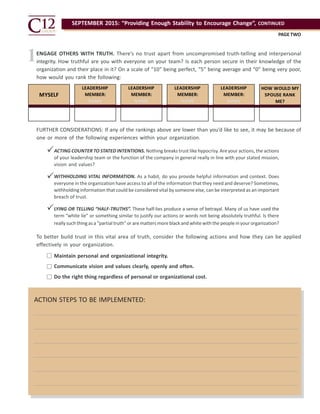
ENGAGE OTHERS WITH TRUTH. There’s no trust apart from uncompromised truth-telling and interpersonal
integrity. How truthful are you with everyone on your team? Is each person secure in their knowledge of the
organization and their place in it? On a scale of “10” being perfect, “5” being average and “0” being very poor,
how would you rank the following:
FURTHER CONSIDERATIONS: If any of the rankings above are lower than you’d like to see, it may be because of
one or more of the following experiences within your organization.
To better build trust in this vital area of truth, consider the following actions and how they can be applied
effectively in your organization.
1
ACTING COUNTER TO STATED INTENTIONS. Nothing breaks trust like hypocrisy. Are your actions, the actions
of your leadership team or the function of the company in general really in line with your stated mission,
vision and values?
WITHHOLDING VITAL INFORMATION. As a habit, do you provide helpful information and context. Does
everyone in the organization have access to all of the information that they need and deserve? Sometimes,
withholding information that could be considered vital by someone else, can be interpreted as an important
breach of trust.
LYING OR TELLING “HALF-TRUTHS”. These half-lies produce a sense of betrayal. Many of us have used the
term “white lie” or something similar to justify our actions or words not being absolutely truthful. Is there
really such thing as a “partial truth” or are matters more black and white with the people in your organization?
Maintain personal and organizational integrity.
Communicate vision and values clearly, openly and often.
Do the right thing regardless of personal or organizational cost.
ACTION STEPS TO BE IMPLEMENTED:






SEPTEMBER 2015: “Providing Enough Stability to Encourage Change”, CONTINUED
PAGETHREE
MYSELF
LEADERSHIP
MEMBER:
NAME
LEADERSHIP
MEMBER:
NAME
LEADERSHIP
MEMBER:
NAME
LEADERSHIP
MEMBER:
NAME
HOW WOULD MY
SPOUSE RANK
ME?
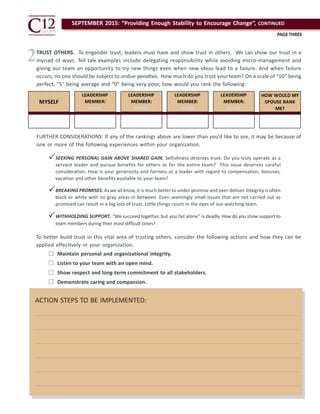
TRUST OTHERS. To engender trust, leaders must have and show trust in others. We can show our trust in a
myriad of ways. Tell tale examples include delegating responsibility while avoiding micro-management and
giving our team an opportunity to try new things even when new ideas lead to a failure. And when failure
occurs, no one should be subject to undue penalties. How much do you trust your team? On a scale of “10” being
perfect, “5” being average and “0” being very poor, how would you rank the following:
FURTHER CONSIDERATIONS: If any of the rankings above are lower than you’d like to see, it may be because of
one or more of the following experiences within your organization.
SEEKING PERSONAL GAIN ABOVE SHARED GAIN. Selfishness destroys trust. Do you truly operate as a
servant leader and pursue benefits for others or for the entire team? This issue deserves careful
consideration. How is your generosity and fairness as a leader with regard to compensation, bonuses,
vacation and other benefits available to your team?
BREAKING PROMISES. As we all know, it is much better to under-promise and over-deliver. Integrity is often
black or white with no gray areas in between. Even seemingly small issues that are not carried out as
promised can result in a big loss of trust. Little things count in the eyes of our watching team.
WITHHOLDING SUPPORT. “We succeed together, but you fail alone” is deadly. How do you show support to
team members during their most difficult times?
ACTION STEPS TO BE IMPLEMENTED:



2
To better build trust in this vital area of trusting others, consider the following actions and how they can be
applied effectively in your organization.


 Maintain personal and organizational integrity.
Listen to your team with an open mind.
Show respect and long-term commitment to all stakeholders.
Demonstrate caring and compassion.
SEPTEMBER 2015: “Providing Enough Stability to Encourage Change”, CONTINUED
PAGEFOUR
MYSELF
LEADERSHIP
MEMBER:
NAME
LEADERSHIP
MEMBER:
NAME
LEADERSHIP
MEMBER:
NAME
LEADERSHIP
MEMBER:
NAME
HOW WOULD MY
SPOUSE RANK
ME?
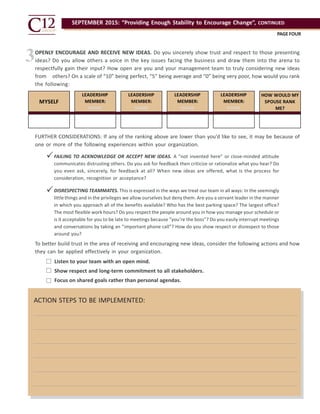
OPENLY ENCOURAGE AND RECEIVE NEW IDEAS. Do you sincerely show trust and respect to those presenting
ideas? Do you allow others a voice in the key issues facing the business and draw them into the arena to
respectfully gain their input? How open are you and your management team to truly considering new ideas
from others? On a scale of “10” being perfect, “5” being average and “0” being very poor, how would you rank
the following:
FURTHER CONSIDERATIONS: If any of the ranking above are lower than you’d like to see, it may be because of
one or more of the following experiences within your organization.
To better build trust in the area of receiving and encouraging new ideas, consider the following actions and how
they can be applied effectively in your organization.
FAILING TO ACKNOWLEDGE OR ACCEPT NEW IDEAS. A “not invented here” or close-minded attitude
communicates distrusting others. Do you ask for feedback then criticize or rationalize what you hear? Do
you even ask, sincerely, for feedback at all? When new ideas are offered, what is the process for
consideration, recognition or acceptance?
DISRESPECTING TEAMMATES. This is expressed in the ways we treat our team in all ways: In the seemingly
littlethings and in the privileges we allow ourselves but deny them. Are you a servant leader in the manner
in which you approach all of the benefits available? Who has the best parking space? The largest office?
The most flexible work hours? Do you respect the people around you in how you manage your schedule or
is it acceptable for you to be late to meetings because “you’re the boss”? Do you easily interrupt meetings
and conversations by taking an “important phone call”? How do you show respect or disrespect to those
around you?
ACTION STEPS TO BE IMPLEMENTED:



3
Listen to your team with an open mind.
Show respect and long-term commitment to all stakeholders.
Focus on shared goals rather than personal agendas.


SEPTEMBER 2015: “Providing Enough Stability to Encourage Change”, CONTINUED
PAGE FIVE
ACTION STEPS TO BE IMPLEMENTED:
4
MYSELF
LEADERSHIP
MEMBER:
NAME
LEADERSHIP
MEMBER:
NAME
LEADERSHIP
MEMBER:
NAME
LEADERSHIP
MEMBER:
NAME
HOW WOULD MY
SPOUSE RANK
ME?
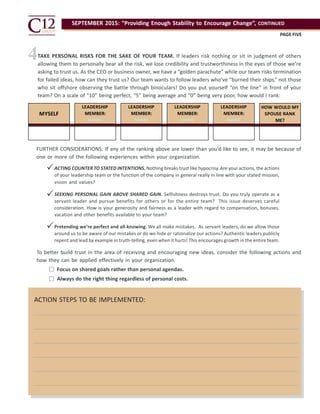
TAKE PERSONAL RISKS FOR THE SAKE OF YOUR TEAM. If leaders risk nothing or sit in judgment of others
allowing them to personally bear all the risk, we lose credibility and trustworthiness in the eyes of those we’re
asking to trust us. As the CEO or business owner, we have a “golden parachute” while our team risks termination
for failed ideas, how can they trust us? Our team wants to follow leaders who’ve “burned their ships,” not those
who sit offshore observing the battle through binoculars! Do you put yourself “on the line” in front of your
team? On a scale of “10” being perfect, “5” being average and “0” being very poor, how would I rank:
FURTHER CONSIDERATIONS: If any of the ranking above are lower than you’d like to see, it may be because of
one or more of the following experiences within your organization.
ACTING COUNTER TO STATED INTENTIONS. Nothing breaks trust like hypocrisy. Are your actions, the actions
of your leadership team or the function of the company in general really in line with your stated mission,
vision and values?
SEEKING PERSONAL GAIN ABOVE SHARED GAIN. Selfishness destroys trust. Do you truly operate as a
servant leader and pursue benefits for others or for the entire team? This issue deserves careful
consideration. How is your generosity and fairness as a leader with regard to compensation, bonuses,
vacation and other benefits available to your team?
Pretending we’re perfect and all-knowing. We all make mistakes. As servant leaders, do we allow those
around us to be aware of our mistakes or do we hide or rationalize our actions? Authentic leaders publicly
repent and lead by example in truth-telling, even when ithurts! This encourages growth in the entire team.



To better build trust in the area of receiving and encouraging new ideas, consider the following actions and
how they can be applied effectively in your organization.

 Focus on shared goals rather than personal agendas.
Always do the right thing regardless of personal costs.
ACTION STEPS TO BE IMPLEMENTED:
SEPTEMBER 2015: “Providing Enough Stability to Encourage Change”, CONTINUED
PAGE SIX
5
MYSELF
LEADERSHIP
MEMBER:
NAME
LEADERSHIP
MEMBER:
NAME
LEADERSHIP
MEMBER:
NAME
LEADERSHIP
MEMBER:
NAME
HOW WOULD MY
SPOUSE RANK
ME?
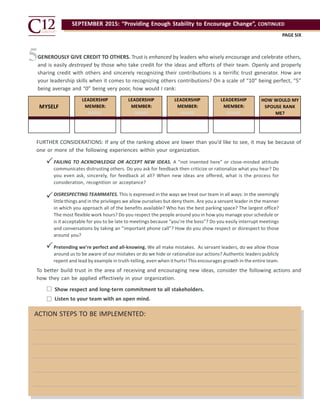
GENEROUSLY GIVE CREDIT TO OTHERS. Trust is enhanced by leaders who wisely encourage and celebrate others,
and is easily destroyed by those who take credit for the ideas and efforts of their team. Openly and properly
sharing credit with others and sincerely recognizing their contributions is a terrific trust generator. How are
your leadership skills when it comes to recognizing others contributions? On a scale of “10” being perfect, “5”
being average and “0” being very poor, how would I rank:
FAILING TO ACKNOWLEDGE OR ACCEPT NEW IDEAS. A “not invented here” or close-minded attitude
communicates distrusting others. Do you ask for feedback then criticize or rationalize what you hear? Do
you even ask, sincerely, for feedback at all? When new ideas are offered, what is the process for
consideration, recognition or acceptance?
DISRESPECTING TEAMMATES. This is expressed in the ways we treat our team in all ways: In the seemingly
littlethings and in the privileges we allow ourselves but deny them. Are you a servant leader in the manner
in which you approach all of the benefits available? Who has the best parking space? The largest office?
The most flexible work hours? Do you respect the people around you in how you manage your schedule or
is it acceptable for you to be late to meetings because “you’re the boss”? Do you easily interrupt meetings
and conversations by taking an “important phone call”? How do you show respect or disrespect to those
around you?
Pretending we’re perfect and all-knowing. We all make mistakes. As servant leaders, do we allow those
around us to be aware of our mistakes or do we hide or rationalize our actions? Authentic leaders publicly
repent and lead by example in truth-telling, even when ithurts! This encourages growth in the entire team.


FURTHER CONSIDERATIONS: If any of the ranking above are lower than you’d like to see, it may be because of
one or more of the following experiences within your organization.
To better build trust in the area of receiving and encouraging new ideas, consider the following actions and
how they can be applied effectively in your organization.


 Show respect and long-term commitment to all stakeholders.
Listen to your team with an open mind.
ACTION STEPS TO BE IMPLEMENTED:
SEPTEMBER 2015: “Providing Enough Stability to Encourage Change”, CONTINUED
PAGE SEVEN
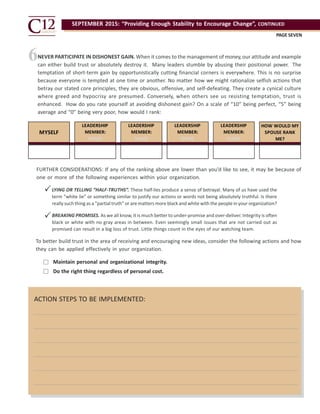
6NEVER PARTICIPATE IN DISHONEST GAIN. When it comes to the management of money, our attitude and example
can either build trust or absolutely destroy it. Many leaders stumble by abusing their positional power. The
temptation of short-term gain by opportunistically cutting financial corners is everywhere. This is no surprise
because everyone is tempted at one time or another. No matter how we might rationalize selfish actions that
betray our stated core principles, they are obvious, offensive, and self-defeating. They create a cynical culture
where greed and hypocrisy are presumed. Conversely, when others see us resisting temptation, trust is
enhanced. How do you rate yourself at avoiding dishonest gain? On a scale of “10” being perfect, “5” being
average and “0” being very poor, how would I rank:
MYSELF
LEADERSHIP
MEMBER:
NAME
LEADERSHIP
MEMBER:
NAME
LEADERSHIP
MEMBER:
NAME
LEADERSHIP
MEMBER:
NAME
HOW WOULD MY
SPOUSE RANK
ME?
FURTHER CONSIDERATIONS: If any of the ranking above are lower than you’d like to see, it may be because of
one or more of the following experiences within your organization.
To better build trust in the area of receiving and encouraging new ideas, consider the following actions and how
they can be applied effectively in your organization.
LYING OR TELLING “HALF-TRUTHS”. These half-lies produce a sense of betrayal. Many of us have used the
term “white lie” or something similar to justify our actions or words not being absolutely truthful. Is there
really such thing as a “partial truth” or are matters more black and white with the people in your organization?
BREAKING PROMISES. As we all know, it is much better to under-promise and over-deliver. Integrity is often
black or white with no gray areas in between. Even seemingly small issues that are not carried out as
promised can result in a big loss of trust. Little things count in the eyes of our watching team.

 Maintain personal and organizational integrity.
Do the right thing regardless of personal cost.


ACTION STEPS TO BE IMPLEMENTED:
SEPTEMBER 2015: “Providing Enough Stability to Encourage Change”, CONTINUED
PAGEEIGHT
7
MYSELF
LEADERSHIP
MEMBER:
NAME
LEADERSHIP
MEMBER:
NAME
LEADERSHIP
MEMBER:
NAME
LEADERSHIP
MEMBER:
NAME
HOW WOULD MY
SPOUSE RANK
ME?
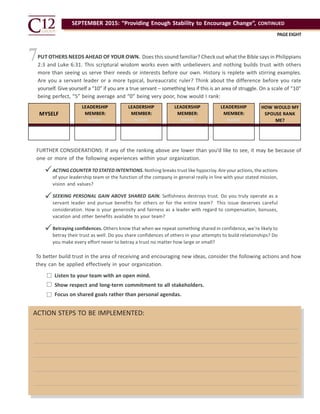
PUT OTHERS NEEDS AHEAD OF YOUR OWN. Does this sound familiar? Check out what the Bible says in Philippians
2:3 and Luke 6:31. This scriptural wisdom works even with unbelievers and nothing builds trust with others
more than seeing us serve their needs or interests before our own. History is replete with stirring examples.
Are you a servant leader or a more typical, bureaucratic ruler? Think about the difference before you rate
yourself. Give yourself a “10” if you are a true servant – something less if this is an area of struggle. On a scale of “10”
being perfect, “5” being average and “0” being very poor, how would I rank:


 Listen to your team with an open mind.
Show respect and long-term commitment to all stakeholders.
Focus on shared goals rather than personal agendas.
FURTHER CONSIDERATIONS: If any of the ranking above are lower than you’d like to see, it may be because of
one or more of the following experiences within your organization.
To better build trust in the area of receiving and encouraging new ideas, consider the following actions and how
they can be applied effectively in your organization.
ACTING COUNTER TO STATED INTENTIONS. Nothing breaks trust like hypocrisy. Are your actions, the actions
of your leadership team or the function of the company in general really in line with your stated mission,
vision and values?
SEEKING PERSONAL GAIN ABOVE SHARED GAIN. Selfishness destroys trust. Do you truly operate as a
servant leader and pursue benefits for others or for the entire team? This issue deserves careful
consideration. How is your generosity and fairness as a leader with regard to compensation, bonuses,
vacation and other benefits available to your team?
Betraying confidences. Others know that when we repeat something shared in confidence, we’re likely to
betray their trust as well. Do you share confidences of others in your attempts to build relationships? Do
you make every effort never to betray a trust no matter how large or small?



SEPTEMBER 2015: “Providing Enough Stability to Encourage Change”, CONTINUED
PAGE NINE
ASSESSMENT SUMMARY:
BEST PRACTICE BONUS:
MYSELF
LEADERSHIP
MEMBER:
NAME
LEADERSHIP
MEMBER:
NAME
LEADERSHIP
MEMBER:
NAME
LEADERSHIP
MEMBER:
NAME
HOW WOULD MY
SPOUSE RANK
ME?
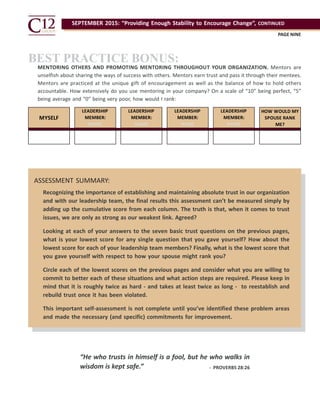
MENTORING OTHERS AND PROMOTING MENTORING THROUGHOUT YOUR ORGANIZATION. Mentors are
unselfish about sharing the ways of success with others. Mentors earn trust and pass it through their mentees.
Mentors are practiced at the unique gift of encouragement as well as the balance of how to hold others
accountable. How extensively do you use mentoring in your company? On a scale of “10” being perfect, “5”
being average and “0” being very poor, how would I rank:
Recognizing the importance of establishing and maintaining absolute trust in our organization
and with our leadership team, the final results this assessment can’t be measured simply by
adding up the cumulative score from each column. The truth is that, when it comes to trust
issues, we are only as strong as our weakest link. Agreed?
Looking at each of your answers to the seven basic trust questions on the previous pages,
what is your lowest score for any single question that you gave yourself? How about the
lowest score for each of your leadership team members? Finally, what is the lowest score that
you gave yourself with respect to how your spouse might rank you?
Circle each of the lowest scores on the previous pages and consider what you are willing to
commit to better each of these situations and what action steps are required. Please keep in
mind that it is roughly twice as hard - and takes at least twice as long - to reestablish and
rebuild trust once it has been violated.
This important self-assessment is not complete until you’ve identified these problem areas
and made the necessary (and specific) commitments for improvement.
“He who trusts in himself is a fool, but he who walks in
wisdom is kept safe.” - PROVERBS 28:26

C12 Leadership Trust Factor Assessment

  • 1.
    SEPTEMBER 2015: “ProvidingEnough Stability to Encourage Change” CEO/BUSINESS OWNER SELF-ASSESSMENT: A fundamental factor in shaping attitudes within our organization that best adapt to change is having a firm operating foundation that doesn’t change. Being able to depend on unchanging principles and purpose enables us to better deal with those things which must change. The trust and security of a reliable operating culture enables our team to deal with change in a more timely and positive way. To illustrate, let’s consider our lives in this world as Christians. We’re able to deal with the uncertainties of life due to the certainty of the Rock upon which we stand. We don’t know what tomorrow will bring, but we do know who holds tomorrow in His hand! We can trust God’s unchanging nature and promises as we deal with the challenges ahead. Our peace and security is in Him who never changes, not in the fluctuating circumstances of this life. When this eternal perspective is lacking, anxiety and worry easily infect our attitudes and outlook. Since our teams aren’t solely comprised of people who share our Christian faith, many see life through lenses lacking such clarity. Still, they can be significantly aided by a sense of security and predictability provided by a stable workplace culture and consistent approaches to planning and decision-making. This happens when we regularly communicate and reinforce foundational principles and practices that reflect our trustworthy and unchanging promises and purpose. By operating in alignment with such a secure foundation, our organizations (and all stakeholders) are more prepared and equipped to resiliently handle change. The first and most significant factor that promotes workplace security and well-being is an atmosphere of trust. If your team doesn’t trust company leadership, they’ll vigorously resist change. Trust is developed under leaders of character through training, testing, teamwork and operating according to shared foundational principles. This self-assessment has been crafted using specific measurable practices known to be primary determinants of trust. You are asked to rate yourselves (and your key leadership team) against eight trust-building elements. Finally, the last column asks you to consider “trust” when it comes to your most important business stakeholder: your partner in life, your spouse. How would he/she score you in each of these eight areas? This is not an ancillary consideration but, actually, this could be the most important area for you to actively pursue improvement. Are you ready to dig in and do the hard work? Turn to the next page and let’s begin. How can I effectively build trust with my team?
  • 2.
    SEPTEMBER 2015: “ProvidingEnough Stability to Encourage Change”, CONTINUED PAGE TWO MYSELF LEADERSHIP MEMBER: NAME LEADERSHIP MEMBER: NAME LEADERSHIP MEMBER: NAME LEADERSHIP MEMBER: NAME HOW WOULD MY SPOUSE RANK ME? ENGAGE OTHERS WITH TRUTH. There’s no trust apart from uncompromised truth-telling and interpersonal integrity. How truthful are you with everyone on your team? Is each person secure in their knowledge of the organization and their place in it? On a scale of “10” being perfect, “5” being average and “0” being very poor, how would you rank the following: FURTHER CONSIDERATIONS: If any of the rankings above are lower than you’d like to see, it may be because of one or more of the following experiences within your organization. To better build trust in this vital area of truth, consider the following actions and how they can be applied effectively in your organization. 1 ACTING COUNTER TO STATED INTENTIONS. Nothing breaks trust like hypocrisy. Are your actions, the actions of your leadership team or the function of the company in general really in line with your stated mission, vision and values? WITHHOLDING VITAL INFORMATION. As a habit, do you provide helpful information and context. Does everyone in the organization have access to all of the information that they need and deserve? Sometimes, withholding information that could be considered vital by someone else, can be interpreted as an important breach of trust. LYING OR TELLING “HALF-TRUTHS”. These half-lies produce a sense of betrayal. Many of us have used the term “white lie” or something similar to justify our actions or words not being absolutely truthful. Is there really such thing as a “partial truth” or are matters more black and white with the people in your organization? Maintain personal and organizational integrity. Communicate vision and values clearly, openly and often. Do the right thing regardless of personal or organizational cost. ACTION STEPS TO BE IMPLEMENTED:      
  • 3.
    SEPTEMBER 2015: “ProvidingEnough Stability to Encourage Change”, CONTINUED PAGETHREE MYSELF LEADERSHIP MEMBER: NAME LEADERSHIP MEMBER: NAME LEADERSHIP MEMBER: NAME LEADERSHIP MEMBER: NAME HOW WOULD MY SPOUSE RANK ME? TRUST OTHERS. To engender trust, leaders must have and show trust in others. We can show our trust in a myriad of ways. Tell tale examples include delegating responsibility while avoiding micro-management and giving our team an opportunity to try new things even when new ideas lead to a failure. And when failure occurs, no one should be subject to undue penalties. How much do you trust your team? On a scale of “10” being perfect, “5” being average and “0” being very poor, how would you rank the following: FURTHER CONSIDERATIONS: If any of the rankings above are lower than you’d like to see, it may be because of one or more of the following experiences within your organization. SEEKING PERSONAL GAIN ABOVE SHARED GAIN. Selfishness destroys trust. Do you truly operate as a servant leader and pursue benefits for others or for the entire team? This issue deserves careful consideration. How is your generosity and fairness as a leader with regard to compensation, bonuses, vacation and other benefits available to your team? BREAKING PROMISES. As we all know, it is much better to under-promise and over-deliver. Integrity is often black or white with no gray areas in between. Even seemingly small issues that are not carried out as promised can result in a big loss of trust. Little things count in the eyes of our watching team. WITHHOLDING SUPPORT. “We succeed together, but you fail alone” is deadly. How do you show support to team members during their most difficult times? ACTION STEPS TO BE IMPLEMENTED:    2 To better build trust in this vital area of trusting others, consider the following actions and how they can be applied effectively in your organization.    Maintain personal and organizational integrity. Listen to your team with an open mind. Show respect and long-term commitment to all stakeholders. Demonstrate caring and compassion.
  • 4.
    SEPTEMBER 2015: “ProvidingEnough Stability to Encourage Change”, CONTINUED PAGEFOUR MYSELF LEADERSHIP MEMBER: NAME LEADERSHIP MEMBER: NAME LEADERSHIP MEMBER: NAME LEADERSHIP MEMBER: NAME HOW WOULD MY SPOUSE RANK ME? OPENLY ENCOURAGE AND RECEIVE NEW IDEAS. Do you sincerely show trust and respect to those presenting ideas? Do you allow others a voice in the key issues facing the business and draw them into the arena to respectfully gain their input? How open are you and your management team to truly considering new ideas from others? On a scale of “10” being perfect, “5” being average and “0” being very poor, how would you rank the following: FURTHER CONSIDERATIONS: If any of the ranking above are lower than you’d like to see, it may be because of one or more of the following experiences within your organization. To better build trust in the area of receiving and encouraging new ideas, consider the following actions and how they can be applied effectively in your organization. FAILING TO ACKNOWLEDGE OR ACCEPT NEW IDEAS. A “not invented here” or close-minded attitude communicates distrusting others. Do you ask for feedback then criticize or rationalize what you hear? Do you even ask, sincerely, for feedback at all? When new ideas are offered, what is the process for consideration, recognition or acceptance? DISRESPECTING TEAMMATES. This is expressed in the ways we treat our team in all ways: In the seemingly littlethings and in the privileges we allow ourselves but deny them. Are you a servant leader in the manner in which you approach all of the benefits available? Who has the best parking space? The largest office? The most flexible work hours? Do you respect the people around you in how you manage your schedule or is it acceptable for you to be late to meetings because “you’re the boss”? Do you easily interrupt meetings and conversations by taking an “important phone call”? How do you show respect or disrespect to those around you? ACTION STEPS TO BE IMPLEMENTED:    3 Listen to your team with an open mind. Show respect and long-term commitment to all stakeholders. Focus on shared goals rather than personal agendas.  
  • 5.
    SEPTEMBER 2015: “ProvidingEnough Stability to Encourage Change”, CONTINUED PAGE FIVE ACTION STEPS TO BE IMPLEMENTED: 4 MYSELF LEADERSHIP MEMBER: NAME LEADERSHIP MEMBER: NAME LEADERSHIP MEMBER: NAME LEADERSHIP MEMBER: NAME HOW WOULD MY SPOUSE RANK ME? TAKE PERSONAL RISKS FOR THE SAKE OF YOUR TEAM. If leaders risk nothing or sit in judgment of others allowing them to personally bear all the risk, we lose credibility and trustworthiness in the eyes of those we’re asking to trust us. As the CEO or business owner, we have a “golden parachute” while our team risks termination for failed ideas, how can they trust us? Our team wants to follow leaders who’ve “burned their ships,” not those who sit offshore observing the battle through binoculars! Do you put yourself “on the line” in front of your team? On a scale of “10” being perfect, “5” being average and “0” being very poor, how would I rank: FURTHER CONSIDERATIONS: If any of the ranking above are lower than you’d like to see, it may be because of one or more of the following experiences within your organization. ACTING COUNTER TO STATED INTENTIONS. Nothing breaks trust like hypocrisy. Are your actions, the actions of your leadership team or the function of the company in general really in line with your stated mission, vision and values? SEEKING PERSONAL GAIN ABOVE SHARED GAIN. Selfishness destroys trust. Do you truly operate as a servant leader and pursue benefits for others or for the entire team? This issue deserves careful consideration. How is your generosity and fairness as a leader with regard to compensation, bonuses, vacation and other benefits available to your team? Pretending we’re perfect and all-knowing. We all make mistakes. As servant leaders, do we allow those around us to be aware of our mistakes or do we hide or rationalize our actions? Authentic leaders publicly repent and lead by example in truth-telling, even when ithurts! This encourages growth in the entire team.    To better build trust in the area of receiving and encouraging new ideas, consider the following actions and how they can be applied effectively in your organization.   Focus on shared goals rather than personal agendas. Always do the right thing regardless of personal costs.
  • 6.
    ACTION STEPS TOBE IMPLEMENTED: SEPTEMBER 2015: “Providing Enough Stability to Encourage Change”, CONTINUED PAGE SIX 5 MYSELF LEADERSHIP MEMBER: NAME LEADERSHIP MEMBER: NAME LEADERSHIP MEMBER: NAME LEADERSHIP MEMBER: NAME HOW WOULD MY SPOUSE RANK ME? GENEROUSLY GIVE CREDIT TO OTHERS. Trust is enhanced by leaders who wisely encourage and celebrate others, and is easily destroyed by those who take credit for the ideas and efforts of their team. Openly and properly sharing credit with others and sincerely recognizing their contributions is a terrific trust generator. How are your leadership skills when it comes to recognizing others contributions? On a scale of “10” being perfect, “5” being average and “0” being very poor, how would I rank: FAILING TO ACKNOWLEDGE OR ACCEPT NEW IDEAS. A “not invented here” or close-minded attitude communicates distrusting others. Do you ask for feedback then criticize or rationalize what you hear? Do you even ask, sincerely, for feedback at all? When new ideas are offered, what is the process for consideration, recognition or acceptance? DISRESPECTING TEAMMATES. This is expressed in the ways we treat our team in all ways: In the seemingly littlethings and in the privileges we allow ourselves but deny them. Are you a servant leader in the manner in which you approach all of the benefits available? Who has the best parking space? The largest office? The most flexible work hours? Do you respect the people around you in how you manage your schedule or is it acceptable for you to be late to meetings because “you’re the boss”? Do you easily interrupt meetings and conversations by taking an “important phone call”? How do you show respect or disrespect to those around you? Pretending we’re perfect and all-knowing. We all make mistakes. As servant leaders, do we allow those around us to be aware of our mistakes or do we hide or rationalize our actions? Authentic leaders publicly repent and lead by example in truth-telling, even when ithurts! This encourages growth in the entire team.   FURTHER CONSIDERATIONS: If any of the ranking above are lower than you’d like to see, it may be because of one or more of the following experiences within your organization. To better build trust in the area of receiving and encouraging new ideas, consider the following actions and how they can be applied effectively in your organization.    Show respect and long-term commitment to all stakeholders. Listen to your team with an open mind.
  • 7.
    ACTION STEPS TOBE IMPLEMENTED: SEPTEMBER 2015: “Providing Enough Stability to Encourage Change”, CONTINUED PAGE SEVEN 6NEVER PARTICIPATE IN DISHONEST GAIN. When it comes to the management of money, our attitude and example can either build trust or absolutely destroy it. Many leaders stumble by abusing their positional power. The temptation of short-term gain by opportunistically cutting financial corners is everywhere. This is no surprise because everyone is tempted at one time or another. No matter how we might rationalize selfish actions that betray our stated core principles, they are obvious, offensive, and self-defeating. They create a cynical culture where greed and hypocrisy are presumed. Conversely, when others see us resisting temptation, trust is enhanced. How do you rate yourself at avoiding dishonest gain? On a scale of “10” being perfect, “5” being average and “0” being very poor, how would I rank: MYSELF LEADERSHIP MEMBER: NAME LEADERSHIP MEMBER: NAME LEADERSHIP MEMBER: NAME LEADERSHIP MEMBER: NAME HOW WOULD MY SPOUSE RANK ME? FURTHER CONSIDERATIONS: If any of the ranking above are lower than you’d like to see, it may be because of one or more of the following experiences within your organization. To better build trust in the area of receiving and encouraging new ideas, consider the following actions and how they can be applied effectively in your organization. LYING OR TELLING “HALF-TRUTHS”. These half-lies produce a sense of betrayal. Many of us have used the term “white lie” or something similar to justify our actions or words not being absolutely truthful. Is there really such thing as a “partial truth” or are matters more black and white with the people in your organization? BREAKING PROMISES. As we all know, it is much better to under-promise and over-deliver. Integrity is often black or white with no gray areas in between. Even seemingly small issues that are not carried out as promised can result in a big loss of trust. Little things count in the eyes of our watching team.   Maintain personal and organizational integrity. Do the right thing regardless of personal cost.  
  • 8.
    ACTION STEPS TOBE IMPLEMENTED: SEPTEMBER 2015: “Providing Enough Stability to Encourage Change”, CONTINUED PAGEEIGHT 7 MYSELF LEADERSHIP MEMBER: NAME LEADERSHIP MEMBER: NAME LEADERSHIP MEMBER: NAME LEADERSHIP MEMBER: NAME HOW WOULD MY SPOUSE RANK ME? PUT OTHERS NEEDS AHEAD OF YOUR OWN. Does this sound familiar? Check out what the Bible says in Philippians 2:3 and Luke 6:31. This scriptural wisdom works even with unbelievers and nothing builds trust with others more than seeing us serve their needs or interests before our own. History is replete with stirring examples. Are you a servant leader or a more typical, bureaucratic ruler? Think about the difference before you rate yourself. Give yourself a “10” if you are a true servant – something less if this is an area of struggle. On a scale of “10” being perfect, “5” being average and “0” being very poor, how would I rank:    Listen to your team with an open mind. Show respect and long-term commitment to all stakeholders. Focus on shared goals rather than personal agendas. FURTHER CONSIDERATIONS: If any of the ranking above are lower than you’d like to see, it may be because of one or more of the following experiences within your organization. To better build trust in the area of receiving and encouraging new ideas, consider the following actions and how they can be applied effectively in your organization. ACTING COUNTER TO STATED INTENTIONS. Nothing breaks trust like hypocrisy. Are your actions, the actions of your leadership team or the function of the company in general really in line with your stated mission, vision and values? SEEKING PERSONAL GAIN ABOVE SHARED GAIN. Selfishness destroys trust. Do you truly operate as a servant leader and pursue benefits for others or for the entire team? This issue deserves careful consideration. How is your generosity and fairness as a leader with regard to compensation, bonuses, vacation and other benefits available to your team? Betraying confidences. Others know that when we repeat something shared in confidence, we’re likely to betray their trust as well. Do you share confidences of others in your attempts to build relationships? Do you make every effort never to betray a trust no matter how large or small?   
  • 9.
    SEPTEMBER 2015: “ProvidingEnough Stability to Encourage Change”, CONTINUED PAGE NINE ASSESSMENT SUMMARY: BEST PRACTICE BONUS: MYSELF LEADERSHIP MEMBER: NAME LEADERSHIP MEMBER: NAME LEADERSHIP MEMBER: NAME LEADERSHIP MEMBER: NAME HOW WOULD MY SPOUSE RANK ME? MENTORING OTHERS AND PROMOTING MENTORING THROUGHOUT YOUR ORGANIZATION. Mentors are unselfish about sharing the ways of success with others. Mentors earn trust and pass it through their mentees. Mentors are practiced at the unique gift of encouragement as well as the balance of how to hold others accountable. How extensively do you use mentoring in your company? On a scale of “10” being perfect, “5” being average and “0” being very poor, how would I rank: Recognizing the importance of establishing and maintaining absolute trust in our organization and with our leadership team, the final results this assessment can’t be measured simply by adding up the cumulative score from each column. The truth is that, when it comes to trust issues, we are only as strong as our weakest link. Agreed? Looking at each of your answers to the seven basic trust questions on the previous pages, what is your lowest score for any single question that you gave yourself? How about the lowest score for each of your leadership team members? Finally, what is the lowest score that you gave yourself with respect to how your spouse might rank you? Circle each of the lowest scores on the previous pages and consider what you are willing to commit to better each of these situations and what action steps are required. Please keep in mind that it is roughly twice as hard - and takes at least twice as long - to reestablish and rebuild trust once it has been violated. This important self-assessment is not complete until you’ve identified these problem areas and made the necessary (and specific) commitments for improvement. “He who trusts in himself is a fool, but he who walks in wisdom is kept safe.” - PROVERBS 28:26