Professional Portfolio
Harnessing Data For Performance Improvement
The following slides depict statistical analyses I conducted on patient level data and
performance dashboards I developed that revealed performance improvement
opportunities and catalyzed performance improvement projects.
Robert Sutter, RN MBA MHA
Quality Performance Dashboard
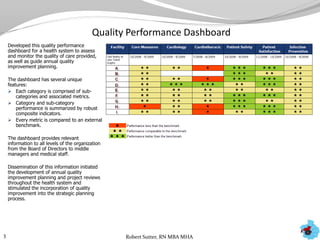
Developed this quality performance
dashboard for a health system to assess
and monitor the quality of care provided,
as well as guide annual quality
improvement planning.
The dashboard has several unique
features:
 Each category is comprised of sub-
categories and associated metrics.
 Category and sub-category
performance is summarized by robust
composite indicators.
 Every metric is compared to an external
benchmark.
The dashboard provides relevant
information to all levels of the organization
from the Board of Directors to middle
managers and medical staff.
Dissemination of this information initiated
the development of annual quality
improvement planning and project reviews
throughout the health system and
stimulated the incorporation of quality
improvement into the strategic planning
process.
3 Robert Sutter, RN MBA MHA
Quality Performance Dashboard
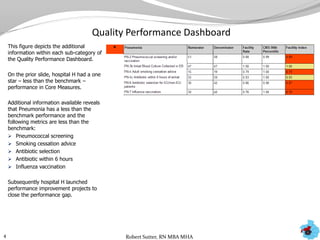
This figure depicts the additional
information within each sub-category of
the Quality Performance Dashboard.
On the prior slide, hospital H had a one
star – less than the benchmark –
performance in Core Measures.
Additional information available reveals
that Pneumonia has a less than the
benchmark performance and the
following metrics are less than the
benchmark:
 Pneumococcal screening
 Smoking cessation advice
 Antibiotic selection
 Antibiotic within 6 hours
 Influenza vaccination
Subsequently hospital H launched
performance improvement projects to
close the performance gap.
4 Robert Sutter, RN MBA MHA
Cardiothoracic Performance Dashboard
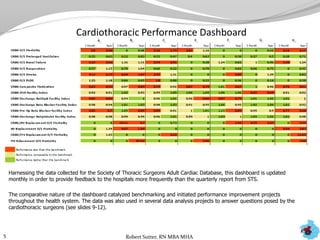
Harnessing the data collected for the Society of Thoracic Surgeons Adult Cardiac Database, this dashboard is updated
monthly in order to provide feedback to the hospitals more frequently than the quarterly report from STS.
The comparative nature of the dashboard catalyzed benchmarking and initiated performance improvement projects
throughout the health system. The data was also used in several data analysis projects to answer questions posed by the
cardiothoracic surgeons (see slides 9-12).
5 Robert Sutter, RN MBA MHA
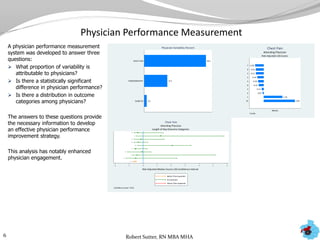
Physician Performance Measurement
A physician performance measurement
system was developed to answer three
questions:
 What proportion of variability is
attributable to physicians?
 Is there a statistically significant
difference in physician performance?
 Is there a distribution in outcome
categories among physicians?
The answers to these questions provide
the necessary information to develop
an effective physician performance
improvement strategy.
This analysis has notably enhanced
physician engagement.
6 Robert Sutter, RN MBA MHA
3.9
37.2
99.2
x
DIABETES
HERNIORRHAPHY
CHEST PAIN
Physician Variability Percent
2.09
1.26
-0.07
-0.13
-0.34
-0.38
-0.43
-0.53
-0.54
-0.58
Median
10
1
6
3
8
5
2
4
9
7
Risk-Adjusted LOS Excess
P<0.05
Attending Physician
Chest Pain
43
12
7
40
56
59
46
11
2
19
AttendingPhysician
-2 -1 0 1 2 3 4 5 6
Risk-Adjusted Median Excess LOS Confidence Interval
Better Than Expected
As Expected
Worse Than Expected
Length of Stay Outcome Categories
Confidence Level = 0.95
Attending Physician
Chest Pain
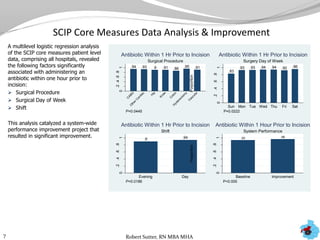
SCIP Core Measures Data Analysis & Improvement
A multilevel logistic regression analysis
of the SCIP core measures patient level
data, comprising all hospitals, revealed
the following factors significantly
associated with administering an
antibiotic within one hour prior to
incision:
 Surgical Procedure
 Surgical Day of Week
 Shift
This analysis catalyzed a system-wide
performance improvement project that
resulted in significant improvement.
.94 .93 .9 .91 .86
.95 .91
0
.2.4.6.8
1
Porportion
C
ABGO
therC
ardiac
H
ip
Knee
C
olonH
ysterectom
y
Vascular
P=0.0445
Surgical Procedure
Antibiotic Within 1 Hr Prior to Incision
.83
.93 .93 .94 .94 .92 .96
0
.2.4.6.8
1
Porportion
Sun Mon Tue Wed Thu Fri Sat
P=0.0222
Surgery Day of Week
Antibiotic Within 1 Hr Prior to Incision
.9 .94
0
.2.4.6.8
1
Porportion
Evening Day
P=0.0186
Shift
Antibiotic Within 1 Hr Prior to Incision
.93 .96
0
.2.4.6.8
1
Proportion
Baseline Improvement
P<0.000
System Performance
Antibiotic Within 1 Hour Prior to Incision
7 Robert Sutter, RN MBA MHA
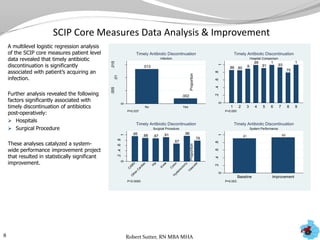
SCIP Core Measures Data Analysis & Improvement
A multilevel logistic regression analysis
of the SCIP core measures patient level
data revealed that timely antibiotic
discontinuation is significantly
associated with patient’s acquiring an
infection.
Further analysis revealed the following
factors significantly associated with
timely discontinuation of antibiotics
post-operatively:
 Hospitals
 Surgical Procedure
These analyses catalyzed a system-
wide performance improvement project
that resulted in statistically significant
improvement.
.013
.002
0
.005
.01
.015
InfectionRate
No Yes
P=0.037
Infection
Timely Antibiotic Discontinuation
.86 .85 .9
.99
.91
1
.93
.79
1
0
.2.4.6.8
1
Proportion
1 2 3 4 5 6 7 8 9
P<0.000
Hospital Comparison
Timely Antibiotic Discontinuation
.95 .88 .87 .91
.67
.96
.78
0
.2.4.6.8
1
Proportion
C
ABGO
therC
ardiac
H
ip
Knee
C
olon
H
ysterectom
y
Vascular
P<0.0000
Surgical Procedure
Timely Antibiotic Discontinuation
.91 .93
0
.2.4.6.8
1
Proportion
Baseline Improvement
P=0.003
System Performance
Timely Antibiotic Discontinuation
8 Robert Sutter, RN MBA MHA
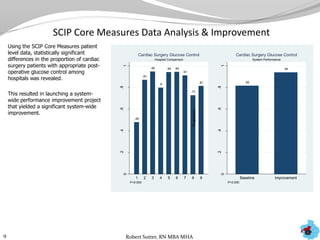
SCIP Core Measures Data Analysis & Improvement
Using the SCIP Core Measures patient
level data, statistically significant
differences in the proportion of cardiac
surgery patients with appropriate post-
operative glucose control among
hospitals was revealed.
This resulted in launching a system-
wide performance improvement project
that yielded a significant system-wide
improvement.
9
.48
.87
.95
.8
.94 .94
.91
.73
.81
0
.2.4.6.8
1
Proportion
1 2 3 4 5 6 7 8 9
P<0.000
Hospital Comparison
Cardiac Surgery Glucose Control
.82
.94
0
.2.4.6.8
1
Proportion
Baseline Improvement
P<0.000
System Performance
Cardiac Surgery Glucose Control
Robert Sutter, RN MBA MHA
Society of Thoracic Surgeons Data Analysis
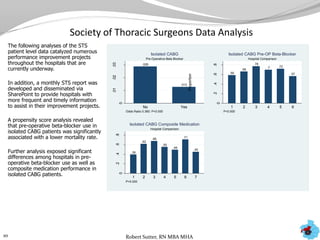
The following analyses of the STS
patient level data catalyzed numerous
performance improvement projects
throughout the hospitals that are
currently underway.
In addition, a monthly STS report was
developed and disseminated via
SharePoint to provide hospitals with
more frequent and timely information
to assist in their improvement projects.
A propensity score analysis revealed
that pre-operative beta-blocker use in
isolated CABG patients was significantly
associated with a lower mortality rate.
Further analysis exposed significant
differences among hospitals in pre-
operative beta-blocker use as well as
composite medication performance in
isolated CABG patients.
10
.029
.013
0
.01.02.03
MortalityRate
No Yes
Odds Ratio 0.360: P<0.000
Pre-Operative Beta Blocker
Isolated CABG
.59
.66
.78
.7 .72
.57
0
.2.4.6.8
Proportion
1 2 3 4 5 6
P<0.000
Hospital Comparison
Isolated CABG Pre-OP Beta-Blocker
.39
.62
.68
.55
.49
.71
.45
0
.2.4.6.8
Proportion
1 2 3 4 5 6 7
P<0.000
Hospital Comparison
Isolated CABG Composite Medication
Robert Sutter, RN MBA MHA
Society of Thoracic Surgeons Data Analysis
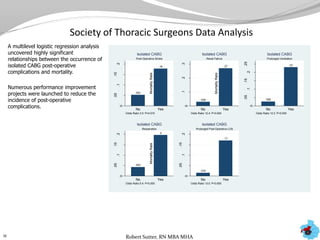
A multilevel logistic regression analysis
uncovered highly significant
relationships between the occurrence of
isolated CABG post-operative
complications and mortality.
Numerous performance improvement
projects were launched to reduce the
incidence of post-operative
complications.
11
.053
.18
0
.05
.1
.15
.2
MortalityRate
No Yes
Odds Ratio 3.0: P=0.010
Post-Operative Stroke
Isolated CABG
.029
.27
0
.1.2.3
MortalityRate
No Yes
Odds Ratio 12.4: P<0.000
Renal Failure
Isolated CABG
.026
.23
0
.05
.1
.15
.2
.25
MortalityRate
No Yes
Odds Ratio 12.2: P<0.000
Prolonged Ventilation
Isolated CABG
.043
.2
0
.05
.1
.15
.2
MortalityRate
No Yes
Odds Ratio 5.4: P<0.000
Reoperation
Isolated CABG
.016
.17
0
.05
.1
.15
.2
MortalityRate
No Yes
Odds Ratio 13.0: P<0.000
Prolonged Post-Operative LOS
Isolated CABG
Robert Sutter, RN MBA MHA
Society of Thoracic Surgeons Data Analysis
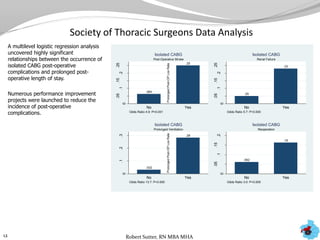
A multilevel logistic regression analysis
uncovered highly significant
relationships between the occurrence of
isolated CABG post-operative
complications and prolonged post-
operative length of stay.
Numerous performance improvement
projects were launched to reduce the
incidence of post-operative
complications.
12
.064
.25
0
.05
.1
.15
.2
.25
ProlongedPost-OPLosRate
No Yes
Odds Ratio 4.9: P=0.001
Post-Operative Stroke
Isolated CABG
.05
.23
0
.05
.1
.15
.2
.25
ProlongedPost-OPLosRate
No Yes
Odds Ratio 5.7: P<0.000
Renal Failure
Isolated CABG
.032
.28
0
.1.2.3
ProlongedPost-OPLosRate
No Yes
Odds Ratio 13.7: P<0.000
Prolonged Ventilation
Isolated CABG
.062
.16
0
.05
.1
.15
.2
ProlongedPost-OPLosRate
No Yes
Odds Ratio 3.0: P<0.005
Reoperation
Isolated CABG
Robert Sutter, RN MBA MHA
Society of Thoracic Surgeons Data Analysis
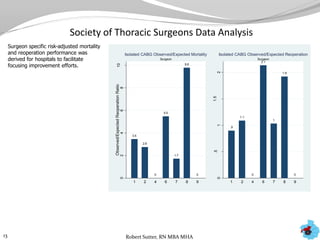
Surgeon specific risk-adjusted mortality
and reoperation performance was
derived for hospitals to facilitate
focusing improvement efforts.
13
3.5
2.8
0
5.5
1.7
9.8
0
02468
10
Observed/ExpectedMortaliltyRatio
1 2 4 6 7 8 9
Surgeon
Isolated CABG Observed/Expected Mortality
.9
1.1
0
2.1
1
1.9
0
0
.5
1
1.5
2
Observed/ExpectedReoperationRatio
1 2 4 6 7 8 9
Surgeon
Isolated CABG Observed/Expected Reoperation
Robert Sutter, RN MBA MHA
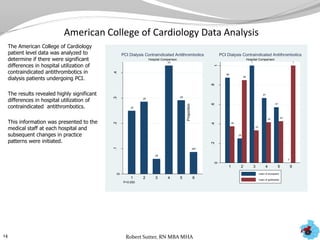
American College of Cardiology Data Analysis
The American College of Cardiology
patient level data was analyzed to
determine if there were significant
differences in hospital utilization of
contraindicated antithrombotics in
dialysis patients undergoing PCI.
The results revealed highly significant
differences in hospital utilization of
contraindicated antithrombotics.
This information was presented to the
medical staff at each hospital and
subsequent changes in practice
patterns were initiated.
14
.25
.29
.06
.43
.29
.087
0
.1.2.3.4
Proportion
1 2 3 4 5 6
P<0.000
Hospital Comparison
PCI Dialysis Contraindicated Antithrombotics
.88
.38
.25
.85
1
.33
.67
.42
.57
.43
0
1
0
.2.4.6.8
1
Proportion
1 2 3 4 5 6
Hospital Comparison
PCI Dialysis Contraindicated Antithrombotics
mean of enoxaparin
mean of eptifibatide
Robert Sutter, RN MBA MHA
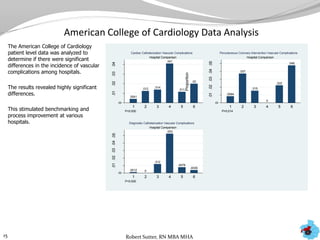
American College of Cardiology Data Analysis
The American College of Cardiology
patient level data was analyzed to
determine if there were significant
differences in the incidence of vascular
complications among hospitals.
The results revealed highly significant
differences.
This stimulated benchmarking and
process improvement at various
hospitals.
15
.0041
.012 .014
.041
.011
.02
0
.01.02.03.04
Proportion
1 2 3 4 5 6
P<0.000
Hospital Comparison
Cardiac Catheterization Vascular Complications
.0084
.037
.015
0
.022
.048
0
.01.02.03.04.05
Proportion
1 2 3 4 5 6
P=0.014
Hospital Comparison
Percutaneous Coronary Intervention Vascular Complications
.0012 0
.012
.053
.0078
.0039
0
.01.02.03.04.05
Proportion
1 2 3 4 5 6
P<0.000
Hospital Comparison
Diagnostic Catheterization Vascular Complications
Robert Sutter, RN MBA MHA
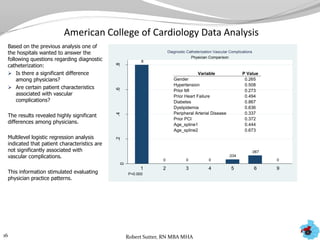
American College of Cardiology Data Analysis
Based on the previous analysis one of
the hospitals wanted to answer the
following questions regarding diagnostic
catheterization:
 Is there a significant difference
among physicians?
 Are certain patient characteristics
associated with vascular
complications?
The results revealed highly significant
differences among physicians.
Multilevel logistic regression analysis
indicated that patient characteristics are
not significantly associated with
vascular complications.
This information stimulated evaluating
physician practice patterns.
16
.8
0 0 0
.034
.067
0
0
.2.4.6.8
Proportion
1 2 3 4 5 6 9
P<0.000
Physician Comparison
Diagnostic Catheterization Vascular Complications
Variable P Value
Gender 0.265
Hypertension 0.508
Prior MI 0.273
Prior Heart Failure 0.494
Diabetes 0.867
Dyslipidemia 0.636
Peripheral Arterial Disease 0.337
Prior PCI 0.372
Age_spline1 0.444
Age_spline2 0.673
Robert Sutter, RN MBA MHA

Robert Sutter Portfolio

  • 1.
  • 2.
    Harnessing Data ForPerformance Improvement The following slides depict statistical analyses I conducted on patient level data and performance dashboards I developed that revealed performance improvement opportunities and catalyzed performance improvement projects. Robert Sutter, RN MBA MHA
  • 3.
    Quality Performance Dashboard Developedthis quality performance dashboard for a health system to assess and monitor the quality of care provided, as well as guide annual quality improvement planning. The dashboard has several unique features:  Each category is comprised of sub- categories and associated metrics.  Category and sub-category performance is summarized by robust composite indicators.  Every metric is compared to an external benchmark. The dashboard provides relevant information to all levels of the organization from the Board of Directors to middle managers and medical staff. Dissemination of this information initiated the development of annual quality improvement planning and project reviews throughout the health system and stimulated the incorporation of quality improvement into the strategic planning process. 3 Robert Sutter, RN MBA MHA
  • 4.
    Quality Performance Dashboard Thisfigure depicts the additional information within each sub-category of the Quality Performance Dashboard. On the prior slide, hospital H had a one star – less than the benchmark – performance in Core Measures. Additional information available reveals that Pneumonia has a less than the benchmark performance and the following metrics are less than the benchmark:  Pneumococcal screening  Smoking cessation advice  Antibiotic selection  Antibiotic within 6 hours  Influenza vaccination Subsequently hospital H launched performance improvement projects to close the performance gap. 4 Robert Sutter, RN MBA MHA
  • 5.
    Cardiothoracic Performance Dashboard Harnessingthe data collected for the Society of Thoracic Surgeons Adult Cardiac Database, this dashboard is updated monthly in order to provide feedback to the hospitals more frequently than the quarterly report from STS. The comparative nature of the dashboard catalyzed benchmarking and initiated performance improvement projects throughout the health system. The data was also used in several data analysis projects to answer questions posed by the cardiothoracic surgeons (see slides 9-12). 5 Robert Sutter, RN MBA MHA
  • 6.
    Physician Performance Measurement Aphysician performance measurement system was developed to answer three questions:  What proportion of variability is attributable to physicians?  Is there a statistically significant difference in physician performance?  Is there a distribution in outcome categories among physicians? The answers to these questions provide the necessary information to develop an effective physician performance improvement strategy. This analysis has notably enhanced physician engagement. 6 Robert Sutter, RN MBA MHA 3.9 37.2 99.2 x DIABETES HERNIORRHAPHY CHEST PAIN Physician Variability Percent 2.09 1.26 -0.07 -0.13 -0.34 -0.38 -0.43 -0.53 -0.54 -0.58 Median 10 1 6 3 8 5 2 4 9 7 Risk-Adjusted LOS Excess P<0.05 Attending Physician Chest Pain 43 12 7 40 56 59 46 11 2 19 AttendingPhysician -2 -1 0 1 2 3 4 5 6 Risk-Adjusted Median Excess LOS Confidence Interval Better Than Expected As Expected Worse Than Expected Length of Stay Outcome Categories Confidence Level = 0.95 Attending Physician Chest Pain
  • 7.
    SCIP Core MeasuresData Analysis & Improvement A multilevel logistic regression analysis of the SCIP core measures patient level data, comprising all hospitals, revealed the following factors significantly associated with administering an antibiotic within one hour prior to incision:  Surgical Procedure  Surgical Day of Week  Shift This analysis catalyzed a system-wide performance improvement project that resulted in significant improvement. .94 .93 .9 .91 .86 .95 .91 0 .2.4.6.8 1 Porportion C ABGO therC ardiac H ip Knee C olonH ysterectom y Vascular P=0.0445 Surgical Procedure Antibiotic Within 1 Hr Prior to Incision .83 .93 .93 .94 .94 .92 .96 0 .2.4.6.8 1 Porportion Sun Mon Tue Wed Thu Fri Sat P=0.0222 Surgery Day of Week Antibiotic Within 1 Hr Prior to Incision .9 .94 0 .2.4.6.8 1 Porportion Evening Day P=0.0186 Shift Antibiotic Within 1 Hr Prior to Incision .93 .96 0 .2.4.6.8 1 Proportion Baseline Improvement P<0.000 System Performance Antibiotic Within 1 Hour Prior to Incision 7 Robert Sutter, RN MBA MHA
  • 8.
    SCIP Core MeasuresData Analysis & Improvement A multilevel logistic regression analysis of the SCIP core measures patient level data revealed that timely antibiotic discontinuation is significantly associated with patient’s acquiring an infection. Further analysis revealed the following factors significantly associated with timely discontinuation of antibiotics post-operatively:  Hospitals  Surgical Procedure These analyses catalyzed a system- wide performance improvement project that resulted in statistically significant improvement. .013 .002 0 .005 .01 .015 InfectionRate No Yes P=0.037 Infection Timely Antibiotic Discontinuation .86 .85 .9 .99 .91 1 .93 .79 1 0 .2.4.6.8 1 Proportion 1 2 3 4 5 6 7 8 9 P<0.000 Hospital Comparison Timely Antibiotic Discontinuation .95 .88 .87 .91 .67 .96 .78 0 .2.4.6.8 1 Proportion C ABGO therC ardiac H ip Knee C olon H ysterectom y Vascular P<0.0000 Surgical Procedure Timely Antibiotic Discontinuation .91 .93 0 .2.4.6.8 1 Proportion Baseline Improvement P=0.003 System Performance Timely Antibiotic Discontinuation 8 Robert Sutter, RN MBA MHA
  • 9.
    SCIP Core MeasuresData Analysis & Improvement Using the SCIP Core Measures patient level data, statistically significant differences in the proportion of cardiac surgery patients with appropriate post- operative glucose control among hospitals was revealed. This resulted in launching a system- wide performance improvement project that yielded a significant system-wide improvement. 9 .48 .87 .95 .8 .94 .94 .91 .73 .81 0 .2.4.6.8 1 Proportion 1 2 3 4 5 6 7 8 9 P<0.000 Hospital Comparison Cardiac Surgery Glucose Control .82 .94 0 .2.4.6.8 1 Proportion Baseline Improvement P<0.000 System Performance Cardiac Surgery Glucose Control Robert Sutter, RN MBA MHA
  • 10.
    Society of ThoracicSurgeons Data Analysis The following analyses of the STS patient level data catalyzed numerous performance improvement projects throughout the hospitals that are currently underway. In addition, a monthly STS report was developed and disseminated via SharePoint to provide hospitals with more frequent and timely information to assist in their improvement projects. A propensity score analysis revealed that pre-operative beta-blocker use in isolated CABG patients was significantly associated with a lower mortality rate. Further analysis exposed significant differences among hospitals in pre- operative beta-blocker use as well as composite medication performance in isolated CABG patients. 10 .029 .013 0 .01.02.03 MortalityRate No Yes Odds Ratio 0.360: P<0.000 Pre-Operative Beta Blocker Isolated CABG .59 .66 .78 .7 .72 .57 0 .2.4.6.8 Proportion 1 2 3 4 5 6 P<0.000 Hospital Comparison Isolated CABG Pre-OP Beta-Blocker .39 .62 .68 .55 .49 .71 .45 0 .2.4.6.8 Proportion 1 2 3 4 5 6 7 P<0.000 Hospital Comparison Isolated CABG Composite Medication Robert Sutter, RN MBA MHA
  • 11.
    Society of ThoracicSurgeons Data Analysis A multilevel logistic regression analysis uncovered highly significant relationships between the occurrence of isolated CABG post-operative complications and mortality. Numerous performance improvement projects were launched to reduce the incidence of post-operative complications. 11 .053 .18 0 .05 .1 .15 .2 MortalityRate No Yes Odds Ratio 3.0: P=0.010 Post-Operative Stroke Isolated CABG .029 .27 0 .1.2.3 MortalityRate No Yes Odds Ratio 12.4: P<0.000 Renal Failure Isolated CABG .026 .23 0 .05 .1 .15 .2 .25 MortalityRate No Yes Odds Ratio 12.2: P<0.000 Prolonged Ventilation Isolated CABG .043 .2 0 .05 .1 .15 .2 MortalityRate No Yes Odds Ratio 5.4: P<0.000 Reoperation Isolated CABG .016 .17 0 .05 .1 .15 .2 MortalityRate No Yes Odds Ratio 13.0: P<0.000 Prolonged Post-Operative LOS Isolated CABG Robert Sutter, RN MBA MHA
  • 12.
    Society of ThoracicSurgeons Data Analysis A multilevel logistic regression analysis uncovered highly significant relationships between the occurrence of isolated CABG post-operative complications and prolonged post- operative length of stay. Numerous performance improvement projects were launched to reduce the incidence of post-operative complications. 12 .064 .25 0 .05 .1 .15 .2 .25 ProlongedPost-OPLosRate No Yes Odds Ratio 4.9: P=0.001 Post-Operative Stroke Isolated CABG .05 .23 0 .05 .1 .15 .2 .25 ProlongedPost-OPLosRate No Yes Odds Ratio 5.7: P<0.000 Renal Failure Isolated CABG .032 .28 0 .1.2.3 ProlongedPost-OPLosRate No Yes Odds Ratio 13.7: P<0.000 Prolonged Ventilation Isolated CABG .062 .16 0 .05 .1 .15 .2 ProlongedPost-OPLosRate No Yes Odds Ratio 3.0: P<0.005 Reoperation Isolated CABG Robert Sutter, RN MBA MHA
  • 13.
    Society of ThoracicSurgeons Data Analysis Surgeon specific risk-adjusted mortality and reoperation performance was derived for hospitals to facilitate focusing improvement efforts. 13 3.5 2.8 0 5.5 1.7 9.8 0 02468 10 Observed/ExpectedMortaliltyRatio 1 2 4 6 7 8 9 Surgeon Isolated CABG Observed/Expected Mortality .9 1.1 0 2.1 1 1.9 0 0 .5 1 1.5 2 Observed/ExpectedReoperationRatio 1 2 4 6 7 8 9 Surgeon Isolated CABG Observed/Expected Reoperation Robert Sutter, RN MBA MHA
  • 14.
    American College ofCardiology Data Analysis The American College of Cardiology patient level data was analyzed to determine if there were significant differences in hospital utilization of contraindicated antithrombotics in dialysis patients undergoing PCI. The results revealed highly significant differences in hospital utilization of contraindicated antithrombotics. This information was presented to the medical staff at each hospital and subsequent changes in practice patterns were initiated. 14 .25 .29 .06 .43 .29 .087 0 .1.2.3.4 Proportion 1 2 3 4 5 6 P<0.000 Hospital Comparison PCI Dialysis Contraindicated Antithrombotics .88 .38 .25 .85 1 .33 .67 .42 .57 .43 0 1 0 .2.4.6.8 1 Proportion 1 2 3 4 5 6 Hospital Comparison PCI Dialysis Contraindicated Antithrombotics mean of enoxaparin mean of eptifibatide Robert Sutter, RN MBA MHA
  • 15.
    American College ofCardiology Data Analysis The American College of Cardiology patient level data was analyzed to determine if there were significant differences in the incidence of vascular complications among hospitals. The results revealed highly significant differences. This stimulated benchmarking and process improvement at various hospitals. 15 .0041 .012 .014 .041 .011 .02 0 .01.02.03.04 Proportion 1 2 3 4 5 6 P<0.000 Hospital Comparison Cardiac Catheterization Vascular Complications .0084 .037 .015 0 .022 .048 0 .01.02.03.04.05 Proportion 1 2 3 4 5 6 P=0.014 Hospital Comparison Percutaneous Coronary Intervention Vascular Complications .0012 0 .012 .053 .0078 .0039 0 .01.02.03.04.05 Proportion 1 2 3 4 5 6 P<0.000 Hospital Comparison Diagnostic Catheterization Vascular Complications Robert Sutter, RN MBA MHA
  • 16.
    American College ofCardiology Data Analysis Based on the previous analysis one of the hospitals wanted to answer the following questions regarding diagnostic catheterization:  Is there a significant difference among physicians?  Are certain patient characteristics associated with vascular complications? The results revealed highly significant differences among physicians. Multilevel logistic regression analysis indicated that patient characteristics are not significantly associated with vascular complications. This information stimulated evaluating physician practice patterns. 16 .8 0 0 0 .034 .067 0 0 .2.4.6.8 Proportion 1 2 3 4 5 6 9 P<0.000 Physician Comparison Diagnostic Catheterization Vascular Complications Variable P Value Gender 0.265 Hypertension 0.508 Prior MI 0.273 Prior Heart Failure 0.494 Diabetes 0.867 Dyslipidemia 0.636 Peripheral Arterial Disease 0.337 Prior PCI 0.372 Age_spline1 0.444 Age_spline2 0.673 Robert Sutter, RN MBA MHA