Bug prediction
based on your code history
Alexey Tokar
VP of Engineering @ WorldAPP
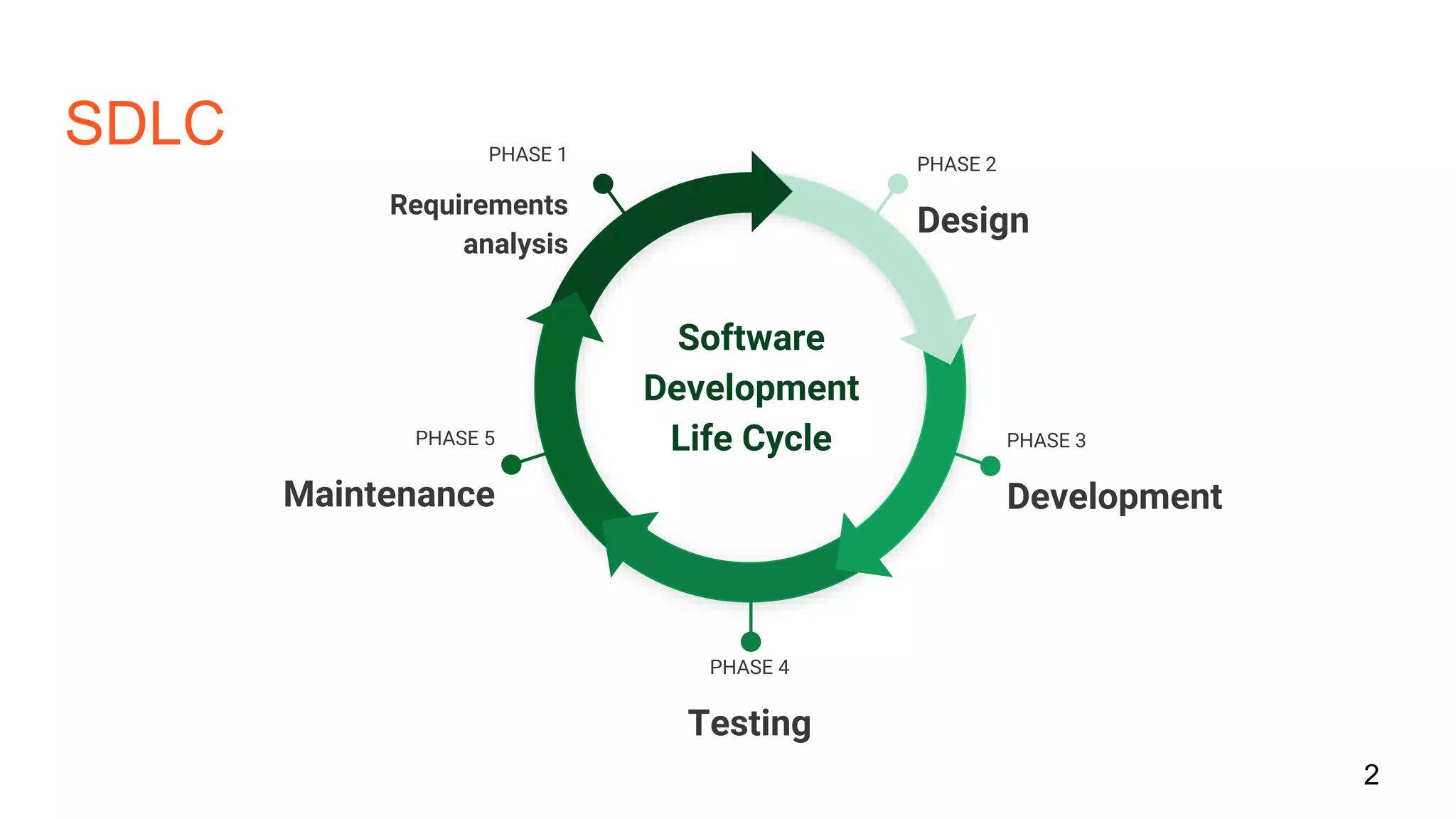
SDLC
2
Software
Development
Life Cycle
PHASE 2
Design
PHASE 1
Requirements
analysis
PHASE 3
Development
PHASE 5
Maintenance
PHASE 4
Testing
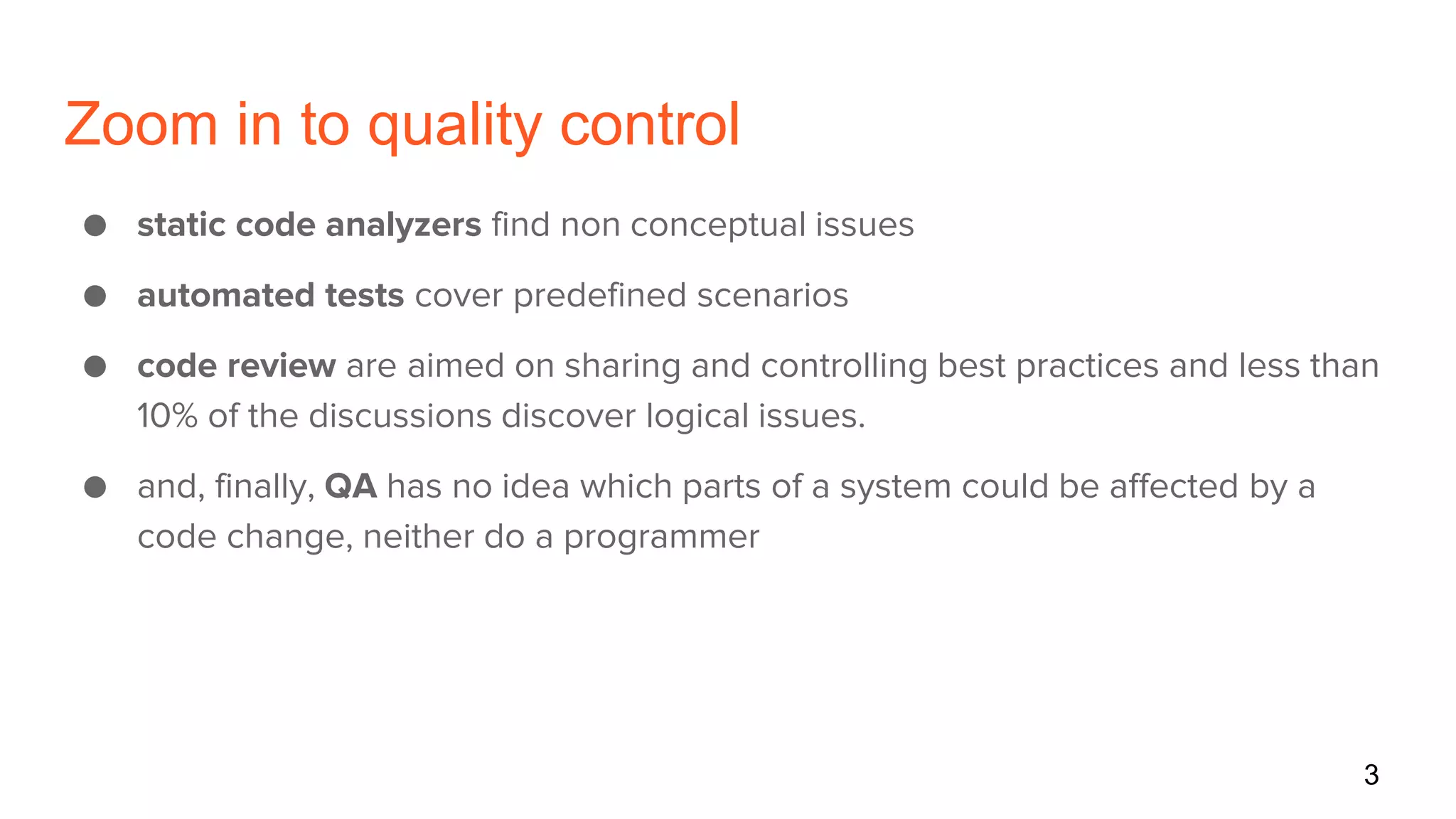
Zoom in to quality control
● static code analyzers find non conceptual issues
● automated tests cover predefined scenarios
● code review are aimed on sharing and controlling best practices and less than
10% of the discussions discover logical issues.
● and, finally, QA has no idea which parts of a system could be affected by a
code change, neither do a programmer
3
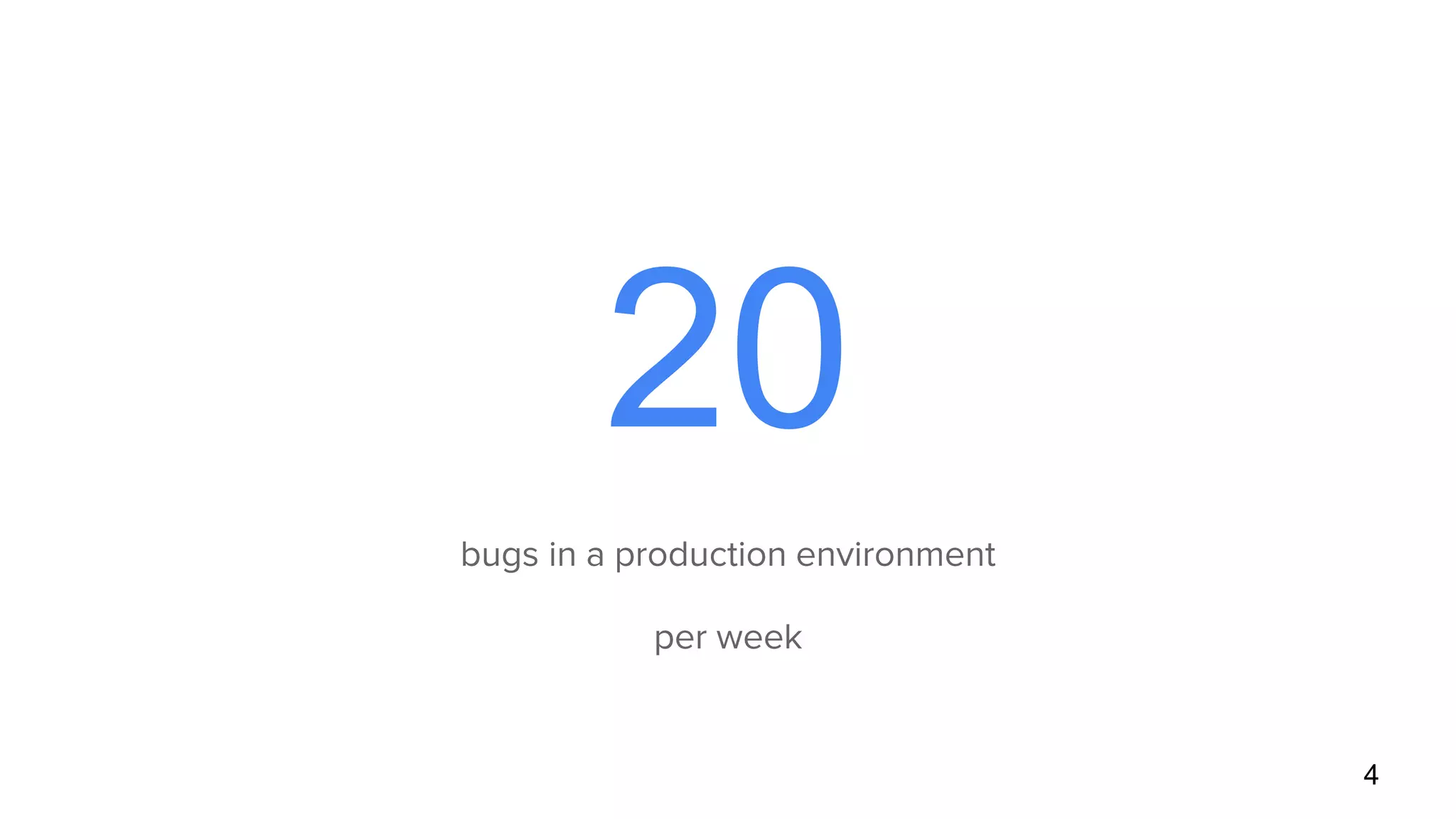
20
bugs in a production environment
per week
4
Let's try to guess common patterns
● a tired engineer makes more mistakes
● the more an engineer knows about certain module the fewer bugs (s)he will
produce
● small changes have fewer bugs than long listings
● some parts of the system are more complicated than another, so the risk of get
a bug increases
● huge changes in a short period of time contains more bugs (done in a hurry)
5
What tools do we have across SDLC?
6
● ticket types
● action history
● exact code changes
● author of modifications
● class complexity
● code metrics
Hypothesis
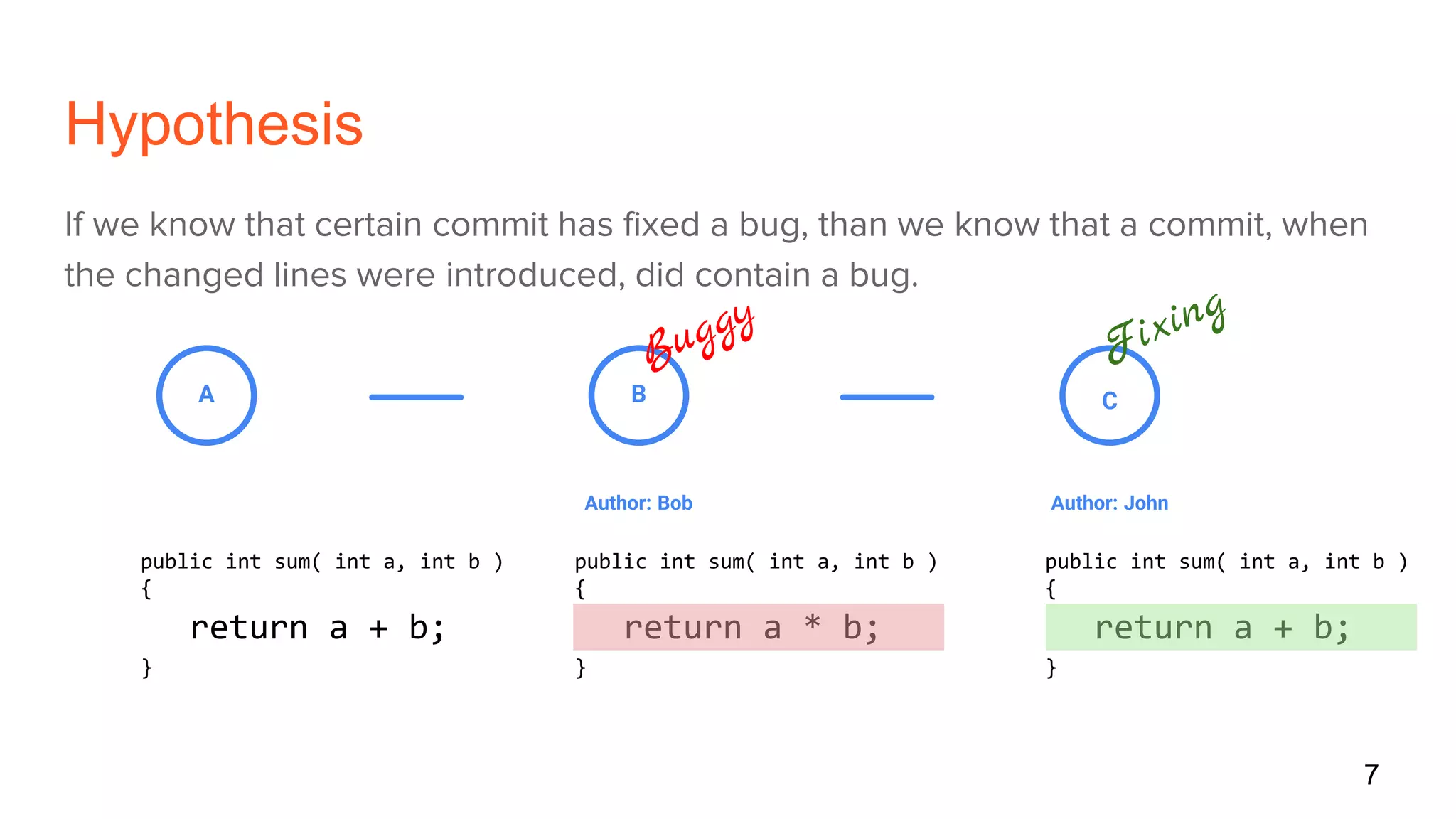
If we know that certain commit has fixed a bug, than we know that a commit, when
the changed lines were introduced, did contain a bug.
7
Author: John
public int sum( int a, int b )
{
return a + b;
}
C
Author: Bob
public int sum( int a, int b )
{
return a * b;
}
BA
public int sum( int a, int b )
{
return a + b;
}
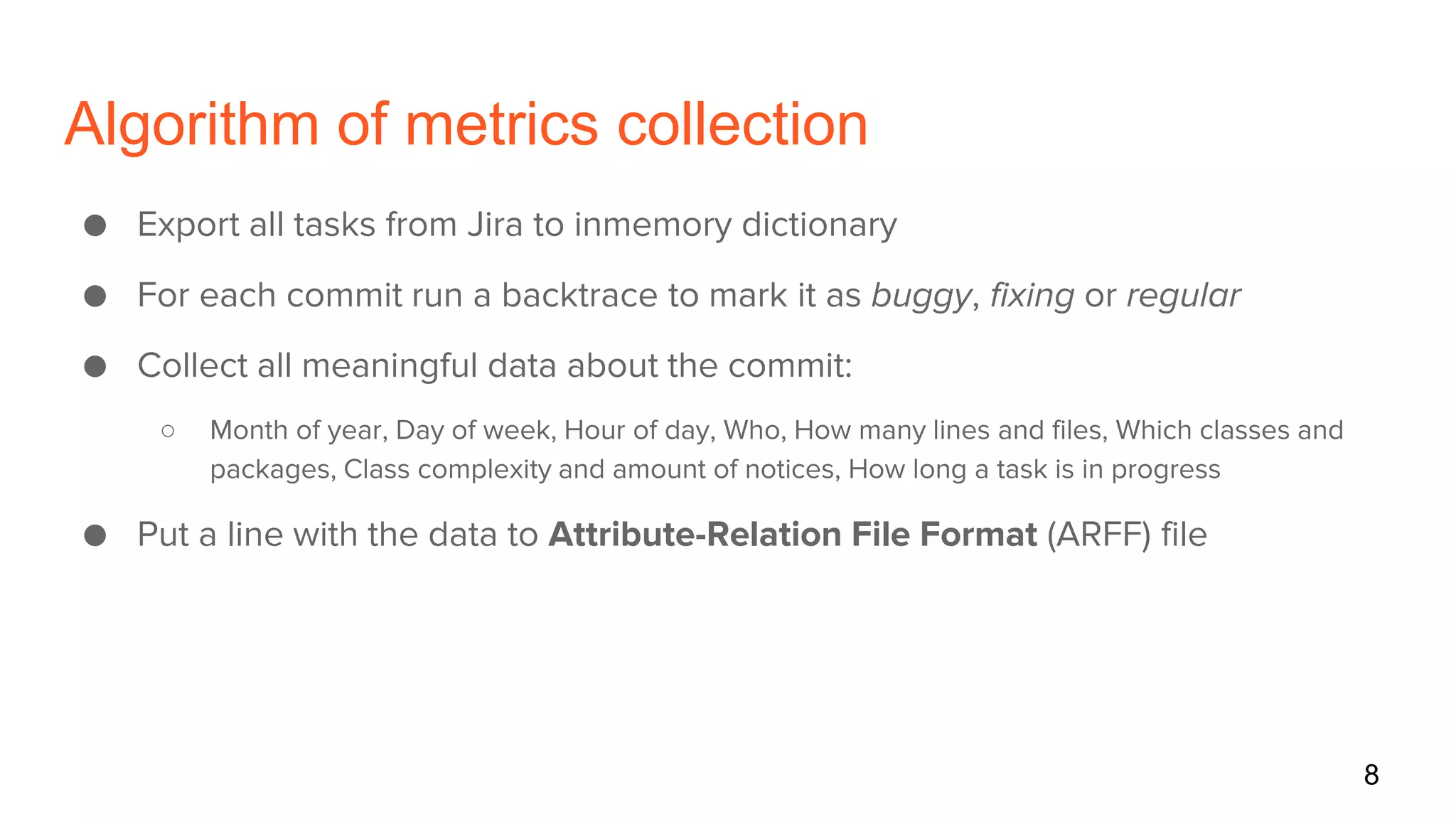
Algorithm of metrics collection
● Export all tasks from Jira to inmemory dictionary
● For each commit run a backtrace to mark it as buggy, fixing or regular
● Collect all meaningful data about the commit:
○ Month of year, Day of week, Hour of day, Who, How many lines and files, Which classes and
packages, Class complexity and amount of notices, How long a task is in progress
● Put a line with the data to Attribute-Relation File Format (ARFF) file
8
Getting educated. WEKA
Waikato Environment for Knowledge Analysis - is a suite of machine learning
software written in Java, developed at the University of Waikato, New Zealand.
● Parsers
● Classifiers
● Training/test splits
9
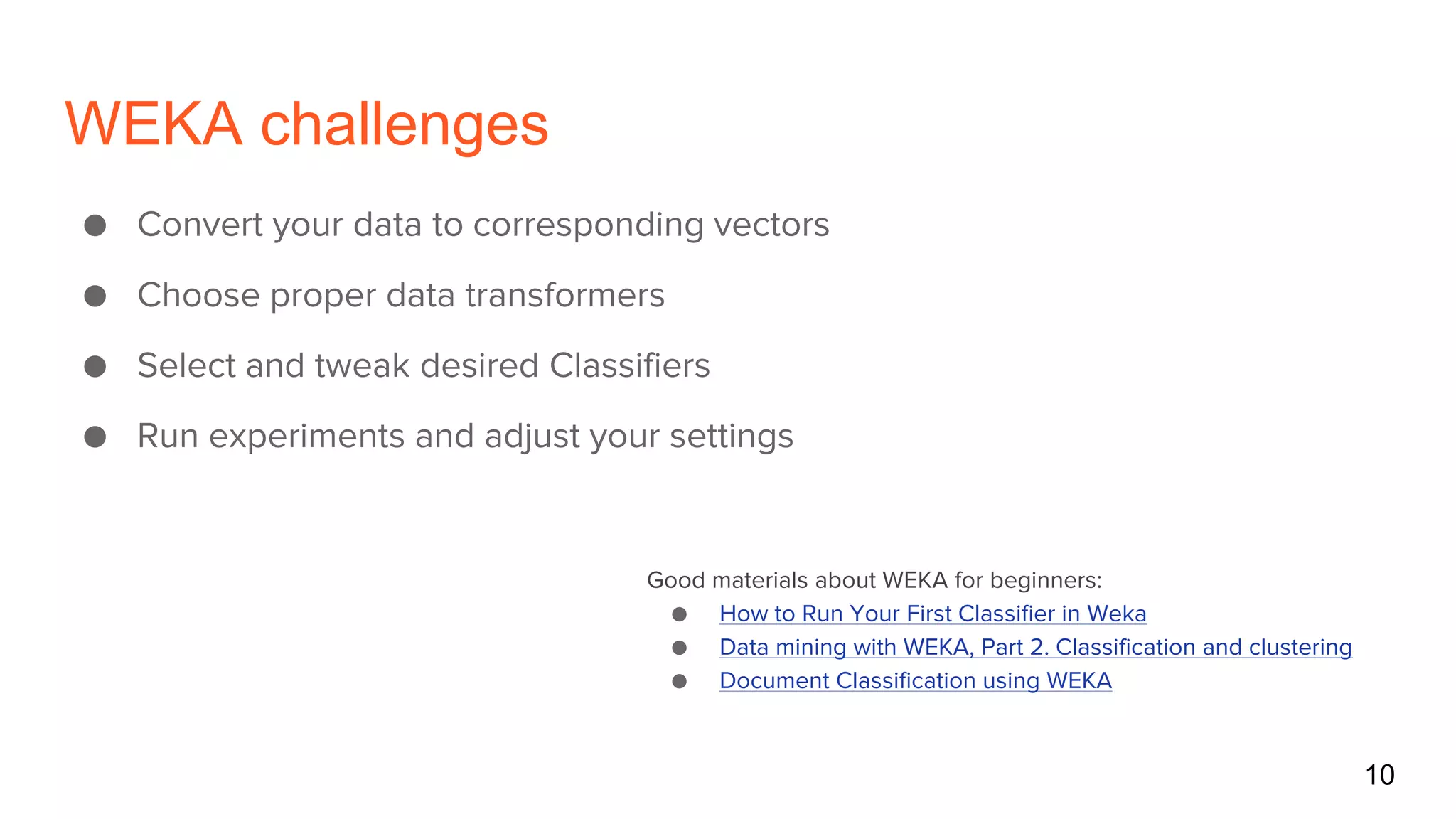
WEKA challenges
● Convert your data to corresponding vectors
● Choose proper data transformers
● Select and tweak desired Classifiers
● Run experiments and adjust your settings
Good materials about WEKA for beginners:
● How to Run Your First Classifier in Weka
● Data mining with WEKA, Part 2. Classification and clustering
● Document Classification using WEKA
10
Decision Tree
Ease of results interpretation
Any data can be fed to the method
Can work with scalars and intervals
11
Decision Tree
12
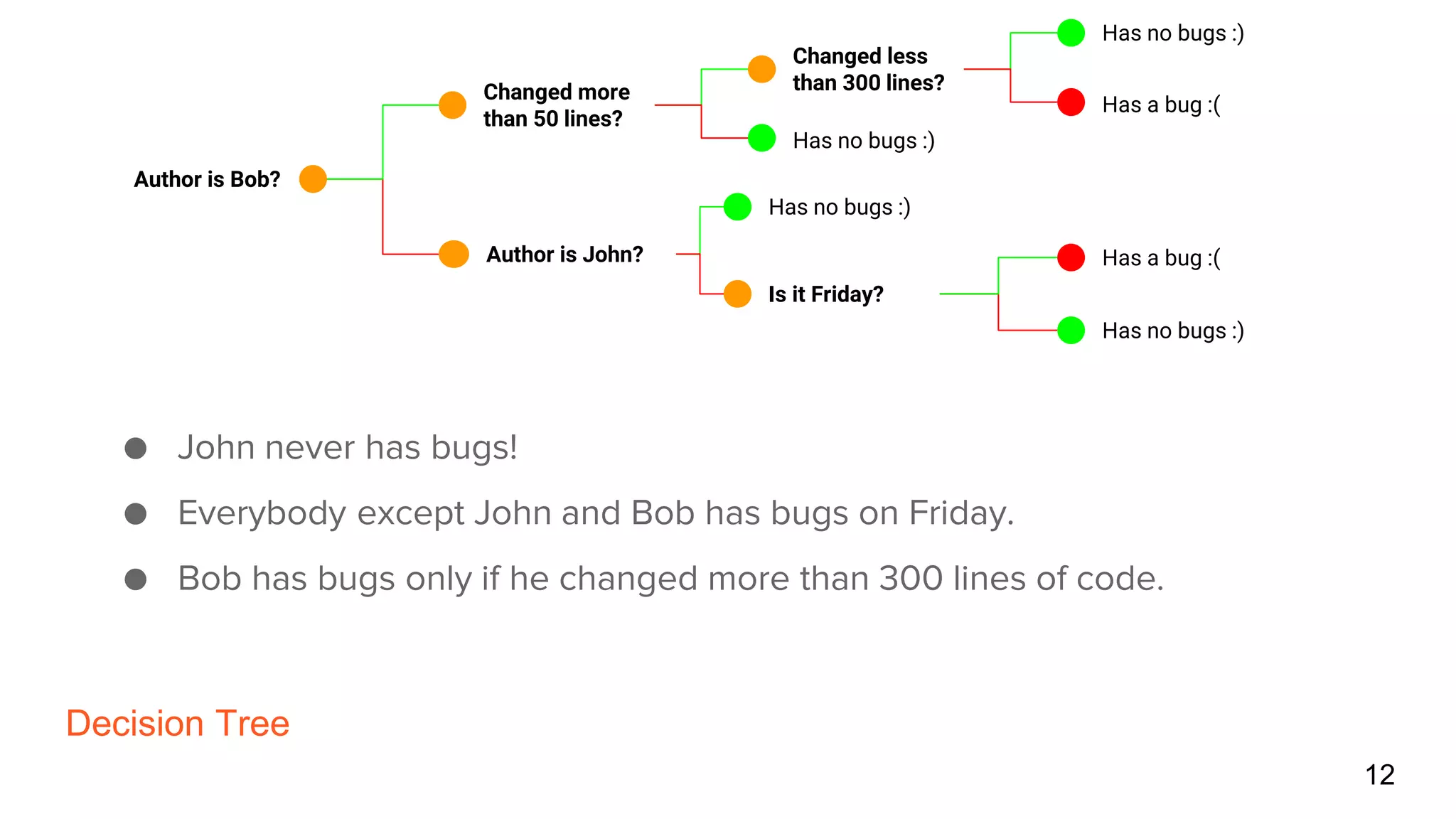
Changed less
than 300 lines?Changed more
than 50 lines?
Author is Bob?
Author is John?
Has no bugs :)
Has no bugs :)
Is it Friday?
Has no bugs :)
Has a bug :(
Has no bugs :)
Has a bug :(
● John never has bugs!
● Everybody except John and Bob has bugs on Friday.
● Bob has bugs only if he changed more than 300 lines of code.
Decision Tree
13
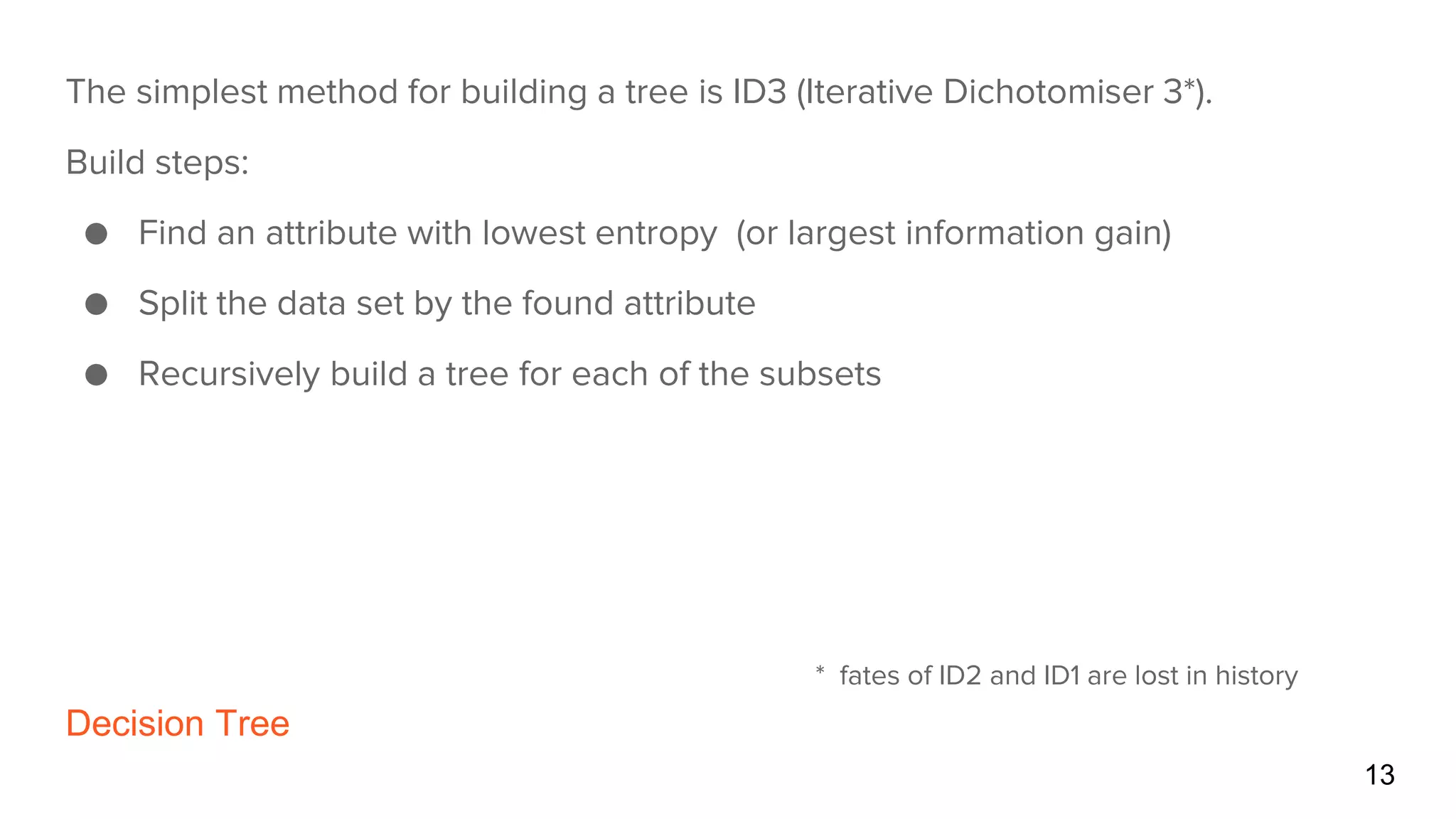
The simplest method for building a tree is ID3 (Iterative Dichotomiser 3*).
Build steps:
● Find an attribute with lowest entropy (or largest information gain)
● Split the data set by the found attribute
● Recursively build a tree for each of the subsets
* fates of ID2 and ID1 are lost in history
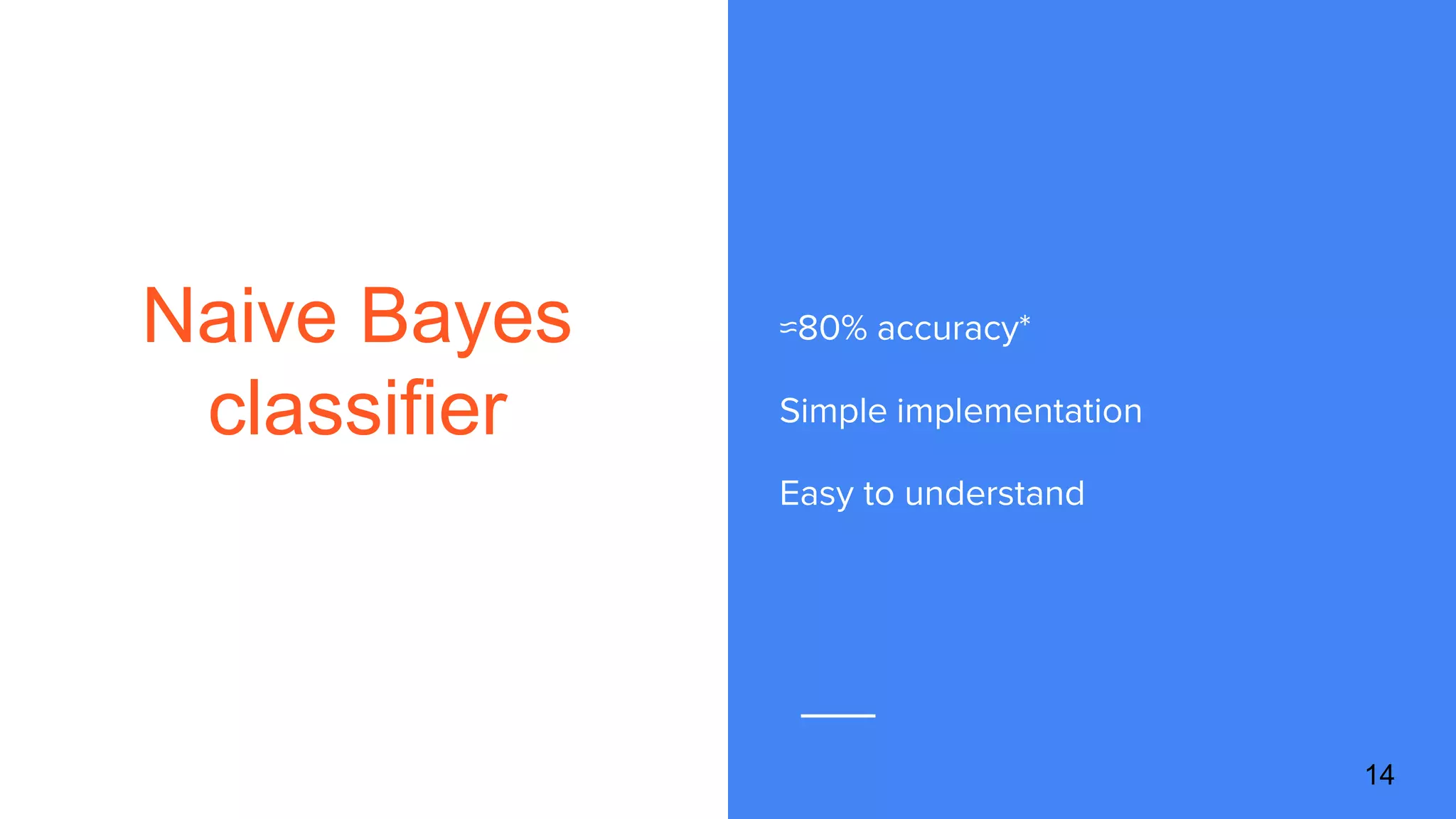
Naive Bayes
classifier
≈80% accuracy*
Simple implementation
Easy to understand
14
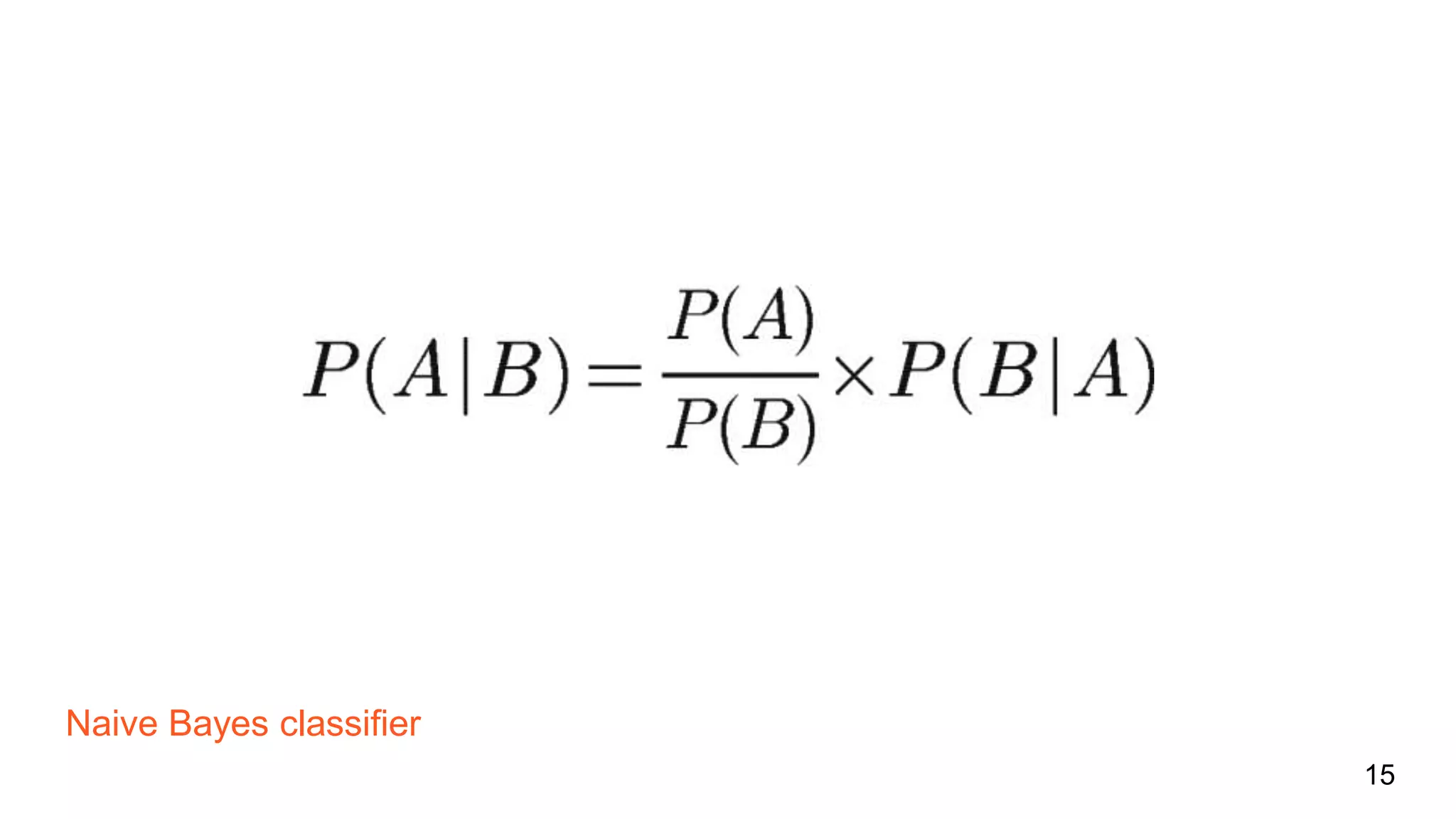
Naive Bayes classifier
15
Naive Bayes classifier
16
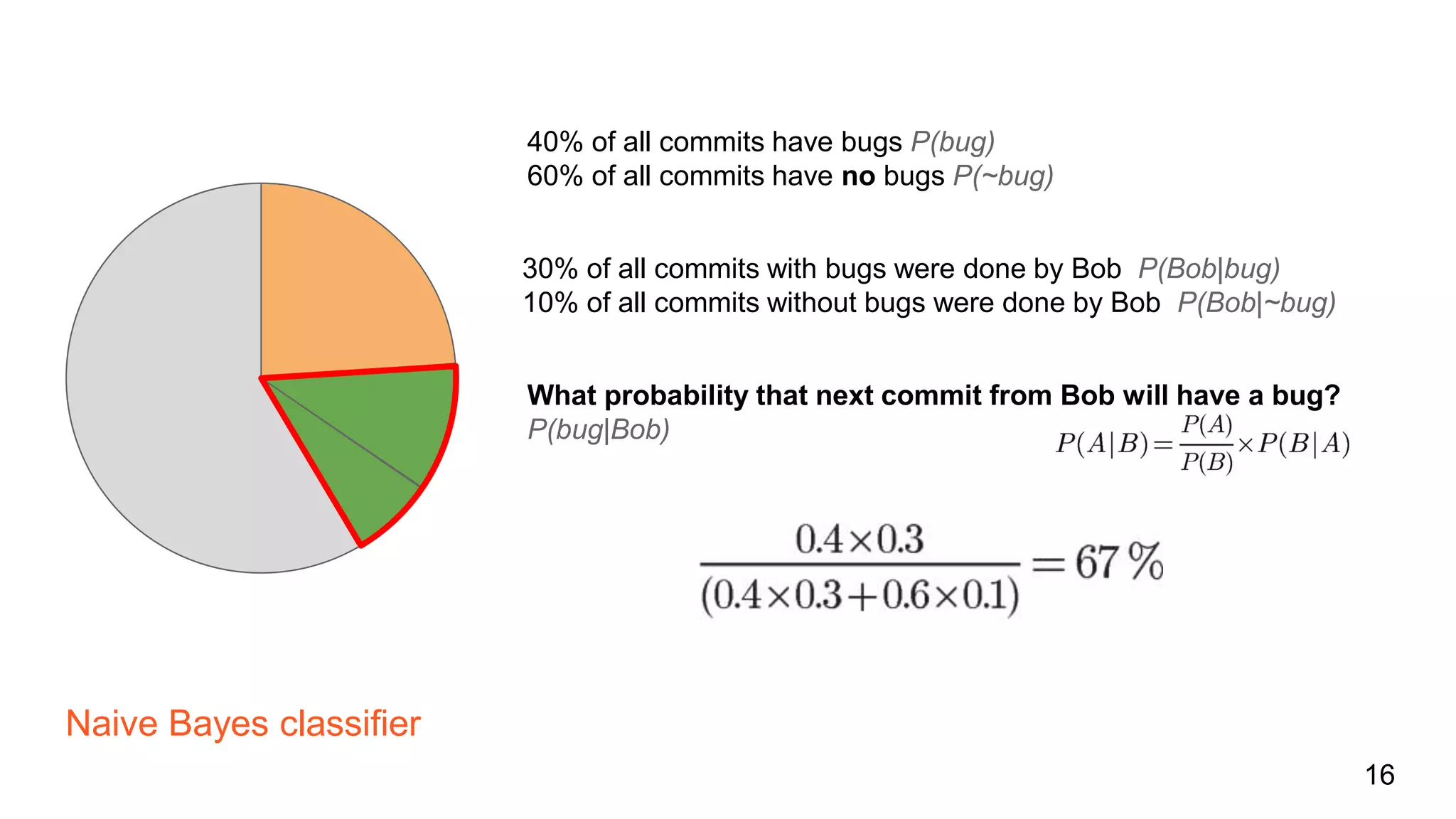
30% of all commits with bugs were done by Bob P(Bob|bug)
10% of all commits without bugs were done by Bob P(Bob|~bug)
40% of all commits have bugs P(bug)
60% of all commits have no bugs P(~bug)
What probability that next commit from Bob will have a bug?
P(bug|Bob)
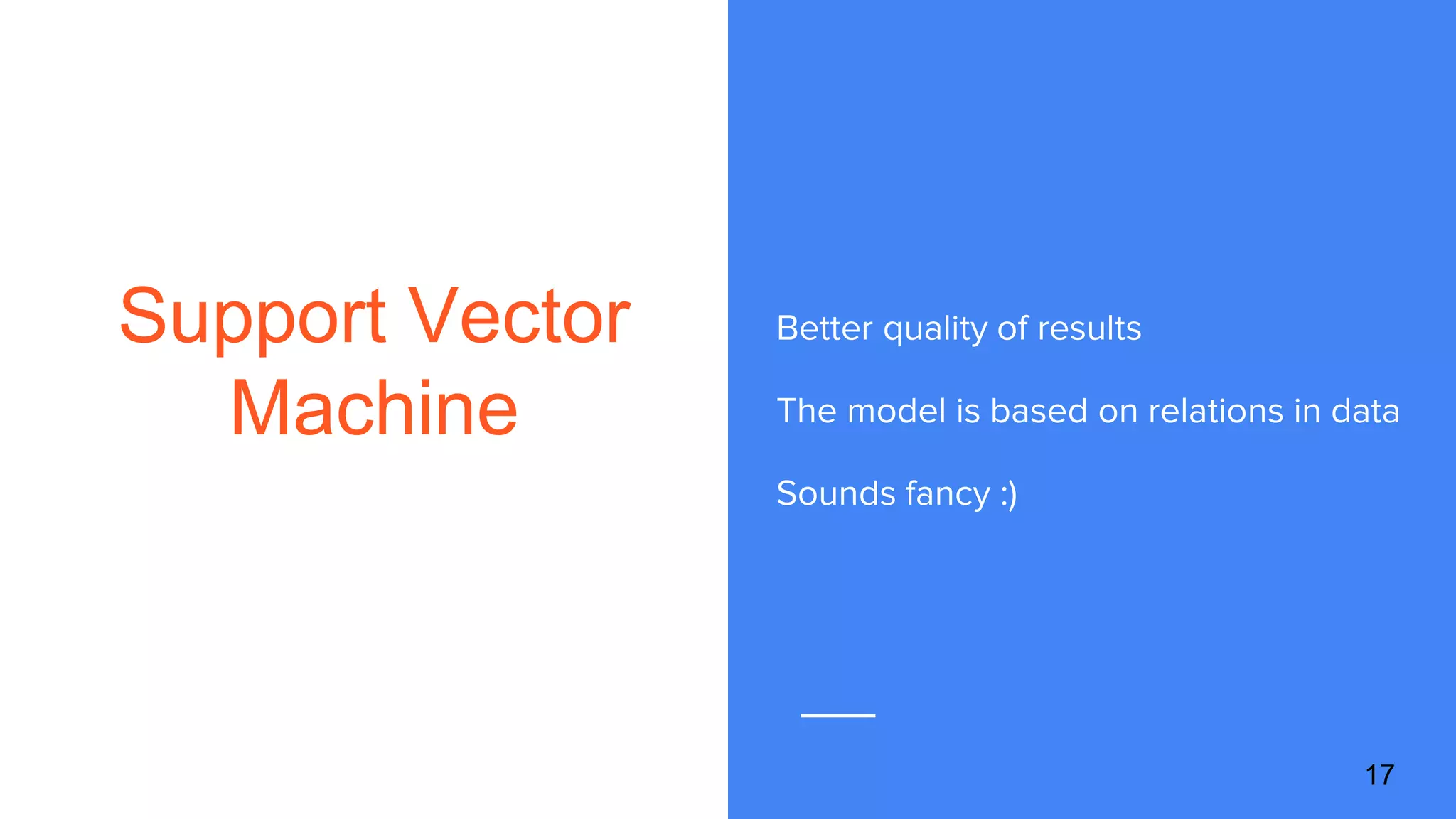
Support Vector
Machine
Better quality of results
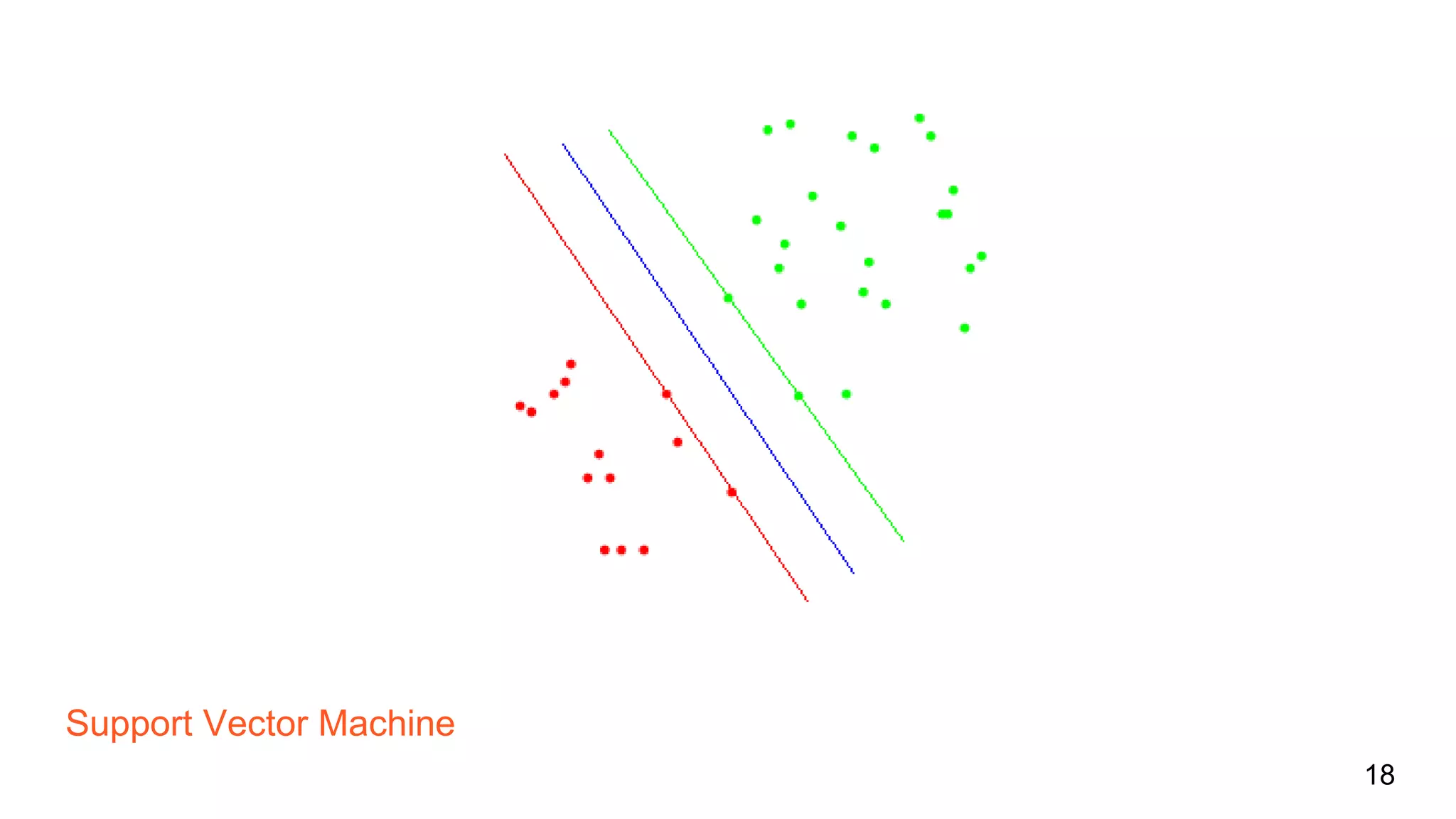
The model is based on relations in data
Sounds fancy :)
17
Support Vector Machine
18
Support Vector Machine
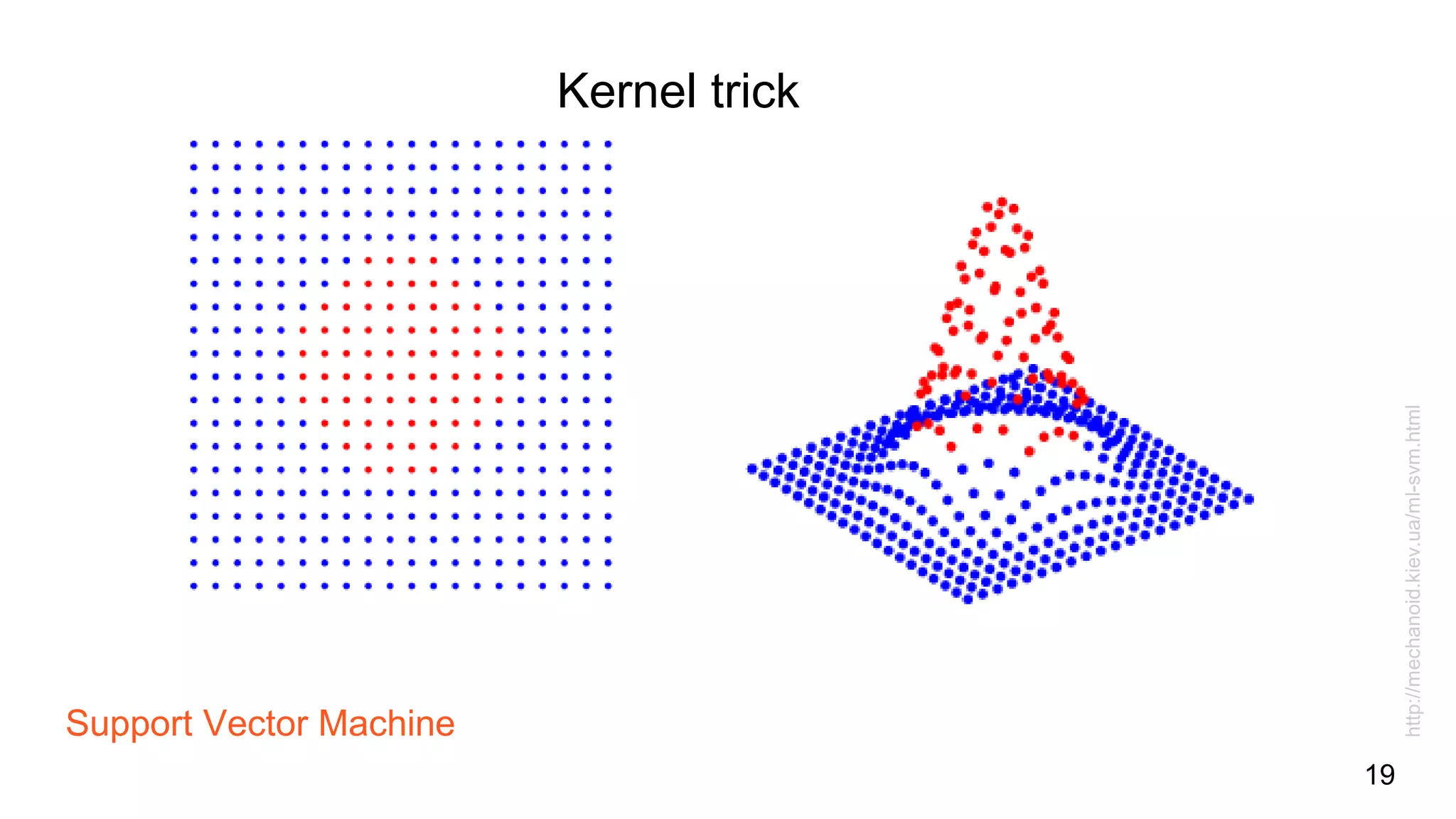
19
Kernel trick
http://mechanoid.kiev.ua/ml-svm.html
WEKA output
results 20
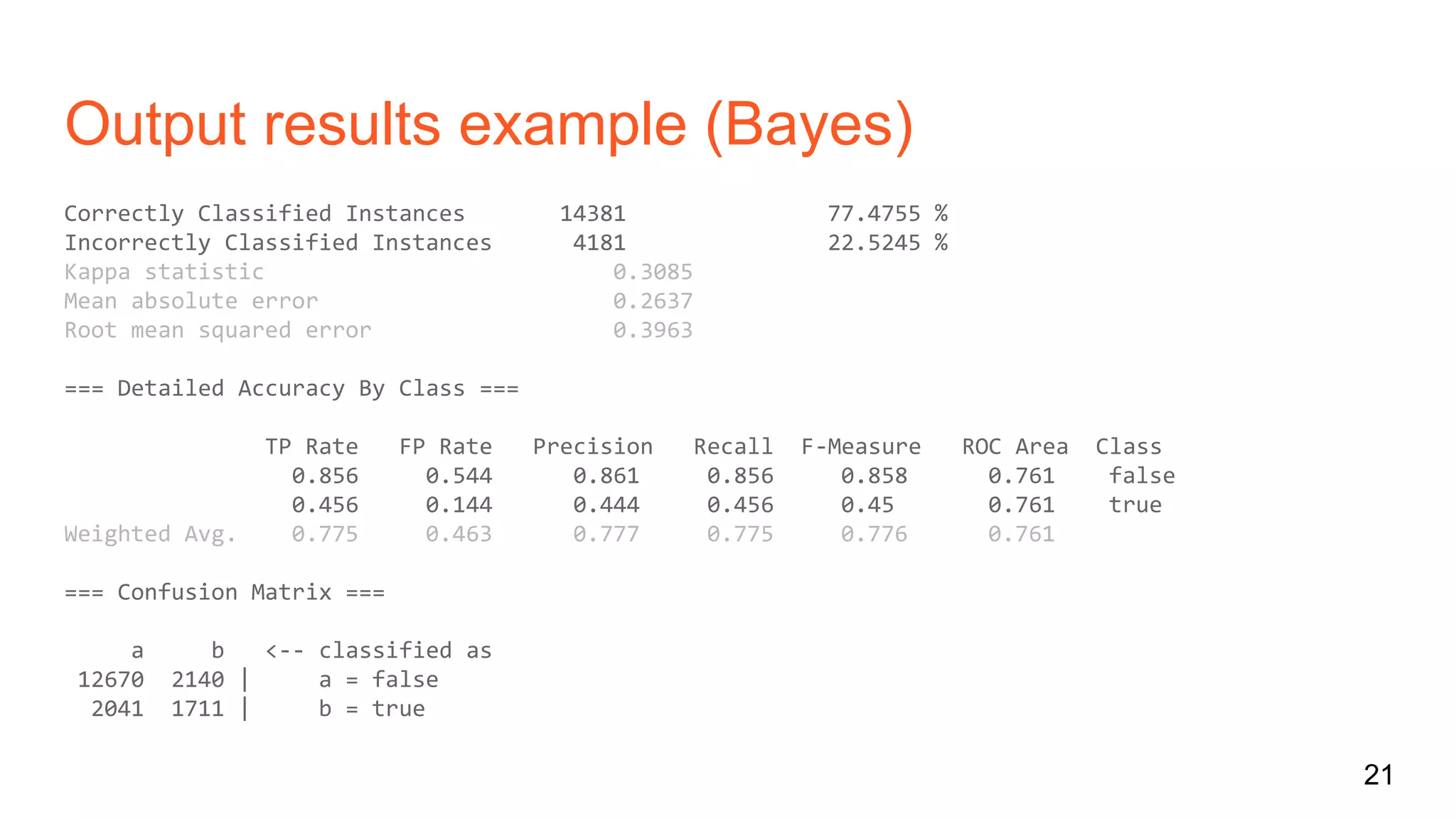
Output results example (Bayes)
Correctly Classified Instances 14381 77.4755 %
Incorrectly Classified Instances 4181 22.5245 %
Kappa statistic 0.3085
Mean absolute error 0.2637
Root mean squared error 0.3963
=== Detailed Accuracy By Class ===
TP Rate FP Rate Precision Recall F-Measure ROC Area Class
0.856 0.544 0.861 0.856 0.858 0.761 false
0.456 0.144 0.444 0.456 0.45 0.761 true
Weighted Avg. 0.775 0.463 0.777 0.775 0.776 0.761
=== Confusion Matrix ===
a b <-- classified as
12670 2140 | a = false
2041 1711 | b = true
21
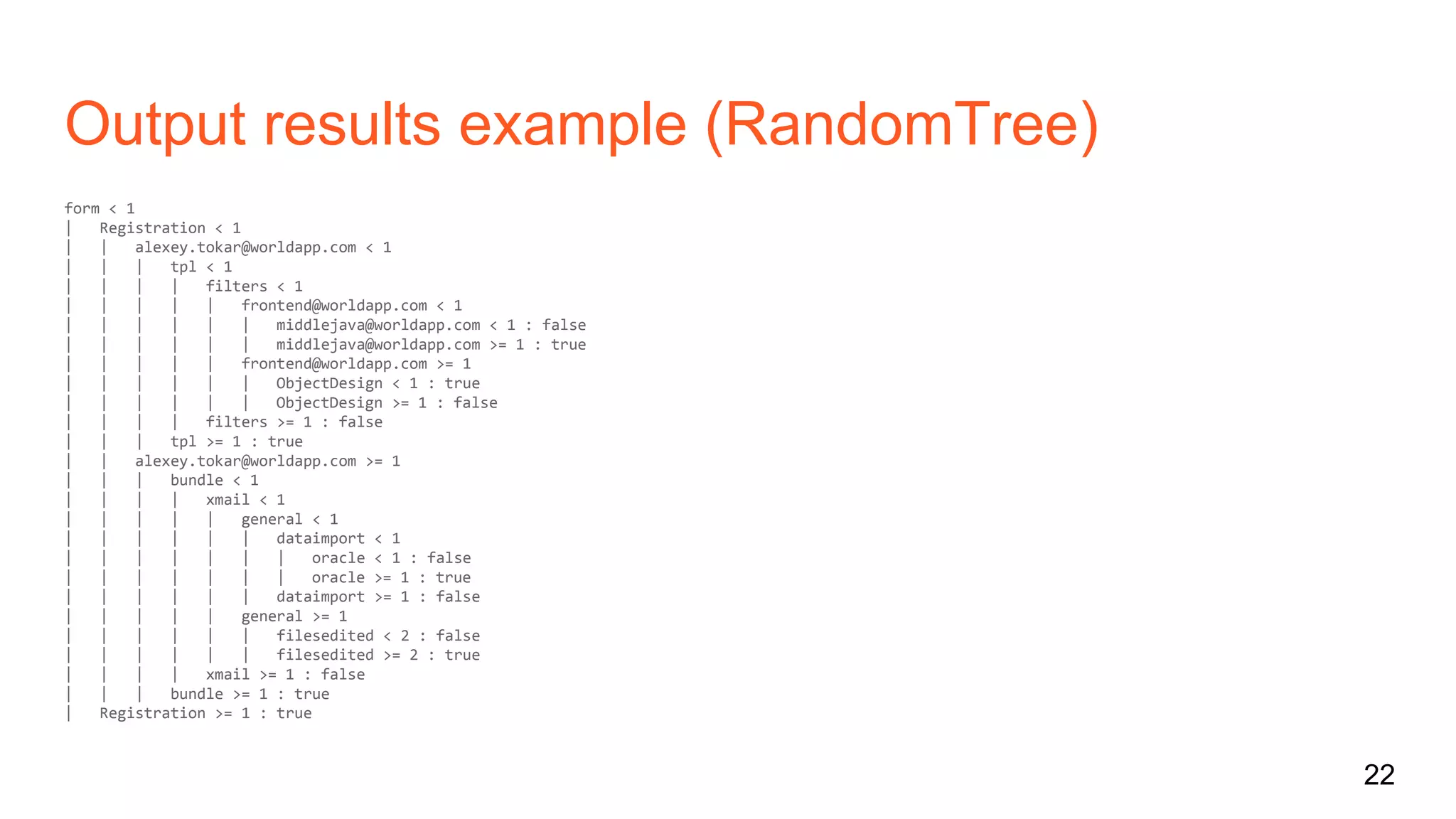
Output results example (RandomTree)
form < 1
| Registration < 1
| | alexey.tokar@worldapp.com < 1
| | | tpl < 1
| | | | filters < 1
| | | | | frontend@worldapp.com < 1
| | | | | | middlejava@worldapp.com < 1 : false
| | | | | | middlejava@worldapp.com >= 1 : true
| | | | | frontend@worldapp.com >= 1
| | | | | | ObjectDesign < 1 : true
| | | | | | ObjectDesign >= 1 : false
| | | | filters >= 1 : false
| | | tpl >= 1 : true
| | alexey.tokar@worldapp.com >= 1
| | | bundle < 1
| | | | xmail < 1
| | | | | general < 1
| | | | | | dataimport < 1
| | | | | | | oracle < 1 : false
| | | | | | | oracle >= 1 : true
| | | | | | dataimport >= 1 : false
| | | | | general >= 1
| | | | | | filesedited < 2 : false
| | | | | | filesedited >= 2 : true
| | | | xmail >= 1 : false
| | | bundle >= 1 : true
| Registration >= 1 : true
22
Integration example
TL;DR: we use GitLab web-hooks and HipChat.
* a long story about SDLC improvements with help of IM bot and a set of
integrations will be available in a week at XPDays conference.
23
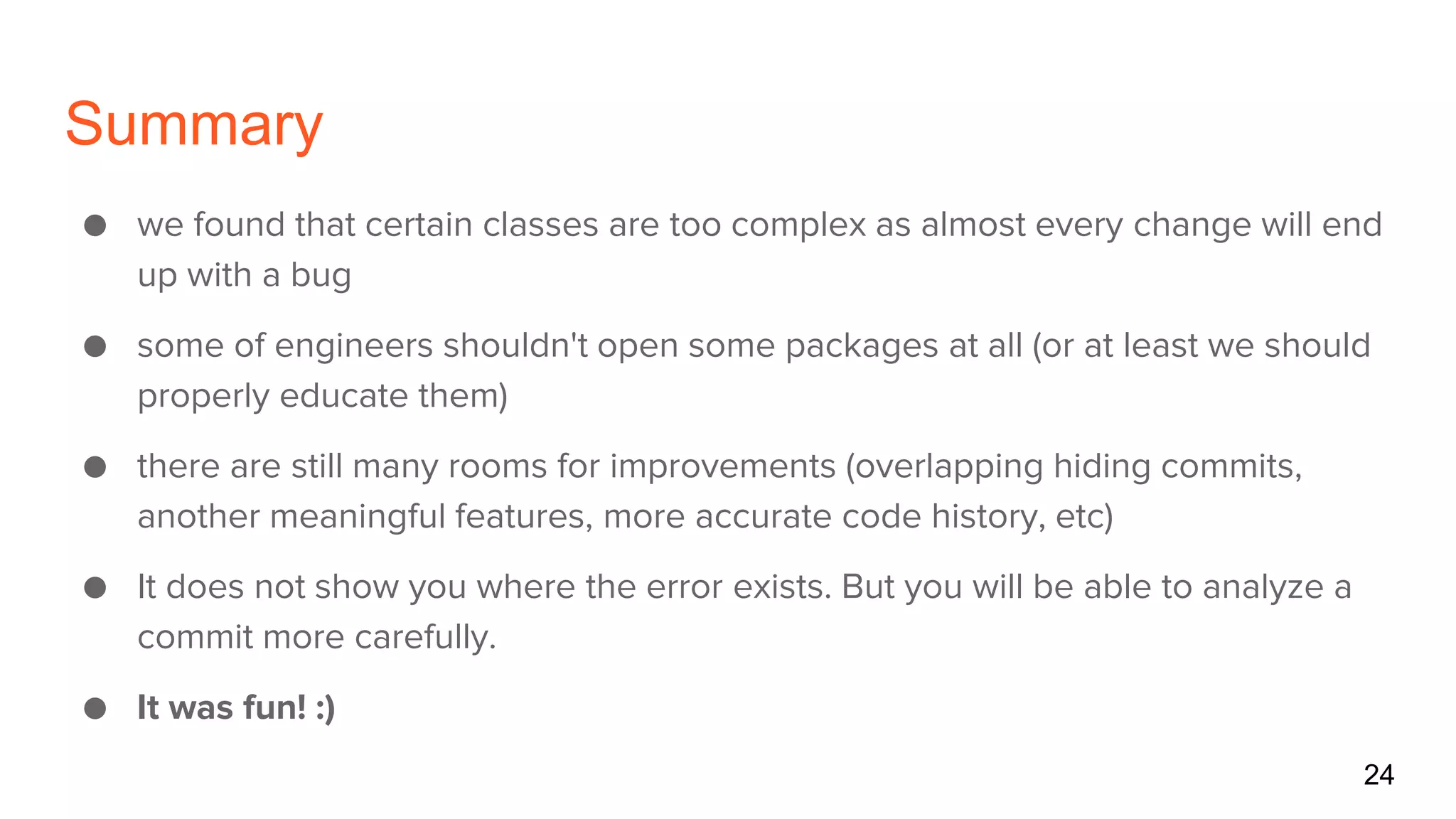
Summary
● we found that certain classes are too complex as almost every change will end
up with a bug
● some of engineers shouldn't open some packages at all (or at least we should
properly educate them)
● there are still many rooms for improvements (overlapping hiding commits,
another meaningful features, more accurate code history, etc)
● It does not show you where the error exists. But you will be able to analyze a
commit more carefully.
● It was fun! :)
24
Questions?
Alexey@Tokar.net.ua
VP of Engineering @ WorldAPP
25

Bug prediction based on your code history

  • 1.
    Bug prediction based onyour code history Alexey Tokar VP of Engineering @ WorldAPP
  • 2.
    SDLC 2 Software Development Life Cycle PHASE 2 Design PHASE1 Requirements analysis PHASE 3 Development PHASE 5 Maintenance PHASE 4 Testing
  • 3.
    Zoom in toquality control ● static code analyzers find non conceptual issues ● automated tests cover predefined scenarios ● code review are aimed on sharing and controlling best practices and less than 10% of the discussions discover logical issues. ● and, finally, QA has no idea which parts of a system could be affected by a code change, neither do a programmer 3
  • 4.
    20 bugs in aproduction environment per week 4
  • 5.
    Let's try toguess common patterns ● a tired engineer makes more mistakes ● the more an engineer knows about certain module the fewer bugs (s)he will produce ● small changes have fewer bugs than long listings ● some parts of the system are more complicated than another, so the risk of get a bug increases ● huge changes in a short period of time contains more bugs (done in a hurry) 5
  • 6.
    What tools dowe have across SDLC? 6 ● ticket types ● action history ● exact code changes ● author of modifications ● class complexity ● code metrics
  • 7.
    Hypothesis If we knowthat certain commit has fixed a bug, than we know that a commit, when the changed lines were introduced, did contain a bug. 7 Author: John public int sum( int a, int b ) { return a + b; } C Author: Bob public int sum( int a, int b ) { return a * b; } BA public int sum( int a, int b ) { return a + b; }
  • 8.
    Algorithm of metricscollection ● Export all tasks from Jira to inmemory dictionary ● For each commit run a backtrace to mark it as buggy, fixing or regular ● Collect all meaningful data about the commit: ○ Month of year, Day of week, Hour of day, Who, How many lines and files, Which classes and packages, Class complexity and amount of notices, How long a task is in progress ● Put a line with the data to Attribute-Relation File Format (ARFF) file 8
  • 9.
    Getting educated. WEKA WaikatoEnvironment for Knowledge Analysis - is a suite of machine learning software written in Java, developed at the University of Waikato, New Zealand. ● Parsers ● Classifiers ● Training/test splits 9
  • 10.
    WEKA challenges ● Convertyour data to corresponding vectors ● Choose proper data transformers ● Select and tweak desired Classifiers ● Run experiments and adjust your settings Good materials about WEKA for beginners: ● How to Run Your First Classifier in Weka ● Data mining with WEKA, Part 2. Classification and clustering ● Document Classification using WEKA 10
  • 11.
    Decision Tree Ease ofresults interpretation Any data can be fed to the method Can work with scalars and intervals 11
  • 12.
    Decision Tree 12 Changed less than300 lines?Changed more than 50 lines? Author is Bob? Author is John? Has no bugs :) Has no bugs :) Is it Friday? Has no bugs :) Has a bug :( Has no bugs :) Has a bug :( ● John never has bugs! ● Everybody except John and Bob has bugs on Friday. ● Bob has bugs only if he changed more than 300 lines of code.
  • 13.
    Decision Tree 13 The simplestmethod for building a tree is ID3 (Iterative Dichotomiser 3*). Build steps: ● Find an attribute with lowest entropy (or largest information gain) ● Split the data set by the found attribute ● Recursively build a tree for each of the subsets * fates of ID2 and ID1 are lost in history
  • 14.
    Naive Bayes classifier ≈80% accuracy* Simpleimplementation Easy to understand 14
  • 15.
  • 16.
    Naive Bayes classifier 16 30%of all commits with bugs were done by Bob P(Bob|bug) 10% of all commits without bugs were done by Bob P(Bob|~bug) 40% of all commits have bugs P(bug) 60% of all commits have no bugs P(~bug) What probability that next commit from Bob will have a bug? P(bug|Bob)
  • 17.
    Support Vector Machine Better qualityof results The model is based on relations in data Sounds fancy :) 17
  • 18.
  • 19.
    Support Vector Machine 19 Kerneltrick http://mechanoid.kiev.ua/ml-svm.html
  • 20.
  • 21.
    Output results example(Bayes) Correctly Classified Instances 14381 77.4755 % Incorrectly Classified Instances 4181 22.5245 % Kappa statistic 0.3085 Mean absolute error 0.2637 Root mean squared error 0.3963 === Detailed Accuracy By Class === TP Rate FP Rate Precision Recall F-Measure ROC Area Class 0.856 0.544 0.861 0.856 0.858 0.761 false 0.456 0.144 0.444 0.456 0.45 0.761 true Weighted Avg. 0.775 0.463 0.777 0.775 0.776 0.761 === Confusion Matrix === a b <-- classified as 12670 2140 | a = false 2041 1711 | b = true 21
  • 22.
    Output results example(RandomTree) form < 1 | Registration < 1 | | alexey.tokar@worldapp.com < 1 | | | tpl < 1 | | | | filters < 1 | | | | | frontend@worldapp.com < 1 | | | | | | middlejava@worldapp.com < 1 : false | | | | | | middlejava@worldapp.com >= 1 : true | | | | | frontend@worldapp.com >= 1 | | | | | | ObjectDesign < 1 : true | | | | | | ObjectDesign >= 1 : false | | | | filters >= 1 : false | | | tpl >= 1 : true | | alexey.tokar@worldapp.com >= 1 | | | bundle < 1 | | | | xmail < 1 | | | | | general < 1 | | | | | | dataimport < 1 | | | | | | | oracle < 1 : false | | | | | | | oracle >= 1 : true | | | | | | dataimport >= 1 : false | | | | | general >= 1 | | | | | | filesedited < 2 : false | | | | | | filesedited >= 2 : true | | | | xmail >= 1 : false | | | bundle >= 1 : true | Registration >= 1 : true 22
  • 23.
    Integration example TL;DR: weuse GitLab web-hooks and HipChat. * a long story about SDLC improvements with help of IM bot and a set of integrations will be available in a week at XPDays conference. 23
  • 24.
    Summary ● we foundthat certain classes are too complex as almost every change will end up with a bug ● some of engineers shouldn't open some packages at all (or at least we should properly educate them) ● there are still many rooms for improvements (overlapping hiding commits, another meaningful features, more accurate code history, etc) ● It does not show you where the error exists. But you will be able to analyze a commit more carefully. ● It was fun! :) 24
  • 25.

Editor's Notes

  • #5 Having all these activities we still get up to 20 bugs during a week in production environments reported by our customers
  • #7 (it is worth to mention that accuracy is a must have for future improvements) crossreferences
  • #8 Боб изменил функцию Джон прислал коммит с текстом fixed Отмечаем такой коммит как Fixing Находим измененные строки Делаем Blame и находим когда они были представлены Отмечаем такой коммит как Buggy
  • #10 As it is a Java conference I should took a java based library for that ;)
  • #15 classifier based on applying Bayes' theorem with strong (naive) independence assumptions between the features.
  • #19 An SVM model is a representation of the examples as points in space, mapped so that the examples of the separate categories are divided by a clear gap that is as wide as possible. New examples are then mapped into that same space and predicted to belong to a category based on which side of the gap they fall.