M E K O W U L U F. C
BUERGER’S
DISEASE
BUERGER’S DISEASE: WHAT IT IS
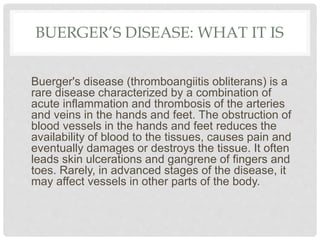
Buerger's disease (thromboangiitis obliterans) is a
rare disease characterized by a combination of
acute inflammation and thrombosis of the arteries
and veins in the hands and feet. The obstruction of
blood vessels in the hands and feet reduces the
availability of blood to the tissues, causes pain and
eventually damages or destroys the tissue. It often
leads skin ulcerations and gangrene of fingers and
toes. Rarely, in advanced stages of the disease, it
may affect vessels in other parts of the body.
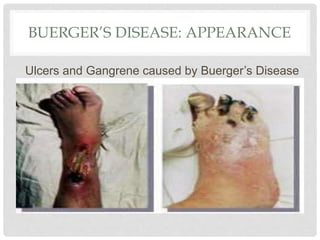
BUERGER’S DISEASE: APPEARANCE
Ulcers and Gangrene caused by Buerger’s Disease
BUERGER’S DISEASE: WHO IT
AFFECTS
Buerger's disease affects approximately six out of
every 10,000 people. It almost always affects men,
ages 20 to 40, who smoke or chew tobacco.
Recently, however, more women and men over the
age of 50 have been diagnosed with Buerger's
disease. This disorder is still very uncommon in
children, but it may occur in those with autoimmune
diseases. Buerger's disease is most common in the
Orient, Southeast Asia, India and the Middle East,
but is rare among African-Americans.
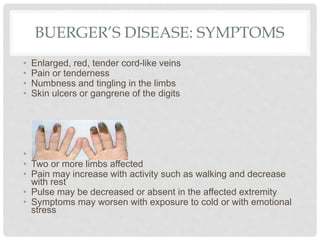
BUERGER’S DISEASE: SYMPTOMS
• Enlarged, red, tender cord-like veins
• Pain or tenderness
• Numbness and tingling in the limbs
• Skin ulcers or gangrene of the digits
• Discoloration
• Two or more limbs affected
• Pain may increase with activity such as walking and decrease
with rest
• Pulse may be decreased or absent in the affected extremity
• Symptoms may worsen with exposure to cold or with emotional
stress
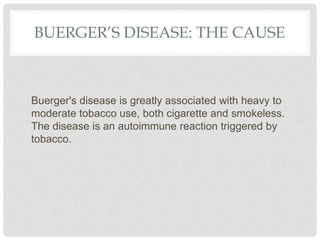
BUERGER’S DISEASE: THE CAUSE
Buerger's disease is greatly associated with heavy to
moderate tobacco use, both cigarette and smokeless.
The disease is an autoimmune reaction triggered by
tobacco.
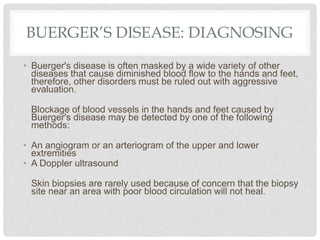
BUERGER’S DISEASE: DIAGNOSING
• Buerger's disease is often masked by a wide variety of other
diseases that cause diminished blood flow to the hands and feet,
therefore, other disorders must be ruled out with aggressive
evaluation.
Blockage of blood vessels in the hands and feet caused by
Buerger's disease may be detected by one of the following
methods:
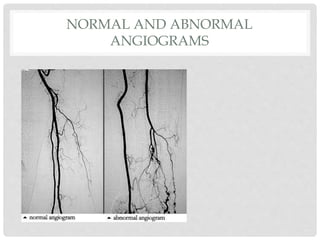
• An angiogram or an arteriogram of the upper and lower
extremities
• A Doppler ultrasound
Skin biopsies are rarely used because of concern that the biopsy
site near an area with poor blood circulation will not heal.
NORMAL AND ABNORMAL
ANGIOGRAMS
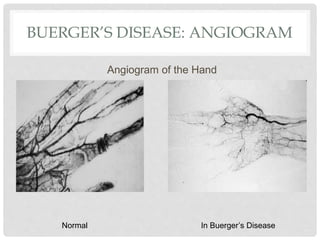
BUERGER’S DISEASE: ANGIOGRAM
Angiogram of the Hand
Normal In Buerger’s Disease
BUERGER’S DISEASE: PREVENTION
To avoid the onset of Buerger's disease, tobacco use
should be avoided, particularly by men.
BUERGER’S DISEASE: TREATMENT
• The only method known to be an effective treatment for
Buerger's disease is immediately quitting smoking.
Patients who continue to smoke after a diagnosis of
Buerger's disease will generally require amputation of
the fingers and toes.
• Since there is no cure for Buerger's disease, the goal of
treatment is to control symptoms.
BUERGER’S DISEASE: SYMPTOM
CONTROL
• Gentle massage and warmth to increase circulation
• Avoid conditions that reduce circulation to the
extremities
• Avoid sitting or standing in one position for long
periods
• Do not walk barefoot to avoid injury
• Do not wear tight or restrictive clothing
• Report all injuries to physician for appropriate
treatment
BUERGER’S DISEASE: PROGNOSIS
The symptoms of Buerger's disease may disappear if
tobacco use is stopped. If the affected extremity is to be
saved, the patient must stop smoking. If infection or
gangrene occurs, amputation of the affect extremity may
be necessary.
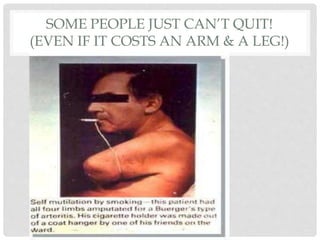
SOME PEOPLE JUST CAN’T QUIT!
(EVEN IF IT COSTS AN ARM & A LEG!)

Buergers disease facts

  • 1.
    M E KO W U L U F. C BUERGER’S DISEASE
  • 2.
    BUERGER’S DISEASE: WHATIT IS Buerger's disease (thromboangiitis obliterans) is a rare disease characterized by a combination of acute inflammation and thrombosis of the arteries and veins in the hands and feet. The obstruction of blood vessels in the hands and feet reduces the availability of blood to the tissues, causes pain and eventually damages or destroys the tissue. It often leads skin ulcerations and gangrene of fingers and toes. Rarely, in advanced stages of the disease, it may affect vessels in other parts of the body.
  • 3.
    BUERGER’S DISEASE: APPEARANCE Ulcersand Gangrene caused by Buerger’s Disease
  • 4.
    BUERGER’S DISEASE: WHOIT AFFECTS Buerger's disease affects approximately six out of every 10,000 people. It almost always affects men, ages 20 to 40, who smoke or chew tobacco. Recently, however, more women and men over the age of 50 have been diagnosed with Buerger's disease. This disorder is still very uncommon in children, but it may occur in those with autoimmune diseases. Buerger's disease is most common in the Orient, Southeast Asia, India and the Middle East, but is rare among African-Americans.
  • 5.
    BUERGER’S DISEASE: SYMPTOMS •Enlarged, red, tender cord-like veins • Pain or tenderness • Numbness and tingling in the limbs • Skin ulcers or gangrene of the digits • Discoloration • Two or more limbs affected • Pain may increase with activity such as walking and decrease with rest • Pulse may be decreased or absent in the affected extremity • Symptoms may worsen with exposure to cold or with emotional stress
  • 6.
    BUERGER’S DISEASE: THECAUSE Buerger's disease is greatly associated with heavy to moderate tobacco use, both cigarette and smokeless. The disease is an autoimmune reaction triggered by tobacco.
  • 7.
    BUERGER’S DISEASE: DIAGNOSING •Buerger's disease is often masked by a wide variety of other diseases that cause diminished blood flow to the hands and feet, therefore, other disorders must be ruled out with aggressive evaluation. Blockage of blood vessels in the hands and feet caused by Buerger's disease may be detected by one of the following methods: • An angiogram or an arteriogram of the upper and lower extremities • A Doppler ultrasound Skin biopsies are rarely used because of concern that the biopsy site near an area with poor blood circulation will not heal.
  • 8.
  • 9.
    BUERGER’S DISEASE: ANGIOGRAM Angiogramof the Hand Normal In Buerger’s Disease
  • 10.
    BUERGER’S DISEASE: PREVENTION Toavoid the onset of Buerger's disease, tobacco use should be avoided, particularly by men.
  • 11.
    BUERGER’S DISEASE: TREATMENT •The only method known to be an effective treatment for Buerger's disease is immediately quitting smoking. Patients who continue to smoke after a diagnosis of Buerger's disease will generally require amputation of the fingers and toes. • Since there is no cure for Buerger's disease, the goal of treatment is to control symptoms.
  • 12.
    BUERGER’S DISEASE: SYMPTOM CONTROL •Gentle massage and warmth to increase circulation • Avoid conditions that reduce circulation to the extremities • Avoid sitting or standing in one position for long periods • Do not walk barefoot to avoid injury • Do not wear tight or restrictive clothing • Report all injuries to physician for appropriate treatment
  • 13.
    BUERGER’S DISEASE: PROGNOSIS Thesymptoms of Buerger's disease may disappear if tobacco use is stopped. If the affected extremity is to be saved, the patient must stop smoking. If infection or gangrene occurs, amputation of the affect extremity may be necessary.
  • 14.
    SOME PEOPLE JUSTCAN’T QUIT! (EVEN IF IT COSTS AN ARM & A LEG!)