
BUDGETING THE INDUSTRY-
  SPONSORED CLINICAL
    RESEARCH STUDY
Carolyn White, Manager, Study Coord & Conduct Unit
Center for the Advancement of Clinical Research (CACR)

             Heather Offhaus, Director
             Medical School Grants Office
Objective:


To learn the fundamentals of
preparing a clinical trial budget
Developing and Negotiating
      Successful Study Budgets

• U-M research community provides
  important resources to help you
      – Departmental Mentoring
      – Department Res. Grants Admin.
      – Medical School Grants Office
      – DRDA Seminars
• Successful budgeting is definitely
  an art refined by experience
Read the Protocol

• Identify items that will generate
  expenses for the site
  – Number & complexity of subject visits
  – Estimated time required for study visits
  – Procedures to be performed
  – Difficulty of meeting Inclusion/Exclusion
    criteria
  – Staffing needs for duration of study
Determine Recruitment
      Potential

• What is a reasonable and realistic
  accrual goal?
  – What measures are necessary to reach the
    desired subject population?
  – How many subjects must be screened to
    identify an eligible participant?
  – What is the recruitment time frame?
Clinical Budget Concepts:


• Must cover all costs
• Needs to be somewhat flexible
• If not in budget, sponsor is not
  obligated to pay
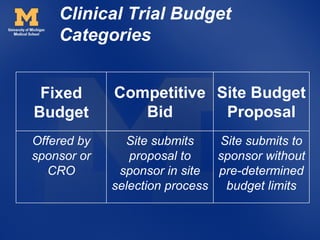
Clinical Trial Budget
    Categories


 Fixed       Competitive Site Budget
Budget          Bid       Proposal
Offered by     Site submits    Site submits to
sponsor or      proposal to    sponsor without
   CRO        sponsor in site  pre-determined
             selection process budget limits
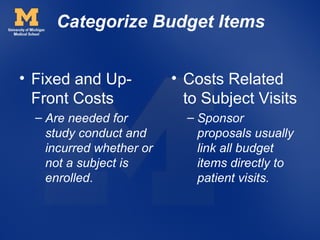
Categorize Budget Items


• Fixed and Up-           • Costs Related
  Front Costs               to Subject Visits
  – Are needed for          – Sponsor
    study conduct and         proposals usually
    incurred whether or       link all budget
    not a subject is          items directly to
    enrolled.                 patient visits.
DISCLAIMER!!!


• We will talk through many types of
  charges
• We will offer many ways of looking
  at things
• BUT, this is not the exhaustive list!
  Many items are protocol specific
  with hundreds of possibilities!
Determine Universal Costs for
    Study Conduct


• What institutional approvals are
  needed?
• Are fees charged?
• Determine institutional Indirect Cost
  rate
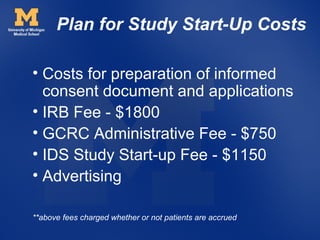
Plan for Study Start-Up Costs

• Costs for preparation of informed
  consent document and applications
• IRB Fee - $1800
• GCRC Administrative Fee - $750
• IDS Study Start-up Fee - $1150
• Advertising

**above fees charged whether or not patients are accrued
Indirect Cost Recovery
       (aka Facility & Administrative charges or Overhead)


These are a real cost to the university
• Determine correct rate to use on your
  study

• Call Me!!!
     Contact: MSA Grants Office,
     Heather Offhaus 763-4272.
Salary Support for the
       Research Team
•   Investigator
•   Co-Investigators
•   Study Coordinator
•   Office Personnel
•   Technical Support
•   Laboratory Staff
•   Professional/Consultant Fees
** Don’t forget Fringe Benefits for each!
Study Maintenance Costs

•   Continuing regulatory reporting
•   Maintaining Investigator binders/files
•   Staff training needs
•   Research team meetings
•   Study communications
•   Sponsor monitoring visits
•   Adverse Events reporting
Data Collection & Subject
     Maintenance Costs

• Case report forms completion
• Scheduling for visits, tests/scans
• IDS study article dispensing/
  accounting
• Subject payments
• Telephone contacts
• Data query resolution
UM Resources Utilization

•   GCRC Outpatient Clinic
•   M-Labs vs. Central Laboratory
•   Photocopying
•   Freezers, dry ice, special equipment
•   Committee review of devices,
    radioisotopes, or gene-transfer
    material
Consider “Hidden” Study
    Costs


Delayed start
Informed consent process
Increased salaries & operating costs
 over time
Travel to offsite clinics
More “Hidden” Study Costs


Unscheduled visits
Overhead costs for “a la carte” or
 one-time procedures
Tracking study funds
Audits
Consider Closing Costs
Don’t forget –
 Closing costs occur AFTER subjects
 complete study and BEFORE
 contract ends
  – Query resolution to close database
  – Sponsor’s close-out visit
  – Pharmacy close-out
  – IRB termination
  – Long-term storage of research records
Potentially Unallowable Costs:

• Dependent on
  – State law
  – Michigan contracting policy

• Includes:
   – Finder’s fees/Referral fees
   – Enrollment incentives
   – Paperwork completion incentives
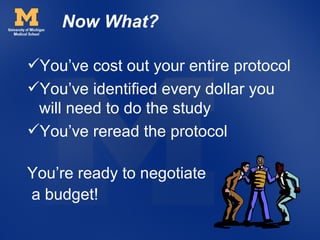
Now What?

You’ve cost out your entire protocol
You’ve identified every dollar you
 will need to do the study
You’ve reread the protocol

You’re ready to negotiate
a budget!
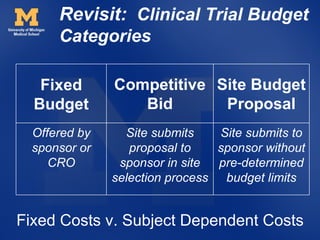
Revisit: Clinical Trial Budget
      Categories

   Fixed       Competitive Site Budget
  Budget          Bid       Proposal
  Offered by     Site submits    Site submits to
  sponsor or      proposal to    sponsor without
     CRO        sponsor in site  pre-determined
               selection process budget limits


Fixed Costs v. Subject Dependent Costs
Build a Payment Schedule &
     Budget You Can “Live With”

• The payment schedule must be
  appropriate for recovering costs as
  they are incurred
• Negotiate non-recurring costs as
  “fixed” and not patient based
• Be aware of milestones set for
  release of study funds…
Build a Payment Schedule &
     Budget You Can “Live With”


• Recover cost of screen failures and
  study drop-outs
• Include provisions for sponsor
  support for extra procedures or
  variable cost items
For Competitive Bids:


Consider asking for Total Costs in your
 payment schedule

  – Instead of $500 for a routine visit, ask $625
  – Don’t break out the indirect costs at the
    bottom of the schedule
For Sponsor or CRO
        Proposed Budgets:

                 REMEMBER:
If the contract is drafted by sponsor, it is
     probably to the sponsor’s benefit!

–You CAN negotiate different payment milestones
–You CAN ask for additional recovery if what they
are offering doesn’t cover your expense
If you think you and sponsor
have a budget you agree on:

            Ask: Is the
             research effort
             and scientific
             contribution
             worth the
             budget cost vs.
             recovery from
             sponsor?
This May Not be the Final
     Budget!

Understand that this may not be
 “cased closed” and final
  – Needs agreement by your department,
    school, and university

Institutional agreement is only given
  by DRDA, not by any faculty
  member…
Routing Information
• What?
 – PAF, study budget, internal budget, draft
   contract, and protocol

• When?
 – After the study budget is agreed to by both
   you and the sponsor
 – Before contract terms are fully negotiated

• Where?
 – Through your division, department, Medical
   School, and DRDA
Routing Hints
• The PAF and internal budget should
  match the bottom line of the payment
  schedule (“Contract Worth”)
• If faculty have effort, please quantify on
  the internal budget
• If the IND/IDE is open & active, indicate
  status under the Notes section of the PAF
• Estimate a probable maximum number of
  patients for Per Patient budgets so that
  you do not have to route for additional
  patients later
Words to the Wise:
      Re-Negotiation is an Option

• Even if you are mid-study!
• Increased mid-study workload may
  justify additional sponsor funding.
  – Requires routing another PAF for additional
    dollars, but worth the recovery
• If sponsor extends the study period,
  contact DRDA directly for a No-
  Cost Time Extension (NCTX)
Words to the Wise:
   Know What’s Going On with
   Study Funds!

• Track $$ received from sponsor
  and study expenditures.
• The PI is responsible for study
  deficits
• Industry studies are not always
  “money-makers.”
                        X
Contact Information:
      University of Michigan Medical
      School Administration

   The Center for Advancement of Clinical
                  Research
        http://www.umich.edu/cacr


        Medical School Grants Office
http://www.med.umich.edu/medschool/grants

Budgeting study

  • 1.
    BUDGETING THE INDUSTRY- SPONSORED CLINICAL RESEARCH STUDY Carolyn White, Manager, Study Coord & Conduct Unit Center for the Advancement of Clinical Research (CACR) Heather Offhaus, Director Medical School Grants Office
  • 2.
    Objective: To learn thefundamentals of preparing a clinical trial budget
  • 3.
    Developing and Negotiating Successful Study Budgets • U-M research community provides important resources to help you – Departmental Mentoring – Department Res. Grants Admin. – Medical School Grants Office – DRDA Seminars • Successful budgeting is definitely an art refined by experience
  • 4.
    Read the Protocol •Identify items that will generate expenses for the site – Number & complexity of subject visits – Estimated time required for study visits – Procedures to be performed – Difficulty of meeting Inclusion/Exclusion criteria – Staffing needs for duration of study
  • 5.
    Determine Recruitment Potential • What is a reasonable and realistic accrual goal? – What measures are necessary to reach the desired subject population? – How many subjects must be screened to identify an eligible participant? – What is the recruitment time frame?
  • 6.
    Clinical Budget Concepts: •Must cover all costs • Needs to be somewhat flexible • If not in budget, sponsor is not obligated to pay
  • 7.
    Clinical Trial Budget Categories Fixed Competitive Site Budget Budget Bid Proposal Offered by Site submits Site submits to sponsor or proposal to sponsor without CRO sponsor in site pre-determined selection process budget limits
  • 8.
    Categorize Budget Items •Fixed and Up- • Costs Related Front Costs to Subject Visits – Are needed for – Sponsor study conduct and proposals usually incurred whether or link all budget not a subject is items directly to enrolled. patient visits.
  • 9.
    DISCLAIMER!!! • We willtalk through many types of charges • We will offer many ways of looking at things • BUT, this is not the exhaustive list! Many items are protocol specific with hundreds of possibilities!
  • 10.
    Determine Universal Costsfor Study Conduct • What institutional approvals are needed? • Are fees charged? • Determine institutional Indirect Cost rate
  • 11.
    Plan for StudyStart-Up Costs • Costs for preparation of informed consent document and applications • IRB Fee - $1800 • GCRC Administrative Fee - $750 • IDS Study Start-up Fee - $1150 • Advertising **above fees charged whether or not patients are accrued
  • 12.
    Indirect Cost Recovery (aka Facility & Administrative charges or Overhead) These are a real cost to the university • Determine correct rate to use on your study • Call Me!!! Contact: MSA Grants Office, Heather Offhaus 763-4272.
  • 13.
    Salary Support forthe Research Team • Investigator • Co-Investigators • Study Coordinator • Office Personnel • Technical Support • Laboratory Staff • Professional/Consultant Fees ** Don’t forget Fringe Benefits for each!
  • 14.
    Study Maintenance Costs • Continuing regulatory reporting • Maintaining Investigator binders/files • Staff training needs • Research team meetings • Study communications • Sponsor monitoring visits • Adverse Events reporting
  • 15.
    Data Collection &Subject Maintenance Costs • Case report forms completion • Scheduling for visits, tests/scans • IDS study article dispensing/ accounting • Subject payments • Telephone contacts • Data query resolution
  • 16.
    UM Resources Utilization • GCRC Outpatient Clinic • M-Labs vs. Central Laboratory • Photocopying • Freezers, dry ice, special equipment • Committee review of devices, radioisotopes, or gene-transfer material
  • 17.
    Consider “Hidden” Study Costs Delayed start Informed consent process Increased salaries & operating costs over time Travel to offsite clinics
  • 18.
    More “Hidden” StudyCosts Unscheduled visits Overhead costs for “a la carte” or one-time procedures Tracking study funds Audits
  • 19.
    Consider Closing Costs Don’tforget – Closing costs occur AFTER subjects complete study and BEFORE contract ends – Query resolution to close database – Sponsor’s close-out visit – Pharmacy close-out – IRB termination – Long-term storage of research records
  • 20.
    Potentially Unallowable Costs: •Dependent on – State law – Michigan contracting policy • Includes: – Finder’s fees/Referral fees – Enrollment incentives – Paperwork completion incentives
  • 21.
    Now What? You’ve costout your entire protocol You’ve identified every dollar you will need to do the study You’ve reread the protocol You’re ready to negotiate a budget!
  • 22.
    Revisit: Clinical TrialBudget Categories Fixed Competitive Site Budget Budget Bid Proposal Offered by Site submits Site submits to sponsor or proposal to sponsor without CRO sponsor in site pre-determined selection process budget limits Fixed Costs v. Subject Dependent Costs
  • 23.
    Build a PaymentSchedule & Budget You Can “Live With” • The payment schedule must be appropriate for recovering costs as they are incurred • Negotiate non-recurring costs as “fixed” and not patient based • Be aware of milestones set for release of study funds…
  • 24.
    Build a PaymentSchedule & Budget You Can “Live With” • Recover cost of screen failures and study drop-outs • Include provisions for sponsor support for extra procedures or variable cost items
  • 25.
    For Competitive Bids: Considerasking for Total Costs in your payment schedule – Instead of $500 for a routine visit, ask $625 – Don’t break out the indirect costs at the bottom of the schedule
  • 26.
    For Sponsor orCRO Proposed Budgets: REMEMBER: If the contract is drafted by sponsor, it is probably to the sponsor’s benefit! –You CAN negotiate different payment milestones –You CAN ask for additional recovery if what they are offering doesn’t cover your expense
  • 27.
    If you thinkyou and sponsor have a budget you agree on: Ask: Is the research effort and scientific contribution worth the budget cost vs. recovery from sponsor?
  • 29.
    This May Notbe the Final Budget! Understand that this may not be “cased closed” and final – Needs agreement by your department, school, and university Institutional agreement is only given by DRDA, not by any faculty member…
  • 30.
    Routing Information • What? – PAF, study budget, internal budget, draft contract, and protocol • When? – After the study budget is agreed to by both you and the sponsor – Before contract terms are fully negotiated • Where? – Through your division, department, Medical School, and DRDA
  • 31.
    Routing Hints • ThePAF and internal budget should match the bottom line of the payment schedule (“Contract Worth”) • If faculty have effort, please quantify on the internal budget • If the IND/IDE is open & active, indicate status under the Notes section of the PAF • Estimate a probable maximum number of patients for Per Patient budgets so that you do not have to route for additional patients later
  • 32.
    Words to theWise: Re-Negotiation is an Option • Even if you are mid-study! • Increased mid-study workload may justify additional sponsor funding. – Requires routing another PAF for additional dollars, but worth the recovery • If sponsor extends the study period, contact DRDA directly for a No- Cost Time Extension (NCTX)
  • 33.
    Words to theWise: Know What’s Going On with Study Funds! • Track $$ received from sponsor and study expenditures. • The PI is responsible for study deficits • Industry studies are not always “money-makers.” X
  • 34.
    Contact Information: University of Michigan Medical School Administration The Center for Advancement of Clinical Research http://www.umich.edu/cacr Medical School Grants Office http://www.med.umich.edu/medschool/grants

Editor's Notes