What is a Budget?
• Best estimate of financial resources needed to accomplish a project
• Includes a Budget Justification which provides an explanation of
included costs
Allowable means the costs are:
• Reasonable*
• Allocable*
• Consistently applied*
• Agreeable with Sponsor specifications
Allowable Direct Costs
+ Allowable Indirect Costs (F&A)
= Total Project Costs
*These terms are taken from the Uniform Guidance 2
Creating a Budget
Review solicitation and guidelines from the Sponsor
Determine and compute the allowable direct costs
Calculate the allowable indirect costs
Develop and format the budget
Create a Budget Justification
1
2
3
4
5
3
Review Solicitation and Guidelines
Review:
• Sponsor Guidelines
• The Solicitation
• Request for Proposal
(RFP)
Look for:
• Min./Max. Duration of the
project
• Floor/Ceiling for budget
• Budget limitations and
restrictions
Specific Sponsor/application questions?
Utilize the appropriate DSP contact
It is helpful to note the specific proposal you
are applying for in the internal budget
4
Review Solicitation and Guidelines
• You will need to create and submit any budget that is necessary for the
Sponsor (formats/specifications vary from Sponsor to Sponsor)
• A budget justification will most likely need to be included with the budget.
• Check to see if the solicitation requires mandatory cost share; if not do not
include cost sharing as part of the budget
5
Keep in Mind:
An internal budget may also
need to be prepared alongside
the Sponsor budget
An internal budget provides an
opportunity to include more
details that a Sponsor budget
may not require
Why?
• Determine and specify what direct expenses fit within the Sponsor
guidelines and are necessary to complete the project
6
Common Direct Costs
• Salary/wages and fringe benefits for
all personnel (including students)
• Travel costs (both domestic and
foreign)
• Equipment ( ≥ $5,000)
• Materials and supplies
• Subawards (direct and indirect costs)
Other Direct Costs
• Tuition
• Participant support costs
• Research Subject Compensation
• Publication costs
• Consultant services
• Patient care costs
• Computer service center charges
Direct Costs
This list is not all-inclusive
Direct Costs
• Seek assistance from your HR
rep. in determining salary base
7
Sponsors may impose a salary cap
An effort to months conversion
table is available here
Personnel Costs – Salary/Wage Expenses
• Salary is calculated using
3 basic salary/wage bases:
• Calendar Year (CY) – 12 months
• Academic Year (AY) – 9 months
• Summer Term – 1-3 months
Direct Costs
8
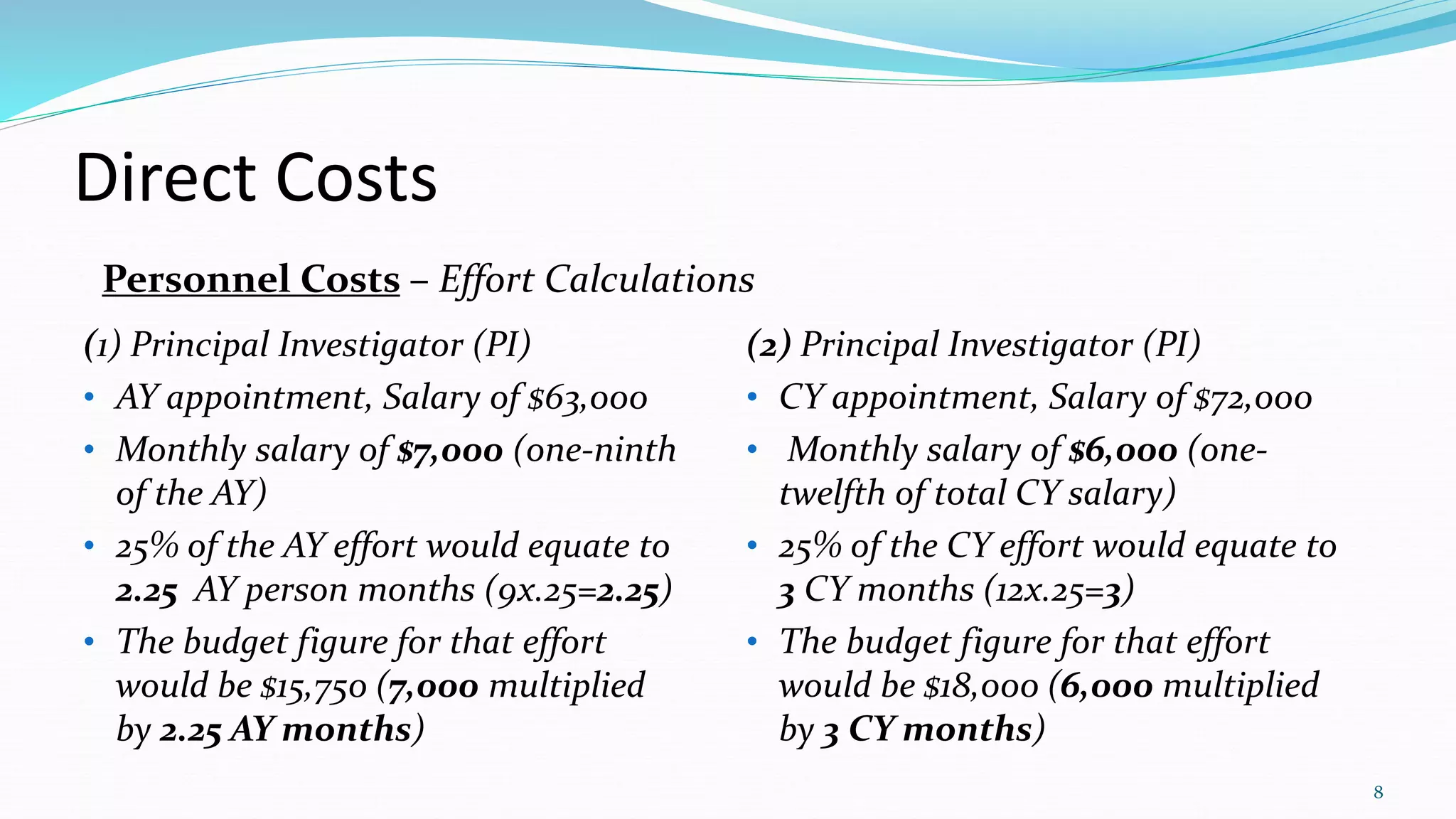
Personnel Costs – Effort Calculations
(2) Principal Investigator (PI)
• CY appointment, Salary of $72,000
• Monthly salary of $6,000 (one-
twelfth of total CY salary)
• 25% of the CY effort would equate to
3 CY months (12x.25=3)
• The budget figure for that effort
would be $18,000 (6,000 multiplied
by 3 CY months)
(1) Principal Investigator (PI)
• AY appointment, Salary of $63,000
• Monthly salary of $7,000 (one-ninth
of the AY)
• 25% of the AY effort would equate to
2.25 AY person months (9x.25=2.25)
• The budget figure for that effort
would be $15,750 (7,000 multiplied
by 2.25 AY months)
Direct Costs
Personnel Costs – Salary Cap
9
• Specific Sponsors or awards may
limit personnel salaries
• It is recommended that salaries
be increased at a rate of 3% per
year when making future year
budget estimates
Example
PI salary: $200,000/year
Salary Cap =$185,100 (subject to change)
If the effort on the project is 25%, determine the
amount of salary based on the Salary Cap, not the
actual salary of the PI
$185,100 x 25% = $46,275
$200,000 x 25% = $50,000
 The difference of $3,725 would need to
be covered by the individual’s UI Department
NIH Salary Cap Information
can be found here.
($185,100 in FY2016)**
Direct Costs
Personnel Costs – Fringe Benefits
10
Current/Projected Fringe Benefit Rates can be found here
Fringe benefits include:
• Social Security
• University Retirement
Programs
• Life Insurance
• Health Insurance
• Disability Insurance
• Etc.
Contact your HR representative for help with
determining appropriate fringe “rate pools”
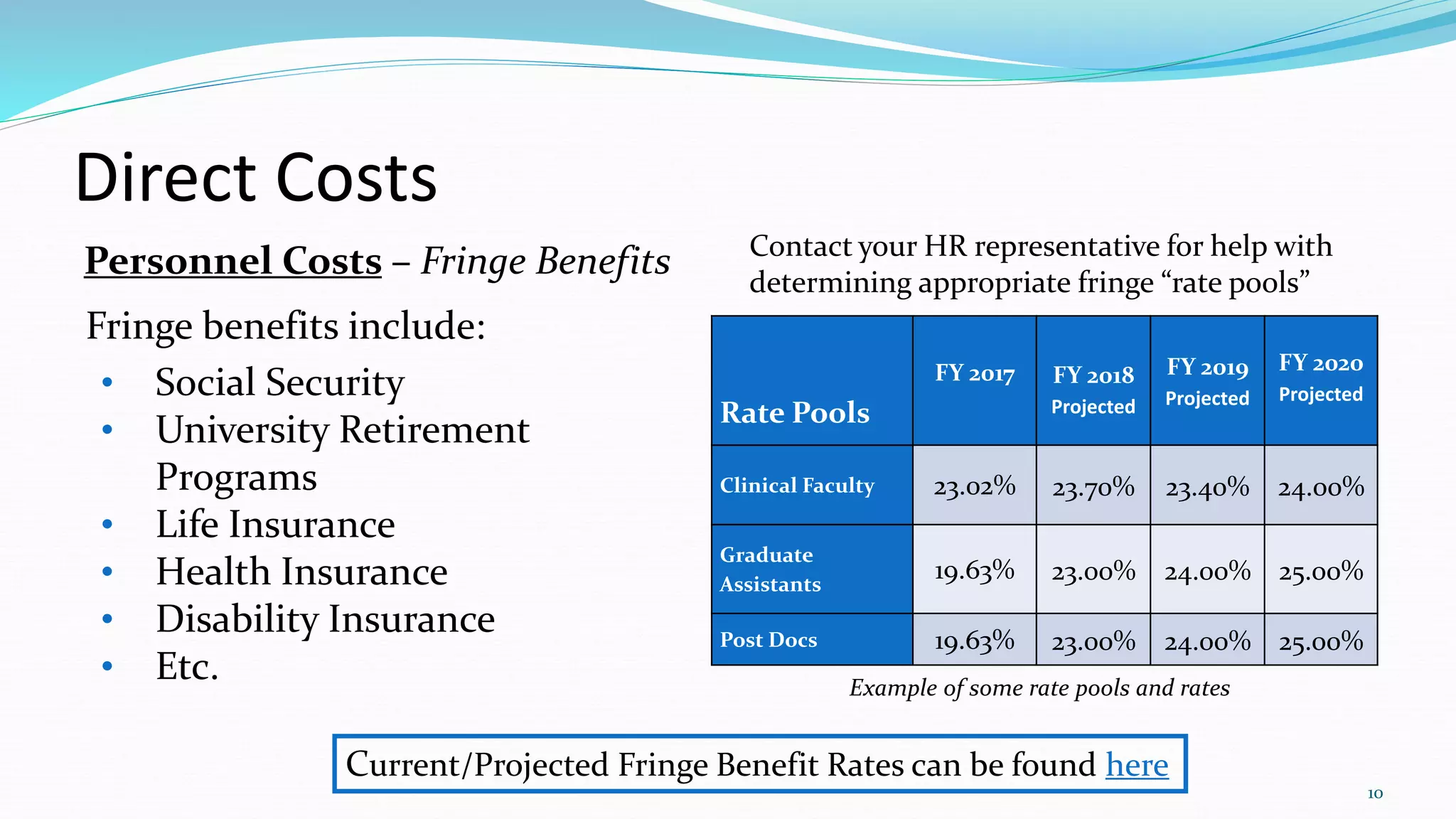
Rate Pools
FY 2017 FY 2018
Projected
FY 2019
Projected
FY 2020
Projected
Clinical Faculty 23.02% 23.70% 23.40% 24.00%
Graduate
Assistants
19.63% 23.00% 24.00% 25.00%
Post Docs 19.63% 23.00% 24.00% 25.00%
Example of some rate pools and rates
Direct Costs
The budget should specify the:
• # of trips/days/people
• per diem rates for food and hotel
• transportation costs
• destination(s)
More information about specific costs, rates, etc.
can be found directly from the Sponsor or at
http://www.uiowa.edu/ap-purchasing/travel
Travel – Domestic and Foreign Keep in Mind:
• Allowances for air travel should not
exceed round trip coach
accommodations
• Generally, only persons participating
directly in the research may travel on
grant funds
• Sponsors require adequate justification
on requested travel expenses – foreign
travel, especially
• Sponsor guidelines may establish rates
for specific costs. Use the more
restrictive rate when UIowa rate differs
Note: Specifics may be unknown at time of proposal
11
Direct Costs
Equipment costs include expenses for equipment
items (useful year: 2 years) that individually cost
$5,000 or more.
Only allowable if it will be dedicated solely to the
project. (Not intended for general office equipment,
copiers, office furniture, etc.)
Equipment – $5,000 or more
More information on Equipment can be found on the Capital
Asset Management (CAM) website or the DSP website:
http://cam.fo.uiowa.edu/content/policies-and-procedures
http://dsp.research.uiowa.edu/equipment
UI policy prohibits the recovery of
indirect costs (F&A) on
direct costs classified as
equipment
Materials and Supplies
• The expendable equipment (equipment
costing less than $5,000) and supplies
required for the project should be indicated
with estimated costs
• There should be a breakdown of these items
by general classification
• Sponsor guidelines usually indicate what
needs to be itemized and justified
12
Direct Costs
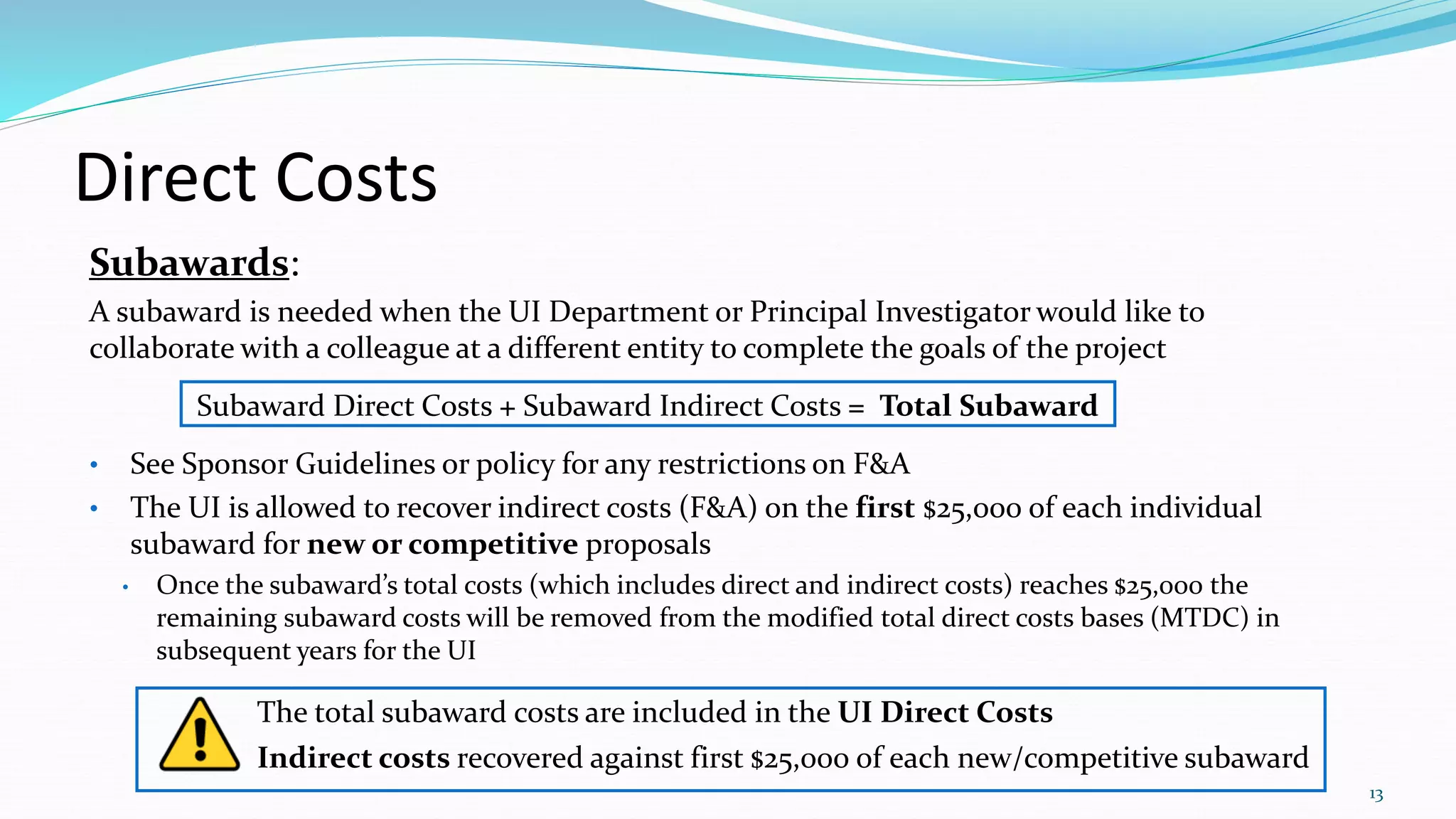
Subawards:
A subaward is needed when the UI Department or Principal Investigator would like to
collaborate with a colleague at a different entity to complete the goals of the project
• See Sponsor Guidelines or policy for any restrictions on F&A
• The UI is allowed to recover indirect costs (F&A) on the first $25,000 of each individual
subaward for new or competitive proposals
• Once the subaward’s total costs (which includes direct and indirect costs) reaches $25,000 the
remaining subaward costs will be removed from the modified total direct costs bases (MTDC) in
subsequent years for the UI
13
Subaward Direct Costs + Subaward Indirect Costs = Total Subaward
The total subaward costs are included in the UI Direct Costs
Indirect costs recovered against first $25,000 of each new/competitive subaward
Direct Costs
Subaward Example:
A subaward has the following
amounts in the first 3 years of
a Sponsored Project:
Year 1: $12,000
Year 2: $15,000
Year 3: $17,000
What amounts would be
included in the UI MTDC?
14
In year 1 the full $12,000 is included in the UI
MTDC, but in year 2 only the first $13,000 is
included in the UI MTDC, and none of year
3 subaward costs would be included in the
UI MTDC
More information regarding subawards can be found here:
http://dsp.research.uiowa.edu/subawards-university-iowa
Consultants
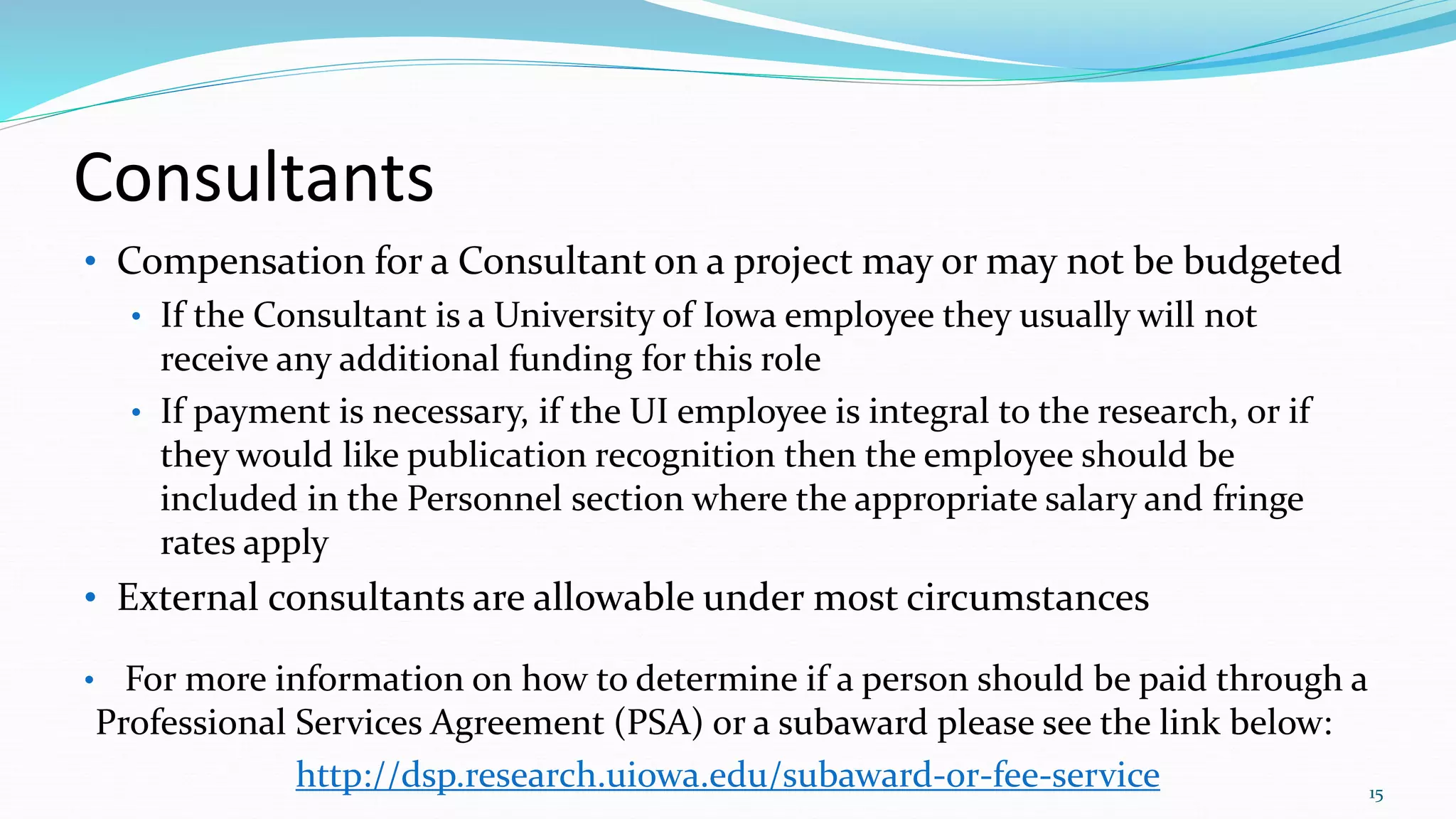
• Compensation for a Consultant on a project may or may not be budgeted
• If the Consultant is a University of Iowa employee they usually will not
receive any additional funding for this role
• If payment is necessary, if the UI employee is integral to the research, or if
they would like publication recognition then the employee should be
included in the Personnel section where the appropriate salary and fringe
rates apply
• External consultants are allowable under most circumstances
• For more information on how to determine if a person should be paid through a
Professional Services Agreement (PSA) or a subaward please see the link below:
http://dsp.research.uiowa.edu/subaward-or-fee-service 15
Direct Costs
Participant Support Costs
• Includes costs for non-UI participants to attend a sponsored training,
symposium, meeting, or workshop
• Costs may include stipends or subsistence allowances, travel
allowances, and registration fees paid to or on behalf of the participants
such as for a NSF Research Experiences for Undergraduates (REU)
program
• Participant Support Costs are not to be included as part of the MTDC
base for calculating F&A
16
Participant support costs do not include patient
care costs or research subject compensation
Direct Costs
Patient Care Costs
These are costs of routine and ancillary hospital services provided to individuals
participating in research programs
•These are not costs of care that are specifically requested for the project (e.g. lab fees for
special screenings)
•Patient Care Costs are not to be included as part of the MTDC base for calculating F&A
Note: Research scans performed at the MR Research Facility are not considered patient
care costs and are subject to F&A. (Clinical scans are considered patient care costs)
17
Patient care costs are separate from
research subject compensation
Direct Costs
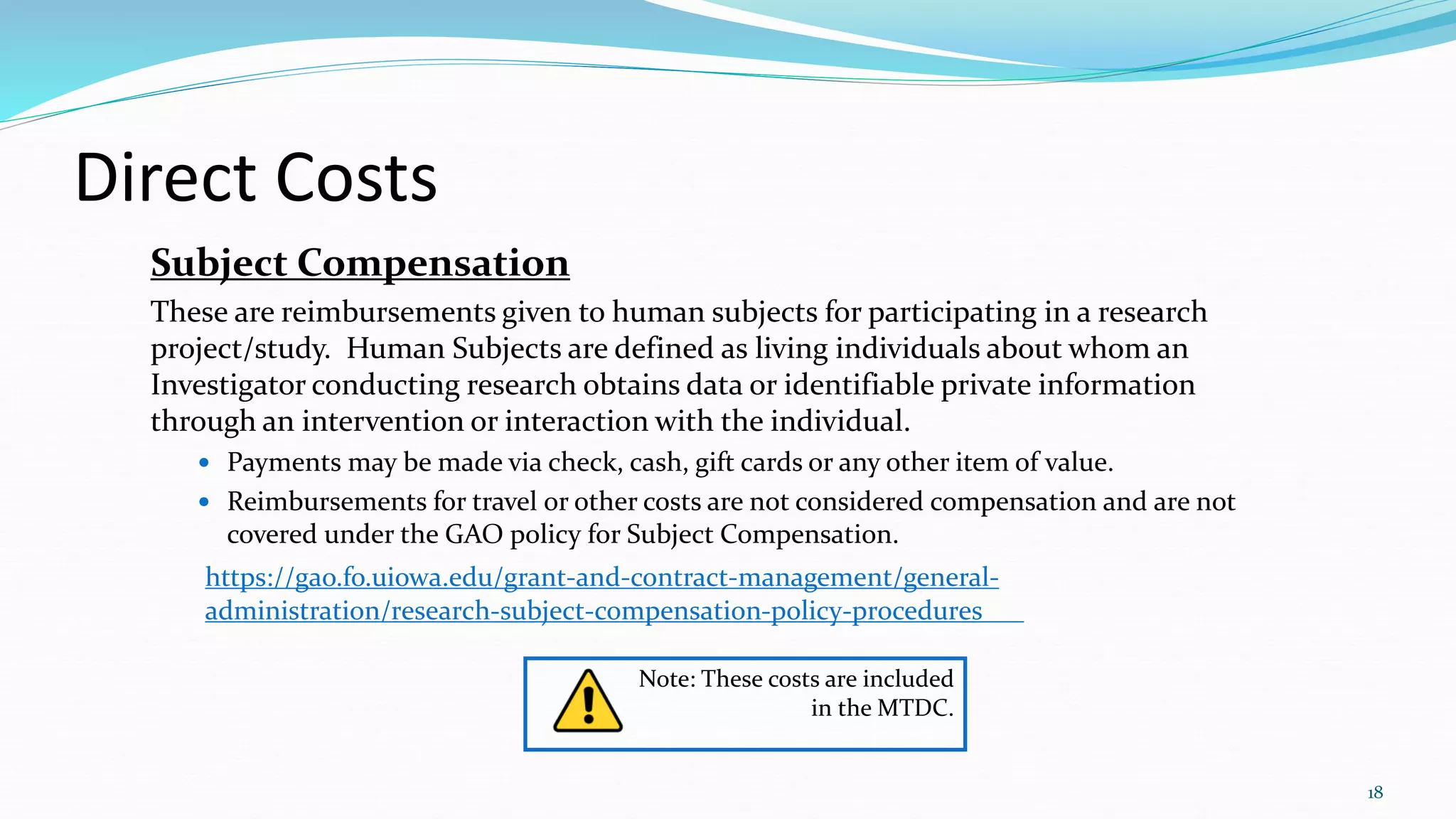
Subject Compensation
These are reimbursements given to human subjects for participating in a research
project/study. Human Subjects are defined as living individuals about whom an
Investigator conducting research obtains data or identifiable private information
through an intervention or interaction with the individual.
 Payments may be made via check, cash, gift cards or any other item of value.
 Reimbursements for travel or other costs are not considered compensation and are not
covered under the GAO policy for Subject Compensation.
https://gao.fo.uiowa.edu/grant-and-contract-management/general-
administration/research-subject-compensation-policy-procedures
18
Note: These costs are included
in the MTDC.
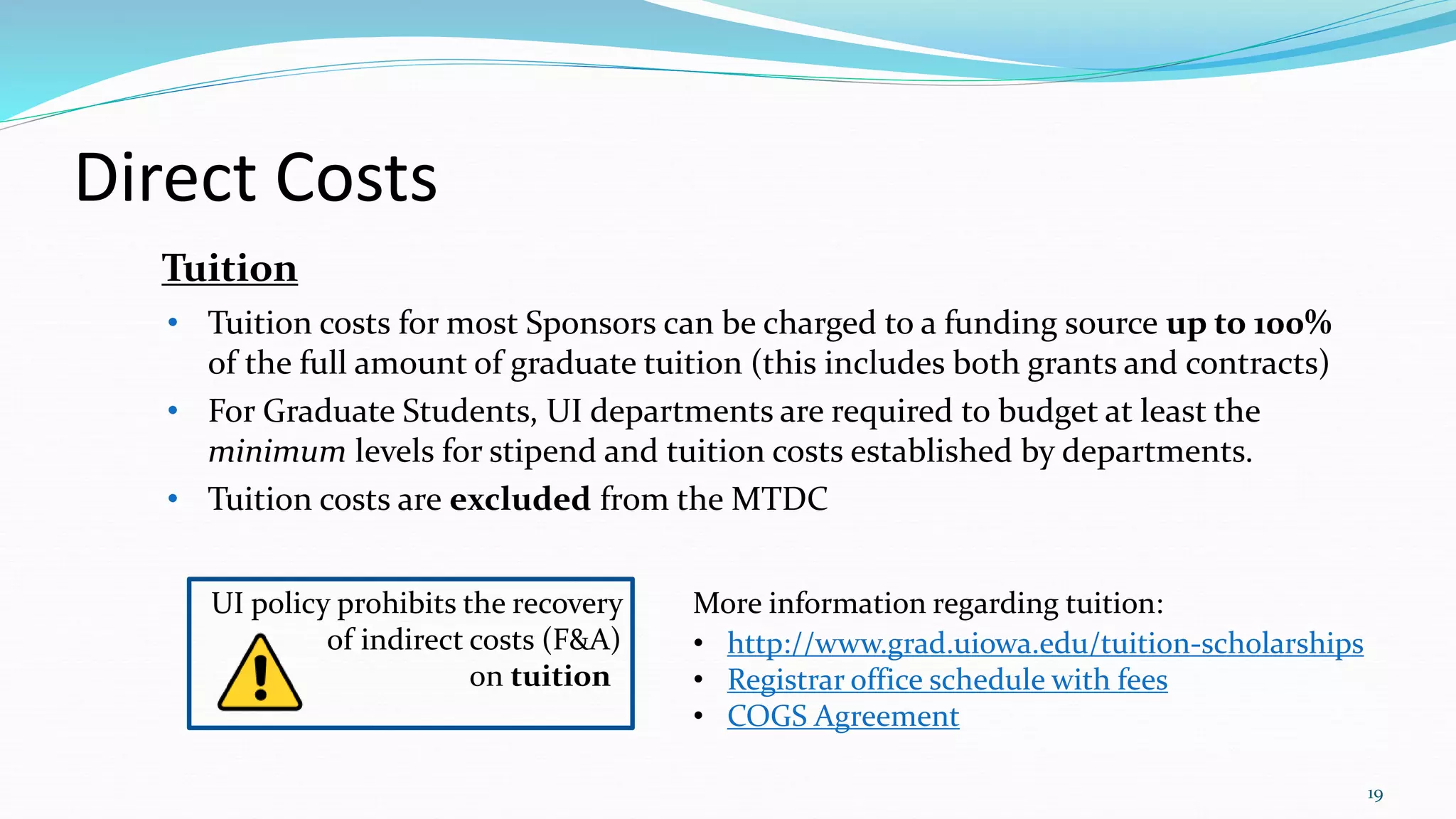
UI policy prohibits the recovery
of indirect costs (F&A)
on tuition-
Direct Costs
• Tuition costs for most Sponsors can be charged to a funding source up to 100%
of the full amount of graduate tuition (this includes both grants and contracts)
• For Graduate Students, UI departments are required to budget at least the
minimum levels for stipend and tuition costs established by departments.
• Tuition costs are excluded from the MTDC
Tuition
19
More information regarding tuition:
• http://www.grad.uiowa.edu/tuition-scholarships
• Registrar office schedule with fees
• COGS Agreement
Indirect Costs
• Indirect costs are those costs that cannot be directly traced to a part of the
project. These costs are also known as Facilities & Administrative (F&A) costs
or overhead
• F&A or Indirect costs are REAL costs that The University of Iowa incurs in
order to operate
Allowable Direct Costs
+ Allowable Indirect Costs (F&A)
= Total Project Costs
Indirect Costs = Modified Total Direct Costs (MTDC) x Appropriate F&A Rate
20
Indirect Costs
• The first step in calculating total indirect costs (F&A) is to determine the
Modified Total Direct Cost base (MTDC)
Determining the MTDC
MTDC = Total Direct Costs - Exclusions
Indirect Costs = Modified Total Direct Costs (MTDC) x Appropriate F&A Rate
Exclusions x
• Equipment ( ≥ 5,000)
• Student tuition remission
• Subcontract costs above $25,000
• Participant support costs
• Scholarships and fellowships
• Patient care costs
• Rental costs of off-site facilities
• Capital expenditures
21
22
Indirect Costs
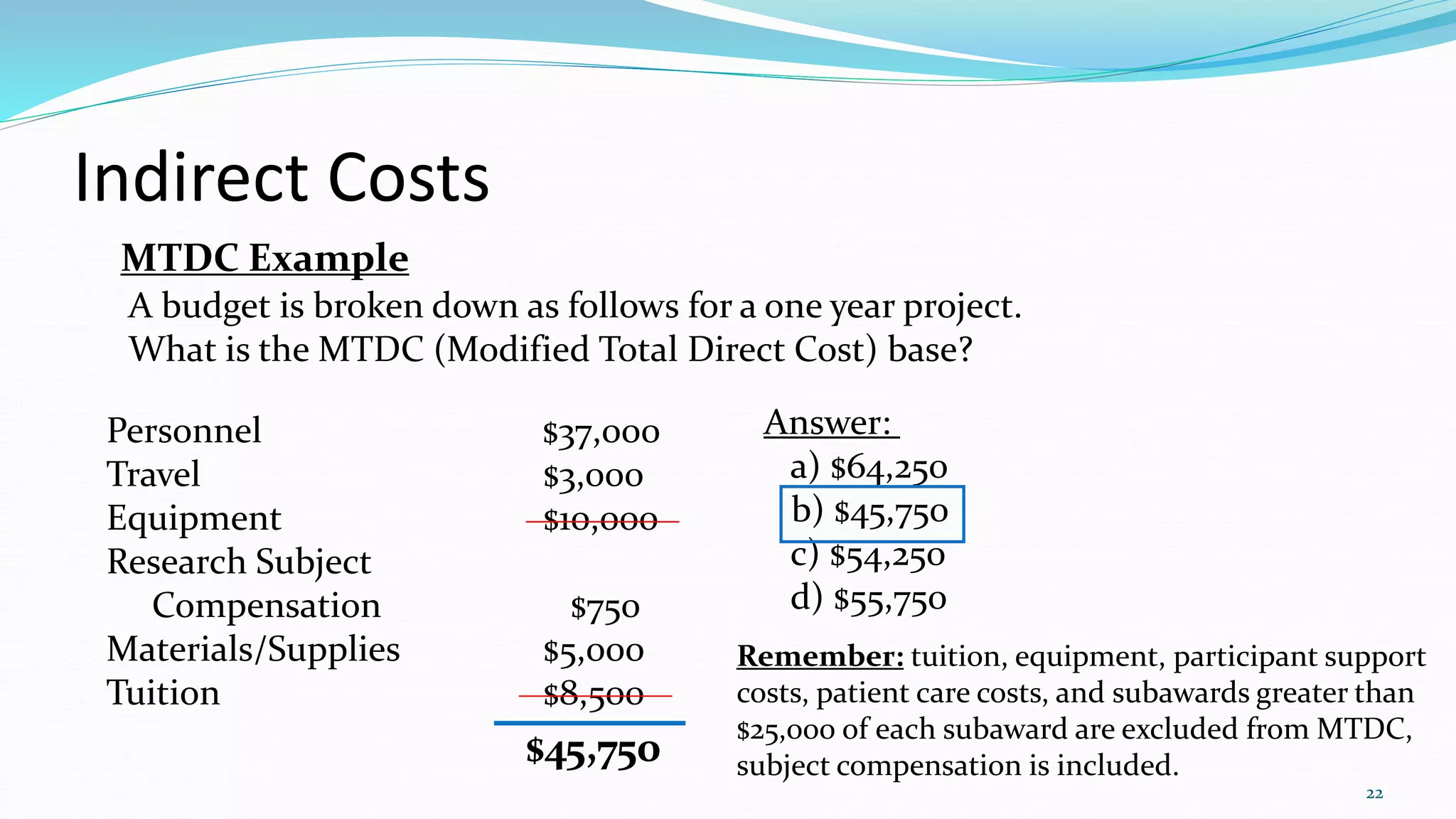
MTDC Example
Personnel $37,000
Travel $3,000
Equipment $10,000
Research Subject
Compensation $750
Materials/Supplies $5,000
Tuition $8,500
$45,750
Answer:
a) $64,250
b) $45,750
c) $54,250
d) $55,750
Remember: tuition, equipment, participant support
costs, patient care costs, and subawards greater than
$25,000 of each subaward are excluded from MTDC,
subject compensation is included.
A budget is broken down as follows for a one year project.
What is the MTDC (Modified Total Direct Cost) base?
Indirect Costs
• Facilities and Administrative
(F&A) rates are established
for reimbursing
institutional overhead and
other expenses associated
with Sponsored Projects
F&A Rates
Indirect Costs = Modified Total Direct Costs (MTDC) x Appropriate F&A Rate
Check to see if the Sponsor limits
or restricts indirect costs from
anything other than the UI
Federally negotiated rates
You can fill out a F&A reduction request form,
but there is no guarantee it will be accepted. For
questions call or email DSP.
http://dsp.research.uiowa.edu/e-forms
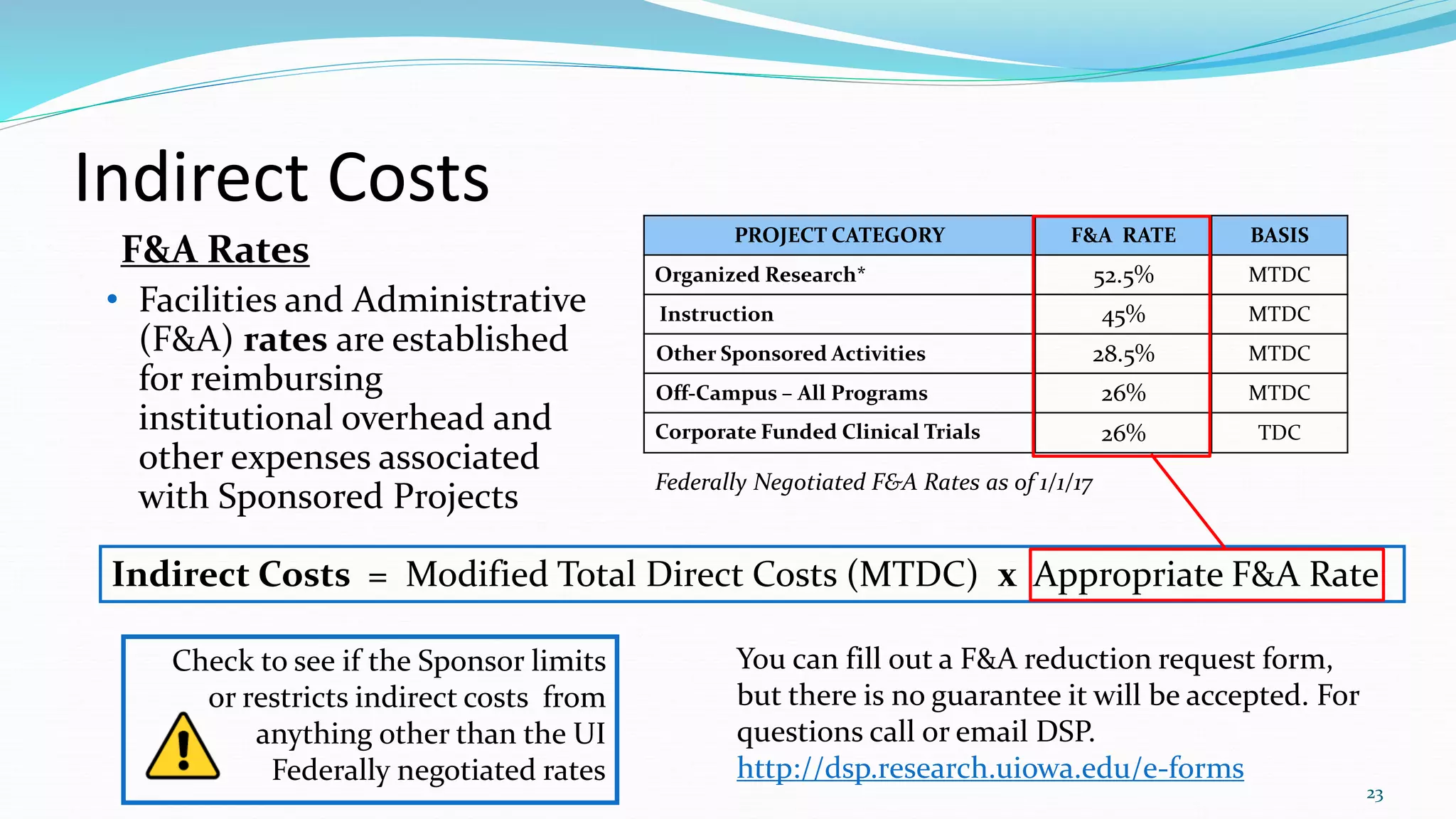
PROJECT CATEGORY F&A RATE BASIS
Organized Research* 52.5% MTDC
Instruction 45% MTDC
Other Sponsored Activities 28.5% MTDC
Off-Campus – All Programs 26% MTDC
Corporate Funded Clinical Trials 26% TDC
Federally Negotiated F&A Rates as of 1/1/17
23
Format the Budget
• Different Sponsors require different formats for budgets
• Check the solicitation and general guidelines to determine if a specific
program, form, or system is required for submission
24
Internal Budget
Remember:
• Apply correct fringe and F&A rates to
both the Sponsor and internal budgets
• The internal budget must match
Sponsor budget categories
• The DSP website has several budget
templates for your convenience
• An internal budget should also be
prepared if the Sponsor’s budget is not
detailed
• The internal budget is extremely
helpful for DSP and Grant Accounting
in their review/post-award
management
Format the Budget
Cayuse
25
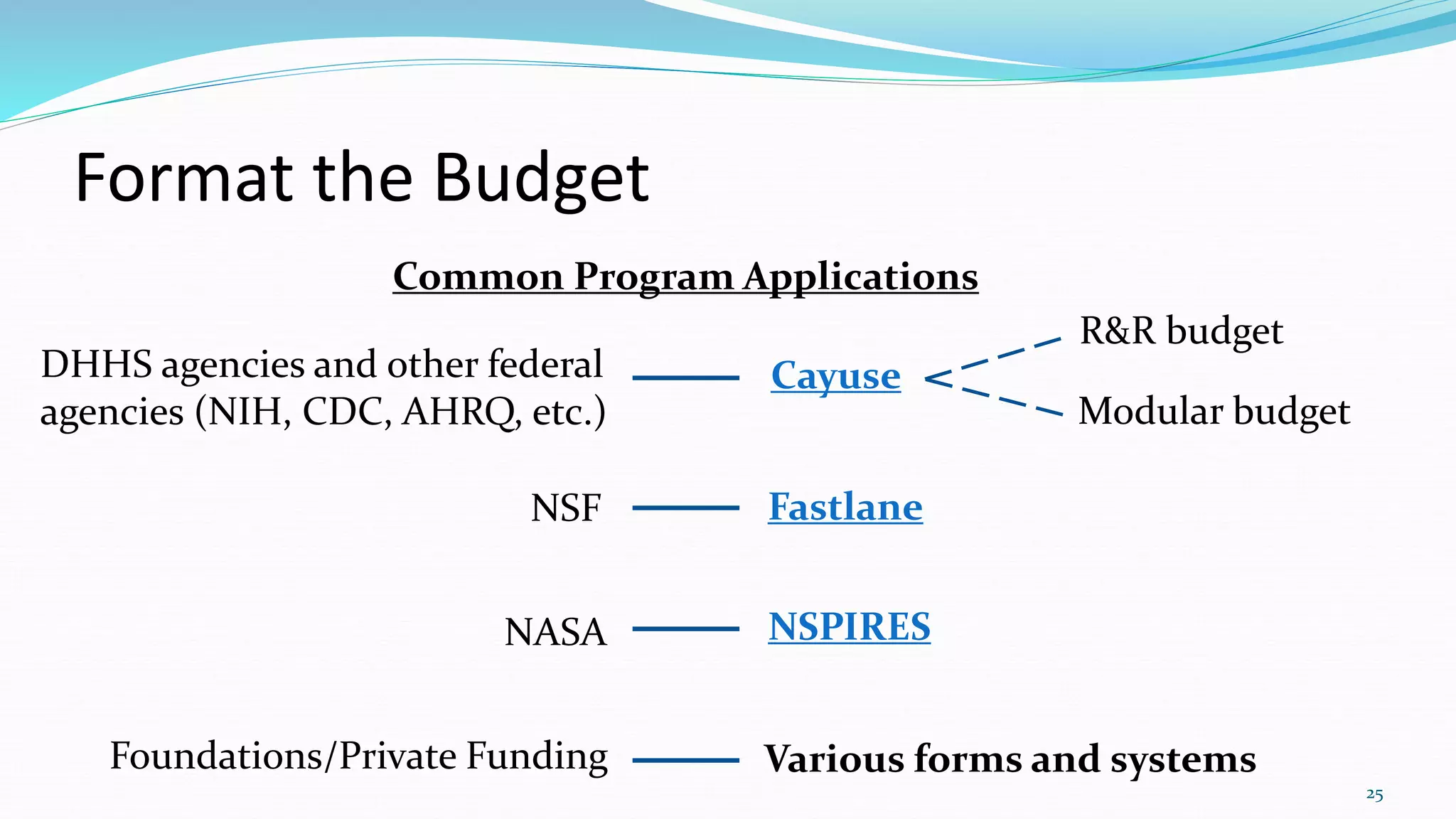
Common Program Applications
DHHS agencies and other federal
agencies (NIH, CDC, AHRQ, etc.)
NSF
NASA
Foundations/Private Funding
NSPIRES
Various forms and systems
Fastlane
Modular budget
R&R budget
Budget Justification
A Budget
Justification
template is
available here
Budget Justification writing tips:
• Follow the Sponsor proposal instructions closely
• Organize and align budget items for ease of review
• Provide adequate detail for items on the budget
• Explain why every cost/cost category on the budget
is needed to accomplish the proposed project
• Make it clear that all budget requests are reasonable
and consistent with Sponsor and University guidelines
Budgets usually require justification that is a narrative explanation designed to
help the Sponsor evaluate the expenses proposed for the project
26
NIH Modular Budgets
27
When can you use the NIH
Modular budget format?
• R01, R03, R15, R21, and R34
programs allow modular budgets
(however, AHRQ does not accept
modular budgets)
• Project direct costs must be
$250,000/year or less
How to budget?
1. Request DIRECT costs in $25,000
increments
a) Subaward/Consortium direct costs
are included in these increments
b) Subaward/Consortium indirect
costs are added on a separate line
on the modular budget
2. INDIRECT costs are calculated based
off the MTDC
If the budget is less than $250,000
per year and using R&R, check the
solicitation/FOA to make sure R&R
may be used.
NIH Modular Budgets
28
Budget Justification
29
Modular Budget Justification
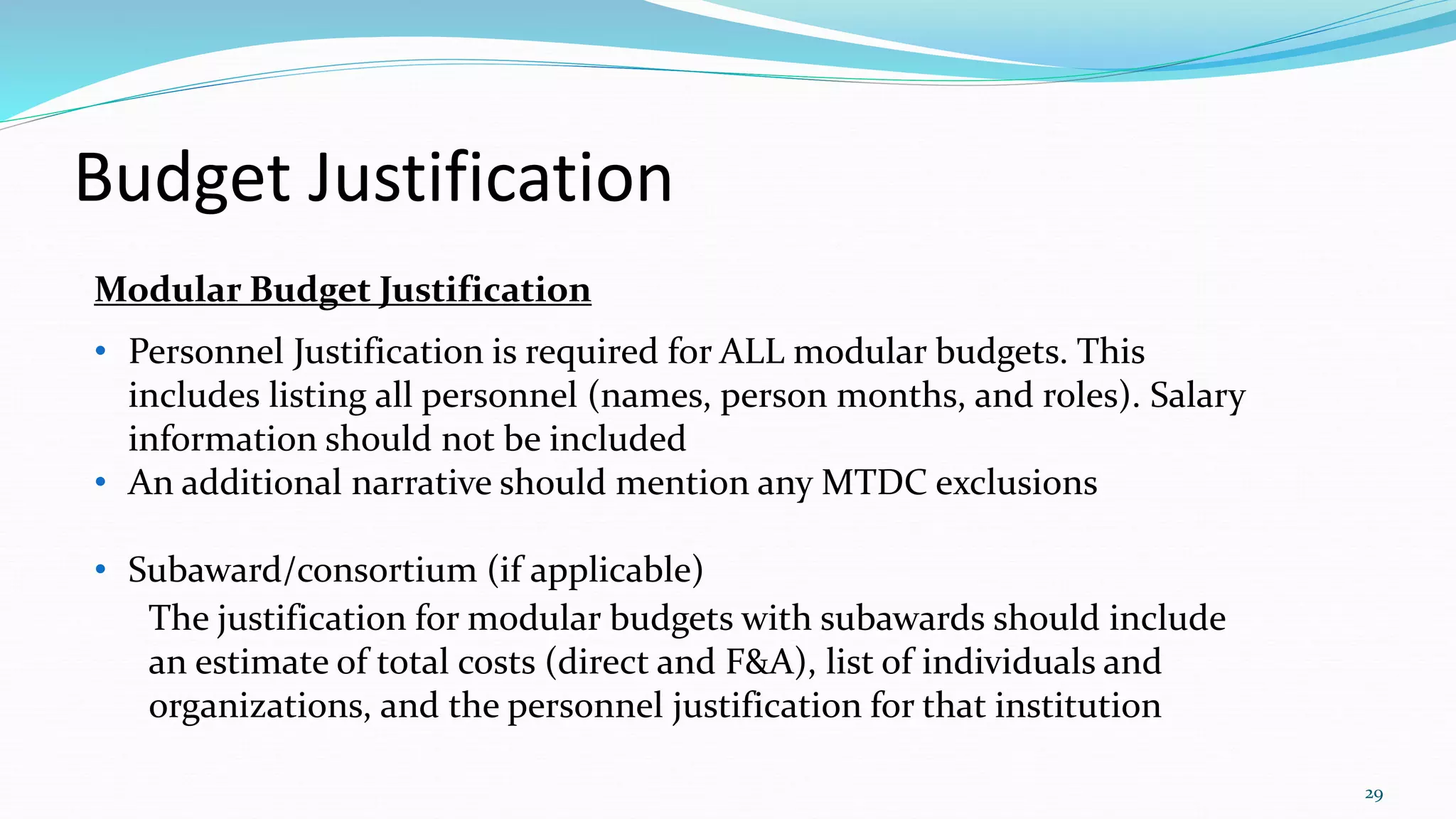
• Personnel Justification is required for ALL modular budgets. This
includes listing all personnel (names, person months, and roles). Salary
information should not be included
• An additional narrative should mention any MTDC exclusions
• Subaward/consortium (if applicable)
The justification for modular budgets with subawards should include
an estimate of total costs (direct and F&A), list of individuals and
organizations, and the personnel justification for that institution
Routing Form
30
Initial Year
ALL costs for
ALL budget years
Cost Share
31
*
Sponsors may
require cost share
32
Indirect Costs = Modified Total Direct
Costs (MTDC) x Appropriate F&A Rate
Summary
Allowable Direct Costs
+ Allowable Indirect Costs (F&A)
= Total Project Costs
5 Steps for Creating a Budget
1. Review solicitation and guidelines
from the Sponsor
2. Determine and compute the
allowable direct costs
3. Calculate the allowable
indirect costs
4. Develop and format the budget
5. Create a Budget Justification
Information regarding the MTDC basis and the
F&A Rate Agreement can be found here.
Resources
• Fringe Rates
• F&A Rate Decision Tool
• F&A Rates
• UIRIS (University of Iowa
Research Information System)
• SPRIE (Sponsored Projects
Research Information
Electronically)
• DSP Policies and Procedures
• Cayuse
• Fastlane
• NSPIRES
• Research.gov
• Other e-Systems
• Budget Templates
• Budget Justification Template
33
Resources
• Further questions? Start at the DSP website:
http://dsp.research.uiowa.edu/

DSP Office Phone #: 319-335-2123
DSP email: dsp@uiowa.edu
DSP Staff Contact List (specific agency questions)
DSP Frequently Needed Information
DSP Budget Preparation Information
Grant Accounting Office Staff Contact List
Grant Accounting Office Phone #: (319) 335-0062
34
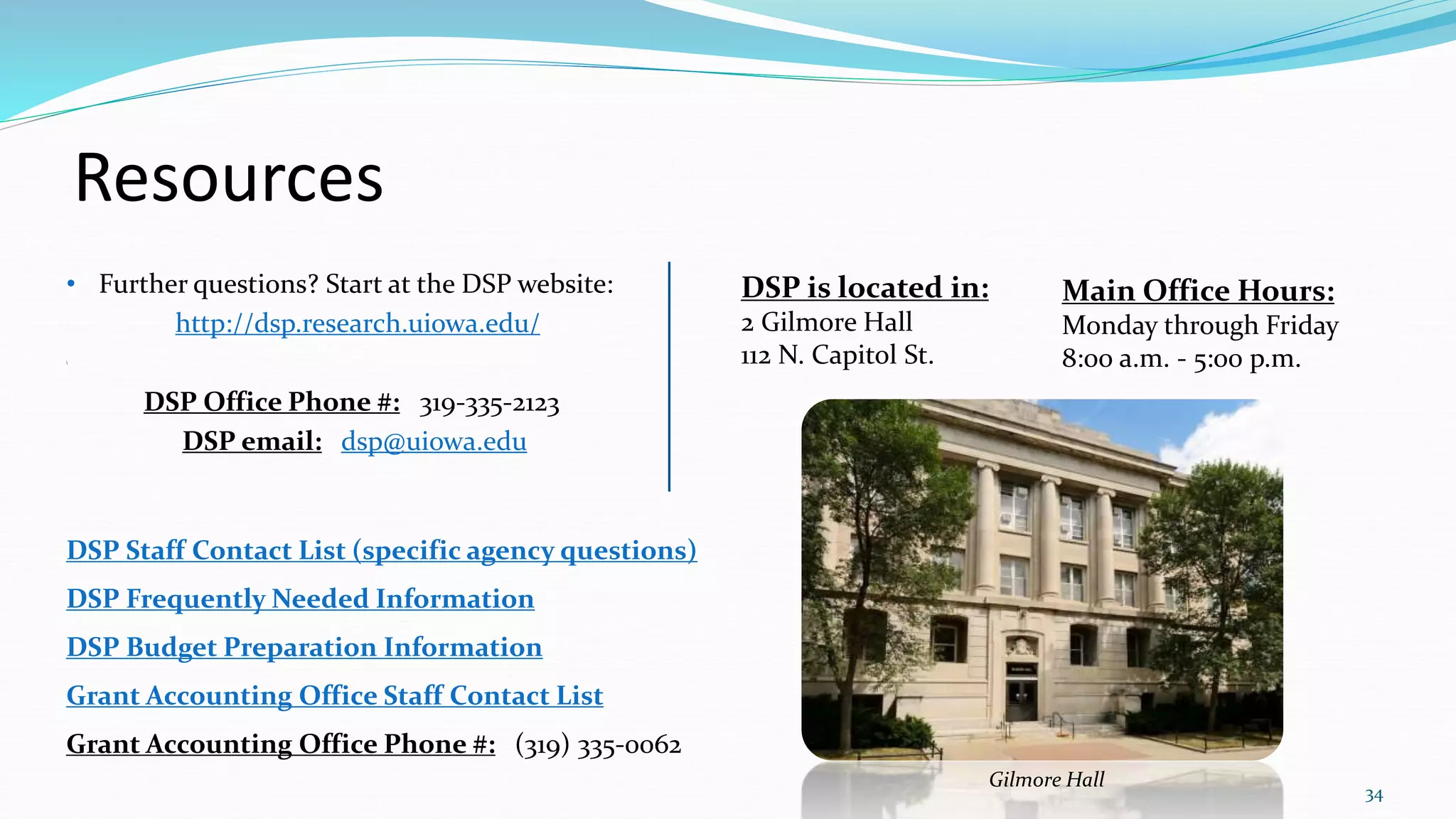
DSP is located in:
2 Gilmore Hall
112 N. Capitol St.
Main Office Hours:
Monday through Friday
8:00 a.m. - 5:00 p.m.
Gilmore Hall
Thank You
35

Budget Prepation Powerpoint - 020717.ppt

  • 2.
    What is aBudget? • Best estimate of financial resources needed to accomplish a project • Includes a Budget Justification which provides an explanation of included costs Allowable means the costs are: • Reasonable* • Allocable* • Consistently applied* • Agreeable with Sponsor specifications Allowable Direct Costs + Allowable Indirect Costs (F&A) = Total Project Costs *These terms are taken from the Uniform Guidance 2
  • 3.
    Creating a Budget Reviewsolicitation and guidelines from the Sponsor Determine and compute the allowable direct costs Calculate the allowable indirect costs Develop and format the budget Create a Budget Justification 1 2 3 4 5 3
  • 4.
    Review Solicitation andGuidelines Review: • Sponsor Guidelines • The Solicitation • Request for Proposal (RFP) Look for: • Min./Max. Duration of the project • Floor/Ceiling for budget • Budget limitations and restrictions Specific Sponsor/application questions? Utilize the appropriate DSP contact It is helpful to note the specific proposal you are applying for in the internal budget 4
  • 5.
    Review Solicitation andGuidelines • You will need to create and submit any budget that is necessary for the Sponsor (formats/specifications vary from Sponsor to Sponsor) • A budget justification will most likely need to be included with the budget. • Check to see if the solicitation requires mandatory cost share; if not do not include cost sharing as part of the budget 5 Keep in Mind: An internal budget may also need to be prepared alongside the Sponsor budget An internal budget provides an opportunity to include more details that a Sponsor budget may not require Why?
  • 6.
    • Determine andspecify what direct expenses fit within the Sponsor guidelines and are necessary to complete the project 6 Common Direct Costs • Salary/wages and fringe benefits for all personnel (including students) • Travel costs (both domestic and foreign) • Equipment ( ≥ $5,000) • Materials and supplies • Subawards (direct and indirect costs) Other Direct Costs • Tuition • Participant support costs • Research Subject Compensation • Publication costs • Consultant services • Patient care costs • Computer service center charges Direct Costs This list is not all-inclusive
  • 7.
    Direct Costs • Seekassistance from your HR rep. in determining salary base 7 Sponsors may impose a salary cap An effort to months conversion table is available here Personnel Costs – Salary/Wage Expenses • Salary is calculated using 3 basic salary/wage bases: • Calendar Year (CY) – 12 months • Academic Year (AY) – 9 months • Summer Term – 1-3 months
  • 8.
    Direct Costs 8 Personnel Costs– Effort Calculations (2) Principal Investigator (PI) • CY appointment, Salary of $72,000 • Monthly salary of $6,000 (one- twelfth of total CY salary) • 25% of the CY effort would equate to 3 CY months (12x.25=3) • The budget figure for that effort would be $18,000 (6,000 multiplied by 3 CY months) (1) Principal Investigator (PI) • AY appointment, Salary of $63,000 • Monthly salary of $7,000 (one-ninth of the AY) • 25% of the AY effort would equate to 2.25 AY person months (9x.25=2.25) • The budget figure for that effort would be $15,750 (7,000 multiplied by 2.25 AY months)
  • 9.
    Direct Costs Personnel Costs– Salary Cap 9 • Specific Sponsors or awards may limit personnel salaries • It is recommended that salaries be increased at a rate of 3% per year when making future year budget estimates Example PI salary: $200,000/year Salary Cap =$185,100 (subject to change) If the effort on the project is 25%, determine the amount of salary based on the Salary Cap, not the actual salary of the PI $185,100 x 25% = $46,275 $200,000 x 25% = $50,000  The difference of $3,725 would need to be covered by the individual’s UI Department NIH Salary Cap Information can be found here. ($185,100 in FY2016)**
  • 10.
    Direct Costs Personnel Costs– Fringe Benefits 10 Current/Projected Fringe Benefit Rates can be found here Fringe benefits include: • Social Security • University Retirement Programs • Life Insurance • Health Insurance • Disability Insurance • Etc. Contact your HR representative for help with determining appropriate fringe “rate pools” Rate Pools FY 2017 FY 2018 Projected FY 2019 Projected FY 2020 Projected Clinical Faculty 23.02% 23.70% 23.40% 24.00% Graduate Assistants 19.63% 23.00% 24.00% 25.00% Post Docs 19.63% 23.00% 24.00% 25.00% Example of some rate pools and rates
  • 11.
    Direct Costs The budgetshould specify the: • # of trips/days/people • per diem rates for food and hotel • transportation costs • destination(s) More information about specific costs, rates, etc. can be found directly from the Sponsor or at http://www.uiowa.edu/ap-purchasing/travel Travel – Domestic and Foreign Keep in Mind: • Allowances for air travel should not exceed round trip coach accommodations • Generally, only persons participating directly in the research may travel on grant funds • Sponsors require adequate justification on requested travel expenses – foreign travel, especially • Sponsor guidelines may establish rates for specific costs. Use the more restrictive rate when UIowa rate differs Note: Specifics may be unknown at time of proposal 11
  • 12.
    Direct Costs Equipment costsinclude expenses for equipment items (useful year: 2 years) that individually cost $5,000 or more. Only allowable if it will be dedicated solely to the project. (Not intended for general office equipment, copiers, office furniture, etc.) Equipment – $5,000 or more More information on Equipment can be found on the Capital Asset Management (CAM) website or the DSP website: http://cam.fo.uiowa.edu/content/policies-and-procedures http://dsp.research.uiowa.edu/equipment UI policy prohibits the recovery of indirect costs (F&A) on direct costs classified as equipment Materials and Supplies • The expendable equipment (equipment costing less than $5,000) and supplies required for the project should be indicated with estimated costs • There should be a breakdown of these items by general classification • Sponsor guidelines usually indicate what needs to be itemized and justified 12
  • 13.
    Direct Costs Subawards: A subawardis needed when the UI Department or Principal Investigator would like to collaborate with a colleague at a different entity to complete the goals of the project • See Sponsor Guidelines or policy for any restrictions on F&A • The UI is allowed to recover indirect costs (F&A) on the first $25,000 of each individual subaward for new or competitive proposals • Once the subaward’s total costs (which includes direct and indirect costs) reaches $25,000 the remaining subaward costs will be removed from the modified total direct costs bases (MTDC) in subsequent years for the UI 13 Subaward Direct Costs + Subaward Indirect Costs = Total Subaward The total subaward costs are included in the UI Direct Costs Indirect costs recovered against first $25,000 of each new/competitive subaward
  • 14.
    Direct Costs Subaward Example: Asubaward has the following amounts in the first 3 years of a Sponsored Project: Year 1: $12,000 Year 2: $15,000 Year 3: $17,000 What amounts would be included in the UI MTDC? 14 In year 1 the full $12,000 is included in the UI MTDC, but in year 2 only the first $13,000 is included in the UI MTDC, and none of year 3 subaward costs would be included in the UI MTDC More information regarding subawards can be found here: http://dsp.research.uiowa.edu/subawards-university-iowa
  • 15.
    Consultants • Compensation fora Consultant on a project may or may not be budgeted • If the Consultant is a University of Iowa employee they usually will not receive any additional funding for this role • If payment is necessary, if the UI employee is integral to the research, or if they would like publication recognition then the employee should be included in the Personnel section where the appropriate salary and fringe rates apply • External consultants are allowable under most circumstances • For more information on how to determine if a person should be paid through a Professional Services Agreement (PSA) or a subaward please see the link below: http://dsp.research.uiowa.edu/subaward-or-fee-service 15
  • 16.
    Direct Costs Participant SupportCosts • Includes costs for non-UI participants to attend a sponsored training, symposium, meeting, or workshop • Costs may include stipends or subsistence allowances, travel allowances, and registration fees paid to or on behalf of the participants such as for a NSF Research Experiences for Undergraduates (REU) program • Participant Support Costs are not to be included as part of the MTDC base for calculating F&A 16 Participant support costs do not include patient care costs or research subject compensation
  • 17.
    Direct Costs Patient CareCosts These are costs of routine and ancillary hospital services provided to individuals participating in research programs •These are not costs of care that are specifically requested for the project (e.g. lab fees for special screenings) •Patient Care Costs are not to be included as part of the MTDC base for calculating F&A Note: Research scans performed at the MR Research Facility are not considered patient care costs and are subject to F&A. (Clinical scans are considered patient care costs) 17 Patient care costs are separate from research subject compensation
  • 18.
    Direct Costs Subject Compensation Theseare reimbursements given to human subjects for participating in a research project/study. Human Subjects are defined as living individuals about whom an Investigator conducting research obtains data or identifiable private information through an intervention or interaction with the individual.  Payments may be made via check, cash, gift cards or any other item of value.  Reimbursements for travel or other costs are not considered compensation and are not covered under the GAO policy for Subject Compensation. https://gao.fo.uiowa.edu/grant-and-contract-management/general- administration/research-subject-compensation-policy-procedures 18 Note: These costs are included in the MTDC.
  • 19.
    UI policy prohibitsthe recovery of indirect costs (F&A) on tuition- Direct Costs • Tuition costs for most Sponsors can be charged to a funding source up to 100% of the full amount of graduate tuition (this includes both grants and contracts) • For Graduate Students, UI departments are required to budget at least the minimum levels for stipend and tuition costs established by departments. • Tuition costs are excluded from the MTDC Tuition 19 More information regarding tuition: • http://www.grad.uiowa.edu/tuition-scholarships • Registrar office schedule with fees • COGS Agreement
  • 20.
    Indirect Costs • Indirectcosts are those costs that cannot be directly traced to a part of the project. These costs are also known as Facilities & Administrative (F&A) costs or overhead • F&A or Indirect costs are REAL costs that The University of Iowa incurs in order to operate Allowable Direct Costs + Allowable Indirect Costs (F&A) = Total Project Costs Indirect Costs = Modified Total Direct Costs (MTDC) x Appropriate F&A Rate 20
  • 21.
    Indirect Costs • Thefirst step in calculating total indirect costs (F&A) is to determine the Modified Total Direct Cost base (MTDC) Determining the MTDC MTDC = Total Direct Costs - Exclusions Indirect Costs = Modified Total Direct Costs (MTDC) x Appropriate F&A Rate Exclusions x • Equipment ( ≥ 5,000) • Student tuition remission • Subcontract costs above $25,000 • Participant support costs • Scholarships and fellowships • Patient care costs • Rental costs of off-site facilities • Capital expenditures 21
  • 22.
    22 Indirect Costs MTDC Example Personnel$37,000 Travel $3,000 Equipment $10,000 Research Subject Compensation $750 Materials/Supplies $5,000 Tuition $8,500 $45,750 Answer: a) $64,250 b) $45,750 c) $54,250 d) $55,750 Remember: tuition, equipment, participant support costs, patient care costs, and subawards greater than $25,000 of each subaward are excluded from MTDC, subject compensation is included. A budget is broken down as follows for a one year project. What is the MTDC (Modified Total Direct Cost) base?
  • 23.
    Indirect Costs • Facilitiesand Administrative (F&A) rates are established for reimbursing institutional overhead and other expenses associated with Sponsored Projects F&A Rates Indirect Costs = Modified Total Direct Costs (MTDC) x Appropriate F&A Rate Check to see if the Sponsor limits or restricts indirect costs from anything other than the UI Federally negotiated rates You can fill out a F&A reduction request form, but there is no guarantee it will be accepted. For questions call or email DSP. http://dsp.research.uiowa.edu/e-forms PROJECT CATEGORY F&A RATE BASIS Organized Research* 52.5% MTDC Instruction 45% MTDC Other Sponsored Activities 28.5% MTDC Off-Campus – All Programs 26% MTDC Corporate Funded Clinical Trials 26% TDC Federally Negotiated F&A Rates as of 1/1/17 23
  • 24.
    Format the Budget •Different Sponsors require different formats for budgets • Check the solicitation and general guidelines to determine if a specific program, form, or system is required for submission 24 Internal Budget Remember: • Apply correct fringe and F&A rates to both the Sponsor and internal budgets • The internal budget must match Sponsor budget categories • The DSP website has several budget templates for your convenience • An internal budget should also be prepared if the Sponsor’s budget is not detailed • The internal budget is extremely helpful for DSP and Grant Accounting in their review/post-award management
  • 25.
    Format the Budget Cayuse 25 CommonProgram Applications DHHS agencies and other federal agencies (NIH, CDC, AHRQ, etc.) NSF NASA Foundations/Private Funding NSPIRES Various forms and systems Fastlane Modular budget R&R budget
  • 26.
    Budget Justification A Budget Justification templateis available here Budget Justification writing tips: • Follow the Sponsor proposal instructions closely • Organize and align budget items for ease of review • Provide adequate detail for items on the budget • Explain why every cost/cost category on the budget is needed to accomplish the proposed project • Make it clear that all budget requests are reasonable and consistent with Sponsor and University guidelines Budgets usually require justification that is a narrative explanation designed to help the Sponsor evaluate the expenses proposed for the project 26
  • 27.
    NIH Modular Budgets 27 Whencan you use the NIH Modular budget format? • R01, R03, R15, R21, and R34 programs allow modular budgets (however, AHRQ does not accept modular budgets) • Project direct costs must be $250,000/year or less How to budget? 1. Request DIRECT costs in $25,000 increments a) Subaward/Consortium direct costs are included in these increments b) Subaward/Consortium indirect costs are added on a separate line on the modular budget 2. INDIRECT costs are calculated based off the MTDC If the budget is less than $250,000 per year and using R&R, check the solicitation/FOA to make sure R&R may be used.
  • 28.
  • 29.
    Budget Justification 29 Modular BudgetJustification • Personnel Justification is required for ALL modular budgets. This includes listing all personnel (names, person months, and roles). Salary information should not be included • An additional narrative should mention any MTDC exclusions • Subaward/consortium (if applicable) The justification for modular budgets with subawards should include an estimate of total costs (direct and F&A), list of individuals and organizations, and the personnel justification for that institution
  • 30.
    Routing Form 30 Initial Year ALLcosts for ALL budget years
  • 31.
  • 32.
    32 Indirect Costs =Modified Total Direct Costs (MTDC) x Appropriate F&A Rate Summary Allowable Direct Costs + Allowable Indirect Costs (F&A) = Total Project Costs 5 Steps for Creating a Budget 1. Review solicitation and guidelines from the Sponsor 2. Determine and compute the allowable direct costs 3. Calculate the allowable indirect costs 4. Develop and format the budget 5. Create a Budget Justification Information regarding the MTDC basis and the F&A Rate Agreement can be found here.
  • 33.
    Resources • Fringe Rates •F&A Rate Decision Tool • F&A Rates • UIRIS (University of Iowa Research Information System) • SPRIE (Sponsored Projects Research Information Electronically) • DSP Policies and Procedures • Cayuse • Fastlane • NSPIRES • Research.gov • Other e-Systems • Budget Templates • Budget Justification Template 33
  • 34.
    Resources • Further questions?Start at the DSP website: http://dsp.research.uiowa.edu/ DSP Office Phone #: 319-335-2123 DSP email: dsp@uiowa.edu DSP Staff Contact List (specific agency questions) DSP Frequently Needed Information DSP Budget Preparation Information Grant Accounting Office Staff Contact List Grant Accounting Office Phone #: (319) 335-0062 34 DSP is located in: 2 Gilmore Hall 112 N. Capitol St. Main Office Hours: Monday through Friday 8:00 a.m. - 5:00 p.m. Gilmore Hall
  • 35.

Editor's Notes

  • #10 This rate is consistent with the rate established by NIH and is considered an acceptable rate to most federal agencies. When dealing with the NIH salary cap in particular, DSP will accept budgets that abide by the salary cap as well as those that choose to escalate the salary cap over the project period. Be aware that if the proposal is funded, NIH will look at the current salary cap and fund no more than the effort needed for the current salary cap.
  • #16 Refrain from mentioning consultant compensation as an “honorarium”