BUDGETARY DEFICIT CONTROL
What is budget?
Budget is an organized plan in monetary terms
What is budgetary deficit?
A budget deficit is the amount by which an
individual, business, or government's income
falls short of the expectations set forth in its
budget over a given time period
TYPES OF BUDGETARY DEFICIT?
 Cyclic budgetary deficit
 Early budgetary deficit
 Structural budgetary deficit
FINANCING A DEFICIT
 The government can borrow from
 Private sector (e.g. sale of bonds): expansionary
 Reserve Bank (‘printing money’): money supply
up
 Public (sale of securities to the public): neutral
 Overseas
 Public sector borrowing requirement (PSBR)
increases in a budget deficit situation
 ‘Crowding-out’ (drain in the pool of funds available
for private borrowers)
WHY DO DEFICIT OCCURS?
Lack of availably of cash to cover the
expenses
Accounts payable
Delay in collection of sales
Sales down tum forecast
CAUSES OF BUDGETARY DEFICIT
 Composition of Spending May Not Be
Appropriate
 Fixed Exchange Rate
 Economic Growth
 Decline in Competitiveness
 Higher inflation
 Recession in other countries.
 Borrowing money
LIMITATIONS OF BUDGETS AND
BUDGETARY CONTROL
 the benefit of the budget must exceed the cost
 budget information may not be accurate
 budgets may lead to disfunctional management
 budgets may be set at too low a level
ECONOMIC EFFECTS OF A BUDGET DEFICIT
•Higher debt interest payments
•Higher Taxes and lower spending
•Increased Interest rates
•Inflation
•Increased borrowing
GOVERNMENT DEFICIT : GOOD OR BAD
good
 If the government borrows
 to deal with a severe recession
 help self defense
 spends on public investment
 (in infrastructure, education, basic research, or public
health)
Bad
 If the deficit finances wasteful expenditure
BUDGET DEFICIT MAY DROP TO 4.5%
 India may be able to cut its fiscal deficit to 4.5
per cent of GDP by March 2011 due to revenues
from 3G auctions and robust economic growth.
 3G auctions by themselves had the potential to
cut the deficit by about 100 basis points by
March 2011. He also said the government was
"very keen" to restrict India's fiscal deficit.
IMPLICATIONS OF HEAVILY BUDGET
DEFICIT IN INDIA
 Economic growth in impeded,
 Real incomes of the people is lower than their
apparent incomes,
 Inflation in prices of commodities makes life of
common people miserable,
 higher government borrowing, preventing a
decline in interest rates.
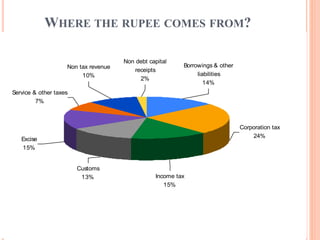
WHERE THE RUPEE COMES FROM?
12
GEN0190n.ppt
Service & other taxes
7%
Borrowings & other
liabilities
14%
Corporation tax
24%
Income tax
15%
Customs
13%
Excise
15%
Non tax revenue
10%
Non debt capital
receipts
2%
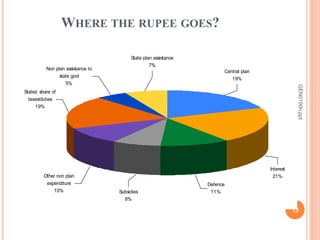
WHERE THE RUPEE GOES?
13
GEN0190n.ppt
State plan assistance
7%
Non plan assistance to
state govt
5%
Other non plan
expenditure
10% Subsidies
8%
Defence
11%
Interest
21%
Central plan
19%
States’ share of
taxes/duties
19%
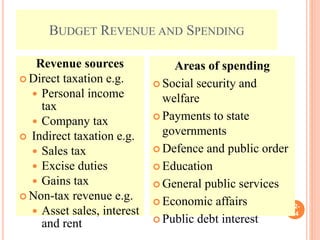
BUDGET REVENUE AND SPENDING
22-
14
Revenue sources
 Direct taxation e.g.
 Personal income
tax
 Company tax
 Indirect taxation e.g.
 Sales tax
 Excise duties
 Gains tax
 Non-tax revenue e.g.
 Asset sales, interest
and rent
Areas of spending
 Social security and
welfare
 Payments to state
governments
 Defence and public order
 Education
 General public services
 Economic affairs
 Public debt interest
MEASURES
 Proper planning before implementing
 Additional training provided to finance staff
 More concentration on tracking each activities
to reduce corruption
 Futuristic approach rather than considering only
the present scenario
CONCLUSION
 Its difficult to eradicate deficit but by employing
proper measures it can be reduced to
considerable extent.

Budgetary deficit control

  • 1.
  • 2.
    What is budget? Budgetis an organized plan in monetary terms What is budgetary deficit? A budget deficit is the amount by which an individual, business, or government's income falls short of the expectations set forth in its budget over a given time period
  • 3.
    TYPES OF BUDGETARYDEFICIT?  Cyclic budgetary deficit  Early budgetary deficit  Structural budgetary deficit
  • 4.
    FINANCING A DEFICIT The government can borrow from  Private sector (e.g. sale of bonds): expansionary  Reserve Bank (‘printing money’): money supply up  Public (sale of securities to the public): neutral  Overseas  Public sector borrowing requirement (PSBR) increases in a budget deficit situation  ‘Crowding-out’ (drain in the pool of funds available for private borrowers)
  • 5.
    WHY DO DEFICITOCCURS? Lack of availably of cash to cover the expenses Accounts payable Delay in collection of sales Sales down tum forecast
  • 6.
    CAUSES OF BUDGETARYDEFICIT  Composition of Spending May Not Be Appropriate  Fixed Exchange Rate  Economic Growth  Decline in Competitiveness  Higher inflation  Recession in other countries.  Borrowing money
  • 7.
    LIMITATIONS OF BUDGETSAND BUDGETARY CONTROL  the benefit of the budget must exceed the cost  budget information may not be accurate  budgets may lead to disfunctional management  budgets may be set at too low a level
  • 8.
    ECONOMIC EFFECTS OFA BUDGET DEFICIT •Higher debt interest payments •Higher Taxes and lower spending •Increased Interest rates •Inflation •Increased borrowing
  • 9.
    GOVERNMENT DEFICIT :GOOD OR BAD good  If the government borrows  to deal with a severe recession  help self defense  spends on public investment  (in infrastructure, education, basic research, or public health) Bad  If the deficit finances wasteful expenditure
  • 10.
    BUDGET DEFICIT MAYDROP TO 4.5%  India may be able to cut its fiscal deficit to 4.5 per cent of GDP by March 2011 due to revenues from 3G auctions and robust economic growth.  3G auctions by themselves had the potential to cut the deficit by about 100 basis points by March 2011. He also said the government was "very keen" to restrict India's fiscal deficit.
  • 11.
    IMPLICATIONS OF HEAVILYBUDGET DEFICIT IN INDIA  Economic growth in impeded,  Real incomes of the people is lower than their apparent incomes,  Inflation in prices of commodities makes life of common people miserable,  higher government borrowing, preventing a decline in interest rates.
  • 12.
    WHERE THE RUPEECOMES FROM? 12 GEN0190n.ppt Service & other taxes 7% Borrowings & other liabilities 14% Corporation tax 24% Income tax 15% Customs 13% Excise 15% Non tax revenue 10% Non debt capital receipts 2%
  • 13.
    WHERE THE RUPEEGOES? 13 GEN0190n.ppt State plan assistance 7% Non plan assistance to state govt 5% Other non plan expenditure 10% Subsidies 8% Defence 11% Interest 21% Central plan 19% States’ share of taxes/duties 19%
  • 14.
    BUDGET REVENUE ANDSPENDING 22- 14 Revenue sources  Direct taxation e.g.  Personal income tax  Company tax  Indirect taxation e.g.  Sales tax  Excise duties  Gains tax  Non-tax revenue e.g.  Asset sales, interest and rent Areas of spending  Social security and welfare  Payments to state governments  Defence and public order  Education  General public services  Economic affairs  Public debt interest
  • 15.
    MEASURES  Proper planningbefore implementing  Additional training provided to finance staff  More concentration on tracking each activities to reduce corruption  Futuristic approach rather than considering only the present scenario
  • 16.
    CONCLUSION  Its difficultto eradicate deficit but by employing proper measures it can be reduced to considerable extent.