Buddhism

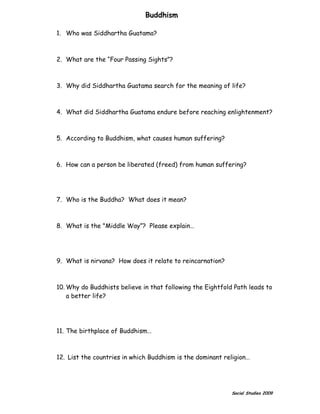
1. Who was Siddhartha Guatama?


2. What are the “Four Passing Sights”?


3. Why did Siddhartha Guatama search for the meaning of life?


4. What did Siddhartha Guatama endure before reaching enlightenment?


5. According to Buddhism, what causes human suffering?


6. How can a person be liberated (freed) from human suffering?


7. Who is the Buddha? What does it mean?


8. What is the "Middle Way”? Please explain…


9. What is nirvana? How does it relate to reincarnation?


10. Why do Buddhists believe in that following the Eightfold Path leads to
    a better life?


11. The birthplace of Buddhism…


12. List the countries in which Buddhism is the dominant religion…


                                                            Social Studies 2009
Buddhism
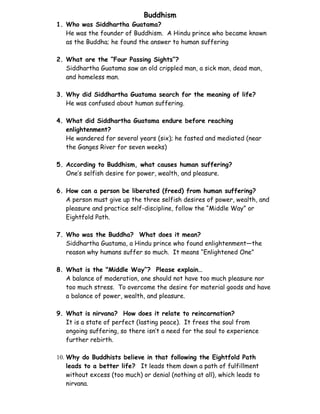
1. Who was Siddhartha Guatama?
   He was the founder of Buddhism. A Hindu prince who became known
   as the Buddha; he found the answer to human suffering

2. What are the “Four Passing Sights”?
   Siddhartha Guatama saw an old crippled man, a sick man, dead man,
   and homeless man.

3. Why did Siddhartha Guatama search for the meaning of life?
   He was confused about human suffering.

4. What did Siddhartha Guatama endure before reaching
   enlightenment?
   He wandered for several years (six); he fasted and mediated (near
   the Ganges River for seven weeks)

5. According to Buddhism, what causes human suffering?
   One’s selfish desire for power, wealth, and pleasure.

6. How can a person be liberated (freed) from human suffering?
   A person must give up the three selfish desires of power, wealth, and
   pleasure and practice self-discipline, follow the “Middle Way” or
   Eightfold Path.

7. Who was the Buddha? What does it mean?
   Siddhartha Guatama, a Hindu prince who found enlightenment—the
   reason why humans suffer so much. It means “Enlightened One”

8. What is the "Middle Way”? Please explain…
   A balance of moderation, one should not have too much pleasure nor
   too much stress. To overcome the desire for material goods and have
   a balance of power, wealth, and pleasure.

9. What is nirvana? How does it relate to reincarnation?
   It is a state of perfect (lasting peace). It frees the soul from
   ongoing suffering, so there isn’t a need for the soul to experience
   further rebirth.

10. Why do Buddhists believe in that following the Eightfold Path
    leads to a better life? It leads them down a path of fulfillment
    without excess (too much) or denial (nothing at all), which leads to
    nirvana.
11. The birthplace of Buddhism…India

12. List the countries in which Buddhism is the dominant religion…
   China, Japan, North & South Korea, and Vietnam
Hinduism

Directions: Fill in the blanks below. Use your textbook pages 478-483.

  1.   Hindus believe in ________ gods. There are so many different people;
       therefore people need a variety of gods to worship.
  2.   There are three major gods. _________ is the creator of the universe,
       __________ is the Earth’s destroyer (kind and cruel; occasionally destroys
       and recreates), and __________ is the Earth’s preserver (god of human
       welfare, kind and concerned about human disaster)
  3.   Hindus believe in a _________universal spirit called ____________. Gods
       and goddesses are _________ of this one spirit.
  4.   Brahman is an all-powerful force and everything in the _________
       comes from ____________.
  5.   Souls are born and ____________ several times. They are born each time
       in the __________ of another living thing or physical form. This process of
       rebirth is called ______________.
  6.   This new physical form (after reincarnation) depends on one’s
       ___________, the effects that good or bad actions have on a person’s soul.
  7.   One’s behavior in their natural life determines the soul’s fate or position in
       the next life.
  8.   One who lives an evil life (bad karma) will be reborn into a lower
       __________ or lesser creature. One who lives a good life (good karma) will
       be reborn into a higher __________.
  9.   There are four main ___________________ (castes)
       _______________ Priests or Scholars
       _______________ Rulers and Warriors
       _______________ Farmers, Craftspeople, Traders, Merchants
       _______________ Laborers and Servants

  10. The ______________ were a group who did not belong to any caste.
      They were called untouchables, because people from the castes were not
      suppose to have contact with them.
  11. The only job open to the untouchables were
      _________________________________________________
  12. Caste Rules: Inter__________ between castes was not allowed. People
      could not eat with others from different castes. If someone broke the
      caste rules, he would be ___________ from their caste and home. These
      rules forced people to spend time with people in the same class.
  13. Aryans ruled India for many years. They divided people into ________.
      The groups were organized by __________. The _________ called this
      social division ___________.
  14. In order for the soul to become one with Brahman, one must obey his
      ______________, a religious or moral duty—to live a good life according to
      one’s place (class) in society.
  15. _____________ is the final group of the Vedic texts (religious writings)
      by religious teachers and _____________.
Buddhism & Hinduism


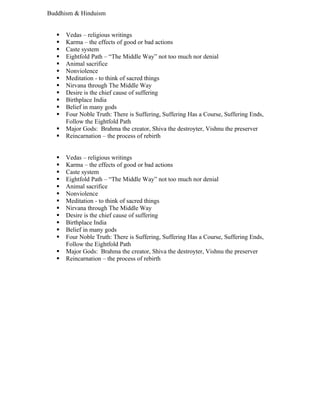
      Vedas – religious writings
      Karma – the effects of good or bad actions
      Caste system
      Eightfold Path – “The Middle Way” not too much nor denial
      Animal sacrifice
      Nonviolence
      Meditation - to think of sacred things
      Nirvana through The Middle Way
      Desire is the chief cause of suffering
      Birthplace India
      Belief in many gods
      Four Noble Truth: There is Suffering, Suffering Has a Course, Suffering Ends,
       Follow the Eightfold Path
      Major Gods: Brahma the creator, Shiva the destroyter, Vishnu the preserver
      Reincarnation – the process of rebirth


      Vedas – religious writings
      Karma – the effects of good or bad actions
      Caste system
      Eightfold Path – “The Middle Way” not too much nor denial
      Animal sacrifice
      Nonviolence
      Meditation - to think of sacred things
      Nirvana through The Middle Way
      Desire is the chief cause of suffering
      Birthplace India
      Belief in many gods
      Four Noble Truth: There is Suffering, Suffering Has a Course, Suffering Ends,
       Follow the Eightfold Path
      Major Gods: Brahma the creator, Shiva the destroyter, Vishnu the preserver
      Reincarnation – the process of rebirth

Buddhism Questions

  • 1.
    Buddhism 1. Who wasSiddhartha Guatama? 2. What are the “Four Passing Sights”? 3. Why did Siddhartha Guatama search for the meaning of life? 4. What did Siddhartha Guatama endure before reaching enlightenment? 5. According to Buddhism, what causes human suffering? 6. How can a person be liberated (freed) from human suffering? 7. Who is the Buddha? What does it mean? 8. What is the "Middle Way”? Please explain… 9. What is nirvana? How does it relate to reincarnation? 10. Why do Buddhists believe in that following the Eightfold Path leads to a better life? 11. The birthplace of Buddhism… 12. List the countries in which Buddhism is the dominant religion… Social Studies 2009
  • 2.
    Buddhism 1. Who wasSiddhartha Guatama? He was the founder of Buddhism. A Hindu prince who became known as the Buddha; he found the answer to human suffering 2. What are the “Four Passing Sights”? Siddhartha Guatama saw an old crippled man, a sick man, dead man, and homeless man. 3. Why did Siddhartha Guatama search for the meaning of life? He was confused about human suffering. 4. What did Siddhartha Guatama endure before reaching enlightenment? He wandered for several years (six); he fasted and mediated (near the Ganges River for seven weeks) 5. According to Buddhism, what causes human suffering? One’s selfish desire for power, wealth, and pleasure. 6. How can a person be liberated (freed) from human suffering? A person must give up the three selfish desires of power, wealth, and pleasure and practice self-discipline, follow the “Middle Way” or Eightfold Path. 7. Who was the Buddha? What does it mean? Siddhartha Guatama, a Hindu prince who found enlightenment—the reason why humans suffer so much. It means “Enlightened One” 8. What is the "Middle Way”? Please explain… A balance of moderation, one should not have too much pleasure nor too much stress. To overcome the desire for material goods and have a balance of power, wealth, and pleasure. 9. What is nirvana? How does it relate to reincarnation? It is a state of perfect (lasting peace). It frees the soul from ongoing suffering, so there isn’t a need for the soul to experience further rebirth. 10. Why do Buddhists believe in that following the Eightfold Path leads to a better life? It leads them down a path of fulfillment without excess (too much) or denial (nothing at all), which leads to nirvana.
  • 3.
    11. The birthplaceof Buddhism…India 12. List the countries in which Buddhism is the dominant religion… China, Japan, North & South Korea, and Vietnam
  • 4.
    Hinduism Directions: Fill inthe blanks below. Use your textbook pages 478-483. 1. Hindus believe in ________ gods. There are so many different people; therefore people need a variety of gods to worship. 2. There are three major gods. _________ is the creator of the universe, __________ is the Earth’s destroyer (kind and cruel; occasionally destroys and recreates), and __________ is the Earth’s preserver (god of human welfare, kind and concerned about human disaster) 3. Hindus believe in a _________universal spirit called ____________. Gods and goddesses are _________ of this one spirit. 4. Brahman is an all-powerful force and everything in the _________ comes from ____________. 5. Souls are born and ____________ several times. They are born each time in the __________ of another living thing or physical form. This process of rebirth is called ______________. 6. This new physical form (after reincarnation) depends on one’s ___________, the effects that good or bad actions have on a person’s soul. 7. One’s behavior in their natural life determines the soul’s fate or position in the next life. 8. One who lives an evil life (bad karma) will be reborn into a lower __________ or lesser creature. One who lives a good life (good karma) will be reborn into a higher __________. 9. There are four main ___________________ (castes) _______________ Priests or Scholars _______________ Rulers and Warriors _______________ Farmers, Craftspeople, Traders, Merchants _______________ Laborers and Servants 10. The ______________ were a group who did not belong to any caste. They were called untouchables, because people from the castes were not suppose to have contact with them. 11. The only job open to the untouchables were _________________________________________________ 12. Caste Rules: Inter__________ between castes was not allowed. People could not eat with others from different castes. If someone broke the caste rules, he would be ___________ from their caste and home. These rules forced people to spend time with people in the same class. 13. Aryans ruled India for many years. They divided people into ________. The groups were organized by __________. The _________ called this social division ___________. 14. In order for the soul to become one with Brahman, one must obey his ______________, a religious or moral duty—to live a good life according to one’s place (class) in society. 15. _____________ is the final group of the Vedic texts (religious writings) by religious teachers and _____________.
  • 5.
    Buddhism & Hinduism  Vedas – religious writings  Karma – the effects of good or bad actions  Caste system  Eightfold Path – “The Middle Way” not too much nor denial  Animal sacrifice  Nonviolence  Meditation - to think of sacred things  Nirvana through The Middle Way  Desire is the chief cause of suffering  Birthplace India  Belief in many gods  Four Noble Truth: There is Suffering, Suffering Has a Course, Suffering Ends, Follow the Eightfold Path  Major Gods: Brahma the creator, Shiva the destroyter, Vishnu the preserver  Reincarnation – the process of rebirth  Vedas – religious writings  Karma – the effects of good or bad actions  Caste system  Eightfold Path – “The Middle Way” not too much nor denial  Animal sacrifice  Nonviolence  Meditation - to think of sacred things  Nirvana through The Middle Way  Desire is the chief cause of suffering  Birthplace India  Belief in many gods  Four Noble Truth: There is Suffering, Suffering Has a Course, Suffering Ends, Follow the Eightfold Path  Major Gods: Brahma the creator, Shiva the destroyter, Vishnu the preserver  Reincarnation – the process of rebirth