INTRODUCTION
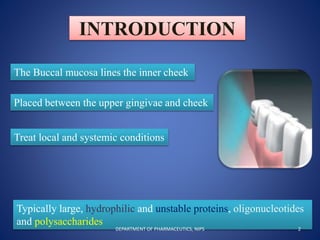
The Buccal mucosa lines the inner cheek
Placed between the upper gingivae and cheek
Treat local and systemic conditions
Typically large, hydrophilic and unstable proteins, oligonucleotides
and polysaccharides
2DEPARTMENT OF PHARMACEUTICS, NIPS
An ideal dosage regimen in the drug
therapy of any disease is the one, which
immediately attains the desired
therapeutic concentration of drug in
plasma (or at the site of action) and
maintains it constant for the entire
duration of treatment
3DEPARTMENT OF PHARMACEUTICS, NIPS
ADVANTAGES
 Avoids first pass effect
 Abundance of blood vessel
 Less hostile environment than GIT
 Ease of administration and termination
 Fast cellular recovery
 Directly & easily modify microenvironment
 Lower intersubject variability as compared to
transdermal patches
4DEPARTMENT OF PHARMACEUTICS, NIPS
Contd…
 Permeability enhancers
 Rapid absorption possible & hence relatively
rapid onset of action
 In comparison to TDDS, mucosal surfaces do
not have a stratum corneum thus, the major
barrier layer is absent
5DEPARTMENT OF PHARMACEUTICS, NIPS
DISADVANTAGES
 Relatively small absorptive surface area (0.01 sq
m vs 100 sq m for GIT)
 Movement affects mucoadhesive systems
 Less permeable than the small intestine
 Salivation and swallowing
 Taste of the drug
6DEPARTMENT OF PHARMACEUTICS, NIPS
BUCCAL MUCOSA: ENVIRONMENT
The cells of the oral epithelia are surrounded by
an intercellular ground substance, mucus
The oral cavity is marked by the presence of
saliva produced by the salivary glands
Mucus which is secreted by the major and minor
salivary glands as part of saliva
7DEPARTMENT OF PHARMACEUTICS, NIPS
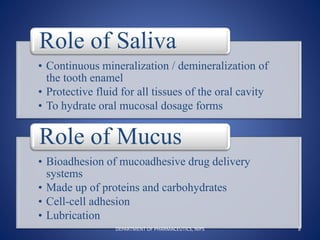
• Continuous mineralization / demineralization of
the tooth enamel
• Protective fluid for all tissues of the oral cavity
• To hydrate oral mucosal dosage forms
Role of Saliva
• Bioadhesion of mucoadhesive drug delivery
systems
• Made up of proteins and carbohydrates
• Cell-cell adhesion
• Lubrication
Role of Mucus
8DEPARTMENT OF PHARMACEUTICS, NIPS
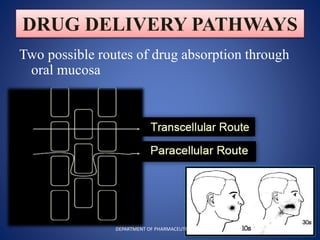
DRUG DELIVERY PATHWAYS
Two possible routes of drug absorption through
oral mucosa
9DEPARTMENT OF PHARMACEUTICS, NIPS
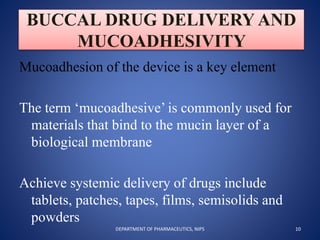
BUCCAL DRUG DELIVERY AND
MUCOADHESIVITY
Mucoadhesion of the device is a key element
The term ‘mucoadhesive’ is commonly used for
materials that bind to the mucin layer of a
biological membrane
Achieve systemic delivery of drugs include
tablets, patches, tapes, films, semisolids and
powders
10DEPARTMENT OF PHARMACEUTICS, NIPS
11DEPARTMENT OF PHARMACEUTICS, NIPS
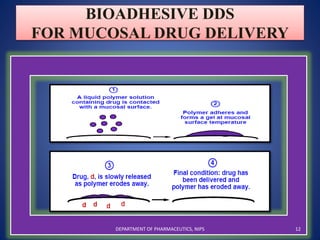
BIOADHESIVE DDS
FOR MUCOSAL DRUG DELIVERY
12DEPARTMENT OF PHARMACEUTICS, NIPS
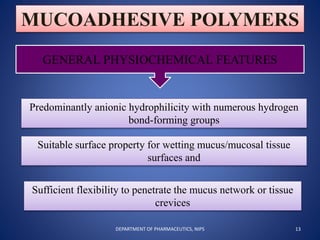
MUCOADHESIVE POLYMERS
GENERAL PHYSIOCHEMICAL FEATURES
Predominantly anionic hydrophilicity with numerous hydrogen
bond-forming groups
Suitable surface property for wetting mucus/mucosal tissue
surfaces and
Sufficient flexibility to penetrate the mucus network or tissue
crevices
13DEPARTMENT OF PHARMACEUTICS, NIPS
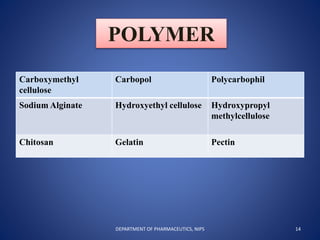
POLYMER
Carboxymethyl
cellulose
Carbopol Polycarbophil
Sodium Alginate Hydroxyethyl cellulose Hydroxypropyl
methylcellulose
Chitosan Gelatin Pectin
14DEPARTMENT OF PHARMACEUTICS, NIPS
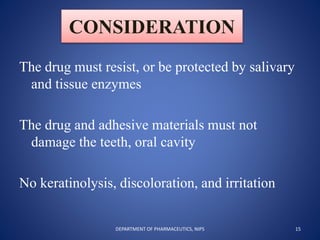
CONSIDERATION
The drug must resist, or be protected by salivary
and tissue enzymes
The drug and adhesive materials must not
damage the teeth, oral cavity
No keratinolysis, discoloration, and irritation
15DEPARTMENT OF PHARMACEUTICS, NIPS
FACTORS AFFECTING DRUG
DELIVERY VIA BUCCAL ROUTE
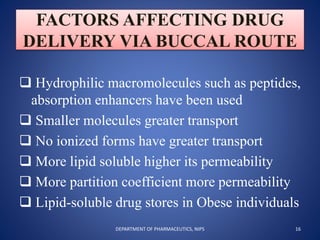
 Hydrophilic macromolecules such as peptides,
absorption enhancers have been used
 Smaller molecules greater transport
 No ionized forms have greater transport
 More lipid soluble higher its permeability
 More partition coefficient more permeability
 Lipid-soluble drug stores in Obese individuals
16DEPARTMENT OF PHARMACEUTICS, NIPS
DESIGN OF BUCCAL DOSAGE FORM
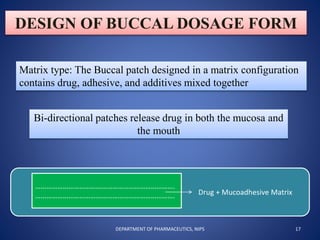
Matrix type: The Buccal patch designed in a matrix configuration
contains drug, adhesive, and additives mixed together
Bi-directional patches release drug in both the mucosa and
the mouth
Drug + Mucoadhesive Matrix
………………………………………………………………….
………………………………………………………………….
17DEPARTMENT OF PHARMACEUTICS, NIPS
Contd…
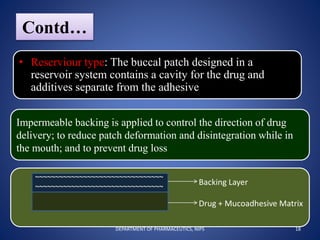
• Reserviour type: The buccal patch designed in a
reservoir system contains a cavity for the drug and
additives separate from the adhesive
Impermeable backing is applied to control the direction of drug
delivery; to reduce patch deformation and disintegration while in
the mouth; and to prevent drug loss
Backing Layer
Drug + Mucoadhesive Matrix
~~~~~~~~~~~~~~~~~~~~~~~~~~~~~~~~
~~~~~~~~~~~~~~~~~~~~~~~~~~~~~~~~
18DEPARTMENT OF PHARMACEUTICS, NIPS
BUCCAL MUCOADHESIVE DOSAGE FORMS
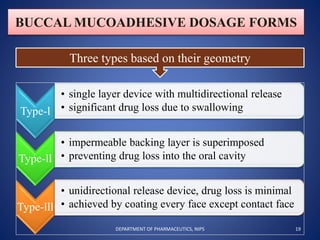
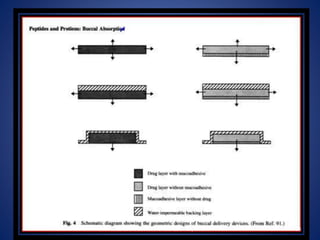
Three types based on their geometry
Type-l
• single layer device with multidirectional release
• significant drug loss due to swallowing
Type-ll
• impermeable backing layer is superimposed
• preventing drug loss into the oral cavity
Type-lll
• unidirectional release device, drug loss is minimal
• achieved by coating every face except contact face
19DEPARTMENT OF PHARMACEUTICS, NIPS
20DEPARTMENT OF PHARMACEUTICS, NIPS
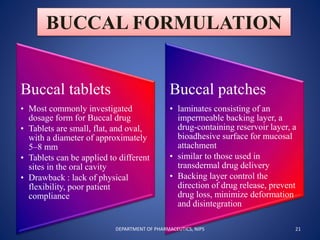
BUCCAL FORMULATION
Buccal tablets
• Most commonly investigated
dosage form for Buccal drug
• Tablets are small, flat, and oval,
with a diameter of approximately
5–8 mm
• Tablets can be applied to different
sites in the oral cavity
• Drawback : lack of physical
flexibility, poor patient
compliance
Buccal patches
• laminates consisting of an
impermeable backing layer, a
drug-containing reservoir layer, a
bioadhesive surface for mucosal
attachment
• similar to those used in
transdermal drug delivery
• Backing layer control the
direction of drug release, prevent
drug loss, minimize deformation
and disintegration
21DEPARTMENT OF PHARMACEUTICS, NIPS
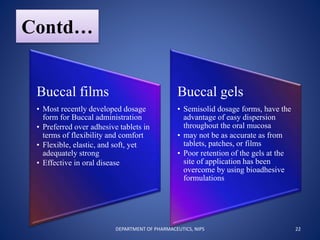
Contd…
Buccal films
• Most recently developed dosage
form for Buccal administration
• Preferred over adhesive tablets in
terms of flexibility and comfort
• Flexible, elastic, and soft, yet
adequately strong
• Effective in oral disease
Buccal gels
• Semisolid dosage forms, have the
advantage of easy dispersion
throughout the oral mucosa
• may not be as accurate as from
tablets, patches, or films
• Poor retention of the gels at the
site of application has been
overcome by using bioadhesive
formulations
22DEPARTMENT OF PHARMACEUTICS, NIPS
EXPERIMENTAL METHODOLOGY FOR
BUCCAL PERMEATION STUDIES
EVALUATION
In vitro
Methods
In vivo
Methods
23DEPARTMENT OF PHARMACEUTICS, NIPS
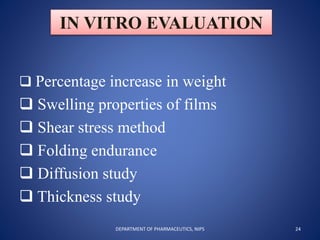
IN VITRO EVALUATION
 Percentage increase in weight
 Swelling properties of films
 Shear stress method
 Folding endurance
 Diffusion study
 Thickness study
24DEPARTMENT OF PHARMACEUTICS, NIPS
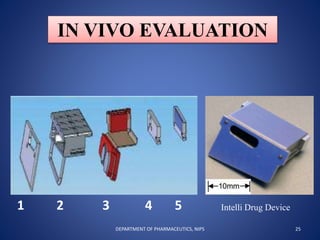
IN VIVO EVALUATION
1 2 3 4 5 Intelli Drug Device
25DEPARTMENT OF PHARMACEUTICS, NIPS
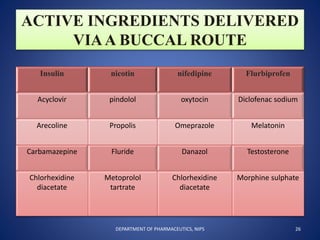
ACTIVE INGREDIENTS DELIVERED
VIAA BUCCAL ROUTE
Insulin nicotin nifedipine Flurbiprofen
Acyclovir pindolol oxytocin Diclofenac sodium
Arecoline Propolis Omeprazole Melatonin
Carbamazepine Fluride Danazol Testosterone
Chlorhexidine
diacetate
Metoprolol
tartrate
Chlorhexidine
diacetate
Morphine sulphate
26DEPARTMENT OF PHARMACEUTICS, NIPS
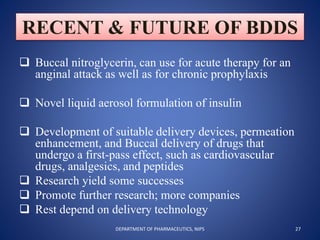
RECENT & FUTURE OF BDDS
 Buccal nitroglycerin, can use for acute therapy for an
anginal attack as well as for chronic prophylaxis
 Novel liquid aerosol formulation of insulin
 Development of suitable delivery devices, permeation
enhancement, and Buccal delivery of drugs that
undergo a first-pass effect, such as cardiovascular
drugs, analgesics, and peptides
 Research yield some successes
 Promote further research; more companies
 Rest depend on delivery technology
27DEPARTMENT OF PHARMACEUTICS, NIPS
CONCLUTION
Buccal drug delivery is a promising area
for systemic delivery of orally inefficient
drugs as well as an attractive alternative
for noninvasive delivery of potent peptide
and perhaps protein drug molecules
28DEPARTMENT OF PHARMACEUTICS, NIPS
REFERENCES
 Michael J Rathbone, in: Oral Mucosal Drug Delivery
 M.S. Wani*, Dr. S.R. Parakh, Dr. M.H. Dehghan, S.A.
Polshettiwar, V.V. Chopade, V.V. Pande, in: Current
Status In Buccal Drug Delivery System: A review
Amir H Shojaei, Faculty of Pharmacy and
Pharmaceutical Sciences, University of Alberta,
Edmonton, Alberta, Canada T6G 2N8, in: Buccal
Mucosa As A Route For Systemic Drug Delivery: A
Review
 Yie W. Chien, in: Novel Drug Delivery System
Hitesh R. Patel*, Dr. M.M. Patel, in: Draw Attention
Towards Mucoadhesive Buccal Drug Delivery System
 Bio-Images Research Ltd, in: Applications of gamma
scintigraphy in oral drug delivery
29DEPARTMENT OF PHARMACEUTICS, NIPS
30DEPARTMENT OF PHARMACEUTICS, NIPS

Buccaldrugdeliverysystem

  • 2.
    INTRODUCTION The Buccal mucosalines the inner cheek Placed between the upper gingivae and cheek Treat local and systemic conditions Typically large, hydrophilic and unstable proteins, oligonucleotides and polysaccharides 2DEPARTMENT OF PHARMACEUTICS, NIPS
  • 3.
    An ideal dosageregimen in the drug therapy of any disease is the one, which immediately attains the desired therapeutic concentration of drug in plasma (or at the site of action) and maintains it constant for the entire duration of treatment 3DEPARTMENT OF PHARMACEUTICS, NIPS
  • 4.
    ADVANTAGES  Avoids firstpass effect  Abundance of blood vessel  Less hostile environment than GIT  Ease of administration and termination  Fast cellular recovery  Directly & easily modify microenvironment  Lower intersubject variability as compared to transdermal patches 4DEPARTMENT OF PHARMACEUTICS, NIPS
  • 5.
    Contd…  Permeability enhancers Rapid absorption possible & hence relatively rapid onset of action  In comparison to TDDS, mucosal surfaces do not have a stratum corneum thus, the major barrier layer is absent 5DEPARTMENT OF PHARMACEUTICS, NIPS
  • 6.
    DISADVANTAGES  Relatively smallabsorptive surface area (0.01 sq m vs 100 sq m for GIT)  Movement affects mucoadhesive systems  Less permeable than the small intestine  Salivation and swallowing  Taste of the drug 6DEPARTMENT OF PHARMACEUTICS, NIPS
  • 7.
    BUCCAL MUCOSA: ENVIRONMENT Thecells of the oral epithelia are surrounded by an intercellular ground substance, mucus The oral cavity is marked by the presence of saliva produced by the salivary glands Mucus which is secreted by the major and minor salivary glands as part of saliva 7DEPARTMENT OF PHARMACEUTICS, NIPS
  • 8.
    • Continuous mineralization/ demineralization of the tooth enamel • Protective fluid for all tissues of the oral cavity • To hydrate oral mucosal dosage forms Role of Saliva • Bioadhesion of mucoadhesive drug delivery systems • Made up of proteins and carbohydrates • Cell-cell adhesion • Lubrication Role of Mucus 8DEPARTMENT OF PHARMACEUTICS, NIPS
  • 9.
    DRUG DELIVERY PATHWAYS Twopossible routes of drug absorption through oral mucosa 9DEPARTMENT OF PHARMACEUTICS, NIPS
  • 10.
    BUCCAL DRUG DELIVERYAND MUCOADHESIVITY Mucoadhesion of the device is a key element The term ‘mucoadhesive’ is commonly used for materials that bind to the mucin layer of a biological membrane Achieve systemic delivery of drugs include tablets, patches, tapes, films, semisolids and powders 10DEPARTMENT OF PHARMACEUTICS, NIPS
  • 11.
  • 12.
    BIOADHESIVE DDS FOR MUCOSALDRUG DELIVERY 12DEPARTMENT OF PHARMACEUTICS, NIPS
  • 13.
    MUCOADHESIVE POLYMERS GENERAL PHYSIOCHEMICALFEATURES Predominantly anionic hydrophilicity with numerous hydrogen bond-forming groups Suitable surface property for wetting mucus/mucosal tissue surfaces and Sufficient flexibility to penetrate the mucus network or tissue crevices 13DEPARTMENT OF PHARMACEUTICS, NIPS
  • 14.
    POLYMER Carboxymethyl cellulose Carbopol Polycarbophil Sodium AlginateHydroxyethyl cellulose Hydroxypropyl methylcellulose Chitosan Gelatin Pectin 14DEPARTMENT OF PHARMACEUTICS, NIPS
  • 15.
    CONSIDERATION The drug mustresist, or be protected by salivary and tissue enzymes The drug and adhesive materials must not damage the teeth, oral cavity No keratinolysis, discoloration, and irritation 15DEPARTMENT OF PHARMACEUTICS, NIPS
  • 16.
    FACTORS AFFECTING DRUG DELIVERYVIA BUCCAL ROUTE  Hydrophilic macromolecules such as peptides, absorption enhancers have been used  Smaller molecules greater transport  No ionized forms have greater transport  More lipid soluble higher its permeability  More partition coefficient more permeability  Lipid-soluble drug stores in Obese individuals 16DEPARTMENT OF PHARMACEUTICS, NIPS
  • 17.
    DESIGN OF BUCCALDOSAGE FORM Matrix type: The Buccal patch designed in a matrix configuration contains drug, adhesive, and additives mixed together Bi-directional patches release drug in both the mucosa and the mouth Drug + Mucoadhesive Matrix …………………………………………………………………. …………………………………………………………………. 17DEPARTMENT OF PHARMACEUTICS, NIPS
  • 18.
    Contd… • Reserviour type:The buccal patch designed in a reservoir system contains a cavity for the drug and additives separate from the adhesive Impermeable backing is applied to control the direction of drug delivery; to reduce patch deformation and disintegration while in the mouth; and to prevent drug loss Backing Layer Drug + Mucoadhesive Matrix ~~~~~~~~~~~~~~~~~~~~~~~~~~~~~~~~ ~~~~~~~~~~~~~~~~~~~~~~~~~~~~~~~~ 18DEPARTMENT OF PHARMACEUTICS, NIPS
  • 19.
    BUCCAL MUCOADHESIVE DOSAGEFORMS Three types based on their geometry Type-l • single layer device with multidirectional release • significant drug loss due to swallowing Type-ll • impermeable backing layer is superimposed • preventing drug loss into the oral cavity Type-lll • unidirectional release device, drug loss is minimal • achieved by coating every face except contact face 19DEPARTMENT OF PHARMACEUTICS, NIPS
  • 20.
  • 21.
    BUCCAL FORMULATION Buccal tablets •Most commonly investigated dosage form for Buccal drug • Tablets are small, flat, and oval, with a diameter of approximately 5–8 mm • Tablets can be applied to different sites in the oral cavity • Drawback : lack of physical flexibility, poor patient compliance Buccal patches • laminates consisting of an impermeable backing layer, a drug-containing reservoir layer, a bioadhesive surface for mucosal attachment • similar to those used in transdermal drug delivery • Backing layer control the direction of drug release, prevent drug loss, minimize deformation and disintegration 21DEPARTMENT OF PHARMACEUTICS, NIPS
  • 22.
    Contd… Buccal films • Mostrecently developed dosage form for Buccal administration • Preferred over adhesive tablets in terms of flexibility and comfort • Flexible, elastic, and soft, yet adequately strong • Effective in oral disease Buccal gels • Semisolid dosage forms, have the advantage of easy dispersion throughout the oral mucosa • may not be as accurate as from tablets, patches, or films • Poor retention of the gels at the site of application has been overcome by using bioadhesive formulations 22DEPARTMENT OF PHARMACEUTICS, NIPS
  • 23.
    EXPERIMENTAL METHODOLOGY FOR BUCCALPERMEATION STUDIES EVALUATION In vitro Methods In vivo Methods 23DEPARTMENT OF PHARMACEUTICS, NIPS
  • 24.
    IN VITRO EVALUATION Percentage increase in weight  Swelling properties of films  Shear stress method  Folding endurance  Diffusion study  Thickness study 24DEPARTMENT OF PHARMACEUTICS, NIPS
  • 25.
    IN VIVO EVALUATION 12 3 4 5 Intelli Drug Device 25DEPARTMENT OF PHARMACEUTICS, NIPS
  • 26.
    ACTIVE INGREDIENTS DELIVERED VIAABUCCAL ROUTE Insulin nicotin nifedipine Flurbiprofen Acyclovir pindolol oxytocin Diclofenac sodium Arecoline Propolis Omeprazole Melatonin Carbamazepine Fluride Danazol Testosterone Chlorhexidine diacetate Metoprolol tartrate Chlorhexidine diacetate Morphine sulphate 26DEPARTMENT OF PHARMACEUTICS, NIPS
  • 27.
    RECENT & FUTUREOF BDDS  Buccal nitroglycerin, can use for acute therapy for an anginal attack as well as for chronic prophylaxis  Novel liquid aerosol formulation of insulin  Development of suitable delivery devices, permeation enhancement, and Buccal delivery of drugs that undergo a first-pass effect, such as cardiovascular drugs, analgesics, and peptides  Research yield some successes  Promote further research; more companies  Rest depend on delivery technology 27DEPARTMENT OF PHARMACEUTICS, NIPS
  • 28.
    CONCLUTION Buccal drug deliveryis a promising area for systemic delivery of orally inefficient drugs as well as an attractive alternative for noninvasive delivery of potent peptide and perhaps protein drug molecules 28DEPARTMENT OF PHARMACEUTICS, NIPS
  • 29.
    REFERENCES  Michael JRathbone, in: Oral Mucosal Drug Delivery  M.S. Wani*, Dr. S.R. Parakh, Dr. M.H. Dehghan, S.A. Polshettiwar, V.V. Chopade, V.V. Pande, in: Current Status In Buccal Drug Delivery System: A review Amir H Shojaei, Faculty of Pharmacy and Pharmaceutical Sciences, University of Alberta, Edmonton, Alberta, Canada T6G 2N8, in: Buccal Mucosa As A Route For Systemic Drug Delivery: A Review  Yie W. Chien, in: Novel Drug Delivery System Hitesh R. Patel*, Dr. M.M. Patel, in: Draw Attention Towards Mucoadhesive Buccal Drug Delivery System  Bio-Images Research Ltd, in: Applications of gamma scintigraphy in oral drug delivery 29DEPARTMENT OF PHARMACEUTICS, NIPS
  • 30.