B Tree
Introduction to B-Tree
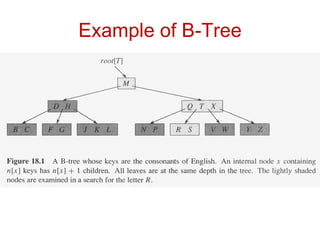
• B-trees are balanced search tree.
• More than two children are possible.
• B-Tree, stores all information in the leaves
and stores only keys and Child pointer.
• If an internal B-tree node x contains n[x]
keys then x has n[x]+1 children.
Example of B-Tree
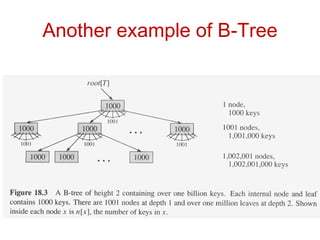
Another example of B-Tree
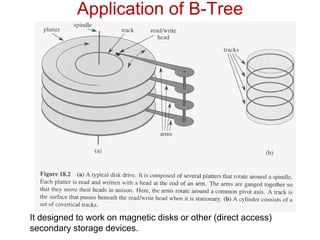
Application of B-Tree
It designed to work on magnetic disks or other (direct access)
secondary storage devices.
Properties of B-Tree
• A B-Tree T is a rooted tree having the following
properties:
1. Every node x has the following fields:
1. n[x] the no. of keys currently stored in node x
2. The n[x] keys themselves, stored in non-decreasing
order, so that key1[x] ≤ key2[x]…… ≤keyn-1[x] ≤ keyn[x].
3. Leaf[x], a Boolean value that is TRUE if x is a leaf and
FALSE if x is an internal node.
2. Each internal node x also contains n[x]+1 pointers
(Childs) c1[x], c2[x],---------cn[x]+1[x].
3. All leaves have the same depth, which is the tree’s
height h.
Properties of B-Tree (cont.)
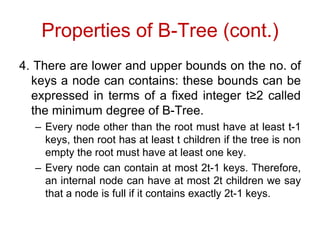
4. There are lower and upper bounds on the no. of
keys a node can contains: these bounds can be
expressed in terms of a fixed integer t≥2 called
the minimum degree of B-Tree.
– Every node other than the root must have at least t-1
keys, then root has at least t children if the tree is non
empty the root must have at least one key.
– Every node can contain at most 2t-1 keys. Therefore,
an internal node can have at most 2t children we say
that a node is full if it contains exactly 2t-1 keys.
Height of B-tree
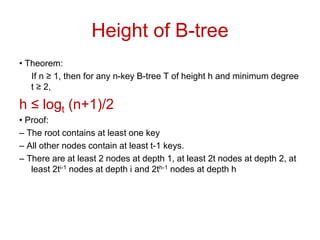
• Theorem:
If n ≥ 1, then for any n-key B-tree T of height h and minimum degree
t ≥ 2,
h ≤ logt (n+1)/2
• Proof:
– The root contains at least one key
– All other nodes contain at least t-1 keys.
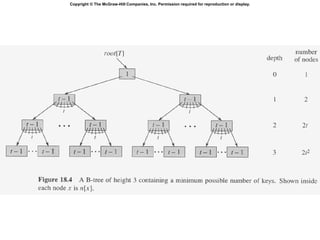
– There are at least 2 nodes at depth 1, at least 2t nodes at depth 2, at
least 2ti-1 nodes at depth i and 2th-1 nodes at depth h
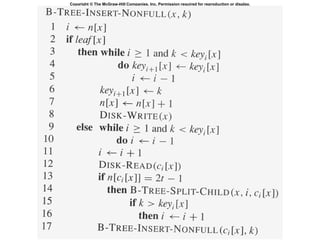
Copyright © The McGraw-Hill Companies, Inc. Permission required for reproduction or display.
Basic operation on B-tree
• B-TREE-SEARCH :-Searching in B Tree
• B-TREE-INSERT :-Inserting key in B Tree
• B-TREE-CREATE :-Creating a B Tree
• B-TREE-DELETE :- Deleting a key from B
Tree
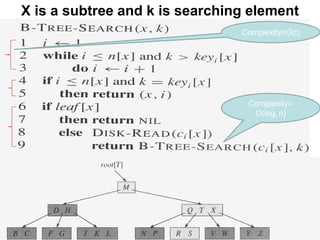
X is a subtree and k is searching element
Complexity=O(t)
Complexity=
O(logt n)
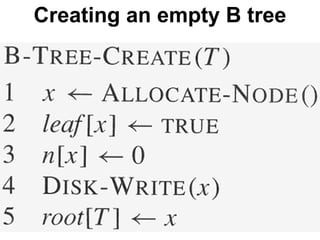
Creating an empty B tree
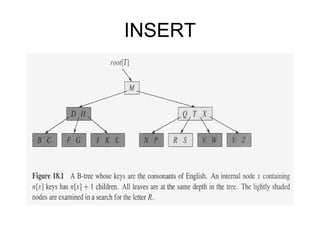
INSERT
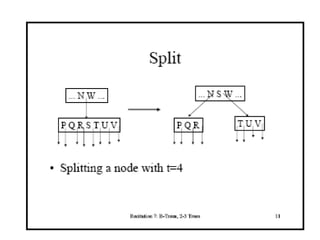
B-TREE-SPLIT-CHILD
ALGORITHM
B-TREE-SPLIT-CHILD(x,i,y)
1. z ALLOCATE-NODE()
2. leaf [z] leaf [y]
3. n[z]t-1
4. for j 1 to t-1
5. do keyj [z]  keyj+t [y]
6. if not leaf [y]
7. then for j1 to t
8. do cj [z] cj+t [y]
9. n[y] t-1
cont…….
10. for j n[x] +1 downto i+1
11. do cj+1 [x] cj [x]
12. cj+1 [x]  z
13. for j n[x] downto i
14. do keyj+1 [x]  keyj [x]
15. keyi [x]  keyt [y]
16. n[x]n[x] +1
17. DISK-WRITE(y)
18. DISK-WRITE(z)
19. DISK-WRITE(x)
B-TREE-INSERT ALGORITHM
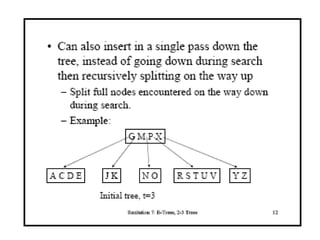
B-TREE-INSERT(T,k)
1. r  root[T]
2. If ( n[r] = 2t-1)
3. then s Allocate-Node()
4. root[T]  s
5. leaf[s]  FALSE
6. n[s]0
7. c1
[s]r
8. B-TREE-SPLIT-CHILD(s,1,r)
9. B-TREE-INSERT-NONFULL(s,k)
10. else B-TREE-INSERT-NONFULL(r,k)
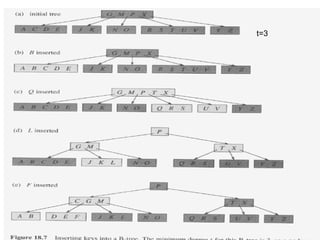
t=3
Comp 750, Fall 2009 B-Trees - 21
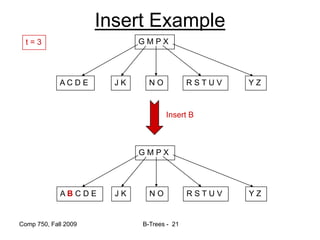
Insert Example
G M P X
A C D E J K N O R S T U V Y Z
t = 3
Insert B
G M P X
A B C D E J K N O R S T U V Y Z
Comp 750, Fall 2009 B-Trees - 22
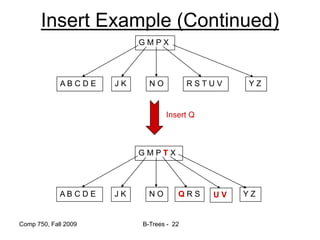
Insert Example (Continued)
Insert Q
G M P X
A B C D E J K N O R S T U V Y Z
G M P T X
A B C D E J K N O Q R S Y Z
U V
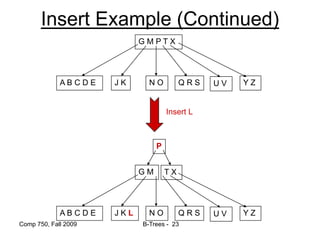
Comp 750, Fall 2009 B-Trees - 23
Insert Example (Continued)
Insert L
G M
A B C D E J K L N O Q R S Y Z
U V
G M P T X
A B C D E J K N O Q R S Y Z
U V
P
T X
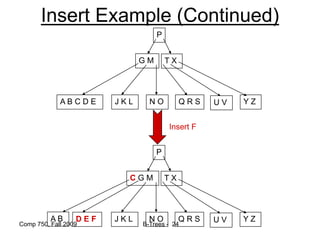
Comp 750, Fall 2009 B-Trees - 24
Insert Example (Continued)
Insert F
C G M
D E F J K L N O Q R S Y Z
U V
P
T X
G M
A B C D E J K L N O Q R S Y Z
U V
P
T X
A B
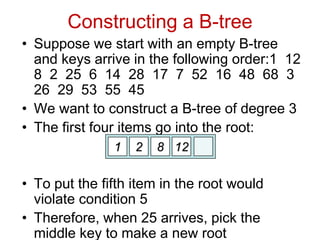
• Suppose we start with an empty B-tree
and keys arrive in the following order:1 12
8 2 25 6 14 28 17 7 52 16 48 68 3
26 29 53 55 45
• We want to construct a B-tree of degree 3
• The first four items go into the root:
• To put the fifth item in the root would
violate condition 5
• Therefore, when 25 arrives, pick the
middle key to make a new root
Constructing a B-tree
12
8
1 2
Constructing a B-tree
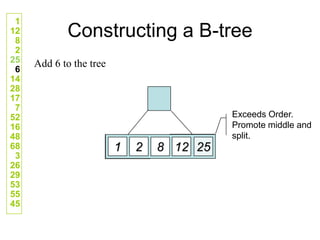
Add 6 to the tree
1
12
8
2
25
6
14
28
17
7
52
16
48
68
3
26
29
53
55
45
12
8
1 2 25
Exceeds Order.
Promote middle and
split.
Constructing a B-tree (contd.)
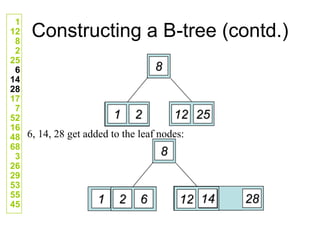
6, 14, 28 get added to the leaf nodes:
1
12
8
2
25
6
14
28
17
7
52
16
48
68
3
26
29
53
55
45
12
8
1 2 25
12
8
1 2 25
6
1 2 28
14
Constructing a B-tree (contd.)
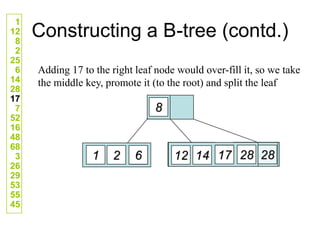
Adding 17 to the right leaf node would over-fill it, so we take
the middle key, promote it (to the root) and split the leaf
1
12
8
2
25
6
14
28
17
7
52
16
48
68
3
26
29
53
55
45
1
12
8
2
25
6
14
28
17
7
52
16
48
68
3
26
29
53
55
45
12
8
2 25
6
1 2 28
14 28
17
Constructing a B-tree (contd.)
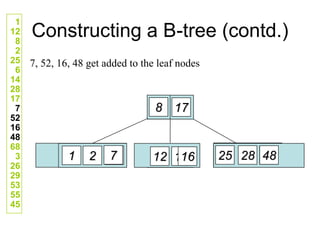
7, 52, 16, 48 get added to the leaf nodes
1
12
8
2
25
6
14
28
17
7
52
16
48
68
3
26
29
53
55
45
12
8
25
6
1 2 28
14
17
7 52
16 48
Constructing a B-tree (contd.)
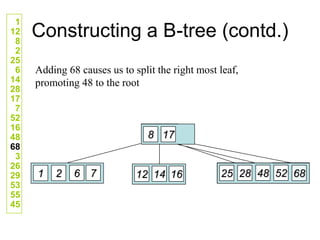
Adding 68 causes us to split the right most leaf,
promoting 48 to the root
1
12
8
2
25
6
14
28
17
7
52
16
48
68
3
26
29
53
55
45
8 17
7
6
2
1 16
14
12 52
48
28
25 68
Constructing a B-tree (contd.)
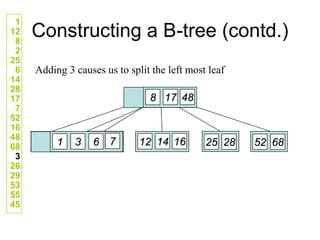
Adding 3 causes us to split the left most leaf
1
12
8
2
25
6
14
28
17
7
52
16
48
68
3
26
29
53
55
45
48
17
8
7
6
2
1 16
14
12 25 28 52 68
3 7
Constructing a B-tree (contd.)
1
12
8
2
25
6
14
28
17
7
52
16
48
68
3
26
29
53
55
45
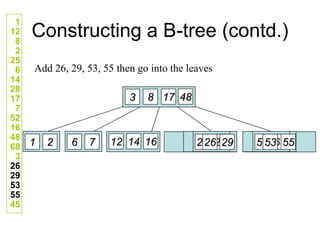
Add 26, 29, 53, 55 then go into the leaves
48
17
8
3
1 2 6 7 52 68
25 28
16
14
12 26 29 53 55
Constructing a B-tree (contd.)
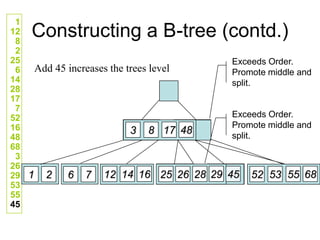
Add 45 increases the trees level
1
12
8
2
25
6
14
28
17
7
52
16
48
68
3
26
29
53
55
45
48
17
8
3
29
28
26
25 68
55
53
52
16
14
12
6 7
1 2 45
Exceeds Order.
Promote middle and
split.
Exceeds Order.
Promote middle and
split.
34
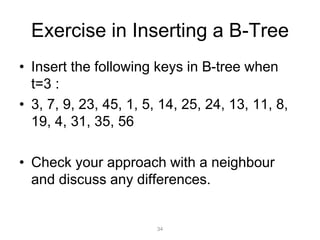
Exercise in Inserting a B-Tree
• Insert the following keys in B-tree when
t=3 :
• 3, 7, 9, 23, 45, 1, 5, 14, 25, 24, 13, 11, 8,
19, 4, 31, 35, 56
• Check your approach with a neighbour
and discuss any differences.
Copyright © The McGraw-Hill Companies, Inc. Permission required for reproduction or display.
Deleting from B-Trees
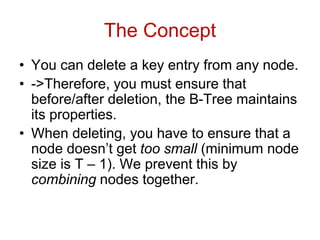
The Concept
• You can delete a key entry from any node.
• ->Therefore, you must ensure that
before/after deletion, the B-Tree maintains
its properties.
• When deleting, you have to ensure that a
node doesn’t get too small (minimum node
size is T – 1). We prevent this by
combining nodes together.
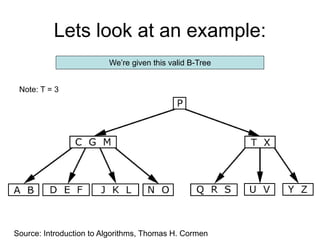
Lets look at an example:
We’re given this valid B-Tree
Source: Introduction to Algorithms, Thomas H. Cormen
Note: T = 3
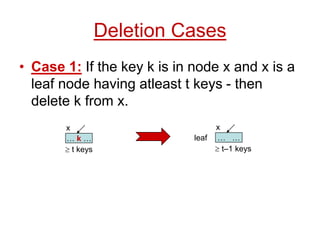
Deletion Cases
• Case 1: If the key k is in node x and x is a
leaf node having atleast t keys - then
delete k from x.
… k …
 t keys
x
… …
 t–1 keys
x
leaf
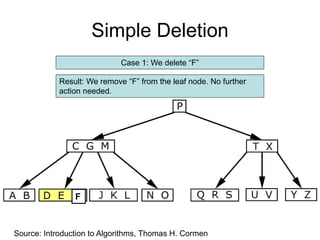
Simple Deletion
Case 1: We delete “F”
Source: Introduction to Algorithms, Thomas H. Cormen
Result: We remove “F” from the leaf node. No further
action needed.
F
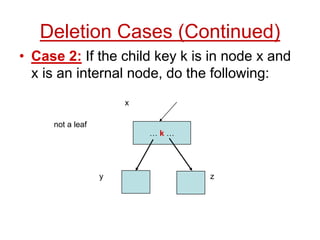
Deletion Cases (Continued)
• Case 2: If the child key k is in node x and
x is an internal node, do the following:
… k …
not a leaf
y z
x
Deletion Cases (Continued)
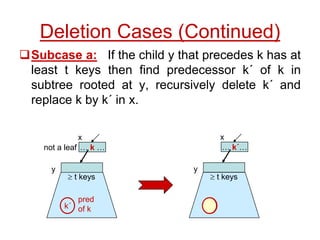
Subcase a: If the child y that precedes k has at
least t keys then find predecessor k´ of k in
subtree rooted at y, recursively delete k´ and
replace k by k´ in x.
… k …
not a leaf
y
 t keys
k´
pred
of k
 t keys
x
… k´…
y
x
Deleting and shifting
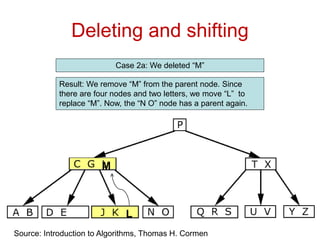
Case 2a: We deleted “M”
Source: Introduction to Algorithms, Thomas H. Cormen
Result: We remove “M” from the parent node. Since
there are four nodes and two letters, we move “L” to
replace “M”. Now, the “N O” node has a parent again.
M
L
Comp 750, Fall 2009 B-Trees - 44
Deletion Cases (Continued)
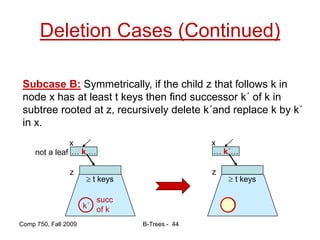
Subcase B: Symmetrically, if the child z that follows k in
node x has at least t keys then find successor k´ of k in
subtree rooted at z, recursively delete k´and replace k by k´
in x.
… k …
not a leaf
z
 t keys
k´
succ
of k
 t keys
x
… k´…
z
x
Comp 750, Fall 2009
Deletion Cases (Continued)
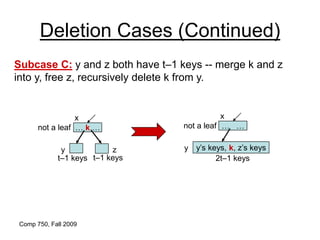
Subcase C: y and z both have t–1 keys -- merge k and z
into y, free z, recursively delete k from y.
… k …
x
not a leaf
y z
t–1 keys t–1 keys
… …
x
not a leaf
y’s keys, k, z’s keys
y
2t–1 keys
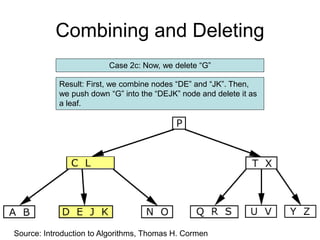
Combining and Deleting
Case 2c: Now, we delete “G”
Source: Introduction to Algorithms, Thomas H. Cormen
Result: First, we combine nodes “DE” and “JK”. Then,
we push down “G” into the “DEJK” node and delete it as
a leaf.
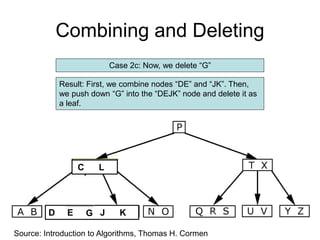
Combining and Deleting
Case 2c: Now, we delete “G”
Source: Introduction to Algorithms, Thomas H. Cormen
Result: First, we combine nodes “DE” and “JK”. Then,
we push down “G” into the “DEJK” node and delete it as
a leaf.
C L
D E J K
G
Comp 750, Fall 2009 B-Trees - 48
Deletion Cases (Continued)
Case 3: k not in internal node. Let ci[x] be the root of the
subtree that must contain k, if k is in the tree.
If ci[x] has at least t keys, then recursively descend;
otherwise, execute 3.A and 3.B as necessary.
Comp 750, Fall 2009 B-Trees - 49
Deletion Cases (Continued)
Subcase A: ci[x] has t–1 keys, some sibling has at least t keys.
… …
not a leaf
ci[x]
t–1 keys
k
x
k1
…
k2
… …
ci[x]
t keys
k
x
k2
…
k1
recursively
descend
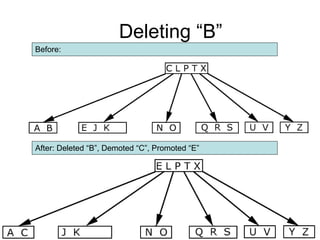
Deleting “B”
Before:
After: Deleted “B”, Demoted “C”, Promoted “E”
Comp 750, Fall 2009 B-Trees - 51
Deletion Cases (Continued)
Subcase B: ci[x] and sibling both have t–1 keys.
… …
not a leaf
ci[x]
t–1 keys
k
x
k1
t–1 keys
ci+1[x]
… …
ci[x]’s keys, , ci+1[x]’s keys
ci[x]
2t–1 keys
k
x
k1
recursively
descend
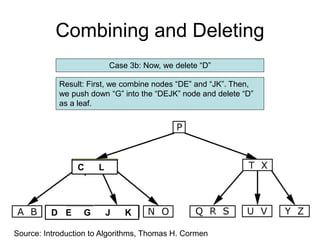
Combining and Deleting
Case 3b: Now, we delete “D”
Source: Introduction to Algorithms, Thomas H. Cormen
Result: First, we combine nodes “DE” and “JK”. Then,
we push down “G” into the “DEJK” node and delete “D”
as a leaf.
C L
E G J K
D
CSCI 2720
53
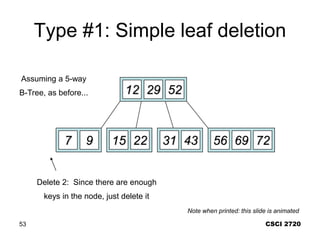
Type #1: Simple leaf deletion
12 29 52
2 7 9 15 22 56 69 72
31 43
Delete 2: Since there are enough
keys in the node, just delete it
Assuming a 5-way
B-Tree, as before...
Note when printed: this slide is animated
CSCI 2720
54
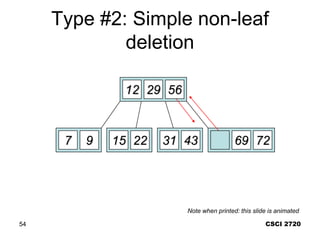
Type #2: Simple non-leaf
deletion
12 29 52
7 9 15 22 56 69 72
31 43
Delete 52
Borrow the predecessor
or (in this case) successor
56
Note when printed: this slide is animated
CSCI 2720
55
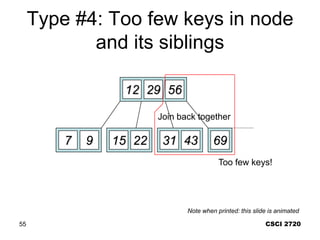
Type #4: Too few keys in node
and its siblings
12 29 56
7 9 15 22 69 72
31 43
Delete 72
Too few keys!
Join back together
Note when printed: this slide is animated
CSCI 2720
56
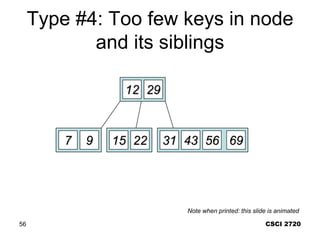
Type #4: Too few keys in node
and its siblings
12 29
7 9 15 22 69
56
31 43
Note when printed: this slide is animated
CSCI 2720
57
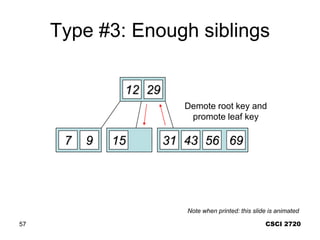
Type #3: Enough siblings
12 29
7 9 15 22 69
56
31 43
Delete 22
Demote root key and
promote leaf key
Note when printed: this slide is animated
CSCI 2720
58
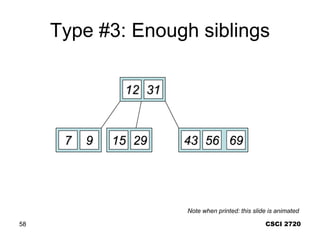
Type #3: Enough siblings
12
29
7 9 15
31
69
56
43
Note when printed: this slide is animated

b-tree.ppt

  • 1.
  • 2.
    Introduction to B-Tree •B-trees are balanced search tree. • More than two children are possible. • B-Tree, stores all information in the leaves and stores only keys and Child pointer. • If an internal B-tree node x contains n[x] keys then x has n[x]+1 children.
  • 3.
  • 4.
  • 5.
    Application of B-Tree Itdesigned to work on magnetic disks or other (direct access) secondary storage devices.
  • 6.
    Properties of B-Tree •A B-Tree T is a rooted tree having the following properties: 1. Every node x has the following fields: 1. n[x] the no. of keys currently stored in node x 2. The n[x] keys themselves, stored in non-decreasing order, so that key1[x] ≤ key2[x]…… ≤keyn-1[x] ≤ keyn[x]. 3. Leaf[x], a Boolean value that is TRUE if x is a leaf and FALSE if x is an internal node. 2. Each internal node x also contains n[x]+1 pointers (Childs) c1[x], c2[x],---------cn[x]+1[x]. 3. All leaves have the same depth, which is the tree’s height h.
  • 7.
    Properties of B-Tree(cont.) 4. There are lower and upper bounds on the no. of keys a node can contains: these bounds can be expressed in terms of a fixed integer t≥2 called the minimum degree of B-Tree. – Every node other than the root must have at least t-1 keys, then root has at least t children if the tree is non empty the root must have at least one key. – Every node can contain at most 2t-1 keys. Therefore, an internal node can have at most 2t children we say that a node is full if it contains exactly 2t-1 keys.
  • 8.
    Height of B-tree •Theorem: If n ≥ 1, then for any n-key B-tree T of height h and minimum degree t ≥ 2, h ≤ logt (n+1)/2 • Proof: – The root contains at least one key – All other nodes contain at least t-1 keys. – There are at least 2 nodes at depth 1, at least 2t nodes at depth 2, at least 2ti-1 nodes at depth i and 2th-1 nodes at depth h
  • 9.
    Copyright © TheMcGraw-Hill Companies, Inc. Permission required for reproduction or display.
  • 10.
    Basic operation onB-tree • B-TREE-SEARCH :-Searching in B Tree • B-TREE-INSERT :-Inserting key in B Tree • B-TREE-CREATE :-Creating a B Tree • B-TREE-DELETE :- Deleting a key from B Tree
  • 11.
    X is asubtree and k is searching element Complexity=O(t) Complexity= O(logt n)
  • 12.
  • 14.
  • 16.
    B-TREE-SPLIT-CHILD ALGORITHM B-TREE-SPLIT-CHILD(x,i,y) 1. z ALLOCATE-NODE() 2.leaf [z] leaf [y] 3. n[z]t-1 4. for j 1 to t-1 5. do keyj [z]  keyj+t [y] 6. if not leaf [y] 7. then for j1 to t 8. do cj [z] cj+t [y] 9. n[y] t-1
  • 17.
    cont……. 10. for jn[x] +1 downto i+1 11. do cj+1 [x] cj [x] 12. cj+1 [x]  z 13. for j n[x] downto i 14. do keyj+1 [x]  keyj [x] 15. keyi [x]  keyt [y] 16. n[x]n[x] +1 17. DISK-WRITE(y) 18. DISK-WRITE(z) 19. DISK-WRITE(x)
  • 18.
    B-TREE-INSERT ALGORITHM B-TREE-INSERT(T,k) 1. r root[T] 2. If ( n[r] = 2t-1) 3. then s Allocate-Node() 4. root[T]  s 5. leaf[s]  FALSE 6. n[s]0 7. c1 [s]r 8. B-TREE-SPLIT-CHILD(s,1,r) 9. B-TREE-INSERT-NONFULL(s,k) 10. else B-TREE-INSERT-NONFULL(r,k)
  • 20.
  • 21.
    Comp 750, Fall2009 B-Trees - 21 Insert Example G M P X A C D E J K N O R S T U V Y Z t = 3 Insert B G M P X A B C D E J K N O R S T U V Y Z
  • 22.
    Comp 750, Fall2009 B-Trees - 22 Insert Example (Continued) Insert Q G M P X A B C D E J K N O R S T U V Y Z G M P T X A B C D E J K N O Q R S Y Z U V
  • 23.
    Comp 750, Fall2009 B-Trees - 23 Insert Example (Continued) Insert L G M A B C D E J K L N O Q R S Y Z U V G M P T X A B C D E J K N O Q R S Y Z U V P T X
  • 24.
    Comp 750, Fall2009 B-Trees - 24 Insert Example (Continued) Insert F C G M D E F J K L N O Q R S Y Z U V P T X G M A B C D E J K L N O Q R S Y Z U V P T X A B
  • 25.
    • Suppose westart with an empty B-tree and keys arrive in the following order:1 12 8 2 25 6 14 28 17 7 52 16 48 68 3 26 29 53 55 45 • We want to construct a B-tree of degree 3 • The first four items go into the root: • To put the fifth item in the root would violate condition 5 • Therefore, when 25 arrives, pick the middle key to make a new root Constructing a B-tree 12 8 1 2
  • 26.
    Constructing a B-tree Add6 to the tree 1 12 8 2 25 6 14 28 17 7 52 16 48 68 3 26 29 53 55 45 12 8 1 2 25 Exceeds Order. Promote middle and split.
  • 27.
    Constructing a B-tree(contd.) 6, 14, 28 get added to the leaf nodes: 1 12 8 2 25 6 14 28 17 7 52 16 48 68 3 26 29 53 55 45 12 8 1 2 25 12 8 1 2 25 6 1 2 28 14
  • 28.
    Constructing a B-tree(contd.) Adding 17 to the right leaf node would over-fill it, so we take the middle key, promote it (to the root) and split the leaf 1 12 8 2 25 6 14 28 17 7 52 16 48 68 3 26 29 53 55 45 1 12 8 2 25 6 14 28 17 7 52 16 48 68 3 26 29 53 55 45 12 8 2 25 6 1 2 28 14 28 17
  • 29.
    Constructing a B-tree(contd.) 7, 52, 16, 48 get added to the leaf nodes 1 12 8 2 25 6 14 28 17 7 52 16 48 68 3 26 29 53 55 45 12 8 25 6 1 2 28 14 17 7 52 16 48
  • 30.
    Constructing a B-tree(contd.) Adding 68 causes us to split the right most leaf, promoting 48 to the root 1 12 8 2 25 6 14 28 17 7 52 16 48 68 3 26 29 53 55 45 8 17 7 6 2 1 16 14 12 52 48 28 25 68
  • 31.
    Constructing a B-tree(contd.) Adding 3 causes us to split the left most leaf 1 12 8 2 25 6 14 28 17 7 52 16 48 68 3 26 29 53 55 45 48 17 8 7 6 2 1 16 14 12 25 28 52 68 3 7
  • 32.
    Constructing a B-tree(contd.) 1 12 8 2 25 6 14 28 17 7 52 16 48 68 3 26 29 53 55 45 Add 26, 29, 53, 55 then go into the leaves 48 17 8 3 1 2 6 7 52 68 25 28 16 14 12 26 29 53 55
  • 33.
    Constructing a B-tree(contd.) Add 45 increases the trees level 1 12 8 2 25 6 14 28 17 7 52 16 48 68 3 26 29 53 55 45 48 17 8 3 29 28 26 25 68 55 53 52 16 14 12 6 7 1 2 45 Exceeds Order. Promote middle and split. Exceeds Order. Promote middle and split.
  • 34.
    34 Exercise in Insertinga B-Tree • Insert the following keys in B-tree when t=3 : • 3, 7, 9, 23, 45, 1, 5, 14, 25, 24, 13, 11, 8, 19, 4, 31, 35, 56 • Check your approach with a neighbour and discuss any differences.
  • 35.
    Copyright © TheMcGraw-Hill Companies, Inc. Permission required for reproduction or display.
  • 36.
  • 37.
    The Concept • Youcan delete a key entry from any node. • ->Therefore, you must ensure that before/after deletion, the B-Tree maintains its properties. • When deleting, you have to ensure that a node doesn’t get too small (minimum node size is T – 1). We prevent this by combining nodes together.
  • 38.
    Lets look atan example: We’re given this valid B-Tree Source: Introduction to Algorithms, Thomas H. Cormen Note: T = 3
  • 39.
    Deletion Cases • Case1: If the key k is in node x and x is a leaf node having atleast t keys - then delete k from x. … k …  t keys x … …  t–1 keys x leaf
  • 40.
    Simple Deletion Case 1:We delete “F” Source: Introduction to Algorithms, Thomas H. Cormen Result: We remove “F” from the leaf node. No further action needed. F
  • 41.
    Deletion Cases (Continued) •Case 2: If the child key k is in node x and x is an internal node, do the following: … k … not a leaf y z x
  • 42.
    Deletion Cases (Continued) Subcasea: If the child y that precedes k has at least t keys then find predecessor k´ of k in subtree rooted at y, recursively delete k´ and replace k by k´ in x. … k … not a leaf y  t keys k´ pred of k  t keys x … k´… y x
  • 43.
    Deleting and shifting Case2a: We deleted “M” Source: Introduction to Algorithms, Thomas H. Cormen Result: We remove “M” from the parent node. Since there are four nodes and two letters, we move “L” to replace “M”. Now, the “N O” node has a parent again. M L
  • 44.
    Comp 750, Fall2009 B-Trees - 44 Deletion Cases (Continued) Subcase B: Symmetrically, if the child z that follows k in node x has at least t keys then find successor k´ of k in subtree rooted at z, recursively delete k´and replace k by k´ in x. … k … not a leaf z  t keys k´ succ of k  t keys x … k´… z x
  • 45.
    Comp 750, Fall2009 Deletion Cases (Continued) Subcase C: y and z both have t–1 keys -- merge k and z into y, free z, recursively delete k from y. … k … x not a leaf y z t–1 keys t–1 keys … … x not a leaf y’s keys, k, z’s keys y 2t–1 keys
  • 46.
    Combining and Deleting Case2c: Now, we delete “G” Source: Introduction to Algorithms, Thomas H. Cormen Result: First, we combine nodes “DE” and “JK”. Then, we push down “G” into the “DEJK” node and delete it as a leaf.
  • 47.
    Combining and Deleting Case2c: Now, we delete “G” Source: Introduction to Algorithms, Thomas H. Cormen Result: First, we combine nodes “DE” and “JK”. Then, we push down “G” into the “DEJK” node and delete it as a leaf. C L D E J K G
  • 48.
    Comp 750, Fall2009 B-Trees - 48 Deletion Cases (Continued) Case 3: k not in internal node. Let ci[x] be the root of the subtree that must contain k, if k is in the tree. If ci[x] has at least t keys, then recursively descend; otherwise, execute 3.A and 3.B as necessary.
  • 49.
    Comp 750, Fall2009 B-Trees - 49 Deletion Cases (Continued) Subcase A: ci[x] has t–1 keys, some sibling has at least t keys. … … not a leaf ci[x] t–1 keys k x k1 … k2 … … ci[x] t keys k x k2 … k1 recursively descend
  • 50.
    Deleting “B” Before: After: Deleted“B”, Demoted “C”, Promoted “E”
  • 51.
    Comp 750, Fall2009 B-Trees - 51 Deletion Cases (Continued) Subcase B: ci[x] and sibling both have t–1 keys. … … not a leaf ci[x] t–1 keys k x k1 t–1 keys ci+1[x] … … ci[x]’s keys, , ci+1[x]’s keys ci[x] 2t–1 keys k x k1 recursively descend
  • 52.
    Combining and Deleting Case3b: Now, we delete “D” Source: Introduction to Algorithms, Thomas H. Cormen Result: First, we combine nodes “DE” and “JK”. Then, we push down “G” into the “DEJK” node and delete “D” as a leaf. C L E G J K D
  • 53.
    CSCI 2720 53 Type #1:Simple leaf deletion 12 29 52 2 7 9 15 22 56 69 72 31 43 Delete 2: Since there are enough keys in the node, just delete it Assuming a 5-way B-Tree, as before... Note when printed: this slide is animated
  • 54.
    CSCI 2720 54 Type #2:Simple non-leaf deletion 12 29 52 7 9 15 22 56 69 72 31 43 Delete 52 Borrow the predecessor or (in this case) successor 56 Note when printed: this slide is animated
  • 55.
    CSCI 2720 55 Type #4:Too few keys in node and its siblings 12 29 56 7 9 15 22 69 72 31 43 Delete 72 Too few keys! Join back together Note when printed: this slide is animated
  • 56.
    CSCI 2720 56 Type #4:Too few keys in node and its siblings 12 29 7 9 15 22 69 56 31 43 Note when printed: this slide is animated
  • 57.
    CSCI 2720 57 Type #3:Enough siblings 12 29 7 9 15 22 69 56 31 43 Delete 22 Demote root key and promote leaf key Note when printed: this slide is animated
  • 58.
    CSCI 2720 58 Type #3:Enough siblings 12 29 7 9 15 31 69 56 43 Note when printed: this slide is animated