BT Social Intrapreneurship
Value Proposition
Principles
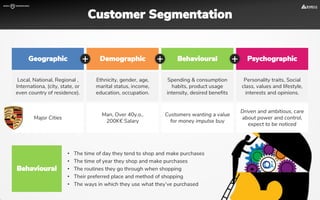
Geographic Demographic Behavioural Psychographic
Local, National, Regional ,
Internationa, (city, state, or
even country of residence).
Ethnicity, gender, age,
marital status, income,
education, occupation.
Spending & consumption
habits, product usage
intensity, desired benefits
Personality traits, Social
class, values and lifestyle,
interests and opinions.
Major Cities
Man, Over 40y.o.,
200K€ Salary
Customers wanting a value
for money impulse buy
Behavioural
• The time of day they tend to shop and make purchases
• The time of year they shop and make purchases
• The routines they go through when shopping
• Their preferred place and method of shopping
• The ways in which they use what they’ve purchased
+ + +
Driven and ambitious, care
about power and control,
expect to be noticed
Customer Segmentation
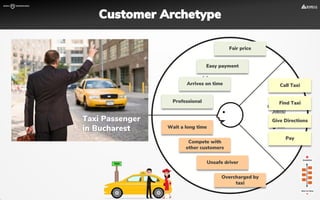
Find Taxi
Call Taxi
Give Directions
Pay
Customer Archetype
Compete with
other customers
Wait a long time
Unsafe driver
Overcharged by
taxi
Easy payment
Fair price
Arrives on time
Professional
Taxi Passenger
in Bucharest
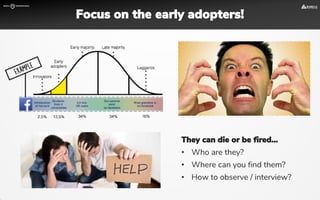
Focus on the early adopters!
​ ​​
They can die or be fired...
• Who are they?
• Where can you find them?
• How to observe / interview?
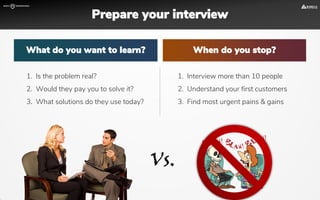
When do you stop?What do you want to learn?
1. Is the problem real?
2. Would they pay you to solve it?
3. What solutions do they use today?
1. Interview more than 10 people
2. Understand your first customers
3. Find most urgent pains & gains
Vs.
Prepare your interview
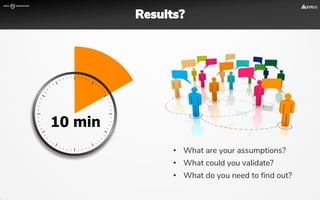
Results?
• What are your assumptions?
• What could you validate?
• What do you need to find out?
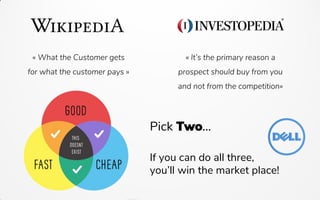
« What the Customer gets
for what the customer pays »
« It’s the primary reason a
prospect should buy from you
and not from the competition»
Pick Two...
If you can do all three,
you’ll win the market place!
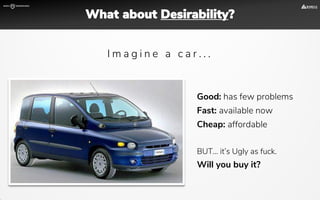
Good: has few problems
Fast: available now
Cheap: affordable
BUT... it’s Ugly as fuck.
Will you buy it?
I m a g i n e a c a r . . .
What about Desirability?
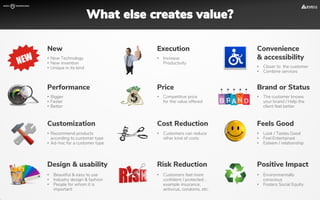
New
• New Technology
• New invention
• Unique in its kind
Performance
• Bigger
• Faster
• Better
Customization
• Recommend products
according to customer type
• Ad-hoc for a customer type
Design & usability
• Beautiful & easy to use
• Industry design & fashion
• People for whom it is
important
Execution
• Increase
Productivity
Price
• Competitive price
for the value offered
Cost Reduction
• Customers can reduce
other kind of costs
Risk Reduction
• Customers feel more
confident / protected ;
example insurance,
antivirus, condoms, etc.
Convenience
& accessibility
• Closer to the customer
• Combine services
Brand or Status
• The customer knows
your brand / Help the
client feel better
Feels Good
• Look / Tastes Good
• Feel Entertained
• Esteem / relationship
• Environmentally
conscious
• Fosters Social Equity
Positive Impact
What else creates value?
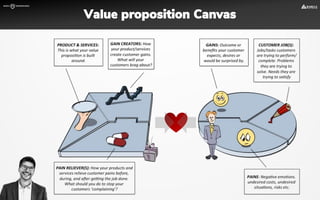
Value proposition Canvas
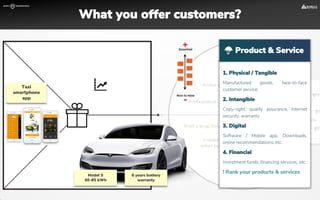
What you offer customers?
Taxi
smartphone
app
Model S
60-85 kWh
8 years battery
warranty
1. Physical / Tangible
Manufactured goods, face-to-face
customer service.
2. Intangible
Copy-right, quality assurance, Internet
security, warranty.
3. Digital
Software / Mobile app, Downloads,
online recommendations, etc.
4. Financial
Investment funds, financing services, etc.
! Rank your products & services
Product & Service
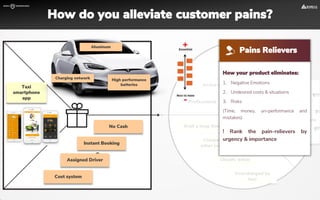
How do you alleviate customer pains?
Taxi
smartphone
app
Aluminum
High performance
batteries
How your product eliminates:
1. Negative Emotions
2. Undesired costs & situations
3. Risks
(Time, money, un-performance and
mistakes)
! Rank the pain-relievers by
urgency & importance
Pains Relievers
Instant Booking
No Cash
Assigned Driver
Cost system
Charging network
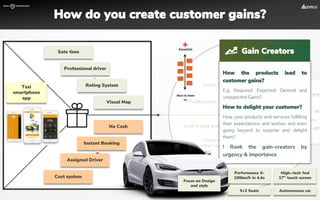
How do you create customer gains?
Taxi
smartphone
app
How the products lead to
customer gains?
E.g. Required, Expected, Desired and
unexpected Gains?
How to delight your customer?
How your products and services fulfilling
their expectations and wishes and even
going beyond to surprise and delight
them?
! Rank the gain-creators by
urgency & importance
Gain Creators
Instant Booking
No Cash
Assigned Driver
Cost system
Professional driver
Sate time
Rating System
Visual Map
Focus on Design
and style
Performance 0-
100km/h in 4,4s
High.-tech feel
17’’ touch screen
Autonomous car5+2 Seats
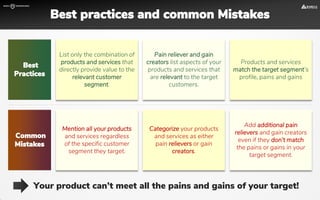
Mention all your products
and services regardless
of the specific customer
segment they target.
Categorize your products
and services as either
pain relievers or gain
creators.
Add additional pain
relievers and gain creators
even if they don’t match
the pains or gains in your
target segment.
Common
Mistakes
List only the combination of
products and services that
directly provide value to the
relevant customer
segment.
Pain reliever and gain
creators list aspects of your
products and services that
are relevant to the target
customers.
Products and services
match the target segment’s
profile, pains and gains
Best
Practices
Your product can’t meet all the pains and gains of your target!
Best practices and common Mistakes
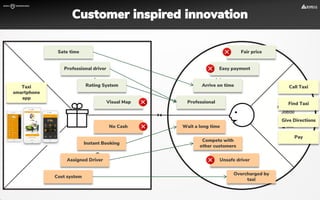
Customer inspired innovation
Find Taxi
Call Taxi
Give Directions
Pay
Compete with
other customers
Wait a long time
Unsafe driver
Overcharged by
taxi
Easy payment
Fair price
Arrive on time
Professional
Taxi
smartphone
app
Professional driver
Sate time
Rating System
Visual Map
Instant Booking
No Cash
Assigned Driver
Cost system
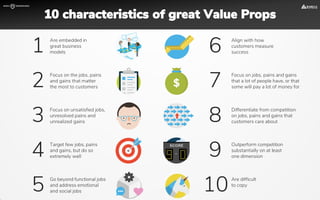
Are embedded in
great business
models1
Focus on the jobs, pains
and gains that matter
the most to customers2
Focus on unsatisfied jobs,
unresolved pains and
unrealized gains3
Target few jobs, pains
and gains, but do so
extremely well4
Go beyond functional jobs
and address emotional
and social jobs5
Align with how
customers measure
success6
Focus on jobs, pains and gains
that a lot of people have, or that
some will pay a lot of money for7
Differentiate from competition
on jobs, pains and gains that
customers care about8
Outperform competition
substantially on at least
one dimension9
Are difficult
to copy
10
10 characteristics of great Value Props
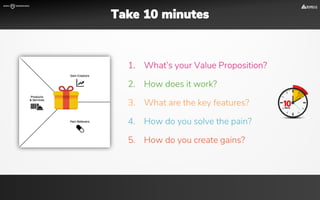
1. What’s your Value Proposition?
2. How does it work?
3. What are the key features?
4. How do you solve the pain?
5. How do you create gains?
Take 10 minutes
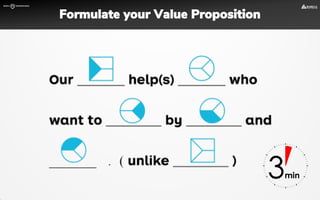
Formulate your Value Proposition
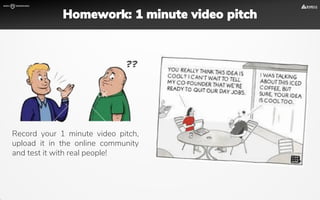
Record your 1 minute video pitch,
upload it in the online community
and test it with real people!
Homework: 1 minute video pitch
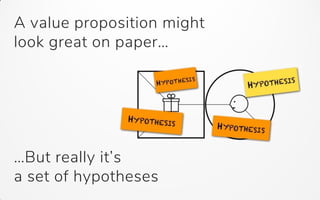
A value proposition might
look great on paper…
…But really it’s
a set of hypotheses
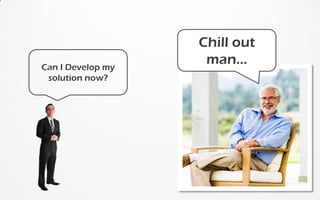
Can I Develop my
solution now?
Chill out
man...
Design Experiments for Validation
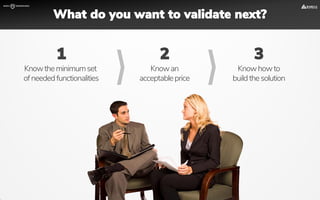
1
Knowtheminimumset
ofneededfunctionalities
2
Knowan
acceptableprice
3
Knowhowto
buildthesolution
What do you want to validate next?
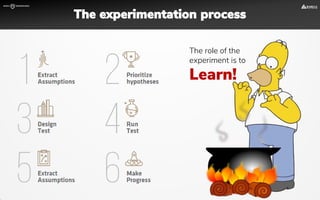
The role of the
experiment is to
Learn!
The experimentation process
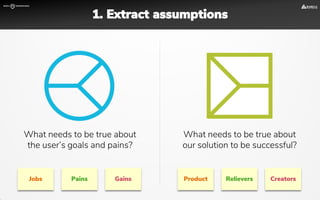
What needs to be true about
the user’s goals and pains?
What needs to be true about
our solution to be successful?
Jobs Pains Gains Product Relievers Creators
1. Extract assumptions
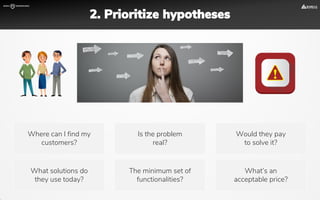
Where can I find my
customers?
Is the problem
real?
Would they pay
to solve it?
What solutions do
they use today?
The minimum set of
functionalities?
What’s an
acceptable price?
2. Prioritize hypotheses
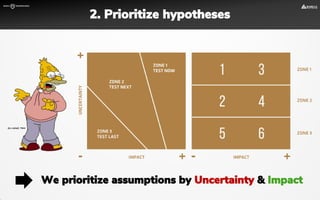
We prioritize assumptions by Uncertainty & Impact
2. Prioritize hypotheses
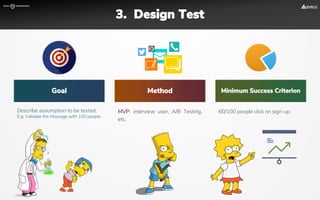
Describe assumption to be tested;
E.g. Validate the Message with 100 people
MVP: interview user, A/B Testing,
etc.
Method
60/100 people click on sign-up
Minimum Success CriterionGoal
3. Design Test
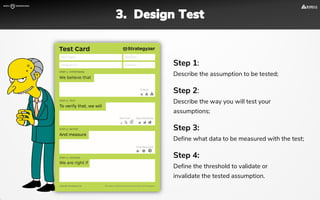
Step 1:
Describe the assumption to be tested;
Step 2:
Describe the way you will test your
assumptions;
Step 3:
Define what data to be measured with the test;
Step 4:
Define the threshold to validate or
invalidate the tested assumption.
3. Design Test
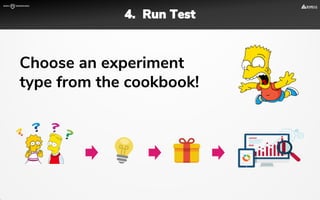
Choose an experiment
type from the cookbook!
4. Run Test
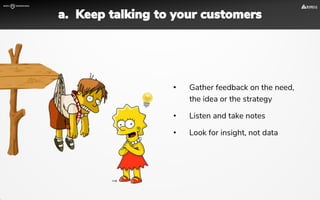
• Gather feedback on the need,
the idea or the strategy
• Listen and take notes
• Look for insight, not data
a. Keep talking to your customers
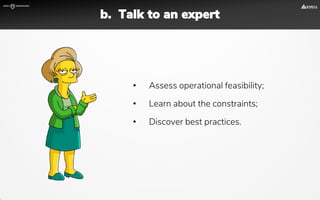
• Assess operational feasibility;
• Learn about the constraints;
• Discover best practices.
b. Talk to an expert
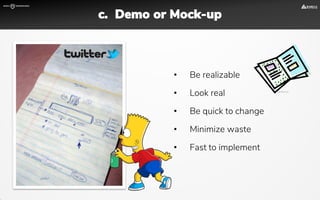
• Be realizable
• Look real
• Be quick to change
• Minimize waste
• Fast to implement
c. Demo or Mock-up
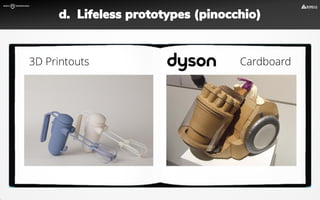
3D Printouts  Cardboard
d. Lifeless prototypes (pinocchio)
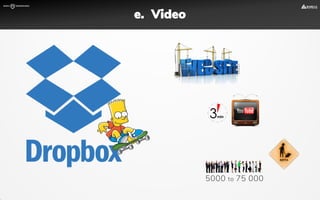
5000 to 75 000
e. Video
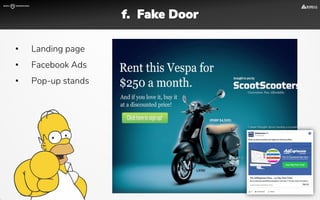
• Landing page
• Facebook Ads
• Pop-up stands
f. Fake Door
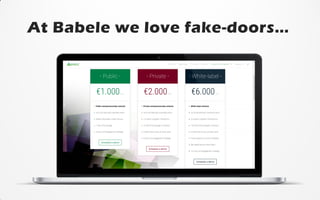
At Babele we love fake-doors…
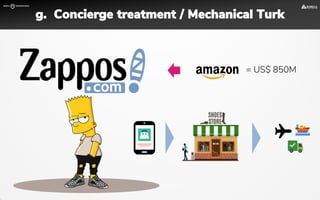
= US$ 850M
g. Concierge treatment / Mechanical Turk
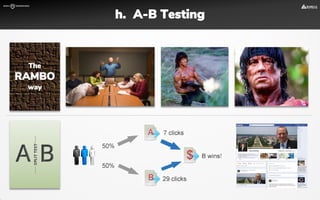
The
RAMBO
way
h. A-B Testing
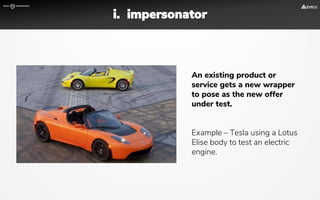
i. impersonator
An existing product or
service gets a new wrapper
to pose as the new offer
under test.
Example – Tesla using a Lotus
Elise body to test an electric
engine.
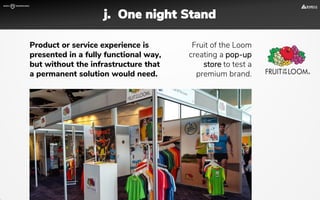
j. One night Stand
Product or service experience is
presented in a fully functional way,
but without the infrastructure that
a permanent solution would need.
Fruit of the Loom
creating a pop-up
store to test a
premium brand.
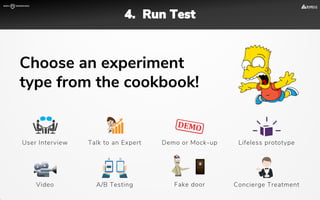
User Interview Talk to an Expert Demo or Mock-up
Video A/B Testing Concierge TreatmentFake door
Lifeless prototype
4. Run Test
Choose an experiment
type from the cookbook!
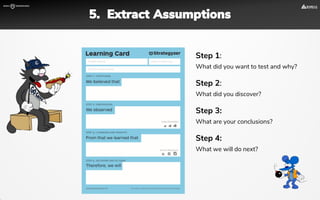
Step 1:
What did you want to test and why?
Step 2:
What did you discover?
Step 3:
What are your conclusions?
Step 4:
What we will do next?
5. Extract Assumptions
6. Move on!
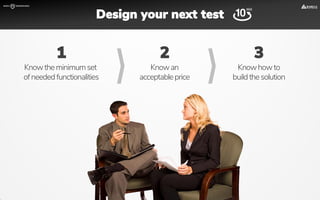
Design your next test
1
Knowtheminimumset
ofneededfunctionalities
2
Knowan
acceptableprice
3
Knowhowto
buildthesolution
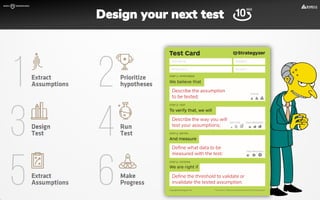
Describe the assumption
to be tested;
Describe the way you will
test your assumptions;
Define what data to be
measured with the test;
Define the threshold to validate or
invalidate the tested assumption.
Design your next test
Build your
first product
Can I develop my
solution now?
Oh My... Are
you still here?
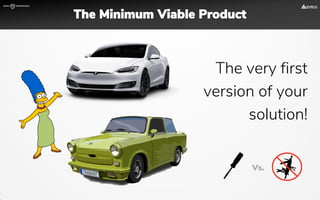
The very first
version of your
solution!
Vs.
The Minimum Viable Product
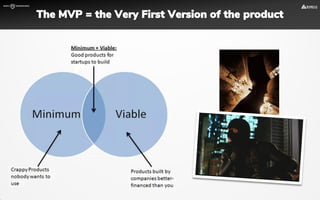
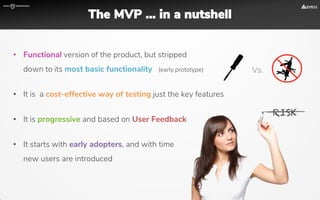
The MVP = the Very First Version of the product
• Functional version of the product, but stripped
down to its most basic functionality (early prototype)
• It is a cost-effective way of testing just the key features
• It is progressive and based on User Feedback
• It starts with early adopters, and with time
new users are introduced
Vs.
The MVP … in a nutshell
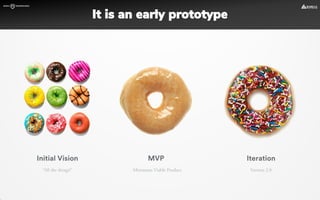
It is an early prototype
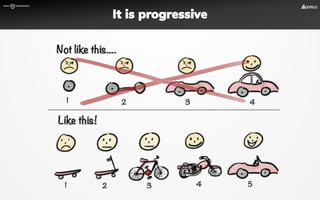
It is progressive
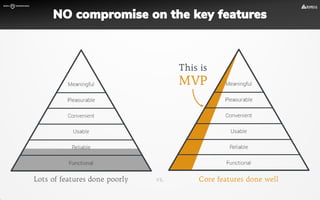
NO compromise on the key features
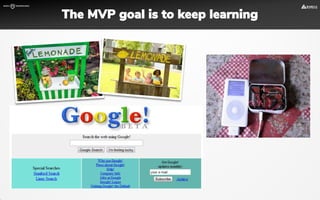
The MVP goal is to keep learning
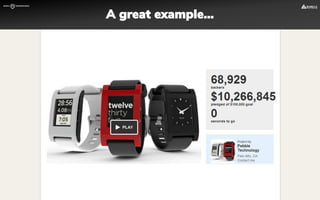
A great example…
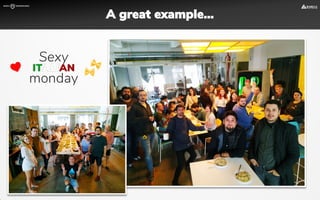
A great example…
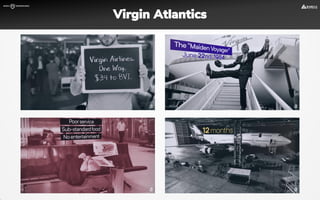
Virgin Atlantics
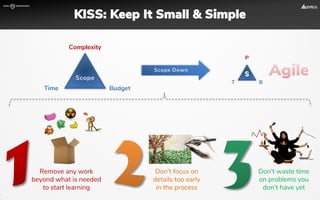
Complexity
Remove any work
beyond what is needed
to start learning
Don’t focus on
details too early
in the process
Don’t waste time
on problems you
don’t have yet
KISS: Keep It Small & Simple
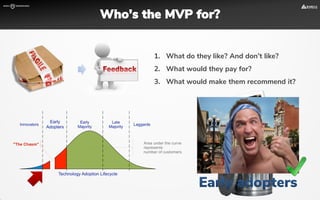
1. What do they like? And don’t like?
2. What would they pay for?
3. What would make them recommend it?
Who’s the MVP for?
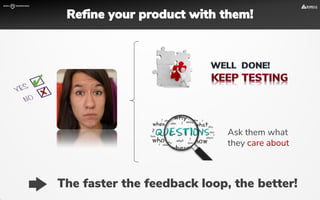
Ask them what
they
The faster the feedback loop, the better!
Refine your product with them!
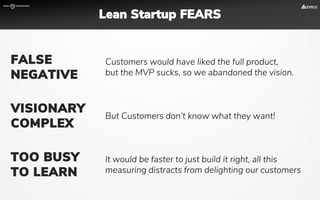
Customers would have liked the full product,
but the MVP sucks, so we abandoned the vision.
FALSE
NEGATIVE
But Customers don’t know what they want!
VISIONARY
COMPLEX
It would be faster to just build it right, all this
measuring distracts from delighting our customers
TOO BUSY
TO LEARN
Lean Startup FEARS
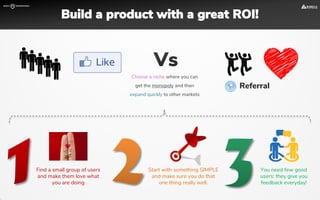
Find a small group of users
and make them love what
you are doing
Start with something SIMPLE
and make sure you do that
one thing really well.
You need few good
users: they give you
feedback everyday!
Referral
Choose a niche where you can
get the monopoly and then
expand quickly to other markets
Build a product with a great ROI!
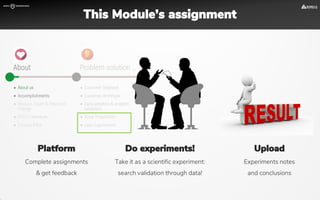
Platform
Complete assignments
& get feedback
Do experiments!
Take it as a scientific experiment:
search validation through data!
Upload
Experiments notes
and conclusions
This Module’s assignment
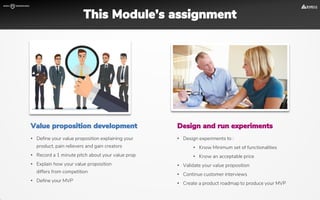
Value proposition development
• Define your value proposition explaining your
product, pain relievers and gain creators
• Record a 1 minute pitch about your value prop
• Explain how your value proposition
differs from competition
• Define your MVP
Design and run experiments
• Design experiments to :
• Know Minimum set of functionalities
• Know an acceptable price
• Validate your value proposition
• Continue customer interviews
• Create a product roadmap to produce your MVP
This Module’s assignment
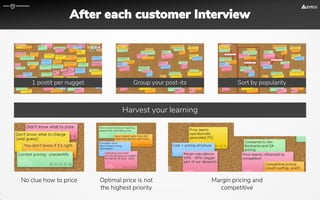
1 postit per nugget Sort by popularityGroup your post-its
Harvest your learning
No clue how to price Optimal price is not
the highest priority
Margin pricing and
competitive
After each customer Interview
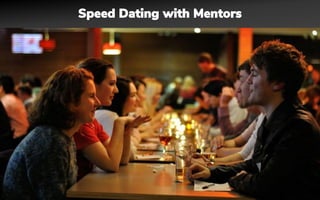
Speed Dating with Mentors
Bt masterclass 2  -  Value proposition development

Bt masterclass 2 - Value proposition development

  • 1.
  • 2.
  • 3.
    Geographic Demographic BehaviouralPsychographic Local, National, Regional , Internationa, (city, state, or even country of residence). Ethnicity, gender, age, marital status, income, education, occupation. Spending & consumption habits, product usage intensity, desired benefits Personality traits, Social class, values and lifestyle, interests and opinions. Major Cities Man, Over 40y.o., 200K€ Salary Customers wanting a value for money impulse buy Behavioural • The time of day they tend to shop and make purchases • The time of year they shop and make purchases • The routines they go through when shopping • Their preferred place and method of shopping • The ways in which they use what they’ve purchased + + + Driven and ambitious, care about power and control, expect to be noticed Customer Segmentation
  • 4.
    Find Taxi Call Taxi GiveDirections Pay Customer Archetype Compete with other customers Wait a long time Unsafe driver Overcharged by taxi Easy payment Fair price Arrives on time Professional Taxi Passenger in Bucharest
  • 5.
    Focus on theearly adopters! ​ ​​ They can die or be fired... • Who are they? • Where can you find them? • How to observe / interview?
  • 6.
    When do youstop?What do you want to learn? 1. Is the problem real? 2. Would they pay you to solve it? 3. What solutions do they use today? 1. Interview more than 10 people 2. Understand your first customers 3. Find most urgent pains & gains Vs. Prepare your interview
  • 7.
    Results? • What areyour assumptions? • What could you validate? • What do you need to find out?
  • 9.
    « What theCustomer gets for what the customer pays » « It’s the primary reason a prospect should buy from you and not from the competition» Pick Two... If you can do all three, you’ll win the market place!
  • 10.
    Good: has fewproblems Fast: available now Cheap: affordable BUT... it’s Ugly as fuck. Will you buy it? I m a g i n e a c a r . . . What about Desirability?
  • 11.
    New • New Technology •New invention • Unique in its kind Performance • Bigger • Faster • Better Customization • Recommend products according to customer type • Ad-hoc for a customer type Design & usability • Beautiful & easy to use • Industry design & fashion • People for whom it is important Execution • Increase Productivity Price • Competitive price for the value offered Cost Reduction • Customers can reduce other kind of costs Risk Reduction • Customers feel more confident / protected ; example insurance, antivirus, condoms, etc. Convenience & accessibility • Closer to the customer • Combine services Brand or Status • The customer knows your brand / Help the client feel better Feels Good • Look / Tastes Good • Feel Entertained • Esteem / relationship • Environmentally conscious • Fosters Social Equity Positive Impact What else creates value?
  • 13.
  • 14.
    What you offercustomers? Taxi smartphone app Model S 60-85 kWh 8 years battery warranty 1. Physical / Tangible Manufactured goods, face-to-face customer service. 2. Intangible Copy-right, quality assurance, Internet security, warranty. 3. Digital Software / Mobile app, Downloads, online recommendations, etc. 4. Financial Investment funds, financing services, etc. ! Rank your products & services Product & Service
  • 15.
    How do youalleviate customer pains? Taxi smartphone app Aluminum High performance batteries How your product eliminates: 1. Negative Emotions 2. Undesired costs & situations 3. Risks (Time, money, un-performance and mistakes) ! Rank the pain-relievers by urgency & importance Pains Relievers Instant Booking No Cash Assigned Driver Cost system Charging network
  • 16.
    How do youcreate customer gains? Taxi smartphone app How the products lead to customer gains? E.g. Required, Expected, Desired and unexpected Gains? How to delight your customer? How your products and services fulfilling their expectations and wishes and even going beyond to surprise and delight them? ! Rank the gain-creators by urgency & importance Gain Creators Instant Booking No Cash Assigned Driver Cost system Professional driver Sate time Rating System Visual Map Focus on Design and style Performance 0- 100km/h in 4,4s High.-tech feel 17’’ touch screen Autonomous car5+2 Seats
  • 17.
    Mention all yourproducts and services regardless of the specific customer segment they target. Categorize your products and services as either pain relievers or gain creators. Add additional pain relievers and gain creators even if they don’t match the pains or gains in your target segment. Common Mistakes List only the combination of products and services that directly provide value to the relevant customer segment. Pain reliever and gain creators list aspects of your products and services that are relevant to the target customers. Products and services match the target segment’s profile, pains and gains Best Practices Your product can’t meet all the pains and gains of your target! Best practices and common Mistakes
  • 18.
    Customer inspired innovation FindTaxi Call Taxi Give Directions Pay Compete with other customers Wait a long time Unsafe driver Overcharged by taxi Easy payment Fair price Arrive on time Professional Taxi smartphone app Professional driver Sate time Rating System Visual Map Instant Booking No Cash Assigned Driver Cost system
  • 19.
    Are embedded in greatbusiness models1 Focus on the jobs, pains and gains that matter the most to customers2 Focus on unsatisfied jobs, unresolved pains and unrealized gains3 Target few jobs, pains and gains, but do so extremely well4 Go beyond functional jobs and address emotional and social jobs5 Align with how customers measure success6 Focus on jobs, pains and gains that a lot of people have, or that some will pay a lot of money for7 Differentiate from competition on jobs, pains and gains that customers care about8 Outperform competition substantially on at least one dimension9 Are difficult to copy 10 10 characteristics of great Value Props
  • 20.
    1. What’s yourValue Proposition? 2. How does it work? 3. What are the key features? 4. How do you solve the pain? 5. How do you create gains? Take 10 minutes
  • 21.
  • 22.
    Record your 1minute video pitch, upload it in the online community and test it with real people! Homework: 1 minute video pitch
  • 23.
    A value propositionmight look great on paper… …But really it’s a set of hypotheses
  • 25.
    Can I Developmy solution now? Chill out man...
  • 26.
  • 27.
  • 28.
    The role ofthe experiment is to Learn! The experimentation process
  • 29.
    What needs tobe true about the user’s goals and pains? What needs to be true about our solution to be successful? Jobs Pains Gains Product Relievers Creators 1. Extract assumptions
  • 30.
    Where can Ifind my customers? Is the problem real? Would they pay to solve it? What solutions do they use today? The minimum set of functionalities? What’s an acceptable price? 2. Prioritize hypotheses
  • 31.
    We prioritize assumptionsby Uncertainty & Impact 2. Prioritize hypotheses
  • 32.
    Describe assumption tobe tested; E.g. Validate the Message with 100 people MVP: interview user, A/B Testing, etc. Method 60/100 people click on sign-up Minimum Success CriterionGoal 3. Design Test
  • 33.
    Step 1: Describe theassumption to be tested; Step 2: Describe the way you will test your assumptions; Step 3: Define what data to be measured with the test; Step 4: Define the threshold to validate or invalidate the tested assumption. 3. Design Test
  • 34.
    Choose an experiment typefrom the cookbook! 4. Run Test
  • 35.
    • Gather feedbackon the need, the idea or the strategy • Listen and take notes • Look for insight, not data a. Keep talking to your customers
  • 36.
    • Assess operationalfeasibility; • Learn about the constraints; • Discover best practices. b. Talk to an expert
  • 37.
    • Be realizable •Look real • Be quick to change • Minimize waste • Fast to implement c. Demo or Mock-up
  • 38.
    3D Printouts  Cardboard d.Lifeless prototypes (pinocchio)
  • 39.
    5000 to 75000 e. Video
  • 40.
    • Landing page •Facebook Ads • Pop-up stands f. Fake Door
  • 41.
    At Babele welove fake-doors…
  • 42.
    = US$ 850M g.Concierge treatment / Mechanical Turk
  • 43.
  • 44.
    i. impersonator An existingproduct or service gets a new wrapper to pose as the new offer under test. Example – Tesla using a Lotus Elise body to test an electric engine.
  • 45.
    j. One nightStand Product or service experience is presented in a fully functional way, but without the infrastructure that a permanent solution would need. Fruit of the Loom creating a pop-up store to test a premium brand.
  • 46.
    User Interview Talkto an Expert Demo or Mock-up Video A/B Testing Concierge TreatmentFake door Lifeless prototype 4. Run Test Choose an experiment type from the cookbook!
  • 47.
    Step 1: What didyou want to test and why? Step 2: What did you discover? Step 3: What are your conclusions? Step 4: What we will do next? 5. Extract Assumptions
  • 48.
  • 50.
    Design your nexttest 1 Knowtheminimumset ofneededfunctionalities 2 Knowan acceptableprice 3 Knowhowto buildthesolution
  • 51.
    Describe the assumption tobe tested; Describe the way you will test your assumptions; Define what data to be measured with the test; Define the threshold to validate or invalidate the tested assumption. Design your next test
  • 52.
  • 53.
    Can I developmy solution now? Oh My... Are you still here?
  • 54.
    The very first versionof your solution! Vs. The Minimum Viable Product
  • 55.
    The MVP =the Very First Version of the product
  • 56.
    • Functional versionof the product, but stripped down to its most basic functionality (early prototype) • It is a cost-effective way of testing just the key features • It is progressive and based on User Feedback • It starts with early adopters, and with time new users are introduced Vs. The MVP … in a nutshell
  • 57.
    It is anearly prototype
  • 58.
  • 59.
    NO compromise onthe key features
  • 60.
    The MVP goalis to keep learning
  • 61.
  • 62.
  • 63.
  • 64.
    Complexity Remove any work beyondwhat is needed to start learning Don’t focus on details too early in the process Don’t waste time on problems you don’t have yet KISS: Keep It Small & Simple
  • 65.
    1. What dothey like? And don’t like? 2. What would they pay for? 3. What would make them recommend it? Who’s the MVP for?
  • 66.
    Ask them what they Thefaster the feedback loop, the better! Refine your product with them!
  • 67.
    Customers would haveliked the full product, but the MVP sucks, so we abandoned the vision. FALSE NEGATIVE But Customers don’t know what they want! VISIONARY COMPLEX It would be faster to just build it right, all this measuring distracts from delighting our customers TOO BUSY TO LEARN Lean Startup FEARS
  • 69.
    Find a smallgroup of users and make them love what you are doing Start with something SIMPLE and make sure you do that one thing really well. You need few good users: they give you feedback everyday! Referral Choose a niche where you can get the monopoly and then expand quickly to other markets Build a product with a great ROI!
  • 70.
    Platform Complete assignments & getfeedback Do experiments! Take it as a scientific experiment: search validation through data! Upload Experiments notes and conclusions This Module’s assignment
  • 71.
    Value proposition development •Define your value proposition explaining your product, pain relievers and gain creators • Record a 1 minute pitch about your value prop • Explain how your value proposition differs from competition • Define your MVP Design and run experiments • Design experiments to : • Know Minimum set of functionalities • Know an acceptable price • Validate your value proposition • Continue customer interviews • Create a product roadmap to produce your MVP This Module’s assignment
  • 72.
    1 postit pernugget Sort by popularityGroup your post-its Harvest your learning No clue how to price Optimal price is not the highest priority Margin pricing and competitive After each customer Interview
  • 73.