RICS BUILDING
SURVEYING JOURNAL
1 2   M AY/J U N E 2 0 1 5 Images © The Severn Partnership
BIM
The pace of technological
change brings with it a tide
of risk and opportunity. For
building surveyors, this is the
time to assess workflows,
gauge whether there is
opportunity to offer clients
new solutions, or at the very
least not get left behind.
RICS continuing
professional development
provides the prod we
need to move outside our
comfort zone and look at
developments on the horizon,
learn new skills and seek
fresh opportunities. The
organisation is pushing hard
to update building information
modelling (BIM) specifications
while working parties are
researching the role of
BIM managers.
Why ? Because chartered
surveyors have the ability
to step into the BIM arena
and bring their skills to
the fore in areas such as
quantity surveying, facilities
management and geomatics.
Retrofit reality
From a geomatics (measured
survey) and refurbishment
perspective, BIM requires a
step up in information capture
Nick Blenkarn discusses the practical
application of building information
modelling in refurbishment
Opportunity
knocks
to enable the 3D reality of
buildings or structures to be
represented.
A variety of methods can
be chosen, but the stand
out winner in terms of
speed, accuracy and clarity
of visualisation is 3D laser
scanning. Decreasing costs,
established workflows and
increased usability have
brought laser scanning to the
masses; bringing efficiency
to both the collection of data
and the creation of BIM for
existing buildings ready for
renovation and retrofit.
Laser scan data or point
clouds are effectively a
collection of 3D survey points
in space, each coloured by
laser signal intensity return
(multihue) or RGB (red, green,
blue via a digital image to
represent ‘true colour’). Site
work is extremely rapid, with
scanners observing up to
1,000,000 points a second
to millimetre accuracy
– surveying complex 3D
geometry ready for addition to
or creation of the BIM.
The detail in the point cloud
will usually be greater than the
BIM, due to the requirement
to model 3D elements to an
agreed level of detail. Where
required, scan data can be
directly overlaid on the BIM to
show where generalisations
have been made.
Along with being used to
create the BIM, scan data
can be collected during the
build process and held as
a repository for the project
team to use – checking build
against design, querying key
T
dimensions, recording steel
position prior to concrete
pour. With free point cloud
viewers available (Bentley
Pointools) and point cloud
engines being incorporated
in design and management
packages, this is another
opportunity to collaborate
around a central dataset.
3D specifications
When planning a scan to BIM
project, the specification
for survey needs to move to
the next level, compared to
procuring 2D plans. Thought
needs to be given to who are
the stakeholders involved in
the project, which disciplines
will be working on the retrofit
BIM: the requirements of
how the BIM is created from
the source point cloud data
may differ depending on the
respective needs of those
who will be using it.
Potentially, structural
engineers, architects, MEP
designers and quantity
surveyors may all have slightly
different requirements that
need to be addressed. This
is why a refurbishment BIM
should be described as a
BIM-ready model; providing
an accurate shell, to an
agreed level of 3D detail
and a set level of feature
attribution (wall construction
and covering). This model
can then be taken further
by professionals with niche
expertise, because the
geomatics teams are not
able to attribute certain M&E
plant or know the structural
properties of a beam.
The degree to which the
BIM is generalised can also
be discussed to agree wall
alignment, for example.
Should a wall be shown as
vertical if within a certain
tolerance, or be depicted
as is, leaning at an angle?
Should a beam be shown as
a bounding area, or I beam
shape or display every rivet?
The bottom line is no
more red line around a site
and standard deliverables
requested. Use a scan to BIM
specification, ask a geomatics
surveyor for a BIM execution
plan, use the new RICS
Measured survey 3rd edition
guidance note and generally
plan to raise communication
with the project team.
New developments
A conventional laser scanning
team observe from tripods
and use conventional survey
control to help ‘register’
individual scans together to
create a point cloud of an
existing building. With the
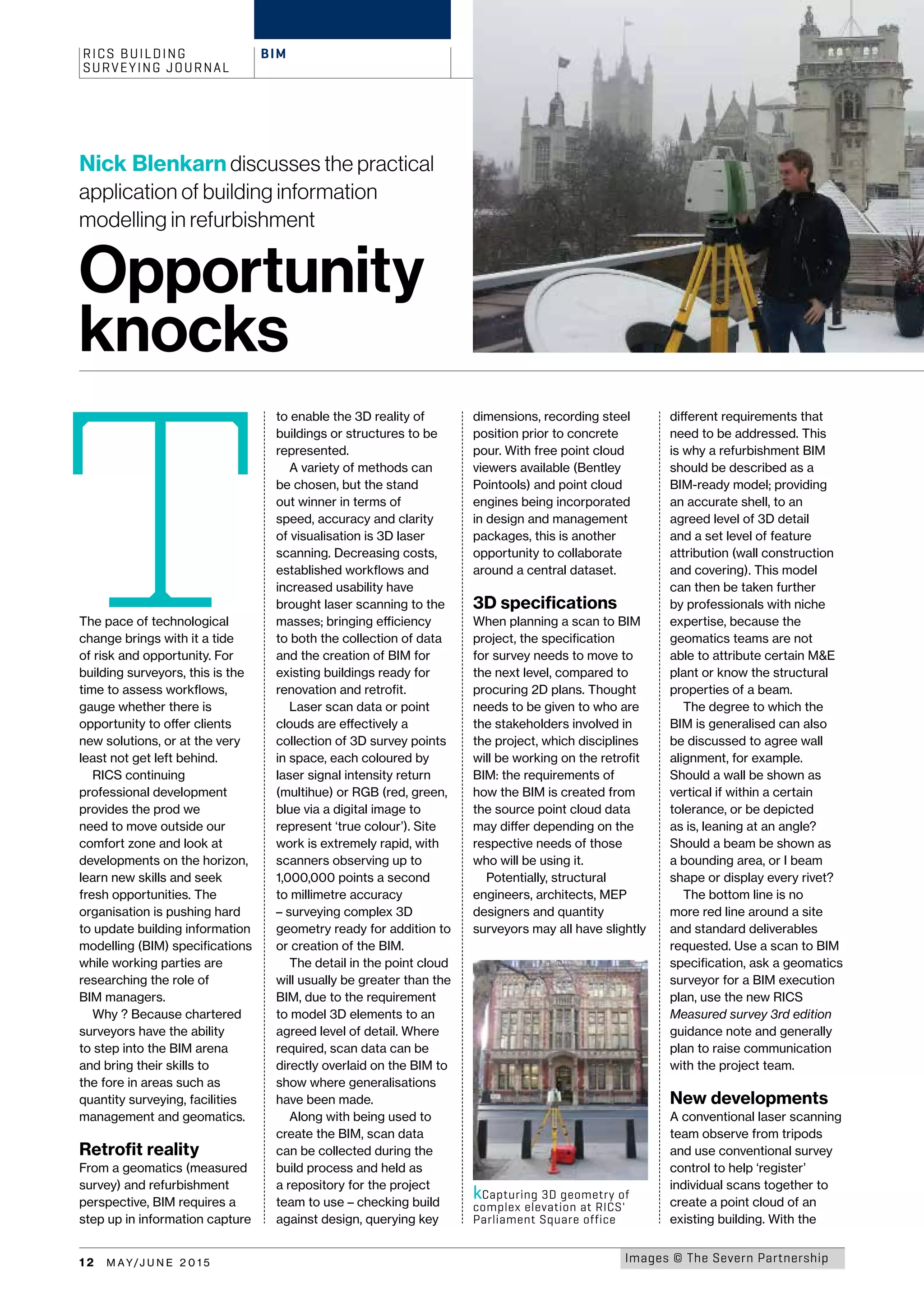
kCapturing 3D geometry of
complex elevation at RICS'
Parliament Square office
RICS BUILDING
SURVEYING JOURNAL
M AY/J U N E 2 0 1 5   1 3
rapid pace of technological
advances, it is worth keeping
an eye on what else surveyors
could use to add value or to
speed up data collection.
What would you say if you
knew there was a technique
that could survey an entire
1km-long street scene in a
matter of minutes and have
a point cloud ready to model
the next day? Well, with the
help of missile guidance
technology, GPS, high
precision scanners and a van,
we can map at driving speed
and potentially get a relative
accuracy or +/-5mm for a
surveyors, inevitably data rot
would set in over time.
The difference with
BIM is that we have a
3D dataset capable of
being visualised, used and
understood by a much wider
non-technical audience.
Take marketing, for example;
conventionally, a project may
be 3D modelled by architects
or engineers, but visualisation
ends with high resolution
renders and possibly a 3D
flythrough animation.
The opportunity is to
repurpose the BIM as an
interactive app that allows
potential users of a new
facility to train virtually. From
enabling interested parties
to walk around a model or
to directors at board level
using augmented reality to
showcase a tender.
One of the stated benefits
of BIM is that it continues
past construction for the
usable life of the facility.
From the building surveyor’s
perspective, there is the
opportunity to add more to
the ‘I’ in BIM. As the intention
is to avoid data rot and use
section through the street or
+/-20mm with control if we
measured from one side of a
town to the other. This is the
kind of speed and accuracy
modern mobile mapping
systems can bring, such as
the Pegasus2.
If you know what is
possible, you can start to
assess whether it is of value
on your project, or bring
innovation to the table and
look good compared to your
competitors. Increasingly,
the 3D geometry of BIM
is being used for rights of
light calculations. So there
is potential to look at the
existing workflows and
consider if mobile mapping
could bring benefits.
Adding value?
If BIM is already being used
by a growing number of
clients, what is the next
risk/opportunity on the
horizon? Well, with a 2D plan
deliverable as the end game,
there is little potential to add
value, if the data use stopped
with architects, engineers or
Nick Blenkarn is Director at The Severn Partnership Ltd
nick.blenkarn@sevenpartnership.com
the BIM actively through the
life cycle of a building, then
key information such as
the presence of asbestos,
HVAC legionnaires’ risks
or even georeference past
accidents could be included.
This then becomes a resource
for safety briefings, Regulation
38 fire details under the
Building Regulations, as well
as a collaborative centre point
for managing the facility.
As surveyors, we could offer
all these services to clients to
allow them to leverage their
investment in BIM for more
than just design.
BIM is here to stay and
3D deliverables will start to
become the norm. In 2004,
Severn Partnership purchased
its first Laser scanner and the
response fro m clients was
often: “If it costs more, we will
stick with our 2D workflow”. In
2015, it features as a standard
specification request from
most clients.
Compared to five years
ago, I can now view the BIM
of an entire school, complete
with structural beams and
sprinkler systems from my
iPad. I can even choose to
host the BIM securely online
and work on it in real time with
a team spread around the
country, tracking edits with a
digital paper trail.
The BIM agenda has been
gathering pace and once the
private sector clients realise
the government is pushing
the BIM agenda to save 20%
on construction projects
by working faster, smarter
and collaborating instead of
cultivating a contract and
claim culture, then it will really
start to fly. b
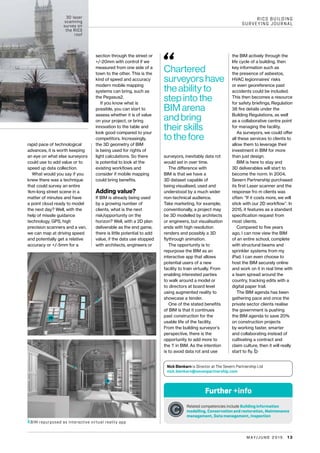
kBIM repurposed as interactive virtual reality app
3D laser
scanning
survey on
the RICS
roof
Chartered
surveyors have
the ability to
step into the
BIM arena
and bring
their skills
to the fore
Related competencies include Building information
modelling, Conservation and restoration, Maintenance
management, Data management, Inspection

BSJ May-June p12-13 GR

  • 1.
    RICS BUILDING SURVEYING JOURNAL 12   M AY/J U N E 2 0 1 5 Images © The Severn Partnership BIM The pace of technological change brings with it a tide of risk and opportunity. For building surveyors, this is the time to assess workflows, gauge whether there is opportunity to offer clients new solutions, or at the very least not get left behind. RICS continuing professional development provides the prod we need to move outside our comfort zone and look at developments on the horizon, learn new skills and seek fresh opportunities. The organisation is pushing hard to update building information modelling (BIM) specifications while working parties are researching the role of BIM managers. Why ? Because chartered surveyors have the ability to step into the BIM arena and bring their skills to the fore in areas such as quantity surveying, facilities management and geomatics. Retrofit reality From a geomatics (measured survey) and refurbishment perspective, BIM requires a step up in information capture Nick Blenkarn discusses the practical application of building information modelling in refurbishment Opportunity knocks to enable the 3D reality of buildings or structures to be represented. A variety of methods can be chosen, but the stand out winner in terms of speed, accuracy and clarity of visualisation is 3D laser scanning. Decreasing costs, established workflows and increased usability have brought laser scanning to the masses; bringing efficiency to both the collection of data and the creation of BIM for existing buildings ready for renovation and retrofit. Laser scan data or point clouds are effectively a collection of 3D survey points in space, each coloured by laser signal intensity return (multihue) or RGB (red, green, blue via a digital image to represent ‘true colour’). Site work is extremely rapid, with scanners observing up to 1,000,000 points a second to millimetre accuracy – surveying complex 3D geometry ready for addition to or creation of the BIM. The detail in the point cloud will usually be greater than the BIM, due to the requirement to model 3D elements to an agreed level of detail. Where required, scan data can be directly overlaid on the BIM to show where generalisations have been made. Along with being used to create the BIM, scan data can be collected during the build process and held as a repository for the project team to use – checking build against design, querying key T dimensions, recording steel position prior to concrete pour. With free point cloud viewers available (Bentley Pointools) and point cloud engines being incorporated in design and management packages, this is another opportunity to collaborate around a central dataset. 3D specifications When planning a scan to BIM project, the specification for survey needs to move to the next level, compared to procuring 2D plans. Thought needs to be given to who are the stakeholders involved in the project, which disciplines will be working on the retrofit BIM: the requirements of how the BIM is created from the source point cloud data may differ depending on the respective needs of those who will be using it. Potentially, structural engineers, architects, MEP designers and quantity surveyors may all have slightly different requirements that need to be addressed. This is why a refurbishment BIM should be described as a BIM-ready model; providing an accurate shell, to an agreed level of 3D detail and a set level of feature attribution (wall construction and covering). This model can then be taken further by professionals with niche expertise, because the geomatics teams are not able to attribute certain M&E plant or know the structural properties of a beam. The degree to which the BIM is generalised can also be discussed to agree wall alignment, for example. Should a wall be shown as vertical if within a certain tolerance, or be depicted as is, leaning at an angle? Should a beam be shown as a bounding area, or I beam shape or display every rivet? The bottom line is no more red line around a site and standard deliverables requested. Use a scan to BIM specification, ask a geomatics surveyor for a BIM execution plan, use the new RICS Measured survey 3rd edition guidance note and generally plan to raise communication with the project team. New developments A conventional laser scanning team observe from tripods and use conventional survey control to help ‘register’ individual scans together to create a point cloud of an existing building. With the kCapturing 3D geometry of complex elevation at RICS' Parliament Square office
  • 2.
    RICS BUILDING SURVEYING JOURNAL MAY/J U N E 2 0 1 5   1 3 rapid pace of technological advances, it is worth keeping an eye on what else surveyors could use to add value or to speed up data collection. What would you say if you knew there was a technique that could survey an entire 1km-long street scene in a matter of minutes and have a point cloud ready to model the next day? Well, with the help of missile guidance technology, GPS, high precision scanners and a van, we can map at driving speed and potentially get a relative accuracy or +/-5mm for a surveyors, inevitably data rot would set in over time. The difference with BIM is that we have a 3D dataset capable of being visualised, used and understood by a much wider non-technical audience. Take marketing, for example; conventionally, a project may be 3D modelled by architects or engineers, but visualisation ends with high resolution renders and possibly a 3D flythrough animation. The opportunity is to repurpose the BIM as an interactive app that allows potential users of a new facility to train virtually. From enabling interested parties to walk around a model or to directors at board level using augmented reality to showcase a tender. One of the stated benefits of BIM is that it continues past construction for the usable life of the facility. From the building surveyor’s perspective, there is the opportunity to add more to the ‘I’ in BIM. As the intention is to avoid data rot and use section through the street or +/-20mm with control if we measured from one side of a town to the other. This is the kind of speed and accuracy modern mobile mapping systems can bring, such as the Pegasus2. If you know what is possible, you can start to assess whether it is of value on your project, or bring innovation to the table and look good compared to your competitors. Increasingly, the 3D geometry of BIM is being used for rights of light calculations. So there is potential to look at the existing workflows and consider if mobile mapping could bring benefits. Adding value? If BIM is already being used by a growing number of clients, what is the next risk/opportunity on the horizon? Well, with a 2D plan deliverable as the end game, there is little potential to add value, if the data use stopped with architects, engineers or Nick Blenkarn is Director at The Severn Partnership Ltd nick.blenkarn@sevenpartnership.com the BIM actively through the life cycle of a building, then key information such as the presence of asbestos, HVAC legionnaires’ risks or even georeference past accidents could be included. This then becomes a resource for safety briefings, Regulation 38 fire details under the Building Regulations, as well as a collaborative centre point for managing the facility. As surveyors, we could offer all these services to clients to allow them to leverage their investment in BIM for more than just design. BIM is here to stay and 3D deliverables will start to become the norm. In 2004, Severn Partnership purchased its first Laser scanner and the response fro m clients was often: “If it costs more, we will stick with our 2D workflow”. In 2015, it features as a standard specification request from most clients. Compared to five years ago, I can now view the BIM of an entire school, complete with structural beams and sprinkler systems from my iPad. I can even choose to host the BIM securely online and work on it in real time with a team spread around the country, tracking edits with a digital paper trail. The BIM agenda has been gathering pace and once the private sector clients realise the government is pushing the BIM agenda to save 20% on construction projects by working faster, smarter and collaborating instead of cultivating a contract and claim culture, then it will really start to fly. b kBIM repurposed as interactive virtual reality app 3D laser scanning survey on the RICS roof Chartered surveyors have the ability to step into the BIM arena and bring their skills to the fore Related competencies include Building information modelling, Conservation and restoration, Maintenance management, Data management, Inspection