How to Leverage BIM
and 3D Laser Scanning
for As-Built
Documentation?
Introduction:
This guide explores how 3D laser scanning and
Building Information Modeling (BIM) are
revolutionizing as-built documentation.
Leave aside the conventional methods riddled
with inaccuracy and say ‘yes’ to a future of
precise, efficient, and data-rich documentation.
Why is As-Built Documentation Important?
Accurate as-built records reflect the final state of a project and serves
as a crucial asset throughout a building's lifecycle. They help in:
Simplified renovation and expansion: Precise details eliminate
guesswork and costly surprises.
Enhanced facility management: Track assets, optimize space
utilization, and streamline maintenance.
Improved collaboration: Share a single source of truth across
stakeholders.
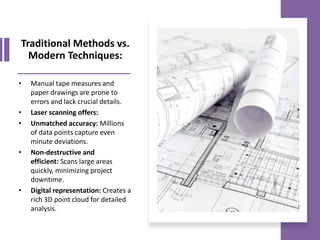
Traditional Methods vs.
Modern Techniques:
• Manual tape measures and
paper drawings are prone to
errors and lack crucial details.
• Laser scanning offers:
• Unmatched accuracy: Millions
of data points capture even
minute deviations.
• Non-destructive and
efficient: Scans large areas
quickly, minimizing project
downtime.
• Digital representation: Creates a
rich 3D point cloud for detailed
analysis.
3D Laser
Scanning for As-
Built
Documentation:
A Breakdown
Stage Description Key Points
Planning & Executing
Define project goals, choose scanner,
plan scan locations, calibrate and
capture data
Goals: Understand data needs and level
of detail.
Scanner: Consider range, resolution,
environment.
Planning: Ensure clear sightlines and
efficient coverage.
Safety: Follow protocols during
scanning.
Capturing Data
Scan relevant building elements,
capture specific details, overlap scans,
document positions
Elements: Walls, floors, ceilings, doors,
windows, etc.
Details: Piping, electrical, mechanical
systems, etc.
Overlap: Ensures seamless data
registration.
Documentation: Track scan positions
and settings.
Processing & Managing
Register scans, filter and clean data,
convert to usable formats, manage
and organize data
Registration: Creates a unified point
cloud. Cleaning: Removes noise and
artifacts. Conversion: BIM elements,
mesh models, etc.
Management: Easy access and
collaboration.
Software: Visualization, analysis,
information extraction.
Benefits
Accuracy, efficiency, digital
representation, non-destructive
Precise data (millions of points), scans
large areas quickly, 3D point cloud for
analysis, minimizes project downtime.
Building
As-Built
Model
with
BIM:
BIM goes beyond drawings, capturing building
systems and properties within a 3D model.
Steps include:
Choosing the right BIM software for your
needs.
Converting point cloud data into intelligent
BIM elements.
Selecting appropriate Level of Detail (LOD) for
your project.
Integrating existing 2D documentation
seamlessly.
Leveraging the BIM
Model for Facility
Management:
• BIM model is a treasure trove of
valuable information.
• Use it to:
 Extract detailed measurements and
specifications.
 Manage space efficiently and track
assets in real-time.
 Plan maintenance and renovations with
precise data.
 Optimize facility performance for
energy efficiency.
The Future is Bright:
• BIM services and laser scanning
technologies are constantly evolving,
promising even greater benefits in the
future.
• Stay ahead of the curve by exploring:
 AI-powered analysis and automated
insights
 AR overlays for real-time visualization
on-site
 Seamless integration with Building IoT
systems
 High-definition scanning and material
recognition
Invest in BIM &
Scanning with Tejjy
Inc. architectural
engineers
• Explore and connect with 3D
laser scanning, BIM and as-built
experts.
• Don't be left behind.
• Build with confidence for
tomorrow, and hold the future
of as-built documentation with
BIM service provider.
• To know more, contact Tejjy Inc.
BIM company in USA.

How to Leverage BIM and 3D Laser Scanning for As-Built Documentation

  • 1.
    How to LeverageBIM and 3D Laser Scanning for As-Built Documentation?
  • 2.
    Introduction: This guide exploreshow 3D laser scanning and Building Information Modeling (BIM) are revolutionizing as-built documentation. Leave aside the conventional methods riddled with inaccuracy and say ‘yes’ to a future of precise, efficient, and data-rich documentation.
  • 3.
    Why is As-BuiltDocumentation Important? Accurate as-built records reflect the final state of a project and serves as a crucial asset throughout a building's lifecycle. They help in: Simplified renovation and expansion: Precise details eliminate guesswork and costly surprises. Enhanced facility management: Track assets, optimize space utilization, and streamline maintenance. Improved collaboration: Share a single source of truth across stakeholders.
  • 4.
    Traditional Methods vs. ModernTechniques: • Manual tape measures and paper drawings are prone to errors and lack crucial details. • Laser scanning offers: • Unmatched accuracy: Millions of data points capture even minute deviations. • Non-destructive and efficient: Scans large areas quickly, minimizing project downtime. • Digital representation: Creates a rich 3D point cloud for detailed analysis.
  • 5.
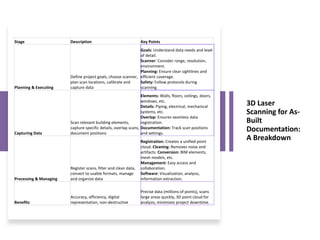
    3D Laser Scanning forAs- Built Documentation: A Breakdown Stage Description Key Points Planning & Executing Define project goals, choose scanner, plan scan locations, calibrate and capture data Goals: Understand data needs and level of detail. Scanner: Consider range, resolution, environment. Planning: Ensure clear sightlines and efficient coverage. Safety: Follow protocols during scanning. Capturing Data Scan relevant building elements, capture specific details, overlap scans, document positions Elements: Walls, floors, ceilings, doors, windows, etc. Details: Piping, electrical, mechanical systems, etc. Overlap: Ensures seamless data registration. Documentation: Track scan positions and settings. Processing & Managing Register scans, filter and clean data, convert to usable formats, manage and organize data Registration: Creates a unified point cloud. Cleaning: Removes noise and artifacts. Conversion: BIM elements, mesh models, etc. Management: Easy access and collaboration. Software: Visualization, analysis, information extraction. Benefits Accuracy, efficiency, digital representation, non-destructive Precise data (millions of points), scans large areas quickly, 3D point cloud for analysis, minimizes project downtime.
  • 6.
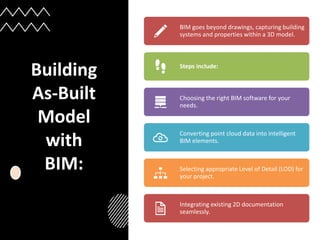
    Building As-Built Model with BIM: BIM goes beyonddrawings, capturing building systems and properties within a 3D model. Steps include: Choosing the right BIM software for your needs. Converting point cloud data into intelligent BIM elements. Selecting appropriate Level of Detail (LOD) for your project. Integrating existing 2D documentation seamlessly.
  • 7.
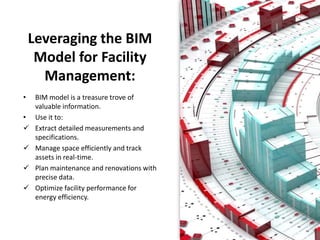
    Leveraging the BIM Modelfor Facility Management: • BIM model is a treasure trove of valuable information. • Use it to:  Extract detailed measurements and specifications.  Manage space efficiently and track assets in real-time.  Plan maintenance and renovations with precise data.  Optimize facility performance for energy efficiency.
  • 8.
    The Future isBright: • BIM services and laser scanning technologies are constantly evolving, promising even greater benefits in the future. • Stay ahead of the curve by exploring:  AI-powered analysis and automated insights  AR overlays for real-time visualization on-site  Seamless integration with Building IoT systems  High-definition scanning and material recognition
  • 9.
    Invest in BIM& Scanning with Tejjy Inc. architectural engineers • Explore and connect with 3D laser scanning, BIM and as-built experts. • Don't be left behind. • Build with confidence for tomorrow, and hold the future of as-built documentation with BIM service provider. • To know more, contact Tejjy Inc. BIM company in USA.