Copyright © 2019, 2015, 2011 Pearson Education, Inc. All Rights Reserved
Part 3
Implementation
Chapter 10
Managing digital business
transformation and growth
hacking
Digital Business and E-Commerce
Management
Seventh Edition
Copyright © 2019, 2015, 2011 Pearson Education, Inc. All Rights Reserved
Learning outcomes
• Critically analyse the journey of an
organisation through transformation
• Review the approaches to be taken in a
digital transformation exercise
• Produce a growth hacking/agile
marketing plan
• Create a plan to measure and improve
the effectiveness of digital businesses
using analytics tools
Copyright © 2019, 2015, 2011 Pearson Education, Inc. All Rights Reserved
Management issues
• What makes an exercise in a digital
business a digital transformation project?
• What are the non-technical aspects of a
digital transformation project?
• How do we gain traction on a limited
budget?
• What techniques are available to measure
and optimise our services?
• Does the organisation have the right culture
to support a growth hacking approach?
Copyright © 2019, 2015, 2011 Pearson Education, Inc. All Rights Reserved
Activity – Digital opportunities
• Make a list of any new technological
developments that have occurred in the last
12 months that seem to have appeared
from nowhere
• Consider what changes are needed by any
organisation to adapt to the development
– What cultural, practice or process changes
could the technology create?
– How would people change?
Copyright © 2019, 2015, 2011 Pearson Education, Inc. All Rights Reserved
Typical responses
• People might bring in aspects of digital
culture
• People might work different hours or in a
different place
• People might change the way they do
something in the workplace
Copyright © 2019, 2015, 2011 Pearson Education, Inc. All Rights Reserved
Definitions
• What’s the difference between:
– Digital transformation?
– Digital business transformation?
• What’s the difference between:
– Adopting technology?
– Adapting to technology?
Copyright © 2019, 2015, 2011 Pearson Education, Inc. All Rights Reserved
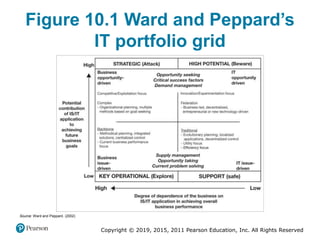
Figure 10.1 Ward and Peppard’s
IT portfolio grid
Source: Ward and Peppard. (2002)
Copyright © 2019, 2015, 2011 Pearson Education, Inc. All Rights Reserved
The applications portfolio
• What makes something high-potential?
• What makes something strategic?
• What makes something key-operational?
• What makes something support?
Copyright © 2019, 2015, 2011 Pearson Education, Inc. All Rights Reserved
Opportunities provided by digital
• Customer service and service design
– Customer insight
– Adding value
– Interfaces with customers
• Business and organisational processes
– Automation
• Business models
– Digital at the heart of the business opportunity
– Adapting the business to a digital opportunity
Copyright © 2019, 2015, 2011 Pearson Education, Inc. All Rights Reserved
Framework for transformation
• The process of review
– Looking at where the digital opportunity is
– Confidence about the digital opportunity
– Leadership grasp of digital
– Maturity of digital
• The process of strategy
• The process of resourcing and planning
– Design of transformation
– Programme of change
Copyright © 2019, 2015, 2011 Pearson Education, Inc. All Rights Reserved
Framework for transformation
(Continued)
• The process of deployment
• The process of living with and evaluating
digital transformation
Copyright © 2019, 2015, 2011 Pearson Education, Inc. All Rights Reserved
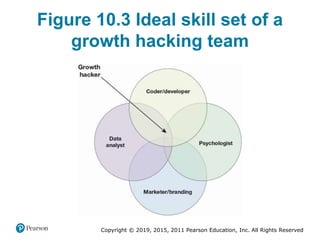
Figure 10.3 Ideal skill set of a
growth hacking team
Copyright © 2019, 2015, 2011 Pearson Education, Inc. All Rights Reserved
The growth hacking process
There are five key pillars to achieving
growth hacking success:
1. Product/market fit – create a Minimum
Viable Product (MVP)
2. User data analysis
3. Conversion rate optimisation (CRO)
4. Viral growth
5. Retention and scalable growth
Copyright © 2019, 2015, 2011 Pearson Education, Inc. All Rights Reserved
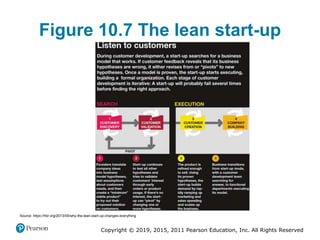
Figure 10.7 The lean start-up
Source: https://hbr.org/2013/05/why-the-lean-start-up-changes-everything
Copyright © 2019, 2015, 2011 Pearson Education, Inc. All Rights Reserved
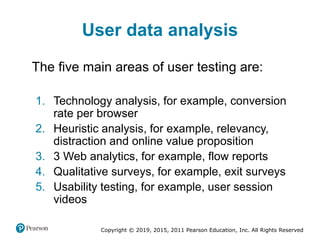
User data analysis
The five main areas of user testing are:
1. Technology analysis, for example, conversion
rate per browser
2. Heuristic analysis, for example, relevancy,
distraction and online value proposition
3. 3 Web analytics, for example, flow reports
4. Qualitative surveys, for example, exit surveys
5. Usability testing, for example, user session
videos
Copyright © 2019, 2015, 2011 Pearson Education, Inc. All Rights Reserved
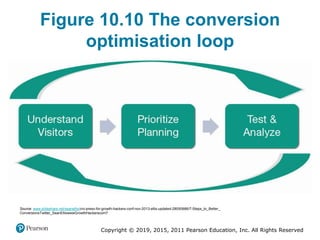
Figure 10.10 The conversion
optimisation loop
Source: www.slideshare.net/seanellis/cro-preso-for-growth-hackers-conf-nov-2013-ellis-updated-28050686/7-Steps_to_Better_
ConversionsTwitter_SeanElliswwwGrowthHackerscom7
Copyright © 2019, 2015, 2011 Pearson Education, Inc. All Rights Reserved
User data analysis
There are seven main areas that can help
improve website conversion and sales:
1. A/B testing an multivariate testing
2. Having a structured approach
3. Customer journey analysis (covered in
Chapter 8)
4. Copy optimisation
5. Online surveys/customer feedback
6. Cart abandonment analysis
7. Segmentation (covered in Chapters 7 & 8)
Copyright © 2019, 2015, 2011 Pearson Education, Inc. All Rights Reserved
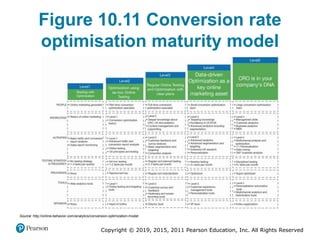
Figure 10.11 Conversion rate
optimisation maturity model
Source: http://online-behavior.com/analytics/conversion-optimization-model
Copyright © 2019, 2015, 2011 Pearson Education, Inc. All Rights Reserved
Viral growth
There are three main types of viral growth
1. Inherent virality: built into the product and
happens as a function of its use (e.g. Skype is
only useful if you share it with others)
2. Artifical virality: forced and is often built into a
reward system (e.g. GiffGaff and it’s community
of users, who help answer each other’s questions
and gain cash rewards)
3. Word-of-Mouth virality: when conversations are
generated by satisfied users (e.g. Zappos and it’s
high customer service, which is about ‘delivering
happiness’)
Copyright © 2019, 2015, 2011 Pearson Education, Inc. All Rights Reserved
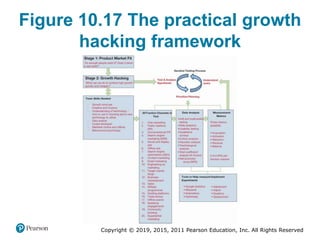
Figure 10.17 The practical growth
hacking framework
Copyright © 2019, 2015, 2011 Pearson Education, Inc. All Rights Reserved
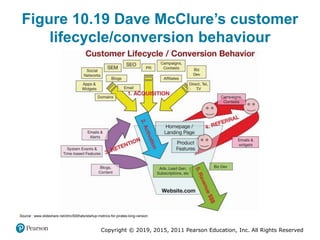
Figure 10.19 Dave McClure’s customer
lifecycle/conversion behaviour
Source : www.slideshare.net/dmc500hats/startup-metrics-for-pirates-long-version
Copyright © 2019, 2015, 2011 Pearson Education, Inc. All Rights Reserved
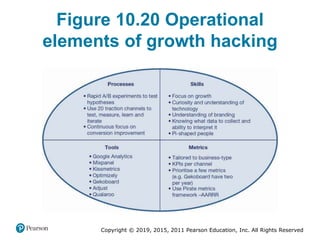
Figure 10.20 Operational
elements of growth hacking
Copyright © 2019, 2015, 2011 Pearson Education, Inc. All Rights Reserved
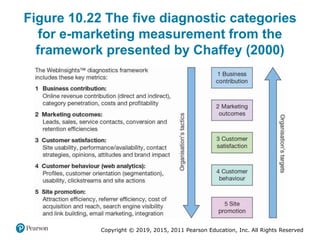
Figure 10.22 The five diagnostic categories
for e-marketing measurement from the
framework presented by Chaffey (2000)
Copyright © 2019, 2015, 2011 Pearson Education, Inc. All Rights Reserved
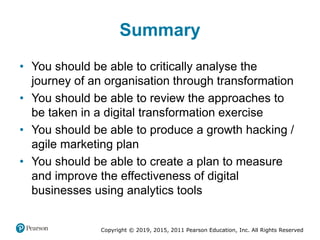
Summary
• You should be able to critically analyse the
journey of an organisation through transformation
• You should be able to review the approaches to
be taken in a digital transformation exercise
• You should be able to produce a growth hacking /
agile marketing plan
• You should be able to create a plan to measure
and improve the effectiveness of digital
businesses using analytics tools

BSAD 372 - CH 10

  • 1.
    Copyright © 2019,2015, 2011 Pearson Education, Inc. All Rights Reserved Part 3 Implementation Chapter 10 Managing digital business transformation and growth hacking Digital Business and E-Commerce Management Seventh Edition
  • 2.
    Copyright © 2019,2015, 2011 Pearson Education, Inc. All Rights Reserved Learning outcomes • Critically analyse the journey of an organisation through transformation • Review the approaches to be taken in a digital transformation exercise • Produce a growth hacking/agile marketing plan • Create a plan to measure and improve the effectiveness of digital businesses using analytics tools
  • 3.
    Copyright © 2019,2015, 2011 Pearson Education, Inc. All Rights Reserved Management issues • What makes an exercise in a digital business a digital transformation project? • What are the non-technical aspects of a digital transformation project? • How do we gain traction on a limited budget? • What techniques are available to measure and optimise our services? • Does the organisation have the right culture to support a growth hacking approach?
  • 4.
    Copyright © 2019,2015, 2011 Pearson Education, Inc. All Rights Reserved Activity – Digital opportunities • Make a list of any new technological developments that have occurred in the last 12 months that seem to have appeared from nowhere • Consider what changes are needed by any organisation to adapt to the development – What cultural, practice or process changes could the technology create? – How would people change?
  • 5.
    Copyright © 2019,2015, 2011 Pearson Education, Inc. All Rights Reserved Typical responses • People might bring in aspects of digital culture • People might work different hours or in a different place • People might change the way they do something in the workplace
  • 6.
    Copyright © 2019,2015, 2011 Pearson Education, Inc. All Rights Reserved Definitions • What’s the difference between: – Digital transformation? – Digital business transformation? • What’s the difference between: – Adopting technology? – Adapting to technology?
  • 7.
    Copyright © 2019,2015, 2011 Pearson Education, Inc. All Rights Reserved Figure 10.1 Ward and Peppard’s IT portfolio grid Source: Ward and Peppard. (2002)
  • 8.
    Copyright © 2019,2015, 2011 Pearson Education, Inc. All Rights Reserved The applications portfolio • What makes something high-potential? • What makes something strategic? • What makes something key-operational? • What makes something support?
  • 9.
    Copyright © 2019,2015, 2011 Pearson Education, Inc. All Rights Reserved Opportunities provided by digital • Customer service and service design – Customer insight – Adding value – Interfaces with customers • Business and organisational processes – Automation • Business models – Digital at the heart of the business opportunity – Adapting the business to a digital opportunity
  • 10.
    Copyright © 2019,2015, 2011 Pearson Education, Inc. All Rights Reserved Framework for transformation • The process of review – Looking at where the digital opportunity is – Confidence about the digital opportunity – Leadership grasp of digital – Maturity of digital • The process of strategy • The process of resourcing and planning – Design of transformation – Programme of change
  • 11.
    Copyright © 2019,2015, 2011 Pearson Education, Inc. All Rights Reserved Framework for transformation (Continued) • The process of deployment • The process of living with and evaluating digital transformation
  • 12.
    Copyright © 2019,2015, 2011 Pearson Education, Inc. All Rights Reserved Figure 10.3 Ideal skill set of a growth hacking team
  • 13.
    Copyright © 2019,2015, 2011 Pearson Education, Inc. All Rights Reserved The growth hacking process There are five key pillars to achieving growth hacking success: 1. Product/market fit – create a Minimum Viable Product (MVP) 2. User data analysis 3. Conversion rate optimisation (CRO) 4. Viral growth 5. Retention and scalable growth
  • 14.
    Copyright © 2019,2015, 2011 Pearson Education, Inc. All Rights Reserved Figure 10.7 The lean start-up Source: https://hbr.org/2013/05/why-the-lean-start-up-changes-everything
  • 15.
    Copyright © 2019,2015, 2011 Pearson Education, Inc. All Rights Reserved User data analysis The five main areas of user testing are: 1. Technology analysis, for example, conversion rate per browser 2. Heuristic analysis, for example, relevancy, distraction and online value proposition 3. 3 Web analytics, for example, flow reports 4. Qualitative surveys, for example, exit surveys 5. Usability testing, for example, user session videos
  • 16.
    Copyright © 2019,2015, 2011 Pearson Education, Inc. All Rights Reserved Figure 10.10 The conversion optimisation loop Source: www.slideshare.net/seanellis/cro-preso-for-growth-hackers-conf-nov-2013-ellis-updated-28050686/7-Steps_to_Better_ ConversionsTwitter_SeanElliswwwGrowthHackerscom7
  • 17.
    Copyright © 2019,2015, 2011 Pearson Education, Inc. All Rights Reserved User data analysis There are seven main areas that can help improve website conversion and sales: 1. A/B testing an multivariate testing 2. Having a structured approach 3. Customer journey analysis (covered in Chapter 8) 4. Copy optimisation 5. Online surveys/customer feedback 6. Cart abandonment analysis 7. Segmentation (covered in Chapters 7 & 8)
  • 18.
    Copyright © 2019,2015, 2011 Pearson Education, Inc. All Rights Reserved Figure 10.11 Conversion rate optimisation maturity model Source: http://online-behavior.com/analytics/conversion-optimization-model
  • 19.
    Copyright © 2019,2015, 2011 Pearson Education, Inc. All Rights Reserved Viral growth There are three main types of viral growth 1. Inherent virality: built into the product and happens as a function of its use (e.g. Skype is only useful if you share it with others) 2. Artifical virality: forced and is often built into a reward system (e.g. GiffGaff and it’s community of users, who help answer each other’s questions and gain cash rewards) 3. Word-of-Mouth virality: when conversations are generated by satisfied users (e.g. Zappos and it’s high customer service, which is about ‘delivering happiness’)
  • 20.
    Copyright © 2019,2015, 2011 Pearson Education, Inc. All Rights Reserved Figure 10.17 The practical growth hacking framework
  • 21.
    Copyright © 2019,2015, 2011 Pearson Education, Inc. All Rights Reserved Figure 10.19 Dave McClure’s customer lifecycle/conversion behaviour Source : www.slideshare.net/dmc500hats/startup-metrics-for-pirates-long-version
  • 22.
    Copyright © 2019,2015, 2011 Pearson Education, Inc. All Rights Reserved Figure 10.20 Operational elements of growth hacking
  • 23.
    Copyright © 2019,2015, 2011 Pearson Education, Inc. All Rights Reserved Figure 10.22 The five diagnostic categories for e-marketing measurement from the framework presented by Chaffey (2000)
  • 24.
    Copyright © 2019,2015, 2011 Pearson Education, Inc. All Rights Reserved Summary • You should be able to critically analyse the journey of an organisation through transformation • You should be able to review the approaches to be taken in a digital transformation exercise • You should be able to produce a growth hacking / agile marketing plan • You should be able to create a plan to measure and improve the effectiveness of digital businesses using analytics tools