
Chapter 3
The Global Environment
Copyright ©2020 Cengage Learning. All Rights Reserved. May not be scanned, copied or duplicated, or posted to a publicly accessible website, in whole or in part.
LEARNING OUTCOMES
2HR5 | CH3
Copyright © 2020 Cengage Learning. All Rights Reserved. May not be scanned, copied or duplicated, or posted to a publicly
accessible website, in whole or in part.
1. Describe the growth of international business
2. Identify and discuss the global issues in
international human resource management
3. Discuss the human resource management
function in international business
4. Identify and discuss the domestic issues in
international human resource management
3
LEARNING OUTCOMES (Continued)
HR5 | CH3
Copyright © 2020 Cengage Learning. All Rights Reserved. May not be scanned, copied or duplicated, or posted to a publicly
accessible website, in whole or in part.
5. Describe the issues involved in managing
international transfers and assignments
6. Summarize the issues in international labor
relations
4
Copyright © 2020 Cengage Learning. All Rights Reserved. May not be scanned, copied or duplicated, or posted to a publicly
accessible website, in whole or in part. HR5 | CH3
Growth of International Business
• British empire was built around the
financial and business interests of the
British nobility
• Forces that shaped today’s competitive
international business environment began
to emerge after World War Two
• 1950s: The United States was by far the
dominant economic power in the world
• Late 1970s: Businesses from other countries
emerged as major players in the world economy
LO 1
5
Copyright © 2020 Cengage Learning. All Rights Reserved. May not be scanned, copied or duplicated, or posted to a publicly
accessible website, in whole or in part. HR5 | CH3
Growth of International Business (Continued)
• By the mid-1990s, global competitiveness
seemed to have become the norm rather
than the exception
• Developments around the world have
affected the new global economy
• Economies have become highly interdependent
• Growth of regional economic alliances has
substantial effects on the global business
community
LO 1
6
Copyright © 2020 Cengage Learning. All Rights Reserved. May not be scanned, copied or duplicated, or posted to a publicly
accessible website, in whole or in part. HR5 | CH3
Global Issues in International Human
Resource Management
• Developing an international HRM strategy
• Developing an understanding of the cultural
environment of HRM
• Developing an understanding of the
political and legal environment of HRM
LO 2
7
Copyright © 2020 Cengage Learning. All Rights Reserved. May not be scanned, copied or duplicated, or posted to a publicly
accessible website, in whole or in part. HR5 | CH3
International HRM Strategy
• Ethnocentric staffing model
• Uses parent-country nationals (PCN’s) to staff
higher-level foreign positions
• Polycentric staffing model
• Calls for the dominant use of host-country
nationals (HCN’s) throughout the organization
• Geocentric staffing model
• Puts PCN’s, HCN’s, and third-country nationals
(TCN’s) all in the same category with the firm
attempting to always hire the best person
available for a position
LO 2
8
Copyright © 2020 Cengage Learning. All Rights Reserved. May not be scanned, copied or duplicated, or posted to a publicly
accessible website, in whole or in part. HR5 | CH3
Understanding the Cultural Environment
• Culture: Set of values, symbols, beliefs, and
languages that guide the behavior of people
within that culture
• Cultural differences directly affect business
practices in international situations
• Language differences complicate the issues
involved in dealing with international business
• Cultural roles directly affect HRM practices
LO 2
9
Copyright © 2020 Cengage Learning. All Rights Reserved. May not be scanned, copied or duplicated, or posted to a publicly
accessible website, in whole or in part. HR5 | CH3
Dimensions of National Culture Identified by
Geert Hofstede
• Power distance
• Individualism versus collectivism
• Masculinity versus femininity
• Uncertainty avoidance
• Long-term orientation versus short-term
orientation
• Indulgence versus restraint
LO 2
10
Copyright © 2020 Cengage Learning. All Rights Reserved. May not be scanned, copied or duplicated, or posted to a publicly
accessible website, in whole or in part. HR5 | CH3
Dimensions of National Culture Identified by
GLOBE project
• Uncertainty avoidance
• Power distance
• Individualism versus collectivism
• Assertiveness
• In-group collectivism
• Gender egalitarianism
• Future orientation
• Performance orientation
• Humane orientation
LO 2
11
Copyright © 2020 Cengage Learning. All Rights Reserved. May not be scanned, copied or duplicated, or posted to a publicly
accessible website, in whole or in part. HR5 | CH3
Political and Legal Issues of International
Business
• Government stability
• Ability of a given government to stay in power
against opposing factions or permanence of
government policies toward businesses
• Includes the extent of risk faced by expatriates
as a result of political instability
• Trade incentives
• Reduced interest rates on loans, construction
subsidies and tax incentives, and relaxation of
various controls on international trade
LO 2
12
Copyright © 2020 Cengage Learning. All Rights Reserved. May not be scanned, copied or duplicated, or posted to a publicly
accessible website, in whole or in part. HR5 | CH3
Political and Legal Issues of International
Business (Continued)
• Trade controls
• Tariffs: Tax collected on goods shipped across
national boundaries
• Quotas: Limit on the number or value of goods
that can be traded
• Economic communities
• Sets of countries that agree to eliminate trade
barriers among their member nations
• Examples: The European Union (E U) and the
North American Free Trade Agreement (NAFTA)
LO 2
13
Copyright © 2020 Cengage Learning. All Rights Reserved. May not be scanned, copied or duplicated, or posted to a publicly
accessible website, in whole or in part. HR5 | CH3
Fundamental Management Challenges in
International Business
• Avoiding discrimination in employment
• Choosing an appropriate source of
employees
• Cross-cultural training and development of
employees
• Includes training programs for both expatriates
and workers in host countries
• Working conditions, compensation, and the
cost of living
LO 3
14
Copyright © 2020 Cengage Learning. All Rights Reserved. May not be scanned, copied or duplicated, or posted to a publicly
accessible website, in whole or in part. HR5 | CH3
Specific Human Resource Issues in
International Business
• Exporting
• Process of making a product in the firm’s
domestic marketplace and then selling it to
another country
• Licensing
• Involves one company granting its permission to
another company in a foreign country to
manufacture or market its products in its local
market
LO 3
15
Copyright © 2020 Cengage Learning. All Rights Reserved. May not be scanned, copied or duplicated, or posted to a publicly
accessible website, in whole or in part. HR5 | CH3
Specific Human Resource Issues in
International Business (Continued)
• Direct foreign investment
• Occurs when a firm headquartered in one
country builds or purchases operating facilities
in a foreign nation
• Joint venture (strategic alliance)
• Two or more firms cooperate in the ownership
or management of an operation on an equity
basis
LO 3
16
Copyright © 2020 Cengage Learning. All Rights Reserved. May not be scanned, copied or duplicated, or posted to a publicly
accessible website, in whole or in part. HR5 | CH3
Domestic Issues in International Human
Resource Management
• Local recruiting and selection issues
• Local training issues
• Local compensation issues
LO 4
17
Copyright © 2020 Cengage Learning. All Rights Reserved. May not be scanned, copied or duplicated, or posted to a publicly
accessible website, in whole or in part. HR5 | CH3
Expatriates
• Employees sent by a firm to work in
another country
• May be either PCN’s or TCN’s
• Threats revolve around opportunistic
behavior and information asymmetry
• Knowledge contracts can ensure information
symmetry by systematically debriefing
expatriate managers
• International strategies firms can adopt
- Global, international, transnational, and
multidomestic
LO 5
18
Copyright © 2020 Cengage Learning. All Rights Reserved. May not be scanned, copied or duplicated, or posted to a publicly
accessible website, in whole or in part. HR5 | CH3
Selecting Expatriates
• HR manager must define skills and abilities
required to do the job and work in a foreign
location
• Sources of experienced managers
• Firm itself
• Other organizations
- Headhunters help businesses recruit qualified
managers and other professionals for higher-
level positions in an organization
• Colleges
LO 5
19
Copyright © 2020 Cengage Learning. All Rights Reserved. May not be scanned, copied or duplicated, or posted to a publicly
accessible website, in whole or in part. HR5 | CH3
Selecting Expatriates (Continued)
• Criteria for selection
• Managerial competence
• Language training
• Adaptability to new situations
LO 5
20
Copyright © 2020 Cengage Learning. All Rights Reserved. May not be scanned, copied or duplicated, or posted to a publicly
accessible website, in whole or in part. HR5 | CH3
Assessing Success or Failure
• Earlier views
• Measure depended upon whether or not the
expatriate remained on assignment for the full
time assigned
- Adjustment was found to be a good indicator
of success later
• Newer approaches
• Measure should be directly tied to the strategic
goals the assignment was to accomplish
• Success or failure should be assessed relative to
the knowledge that was successfully transferred
LO 5
21
Copyright © 2020 Cengage Learning. All Rights Reserved. May not be scanned, copied or duplicated, or posted to a publicly
accessible website, in whole or in part. HR5 | CH3
Assessing Success or Failure (Continued)
- Knowledge that expatriates were to disperse
to subsidiary operations and that they were
to gain and bring back to the headquarters
• Contributing factors
• Inability of the manager or the manager’s
spouse and family to adjust to a new location
• Perspective of an international manager’s
motivation for and real interest in a foreign
assignment
• Personality and international experience
• Ethnocentric attitudes of HCN’s
LO 5
22
Copyright © 2020 Cengage Learning. All Rights Reserved. May not be scanned, copied or duplicated, or posted to a publicly
accessible website, in whole or in part. HR5 | CH3
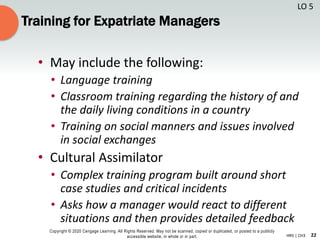
Training for Expatriate Managers
• May include the following:
• Language training
• Classroom training regarding the history of and
the daily living conditions in a country
• Training on social manners and issues involved
in social exchanges
• Cultural Assimilator
• Complex training program built around short
case studies and critical incidents
• Asks how a manager would react to different
situations and then provides detailed feedback
LO 5
23
Copyright © 2020 Cengage Learning. All Rights Reserved. May not be scanned, copied or duplicated, or posted to a publicly
accessible website, in whole or in part. HR5 | CH3
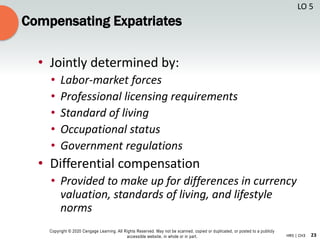
Compensating Expatriates
• Jointly determined by:
• Labor-market forces
• Professional licensing requirements
• Standard of living
• Occupational status
• Government regulations
• Differential compensation
• Provided to make up for differences in currency
valuation, standards of living, and lifestyle
norms
LO 5
24
Copyright © 2020 Cengage Learning. All Rights Reserved. May not be scanned, copied or duplicated, or posted to a publicly
accessible website, in whole or in part. HR5 | CH3
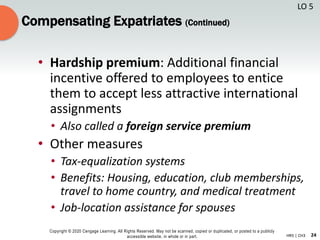
Compensating Expatriates (Continued)
• Hardship premium: Additional financial
incentive offered to employees to entice
them to accept less attractive international
assignments
• Also called a foreign service premium
• Other measures
• Tax-equalization systems
• Benefits: Housing, education, club memberships,
travel to home country, and medical treatment
• Job-location assistance for spouses
LO 5
25
Copyright © 2020 Cengage Learning. All Rights Reserved. May not be scanned, copied or duplicated, or posted to a publicly
accessible website, in whole or in part. HR5 | CH3
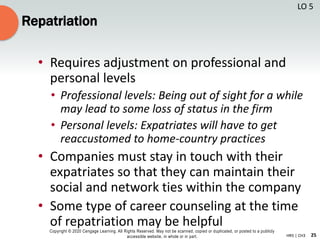
Repatriation
• Requires adjustment on professional and
personal levels
• Professional levels: Being out of sight for a while
may lead to some loss of status in the firm
• Personal levels: Expatriates will have to get
reaccustomed to home-country practices
• Companies must stay in touch with their
expatriates so that they can maintain their
social and network ties within the company
• Some type of career counseling at the time
of repatriation may be helpful
LO 5
26
Copyright © 2020 Cengage Learning. All Rights Reserved. May not be scanned, copied or duplicated, or posted to a publicly
accessible website, in whole or in part. HR5 | CH3
International Labor Relations
• Labor relations
• Processes of dealing with employees who are
organized into labor unions
• Heavily regulated by law
• Norms regarding the relationship between
unions and management vary from nation
to nation
LO 6
KEY TERMS
27HR5 | CH3
Copyright © 2020 Cengage Learning. All Rights Reserved. May not be scanned, copied or duplicated, or posted to a publicly
accessible website, in whole or in part.
• Ethnocentric staffing
model
• Polycentric staffing
model
• Geocentric staffing
model
• Culture
• Exporting
• Licensing
• Direct foreign
investment
• Joint venture
(strategic alliance)
• Expatriates
• Hardship premium
(foreign service
premium)
SUMMARY
28HR5 | CH3
Copyright © 2020 Cengage Learning. All Rights Reserved. May not be scanned, copied or duplicated, or posted to a publicly
accessible website, in whole or in part.
• Forces that shaped today’s competitive
international business environment began
to emerge after World War Two
• International HRM must address various
global issues and manage expatriates well
• International firms must confront local
recruiting and selection, local training, and
local compensation
• Knowledge of international labor relations
is very important for HRM

CH 3 BSAD 310 Fall 2019

  • 1.
    Chapter 3 The GlobalEnvironment Copyright ©2020 Cengage Learning. All Rights Reserved. May not be scanned, copied or duplicated, or posted to a publicly accessible website, in whole or in part.
  • 2.
    LEARNING OUTCOMES 2HR5 |CH3 Copyright © 2020 Cengage Learning. All Rights Reserved. May not be scanned, copied or duplicated, or posted to a publicly accessible website, in whole or in part. 1. Describe the growth of international business 2. Identify and discuss the global issues in international human resource management 3. Discuss the human resource management function in international business 4. Identify and discuss the domestic issues in international human resource management
  • 3.
    3 LEARNING OUTCOMES (Continued) HR5| CH3 Copyright © 2020 Cengage Learning. All Rights Reserved. May not be scanned, copied or duplicated, or posted to a publicly accessible website, in whole or in part. 5. Describe the issues involved in managing international transfers and assignments 6. Summarize the issues in international labor relations
  • 4.
    4 Copyright © 2020Cengage Learning. All Rights Reserved. May not be scanned, copied or duplicated, or posted to a publicly accessible website, in whole or in part. HR5 | CH3 Growth of International Business • British empire was built around the financial and business interests of the British nobility • Forces that shaped today’s competitive international business environment began to emerge after World War Two • 1950s: The United States was by far the dominant economic power in the world • Late 1970s: Businesses from other countries emerged as major players in the world economy LO 1
  • 5.
    5 Copyright © 2020Cengage Learning. All Rights Reserved. May not be scanned, copied or duplicated, or posted to a publicly accessible website, in whole or in part. HR5 | CH3 Growth of International Business (Continued) • By the mid-1990s, global competitiveness seemed to have become the norm rather than the exception • Developments around the world have affected the new global economy • Economies have become highly interdependent • Growth of regional economic alliances has substantial effects on the global business community LO 1
  • 6.
    6 Copyright © 2020Cengage Learning. All Rights Reserved. May not be scanned, copied or duplicated, or posted to a publicly accessible website, in whole or in part. HR5 | CH3 Global Issues in International Human Resource Management • Developing an international HRM strategy • Developing an understanding of the cultural environment of HRM • Developing an understanding of the political and legal environment of HRM LO 2
  • 7.
    7 Copyright © 2020Cengage Learning. All Rights Reserved. May not be scanned, copied or duplicated, or posted to a publicly accessible website, in whole or in part. HR5 | CH3 International HRM Strategy • Ethnocentric staffing model • Uses parent-country nationals (PCN’s) to staff higher-level foreign positions • Polycentric staffing model • Calls for the dominant use of host-country nationals (HCN’s) throughout the organization • Geocentric staffing model • Puts PCN’s, HCN’s, and third-country nationals (TCN’s) all in the same category with the firm attempting to always hire the best person available for a position LO 2
  • 8.
    8 Copyright © 2020Cengage Learning. All Rights Reserved. May not be scanned, copied or duplicated, or posted to a publicly accessible website, in whole or in part. HR5 | CH3 Understanding the Cultural Environment • Culture: Set of values, symbols, beliefs, and languages that guide the behavior of people within that culture • Cultural differences directly affect business practices in international situations • Language differences complicate the issues involved in dealing with international business • Cultural roles directly affect HRM practices LO 2
  • 9.
    9 Copyright © 2020Cengage Learning. All Rights Reserved. May not be scanned, copied or duplicated, or posted to a publicly accessible website, in whole or in part. HR5 | CH3 Dimensions of National Culture Identified by Geert Hofstede • Power distance • Individualism versus collectivism • Masculinity versus femininity • Uncertainty avoidance • Long-term orientation versus short-term orientation • Indulgence versus restraint LO 2
  • 10.
    10 Copyright © 2020Cengage Learning. All Rights Reserved. May not be scanned, copied or duplicated, or posted to a publicly accessible website, in whole or in part. HR5 | CH3 Dimensions of National Culture Identified by GLOBE project • Uncertainty avoidance • Power distance • Individualism versus collectivism • Assertiveness • In-group collectivism • Gender egalitarianism • Future orientation • Performance orientation • Humane orientation LO 2
  • 11.
    11 Copyright © 2020Cengage Learning. All Rights Reserved. May not be scanned, copied or duplicated, or posted to a publicly accessible website, in whole or in part. HR5 | CH3 Political and Legal Issues of International Business • Government stability • Ability of a given government to stay in power against opposing factions or permanence of government policies toward businesses • Includes the extent of risk faced by expatriates as a result of political instability • Trade incentives • Reduced interest rates on loans, construction subsidies and tax incentives, and relaxation of various controls on international trade LO 2
  • 12.
    12 Copyright © 2020Cengage Learning. All Rights Reserved. May not be scanned, copied or duplicated, or posted to a publicly accessible website, in whole or in part. HR5 | CH3 Political and Legal Issues of International Business (Continued) • Trade controls • Tariffs: Tax collected on goods shipped across national boundaries • Quotas: Limit on the number or value of goods that can be traded • Economic communities • Sets of countries that agree to eliminate trade barriers among their member nations • Examples: The European Union (E U) and the North American Free Trade Agreement (NAFTA) LO 2
  • 13.
    13 Copyright © 2020Cengage Learning. All Rights Reserved. May not be scanned, copied or duplicated, or posted to a publicly accessible website, in whole or in part. HR5 | CH3 Fundamental Management Challenges in International Business • Avoiding discrimination in employment • Choosing an appropriate source of employees • Cross-cultural training and development of employees • Includes training programs for both expatriates and workers in host countries • Working conditions, compensation, and the cost of living LO 3
  • 14.
    14 Copyright © 2020Cengage Learning. All Rights Reserved. May not be scanned, copied or duplicated, or posted to a publicly accessible website, in whole or in part. HR5 | CH3 Specific Human Resource Issues in International Business • Exporting • Process of making a product in the firm’s domestic marketplace and then selling it to another country • Licensing • Involves one company granting its permission to another company in a foreign country to manufacture or market its products in its local market LO 3
  • 15.
    15 Copyright © 2020Cengage Learning. All Rights Reserved. May not be scanned, copied or duplicated, or posted to a publicly accessible website, in whole or in part. HR5 | CH3 Specific Human Resource Issues in International Business (Continued) • Direct foreign investment • Occurs when a firm headquartered in one country builds or purchases operating facilities in a foreign nation • Joint venture (strategic alliance) • Two or more firms cooperate in the ownership or management of an operation on an equity basis LO 3
  • 16.
    16 Copyright © 2020Cengage Learning. All Rights Reserved. May not be scanned, copied or duplicated, or posted to a publicly accessible website, in whole or in part. HR5 | CH3 Domestic Issues in International Human Resource Management • Local recruiting and selection issues • Local training issues • Local compensation issues LO 4
  • 17.
    17 Copyright © 2020Cengage Learning. All Rights Reserved. May not be scanned, copied or duplicated, or posted to a publicly accessible website, in whole or in part. HR5 | CH3 Expatriates • Employees sent by a firm to work in another country • May be either PCN’s or TCN’s • Threats revolve around opportunistic behavior and information asymmetry • Knowledge contracts can ensure information symmetry by systematically debriefing expatriate managers • International strategies firms can adopt - Global, international, transnational, and multidomestic LO 5
  • 18.
    18 Copyright © 2020Cengage Learning. All Rights Reserved. May not be scanned, copied or duplicated, or posted to a publicly accessible website, in whole or in part. HR5 | CH3 Selecting Expatriates • HR manager must define skills and abilities required to do the job and work in a foreign location • Sources of experienced managers • Firm itself • Other organizations - Headhunters help businesses recruit qualified managers and other professionals for higher- level positions in an organization • Colleges LO 5
  • 19.
    19 Copyright © 2020Cengage Learning. All Rights Reserved. May not be scanned, copied or duplicated, or posted to a publicly accessible website, in whole or in part. HR5 | CH3 Selecting Expatriates (Continued) • Criteria for selection • Managerial competence • Language training • Adaptability to new situations LO 5
  • 20.
    20 Copyright © 2020Cengage Learning. All Rights Reserved. May not be scanned, copied or duplicated, or posted to a publicly accessible website, in whole or in part. HR5 | CH3 Assessing Success or Failure • Earlier views • Measure depended upon whether or not the expatriate remained on assignment for the full time assigned - Adjustment was found to be a good indicator of success later • Newer approaches • Measure should be directly tied to the strategic goals the assignment was to accomplish • Success or failure should be assessed relative to the knowledge that was successfully transferred LO 5
  • 21.
    21 Copyright © 2020Cengage Learning. All Rights Reserved. May not be scanned, copied or duplicated, or posted to a publicly accessible website, in whole or in part. HR5 | CH3 Assessing Success or Failure (Continued) - Knowledge that expatriates were to disperse to subsidiary operations and that they were to gain and bring back to the headquarters • Contributing factors • Inability of the manager or the manager’s spouse and family to adjust to a new location • Perspective of an international manager’s motivation for and real interest in a foreign assignment • Personality and international experience • Ethnocentric attitudes of HCN’s LO 5
  • 22.
    22 Copyright © 2020Cengage Learning. All Rights Reserved. May not be scanned, copied or duplicated, or posted to a publicly accessible website, in whole or in part. HR5 | CH3 Training for Expatriate Managers • May include the following: • Language training • Classroom training regarding the history of and the daily living conditions in a country • Training on social manners and issues involved in social exchanges • Cultural Assimilator • Complex training program built around short case studies and critical incidents • Asks how a manager would react to different situations and then provides detailed feedback LO 5
  • 23.
    23 Copyright © 2020Cengage Learning. All Rights Reserved. May not be scanned, copied or duplicated, or posted to a publicly accessible website, in whole or in part. HR5 | CH3 Compensating Expatriates • Jointly determined by: • Labor-market forces • Professional licensing requirements • Standard of living • Occupational status • Government regulations • Differential compensation • Provided to make up for differences in currency valuation, standards of living, and lifestyle norms LO 5
  • 24.
    24 Copyright © 2020Cengage Learning. All Rights Reserved. May not be scanned, copied or duplicated, or posted to a publicly accessible website, in whole or in part. HR5 | CH3 Compensating Expatriates (Continued) • Hardship premium: Additional financial incentive offered to employees to entice them to accept less attractive international assignments • Also called a foreign service premium • Other measures • Tax-equalization systems • Benefits: Housing, education, club memberships, travel to home country, and medical treatment • Job-location assistance for spouses LO 5
  • 25.
    25 Copyright © 2020Cengage Learning. All Rights Reserved. May not be scanned, copied or duplicated, or posted to a publicly accessible website, in whole or in part. HR5 | CH3 Repatriation • Requires adjustment on professional and personal levels • Professional levels: Being out of sight for a while may lead to some loss of status in the firm • Personal levels: Expatriates will have to get reaccustomed to home-country practices • Companies must stay in touch with their expatriates so that they can maintain their social and network ties within the company • Some type of career counseling at the time of repatriation may be helpful LO 5
  • 26.
    26 Copyright © 2020Cengage Learning. All Rights Reserved. May not be scanned, copied or duplicated, or posted to a publicly accessible website, in whole or in part. HR5 | CH3 International Labor Relations • Labor relations • Processes of dealing with employees who are organized into labor unions • Heavily regulated by law • Norms regarding the relationship between unions and management vary from nation to nation LO 6
  • 27.
    KEY TERMS 27HR5 |CH3 Copyright © 2020 Cengage Learning. All Rights Reserved. May not be scanned, copied or duplicated, or posted to a publicly accessible website, in whole or in part. • Ethnocentric staffing model • Polycentric staffing model • Geocentric staffing model • Culture • Exporting • Licensing • Direct foreign investment • Joint venture (strategic alliance) • Expatriates • Hardship premium (foreign service premium)
  • 28.
    SUMMARY 28HR5 | CH3 Copyright© 2020 Cengage Learning. All Rights Reserved. May not be scanned, copied or duplicated, or posted to a publicly accessible website, in whole or in part. • Forces that shaped today’s competitive international business environment began to emerge after World War Two • International HRM must address various global issues and manage expatriates well • International firms must confront local recruiting and selection, local training, and local compensation • Knowledge of international labor relations is very important for HRM