BRUCELLA/BRUCELLOSIS
Gopiram (Shulav) Syangtan
M.Sc. Medical Microbiology
Shi-Gan Int’l College of Science & Technology
(Affiliations with Tribhuvan University)
E-Mail:-syangtangopiram1@gmail.com
1/28/2019 1G.R Syangtan(Shulav)
INTRODUCTION
• The genus Brucella consist of small, non-motile, aerobic,
Gram-Negative, Cocco-bacilli and grow poorly on ordinary
media. They are strict intracellular parasites of domesticated
animals (Goats, Sheep,Cattel, Buffaloes, Pigs) and may also
infect humans.
• Brucellosis is a zoonotic infection transmitted to humans
contact with fluids from infected animals (sheep, cattle, goats,
pigs, or other animals) derived food products such as
unpasteurized milk and cheese . The disease is rarely, if ever,
transmitted between humans.
• Brucellosis, also called Bang's disease, Crimean fever, Malta
fever, Maltese fever, Mediterranean fever, rock fever, or
undulant fever, is a highly contagious zoonosis caused by
ingestion of unsterilized milk or meat from infected animals or
close contact with their secretions
1/28/2019 2G.R Syangtan(Shulav)
HISTORY
• In 1887, Davit Bruce (surgeon,Military
Doctor) isolated microoranism (micrococcus
melitensis) from spleens of fetal cases of British
soldiers at Malta.
• Brucella melitensis( malta fever) in honor of
Bruce
• In 1905, Zammit ( Maltese Bacteriologist) ;
demonastred B.melitensis carry in goats milk
and transmitted to man by goat raw milk
1/28/2019 3G.R Syangtan(Shulav)
• In 1897, Bang discovered B.abortus in
copenhagen- cottel
• In 1814, Tratum, isolate B. suis from feotus of
a pig in USA.
• B. neotomae- Desert rodents
• B. ovis - rams
• B. canis – dog
• B. maris – dilphin ( marine mammals-
unrecognise brucella spp in 1994)
1/28/2019 4G.R Syangtan(Shulav)
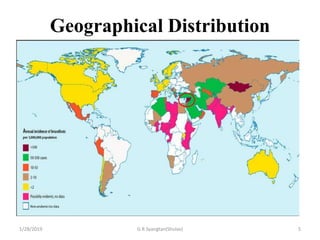
Geographical Distribution
1/28/2019 G.R Syangtan(Shulav) 5
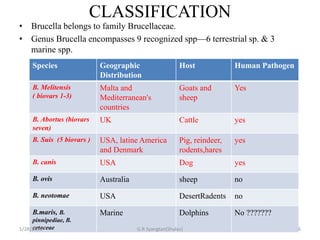
• Brucella belongs to family Brucellaceae.
• Genus Brucella encompasses 9 recognized spp—6 terrestrial sp. & 3
marine spp.
CLASSIFICATION
Species Geographic
Distribution
Host Human Pathogen
B. Melitensis
( biovars 1-3)
Malta and
Mediterranean's
countries
Goats and
sheep
Yes
B. Abortus (biovars
seven)
UK Cattle yes
B. Suis (5 biovars ) USA, latine America
and Denmark
Pig, reindeer,
rodents,hares
yes
B. canis USA Dog yes
B. ovis Australia sheep no
B. neotomae USA DesertRadents no
B.maris, B.
pinnipediae, B.
cetaceae
Marine Dolphins No ???????
1/28/2019 6G.R Syangtan(Shulav)
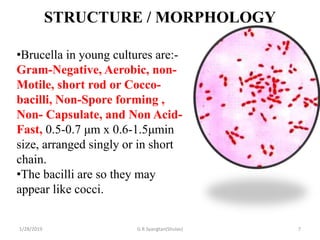
STRUCTURE / MORPHOLOGY
•Brucella in young cultures are:-
Gram-Negative, Aerobic, non-
Motile, short rod or Cocco-
bacilli, Non-Spore forming ,
Non- Capsulate, and Non Acid-
Fast, 0.5-0.7 μm x 0.6-1.5μmin
size, arranged singly or in short
chain.
•The bacilli are so they may
appear like cocci.
1/28/2019 7G.R Syangtan(Shulav)
CULTURAL CHARACTERISTICS
• Brucellae are strict aerobes.
• B.abortus is capnophilic, many strains requiring
5-10% C02 for growth.
• Optimum temperature is 37°C (range 20-40 °C)
and pH 6.6-7.4.
• Grow on simple media, though growth is slow and
scanty (small amount).
• Growth is improved by the addition of serum or
liver extract.
• The media employed currently are serum dextrose
agar, serum potato infusion agar, trypticase soy
agar, or tryptose agar.
1/28/2019 8G.R Syangtan(Shulav)
•The addition of bacitracin, polymyxin and cycloheximide to the above
media makes them selective.
• Erythritol has a specially stimulating effect on the growth of
Morphology of Brucellae.
• On solid media, colonies are small, convex, smooth, translucent and
slightly yellow or opalescent after 3 or more days of incubation.
• In liquid media growth is uniform.
1/28/2019 9G.R Syangtan(Shulav)
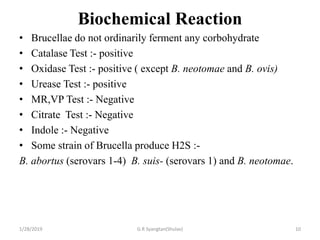
Biochemical Reaction
• Brucellae do not ordinarily ferment any corbohydrate
• Catalase Test :- positive
• Oxidase Test :- positive ( except B. neotomae and B. ovis)
• Urease Test :- positive
• MR,VP Test :- Negative
• Citrate Test :- Negative
• Indole :- Negative
• Some strain of Brucella produce H2S :-
B. abortus (serovars 1-4) B. suis- (serovars 1) and B. neotomae.
1/28/2019 G.R Syangtan(Shulav) 10
Antigenic Character
Antigen:- The LPS is the major virulence factor as well as the
major cell wall (somatic) antigen.
Antigen -A ( for abortus :- dominant about 20 times ) /M-Antigen
(militensis)
1/28/2019 11
G.R Syangtan(Shulav)
Fig: Antigenic structure of Brucella spp. ( source : Science Direct)
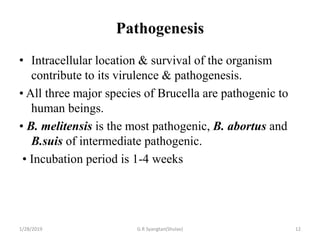
Pathogenesis
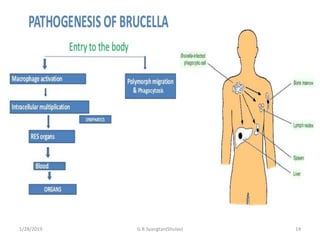
• Intracellular location & survival of the organism
contribute to its virulence & pathogenesis.
• All three major species of Brucella are pathogenic to
human beings.
• B. melitensis is the most pathogenic, B. abortus and
B.suis of intermediate pathogenic.
• Incubation period is 1-4 weeks
1/28/2019 G.R Syangtan(Shulav) 12
POTRALS OF ENTRY
1. Oral entry :
• Ingestion of contaminated animal products (often
raw milk or its derivatives).
• contact with contaminated fingers.
2. Aerosols:
• Inhalation of bacteria.
• Contamination of the conjunctivae.
3. Percutaneous infection:
• through skin abrasions or by accidental
inoculation.
1/28/2019 G.R Syangtan(Shulav) 13
1/28/2019 G.R Syangtan(Shulav) 14
Pathogenesis
• Human infection may be of three types:
• 1. Latent infection: with only serological but no
clinical evidence;
• 2. Acute or sub-acute brucellosis; and
• 3. Chronic brucellosis.
1/28/2019 G.R Syangtan(Shulav) 15
Acute Brucellosis
• Acute brucellosis is mostly due to B. melitensis.
• It is usually known as undulant fever, but this is misleading as
only some cases show the undulant pattern
• It is associated with prolonged bacteraemia and irregular fever.
• The symptomatology is varied, consisting of muscular and
articular pains, asthmatic attacks, nocturnal drenching sweats,
exhaustion, anorexia, constipation, nervous irritability and
chills.
• The usual complications are articular, visceral or neurological.
• Sub-acute brucellosis: It may follow acute brucellosis. Blood
culture is less frequently positive.
1/28/2019 G.R Syangtan(Shulav) 16
Chronic Brucellosis
• Chronic brucellosis, which may be non-bacteremic, is
a low-grade infection with periodic exacerbations.
• The symptoms are generally related to a state of
hypersensitivity in the patient.
• Common clinical manifestations are sweating,
lassitude and joint pains, with minimal or no pyrexia.
• The illness lasts for years.
1/28/2019 G.R Syangtan(Shulav) 17
Mechanisms
1/28/2019 G.R Syangtan(Shulav) 18
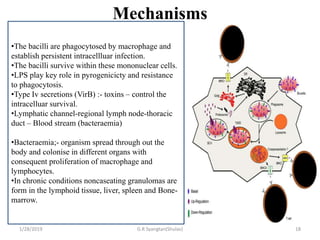
•The bacilli are phagocytosed by macrophage and
establish persistent intracellluar infection.
•The bacilli survive within these mononuclear cells.
•LPS play key role in pyrogenicicty and resistance
to phagocytosis.
•Type Iv secretions (VirB) :- toxins – control the
intracelluar survival.
•Lymphatic channel-regional lymph node-thoracic
duct – Blood stream (bacteraemia)
•Bacteraemia;- organism spread through out the
body and colonise in different organs with
consequent proliferation of macrophage and
lymphocytes.
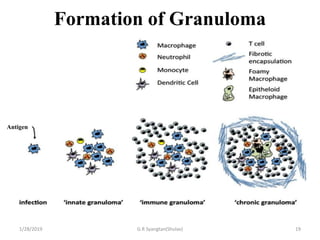
•In chronic conditions noncaseating granulomas are
form in the lymphoid tissue, liver, spleen and Bone-
marrow.
Formation of Granuloma
1/28/2019 G.R Syangtan(Shulav) 19
Antigen
Clinical Manifestation
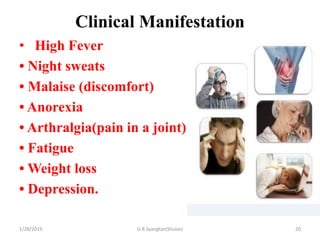
• High Fever
• Night sweats
• Malaise (discomfort)
• Anorexia
• Arthralgia(pain in a joint)
• Fatigue
• Weight loss
• Depression.
1/28/2019 G.R Syangtan(Shulav) 20
Clinical Manifestations
• Gastrointestinal tract: Anorexia, Abdominal
pain, Vomiting, Diarrhea, Constipation,
Hepato-Splenomegaly.
• LIVER: Involved in most cases but LFTs
normal or mildly abnormal. – Granulomas (B.
abortus). – Hepatitis (B.melitensis). –
Abscesses (B.suis).
• Skeletal:
• Arthritis, spondylitis, osteomyelitis.
- Arthritis - Hip, Knee & Ankles.
1/28/2019 G.R Syangtan(Shulav) 21
Clinical Manifestations
• Neurologic
– Meningitis, encephalitis, radiculopathy &
peripheral neuropathy, intra-cerebral abscesses
• Cardiovascular
– Endocarditis 2% (major cause of mortality)
– Pericarditis & myocarditis
• Pulmonary
– Inhalation or hematogenous
– Cause any chest syndrome
– Rarely Brucella isolated from sputum
1/28/2019 G.R Syangtan(Shulav) 22
Clinical Manifestations
• Genitourinary
– Epidydemo-orchitis
– Pyonephrosis (rare)
• Cutaneous
– Nonspecific
• Hematologic
– Anemia
– Leukopenia
– Thrombocytopenia
1/28/2019 G.R Syangtan(Shulav) 23
LABORATORY DIAGNOSIS
Specimen: Blood, Urine, sputum, breast milk,
Lymph node biopsy and Bone marrow aspirate.
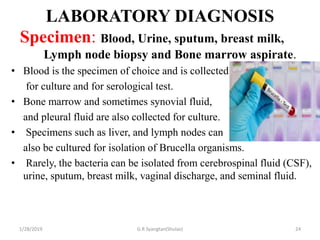
• Blood is the specimen of choice and is collected
for culture and for serological test.
• Bone marrow and sometimes synovial fluid,
and pleural fluid are also collected for culture.
• Specimens such as liver, and lymph nodes can
also be cultured for isolation of Brucella organisms.
• Rarely, the bacteria can be isolated from cerebrospinal fluid (CSF),
urine, sputum, breast milk, vaginal discharge, and seminal fluid.
1/28/2019 G.R Syangtan(Shulav) 24
Laboratory Methods for Diagnosis
• Culture
• Serology.
• Hypersensitivity tests.
• Molecular testing
• Conventional PCR.
• Real time PCR.
• MICROSCOPY –NO USE
• Gram staining is not useful for demonstration of
Brucella organisms in clinical specimens due to
their small size and intracellular location.
1/28/2019 G.R Syangtan(Shulav) 25
Culture and Isolations
• Methods:
1.Castaneda’s method
2.Automated methods such as Bac-tec
• Blood culture is the most definitive method for the
diagnosis of brucellosis.
• 5ml of Blood is inoculated into a bottle of 50 (45mL)
mL Brain Heart infusion (BHI) Broth or (Trypticase
soy broth) incubated at 37 °C under 5- 10% C02.
• Subcultures are made on solid media every 3-5 days,
beginning on the fourth day. subcultures are made on
solid media, every 3-5 days for 8 weeks before
declaring the culture as negative.
• BACTEC cultures may become positive in 5 to 6 days.
1/28/2019 G.R Syangtan(Shulav) 26
1/28/2019 G.R Syangtan(Shulav) 27
Fig:- Biphasic Media Fig:- Automated liquid Media
Castaneda method of blood culture
• This biphasic medium contains both trypticase soy broth
and solid trypticase soy agar slant in the same bottle .
• The blood is inoculated onto the liquid broth and bottle
is incubated in the upright position.
• For subculture, no need to open the bottle; but the bottle
is tilted so that liquid broth flows over the solid
medium slant.
• It is again incubated in the upright position.
• In case of positive blood culture, colonies appear on the
slant.
• The Castaneda's method of blood culture reduces the
possibilities of contamination as well reduces the risk
of laboratory-acquired infection to both medical and
paramedical staff.
1/28/2019 G.R Syangtan(Shulav) 28
Serological Test
• Specific brucella antibodies, both IgG and IgM
antibodies appear in the serum 7-10 days after
infection.
• IgM antibodies persist for up to 3 months after
which these antibodies decline.
• Then IgG and IgA antibodies appear after 3
weeks of infection and persist for longer time.
• In acute stage or subclinical brucellosis both
IgG and IgM can be demonstrated.
1/28/2019 G.R Syangtan(Shulav) 29
Serological Test
• In chronic brucellosis only IgG can be
demonstrated, as IgM are absent.
• As IgG antibodies persist for many months or
years, demonstration of significant rise in the
antibody titer is the definitive serological
evidence of brucellosis.
• Antibody titer of 1: 160 is the presumptive
evidence of Brucella infection.
1/28/2019 G.R Syangtan(Shulav) 30
Serological Test
• Most serological studies for diagnosis of Brucellosis
are based on antibody detection, These include:
• Serum agglutination test –SAT (standard tube
agglutination)
• Rose Bengal test- Slide agglutination
• ELISA
• Complement fixation
• Indirect Coombs test
• Whole cell preparations of Brucella antigens are used
in IFA, Agglutination.
• Purified LPS/ Protein extracts are used for ELISA.
1/28/2019 G.R Syangtan(Shulav) 31
Brucella Skin Test
• Brucella skin test is a delayed type of
hypersensitivity reaction to brucella antigen.
• In this test, brucellin, a protein extract of the
bacteria, is used as an antigen and is administered
intra-dermally.
• The presence of erythema and indurations of 6
mm or more within 24 hours is suggestive of
positive reaction.
• This test is positive only in chronic brucellosis but
negative in acute brucellosis.
• Repeated negative skin test excludes brucellosis.
1/28/2019 G.R Syangtan(Shulav) 32
Molecular Test
• Polymerase chain reaction (PCR) shows
promise for rapid diagnosis of Brucella spp in
human blood specimens
• Positive PCR at the completion of treatment is
not predictive of subsequent relapse
• PCR testing for fluid and tissue samples other
than blood has also been described
1/28/2019 G.R Syangtan(Shulav) 33
Imaging
• Patients with spine symptoms -MRI
examination to rule out spinal cord
compromise.
• Plain radiographs, radionuclide bone
Scintigraphy, CT scanning, and joint
Sonography (ultrasound).
1/28/2019 G.R Syangtan(Shulav) 34
Treatment
Controls and Prevention
1/28/2019 G.R Syangtan(Shulav) 35
1/28/2019 G.R Syangtan(Shulav) 36
1/28/2019 G.R Syangtan(Shulav) 37

Brucella spp /Brocellosis

  • 1.
    BRUCELLA/BRUCELLOSIS Gopiram (Shulav) Syangtan M.Sc.Medical Microbiology Shi-Gan Int’l College of Science & Technology (Affiliations with Tribhuvan University) E-Mail:-syangtangopiram1@gmail.com 1/28/2019 1G.R Syangtan(Shulav)
  • 2.
    INTRODUCTION • The genusBrucella consist of small, non-motile, aerobic, Gram-Negative, Cocco-bacilli and grow poorly on ordinary media. They are strict intracellular parasites of domesticated animals (Goats, Sheep,Cattel, Buffaloes, Pigs) and may also infect humans. • Brucellosis is a zoonotic infection transmitted to humans contact with fluids from infected animals (sheep, cattle, goats, pigs, or other animals) derived food products such as unpasteurized milk and cheese . The disease is rarely, if ever, transmitted between humans. • Brucellosis, also called Bang's disease, Crimean fever, Malta fever, Maltese fever, Mediterranean fever, rock fever, or undulant fever, is a highly contagious zoonosis caused by ingestion of unsterilized milk or meat from infected animals or close contact with their secretions 1/28/2019 2G.R Syangtan(Shulav)
  • 3.
    HISTORY • In 1887,Davit Bruce (surgeon,Military Doctor) isolated microoranism (micrococcus melitensis) from spleens of fetal cases of British soldiers at Malta. • Brucella melitensis( malta fever) in honor of Bruce • In 1905, Zammit ( Maltese Bacteriologist) ; demonastred B.melitensis carry in goats milk and transmitted to man by goat raw milk 1/28/2019 3G.R Syangtan(Shulav)
  • 4.
    • In 1897,Bang discovered B.abortus in copenhagen- cottel • In 1814, Tratum, isolate B. suis from feotus of a pig in USA. • B. neotomae- Desert rodents • B. ovis - rams • B. canis – dog • B. maris – dilphin ( marine mammals- unrecognise brucella spp in 1994) 1/28/2019 4G.R Syangtan(Shulav)
  • 5.
  • 6.
    • Brucella belongsto family Brucellaceae. • Genus Brucella encompasses 9 recognized spp—6 terrestrial sp. & 3 marine spp. CLASSIFICATION Species Geographic Distribution Host Human Pathogen B. Melitensis ( biovars 1-3) Malta and Mediterranean's countries Goats and sheep Yes B. Abortus (biovars seven) UK Cattle yes B. Suis (5 biovars ) USA, latine America and Denmark Pig, reindeer, rodents,hares yes B. canis USA Dog yes B. ovis Australia sheep no B. neotomae USA DesertRadents no B.maris, B. pinnipediae, B. cetaceae Marine Dolphins No ??????? 1/28/2019 6G.R Syangtan(Shulav)
  • 7.
    STRUCTURE / MORPHOLOGY •Brucellain young cultures are:- Gram-Negative, Aerobic, non- Motile, short rod or Cocco- bacilli, Non-Spore forming , Non- Capsulate, and Non Acid- Fast, 0.5-0.7 μm x 0.6-1.5μmin size, arranged singly or in short chain. •The bacilli are so they may appear like cocci. 1/28/2019 7G.R Syangtan(Shulav)
  • 8.
    CULTURAL CHARACTERISTICS • Brucellaeare strict aerobes. • B.abortus is capnophilic, many strains requiring 5-10% C02 for growth. • Optimum temperature is 37°C (range 20-40 °C) and pH 6.6-7.4. • Grow on simple media, though growth is slow and scanty (small amount). • Growth is improved by the addition of serum or liver extract. • The media employed currently are serum dextrose agar, serum potato infusion agar, trypticase soy agar, or tryptose agar. 1/28/2019 8G.R Syangtan(Shulav)
  • 9.
    •The addition ofbacitracin, polymyxin and cycloheximide to the above media makes them selective. • Erythritol has a specially stimulating effect on the growth of Morphology of Brucellae. • On solid media, colonies are small, convex, smooth, translucent and slightly yellow or opalescent after 3 or more days of incubation. • In liquid media growth is uniform. 1/28/2019 9G.R Syangtan(Shulav)
  • 10.
    Biochemical Reaction • Brucellaedo not ordinarily ferment any corbohydrate • Catalase Test :- positive • Oxidase Test :- positive ( except B. neotomae and B. ovis) • Urease Test :- positive • MR,VP Test :- Negative • Citrate Test :- Negative • Indole :- Negative • Some strain of Brucella produce H2S :- B. abortus (serovars 1-4) B. suis- (serovars 1) and B. neotomae. 1/28/2019 G.R Syangtan(Shulav) 10
  • 11.
    Antigenic Character Antigen:- TheLPS is the major virulence factor as well as the major cell wall (somatic) antigen. Antigen -A ( for abortus :- dominant about 20 times ) /M-Antigen (militensis) 1/28/2019 11 G.R Syangtan(Shulav) Fig: Antigenic structure of Brucella spp. ( source : Science Direct)
  • 12.
    Pathogenesis • Intracellular location& survival of the organism contribute to its virulence & pathogenesis. • All three major species of Brucella are pathogenic to human beings. • B. melitensis is the most pathogenic, B. abortus and B.suis of intermediate pathogenic. • Incubation period is 1-4 weeks 1/28/2019 G.R Syangtan(Shulav) 12
  • 13.
    POTRALS OF ENTRY 1.Oral entry : • Ingestion of contaminated animal products (often raw milk or its derivatives). • contact with contaminated fingers. 2. Aerosols: • Inhalation of bacteria. • Contamination of the conjunctivae. 3. Percutaneous infection: • through skin abrasions or by accidental inoculation. 1/28/2019 G.R Syangtan(Shulav) 13
  • 14.
  • 15.
    Pathogenesis • Human infectionmay be of three types: • 1. Latent infection: with only serological but no clinical evidence; • 2. Acute or sub-acute brucellosis; and • 3. Chronic brucellosis. 1/28/2019 G.R Syangtan(Shulav) 15
  • 16.
    Acute Brucellosis • Acutebrucellosis is mostly due to B. melitensis. • It is usually known as undulant fever, but this is misleading as only some cases show the undulant pattern • It is associated with prolonged bacteraemia and irregular fever. • The symptomatology is varied, consisting of muscular and articular pains, asthmatic attacks, nocturnal drenching sweats, exhaustion, anorexia, constipation, nervous irritability and chills. • The usual complications are articular, visceral or neurological. • Sub-acute brucellosis: It may follow acute brucellosis. Blood culture is less frequently positive. 1/28/2019 G.R Syangtan(Shulav) 16
  • 17.
    Chronic Brucellosis • Chronicbrucellosis, which may be non-bacteremic, is a low-grade infection with periodic exacerbations. • The symptoms are generally related to a state of hypersensitivity in the patient. • Common clinical manifestations are sweating, lassitude and joint pains, with minimal or no pyrexia. • The illness lasts for years. 1/28/2019 G.R Syangtan(Shulav) 17
  • 18.
    Mechanisms 1/28/2019 G.R Syangtan(Shulav)18 •The bacilli are phagocytosed by macrophage and establish persistent intracellluar infection. •The bacilli survive within these mononuclear cells. •LPS play key role in pyrogenicicty and resistance to phagocytosis. •Type Iv secretions (VirB) :- toxins – control the intracelluar survival. •Lymphatic channel-regional lymph node-thoracic duct – Blood stream (bacteraemia) •Bacteraemia;- organism spread through out the body and colonise in different organs with consequent proliferation of macrophage and lymphocytes. •In chronic conditions noncaseating granulomas are form in the lymphoid tissue, liver, spleen and Bone- marrow.
  • 19.
    Formation of Granuloma 1/28/2019G.R Syangtan(Shulav) 19 Antigen
  • 20.
    Clinical Manifestation • HighFever • Night sweats • Malaise (discomfort) • Anorexia • Arthralgia(pain in a joint) • Fatigue • Weight loss • Depression. 1/28/2019 G.R Syangtan(Shulav) 20
  • 21.
    Clinical Manifestations • Gastrointestinaltract: Anorexia, Abdominal pain, Vomiting, Diarrhea, Constipation, Hepato-Splenomegaly. • LIVER: Involved in most cases but LFTs normal or mildly abnormal. – Granulomas (B. abortus). – Hepatitis (B.melitensis). – Abscesses (B.suis). • Skeletal: • Arthritis, spondylitis, osteomyelitis. - Arthritis - Hip, Knee & Ankles. 1/28/2019 G.R Syangtan(Shulav) 21
  • 22.
    Clinical Manifestations • Neurologic –Meningitis, encephalitis, radiculopathy & peripheral neuropathy, intra-cerebral abscesses • Cardiovascular – Endocarditis 2% (major cause of mortality) – Pericarditis & myocarditis • Pulmonary – Inhalation or hematogenous – Cause any chest syndrome – Rarely Brucella isolated from sputum 1/28/2019 G.R Syangtan(Shulav) 22
  • 23.
    Clinical Manifestations • Genitourinary –Epidydemo-orchitis – Pyonephrosis (rare) • Cutaneous – Nonspecific • Hematologic – Anemia – Leukopenia – Thrombocytopenia 1/28/2019 G.R Syangtan(Shulav) 23
  • 24.
    LABORATORY DIAGNOSIS Specimen: Blood,Urine, sputum, breast milk, Lymph node biopsy and Bone marrow aspirate. • Blood is the specimen of choice and is collected for culture and for serological test. • Bone marrow and sometimes synovial fluid, and pleural fluid are also collected for culture. • Specimens such as liver, and lymph nodes can also be cultured for isolation of Brucella organisms. • Rarely, the bacteria can be isolated from cerebrospinal fluid (CSF), urine, sputum, breast milk, vaginal discharge, and seminal fluid. 1/28/2019 G.R Syangtan(Shulav) 24
  • 25.
    Laboratory Methods forDiagnosis • Culture • Serology. • Hypersensitivity tests. • Molecular testing • Conventional PCR. • Real time PCR. • MICROSCOPY –NO USE • Gram staining is not useful for demonstration of Brucella organisms in clinical specimens due to their small size and intracellular location. 1/28/2019 G.R Syangtan(Shulav) 25
  • 26.
    Culture and Isolations •Methods: 1.Castaneda’s method 2.Automated methods such as Bac-tec • Blood culture is the most definitive method for the diagnosis of brucellosis. • 5ml of Blood is inoculated into a bottle of 50 (45mL) mL Brain Heart infusion (BHI) Broth or (Trypticase soy broth) incubated at 37 °C under 5- 10% C02. • Subcultures are made on solid media every 3-5 days, beginning on the fourth day. subcultures are made on solid media, every 3-5 days for 8 weeks before declaring the culture as negative. • BACTEC cultures may become positive in 5 to 6 days. 1/28/2019 G.R Syangtan(Shulav) 26
  • 27.
    1/28/2019 G.R Syangtan(Shulav)27 Fig:- Biphasic Media Fig:- Automated liquid Media
  • 28.
    Castaneda method ofblood culture • This biphasic medium contains both trypticase soy broth and solid trypticase soy agar slant in the same bottle . • The blood is inoculated onto the liquid broth and bottle is incubated in the upright position. • For subculture, no need to open the bottle; but the bottle is tilted so that liquid broth flows over the solid medium slant. • It is again incubated in the upright position. • In case of positive blood culture, colonies appear on the slant. • The Castaneda's method of blood culture reduces the possibilities of contamination as well reduces the risk of laboratory-acquired infection to both medical and paramedical staff. 1/28/2019 G.R Syangtan(Shulav) 28
  • 29.
    Serological Test • Specificbrucella antibodies, both IgG and IgM antibodies appear in the serum 7-10 days after infection. • IgM antibodies persist for up to 3 months after which these antibodies decline. • Then IgG and IgA antibodies appear after 3 weeks of infection and persist for longer time. • In acute stage or subclinical brucellosis both IgG and IgM can be demonstrated. 1/28/2019 G.R Syangtan(Shulav) 29
  • 30.
    Serological Test • Inchronic brucellosis only IgG can be demonstrated, as IgM are absent. • As IgG antibodies persist for many months or years, demonstration of significant rise in the antibody titer is the definitive serological evidence of brucellosis. • Antibody titer of 1: 160 is the presumptive evidence of Brucella infection. 1/28/2019 G.R Syangtan(Shulav) 30
  • 31.
    Serological Test • Mostserological studies for diagnosis of Brucellosis are based on antibody detection, These include: • Serum agglutination test –SAT (standard tube agglutination) • Rose Bengal test- Slide agglutination • ELISA • Complement fixation • Indirect Coombs test • Whole cell preparations of Brucella antigens are used in IFA, Agglutination. • Purified LPS/ Protein extracts are used for ELISA. 1/28/2019 G.R Syangtan(Shulav) 31
  • 32.
    Brucella Skin Test •Brucella skin test is a delayed type of hypersensitivity reaction to brucella antigen. • In this test, brucellin, a protein extract of the bacteria, is used as an antigen and is administered intra-dermally. • The presence of erythema and indurations of 6 mm or more within 24 hours is suggestive of positive reaction. • This test is positive only in chronic brucellosis but negative in acute brucellosis. • Repeated negative skin test excludes brucellosis. 1/28/2019 G.R Syangtan(Shulav) 32
  • 33.
    Molecular Test • Polymerasechain reaction (PCR) shows promise for rapid diagnosis of Brucella spp in human blood specimens • Positive PCR at the completion of treatment is not predictive of subsequent relapse • PCR testing for fluid and tissue samples other than blood has also been described 1/28/2019 G.R Syangtan(Shulav) 33
  • 34.
    Imaging • Patients withspine symptoms -MRI examination to rule out spinal cord compromise. • Plain radiographs, radionuclide bone Scintigraphy, CT scanning, and joint Sonography (ultrasound). 1/28/2019 G.R Syangtan(Shulav) 34
  • 35.
  • 36.
  • 37.

Editor's Notes

  • #3 Bangs Disease:-cause by B. abortus (bernhard l. f. bang 1932) Crimean fever :- crimean war attention of british medical officers in 1850. Maltase fever:- ethnic group indigenous to malta (island in the middle of the mediterranea sea)
  • #4 Melita= honey, the roman name for malta.
  • #9 Capnophilic:- oxygen reduce and presence of high concentration of co2.
  • #10 Erythritol:- sugar alcohol considered safe as a food additive
  • #18 Lassitude:- the condition of being tired: lack of physical or mental energy.
  • #22 Spondylitis :-inflamation of the vertebrae Osteomylitis;-painful inflammatory of bone infection by bacteria
  • #25 Synovial fluid :- a transparent viscid lubricating fluid secreted by a membrane of an articulation, bursa or tendon sheath
  • #35 Scitigraphy:- Gamma scan – radeioisotpe attached to drugs that travel to specific organ or tissue are taken internally and the emitted gamma radiation image.