• The Legislative Power: makes the law (ie.
Debates, votes and passes new laws)
• The Judicial Power: interprets the law (ie.
Decides what punishment should be given for
those that break the law)
• The Executive Power: implements and enforces
the law (ie. Makes sure that the decisions of the
legislature are carried out)
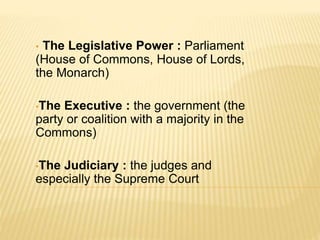
• The Legislative Power : Parliament
(House of Commons, House of Lords,
the Monarch)
•The Executive : the government (the
party or coalition with a majority in the
Commons)
•The Judiciary : the judges and
especially the Supreme Court
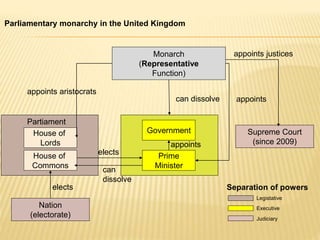
Monarch
(Representative
Function)
Supreme Court
(since 2009)
House of
Lords
House of
Commons
Government
Prime
Minister
Nation
(electorate)
Partiament
elects
elects
can
dissolve
appoints aristocrats
can dissolve appoints
appoints justices
Legistative
Executive
Judiciary
Separation of powers
appoints
Parliamentary monarchy in the United Kingdom
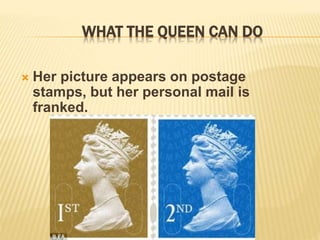
WHAT THE QUEEN CAN DO
 Her picture appears on postage
stamps, but her personal mail is
franked.
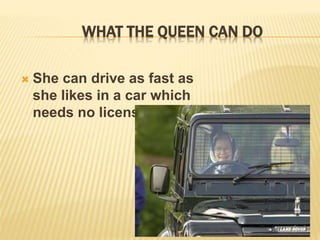
WHAT THE QUEEN CAN DO
 She can drive as fast as
she likes in a car which
needs no license number.
WHAT THE QUEEN CAN DO
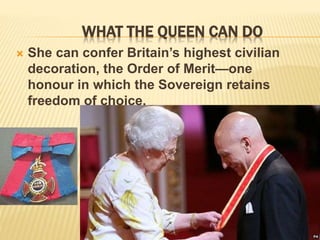
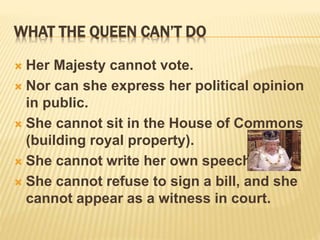
 She can confer Britain’s highest civilian
decoration, the Order of Merit—one
honour in which the Sovereign retains
freedom of choice.
WHAT THE QUEEN CAN’T DO
 Her Majesty cannot vote.
 Nor can she express her political opinion
in public.
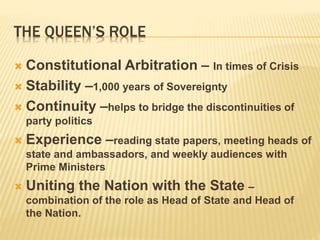
 She cannot sit in the House of Commons
(building royal property).
 She cannot write her own speech.
 She cannot refuse to sign a bill, and she
cannot appear as a witness in court.
THE QUEEN’S ROLE
 Constitutional Arbitration – In times of Crisis
 Stability –1,000 years of Sovereignty
 Continuity –helps to bridge the discontinuities of
party politics
 Experience –reading state papers, meeting heads of
state and ambassadors, and weekly audiences with
Prime Ministers
 Uniting the Nation with the State –
combination of the role as Head of State and Head of
the Nation.
THE QUEEN’S ROLE (2)
 Unity: Party politics = disagreement and
confrontation. (rich vs poor, north vs south,
management vs unions, Catholic vs Protestant…)
 Moral Leadership & Model Behaviour
 Custodianship of the Past – Through its
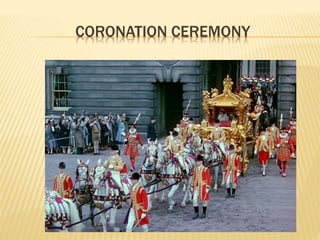
ceremony, pageantry and ritual, the monarchy
preserves the link with Britain’s history
CORONATION CEREMONY
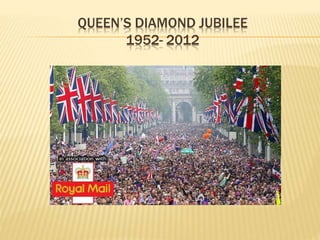
QUEEN’S DIAMOND JUBILEE
1952- 2012
THE BRITISH CONSTITUTION
 A constitution is a set of laws on how a
country is governed.
 The British Constitution is unwritten
 It is referred to as an uncodified constitution.
 Amendments to constitution are made by a
majority support in both Houses of
Parliament to be followed by the Royal
Assent.
SOURCES OF THE CONSTITUTION:
 Statutes such as the Magna Carta of 1215
and the Act of Settlement of 1701.
 Laws and Customs of Parliament;
 Political conventions
 Decisions in a court of law
 Constitutional experts who have written on
the subject such as Walter Bagehot and A.V
Dicey.
PRINCIPLES OF THE CONSTITUTION
 Two basic principles govern the Constitution:
 The Rule of Law
 The Supremacy of Parliament
FOR OR AGAINST
 Pros: Flexibility and change
 Cons: no public access– Only constitutional
experts know where to look and how to
interpret it.
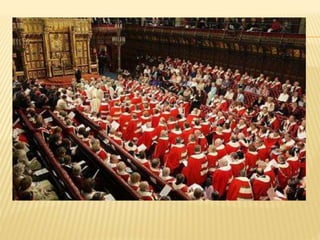
THE HOUSE OF LORDS
 Parliament's second chamber.
 Role: 'double check' new laws to make sure
they are fair and will work.
 675 members. Not elected.
 Does not have the power to stop a new law
but can delay it.
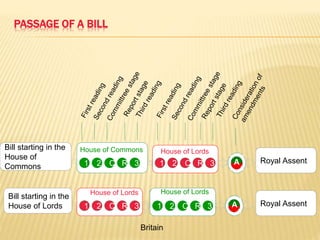
 Bills must go through both Houses before
becoming 'Acts' (laws).
HOUSE OF COMMONS
 The most powerful of the two houses.
 659 elected members.
 Members are called MPs.
 The Commons is the most important place
for discussing policies and making laws.
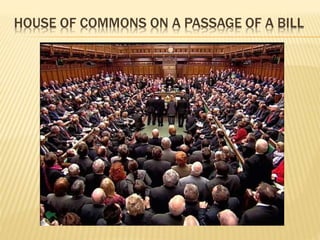
 There are only 427 green leather seats so
when it's full a lot of politicians have to stand!
HOUSE OF COMMONS ON A PASSAGE OF A BILL
PASSAGE OF A BILL
House of Commons
House of Lords
House of Lords
House of Lords
3RC21
1 2 C R 31 2 C R 3
3RC21
Royal Assent
Bill starting in the
House of Lords
Bill starting in the
House of
Commons
Royal AssentA
A
Britain

British institutions

  • 1.
    • The LegislativePower: makes the law (ie. Debates, votes and passes new laws) • The Judicial Power: interprets the law (ie. Decides what punishment should be given for those that break the law) • The Executive Power: implements and enforces the law (ie. Makes sure that the decisions of the legislature are carried out)
  • 2.
    • The LegislativePower : Parliament (House of Commons, House of Lords, the Monarch) •The Executive : the government (the party or coalition with a majority in the Commons) •The Judiciary : the judges and especially the Supreme Court
  • 3.
    Monarch (Representative Function) Supreme Court (since 2009) Houseof Lords House of Commons Government Prime Minister Nation (electorate) Partiament elects elects can dissolve appoints aristocrats can dissolve appoints appoints justices Legistative Executive Judiciary Separation of powers appoints Parliamentary monarchy in the United Kingdom
  • 4.
    WHAT THE QUEENCAN DO  Her picture appears on postage stamps, but her personal mail is franked.
  • 5.
    WHAT THE QUEENCAN DO  She can drive as fast as she likes in a car which needs no license number.
  • 6.
    WHAT THE QUEENCAN DO  She can confer Britain’s highest civilian decoration, the Order of Merit—one honour in which the Sovereign retains freedom of choice.
  • 7.
    WHAT THE QUEENCAN’T DO  Her Majesty cannot vote.  Nor can she express her political opinion in public.  She cannot sit in the House of Commons (building royal property).  She cannot write her own speech.  She cannot refuse to sign a bill, and she cannot appear as a witness in court.
  • 8.
    THE QUEEN’S ROLE Constitutional Arbitration – In times of Crisis  Stability –1,000 years of Sovereignty  Continuity –helps to bridge the discontinuities of party politics  Experience –reading state papers, meeting heads of state and ambassadors, and weekly audiences with Prime Ministers  Uniting the Nation with the State – combination of the role as Head of State and Head of the Nation.
  • 9.
    THE QUEEN’S ROLE(2)  Unity: Party politics = disagreement and confrontation. (rich vs poor, north vs south, management vs unions, Catholic vs Protestant…)  Moral Leadership & Model Behaviour  Custodianship of the Past – Through its ceremony, pageantry and ritual, the monarchy preserves the link with Britain’s history
  • 10.
  • 11.
  • 12.
    THE BRITISH CONSTITUTION A constitution is a set of laws on how a country is governed.  The British Constitution is unwritten  It is referred to as an uncodified constitution.  Amendments to constitution are made by a majority support in both Houses of Parliament to be followed by the Royal Assent.
  • 13.
    SOURCES OF THECONSTITUTION:  Statutes such as the Magna Carta of 1215 and the Act of Settlement of 1701.  Laws and Customs of Parliament;  Political conventions  Decisions in a court of law  Constitutional experts who have written on the subject such as Walter Bagehot and A.V Dicey.
  • 14.
    PRINCIPLES OF THECONSTITUTION  Two basic principles govern the Constitution:  The Rule of Law  The Supremacy of Parliament
  • 15.
    FOR OR AGAINST Pros: Flexibility and change  Cons: no public access– Only constitutional experts know where to look and how to interpret it.
  • 16.
    THE HOUSE OFLORDS  Parliament's second chamber.  Role: 'double check' new laws to make sure they are fair and will work.  675 members. Not elected.  Does not have the power to stop a new law but can delay it.  Bills must go through both Houses before becoming 'Acts' (laws).
  • 18.
    HOUSE OF COMMONS The most powerful of the two houses.  659 elected members.  Members are called MPs.  The Commons is the most important place for discussing policies and making laws.  There are only 427 green leather seats so when it's full a lot of politicians have to stand!
  • 19.
    HOUSE OF COMMONSON A PASSAGE OF A BILL
  • 20.
    PASSAGE OF ABILL House of Commons House of Lords House of Lords House of Lords 3RC21 1 2 C R 31 2 C R 3 3RC21 Royal Assent Bill starting in the House of Lords Bill starting in the House of Commons Royal AssentA A Britain