Bridges
Tech Ed I
Mr. Benich
Objectives
 Identify the loads acting on
structures
 Analyze the forces acting on a
structure
 Demonstrate how structures can be
designed to withstand loads.
 Design and make a product that
incorporates structural principles.
History of Bridges
 The function of bridges is essential to modern
America.
 Without adequate bridges in place, the pioneers
would sometimes travel many miles out of the
way to find a safe place to cross a river.
 Other times they waited for days or weeks for
the flooded rivers to recede until it was safe to
cross.
 Consider how the movement of people, goods,
and services would be affected without highway
systems, which include bridges.
Factors in Bridge Design
 A number of factors must be taken
into account when an engineer is
designing a bridge.
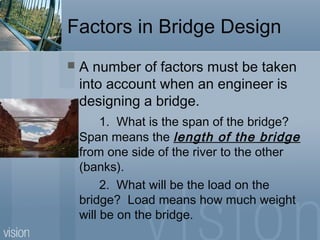
1. What is the span of the bridge?
Span means the length of the bridge
from one side of the river to the other
(banks).
2. What will be the load on the
bridge? Load means how much weight
will be on the bridge.
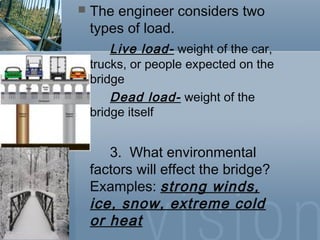
 The engineer considers two
types of load.
Live load- weight of the car,
trucks, or people expected on the
bridge
Dead load- weight of the
bridge itself
3. What environmental
factors will effect the bridge?
Examples: strong winds,
ice, snow, extreme cold
or heat
4. What is the budget allowance
for the bridge?
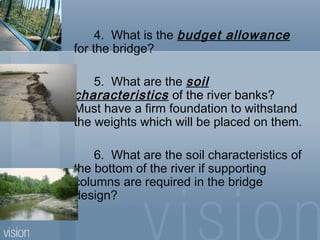
5. What are the soil
characteristics of the river banks?
Must have a firm foundation to withstand
the weights which will be placed on them.
6. What are the soil characteristics of
the bottom of the river if supporting
columns are required in the bridge
design?
7. What is the time frame in which
the bridge must be built?
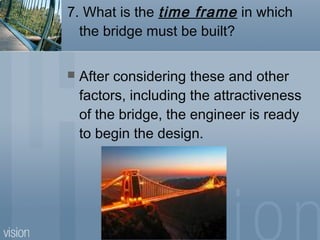
 After considering these and other
factors, including the attractiveness
of the bridge, the engineer is ready
to begin the design.
Other Types of Loads
 Static Loads – loads that are
unchanging or change slowly.
They maybe caused by the weight
of the structure itself. Columns,
beams, floors, and roofs are part of
this load.
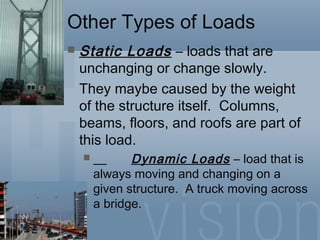
 Dynamic Loads – load that is
always moving and changing on a
given structure. A truck moving across
a bridge.
Forces Acting on
Structures
 Both static and dynamic loads create
forces.
 Understanding these forces…..
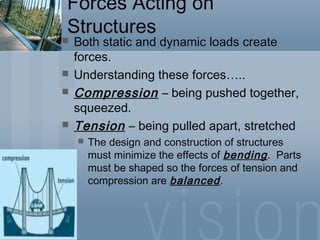
 Compression – being pushed together,
squeezed.
 Tension – being pulled apart, stretched
 The design and construction of structures
must minimize the effects of bending. Parts
must be shaped so the forces of tension and
compression are balanced.
Designing to Withstand Loads
 After members have been shaped
to resist compression and tension,
they must be connected in a way
that minimizes bending.
 Square example…
 A rigid member in tension is called a
tie.
 A rigid member in compression is
called a strut.
 A triangle is the strongest shape.
Types of Bridges
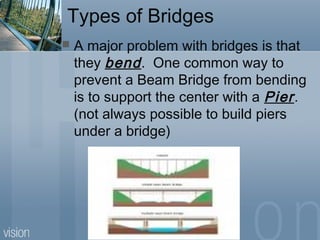
 A major problem with bridges is that
they bend. One common way to
prevent a Beam Bridge from bending
is to support the center with a Pier.
(not always possible to build piers
under a bridge)
Truss Bridges
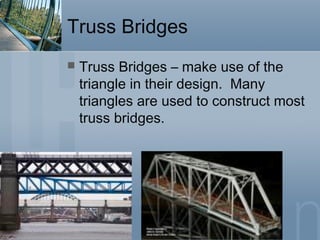
 Truss Bridges – make use of the
triangle in their design. Many
triangles are used to construct most
truss bridges.
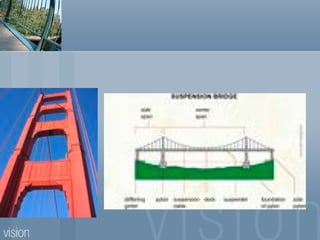
 Suspension Bridges – a bridge deck can be
supported from above by cables called stays.
Suspension bridges are the longest bridges.
The bridge deck is suspended from hangers
attached to a continuous cable.
the cable is securely anchored into the ground at
both ends.
The cables transfer the mass of the deck to the
top of the towers, where compression transfers
the mass to the ground.
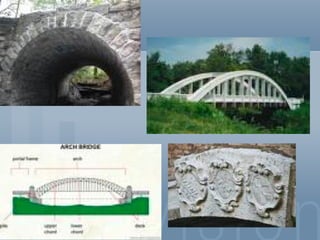
 Arch bridges – the compressive stress
created by the load is spread over the
arch as a whole.
The mass is transferred outward along two
curving paths.
The supports where the arch meets the
ground are called abutments.
In a stone arch bridge, the middle stone is
called a keystone.
Bridges new

Bridges new

  • 1.
  • 2.
    Objectives  Identify theloads acting on structures  Analyze the forces acting on a structure  Demonstrate how structures can be designed to withstand loads.  Design and make a product that incorporates structural principles.
  • 3.
    History of Bridges The function of bridges is essential to modern America.  Without adequate bridges in place, the pioneers would sometimes travel many miles out of the way to find a safe place to cross a river.  Other times they waited for days or weeks for the flooded rivers to recede until it was safe to cross.  Consider how the movement of people, goods, and services would be affected without highway systems, which include bridges.
  • 4.
    Factors in BridgeDesign  A number of factors must be taken into account when an engineer is designing a bridge. 1. What is the span of the bridge? Span means the length of the bridge from one side of the river to the other (banks). 2. What will be the load on the bridge? Load means how much weight will be on the bridge.
  • 5.
     The engineerconsiders two types of load. Live load- weight of the car, trucks, or people expected on the bridge Dead load- weight of the bridge itself 3. What environmental factors will effect the bridge? Examples: strong winds, ice, snow, extreme cold or heat
  • 6.
    4. What isthe budget allowance for the bridge? 5. What are the soil characteristics of the river banks? Must have a firm foundation to withstand the weights which will be placed on them. 6. What are the soil characteristics of the bottom of the river if supporting columns are required in the bridge design?
  • 7.
    7. What isthe time frame in which the bridge must be built?  After considering these and other factors, including the attractiveness of the bridge, the engineer is ready to begin the design.
  • 8.
    Other Types ofLoads  Static Loads – loads that are unchanging or change slowly. They maybe caused by the weight of the structure itself. Columns, beams, floors, and roofs are part of this load.  Dynamic Loads – load that is always moving and changing on a given structure. A truck moving across a bridge.
  • 9.
    Forces Acting on Structures Both static and dynamic loads create forces.  Understanding these forces…..  Compression – being pushed together, squeezed.  Tension – being pulled apart, stretched  The design and construction of structures must minimize the effects of bending. Parts must be shaped so the forces of tension and compression are balanced.
  • 10.
    Designing to WithstandLoads  After members have been shaped to resist compression and tension, they must be connected in a way that minimizes bending.  Square example…  A rigid member in tension is called a tie.  A rigid member in compression is called a strut.  A triangle is the strongest shape.
  • 11.
    Types of Bridges A major problem with bridges is that they bend. One common way to prevent a Beam Bridge from bending is to support the center with a Pier. (not always possible to build piers under a bridge)
  • 12.
    Truss Bridges  TrussBridges – make use of the triangle in their design. Many triangles are used to construct most truss bridges.
  • 13.
     Suspension Bridges– a bridge deck can be supported from above by cables called stays. Suspension bridges are the longest bridges. The bridge deck is suspended from hangers attached to a continuous cable. the cable is securely anchored into the ground at both ends. The cables transfer the mass of the deck to the top of the towers, where compression transfers the mass to the ground.
  • 15.
     Arch bridges– the compressive stress created by the load is spread over the arch as a whole. The mass is transferred outward along two curving paths. The supports where the arch meets the ground are called abutments. In a stone arch bridge, the middle stone is called a keystone.