ANALYTICAL
MINDS
- A UNIT OF BHUBAN ENTERPRISES
INTRODUCTION
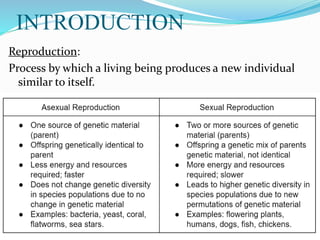
Reproduction:
Process by which a living being produces a new individual
similar to itself.
Human Reproduction
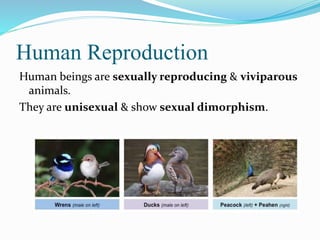
Human beings are sexually reproducing & viviparous
animals.
They are unisexual & show sexual dimorphism.
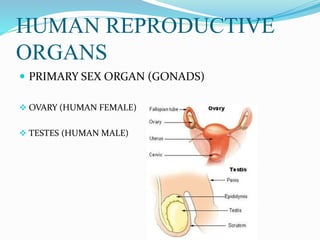
HUMAN REPRODUCTIVE
ORGANS
 PRIMARY SEX ORGAN (GONADS)
 OVARY (HUMAN FEMALE)
 TESTES (HUMAN MALE)
 SECONDARY SEX ORGAN
 VASA EFFERENTIA, EPIDIDYMIS. VASA DEFERENTIA,
EJACULATORY TRACTS, SEMINAL VESICLES,URETHRA, PROSTATE
GLANDS, COWPER’S GLAND, PENIS (HUMAN MALE)
 FALLOPIAN TUBES, UTERUS , VAGINA, MAMMARY GLANDS
(HUMAN FEMALE)
SECONDARY SEXUAL
CHARECTERS
IN HUMAN MALE:
 Growth of body hair, including underarm, abdominal, chest hair and pubic hair.
 Growth of facial hair.
 Enlargement of larynx (Adam's apple) and deepening of voice.
 Increased stature; adult males are taller than adult females, on average.
 Heavier skull and bone structure.
IN HUMAN FEMALE:
 Enlargement of breasts and erection of nipples.
 High pitched voice
 Rounded body contours
 Growth of body hair, most prominently underarm and pubic hair.
 Widening of hips; lower waist to hip ratio than adult males.
SEQUENCE OF EVENTS IN
HUMAN REPRODUCTION
 GAMETOGENESIS
 INSEMINATION
 FERTILISATION
 CLEAVAGE
 IMPLANTATION
 GESTATION
 PARTURATION
PRACTICE QUIZ
1. Which of the following is not a secondary sexual character of female?
(a) menopause
(b) Presence of pubic hair
(c) More subcutaneous fat and fat deposits
(d) Development of mammary gland
2. After fertilisation, the resulting cell which gives rise to a new individual is the
(a) embryo
(b) Ovum
(c) Foetus
(d) Zygote
3. In human beings, the correct sequence of events during reproduction is
(a) gamete formation, fertilisation, zygote, embryo
(b) embryo, zygote, fertilisation, gamete formation
(c) fertilisation, gamete formation, embryo, zygote
(d) gamete formation, fertilisation, embryo, zygote
ANALYTICAL
MINDS
- A UNIT OF BHUBAN ENTERPRISES

Human reproduction

  • 1.
    ANALYTICAL MINDS - A UNITOF BHUBAN ENTERPRISES
  • 2.
    INTRODUCTION Reproduction: Process by whicha living being produces a new individual similar to itself.
  • 3.
    Human Reproduction Human beingsare sexually reproducing & viviparous animals. They are unisexual & show sexual dimorphism.
  • 4.
    HUMAN REPRODUCTIVE ORGANS  PRIMARYSEX ORGAN (GONADS)  OVARY (HUMAN FEMALE)  TESTES (HUMAN MALE)
  • 5.
     SECONDARY SEXORGAN  VASA EFFERENTIA, EPIDIDYMIS. VASA DEFERENTIA, EJACULATORY TRACTS, SEMINAL VESICLES,URETHRA, PROSTATE GLANDS, COWPER’S GLAND, PENIS (HUMAN MALE)  FALLOPIAN TUBES, UTERUS , VAGINA, MAMMARY GLANDS (HUMAN FEMALE)
  • 6.
    SECONDARY SEXUAL CHARECTERS IN HUMANMALE:  Growth of body hair, including underarm, abdominal, chest hair and pubic hair.  Growth of facial hair.  Enlargement of larynx (Adam's apple) and deepening of voice.  Increased stature; adult males are taller than adult females, on average.  Heavier skull and bone structure. IN HUMAN FEMALE:  Enlargement of breasts and erection of nipples.  High pitched voice  Rounded body contours  Growth of body hair, most prominently underarm and pubic hair.  Widening of hips; lower waist to hip ratio than adult males.
  • 7.
    SEQUENCE OF EVENTSIN HUMAN REPRODUCTION  GAMETOGENESIS  INSEMINATION  FERTILISATION  CLEAVAGE  IMPLANTATION  GESTATION  PARTURATION
  • 8.
    PRACTICE QUIZ 1. Whichof the following is not a secondary sexual character of female? (a) menopause (b) Presence of pubic hair (c) More subcutaneous fat and fat deposits (d) Development of mammary gland 2. After fertilisation, the resulting cell which gives rise to a new individual is the (a) embryo (b) Ovum (c) Foetus (d) Zygote 3. In human beings, the correct sequence of events during reproduction is (a) gamete formation, fertilisation, zygote, embryo (b) embryo, zygote, fertilisation, gamete formation (c) fertilisation, gamete formation, embryo, zygote (d) gamete formation, fertilisation, embryo, zygote
  • 9.
    ANALYTICAL MINDS - A UNITOF BHUBAN ENTERPRISES