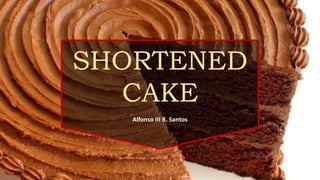
SHORTENED
CAKE
Alfonso III B. Santos
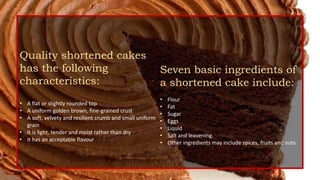
Quality shortened cakes
has the following
characteristics:
• A flat or slightly rounded top
• A uniform golden brown, fine-grained crust
• A soft, velvety and resilient crumb and small uniform
grain
• It is light, tender and moist rather than dry
• It has an acceptable flavour
Seven basic ingredients of
a shortened cake include:
• Flour
• Fat
• Sugar
• Eggs
• Liquid
• Salt and leavening.
• Other ingredients may include spices, fruits and nuts
Shortened Cakes Ingredients
and Their Functions
Flour: soft or weak flour is recommended for cake
making. This type of flour results in a fined grained, soft,
velvety crumb and tender product. Satisfactory results
can be obtained with plain flour. Self-raising flour may be
used. Whole wheat or brown flour results in a darker
colour, a heavier product and coarser texture due to the
bran and germ. Strong or bread flour is not
recommended as it produces a more open grain
characteristic of bread.
Fat is needed to shorten or tenderise the product. It is a
means of introducing air into creamed cakes and
contributes to the colour and flavour as well as to the
keeping qualities.
Caster sugar is recommended for cake making. In
addition to giving a sweet taste, it helps to incorporate
air in creamed cake mixtures. It delays the coagulation of
egg protein and the pasting of starch in the flour and this
helps to give a good volume. Sugar also plays a role in
keeping cakes moist.
Eggs introduce air into cakes and play a structural role
in the cooked product due to the coagulation of egg
proteins during cooking. The fact that eggs are liquid is
useful for purposes of mixing. Emulsifiers in eggs are
useful in the formation of cake batters owing to their
emulsifying properties.
Liquid dissolves the sugar and salt and makes possible
the action of chemical leavenings. It disperses the
ingredients and hydrates the flour. Steam made from
liquid through baking acts as a leavening.
Leavening agent: as in scone making, chemical
leavening agents are used.
Salt is used for flavouring.
Recipe Balance in
Shortened Cakes
Fat: The higher the proportion of fat, the more tender
and fragile the cake crumb will be and the richer the
cake.
Sugar: The use of more sugar than is recommended
produces a coarse-grained product and a biscuit like
crust. Cakes made by the melting method have a high
proportion of sugar, and this accounts to some extent for
the coarser grain and the ease with which this mixture
burns.
Eggs: The richer the cake, the higher the proportion
of eggs in the formula. Too many eggs results in a
rubbery texture and excessive liquid in the mixture.
Leavening: Too little results in a poor volume and
close texture. Too much can give the cake a coarse open
texture; the surface may be cracked and the cake may
collapse so that the surface is hollowed.
Liquid: too much causes the cake to be doughy and
heavy and the top may be cracked. If not enough is used
the cake may be cracked on the surface, the crumb dry
and tunnels are likely to develop.
Saltin excessive amounts can give the cake an
unpleasant taste.
Different Types of Shortened Cake Mixtures in
Food Preparation
Rubbing in: small: raspberry buns, rock cakes, American doughnuts; large: farmhouse fruit cake; chocolate cake
and dorset apple cake.
Creaming small: queen cakes, fairy cakes, madelines, large: cherry, madeira, Dundee, Victoria sandwich,
battenburg
Melting: gingerbread and parkin
All in one: Victoria sandwich, madeira cake.
Red Velvet Cake
Ingredients
1 cup vegetable shortening
2 eggs
1 1/2 cups sugar
1 teaspoon cocoa powder
2 ounces red food coloring
2 1/2 cups cake flour
1 teaspoon salt
1 cup buttermilk
1 teaspoon vanilla extract
1 teaspoon baking soda
1 teaspoon vinegar
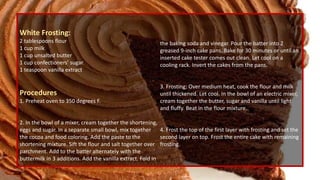
White Frosting:
2 tablespoons flour
1 cup milk
1 cup unsalted butter
1 cup confectioners' sugar
1 teaspoon vanilla extract
Procedures
1. Preheat oven to 350 degrees F.
2. In the bowl of a mixer, cream together the shortening,
eggs and sugar. In a separate small bowl, mix together
the cocoa and food coloring. Add the paste to the
shortening mixture. Sift the flour and salt together over
parchment. Add to the batter alternately with the
buttermilk in 3 additions. Add the vanilla extract. Fold in
the baking soda and vinegar. Pour the batter into 2
greased 9-inch cake pans. Bake for 30 minutes or until an
inserted cake tester comes out clean. Let cool on a
cooling rack. Invert the cakes from the pans.
3. Frosting: Over medium heat, cook the flour and milk
until thickened. Let cool. In the bowl of an electric mixer,
cream together the butter, sugar and vanilla until light
and fluffy. Beat in the flour mixture.
4. Frost the top of the first layer with frosting and set the
second layer on top. Frost the entire cake with remaining
frosting.
REFERENCES:
https://www.google.com/url?sa=t&source=web&rct=j&url=https://www.wonderlandcakesbw.com/what-are-
shortened-
cakes/&ved=2ahUKEwiQpJSY34_yAhVIUd4KHXsXAW8QFjAUegQIOxAC&usg=AOvVaw13NYXNYgHO8tO02QApvY7S
&cshid=1627818362695
https://www.google.com/amp/s/www.foodnetwork.com/recipes/fabulous-red-velvet-cake-recipe-1909307.amp

Shortened cake

  • 1.
  • 2.
    Quality shortened cakes hasthe following characteristics: • A flat or slightly rounded top • A uniform golden brown, fine-grained crust • A soft, velvety and resilient crumb and small uniform grain • It is light, tender and moist rather than dry • It has an acceptable flavour Seven basic ingredients of a shortened cake include: • Flour • Fat • Sugar • Eggs • Liquid • Salt and leavening. • Other ingredients may include spices, fruits and nuts
  • 3.
    Shortened Cakes Ingredients andTheir Functions Flour: soft or weak flour is recommended for cake making. This type of flour results in a fined grained, soft, velvety crumb and tender product. Satisfactory results can be obtained with plain flour. Self-raising flour may be used. Whole wheat or brown flour results in a darker colour, a heavier product and coarser texture due to the bran and germ. Strong or bread flour is not recommended as it produces a more open grain characteristic of bread. Fat is needed to shorten or tenderise the product. It is a means of introducing air into creamed cakes and contributes to the colour and flavour as well as to the keeping qualities. Caster sugar is recommended for cake making. In addition to giving a sweet taste, it helps to incorporate air in creamed cake mixtures. It delays the coagulation of egg protein and the pasting of starch in the flour and this helps to give a good volume. Sugar also plays a role in keeping cakes moist. Eggs introduce air into cakes and play a structural role in the cooked product due to the coagulation of egg proteins during cooking. The fact that eggs are liquid is useful for purposes of mixing. Emulsifiers in eggs are useful in the formation of cake batters owing to their emulsifying properties. Liquid dissolves the sugar and salt and makes possible the action of chemical leavenings. It disperses the ingredients and hydrates the flour. Steam made from liquid through baking acts as a leavening. Leavening agent: as in scone making, chemical leavening agents are used. Salt is used for flavouring.
  • 4.
    Recipe Balance in ShortenedCakes Fat: The higher the proportion of fat, the more tender and fragile the cake crumb will be and the richer the cake. Sugar: The use of more sugar than is recommended produces a coarse-grained product and a biscuit like crust. Cakes made by the melting method have a high proportion of sugar, and this accounts to some extent for the coarser grain and the ease with which this mixture burns. Eggs: The richer the cake, the higher the proportion of eggs in the formula. Too many eggs results in a rubbery texture and excessive liquid in the mixture. Leavening: Too little results in a poor volume and close texture. Too much can give the cake a coarse open texture; the surface may be cracked and the cake may collapse so that the surface is hollowed. Liquid: too much causes the cake to be doughy and heavy and the top may be cracked. If not enough is used the cake may be cracked on the surface, the crumb dry and tunnels are likely to develop. Saltin excessive amounts can give the cake an unpleasant taste.
  • 5.
    Different Types ofShortened Cake Mixtures in Food Preparation Rubbing in: small: raspberry buns, rock cakes, American doughnuts; large: farmhouse fruit cake; chocolate cake and dorset apple cake. Creaming small: queen cakes, fairy cakes, madelines, large: cherry, madeira, Dundee, Victoria sandwich, battenburg Melting: gingerbread and parkin All in one: Victoria sandwich, madeira cake.
  • 6.
    Red Velvet Cake Ingredients 1cup vegetable shortening 2 eggs 1 1/2 cups sugar 1 teaspoon cocoa powder 2 ounces red food coloring 2 1/2 cups cake flour 1 teaspoon salt 1 cup buttermilk 1 teaspoon vanilla extract 1 teaspoon baking soda 1 teaspoon vinegar
  • 7.
    White Frosting: 2 tablespoonsflour 1 cup milk 1 cup unsalted butter 1 cup confectioners' sugar 1 teaspoon vanilla extract Procedures 1. Preheat oven to 350 degrees F. 2. In the bowl of a mixer, cream together the shortening, eggs and sugar. In a separate small bowl, mix together the cocoa and food coloring. Add the paste to the shortening mixture. Sift the flour and salt together over parchment. Add to the batter alternately with the buttermilk in 3 additions. Add the vanilla extract. Fold in the baking soda and vinegar. Pour the batter into 2 greased 9-inch cake pans. Bake for 30 minutes or until an inserted cake tester comes out clean. Let cool on a cooling rack. Invert the cakes from the pans. 3. Frosting: Over medium heat, cook the flour and milk until thickened. Let cool. In the bowl of an electric mixer, cream together the butter, sugar and vanilla until light and fluffy. Beat in the flour mixture. 4. Frost the top of the first layer with frosting and set the second layer on top. Frost the entire cake with remaining frosting.
  • 8.